“PRODUCTIVE GROUP
WORK”
CLASSROOM MANAGEMENT
BY DR. HAYAL KÖKSAL
*http://tr.wikipedia.org/wiki/Dosya:Bo%C4%9Fazi%C3%A7i_%C3%9Cniversitesi_Logosu.jpg
* http://kwasugsa.blogspot.com.tr/
*http://moodle.sou.edu/mod/book/view.php?id=143884&chapterid=13555
ED401.02
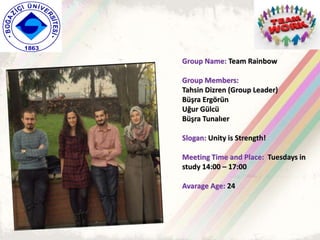
Group Name: Team Rainbow
Group Members:
Tahsin Dizren (Group Leader)
Büşra Ergörün
Uğur Gülcü
Büşra Tunalıer
Slogan: Unity is Strength!
Meeting Time and Place: Tuesdays in
study 14:00 – 17:00
Avarage Age: 24
Content
• INTRODUCTION
• GANNT CARD
• LITERATURE REVIEW
• MATRIX DIAGRAM
• PROBLEM DEFINITION
• BRAINSTORMING
• FISHBONE DIAGRAM
• SURVEY RESULTS
• SUGGESTIONS & SOLUTIONS
• LIMITATIONS
• REFERENCES
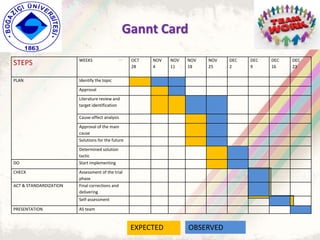
Gannt Card
STEPS WEEKS OCT
28
NOV
4
NOV
11
NOV
18
NOV
25
DEC
2
DEC
9
DEC
16
DEC
23
PLAN Identify the topic
Approval
Literature review and
target identification
Cause-effect analysis
Approval of the main
cause
Solutions for the future
Determined solution
tactic
DO Start implementing
CHECK Assessment of the trial
phase
ACT & STANDARDIZATION Final corrections and
delivering
Self-assessment
PRESENTATION AS team
EXPECTED OBSERVED
Literature Review
Williamson, R. (2010). Research Brief Productive
Group Work for Students
W. Johnson and Roger T. Johnson, Social Skills
for Successful Group Work.1989
Anna F. Dejarnette, Jennifer N. Dao, and
González, G. (2014). Promoting Small Group
Disscussions
 Williamson, R. (2010). Research Brief Productive
Group Work for Students
• “There is clear evidence that students who are involved
in productive collaborative groups outperform their
peers. Cooperative group work also results in improved
self-esteem, improved relationships and enhanced
social and decision-making skills.”
• “Several studies report that while almost all teachers
use some sort of group work in their classrooms, most
struggle to make the work productive and to promote
positive interaction within the groups.”
Literature Review
• Scardamalie (2002) identified the conditions that must
be established so that the shared responsibility of
students can occur.
• The work must be connected to real-world problems.
• The work must involve ideas that are improvable.
• The scope of work should not be overly prescriptive so
that groups find they own way.
• Group members hold shared responsibility for outcomes.
• The work has an embedded assessment that allows each
member, individually and collectively, to evaluate his or
her own success. (Scardamalie, 2002, pp. 75-76).”
Literature Review
Literature Review
 W. Johnson and Roger T. Johnson, Scoial
Skills for Successful Group Work.1989
• Interpersonal and small group skills are vital
to the success of cooperative learning.
• Improving the quality of relationships among
classmates, some conditions are needed:
positive interdependence, face to face
(promotive) interaction, individual
accountability, social skills, and group
processing. (Johnson and Johnson 1987,
Johnson et al. 1988)
• People do not know instinctively how to
interact with others or they do not have
interpersonal and group skills.
• Toachievemutualgoals,studentsmust:*gettoknowandtrust
oneanother,*communicateaccuratelyandunambiguously,
*acceptandsupportoneanother,*resolveconflicts
constructively.(Johnson1986,JohnsonandJohnson1987)
• Somestepsforteachertofollowinordertoteachstudents
interpersonalandsmall-groupskills:
 Explainingstudentsimportanceofskills.
 Informingstudentswhataretheskillsandwhen theyareused.(T-
Chartcanbeusedforthis)
 Providingstudentswithpracticingtheskills.Forexample,teachercan
assigntherolesofreader,encourager,summarizeretctothemembers
ofthegroup.Androlescouldberotatedinaperiodoftime.
 Providingaregulartimeforgroupprocessingtoseehowfrequently
andhowwelltheyareusingskills.
 Givingfeedbacktostudentsabouttheirusingofskills
Literature Review
• Having interpersonal skills has long-term
effects such as academic achievement, one’s
employability, productivity, and career
success.
• According to findings of survey of Center for
Public Resources, 90 percent of the
respondents who has been fired from their
jobs were fired because of the poor job
attitudes, poor interpersonal relationships,
and inappropriate behaviors.
Literature Review
 Anna F. Dejarnette, Jennifer N. Dao, and González,
G. (2014). Promoting Small Group Disscussions
• “Group working allows students to communicate
their mathematical thinking as well as listen carefully
and respond to the ideas of their peers.” (CCSSI
2010; NCTM 2000).
• Teachers think that it is hard to implement
productive interactions in several groups of students
simultaneously.
Literature Review
• Strategies for maintaining productive mathematical
discussions within their groups:
1. asking questions about the problem;
2. sharing the mathematical authority within the group;
3. challenging one another’s mathematical ideas.
* By using these strategies, students have more resources
for working effectively in groups.
• “When students work together in groups, asking questions is
the responsibility of the students. It can be challenging for
students to establish this practice.”
Literature Review
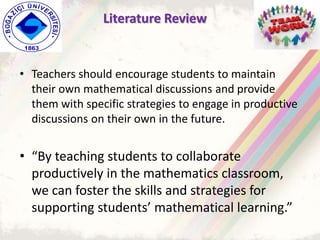
• Teachers should encourage students to maintain
their own mathematical discussions and provide
them with specific strategies to engage in productive
discussions on their own in the future.
• “By teaching students to collaborate
productively in the mathematics classroom,
we can foster the skills and strategies for
supporting students’ mathematical learning.”
Literature Review
Problem Definition
*http://www.umich.edu/~scps/html/01chap/html/summary.htm
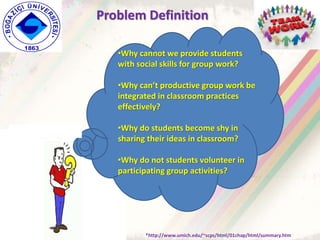
•Why cannot we provide students
with social skills for group work?
•Why can’t productive group work be
integrated in classroom practices
effectively?
•Why do students become shy in
sharing their ideas in classroom?
•Why do not students volunteer in
participating group activities?
Matrix Diagram
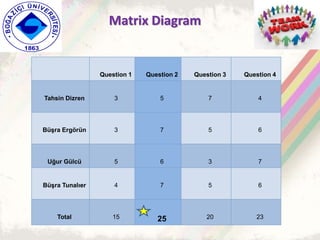
Question 1 Question 2 Question 3 Question 4
Tahsin Dizren 3 5 7 4
Büşra Ergörün 3 7 5 6
Uğur Gülcü 5 6 3 7
Büşra Tunalıer 4 7 5 6
Total 15 25 20 23
Problem Definiton
Why can’t productive group
work be integrated in classroom
practices effectively?
*http://thumbs.dreamstime.com/z/problem-21177102.jpg
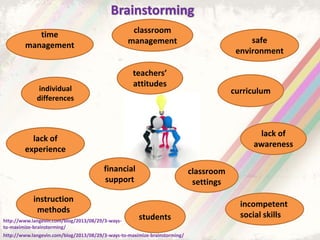
Brainstorming
http://www.langevin.com/blog/2013/08/29/3-ways-to-maximize-brainstorming/
individual
differences
teachers’
attitudes
safe
environment
lack of
awareness
instruction
methods
financial
support
classroom
settings
incompetent
social skills
curriculum
students
time
management
classroom
management
lack of
experience
http://www.langevin.com/blog/2013/08/29/3-ways-
to-maximize-brainstorming/
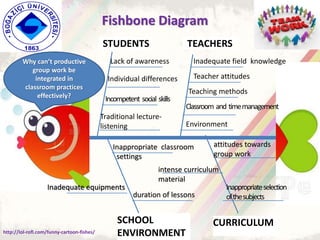
Fishbone Diagram
http://lol-rofl.com/funny-cartoon-fishes/
Why can’t productive
group work be
integrated in
classroom practices
effectively?
Lack of awareness
Individual differences
Incompetent social skills
Traditional lecture-
listening
STUDENTS TEACHERS
Environment
Inadequate field knowledge
Teacher attitudes
Teaching methods
Inappropriate classroom
settings
Inadequate equipments
duration of lessons
intense curriculum
material
attitudes towards
group work
Inappropriateselection
ofthesubjects
SCHOOL
ENVIRONMENT
CURRICULUM
Classroom and timemanagement
Data Collection
We conducted a survey with 75 students in
• TED İstanbul College
• ASFA Schools
• Vefa High School
• Beşiktaş Anatolian School
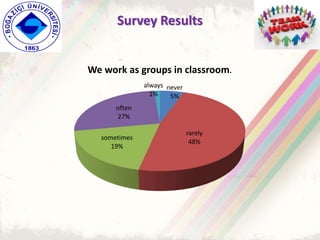
Survey Results
never
5%
rarely
48%
sometimes
19%
often
27%
always
1%
We work as groups in classroom.
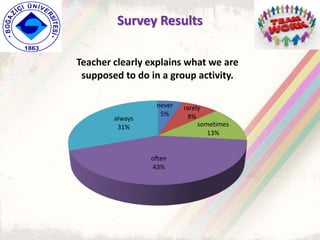
never
5%
rarely
8%
sometimes
13%
often
43%
always
31%
Teacher clearly explains what we are
supposed to do in a group activity.
Survey Results
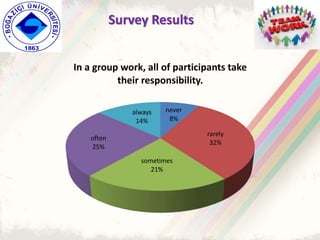
never
8%
rarely
32%
sometimes
21%
often
25%
always
14%
In a group work, all of participants take
their responsibility.
Survey Results
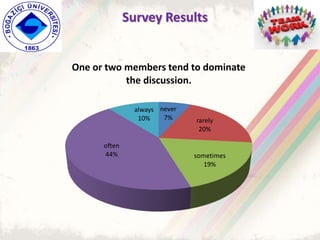
never
7% rarely
20%
sometimes
19%
often
44%
always
10%
One or two members tend to dominate
the discussion.
Survey Results
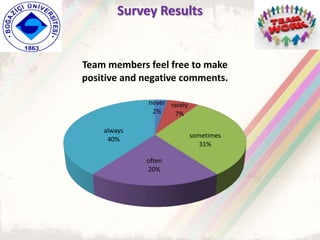
never
2%
rarely
7%
sometimes
31%
often
20%
always
40%
Team members feel free to make
positive and negative comments.
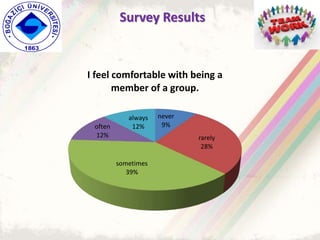
Survey Results
never
9%
rarely
28%
sometimes
39%
often
12%
always
12%
I feel comfortable with being a
member of a group.
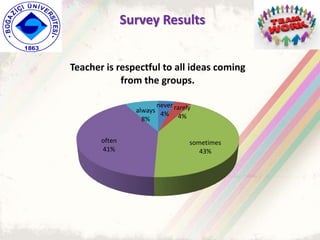
Survey Results
never
4%
rarely
4%
sometimes
43%
often
41%
always
8%
Teacher is respectful to all ideas coming
from the groups.
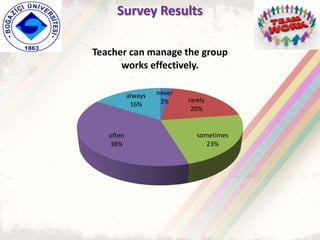
Survey Results
never
3% rarely
20%
sometimes
23%
often
38%
always
16%
Teacher can manage the group
works effectively.
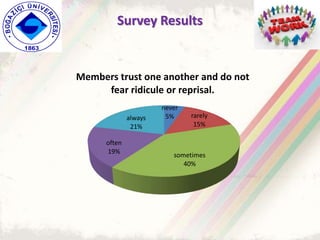
Survey Results
never
5% rarely
15%
sometimes
40%
often
19%
always
21%
Members trust one another and do not
fear ridicule or reprisal.
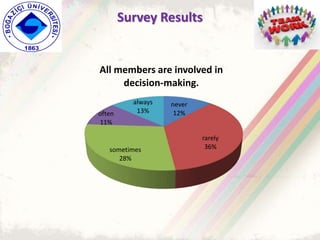
Survey Results
never
12%
rarely
36%sometimes
28%
often
11%
always
13%
All members are involved in
decision-making.
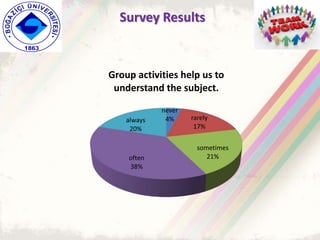
Survey Results
never
4% rarely
17%
sometimes
21%often
38%
always
20%
Group activities help us to
understand the subject.
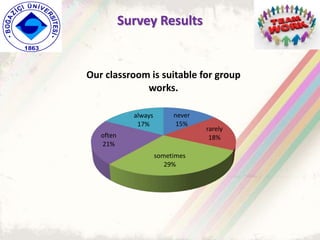
Survey Results
never
15%
rarely
18%
sometimes
29%
often
21%
always
17%
Our classroom is suitable for group
works.
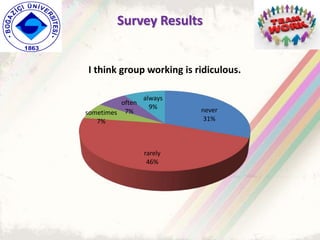
Survey Results
never
31%
rarely
46%
sometimes
7%
often
7%
always
9%
I think group working is ridiculous.
Survey Results
never
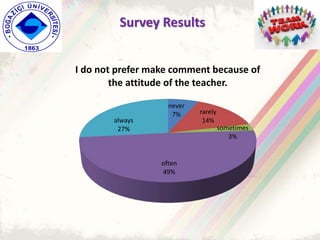
7% rarely
14%
sometimes
3%
often
49%
always
27%
I do not prefer make comment because of
the attitude of the teacher.
Survey Results
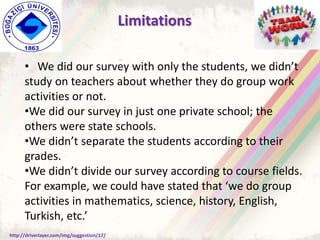
Limitations
http://driverlayer.com/img/suggestion/17/
• We did our survey with only the students, we didn’t
study on teachers about whether they do group work
activities or not.
•We did our survey in just one private school; the
others were state schools.

•We didn’t separate the students according to their
grades.
•We didn’t divide our survey according to course fields.
For example, we could have stated that ‘we do group
activities in mathematics, science, history, English,
Turkish, etc.’
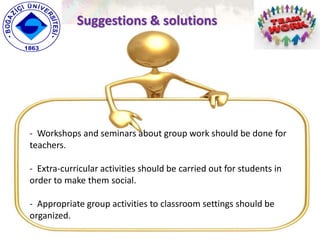
Suggestions & solutions
- Workshops and seminars about group work should be done for
teachers.
- Extra-curricular activities should be carried out for students in
order to make them social.
- Appropriate group activities to classroom settings should be
organized.
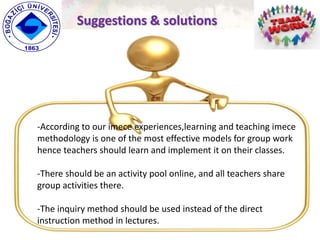
Suggestions & solutions
-According to our imece experiences,learning and teaching imece
methodology is one of the most effective models for group work
hence teachers should learn and implement it on their classes.
-There should be an activity pool online, and all teachers share
group activities there.
-The inquiry method should be used instead of the direct
instruction method in lectures.
References
• Anna F. Dejarnette, Jennifer N. Dao, and González, G.
(2014). Promoting Small Group Disscussions
• Imece Circles training by Dr. Hayal Köksal
• Williamson, R. (2010). Research Brief Productive
Group Work for Students. Retrieved from
http://www.educationpartnerships.org/
• W. Johnson and Roger T. Johnson, Social Skills for
Successful Group Work.1989
http://www.gabi-software.com/industries/food-agriculture/reference-projects/
Special Thanks To HAYAL
KÖKSAL
https://www.facebook.com/photo.php?fbid=10151775980843108&set=pb.703658107.-
2207520000.1389020869.&type=3&theater

Ed401 project ppt