www.huawei.com
Copyright © 2018 Huawei Technologies Co., Ltd. All rights reserved.
Common Network Devices
Page 2
Copyright © 2018 Huawei Technologies Co., Ltd. All rights reserved.
Foreword
 Network devices are the basic components of a network. When planning
and constructing a network, you need to deploy and configure the network
devices to meet network connection or network security requirements.
Page 3
Copyright © 2018 Huawei Technologies Co., Ltd. All rights reserved.
Objectives
 Upon completion of this course, you will be able to:
 Describe Huawei common network devices.
 Describe the functions of network devices.
 Log in to network devices and perform basic configurations.
Page 4
Copyright © 2018 Huawei Technologies Co., Ltd. All rights reserved.
Contents
1. Basic Network Devices
2. Initial Device Login
Page 5
Copyright © 2018 Huawei Technologies Co., Ltd. All rights reserved.
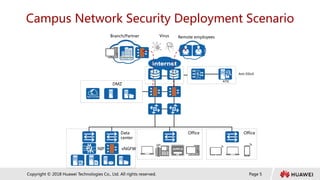
Campus Network Security Deployment Scenario
Remote employees
Branch/Partner Virus
DMZ
Office Office
Data
center
NIP vNGFW
Anti-DDoS
ATIC
Page 6
Copyright © 2018 Huawei Technologies Co., Ltd. All rights reserved.
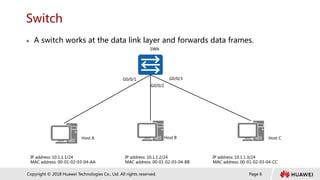
Switch
 A switch works at the data link layer and forwards data frames.
SWA
Host A Host C
Host B
IP address: 10.1.1.1/24
MAC address: 00-01-02-03-04-AA
IP address: 10.1.1.2/24
MAC address: 00-01-02-03-04-BB
IP address: 10.1.1.3/24
MAC address: 00-01-02-03-04-CC
G0/0/1
G0/0/2
G0/0/3
Page 7
Copyright © 2018 Huawei Technologies Co., Ltd. All rights reserved.
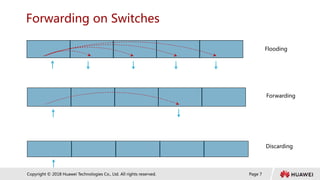
Forwarding on Switches
Flooding
Forwarding
Discarding
Page 9
Copyright © 2018 Huawei Technologies Co., Ltd. All rights reserved.
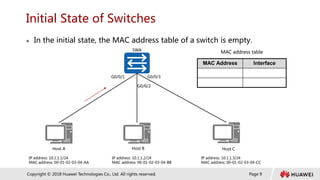
Initial State of Switches
 In the initial state, the MAC address table of a switch is empty.
MAC address table
MAC Address Interface
SWA
Host A Host C
Host B
IP address: 10.1.1.1/24
MAC address: 00-01-02-03-04-AA
IP address: 10.1.1.2/24
MAC address: 00-01-02-03-04-BB
IP address: 10.1.1.3/24
MAC address: 00-01-02-03-04-CC
G0/0/1
G0/0/2
G0/0/3
Page 10
Copyright © 2018 Huawei Technologies Co., Ltd. All rights reserved.
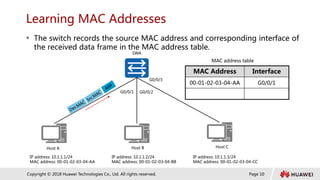
Learning MAC Addresses
 The switch records the source MAC address and corresponding interface of
the received data frame in the MAC address table.
MAC Address Interface
00-01-02-03-04-AA G0/0/1
MAC address table
SWA
Host A Host C
Host B
IP address: 10.1.1.1/24
MAC address: 00-01-02-03-04-AA
IP address: 10.1.1.2/24
MAC address: 00-01-02-03-04-BB
IP address: 10.1.1.3/24
MAC address: 00-01-02-03-04-CC
G0/0/1 G0/0/2
G0/0/3
Page 11
Copyright © 2018 Huawei Technologies Co., Ltd. All rights reserved.
MAC Address Interface
00-01-02-03-04-AA G0/0/1
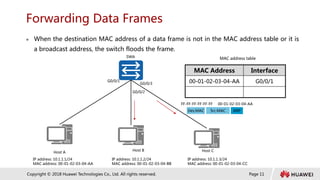
Forwarding Data Frames
 When the destination MAC address of a data frame is not in the MAC address table or it is
a broadcast address, the switch floods the frame.
MAC address table
SWA
Host A Host C
Host B
IP address: 10.1.1.1/24
MAC address: 00-01-02-03-04-AA
IP address: 10.1.1.2/24
MAC address: 00-01-02-03-04-BB
IP address: 10.1.1.3/24
MAC address: 00-01-02-03-04-CC
G0/0/1
G0/0/2
G0/0/3
Des.MAC
00-01-02-03-04-AA
FF-FF-FF-FF-FF-FF
Src.MAC
Page 12
Copyright © 2018 Huawei Technologies Co., Ltd. All rights reserved.
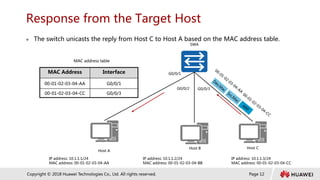
Response from the Target Host
 The switch unicasts the reply from Host C to Host A based on the MAC address table.
MAC Address Interface
00-01-02-03-04-AA G0/0/1
00-01-02-03-04-CC G0/0/3
MAC address table
SWA
Host A
Host C
Host B
IP address: 10.1.1.1/24
MAC address: 00-01-02-03-04-AA
IP address: 10.1.1.2/24
MAC address: 00-01-02-03-04-BB
IP address: 10.1.1.3/24
MAC address: 00-01-02-03-04-CC
G0/0/1
G0/0/2 G0/0/3
Page 13
Copyright © 2018 Huawei Technologies Co., Ltd. All rights reserved.
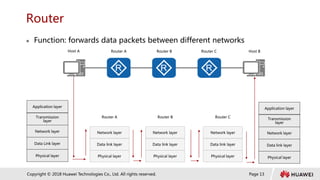
Router
 Function: forwards data packets between different networks
Network layer
Data link layer
Physical layer
Network layer
Data link layer
Physical layer
Network layer
Data link layer
Physical layer
Router A Router B Router C
Application layer
Transmission
layer
Network layer
Data link layer
Physical layer
Host A Host B
Application layer
Transmission
layer
Network layer
Data Link layer
Physical layer
Router C
Router B
Router A
Page 14
Copyright © 2018 Huawei Technologies Co., Ltd. All rights reserved.
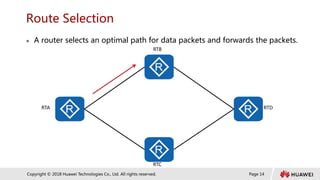
Route Selection
 A router selects an optimal path for data packets and forwards the packets.
RTA
RTB
RTC
RTD
Page 15
Copyright © 2018 Huawei Technologies Co., Ltd. All rights reserved.
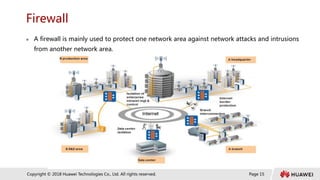
Firewall
 A firewall is mainly used to protect one network area against network attacks and intrusions
from another network area.
Page 16
Copyright © 2018 Huawei Technologies Co., Ltd. All rights reserved.
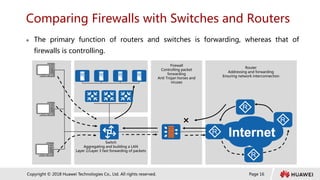
Comparing Firewalls with Switches and Routers
 The primary function of routers and switches is forwarding, whereas that of
firewalls is controlling.
Switch
Aggregating and building a LAN
Layer 2/Layer 3 fast forwarding of packets
Firewall
Controlling packet
forwarding
Anti Trojan horses and
viruses
Router
Addressing and forwarding
Ensuring network interconnection
×
Page 17
Copyright © 2018 Huawei Technologies Co., Ltd. All rights reserved.
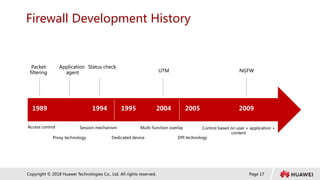
Firewall Development History
1989 1994 1995 2004 2005 2009
Access control
Packet
filtering
Application
agent
Status check
UTM NGFW
Dedicated device
Session mechanism Multi-function overlay
DPI technology
Proxy technology
Control based on user + application +
content
Page 19
Copyright © 2018 Huawei Technologies Co., Ltd. All rights reserved.
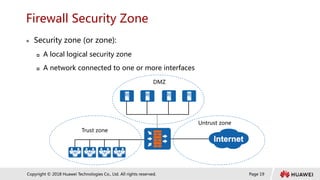
Firewall Security Zone
 Security zone (or zone):
 A local logical security zone
 A network connected to one or more interfaces
DMZ
Trust zone
Untrust zone
Page 20
Copyright © 2018 Huawei Technologies Co., Ltd. All rights reserved.
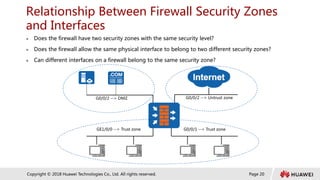
Relationship Between Firewall Security Zones
and Interfaces
 Does the firewall have two security zones with the same security level?
 Does the firewall allow the same physical interface to belong to two different security zones?
 Can different interfaces on a firewall belong to the same security zone?
G0/0/2 --> DMZ G0/0/2 --> Untrust zone
GE1/0/0 --> Trust zone G0/0/1 --> Trust zone
Page 21
Copyright © 2018 Huawei Technologies Co., Ltd. All rights reserved.
Contents
1. Basic Network Devices
2. Device Initial Login
 Basic Service Configurations
 Basic System Settings
Page 22
Copyright © 2018 Huawei Technologies Co., Ltd. All rights reserved.
VRP Overview
 Versatile Routing Platform (VRP)
 Network operating system
 Software platform that supports multiple types of devices
 Provides TCP/IP routing services
Page 23
Copyright © 2018 Huawei Technologies Co., Ltd. All rights reserved.
Introduction to Command Line
 The CLI is divided into command views. All commands must be executed in
command views. You can run a command only after you enter its
command view.
<NGFW> User view
<NGFW>system-view
[NGFW] System view
[NGFW]interface GigabitEthernet 0/0/1
[NGFW–GigabitEthernet0/0/1]quit Interface view
[NGFW]ospf 1
[NGFW-ospf-1] Protocol view
Page 24
Copyright © 2018 Huawei Technologies Co., Ltd. All rights reserved.
Command Line Help: Full Help
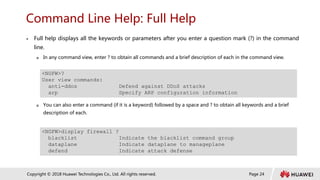
 Full help displays all the keywords or parameters after you enter a question mark (?) in the command
line.
 In any command view, enter ? to obtain all commands and a brief description of each in the command view.
 You can also enter a command (if it is a keyword) followed by a space and ? to obtain all keywords and a brief
description of each.
<NGFW>?
User view commands:
anti-ddos Defend against DDoS attacks
arp Specify ARP configuration information
<NGFW>display firewall ?
blacklist Indicate the blacklist command group
dataplane Indicate dataplane to manageplane
defend Indicate attack defense
Page 25
Copyright © 2018 Huawei Technologies Co., Ltd. All rights reserved.
Command Line Help: Partial Help
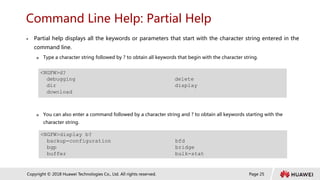
 Partial help displays all the keywords or parameters that start with the character string entered in the
command line.
 Type a character string followed by ? to obtain all keywords that begin with the character string.
 You can also enter a command followed by a character string and ? to obtain all keywords starting with the
character string.
<NGFW>d?
debugging delete
dir display
download
<NGFW>display b?
backup-configuration bfd
bgp bridge
buffer bulk-stat
Page 26
Copyright © 2018 Huawei Technologies Co., Ltd. All rights reserved.
Command Line Help: Tab Key
 If there is only one match for an incomplete keyword:
 If there are multiple matches for a keyword:
[NGFW]info-
[NGFW]info-center
[NGFW]info-center l
[NGFW]info-center lo
[NGFW]info-center loghost
[NGFW]info-center local
[NGFW]info-center logbuffer
[NGFW]info-center logfile
Page 27
Copyright © 2018 Huawei Technologies Co., Ltd. All rights reserved.
Configuring Interfaces
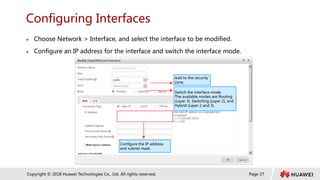
 Choose Network > Interface, and select the interface to be modified.
 Configure an IP address for the interface and switch the interface mode.
Switch the interface mode.
The available modes are Routing
(Layer 3), Switching (Layer 2), and
Hybrid (Layer 2 and 3).
Configure the IP address
and subnet mask.
Add to the security
zone.
Page 28
Copyright © 2018 Huawei Technologies Co., Ltd. All rights reserved.
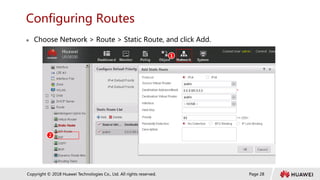
Configuring Routes
 Choose Network > Route > Static Route, and click Add.
1
2
Page 29
Copyright © 2018 Huawei Technologies Co., Ltd. All rights reserved.
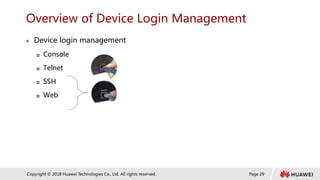
Overview of Device Login Management
 Device login management
 Console
 Telnet
 SSH
 Web
Page 30
Copyright © 2018 Huawei Technologies Co., Ltd. All rights reserved.
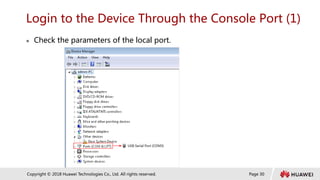
Login to the Device Through the Console Port (1)
 Check the parameters of the local port.
Page 31
Copyright © 2018 Huawei Technologies Co., Ltd. All rights reserved.
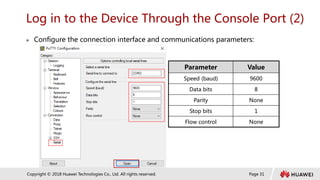
Log in to the Device Through the Console Port (2)
 Configure the connection interface and communications parameters:
Parameter Value
Speed (baud) 9600
Data bits 8
Parity None
Stop bits 1
Flow control None
Page 32
Copyright © 2018 Huawei Technologies Co., Ltd. All rights reserved.
Web Login: Function Overview
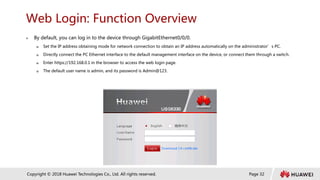
 By default, you can log in to the device through GigabitEthernet0/0/0.
 Set the IP address obtaining mode for network connection to obtain an IP address automatically on the administrator’s PC.
 Directly connect the PC Ethernet interface to the default management interface on the device, or connect them through a switch.
 Enter https://192.168.0.1 in the browser to access the web login page.
 The default user name is admin, and its password is Admin@123.
Page 33
Copyright © 2018 Huawei Technologies Co., Ltd. All rights reserved.
Web Login: Configuration Management (1)
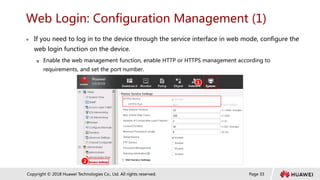
 If you need to log in to the device through the service interface in web mode, configure the
web login function on the device.
 Enable the web management function, enable HTTP or HTTPS management according to
requirements, and set the port number.
1
2
Page 34
Copyright © 2018 Huawei Technologies Co., Ltd. All rights reserved.
Web Login: Configuration Management (2)
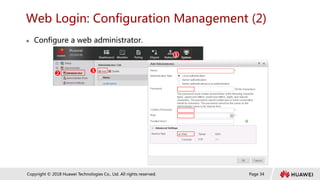
 Configure a web administrator.
1
2
3
Page 35
Copyright © 2018 Huawei Technologies Co., Ltd. All rights reserved.
Web Login: Configuration Management (3)
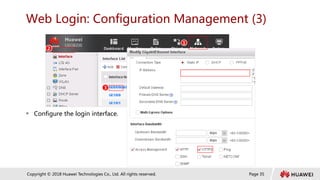
 Configure the login interface.
1
2
3
Page 36
Copyright © 2018 Huawei Technologies Co., Ltd. All rights reserved.
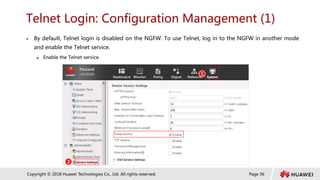
Telnet Login: Configuration Management (1)
 By default, Telnet login is disabled on the NGFW. To use Telnet, log in to the NGFW in another mode
and enable the Telnet service.
 Enable the Telnet service.
1
2
Page 37
Copyright © 2018 Huawei Technologies Co., Ltd. All rights reserved.
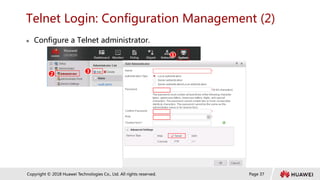
Telnet Login: Configuration Management (2)
 Configure a Telnet administrator.
1
2
3
Page 38
Copyright © 2018 Huawei Technologies Co., Ltd. All rights reserved.
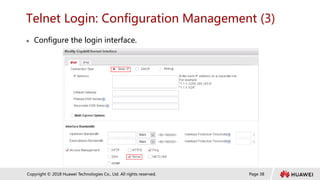
Telnet Login: Configuration Management (3)
 Configure the login interface.
Page 39
Copyright © 2018 Huawei Technologies Co., Ltd. All rights reserved.
SSH Login: Configuration Management (1)
 SSH provides greater security and powerful authentication functions for users to log in to the device. Configure SSH
device management on the USG interface. The administrator can enable SSH device management as required.
 Configuration commands:
 Enable the STelnet service.
 Configure SSH management on the USG interface.
 Configure a local RSA key pair.
 Configure VTY user interfaces.
[NGFW]stelnet server enable
[NGFW-GigabitEthernet1/0/1]service-manage enable
[NGFW-GigabitEthernet1/0/1]service-manage ssh permit
<NGFW>system-view
[NGFW]rsa local-key-pair create
[USG]user-interface vty 0 4
[USG-ui-vty0-4]protocol inbound all
[USG-ui-vty0-4]authentication-mode aaa
Page 40
Copyright © 2018 Huawei Technologies Co., Ltd. All rights reserved.
SSH Login: Configuration Management (2)
 Create an SSH administrator account and set the authentication mode to Password and service mode
to STelnet.
 Create an SSH user.
 After the preceding configurations are completed, run the SSH client software to establish an SSH
connection.
 If a Huawei device functions as an SSH client, enable the SSH login function on the client.
[NGFW]aaa
[NGFW-aaa]manager-user sshadmin
[NGFW-aaa-manager-user-sshadmin]service-type ssh
[NGFW-aaa-manager-user-sshadmin]level 3
[NGFW-aaa-manager-user-sshadmin]password cipher huawei
[NGFW]ssh user sshadmin
[NGFW]ssh user sshadmin authentication-type password
[NGFW]ssh user sshadmin service-type stelnet
[NGFW]ssh client first-time enable
Page 41
Copyright © 2018 Huawei Technologies Co., Ltd. All rights reserved.
Contents
1. Basic Network Devices
2. Device Initial Login
 Basic Service Configurations
 Basic System Settings
Page 42
Copyright © 2018 Huawei Technologies Co., Ltd. All rights reserved.
Overview of Device File Management
 Device File Management
 Configuration file management
 System file management (software upgrade)
 License management
Page 43
Copyright © 2018 Huawei Technologies Co., Ltd. All rights reserved.
Configuration File Management
 Configuration file types:
 Saved-configuration: the configuration file used for the next startup of the USG. It is
stored in the flash memory or CF card of the USG and persists across restarts.
 Current-configuration: the configuration currently in use on the USG. It is modified by
command lines and web operations. It is stored in the memory of the USG and persists
across restarts. Common operations for the configuration file
 Save the configuration file.
 Erase the configuration file (restore to factory settings).
 Configure the system software and configuration file for the next startup.
 Restart devices.
Page 45
Copyright © 2018 Huawei Technologies Co., Ltd. All rights reserved.
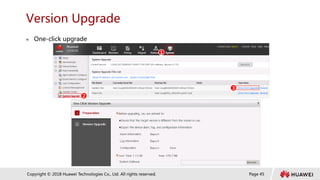
Version Upgrade
 One-click upgrade
1
2
3
Page 47
Copyright © 2018 Huawei Technologies Co., Ltd. All rights reserved.
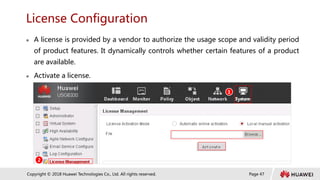
License Configuration
 A license is provided by a vendor to authorize the usage scope and validity period
of product features. It dynamically controls whether certain features of a product
are available.
 Activate a license.
1
2
Page 48
Copyright © 2018 Huawei Technologies Co., Ltd. All rights reserved.
Quiz
1. What is the default login IP address used in web login mode?
A. 192.168.0.1/24
B. 192.168.1.1/24
C. 172.16.0.1/16
D. 172.21.1.1/16
Page 49
Copyright © 2018 Huawei Technologies Co., Ltd. All rights reserved.
Summary
 Functions and models of common network devices
 Device login methods
 Basic configuration of security devices
Page 50
Copyright © 2018 Huawei Technologies Co., Ltd. All rights reserved.
Thank You
www.huawei.com

104 Common network devices

  • 1.
    www.huawei.com Copyright © 2018Huawei Technologies Co., Ltd. All rights reserved. Common Network Devices
  • 2.
    Page 2 Copyright ©2018 Huawei Technologies Co., Ltd. All rights reserved. Foreword  Network devices are the basic components of a network. When planning and constructing a network, you need to deploy and configure the network devices to meet network connection or network security requirements.
  • 3.
    Page 3 Copyright ©2018 Huawei Technologies Co., Ltd. All rights reserved. Objectives  Upon completion of this course, you will be able to:  Describe Huawei common network devices.  Describe the functions of network devices.  Log in to network devices and perform basic configurations.
  • 4.
    Page 4 Copyright ©2018 Huawei Technologies Co., Ltd. All rights reserved. Contents 1. Basic Network Devices 2. Initial Device Login
  • 5.
    Page 5 Copyright ©2018 Huawei Technologies Co., Ltd. All rights reserved. Campus Network Security Deployment Scenario Remote employees Branch/Partner Virus DMZ Office Office Data center NIP vNGFW Anti-DDoS ATIC
  • 6.
    Page 6 Copyright ©2018 Huawei Technologies Co., Ltd. All rights reserved. Switch  A switch works at the data link layer and forwards data frames. SWA Host A Host C Host B IP address: 10.1.1.1/24 MAC address: 00-01-02-03-04-AA IP address: 10.1.1.2/24 MAC address: 00-01-02-03-04-BB IP address: 10.1.1.3/24 MAC address: 00-01-02-03-04-CC G0/0/1 G0/0/2 G0/0/3
  • 7.
    Page 7 Copyright ©2018 Huawei Technologies Co., Ltd. All rights reserved. Forwarding on Switches Flooding Forwarding Discarding
  • 8.
    Page 9 Copyright ©2018 Huawei Technologies Co., Ltd. All rights reserved. Initial State of Switches  In the initial state, the MAC address table of a switch is empty. MAC address table MAC Address Interface SWA Host A Host C Host B IP address: 10.1.1.1/24 MAC address: 00-01-02-03-04-AA IP address: 10.1.1.2/24 MAC address: 00-01-02-03-04-BB IP address: 10.1.1.3/24 MAC address: 00-01-02-03-04-CC G0/0/1 G0/0/2 G0/0/3
  • 9.
    Page 10 Copyright ©2018 Huawei Technologies Co., Ltd. All rights reserved. Learning MAC Addresses  The switch records the source MAC address and corresponding interface of the received data frame in the MAC address table. MAC Address Interface 00-01-02-03-04-AA G0/0/1 MAC address table SWA Host A Host C Host B IP address: 10.1.1.1/24 MAC address: 00-01-02-03-04-AA IP address: 10.1.1.2/24 MAC address: 00-01-02-03-04-BB IP address: 10.1.1.3/24 MAC address: 00-01-02-03-04-CC G0/0/1 G0/0/2 G0/0/3
  • 10.
    Page 11 Copyright ©2018 Huawei Technologies Co., Ltd. All rights reserved. MAC Address Interface 00-01-02-03-04-AA G0/0/1 Forwarding Data Frames  When the destination MAC address of a data frame is not in the MAC address table or it is a broadcast address, the switch floods the frame. MAC address table SWA Host A Host C Host B IP address: 10.1.1.1/24 MAC address: 00-01-02-03-04-AA IP address: 10.1.1.2/24 MAC address: 00-01-02-03-04-BB IP address: 10.1.1.3/24 MAC address: 00-01-02-03-04-CC G0/0/1 G0/0/2 G0/0/3 Des.MAC 00-01-02-03-04-AA FF-FF-FF-FF-FF-FF Src.MAC
  • 11.
    Page 12 Copyright ©2018 Huawei Technologies Co., Ltd. All rights reserved. Response from the Target Host  The switch unicasts the reply from Host C to Host A based on the MAC address table. MAC Address Interface 00-01-02-03-04-AA G0/0/1 00-01-02-03-04-CC G0/0/3 MAC address table SWA Host A Host C Host B IP address: 10.1.1.1/24 MAC address: 00-01-02-03-04-AA IP address: 10.1.1.2/24 MAC address: 00-01-02-03-04-BB IP address: 10.1.1.3/24 MAC address: 00-01-02-03-04-CC G0/0/1 G0/0/2 G0/0/3
  • 12.
    Page 13 Copyright ©2018 Huawei Technologies Co., Ltd. All rights reserved. Router  Function: forwards data packets between different networks Network layer Data link layer Physical layer Network layer Data link layer Physical layer Network layer Data link layer Physical layer Router A Router B Router C Application layer Transmission layer Network layer Data link layer Physical layer Host A Host B Application layer Transmission layer Network layer Data Link layer Physical layer Router C Router B Router A
  • 13.
    Page 14 Copyright ©2018 Huawei Technologies Co., Ltd. All rights reserved. Route Selection  A router selects an optimal path for data packets and forwards the packets. RTA RTB RTC RTD
  • 14.
    Page 15 Copyright ©2018 Huawei Technologies Co., Ltd. All rights reserved. Firewall  A firewall is mainly used to protect one network area against network attacks and intrusions from another network area.
  • 15.
    Page 16 Copyright ©2018 Huawei Technologies Co., Ltd. All rights reserved. Comparing Firewalls with Switches and Routers  The primary function of routers and switches is forwarding, whereas that of firewalls is controlling. Switch Aggregating and building a LAN Layer 2/Layer 3 fast forwarding of packets Firewall Controlling packet forwarding Anti Trojan horses and viruses Router Addressing and forwarding Ensuring network interconnection ×
  • 16.
    Page 17 Copyright ©2018 Huawei Technologies Co., Ltd. All rights reserved. Firewall Development History 1989 1994 1995 2004 2005 2009 Access control Packet filtering Application agent Status check UTM NGFW Dedicated device Session mechanism Multi-function overlay DPI technology Proxy technology Control based on user + application + content
  • 17.
    Page 19 Copyright ©2018 Huawei Technologies Co., Ltd. All rights reserved. Firewall Security Zone  Security zone (or zone):  A local logical security zone  A network connected to one or more interfaces DMZ Trust zone Untrust zone
  • 18.
    Page 20 Copyright ©2018 Huawei Technologies Co., Ltd. All rights reserved. Relationship Between Firewall Security Zones and Interfaces  Does the firewall have two security zones with the same security level?  Does the firewall allow the same physical interface to belong to two different security zones?  Can different interfaces on a firewall belong to the same security zone? G0/0/2 --> DMZ G0/0/2 --> Untrust zone GE1/0/0 --> Trust zone G0/0/1 --> Trust zone
  • 19.
    Page 21 Copyright ©2018 Huawei Technologies Co., Ltd. All rights reserved. Contents 1. Basic Network Devices 2. Device Initial Login  Basic Service Configurations  Basic System Settings
  • 20.
    Page 22 Copyright ©2018 Huawei Technologies Co., Ltd. All rights reserved. VRP Overview  Versatile Routing Platform (VRP)  Network operating system  Software platform that supports multiple types of devices  Provides TCP/IP routing services
  • 21.
    Page 23 Copyright ©2018 Huawei Technologies Co., Ltd. All rights reserved. Introduction to Command Line  The CLI is divided into command views. All commands must be executed in command views. You can run a command only after you enter its command view. <NGFW> User view <NGFW>system-view [NGFW] System view [NGFW]interface GigabitEthernet 0/0/1 [NGFW–GigabitEthernet0/0/1]quit Interface view [NGFW]ospf 1 [NGFW-ospf-1] Protocol view
  • 22.
    Page 24 Copyright ©2018 Huawei Technologies Co., Ltd. All rights reserved. Command Line Help: Full Help  Full help displays all the keywords or parameters after you enter a question mark (?) in the command line.  In any command view, enter ? to obtain all commands and a brief description of each in the command view.  You can also enter a command (if it is a keyword) followed by a space and ? to obtain all keywords and a brief description of each. <NGFW>? User view commands: anti-ddos Defend against DDoS attacks arp Specify ARP configuration information <NGFW>display firewall ? blacklist Indicate the blacklist command group dataplane Indicate dataplane to manageplane defend Indicate attack defense
  • 23.
    Page 25 Copyright ©2018 Huawei Technologies Co., Ltd. All rights reserved. Command Line Help: Partial Help  Partial help displays all the keywords or parameters that start with the character string entered in the command line.  Type a character string followed by ? to obtain all keywords that begin with the character string.  You can also enter a command followed by a character string and ? to obtain all keywords starting with the character string. <NGFW>d? debugging delete dir display download <NGFW>display b? backup-configuration bfd bgp bridge buffer bulk-stat
  • 24.
    Page 26 Copyright ©2018 Huawei Technologies Co., Ltd. All rights reserved. Command Line Help: Tab Key  If there is only one match for an incomplete keyword:  If there are multiple matches for a keyword: [NGFW]info- [NGFW]info-center [NGFW]info-center l [NGFW]info-center lo [NGFW]info-center loghost [NGFW]info-center local [NGFW]info-center logbuffer [NGFW]info-center logfile
  • 25.
    Page 27 Copyright ©2018 Huawei Technologies Co., Ltd. All rights reserved. Configuring Interfaces  Choose Network > Interface, and select the interface to be modified.  Configure an IP address for the interface and switch the interface mode. Switch the interface mode. The available modes are Routing (Layer 3), Switching (Layer 2), and Hybrid (Layer 2 and 3). Configure the IP address and subnet mask. Add to the security zone.
  • 26.
    Page 28 Copyright ©2018 Huawei Technologies Co., Ltd. All rights reserved. Configuring Routes  Choose Network > Route > Static Route, and click Add. 1 2
  • 27.
    Page 29 Copyright ©2018 Huawei Technologies Co., Ltd. All rights reserved. Overview of Device Login Management  Device login management  Console  Telnet  SSH  Web
  • 28.
    Page 30 Copyright ©2018 Huawei Technologies Co., Ltd. All rights reserved. Login to the Device Through the Console Port (1)  Check the parameters of the local port.
  • 29.
    Page 31 Copyright ©2018 Huawei Technologies Co., Ltd. All rights reserved. Log in to the Device Through the Console Port (2)  Configure the connection interface and communications parameters: Parameter Value Speed (baud) 9600 Data bits 8 Parity None Stop bits 1 Flow control None
  • 30.
    Page 32 Copyright ©2018 Huawei Technologies Co., Ltd. All rights reserved. Web Login: Function Overview  By default, you can log in to the device through GigabitEthernet0/0/0.  Set the IP address obtaining mode for network connection to obtain an IP address automatically on the administrator’s PC.  Directly connect the PC Ethernet interface to the default management interface on the device, or connect them through a switch.  Enter https://192.168.0.1 in the browser to access the web login page.  The default user name is admin, and its password is Admin@123.
  • 31.
    Page 33 Copyright ©2018 Huawei Technologies Co., Ltd. All rights reserved. Web Login: Configuration Management (1)  If you need to log in to the device through the service interface in web mode, configure the web login function on the device.  Enable the web management function, enable HTTP or HTTPS management according to requirements, and set the port number. 1 2
  • 32.
    Page 34 Copyright ©2018 Huawei Technologies Co., Ltd. All rights reserved. Web Login: Configuration Management (2)  Configure a web administrator. 1 2 3
  • 33.
    Page 35 Copyright ©2018 Huawei Technologies Co., Ltd. All rights reserved. Web Login: Configuration Management (3)  Configure the login interface. 1 2 3
  • 34.
    Page 36 Copyright ©2018 Huawei Technologies Co., Ltd. All rights reserved. Telnet Login: Configuration Management (1)  By default, Telnet login is disabled on the NGFW. To use Telnet, log in to the NGFW in another mode and enable the Telnet service.  Enable the Telnet service. 1 2
  • 35.
    Page 37 Copyright ©2018 Huawei Technologies Co., Ltd. All rights reserved. Telnet Login: Configuration Management (2)  Configure a Telnet administrator. 1 2 3
  • 36.
    Page 38 Copyright ©2018 Huawei Technologies Co., Ltd. All rights reserved. Telnet Login: Configuration Management (3)  Configure the login interface.
  • 37.
    Page 39 Copyright ©2018 Huawei Technologies Co., Ltd. All rights reserved. SSH Login: Configuration Management (1)  SSH provides greater security and powerful authentication functions for users to log in to the device. Configure SSH device management on the USG interface. The administrator can enable SSH device management as required.  Configuration commands:  Enable the STelnet service.  Configure SSH management on the USG interface.  Configure a local RSA key pair.  Configure VTY user interfaces. [NGFW]stelnet server enable [NGFW-GigabitEthernet1/0/1]service-manage enable [NGFW-GigabitEthernet1/0/1]service-manage ssh permit <NGFW>system-view [NGFW]rsa local-key-pair create [USG]user-interface vty 0 4 [USG-ui-vty0-4]protocol inbound all [USG-ui-vty0-4]authentication-mode aaa
  • 38.
    Page 40 Copyright ©2018 Huawei Technologies Co., Ltd. All rights reserved. SSH Login: Configuration Management (2)  Create an SSH administrator account and set the authentication mode to Password and service mode to STelnet.  Create an SSH user.  After the preceding configurations are completed, run the SSH client software to establish an SSH connection.  If a Huawei device functions as an SSH client, enable the SSH login function on the client. [NGFW]aaa [NGFW-aaa]manager-user sshadmin [NGFW-aaa-manager-user-sshadmin]service-type ssh [NGFW-aaa-manager-user-sshadmin]level 3 [NGFW-aaa-manager-user-sshadmin]password cipher huawei [NGFW]ssh user sshadmin [NGFW]ssh user sshadmin authentication-type password [NGFW]ssh user sshadmin service-type stelnet [NGFW]ssh client first-time enable
  • 39.
    Page 41 Copyright ©2018 Huawei Technologies Co., Ltd. All rights reserved. Contents 1. Basic Network Devices 2. Device Initial Login  Basic Service Configurations  Basic System Settings
  • 40.
    Page 42 Copyright ©2018 Huawei Technologies Co., Ltd. All rights reserved. Overview of Device File Management  Device File Management  Configuration file management  System file management (software upgrade)  License management
  • 41.
    Page 43 Copyright ©2018 Huawei Technologies Co., Ltd. All rights reserved. Configuration File Management  Configuration file types:  Saved-configuration: the configuration file used for the next startup of the USG. It is stored in the flash memory or CF card of the USG and persists across restarts.  Current-configuration: the configuration currently in use on the USG. It is modified by command lines and web operations. It is stored in the memory of the USG and persists across restarts. Common operations for the configuration file  Save the configuration file.  Erase the configuration file (restore to factory settings).  Configure the system software and configuration file for the next startup.  Restart devices.
  • 42.
    Page 45 Copyright ©2018 Huawei Technologies Co., Ltd. All rights reserved. Version Upgrade  One-click upgrade 1 2 3
  • 43.
    Page 47 Copyright ©2018 Huawei Technologies Co., Ltd. All rights reserved. License Configuration  A license is provided by a vendor to authorize the usage scope and validity period of product features. It dynamically controls whether certain features of a product are available.  Activate a license. 1 2
  • 44.
    Page 48 Copyright ©2018 Huawei Technologies Co., Ltd. All rights reserved. Quiz 1. What is the default login IP address used in web login mode? A. 192.168.0.1/24 B. 192.168.1.1/24 C. 172.16.0.1/16 D. 172.21.1.1/16
  • 45.
    Page 49 Copyright ©2018 Huawei Technologies Co., Ltd. All rights reserved. Summary  Functions and models of common network devices  Device login methods  Basic configuration of security devices
  • 46.
    Page 50 Copyright ©2018 Huawei Technologies Co., Ltd. All rights reserved. Thank You www.huawei.com