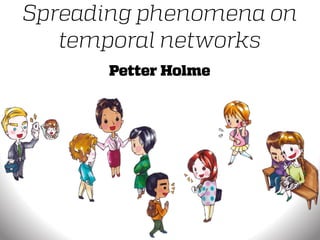
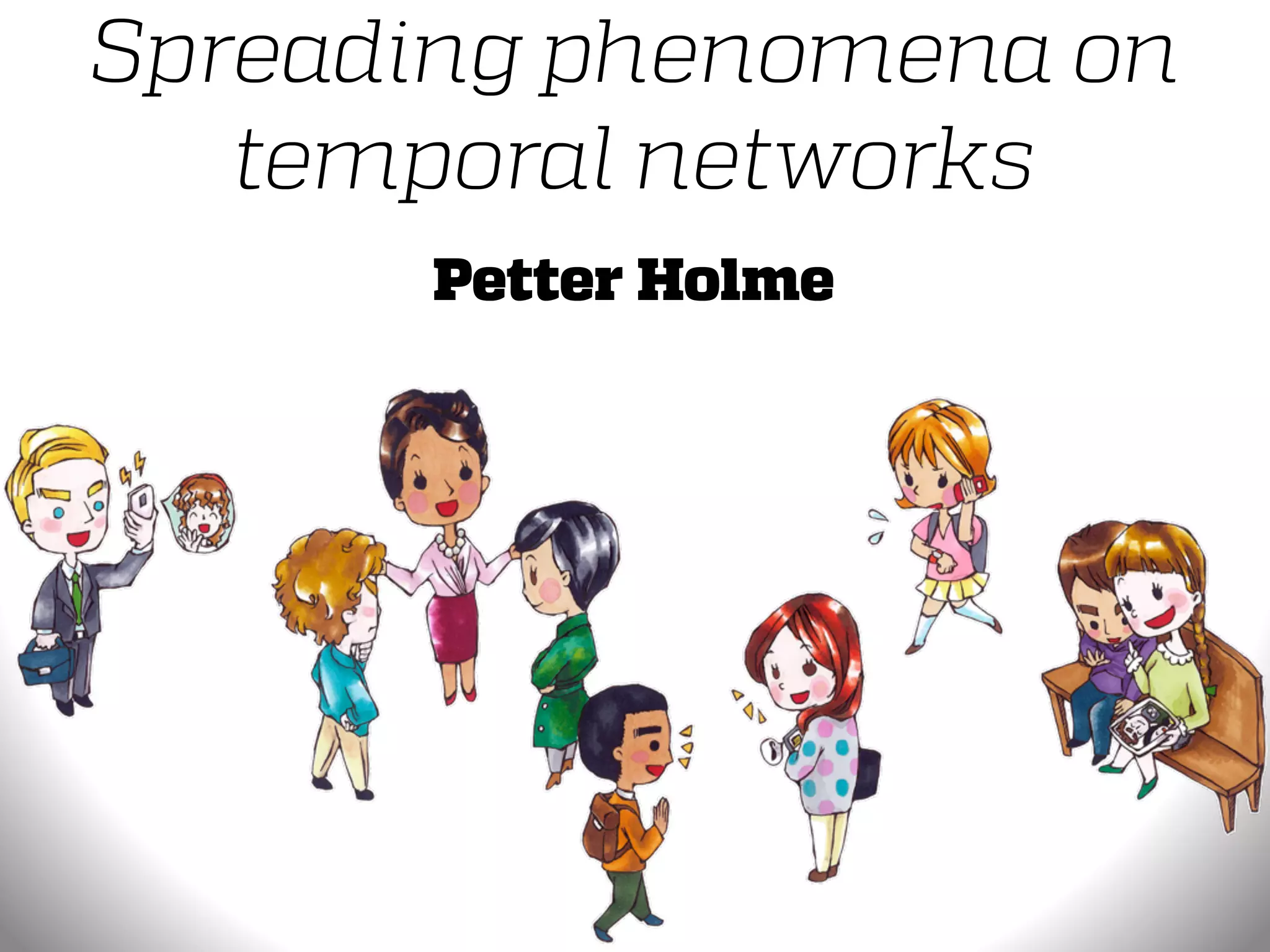





Spreading phenomena on
temporal networks
Petter Holme
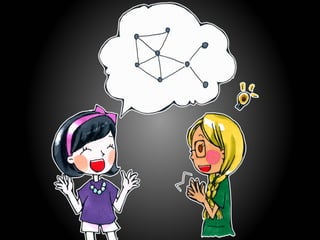
Temporal networks
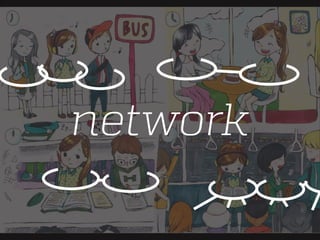
network
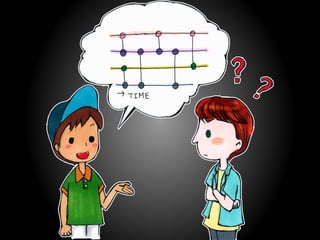
time
Temporal networks
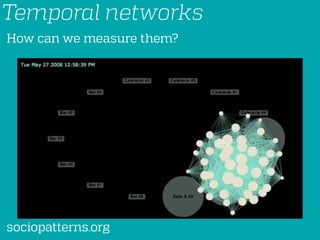
How can we measure them?
sociopatterns.org
Temporal networks
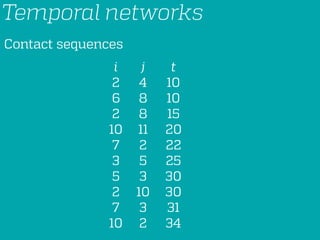
Contact sequences
i
2
6
2
10
7
3
5
2
7
10
j
4
8
8
11
2
5
3
10
3
2
t
10
10
15
20
22
25
30
30
31
34
Temporal networks
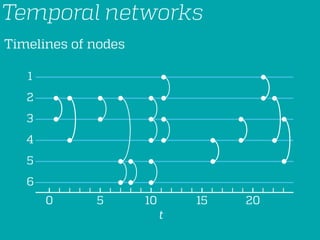
Timelines of nodes
0 5 10 15 20
1
2
3
4
5
6
t
Temporal networks
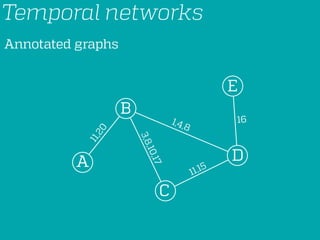
Annotated graphs
E
D
C
B
A
11,20
1,4,8
3,8,10,17
11,15
16
Temporal network
epidemiology
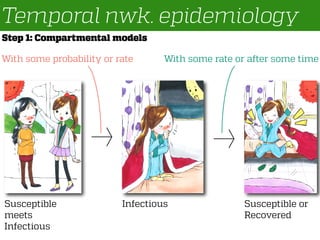
Temporal nwk. epidemiology
Susceptible
meets
Infectious
Infectious
With some probability or rate
Susceptible or
Recovered
With some rate or after some time
Step 1: Compartmental models
time
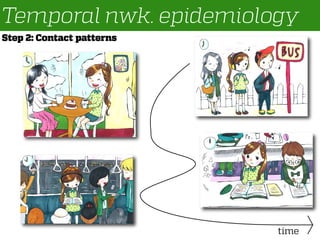
Temporal nwk. epidemiology
Step 2: Contact patterns
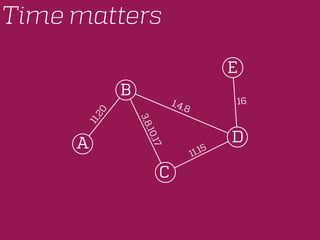
Time matters
Time matters
E
D
C
B
A
11,20 1,4,8
3,8,10,17 11,15
16
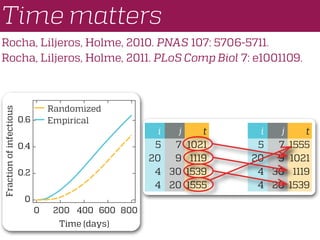
Rocha, Liljeros, Holme, 2010. PNAS 107: 5706-5711.
Escort/sex-buyer
contacts:
16,730 individuals
50,632 contacts
2,232 days
Time matters
Rocha, Liljeros, Holme, 2011. PLoS Comp Biol 7: e1001109.
0
0.2
0.4
0.6
0 200 400 600
Time (days)
800
Fractionofinfectious
0
0.2
0.4
0.6
0 200 400 600
Time (days)
Empirical
Randomized
800
Fractionofinfectious
1555
i j t
5 7 1021
20 9 1119
4 30 1539
i j t
5 7 1555
20 9 1021
4 30 1119
4 20 15394 20
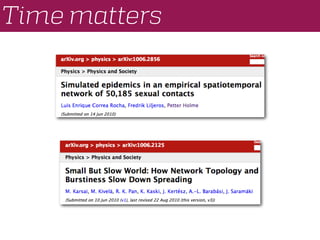
Time matters
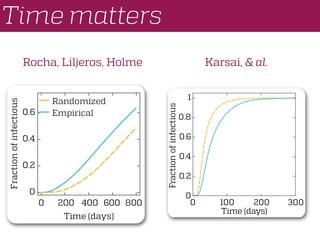
Rocha, Liljeros, Holme Karsai, & al.
Time matters
0
0.2
0.4
0.6
0 200 400 600
Time (days)
Empirical
Randomized
800
Fractionofinfectious
1
0.8
0.6
0.4
0.2
0
0 100 200 300
Time (days)
Fractionofinfectious
1
Understanding Complex Systems
Petter Holme
Jari Saramäki Editors
Temporal
Networks
Physics Reports 519 (2012) 97–125
Contents lists available at SciVerse ScienceDirect
Physics Reports
journal homepage: www.elsevier.com/locate/physrep
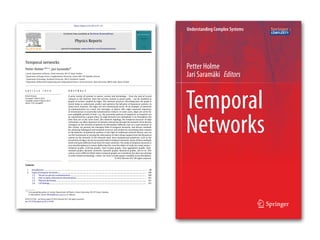
Temporal networks
Petter Holmea,b,c,⇤
, Jari Saramäkid
a
IceLab, Department of Physics, Umeå University, 901 87 Umeå, Sweden
b
Department of Energy Science, Sungkyunkwan University, Suwon 440–746, Republic of Korea
c
Department of Sociology, Stockholm University, 106 91 Stockholm, Sweden
d
Department of Biomedical Engineering and Computational Science, School of Science, Aalto University, 00076 Aalto, Espoo, Finland
a r t i c l e i n f o
Article history:
Accepted 1 March 2012
Available online 6 March 2012
editor: D.K. Campbell
a b s t r a c t
A great variety of systems in nature, society and technology – from the web of sexual
contacts to the Internet, from the nervous system to power grids – can be modeled as
graphs of vertices coupled by edges. The network structure, describing how the graph is
wired, helps us understand, predict and optimize the behavior of dynamical systems. In
many cases, however, the edges are not continuously active. As an example, in networks
of communication via e-mail, text messages, or phone calls, edges represent sequences
of instantaneous or practically instantaneous contacts. In some cases, edges are active for
non-negligible periods of time: e.g., the proximity patterns of inpatients at hospitals can
be represented by a graph where an edge between two individuals is on throughout the
time they are at the same ward. Like network topology, the temporal structure of edge
activations can affect dynamics of systems interacting through the network, from disease
contagion on the network of patients to information diffusion over an e-mail network. In
this review, we present the emergent field of temporal networks, and discuss methods
for analyzing topological and temporal structure and models for elucidating their relation
to the behavior of dynamical systems. In the light of traditional network theory, one can
see this framework as moving the information of when things happen from the dynamical
system on the network, to the network itself. Since fundamental properties, such as the
transitivity of edges, do not necessarily hold in temporal networks, many of these methods
need to be quite different from those for static networks. The study of temporal networks is
very interdisciplinary in nature. Reflecting this, even the object of study has many names—
temporal graphs, evolving graphs, time-varying graphs, time-aggregated graphs, time-
stamped graphs, dynamic networks, dynamic graphs, dynamical graphs, and so on. This
review covers different fields where temporal graphs are considered, but does not attempt
to unify related terminology—rather, we want to make papers readable across disciplines.
© 2012 Elsevier B.V. All rights reserved.
Contents
1. Introduction.......................................................................................................................................................................................... 98
2. Types of temporal networks................................................................................................................................................................ 100
2.1. Person-to-person communication.......................................................................................................................................... 100
2.2. One-to many information dissemination............................................................................................................................... 101
2.3. Physical proximity ................................................................................................................................................................... 101
2.4. Cell biology............................................................................................................................................................................... 101
⇤ Corresponding author at: IceLab, Department of Physics, Umeå University, 901 87 Umeå, Sweden.
E-mail address: petter.holme@physics.umu.se (P. Holme).
0370-1573/$ – see front matter © 2012 Elsevier B.V. All rights reserved.
doi:10.1016/j.physrep.2012.03.001
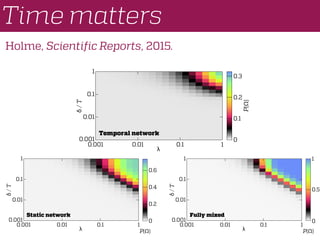
Holme, Scientific Reports, 2015.
Time matters
0.2
0.3
0.1
0
P(Ω)
Temporal network
0.001 0.01 0.1 1
0.001
0.01
0.1
1
λ
δ/T
0.2
0.6
0.4
0
0.5
0
1
P(Ω) P(Ω)
Static network Fully mixed
0.001 0.01 0.1 1
0.001
0.01
0.1
1
λ
δ/T
0.001 0.01 0.1 1
0.001
0.01
0.1
1
λ
δ/T
Temporal structures
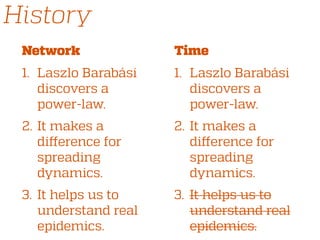
History
Network
1. Laszlo Barabási
discovers a
power-law.
2. It makes a
difference for
spreading
dynamics.
3. It helps us to
understand real
epidemics.
Time
1. Laszlo Barabási
discovers a
power-law.
2. It makes a
difference for
spreading
dynamics.
3. It helps us to
understand real
epidemics.
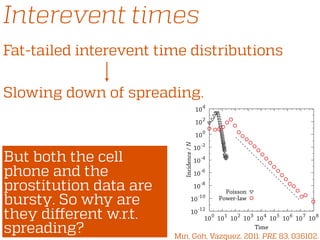
Fat-tailed interevent time distributions
Slowing down of spreading.
10-12
10
-10
10
-8
10-6
10
-4
10
-2
10
0
10
2
10
4
10
0
10
1
10
2
10
3
10
4
10
5
10
6
10
7
10
8
Poisson
Power-law
Time
Incidence/N
Min, Goh, Vazquez, 2011. PRE 83, 036102.
But both the cell
phone and the
prostitution data are
bursty. So why are
they different w.r.t.
spreading?
Interevent times
Europhys. Lett., 64 (3), pp. 427–433 (2003)
EUROPHYSICS LETTERS 1 November 2003
Network dynamics of ongoing social relationships
P. Holme(∗
)
Department of Physics, Ume˚a University - 901 87 Ume˚a, Sweden
(received 21 July 2003; accepted in final form 22 August 2003)
PACS. 89.65.-s – Social and economic systems.
PACS. 89.75.Hc – Networks and genealogical trees.
PACS. 89.75.-k – Complex systems.
Abstract. – Many recent large-scale studies of interaction networks have focused on networks
of accumulated contacts. In this letter we explore social networks of ongoing relationships with
an emphasis on dynamical aspects. We find a distribution of response times (times between
consecutive contacts of different direction between two actors) that has a power law shape over a
large range. We also argue that the distribution of relationship duration (the time between the
first and last contacts between actors) is exponentially decaying. Methods to reanalyze the data
to compensate for the finite sampling time are proposed. We find that the degree distribution
for networks of ongoing contacts fits better to a power law than the degree distribution of
the network of accumulated contacts do. We see that the clustering and assortative mixing
coefficients are of the same order for networks of ongoing and accumulated contacts, and that
the structural fluctuations of the former are rather large.
Introduction. – The recent development in database technology has allowed researchers
to extract very large data sets of human interaction sequences. These large data sets are
suitable to the methods and modeling techniques of statistical physics, and thus, the last years
have witnessed the appearance of an interdisciplinary field between physics and sociology [1–3].
More specifically, these studies have focused on network structure —in what ways the networks
Limited communication capacity unveils
strategies for human interaction
Giovanna Miritello1,2
, Rube´n Lara2
, Manuel Cebrian3,4
& Esteban Moro1,5
1
Departamento de Matema´ticas & GISC, Universidad Carlos III de Madrid, 28911 Legane´s, Spain, 2
Telefo´nica Research, 28050
Madrid, Spain, 3
NICTA, Melbourne, Victoria 3010, Australia, 4
Department of Computer Science & Engineering, University of
California at San Diego, La Jolla, CA 92093, USA, 5
Instituto de Ingenierı´a del Conocimiento, Universidad Auto´noma de Madrid,
28049 Madrid, Spain.
Connectivity is the key process that characterizes the structural and functional properties of social networks.
However, the bursty activity of dyadic interactions may hinder the discrimination of inactive ties from large
interevent times in active ones. We develop a principled method to detect tie de-activation and apply it to a
large longitudinal, cross-sectional communication dataset (<19 months, <20 million people). Contrary to
the perception of ever-growing connectivity, we observe that individuals exhibit a finite communication
capacity, which limits the number of ties they can maintain active in time. On average men display higher
capacity than women, and this capacity decreases for both genders over their lifespan. Separating
communication capacity from activity reveals a diverse range of tie activation strategies, from stable to
exploratory. This allows us to draw novel relationships between individual strategies for human interaction
and the evolution of social networks at global scale.
any different forces govern the evolution of social relationships making them far from random. In recent
years, the understanding of what mechanisms control the dynamics of activating or deactivating social
SUBJECT AREAS:
SCIENTIFIC DATA
COMPLEX NETWORKS
APPLIED MATHEMATICS
STATISTICAL PHYSICS
Received
15 January 2013
Accepted
2 May 2013
Published
6 June 2013
Correspondence and
requests for materials
should be addressed to
E.M. (emoro@math.
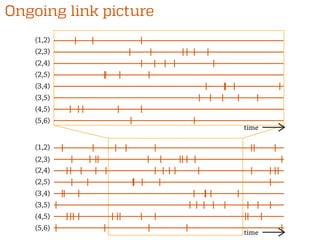
time
time
(2,3)
(2,4)
(2,5)
(3,4)
(3,5)
(4,5)
(5,6)
(1,2)
(1,2)
(2,3)
(2,4)
(2,5)
(3,4)
(3,5)
(4,5)
(5,6)
Ongoing link picture
time
(2,3)
(2,4)
(2,5)
(3,4)
(3,5)
(4,5)
(5,6)
(1,2)
(1,2)
(2,3)
(2,4)
(2,5)
(3,4)
(3,5)
(4,5)
(5,6)
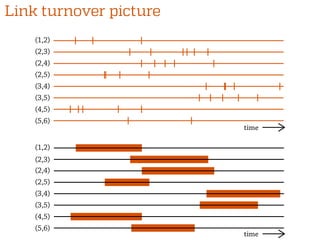
time
Link turnover picture
T0
T0
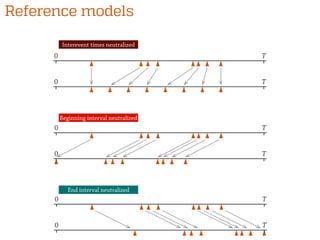
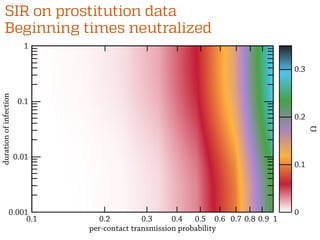
Beginning interval neutralized
T0
T0
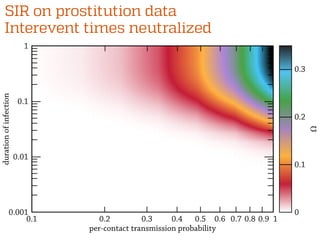
Interevent times neutralized
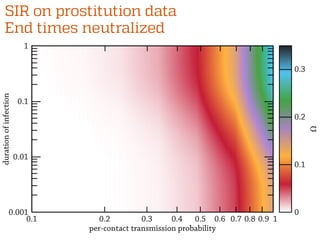
End interval neutralized
T0
T0
Reference models
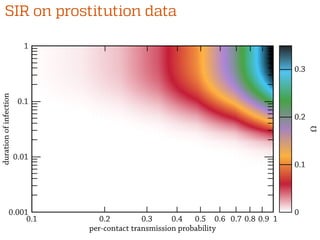
SIR on prostitution data
0
0.1
0.2
0.3
0.1 0.2 0.90.8 10.70.60.50.40.3
0.1
1
0.01
0.001
per-contact transmission probability
durationofinfection
Ω
SIR on prostitution data
0
0.1
0.2
0.3
0.1 0.2 0.90.8 10.70.60.50.40.3
0.1
1
0.01
0.001
per-contact transmission probability
durationofinfection
Ω
Interevent times neutralized
SIR on prostitution data
0
0.1
0.2
0.3
0.1 0.2 0.90.8 10.70.60.50.40.3
0.1
1
0.01
0.001
per-contact transmission probability
durationofinfection
Ω
Beginning times neutralized
SIR on prostitution data
0
0.1
0.2
0.3
0.1 0.2 0.90.8 10.70.60.50.40.3
0.1
1
0.01
0.001
per-contact transmission probability
durationofinfection
Ω
End times neutralized
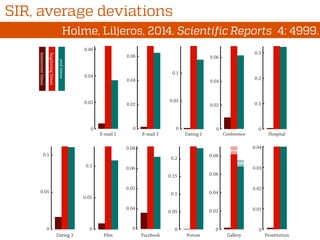
SIR, average deviations
0
0.02
0.04
0.06
E-mail 1
0.1
0
0.05
Film
0
0.05
0.1
Dating 1
0.05
0.1
0.15
0.2
0
Forum
0
0.02
0.04
0.06
E-mail 2
0
0.02
0.06
0.08
0.04
Facebook
0
0.01
0.02
0.03
0.04
Prostitution
0
0.1
0.2
0.3
Hospital
0
0.04
0.06
0.08
0.02
Gallery
0
0.02
0.04
0.06
Conference
0.05
0.1
0
Dating 2
endtimes
beginningtimes
intereventtimes
Holme, Liljeros, 2014. Scientific Reports 4: 4999.
Temporal structures 2
…a no-brain (low-brain?) approach
but what about yet other structures?
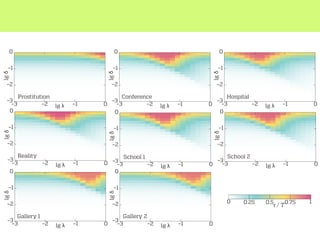
School 2
ConferenceProstitution Hospital
Reality
Gallery 1
School 1
Gallery 2
–3 –2 –1 0lg λ
–3
–2
–1
0
lgδ
–3 –2 –1 0lg λ
–3
–2
–1
0
lgδ
–3 –2 –1 0lg λ
–3
–2
–1
0
lgδ
–3 –2 –1 0lg λ
–3
–2
–1
0
lgδ
–3 –2 –1 0lg λ
–3
–2
–1
0
lgδ
–3 –2 –1 0lg λ
–3
–2
–1
0
lgδ
–3 –2 –1 0lg λ
–3
–2
–1
0
lgδ
–3 –2 –1 0lg λ
–3
–2
–1
0lgδ
0.75 10.50
τ / T
0.25
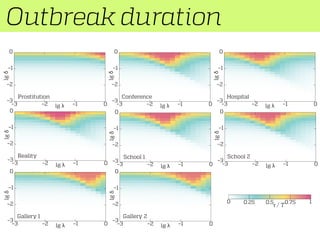
Outbreak duration
School 2
ConferenceProstitution Hospital
Reality
Gallery 1
School 1
Gallery 2
–3 –2 –1 0lg λ
–3
–2
–1
0
lgδ
–3 –2 –1 0lg λ
–3
–2
–1
0
lgδ
–3 –2 –1 0lg λ
–3
–2
–1
0
lgδ
–3 –2 –1 0lg λ
–3
–2
–1
0
lgδ
–3 –2 –1 0lg λ
–3
–2
–1
0
lgδ
–3 –2 –1 0lg λ
–3
–2
–1
0
lgδ
–3 –2 –1 0lg λ
–3
–2
–1
0
lgδ
–3 –2 –1 0lg λ
–3
–2
–1
0lgδ
0.75 10.50
τ / T
0.25
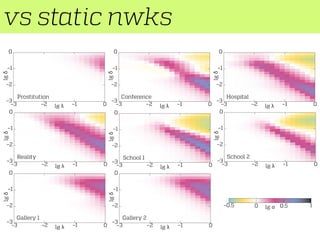
vs static nwks
School 2
ConferenceProstitution Hospital
Reality
Gallery 1
School 1
Gallery 2
–3 –2 –1 0lg λ
–3
–2
–1
0
lgδ
–3 –2 –1 0lg λ
–3
–2
–1
0
lgδ
–3 –2 –1 0lg λ
–3
–2
–1
0
lgδ
–3 –2 –1 0lg λ
–3
–2
–1
0
lgδ
–3 –2 –1 0lg λ
–3
–2
–1
0
lgδ
–3 –2 –1 0lg λ
–3
–2
–1
0
lgδ
–3 –2 –1 0lg λ
–3
–2
–1
0
lgδ
–3 –2 –1 0lg λ
–3
–2
–1
0lgδ
0.5 10–0.5 lg σ
–3 –2 –1 0lg λ
–3
–2
–1
0
lgδ
–3 –2 –1 0lg λ
–3
–2
–1
0
lgδ
–3 –2 –1 0lg λ
–3
–2
–1
0
lgδ
–3 –2 –1 0lg λ
–3
–2
–1
0
lgδ
–3 –2 –1 0lg λ
–3
–2
–1
0
lgδ
–3 –2 –1 0lg λ
–3
–2
–1
0
lgδ
–3 –2 –1 0lg λ
–3
–2
–1
0
lgδ
–3 –2 –1 0lg λ
–3
–2
–1
0lgδ
0.5 10–0.5 lg σ
School 2School 1
ConferenceProstitution Hospital
Reality
Gallery 1 Gallery 2
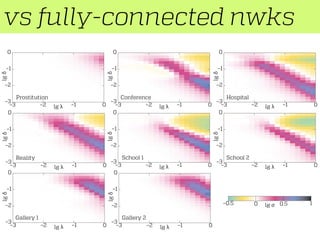
vs fully-connected nwks
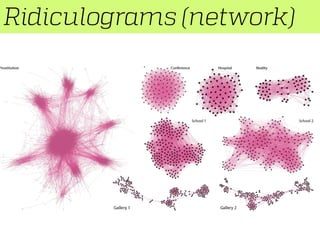
Ridiculograms (network)
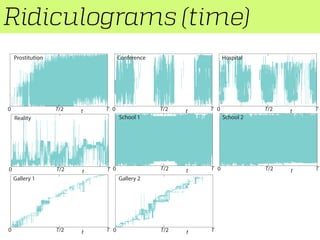
Ridiculograms (time)
0 T/2 Tt
0 T/2 Tt 0 T/2 Tt
0 T/2 Tt
0 T/2 Tt
0 T/2 Tt
0 T/2 Tt
0 T/2 Tt
School 2School 1
ConferenceProstitution Hospital
Reality
Gallery 1 Gallery 2
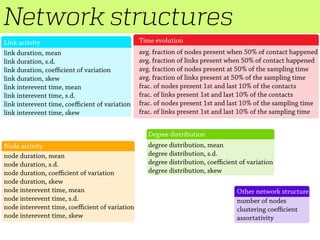
Network structures
avg. fraction of nodes present when 50% of contact happened
avg. fraction of links present when 50% of contact happened
avg. fraction of nodes present at 50% of the sampling time
avg. fraction of links present at 50% of the sampling time
frac. of nodes present 1st and last 10% of the contacts
frac. of links present 1st and last 10% of the contacts
frac. of nodes present 1st and last 10% of the sampling time
frac. of links present 1st and last 10% of the sampling time
Time evolution
degree distribution, mean
degree distribution, s.d.
degree distribution, coefficient of variation
degree distribution, skew
Degree distribution
link duration, mean
link duration, s.d.
link duration, coefficient of variation
link duration, skew
link interevent time, mean
link interevent time, s.d.
link interevent time, coefficient of variation
link interevent time, skew
Link activity
Node activity
node duration, mean
node duration, s.d.
node duration, coefficient of variation
node duration, skew
node interevent time, mean
node interevent time, s.d.
node interevent time, coefficient of variation
node interevent time, skew
Other network structure
number of nodes
clustering coefficient
assortativity
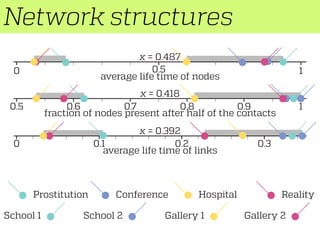
Network structures
0 10.5
average life time of nodes
0.10 0.2 0.3
average life time of links
fraction of nodes present after half of the contacts
0.5 10.6 0.7 0.8 0.9
x = 0.392
x = 0.418
x = 0.487
Prostitution Conference Hospital
Gallery 2Gallery 1School 1 School 2
Reality
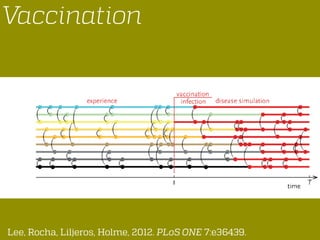
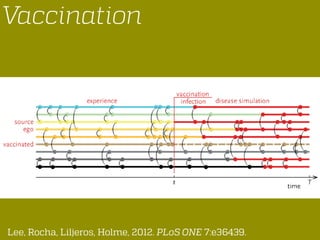
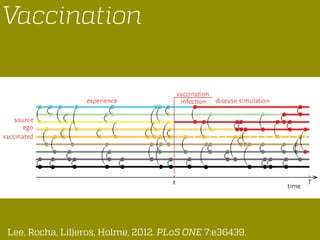
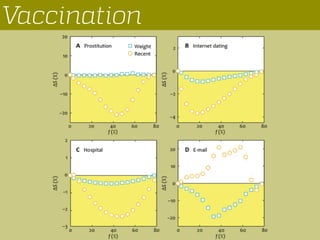
Vaccination
Assume we can vaccinate a fraction f,
then how can we choose the people
to vaccinate? Using only local info?
Vaccination
Chose a person at random.
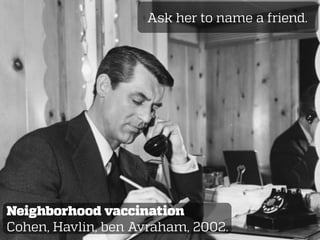
Neighborhood vaccination
Cohen, Havlin, ben Avraham, 2002.
Ask her to name a friend.
Neighborhood vaccination
Cohen, Havlin, ben Avraham, 2002.
Vaccinate the friend.
Neighborhood vaccination
Cohen, Havlin, ben Avraham, 2002.
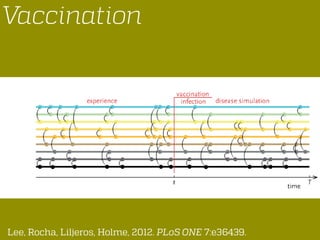
Lee, Rocha, Liljeros, Holme, 2012. PLoS ONE 7:e36439.
Vaccination
Lee, Rocha, Liljeros, Holme, 2012. PLoS ONE 7:e36439.
Vaccination
Lee, Rocha, Liljeros, Holme, 2012. PLoS ONE 7:e36439.
Vaccination
Lee, Rocha, Liljeros, Holme, 2012. PLoS ONE 7:e36439.
Vaccination
Vaccination
Other temporal networks
results
Spreading by threshold dynamics
Takaguchi, Masuda, Holme, 2013. Bursty communication patterns
facilitate spreading in a threshold-based epidemic dynamics. PLoS
ONE 8:e68629.
Karimi, Holme, 2013. Threshold model of cascades in empirical
temporal networks. Physica A 392:3476– 3483.
Random walks
Holme, Saramäki, 2015. Exploring temporal networks with greedy
walks. Eur J Phys B 88:334.
Review papers
Masuda, Holme, 2013. Predicting and controlling infectious
disease epidemics using temporal networks. F1000Prime Rep. 5:6.
Holme, 2015. Modern temporal network theory: A colloquium. Eur J
Phys B 88:234.
Holme, 2014. Analyzing temporal networks in social media, Proc.
IEEE 102:1922–1933.
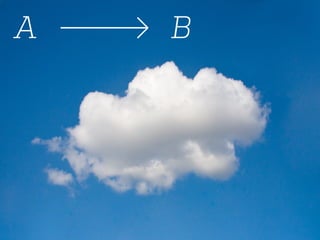
A B
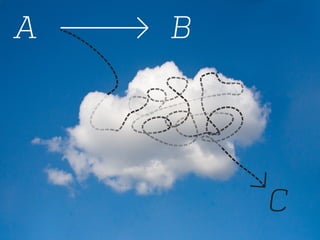
A B
C
Thank you!
Спасибо!
Collaborators:
Jari Saramäki
Naoki Masuda
Luis Rocha
Sungmin Lee
Fredrik Liljeros
Fariba Karimi
Illustrations by:
Mi Jin Lee

Spreading processes on temporal networks

  • 1.
    Spreading phenomena on temporalnetworks Petter Holme
  • 2.
  • 4.
  • 5.
  • 6.
    Temporal networks How canwe measure them? sociopatterns.org
  • 7.
  • 8.
    Temporal networks Timelines ofnodes 0 5 10 15 20 1 2 3 4 5 6 t
  • 9.
  • 12.
  • 13.
    Temporal nwk. epidemiology Susceptible meets Infectious Infectious Withsome probability or rate Susceptible or Recovered With some rate or after some time Step 1: Compartmental models
  • 14.
  • 15.
  • 16.
  • 17.
    Rocha, Liljeros, Holme,2010. PNAS 107: 5706-5711. Escort/sex-buyer contacts: 16,730 individuals 50,632 contacts 2,232 days Time matters Rocha, Liljeros, Holme, 2011. PLoS Comp Biol 7: e1001109. 0 0.2 0.4 0.6 0 200 400 600 Time (days) 800 Fractionofinfectious 0 0.2 0.4 0.6 0 200 400 600 Time (days) Empirical Randomized 800 Fractionofinfectious 1555 i j t 5 7 1021 20 9 1119 4 30 1539 i j t 5 7 1555 20 9 1021 4 30 1119 4 20 15394 20
  • 18.
  • 19.
    Rocha, Liljeros, HolmeKarsai, & al. Time matters 0 0.2 0.4 0.6 0 200 400 600 Time (days) Empirical Randomized 800 Fractionofinfectious 1 0.8 0.6 0.4 0.2 0 0 100 200 300 Time (days) Fractionofinfectious
  • 20.
    1 Understanding Complex Systems PetterHolme Jari Saramäki Editors Temporal Networks Physics Reports 519 (2012) 97–125 Contents lists available at SciVerse ScienceDirect Physics Reports journal homepage: www.elsevier.com/locate/physrep Temporal networks Petter Holmea,b,c,⇤ , Jari Saramäkid a IceLab, Department of Physics, Umeå University, 901 87 Umeå, Sweden b Department of Energy Science, Sungkyunkwan University, Suwon 440–746, Republic of Korea c Department of Sociology, Stockholm University, 106 91 Stockholm, Sweden d Department of Biomedical Engineering and Computational Science, School of Science, Aalto University, 00076 Aalto, Espoo, Finland a r t i c l e i n f o Article history: Accepted 1 March 2012 Available online 6 March 2012 editor: D.K. Campbell a b s t r a c t A great variety of systems in nature, society and technology – from the web of sexual contacts to the Internet, from the nervous system to power grids – can be modeled as graphs of vertices coupled by edges. The network structure, describing how the graph is wired, helps us understand, predict and optimize the behavior of dynamical systems. In many cases, however, the edges are not continuously active. As an example, in networks of communication via e-mail, text messages, or phone calls, edges represent sequences of instantaneous or practically instantaneous contacts. In some cases, edges are active for non-negligible periods of time: e.g., the proximity patterns of inpatients at hospitals can be represented by a graph where an edge between two individuals is on throughout the time they are at the same ward. Like network topology, the temporal structure of edge activations can affect dynamics of systems interacting through the network, from disease contagion on the network of patients to information diffusion over an e-mail network. In this review, we present the emergent field of temporal networks, and discuss methods for analyzing topological and temporal structure and models for elucidating their relation to the behavior of dynamical systems. In the light of traditional network theory, one can see this framework as moving the information of when things happen from the dynamical system on the network, to the network itself. Since fundamental properties, such as the transitivity of edges, do not necessarily hold in temporal networks, many of these methods need to be quite different from those for static networks. The study of temporal networks is very interdisciplinary in nature. Reflecting this, even the object of study has many names— temporal graphs, evolving graphs, time-varying graphs, time-aggregated graphs, time- stamped graphs, dynamic networks, dynamic graphs, dynamical graphs, and so on. This review covers different fields where temporal graphs are considered, but does not attempt to unify related terminology—rather, we want to make papers readable across disciplines. © 2012 Elsevier B.V. All rights reserved. Contents 1. Introduction.......................................................................................................................................................................................... 98 2. Types of temporal networks................................................................................................................................................................ 100 2.1. Person-to-person communication.......................................................................................................................................... 100 2.2. One-to many information dissemination............................................................................................................................... 101 2.3. Physical proximity ................................................................................................................................................................... 101 2.4. Cell biology............................................................................................................................................................................... 101 ⇤ Corresponding author at: IceLab, Department of Physics, Umeå University, 901 87 Umeå, Sweden. E-mail address: petter.holme@physics.umu.se (P. Holme). 0370-1573/$ – see front matter © 2012 Elsevier B.V. All rights reserved. doi:10.1016/j.physrep.2012.03.001
  • 21.
    Holme, Scientific Reports,2015. Time matters 0.2 0.3 0.1 0 P(Ω) Temporal network 0.001 0.01 0.1 1 0.001 0.01 0.1 1 λ δ/T 0.2 0.6 0.4 0 0.5 0 1 P(Ω) P(Ω) Static network Fully mixed 0.001 0.01 0.1 1 0.001 0.01 0.1 1 λ δ/T 0.001 0.01 0.1 1 0.001 0.01 0.1 1 λ δ/T
  • 22.
  • 23.
    History Network 1. Laszlo Barabási discoversa power-law. 2. It makes a difference for spreading dynamics. 3. It helps us to understand real epidemics. Time 1. Laszlo Barabási discovers a power-law. 2. It makes a difference for spreading dynamics. 3. It helps us to understand real epidemics.
  • 24.
    Fat-tailed interevent timedistributions Slowing down of spreading. 10-12 10 -10 10 -8 10-6 10 -4 10 -2 10 0 10 2 10 4 10 0 10 1 10 2 10 3 10 4 10 5 10 6 10 7 10 8 Poisson Power-law Time Incidence/N Min, Goh, Vazquez, 2011. PRE 83, 036102. But both the cell phone and the prostitution data are bursty. So why are they different w.r.t. spreading? Interevent times
  • 27.
    Europhys. Lett., 64(3), pp. 427–433 (2003) EUROPHYSICS LETTERS 1 November 2003 Network dynamics of ongoing social relationships P. Holme(∗ ) Department of Physics, Ume˚a University - 901 87 Ume˚a, Sweden (received 21 July 2003; accepted in final form 22 August 2003) PACS. 89.65.-s – Social and economic systems. PACS. 89.75.Hc – Networks and genealogical trees. PACS. 89.75.-k – Complex systems. Abstract. – Many recent large-scale studies of interaction networks have focused on networks of accumulated contacts. In this letter we explore social networks of ongoing relationships with an emphasis on dynamical aspects. We find a distribution of response times (times between consecutive contacts of different direction between two actors) that has a power law shape over a large range. We also argue that the distribution of relationship duration (the time between the first and last contacts between actors) is exponentially decaying. Methods to reanalyze the data to compensate for the finite sampling time are proposed. We find that the degree distribution for networks of ongoing contacts fits better to a power law than the degree distribution of the network of accumulated contacts do. We see that the clustering and assortative mixing coefficients are of the same order for networks of ongoing and accumulated contacts, and that the structural fluctuations of the former are rather large. Introduction. – The recent development in database technology has allowed researchers to extract very large data sets of human interaction sequences. These large data sets are suitable to the methods and modeling techniques of statistical physics, and thus, the last years have witnessed the appearance of an interdisciplinary field between physics and sociology [1–3]. More specifically, these studies have focused on network structure —in what ways the networks
  • 28.
    Limited communication capacityunveils strategies for human interaction Giovanna Miritello1,2 , Rube´n Lara2 , Manuel Cebrian3,4 & Esteban Moro1,5 1 Departamento de Matema´ticas & GISC, Universidad Carlos III de Madrid, 28911 Legane´s, Spain, 2 Telefo´nica Research, 28050 Madrid, Spain, 3 NICTA, Melbourne, Victoria 3010, Australia, 4 Department of Computer Science & Engineering, University of California at San Diego, La Jolla, CA 92093, USA, 5 Instituto de Ingenierı´a del Conocimiento, Universidad Auto´noma de Madrid, 28049 Madrid, Spain. Connectivity is the key process that characterizes the structural and functional properties of social networks. However, the bursty activity of dyadic interactions may hinder the discrimination of inactive ties from large interevent times in active ones. We develop a principled method to detect tie de-activation and apply it to a large longitudinal, cross-sectional communication dataset (<19 months, <20 million people). Contrary to the perception of ever-growing connectivity, we observe that individuals exhibit a finite communication capacity, which limits the number of ties they can maintain active in time. On average men display higher capacity than women, and this capacity decreases for both genders over their lifespan. Separating communication capacity from activity reveals a diverse range of tie activation strategies, from stable to exploratory. This allows us to draw novel relationships between individual strategies for human interaction and the evolution of social networks at global scale. any different forces govern the evolution of social relationships making them far from random. In recent years, the understanding of what mechanisms control the dynamics of activating or deactivating social SUBJECT AREAS: SCIENTIFIC DATA COMPLEX NETWORKS APPLIED MATHEMATICS STATISTICAL PHYSICS Received 15 January 2013 Accepted 2 May 2013 Published 6 June 2013 Correspondence and requests for materials should be addressed to E.M. (emoro@math.
  • 29.
  • 30.
  • 31.
    T0 T0 Beginning interval neutralized T0 T0 Intereventtimes neutralized End interval neutralized T0 T0 Reference models
  • 32.
    SIR on prostitutiondata 0 0.1 0.2 0.3 0.1 0.2 0.90.8 10.70.60.50.40.3 0.1 1 0.01 0.001 per-contact transmission probability durationofinfection Ω
  • 33.
    SIR on prostitutiondata 0 0.1 0.2 0.3 0.1 0.2 0.90.8 10.70.60.50.40.3 0.1 1 0.01 0.001 per-contact transmission probability durationofinfection Ω Interevent times neutralized
  • 34.
    SIR on prostitutiondata 0 0.1 0.2 0.3 0.1 0.2 0.90.8 10.70.60.50.40.3 0.1 1 0.01 0.001 per-contact transmission probability durationofinfection Ω Beginning times neutralized
  • 35.
    SIR on prostitutiondata 0 0.1 0.2 0.3 0.1 0.2 0.90.8 10.70.60.50.40.3 0.1 1 0.01 0.001 per-contact transmission probability durationofinfection Ω End times neutralized
  • 36.
    SIR, average deviations 0 0.02 0.04 0.06 E-mail1 0.1 0 0.05 Film 0 0.05 0.1 Dating 1 0.05 0.1 0.15 0.2 0 Forum 0 0.02 0.04 0.06 E-mail 2 0 0.02 0.06 0.08 0.04 Facebook 0 0.01 0.02 0.03 0.04 Prostitution 0 0.1 0.2 0.3 Hospital 0 0.04 0.06 0.08 0.02 Gallery 0 0.02 0.04 0.06 Conference 0.05 0.1 0 Dating 2 endtimes beginningtimes intereventtimes Holme, Liljeros, 2014. Scientific Reports 4: 4999.
  • 37.
    Temporal structures 2 …ano-brain (low-brain?) approach but what about yet other structures?
  • 38.
    School 2 ConferenceProstitution Hospital Reality Gallery1 School 1 Gallery 2 –3 –2 –1 0lg λ –3 –2 –1 0 lgδ –3 –2 –1 0lg λ –3 –2 –1 0 lgδ –3 –2 –1 0lg λ –3 –2 –1 0 lgδ –3 –2 –1 0lg λ –3 –2 –1 0 lgδ –3 –2 –1 0lg λ –3 –2 –1 0 lgδ –3 –2 –1 0lg λ –3 –2 –1 0 lgδ –3 –2 –1 0lg λ –3 –2 –1 0 lgδ –3 –2 –1 0lg λ –3 –2 –1 0lgδ 0.75 10.50 τ / T 0.25
  • 39.
    Outbreak duration School 2 ConferenceProstitutionHospital Reality Gallery 1 School 1 Gallery 2 –3 –2 –1 0lg λ –3 –2 –1 0 lgδ –3 –2 –1 0lg λ –3 –2 –1 0 lgδ –3 –2 –1 0lg λ –3 –2 –1 0 lgδ –3 –2 –1 0lg λ –3 –2 –1 0 lgδ –3 –2 –1 0lg λ –3 –2 –1 0 lgδ –3 –2 –1 0lg λ –3 –2 –1 0 lgδ –3 –2 –1 0lg λ –3 –2 –1 0 lgδ –3 –2 –1 0lg λ –3 –2 –1 0lgδ 0.75 10.50 τ / T 0.25
  • 40.
    vs static nwks School2 ConferenceProstitution Hospital Reality Gallery 1 School 1 Gallery 2 –3 –2 –1 0lg λ –3 –2 –1 0 lgδ –3 –2 –1 0lg λ –3 –2 –1 0 lgδ –3 –2 –1 0lg λ –3 –2 –1 0 lgδ –3 –2 –1 0lg λ –3 –2 –1 0 lgδ –3 –2 –1 0lg λ –3 –2 –1 0 lgδ –3 –2 –1 0lg λ –3 –2 –1 0 lgδ –3 –2 –1 0lg λ –3 –2 –1 0 lgδ –3 –2 –1 0lg λ –3 –2 –1 0lgδ 0.5 10–0.5 lg σ
  • 41.
    –3 –2 –10lg λ –3 –2 –1 0 lgδ –3 –2 –1 0lg λ –3 –2 –1 0 lgδ –3 –2 –1 0lg λ –3 –2 –1 0 lgδ –3 –2 –1 0lg λ –3 –2 –1 0 lgδ –3 –2 –1 0lg λ –3 –2 –1 0 lgδ –3 –2 –1 0lg λ –3 –2 –1 0 lgδ –3 –2 –1 0lg λ –3 –2 –1 0 lgδ –3 –2 –1 0lg λ –3 –2 –1 0lgδ 0.5 10–0.5 lg σ School 2School 1 ConferenceProstitution Hospital Reality Gallery 1 Gallery 2 vs fully-connected nwks
  • 42.
  • 43.
    Ridiculograms (time) 0 T/2Tt 0 T/2 Tt 0 T/2 Tt 0 T/2 Tt 0 T/2 Tt 0 T/2 Tt 0 T/2 Tt 0 T/2 Tt School 2School 1 ConferenceProstitution Hospital Reality Gallery 1 Gallery 2
  • 44.
    Network structures avg. fractionof nodes present when 50% of contact happened avg. fraction of links present when 50% of contact happened avg. fraction of nodes present at 50% of the sampling time avg. fraction of links present at 50% of the sampling time frac. of nodes present 1st and last 10% of the contacts frac. of links present 1st and last 10% of the contacts frac. of nodes present 1st and last 10% of the sampling time frac. of links present 1st and last 10% of the sampling time Time evolution degree distribution, mean degree distribution, s.d. degree distribution, coefficient of variation degree distribution, skew Degree distribution link duration, mean link duration, s.d. link duration, coefficient of variation link duration, skew link interevent time, mean link interevent time, s.d. link interevent time, coefficient of variation link interevent time, skew Link activity Node activity node duration, mean node duration, s.d. node duration, coefficient of variation node duration, skew node interevent time, mean node interevent time, s.d. node interevent time, coefficient of variation node interevent time, skew Other network structure number of nodes clustering coefficient assortativity
  • 45.
    Network structures 0 10.5 averagelife time of nodes 0.10 0.2 0.3 average life time of links fraction of nodes present after half of the contacts 0.5 10.6 0.7 0.8 0.9 x = 0.392 x = 0.418 x = 0.487 Prostitution Conference Hospital Gallery 2Gallery 1School 1 School 2 Reality
  • 46.
  • 47.
    Assume we canvaccinate a fraction f, then how can we choose the people to vaccinate? Using only local info? Vaccination
  • 48.
    Chose a personat random. Neighborhood vaccination Cohen, Havlin, ben Avraham, 2002.
  • 49.
    Ask her toname a friend. Neighborhood vaccination Cohen, Havlin, ben Avraham, 2002.
  • 50.
    Vaccinate the friend. Neighborhoodvaccination Cohen, Havlin, ben Avraham, 2002.
  • 51.
    Lee, Rocha, Liljeros,Holme, 2012. PLoS ONE 7:e36439. Vaccination
  • 52.
    Lee, Rocha, Liljeros,Holme, 2012. PLoS ONE 7:e36439. Vaccination
  • 53.
    Lee, Rocha, Liljeros,Holme, 2012. PLoS ONE 7:e36439. Vaccination
  • 54.
    Lee, Rocha, Liljeros,Holme, 2012. PLoS ONE 7:e36439. Vaccination
  • 55.
  • 56.
  • 57.
    Spreading by thresholddynamics Takaguchi, Masuda, Holme, 2013. Bursty communication patterns facilitate spreading in a threshold-based epidemic dynamics. PLoS ONE 8:e68629. Karimi, Holme, 2013. Threshold model of cascades in empirical temporal networks. Physica A 392:3476– 3483. Random walks Holme, Saramäki, 2015. Exploring temporal networks with greedy walks. Eur J Phys B 88:334. Review papers Masuda, Holme, 2013. Predicting and controlling infectious disease epidemics using temporal networks. F1000Prime Rep. 5:6. Holme, 2015. Modern temporal network theory: A colloquium. Eur J Phys B 88:234. Holme, 2014. Analyzing temporal networks in social media, Proc. IEEE 102:1922–1933.
  • 58.
  • 59.
  • 60.
    Thank you! Спасибо! Collaborators: Jari Saramäki NaokiMasuda Luis Rocha Sungmin Lee Fredrik Liljeros Fariba Karimi Illustrations by: Mi Jin Lee