Terrorism - Introduction
Marian Żuber, Assoc. Prof.
Military University of Land Forces
Wroclaw, Poland
Erasmus Programme, 2019
2
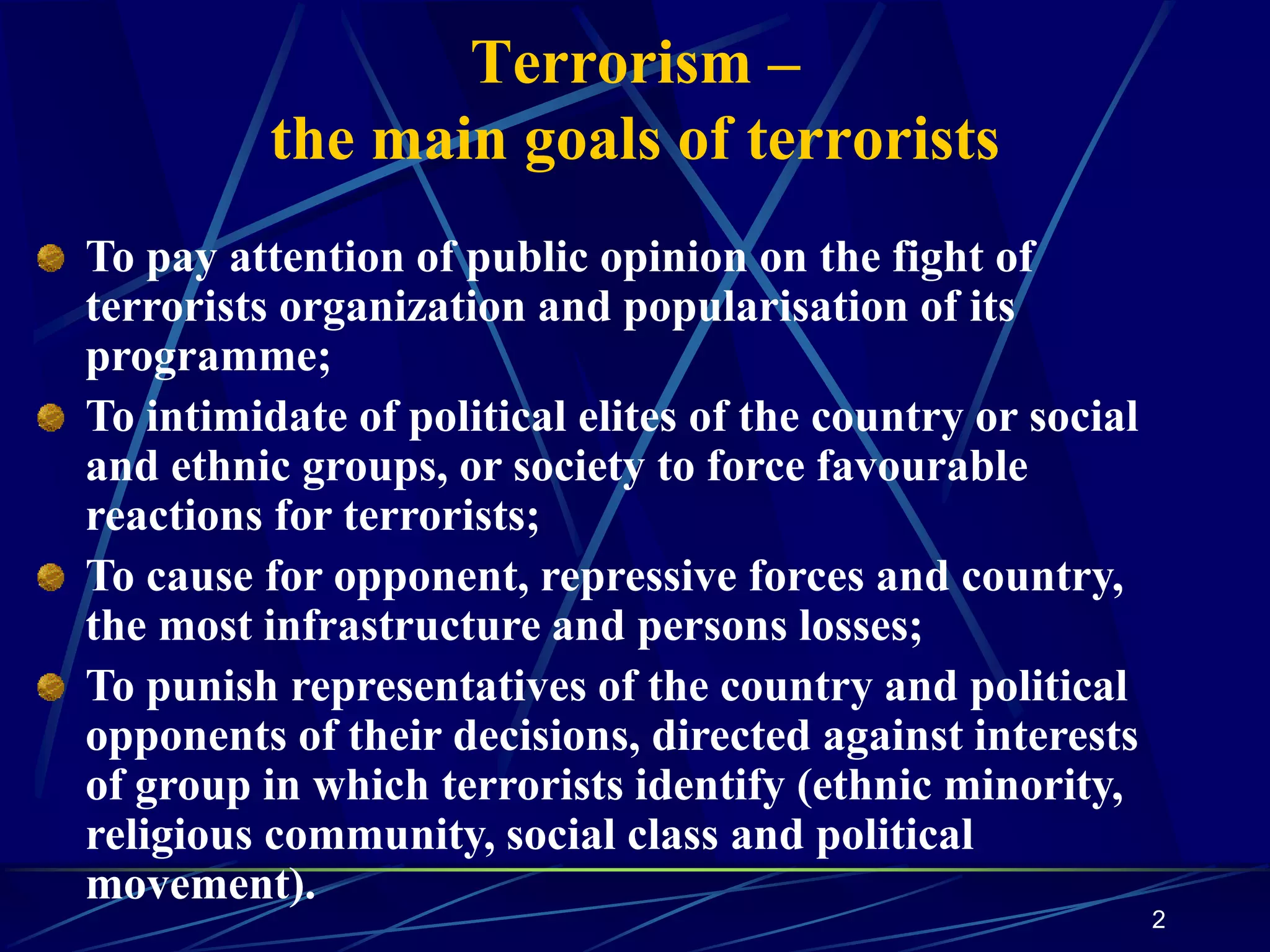
Terrorism –
the main goals of terrorists
To pay attention of public opinion on the fight of
terrorists organization and popularisation of its
programme;
To intimidate of political elites of the country or social
and ethnic groups, or society to force favourable
reactions for terrorists;
To cause for opponent, repressive forces and country,
the most infrastructure and persons losses;
To punish representatives of the country and political
opponents of their decisions, directed against interests
of group in which terrorists identify (ethnic minority,
religious community, social class and political
movement).
3
Political violence
4
Terrorism - main features
Terrorism is
 (1) an intentional,
 (2) rational,
 (3) act of violence,
 (4) to achieve a political goal,
 (5) by causing fear,
 (6) in the target audience or society,
 (7) in order to change behavior in that audience or
society.
5
Terrorism
 L 1.The act of terrorizing, or state of being
terrorized; a mode of government by terror
or intimidation.
 L 2.The practice of coercing governments to
accede to political demands by committing
violence on civilian targets; any similar use
of violence to achieve goals.
Terrorism – definition
Websters Dictionary
6
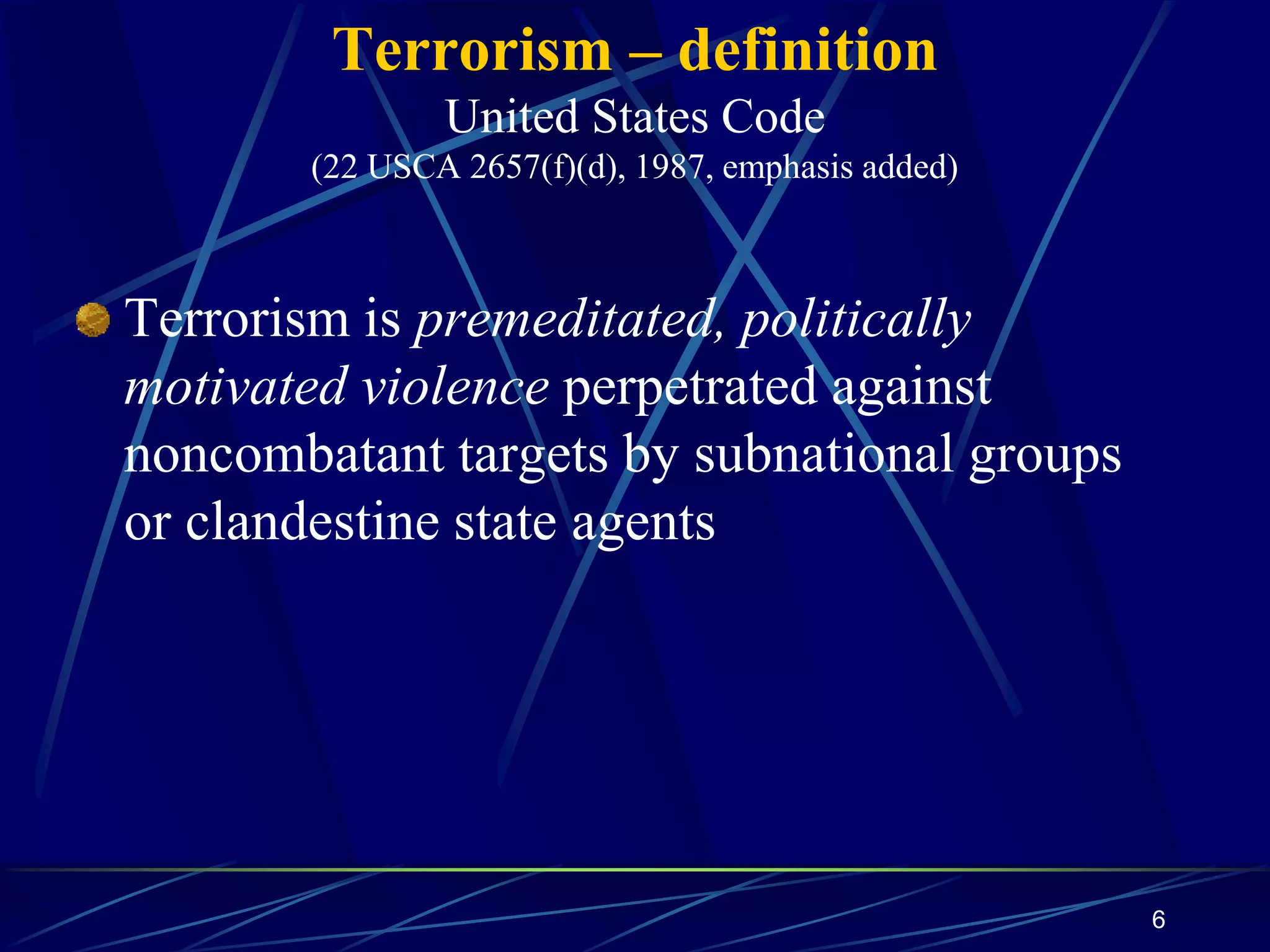
Terrorism is premeditated, politically
motivated violence perpetrated against
noncombatant targets by subnational groups
or clandestine state agents
Terrorism – definition
United States Code
(22 USCA 2657(f)(d), 1987, emphasis added)
7
Terrorism involves the use of violence
by an organization other than a national
government to cause intimidation or fear
among a target audience
Terrorism – definition
Departament of State
8
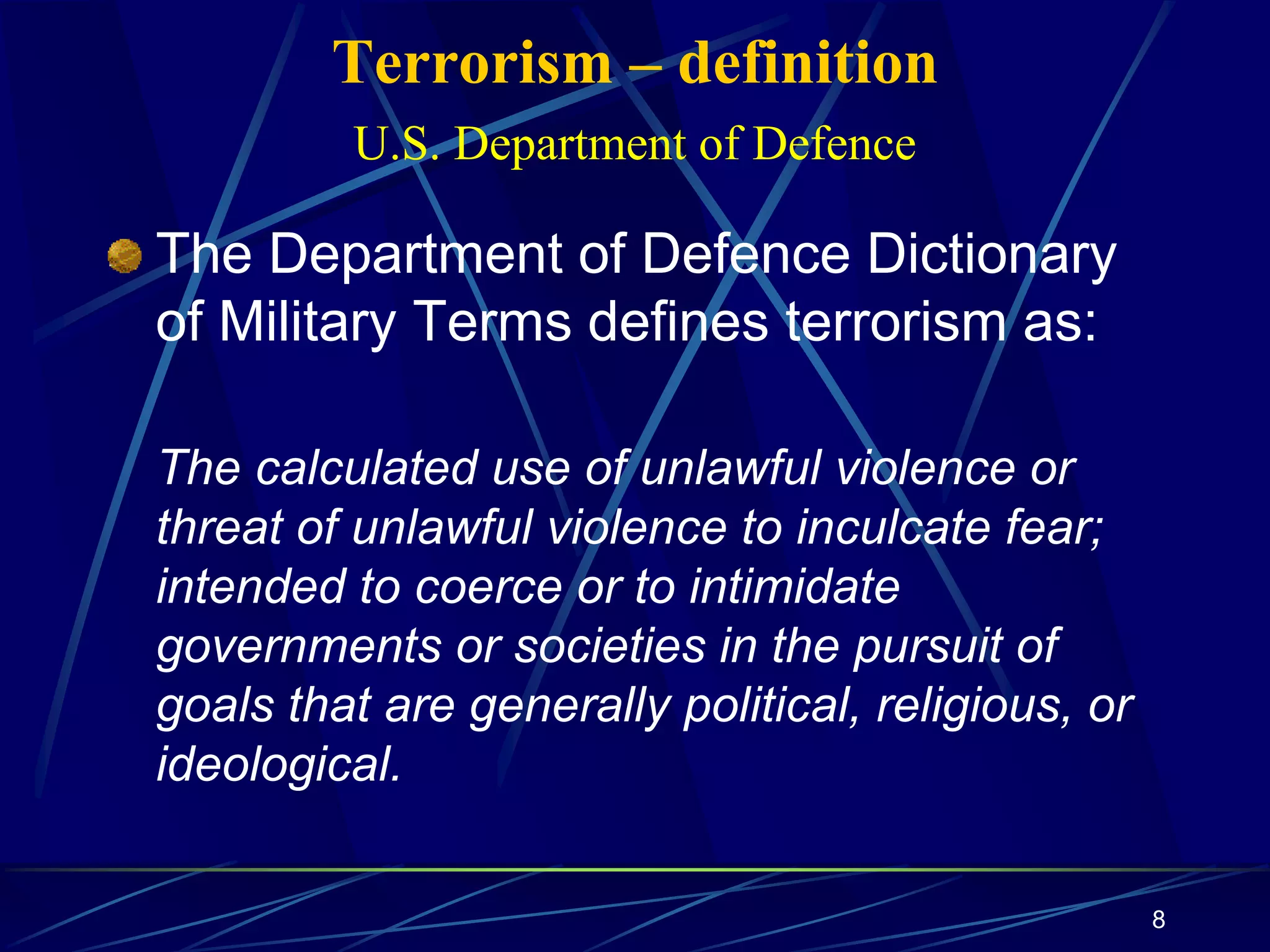
Terrorism – definition
U.S. Department of Defence
The Department of Defence Dictionary
of Military Terms defines terrorism as:
The calculated use of unlawful violence or
threat of unlawful violence to inculcate fear;
intended to coerce or to intimidate
governments or societies in the pursuit of
goals that are generally political, religious, or
ideological.
9
Factor Participation, %
· using of violence or force 83,5
· political goals or outcomes 65,0
· fear or terror in a population 51,0
· the threat of violence 47,0
· produce psychological reactions 41,5
· differentiation between victim and target 37,5
· the act being organized, planned, systematic, and
one with a purpose
32,0
· strategy, tactic 30,5
· outside of normal human constraints and outside
accepted rules of combat
30,0
· use of coercion or extortion 28,0
· dimensions of publicity 21,5
Terrorism – characteristics of definition
10
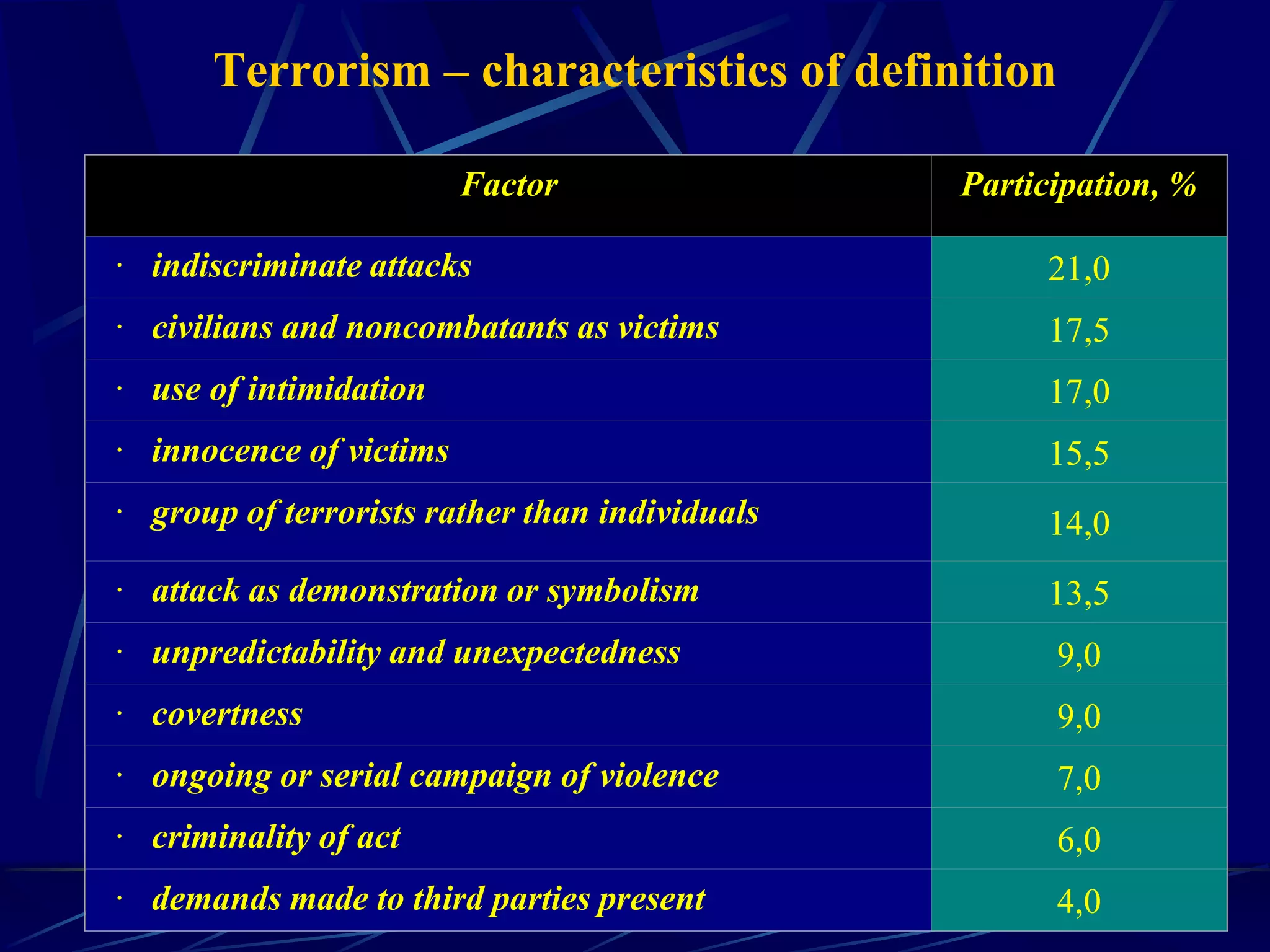
Factor Participation, %
· indiscriminate attacks 21,0
· civilians and noncombatants as victims 17,5
· use of intimidation 17,0
· innocence of victims 15,5
· group of terrorists rather than individuals 14,0
· attack as demonstration or symbolism 13,5
· unpredictability and unexpectedness 9,0
· covertness 9,0
· ongoing or serial campaign of violence 7,0
· criminality of act 6,0
· demands made to third parties present 4,0
Terrorism – characteristics of definition
11
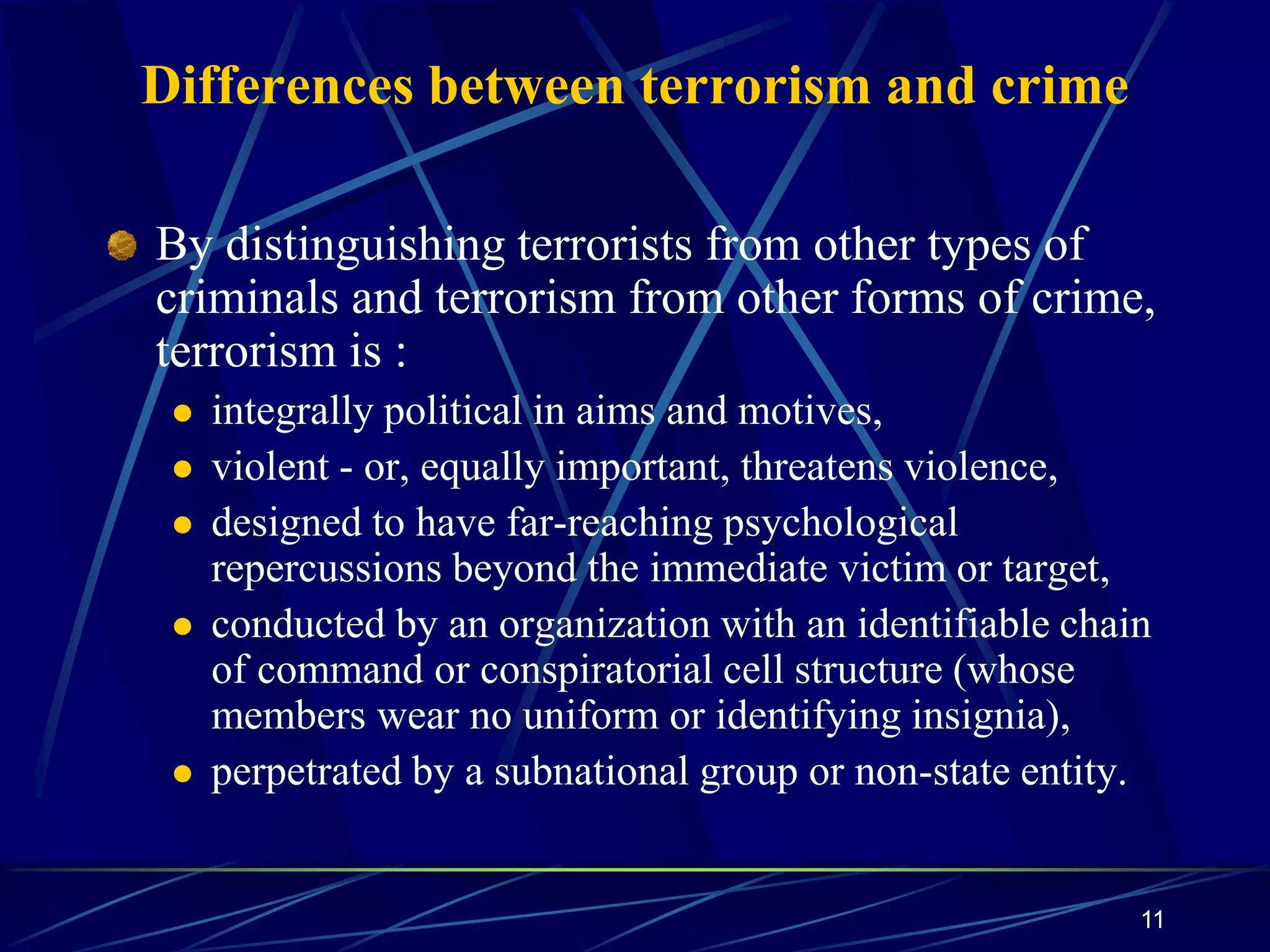
Differences between terrorism and crime
By distinguishing terrorists from other types of
criminals and terrorism from other forms of crime,
terrorism is :
 integrally political in aims and motives,
 violent - or, equally important, threatens violence,
 designed to have far-reaching psychological
repercussions beyond the immediate victim or target,
 conducted by an organization with an identifiable chain
of command or conspiratorial cell structure (whose
members wear no uniform or identifying insignia),
 perpetrated by a subnational group or non-state entity.
12
Terrorism - clasification
Basic typology
Dominant motivation
Functional typology
Ideology
13
Terrorism – basic typology
Domestic – (home-grown or internal)
terrorists originate and act within their
own political systems (e.g. the April
1995 Oklahoma City bombing in the
USA)
International - terrorist activities
conducted on the territory of more than
one state or involving citizens of more
than one state (as victims or
perpetrators) .
14
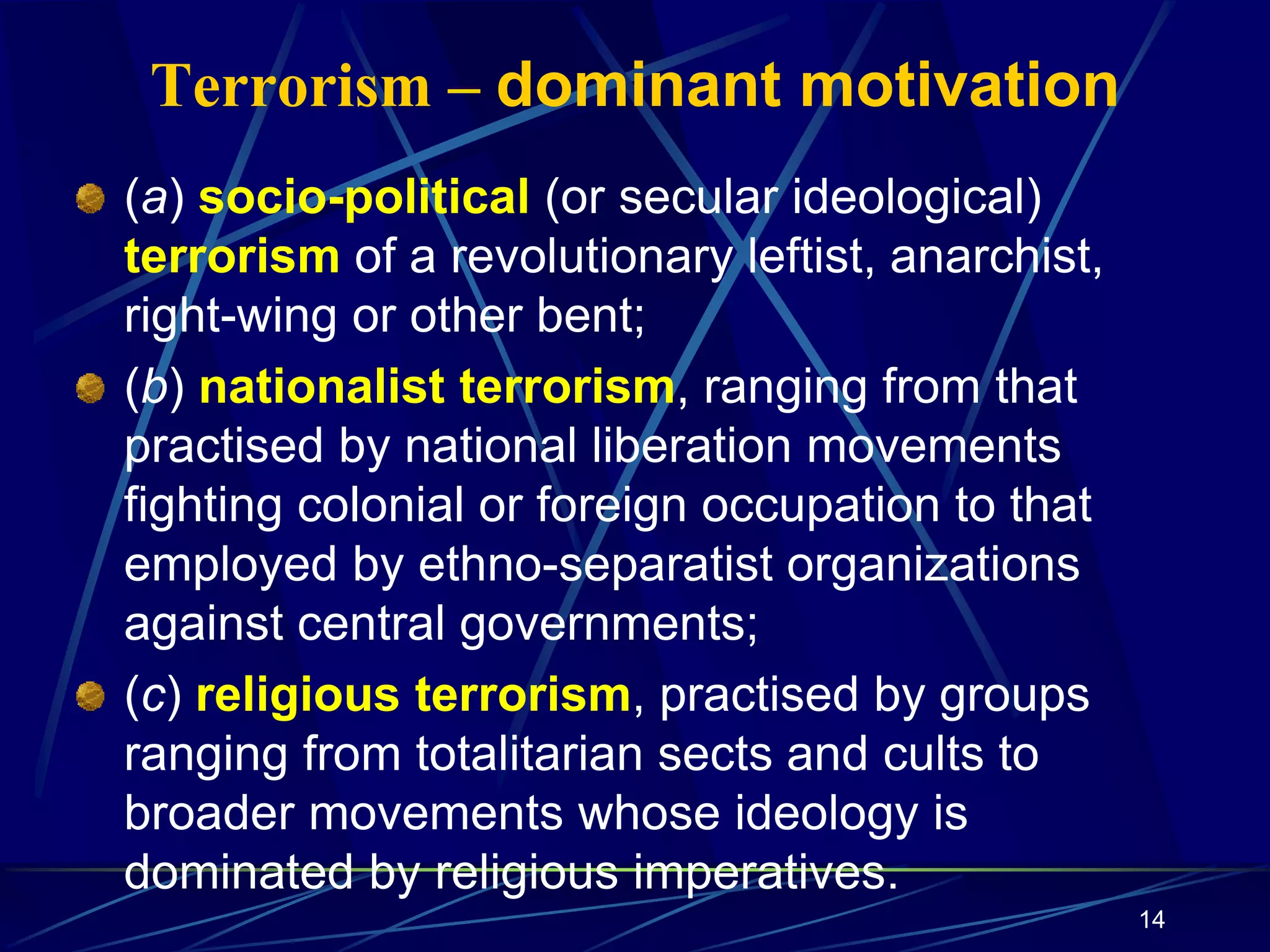
Terrorism – dominant motivation
(a) socio-political (or secular ideological)
terrorism of a revolutionary leftist, anarchist,
right-wing or other bent;
(b) nationalist terrorism, ranging from that
practised by national liberation movements
fighting colonial or foreign occupation to that
employed by ethno-separatist organizations
against central governments;
(c) religious terrorism, practised by groups
ranging from totalitarian sects and cults to
broader movements whose ideology is
dominated by religious imperatives.
15
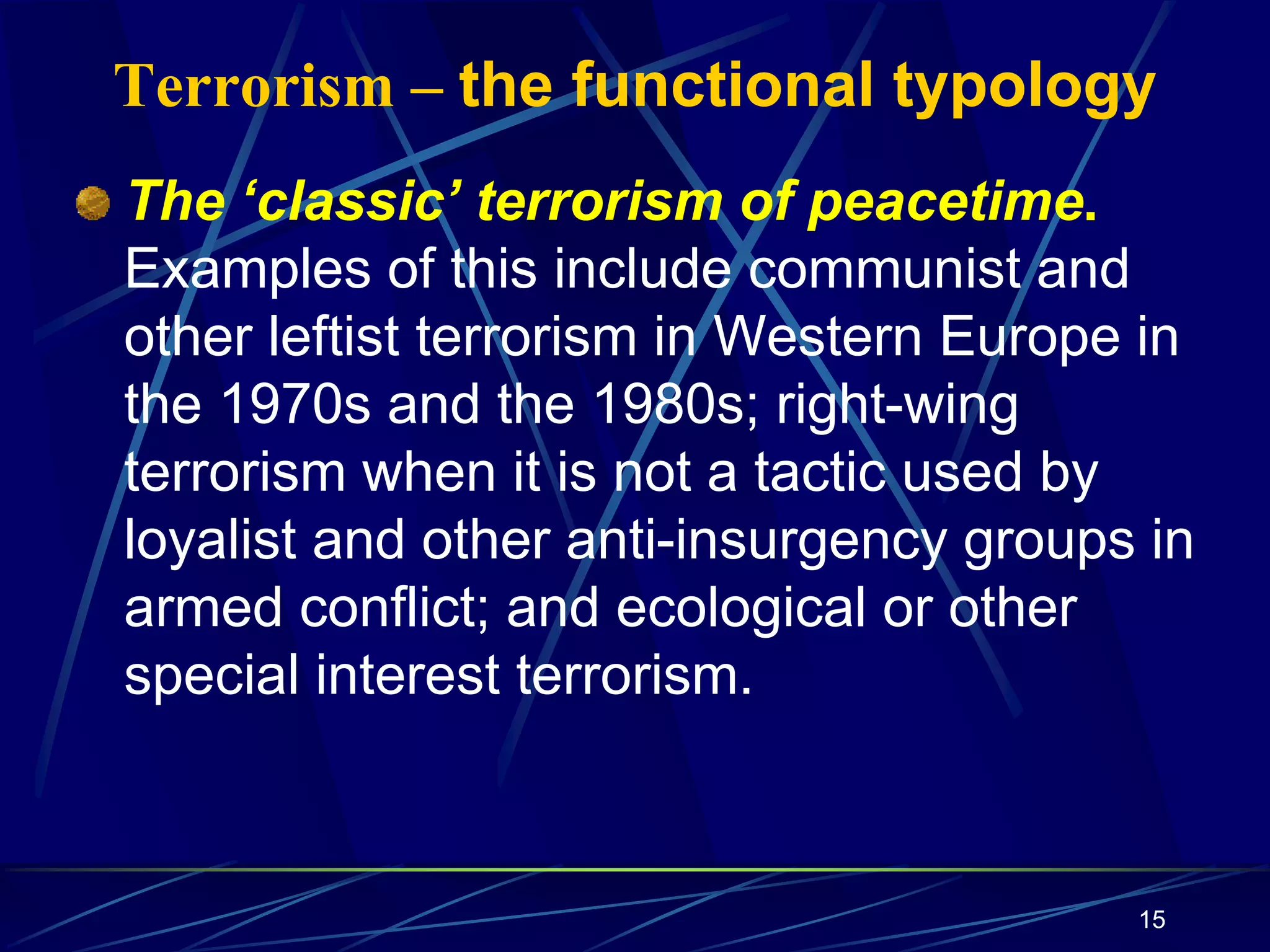
Terrorism – the functional typology
The ‘classic’ terrorism of peacetime.
Examples of this include communist and
other leftist terrorism in Western Europe in
the 1970s and the 1980s; right-wing
terrorism when it is not a tactic used by
loyalist and other anti-insurgency groups in
armed conflict; and ecological or other
special interest terrorism.
16
Terrorism – the functional typology
Conflict-related terrorism. Such terrorism
is systematically employed as a tactic in
asymmetrical local or regional armed
conflicts (e.g. by Chechen, Kashmiri,
Palestinian, Tamil and other militants).
Conflict-related terrorism is tied to the
concrete agenda of a particular armed
conflict and terrorists identify themselves
with a particular political cause (or causes)
- the incompatibility over which the conflict
is fought.
17
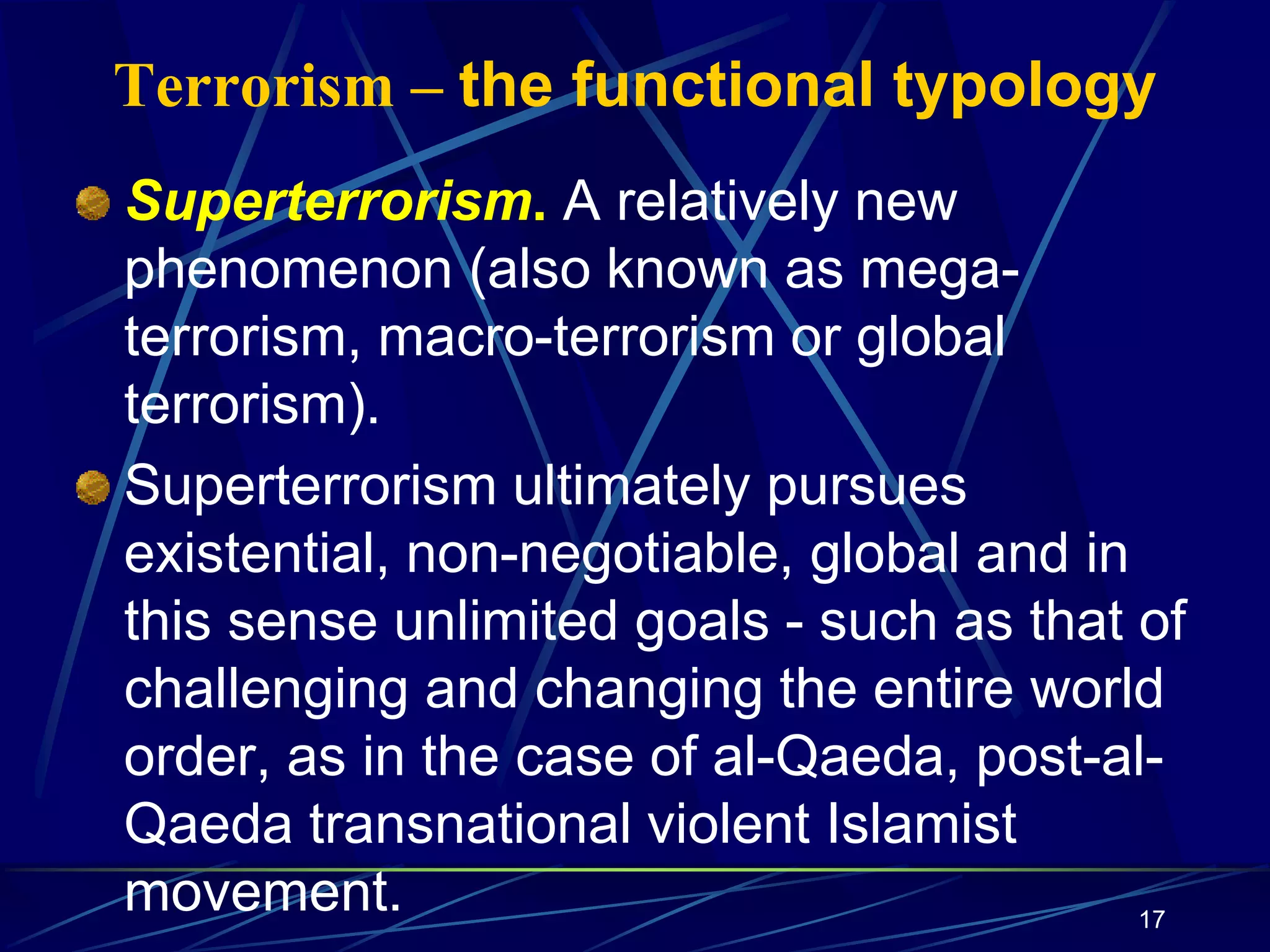
Terrorism – the functional typology
Superterrorism. A relatively new
phenomenon (also known as mega-
terrorism, macro-terrorism or global
terrorism).
Superterrorism ultimately pursues
existential, non-negotiable, global and in
this sense unlimited goals - such as that of
challenging and changing the entire world
order, as in the case of al-Qaeda, post-al-
Qaeda transnational violent Islamist
movement.
18
Clasification of terrorism - ideology
Extreme Right-Wing
Extreme Left-Wing
Religious
Ethnonationalist/Separatist
Single Issue
19
Clasification of terrorism - ideology
Extreme Right-Wing: groups that believe that one’s
personal and/or national “way of life” is under attack
and is either already lost or that the threat is imminent
(for some the threat is from a specific ethnic, racial, or
religious group), and believe in the need to be prepared
for an attack either by participating in paramilitary
preparations and training or survivalism. Groups may
also be fiercely nationalistic (as opposed to universal
and international in orientation), anti-global, suspicious
of centralized federal authority, reverent of individual
liberty, and believe in conspiracy theories that involve
grave threat to national sovereignty and/or personal
liberty (Organization of Suprematists in USA).
20
Clasification of terrorism - ideology
Extreme Left-Wing: groups that want to bring
about change through violent revolution rather
than through established political processes.
This category also includes secular left-wing
groups that rely heavily on terrorism to
overthrow the capitalist system and either
establish “a dictatorship of the proletariat”
(Marxist-Leninists) or, much more rarely, a
decentralized, non-hierarchical political system
(anarchists) (Rote Armee Fraction - Germany,
Brigade Rose - Italy, Action Directe - France).
21
Clasification of terrorism - ideology
Religious: groups that seek to smite the
purported enemies of God and other evildoers,
impose strict religious tenets or laws on society
(fundamentalists), forcibly insert religion into
the political sphere (e.g., those who seek to
politicize religion, such as Christian
Reconstructionists and Islamists), and/or bring
about Armageddon (apocalyptic millenarian
cults). For example, Aum Shinrikyo, Jewish
Direct Action, Mormon extremist, Jamaat-al-
Fuqra, and Covenant, Sword and the Arm of the
Lord (CSA) are included in this category.
22
Clasification of terrorism - ideology
Ethno-Nationalist/Separatist: regionally
concentrated groups with a history of organized
political autonomy with their own state,
traditional ruler, or regional government, who
are committed to gaining or regaining political
independence through any means and who have
supported political movements for autonomy at
some time since 1945 (Front Liberation
National (FLN) in Algieria.
23
Clasification of terrorism - ideology
Single Issue: groups or individuals that
obsessively focus on very specific or narrowly -
defined causes (e.g., anti-abortion, anti-
Catholic, anti-nuclear, pro-ecology). This
category includes groups from all sides of the
political spectrum.

1. terrorism basic facts

  • 1.
    Terrorism - Introduction MarianŻuber, Assoc. Prof. Military University of Land Forces Wroclaw, Poland Erasmus Programme, 2019
  • 2.
    2 Terrorism – the maingoals of terrorists To pay attention of public opinion on the fight of terrorists organization and popularisation of its programme; To intimidate of political elites of the country or social and ethnic groups, or society to force favourable reactions for terrorists; To cause for opponent, repressive forces and country, the most infrastructure and persons losses; To punish representatives of the country and political opponents of their decisions, directed against interests of group in which terrorists identify (ethnic minority, religious community, social class and political movement).
  • 3.
  • 4.
    4 Terrorism - mainfeatures Terrorism is  (1) an intentional,  (2) rational,  (3) act of violence,  (4) to achieve a political goal,  (5) by causing fear,  (6) in the target audience or society,  (7) in order to change behavior in that audience or society.
  • 5.
    5 Terrorism  L 1.Theact of terrorizing, or state of being terrorized; a mode of government by terror or intimidation.  L 2.The practice of coercing governments to accede to political demands by committing violence on civilian targets; any similar use of violence to achieve goals. Terrorism – definition Websters Dictionary
  • 6.
    6 Terrorism is premeditated,politically motivated violence perpetrated against noncombatant targets by subnational groups or clandestine state agents Terrorism – definition United States Code (22 USCA 2657(f)(d), 1987, emphasis added)
  • 7.
    7 Terrorism involves theuse of violence by an organization other than a national government to cause intimidation or fear among a target audience Terrorism – definition Departament of State
  • 8.
    8 Terrorism – definition U.S.Department of Defence The Department of Defence Dictionary of Military Terms defines terrorism as: The calculated use of unlawful violence or threat of unlawful violence to inculcate fear; intended to coerce or to intimidate governments or societies in the pursuit of goals that are generally political, religious, or ideological.
  • 9.
    9 Factor Participation, % ·using of violence or force 83,5 · political goals or outcomes 65,0 · fear or terror in a population 51,0 · the threat of violence 47,0 · produce psychological reactions 41,5 · differentiation between victim and target 37,5 · the act being organized, planned, systematic, and one with a purpose 32,0 · strategy, tactic 30,5 · outside of normal human constraints and outside accepted rules of combat 30,0 · use of coercion or extortion 28,0 · dimensions of publicity 21,5 Terrorism – characteristics of definition
  • 10.
    10 Factor Participation, % ·indiscriminate attacks 21,0 · civilians and noncombatants as victims 17,5 · use of intimidation 17,0 · innocence of victims 15,5 · group of terrorists rather than individuals 14,0 · attack as demonstration or symbolism 13,5 · unpredictability and unexpectedness 9,0 · covertness 9,0 · ongoing or serial campaign of violence 7,0 · criminality of act 6,0 · demands made to third parties present 4,0 Terrorism – characteristics of definition
  • 11.
    11 Differences between terrorismand crime By distinguishing terrorists from other types of criminals and terrorism from other forms of crime, terrorism is :  integrally political in aims and motives,  violent - or, equally important, threatens violence,  designed to have far-reaching psychological repercussions beyond the immediate victim or target,  conducted by an organization with an identifiable chain of command or conspiratorial cell structure (whose members wear no uniform or identifying insignia),  perpetrated by a subnational group or non-state entity.
  • 12.
    12 Terrorism - clasification Basictypology Dominant motivation Functional typology Ideology
  • 13.
    13 Terrorism – basictypology Domestic – (home-grown or internal) terrorists originate and act within their own political systems (e.g. the April 1995 Oklahoma City bombing in the USA) International - terrorist activities conducted on the territory of more than one state or involving citizens of more than one state (as victims or perpetrators) .
  • 14.
    14 Terrorism – dominantmotivation (a) socio-political (or secular ideological) terrorism of a revolutionary leftist, anarchist, right-wing or other bent; (b) nationalist terrorism, ranging from that practised by national liberation movements fighting colonial or foreign occupation to that employed by ethno-separatist organizations against central governments; (c) religious terrorism, practised by groups ranging from totalitarian sects and cults to broader movements whose ideology is dominated by religious imperatives.
  • 15.
    15 Terrorism – thefunctional typology The ‘classic’ terrorism of peacetime. Examples of this include communist and other leftist terrorism in Western Europe in the 1970s and the 1980s; right-wing terrorism when it is not a tactic used by loyalist and other anti-insurgency groups in armed conflict; and ecological or other special interest terrorism.
  • 16.
    16 Terrorism – thefunctional typology Conflict-related terrorism. Such terrorism is systematically employed as a tactic in asymmetrical local or regional armed conflicts (e.g. by Chechen, Kashmiri, Palestinian, Tamil and other militants). Conflict-related terrorism is tied to the concrete agenda of a particular armed conflict and terrorists identify themselves with a particular political cause (or causes) - the incompatibility over which the conflict is fought.
  • 17.
    17 Terrorism – thefunctional typology Superterrorism. A relatively new phenomenon (also known as mega- terrorism, macro-terrorism or global terrorism). Superterrorism ultimately pursues existential, non-negotiable, global and in this sense unlimited goals - such as that of challenging and changing the entire world order, as in the case of al-Qaeda, post-al- Qaeda transnational violent Islamist movement.
  • 18.
    18 Clasification of terrorism- ideology Extreme Right-Wing Extreme Left-Wing Religious Ethnonationalist/Separatist Single Issue
  • 19.
    19 Clasification of terrorism- ideology Extreme Right-Wing: groups that believe that one’s personal and/or national “way of life” is under attack and is either already lost or that the threat is imminent (for some the threat is from a specific ethnic, racial, or religious group), and believe in the need to be prepared for an attack either by participating in paramilitary preparations and training or survivalism. Groups may also be fiercely nationalistic (as opposed to universal and international in orientation), anti-global, suspicious of centralized federal authority, reverent of individual liberty, and believe in conspiracy theories that involve grave threat to national sovereignty and/or personal liberty (Organization of Suprematists in USA).
  • 20.
    20 Clasification of terrorism- ideology Extreme Left-Wing: groups that want to bring about change through violent revolution rather than through established political processes. This category also includes secular left-wing groups that rely heavily on terrorism to overthrow the capitalist system and either establish “a dictatorship of the proletariat” (Marxist-Leninists) or, much more rarely, a decentralized, non-hierarchical political system (anarchists) (Rote Armee Fraction - Germany, Brigade Rose - Italy, Action Directe - France).
  • 21.
    21 Clasification of terrorism- ideology Religious: groups that seek to smite the purported enemies of God and other evildoers, impose strict religious tenets or laws on society (fundamentalists), forcibly insert religion into the political sphere (e.g., those who seek to politicize religion, such as Christian Reconstructionists and Islamists), and/or bring about Armageddon (apocalyptic millenarian cults). For example, Aum Shinrikyo, Jewish Direct Action, Mormon extremist, Jamaat-al- Fuqra, and Covenant, Sword and the Arm of the Lord (CSA) are included in this category.
  • 22.
    22 Clasification of terrorism- ideology Ethno-Nationalist/Separatist: regionally concentrated groups with a history of organized political autonomy with their own state, traditional ruler, or regional government, who are committed to gaining or regaining political independence through any means and who have supported political movements for autonomy at some time since 1945 (Front Liberation National (FLN) in Algieria.
  • 23.
    23 Clasification of terrorism- ideology Single Issue: groups or individuals that obsessively focus on very specific or narrowly - defined causes (e.g., anti-abortion, anti- Catholic, anti-nuclear, pro-ecology). This category includes groups from all sides of the political spectrum.

Editor's Notes