Internet Operations
and
the RIRs
3 February 2011
Overview
• ARIN and the Regional Internet Registry
(RIR) System
• IP Number Resources, DNS and Routing
• IP Address Management
• Whois
ARIN and the RIR System
About ARIN
• One of five Regional Internet Registries
• Issues Internet number resources; facilitates consensus
based policies and promotes the advancement of the
Internet through education and outreach
• Services 25 Economies in the Caribbean and North
America
• Nonprofit corporation based in
Chantilly, VA, established December 1997
• 100% community funded
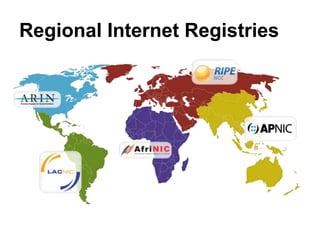
Regional Internet Registries
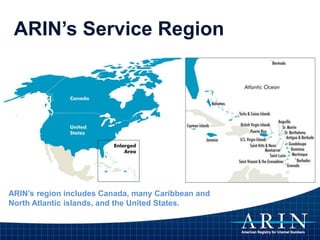
ARIN’s Service Region
ARIN’s region includes Canada, many Caribbean and
North Atlantic islands, and the United States.
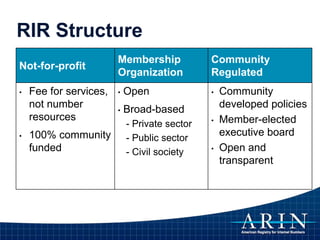
Not-for-profit
Membership
Organization
Community
Regulated
• Fee for services,
not number
resources
• 100% community
funded
• Open
• Broad-based
- Private sector
- Public sector
- Civil society
• Community
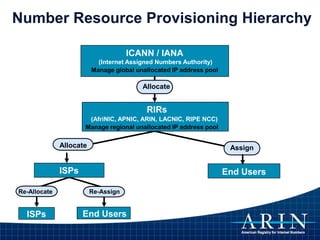
developed policies
• Member-elected
executive board
• Open and
transparent
RIR Structure
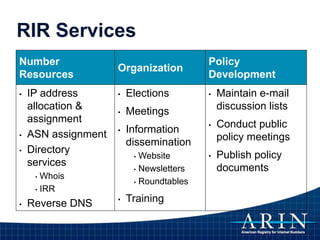
Number
Resources
Organization
Policy
Development
• IP address
allocation &
assignment
• ASN assignment
• Directory
services
• Whois
• IRR
• Reverse DNS
• Elections
• Meetings
• Information
dissemination
• Website
• Newsletters
• Roundtables
• Training
• Maintain e-mail
discussion lists
• Conduct public
policy meetings
• Publish policy
documents
RIR Services
Internet Operations
193.0.0.131
196.216.2.1
192.149.252.7
200.160.2.15
202.12.29.20
192.0.0.214
206.131.253.68
192.0.34.163
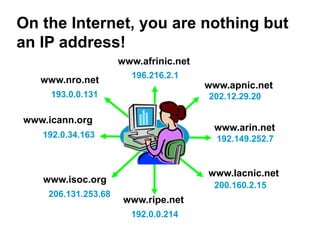
On the Internet, you are nothing but
an IP address!
202.12.29.142
www.nro.net
www.afrinic.net
www.arin.net
www.lacnic.net
www.apnic.net
www.ripe.net
www.isoc.org
www.icann.org
What is an IP Address?
An Internet Protocol (IP) address is a
number that identifies a device on a
computer network.
– Every device directly connected to the
Internet needs a unique IP address
– There are two types of IP addresses – IPv4
and IPv6
Quick History of the Internet Protocol
• Internet Protocol version 4 (IPv4, or just “IP”)
– First developed for the original Internet (ARPANET) in spring 1978
– Deployed globally with growth of the Internet
– Total of 4 billion IP addresses available
– Used by every ISP and hosting company to connect customers to the
Internet
– Allocated based on documented need
• Internet Protocol version 6 (IPv6)
– Design started in 1993 when IETF forecasts showed IPv4 depletion
between 2010 and 2017
– Completed, tested, and available for production since 1999
– Total of 340,282,366,920,938,463,463,374,607,431,768,211,456 IP
addresses available
– Used and managed similar to IPv4
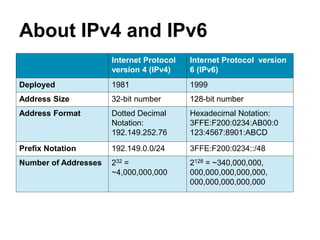
About IPv4 and IPv6
Internet Protocol
version 4 (IPv4)
Internet Protocol version
6 (IPv6)
Deployed 1981 1999
Address Size 32-bit number 128-bit number
Address Format Dotted Decimal
Notation:
192.149.252.76
Hexadecimal Notation:
3FFE:F200:0234:AB00:0
123:4567:8901:ABCD
Prefix Notation 192.149.0.0/24 3FFE:F200:0234::/48
Number of Addresses 232 =
~4,000,000,000
2128 = ~340,000,000,
000,000,000,000,000,
000,000,000,000,000
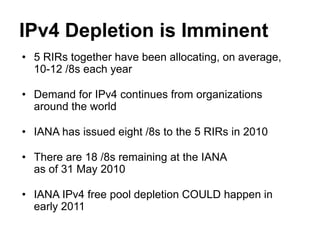
IPv4 Depletion is Imminent
• 5 RIRs together have been allocating, on average,
10-12 /8s each year
• Demand for IPv4 continues from organizations
around the world
• IANA has issued eight /8s to the 5 RIRs in 2010
• There are 18 /8s remaining at the IANA
as of 31 May 2010
• IANA IPv4 free pool depletion COULD happen in
early 2011
What is a Domain Name?
A domain name is label that a
person uses in place of an IP
address to locate a site on the
Internet, like www.arin.net.
What is the Domain Name
System (DNS)?
The Domain Name System (DNS)
is a way to store and retrieve
information about domain names
and IP addresses.
IP Addresses are Not Domain Names
• IP Address [Identifier]
– “Computer-friendly”
– Unique number identifies computer on Internet
– Used for routing (moving information across an inter-network
from a source to a destination)
• DNS Name [Reference]
– “People-Friendly”
– Maps host name to unique IP address
– A means of storing and retrieving information about
hostnames and IP addresses in a distributed data
base
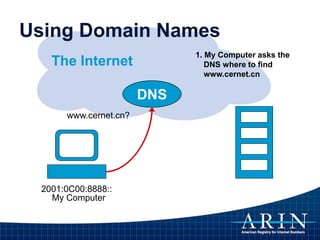
The Internet
2001:0C00:8888::
My Computer
www.cernet.cn?
Using Domain Names
DNS
1. My Computer asks the
DNS where to find
www.cernet.cn
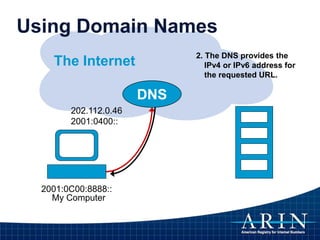
The Internet
2001:0C00:8888::
My Computer
202.112.0.46
2001:0400::
Using Domain Names
DNS
2. The DNS provides the
IPv4 or IPv6 address for
the requested URL.
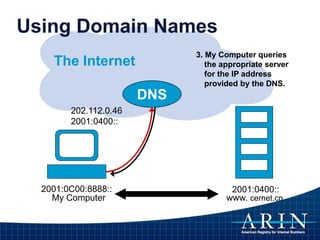
The Internet
2001:0C00:8888::
My Computer www. cernet.cn
2001:0400::
202.112.0.46
2001:0400::
Using Domain Names
DNS
3. My Computer queries
the appropriate server
for the IP address
provided by the DNS.
What is an Autonomous System
Number (ASN)?
• A globally unique number (16 or 32 bit) used by
routing protocols (like BGP) to identify an
autonomous system (a connected group of IP
networks that adhere to a single, clearly defined
routing policy)
–4,294,967,296 AS numbers (or 232)
–e.g. 36863 (16 bit), 393225 (32 bit)
What is Routing?
Routing is the act of moving
information across an internetwork
from a source to a destination.
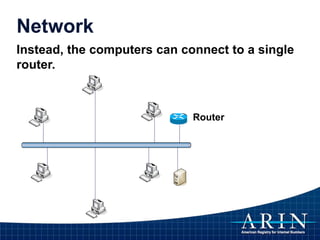
Network
Instead, the computers can connect to a single
router.
Router
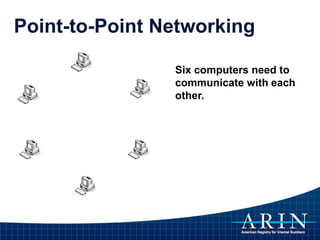
Six computers need to
communicate with each
other.
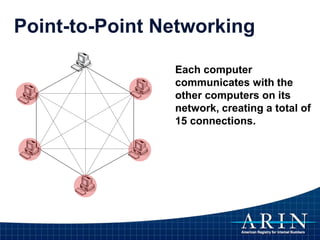
Point-to-Point Networking
Each computer
communicates with the
other computers on its
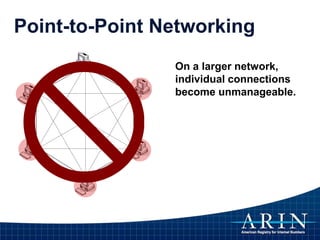
network, creating a total of
15 connections.
Point-to-Point Networking
On a larger network,
individual connections
become unmanageable.
Point-to-Point Networking
Interconnected Networks
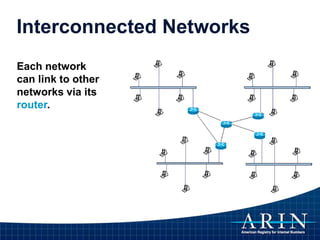
Each network
can link to other
networks via its
router.
Interconnected Networks
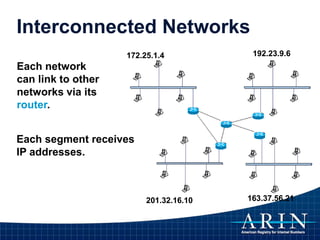
Each network
can link to other
networks via its
router.
172.25.1.4 192.23.9.6
201.32.16.10
Each segment receives
IP addresses.
163.37.56.21
172.25.1.4 192.23.9.6
201.32.16.10 163.37.56.21
Administrative Grouping
172.25.1.4 192.23.9.6
201.32.16.10
163.37.56.21
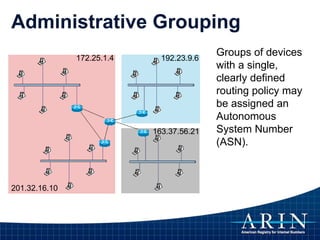
Groups of devices
with a single,
clearly defined
routing policy may
be assigned an
Autonomous
System Number
(ASN).
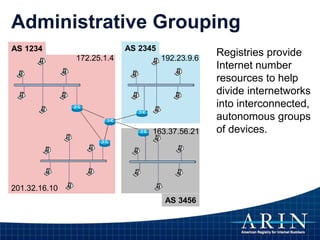
Administrative Grouping
172.25.1.4 192.23.9.6
201.32.16.10
163.37.56.21
AS 1234 AS 2345
AS 3456
Registries provide
Internet number
resources to help
divide internetworks
into interconnected,
autonomous groups
of devices.
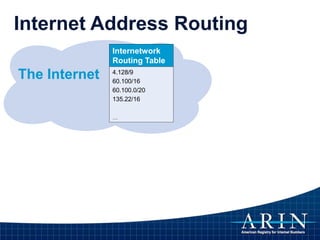
The Internet
Internet Address Routing
Internetwork
Routing Table
4.128/9
60.100/16
60.100.0/20
135.22/16
…
Internetwork
Routing Table
4.128/9
60.100/16
60.100.0/20
135.22/16
…
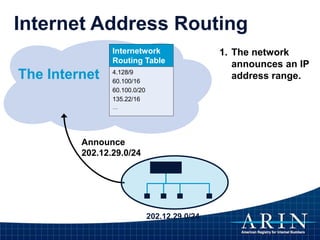
The Internet
Announce
202.12.29.0/24
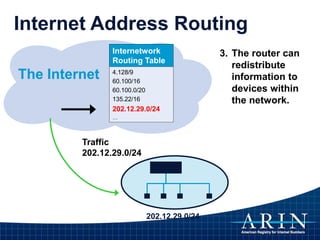
Internet Address Routing
Internetwork
Routing Table
4.128/9
60.100/16
60.100.0/20
135.22/16
…
202.12.29.0/24
1. The network
announces an IP
address range.
Internetwork
Routing Table
4.128/9
60.100/16
60.100.0/20
135.22/16
…
The Internet
Announce
202.12.29.0/24
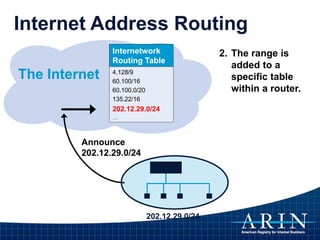
Internet Address Routing
Internetwork
Routing Table
4.128/9
60.100/16
60.100.0/20
135.22/16
…
202.12.29.0/24
2. The range is
added to a
specific table
within a router.
Internetwork
Routing Table
4.128/9
60.100/16
60.100.0/20
135.22/16
202.12.29.0/24
…
The Internet
Traffic
202.12.29.0/24
Internet Address Routing
Internetwork
Routing Table
4.128/9
60.100/16
60.100.0/20
135.22/16
…
202.12.29.0/24
3. The router can
redistribute
information to
devices within
the network.
Internetwork
Routing Table
4.128/9
60.100/16
60.100.0/20
135.22/16
202.12.29.0/24
…
Internet Address Routing
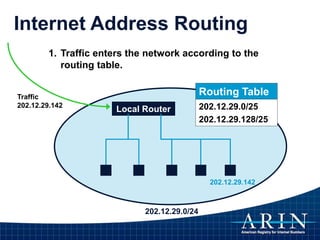
Traffic
202.12.29.142
Routing Table
202.12.29.0/25
202.12.29.128/25
Local Router
202.12.29.142
202.12.29.0/24
1. Traffic enters the network according to the
routing table.
Internet Address Routing
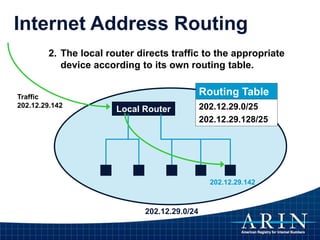
Traffic
202.12.29.142
Routing Table
202.12.29.0/25
202.12.29.128/25
Local Router
202.12.29.142
202.12.29.0/24
2. The local router directs traffic to the appropriate
device according to its own routing table.
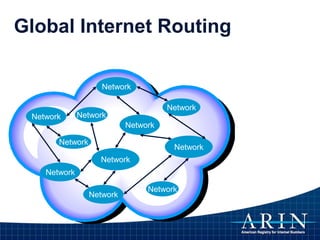
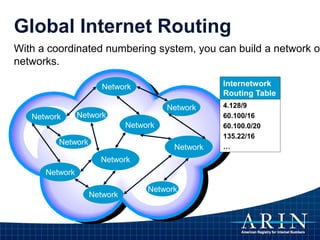
Global Internet Routing
Network
Network
Network
Network
Network
Network
Network
Network
Network
Network
Network
Global Internet Routing
Network
Network
Network
Network
Network
Network
Network
Network
Network
Network
Network
Internetwork
Routing Table
4.128/9
60.100/16
60.100.0/20
135.22/16
…
With a coordinated numbering system, you can build a network of
networks.
IP Address Management
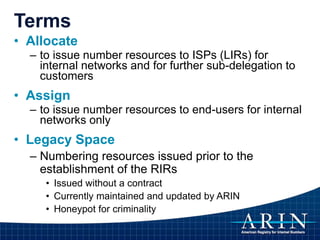
Terms
• Allocate
– to issue number resources to ISPs (LIRs) for
internal networks and for further sub-delegation to
customers
• Assign
– to issue number resources to end-users for internal
networks only
• Legacy Space
– Numbering resources issued prior to the
establishment of the RIRs
• Issued without a contract
• Currently maintained and updated by ARIN
• Honeypot for criminality
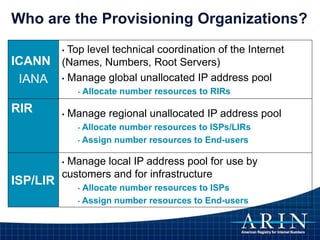
Who are the Provisioning Organizations?
ICANN
IANA
• Top level technical coordination of the Internet
(Names, Numbers, Root Servers)
• Manage global unallocated IP address pool
• Allocate number resources to RIRs
RIR • Manage regional unallocated IP address pool
• Allocate number resources to ISPs/LIRs
• Assign number resources to End-users
ISP/LIR
• Manage local IP address pool for use by
customers and for infrastructure
• Allocate number resources to ISPs
• Assign number resources to End-users
Number Resource Provisioning Hierarchy
ICANN / IANA
(Internet Assigned Numbers Authority)
Manage global unallocated IP address pool
ISPs
End UsersISPs
RIRs
(AfriNIC, APNIC, ARIN, LACNIC, RIPE NCC)
Manage regional unallocated IP address pool
Re-Allocate Re-Assign
End Users
Allocate
Allocate Assign
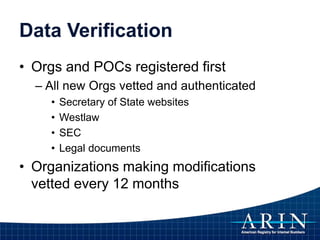
Data Verification
• Orgs and POCs registered first
– All new Orgs vetted and authenticated
• Secretary of State websites
• Westlaw
• SEC
• Legal documents
• Organizations making modifications
vetted every 12 months
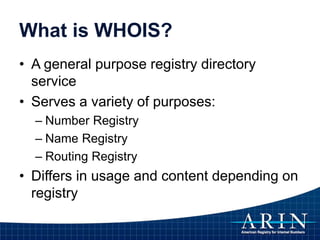
What is WHOIS?
• A general purpose registry directory
service
• Serves a variety of purposes:
– Number Registry
– Name Registry
– Routing Registry
• Differs in usage and content depending on
registry
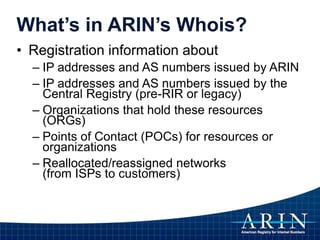
• Registration information about
– IP addresses and AS numbers issued by ARIN
– IP addresses and AS numbers issued by the
Central Registry (pre-RIR or legacy)
– Organizations that hold these resources
(ORGs)
– Points of Contact (POCs) for resources or
organizations
– Reallocated/reassigned networks
(from ISPs to customers)
What’s in ARIN’s Whois?
What’s not in ARIN’s Whois?
• Information about
– Domain names
– Host names
– Reassignments/reallocations by ISPs using their own
Whois servers (called RWHOIS)
– Military networks (see http://www.nic.mil)
• Routing information
• Geographic location of the network
– Addresses shown not necessarily the physical location of
the resource
Whois Tips
• Data not always accurate
– Registrants responsibility to update
– Legacy space rarely updated
• Not all customer reallocations/reassignments in
Whois
– Those smaller than /29 (generally)
– Those registered in RWHOIS server
– Private residence info not shown
• If you need data not shown in Whois, may need
subpoena
What Other Information Might ARIN
Have?
• Information about about an organization’s network
– Peering or exchange points to which the network may directly
connect
– An organization’s internal utilization information
– IP ranges utilizing specific types of services, e.g., DSL, webhosting,
dial-up, etc.
• Historical Data
– Previous Points of Contact for the network
– Address ranges an organization may have renumbered out of and
returned to ARIN
– Previous address registrants subsequent to a transfer or merger
• More detailed reassignment information
• Financial transaction records and billing POCs
• Corporate papers and list of officers
Useful Links
RIR’s Whois
• ARIN
http://whois.arin.net/ui/
• AfriNIC
http://www.afrinic.net/cgi-bin/whois
• APNIC
http://www.apnic.net/search/index.html
• LACNIC
http://lacnic.net/cgi-bin/lacnic/whois
• RIPE NCC
http://www.ripe.net/perl/whois
Number and Name Lookup
Services
• Domain registries
http://www.iana.org/gtld/gtld.htm
http://www.iana.org/cctld/cctld-whois.htm
• GeekTools
http://www.geektools.org/whois.php
Routing
Information
• Route Views
http://www.routeviews.org
• RIS
http://www.ripe.net/projects/ris/index.html
• Looking glass information
http://www.caida.org/analysis/routing/reversetrace/
• Blacklisting
http://www.mxtoolbox.com/blacklists.aspx
Questions?

Internet Operations and the RIRs

  • 1.
  • 2.
    Overview • ARIN andthe Regional Internet Registry (RIR) System • IP Number Resources, DNS and Routing • IP Address Management • Whois
  • 3.
    ARIN and theRIR System
  • 4.
    About ARIN • Oneof five Regional Internet Registries • Issues Internet number resources; facilitates consensus based policies and promotes the advancement of the Internet through education and outreach • Services 25 Economies in the Caribbean and North America • Nonprofit corporation based in Chantilly, VA, established December 1997 • 100% community funded
  • 5.
  • 6.
    ARIN’s Service Region ARIN’sregion includes Canada, many Caribbean and North Atlantic islands, and the United States.
  • 7.
    Not-for-profit Membership Organization Community Regulated • Fee forservices, not number resources • 100% community funded • Open • Broad-based - Private sector - Public sector - Civil society • Community developed policies • Member-elected executive board • Open and transparent RIR Structure
  • 8.
    Number Resources Organization Policy Development • IP address allocation& assignment • ASN assignment • Directory services • Whois • IRR • Reverse DNS • Elections • Meetings • Information dissemination • Website • Newsletters • Roundtables • Training • Maintain e-mail discussion lists • Conduct public policy meetings • Publish policy documents RIR Services
  • 9.
  • 10.
    193.0.0.131 196.216.2.1 192.149.252.7 200.160.2.15 202.12.29.20 192.0.0.214 206.131.253.68 192.0.34.163 On the Internet,you are nothing but an IP address! 202.12.29.142 www.nro.net www.afrinic.net www.arin.net www.lacnic.net www.apnic.net www.ripe.net www.isoc.org www.icann.org
  • 11.
    What is anIP Address? An Internet Protocol (IP) address is a number that identifies a device on a computer network. – Every device directly connected to the Internet needs a unique IP address – There are two types of IP addresses – IPv4 and IPv6
  • 12.
    Quick History ofthe Internet Protocol • Internet Protocol version 4 (IPv4, or just “IP”) – First developed for the original Internet (ARPANET) in spring 1978 – Deployed globally with growth of the Internet – Total of 4 billion IP addresses available – Used by every ISP and hosting company to connect customers to the Internet – Allocated based on documented need • Internet Protocol version 6 (IPv6) – Design started in 1993 when IETF forecasts showed IPv4 depletion between 2010 and 2017 – Completed, tested, and available for production since 1999 – Total of 340,282,366,920,938,463,463,374,607,431,768,211,456 IP addresses available – Used and managed similar to IPv4
  • 13.
    About IPv4 andIPv6 Internet Protocol version 4 (IPv4) Internet Protocol version 6 (IPv6) Deployed 1981 1999 Address Size 32-bit number 128-bit number Address Format Dotted Decimal Notation: 192.149.252.76 Hexadecimal Notation: 3FFE:F200:0234:AB00:0 123:4567:8901:ABCD Prefix Notation 192.149.0.0/24 3FFE:F200:0234::/48 Number of Addresses 232 = ~4,000,000,000 2128 = ~340,000,000, 000,000,000,000,000, 000,000,000,000,000
  • 14.
    IPv4 Depletion isImminent • 5 RIRs together have been allocating, on average, 10-12 /8s each year • Demand for IPv4 continues from organizations around the world • IANA has issued eight /8s to the 5 RIRs in 2010 • There are 18 /8s remaining at the IANA as of 31 May 2010 • IANA IPv4 free pool depletion COULD happen in early 2011
  • 15.
    What is aDomain Name? A domain name is label that a person uses in place of an IP address to locate a site on the Internet, like www.arin.net.
  • 16.
    What is theDomain Name System (DNS)? The Domain Name System (DNS) is a way to store and retrieve information about domain names and IP addresses.
  • 17.
    IP Addresses areNot Domain Names • IP Address [Identifier] – “Computer-friendly” – Unique number identifies computer on Internet – Used for routing (moving information across an inter-network from a source to a destination) • DNS Name [Reference] – “People-Friendly” – Maps host name to unique IP address – A means of storing and retrieving information about hostnames and IP addresses in a distributed data base
  • 18.
    The Internet 2001:0C00:8888:: My Computer www.cernet.cn? UsingDomain Names DNS 1. My Computer asks the DNS where to find www.cernet.cn
  • 19.
    The Internet 2001:0C00:8888:: My Computer 202.112.0.46 2001:0400:: UsingDomain Names DNS 2. The DNS provides the IPv4 or IPv6 address for the requested URL.
  • 20.
    The Internet 2001:0C00:8888:: My Computerwww. cernet.cn 2001:0400:: 202.112.0.46 2001:0400:: Using Domain Names DNS 3. My Computer queries the appropriate server for the IP address provided by the DNS.
  • 21.
    What is anAutonomous System Number (ASN)? • A globally unique number (16 or 32 bit) used by routing protocols (like BGP) to identify an autonomous system (a connected group of IP networks that adhere to a single, clearly defined routing policy) –4,294,967,296 AS numbers (or 232) –e.g. 36863 (16 bit), 393225 (32 bit)
  • 22.
    What is Routing? Routingis the act of moving information across an internetwork from a source to a destination.
  • 23.
    Network Instead, the computerscan connect to a single router. Router
  • 24.
    Six computers needto communicate with each other. Point-to-Point Networking
  • 25.
    Each computer communicates withthe other computers on its network, creating a total of 15 connections. Point-to-Point Networking
  • 26.
    On a largernetwork, individual connections become unmanageable. Point-to-Point Networking
  • 27.
    Interconnected Networks Each network canlink to other networks via its router.
  • 28.
    Interconnected Networks Each network canlink to other networks via its router. 172.25.1.4 192.23.9.6 201.32.16.10 Each segment receives IP addresses. 163.37.56.21 172.25.1.4 192.23.9.6 201.32.16.10 163.37.56.21
  • 29.
    Administrative Grouping 172.25.1.4 192.23.9.6 201.32.16.10 163.37.56.21 Groupsof devices with a single, clearly defined routing policy may be assigned an Autonomous System Number (ASN).
  • 30.
    Administrative Grouping 172.25.1.4 192.23.9.6 201.32.16.10 163.37.56.21 AS1234 AS 2345 AS 3456 Registries provide Internet number resources to help divide internetworks into interconnected, autonomous groups of devices.
  • 31.
    The Internet Internet AddressRouting Internetwork Routing Table 4.128/9 60.100/16 60.100.0/20 135.22/16 … Internetwork Routing Table 4.128/9 60.100/16 60.100.0/20 135.22/16 …
  • 32.
    The Internet Announce 202.12.29.0/24 Internet AddressRouting Internetwork Routing Table 4.128/9 60.100/16 60.100.0/20 135.22/16 … 202.12.29.0/24 1. The network announces an IP address range. Internetwork Routing Table 4.128/9 60.100/16 60.100.0/20 135.22/16 …
  • 33.
    The Internet Announce 202.12.29.0/24 Internet AddressRouting Internetwork Routing Table 4.128/9 60.100/16 60.100.0/20 135.22/16 … 202.12.29.0/24 2. The range is added to a specific table within a router. Internetwork Routing Table 4.128/9 60.100/16 60.100.0/20 135.22/16 202.12.29.0/24 …
  • 34.
    The Internet Traffic 202.12.29.0/24 Internet AddressRouting Internetwork Routing Table 4.128/9 60.100/16 60.100.0/20 135.22/16 … 202.12.29.0/24 3. The router can redistribute information to devices within the network. Internetwork Routing Table 4.128/9 60.100/16 60.100.0/20 135.22/16 202.12.29.0/24 …
  • 35.
    Internet Address Routing Traffic 202.12.29.142 RoutingTable 202.12.29.0/25 202.12.29.128/25 Local Router 202.12.29.142 202.12.29.0/24 1. Traffic enters the network according to the routing table.
  • 36.
    Internet Address Routing Traffic 202.12.29.142 RoutingTable 202.12.29.0/25 202.12.29.128/25 Local Router 202.12.29.142 202.12.29.0/24 2. The local router directs traffic to the appropriate device according to its own routing table.
  • 37.
  • 38.
    Global Internet Routing Network Network Network Network Network Network Network Network Network Network Network Internetwork RoutingTable 4.128/9 60.100/16 60.100.0/20 135.22/16 … With a coordinated numbering system, you can build a network of networks.
  • 39.
  • 40.
    Terms • Allocate – toissue number resources to ISPs (LIRs) for internal networks and for further sub-delegation to customers • Assign – to issue number resources to end-users for internal networks only • Legacy Space – Numbering resources issued prior to the establishment of the RIRs • Issued without a contract • Currently maintained and updated by ARIN • Honeypot for criminality
  • 41.
    Who are theProvisioning Organizations? ICANN IANA • Top level technical coordination of the Internet (Names, Numbers, Root Servers) • Manage global unallocated IP address pool • Allocate number resources to RIRs RIR • Manage regional unallocated IP address pool • Allocate number resources to ISPs/LIRs • Assign number resources to End-users ISP/LIR • Manage local IP address pool for use by customers and for infrastructure • Allocate number resources to ISPs • Assign number resources to End-users
  • 42.
    Number Resource ProvisioningHierarchy ICANN / IANA (Internet Assigned Numbers Authority) Manage global unallocated IP address pool ISPs End UsersISPs RIRs (AfriNIC, APNIC, ARIN, LACNIC, RIPE NCC) Manage regional unallocated IP address pool Re-Allocate Re-Assign End Users Allocate Allocate Assign
  • 43.
    Data Verification • Orgsand POCs registered first – All new Orgs vetted and authenticated • Secretary of State websites • Westlaw • SEC • Legal documents • Organizations making modifications vetted every 12 months
  • 44.
    What is WHOIS? •A general purpose registry directory service • Serves a variety of purposes: – Number Registry – Name Registry – Routing Registry • Differs in usage and content depending on registry
  • 45.
    • Registration informationabout – IP addresses and AS numbers issued by ARIN – IP addresses and AS numbers issued by the Central Registry (pre-RIR or legacy) – Organizations that hold these resources (ORGs) – Points of Contact (POCs) for resources or organizations – Reallocated/reassigned networks (from ISPs to customers) What’s in ARIN’s Whois?
  • 46.
    What’s not inARIN’s Whois? • Information about – Domain names – Host names – Reassignments/reallocations by ISPs using their own Whois servers (called RWHOIS) – Military networks (see http://www.nic.mil) • Routing information • Geographic location of the network – Addresses shown not necessarily the physical location of the resource
  • 47.
    Whois Tips • Datanot always accurate – Registrants responsibility to update – Legacy space rarely updated • Not all customer reallocations/reassignments in Whois – Those smaller than /29 (generally) – Those registered in RWHOIS server – Private residence info not shown • If you need data not shown in Whois, may need subpoena
  • 48.
    What Other InformationMight ARIN Have? • Information about about an organization’s network – Peering or exchange points to which the network may directly connect – An organization’s internal utilization information – IP ranges utilizing specific types of services, e.g., DSL, webhosting, dial-up, etc. • Historical Data – Previous Points of Contact for the network – Address ranges an organization may have renumbered out of and returned to ARIN – Previous address registrants subsequent to a transfer or merger • More detailed reassignment information • Financial transaction records and billing POCs • Corporate papers and list of officers
  • 49.
  • 50.
    RIR’s Whois • ARIN http://whois.arin.net/ui/ •AfriNIC http://www.afrinic.net/cgi-bin/whois • APNIC http://www.apnic.net/search/index.html • LACNIC http://lacnic.net/cgi-bin/lacnic/whois • RIPE NCC http://www.ripe.net/perl/whois
  • 51.
    Number and NameLookup Services • Domain registries http://www.iana.org/gtld/gtld.htm http://www.iana.org/cctld/cctld-whois.htm • GeekTools http://www.geektools.org/whois.php
  • 52.
    Routing Information • Route Views http://www.routeviews.org •RIS http://www.ripe.net/projects/ris/index.html • Looking glass information http://www.caida.org/analysis/routing/reversetrace/ • Blacklisting http://www.mxtoolbox.com/blacklists.aspx
  • 53.