NTT Communications IPv6 Overview:

                          Deployment & Commercial Applications


                                                             Doug Junkins
                                                        Chief Technology Officer
                                                             NTT America


1   Proprietary and Confidential - © NTT America 2010
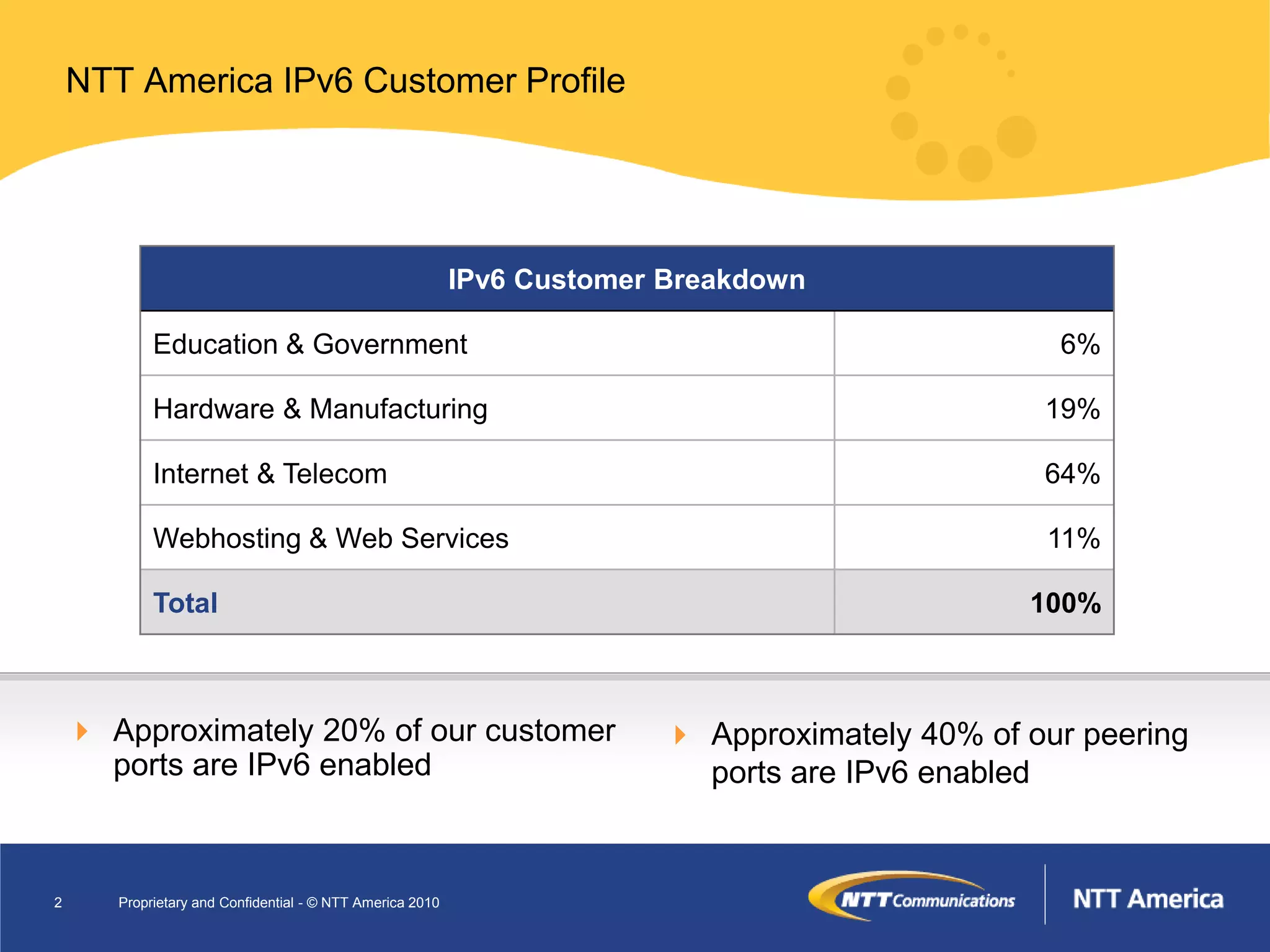
NTT America IPv6 Customer Profile


                                                           IPv6 Customer Breakdown

            Education & Government                                                               6%

            Hardware & Manufacturing                                                            19%

            Internet & Telecom                                                                  64%

            Webhosting & Web Services                                                           11%

            Total                                                                              100%


     Approximately 20% of our customer                                  Approximately 40% of our peering
      ports are IPv6 enabled                                              ports are IPv6 enabled


2      Proprietary and Confidential - © NTT America 2010
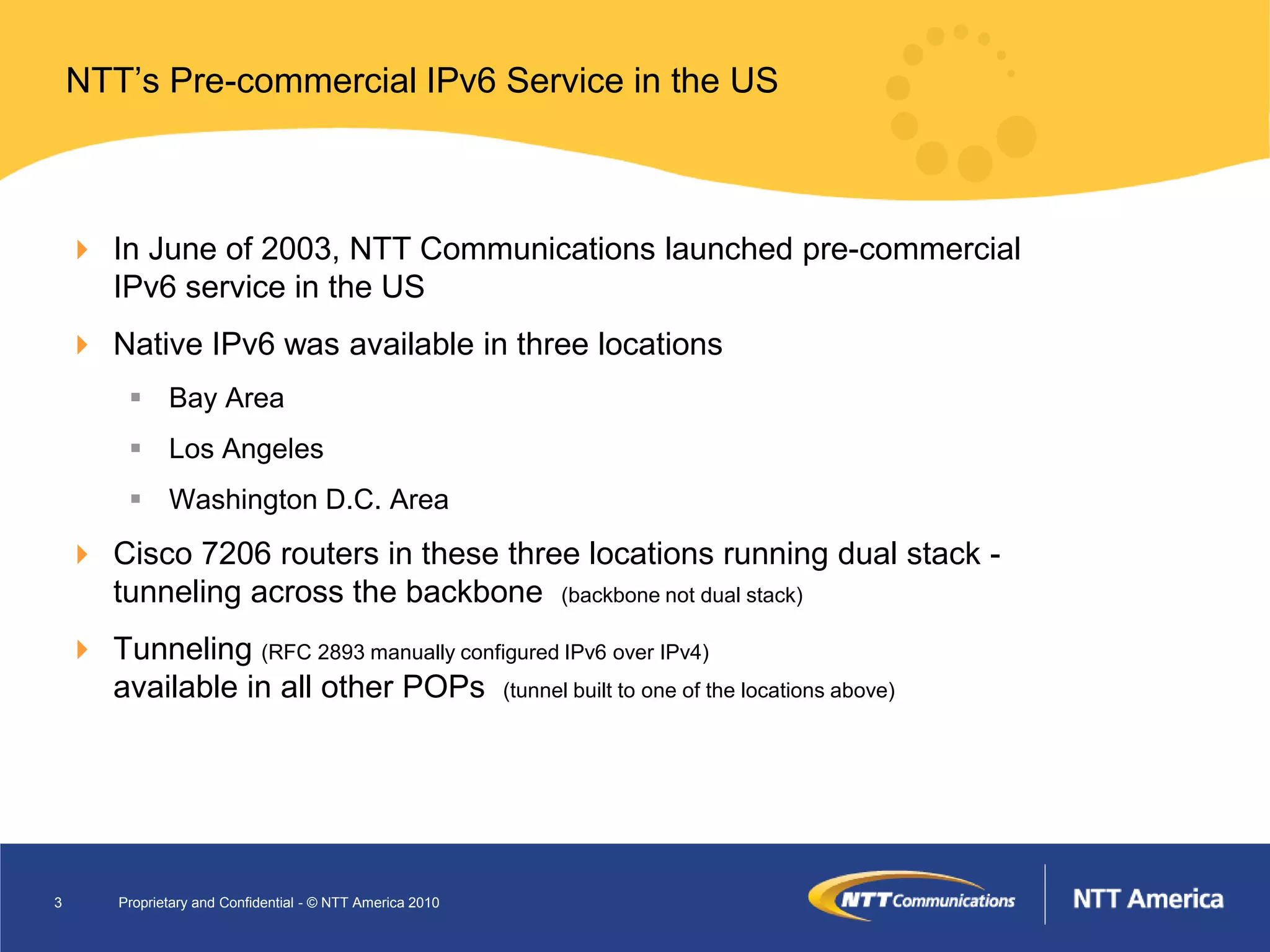
NTT’s Pre-commercial IPv6 Service in the US


     In June of 2003, NTT Communications launched pre-commercial
      IPv6 service in the US
     Native IPv6 was available in three locations
          Bay Area
          Los Angeles
          Washington D.C. Area
     Cisco 7206 routers in these three locations running dual stack -
      tunneling across the backbone (backbone not dual stack)
     Tunneling (RFC 2893 manually configured IPv6 over IPv4)
      available in all other POPs (tunnel built to one of the locations above)


3       Proprietary and Confidential - © NTT America 2010
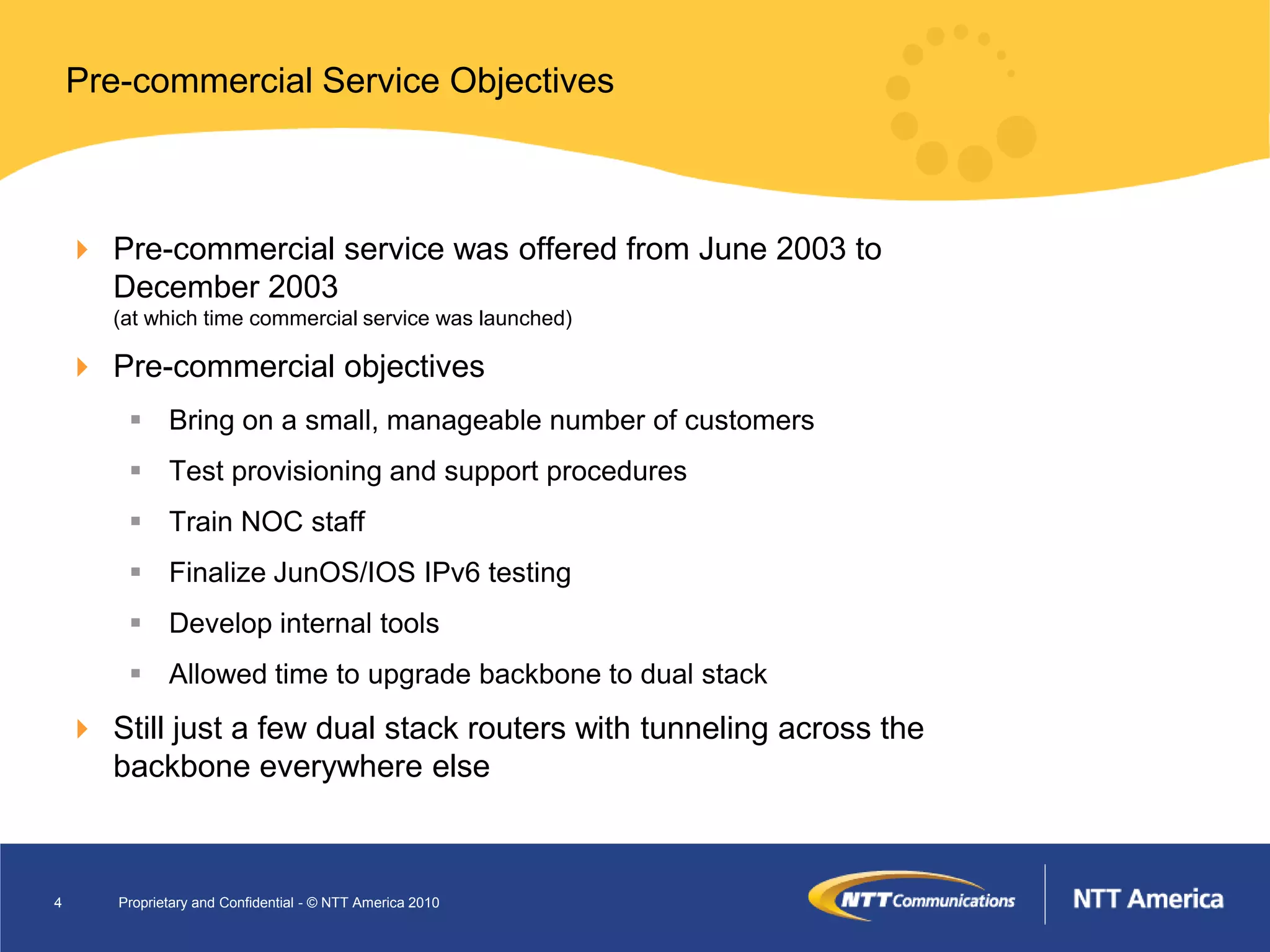
Pre-commercial Service Objectives


     Pre-commercial service was offered from June 2003 to
      December 2003
       (at which time commercial service was launched)

     Pre-commercial objectives
         Bring on a small, manageable number of customers
         Test provisioning and support procedures
         Train NOC staff
         Finalize JunOS/IOS IPv6 testing
         Develop internal tools
         Allowed time to upgrade backbone to dual stack
     Still just a few dual stack routers with tunneling across the
      backbone everywhere else


4      Proprietary and Confidential - © NTT America 2010
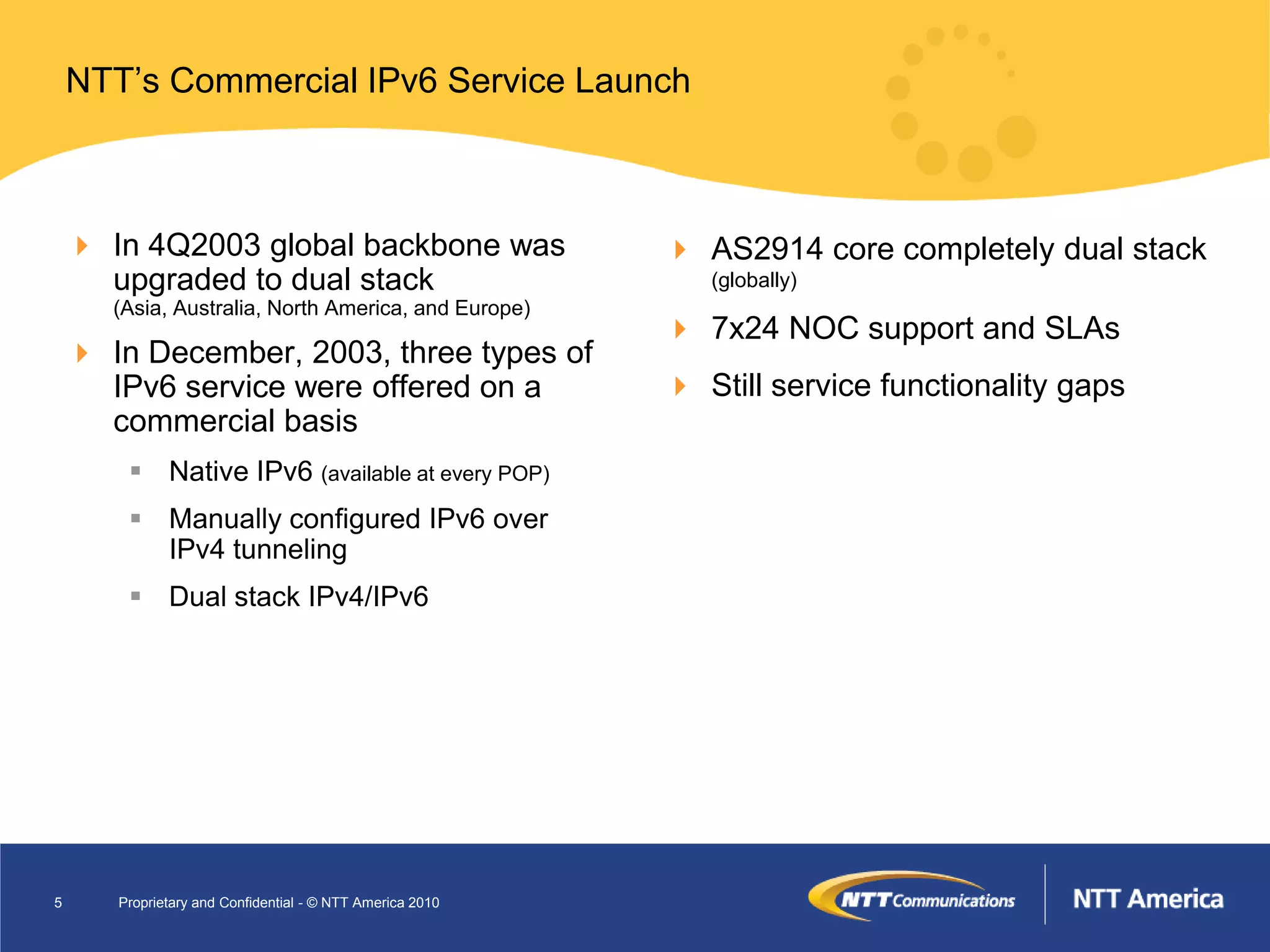
NTT’s Commercial IPv6 Service Launch


     In 4Q2003 global backbone was                         AS2914 core completely dual stack
      upgraded to dual stack                                  (globally)
       (Asia, Australia, North America, and Europe)
                                                            7x24 NOC support and SLAs
     In December, 2003, three types of
      IPv6 service were offered on a                        Still service functionality gaps
      commercial basis
         Native IPv6 (available at every POP)
         Manually configured IPv6 over
          IPv4 tunneling
         Dual stack IPv4/IPv6


5      Proprietary and Confidential - © NTT America 2010
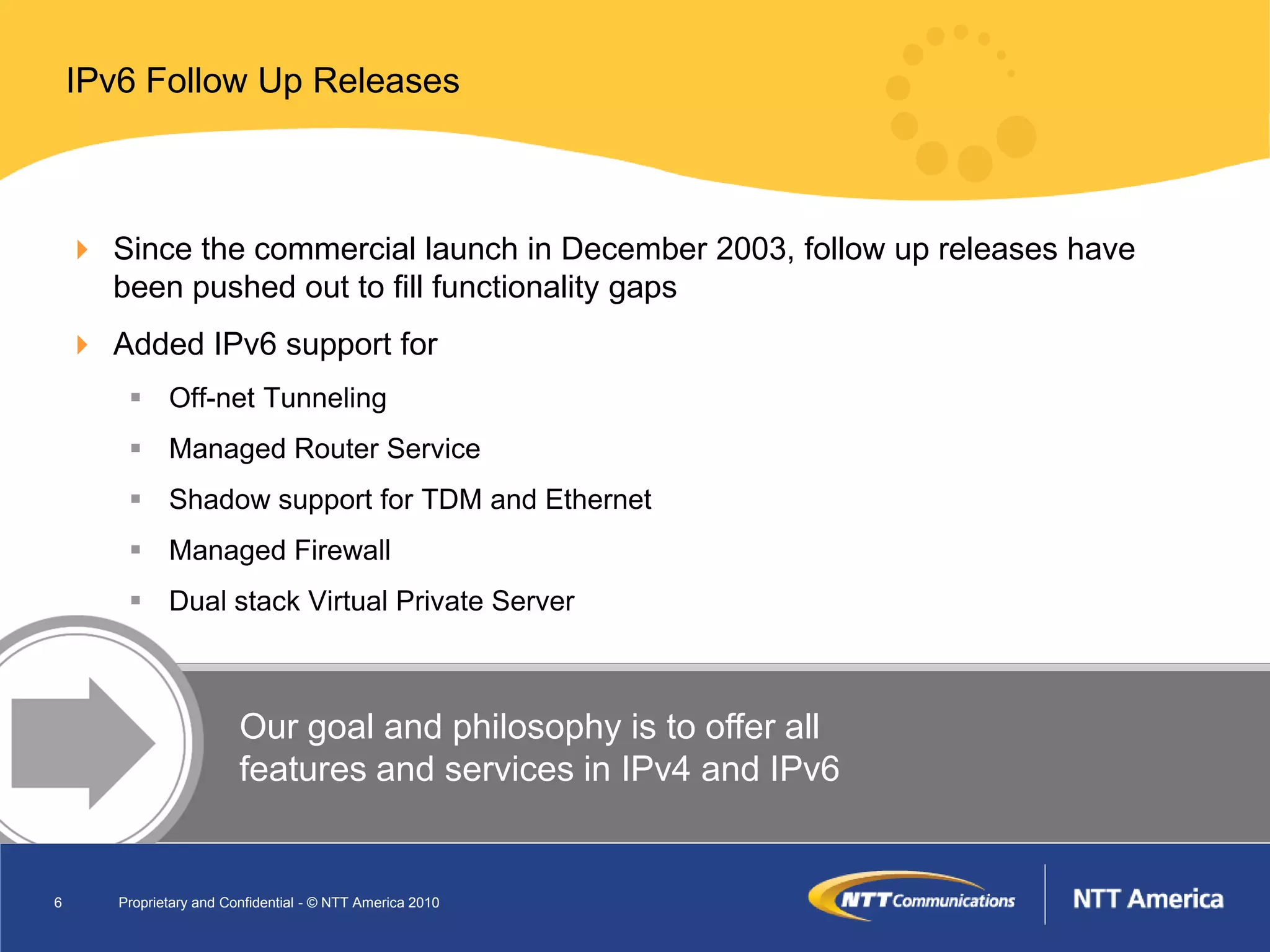
IPv6 Follow Up Releases


     Since the commercial launch in December 2003, follow up releases have
      been pushed out to fill functionality gaps
     Added IPv6 support for
         Off-net Tunneling
         Managed Router Service
         Shadow support for TDM and Ethernet
         Managed Firewall
         Dual stack Virtual Private Server


                         Our goal and philosophy is to offer all
                         features and services in IPv4 and IPv6


6      Proprietary and Confidential - © NTT America 2010
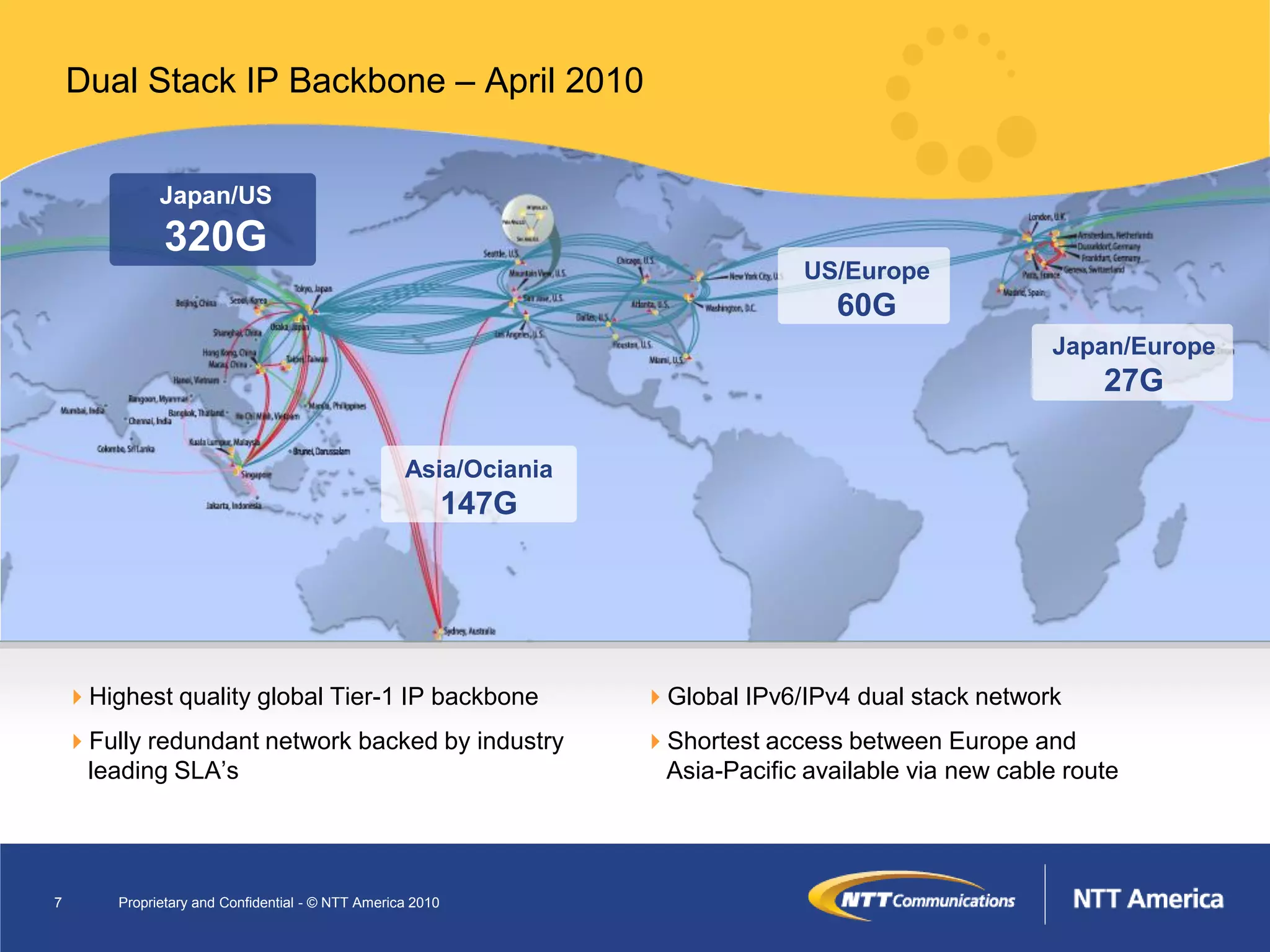
Dual Stack IP Backbone – April 2010


              Japan/US
              320G
                                                                                 US/Europe
                                                                                    60G
                                                                                                        Japan/Europe
                                                                                                            27G

                                                   Asia/Ociania
                                                            147G


    Highest quality global Tier-1 IP backbone                     Global IPv6/IPv4 dual stack network
    Fully redundant network backed by industry                    Shortest access between Europe and
     leading SLA’s                                                  Asia-Pacific available via new cable route


7       Proprietary and Confidential - © NTT America 2010
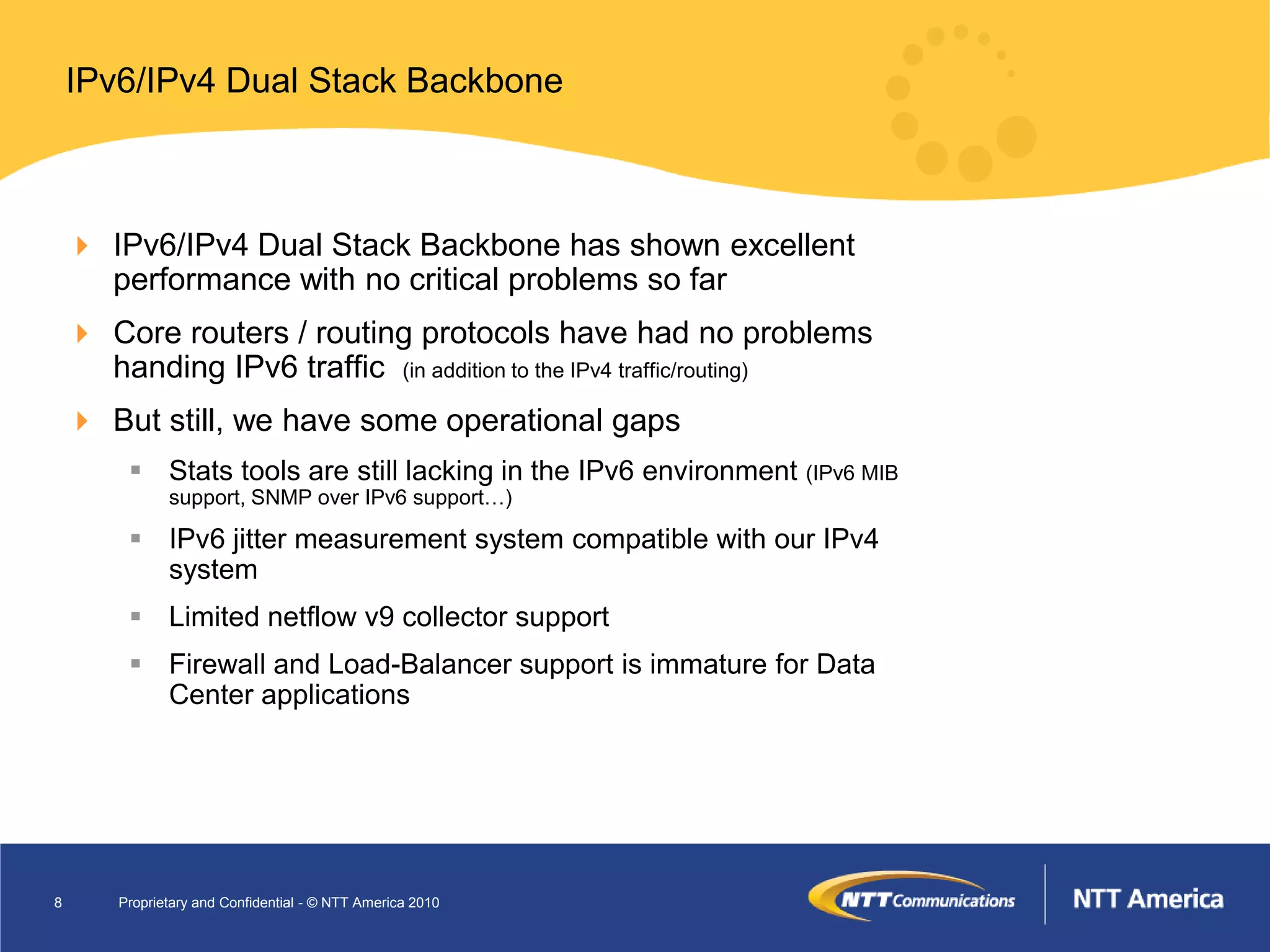
IPv6/IPv4 Dual Stack Backbone


     IPv6/IPv4 Dual Stack Backbone has shown excellent
      performance with no critical problems so far
     Core routers / routing protocols have had no problems
      handing IPv6 traffic (in addition to the IPv4 traffic/routing)
     But still, we have some operational gaps
          Stats tools are still lacking in the IPv6 environment (IPv6 MIB
               support, SNMP over IPv6 support…)

          IPv6 jitter measurement system compatible with our IPv4
           system
          Limited netflow v9 collector support
          Firewall and Load-Balancer support is immature for Data
           Center applications


8       Proprietary and Confidential - © NTT America 2010
Current Issues


     Routing technology is “IPv4 with more address space”
         Does not address routing architecture changes necessary to address expansion of
          the Internet routing table
         IPv6 policy solution to slow routing table growth makes it difficult for customers to
          multi-homed
     We need a solution to the multi-homing issues before IPv6 will be widely
      adopted
     Not seeing a huge demand from our customers yet
         Current customers are mostly research oriented
         OMB “mandate” not leading to many new customers


9      Proprietary and Confidential - © NTT America 2010
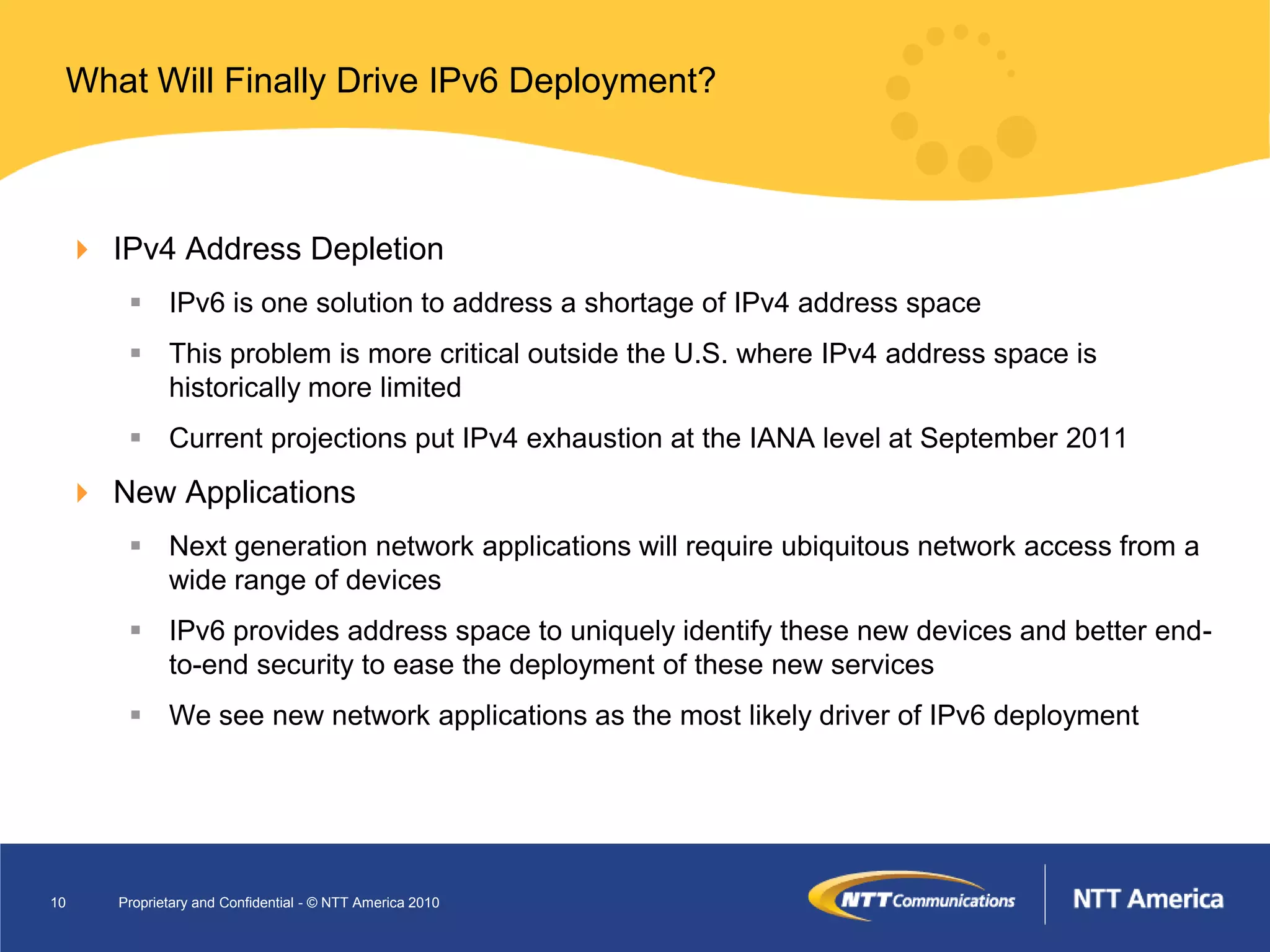
What Will Finally Drive IPv6 Deployment?


  IPv4 Address Depletion
       IPv6 is one solution to address a shortage of IPv4 address space
       This problem is more critical outside the U.S. where IPv4 address space is
        historically more limited
       Current projections put IPv4 exhaustion at the IANA level at September 2011
  New Applications
       Next generation network applications will require ubiquitous network access from a
        wide range of devices
       IPv6 provides address space to uniquely identify these new devices and better end-
        to-end security to ease the deployment of these new services
       We see new network applications as the most likely driver of IPv6 deployment


10   Proprietary and Confidential - © NTT America 2010
Questions – junkins@ntt.net


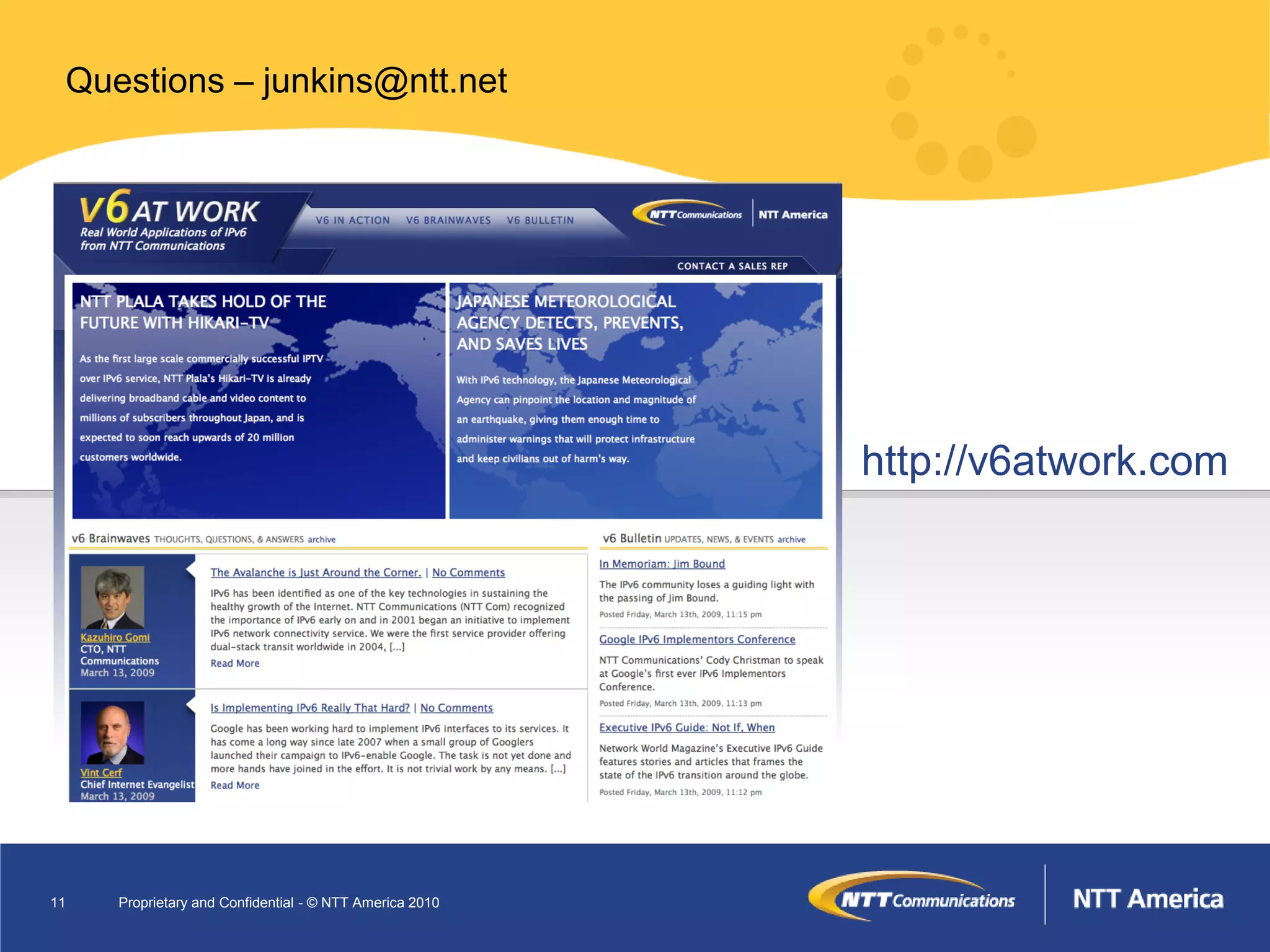
                                                         http://v6atwork.com


11   Proprietary and Confidential - © NTT America 2010

10 fn s11

  • 1.
    NTT Communications IPv6Overview: Deployment & Commercial Applications Doug Junkins Chief Technology Officer NTT America 1 Proprietary and Confidential - © NTT America 2010
  • 2.
    NTT America IPv6Customer Profile IPv6 Customer Breakdown Education & Government 6% Hardware & Manufacturing 19% Internet & Telecom 64% Webhosting & Web Services 11% Total 100%  Approximately 20% of our customer  Approximately 40% of our peering ports are IPv6 enabled ports are IPv6 enabled 2 Proprietary and Confidential - © NTT America 2010
  • 3.
    NTT’s Pre-commercial IPv6Service in the US  In June of 2003, NTT Communications launched pre-commercial IPv6 service in the US  Native IPv6 was available in three locations  Bay Area  Los Angeles  Washington D.C. Area  Cisco 7206 routers in these three locations running dual stack - tunneling across the backbone (backbone not dual stack)  Tunneling (RFC 2893 manually configured IPv6 over IPv4) available in all other POPs (tunnel built to one of the locations above) 3 Proprietary and Confidential - © NTT America 2010
  • 4.
    Pre-commercial Service Objectives  Pre-commercial service was offered from June 2003 to December 2003 (at which time commercial service was launched)  Pre-commercial objectives  Bring on a small, manageable number of customers  Test provisioning and support procedures  Train NOC staff  Finalize JunOS/IOS IPv6 testing  Develop internal tools  Allowed time to upgrade backbone to dual stack  Still just a few dual stack routers with tunneling across the backbone everywhere else 4 Proprietary and Confidential - © NTT America 2010
  • 5.
    NTT’s Commercial IPv6Service Launch  In 4Q2003 global backbone was  AS2914 core completely dual stack upgraded to dual stack (globally) (Asia, Australia, North America, and Europe)  7x24 NOC support and SLAs  In December, 2003, three types of IPv6 service were offered on a  Still service functionality gaps commercial basis  Native IPv6 (available at every POP)  Manually configured IPv6 over IPv4 tunneling  Dual stack IPv4/IPv6 5 Proprietary and Confidential - © NTT America 2010
  • 6.
    IPv6 Follow UpReleases  Since the commercial launch in December 2003, follow up releases have been pushed out to fill functionality gaps  Added IPv6 support for  Off-net Tunneling  Managed Router Service  Shadow support for TDM and Ethernet  Managed Firewall  Dual stack Virtual Private Server Our goal and philosophy is to offer all features and services in IPv4 and IPv6 6 Proprietary and Confidential - © NTT America 2010
  • 7.
    Dual Stack IPBackbone – April 2010 Japan/US 320G US/Europe 60G Japan/Europe 27G Asia/Ociania 147G Highest quality global Tier-1 IP backbone Global IPv6/IPv4 dual stack network Fully redundant network backed by industry Shortest access between Europe and leading SLA’s Asia-Pacific available via new cable route 7 Proprietary and Confidential - © NTT America 2010
  • 8.
    IPv6/IPv4 Dual StackBackbone  IPv6/IPv4 Dual Stack Backbone has shown excellent performance with no critical problems so far  Core routers / routing protocols have had no problems handing IPv6 traffic (in addition to the IPv4 traffic/routing)  But still, we have some operational gaps  Stats tools are still lacking in the IPv6 environment (IPv6 MIB support, SNMP over IPv6 support…)  IPv6 jitter measurement system compatible with our IPv4 system  Limited netflow v9 collector support  Firewall and Load-Balancer support is immature for Data Center applications 8 Proprietary and Confidential - © NTT America 2010
  • 9.
    Current Issues  Routing technology is “IPv4 with more address space”  Does not address routing architecture changes necessary to address expansion of the Internet routing table  IPv6 policy solution to slow routing table growth makes it difficult for customers to multi-homed  We need a solution to the multi-homing issues before IPv6 will be widely adopted  Not seeing a huge demand from our customers yet  Current customers are mostly research oriented  OMB “mandate” not leading to many new customers 9 Proprietary and Confidential - © NTT America 2010
  • 10.
    What Will FinallyDrive IPv6 Deployment?  IPv4 Address Depletion  IPv6 is one solution to address a shortage of IPv4 address space  This problem is more critical outside the U.S. where IPv4 address space is historically more limited  Current projections put IPv4 exhaustion at the IANA level at September 2011  New Applications  Next generation network applications will require ubiquitous network access from a wide range of devices  IPv6 provides address space to uniquely identify these new devices and better end- to-end security to ease the deployment of these new services  We see new network applications as the most likely driver of IPv6 deployment 10 Proprietary and Confidential - © NTT America 2010
  • 11.
    Questions – junkins@ntt.net http://v6atwork.com 11 Proprietary and Confidential - © NTT America 2010