IPv6	
  deployment	
  at	
  IIJ/AS2497	
Matsuzaki	
  ‘maz’	
  Yoshinobu	
  
<maz@iij.ad.jp>	
1	
Copyright	
  (c)	
  2009	
  Internet	
  IniOaOve	
  Japan	
  Inc.
History	
  of	
  IIJ’s	
  IPv6	
  service	
•  1999	
  
– IPv6	
  over	
  IPv4	
  tunnel	
  service	
  (experimental)	
  
•  2000	
  
– IPv6	
  naOve	
  service	
  (leased	
  line,	
  experimental)	
  
•  2001	
  
– IPv4/IPv6	
  dual	
  stack	
  service	
  (leased	
  line)	
  	
  
– IPv6	
  data	
  center	
  service	
  
– IPv6	
  over	
  IPv4	
  tunnel	
  service	
  for	
  consumers	
  
Copyright	
  (c)	
  2009	
  Internet	
  IniOaOve	
  Japan	
  Inc.	
 2
business	
  model	
•  IIJ	
  sells	
  bandwidth	
  
– Customers	
  can	
  select	
  protocol(s)	
  which	
  should	
  be	
  
forwarded	
  on	
  the	
  link	
  
•  IPv4	
  only	
  
•  IPv4/IPv6	
  dual	
  stack	
  
•  IPv6	
  only	
  
– Or,	
  customer	
  can	
  ask	
  IPv6	
  over	
  IPv4	
  tunnel	
  for	
  
free.	
  
Copyright	
  (c)	
  2009	
  Internet	
  IniOaOve	
  Japan	
  Inc.	
 3
History	
  of	
  IIJ’s	
  IPv6	
  backbone	
•  IniOally	
  we	
  started	
  with	
  dedicated	
  backbone	
  
•  1998	
  
–  PC	
  based	
  router(kame	
  stack)	
  
–  tunnel	
  and	
  ethernet	
  
•  2000	
  
–  cisco	
  c72xx	
  series	
  
–  tunnel,	
  ethernet	
  and	
  T1	
  line	
  
•  2005	
  
–  we	
  started	
  to	
  migrate	
  to	
  IPv4/IPv6	
  dual	
  stack	
  
backbone	
  
Copyright	
  (c)	
  2009	
  Internet	
  IniOaOve	
  Japan	
  Inc.	
 4
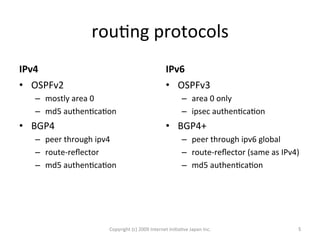
rouOng	
  protocols	
IPv4	
•  OSPFv2	
  
–  mostly	
  area	
  0	
  
–  md5	
  authenOcaOon	
  
•  BGP4	
  
–  peer	
  through	
  ipv4	
  
–  route-­‐reflector	
  
–  md5	
  authenOcaOon	
  
IPv6	
•  OSPFv3	
  
–  area	
  0	
  only	
  
–  ipsec	
  authenOcaOon	
  
•  BGP4+	
  
–  peer	
  through	
  ipv6	
  global	
  
–  route-­‐reflector	
  (same	
  as	
  IPv4)	
  
–  md5	
  authenOcaOon	
Copyright	
  (c)	
  2009	
  Internet	
  IniOaOve	
  Japan	
  Inc.	
 5
simple	
  operaOon	
•  OSPFv3	
  cost	
  ==	
  OSPF	
  cost	
  
– using	
  the	
  same	
  link	
  cost	
  value	
  as	
  IPv4’s.	
  
– The	
  network	
  topology	
  is	
  almost	
  same.	
  	
  
•  BGP(IPv6)	
  design	
  ==	
  BGP(IPv4)	
  design	
  
– minimalizing	
  operaOonal	
  confusion	


•  all	
  working	
  fine	
  J	
  
Copyright	
  (c)	
  2009	
  Internet	
  IniOaOve	
  Japan	
  Inc.	
 6
acOviOes	
  in	
  Japan	
•  IPv6	
  measurement	
  
– adopOon	
  
•  providing	
  IPv6	
  by	
  default	
  
– auto	
  configuraOon	
  of	
  IPv6	
  PPPoE	
  
Copyright	
  (c)	
  2009	
  Internet	
  IniOaOve	
  Japan	
  Inc.	
 7
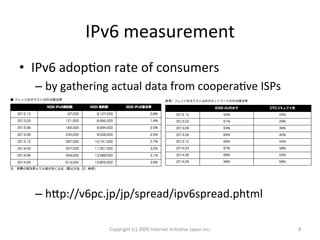
IPv6	
  measurement	
•  IPv6	
  adopOon	
  rate	
  of	
  consumers	
  
– by	
  gathering	
  actual	
  data	
  from	
  cooperaOve	
  ISPs	
  
– hdp://v6pc.jp/jp/spread/ipv6spread.phtml	
  
Copyright	
  (c)	
  2009	
  Internet	
  IniOaOve	
  Japan	
  Inc.	
 8
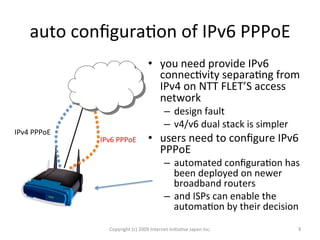
auto	
  configuraOon	
  of	
  IPv6	
  PPPoE	
•  you	
  need	
  provide	
  IPv6	
  
connecOvity	
  separaOng	
  from	
  
IPv4	
  on	
  NTT	
  FLET’S	
  access	
  
network	
  
–  design	
  fault	
  
–  v4/v6	
  dual	
  stack	
  is	
  simpler	
  
•  users	
  need	
  to	
  configure	
  IPv6	
  
PPPoE	
  
–  automated	
  configuraOon	
  has	
  
been	
  deployed	
  on	
  newer	
  
broadband	
  routers	
  
–  and	
  ISPs	
  can	
  enable	
  the	
  
automaOon	
  by	
  their	
  decision	
Copyright	
  (c)	
  2009	
  Internet	
  IniOaOve	
  Japan	
  Inc.	
 9	
IPv4	
  PPPoE	
IPv6	
  PPPoE

ION Sri Lanka - IPv6 Deployment at IIJ (IPv6 Panel)

  • 1.
    IPv6  deployment  at  IIJ/AS2497 Matsuzaki  ‘maz’  Yoshinobu   <maz@iij.ad.jp> 1 Copyright  (c)  2009  Internet  IniOaOve  Japan  Inc.
  • 2.
    History  of  IIJ’s  IPv6  service •  1999   – IPv6  over  IPv4  tunnel  service  (experimental)   •  2000   – IPv6  naOve  service  (leased  line,  experimental)   •  2001   – IPv4/IPv6  dual  stack  service  (leased  line)     – IPv6  data  center  service   – IPv6  over  IPv4  tunnel  service  for  consumers   Copyright  (c)  2009  Internet  IniOaOve  Japan  Inc. 2
  • 3.
    business  model •  IIJ  sells  bandwidth   – Customers  can  select  protocol(s)  which  should  be   forwarded  on  the  link   •  IPv4  only   •  IPv4/IPv6  dual  stack   •  IPv6  only   – Or,  customer  can  ask  IPv6  over  IPv4  tunnel  for   free.   Copyright  (c)  2009  Internet  IniOaOve  Japan  Inc. 3
  • 4.
    History  of  IIJ’s  IPv6  backbone •  IniOally  we  started  with  dedicated  backbone   •  1998   –  PC  based  router(kame  stack)   –  tunnel  and  ethernet   •  2000   –  cisco  c72xx  series   –  tunnel,  ethernet  and  T1  line   •  2005   –  we  started  to  migrate  to  IPv4/IPv6  dual  stack   backbone   Copyright  (c)  2009  Internet  IniOaOve  Japan  Inc. 4
  • 5.
    rouOng  protocols IPv4 •  OSPFv2   –  mostly  area  0   –  md5  authenOcaOon   •  BGP4   –  peer  through  ipv4   –  route-­‐reflector   –  md5  authenOcaOon   IPv6 •  OSPFv3   –  area  0  only   –  ipsec  authenOcaOon   •  BGP4+   –  peer  through  ipv6  global   –  route-­‐reflector  (same  as  IPv4)   –  md5  authenOcaOon Copyright  (c)  2009  Internet  IniOaOve  Japan  Inc. 5
  • 6.
    simple  operaOon •  OSPFv3  cost  ==  OSPF  cost   – using  the  same  link  cost  value  as  IPv4’s.   – The  network  topology  is  almost  same.     •  BGP(IPv6)  design  ==  BGP(IPv4)  design   – minimalizing  operaOonal  confusion     •  all  working  fine  J   Copyright  (c)  2009  Internet  IniOaOve  Japan  Inc. 6
  • 7.
    acOviOes  in  Japan • IPv6  measurement   – adopOon   •  providing  IPv6  by  default   – auto  configuraOon  of  IPv6  PPPoE   Copyright  (c)  2009  Internet  IniOaOve  Japan  Inc. 7
  • 8.
    IPv6  measurement •  IPv6  adopOon  rate  of  consumers   – by  gathering  actual  data  from  cooperaOve  ISPs   – hdp://v6pc.jp/jp/spread/ipv6spread.phtml   Copyright  (c)  2009  Internet  IniOaOve  Japan  Inc. 8
  • 9.
    auto  configuraOon  of  IPv6  PPPoE •  you  need  provide  IPv6   connecOvity  separaOng  from   IPv4  on  NTT  FLET’S  access   network   –  design  fault   –  v4/v6  dual  stack  is  simpler   •  users  need  to  configure  IPv6   PPPoE   –  automated  configuraOon  has   been  deployed  on  newer   broadband  routers   –  and  ISPs  can  enable  the   automaOon  by  their  decision Copyright  (c)  2009  Internet  IniOaOve  Japan  Inc. 9 IPv4  PPPoE IPv6  PPPoE