10. CONTAMINATED RUNWAYS
Performance JAR 25
CONTAMINATED RUNWAYS
 Definitions
 Screen height
 Distances
 Takeoff charts
 Example
DEFINITIONS
DRY RUNWAY
A dry runway is one which is neither wet nor contaminated, and
includes those paved runways which have been specially prepared
with grooves or porous pavement and maintained to retain ‘effectively
dry’ braking action even when moisture is present.
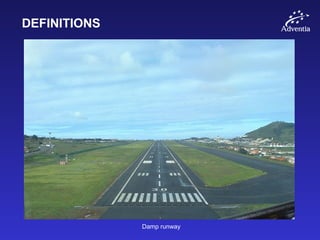
DAMP RUNWAY
A runway is considered damp when the surface is not dry, but when
the moisture on it does not give it a shiny appearance.
According to JAA regulations, a damp runway is considered dry as far
as performance calculations are concerned. This may change in the
future.
DEFINITIONS
Damp runway
DEFINITIONS
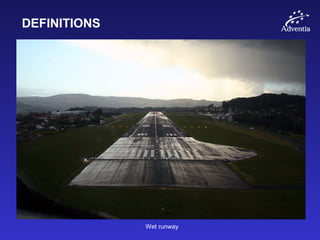
WET RUNWAY
A runway is considered wet when the runway surface is covered with
water or equivalent, [with a depth less than or equal to 3 mm], or when
there is a sufficient moisture on the runway surface to cause it to
appear reflective, but without significant areas of standing water.
A wet runway has a shiny appearance, but without risk of
hydroplaning.
DEFINITIONS
Wet runway
DEFINITIONS
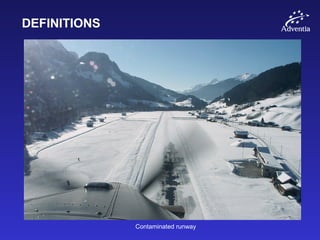
CONTAMINATED RUNWAY
A runway is considered to be contaminated when more than 25% of
the runway surface area within the required length and width being
used is covered by the following:
Standing water: Caused by heavy rainfall and/or insufficient runway
drainage with a depth of more than 3 mm (0.125 in).
Slush: Water saturated with snow, which spatters when stepping
firmly on it.
Wet snow: If compacted by hand, snow will stick together and tend to
form a snowball.
Dry snow: Snow can be blown if loose, or if compacted by hand, will
fall apart again upon release.
Compacted snow: Snow has been compressed
Ice: The friction coefficient is 0.05 or below.
DEFINITIONS
Contaminated runway
DEFINITIONS
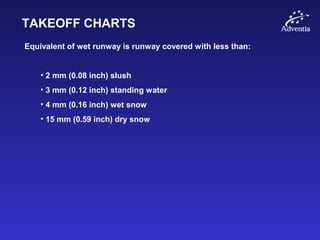
Equivalent of wet runway is runway covered with less than:
• 2 mm (0.08 inch) slush
• 3 mm (0.12 inch) standing water
• 4 mm (0.16 inch) wet snow
• 15 mm (0.59 inch) dry snow
SCREEN HEIGHT
On wet and contaminated runways, the screen height is measured at
15 feet rather than 35 feet on dry runways. Moreover, the use of
reverse thrust is allowed for ASD determination on wet and
contaminated runways, whereas it is forbidden to take it into account
for the ASD determination on dry runways.
Therefore, it is possible to obtain shorter TODs and ASDs on wet and
contaminated runways than on dry runways for the same takeoff
conditions. Thus, it is possible to obtain higher takeoff weights on
surfaces covered with water, slush, or snow than on dry runways. This
is why the regulation indicates that:
On a wet or contaminated runway, the takeoff mass must not exceed
that permitted for a takeoff on a dry runway under the same
conditions.
DISTANCES
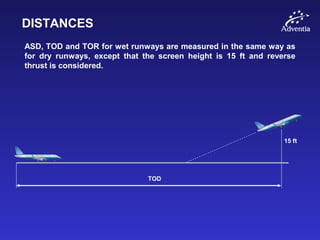
ASD, TOD and TOR for wet runways are measured in the same way as
for dry runways, except that the screen height is 15 ft and reverse
thrust is considered.
TOD
15 ft
TAKEOFF CHARTS
Depending on the depth of water, we will use a different chart for takeoff
performance calculations:
• Under 3 mm of water, use the WET RUNWAY correction.
• Between 3 mm and 6.3 mm, use the 6.3 mm (1/4 inch) WATER chart.
• Between 6.3 mm and 12.7 mm, use the 12.7 mm (1/2 inch) WATER chart.
TAKEOFF CHARTS
Depending on the depth of slush, we will use a different chart for takeoff
performance calculations:
• Under 2 mm of slush, use the WET RUNWAY correction.
• Between 2 mm and 6.3 mm, use the 6.3 mm (1/4 inch) SLUSH chart.
• Between 6.3 mm and 12.7 mm, use the 12.7 mm (1/2 inch) SLUSH chart.
For compacted snow, a special chart is provided (COMPACTED SNOW).
TAKEOFF CHARTS
Equivalent of wet runway is runway covered with less than:
• 2 mm (0.08 inch) slush
• 3 mm (0.12 inch) standing water
• 4 mm (0.16 inch) wet snow
• 15 mm (0.59 inch) dry snow
TAKEOFF CHARTS
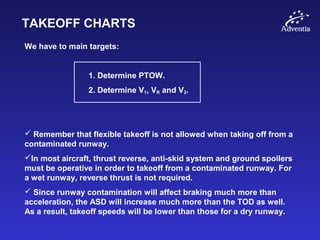
We have to main targets:
1. Determine PTOW.
2. Determine V1, VR and V2.
 Remember that flexible takeoff is not allowed when taking off from a
contaminated runway.
In most aircraft, thrust reverse, anti-skid system and ground spoilers
must be operative in order to takeoff from a contaminated runway. For
a wet runway, reverse thrust is not required.
 Since runway contamination will affect braking much more than
acceleration, the ASD will increase much more than the TOD as well.
As a result, takeoff speeds will be lower than those for a dry runway.
TAKEOFF CHARTS
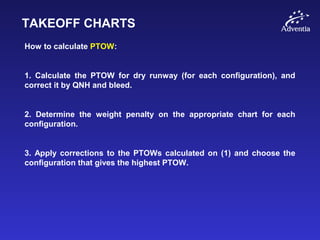
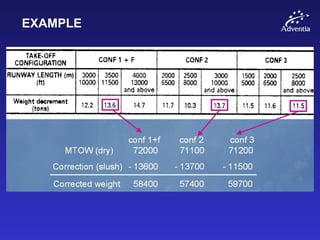
How to calculate PTOW:
1. Calculate the PTOW for dry runway (for each configuration), and
correct it by QNH and bleed.
2. Determine the weight penalty on the appropriate chart for each
configuration.
3. Apply corrections to the PTOWs calculated on (1) and choose the
configuration that gives the highest PTOW.
TAKEOFF CHARTS
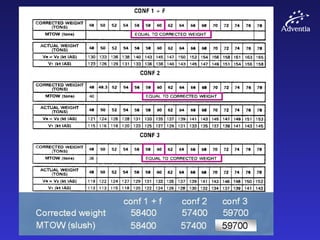
How to calculate takeoff speeds:
1. With the configuration and ATOW, use the appropriate chart to find
takeoff speeds.
EXAMPLE
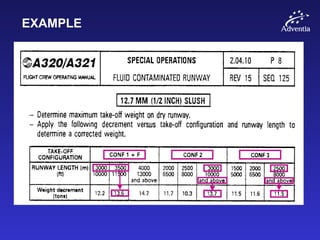
Let’s calculate PTOW and takeoff speeds with this conditions:
• LFPO Runway 08
• TORA: 3320 m
• Runway covered with 7 mm slush
• PTOW (dry): 72000 Kg (CONF 1+F)
71100 Kg (CONF 2)
71200 Kg (CONF 3)
We will use the 12.7
mm slush chart
EXAMPLE
EXAMPLE
EXAMPLE
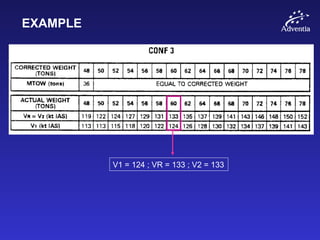
V1 = 124 ; VR = 133 ; V2 = 133

10. contaminated runways

  • 1.
  • 2.
    CONTAMINATED RUNWAYS  Definitions Screen height  Distances  Takeoff charts  Example
  • 3.
    DEFINITIONS DRY RUNWAY A dryrunway is one which is neither wet nor contaminated, and includes those paved runways which have been specially prepared with grooves or porous pavement and maintained to retain ‘effectively dry’ braking action even when moisture is present. DAMP RUNWAY A runway is considered damp when the surface is not dry, but when the moisture on it does not give it a shiny appearance. According to JAA regulations, a damp runway is considered dry as far as performance calculations are concerned. This may change in the future.
  • 4.
  • 5.
    DEFINITIONS WET RUNWAY A runwayis considered wet when the runway surface is covered with water or equivalent, [with a depth less than or equal to 3 mm], or when there is a sufficient moisture on the runway surface to cause it to appear reflective, but without significant areas of standing water. A wet runway has a shiny appearance, but without risk of hydroplaning.
  • 6.
  • 7.
    DEFINITIONS CONTAMINATED RUNWAY A runwayis considered to be contaminated when more than 25% of the runway surface area within the required length and width being used is covered by the following: Standing water: Caused by heavy rainfall and/or insufficient runway drainage with a depth of more than 3 mm (0.125 in). Slush: Water saturated with snow, which spatters when stepping firmly on it. Wet snow: If compacted by hand, snow will stick together and tend to form a snowball. Dry snow: Snow can be blown if loose, or if compacted by hand, will fall apart again upon release. Compacted snow: Snow has been compressed Ice: The friction coefficient is 0.05 or below.
  • 8.
  • 9.
    DEFINITIONS Equivalent of wetrunway is runway covered with less than: • 2 mm (0.08 inch) slush • 3 mm (0.12 inch) standing water • 4 mm (0.16 inch) wet snow • 15 mm (0.59 inch) dry snow
  • 10.
    SCREEN HEIGHT On wetand contaminated runways, the screen height is measured at 15 feet rather than 35 feet on dry runways. Moreover, the use of reverse thrust is allowed for ASD determination on wet and contaminated runways, whereas it is forbidden to take it into account for the ASD determination on dry runways. Therefore, it is possible to obtain shorter TODs and ASDs on wet and contaminated runways than on dry runways for the same takeoff conditions. Thus, it is possible to obtain higher takeoff weights on surfaces covered with water, slush, or snow than on dry runways. This is why the regulation indicates that: On a wet or contaminated runway, the takeoff mass must not exceed that permitted for a takeoff on a dry runway under the same conditions.
  • 11.
    DISTANCES ASD, TOD andTOR for wet runways are measured in the same way as for dry runways, except that the screen height is 15 ft and reverse thrust is considered. TOD 15 ft
  • 12.
    TAKEOFF CHARTS Depending onthe depth of water, we will use a different chart for takeoff performance calculations: • Under 3 mm of water, use the WET RUNWAY correction. • Between 3 mm and 6.3 mm, use the 6.3 mm (1/4 inch) WATER chart. • Between 6.3 mm and 12.7 mm, use the 12.7 mm (1/2 inch) WATER chart.
  • 13.
    TAKEOFF CHARTS Depending onthe depth of slush, we will use a different chart for takeoff performance calculations: • Under 2 mm of slush, use the WET RUNWAY correction. • Between 2 mm and 6.3 mm, use the 6.3 mm (1/4 inch) SLUSH chart. • Between 6.3 mm and 12.7 mm, use the 12.7 mm (1/2 inch) SLUSH chart. For compacted snow, a special chart is provided (COMPACTED SNOW).
  • 14.
    TAKEOFF CHARTS Equivalent ofwet runway is runway covered with less than: • 2 mm (0.08 inch) slush • 3 mm (0.12 inch) standing water • 4 mm (0.16 inch) wet snow • 15 mm (0.59 inch) dry snow
  • 15.
    TAKEOFF CHARTS We haveto main targets: 1. Determine PTOW. 2. Determine V1, VR and V2.  Remember that flexible takeoff is not allowed when taking off from a contaminated runway. In most aircraft, thrust reverse, anti-skid system and ground spoilers must be operative in order to takeoff from a contaminated runway. For a wet runway, reverse thrust is not required.  Since runway contamination will affect braking much more than acceleration, the ASD will increase much more than the TOD as well. As a result, takeoff speeds will be lower than those for a dry runway.
  • 16.
    TAKEOFF CHARTS How tocalculate PTOW: 1. Calculate the PTOW for dry runway (for each configuration), and correct it by QNH and bleed. 2. Determine the weight penalty on the appropriate chart for each configuration. 3. Apply corrections to the PTOWs calculated on (1) and choose the configuration that gives the highest PTOW.
  • 17.
    TAKEOFF CHARTS How tocalculate takeoff speeds: 1. With the configuration and ATOW, use the appropriate chart to find takeoff speeds.
  • 18.
    EXAMPLE Let’s calculate PTOWand takeoff speeds with this conditions: • LFPO Runway 08 • TORA: 3320 m • Runway covered with 7 mm slush • PTOW (dry): 72000 Kg (CONF 1+F) 71100 Kg (CONF 2) 71200 Kg (CONF 3) We will use the 12.7 mm slush chart
  • 19.
  • 20.
  • 22.
    EXAMPLE V1 = 124; VR = 133 ; V2 = 133