20-14 Takeoff Distances on Loose Contaminants
Copyright 2009 Boeing Jet Transport Performance Methods D6-1420
All rights reserved Takeoff on Non-Dry Runways revised March 2009
• Reverse thrust is a function of time and velocity.
Takeoff Distances on Loose Contaminants
Up to this point, we have considered those runway conditions that have no effect on an airplane’s
acceleration during takeoff. Now it’s time to look at the conditions called “loose contaminants”:
standing water, slush, wet snow, or dry (loose) snow. These are considerably more complex, and
they will affect the airplane’s deceleration capability as well as its acceleration.
Note: contaminant drag is the term traditionally given to the additional drag imposed on an air-
plane due to the presence of a contaminant on the runway. For simplicity in this discussion,
whether we’re talking about slush or standing water or wet snow, we’ll refer to the increment of
drag they cause as contaminant drag.
physics of contaminant drag
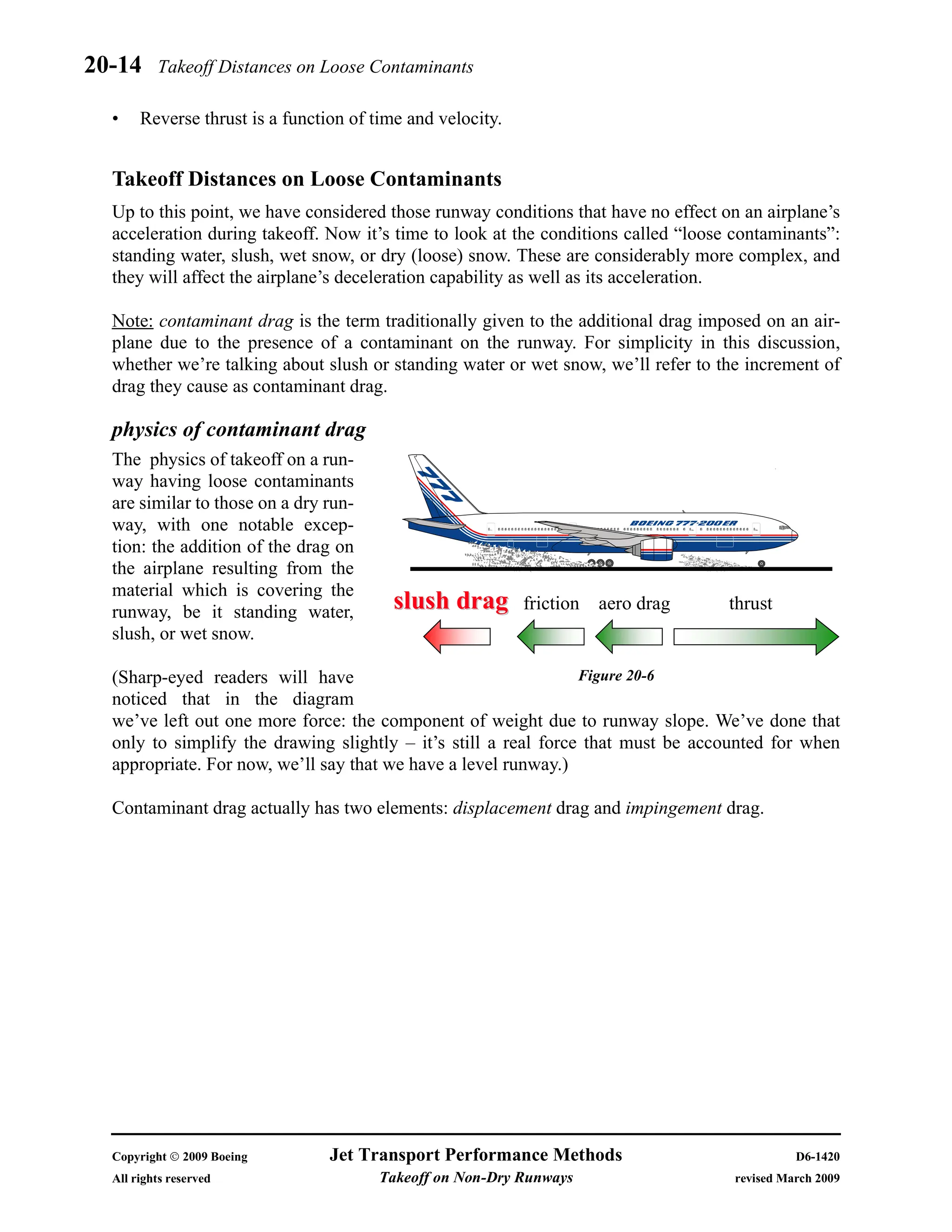
The physics of takeoff on a run-
way having loose contaminants
are similar to those on a dry run-
way, with one notable excep-
tion: the addition of the drag on
the airplane resulting from the
material which is covering the
runway, be it standing water,
slush, or wet snow.
(Sharp-eyed readers will have
noticed that in the diagram
we’ve left out one more force: the component of weight due to runway slope. We’ve done that
only to simplify the drawing slightly – it’s still a real force that must be accounted for when
appropriate. For now, we’ll say that we have a level runway.)
Contaminant drag actually has two elements: displacement drag and impingement drag.
slush
slush drag
drag friction aero drag thrust
Figure 20-6
hydroplaning 20-15
Copyright 2009 Boeing Jet Transport Performance Methods D6-1420
All rights reserved Takeoff on Non-Dry Runways revised March 2009
As illustrated in the figure to the right,
displacement drag results from the
energy required for the landing gear
tires to displace the contaminant – that
is, to move it out of their way as the air-
plane rolls along the runway.
Impingement drag results from the air-
plane kinetic energy lost due to the
impact of contaminant on parts of the
body. The passage of the wheels
through the contaminant causes a very
powerful spray to be thrown up; due to
its density and the velocity at which it
strikes the airplane, it creates consider-
able impact force on the airplane. Since
this impact force is in an aftward direc-
tion, it subtracts from the airplane’s
kinetic energy.
The contaminant impact can actually cause physical damage to an airplane. As a result of this, and
because of the increasingly adverse effect of loose contaminants on takeoff performance as depth
increases, the FAA and JAA both state specifically that takeoff is prohibited on runways having
more than 1/2 inch (FAA) or 12.7 millimeters (JAA) of loose contaminant.
There’s one exception to the statement above: the latest EASA regulations on non-dry runways
permit up to 15 millimeters of depth instead of the earlier 12.7 millimeters, which corresponds to
the FAA’s maximum depth of one-half inch. At the time of this writing (March 2009) however,
Boeing takeoff software still limits the maximum depth to 12.7 millimeters.
hydroplaning
Hydroplaning (also sometimes referred to as “aquaplaning”) is a dynamic condition encountered
by an airplane’s tires when operating on runways covered with loose contaminant.
At low speeds on a runway having loose contaminant there is adequate time for the contaminant
to move away from an airplane’s tires as it accelerates down the runway for takeoff. The tires
remain in solid contact with the runway surface. The presence of the contaminant does result in an
increase of the airplane’s drag, as discussed above, but there are no other adverse effects.
Displacement drag
FWD
Impingement drag
FWD
Figure 20-7
20-16 Takeoff Distances on Loose Contaminants
Copyright 2009 Boeing Jet Transport Performance Methods D6-1420
All rights reserved Takeoff on Non-Dry Runways revised March 2009
However, as an airplane accelerates in
loose contaminant, the tires cause an
increase of pressure in the contaminant
in the area immediately ahead of them.
When that pressure becomes suffi-
ciently great, it forces a wedge of fluid
underneath the tires’ leading edges, thus
lifting the tires out of contact with the
runway surface resulting in a loss of
traction.
The speed at which hydroplaning com-
mences during an acceleration is known as the “hydroplaning speed” VHP. It’s a function of tire
pressure.
The accepted equation for the hydroplaning speed is:
(eq. 1)
where VHP is the hydroplaning speed in knots
is the contaminant specific gravity
tire pressure is expressed in pounds per square inch (psi)
Traditionally, Boeing has used values of 0.85 and 1.00 for the contaminant specific gravity of
slush and standing water respectively.
It’s worth noting here that EASA presently uses a slightly different version of equation 1:
the takeoff distance calculation process
The acceleration of the airplane from the start of the takeoff roll to liftoff is divided into three dif-
ferent speed ranges:
• From brake release to the hydroplaning speed. In this speed regime, the distance calculation
follows the same method as before, but includes the additional drag of the contaminant as a
function of speed;
• From hydroplaning speed to rotation speed. In this speed range, the tires are out of contact
with the runway surface; the contaminant drag initially increases slowly, then as the hydro-
planing effect increases the contaminant drag begins to decrease. As the speed increases fur-
ther, the contaminant drag decreases more rapidly.
Figure 20-8
VHP 8.63
tire pressure
-----------------------------
-
=
VHP 9.0 tire pressure
=
the takeoff distance calculation process 20-17
Copyright 2009 Boeing Jet Transport Performance Methods D6-1420
All rights reserved Takeoff on Non-Dry Runways revised March 2009
• From rotation speed to liftoff. When the airplane is rotated, the nose landing gear tires are
instantaneously lifted out of the contaminant, causing an abrupt discontinuity in the contami-
nant drag. Beyond VR, as the speed increases toward the liftoff speed, the contaminant drag
decreases more and more rapidly.
The calculation process used by Boeing for determining the distance is considered proprietary and
may not be discussed here.
In Figure 20-10, to the right, for one Boeing
model taking off in half an inch of water with
all engines operating you can see how the slush
drag varies with velocity at ground speeds
approaching and then exceeding the hydroplan-
ing and rotation speeds.
Up to the hydroplaning speed VHP the slush
drag increases with the square of the velocity.
At VHP you see that the hyroplaning is begin-
ning to affect the slush drag as the tires lose
contact with the takeoff surface.
At the rotation speed VR there is an instanta-
neous discontinuity in the contaminant drag
due to the lifting of the nose landing gear from
the runway, out of contact with the contaminant.
Following rotation, as the main landing gear tires lift out of the contaminant, the drag decreases
rapidly and becomes equal to zero at the liftoff speed.
For the engine-out accelerate-go distance, the effect of the contaminant will look much the same
as you see for all engines operating, except of course the acceleration will be greatly reduced fol-
lowing the engine failure.
For the accelerate-stop distances, the slush has two different effects, and the effect of the slush
depth is different in these two cases. For acceleration, increasing contaminant depth has an
adverse effect, since the contaminant drag is a function of the area of the tire exposed to the slush
– which depends directly on the depth. On the other hand, increasing contaminant depth actually
improves the deceleration because of the increasing drag.
0
2000
4000
6000
8000
10000
12000
14000
120 130 140 150 160
ground speed - knots
VHP
VR
Figure 20-10
20-18 Takeoff Distances on Loose Contaminants
Copyright 2009 Boeing Jet Transport Performance Methods D6-1420
All rights reserved Takeoff on Non-Dry Runways revised March 2009
effects of slush on acceleration and deceleration
All-engine acceleration: in six
millimeters (1/4 inch) of slush,
you can see that there’s a 10 to
20 percent reduction in the all-
engine acceleration. A slush
depth of 13 millimeters (1/2
inch), the maximum, causes a
20 to 40 percent reduction in the
all-engine acceleration. That’s
reasonable. How about the acceleration capability following an engine failure?
Engine-out acceleration: to the
right we show the effect of run-
ways covered with slush or
standing water on engine-out
acceleration. You see that in six
millimeters of slush, there’s a 15
to 50 percent reduction in the
engine-out acceleration capabil-
ity.
In 13 millimeters of slush, there’s a 30 to 110 percent reduction in the engine-out acceleration.
More than 100 percent loss of acceleration? Yes.
Because of this fact, if constrained to a balanced takeoff, the 737 could not take off in 12.7 milli-
meters of slush or standing water. (There is, however, an operational method for getting around
this condition, given a sufficiently long runway: by setting V1 equal to VR. That will unbalance
the takeoff distances, making the accelerate-stop distance longer but enabling the airplane to con-
duct the accelerate-go.)
You can see that when computing the engine-out takeoff distances on runways having loose con-
taminants, it’s necessary to ensure that the airplane has adequate acceleration to continue the take-
off following the engine failure. This is done by checking the engine-out acceleration capability at
speeds below the rotation speed. If the acceleration doesn’t meet a specified minimum threshold
then mitigating action must be taken. On Boeing airplanes the minimum acceleration value used
and the method for mitigation has changed over the years. It should also be pointed out that this
issue is more common on smaller airplanes.
In general on older airplanes such as the 737-100 through -500, the 757-200, and the 767-200/-
300 the minimum engine-out acceleration considered was zero feet per second per second. When
the engine-out acceleration fell below the zero threshold, the typical mitigation strategy was to set
V1 equal to VR, in essence not allowing an engine failure to be considered until flying speed had
been reached. The field length in this case would be based on an accelerate-stop distance from a
V1 equal to VR, resulting in very long takeoff distances. This mitigation method had the advan-
4.0
3.0
2.0
1.0
0.0
all engine
acceleration
knots per sec
Dry
6 mm
13 mm
747 767 757 737
Dry
6 mm
13 mm
Dry
6 mm
13 mm
Dry
6 mm
13 mm
Figure 20-11a
747
0.0
1.0
2.0
3.0
4.0
6 mm
13 mm
Dry all
engine
-0.5
Engine out
Dry
767 757 737
6 mm
13 mm
Engine out
Dry
6 mm
13 mm
Engine out
Dry
6 mm
13 mm
Engine out
Dry
Dry all
engine
Dry all
engine Dry all
engine
acceleration
knots per sec
Figure 20-11b
calculating the loose contaminant takeoff distances 20-19
Copyright 2009 Boeing Jet Transport Performance Methods D6-1420
All rights reserved Takeoff on Non-Dry Runways revised March 2009
tage of ensuring that such takeoffs could still be conducted, providing adequate runway length
was available.
In general, on the newer airplanes like the 777, 737NG, 757-300 and 767-400 the minimum
engine-out acceleration considered is 0.5 feet per second per second. When the engine-out accel-
eration falls below this check value, the computation is discontinued. The maximum takeoff
weight allowed is that weight for which the engine-out acceleration exceeds the threshold.
Engine-out deceleration:
You saw previously that the air-
plane braking coefficient is
greatly reduced in slush.
However, the slush does add
drag to the landing gear, at least
partially offsetting the loss of
braking coefficient. You can see too that a greater contaminant depth is better than a lesser depth
because of the greater slush drag.
calculating the loose contaminant takeoff distances
Armed with the above information on the effects of loose contaminants, it’s now possible to cal-
culate the takeoff distances.
While the calculation isn’t trivial, it follows the same basic step-integration method as for the dry
case. The dependence of the thrust on time following the throttle chop and the dependence of the
liftoff relief factor flof on time following rotation necessitate a complex time-based step integra-
tion to arrive at the distance. The underlying methods, however, are the same as those you’ve seen
previously and will not be demonstrated here.
deceleration
knots per sec
Dry
6 mm
13 mm
Dry
6 mm
13 mm
Dry
6 mm
13 mm
Dry
6 mm
13 mm
8.0
6.0
4.0
2.0
0.0
747 767 757 737
Figure 20-11c
20-20 Summary: Takeoff Distances on Loose and Solid Contaminants
Copyright 2009 Boeing Jet Transport Performance Methods D6-1420
All rights reserved Takeoff on Non-Dry Runways revised March 2009
Summary: Takeoff Distances on Loose and Solid Contaminants
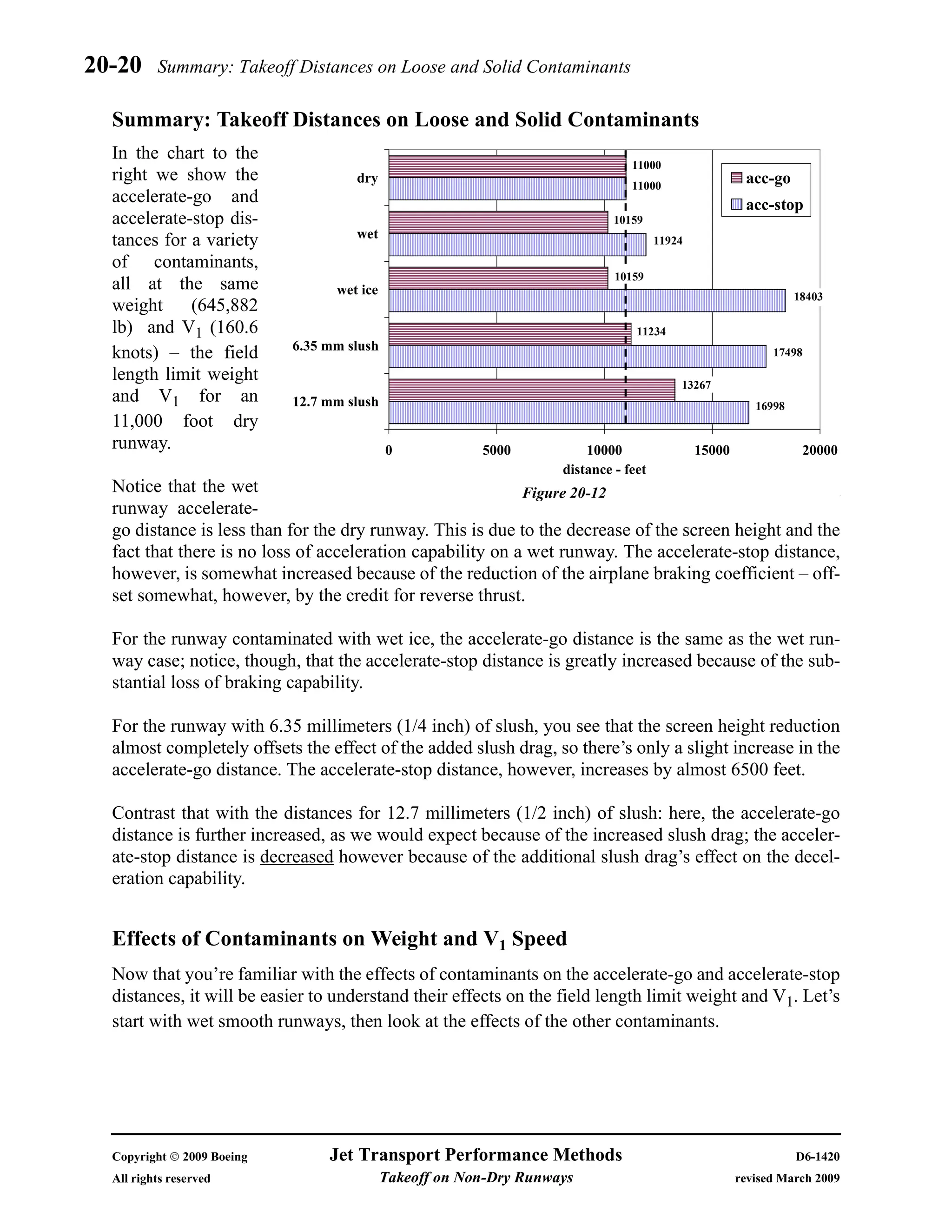
In the chart to the
right we show the
accelerate-go and
accelerate-stop dis-
tances for a variety
of contaminants,
all at the same
weight (645,882
lb) and V1 (160.6
knots) – the field
length limit weight
and V1 for an
11,000 foot dry
runway.
Notice that the wet
runway accelerate-
go distance is less than for the dry runway. This is due to the decrease of the screen height and the
fact that there is no loss of acceleration capability on a wet runway. The accelerate-stop distance,
however, is somewhat increased because of the reduction of the airplane braking coefficient – off-
set somewhat, however, by the credit for reverse thrust.
For the runway contaminated with wet ice, the accelerate-go distance is the same as the wet run-
way case; notice, though, that the accelerate-stop distance is greatly increased because of the sub-
stantial loss of braking capability.
For the runway with 6.35 millimeters (1/4 inch) of slush, you see that the screen height reduction
almost completely offsets the effect of the added slush drag, so there’s only a slight increase in the
accelerate-go distance. The accelerate-stop distance, however, increases by almost 6500 feet.
Contrast that with the distances for 12.7 millimeters (1/2 inch) of slush: here, the accelerate-go
distance is further increased, as we would expect because of the increased slush drag; the acceler-
ate-stop distance is decreased however because of the additional slush drag’s effect on the decel-
eration capability.
Effects of Contaminants on Weight and V1 Speed
Now that you’re familiar with the effects of contaminants on the accelerate-go and accelerate-stop
distances, it will be easier to understand their effects on the field length limit weight and V1. Let’s
start with wet smooth runways, then look at the effects of the other contaminants.
0 5000 10000 15000 20000
12.7 mm slush
6.35 mm slush
wet ice
wet
dry
distance - feet
acc-go
acc-stop
11000
11000
10159
11924
10159
18403
11234
17498
13267
16998
Figure 20-12

Hydroplaning.pdf notes of all all important

  • 1.
    20-14 Takeoff Distanceson Loose Contaminants Copyright 2009 Boeing Jet Transport Performance Methods D6-1420 All rights reserved Takeoff on Non-Dry Runways revised March 2009 • Reverse thrust is a function of time and velocity. Takeoff Distances on Loose Contaminants Up to this point, we have considered those runway conditions that have no effect on an airplane’s acceleration during takeoff. Now it’s time to look at the conditions called “loose contaminants”: standing water, slush, wet snow, or dry (loose) snow. These are considerably more complex, and they will affect the airplane’s deceleration capability as well as its acceleration. Note: contaminant drag is the term traditionally given to the additional drag imposed on an air- plane due to the presence of a contaminant on the runway. For simplicity in this discussion, whether we’re talking about slush or standing water or wet snow, we’ll refer to the increment of drag they cause as contaminant drag. physics of contaminant drag The physics of takeoff on a run- way having loose contaminants are similar to those on a dry run- way, with one notable excep- tion: the addition of the drag on the airplane resulting from the material which is covering the runway, be it standing water, slush, or wet snow. (Sharp-eyed readers will have noticed that in the diagram we’ve left out one more force: the component of weight due to runway slope. We’ve done that only to simplify the drawing slightly – it’s still a real force that must be accounted for when appropriate. For now, we’ll say that we have a level runway.) Contaminant drag actually has two elements: displacement drag and impingement drag. slush slush drag drag friction aero drag thrust Figure 20-6
  • 2.
    hydroplaning 20-15 Copyright 2009Boeing Jet Transport Performance Methods D6-1420 All rights reserved Takeoff on Non-Dry Runways revised March 2009 As illustrated in the figure to the right, displacement drag results from the energy required for the landing gear tires to displace the contaminant – that is, to move it out of their way as the air- plane rolls along the runway. Impingement drag results from the air- plane kinetic energy lost due to the impact of contaminant on parts of the body. The passage of the wheels through the contaminant causes a very powerful spray to be thrown up; due to its density and the velocity at which it strikes the airplane, it creates consider- able impact force on the airplane. Since this impact force is in an aftward direc- tion, it subtracts from the airplane’s kinetic energy. The contaminant impact can actually cause physical damage to an airplane. As a result of this, and because of the increasingly adverse effect of loose contaminants on takeoff performance as depth increases, the FAA and JAA both state specifically that takeoff is prohibited on runways having more than 1/2 inch (FAA) or 12.7 millimeters (JAA) of loose contaminant. There’s one exception to the statement above: the latest EASA regulations on non-dry runways permit up to 15 millimeters of depth instead of the earlier 12.7 millimeters, which corresponds to the FAA’s maximum depth of one-half inch. At the time of this writing (March 2009) however, Boeing takeoff software still limits the maximum depth to 12.7 millimeters. hydroplaning Hydroplaning (also sometimes referred to as “aquaplaning”) is a dynamic condition encountered by an airplane’s tires when operating on runways covered with loose contaminant. At low speeds on a runway having loose contaminant there is adequate time for the contaminant to move away from an airplane’s tires as it accelerates down the runway for takeoff. The tires remain in solid contact with the runway surface. The presence of the contaminant does result in an increase of the airplane’s drag, as discussed above, but there are no other adverse effects. Displacement drag FWD Impingement drag FWD Figure 20-7
  • 3.
    20-16 Takeoff Distanceson Loose Contaminants Copyright 2009 Boeing Jet Transport Performance Methods D6-1420 All rights reserved Takeoff on Non-Dry Runways revised March 2009 However, as an airplane accelerates in loose contaminant, the tires cause an increase of pressure in the contaminant in the area immediately ahead of them. When that pressure becomes suffi- ciently great, it forces a wedge of fluid underneath the tires’ leading edges, thus lifting the tires out of contact with the runway surface resulting in a loss of traction. The speed at which hydroplaning com- mences during an acceleration is known as the “hydroplaning speed” VHP. It’s a function of tire pressure. The accepted equation for the hydroplaning speed is: (eq. 1) where VHP is the hydroplaning speed in knots is the contaminant specific gravity tire pressure is expressed in pounds per square inch (psi) Traditionally, Boeing has used values of 0.85 and 1.00 for the contaminant specific gravity of slush and standing water respectively. It’s worth noting here that EASA presently uses a slightly different version of equation 1: the takeoff distance calculation process The acceleration of the airplane from the start of the takeoff roll to liftoff is divided into three dif- ferent speed ranges: • From brake release to the hydroplaning speed. In this speed regime, the distance calculation follows the same method as before, but includes the additional drag of the contaminant as a function of speed; • From hydroplaning speed to rotation speed. In this speed range, the tires are out of contact with the runway surface; the contaminant drag initially increases slowly, then as the hydro- planing effect increases the contaminant drag begins to decrease. As the speed increases fur- ther, the contaminant drag decreases more rapidly. Figure 20-8 VHP 8.63 tire pressure ----------------------------- - = VHP 9.0 tire pressure =
  • 4.
    the takeoff distancecalculation process 20-17 Copyright 2009 Boeing Jet Transport Performance Methods D6-1420 All rights reserved Takeoff on Non-Dry Runways revised March 2009 • From rotation speed to liftoff. When the airplane is rotated, the nose landing gear tires are instantaneously lifted out of the contaminant, causing an abrupt discontinuity in the contami- nant drag. Beyond VR, as the speed increases toward the liftoff speed, the contaminant drag decreases more and more rapidly. The calculation process used by Boeing for determining the distance is considered proprietary and may not be discussed here. In Figure 20-10, to the right, for one Boeing model taking off in half an inch of water with all engines operating you can see how the slush drag varies with velocity at ground speeds approaching and then exceeding the hydroplan- ing and rotation speeds. Up to the hydroplaning speed VHP the slush drag increases with the square of the velocity. At VHP you see that the hyroplaning is begin- ning to affect the slush drag as the tires lose contact with the takeoff surface. At the rotation speed VR there is an instanta- neous discontinuity in the contaminant drag due to the lifting of the nose landing gear from the runway, out of contact with the contaminant. Following rotation, as the main landing gear tires lift out of the contaminant, the drag decreases rapidly and becomes equal to zero at the liftoff speed. For the engine-out accelerate-go distance, the effect of the contaminant will look much the same as you see for all engines operating, except of course the acceleration will be greatly reduced fol- lowing the engine failure. For the accelerate-stop distances, the slush has two different effects, and the effect of the slush depth is different in these two cases. For acceleration, increasing contaminant depth has an adverse effect, since the contaminant drag is a function of the area of the tire exposed to the slush – which depends directly on the depth. On the other hand, increasing contaminant depth actually improves the deceleration because of the increasing drag. 0 2000 4000 6000 8000 10000 12000 14000 120 130 140 150 160 ground speed - knots VHP VR Figure 20-10
  • 5.
    20-18 Takeoff Distanceson Loose Contaminants Copyright 2009 Boeing Jet Transport Performance Methods D6-1420 All rights reserved Takeoff on Non-Dry Runways revised March 2009 effects of slush on acceleration and deceleration All-engine acceleration: in six millimeters (1/4 inch) of slush, you can see that there’s a 10 to 20 percent reduction in the all- engine acceleration. A slush depth of 13 millimeters (1/2 inch), the maximum, causes a 20 to 40 percent reduction in the all-engine acceleration. That’s reasonable. How about the acceleration capability following an engine failure? Engine-out acceleration: to the right we show the effect of run- ways covered with slush or standing water on engine-out acceleration. You see that in six millimeters of slush, there’s a 15 to 50 percent reduction in the engine-out acceleration capabil- ity. In 13 millimeters of slush, there’s a 30 to 110 percent reduction in the engine-out acceleration. More than 100 percent loss of acceleration? Yes. Because of this fact, if constrained to a balanced takeoff, the 737 could not take off in 12.7 milli- meters of slush or standing water. (There is, however, an operational method for getting around this condition, given a sufficiently long runway: by setting V1 equal to VR. That will unbalance the takeoff distances, making the accelerate-stop distance longer but enabling the airplane to con- duct the accelerate-go.) You can see that when computing the engine-out takeoff distances on runways having loose con- taminants, it’s necessary to ensure that the airplane has adequate acceleration to continue the take- off following the engine failure. This is done by checking the engine-out acceleration capability at speeds below the rotation speed. If the acceleration doesn’t meet a specified minimum threshold then mitigating action must be taken. On Boeing airplanes the minimum acceleration value used and the method for mitigation has changed over the years. It should also be pointed out that this issue is more common on smaller airplanes. In general on older airplanes such as the 737-100 through -500, the 757-200, and the 767-200/- 300 the minimum engine-out acceleration considered was zero feet per second per second. When the engine-out acceleration fell below the zero threshold, the typical mitigation strategy was to set V1 equal to VR, in essence not allowing an engine failure to be considered until flying speed had been reached. The field length in this case would be based on an accelerate-stop distance from a V1 equal to VR, resulting in very long takeoff distances. This mitigation method had the advan- 4.0 3.0 2.0 1.0 0.0 all engine acceleration knots per sec Dry 6 mm 13 mm 747 767 757 737 Dry 6 mm 13 mm Dry 6 mm 13 mm Dry 6 mm 13 mm Figure 20-11a 747 0.0 1.0 2.0 3.0 4.0 6 mm 13 mm Dry all engine -0.5 Engine out Dry 767 757 737 6 mm 13 mm Engine out Dry 6 mm 13 mm Engine out Dry 6 mm 13 mm Engine out Dry Dry all engine Dry all engine Dry all engine acceleration knots per sec Figure 20-11b
  • 6.
    calculating the loosecontaminant takeoff distances 20-19 Copyright 2009 Boeing Jet Transport Performance Methods D6-1420 All rights reserved Takeoff on Non-Dry Runways revised March 2009 tage of ensuring that such takeoffs could still be conducted, providing adequate runway length was available. In general, on the newer airplanes like the 777, 737NG, 757-300 and 767-400 the minimum engine-out acceleration considered is 0.5 feet per second per second. When the engine-out accel- eration falls below this check value, the computation is discontinued. The maximum takeoff weight allowed is that weight for which the engine-out acceleration exceeds the threshold. Engine-out deceleration: You saw previously that the air- plane braking coefficient is greatly reduced in slush. However, the slush does add drag to the landing gear, at least partially offsetting the loss of braking coefficient. You can see too that a greater contaminant depth is better than a lesser depth because of the greater slush drag. calculating the loose contaminant takeoff distances Armed with the above information on the effects of loose contaminants, it’s now possible to cal- culate the takeoff distances. While the calculation isn’t trivial, it follows the same basic step-integration method as for the dry case. The dependence of the thrust on time following the throttle chop and the dependence of the liftoff relief factor flof on time following rotation necessitate a complex time-based step integra- tion to arrive at the distance. The underlying methods, however, are the same as those you’ve seen previously and will not be demonstrated here. deceleration knots per sec Dry 6 mm 13 mm Dry 6 mm 13 mm Dry 6 mm 13 mm Dry 6 mm 13 mm 8.0 6.0 4.0 2.0 0.0 747 767 757 737 Figure 20-11c
  • 7.
    20-20 Summary: TakeoffDistances on Loose and Solid Contaminants Copyright 2009 Boeing Jet Transport Performance Methods D6-1420 All rights reserved Takeoff on Non-Dry Runways revised March 2009 Summary: Takeoff Distances on Loose and Solid Contaminants In the chart to the right we show the accelerate-go and accelerate-stop dis- tances for a variety of contaminants, all at the same weight (645,882 lb) and V1 (160.6 knots) – the field length limit weight and V1 for an 11,000 foot dry runway. Notice that the wet runway accelerate- go distance is less than for the dry runway. This is due to the decrease of the screen height and the fact that there is no loss of acceleration capability on a wet runway. The accelerate-stop distance, however, is somewhat increased because of the reduction of the airplane braking coefficient – off- set somewhat, however, by the credit for reverse thrust. For the runway contaminated with wet ice, the accelerate-go distance is the same as the wet run- way case; notice, though, that the accelerate-stop distance is greatly increased because of the sub- stantial loss of braking capability. For the runway with 6.35 millimeters (1/4 inch) of slush, you see that the screen height reduction almost completely offsets the effect of the added slush drag, so there’s only a slight increase in the accelerate-go distance. The accelerate-stop distance, however, increases by almost 6500 feet. Contrast that with the distances for 12.7 millimeters (1/2 inch) of slush: here, the accelerate-go distance is further increased, as we would expect because of the increased slush drag; the acceler- ate-stop distance is decreased however because of the additional slush drag’s effect on the decel- eration capability. Effects of Contaminants on Weight and V1 Speed Now that you’re familiar with the effects of contaminants on the accelerate-go and accelerate-stop distances, it will be easier to understand their effects on the field length limit weight and V1. Let’s start with wet smooth runways, then look at the effects of the other contaminants. 0 5000 10000 15000 20000 12.7 mm slush 6.35 mm slush wet ice wet dry distance - feet acc-go acc-stop 11000 11000 10159 11924 10159 18403 11234 17498 13267 16998 Figure 20-12