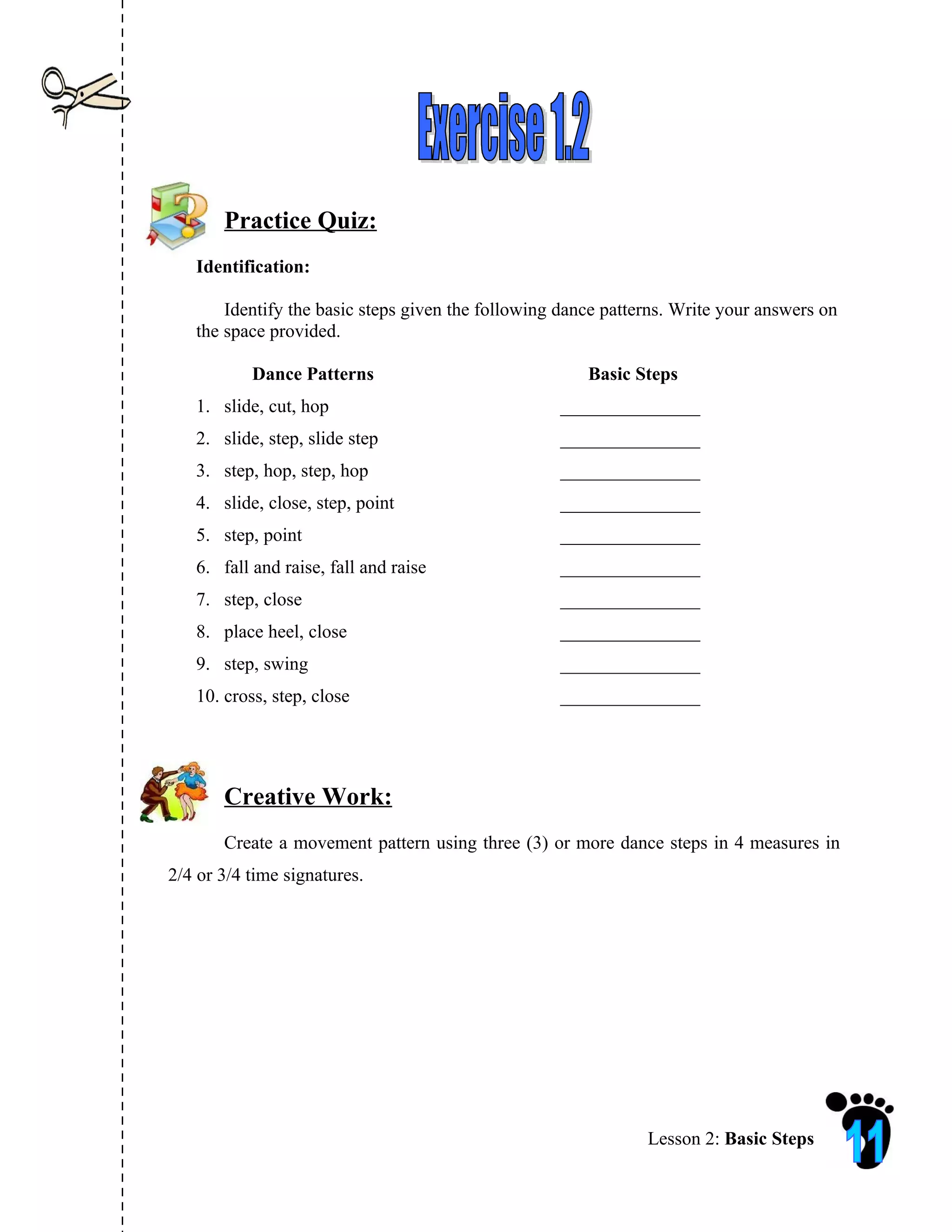
The document defines and describes 13 basic dance steps arranged alphabetically. The steps are divided into those used in 2/4 time and 3/4 time signatures. Each step is defined in 1-3 sentences with a focus on the foot and body movements involved. For example, the Bleking step in 2/4 time is defined as "Place R heel in front and hop on the L foot (ct. 1), with a spring reverse the position of the feet, that is L heel is placed in front (ct. 2)." Practice questions are then provided to test understanding of identifying the steps from movement patterns.
Lesson Objectives:
1. To execute the basic steps with accuracy while dancing;
2. To enumerate the basic steps in the different dance patterns: 2/4 and 3/4 time
signature; and
3. To define each basic steps.
The following basic steps are arranged in alphabetical order. It is divided into two
groups, basic steps in 2/4 and the 3/4 time signature.
You will notice that some basic steps can be found on both groups, it is because
they can be executed in both time signatures. These basic steps will be applied to the
dances on the preceding chapters.
ABBREVIATIONS USED
Ct. – count
Cts. – counts
L – left
R – right
1. Bleking Step - count 1, 2 to a measure.
Place R heel in front and hop on the L foot (ct. 1), with a spring reverse the
position of the feet, that is L heel is placed in front (ct. 2). This is taking one count for
each movement. Place R heel in front (ct. 1), step R close to L (ct. 2). This is taking two
counts for each movement.
2.
2. Chasse (slides)- count 1, and 2, and to a measure.
Slide R sideward (ct. 1), step L close to R or cut R with the L (ct. and). Two
chasse steps or two slides in one measure.
3. Close steps – count 1, 2 to a measure
Step R in any direction (ct. 1) then close L to R (ct. 2).
4. Pivot Turn - count 1, and 2, and a measure.
Step R foot in fourth in front (or a little close to fifth position in front) and bend
the R knee slightly (ct. 1), execute a quarter turn right with a push on the ball of the L
foot and raise the R foot slightly off the floor (ct. and). Repeat this movement three more
times to complete the turn in two measures. This may be done in 2 or more measures.
5. Rocking Step - count 1, 2 to a measure.
Fall onto L foot forward and raise R foot in rear (ct. 1), fall onto R foot backward
and raise L foot in front (ct. 2). The body is inclined slightly forward and backward in a
rocking motion.
6. Shuffling Steps - count 1, and, 2, and, or 1, ah, and, ah, 2, ah, and, ah to a measure.
Shuffling steps are tiny sliding steps forward on the balls of the feet. Execute as
many steps as necessary.
7. Skip Step - count 1 , ah, 2, ah to a measure.
The movements are the same as in step-hop, but done in one count only. Step on
R (ct. 1) and hop on R (ct. ah). There are two skip steps in one measure. This may be
executed in any direction.
Lesson 2: Basic Steps
3.
8. Step-Hop -count 1, 2 to a measure.
Step R foot forward (ct. 1), hop on the same foot and raise the L foot in front or in
rear (ct. 2).
9. Step-Swing-Hop - count 1, 2 to a measure.
Step R foot sideward (ct. 1), swing the L foot across the R in front and hop on the
R at the same time (ct. 2).
10. Step-Point - count 1, 2 to a measure.
Step R foot sideward (ct. 1), point L in front or obliquely L forward (ct. 2).
11. Step-Swing - count 1, 2 to a measure.
Step R foot sideward (ct. 1), swing the L foot across the R in front (ct. 2). This
may be executed in any direction.
12. Touch Step - count 1, 2 to a measure.
a. Point R foot in front (ct. 1), step R close L foot (ct. 2).
b. Hop on L and point R in front (ct. 1), with a spring reverse the position of the
feet (ct. 2). This is taking the step in one count.
1. Blecking step - count 1, 2, 3 to a measure.
Place R heel in front (cts. 1, 2) step R close to L foot (ct. 3). This is taking three
counts for each movement.
2. Cross Waltz – count 1, 2, 3 to a measure.
Step R across L in front and raise slightly the L foot across in rear (ct. 1), step L
close to R in third in rear (ct. 2), step R forward (ct. 3). There is a slight bending of the
knees on ct. 1. Step on the ball of the rear foot on ct. 2. This step is usually done in
forward or sideward direction.
Lesson 2: Basic Steps
4.
3. Mazurka -count 1, 2, 3 to a measure.
Slide R foot sideward (ct. 1), cut R sideward with the L foot (ct. 2), hop on L and
bring the R foot in front or in rear of the L ankle (ct. 3). This is done with one foot
leading and usually in a sideward or forward direction.
4. Redoba – count 1, 2, 3 to a measure
Slide R diagonally forward (ct. 1), cut R with L (ct. 2) and cut L with R (ct. 3).
5. Shuffling Steps -1, and, 2, and, 3, and or 1, ah, and, ah, 2, ah, and, ah, 3, ah, and, ah to
a measure.
Shuffling steps are tiny sliding steps forward on the balls of the feet. Execute as
many steps as necessary.
6. Step-hop - count 1, 2, 3 to a measure.
Step R foot forward (cts. 1, 2), hop on the same foot and raise the L foot in front
or in rear (cts. 3). This may be done in any direction.
7. Step-point - count 1, 2, 3 to a measure.
Step R foot sideward (cts. 1, 2), point L in front or obliquely L forward (ct. 3).
This step may be done in all directions.
8. Step-swing - count 1, 2, 3 to a measure.
a. Step R foot sideward (ct. 1), swing the L foot across the R in front (cts. 2, 3).
b. Step R foot sideward (cts. 1, 2), swing the L foot across the R in front (ct. 3).
9. Step-swing-hop – count 1, 2, 3 to a measure
Step R in any direction swing L (ct. 1), across R in front (ct. 2) and hop on R (ct.
3).
10. Touch step - count 1, 2, 3 to a measure.
a. Point R foot in front (cts. 1, 2), step R close to L (ct. 3).
b. Point R foot in front (ct. 1), step R close to L (cts. 2, 3).
5.
11. Varsovienne Step- Music ¾ time. Count 1, 2, 3 to a measure.
Lesson 2: Basic Steps
Slide R foot diagonally forward R (ct. 1), step L close to R in third in rear or in
first position (ct. 2), step R sideward (ct. 3). Point L foot in front (cts. 1, 2, 3). Bend the
body toward the pointing foot.
12. Waltz Balance - count 1, 2, 3 to a measure.
Step R foot forward (ct. 1), close L to R in third in rear or in first position and
raise both heels (ct. 2), lower heels with the weight of the body on the R foot (ct. 3). This
may be done in any direction.
13. Waltz step – count 1, 2, 3 to a measure
Step R sideward (ct. 1) then close L to R (ct. 2) and step R in place (ct. 3)
Lesson 2: Basic Steps
6.
Practice Quiz:
Identification:
Identify the basic steps given the following dance patterns. Write your answers on
the space provided.
Dance Patterns Basic Steps
1. slide, cut, hop _______________
2. slide, step, slide step _______________
3. step, hop, step, hop _______________
4. slide, close, step, point _______________
5. step, point _______________
6. fall and raise, fall and raise _______________
7. step, close _______________
8. place heel, close _______________
9. step, swing _______________
10. cross, step, close _______________
Creative Work:
Create a movement pattern using three (3) or more dance steps in 4 measures in
2/4 or 3/4 time signatures.
Lesson 2: Basic Steps