Economic and Financial
Instruments for IWRM
Financing water and sanitation through
bonds, BOTs and reforms
Meine Pieter van Dijk, UNESCO-IHE
28-08-2007
Goal and objectives of the session
 To look at the availability of a capital market at
the national level and the possibility to use it for
integrated water resource management
 To identify the different legal forms used for
funding, which go with the different financial
instruments which can be used in the water
sector and have been introduced in the previous
chapters
 To indicate how such a local capital market can
be developed over time if the right attitude and
policies are in place
Learning objectives of the session: to
1. Make participants aware of the importance of
developing local capital markets
2. Learn to appreciate the importance of legal
constructions to secure finance in the water sector
3. Provide arguments in favour and against private
sector involvement in the water sector
4. Show importance & composition of foreign capital
5. Identify financial risks and discuss possibilities to
mitigate risks
6. Understand reforms that need to be carried out
Outline presentation
1a The distinction between legal forms and
financing instruments
1b Introduce the notion of capital market
1c The importance of the capital market in your
country
2a The Indian experiences with such an approach
2b How to develop a local capital market
3a Africa’s experience in with bond markets
3b Exercise, or role play on sources of finance
Introduction
 Link water issues of the participants to
what can be achieved through mobilizing
capital from the local capital market
 Explain that with different sources of
finance you may also have different legal
forms but this requires a legal framework
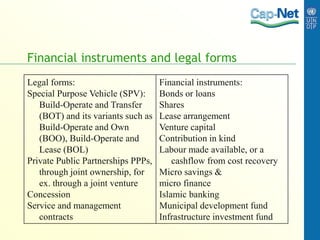
Financial instruments and legal forms
Legal forms:
Special Purpose Vehicle (SPV):
Build-Operate and Transfer
(BOT) and its variants such as
Build-Operate and Own
(BOO), Build-Operate and
Lease (BOL)
Private Public Partnerships PPPs,
through joint ownership, for
ex. through a joint venture
Concession
Service and management
contracts
Financial instruments:
Bonds or loans
Shares
Lease arrangement
Venture capital
Contribution in kind
Labour made available, or a
cashflow from cost recovery
Micro savings &
micro finance
Islamic banking
Municipal development fund
Infrastructure investment fund
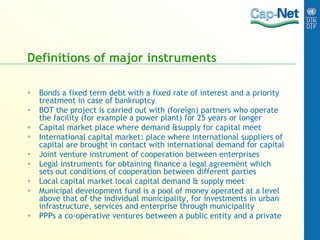
Definitions of major instruments
 Bonds a fixed term debt with a fixed rate of interest and a priority
treatment in case of bankruptcy
 BOT the project is carried out with (foreign) partners who operate
the facility (for example a power plant) for 25 years or longer
 Capital market place where demand &supply for capital meet
 International capital market: place where international suppliers of
capital are brought in contact with international demand for capital
 Joint venture instrument of cooperation between enterprises
 Legal instruments for obtaining finance a legal agreement which
sets out conditions of cooperation between different parties
 Local capital market local capital demand & supply meet
 Municipal development fund is a pool of money operated at a level
above that of the individual municipality, for investments in urban
infrastructure, services and enterprise through municipality
 PPPs a co-operative ventures between a public entity and a private
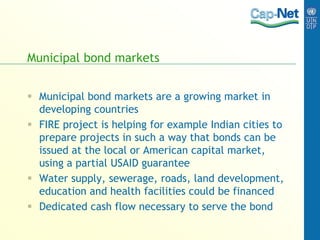
Municipal bond markets
 Municipal bond markets are a growing market in
developing countries
 FIRE project is helping for example Indian cities to
prepare projects in such a way that bonds can be
issued at the local or American capital market,
using a partial USAID guarantee
 Water supply, sewerage, roads, land development,
education and health facilities could be financed
 Dedicated cash flow necessary to serve the bond
The development of the bond market in India
 FIRE created possibilities for local governments to
gain access to the local and international capital
markets to allow them to finance infrastructure
 Questions asked are: what are the pre-requisites
to make PPPs a success, what kind of legal
framework is required and where would the funds
come from?
 The emphasis is on the conditions that need to be
satisfied to attract different sources of finance
Conditions that need to be satisfied to attract
different sources of finance
 Obtain a credit rating before issuing bonds
 The Gujarat State government prepared an
infrastructure 2000 Plan with vision and strategy
 The state was the first one in the country to draft
a Build Operate and Transfer law &
 Has experience with giving concessions to the
private sector
 Find sources of finance to serve and eventually
repay the bond
Things going wrong with India’s bonds: lack of …
 Genuine political commitment to reforms
 Clarity in scope and framework for PSP, no
adequate concern for management improvements
 Rigor in project and contract development, no risk
management
 Concern for financial viability
 Quality support &funding for project development
 Appropriate regulatory framework
 Participation & capacity building for stakeholders
 Continuity of champions for the projects when
leaders got transferred or defeated in elections
 Ownership for the project within the city; while
 Strong opposition from the existing rent seekers
Mechanisms for financing water and sanitation:
developing the local capital market
 Development of domestic debt markets requires
an efficient & liquid market for government debt
 It also requires the development of institutions
engaged in mobilizing long-term savings,
especially insurances and pensions funds
 Alternative: go for credit enhancement through
partial credit risk guarantees (offered by
multilateral development banks)
 Continue to tap funds from international lending
agencies and utilize these resources as seed
capital for leveraging funds from the market
Initiatives in Africa
 A number of countries have taken initiatives to
develop their local capital markets
 Countries are eager to use bonds and equity to
finance their infrastructure
 Ethiopia has bond market. The ministry of finance
organizes auctions regularly to sell national bonds
 Ethiopian cities will be allowed to finance their
infrastructure in that way
 Many countries wants to move to what is a called a
sub-sovereign bond market: public bodies below
the level of the national state can issue bonds
An example, Johannesburg in South Africa
 In South Africa it has already happened:
Johannesburg has issued bonds with a guarantee of
the IFC, the commercial wing of the World Bank
and the national government (through the
Development Bank of South Africa, DBSA)
 Although the city has not audited its accounts over
the last years, it is so big and important for the
South African economy that the government and
the IFC were willing to guarantee the bond
 The bond was taken up (bought) by local insurance
companies and investment funds
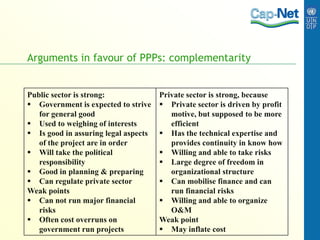
Arguments in favour of PPPs: complementarity
Public sector is strong:
 Government is expected to strive
for general good
 Used to weighing of interests
 Is good in assuring legal aspects
of the project are in order
 Will take the political
responsibility
 Good in planning & preparing
 Can regulate private sector
Weak points
 Can not run major financial
risks
 Often cost overruns on
government run projects
Private sector is strong, because
 Private sector is driven by profit
motive, but supposed to be more
efficient
 Has the technical expertise and
provides continuity in know how
 Willing and able to take risks
 Large degree of freedom in
organizational structure
 Can mobilise finance and can
run financial risks
 Willing and able to organize
O&M
Weak point
 May inflate cost
Conclusions
 Indian cities have started issuing bonds
 The easiest instrument to finance your
water infrastructure remains the BOT
 Conditions for success: have the required
legislation in place, have bankable projects
and the unit going for the BOT should have
prepared a good cost benefit analysis
 Infrastructure should generate a cash flow
Think about it
 Discuss your experiences with a more
sophisticated way of financing the water
sector, while indicating the advantages and
disadvantages of each approach (of the
different ways of tapping the capital
market)
End
 Now you need to apply these ideas, in the
next chapter we summarize some of the
suggestions how to finance IWRM plans
 The last chapter takes the different actors
and shows what they can contribute: local
governments, small companies, NGOs &
financial institutions

10. capnetch7.1

  • 1.
    Economic and Financial Instrumentsfor IWRM Financing water and sanitation through bonds, BOTs and reforms Meine Pieter van Dijk, UNESCO-IHE 28-08-2007
  • 2.
    Goal and objectivesof the session  To look at the availability of a capital market at the national level and the possibility to use it for integrated water resource management  To identify the different legal forms used for funding, which go with the different financial instruments which can be used in the water sector and have been introduced in the previous chapters  To indicate how such a local capital market can be developed over time if the right attitude and policies are in place
  • 3.
    Learning objectives ofthe session: to 1. Make participants aware of the importance of developing local capital markets 2. Learn to appreciate the importance of legal constructions to secure finance in the water sector 3. Provide arguments in favour and against private sector involvement in the water sector 4. Show importance & composition of foreign capital 5. Identify financial risks and discuss possibilities to mitigate risks 6. Understand reforms that need to be carried out
  • 4.
    Outline presentation 1a Thedistinction between legal forms and financing instruments 1b Introduce the notion of capital market 1c The importance of the capital market in your country 2a The Indian experiences with such an approach 2b How to develop a local capital market 3a Africa’s experience in with bond markets 3b Exercise, or role play on sources of finance
  • 5.
    Introduction  Link waterissues of the participants to what can be achieved through mobilizing capital from the local capital market  Explain that with different sources of finance you may also have different legal forms but this requires a legal framework
  • 6.
    Financial instruments andlegal forms Legal forms: Special Purpose Vehicle (SPV): Build-Operate and Transfer (BOT) and its variants such as Build-Operate and Own (BOO), Build-Operate and Lease (BOL) Private Public Partnerships PPPs, through joint ownership, for ex. through a joint venture Concession Service and management contracts Financial instruments: Bonds or loans Shares Lease arrangement Venture capital Contribution in kind Labour made available, or a cashflow from cost recovery Micro savings & micro finance Islamic banking Municipal development fund Infrastructure investment fund
  • 7.
    Definitions of majorinstruments  Bonds a fixed term debt with a fixed rate of interest and a priority treatment in case of bankruptcy  BOT the project is carried out with (foreign) partners who operate the facility (for example a power plant) for 25 years or longer  Capital market place where demand &supply for capital meet  International capital market: place where international suppliers of capital are brought in contact with international demand for capital  Joint venture instrument of cooperation between enterprises  Legal instruments for obtaining finance a legal agreement which sets out conditions of cooperation between different parties  Local capital market local capital demand & supply meet  Municipal development fund is a pool of money operated at a level above that of the individual municipality, for investments in urban infrastructure, services and enterprise through municipality  PPPs a co-operative ventures between a public entity and a private
  • 8.
    Municipal bond markets Municipal bond markets are a growing market in developing countries  FIRE project is helping for example Indian cities to prepare projects in such a way that bonds can be issued at the local or American capital market, using a partial USAID guarantee  Water supply, sewerage, roads, land development, education and health facilities could be financed  Dedicated cash flow necessary to serve the bond
  • 9.
    The development ofthe bond market in India  FIRE created possibilities for local governments to gain access to the local and international capital markets to allow them to finance infrastructure  Questions asked are: what are the pre-requisites to make PPPs a success, what kind of legal framework is required and where would the funds come from?  The emphasis is on the conditions that need to be satisfied to attract different sources of finance
  • 10.
    Conditions that needto be satisfied to attract different sources of finance  Obtain a credit rating before issuing bonds  The Gujarat State government prepared an infrastructure 2000 Plan with vision and strategy  The state was the first one in the country to draft a Build Operate and Transfer law &  Has experience with giving concessions to the private sector  Find sources of finance to serve and eventually repay the bond
  • 11.
    Things going wrongwith India’s bonds: lack of …  Genuine political commitment to reforms  Clarity in scope and framework for PSP, no adequate concern for management improvements  Rigor in project and contract development, no risk management  Concern for financial viability  Quality support &funding for project development  Appropriate regulatory framework  Participation & capacity building for stakeholders  Continuity of champions for the projects when leaders got transferred or defeated in elections  Ownership for the project within the city; while  Strong opposition from the existing rent seekers
  • 12.
    Mechanisms for financingwater and sanitation: developing the local capital market  Development of domestic debt markets requires an efficient & liquid market for government debt  It also requires the development of institutions engaged in mobilizing long-term savings, especially insurances and pensions funds  Alternative: go for credit enhancement through partial credit risk guarantees (offered by multilateral development banks)  Continue to tap funds from international lending agencies and utilize these resources as seed capital for leveraging funds from the market
  • 13.
    Initiatives in Africa A number of countries have taken initiatives to develop their local capital markets  Countries are eager to use bonds and equity to finance their infrastructure  Ethiopia has bond market. The ministry of finance organizes auctions regularly to sell national bonds  Ethiopian cities will be allowed to finance their infrastructure in that way  Many countries wants to move to what is a called a sub-sovereign bond market: public bodies below the level of the national state can issue bonds
  • 14.
    An example, Johannesburgin South Africa  In South Africa it has already happened: Johannesburg has issued bonds with a guarantee of the IFC, the commercial wing of the World Bank and the national government (through the Development Bank of South Africa, DBSA)  Although the city has not audited its accounts over the last years, it is so big and important for the South African economy that the government and the IFC were willing to guarantee the bond  The bond was taken up (bought) by local insurance companies and investment funds
  • 15.
    Arguments in favourof PPPs: complementarity Public sector is strong:  Government is expected to strive for general good  Used to weighing of interests  Is good in assuring legal aspects of the project are in order  Will take the political responsibility  Good in planning & preparing  Can regulate private sector Weak points  Can not run major financial risks  Often cost overruns on government run projects Private sector is strong, because  Private sector is driven by profit motive, but supposed to be more efficient  Has the technical expertise and provides continuity in know how  Willing and able to take risks  Large degree of freedom in organizational structure  Can mobilise finance and can run financial risks  Willing and able to organize O&M Weak point  May inflate cost
  • 16.
    Conclusions  Indian citieshave started issuing bonds  The easiest instrument to finance your water infrastructure remains the BOT  Conditions for success: have the required legislation in place, have bankable projects and the unit going for the BOT should have prepared a good cost benefit analysis  Infrastructure should generate a cash flow
  • 17.
    Think about it Discuss your experiences with a more sophisticated way of financing the water sector, while indicating the advantages and disadvantages of each approach (of the different ways of tapping the capital market)
  • 18.
    End  Now youneed to apply these ideas, in the next chapter we summarize some of the suggestions how to finance IWRM plans  The last chapter takes the different actors and shows what they can contribute: local governments, small companies, NGOs & financial institutions