1
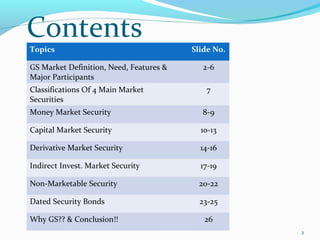
Contents
2
Topics Slide No.
GS Market Definition, Need, Features &
Major Participants
2-6
Classifications Of 4 Main Market
Securities
7
Money Market Security 8-9
Capital Market Security 10-13
Derivative Market Security 14-16
Indirect Invest. Market Security 17-19
Non-Marketable Security 20-22
Dated Security Bonds 23-25
Why GS?? & Conclusion!! 26
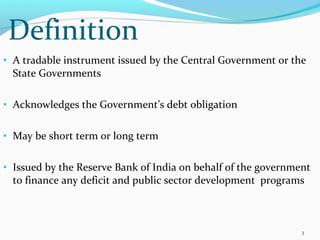
• A tradable instrument issued by the Central Government or the
State Governments
• Acknowledges the Government’s debt obligation
• May be short term or long term
• Issued by the Reserve Bank of India on behalf of the government
to finance any deficit and public sector development programs
3
Definition
Government needs enormous amount of money to
perform the following main functions:
Creation and maintenance of physical infrastructure
They are issued in order to finance the fiscal deficit
and managing the temporary cash mismatches of the
Government.
4
Need of GS
• Issued at face value
• No default risk as the securities carry sovereign guarantee
• Ample liquidity as the investor can sell the security in the
secondary market
• Interest payment on a half yearly basis on face value
• No tax deducted at source
5
Features of GS
The Government securities market consists of securities
issued by the State government and the Central
government.
Government securities include Central Government
securities, Treasury bills and State Development Loans.
All entities registered in India like banks, financial
institutions, Primary Dealers, firms, companies, corporate
bodies, partnership firms, institutions, mutual funds,
Foreign Institutional Investors, State Governments,
Provident Funds, trusts, research organizations, Nepal
Rashtra bank and even individuals are eligible to purchase
Government Securities. 6
Major Participants
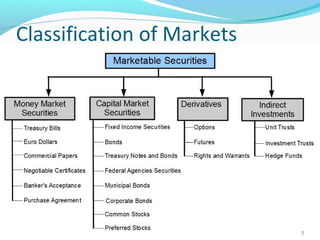
Classification of Markets
7
Money Market Security
8
o Stocks, bonds or any other types of securities
which can be traded easily in organized financial
markets or between two investors with the help
of brokers, are known as marketable securities.
o Feature:
It is easier to trade them and they can be
converted into cash whenever required by the
investor
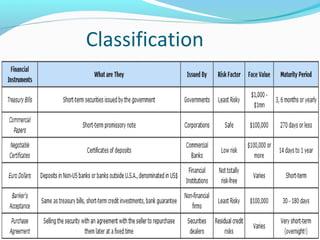
Classification
The common stocks in which we trade in the open
market are classic examples of a capital market
security. In such securities, the maturity period is
greater than one year and for some securities (for
example, stocks), there is no defined maturity period.
Capital Market Security
10
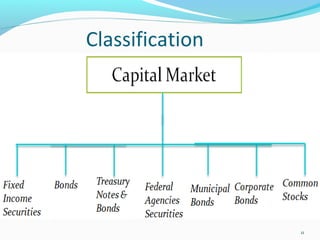
Classification
11
 Fixed Income Securities: These are investments that promise guaranteed income on the
amount invested, though at a lower rate of return.
 Bonds: They are a form of fixed-income securities, and payments are made as per the
time and depending on the conditions mentioned in the deal.
 Treasury Notes and Bonds: These securities offer higher interests, and they also repay
the principal on maturity. The terms of treasury notes are usually between 1 to 10 years
while for the treasury bonds, it is between 10-30 years.
 Municipal Bonds: These are tax-exempted investments and hence, one of the most
sought after bonds issued by the government.
 Corporate Bonds: These are almost similar to the treasury bonds with the major
difference that they are issued by corporate entities, so the risk of default is higher.
 Stocks: Stocks are divided into two types:
 Preferred stocks : Suppose if a company shuts down or goes broke, common stock
shareholders are the last investors to get compensated. Dividend, if it is distributed at
all, first goes to creditors, bondholders, and preferred shareholders.
 Common stocks: The general trading we see in stock markets is done in common
stocks. 12
These class of marketable securities represent those
investments values of which are dependent on the
performance of several other securities. That means,
their values are derived from the value of other
investment instruments and hence, the name
derivatives.
Derivative Market Security
13
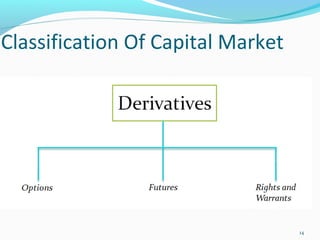
Classification Of Capital Market
14
Options: It is an interesting security that provides the holder the right, but not
obligation to buy or sell securities at some fixed point of time in the future.
The buying is typically known as 'a call option' while selling is popular as 'a put
option'. In case, the holder doesn't carry the transaction within the specified
time constraints, the deal expires.
Very speculative and hence only ideal for sophisticated investors.
Futures: Futures securities are just like options, but with a major difference
that in future securities, the buyer is obligated to fulfill the terms of contract
unlike the options.
The futures market is extremely liquid, risky and very complex.
Rights and Warrants: Similar to options and futures, are rights and warrants
that grant the shareholders some rights of ownership and profit from the
company's performance.
Rights and warrants are issued by the companies for raising money.
Rights are generally for short-term and expire within a week, while warrants may
be traded for one to a few years.
15
Investments in securities that are made by purchasing
shares of an investment company, are known as
indirect investments. Just like any other company,
even an investment company tries to diversify its
portfolio and generate funds for its business
purposes.
Indirect Investment Market Security
16
Classification
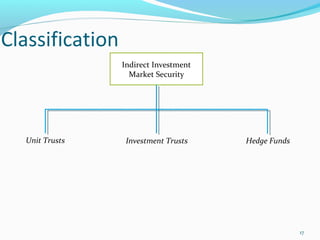
Unit Trusts Investment Trusts Hedge Funds
Indirect Investment
Market Security
17
 Unit Trusts: Also known as open-ended investments, the value of a unit trust depends
on the number of units issued and the price of each unit. The success of a unit trust
depends on the expertise and experience of the fund managers handling it.
 Investment Trusts: One of the most popular investment instruments are the mutual
funds. Investment trusts, like mutual funds, also known as open-end investment
companies sell shares of the companies even after the Initial Public Offering (IPO) gets
over.
Another type of marketable securities are in the form of closed-end investments. These
are the companies under trusts that don't sell the shares after the IPO of a company
gets over.
 Hedge Funds: Hedge fund is a general, non-legal term used to describe private,
unregistered investment pools that traditionally have been limited to sophisticated,
wealthy investors.
Hedge funds are not mutual funds and, as such, are not subject to the numerous
regulations that apply to mutual funds for the protection of investors - including
regulations requiring a certain degree of liquidity.
18
Non-Marketable Securities
19
o Securities that are difficult to trade in a normal financial market are generally
called non-marketable securities.
o It is difficult to get a potential buyer for non-marketable securities and hence,
some of the financial instruments that comprise non-marketable securities are
traded in private transactions.
o Although these securities can't be traded easily, they from a significant portion of
an investor's portfolio.
o These securities are traded between investors and large financial institutions like
commercial banks, so it is a risk-free and safe investment.
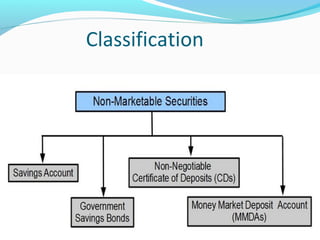
Classification
 Savings Account
They are a form of non-marketable securities that earn an interest over a period. The
interest rates and maturity period depends on the banks. For the account to function,
investor needs to maintain some minimum balance as per the directives of the bank. It
is a safe and simple form of investment although, the returns are not very high.
 Government Savings Bonds
Those government bonds that can't be traded in the open market, constitute a part of
government savings bonds. These government debt instruments are traded amongst
investors and financial institutions (banks) indirectly. These bonds earn interest only
when they are redeemed.
 Non-negotiable Certificates of Deposits (CDs)
CDs are promissory notes (the bearer is promised some return on investment with
interest) that are issued by commercial banks.
CDs have a maturity period of one month to five years and any withdrawal prior to
maturity attracts penalty.
Money Market Deposit Accounts (MMDAs)
MMDA securities have very high interest rates along with some restrictions as:
 An investor is allowed a limited number of transactions every month
 It is also mandatory to maintain a minimum balance that is normally higher than that
in normal savings account.
21
Dated Security Bonds
Dated Government securities are longer term
securities and carry a fixed or floating coupon
(interest rate) paid on the face value, payable at fixed
time periods (usually half -yearly).
The tenor of dated securities can be up to 30 years
22
23
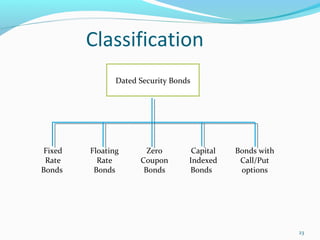
Classification
Dated Security Bonds
Fixed
Rate
Bonds
Floating
Rate
Bonds
Zero
Coupon
Bonds
Capital
Indexed
Bonds
Bonds with
Call/Put
options
o Fixed Rate Bonds
These are bonds on which the coupon rate is fixed for the entire life of the bond
o Floating Rate Bonds
Floating Rate bonds are securities which do not have a fixed coupon rate and the
coupon is reset at pre-announced intervals based on a specified methodology.
o Zero Coupon Bonds
Zero coupon bonds are bonds with no coupon payments. Like Treasury Bills,
they
are issued at a discount to face value
o Capital Indexed Bonds
These are bonds, the principal of which is linked to an accepted index of
inflation
with a view to protect the holder from inflation
o Bonds with Call/Put options
Bonds can also be issued with features of option wherein the issuer can have the
option to buy back (call option) or the investor might have the option to sell the
Why Government Securities???
• It Constitutes the principal segment of the debt market
• Acts as a benchmark for pricing corporate papers of varying maturities
• Helpful in implementing the fiscal policy of the government
• Provide the highest type of collateral for borrowing against their
pledge
• Have the highest degree of security of capital and the return on each
security depending on the coupon rate and period of maturity
• Switches between the short dated and long dated securities take place
on the basis of difference in redemption yields.
25
26

Govt sec markts

  • 1.
  • 2.
    Contents 2 Topics Slide No. GSMarket Definition, Need, Features & Major Participants 2-6 Classifications Of 4 Main Market Securities 7 Money Market Security 8-9 Capital Market Security 10-13 Derivative Market Security 14-16 Indirect Invest. Market Security 17-19 Non-Marketable Security 20-22 Dated Security Bonds 23-25 Why GS?? & Conclusion!! 26
  • 3.
    • A tradableinstrument issued by the Central Government or the State Governments • Acknowledges the Government’s debt obligation • May be short term or long term • Issued by the Reserve Bank of India on behalf of the government to finance any deficit and public sector development programs 3 Definition
  • 4.
    Government needs enormousamount of money to perform the following main functions: Creation and maintenance of physical infrastructure They are issued in order to finance the fiscal deficit and managing the temporary cash mismatches of the Government. 4 Need of GS
  • 5.
    • Issued atface value • No default risk as the securities carry sovereign guarantee • Ample liquidity as the investor can sell the security in the secondary market • Interest payment on a half yearly basis on face value • No tax deducted at source 5 Features of GS
  • 6.
    The Government securitiesmarket consists of securities issued by the State government and the Central government. Government securities include Central Government securities, Treasury bills and State Development Loans. All entities registered in India like banks, financial institutions, Primary Dealers, firms, companies, corporate bodies, partnership firms, institutions, mutual funds, Foreign Institutional Investors, State Governments, Provident Funds, trusts, research organizations, Nepal Rashtra bank and even individuals are eligible to purchase Government Securities. 6 Major Participants
  • 7.
  • 8.
    Money Market Security 8 oStocks, bonds or any other types of securities which can be traded easily in organized financial markets or between two investors with the help of brokers, are known as marketable securities. o Feature: It is easier to trade them and they can be converted into cash whenever required by the investor
  • 9.
  • 10.
    The common stocksin which we trade in the open market are classic examples of a capital market security. In such securities, the maturity period is greater than one year and for some securities (for example, stocks), there is no defined maturity period. Capital Market Security 10
  • 11.
  • 12.
     Fixed IncomeSecurities: These are investments that promise guaranteed income on the amount invested, though at a lower rate of return.  Bonds: They are a form of fixed-income securities, and payments are made as per the time and depending on the conditions mentioned in the deal.  Treasury Notes and Bonds: These securities offer higher interests, and they also repay the principal on maturity. The terms of treasury notes are usually between 1 to 10 years while for the treasury bonds, it is between 10-30 years.  Municipal Bonds: These are tax-exempted investments and hence, one of the most sought after bonds issued by the government.  Corporate Bonds: These are almost similar to the treasury bonds with the major difference that they are issued by corporate entities, so the risk of default is higher.  Stocks: Stocks are divided into two types:  Preferred stocks : Suppose if a company shuts down or goes broke, common stock shareholders are the last investors to get compensated. Dividend, if it is distributed at all, first goes to creditors, bondholders, and preferred shareholders.  Common stocks: The general trading we see in stock markets is done in common stocks. 12
  • 13.
    These class ofmarketable securities represent those investments values of which are dependent on the performance of several other securities. That means, their values are derived from the value of other investment instruments and hence, the name derivatives. Derivative Market Security 13
  • 14.
  • 15.
    Options: It isan interesting security that provides the holder the right, but not obligation to buy or sell securities at some fixed point of time in the future. The buying is typically known as 'a call option' while selling is popular as 'a put option'. In case, the holder doesn't carry the transaction within the specified time constraints, the deal expires. Very speculative and hence only ideal for sophisticated investors. Futures: Futures securities are just like options, but with a major difference that in future securities, the buyer is obligated to fulfill the terms of contract unlike the options. The futures market is extremely liquid, risky and very complex. Rights and Warrants: Similar to options and futures, are rights and warrants that grant the shareholders some rights of ownership and profit from the company's performance. Rights and warrants are issued by the companies for raising money. Rights are generally for short-term and expire within a week, while warrants may be traded for one to a few years. 15
  • 16.
    Investments in securitiesthat are made by purchasing shares of an investment company, are known as indirect investments. Just like any other company, even an investment company tries to diversify its portfolio and generate funds for its business purposes. Indirect Investment Market Security 16
  • 17.
    Classification Unit Trusts InvestmentTrusts Hedge Funds Indirect Investment Market Security 17
  • 18.
     Unit Trusts:Also known as open-ended investments, the value of a unit trust depends on the number of units issued and the price of each unit. The success of a unit trust depends on the expertise and experience of the fund managers handling it.  Investment Trusts: One of the most popular investment instruments are the mutual funds. Investment trusts, like mutual funds, also known as open-end investment companies sell shares of the companies even after the Initial Public Offering (IPO) gets over. Another type of marketable securities are in the form of closed-end investments. These are the companies under trusts that don't sell the shares after the IPO of a company gets over.  Hedge Funds: Hedge fund is a general, non-legal term used to describe private, unregistered investment pools that traditionally have been limited to sophisticated, wealthy investors. Hedge funds are not mutual funds and, as such, are not subject to the numerous regulations that apply to mutual funds for the protection of investors - including regulations requiring a certain degree of liquidity. 18
  • 19.
    Non-Marketable Securities 19 o Securitiesthat are difficult to trade in a normal financial market are generally called non-marketable securities. o It is difficult to get a potential buyer for non-marketable securities and hence, some of the financial instruments that comprise non-marketable securities are traded in private transactions. o Although these securities can't be traded easily, they from a significant portion of an investor's portfolio. o These securities are traded between investors and large financial institutions like commercial banks, so it is a risk-free and safe investment.
  • 20.
  • 21.
     Savings Account Theyare a form of non-marketable securities that earn an interest over a period. The interest rates and maturity period depends on the banks. For the account to function, investor needs to maintain some minimum balance as per the directives of the bank. It is a safe and simple form of investment although, the returns are not very high.  Government Savings Bonds Those government bonds that can't be traded in the open market, constitute a part of government savings bonds. These government debt instruments are traded amongst investors and financial institutions (banks) indirectly. These bonds earn interest only when they are redeemed.  Non-negotiable Certificates of Deposits (CDs) CDs are promissory notes (the bearer is promised some return on investment with interest) that are issued by commercial banks. CDs have a maturity period of one month to five years and any withdrawal prior to maturity attracts penalty. Money Market Deposit Accounts (MMDAs) MMDA securities have very high interest rates along with some restrictions as:  An investor is allowed a limited number of transactions every month  It is also mandatory to maintain a minimum balance that is normally higher than that in normal savings account. 21
  • 22.
    Dated Security Bonds DatedGovernment securities are longer term securities and carry a fixed or floating coupon (interest rate) paid on the face value, payable at fixed time periods (usually half -yearly). The tenor of dated securities can be up to 30 years 22
  • 23.
  • 24.
    o Fixed RateBonds These are bonds on which the coupon rate is fixed for the entire life of the bond o Floating Rate Bonds Floating Rate bonds are securities which do not have a fixed coupon rate and the coupon is reset at pre-announced intervals based on a specified methodology. o Zero Coupon Bonds Zero coupon bonds are bonds with no coupon payments. Like Treasury Bills, they are issued at a discount to face value o Capital Indexed Bonds These are bonds, the principal of which is linked to an accepted index of inflation with a view to protect the holder from inflation o Bonds with Call/Put options Bonds can also be issued with features of option wherein the issuer can have the option to buy back (call option) or the investor might have the option to sell the
  • 25.
    Why Government Securities??? •It Constitutes the principal segment of the debt market • Acts as a benchmark for pricing corporate papers of varying maturities • Helpful in implementing the fiscal policy of the government • Provide the highest type of collateral for borrowing against their pledge • Have the highest degree of security of capital and the return on each security depending on the coupon rate and period of maturity • Switches between the short dated and long dated securities take place on the basis of difference in redemption yields. 25
  • 26.

Editor's Notes

  • #13 Suppose you invest US$100 in a bond at 10% fixed interest annually. So, it will give you a $10 return every year until maturity when you would receive the US$100 back. The investor can sell the purchased bond before maturity, depending on the market conditions and how that particular bond is rated.