School of Management
By: Mr. Manoj Kumar Mishra
1/30/2023 Business Mathematics 1
UNIVERSITY OF STEEL TECHNOLOGY
AND MANAGEMENT
Matrices Algebra
For BBA & B.Com
Topic To be Covered
1/30/2023 Business Mathematics 2
1. Solution of Simultaneous Linear Equations
2. Cramer Rule
3. Row echelon form of matrix
4. Gauss Jordan Method
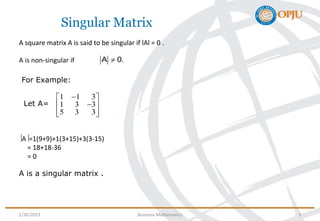
Singular Matrix
A square matrix A is said to be singular if lAl = 0 .
A is non-singular if 
A 0.
For Example:
1 1 3
1 3 3
5 3 3

 

 
 
 
Let A=
A is a singular matrix .
A=1(9+9)+1(3+15)+3(3-15)
= 18+18-36
= 0
1/30/2023 Business Mathematics 3
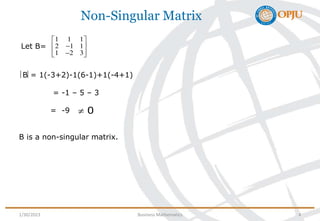
Non-Singular Matrix
Let B=
1 1 1
2 1 1
1 2 3
 

 
 

 
B is a non-singular matrix.
B= 1(-3+2)-1(6-1)+1(-4+1)
= -1 – 5 – 3
= -9 0

1/30/2023 Business Mathematics 4
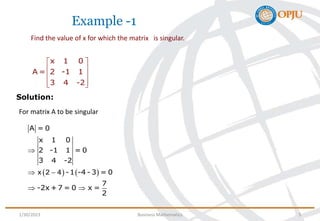
Example -1
Find the value of x for which the matrix is singular.
x 1 0
A = 2 -1 1
3 4 -2
 
 
 
 
 
For matrix A to be singular
   
A = 0
x 1 0
2 -1 1 = 0
3 4 -2
-1 -4 - 3 = 0
7
-2x +7 = 0 x =
2
x 2 4

 
 
Solution:
1/30/2023 Business Mathematics 5
Solution of Simultaneous Linear Equations
(Matrix Method)
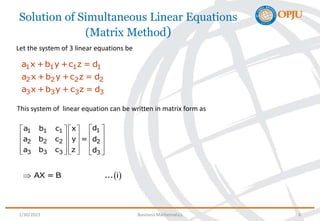
Let the system of 3 linear equations be
1 1 1 1
2 2 2 2
3 3 3 3
a x +b y +c z = d
a x +b y +c z = d
a x +b y + c z = d
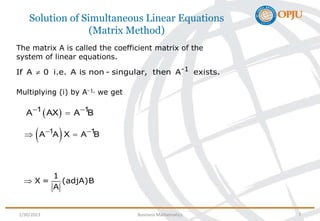
This system of linear equation can be written in matrix form as
1
1 1 1
2 2 2 2
3 3 3 3
d
a b c x
a b c y = d
a b c z d
 
   
 
   
 
   
 
   
 
   
 
AX = B ... i

1/30/2023 Business Mathematics 6
Solution of Simultaneous Linear Equations
(Matrix Method)
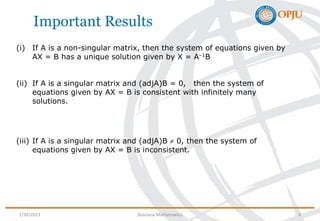
1
X = (adjA)B
A

The matrix A is called the coefficient matrix of the
system of linear equations.
Multiplying (i) by A–1, we get
-1
If A 0 i.e. A is non - singular, then A exists.

 
1 1
A AX A B
 

 
1 1
A A X A B
 
 
1/30/2023 Business Mathematics 7
Important Results
(i) If A is a non-singular matrix, then the system of equations given by
AX = B has a unique solution given by X = A–1B
(ii) If A is a singular matrix and (adjA)B = 0, then the system of
equations given by AX = B is consistent with infinitely many
solutions.
(iii) If A is a singular matrix and (adjA)B  0, then the system of
equations given by AX = B is inconsistent.
1/30/2023 Business Mathematics 8
Question-1
Using matrix method, solve the following system of linear equations
x + 2y -3z = -4
2x + 3y + 2z = 2
3x - 3y - 4z = 11
Solution:
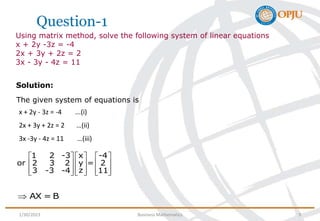
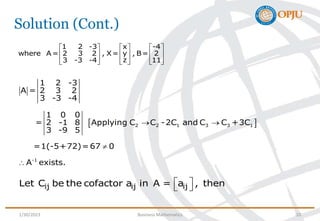
The given system of equations is
x + 2y - 3z = -4 ...(i)
2x + 3y + 2z = 2 …(ii)
3x -3y - 4z = 11 …(iii)
1 2 -3 x -4
or 2 3 2 y = 2
z
3 -3 -4 11
     
     
     
     
AX = B

1/30/2023 Business Mathematics 9
Solution (Cont.)
1 2 -3 x -4
where A= 2 3 2 , X= y , B= 2
z
3 -3 -4 11
     
     
     
     
 
2 2 1 3 3 1
-1
1 2 -3
A = 2 3 2
3 -3 -4
1 0 0
= 2 -1 8 Applying C C -2C and C C +3C
3 -9 5
=1(-5+72)=67 0
A exists.
 


ij ij ij
Let C be the cofactor a in A = a , then
 
 
1/30/2023 Business Mathematics 10
Solution Cont.
 
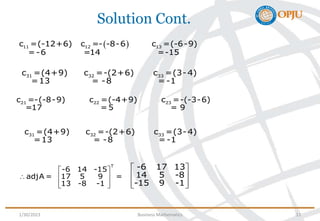
11 12 13
c =(-12+6) c =- -8-6 c =(-6-9)
=-6 =14 =-15
21 22 23
c =-(-8-9) c =(-4+9) c =-(-3-6)
=17 =5 = 9
31 32 33
c =(4+9) c =-(2+6) c =(3-4)
=13 = -8 = -1
31 32 33
c =(4+9) c =-(2+6) c =(3-4)
=13 = -8 = -1
-6 17 13
14 5 -8
-15 9 -1
 
 
 
 
T
-6 14 -15
adjA = 17 5 9 =
13 -8 -1
 
  
 
 
1/30/2023 Business Mathematics 11
Solution (Con.)
-1
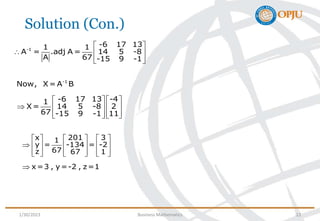
Now, X= A B
-6 17 13 -4
1
X= 14 5 -8 2
67 -15 9 -1 11
   
    
   
   
x 201 3
1
y = -134 = -2
67
z 67 1
x=3 , y=-2 , z=1
     
      
     
     

-1
-6 17 13
1 1
A = .adj A = 14 5 -8
A 67 -15 9 -1
 
  
 
 
1/30/2023 Business Mathematics 12
Practice Question
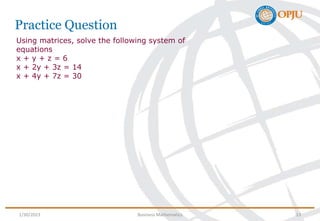
Using matrices, solve the following system of
equations
x + y + z = 6
x + 2y + 3z = 14
x + 4y + 7z = 30
1/30/2023 Business Mathematics 13
Cramer’s Rule
• System of Linear Equations
• How to solve using Cramer’s Rule
1/30/2023 Business Mathematics 14
Introduction
• Cramer’s Rule is a method for solving linear
simultaneous equations. It makes use of
determinants and so a knowledge of these is
necessary before proceeding.
• Cramer’s Rule relies on determinants
1/30/2023 Business Mathematics 15
Coefficient Matrices
• You can use determinants to solve a system of
linear equations.
• You use the coefficient matrix of the linear
system.
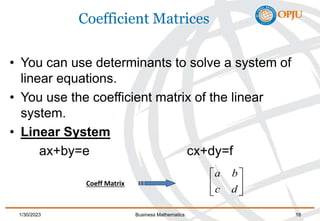
• Linear System
ax+by=e cx+dy=f






d
c
b
a
1/30/2023 Business Mathematics 16
Coeff Matrix
Using Cramer’s Rule
to Solve a System of Three Equations
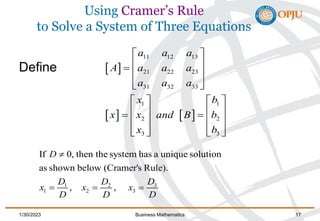
Define  
   
11 12 13
21 22 23
31 32 33
1 1
2 2
3 3
a a a
A a a a
a a a
x b
x x and B b
x b
 
 
  
 
 
   
   
   
   
   
   
3
1 2
1 2 3
If 0, then the system has a unique solution
as shown below (Cramer's Rule).
, ,
D
D
D D
x x x
D D D
         
   
    
1/30/2023 Business Mathematics 17
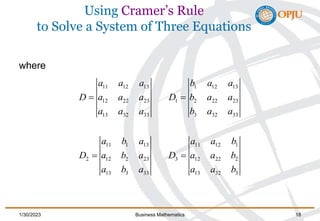
Using Cramer’s Rule
to Solve a System of Three Equations
where
11 12 13 1 12 13
12 22 23 1 2 22 23
13 32 33 3 32 33
11 1 13 11 12 1
2 12 2 23 3 12 22 2
13 3 33 13 32 3
a a a b a a
D a a a D b a a
a a a b a a
a b a a a b
D a b a D a a b
a b a a a b
  
  
1/30/2023 Business Mathematics 18
Example 1
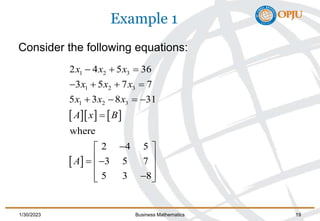
Consider the following equations:
    
 
1 2 3
1 2 3
1 2 3
2 4 5 36
3 5 7 7
5 3 8 31
where
2 4 5
3 5 7
5 3 8
x x x
x x x
x x x
A x B
A
  
   
   


 
 
 
 
 

 
1/30/2023 Business Mathematics 19
Example 1
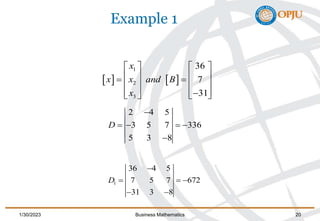
   
1
2
3
36
7
31
x
x x and B
x
   
   
   
   
   

   
2 4 5
3 5 7 336
5 3 8
D

   

1
36 4 5
7 5 7 672
31 3 8
D

  
 
1/30/2023 Business Mathematics 20
Example 1
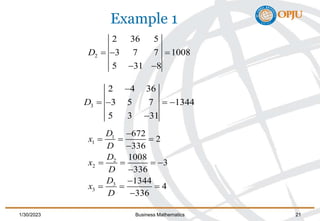
2
2 36 5
3 7 7 1008
5 31 8
D   
 
3
2 4 36
3 5 7 1344
5 3 31
D

   

1
1
2
2
3
3
672
2
336
1008
3
336
1344
4
336
D
x
D
D
x
D
D
x
D

  

   


  

1/30/2023 Business Mathematics 21
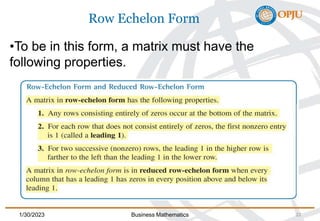
Row Echelon Form
•To be in this form, a matrix must have the
following properties.
1/30/2023 Business Mathematics 22
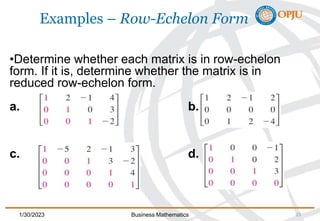
Examples – Row-Echelon Form
•Determine whether each matrix is in row-echelon
form. If it is, determine whether the matrix is in
reduced row-echelon form.
a. b.
c. d.
1/30/2023 Business Mathematics 23
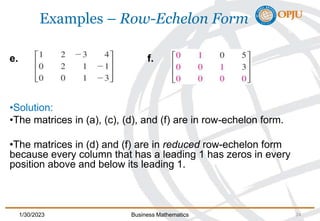
Examples – Row-Echelon Form
e. f.
•Solution:
•The matrices in (a), (c), (d), and (f) are in row-echelon form.
•The matrices in (d) and (f) are in reduced row-echelon form
because every column that has a leading 1 has zeros in every
position above and below its leading 1.
cont’d
1/30/2023 Business Mathematics 24
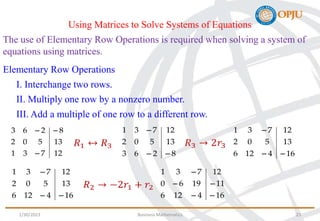
Using Matrices to Solve Systems of Equations
The use of Elementary Row Operations is required when solving a system of
equations using matrices.
12
7
3
1
13
5
0
2
8
2
6
3



Elementary Row Operations
I. Interchange two rows.
II. Multiply one row by a nonzero number.
III. Add a multiple of one row to a different row.
8
2
6
3
13
5
0
2
12
7
3
1



16
4
12
6
13
5
0
2
12
7
3
1



16
4
12
6
13
5
0
2
12
7
3
1



16
4
12
6
11
19
6
0
12
7
3
1





1/30/2023 Business Mathematics 25
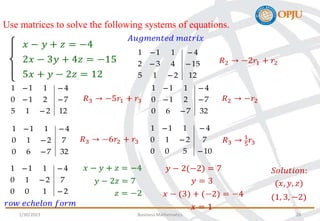
Use matrices to solve the following systems of equations.
12
2
1
5
15
4
3
2
4
1
1
1










12
2
1
5
7
2
1
0
4
1
1
1





32
7
6
0
7
2
1
0
4
1
1
1





32
7
6
0
7
2
1
0
4
1
1
1




10
5
0
0
7
2
1
0
4
1
1
1




2
1
0
0
7
2
1
0
4
1
1
1




1/30/2023 Business Mathematics 26

Appliacation of Matrix.pptx

  • 1.
    School of Management By:Mr. Manoj Kumar Mishra 1/30/2023 Business Mathematics 1 UNIVERSITY OF STEEL TECHNOLOGY AND MANAGEMENT Matrices Algebra For BBA & B.Com
  • 2.
    Topic To beCovered 1/30/2023 Business Mathematics 2 1. Solution of Simultaneous Linear Equations 2. Cramer Rule 3. Row echelon form of matrix 4. Gauss Jordan Method
  • 3.
    Singular Matrix A squarematrix A is said to be singular if lAl = 0 . A is non-singular if  A 0. For Example: 1 1 3 1 3 3 5 3 3           Let A= A is a singular matrix . A=1(9+9)+1(3+15)+3(3-15) = 18+18-36 = 0 1/30/2023 Business Mathematics 3
  • 4.
    Non-Singular Matrix Let B= 11 1 2 1 1 1 2 3           B is a non-singular matrix. B= 1(-3+2)-1(6-1)+1(-4+1) = -1 – 5 – 3 = -9 0  1/30/2023 Business Mathematics 4
  • 5.
    Example -1 Find thevalue of x for which the matrix is singular. x 1 0 A = 2 -1 1 3 4 -2           For matrix A to be singular     A = 0 x 1 0 2 -1 1 = 0 3 4 -2 -1 -4 - 3 = 0 7 -2x +7 = 0 x = 2 x 2 4      Solution: 1/30/2023 Business Mathematics 5
  • 6.
    Solution of SimultaneousLinear Equations (Matrix Method) Let the system of 3 linear equations be 1 1 1 1 2 2 2 2 3 3 3 3 a x +b y +c z = d a x +b y +c z = d a x +b y + c z = d This system of linear equation can be written in matrix form as 1 1 1 1 2 2 2 2 3 3 3 3 d a b c x a b c y = d a b c z d                                 AX = B ... i  1/30/2023 Business Mathematics 6
  • 7.
    Solution of SimultaneousLinear Equations (Matrix Method) 1 X = (adjA)B A  The matrix A is called the coefficient matrix of the system of linear equations. Multiplying (i) by A–1, we get -1 If A 0 i.e. A is non - singular, then A exists.    1 1 A AX A B      1 1 A A X A B     1/30/2023 Business Mathematics 7
  • 8.
    Important Results (i) IfA is a non-singular matrix, then the system of equations given by AX = B has a unique solution given by X = A–1B (ii) If A is a singular matrix and (adjA)B = 0, then the system of equations given by AX = B is consistent with infinitely many solutions. (iii) If A is a singular matrix and (adjA)B  0, then the system of equations given by AX = B is inconsistent. 1/30/2023 Business Mathematics 8
  • 9.
    Question-1 Using matrix method,solve the following system of linear equations x + 2y -3z = -4 2x + 3y + 2z = 2 3x - 3y - 4z = 11 Solution: The given system of equations is x + 2y - 3z = -4 ...(i) 2x + 3y + 2z = 2 …(ii) 3x -3y - 4z = 11 …(iii) 1 2 -3 x -4 or 2 3 2 y = 2 z 3 -3 -4 11                         AX = B  1/30/2023 Business Mathematics 9
  • 10.
    Solution (Cont.) 1 2-3 x -4 where A= 2 3 2 , X= y , B= 2 z 3 -3 -4 11                           2 2 1 3 3 1 -1 1 2 -3 A = 2 3 2 3 -3 -4 1 0 0 = 2 -1 8 Applying C C -2C and C C +3C 3 -9 5 =1(-5+72)=67 0 A exists.     ij ij ij Let C be the cofactor a in A = a , then     1/30/2023 Business Mathematics 10
  • 11.
    Solution Cont.   1112 13 c =(-12+6) c =- -8-6 c =(-6-9) =-6 =14 =-15 21 22 23 c =-(-8-9) c =(-4+9) c =-(-3-6) =17 =5 = 9 31 32 33 c =(4+9) c =-(2+6) c =(3-4) =13 = -8 = -1 31 32 33 c =(4+9) c =-(2+6) c =(3-4) =13 = -8 = -1 -6 17 13 14 5 -8 -15 9 -1         T -6 14 -15 adjA = 17 5 9 = 13 -8 -1          1/30/2023 Business Mathematics 11
  • 12.
    Solution (Con.) -1 Now, X=A B -6 17 13 -4 1 X= 14 5 -8 2 67 -15 9 -1 11                  x 201 3 1 y = -134 = -2 67 z 67 1 x=3 , y=-2 , z=1                           -1 -6 17 13 1 1 A = .adj A = 14 5 -8 A 67 -15 9 -1          1/30/2023 Business Mathematics 12
  • 13.
    Practice Question Using matrices,solve the following system of equations x + y + z = 6 x + 2y + 3z = 14 x + 4y + 7z = 30 1/30/2023 Business Mathematics 13
  • 14.
    Cramer’s Rule • Systemof Linear Equations • How to solve using Cramer’s Rule 1/30/2023 Business Mathematics 14
  • 15.
    Introduction • Cramer’s Ruleis a method for solving linear simultaneous equations. It makes use of determinants and so a knowledge of these is necessary before proceeding. • Cramer’s Rule relies on determinants 1/30/2023 Business Mathematics 15
  • 16.
    Coefficient Matrices • Youcan use determinants to solve a system of linear equations. • You use the coefficient matrix of the linear system. • Linear System ax+by=e cx+dy=f       d c b a 1/30/2023 Business Mathematics 16 Coeff Matrix
  • 17.
    Using Cramer’s Rule toSolve a System of Three Equations Define       11 12 13 21 22 23 31 32 33 1 1 2 2 3 3 a a a A a a a a a a x b x x and B b x b                                    3 1 2 1 2 3 If 0, then the system has a unique solution as shown below (Cramer's Rule). , , D D D D x x x D D D                    1/30/2023 Business Mathematics 17
  • 18.
    Using Cramer’s Rule toSolve a System of Three Equations where 11 12 13 1 12 13 12 22 23 1 2 22 23 13 32 33 3 32 33 11 1 13 11 12 1 2 12 2 23 3 12 22 2 13 3 33 13 32 3 a a a b a a D a a a D b a a a a a b a a a b a a a b D a b a D a a b a b a a a b       1/30/2023 Business Mathematics 18
  • 19.
    Example 1 Consider thefollowing equations:        1 2 3 1 2 3 1 2 3 2 4 5 36 3 5 7 7 5 3 8 31 where 2 4 5 3 5 7 5 3 8 x x x x x x x x x A x B A                           1/30/2023 Business Mathematics 19
  • 20.
    Example 1    1 2 3 36 7 31 x x x and B x                          2 4 5 3 5 7 336 5 3 8 D       1 36 4 5 7 5 7 672 31 3 8 D       1/30/2023 Business Mathematics 20
  • 21.
    Example 1 2 2 365 3 7 7 1008 5 31 8 D      3 2 4 36 3 5 7 1344 5 3 31 D       1 1 2 2 3 3 672 2 336 1008 3 336 1344 4 336 D x D D x D D x D                1/30/2023 Business Mathematics 21
  • 22.
    Row Echelon Form •Tobe in this form, a matrix must have the following properties. 1/30/2023 Business Mathematics 22
  • 23.
    Examples – Row-EchelonForm •Determine whether each matrix is in row-echelon form. If it is, determine whether the matrix is in reduced row-echelon form. a. b. c. d. 1/30/2023 Business Mathematics 23
  • 24.
    Examples – Row-EchelonForm e. f. •Solution: •The matrices in (a), (c), (d), and (f) are in row-echelon form. •The matrices in (d) and (f) are in reduced row-echelon form because every column that has a leading 1 has zeros in every position above and below its leading 1. cont’d 1/30/2023 Business Mathematics 24
  • 25.
    Using Matrices toSolve Systems of Equations The use of Elementary Row Operations is required when solving a system of equations using matrices. 12 7 3 1 13 5 0 2 8 2 6 3    Elementary Row Operations I. Interchange two rows. II. Multiply one row by a nonzero number. III. Add a multiple of one row to a different row. 8 2 6 3 13 5 0 2 12 7 3 1    16 4 12 6 13 5 0 2 12 7 3 1    16 4 12 6 13 5 0 2 12 7 3 1    16 4 12 6 11 19 6 0 12 7 3 1      1/30/2023 Business Mathematics 25
  • 26.
    Use matrices tosolve the following systems of equations. 12 2 1 5 15 4 3 2 4 1 1 1           12 2 1 5 7 2 1 0 4 1 1 1      32 7 6 0 7 2 1 0 4 1 1 1      32 7 6 0 7 2 1 0 4 1 1 1     10 5 0 0 7 2 1 0 4 1 1 1     2 1 0 0 7 2 1 0 4 1 1 1     1/30/2023 Business Mathematics 26