INTRODUCTION TO
RADICAL FUNCTIONS
Lesson 6
Summary of Topics
• Evaluate Radical Functions
• Find the domain of Radical functions
Evaluate Radical
Function
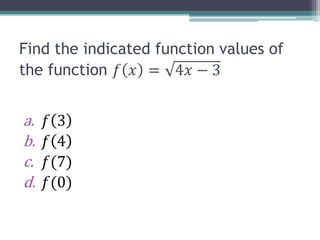
Find the indicated function values of
the function 𝑓 𝑥 = 4𝑥 − 3
a. 𝑓 3
b. 𝑓 4
c. 𝑓(7)
d. 𝑓(0)
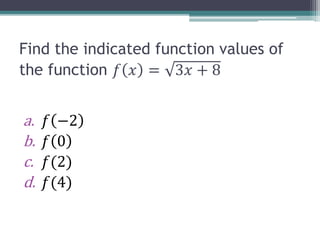
Find the indicated function values of
the function 𝑓 𝑥 = 3𝑥 + 8
a. 𝑓 −2
b. 𝑓 0
c. 𝑓(2)
d. 𝑓(4)
Graph of Radical
Function
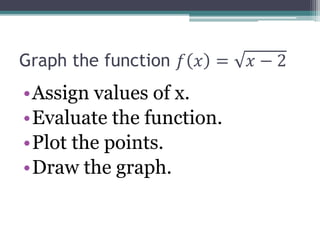
Graph the function 𝑓 𝑥 = 𝑥 − 2
•Assign values of x.
•Evaluate the function.
•Plot the points.
•Draw the graph.
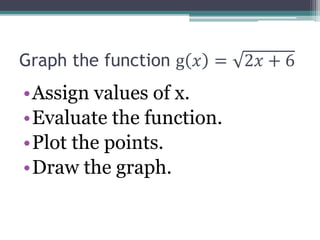
Graph the function g 𝑥 = 2𝑥 + 6
•Assign values of x.
•Evaluate the function.
•Plot the points.
•Draw the graph.
Find the Domain
of Radical
Function
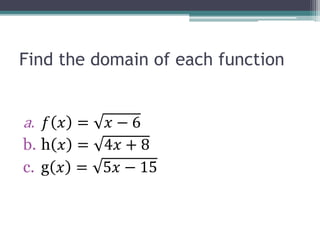
Find the domain of each function
a. 𝑓 𝑥 = 𝑥 − 6
b. h 𝑥 = 4𝑥 + 8
c. g 𝑥 = 5𝑥 − 15
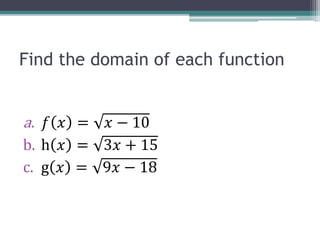
Find the domain of each function
a. 𝑓 𝑥 = 𝑥 − 10
b. h 𝑥 = 3𝑥 + 15
c. g 𝑥 = 9𝑥 − 18
Performing Function
Operations
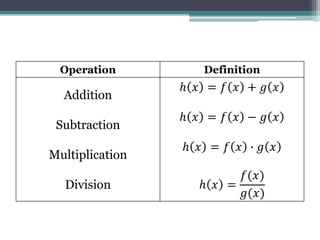
Operation Definition
Addition
Subtraction
Multiplication
Division
ℎ 𝑥 = 𝑓 𝑥 + 𝑔 𝑥
ℎ 𝑥 = 𝑓 𝑥 − 𝑔 𝑥
ℎ 𝑥 = 𝑓 𝑥 ∙ 𝑔 𝑥
ℎ 𝑥 =
𝑓(𝑥)
𝑔(𝑥)
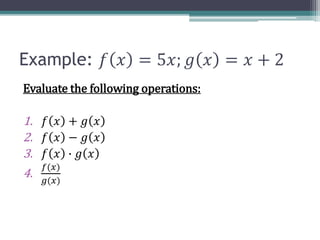
Example: 𝑓 𝑥 = 5𝑥; 𝑔 𝑥 = 𝑥 + 2
Evaluate the following operations:
1. 𝑓 𝑥 + 𝑔 𝑥
2. 𝑓 𝑥 − 𝑔 𝑥
3. 𝑓 𝑥 ∙ 𝑔 𝑥
4.
𝑓(𝑥)
𝑔(𝑥)
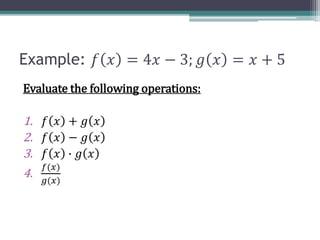
Example: 𝑓 𝑥 = 4𝑥 − 3; 𝑔 𝑥 = 𝑥 + 5
Evaluate the following operations:
1. 𝑓 𝑥 + 𝑔 𝑥
2. 𝑓 𝑥 − 𝑔 𝑥
3. 𝑓 𝑥 ∙ 𝑔 𝑥
4.
𝑓(𝑥)
𝑔(𝑥)
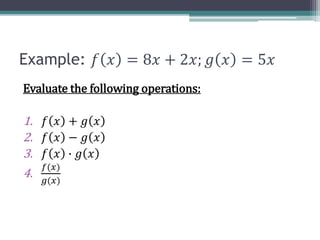
Example: 𝑓 𝑥 = 8𝑥 + 2𝑥; 𝑔 𝑥 = 5𝑥
Evaluate the following operations:
1. 𝑓 𝑥 + 𝑔 𝑥
2. 𝑓 𝑥 − 𝑔 𝑥
3. 𝑓 𝑥 ∙ 𝑔 𝑥
4.
𝑓(𝑥)
𝑔(𝑥)
Performing Function
Composition
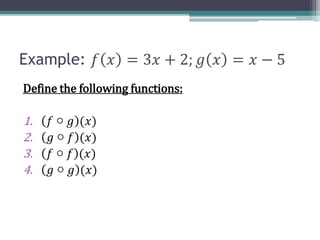
Example: 𝑓 𝑥 = 3𝑥 + 2; 𝑔 𝑥 = 𝑥 − 5
Define the following functions:
1. 𝑓 ○ 𝑔 (𝑥)
2. 𝑔 ○ 𝑓 (𝑥)
3. 𝑓 ○ 𝑓 (𝑥)
4. 𝑔 ○ 𝑔 (𝑥)
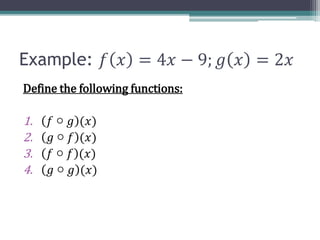
Example: 𝑓 𝑥 = 4𝑥 − 9; 𝑔 𝑥 = 2𝑥
Define the following functions:
1. 𝑓 ○ 𝑔 (𝑥)
2. 𝑔 ○ 𝑓 (𝑥)
3. 𝑓 ○ 𝑓 (𝑥)
4. 𝑔 ○ 𝑔 (𝑥)

1 lesson 6 introduction to radical functions