GROWING OLD WITH A
DEVELOPMENTAL DISABILITY
         Dr. A. M. Lane
               And
           Dr. S. Hirst
         IFA, May 2012


               1
Outline


 Understanding the Context of our Practice
 Knowing we were not prepared!
     What we first learned related to life expectancy
   Questions
   Method
   Findings
   Discussion of Findings
   Recommendations

                               2
Understanding the Context of our
            Practice

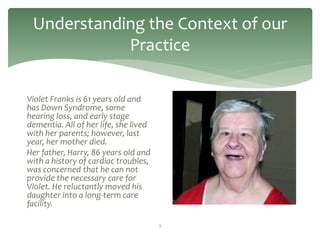
Violet Franks is 61 years old and
has Down Syndrome, some
hearing loss, and early stage
dementia. All of her life, she lived
with her parents; however, last
year, her mother died.
Her father, Harry, 86 years old and
with a history of cardiac troubles,
was concerned that he can not
provide the necessary care for
Violet. He reluctantly moved his
daughter into a long-term care
facility.

                                       3
Knowing we were NOT prepared!


 Developmental disabilities           People, including those
  (DDs) defined as conditions           with developmental
  originating before the age
                                        disabilities, are living
  of 18 that result in
  significant limitations in
                                        longer than ever before,
  intellectual functioning, and         and with increased life
  conceptual, social and                expectancy comes
  practical adaptive skills.            increased challenges in
  (Luckasson et al. 2002)               addressing age-related
                                        issues.
                                  4
Living longer / Aging earlier


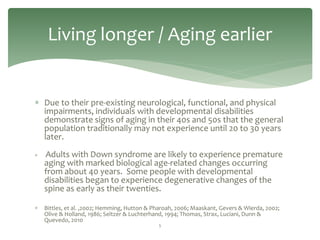
 Due to their pre-existing neurological, functional, and physical
  impairments, individuals with developmental disabilities
  demonstrate signs of aging in their 40s and 50s that the general
  population traditionally may not experience until 20 to 30 years
  later.
   Adults with Down syndrome are likely to experience premature
    aging with marked biological age-related changes occurring
    from about 40 years. Some people with developmental
    disabilities began to experience degenerative changes of the
    spine as early as their twenties.

   Bittles, et al. ,2002; Hemming, Hutton & Pharoah, 2006; Maaskant, Gevers & Wierda, 2002;
    Olive & Holland, 1986; Seltzer & Luchterhand, 1994; Thomas, Strax, Luciani, Dunn &
    Quevedo, 2010
                                              5
Life Expectancy


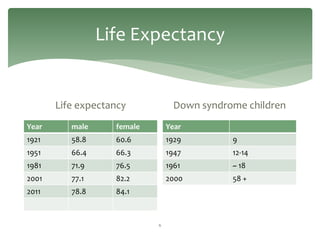
       Life expectancy            Down syndrome children
Year      male     female       Year
1921      58.8     60.6         1929         9
1951      66.4     66.3         1947         12-14
1981      71.9     76.5         1961         ~ 18
2001      77.1     82.2         2000         58 +
2011      78.8     84.1


                            6
The following QUESTIONS
       were asked:

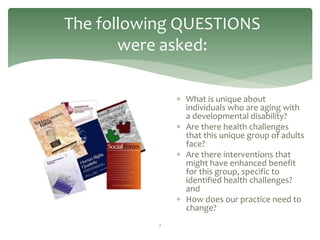
                What is unique about
                 individuals who are aging with
                 a developmental disability?
                Are there health challenges
                 that this unique group of adults
                 face?
                Are there interventions that
                 might have enhanced benefit
                 for this group, specific to
                 identified health challenges?
                 and
                How does our practice need to
                 change?
           7
Method


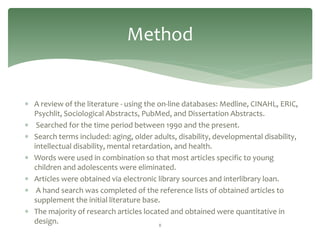
 A review of the literature - using the on-line databases: Medline, CINAHL, ERIC,
  Psychlit, Sociological Abstracts, PubMed, and Dissertation Abstracts.
 Searched for the time period between 1990 and the present.
 Search terms included: aging, older adults, disability, developmental disability,
  intellectual disability, mental retardation, and health.
 Words were used in combination so that most articles specific to young
  children and adolescents were eliminated.
 Articles were obtained via electronic library sources and interlibrary loan.
 A hand search was completed of the reference lists of obtained articles to
  supplement the initial literature base.
 The majority of research articles located and obtained were quantitative in
  design.                                 8
Methodological concerns identified


 Most studies are prevalence based because of limited
  financial resources / resource timelines;
 Most studies used different definitions of older adult;
 Measurement tools differed; and
 Small numbers and small sample size were used.


                            9
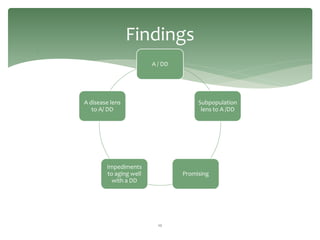
Findings
1.
                             A / DD


     A disease lens                        Subpopulation
        to A/ DD                            lens to A /DD


             Impediments
             to aging well            Promising
               with a DD


                               10
Aging with a Developmental
           Disability: Key points
  Physical health
 Older adults with developmental disabilities show age-related
  changes in health, cognitive, and functional capacities indicative of
  accelerated aging.
 The earlier age of onset suggests that women with developmental
  disabilities are at increased risk for post menopausal health
  disorders, such as heart disease, depression, breast cancer, and
  osteoporosis as a result of the cessation of estrogen production.
 Obesity levels and related lack of exercise should be a concern
  because of their strong association with higher rates of morbidity
   and mortality.

                                    11
Mental health
 Psychiatric problems are more prevalent among
  people with DD (Esbensen et al., 2006)
 ~ about 50% of PDD have a diagnosis of a psychiatric
  or behavioural disorder (Santos et al., 2002)
 Higher levels of stress (Olsson et al., 2003)


                           12
A Subpopulation Lens to Aging with a
Developmental Disability: Key points


  Adults aging with Cerebral palsy
    Studies indicate that older adults have the highest rates
     of periodontal disease and need to do more to maintain
     good oral health.
  Adults aging with Down syndrome
    Prevalence of Alzheimer disease, E.g.:
      Janiciki & Dalton, 2000
      Coppus, Evenhuis, Verberne, Visser, Van
       Gool, Eikelenboom & Van Duijin, 2006

                               13
A Disease Lens to Aging with a
Developmental Disability: Key points

  The course of Alzheimer’s disease for people with Down
   syndrome is atypical, onset is earlier, and its course is more
   rapid.
  Symptoms of dementia may often be caused by other
   conditions that are treatable such as
   hyper/hypothyroidism, depression, and sensory
   impairments, for persons with Down syndrome.
  Diagnosis and management of dementia is complicated by
   the high rates of co-morbid physical and mental health
   problems.

                               14
 CVD
    Elevated disease presence complicated by age changes to
     cardiovascular physiology
 Respiratory disorders
   COPD
 Hypothyroidism
   If left untreated – wrongly attributed
 Cancer
   Breast cancer

                                15
Impediments to Aging Well with a
Developmental Disability: Key points

 Identification and Diagnosis of Health Challenges
    Identification is complicated by lack of knowledge of
     health care providers
    Kerr, Dunstan & Thapar, 1996; Kirby & Hegarty, 2010; Henderson,
     Lynch & Wilkinson, 2007
  The lived experience of pain in individuals who are
   aging with a developmental disability is not clearly
   understood.
  Lack of uptake of health promotion / disease
   prevention activities.

                                 16
Promising Practices: Key points


 Individuals who are aging with disabilities have the
  ability to be active participants in their own aging and
  health care.
 Elements of good practice in working with adults who
  are aging with developmental disability are similar
  across the life course.


                            17
Discussion of Findings


 The forgotten
   The presence of pain
   Grief, loss, and death
   Adequate assessment / intervention
   Recommendations:
     Health care practitioners


                            18
Grief, Loss, and Death


          19
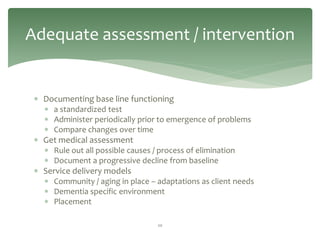
Adequate assessment / intervention


  Documenting base line functioning
    a standardized test
    Administer periodically prior to emergence of problems
    Compare changes over time
  Get medical assessment
    Rule out all possible causes / process of elimination
    Document a progressive decline from baseline
  Service delivery models
    Community / aging in place – adaptations as client needs
    Dementia specific environment
    Placement

                                   20
Recommendations for health care
       practitioners


 Basic professional education for health care
  professionals e.g. registered nurses must include
  content / skills specific to aging and developmental
  disabilities
 Regular monitoring for aging changes should begin
  by 40 yrs of age
 Monitor use of prescription and over the counter
  medications

                            21
Recommendations con’t


Dialogue with adults who are aging with a developmental
 disability how to best empower them to participate in their
 own health care.
Consider the development of a health promotion policy /
 program specific to aging with a developmental disability
 for adults who are aging with a developmental disability.
Establish a task force of health care professionals,
 practitioners, and policy makers to create curricula to
 improve knowledge and clinical practice skills.
Expand the current research base by including qualitative
 studies.

                             22
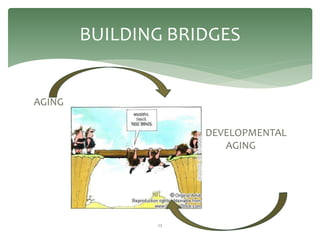
BUILDING BRIDGES


AGING

                    DEVELOPMENTAL
                       AGING


               23
Thank you

shirst@ucalgary.ca
alane@ucalgary.ca


        24

1 lane-pdd

  • 1.
    GROWING OLD WITHA DEVELOPMENTAL DISABILITY Dr. A. M. Lane And Dr. S. Hirst IFA, May 2012 1
  • 2.
    Outline  Understanding theContext of our Practice  Knowing we were not prepared!  What we first learned related to life expectancy  Questions  Method  Findings  Discussion of Findings  Recommendations 2
  • 3.
    Understanding the Contextof our Practice Violet Franks is 61 years old and has Down Syndrome, some hearing loss, and early stage dementia. All of her life, she lived with her parents; however, last year, her mother died. Her father, Harry, 86 years old and with a history of cardiac troubles, was concerned that he can not provide the necessary care for Violet. He reluctantly moved his daughter into a long-term care facility. 3
  • 4.
    Knowing we wereNOT prepared!  Developmental disabilities  People, including those (DDs) defined as conditions with developmental originating before the age disabilities, are living of 18 that result in significant limitations in longer than ever before, intellectual functioning, and and with increased life conceptual, social and expectancy comes practical adaptive skills. increased challenges in (Luckasson et al. 2002) addressing age-related issues. 4
  • 5.
    Living longer /Aging earlier  Due to their pre-existing neurological, functional, and physical impairments, individuals with developmental disabilities demonstrate signs of aging in their 40s and 50s that the general population traditionally may not experience until 20 to 30 years later.  Adults with Down syndrome are likely to experience premature aging with marked biological age-related changes occurring from about 40 years. Some people with developmental disabilities began to experience degenerative changes of the spine as early as their twenties.  Bittles, et al. ,2002; Hemming, Hutton & Pharoah, 2006; Maaskant, Gevers & Wierda, 2002; Olive & Holland, 1986; Seltzer & Luchterhand, 1994; Thomas, Strax, Luciani, Dunn & Quevedo, 2010 5
  • 6.
    Life Expectancy Life expectancy Down syndrome children Year male female Year 1921 58.8 60.6 1929 9 1951 66.4 66.3 1947 12-14 1981 71.9 76.5 1961 ~ 18 2001 77.1 82.2 2000 58 + 2011 78.8 84.1 6
  • 7.
    The following QUESTIONS were asked:  What is unique about individuals who are aging with a developmental disability?  Are there health challenges that this unique group of adults face?  Are there interventions that might have enhanced benefit for this group, specific to identified health challenges? and  How does our practice need to change? 7
  • 8.
    Method  A reviewof the literature - using the on-line databases: Medline, CINAHL, ERIC, Psychlit, Sociological Abstracts, PubMed, and Dissertation Abstracts.  Searched for the time period between 1990 and the present.  Search terms included: aging, older adults, disability, developmental disability, intellectual disability, mental retardation, and health.  Words were used in combination so that most articles specific to young children and adolescents were eliminated.  Articles were obtained via electronic library sources and interlibrary loan.  A hand search was completed of the reference lists of obtained articles to supplement the initial literature base.  The majority of research articles located and obtained were quantitative in design. 8
  • 9.
    Methodological concerns identified Most studies are prevalence based because of limited financial resources / resource timelines;  Most studies used different definitions of older adult;  Measurement tools differed; and  Small numbers and small sample size were used. 9
  • 10.
    Findings 1. A / DD A disease lens Subpopulation to A/ DD lens to A /DD Impediments to aging well Promising with a DD 10
  • 11.
    Aging with aDevelopmental Disability: Key points Physical health  Older adults with developmental disabilities show age-related changes in health, cognitive, and functional capacities indicative of accelerated aging.  The earlier age of onset suggests that women with developmental disabilities are at increased risk for post menopausal health disorders, such as heart disease, depression, breast cancer, and osteoporosis as a result of the cessation of estrogen production.  Obesity levels and related lack of exercise should be a concern because of their strong association with higher rates of morbidity and mortality. 11
  • 12.
    Mental health  Psychiatricproblems are more prevalent among people with DD (Esbensen et al., 2006)  ~ about 50% of PDD have a diagnosis of a psychiatric or behavioural disorder (Santos et al., 2002)  Higher levels of stress (Olsson et al., 2003) 12
  • 13.
    A Subpopulation Lensto Aging with a Developmental Disability: Key points  Adults aging with Cerebral palsy  Studies indicate that older adults have the highest rates of periodontal disease and need to do more to maintain good oral health.  Adults aging with Down syndrome  Prevalence of Alzheimer disease, E.g.:  Janiciki & Dalton, 2000  Coppus, Evenhuis, Verberne, Visser, Van Gool, Eikelenboom & Van Duijin, 2006 13
  • 14.
    A Disease Lensto Aging with a Developmental Disability: Key points  The course of Alzheimer’s disease for people with Down syndrome is atypical, onset is earlier, and its course is more rapid.  Symptoms of dementia may often be caused by other conditions that are treatable such as hyper/hypothyroidism, depression, and sensory impairments, for persons with Down syndrome.  Diagnosis and management of dementia is complicated by the high rates of co-morbid physical and mental health problems. 14
  • 15.
     CVD  Elevated disease presence complicated by age changes to cardiovascular physiology  Respiratory disorders  COPD  Hypothyroidism  If left untreated – wrongly attributed  Cancer  Breast cancer 15
  • 16.
    Impediments to AgingWell with a Developmental Disability: Key points Identification and Diagnosis of Health Challenges  Identification is complicated by lack of knowledge of health care providers  Kerr, Dunstan & Thapar, 1996; Kirby & Hegarty, 2010; Henderson, Lynch & Wilkinson, 2007  The lived experience of pain in individuals who are aging with a developmental disability is not clearly understood.  Lack of uptake of health promotion / disease prevention activities. 16
  • 17.
    Promising Practices: Keypoints  Individuals who are aging with disabilities have the ability to be active participants in their own aging and health care.  Elements of good practice in working with adults who are aging with developmental disability are similar across the life course. 17
  • 18.
    Discussion of Findings The forgotten  The presence of pain  Grief, loss, and death  Adequate assessment / intervention  Recommendations:  Health care practitioners 18
  • 19.
  • 20.
    Adequate assessment /intervention  Documenting base line functioning  a standardized test  Administer periodically prior to emergence of problems  Compare changes over time  Get medical assessment  Rule out all possible causes / process of elimination  Document a progressive decline from baseline  Service delivery models  Community / aging in place – adaptations as client needs  Dementia specific environment  Placement 20
  • 21.
    Recommendations for healthcare practitioners  Basic professional education for health care professionals e.g. registered nurses must include content / skills specific to aging and developmental disabilities  Regular monitoring for aging changes should begin by 40 yrs of age  Monitor use of prescription and over the counter medications 21
  • 22.
    Recommendations con’t Dialogue withadults who are aging with a developmental disability how to best empower them to participate in their own health care. Consider the development of a health promotion policy / program specific to aging with a developmental disability for adults who are aging with a developmental disability. Establish a task force of health care professionals, practitioners, and policy makers to create curricula to improve knowledge and clinical practice skills. Expand the current research base by including qualitative studies. 22
  • 23.
    BUILDING BRIDGES AGING DEVELOPMENTAL AGING 23
  • 24.