AGING IN PLACE: THE
      SWEDISH CONTEXT

Cecilia Henning
Associate Professor
School of Health Sciences
Jököping University
Sweden
Cecilia.henning@hhj.hj.se
Web page: hhj.hj.se/en/cecilia-henning
Housing for older adults in
            Sweden
• To age in place
Ordinary housing
Collaborative housing
Senior housing
Senior cohousing/Senior community housing
Housing for older adults in
         Sweden (cont.)
• Special housing for assisted living and
  complex care/residential care home
Incl. group living alternatives
Older models:
Service house unit/service accomodation (1970-
80)
Nursing home (1970-80)
Old people’s home (1950-60)
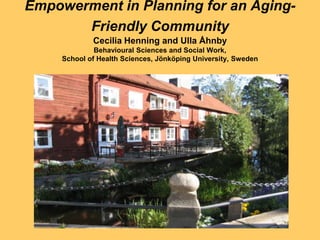
Empowerment in Planning for an Aging-
       Friendly Community
             Cecilia Henning and Ulla Åhnby
              Behavioural Sciences and Social Work,
     School of Health Sciences, Jönköping University, Sweden
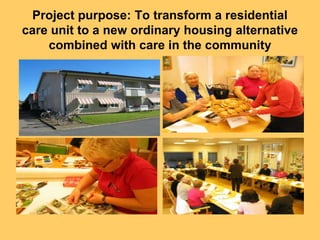
Project purpose: To transform a residential
care unit to a new ordinary housing alternative
    combined with care in the community
Further aims
To develop strategies for facilitating aging in
place with the help of the future workshop
method, in collaboration with elderly people,
eldercare staff, and other stakeholders.

Suggestions brought up in the future
workshops should be developed into concrete
plans to bring about changes in housing,
care and in the local environment to facilitate
aging in place.
To let elderly people, together with staff
within eldercare and other actors, create
new forms for joint action, collaboration,
networking, and coordination of formal and
informal resources.

To encourage participation of elderly
people and staff within home help service in
processes to improve the daily life of the
elderly from a holistic view on housing and
care.
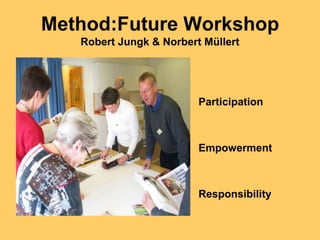
Method:Future Workshop
   Robert Jungk & Norbert Müllert


                         Participation


                         Empowerment


                         Responsibility
Participants
• Older people (dwellers and/or users of day
  center facilities/restaurant)
• Staff (within eldercare and health care)
• Stakeholders (representatives from the
  housing company and the social services)
• Representatives from volunteer
  organizations
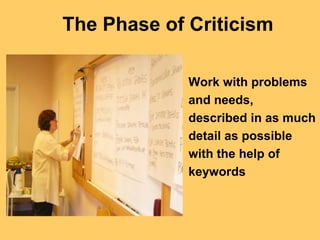
The Phase of Criticism

             Work with problems
             and needs,
             described in as much
             detail as possible
             with the help of
             keywords
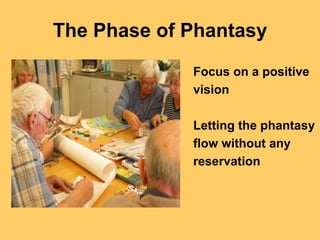
The Phase of Phantasy
             Focus on a positive
             vision

             Letting the phantasy
             flow without any
             reservation
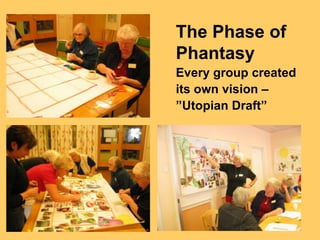
The Phase of
Phantasy
Every group created
its own vision –
”Utopian Draft”
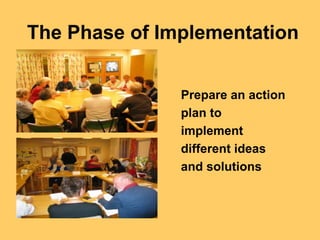
The Phase of Implementation


               Prepare an action
               plan to
               implement
               different ideas
               and solutions
Follow-up and Evaluation

What has happened?

What has the future workshop meant for
the elderly who had participated?
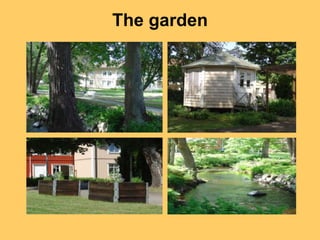
The garden
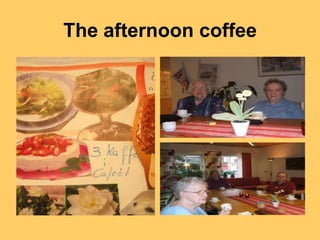
The afternoon coffee
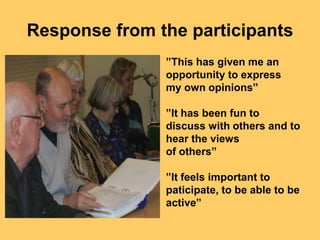
Response from the participants
               ”This has given me an
               opportunity to express
               my own opinions”

               ”It has been fun to
               discuss with others and to
               hear the views
               of others”

               ”It feels important to
               paticipate, to be able to be
               active”
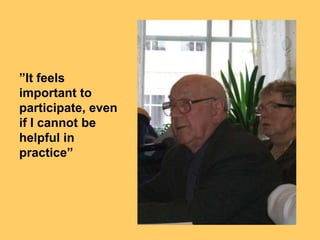
”It feels
important to
participate, even
if I cannot be
helpful in
practice”
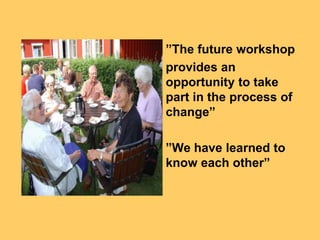
”The future workshop
provides an
opportunity to take
part in the process of
change”

”We have learned to
know each other”
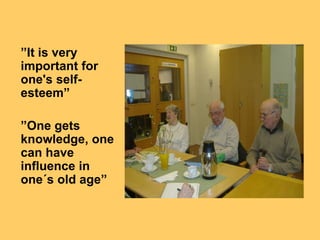
”It is very
important for
one's self-
esteem”

”One gets
knowledge, one
can have
influence in
one´s old age”
Summary of results

• A viable way to encourage seniors and staff
  to be involved in change work that affects
  them

• It produced numerous concrete suggestions
  for various acitvities which seniors, staff,
  other stakeholders and volunteers want to
  elaborate further in collaboration
Theoretical connection


     Social Pedagogy

      Empowerment

Social Networks and Support
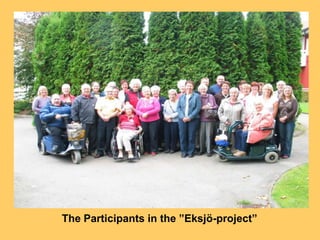
The Participants in the ”Eksjö-project”
New housing concept
• Senior housing for assisted living
Barrier free
Coordinator
Localities for joint activities
Eating together
(SOU 2008:113 Bo bra hela livet. Slutbetänkande
från Äldredelegationen)
Growing Older Living Well program 2010-
2012

3 henning, stolarz-ifahenning2012

  • 1.
    AGING IN PLACE:THE SWEDISH CONTEXT Cecilia Henning Associate Professor School of Health Sciences Jököping University Sweden Cecilia.henning@hhj.hj.se Web page: hhj.hj.se/en/cecilia-henning
  • 2.
    Housing for olderadults in Sweden • To age in place Ordinary housing Collaborative housing Senior housing Senior cohousing/Senior community housing
  • 3.
    Housing for olderadults in Sweden (cont.) • Special housing for assisted living and complex care/residential care home Incl. group living alternatives Older models: Service house unit/service accomodation (1970- 80) Nursing home (1970-80) Old people’s home (1950-60)
  • 4.
    Empowerment in Planningfor an Aging- Friendly Community Cecilia Henning and Ulla Åhnby Behavioural Sciences and Social Work, School of Health Sciences, Jönköping University, Sweden
  • 5.
    Project purpose: Totransform a residential care unit to a new ordinary housing alternative combined with care in the community
  • 6.
    Further aims To developstrategies for facilitating aging in place with the help of the future workshop method, in collaboration with elderly people, eldercare staff, and other stakeholders. Suggestions brought up in the future workshops should be developed into concrete plans to bring about changes in housing, care and in the local environment to facilitate aging in place.
  • 7.
    To let elderlypeople, together with staff within eldercare and other actors, create new forms for joint action, collaboration, networking, and coordination of formal and informal resources. To encourage participation of elderly people and staff within home help service in processes to improve the daily life of the elderly from a holistic view on housing and care.
  • 8.
    Method:Future Workshop Robert Jungk & Norbert Müllert Participation Empowerment Responsibility
  • 9.
    Participants • Older people(dwellers and/or users of day center facilities/restaurant) • Staff (within eldercare and health care) • Stakeholders (representatives from the housing company and the social services) • Representatives from volunteer organizations
  • 10.
    The Phase ofCriticism Work with problems and needs, described in as much detail as possible with the help of keywords
  • 11.
    The Phase ofPhantasy Focus on a positive vision Letting the phantasy flow without any reservation
  • 12.
    The Phase of Phantasy Everygroup created its own vision – ”Utopian Draft”
  • 13.
    The Phase ofImplementation Prepare an action plan to implement different ideas and solutions
  • 14.
    Follow-up and Evaluation Whathas happened? What has the future workshop meant for the elderly who had participated?
  • 15.
  • 16.
  • 17.
    Response from theparticipants ”This has given me an opportunity to express my own opinions” ”It has been fun to discuss with others and to hear the views of others” ”It feels important to paticipate, to be able to be active”
  • 18.
    ”It feels important to participate,even if I cannot be helpful in practice”
  • 19.
    ”The future workshop providesan opportunity to take part in the process of change” ”We have learned to know each other”
  • 20.
    ”It is very importantfor one's self- esteem” ”One gets knowledge, one can have influence in one´s old age”
  • 21.
    Summary of results •A viable way to encourage seniors and staff to be involved in change work that affects them • It produced numerous concrete suggestions for various acitvities which seniors, staff, other stakeholders and volunteers want to elaborate further in collaboration
  • 22.
    Theoretical connection Social Pedagogy Empowerment Social Networks and Support
  • 23.
    The Participants inthe ”Eksjö-project”
  • 24.
    New housing concept •Senior housing for assisted living Barrier free Coordinator Localities for joint activities Eating together (SOU 2008:113 Bo bra hela livet. Slutbetänkande från Äldredelegationen) Growing Older Living Well program 2010- 2012