MARKETING MANAGEMENT :
SCOPE AND NATURE
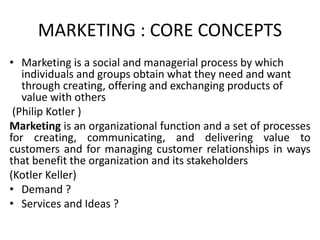
MARKETING : CORE CONCEPTS
• Marketing is a social and managerial process by which
individuals and groups obtain what they need and want
through creating, offering and exchanging products of
value with others
(Philip Kotler )
Marketing is an organizational function and a set of processes
for creating, communicating, and delivering value to
customers and for managing customer relationships in ways
that benefit the organization and its stakeholders
(Kotler Keller)
• Demand ?
• Services and Ideas ?
MARKETING : CORE CONCEPTS
• Needs : State of deprivation of some basic
satisfaction. Not created by society / marketers.
Exist in very texture of human biology and condition
• Wants : Desires for specific satisfiers of need.
Continuously shaped/reshaped by social forces and
institutions..
• Demands : Want for specific products products that
are backed by the ability and willingness to buy
them. Wants become demands when supported by
purchasing power
MARKETING : CORE CONCEPTS
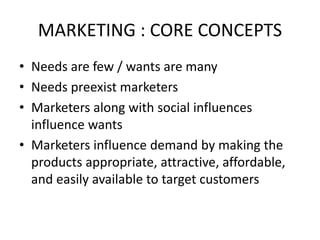
• Needs are few / wants are many
• Needs preexist marketers
• Marketers along with social influences
influence wants
• Marketers influence demand by making the
products appropriate, attractive, affordable,
and easily available to target customers
MARKETING : CORE CONCEPTS
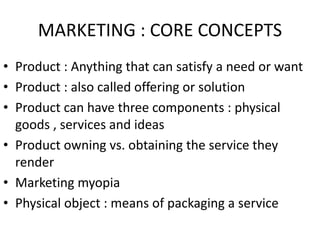
• Product : Anything that can satisfy a need or want
• Product : also called offering or solution
• Product can have three components : physical
goods , services and ideas
• Product owning vs. obtaining the service they
render
• Marketing myopia
• Physical object : means of packaging a service
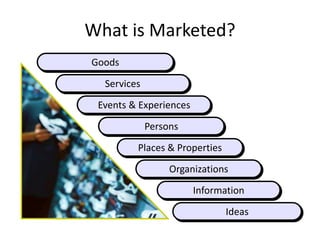
What is Marketed?
Goods
Services
Events & Experiences
Persons
Places & Properties
Organizations
Information
Ideas
MARKETING : CORE CONCEPTS
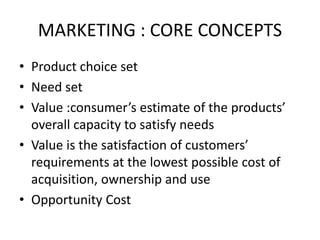
• Product choice set
• Need set
• Value :consumer’s estimate of the products’
overall capacity to satisfy needs
• Value is the satisfaction of customers’
requirements at the lowest possible cost of
acquisition, ownership and use
• Opportunity Cost
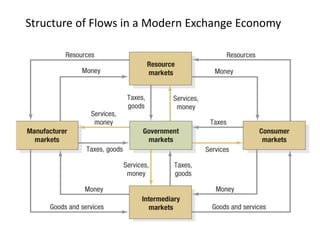
Structure of Flows in a Modern Exchange Economy
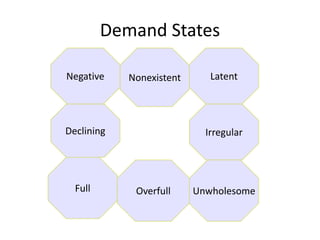
Demand States
Nonexistent Latent
Declining Irregular
Full UnwholesomeOverfull
Negative
MARKETING : CORE CONCEPTS
• How people can obtain products :
1. Self – production
2. Coercion
3. Begging
4. Exchange : act of obtaining a desired product
from someone by offering something in
return
MARKETING : CORE CONCEPTS
• Conditions that must be satisfied for exchange
potential to exist :
1. At least two parties
2. Each party has something that might be of value to
the other party
3. Each party is capable of communication and delivery
4. Each party is free to accept or reject the exchange
offer
5. Each party believes it is appropriate or desirable to
deal with the other party
MARKETING : CORE CONCEPTS
• Exchange is a process rather than an event
• Transaction is a trade of values between two or more
parties
• Monetary transaction vs. barter transaction
• Transfer : One party gives something of value to the
other party but does not receive anything in return
• Marketers seek to elicit a behavioral response from the
other party
• Negotiation : Process of trying to reach agreeable
terms
MARKETING : CORE CONCEPTS
• Market : Consists of all the potential customers
sharing a particular need or want who may be
willing and able to engage in exchange to satisfy
that need or want
• Traditionally : Market is a place here buyers and
sellers gather to exchange their goods
• Economists : Collection of buyers and sellers
who transact over particular product (class)
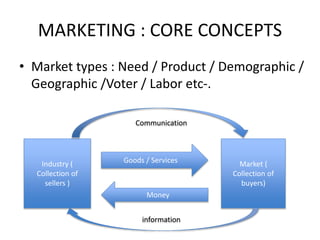
• Marketers : Sellers = industry , buyers = market
MARKETING : CORE CONCEPTS
• Market types : Need / Product / Demographic /
Geographic /Voter / Labor etc-.
Industry (
Collection of
sellers )
Market (
Collection of
buyers)
Goods / Services
Money
Communication
information
MARKETING : CORE CONCEPTS
• Marketing (Management) : Process of planning and
executing the conception, pricing, promotion, and
distribution of ideas, goods, and services to create
exchanges that satisfy individual and organizational
goals.
• Marketing management is the art and science of
choosing target markets and getting, keeping, and
growing customers through creating, delivering, and
communicating superior customer value
• Marketing Management has the task of influencing the
level, timing and composition of demand in a way that
will help the organization achieve its objective
MARKETING : CORE CONCEPTS
• Production Concept : The consumers will favor
those products that are widely available and
low in cost. Managers of production oriented
organizations concentrate on achieving high
production efficiency and wide distribution.
• This holds true in two situations :
1. Demand for a product exceeds supply
2. Product’s cost is high and has to be
decreased to expand the market
MARKETING : CORE CONCEPTS
• Product Concept : Customers will favor those
products that offer the most quality, performance,
or innovative feature. Concentration is on making
superior products and improving them all the time.
• Companies are more self obsessed
• Customer input is vital
• Looking into a mirror vs. looking outside the
window
MARKETING : CORE CONCEPTS
• Selling Concept : Holds that the consumers, if left
alone, will not buy enough of the organisation’s
products. The organisation must therefore undertake
an aggressive selling and promotion effort
• Practice for goods that people do not normally think of
buying / overcapacity
• Aim is to sell what they make rather than make what
the markets want
• Aim of marketing is to make selling superfluous
• Aim of marketing is to know the customer so well that
the product or service fits him and sells itself
MARKETING : CORE CONCEPTS
• Marketing Concept :The key to achieve organisational
goals consists of being more effective than competitors
in integrating marketing activities towards determining
and satisfying the needs and wants of target markets
• 4 pillars of marketing concept : Target Market /
Customer Needs / Integrated marketing / profitability
• Selling focuses on the needs of the seller, marketing on
the needs of the buyer
• Selling is preoccupied with the seller’s need to convert
his product into cash, marketing with the whole idea of
satisfying the needs of the customer by means of the
product
MARKETING : CORE CONCEPTS
• Customer Needs : Types of Need :
1. Stated Needs
2. Real Needs
3. Unstated Needs
4. Delight Needs
5. Secret Needs
MARKETING : CORE CONCEPTS
• Responsive Marketing : Find a stated need and fulfill it
• Creative Marketing : Discovers and produces solutions
that the customer did not as for but to which they
respond enthusiastically
• Integrated Marketing : When all the company’s
departments work together to satisfy the customer’s
interest, the result is integrated marketing
• External marketing : Marketing directed to people
outside the company
• Internal marketing : Successful hiring / training and
motivating employees who want to serve the
customers well
MARKETING : CORE CONCEPTS
• Societal Marketing Concept : The organisation’s
task is to determine the needs, wants and
interests of target markets and to deliver the
desired satisfactions more effectively and
efficiently than competitors in a way that
preserves or enhances the consumer’s and the
society’s well being
• Calls for marketer to build social and ethical
considerations into the marketing practices
• Green marketing : Marketing of products that are
presumed to be environmentally safe
MARKETING : CORE CONCEPTS
• Social marketing : Systematic application of marketing,
along with other concepts and techniques, to achieve
specific behavioral goals for a social good.
• Social marketing can be applied to promote merit goods, or
to make a society avoid demerit goods and thus to promote
society's well being as a whole
• The primary aim of social marketing is "social good", while
in "commercial marketing" the aim is primarily "financial”
• Social marketing is being described as having "two
parents"—a "social parent" = social sciences and social
policy, and a "marketing parent" = commercial and public
sector marketing approaches
Functions of CMOs
• Strengthening the brands
• Measuring marketing effectiveness
• Driving new product development based on
customer needs
• Gathering meaningful customer insights
• Utilizing new marketing technology
Improving CMO Success
• Make the mission and responsibilities clear
• Fit the role to the marketing culture and
structure
• Ensure the CMO is compatible with the CEO
• Remember that show people don’t succeed
• Match the personality with the CMO type
• Make line managers marketing heroes
• Infiltrate the line organization
• Require right-brain and left-brain skills
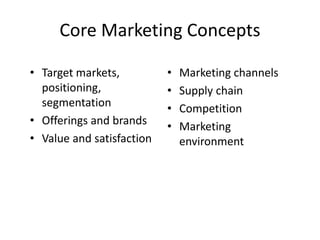
Core Marketing Concepts
• Target markets,
positioning,
segmentation
• Offerings and brands
• Value and satisfaction
• Marketing channels
• Supply chain
• Competition
• Marketing
environment
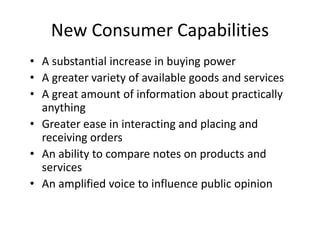
New Consumer Capabilities
• A substantial increase in buying power
• A greater variety of available goods and services
• A great amount of information about practically
anything
• Greater ease in interacting and placing and
receiving orders
• An ability to compare notes on products and
services
• An amplified voice to influence public opinion
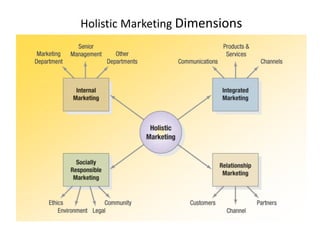
Holistic Marketing Dimensions
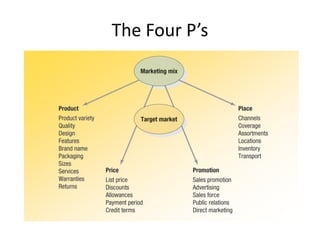
The Four P’s
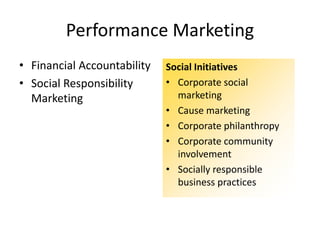
Performance Marketing
• Financial Accountability
• Social Responsibility
Marketing
Social Initiatives
• Corporate social
marketing
• Cause marketing
• Corporate philanthropy
• Corporate community
involvement
• Socially responsible
business practices
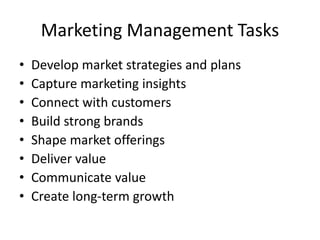
Marketing Management Tasks
• Develop market strategies and plans
• Capture marketing insights
• Connect with customers
• Build strong brands
• Shape market offerings
• Deliver value
• Communicate value
• Create long-term growth

1 intro marketing

  • 1.
  • 2.
    MARKETING : CORECONCEPTS • Marketing is a social and managerial process by which individuals and groups obtain what they need and want through creating, offering and exchanging products of value with others (Philip Kotler ) Marketing is an organizational function and a set of processes for creating, communicating, and delivering value to customers and for managing customer relationships in ways that benefit the organization and its stakeholders (Kotler Keller) • Demand ? • Services and Ideas ?
  • 3.
    MARKETING : CORECONCEPTS • Needs : State of deprivation of some basic satisfaction. Not created by society / marketers. Exist in very texture of human biology and condition • Wants : Desires for specific satisfiers of need. Continuously shaped/reshaped by social forces and institutions.. • Demands : Want for specific products products that are backed by the ability and willingness to buy them. Wants become demands when supported by purchasing power
  • 4.
    MARKETING : CORECONCEPTS • Needs are few / wants are many • Needs preexist marketers • Marketers along with social influences influence wants • Marketers influence demand by making the products appropriate, attractive, affordable, and easily available to target customers
  • 5.
    MARKETING : CORECONCEPTS • Product : Anything that can satisfy a need or want • Product : also called offering or solution • Product can have three components : physical goods , services and ideas • Product owning vs. obtaining the service they render • Marketing myopia • Physical object : means of packaging a service
  • 6.
    What is Marketed? Goods Services Events& Experiences Persons Places & Properties Organizations Information Ideas
  • 7.
    MARKETING : CORECONCEPTS • Product choice set • Need set • Value :consumer’s estimate of the products’ overall capacity to satisfy needs • Value is the satisfaction of customers’ requirements at the lowest possible cost of acquisition, ownership and use • Opportunity Cost
  • 8.
    Structure of Flowsin a Modern Exchange Economy
  • 9.
    Demand States Nonexistent Latent DecliningIrregular Full UnwholesomeOverfull Negative
  • 10.
    MARKETING : CORECONCEPTS • How people can obtain products : 1. Self – production 2. Coercion 3. Begging 4. Exchange : act of obtaining a desired product from someone by offering something in return
  • 11.
    MARKETING : CORECONCEPTS • Conditions that must be satisfied for exchange potential to exist : 1. At least two parties 2. Each party has something that might be of value to the other party 3. Each party is capable of communication and delivery 4. Each party is free to accept or reject the exchange offer 5. Each party believes it is appropriate or desirable to deal with the other party
  • 12.
    MARKETING : CORECONCEPTS • Exchange is a process rather than an event • Transaction is a trade of values between two or more parties • Monetary transaction vs. barter transaction • Transfer : One party gives something of value to the other party but does not receive anything in return • Marketers seek to elicit a behavioral response from the other party • Negotiation : Process of trying to reach agreeable terms
  • 13.
    MARKETING : CORECONCEPTS • Market : Consists of all the potential customers sharing a particular need or want who may be willing and able to engage in exchange to satisfy that need or want • Traditionally : Market is a place here buyers and sellers gather to exchange their goods • Economists : Collection of buyers and sellers who transact over particular product (class) • Marketers : Sellers = industry , buyers = market
  • 14.
    MARKETING : CORECONCEPTS • Market types : Need / Product / Demographic / Geographic /Voter / Labor etc-. Industry ( Collection of sellers ) Market ( Collection of buyers) Goods / Services Money Communication information
  • 15.
    MARKETING : CORECONCEPTS • Marketing (Management) : Process of planning and executing the conception, pricing, promotion, and distribution of ideas, goods, and services to create exchanges that satisfy individual and organizational goals. • Marketing management is the art and science of choosing target markets and getting, keeping, and growing customers through creating, delivering, and communicating superior customer value • Marketing Management has the task of influencing the level, timing and composition of demand in a way that will help the organization achieve its objective
  • 16.
    MARKETING : CORECONCEPTS • Production Concept : The consumers will favor those products that are widely available and low in cost. Managers of production oriented organizations concentrate on achieving high production efficiency and wide distribution. • This holds true in two situations : 1. Demand for a product exceeds supply 2. Product’s cost is high and has to be decreased to expand the market
  • 17.
    MARKETING : CORECONCEPTS • Product Concept : Customers will favor those products that offer the most quality, performance, or innovative feature. Concentration is on making superior products and improving them all the time. • Companies are more self obsessed • Customer input is vital • Looking into a mirror vs. looking outside the window
  • 18.
    MARKETING : CORECONCEPTS • Selling Concept : Holds that the consumers, if left alone, will not buy enough of the organisation’s products. The organisation must therefore undertake an aggressive selling and promotion effort • Practice for goods that people do not normally think of buying / overcapacity • Aim is to sell what they make rather than make what the markets want • Aim of marketing is to make selling superfluous • Aim of marketing is to know the customer so well that the product or service fits him and sells itself
  • 19.
    MARKETING : CORECONCEPTS • Marketing Concept :The key to achieve organisational goals consists of being more effective than competitors in integrating marketing activities towards determining and satisfying the needs and wants of target markets • 4 pillars of marketing concept : Target Market / Customer Needs / Integrated marketing / profitability • Selling focuses on the needs of the seller, marketing on the needs of the buyer • Selling is preoccupied with the seller’s need to convert his product into cash, marketing with the whole idea of satisfying the needs of the customer by means of the product
  • 20.
    MARKETING : CORECONCEPTS • Customer Needs : Types of Need : 1. Stated Needs 2. Real Needs 3. Unstated Needs 4. Delight Needs 5. Secret Needs
  • 21.
    MARKETING : CORECONCEPTS • Responsive Marketing : Find a stated need and fulfill it • Creative Marketing : Discovers and produces solutions that the customer did not as for but to which they respond enthusiastically • Integrated Marketing : When all the company’s departments work together to satisfy the customer’s interest, the result is integrated marketing • External marketing : Marketing directed to people outside the company • Internal marketing : Successful hiring / training and motivating employees who want to serve the customers well
  • 22.
    MARKETING : CORECONCEPTS • Societal Marketing Concept : The organisation’s task is to determine the needs, wants and interests of target markets and to deliver the desired satisfactions more effectively and efficiently than competitors in a way that preserves or enhances the consumer’s and the society’s well being • Calls for marketer to build social and ethical considerations into the marketing practices • Green marketing : Marketing of products that are presumed to be environmentally safe
  • 23.
    MARKETING : CORECONCEPTS • Social marketing : Systematic application of marketing, along with other concepts and techniques, to achieve specific behavioral goals for a social good. • Social marketing can be applied to promote merit goods, or to make a society avoid demerit goods and thus to promote society's well being as a whole • The primary aim of social marketing is "social good", while in "commercial marketing" the aim is primarily "financial” • Social marketing is being described as having "two parents"—a "social parent" = social sciences and social policy, and a "marketing parent" = commercial and public sector marketing approaches
  • 24.
    Functions of CMOs •Strengthening the brands • Measuring marketing effectiveness • Driving new product development based on customer needs • Gathering meaningful customer insights • Utilizing new marketing technology
  • 25.
    Improving CMO Success •Make the mission and responsibilities clear • Fit the role to the marketing culture and structure • Ensure the CMO is compatible with the CEO • Remember that show people don’t succeed • Match the personality with the CMO type • Make line managers marketing heroes • Infiltrate the line organization • Require right-brain and left-brain skills
  • 26.
    Core Marketing Concepts •Target markets, positioning, segmentation • Offerings and brands • Value and satisfaction • Marketing channels • Supply chain • Competition • Marketing environment
  • 27.
    New Consumer Capabilities •A substantial increase in buying power • A greater variety of available goods and services • A great amount of information about practically anything • Greater ease in interacting and placing and receiving orders • An ability to compare notes on products and services • An amplified voice to influence public opinion
  • 28.
  • 29.
  • 30.
    Performance Marketing • FinancialAccountability • Social Responsibility Marketing Social Initiatives • Corporate social marketing • Cause marketing • Corporate philanthropy • Corporate community involvement • Socially responsible business practices
  • 31.
    Marketing Management Tasks •Develop market strategies and plans • Capture marketing insights • Connect with customers • Build strong brands • Shape market offerings • Deliver value • Communicate value • Create long-term growth