Chapter 1Chapter 1
Defining MarketingDefining Marketing
for the Twenty-Firstfor the Twenty-First
CenturyCentury
ObjectivesObjectives
 Understand the new economy.
 Learn the tasks of marketing.
 Become familiar with the major
concepts and tools of marketing.
 Understand the orientations
exhibited by companies.
ObjectivesObjectives
 Learn how companies and
marketers are responding to
new challenges.
The New EconomyThe New Economy
 Consumer benefits from the digital
revolution include:
– Increased buying power.
– Greater variety of goods and services.
– Increased information.
– Enhanced shopping convenience.
– Greater opportunities to compare product
information with others.
The New EconomyThe New Economy
 Firm benefits from the digital
revolution include:
–New promotional medium.
–Access to richer research data.
–Enhanced employee and customer
communication.
–Ability to customize promotions.
Marketing TasksMarketing Tasks
 Marketing practices may pass
through two stages:
–Entrepreneurial marketing
–Formulated marketing
 As marketing becomes more
formulated, creativity is inhibited.
What Can Be Marketed?What Can Be Marketed?
 Goods
 Services
 Experiences
 Events
 Persons
 Places
 Properties
 Organizations
 Information
 Ideas
Marketing DefinedMarketing Defined
 Kotler’s social definition:
“Marketing is a societal process by
which individuals and groups
obtain what they need and want
through creating, offering, and
freely exchanging products and
services of value with others.”
Marketing DefinedMarketing Defined
 The AMA managerial definition:
“Marketing is the process of
planning and executing the
conception, pricing, promotion,
and distribution of ideas, goods,
and services to create exchanges
that satisfy individual and
organizational objectives.”
Core Marketing ConceptsCore Marketing Concepts
 Target markets and
market segmentation
 Marketplace, market-
space, metamarkets
 Marketers & prospects
 Needs, wants, demands
 Product offering and
brand
 Value and satisfaction
 Exchange and
transactions
 Relationship and
networks
 Marketing channels
 Supply chain
 Competition
 Marketing environment
 Marketing program
Core Marketing ConceptsCore Marketing Concepts
 Target markets & segmentation
–Differences in needs, behavior,
demographics or psychographics
are used to identify segments.
–The segment served by the firm is
called the target market.
–The market offering is customized
to the needs of the target market.
Core Marketing ConceptsCore Marketing Concepts
 Shopping can take place in a:
– Marketplace (physical entity, Lowe’s)
– Marketspace (virtual entity, Amazon)
 Metamarkets refer to complementary
goods and services that are related
in the minds of consumers.
 Marketers seek responses from
prospects.
Core Marketing ConceptsCore Marketing Concepts
 Needs describe basic human
requirements such as food, air, water,
clothing, shelter, recreation, education,
and entertainment.
 Needs become wants when they are
directed to specific objects that might
satisfy the need. (Fast food)
 Demands are wants for specific
products backed by an ability to pay.
Core Marketing ConceptsCore Marketing Concepts
 A Product is any offering that can
satisfy a need or want, while a brand
is a specific offering from a known
source.
 When offerings deliver value and
satisfaction to the buyer, they are
successful.
Enhancing ValueEnhancing Value
 Marketers can enhance the value of
an offering to the customer by:
– Raising benefits.
– Reducing costs.
– Raising benefits while lowering costs.
– Raising benefits by more than the
increase in costs.
– Lowering benefits by less than the
reduction in costs.
Core Marketing ConceptsCore Marketing Concepts
 Exchange involves obtaining a desired
product from someone by offering
something in return. Five conditions
must be satisfied for exchange to occur.
 Transaction involves at least two things
of value, agreed-upon conditions, a time
of agreement, and a place of agreement.
Core Marketing ConceptsCore Marketing Concepts
 Relationship marketing aims to
build long-term mutually satisfying
relations with key parties, which
ultimately results in marketing
network between the company and
its supporting stakeholders.
Core Marketing ConceptsCore Marketing Concepts
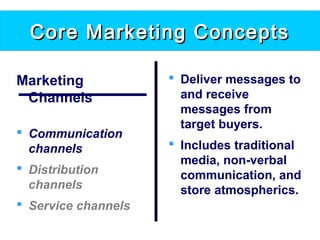
Marketing
Channels
 Communication
channels
 Distribution
channels
 Service channels
 Deliver messages to
and receive
messages from
target buyers.
 Includes traditional
media, non-verbal
communication, and
store atmospherics.
Core Marketing ConceptsCore Marketing Concepts
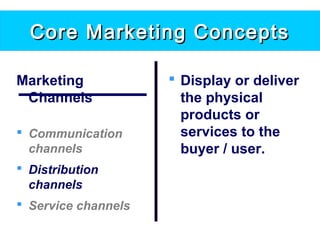
Marketing
Channels
 Communication
channels
 Distribution
channels
 Service channels
 Display or deliver
the physical
products or
services to the
buyer / user.
Core Marketing ConceptsCore Marketing Concepts
Marketing
Channels
 Communication
channels
 Distribution
channels
 Service channels
 Carry out
transactions with
potential buyers
by facilitating the
transaction.
Core Marketing ConceptsCore Marketing Concepts
 A supply chain stretches from raw
materials to components to final
products that are carried to final
buyers.
 Each company captures only a
certain percentage of the total value
generated by the supply chain.
Core Marketing ConceptsCore Marketing Concepts
 The following forces in the broad
environment have a major impact on
the task environment:
– Demographics
– Economics
– Natural environment
– Technological environment
– Political-legal environment
– Social-cultural environment
Core Marketing ConceptsCore Marketing Concepts
 The marketing program is developed
to achieve the company’s objectives.
Marketing mix decisions include:
– Product: provides customer solution.
– Price: represents the customer’s cost.
– Place: customer convenience is key.
– Promotion: communicates with customer.
Company OrientationsCompany Orientations
 The orientation or philosophy of the
firm typically guides marketing efforts.
Several competing orientations exist:
–Production concept-consumers favor
products that are widely available and
inexpensive.
–Product concept-consumers favor
those products that offer the most quality,
performance and innovative features.
–Selling concept-holds that consumers will not
buy enough of products unless the firm undertakes
a large scale selling and promotion effort. (for
unsought goods.)
–Marketing concept-instead of product
centered “make and-sell” shift to a customer
centered, “sense and-respond” philosophy.
Instead of “hunting” marketing is “gardening”.
organisational goals depends on knowing the
needs and wants of target markets. Customer
value and focus are the paths to sale and profits.
–Societal marketing concept-
understanding broader concerns and
the ethical, environmental, legal and
social context of marketing activities
and programs clearly extending beyond
the company and the consumers to
society as a whole.
To accompany A Framework for Slide 27 in
Š2003 Prentice Hall, Inc.
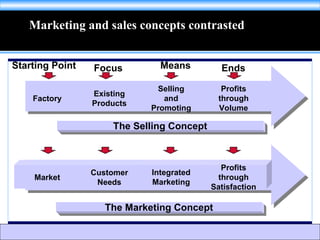
Marketing and sales concepts contrastedMarketing and sales concepts contrasted
Factory
Existing
Products
Selling
and
Promoting
Profits
through
Volume
Market
Customer
Needs
Integrated
Marketing
Profits
through
Satisfaction
The Selling ConceptThe Selling Concept
The Marketing ConceptThe Marketing Concept
Starting Point Focus Means Ends
To accompany A Framework for Slide 28 in
Š2003 Prentice Hall, Inc.
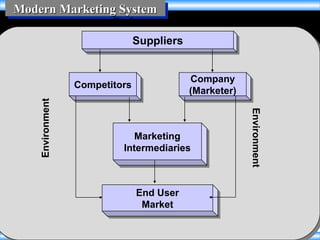
Modern Marketing SystemModern Marketing SystemModern Marketing SystemModern Marketing System
SuppliersSuppliers
End User
Market
End User
Market
Marketing
Intermediaries
Marketing
Intermediaries
CompetitorsCompetitors Company
(Marketer)
Company
(Marketer)
Environment
Environment

Chapter 1

  • 1.
    Chapter 1Chapter 1 DefiningMarketingDefining Marketing for the Twenty-Firstfor the Twenty-First CenturyCentury
  • 2.
    ObjectivesObjectives  Understand thenew economy.  Learn the tasks of marketing.  Become familiar with the major concepts and tools of marketing.  Understand the orientations exhibited by companies.
  • 3.
    ObjectivesObjectives  Learn howcompanies and marketers are responding to new challenges.
  • 4.
    The New EconomyTheNew Economy  Consumer benefits from the digital revolution include: – Increased buying power. – Greater variety of goods and services. – Increased information. – Enhanced shopping convenience. – Greater opportunities to compare product information with others.
  • 5.
    The New EconomyTheNew Economy  Firm benefits from the digital revolution include: –New promotional medium. –Access to richer research data. –Enhanced employee and customer communication. –Ability to customize promotions.
  • 6.
    Marketing TasksMarketing Tasks Marketing practices may pass through two stages: –Entrepreneurial marketing –Formulated marketing  As marketing becomes more formulated, creativity is inhibited.
  • 7.
    What Can BeMarketed?What Can Be Marketed?  Goods  Services  Experiences  Events  Persons  Places  Properties  Organizations  Information  Ideas
  • 8.
    Marketing DefinedMarketing Defined Kotler’s social definition: “Marketing is a societal process by which individuals and groups obtain what they need and want through creating, offering, and freely exchanging products and services of value with others.”
  • 9.
    Marketing DefinedMarketing Defined The AMA managerial definition: “Marketing is the process of planning and executing the conception, pricing, promotion, and distribution of ideas, goods, and services to create exchanges that satisfy individual and organizational objectives.”
  • 10.
    Core Marketing ConceptsCoreMarketing Concepts  Target markets and market segmentation  Marketplace, market- space, metamarkets  Marketers & prospects  Needs, wants, demands  Product offering and brand  Value and satisfaction  Exchange and transactions  Relationship and networks  Marketing channels  Supply chain  Competition  Marketing environment  Marketing program
  • 11.
    Core Marketing ConceptsCoreMarketing Concepts  Target markets & segmentation –Differences in needs, behavior, demographics or psychographics are used to identify segments. –The segment served by the firm is called the target market. –The market offering is customized to the needs of the target market.
  • 12.
    Core Marketing ConceptsCoreMarketing Concepts  Shopping can take place in a: – Marketplace (physical entity, Lowe’s) – Marketspace (virtual entity, Amazon)  Metamarkets refer to complementary goods and services that are related in the minds of consumers.  Marketers seek responses from prospects.
  • 13.
    Core Marketing ConceptsCoreMarketing Concepts  Needs describe basic human requirements such as food, air, water, clothing, shelter, recreation, education, and entertainment.  Needs become wants when they are directed to specific objects that might satisfy the need. (Fast food)  Demands are wants for specific products backed by an ability to pay.
  • 14.
    Core Marketing ConceptsCoreMarketing Concepts  A Product is any offering that can satisfy a need or want, while a brand is a specific offering from a known source.  When offerings deliver value and satisfaction to the buyer, they are successful.
  • 15.
    Enhancing ValueEnhancing Value Marketers can enhance the value of an offering to the customer by: – Raising benefits. – Reducing costs. – Raising benefits while lowering costs. – Raising benefits by more than the increase in costs. – Lowering benefits by less than the reduction in costs.
  • 16.
    Core Marketing ConceptsCoreMarketing Concepts  Exchange involves obtaining a desired product from someone by offering something in return. Five conditions must be satisfied for exchange to occur.  Transaction involves at least two things of value, agreed-upon conditions, a time of agreement, and a place of agreement.
  • 17.
    Core Marketing ConceptsCoreMarketing Concepts  Relationship marketing aims to build long-term mutually satisfying relations with key parties, which ultimately results in marketing network between the company and its supporting stakeholders.
  • 18.
    Core Marketing ConceptsCoreMarketing Concepts Marketing Channels  Communication channels  Distribution channels  Service channels  Deliver messages to and receive messages from target buyers.  Includes traditional media, non-verbal communication, and store atmospherics.
  • 19.
    Core Marketing ConceptsCoreMarketing Concepts Marketing Channels  Communication channels  Distribution channels  Service channels  Display or deliver the physical products or services to the buyer / user.
  • 20.
    Core Marketing ConceptsCoreMarketing Concepts Marketing Channels  Communication channels  Distribution channels  Service channels  Carry out transactions with potential buyers by facilitating the transaction.
  • 21.
    Core Marketing ConceptsCoreMarketing Concepts  A supply chain stretches from raw materials to components to final products that are carried to final buyers.  Each company captures only a certain percentage of the total value generated by the supply chain.
  • 22.
    Core Marketing ConceptsCoreMarketing Concepts  The following forces in the broad environment have a major impact on the task environment: – Demographics – Economics – Natural environment – Technological environment – Political-legal environment – Social-cultural environment
  • 23.
    Core Marketing ConceptsCoreMarketing Concepts  The marketing program is developed to achieve the company’s objectives. Marketing mix decisions include: – Product: provides customer solution. – Price: represents the customer’s cost. – Place: customer convenience is key. – Promotion: communicates with customer.
  • 24.
    Company OrientationsCompany Orientations The orientation or philosophy of the firm typically guides marketing efforts. Several competing orientations exist: –Production concept-consumers favor products that are widely available and inexpensive. –Product concept-consumers favor those products that offer the most quality, performance and innovative features.
  • 25.
    –Selling concept-holds thatconsumers will not buy enough of products unless the firm undertakes a large scale selling and promotion effort. (for unsought goods.) –Marketing concept-instead of product centered “make and-sell” shift to a customer centered, “sense and-respond” philosophy. Instead of “hunting” marketing is “gardening”. organisational goals depends on knowing the needs and wants of target markets. Customer value and focus are the paths to sale and profits.
  • 26.
    –Societal marketing concept- understandingbroader concerns and the ethical, environmental, legal and social context of marketing activities and programs clearly extending beyond the company and the consumers to society as a whole.
  • 27.
    To accompany AFramework for Slide 27 in Š2003 Prentice Hall, Inc. Marketing and sales concepts contrastedMarketing and sales concepts contrasted Factory Existing Products Selling and Promoting Profits through Volume Market Customer Needs Integrated Marketing Profits through Satisfaction The Selling ConceptThe Selling Concept The Marketing ConceptThe Marketing Concept Starting Point Focus Means Ends
  • 28.
    To accompany AFramework for Slide 28 in Š2003 Prentice Hall, Inc. Modern Marketing SystemModern Marketing SystemModern Marketing SystemModern Marketing System SuppliersSuppliers End User Market End User Market Marketing Intermediaries Marketing Intermediaries CompetitorsCompetitors Company (Marketer) Company (Marketer) Environment Environment

Editor's Notes

  • #28 Marketing and Sales Concept Contrasted This CTR corresponds to Figure 1-4 on p. 15 and to the material on pp. 14-16. Comparisons and Contrasts: The Selling Concept takes an inside-out perspective -- looking at the company’s needs and wants in terms of existing products and ways to find customers for them. The Marketing Concept takes an outside-in perspective - identifying the needs and wants of a clearly defined market and adjusting company efforts to make products that meet the needs. Discussion Note: Promotional tone may help indicate whether a company practices the selling or the marketing concept. Selling involves persuasion -- convincing the customer of their need to buy existing products. Marketing, at its best, involves information -- bringing the developed product to the awareness of a target market that recognizes need satisfying products. As the text notes, companies can let their own success lock them into a rigid selling structure. As times change, and they always do, those companies fail to see the need for meeting new and emerging consumer needs. The marketing concept helps companies focus on customer need satisfaction , leading to long-term success by customer retention .
  • #29 Modern Marketing System This CTR corresponds to Figure 1-3 on p.11 and relates to the material on p. 10. The Marketing System A modern marketing system consist of four levels of activity. In a very real sense, each level influences the other levels. Each level adds value to the system. Discussion Note: Consumers add value to the system when they buy products. Their purchase price in turn funds the efforts (as profits) of each of the other layers to create more value as the system continues the cycle. Suppliers . This level provides the inputs to the production of goods and services. Company and Competitors . Each company adds value to supplies to create the products (goods, services, or both) offered to various markets. Marketing Intermediaries . Because of specialization, one or more other firms can get products to consumers more efficiently than most producers can (though there are important exceptions). End User Market . The consumer is the “final cause” of the efforts of each level of the marketing system. Discussion Note: Ask students to comment on whether the schematic should have “dotted line” feedback connection from the end user to each level of the system. What form of communication does that feedback take? Purchase? Satisfaction level? Brand loyalty? Brand switching? You might encourage students to remember this system perspective throughout the course and relate examples back to this CTR from time to time.