Technical Integration Department System Analysis & Training Group Jerry Yang July 21, 2005 SQL Server 2000 Research Series  Essential Knowledge
Introduction SQL Server 2000 Environment Fundamental Operations Summary Agenda
Introduction SQL Server 2000 Environment Fundamental Operations Summary Essential Knowledge
Evolution COBOL ANSI File IBM DB2, TANDEM non-STOP SQL Oracle , Sybase , Informix Microsoft SQL Server Microsoft SQL Server 2000 Middle Level Price High Level Architectural Design Microsoft Solution Introduction
MSDE 2000 – Microsoft SQL Server 2000 Desktop Engine The Secret of The Sphinx Limitation Storage: 2 GB Per Database Concurrency Workload: 5 Optimal Performance Extensibility Introduction
Introduction SQL Server 2000 Environment Fundamental Operations Summary Essential Knowledge
Service Manager Enterprise Manager Query Analyzer SQL Server Profiler DTS - Data Transformation Services Client Network Utility SQL Server 2000 Environment
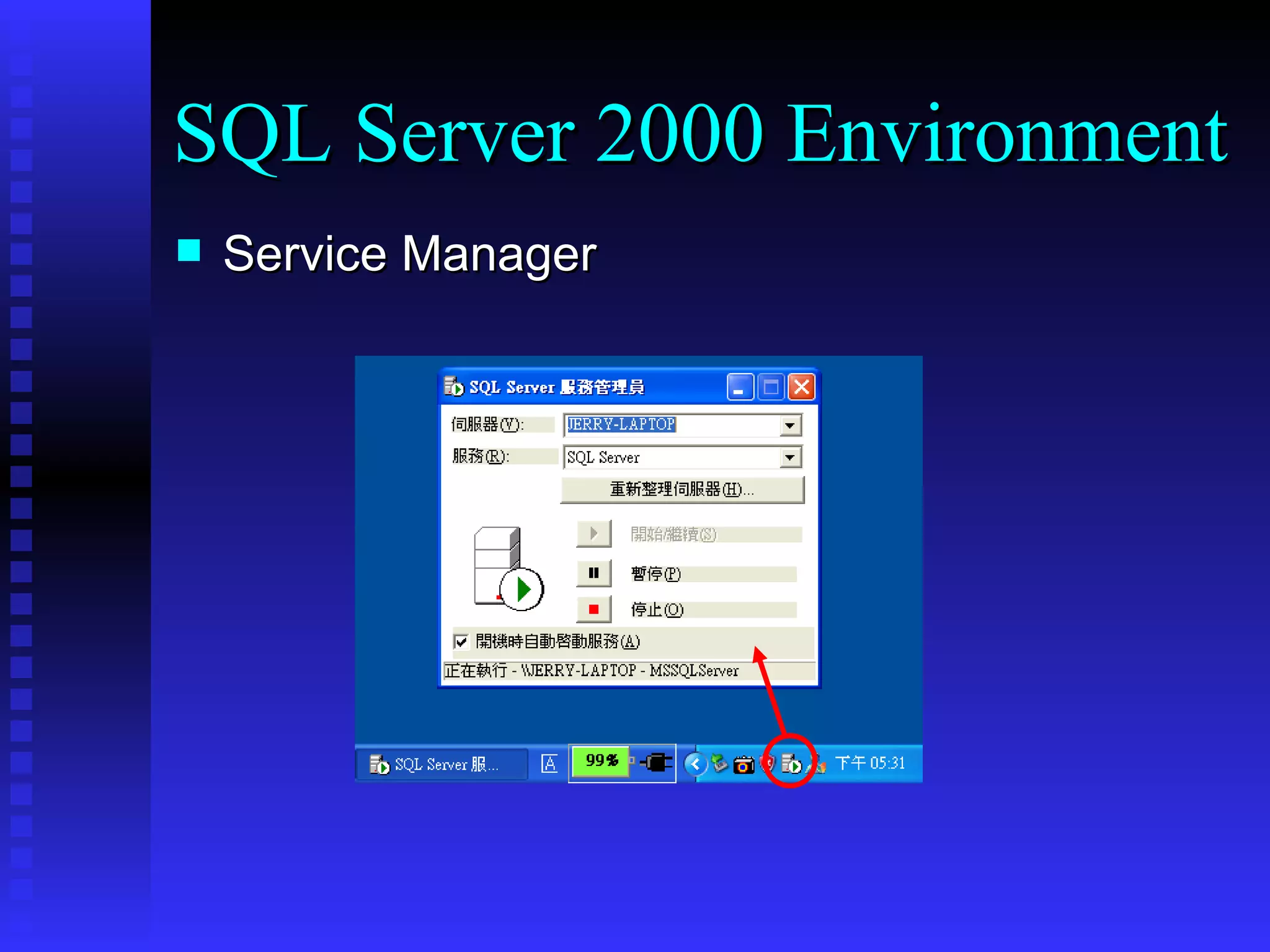
Service Manager SQL Server 2000 Environment
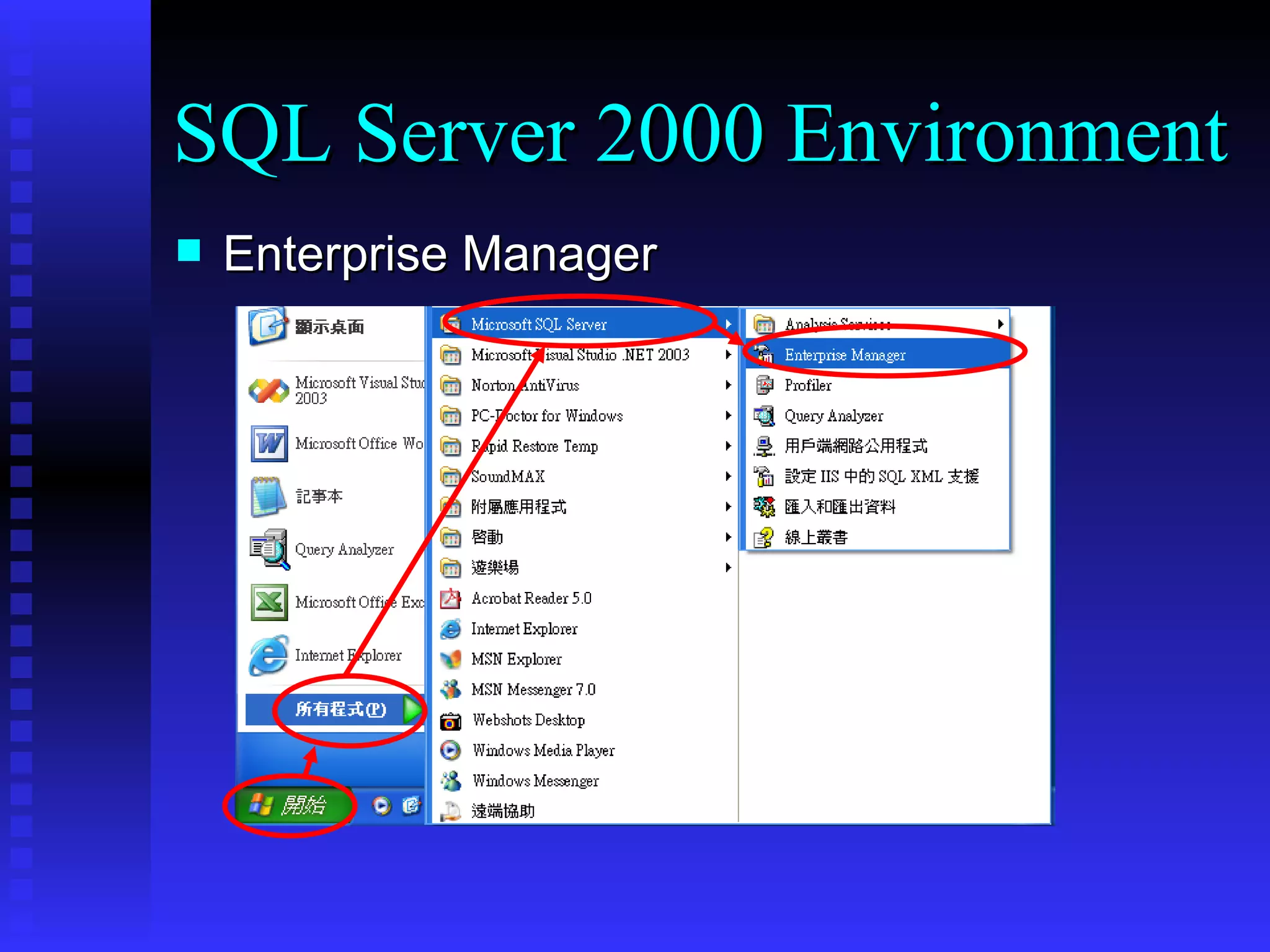
Enterprise Manager SQL Server 2000 Environment
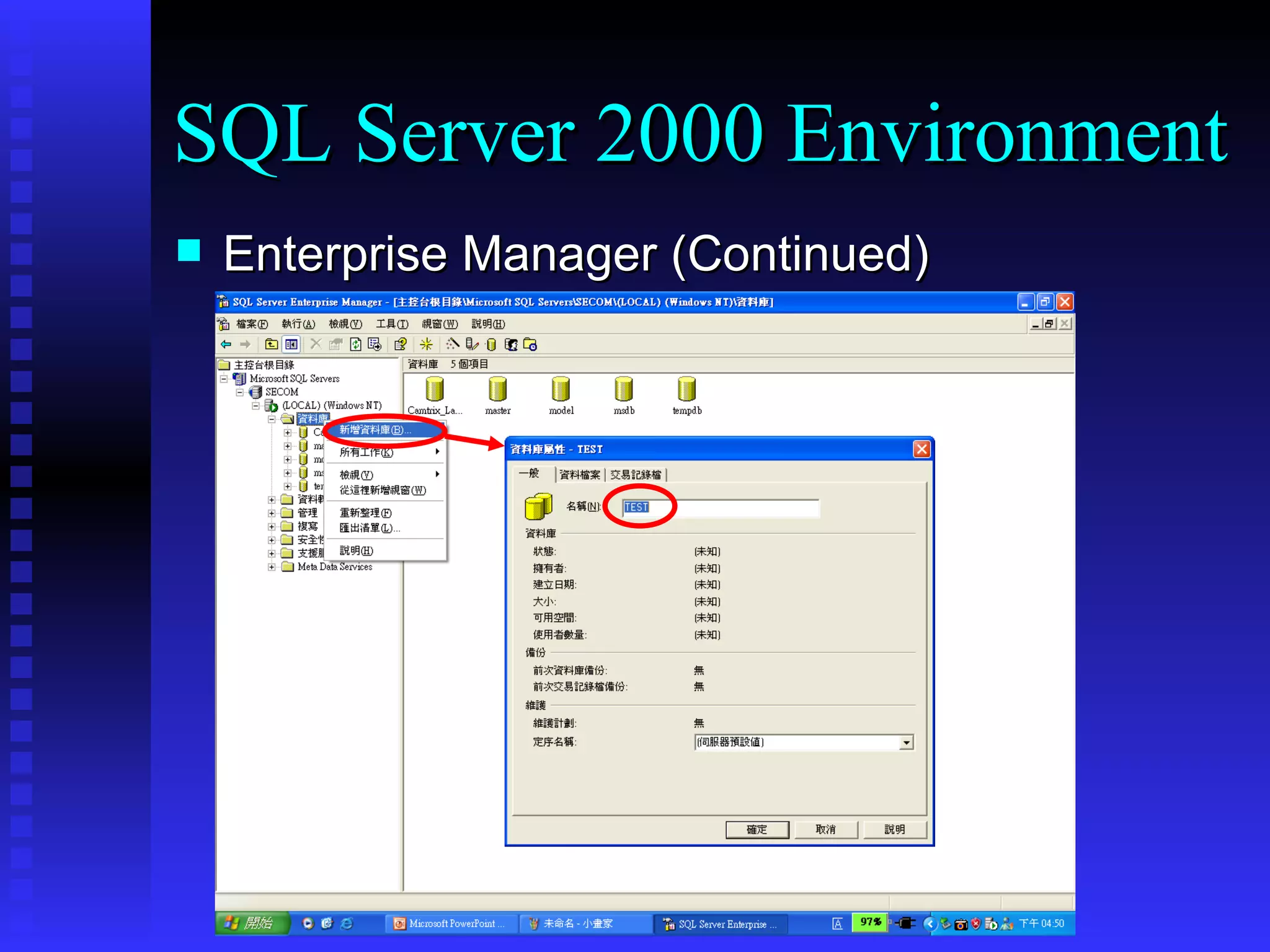
Enterprise Manager (Continued) SQL Server 2000 Environment
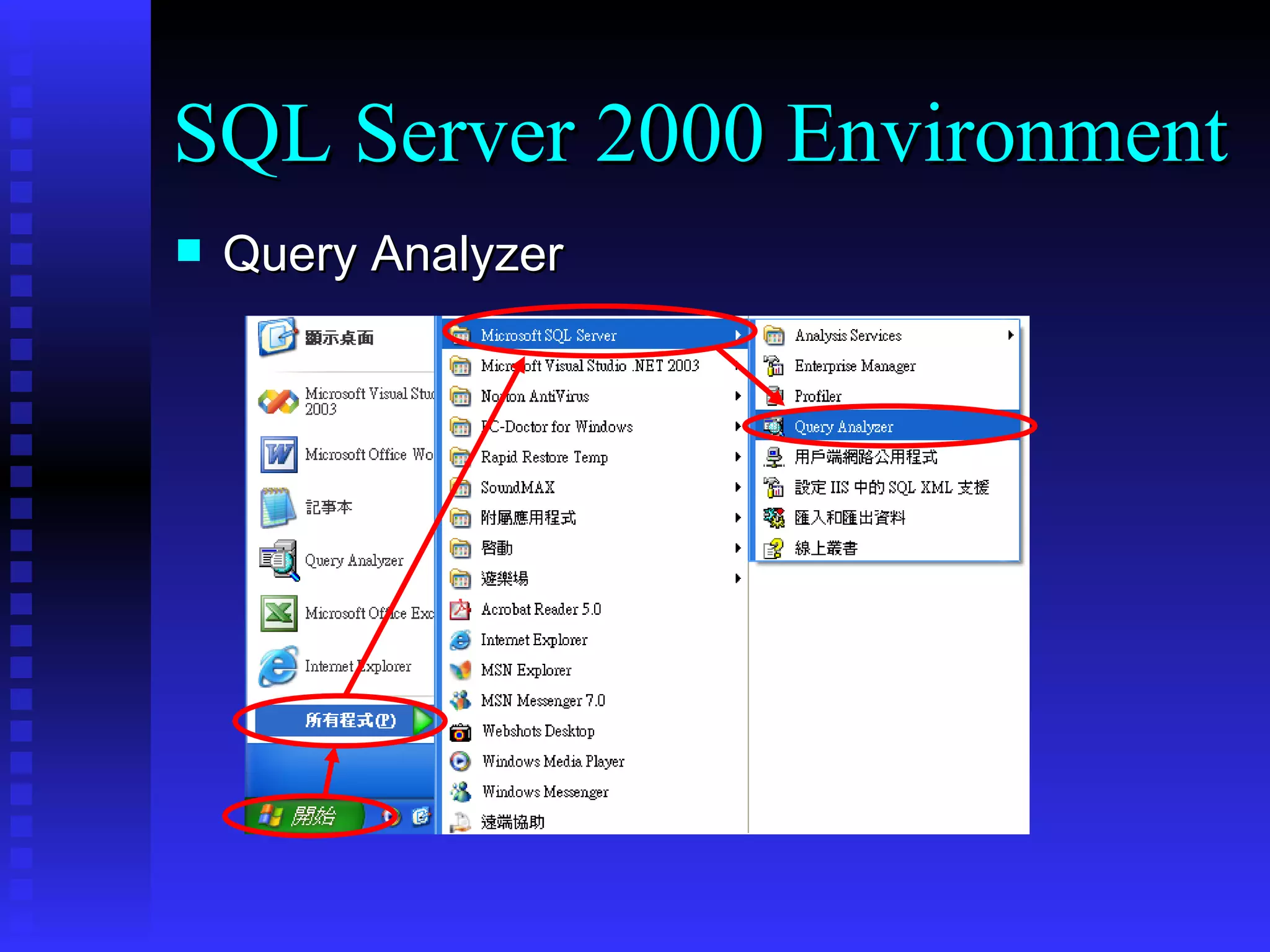
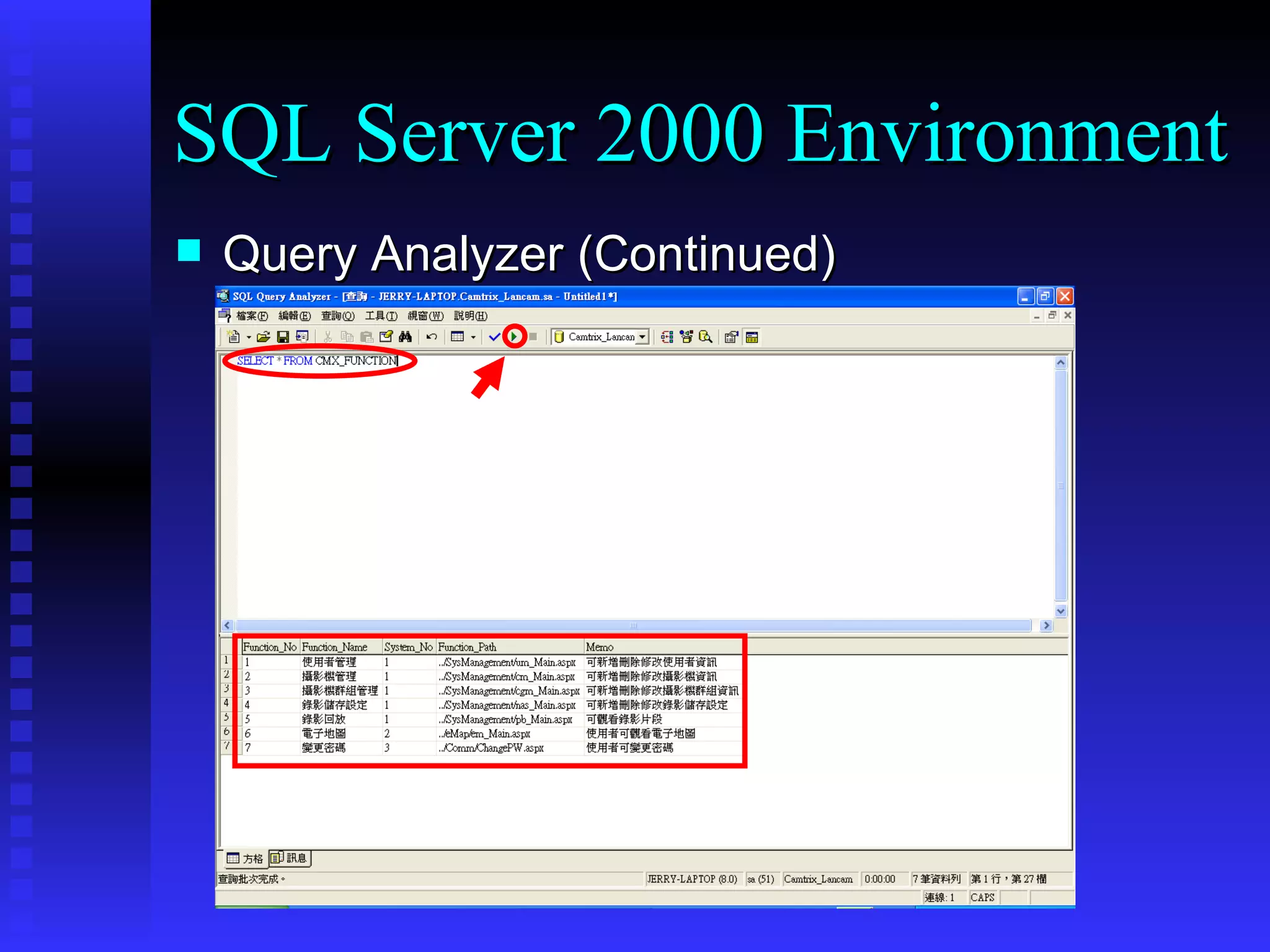
Query Analyzer SQL Server 2000 Environment
Query Analyzer (Continued) SQL Server 2000 Environment
Introduction SQL Server 2000 Environment Fundamental Operations Summary Essential Knowledge
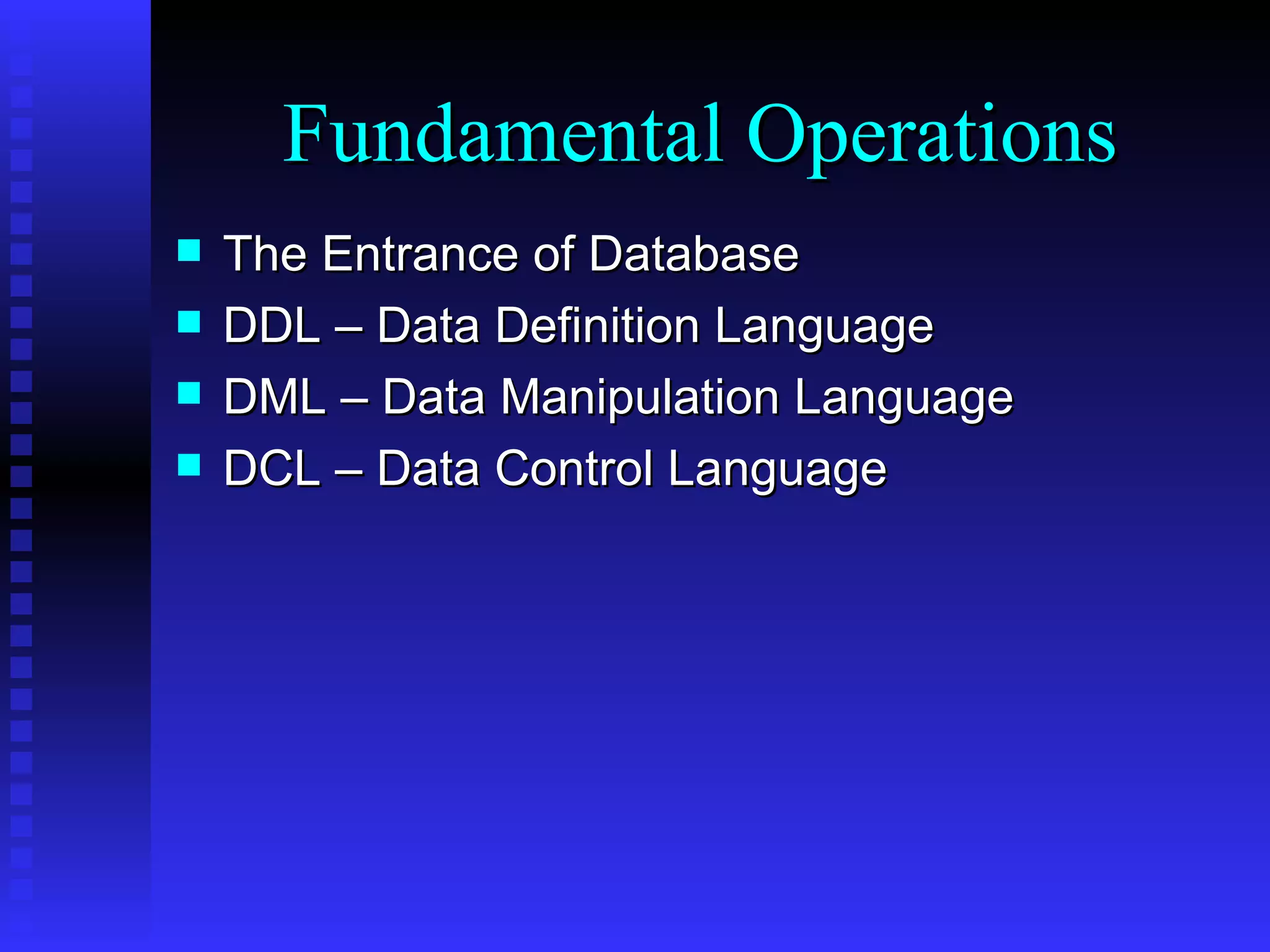
The Entrance of Database DDL – Data Definition Language DML – Data Manipulation Language DCL – Data Control Language Fundamental Operations
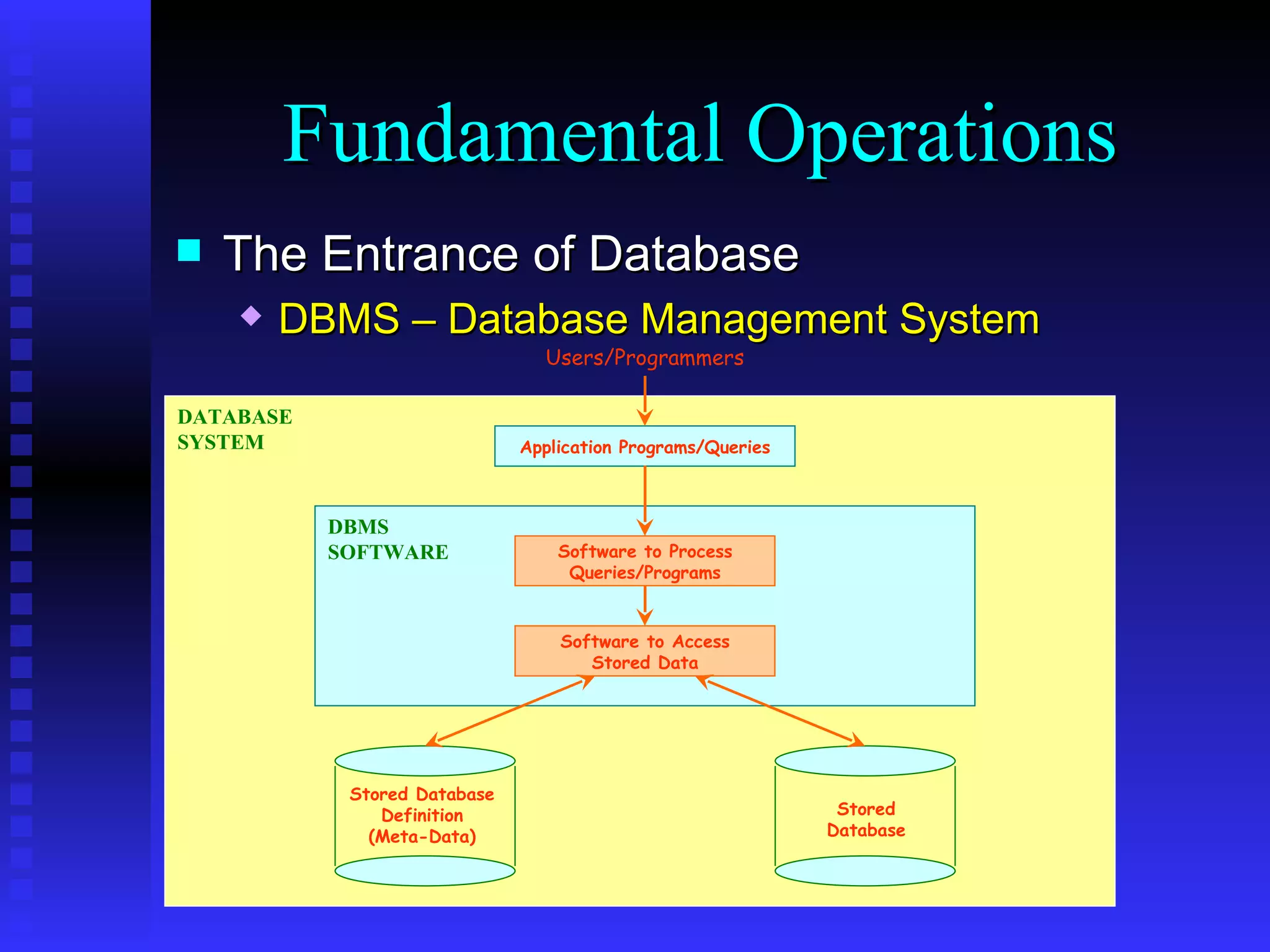
The Entrance of Database DBMS – Database Management System Fundamental Operations Application Programs/Queries Software to Process Queries/Programs Software to Access Stored Data Users/Programmers DATABASE SYSTEM DBMS SOFTWARE Stored Database Definition (Meta-Data) Stored Database
The Entrance of Database (Continued) Table, Row, and Column Page (8K Byte/Page) Index Clustered Index Non-Clustered Index Fundamental Operations
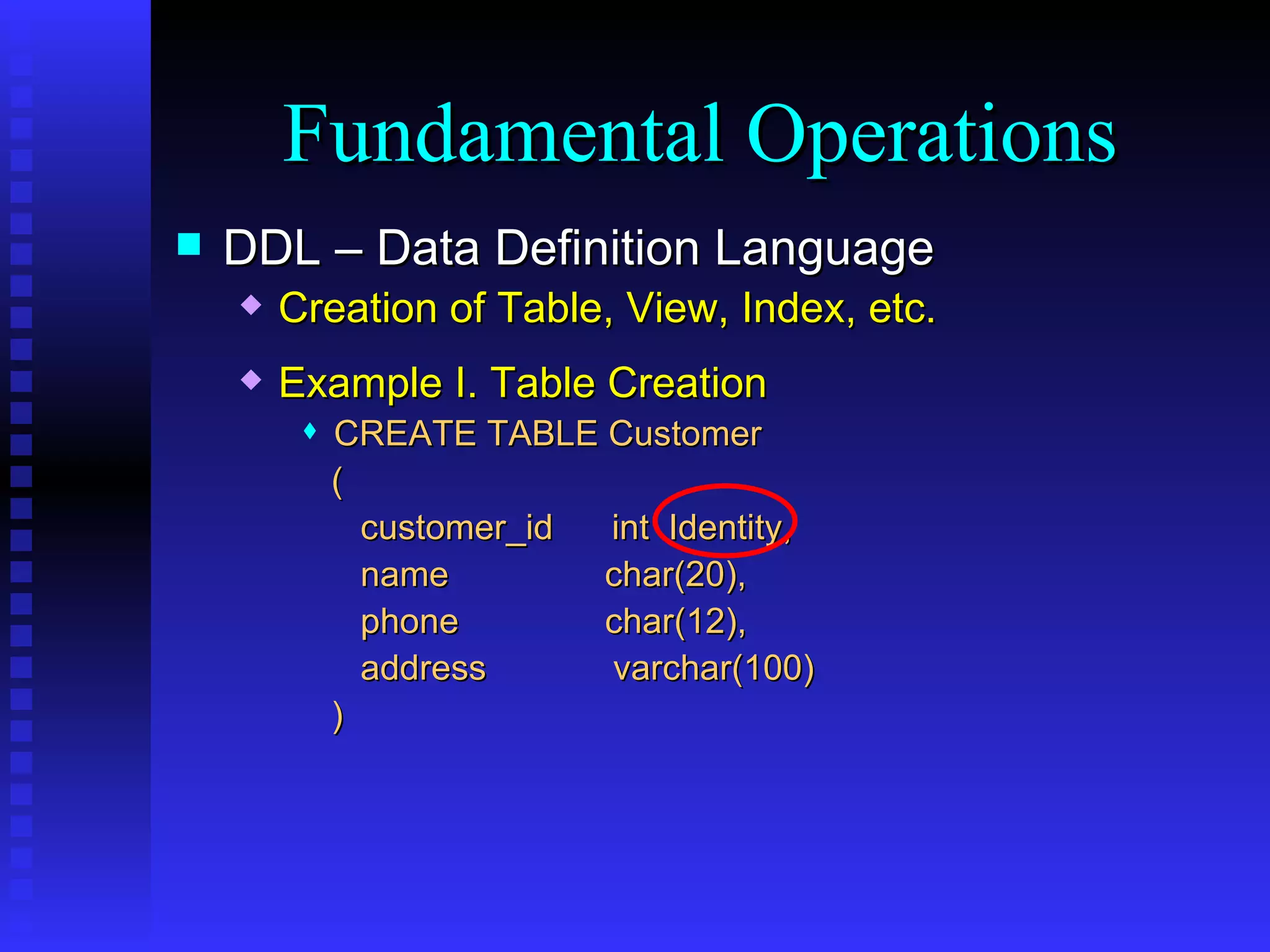
DDL – Data Definition Language Creation of Table, View, Index, etc. Example I. Table Creation CREATE TABLE Customer ( customer_id  int  Identity, name  char(20), phone  char(12), address  varchar(100) ) Fundamental Operations
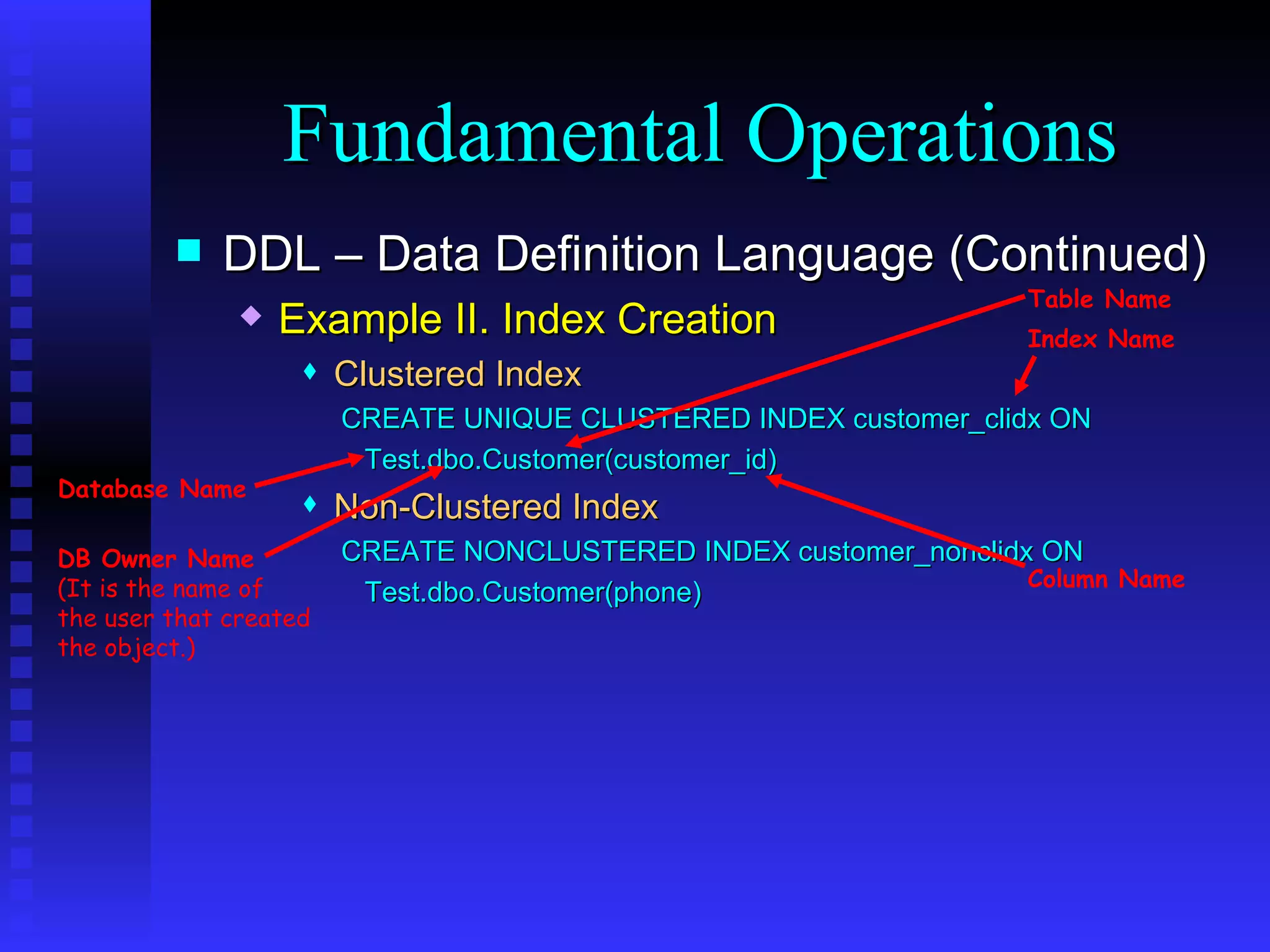
DDL – Data Definition Language (Continued) Example II. Index Creation Clustered Index CREATE UNIQUE CLUSTERED INDEX customer_clidx ON  Test.dbo.Customer(customer_id) Non-Clustered Index CREATE NONCLUSTERED INDEX customer_nonclidx ON  Test.dbo.Customer(phone) Fundamental Operations Database Name DB Owner Name (It is the name of  the user that created the object.) Table Name Column Name Index Name
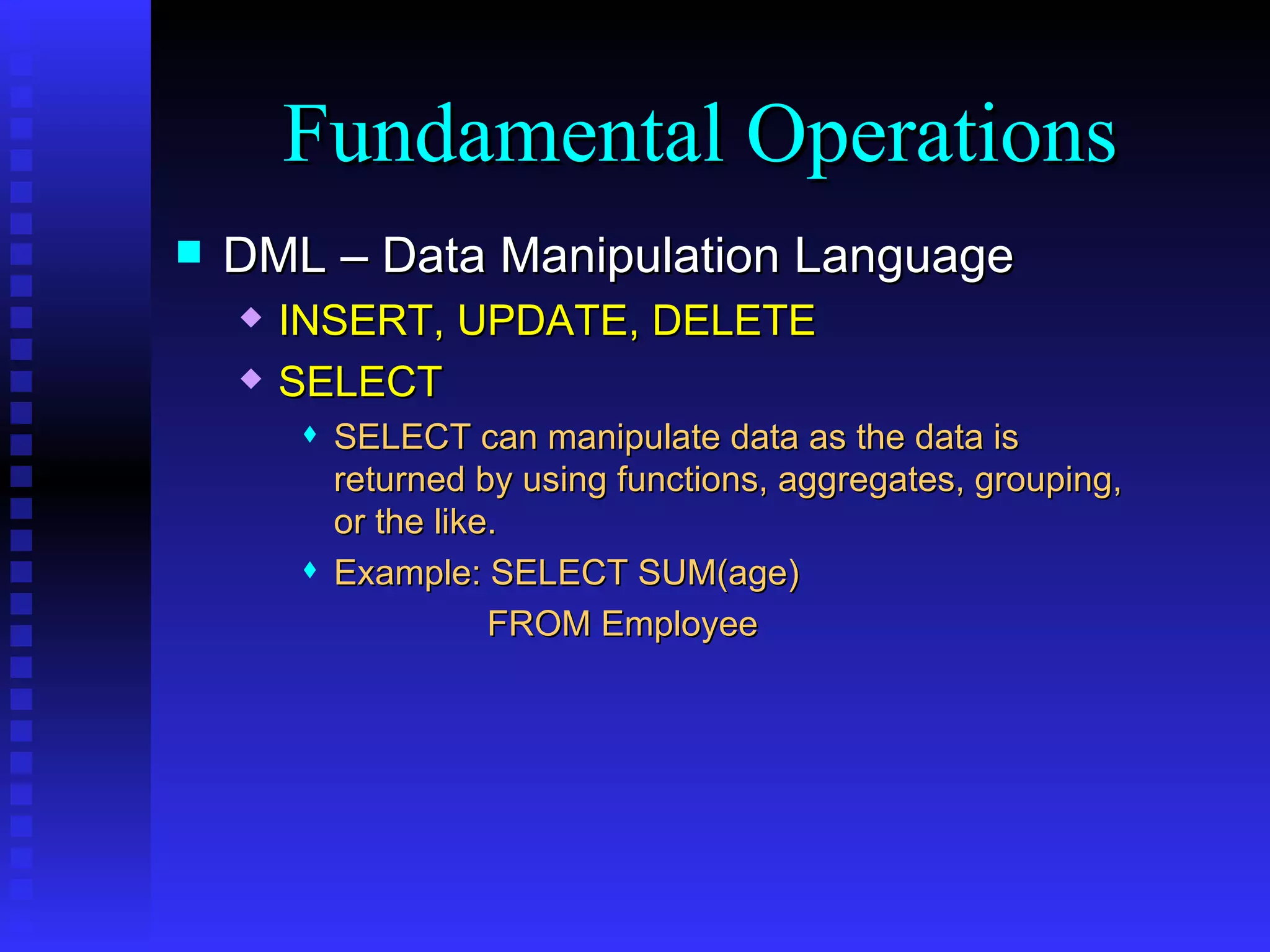
DML – Data Manipulation Language INSERT, UPDATE, DELETE SELECT SELECT can manipulate data as the data is returned by using functions, aggregates, grouping, or the like. Example: SELECT SUM(age) FROM Employee Fundamental Operations
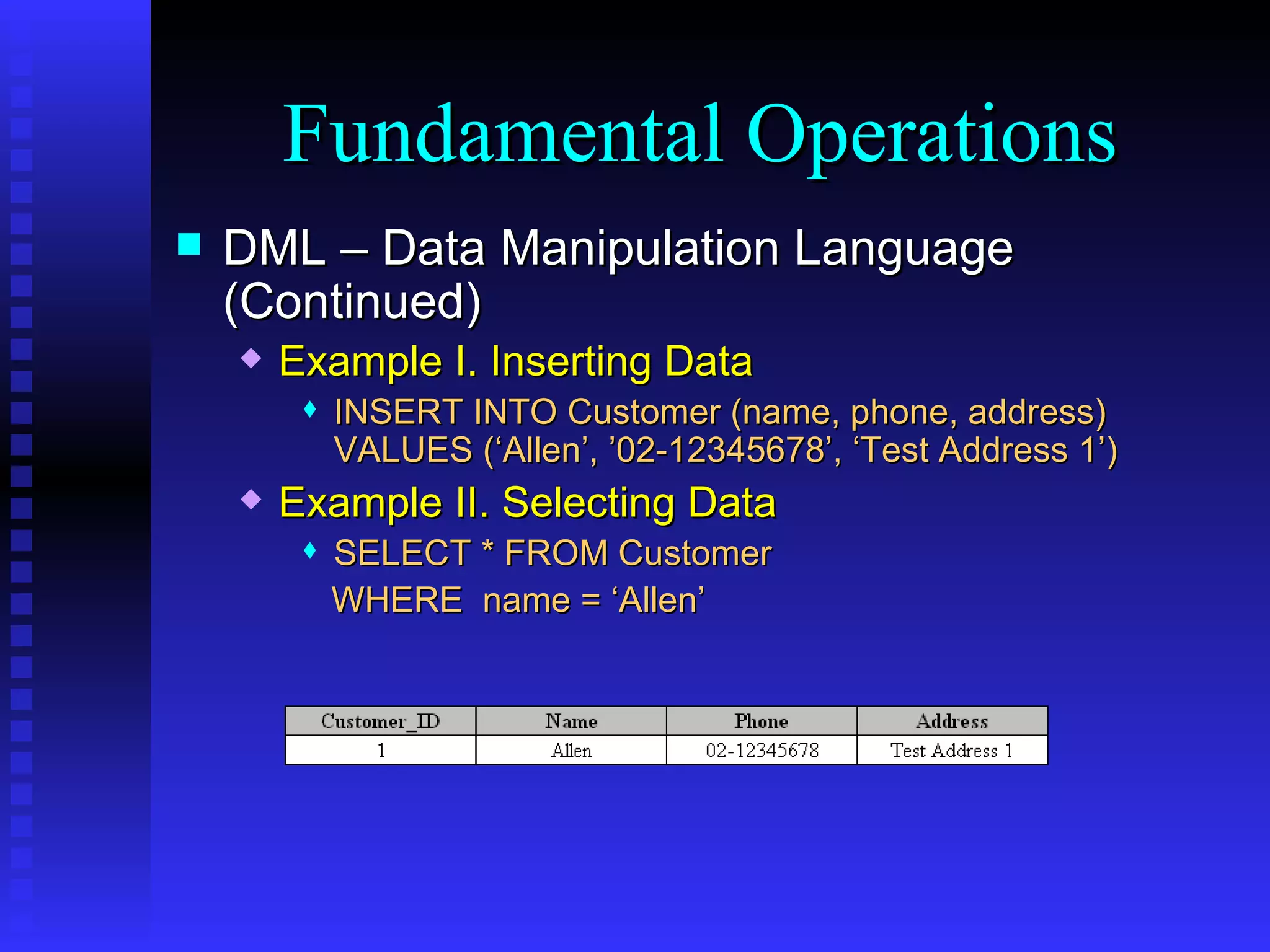
DML – Data Manipulation Language (Continued) Example I. Inserting Data INSERT INTO Customer (name, phone, address) VALUES (‘Allen’, ’02-12345678’, ‘Test Address 1’) Example II. Selecting Data SELECT * FROM Customer WHERE  name = ‘Allen’ Fundamental Operations
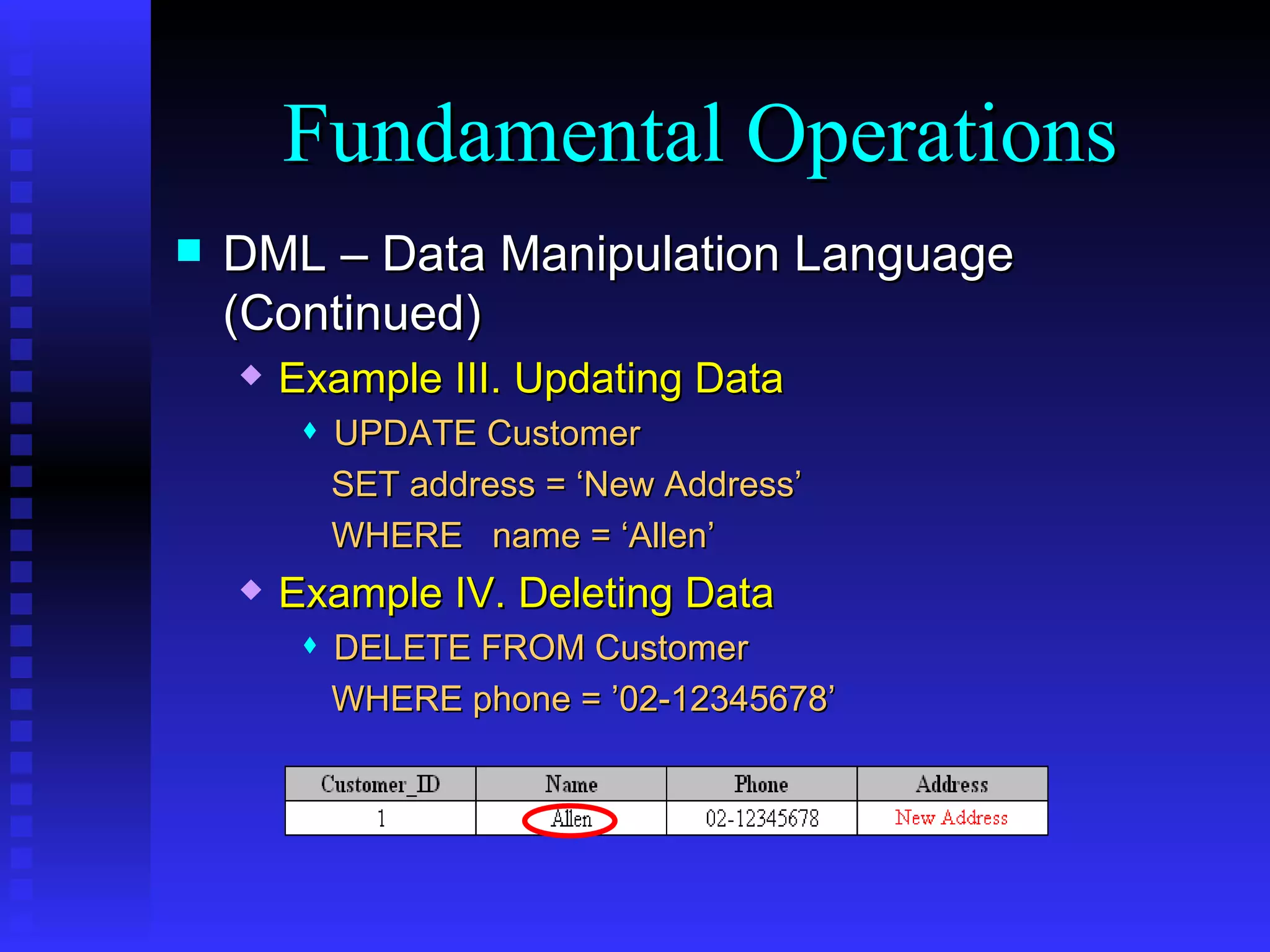
DML – Data Manipulation Language (Continued) Example III. Updating Data UPDATE Customer SET address = ‘New Address’ WHERE  name = ‘Allen’ Example IV. Deleting Data DELETE FROM Customer WHERE phone = ’02-12345678’ Fundamental Operations
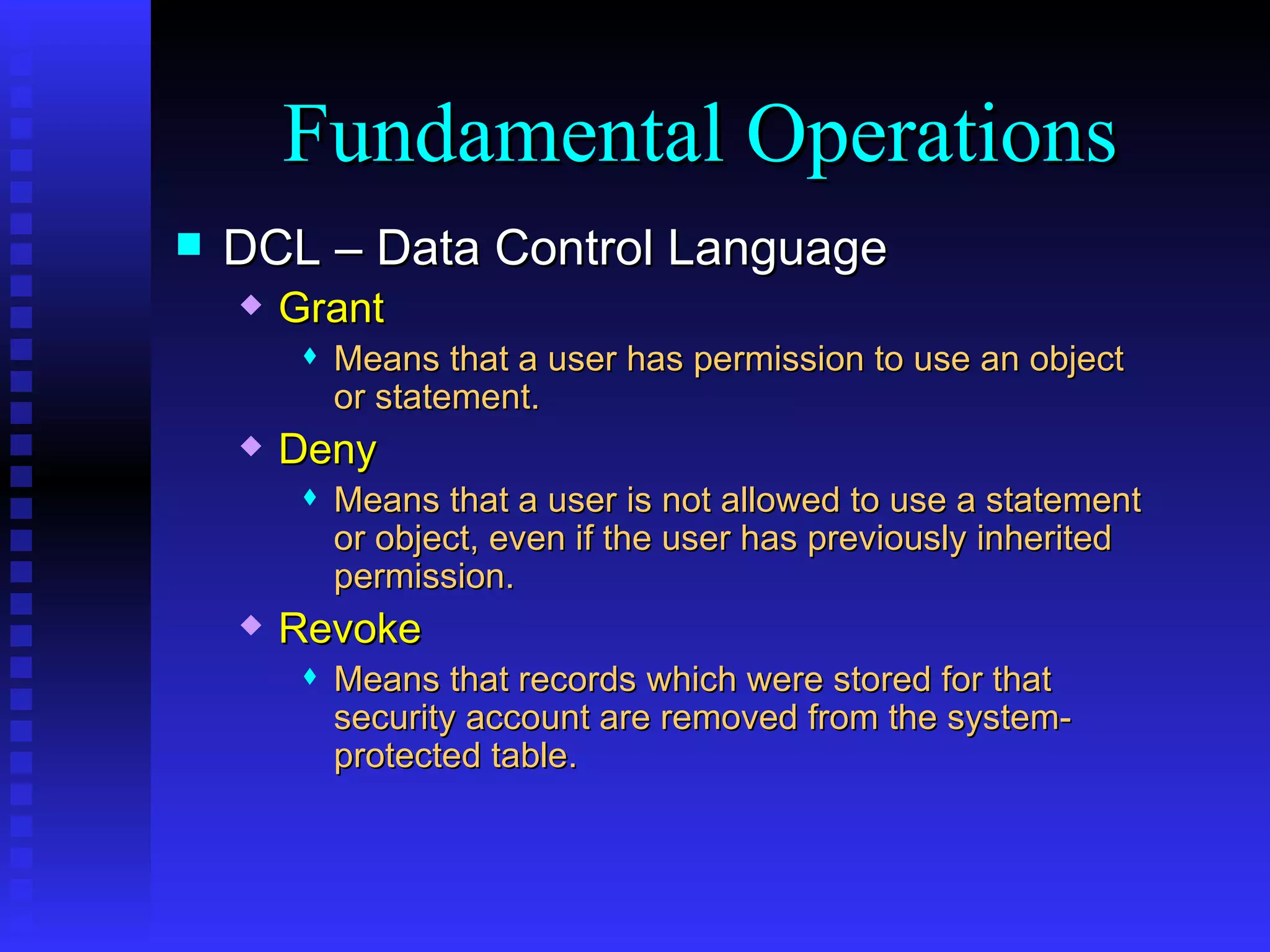
DCL – Data Control Language Grant Means that a user has permission to use an object or statement. Deny Means that a user is not allowed to use a statement or object, even if the user has previously inherited permission. Revoke Means that records which were stored for that security account are removed from the system-protected table. Fundamental Operations
Introduction SQL Server 2000 Environment Fundamental Operations Summary Essential Knowledge
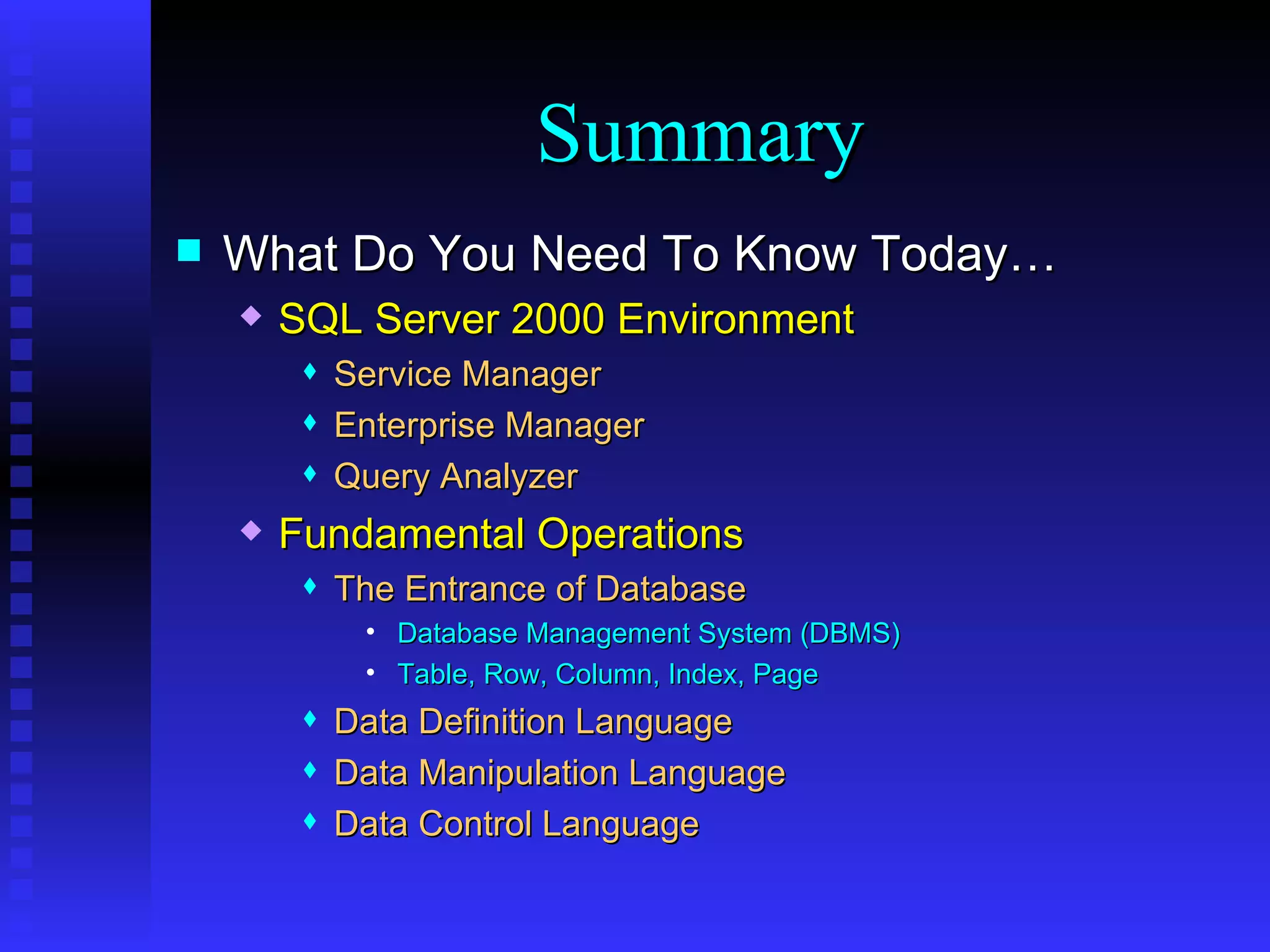
What Do You Need To Know Today… SQL Server 2000 Environment Service Manager Enterprise Manager Query Analyzer Fundamental Operations The Entrance of Database Database Management System (DBMS)  Table, Row, Column, Index, Page Data Definition Language Data Manipulation Language Data Control Language Summary
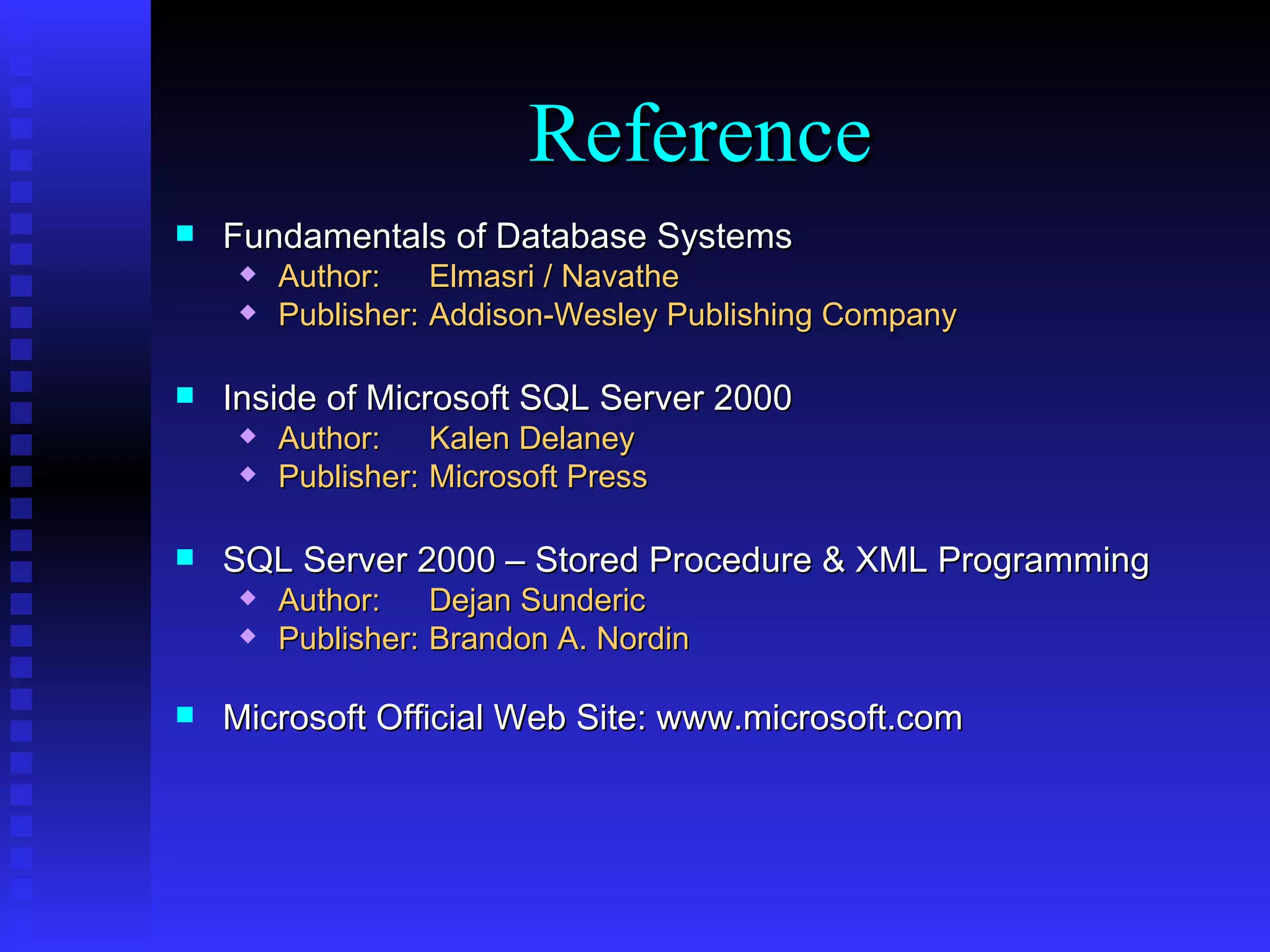
Fundamentals of Database Systems Author: Elmasri / Navathe Publisher: Addison-Wesley Publishing Company Inside of Microsoft SQL Server 2000 Author: Kalen Delaney Publisher: Microsoft Press SQL Server 2000 – Stored Procedure & XML Programming Author: Dejan Sunderic Publisher: Brandon A. Nordin Microsoft Official Web Site: www.microsoft.com Reference
Any Question?

SQL Server 2000 Research Series - Essential Knowledge

  • 1.
    Technical Integration DepartmentSystem Analysis & Training Group Jerry Yang July 21, 2005 SQL Server 2000 Research Series Essential Knowledge
  • 2.
    Introduction SQL Server2000 Environment Fundamental Operations Summary Agenda
  • 3.
    Introduction SQL Server2000 Environment Fundamental Operations Summary Essential Knowledge
  • 4.
    Evolution COBOL ANSIFile IBM DB2, TANDEM non-STOP SQL Oracle , Sybase , Informix Microsoft SQL Server Microsoft SQL Server 2000 Middle Level Price High Level Architectural Design Microsoft Solution Introduction
  • 5.
    MSDE 2000 –Microsoft SQL Server 2000 Desktop Engine The Secret of The Sphinx Limitation Storage: 2 GB Per Database Concurrency Workload: 5 Optimal Performance Extensibility Introduction
  • 6.
    Introduction SQL Server2000 Environment Fundamental Operations Summary Essential Knowledge
  • 7.
    Service Manager EnterpriseManager Query Analyzer SQL Server Profiler DTS - Data Transformation Services Client Network Utility SQL Server 2000 Environment
  • 8.
    Service Manager EnterpriseManager Query Analyzer SQL Server Profiler DTS - Data Transformation Services Client Network Utility SQL Server 2000 Environment
  • 9.
    Service Manager SQLServer 2000 Environment
  • 10.
    Enterprise Manager SQLServer 2000 Environment
  • 11.
    Enterprise Manager (Continued)SQL Server 2000 Environment
  • 12.
    Query Analyzer SQLServer 2000 Environment
  • 13.
    Query Analyzer (Continued)SQL Server 2000 Environment
  • 14.
    Introduction SQL Server2000 Environment Fundamental Operations Summary Essential Knowledge
  • 15.
    The Entrance ofDatabase DDL – Data Definition Language DML – Data Manipulation Language DCL – Data Control Language Fundamental Operations
  • 16.
    The Entrance ofDatabase DBMS – Database Management System Fundamental Operations Application Programs/Queries Software to Process Queries/Programs Software to Access Stored Data Users/Programmers DATABASE SYSTEM DBMS SOFTWARE Stored Database Definition (Meta-Data) Stored Database
  • 17.
    The Entrance ofDatabase (Continued) Table, Row, and Column Page (8K Byte/Page) Index Clustered Index Non-Clustered Index Fundamental Operations
  • 18.
    DDL – DataDefinition Language Creation of Table, View, Index, etc. Example I. Table Creation CREATE TABLE Customer ( customer_id int Identity, name char(20), phone char(12), address varchar(100) ) Fundamental Operations
  • 19.
    DDL – DataDefinition Language (Continued) Example II. Index Creation Clustered Index CREATE UNIQUE CLUSTERED INDEX customer_clidx ON Test.dbo.Customer(customer_id) Non-Clustered Index CREATE NONCLUSTERED INDEX customer_nonclidx ON Test.dbo.Customer(phone) Fundamental Operations Database Name DB Owner Name (It is the name of the user that created the object.) Table Name Column Name Index Name
  • 20.
    DML – DataManipulation Language INSERT, UPDATE, DELETE SELECT SELECT can manipulate data as the data is returned by using functions, aggregates, grouping, or the like. Example: SELECT SUM(age) FROM Employee Fundamental Operations
  • 21.
    DML – DataManipulation Language (Continued) Example I. Inserting Data INSERT INTO Customer (name, phone, address) VALUES (‘Allen’, ’02-12345678’, ‘Test Address 1’) Example II. Selecting Data SELECT * FROM Customer WHERE name = ‘Allen’ Fundamental Operations
  • 22.
    DML – DataManipulation Language (Continued) Example III. Updating Data UPDATE Customer SET address = ‘New Address’ WHERE name = ‘Allen’ Example IV. Deleting Data DELETE FROM Customer WHERE phone = ’02-12345678’ Fundamental Operations
  • 23.
    DCL – DataControl Language Grant Means that a user has permission to use an object or statement. Deny Means that a user is not allowed to use a statement or object, even if the user has previously inherited permission. Revoke Means that records which were stored for that security account are removed from the system-protected table. Fundamental Operations
  • 24.
    Introduction SQL Server2000 Environment Fundamental Operations Summary Essential Knowledge
  • 25.
    What Do YouNeed To Know Today… SQL Server 2000 Environment Service Manager Enterprise Manager Query Analyzer Fundamental Operations The Entrance of Database Database Management System (DBMS) Table, Row, Column, Index, Page Data Definition Language Data Manipulation Language Data Control Language Summary
  • 26.
    Fundamentals of DatabaseSystems Author: Elmasri / Navathe Publisher: Addison-Wesley Publishing Company Inside of Microsoft SQL Server 2000 Author: Kalen Delaney Publisher: Microsoft Press SQL Server 2000 – Stored Procedure & XML Programming Author: Dejan Sunderic Publisher: Brandon A. Nordin Microsoft Official Web Site: www.microsoft.com Reference
  • 27.