Introduction to Information
and Communication
Technology
BY
NAJEEB SAFI
4/19/2021 CONTACT: studysmart735@gmail.com 1
NAJEEB SAFI
NAJEEB SAFI
Basic Concept
For thousand of years, mathematicians, scientists and businessmen have
searched for computing machines that could perform calculations
quickly and efficiently.
4/19/2021 CONTACT: studysmart735@gmail.com 2
NAJEEB SAFI
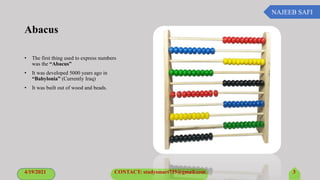
Abacus
• The first thing used to express numbers
was the “Abacus”
• It was developed 5000 years ago in
“Babylonia” (Currently Iraq)
• It was built out of wood and beads.
4/19/2021 CONTACT: studysmart735@gmail.com 3
NAJEEB SAFI
Napier’s Bone
• In the early 1600 a mathematician
invented a calculating rods, called
“Napier’s Bone”.
• This device allowed quick and accurate
multiplication of large numbers.
4/19/2021 CONTACT: studysmart735@gmail.com 4
NAJEEB SAFI
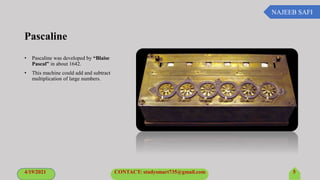
Pascaline
• Pascaline was developed by “Blaise
Pascal” in about 1642.
• This machine could add and subtract
multiplication of large numbers.
4/19/2021 CONTACT: studysmart735@gmail.com 5
NAJEEB SAFI
Difference Engine
• The man who conceived of the computer
was the British inventor “Charles
Babbage”. He is considered the father of
modern digital computer.
• He invented “Difference Engine” for
mathematical calculations.
4/19/2021 CONTACT: studysmart735@gmail.com 6
NAJEEB SAFI
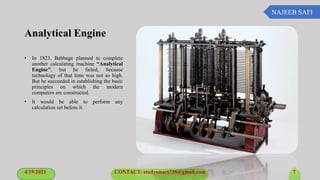
Analytical Engine
• In 1823, Babbage planned to complete
another calculating machine “Analytical
Engine”, but he failed, because
technology of that time was not so high.
But he succeeded in establishing the basic
principles on which the modern
computers are constructed.
• It would be able to perform any
calculation set before it.
4/19/2021 CONTACT: studysmart735@gmail.com 7
NAJEEB SAFI
Computer Definition
• Computer is an electronic device which store data and process data in
binary format.
• Computer deal every instruction in the form of current presence (1)
and current absence (0)
• Computer word is derived from Latin “Computare” which means to
compute, to calculate to process.
4/19/2021 CONTACT: studysmart735@gmail.com 8
NAJEEB SAFI
History & Generation of Computers
• Computer generation refers to the advancements of computer
technology. With each new generation, the circuitry has gotten
smaller and more advanced than the previous generation.
• As a result the efficiency, speed, power, and memory of computers
have increased.
• The history of computers is divided into five generations.
4/19/2021 CONTACT: studysmart735@gmail.com 9
NAJEEB SAFI
The First Generation:
1946-1958
(The Vacuum Tube Era)
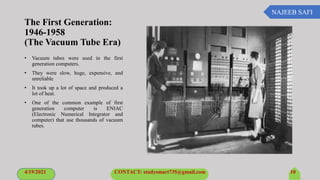
• Vacuum tubes were used in the first
generation computers.
• They were slow, huge, expensive, and
unreliable
• It took up a lot of space and produced a
lot of heat.
• One of the common example of first
generation computer is ENIAC
(Electronic Numerical Integrator and
computer) that use thousands of vacuum
tubes.
4/19/2021 CONTACT: studysmart735@gmail.com 10
NAJEEB SAFI
The Second Generation:
1959-1964
(The Transistor Era)
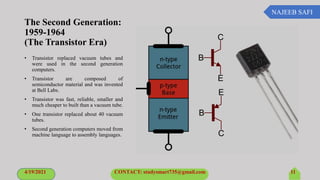
• Transistor replaced vacuum tubes and
were used in the second generation
computers.
• Transistor are composed of
semiconductor material and was invented
at Bell Labs.
• Transistor was fast, reliable, smaller and
much cheaper to built than a vacuum tube.
• One transistor replaced about 40 vacuum
tubes.
• Second generation computers moved from
machine language to assembly languages.
4/19/2021 CONTACT: studysmart735@gmail.com 11
NAJEEB SAFI
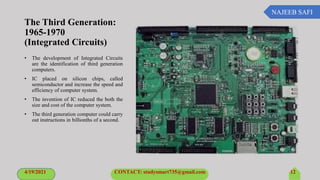
The Third Generation:
1965-1970
(Integrated Circuits)
• The development of Integrated Circuits
are the identification of third generation
computers.
• IC placed on silicon chips, called
semiconductor and increase the speed and
efficiency of computer system.
• The invention of IC reduced the both the
size and cost of the computer system.
• The third generation computer could carry
out instructions in billionths of a second.
4/19/2021 CONTACT: studysmart735@gmail.com 12
NAJEEB SAFI
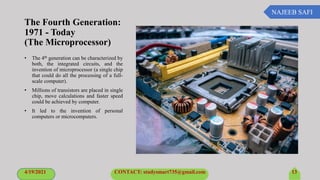
The Fourth Generation:
1971 - Today
(The Microprocessor)
• The 4th generation can be characterized by
both, the integrated circuits, and the
invention of microprocessor (a single chip
that could do all the processing of a full-
scale computer).
• Millions of transistors are placed in single
chip, move calculations and faster speed
could be achieved by computer.
• It led to the invention of personal
computers or microcomputers.
4/19/2021 CONTACT: studysmart735@gmail.com 13
NAJEEB SAFI
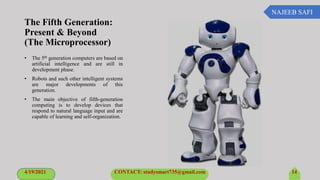
The Fifth Generation:
Present & Beyond
(The Microprocessor)
• The 5th generation computers are based on
artificial intelligence and are still in
development phase.
• Robots and such other intelligent systems
are major developments of this
generation.
• The main objective of fifth-generation
computing is to develop devices that
respond to natural language input and are
capable of learning and self-organization.
4/19/2021 CONTACT: studysmart735@gmail.com 14
NAJEEB SAFI
Types Of Computers
Computers are categorized in deferent categories according to their nature of the
information or data provided to the system. These types of computers are listed
below.
Analog Computers
 Digital Computers
 Hybrid Computers
4/19/2021 CONTACT: studysmart735@gmail.com 15
NAJEEB SAFI
Analog Computer
• Analog computers are used to process and
represent continuous data.
• Analog data includes temperature,
pressure, voltage and weight etc.
• These computers/devices use an analog
quantities and produces analog values as
output.
4/19/2021 CONTACT: studysmart735@gmail.com 16
NAJEEB SAFI
Digital Computer
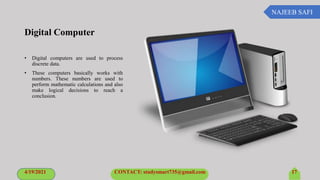
• Digital computers are used to process
discrete data.
• These computers basically works with
numbers. These numbers are used to
perform mathematic calculations and also
make logical decisions to reach a
conclusion.
4/19/2021 CONTACT: studysmart735@gmail.com 17
NAJEEB SAFI
Hybrid Computer
• Hybrid computer is a combination of
analog and digital technologies.
• Hybrid system provide good precision
that can be attained with analog
computers.
• Hybrid system provide greater control
that is possible with digital computers.
• Hybrid computer has the ability to accept
input data in either form.
4/19/2021 CONTACT: studysmart735@gmail.com 18
NAJEEB SAFI
4/19/2021 CONTACT: studysmart735@gmail.com 19
NAJEEB SAFI
4/19/2021 CONTACT: studysmart735@gmail.com 19
THANK YOU

1. basic definition & concepts of computer

  • 1.
    Introduction to Information andCommunication Technology BY NAJEEB SAFI 4/19/2021 CONTACT: studysmart735@gmail.com 1 NAJEEB SAFI
  • 2.
    NAJEEB SAFI Basic Concept Forthousand of years, mathematicians, scientists and businessmen have searched for computing machines that could perform calculations quickly and efficiently. 4/19/2021 CONTACT: studysmart735@gmail.com 2
  • 3.
    NAJEEB SAFI Abacus • Thefirst thing used to express numbers was the “Abacus” • It was developed 5000 years ago in “Babylonia” (Currently Iraq) • It was built out of wood and beads. 4/19/2021 CONTACT: studysmart735@gmail.com 3
  • 4.
    NAJEEB SAFI Napier’s Bone •In the early 1600 a mathematician invented a calculating rods, called “Napier’s Bone”. • This device allowed quick and accurate multiplication of large numbers. 4/19/2021 CONTACT: studysmart735@gmail.com 4
  • 5.
    NAJEEB SAFI Pascaline • Pascalinewas developed by “Blaise Pascal” in about 1642. • This machine could add and subtract multiplication of large numbers. 4/19/2021 CONTACT: studysmart735@gmail.com 5
  • 6.
    NAJEEB SAFI Difference Engine •The man who conceived of the computer was the British inventor “Charles Babbage”. He is considered the father of modern digital computer. • He invented “Difference Engine” for mathematical calculations. 4/19/2021 CONTACT: studysmart735@gmail.com 6
  • 7.
    NAJEEB SAFI Analytical Engine •In 1823, Babbage planned to complete another calculating machine “Analytical Engine”, but he failed, because technology of that time was not so high. But he succeeded in establishing the basic principles on which the modern computers are constructed. • It would be able to perform any calculation set before it. 4/19/2021 CONTACT: studysmart735@gmail.com 7
  • 8.
    NAJEEB SAFI Computer Definition •Computer is an electronic device which store data and process data in binary format. • Computer deal every instruction in the form of current presence (1) and current absence (0) • Computer word is derived from Latin “Computare” which means to compute, to calculate to process. 4/19/2021 CONTACT: studysmart735@gmail.com 8
  • 9.
    NAJEEB SAFI History &Generation of Computers • Computer generation refers to the advancements of computer technology. With each new generation, the circuitry has gotten smaller and more advanced than the previous generation. • As a result the efficiency, speed, power, and memory of computers have increased. • The history of computers is divided into five generations. 4/19/2021 CONTACT: studysmart735@gmail.com 9
  • 10.
    NAJEEB SAFI The FirstGeneration: 1946-1958 (The Vacuum Tube Era) • Vacuum tubes were used in the first generation computers. • They were slow, huge, expensive, and unreliable • It took up a lot of space and produced a lot of heat. • One of the common example of first generation computer is ENIAC (Electronic Numerical Integrator and computer) that use thousands of vacuum tubes. 4/19/2021 CONTACT: studysmart735@gmail.com 10
  • 11.
    NAJEEB SAFI The SecondGeneration: 1959-1964 (The Transistor Era) • Transistor replaced vacuum tubes and were used in the second generation computers. • Transistor are composed of semiconductor material and was invented at Bell Labs. • Transistor was fast, reliable, smaller and much cheaper to built than a vacuum tube. • One transistor replaced about 40 vacuum tubes. • Second generation computers moved from machine language to assembly languages. 4/19/2021 CONTACT: studysmart735@gmail.com 11
  • 12.
    NAJEEB SAFI The ThirdGeneration: 1965-1970 (Integrated Circuits) • The development of Integrated Circuits are the identification of third generation computers. • IC placed on silicon chips, called semiconductor and increase the speed and efficiency of computer system. • The invention of IC reduced the both the size and cost of the computer system. • The third generation computer could carry out instructions in billionths of a second. 4/19/2021 CONTACT: studysmart735@gmail.com 12
  • 13.
    NAJEEB SAFI The FourthGeneration: 1971 - Today (The Microprocessor) • The 4th generation can be characterized by both, the integrated circuits, and the invention of microprocessor (a single chip that could do all the processing of a full- scale computer). • Millions of transistors are placed in single chip, move calculations and faster speed could be achieved by computer. • It led to the invention of personal computers or microcomputers. 4/19/2021 CONTACT: studysmart735@gmail.com 13
  • 14.
    NAJEEB SAFI The FifthGeneration: Present & Beyond (The Microprocessor) • The 5th generation computers are based on artificial intelligence and are still in development phase. • Robots and such other intelligent systems are major developments of this generation. • The main objective of fifth-generation computing is to develop devices that respond to natural language input and are capable of learning and self-organization. 4/19/2021 CONTACT: studysmart735@gmail.com 14
  • 15.
    NAJEEB SAFI Types OfComputers Computers are categorized in deferent categories according to their nature of the information or data provided to the system. These types of computers are listed below. Analog Computers  Digital Computers  Hybrid Computers 4/19/2021 CONTACT: studysmart735@gmail.com 15
  • 16.
    NAJEEB SAFI Analog Computer •Analog computers are used to process and represent continuous data. • Analog data includes temperature, pressure, voltage and weight etc. • These computers/devices use an analog quantities and produces analog values as output. 4/19/2021 CONTACT: studysmart735@gmail.com 16
  • 17.
    NAJEEB SAFI Digital Computer •Digital computers are used to process discrete data. • These computers basically works with numbers. These numbers are used to perform mathematic calculations and also make logical decisions to reach a conclusion. 4/19/2021 CONTACT: studysmart735@gmail.com 17
  • 18.
    NAJEEB SAFI Hybrid Computer •Hybrid computer is a combination of analog and digital technologies. • Hybrid system provide good precision that can be attained with analog computers. • Hybrid system provide greater control that is possible with digital computers. • Hybrid computer has the ability to accept input data in either form. 4/19/2021 CONTACT: studysmart735@gmail.com 18
  • 19.
    NAJEEB SAFI 4/19/2021 CONTACT:studysmart735@gmail.com 19 NAJEEB SAFI 4/19/2021 CONTACT: studysmart735@gmail.com 19 THANK YOU