BASIC OF COMPUTER
BY KRISHNA KITTI
CONTENTS
• ABOUT COMPUTER
• KEYBOARD
• MOUSE
• GENERATION OF COMPUTER
• INPUT DEVICE
• OUTPUT DEVICE
• HARDWARE
• SOFTWARE
• TYPING
• ABOUT INTERNET
• SHORT CUT KEYS
• GMAIL
• GOOGLE DRIVE
• PPT
WHAT IS COMPUTER
• An electronic device which is capable
of receiving information (data) in a
particular form and of performing a
sequence of operations in accordance
with a predetermined but variable set
of procedural instructions (program) to
produce a result in the form of
information or signals.
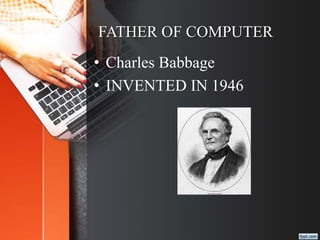
FATHER OF COMPUTER
• Charles Babbage
• INVENTED IN 1946
FULL FORM OF COMPUTER
• C=COMMMONLY
• 0=OPERATED
• M=MACHINE
• P=PARTICULARLY
• U=USED FOR
• T=TRAINING
• E=EDUCATIONAL
• R=RESEARCH
TYPES OF COMPUTER
• Mini Computer
• Super Computer
• Personal Computer
• Micro Computer
• Laptop
• Tablet
KEYBOARD
• A keyboard is an input device that uses
an arrangement of keys or buttons that
have letters, numbers or symbols that
when process the letter on the
keyboard then shows up an the screen
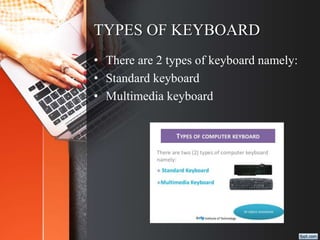
TYPES OF KEYBOARD
• There are 2 types of keyboard namely:
• Standard keyboard
• Multimedia keyboard
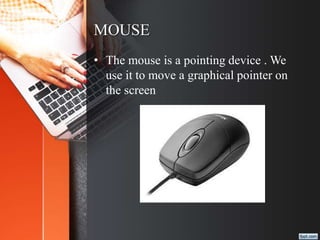
MOUSE
• The mouse is a pointing device . We
use it to move a graphical pointer on
the screen
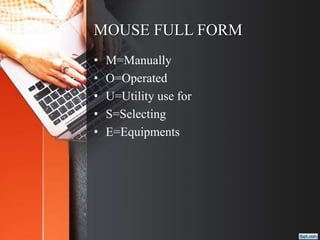
MOUSE FULL FORM
• M=Manually
• O=Operated
• U=Utility use for
• S=Selecting
• E=Equipments
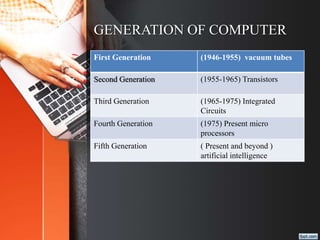
GENERATION OF COMPUTER
First Generation (1946-1955) vacuum tubes
Second Generation (1955-1965) Transistors
Third Generation (1965-1975) Integrated
Circuits
Fourth Generation (1975) Present micro
processors
Fifth Generation ( Present and beyond )
artificial intelligence
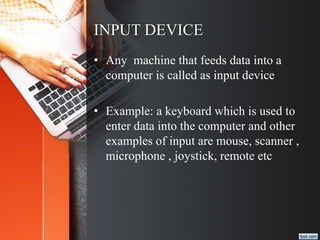
INPUT DEVICE
• Any machine that feeds data into a
computer is called as input device
• Example: a keyboard which is used to
enter data into the computer and other
examples of input are mouse, scanner ,
microphone , joystick, remote etc
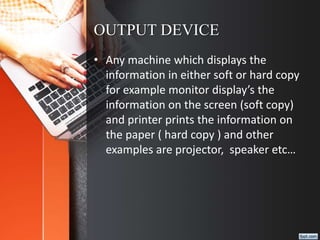
OUTPUT DEVICE
• Any machine which displays the
information in either soft or hard copy
for example monitor display’s the
information on the screen (soft copy)
and printer prints the information on
the paper ( hard copy ) and other
examples are projector, speaker etc…
HARDWARE
• The physical component of the
computer are called as hardware, parts
of which can be touched and feel
• EXAMPLES: Mother board , Hard
disk , RAM, Keyboard , Mouse etc….
SOFTWARE
• Software is a set of programme
• TYPES OF SOFTWARE
• As operating system, it is a interface
between hardware and the user
• Ex: DOS, Windows 98, win xp, win
ux, win8, win 8.1 , win 10
INTERNET
• A World wide network of computer
allows people to share information
electronically
• Why use the internet
• Apply for jobs or schools
• Fill out government forms
• Check bank account
• Communicate with family friends and co-
worker
• Read news
• Watch videos
SHORTCUT KEYS
• CTRL Shortcuts from A-Z:
• CTRL + A = Select text
CTRL + B = Bold text
CTRL + C = Copy text
CTRL + D = Open font formatting window
CTRL + E = Centre text
CTRL + F = Find a phrase
CTRL + G = Go To a specific page or bookmark
CTRL + H = Replace text with another text or replace text with different formatting
CTRL + I = Italic
CTRL + J = Justify text
CTRL + K = Open Insert Hyperlink window
CTRL + L = Left align text
CTRL + M = Indent a paragraph from the left
CTRL + N = Open new Word document
CTRL + O = Open an existing Word document
CTRL + P = Print Word document
CTRL + Q = Remove paragraph formatting
CTRL + R = Right align text
CTRL + S = Save Word document
CTRL + T = Create a hanging indent
CTRL + U = Underline text
CTRL + V = Paste text
CTRL + W = Close Word document
CTRL + X = Cut text
CTRL + Y = Redo an action previously undone OR repeat an action
CTRL + Z = Undo a previous action
SHORTCUT KEYS
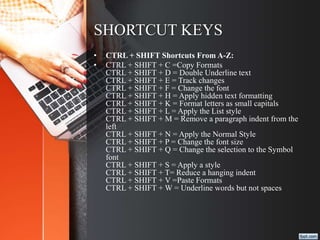
• CTRL + SHIFT Shortcuts From A-Z:
• CTRL + SHIFT + C =Copy Formats
CTRL + SHIFT + D = Double Underline text
CTRL + SHIFT + E = Track changes
CTRL + SHIFT + F = Change the font
CTRL + SHIFT + H = Apply hidden text formatting
CTRL + SHIFT + K = Format letters as small capitals
CTRL + SHIFT + L = Apply the List style
CTRL + SHIFT + M = Remove a paragraph indent from the
left
CTRL + SHIFT + N = Apply the Normal Style
CTRL + SHIFT + P = Change the font size
CTRL + SHIFT + Q = Change the selection to the Symbol
font
CTRL + SHIFT + S = Apply a style
CTRL + SHIFT + T= Reduce a hanging indent
CTRL + SHIFT + V =Paste Formats
CTRL + SHIFT + W = Underline words but not spaces
SHORTCUT KEYS
• Other CTRL Shortcuts
• CTRL + ] = Increase size of selected text by one point
CTRL + [ = Decrease size of selected text by one point
CTRL + SHIFT+ > = Increase font size
CTRL + SHIFT + < = Decrease font size
CTRL + 1 = Single-space lines
CTRL + 2 = Double-space lines
CTRL + 5 = 1.5 space lines
CTRL + 0 = Add/remove one line space preceding a paragraph
CTRL + Left Arrow = Move one word to the left
CTRL + Right Arrow = Move one word to the right
CTRL + Up Arrow = Move one paragraph up
CTRL + Down Arrow =Move one paragraph down
CTRL + Page Up = Go to the top of previous page
CTRL + Page Down = Go to the top of next page
CTRL + END = Go to the end of document
CTRL + HOME = Go to the beginning of document
CTRL + ENTER = Page break
CTRL + DELETE = Delete one word to the right
CTRL + BACKSPACE = Delete one word to the left
CTRL + TAB = Insert a Tab character
CTRL + ALT + S = Copyright symbol
CTRL + ALT + R = Registered trademark symbol
CTRL + ALT + T = Trademark symbol
CTRL + ALT + M = Insert a comment
CTRL + ALT + I = Switch in or out of print preview
GMAIL
• Gmail is Google's free web-based
email service
• Where we use
• Office
• Schools
• Bank
• Company
• Hospital etc…
GOOGLE DRIVE
• Google drive is a file storage and
synchronization service developed by
Google. Launched on April 24, 2012,
GOOGLE DRIVE USED FOR
• Your storage works with Drive, Gmail
and Google Photos, so you can store
files, save email attachments and back-
up photos directly to Drive. You can
also purchase a larger cloud storage
plan as you need it. Photos, videos,
presentations, PDFs – even Microsoft
Office files.
ADVANTAGES OF G-DRIVE
• Access your files everywhere
• You can edit and make changes to the
files
• Able to access with various devices
• Easy to search your files
• View any types of file
• Share your files with your friends
• 15GB Disk Space and It’s FREE
WHAT IS MS-POWER POINT
• Ms-power point is a presentation
application it can be used for slide
presentation .It was launched on may
22 1990 as a part of Microsoft office
WHY MS-POWER POINT USED
FOR
• For effective presentation
• Multiple learning styles
• Increasing visual impact
• Improving audience focus
• For making attention towards students
FEATURE OF MS-POWER
POINT
• Change font
• Shapes
• Clipart
• Images
• Charts
• Tables
• Animations
• Animating text or chart
•THANK YOU

Basic computer ppt

  • 1.
    BASIC OF COMPUTER BYKRISHNA KITTI
  • 2.
    CONTENTS • ABOUT COMPUTER •KEYBOARD • MOUSE • GENERATION OF COMPUTER • INPUT DEVICE • OUTPUT DEVICE • HARDWARE • SOFTWARE • TYPING • ABOUT INTERNET • SHORT CUT KEYS • GMAIL • GOOGLE DRIVE • PPT
  • 3.
    WHAT IS COMPUTER •An electronic device which is capable of receiving information (data) in a particular form and of performing a sequence of operations in accordance with a predetermined but variable set of procedural instructions (program) to produce a result in the form of information or signals.
  • 4.
    FATHER OF COMPUTER •Charles Babbage • INVENTED IN 1946
  • 5.
    FULL FORM OFCOMPUTER • C=COMMMONLY • 0=OPERATED • M=MACHINE • P=PARTICULARLY • U=USED FOR • T=TRAINING • E=EDUCATIONAL • R=RESEARCH
  • 6.
    TYPES OF COMPUTER •Mini Computer • Super Computer • Personal Computer • Micro Computer • Laptop • Tablet
  • 7.
    KEYBOARD • A keyboardis an input device that uses an arrangement of keys or buttons that have letters, numbers or symbols that when process the letter on the keyboard then shows up an the screen
  • 8.
    TYPES OF KEYBOARD •There are 2 types of keyboard namely: • Standard keyboard • Multimedia keyboard
  • 9.
    MOUSE • The mouseis a pointing device . We use it to move a graphical pointer on the screen
  • 10.
    MOUSE FULL FORM •M=Manually • O=Operated • U=Utility use for • S=Selecting • E=Equipments
  • 11.
    GENERATION OF COMPUTER FirstGeneration (1946-1955) vacuum tubes Second Generation (1955-1965) Transistors Third Generation (1965-1975) Integrated Circuits Fourth Generation (1975) Present micro processors Fifth Generation ( Present and beyond ) artificial intelligence
  • 12.
    INPUT DEVICE • Anymachine that feeds data into a computer is called as input device • Example: a keyboard which is used to enter data into the computer and other examples of input are mouse, scanner , microphone , joystick, remote etc
  • 13.
    OUTPUT DEVICE • Anymachine which displays the information in either soft or hard copy for example monitor display’s the information on the screen (soft copy) and printer prints the information on the paper ( hard copy ) and other examples are projector, speaker etc…
  • 14.
    HARDWARE • The physicalcomponent of the computer are called as hardware, parts of which can be touched and feel • EXAMPLES: Mother board , Hard disk , RAM, Keyboard , Mouse etc….
  • 15.
    SOFTWARE • Software isa set of programme • TYPES OF SOFTWARE • As operating system, it is a interface between hardware and the user • Ex: DOS, Windows 98, win xp, win ux, win8, win 8.1 , win 10
  • 16.
    INTERNET • A Worldwide network of computer allows people to share information electronically • Why use the internet • Apply for jobs or schools • Fill out government forms • Check bank account • Communicate with family friends and co- worker • Read news • Watch videos
  • 17.
    SHORTCUT KEYS • CTRLShortcuts from A-Z: • CTRL + A = Select text CTRL + B = Bold text CTRL + C = Copy text CTRL + D = Open font formatting window CTRL + E = Centre text CTRL + F = Find a phrase CTRL + G = Go To a specific page or bookmark CTRL + H = Replace text with another text or replace text with different formatting CTRL + I = Italic CTRL + J = Justify text CTRL + K = Open Insert Hyperlink window CTRL + L = Left align text CTRL + M = Indent a paragraph from the left CTRL + N = Open new Word document CTRL + O = Open an existing Word document CTRL + P = Print Word document CTRL + Q = Remove paragraph formatting CTRL + R = Right align text CTRL + S = Save Word document CTRL + T = Create a hanging indent CTRL + U = Underline text CTRL + V = Paste text CTRL + W = Close Word document CTRL + X = Cut text CTRL + Y = Redo an action previously undone OR repeat an action CTRL + Z = Undo a previous action
  • 18.
    SHORTCUT KEYS • CTRL+ SHIFT Shortcuts From A-Z: • CTRL + SHIFT + C =Copy Formats CTRL + SHIFT + D = Double Underline text CTRL + SHIFT + E = Track changes CTRL + SHIFT + F = Change the font CTRL + SHIFT + H = Apply hidden text formatting CTRL + SHIFT + K = Format letters as small capitals CTRL + SHIFT + L = Apply the List style CTRL + SHIFT + M = Remove a paragraph indent from the left CTRL + SHIFT + N = Apply the Normal Style CTRL + SHIFT + P = Change the font size CTRL + SHIFT + Q = Change the selection to the Symbol font CTRL + SHIFT + S = Apply a style CTRL + SHIFT + T= Reduce a hanging indent CTRL + SHIFT + V =Paste Formats CTRL + SHIFT + W = Underline words but not spaces
  • 19.
    SHORTCUT KEYS • OtherCTRL Shortcuts • CTRL + ] = Increase size of selected text by one point CTRL + [ = Decrease size of selected text by one point CTRL + SHIFT+ > = Increase font size CTRL + SHIFT + < = Decrease font size CTRL + 1 = Single-space lines CTRL + 2 = Double-space lines CTRL + 5 = 1.5 space lines CTRL + 0 = Add/remove one line space preceding a paragraph CTRL + Left Arrow = Move one word to the left CTRL + Right Arrow = Move one word to the right CTRL + Up Arrow = Move one paragraph up CTRL + Down Arrow =Move one paragraph down CTRL + Page Up = Go to the top of previous page CTRL + Page Down = Go to the top of next page CTRL + END = Go to the end of document CTRL + HOME = Go to the beginning of document CTRL + ENTER = Page break CTRL + DELETE = Delete one word to the right CTRL + BACKSPACE = Delete one word to the left CTRL + TAB = Insert a Tab character CTRL + ALT + S = Copyright symbol CTRL + ALT + R = Registered trademark symbol CTRL + ALT + T = Trademark symbol CTRL + ALT + M = Insert a comment CTRL + ALT + I = Switch in or out of print preview
  • 20.
    GMAIL • Gmail isGoogle's free web-based email service • Where we use • Office • Schools • Bank • Company • Hospital etc…
  • 21.
    GOOGLE DRIVE • Googledrive is a file storage and synchronization service developed by Google. Launched on April 24, 2012,
  • 22.
    GOOGLE DRIVE USEDFOR • Your storage works with Drive, Gmail and Google Photos, so you can store files, save email attachments and back- up photos directly to Drive. You can also purchase a larger cloud storage plan as you need it. Photos, videos, presentations, PDFs – even Microsoft Office files.
  • 23.
    ADVANTAGES OF G-DRIVE •Access your files everywhere • You can edit and make changes to the files • Able to access with various devices • Easy to search your files • View any types of file • Share your files with your friends • 15GB Disk Space and It’s FREE
  • 24.
    WHAT IS MS-POWERPOINT • Ms-power point is a presentation application it can be used for slide presentation .It was launched on may 22 1990 as a part of Microsoft office
  • 25.
    WHY MS-POWER POINTUSED FOR • For effective presentation • Multiple learning styles • Increasing visual impact • Improving audience focus • For making attention towards students
  • 26.
    FEATURE OF MS-POWER POINT •Change font • Shapes • Clipart • Images • Charts • Tables • Animations • Animating text or chart
  • 27.