Dr.Akshata Swamy
Dr.Shankhargowda ,
Prof .& HOD(UG)
Dept.of RASA SHASTRA &
BHAISHAJYA KALPANA
Dr.M.S.Doddamani
Prof. & HOD (PG)
Dept.of RASA SHATRA &
BHAISHAJYA KALPANA
It is the only unchangeable fact and
everything else in this Universe is in a continuous
process of change. The changes( Physical or
chemical) happening continuously and naturally in
any pancabhautika substance are due to the
Agni Mahabhuta present in it
 Heat is a form of energy.
 It can neither be created nor be destroyed.
 Heat flow from a high to a low temperature body
occurs spontaneously.
 With the help of heat we can transform the
materials from one form to another.
Ex: Transformation of Ice to water and water to
vapors.
 Its one among Pancha mahabhuta.
 It is hot in touch, Aruna in colour. (Blue coloured
agni- Due to presence pritvi particles)
 Agni is responsible for dravyapaka and
parivartana (Transformation).
 Important Lakshanas
1) Pavitrata (sterilization)
2) Pachana (Digestion)
 Among the panchamahabhutas Agni is having
important position since it is having the property
of purification.
 Where all the other mahabhutas having the
property of undergoing vitiation.
Ex: In Janapadodwamsa soil,water, air,
Environment get vitiated.
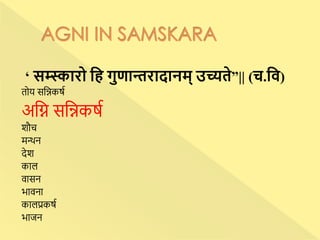
‘ सम्स्कारो हि गुणान्तरादानम् उच्यते”|| (च.हि)
तोय सन्निकर्ष
अन्नि सन्निकर्ष
शौच
मन्थन
देश
काल
वासन
भावना
कालप्रकर्ष
भाजन
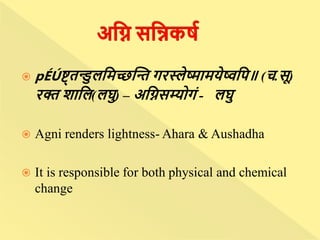
 pÉÚष्ट्तन्डुलहमच्छन्तन्त गरस्लेष्मामयेष्वहि॥ (च.सू)
रक्त शाहल(लघु) – अहिसम्योगं - लघु
 Agni renders lightness- Ahara & Aushadha
 It is responsible for both physical and chemical
change
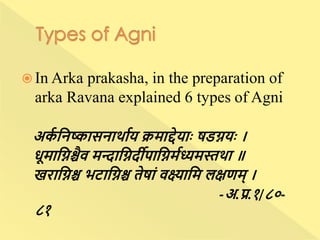
 In Arka prakasha, in the preparation of
arka Ravana explained 6 types of Agni
अर्क हनष्कासनार्ाकय क्रमाद्देयााः षडियाः ।
धूमाहिश्चैि मन्दाहिदीिाहिमकध्यमस्तर्ा ॥
खराहिश्च भटाहिश्च तेषां िक्ष्याहम लक्षणम् ।
-अ.प्र.१/८०-
८१
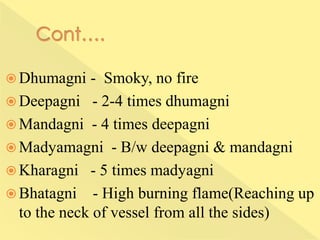
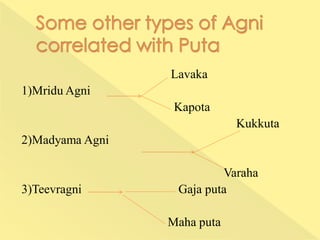
 Dhumagni - Smoky, no fire
 Deepagni - 2-4 times dhumagni
 Mandagni - 4 times deepagni
 Madyamagni - B/w deepagni & mandagni
 Kharagni - 5 times madyagni
 Bhatagni - High burning flame(Reaching up
to the neck of vessel from all the sides)
Lavaka
1)Mridu Agni
Kapota
Kukkuta
2)Madyama Agni
Varaha
3)Teevragni Gaja puta
Maha puta
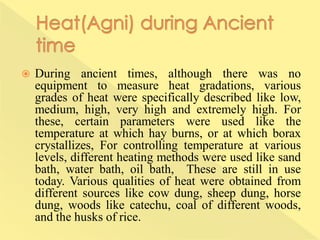
 During ancient times, although there was no
equipment to measure heat gradations, various
grades of heat were specifically described like low,
medium, high, very high and extremely high. For
these, certain parameters were used like the
temperature at which hay burns, or at which borax
crystallizes, For controlling temperature at various
levels, different heating methods were used like sand
bath, water bath, oil bath, These are still in use
today. Various qualities of heat were obtained from
different sources like cow dung, sheep dung, horse
dung, woods like catechu, coal of different woods,
and the husks of rice.
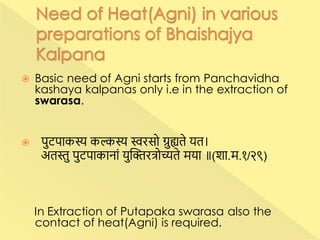
 Basic need of Agni starts from Panchavidha
kashaya kalpanas only i.e in the extraction of
swarasa.
 पुटपाकस्य कल्कस्य स्वरसो ग्रुह्यते यत।
अतस्तु पुटपाकानाां युक्तिरत्रोच्यते मया ॥(शा.म.१/२९)
In Extraction of Putapaka swarasa also the
contact of heat(Agni) is required.
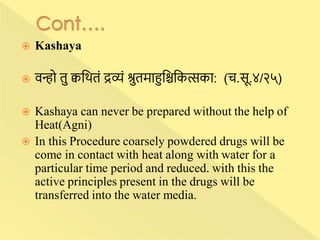
 Kashaya
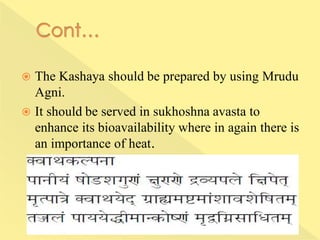
 वन्हो तु क्वन्नितां द्रव्यां श्रुतमाहुन्निन्नकत्सका: (च.सू.४/२५)
 Kashaya can never be prepared without the help of
Heat(Agni)
 In this Procedure coarsely powdered drugs will be
come in contact with heat along with water for a
particular time period and reduced. with this the
active principles present in the drugs will be
transferred into the water media.
 The Kashaya should be prepared by using Mrudu
Agni.
 It should be served in sukhoshna avasta to
enhance its bioavailability where in again there is
an importance of heat.
 In the preparation of Phanta kalpana heat is
required where sukshma choornas are put into
boiling water.
 In most of the upakalpanas like
 Ushnodaka
 Pramatya
 Kshirapaka
 Laksha rasa
 Mamsarasa
 Arka etc Heat is must..
In choorna kalpana
 To make choorna itself the drugs should be
heated under sunlight.
 In choornas some of the drugs need to be roasted
before making them into powders.
ex:- In Hingvastaka choorna the hingu should be
roasted before powdering.
 Rasakriya, Ghanasara, Ghanasattva,
Ghanavati, phanita
In above said kalpanas also role of heat is very
much essential where repeated heat is required.
 Avalehha kalpana, Khanda kalpana
 Without Heat(Agni) the avaleha cant be
prepared,here paaka of kwatha is done repeatedly
to become Avaleha. In Khanda kalpana further
heat is required till it attains granular form.
 क्वािादीनाां पुन: पाकात् कथ्यते सा रसन्निया सो
अवलेहश्च्च्य लेह...(शा.म.८/१)
 Sarkara and gudapaka
 Here also the heat source is mandatory
 By using adequate amount of heat only thread
consistency of sarkara and guda can be obtained,
which are also helpful in preparing Avaleha and
Khanda kalpana.
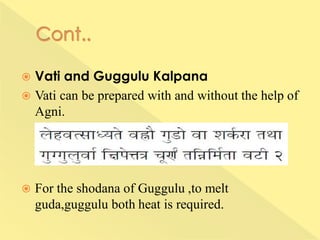
 Vati and Guggulu Kalpana
 Vati can be prepared with and without the help of
Agni.
 For the shodana of Guggulu ,to melt
guda,guggulu both heat is required.
 Kshara and masi kalpana
 In these kalpanas also the drugs are coming in
contact with Heat(Agni) where in both the
procedures the drugs are burnt. In the former the
burnt ashes were soaked in water, filtered and
again the obtained water is heated to get white
substance which is devoid of moisture. In the
later drugs are burnt till they attain carbonized
form.
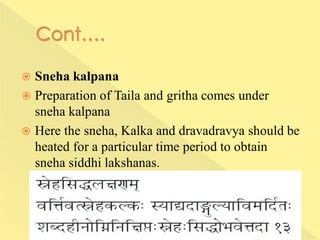
 Sneha kalpana
 Preparation of Taila and gritha comes under
sneha kalpana
 Here the sneha, Kalka and dravadravya should be
heated for a particular time period to obtain
sneha siddhi lakshanas.
 Sandhana kalpana
 Sandhana kalpana includes Asava aristas.
 Here before keeping the drugs for sandhana they
are made into kashaya and used in Aristas.
 For the fermentation process also little amount of
heat is required.
 Pathya kalpana
 In pathya kalpanas also for most of the
preparations heat is necessary like in
 Manda, peya, vilepi, yavagu, supa, mamsarasa,
vesavara, khada, kambalika ,raga, shadava etc.
 So, for most of the preparations in Bhaishajya
kalpana heat is required.
 Without heat most of the procedures cant be
fulfilled.
 Heat is essential but to prepare different
bhaishajya kalpas specific amout heat is required.
 They are graded as 1) Mandagni
2) Mandyamagni
3) Teekshnagni
In majority of the preparations Mandagni is
preferred over other Agnis.
There are two types of drug materials
1) Thermo stable
2) Thermo labile
Thermo stable drugs are those which can
withstand high temperature.
Thermo labile drugs are those which are sensitive to
high temperature so, required amount of heat
should be provided to extract active principles.
 Sun
 Steam
 Induction
 Electricity
 Radiation
 Microwave
etc…
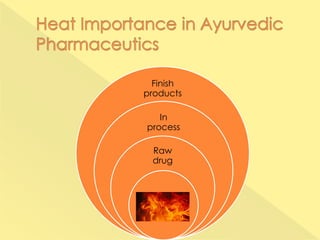
Finish
products
In
process
Raw
drug
 Conduction
 Convection
 Radiation
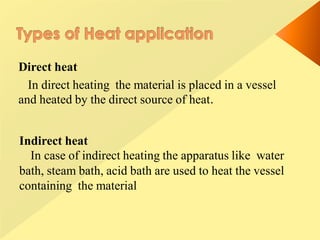
Direct heat
In direct heating the material is placed in a vessel
and heated by the direct source of heat.
Indirect heat
In case of indirect heating the apparatus like water
bath, steam bath, acid bath are used to heat the vessel
containing the material
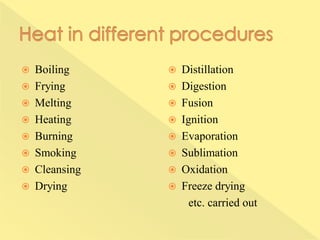
 Boiling
 Frying
 Melting
 Heating
 Burning
 Smoking
 Cleansing
 Drying
 Distillation
 Digestion
 Fusion
 Ignition
 Evaporation
 Sublimation
 Oxidation
 Freeze drying
etc. carried out
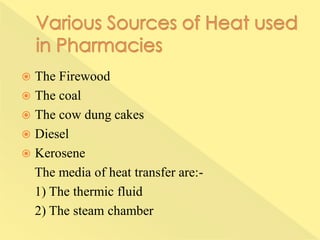
 The Firewood
 The coal
 The cow dung cakes
 Diesel
 Kerosene
The media of heat transfer are:-
1) The thermic fluid
2) The steam chamber
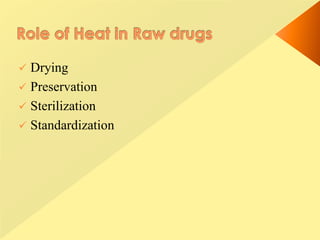
 Drying
 Preservation
 Sterilization
 Standardization
 Primary kalpanas
 Sec. kalpanas
 Sterilization
 Drying of
medicaments
 For coating of tablets
 Standardization
 Preservation of raw drugs
 Preservation of finished products
Preservation of raw drugs
The raw drugs which are used in kalpanas should
be dried properly to maintain its potency
 Natural
 Artificial
 Sterilization is the process by which products
rendered sterile i.e. destruction or removal of
microorganisms
 1.Heat Sterilization
 Heat has been employed as purifying agent since
early historical times & is now used world wide
 Moist heat sterilization
 It relies on combine of steam temp. & pressure
 Standardization is an evaluation that serves as a
basis to evaluate similar substances.
 Heat source is essential to carry out certain
analytical measures of finished products
• Loss on drying
• Determination of ash value
• Extractives
• Melting materials
• Creating an elevated temperature during cream,
suppository or ointment production
• Heating of solvents to hasten dissolution
processes
e.g. Dissolution of preservatives in the
manufacture of solution products
• Evaporation of liquids to concentrate products
• Drying granules for tablet production
• Heating air to facilitate coating process
 Agni is one of the most important factor in the
preparation of Ayurvedic medicine
 Agni along with its gradation and duration are
important in deciding siddhi lakshana of all the
kalpanas
 It increases the bio availability
 It brings about transformation of qualities
required for pharmaceutical processes.
 Among Panchamahabhoota , Agni plays a
pivotal role in Bhaishajya kalpana
• Use of Heat is an indispensable factor in Ayurvedic
Pharma industries
• Study of heat transfer is required in designing the
plant efficiently and economically.
• Selection of heat source is most important considering
the scale of production, which ultimately leads to the
profitable running of pharmacy.
• Source of heat contributes in the transformation of a
raw drug into a finished product.
• It reflects the economy, stability and quality of a
product
Role of Agni in bhaishajya kalpana

Role of Agni in bhaishajya kalpana

  • 1.
    Dr.Akshata Swamy Dr.Shankhargowda , Prof.& HOD(UG) Dept.of RASA SHASTRA & BHAISHAJYA KALPANA Dr.M.S.Doddamani Prof. & HOD (PG) Dept.of RASA SHATRA & BHAISHAJYA KALPANA
  • 2.
    It is theonly unchangeable fact and everything else in this Universe is in a continuous process of change. The changes( Physical or chemical) happening continuously and naturally in any pancabhautika substance are due to the Agni Mahabhuta present in it
  • 3.
     Heat isa form of energy.  It can neither be created nor be destroyed.  Heat flow from a high to a low temperature body occurs spontaneously.  With the help of heat we can transform the materials from one form to another. Ex: Transformation of Ice to water and water to vapors.
  • 4.
     Its oneamong Pancha mahabhuta.  It is hot in touch, Aruna in colour. (Blue coloured agni- Due to presence pritvi particles)  Agni is responsible for dravyapaka and parivartana (Transformation).  Important Lakshanas 1) Pavitrata (sterilization) 2) Pachana (Digestion)
  • 5.
     Among thepanchamahabhutas Agni is having important position since it is having the property of purification.  Where all the other mahabhutas having the property of undergoing vitiation. Ex: In Janapadodwamsa soil,water, air, Environment get vitiated.
  • 6.
    ‘ सम्स्कारो हिगुणान्तरादानम् उच्यते”|| (च.हि) तोय सन्निकर्ष अन्नि सन्निकर्ष शौच मन्थन देश काल वासन भावना कालप्रकर्ष भाजन
  • 7.
     pÉÚष्ट्तन्डुलहमच्छन्तन्त गरस्लेष्मामयेष्वहि॥(च.सू) रक्त शाहल(लघु) – अहिसम्योगं - लघु  Agni renders lightness- Ahara & Aushadha  It is responsible for both physical and chemical change
  • 8.
     In Arkaprakasha, in the preparation of arka Ravana explained 6 types of Agni अर्क हनष्कासनार्ाकय क्रमाद्देयााः षडियाः । धूमाहिश्चैि मन्दाहिदीिाहिमकध्यमस्तर्ा ॥ खराहिश्च भटाहिश्च तेषां िक्ष्याहम लक्षणम् । -अ.प्र.१/८०- ८१
  • 9.
     Dhumagni -Smoky, no fire  Deepagni - 2-4 times dhumagni  Mandagni - 4 times deepagni  Madyamagni - B/w deepagni & mandagni  Kharagni - 5 times madyagni  Bhatagni - High burning flame(Reaching up to the neck of vessel from all the sides)
  • 10.
  • 11.
     During ancienttimes, although there was no equipment to measure heat gradations, various grades of heat were specifically described like low, medium, high, very high and extremely high. For these, certain parameters were used like the temperature at which hay burns, or at which borax crystallizes, For controlling temperature at various levels, different heating methods were used like sand bath, water bath, oil bath, These are still in use today. Various qualities of heat were obtained from different sources like cow dung, sheep dung, horse dung, woods like catechu, coal of different woods, and the husks of rice.
  • 12.
     Basic needof Agni starts from Panchavidha kashaya kalpanas only i.e in the extraction of swarasa.  पुटपाकस्य कल्कस्य स्वरसो ग्रुह्यते यत। अतस्तु पुटपाकानाां युक्तिरत्रोच्यते मया ॥(शा.म.१/२९) In Extraction of Putapaka swarasa also the contact of heat(Agni) is required.
  • 13.
     Kashaya  वन्होतु क्वन्नितां द्रव्यां श्रुतमाहुन्निन्नकत्सका: (च.सू.४/२५)  Kashaya can never be prepared without the help of Heat(Agni)  In this Procedure coarsely powdered drugs will be come in contact with heat along with water for a particular time period and reduced. with this the active principles present in the drugs will be transferred into the water media.
  • 14.
     The Kashayashould be prepared by using Mrudu Agni.  It should be served in sukhoshna avasta to enhance its bioavailability where in again there is an importance of heat.
  • 15.
     In thepreparation of Phanta kalpana heat is required where sukshma choornas are put into boiling water.  In most of the upakalpanas like  Ushnodaka  Pramatya  Kshirapaka  Laksha rasa  Mamsarasa  Arka etc Heat is must..
  • 16.
    In choorna kalpana To make choorna itself the drugs should be heated under sunlight.  In choornas some of the drugs need to be roasted before making them into powders. ex:- In Hingvastaka choorna the hingu should be roasted before powdering.
  • 17.
     Rasakriya, Ghanasara,Ghanasattva, Ghanavati, phanita In above said kalpanas also role of heat is very much essential where repeated heat is required.
  • 18.
     Avalehha kalpana,Khanda kalpana  Without Heat(Agni) the avaleha cant be prepared,here paaka of kwatha is done repeatedly to become Avaleha. In Khanda kalpana further heat is required till it attains granular form.  क्वािादीनाां पुन: पाकात् कथ्यते सा रसन्निया सो अवलेहश्च्च्य लेह...(शा.म.८/१)
  • 19.
     Sarkara andgudapaka  Here also the heat source is mandatory  By using adequate amount of heat only thread consistency of sarkara and guda can be obtained, which are also helpful in preparing Avaleha and Khanda kalpana.
  • 20.
     Vati andGuggulu Kalpana  Vati can be prepared with and without the help of Agni.  For the shodana of Guggulu ,to melt guda,guggulu both heat is required.
  • 21.
     Kshara andmasi kalpana  In these kalpanas also the drugs are coming in contact with Heat(Agni) where in both the procedures the drugs are burnt. In the former the burnt ashes were soaked in water, filtered and again the obtained water is heated to get white substance which is devoid of moisture. In the later drugs are burnt till they attain carbonized form.
  • 22.
     Sneha kalpana Preparation of Taila and gritha comes under sneha kalpana  Here the sneha, Kalka and dravadravya should be heated for a particular time period to obtain sneha siddhi lakshanas.
  • 23.
     Sandhana kalpana Sandhana kalpana includes Asava aristas.  Here before keeping the drugs for sandhana they are made into kashaya and used in Aristas.  For the fermentation process also little amount of heat is required.
  • 24.
     Pathya kalpana In pathya kalpanas also for most of the preparations heat is necessary like in  Manda, peya, vilepi, yavagu, supa, mamsarasa, vesavara, khada, kambalika ,raga, shadava etc.
  • 25.
     So, formost of the preparations in Bhaishajya kalpana heat is required.  Without heat most of the procedures cant be fulfilled.  Heat is essential but to prepare different bhaishajya kalpas specific amout heat is required.  They are graded as 1) Mandagni 2) Mandyamagni 3) Teekshnagni In majority of the preparations Mandagni is preferred over other Agnis.
  • 26.
    There are twotypes of drug materials 1) Thermo stable 2) Thermo labile Thermo stable drugs are those which can withstand high temperature. Thermo labile drugs are those which are sensitive to high temperature so, required amount of heat should be provided to extract active principles.
  • 27.
     Sun  Steam Induction  Electricity  Radiation  Microwave etc…
  • 28.
  • 29.
  • 30.
    Direct heat In directheating the material is placed in a vessel and heated by the direct source of heat. Indirect heat In case of indirect heating the apparatus like water bath, steam bath, acid bath are used to heat the vessel containing the material
  • 31.
     Boiling  Frying Melting  Heating  Burning  Smoking  Cleansing  Drying  Distillation  Digestion  Fusion  Ignition  Evaporation  Sublimation  Oxidation  Freeze drying etc. carried out
  • 32.
     The Firewood The coal  The cow dung cakes  Diesel  Kerosene The media of heat transfer are:- 1) The thermic fluid 2) The steam chamber
  • 33.
     Drying  Preservation Sterilization  Standardization
  • 34.
  • 35.
     Sterilization  Dryingof medicaments  For coating of tablets  Standardization
  • 36.
     Preservation ofraw drugs  Preservation of finished products Preservation of raw drugs The raw drugs which are used in kalpanas should be dried properly to maintain its potency  Natural  Artificial
  • 37.
     Sterilization isthe process by which products rendered sterile i.e. destruction or removal of microorganisms  1.Heat Sterilization  Heat has been employed as purifying agent since early historical times & is now used world wide  Moist heat sterilization  It relies on combine of steam temp. & pressure
  • 38.
     Standardization isan evaluation that serves as a basis to evaluate similar substances.  Heat source is essential to carry out certain analytical measures of finished products • Loss on drying • Determination of ash value • Extractives
  • 39.
    • Melting materials •Creating an elevated temperature during cream, suppository or ointment production • Heating of solvents to hasten dissolution processes e.g. Dissolution of preservatives in the manufacture of solution products • Evaporation of liquids to concentrate products • Drying granules for tablet production • Heating air to facilitate coating process
  • 40.
     Agni isone of the most important factor in the preparation of Ayurvedic medicine  Agni along with its gradation and duration are important in deciding siddhi lakshana of all the kalpanas  It increases the bio availability  It brings about transformation of qualities required for pharmaceutical processes.  Among Panchamahabhoota , Agni plays a pivotal role in Bhaishajya kalpana
  • 41.
    • Use ofHeat is an indispensable factor in Ayurvedic Pharma industries • Study of heat transfer is required in designing the plant efficiently and economically. • Selection of heat source is most important considering the scale of production, which ultimately leads to the profitable running of pharmacy. • Source of heat contributes in the transformation of a raw drug into a finished product. • It reflects the economy, stability and quality of a product