Enhancing Scholarship
Preparing Web Spaces for Materials Complementing Conventionally-Prepared Book Publications in
                             the Humanities and Social Sciences

                            International Communication Association (ICA) conference
                                               Boston, 26-30 May 2011
                 Electronic version of this flyer available at SlideShare: http://slidesha.re/mEvrUV


Background
Scholars in the Humanities and Social Sciences are increasingly exploring ways to make their research available on the Web.
Instruments for data collection and analysis, datasets and metadata describing this material, conference papers and project
reports are all finding their way into Web-based repositories. One area lagging behind in this trend, however, is a Web
venue that integrates the traditionally published book with the diverse materials related to an overall research project.

 ‘Enhanced Publications’ is a term reflecting such integration and constitutes the focus of a range of initiatives in the
Netherlands that explores possibilities and solutions for publishing scholarship in a Web environment. One of the initiatives
involves exploring how the traditionally printed scholarly book can be complemented by materials made available on the
Web. This initiative is developing Web venues to complement four such books. On the basis of this experience we are
interested in extending this approach and exploring with publishers and authors ways for Web enhancement of their book
publications.

Scholars interested in such Web venues for their book publications are invited to contact the initiators of the Enhanced
Publication Project; see names and contact information below. All are affiliated with the e-Humanities Group of the Royal
Netherlands Academy of Arts and Sciences (KNAW). Nicholas Jankowski, Project Coordinator, is attending the ICA
conference and welcomes discussing possibilities for extending the approach developed to other publishing projects; he
may be contacted by email: nickjan@xs4all.nl.

Description
An Enhanced Publication is a conventionally-prepared text-based print publication that is complemented by research
materials made available on the Web. The original text may be a journal article, dissertation, research report, chapter or
entire book. The enhancement involves integration of this text with additional project-related materials: data, additional
analyses, supplementary figures and images; further resources, post-publication addenda, exchange between author and
other researchers. The special challenge of Enhanced Publications involves integrating this material in a meaningful manner
in a Web environment with a database operating in the background and interlinking the components of the research
project.

Myriad issues emerge in developing an Enhanced Publication (Woutersen-Windhouwer & Brandsma, 2009: 54-55):
         Use of ‘persistent identifiers’ for publication components that are unique, global, and durable;
         Accessibility to datasets for additional analysis;
         Provision of timestamp and citation information for supplementary materials;
         Web platform and template allowing for easy site construction and modification;
         Assurance of site durability;
         Negotiation of copyright with book publisher and other copyright holders.
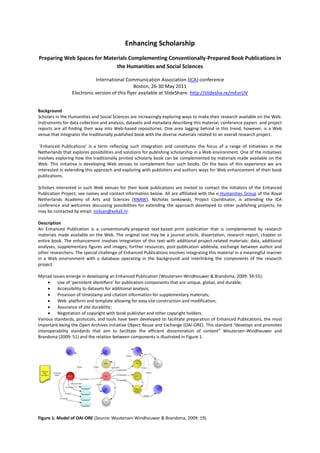
Various standards, protocols, and tools have been developed to facilitate preparation of Enhanced Publications, the most
important being the Open Archives Initiative Object Reuse and Exchange (OAI-ORE). This standard “develops and promotes
interoperability standards that aim to facilitate the efficient dissemination of content” Woutersen-Windhouwer and
Brandsma (2009: 51) and the relation between components is illustrated in Figure 1.


Figure 1: Model of OAI-ORE (Source: Woutersen-Windhouwer & Brandsma, 2009: 19)
Illustrations
Many illustrations of enhancing scholarship are emerging. Regarding journal articles, perhaps the most far-reaching is the
transformation of the content of the biology periodical Cell into what Elsevier calls the ‘Article of the Future’; see
illustration of the prototype in Figure 2. Other illustrations include the integration of a social media platform for
communication between scholars active in specialized areas, such as the SAGE sites Methodspace and
Communicationspace. Yet another innovation is the MIT research project Visualizing Cultures: Image-Driven Scholarship. A
prototype of one of the Web sites developed by the e-Humanities Group Enhanced Publication Project team is under
construction for the Routledge title e-Research: Transformation of Scholarly Practice; see Figure 3. Similar sites are being
prepared for three other titles:

          The Long History of New Media: Technology, Historiography, and Newness Contextualized (editors: David Park,
           Nicholas W. Jankowski, & Steve Jones; Digital Formations series, Peter Lang, 2011);
          Virtual Knowledge (editors: Paul Wouters, Anne Beaulieu, Andrea Scharnhorst & Sally Wyatt; manuscript under
           review);
          Digital Media: Concepts & Issues, Research & Resources, (Nicholas W. Jankowski , Polity Press, Digital Media and
           Society series, forthcoming 2011).


Figure 2: Prototype of Article in Cell                             Figure 3: Template of e-Research Web Site


Resources

          Digital Scholarship Web site; includes documents, presentations, blog
          Enhanced Publications in Archaeology. Hoogerwerf et al. 2009. Background for launching an open access journal
           for this field: Journal of Archaeology in the Low Countries (JALC).
          Van den Berg, H. Scagliola, S., & Wester, F. (2010). Wat Veteranen Vertellen: Verschillende Perspectieven op
           verhalen over ervaringen tijdens militaire operaties [What Veterans Have to Say]. Amsterdam: Amsterdam
           University Press. Web site accompaning printed book.
                                                                                                                         th
          Woutersen-Windhouwer, S. & Brandsma, R. (2009). Enhanced publications: State of the art. Report, DRIVE, EU 7
           Framework. Available at: http://www.driver-
           repository.eu/component/option,com_jdownloads/Itemid,83/task,summary/cid,53/catid,8/
          Presentations
           -    Scholarly Publishing in the Digital Era, (Nicholas Jankowski, University of Tampere, Nov. 2010)
                                                                           rd
           -    Enhanced Publications (John Doove, SURFfoundation, 3 Scientific Publishing in Natural History Institutions,
                Oct. 2010)
Contacts

          Nicholas Jankowski, Coordinator Enhanced Publications Project, Visiting Fellow, KNAW e-Humanities Group;
           email: nickjan@xs4all.nl
          Clifford Tatum, Digital Scholarship Fellow, KNAW e-Humanities Group;
          Zuotian Tatum, Software Development Engineer
          Andrea Scharnhorst, Senior Research Fellow, Data Archiving and Networked Services (DANS)

Brochure, enhancing scholarship, revised, 25 may2011

  • 1.
    Enhancing Scholarship Preparing WebSpaces for Materials Complementing Conventionally-Prepared Book Publications in the Humanities and Social Sciences International Communication Association (ICA) conference Boston, 26-30 May 2011 Electronic version of this flyer available at SlideShare: http://slidesha.re/mEvrUV Background Scholars in the Humanities and Social Sciences are increasingly exploring ways to make their research available on the Web. Instruments for data collection and analysis, datasets and metadata describing this material, conference papers and project reports are all finding their way into Web-based repositories. One area lagging behind in this trend, however, is a Web venue that integrates the traditionally published book with the diverse materials related to an overall research project. ‘Enhanced Publications’ is a term reflecting such integration and constitutes the focus of a range of initiatives in the Netherlands that explores possibilities and solutions for publishing scholarship in a Web environment. One of the initiatives involves exploring how the traditionally printed scholarly book can be complemented by materials made available on the Web. This initiative is developing Web venues to complement four such books. On the basis of this experience we are interested in extending this approach and exploring with publishers and authors ways for Web enhancement of their book publications. Scholars interested in such Web venues for their book publications are invited to contact the initiators of the Enhanced Publication Project; see names and contact information below. All are affiliated with the e-Humanities Group of the Royal Netherlands Academy of Arts and Sciences (KNAW). Nicholas Jankowski, Project Coordinator, is attending the ICA conference and welcomes discussing possibilities for extending the approach developed to other publishing projects; he may be contacted by email: nickjan@xs4all.nl. Description An Enhanced Publication is a conventionally-prepared text-based print publication that is complemented by research materials made available on the Web. The original text may be a journal article, dissertation, research report, chapter or entire book. The enhancement involves integration of this text with additional project-related materials: data, additional analyses, supplementary figures and images; further resources, post-publication addenda, exchange between author and other researchers. The special challenge of Enhanced Publications involves integrating this material in a meaningful manner in a Web environment with a database operating in the background and interlinking the components of the research project. Myriad issues emerge in developing an Enhanced Publication (Woutersen-Windhouwer & Brandsma, 2009: 54-55):  Use of ‘persistent identifiers’ for publication components that are unique, global, and durable;  Accessibility to datasets for additional analysis;  Provision of timestamp and citation information for supplementary materials;  Web platform and template allowing for easy site construction and modification;  Assurance of site durability;  Negotiation of copyright with book publisher and other copyright holders. Various standards, protocols, and tools have been developed to facilitate preparation of Enhanced Publications, the most important being the Open Archives Initiative Object Reuse and Exchange (OAI-ORE). This standard “develops and promotes interoperability standards that aim to facilitate the efficient dissemination of content” Woutersen-Windhouwer and Brandsma (2009: 51) and the relation between components is illustrated in Figure 1. Figure 1: Model of OAI-ORE (Source: Woutersen-Windhouwer & Brandsma, 2009: 19)
  • 2.
    Illustrations Many illustrations ofenhancing scholarship are emerging. Regarding journal articles, perhaps the most far-reaching is the transformation of the content of the biology periodical Cell into what Elsevier calls the ‘Article of the Future’; see illustration of the prototype in Figure 2. Other illustrations include the integration of a social media platform for communication between scholars active in specialized areas, such as the SAGE sites Methodspace and Communicationspace. Yet another innovation is the MIT research project Visualizing Cultures: Image-Driven Scholarship. A prototype of one of the Web sites developed by the e-Humanities Group Enhanced Publication Project team is under construction for the Routledge title e-Research: Transformation of Scholarly Practice; see Figure 3. Similar sites are being prepared for three other titles:  The Long History of New Media: Technology, Historiography, and Newness Contextualized (editors: David Park, Nicholas W. Jankowski, & Steve Jones; Digital Formations series, Peter Lang, 2011);  Virtual Knowledge (editors: Paul Wouters, Anne Beaulieu, Andrea Scharnhorst & Sally Wyatt; manuscript under review);  Digital Media: Concepts & Issues, Research & Resources, (Nicholas W. Jankowski , Polity Press, Digital Media and Society series, forthcoming 2011). Figure 2: Prototype of Article in Cell Figure 3: Template of e-Research Web Site Resources  Digital Scholarship Web site; includes documents, presentations, blog  Enhanced Publications in Archaeology. Hoogerwerf et al. 2009. Background for launching an open access journal for this field: Journal of Archaeology in the Low Countries (JALC).  Van den Berg, H. Scagliola, S., & Wester, F. (2010). Wat Veteranen Vertellen: Verschillende Perspectieven op verhalen over ervaringen tijdens militaire operaties [What Veterans Have to Say]. Amsterdam: Amsterdam University Press. Web site accompaning printed book. th  Woutersen-Windhouwer, S. & Brandsma, R. (2009). Enhanced publications: State of the art. Report, DRIVE, EU 7 Framework. Available at: http://www.driver- repository.eu/component/option,com_jdownloads/Itemid,83/task,summary/cid,53/catid,8/  Presentations - Scholarly Publishing in the Digital Era, (Nicholas Jankowski, University of Tampere, Nov. 2010) rd - Enhanced Publications (John Doove, SURFfoundation, 3 Scientific Publishing in Natural History Institutions, Oct. 2010) Contacts  Nicholas Jankowski, Coordinator Enhanced Publications Project, Visiting Fellow, KNAW e-Humanities Group; email: nickjan@xs4all.nl  Clifford Tatum, Digital Scholarship Fellow, KNAW e-Humanities Group;  Zuotian Tatum, Software Development Engineer  Andrea Scharnhorst, Senior Research Fellow, Data Archiving and Networked Services (DANS)