Re: Pubrarians
John Unsworth
Library Publishing Forum
Kansas City, MO
March 5, 2014
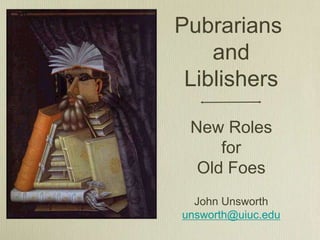
Pubrarians
and
Liblishers
New Roles
for
Old Foes
John Unsworth
unsworth@uiuc.edu
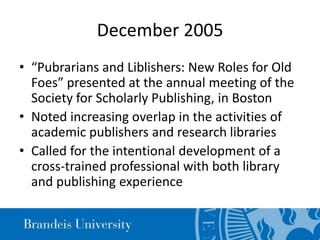
December 2005
• “Pubrarians and Liblishers: New Roles for Old
Foes” presented at the annual meeting of the
Society for Scholarly Publishing, in Boston
• Noted increasing overlap in the activities of
academic publishers and research libraries
• Called for the intentional development of a
cross-trained professional with both library
and publishing experience
Library Publishing
• “Based on core library values and building on
the traditional skills of librarians, it is
distinguished from other publishing fields by a
preference for Open Access dissemination and
a willingness to embrace informal and
experimental forms of scholarly
communication and to challenge the status
quo.” LPC website
“The ‘true professional ideal’ encouraged
doctors, lawyers, engineers, scientists,
ministers, and professors to approach their jobs
as ‘callings’ that demanded disinterested
objectivity, a devotion to public service,
professional autonomy, and a rejection of
material ambition.”
--Michael Augspurger, "Sinclair Lewis’ Primers for the Professional
Managerial Class: ‘Babbitt,’ ‘Arrowsmith,’ and ‘Dodsworth’."
http://www.jstor.org/stable/1315141
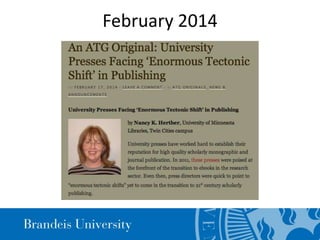
February 2014
Flash forward
• February 17, 2014 ATG Original: “University
Presses Facing ‘Enormous Tectonic Shift’ in
Publishing”
• More than 20 presses are now reporting
through or as part of the library
• 60 libraries now belong to the library
publishing coalition
• And yet…
We haven’t quite figured it out
• Libraries, subsidized to produce a local good,
don’t want to charge for access to information.
• University presses, believing in the value of the
content they produce, don’t want to think that
people might pay for the format in which that
content is delivered.
• Nobody is fully funded for innovation, or for
altruism.
What we measure counts
Wrt LPC Directory: The reason for excluding
university press output is to enable direct
comparison across library publishing programs
(including those who do not work with a university
press), and because the press often operates
independently (in terms of acquisitions, production,
etc.) from other library publishing activities, even if
it is housed within the library.
On the other hand…
“Monograph publishing has been a fruitful area for
collaboration between libraries and university
presses. In one collaborative model, the press
contributes editorial expertise and distribution
mechanisms for print [and ebook] media, while the
library provides sophisticated technology for digital
versions of the monograph or supplemental
material.” -- Sarah Lippincott
Value the activity,
regardless of the actors
In my 2005 SSP talk, I noted the following …
Obviously, there is value in sharing experience
with others newly arrived in the arena of
publishing, but ultimately, we should
Publishers:
• Acquire
• Edit
• Design
• Manage production
• Work with distributors
• Provide business services
Librarians
• Select
• Catalog & classify
• Design & evaluate information systems
• Teach information literacy
• Provide access
• Preserve
What could we do together?
• Work with iSchools to educate and train
pubrarians (Go Illinois!)
• Provide publisher services to library publishing
(e.g. business services, design, editorial)
• Provide library services to university press
publishers (e.g., selection, metadata, systems)
• Make open access sustainable
• Maybe even address some of these problems:
• There’s no business model for preservation
by publishers.
• There’s no mission in libraries to work with
authors.
• Publishers aren’t trained in the organization
of collections of information.
• Librarians aren’t trained in marketing,
graphic design, or business.
• The major “stand-alone” pubrarians are
commercial publishers: with few exceptions,
university presses are only in this game if
they are cooperating with university libraries.
• Commercial publishers are capitalized for
new ventures, which is good; university
presses are not, which is bad.
• On the other hand, commercial publishers
are profit-driven, and profit (especially short-
term profit) is not necessarily the most
important measure of value where research
collections are concerned.
New Opportunities
HathiTrust Research Center
• Developing “data communities” without
redundant investments in infrastructure
• Mellon-funded Work-set Creation for
Scholarly Analysis
• Laboratory for exploring new research needs
and opportunities
• Rights management and protection
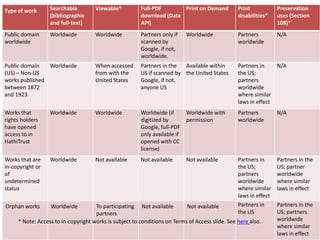
Type of work Searchable
(bibliographic
and full-text)
Viewable* Full-PDF
download (Data
API)
Print on Demand Print
disabilities*
Preservation
uses (Section
108)*
Public domain
worldwide
Worldwide Worldwide Partners only if
scanned by
Google, if not,
worldwide.
Worldwide Partners
worldwide
N/A
Public domain
(US) – Non-US
works published
between 1872
and 1923.
Worldwide When accessed
from with the
United States
Partners in the
US if scanned by
Google, if not,
anyone US
Available within
the United States
Partners in
the US;
partners
worldwide
where similar
laws in effect
N/A
Works that
rights holders
have opened
access to in
HathiTrust
Worldwide Worldwide Worldwide (if
digitized by
Google, full-PDF
only available if
opened with CC
license)
Worldwide with
permission
Partners
worldwide
N/A
Works that are
in-copyright or
of
undetermined
status
Worldwide Not available Not available Not available Partners in
the US;
partners
worldwide
where similar
laws in effect
Partners in the
US; partner
worldwide
where similar
laws in effect
Orphan works Worldwide To participating
partners
Not available Not available Partners in
the US
Partners in the
US; partners
worldwide
where similar
laws in effect
* Note: Access to in-copyright works is subject to conditions on Terms of Access slide. See here also.
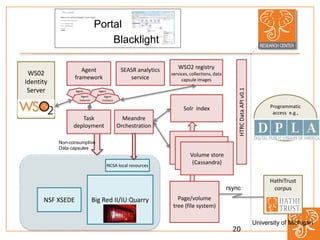
Agent
framework
Page/volume
tree (file system)
Volume store
(Cassandra)
SEASR analytics
service
Task
deployment
WSO2 registry
services, collections, data
capsule images
Solr index
HathiTrust
corpusrsync
HTRCDataAPIv0.1
NCSA local resources
Programmatic
access e.g.,
WS02
Identity
Server
University of Michigan
Meandre
Orchestration
Agent
instanceAgent
instance
Agent
instance
Agent
instance
Non-consumptive
Data capsules
Big Red II/IU Quarry
20
Blacklight
Volume store
(Cassandra)Volume store
(Cassandra)
NSF XSEDE
Portal
Workset Questions
• “Can we identify all the works that deal with Francis Bacon?”
• “What musical scores are in the corpus? What works contain
music notation?”
• “Which works have back of book indexes that I might
analyze?”
• “How would I gather works by 16th-century women? By 19th-
century men?”
• “Which works are fiction? Which are non-fiction? Essays?
Poetry?”
• “How would I gather works similar to those that I currently I
have in hand? Can I define different kinds of similarity?”
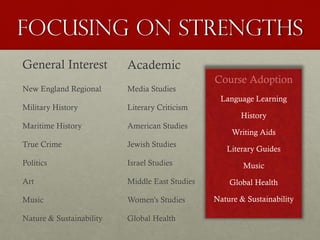
Focusing on Strengths
General Interest
New England Regional
Military History
Maritime History
True Crime
Politics
Art
Music
Nature & Sustainability
Academic
Media Studies
Literary Criticism
American Studies
Jewish Studies
Israel Studies
Middle East Studies
Women’s Studies
Global Health
Course Adoption
Language Learning
History
Writing Aids
Literary Guides
Music
Global Health
Nature & Sustainability
UPNE Publishing Services
• Manuscript editing and book design
• Project management
• Domestic and Asian print brokering
• Ebook production, conversion, and national and
international distribution to major channels, including
Kindle, Nook, iBooks, and library ebook aggregators
• Financial management and business operations
• Metadata management
• Book marketing and publicity
• Book sales, order entry, and customer service
• Warehousing and fulfillment, including Print-on-Demand
coordination
Ebooks
“The ebook transition has been a major hurdle,
but that is well underway…. In some ways, the
biggest challenge in the academic library market
is that it hasn’t transitioned to electronic fast
enough and presses are still running parallel
print and digital systems for library products,
which is costly.” --Doug Armato
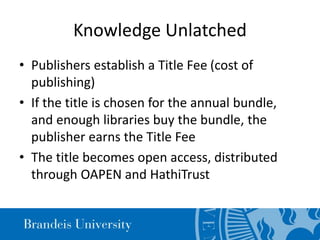
Knowledge Unlatched
• Publishers establish a Title Fee (cost of
publishing)
• If the title is chosen for the annual bundle,
and enough libraries buy the bundle, the
publisher earns the Title Fee
• The title becomes open access, distributed
through OAPEN and HathiTrust
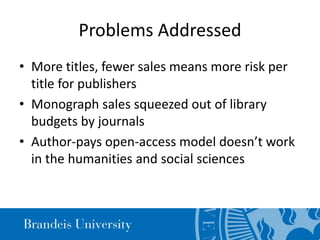
Problems Addressed
• More titles, fewer sales means more risk per
title for publishers
• Monograph sales squeezed out of library
budgets by journals
• Author-pays open-access model doesn’t work
in the humanities and social sciences
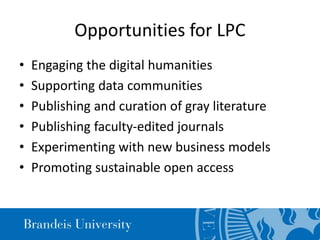
Opportunities for LPC
• Engaging the digital humanities
• Supporting data communities
• Publishing and curation of gray literature
• Publishing faculty-edited journals
• Experimenting with new business models
• Promoting sustainable open access
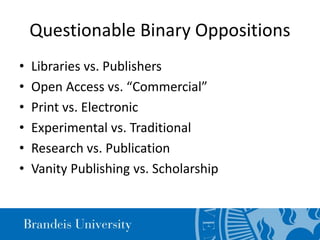
Questionable Binary Oppositions
• Libraries vs. Publishers
• Open Access vs. “Commercial”
• Print vs. Electronic
• Experimental vs. Traditional
• Research vs. Publication
• Vanity Publishing vs. Scholarship
unsworth@brandeis.edu

Lpf.2014

  • 1.
    Re: Pubrarians John Unsworth LibraryPublishing Forum Kansas City, MO March 5, 2014
  • 2.
  • 3.
    December 2005 • “Pubrariansand Liblishers: New Roles for Old Foes” presented at the annual meeting of the Society for Scholarly Publishing, in Boston • Noted increasing overlap in the activities of academic publishers and research libraries • Called for the intentional development of a cross-trained professional with both library and publishing experience
  • 4.
    Library Publishing • “Basedon core library values and building on the traditional skills of librarians, it is distinguished from other publishing fields by a preference for Open Access dissemination and a willingness to embrace informal and experimental forms of scholarly communication and to challenge the status quo.” LPC website
  • 5.
    “The ‘true professionalideal’ encouraged doctors, lawyers, engineers, scientists, ministers, and professors to approach their jobs as ‘callings’ that demanded disinterested objectivity, a devotion to public service, professional autonomy, and a rejection of material ambition.” --Michael Augspurger, "Sinclair Lewis’ Primers for the Professional Managerial Class: ‘Babbitt,’ ‘Arrowsmith,’ and ‘Dodsworth’." http://www.jstor.org/stable/1315141
  • 6.
  • 7.
    Flash forward • February17, 2014 ATG Original: “University Presses Facing ‘Enormous Tectonic Shift’ in Publishing” • More than 20 presses are now reporting through or as part of the library • 60 libraries now belong to the library publishing coalition • And yet…
  • 8.
    We haven’t quitefigured it out • Libraries, subsidized to produce a local good, don’t want to charge for access to information. • University presses, believing in the value of the content they produce, don’t want to think that people might pay for the format in which that content is delivered. • Nobody is fully funded for innovation, or for altruism.
  • 9.
    What we measurecounts Wrt LPC Directory: The reason for excluding university press output is to enable direct comparison across library publishing programs (including those who do not work with a university press), and because the press often operates independently (in terms of acquisitions, production, etc.) from other library publishing activities, even if it is housed within the library.
  • 10.
    On the otherhand… “Monograph publishing has been a fruitful area for collaboration between libraries and university presses. In one collaborative model, the press contributes editorial expertise and distribution mechanisms for print [and ebook] media, while the library provides sophisticated technology for digital versions of the monograph or supplemental material.” -- Sarah Lippincott
  • 11.
    Value the activity, regardlessof the actors In my 2005 SSP talk, I noted the following … Obviously, there is value in sharing experience with others newly arrived in the arena of publishing, but ultimately, we should
  • 12.
    Publishers: • Acquire • Edit •Design • Manage production • Work with distributors • Provide business services
  • 13.
    Librarians • Select • Catalog& classify • Design & evaluate information systems • Teach information literacy • Provide access • Preserve
  • 14.
    What could wedo together? • Work with iSchools to educate and train pubrarians (Go Illinois!) • Provide publisher services to library publishing (e.g. business services, design, editorial) • Provide library services to university press publishers (e.g., selection, metadata, systems) • Make open access sustainable • Maybe even address some of these problems:
  • 15.
    • There’s nobusiness model for preservation by publishers. • There’s no mission in libraries to work with authors. • Publishers aren’t trained in the organization of collections of information. • Librarians aren’t trained in marketing, graphic design, or business.
  • 16.
    • The major“stand-alone” pubrarians are commercial publishers: with few exceptions, university presses are only in this game if they are cooperating with university libraries. • Commercial publishers are capitalized for new ventures, which is good; university presses are not, which is bad. • On the other hand, commercial publishers are profit-driven, and profit (especially short- term profit) is not necessarily the most important measure of value where research collections are concerned.
  • 17.
  • 18.
    HathiTrust Research Center •Developing “data communities” without redundant investments in infrastructure • Mellon-funded Work-set Creation for Scholarly Analysis • Laboratory for exploring new research needs and opportunities • Rights management and protection
  • 19.
    Type of workSearchable (bibliographic and full-text) Viewable* Full-PDF download (Data API) Print on Demand Print disabilities* Preservation uses (Section 108)* Public domain worldwide Worldwide Worldwide Partners only if scanned by Google, if not, worldwide. Worldwide Partners worldwide N/A Public domain (US) – Non-US works published between 1872 and 1923. Worldwide When accessed from with the United States Partners in the US if scanned by Google, if not, anyone US Available within the United States Partners in the US; partners worldwide where similar laws in effect N/A Works that rights holders have opened access to in HathiTrust Worldwide Worldwide Worldwide (if digitized by Google, full-PDF only available if opened with CC license) Worldwide with permission Partners worldwide N/A Works that are in-copyright or of undetermined status Worldwide Not available Not available Not available Partners in the US; partners worldwide where similar laws in effect Partners in the US; partner worldwide where similar laws in effect Orphan works Worldwide To participating partners Not available Not available Partners in the US Partners in the US; partners worldwide where similar laws in effect * Note: Access to in-copyright works is subject to conditions on Terms of Access slide. See here also.
  • 20.
    Agent framework Page/volume tree (file system) Volumestore (Cassandra) SEASR analytics service Task deployment WSO2 registry services, collections, data capsule images Solr index HathiTrust corpusrsync HTRCDataAPIv0.1 NCSA local resources Programmatic access e.g., WS02 Identity Server University of Michigan Meandre Orchestration Agent instanceAgent instance Agent instance Agent instance Non-consumptive Data capsules Big Red II/IU Quarry 20 Blacklight Volume store (Cassandra)Volume store (Cassandra) NSF XSEDE Portal
  • 21.
    Workset Questions • “Canwe identify all the works that deal with Francis Bacon?” • “What musical scores are in the corpus? What works contain music notation?” • “Which works have back of book indexes that I might analyze?” • “How would I gather works by 16th-century women? By 19th- century men?” • “Which works are fiction? Which are non-fiction? Essays? Poetry?” • “How would I gather works similar to those that I currently I have in hand? Can I define different kinds of similarity?”
  • 23.
    Focusing on Strengths GeneralInterest New England Regional Military History Maritime History True Crime Politics Art Music Nature & Sustainability Academic Media Studies Literary Criticism American Studies Jewish Studies Israel Studies Middle East Studies Women’s Studies Global Health Course Adoption Language Learning History Writing Aids Literary Guides Music Global Health Nature & Sustainability
  • 24.
    UPNE Publishing Services •Manuscript editing and book design • Project management • Domestic and Asian print brokering • Ebook production, conversion, and national and international distribution to major channels, including Kindle, Nook, iBooks, and library ebook aggregators • Financial management and business operations • Metadata management • Book marketing and publicity • Book sales, order entry, and customer service • Warehousing and fulfillment, including Print-on-Demand coordination
  • 25.
    Ebooks “The ebook transitionhas been a major hurdle, but that is well underway…. In some ways, the biggest challenge in the academic library market is that it hasn’t transitioned to electronic fast enough and presses are still running parallel print and digital systems for library products, which is costly.” --Doug Armato
  • 26.
    Knowledge Unlatched • Publishersestablish a Title Fee (cost of publishing) • If the title is chosen for the annual bundle, and enough libraries buy the bundle, the publisher earns the Title Fee • The title becomes open access, distributed through OAPEN and HathiTrust
  • 27.
    Problems Addressed • Moretitles, fewer sales means more risk per title for publishers • Monograph sales squeezed out of library budgets by journals • Author-pays open-access model doesn’t work in the humanities and social sciences
  • 29.
    Opportunities for LPC •Engaging the digital humanities • Supporting data communities • Publishing and curation of gray literature • Publishing faculty-edited journals • Experimenting with new business models • Promoting sustainable open access
  • 30.
    Questionable Binary Oppositions •Libraries vs. Publishers • Open Access vs. “Commercial” • Print vs. Electronic • Experimental vs. Traditional • Research vs. Publication • Vanity Publishing vs. Scholarship
  • 31.