Jean Lowry50587California: An Overview
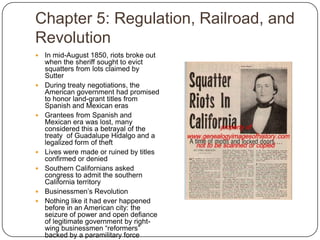
Chapter 5: Regulation, Railroad, and RevolutionIn mid-August 1850, riots broke out when the sheriff sought to evict squatters from lots claimed by SutterDuring treaty negotiations, the American government had promised to honor land-grant titles from Spanish and Mexican erasGrantees from Spanish and Mexican era was lost, many considered this a betrayal of the treaty  of Guadalupe Hidalgo and a legalized form of theftLives were made or ruined by titles confirmed or deniedSouthern Californians asked congress to admit the southern California territoryBusinessmen’s RevolutionNothing like it had ever happened before in an American city: the seizure of power and open defiance of legitimate government by right-wing businessmen “reformers” backed by a paramilitary force
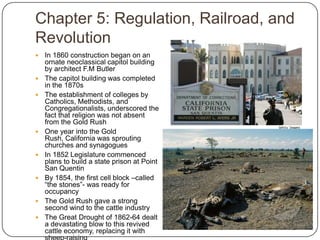
Chapter 5: Regulation, Railroad, and RevolutionIn 1860 construction began on an ornate neoclassical capitol building by architect F.M ButlerThe capitol building was completed in the 1870sThe establishment of colleges by Catholics, Methodists, and Congregationalists, underscored the fact that religion was not absent from the Gold RushOne year into the Gold Rush, California was sprouting churches and synagoguesIn 1852 Legislature commenced plans to build a state prison at Point San QuentinBy 1854, the first cell block –called “the stones”- was ready for occupancyThe Gold Rush gave a strong second wind to the cattle industryThe Great Drought of 1862-64 dealt a devastating blow to this revived cattle economy, replacing it with sheep-raising
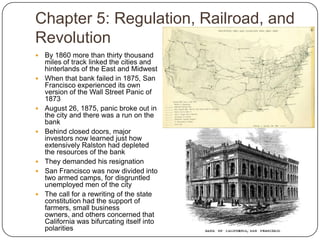
Chapter 5: Regulation, Railroad, and RevolutionBy 1860 more than thirty thousand miles of track linked the cities and hinterlands of the East and MidwestWhen that bank failed in 1875, San Francisco experienced its own version of the Wall Street Panic of 1873August 26, 1875, panic broke out in the city and there was a run on the bankBehind closed doors, major investors now learned just how extensively Ralston had depleted the resources of the bankThey demanded his resignationSan Francisco was now divided into two armed camps, for disgruntled unemployed men of the cityThe call for a rewriting of the state constitution had the support of farmers, small business owners, and others concerned that California was bifurcating itself into polarities
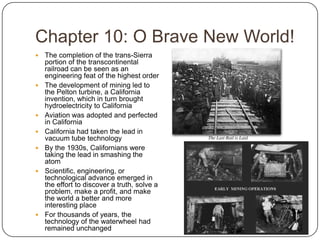
Chapter 10: O Brave New World!The completion of the trans-Sierra portion of the transcontinental railroad can be seen as an engineering feat of the highest orderThe development of mining led to the Pelton turbine, a California invention, which in turn brought hydroelectricity to CaliforniaAviation was adopted and perfected in CaliforniaCalifornia had taken the lead in vacuum tube technologyBy the 1930s, Californians were taking the lead in smashing the atomScientific, engineering, or technological advance emerged in the effort to discover a truth, solve a problem, make a profit, and make the world a better and more interesting placeFor thousands of years, the technology of the waterwheel had remained unchanged
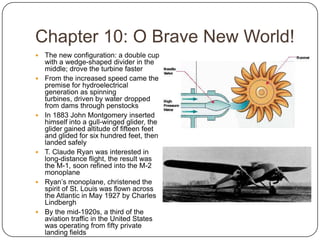
Chapter 10: O Brave New World!The new configuration: a double cup with a wedge-shaped divider in the middle; drove the turbine faster From the increased speed came the premise for hydroelectrical generation as spinning turbines, driven by water dropped from dams through penstocksIn 1883 John Montgomery inserted himself into a gull-winged glider, the glider gained altitude of fifteen feet and glided for six hundred feet, then landed safelyT. Claude Ryan was interested in long-distance flight, the result was the M-1, soon refined into the M-2 monoplaneRyan’s monoplane, christened the spirit of St. Louis was flown across the Atlantic in May 1927 by Charles LindberghBy the mid-1920s, a third of the aviation traffic in the United States was operating from fifty private landing fields
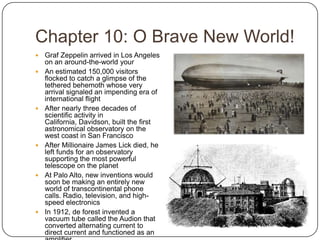
Chapter 10: O Brave New World!Graf Zeppelin arrived in Los Angeles on an around-the-world yourAn estimated 150,000 visitors flocked to catch a glimpse of the tethered behemoth whose very arrival signaled an impending era of international flightAfter nearly three decades of scientific activity in California, Davidson, built the first astronomical observatory on the west coast in San FranciscoAfter Millionaire James Lick died, he left funds for an observatory supporting the most powerful telescope on the planetAt Palo Alto, new inventions would soon be making an entirely new world of transcontinental phone calls. Radio, television, and high-speed electronicsIn 1912, de forest invented a vacuum tube called the Audion that converted alternating current to direct current and functioned as an amplifier
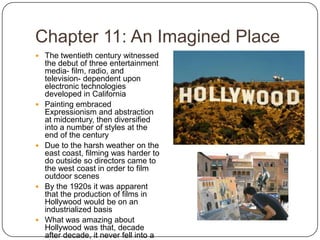
Chapter 11: An Imagined PlaceThe twentieth century witnessed the debut of three entertainment media- film, radio, and television- dependent upon electronic technologies developed in CaliforniaPainting embraced Expressionism and abstraction at midcentury, then diversified into a number of styles at the end of the centuryDue to the harsh weather on the east coast, filming was harder to do outside so directors came to the west coast in order to film outdoor scenesBy the 1920s it was apparent that the production of films in Hollywood would be on an industrialized basisWhat was amazing about Hollywood was that, decade after decade, it never fell into a slump
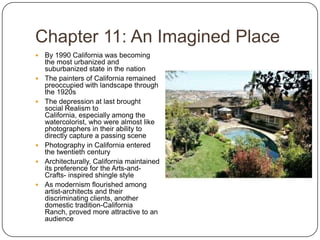
Chapter 11: An Imagined PlaceBy 1990 California was becoming the most urbanized and suburbanized state in the nationThe painters of California remained preoccupied with landscape through the 1920sThe depression at last brought social Realism to California, especially among the watercolorist, who were almost like photographers in their ability to directly capture a passing scenePhotography in California entered the twentieth centuryArchitecturally, California maintained its preference for the Arts-and-Crafts- inspired shingle styleAs modernism flourished among artist-architects and their discriminating clients, another domestic tradition-California Ranch, proved more attractive to an audience
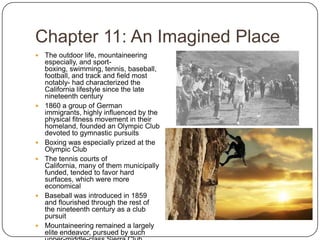
Chapter 11: An Imagined PlaceThe outdoor life, mountaineering especially, and sport-boxing, swimming, tennis, baseball, football, and track and field most notably- had characterized the California lifestyle since the late nineteenth century1860 a group of German immigrants, highly influenced by the physical fitness movement in their homeland, founded an Olympic Club devoted to gymnastic pursuitsBoxing was especially prized at the Olympic ClubThe tennis courts of California, many of them municipally funded, tended to favor hard surfaces, which were more economicalBaseball was introduced in 1859 and flourished through the rest of the nineteenth century as a club pursuitMountaineering remained a largely elite endeavor, pursued by such upper-middle-class Sierra Club members
SourceStarr, Kevin. California: a History. New York: Modern Library, 2005. Print.

California

  • 1.
  • 2.
    Chapter 5: Regulation,Railroad, and RevolutionIn mid-August 1850, riots broke out when the sheriff sought to evict squatters from lots claimed by SutterDuring treaty negotiations, the American government had promised to honor land-grant titles from Spanish and Mexican erasGrantees from Spanish and Mexican era was lost, many considered this a betrayal of the treaty of Guadalupe Hidalgo and a legalized form of theftLives were made or ruined by titles confirmed or deniedSouthern Californians asked congress to admit the southern California territoryBusinessmen’s RevolutionNothing like it had ever happened before in an American city: the seizure of power and open defiance of legitimate government by right-wing businessmen “reformers” backed by a paramilitary force
  • 3.
    Chapter 5: Regulation,Railroad, and RevolutionIn 1860 construction began on an ornate neoclassical capitol building by architect F.M ButlerThe capitol building was completed in the 1870sThe establishment of colleges by Catholics, Methodists, and Congregationalists, underscored the fact that religion was not absent from the Gold RushOne year into the Gold Rush, California was sprouting churches and synagoguesIn 1852 Legislature commenced plans to build a state prison at Point San QuentinBy 1854, the first cell block –called “the stones”- was ready for occupancyThe Gold Rush gave a strong second wind to the cattle industryThe Great Drought of 1862-64 dealt a devastating blow to this revived cattle economy, replacing it with sheep-raising
  • 4.
    Chapter 5: Regulation,Railroad, and RevolutionBy 1860 more than thirty thousand miles of track linked the cities and hinterlands of the East and MidwestWhen that bank failed in 1875, San Francisco experienced its own version of the Wall Street Panic of 1873August 26, 1875, panic broke out in the city and there was a run on the bankBehind closed doors, major investors now learned just how extensively Ralston had depleted the resources of the bankThey demanded his resignationSan Francisco was now divided into two armed camps, for disgruntled unemployed men of the cityThe call for a rewriting of the state constitution had the support of farmers, small business owners, and others concerned that California was bifurcating itself into polarities
  • 5.
    Chapter 10: OBrave New World!The completion of the trans-Sierra portion of the transcontinental railroad can be seen as an engineering feat of the highest orderThe development of mining led to the Pelton turbine, a California invention, which in turn brought hydroelectricity to CaliforniaAviation was adopted and perfected in CaliforniaCalifornia had taken the lead in vacuum tube technologyBy the 1930s, Californians were taking the lead in smashing the atomScientific, engineering, or technological advance emerged in the effort to discover a truth, solve a problem, make a profit, and make the world a better and more interesting placeFor thousands of years, the technology of the waterwheel had remained unchanged
  • 6.
    Chapter 10: OBrave New World!The new configuration: a double cup with a wedge-shaped divider in the middle; drove the turbine faster From the increased speed came the premise for hydroelectrical generation as spinning turbines, driven by water dropped from dams through penstocksIn 1883 John Montgomery inserted himself into a gull-winged glider, the glider gained altitude of fifteen feet and glided for six hundred feet, then landed safelyT. Claude Ryan was interested in long-distance flight, the result was the M-1, soon refined into the M-2 monoplaneRyan’s monoplane, christened the spirit of St. Louis was flown across the Atlantic in May 1927 by Charles LindberghBy the mid-1920s, a third of the aviation traffic in the United States was operating from fifty private landing fields
  • 7.
    Chapter 10: OBrave New World!Graf Zeppelin arrived in Los Angeles on an around-the-world yourAn estimated 150,000 visitors flocked to catch a glimpse of the tethered behemoth whose very arrival signaled an impending era of international flightAfter nearly three decades of scientific activity in California, Davidson, built the first astronomical observatory on the west coast in San FranciscoAfter Millionaire James Lick died, he left funds for an observatory supporting the most powerful telescope on the planetAt Palo Alto, new inventions would soon be making an entirely new world of transcontinental phone calls. Radio, television, and high-speed electronicsIn 1912, de forest invented a vacuum tube called the Audion that converted alternating current to direct current and functioned as an amplifier
  • 8.
    Chapter 11: AnImagined PlaceThe twentieth century witnessed the debut of three entertainment media- film, radio, and television- dependent upon electronic technologies developed in CaliforniaPainting embraced Expressionism and abstraction at midcentury, then diversified into a number of styles at the end of the centuryDue to the harsh weather on the east coast, filming was harder to do outside so directors came to the west coast in order to film outdoor scenesBy the 1920s it was apparent that the production of films in Hollywood would be on an industrialized basisWhat was amazing about Hollywood was that, decade after decade, it never fell into a slump
  • 9.
    Chapter 11: AnImagined PlaceBy 1990 California was becoming the most urbanized and suburbanized state in the nationThe painters of California remained preoccupied with landscape through the 1920sThe depression at last brought social Realism to California, especially among the watercolorist, who were almost like photographers in their ability to directly capture a passing scenePhotography in California entered the twentieth centuryArchitecturally, California maintained its preference for the Arts-and-Crafts- inspired shingle styleAs modernism flourished among artist-architects and their discriminating clients, another domestic tradition-California Ranch, proved more attractive to an audience
  • 10.
    Chapter 11: AnImagined PlaceThe outdoor life, mountaineering especially, and sport-boxing, swimming, tennis, baseball, football, and track and field most notably- had characterized the California lifestyle since the late nineteenth century1860 a group of German immigrants, highly influenced by the physical fitness movement in their homeland, founded an Olympic Club devoted to gymnastic pursuitsBoxing was especially prized at the Olympic ClubThe tennis courts of California, many of them municipally funded, tended to favor hard surfaces, which were more economicalBaseball was introduced in 1859 and flourished through the rest of the nineteenth century as a club pursuitMountaineering remained a largely elite endeavor, pursued by such upper-middle-class Sierra Club members
  • 11.
    SourceStarr, Kevin. California: aHistory. New York: Modern Library, 2005. Print.