Negotiation & Objection Handling: 
10 Tips for Getting What You’re Worth 
Dan Thompson 
East Sales Director, Smarsh 
November 20th, 2014
Negotiation & Objection Handling 
Tonight’s Agenda 
I. Objection Handling vs. Negotiation 
II. 5 Tips for Overcoming Objections 
III. 5 Tips for Better Negotiations 
IV. Brief Summary 
V. Q&A
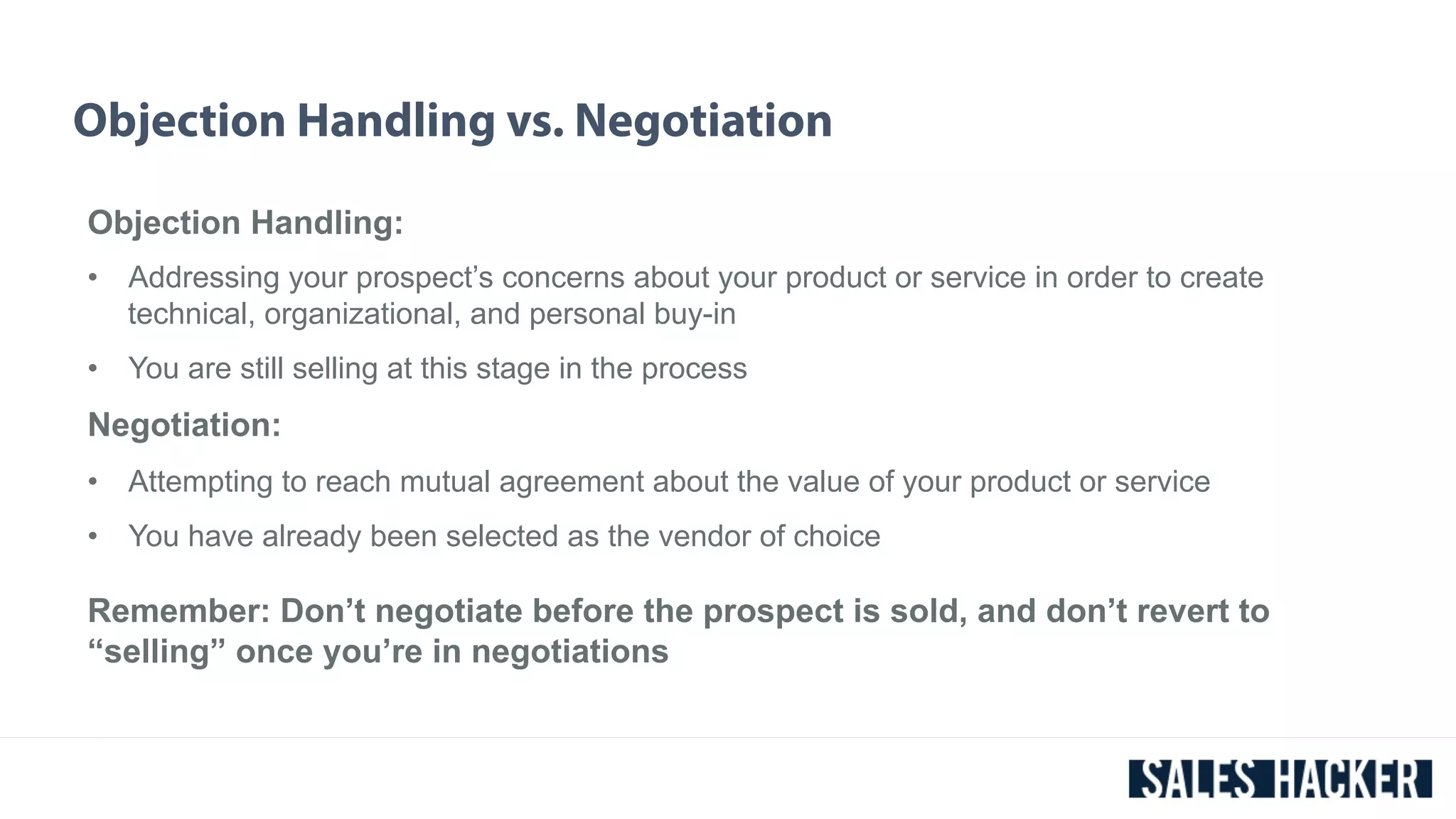
Objection Handling vs. Negotiation 
Objection Handling: 
• Addressing your prospect’s concerns about your product or service in order to create 
technical, organizational, and personal buy-in 
• You are still selling at this stage in the process 
Negotiation: 
• Attempting to reach mutual agreement about the value of your product or service 
• You have already been selected as the vendor of choice 
Remember: Don’t negotiate before the prospect is sold, and don’t revert to 
“selling” once you’re in negotiations
Overcoming Objections
Objection Handling: Tip #1 
Learn From Your Losses 
• Review your lost opportunities over the past year and look for themes 
• Which objections came up most often? Which ones were the deal breakers? 
• What areas will require product development? What can you work or talk around? 
• Review your near-losses and close calls; opportunities you won but almost didn’t 
• What were the biggest hurdles to closing the sale? How did you overcome them? 
• Use these insights to create a “cheat sheet” of common objections and craft 2-3 
potential responses for each. Test them out and revisit them often.
Objection Handling: Tip #2 
Understand Your Prospect’s Real Concerns 
• Why is the objection an issue for them, and why are they bringing it up now? 
• No assumptions. Guessing at the prospect’s intention can put the deal at risk. 
• In order to truly understand, you must: 
• Validate and acknowledge the prospect’s concern (nurture) 
• Understand the problem they’re facing and the reasons behind it (ask why?) 
• Respond only once you’re sure you understand the real concern 
• Never answer a question without understanding the context behind it! 
• When in doubt, place the ball back in the prospect’s court. It’s their job to clarify.
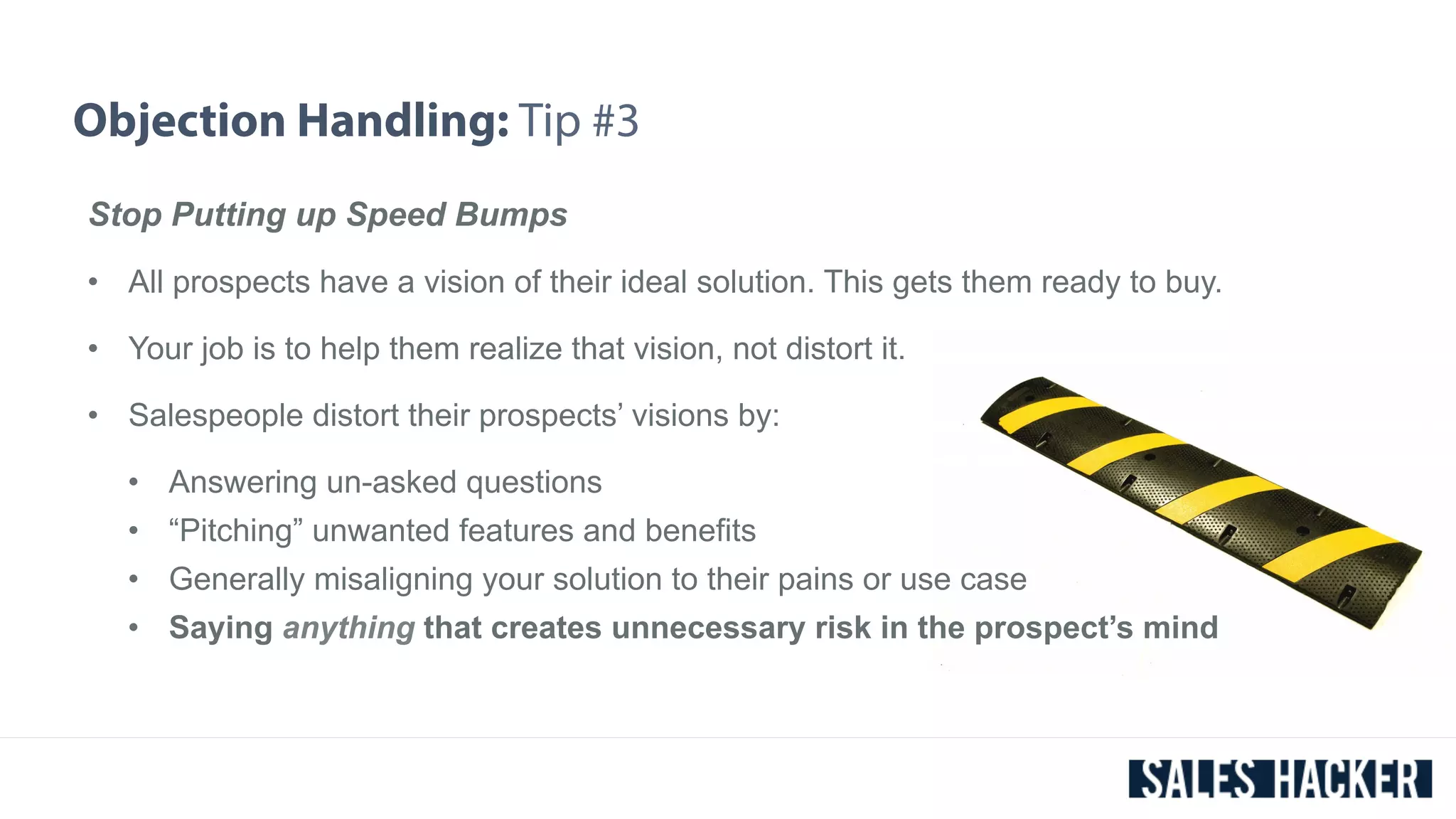
Objection Handling: Tip #3 
Stop Putting up Speed Bumps 
• All prospects have a vision of their ideal solution. This gets them ready to buy. 
• Your job is to help them realize that vision, not distort it. 
• Salespeople distort their prospects’ visions by: 
• Answering un-asked questions 
• “Pitching” unwanted features and benefits 
• Generally misaligning your solution to their pains or use case 
• Saying anything that creates unnecessary risk in the prospect’s mind
Objection Handling: Tip #4 
Go for the “No” 
• “Is it over?” “is this going to be a deal breaker?” “should we just call it quits?” 
• “Walking away” tests an objection’s importance and identifies the prospect’s real 
concern 
• When there’s a particular objection that comes up repeatedly, don’t wait for your 
prospects to bring it up. Get it on the table early and seek resolution. 
• This builds genuine credibility and rapport 
• Don’t worry: Just because you’re walking towards the door doesn’t mean you 
have to go through it... unless, you want to.
Objection Handling: Tip #5 
Understand That Pricing is NEVER the Real Issue 
• There is a direct correlation between pricing and conviction (value) 
• Less certainty your product will solve their problem means greater pricing pressure 
• Solution: Learn what your prospects would need to see to justify paying more, then 
show them you can deliver (ROI) 
• In other words: Let your prospects answer their own objections.
Better Negotiation
Negotiation: Tip #1 
Have a Game Plan 
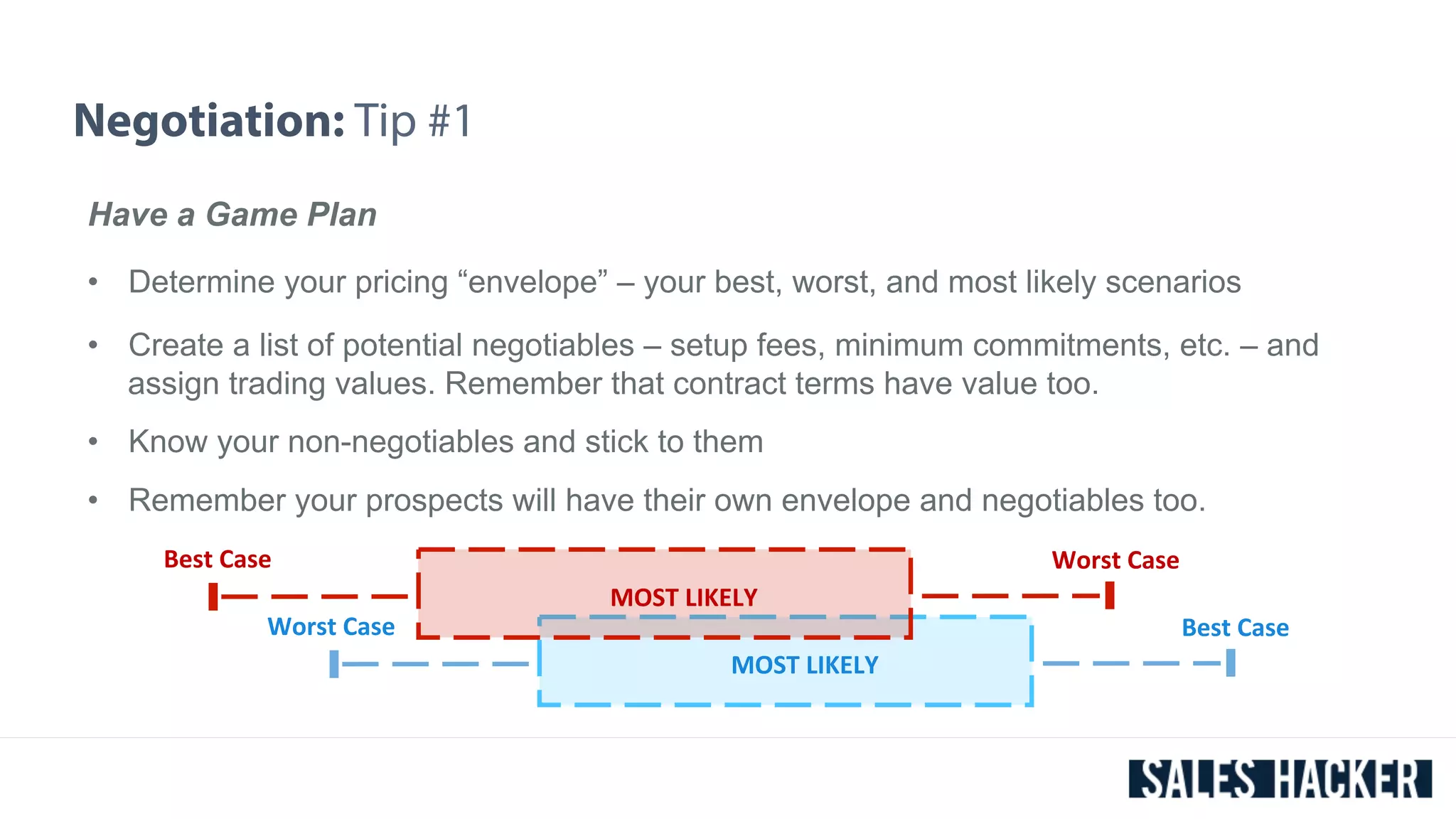
• Determine your pricing “envelope” – your best, worst, and most likely scenarios 
• Create a list of potential negotiables – setup fees, minimum commitments, etc. – and 
assign trading values. Remember that contract terms have value too. 
• Know your non-negotiables and stick to them 
• Remember your prospects will have their own envelope and negotiables too. 
Worst 
Case 
Best 
Case 
MOST 
LIKELY 
Best 
Case 
Worst 
Case 
MOST 
LIKELY
Negotiation: Tip #2 
Consider Your Prospect’s Environment & Business Drivers 
• What do you believe is of value to this particular prospect? Why? 
• Internal & external factors influencing their decisions may include: 
• Buying team, business challenges / goals, and individual motivators 
• Short- and long-term strategy – expansion, relocation, new technologies, etc. 
• Competitive pressures, market trends, and general business environment 
• Determine their most likely alternative – a competitor, develop in-house, or doing nothing 
• What unique advantages does your product or service provide? 
• This will determine how much leverage you have
Negotiation: Tip #3 
Never Give Anything for Free 
• Always get something comparable or greater in return when you give concessions 
• Know what items could sweeten the deal for you: 
• Commitment to sign within an agreed-upon timeframe (EOM, EOQ, etc.) 
• Longer initial term (annual vs. monthly contracts, multi-year agreements) 
• Case study or reference account, use of logo in marketing materials 
• Introduction or referral to other potential clients 
• Better payment terms (upfront vs. monthly payments, shorter collection times) 
• “Freebies” lower your solution’s (and company’s) perceived value
Negotiation: Tip #4 
Know When NOT to Negotiate 
• Providing certain concessions create undue risk to the business, regardless of how 
much you may want the deal, the new logo, or the revenue 
• Owners and Sales Managers: It’s your job to know when these times are. 
• Set guidelines, implement check-and-balances, and stick to them. 
• This is easy if you’ve done a good job creating your pricing envelope and valuations 
• Live to sell another day…
Negotiation: Tip #5 
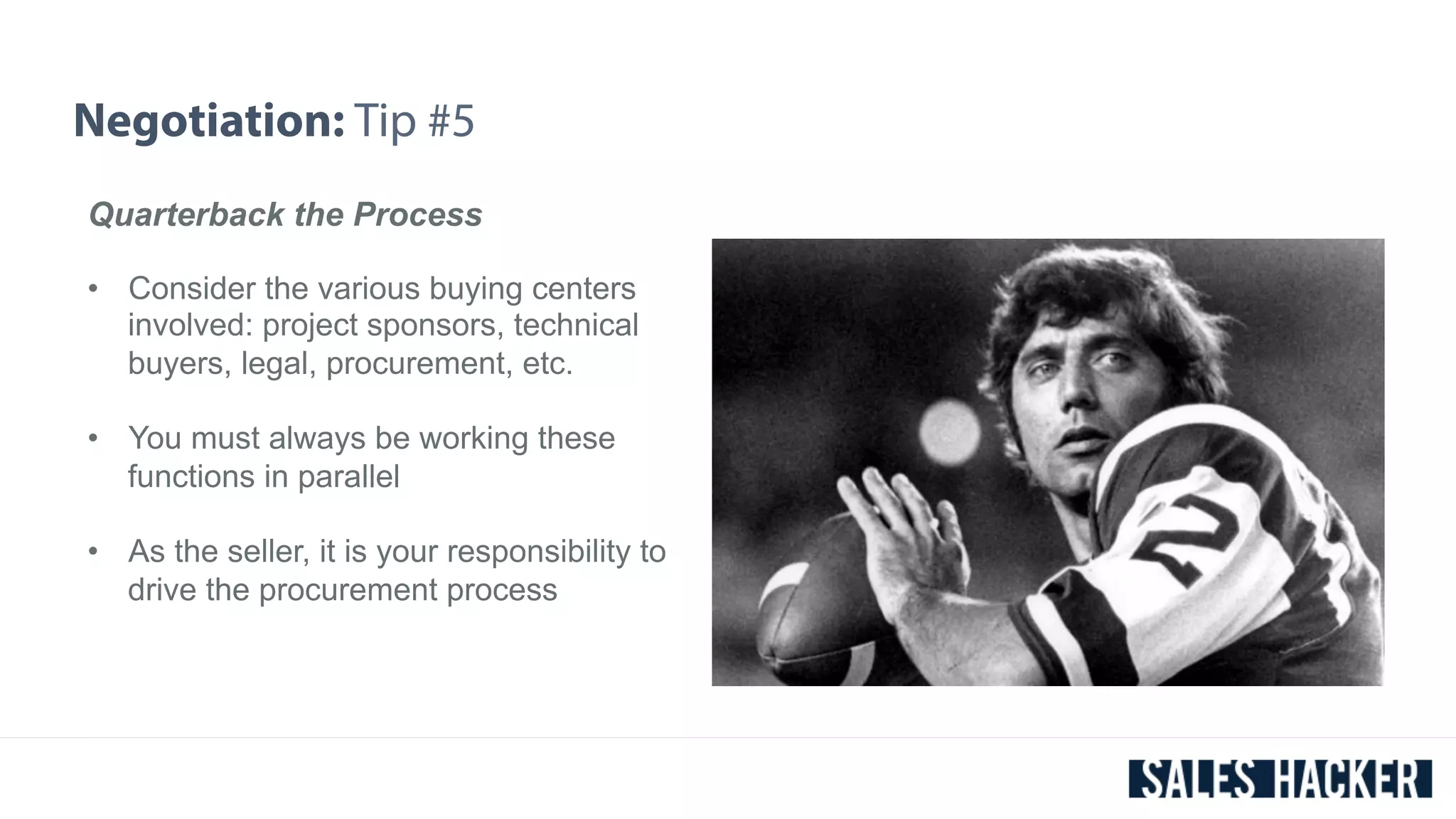
Quarterback the Process 
• Consider the various buying centers 
involved: project sponsors, technical 
buyers, legal, procurement, etc. 
• You must always be working these 
functions in parallel 
• As the seller, it is your responsibility to 
drive the procurement process
One Final Tip:
In Summary 
Successful objection handling and negotiation ultimately comes down to: 
• Knowing yourself, your customers, and your marketplace 
• Remembering that “pricing” is really about conviction 
• Having a game plan and never giving anything for free 
• Owning the process and maintaining control 
• Never taking things personally
Questions?
Thank You 
Email: dthompson@smarsh.com 
Connect on LinkedIn 
@dethomps8069

10 Tips for Getting What You’re Worth - Negotiation & Objection Handling

  • 1.
    Negotiation & ObjectionHandling: 10 Tips for Getting What You’re Worth Dan Thompson East Sales Director, Smarsh November 20th, 2014
  • 2.
    Negotiation & ObjectionHandling Tonight’s Agenda I. Objection Handling vs. Negotiation II. 5 Tips for Overcoming Objections III. 5 Tips for Better Negotiations IV. Brief Summary V. Q&A
  • 3.
    Objection Handling vs.Negotiation Objection Handling: • Addressing your prospect’s concerns about your product or service in order to create technical, organizational, and personal buy-in • You are still selling at this stage in the process Negotiation: • Attempting to reach mutual agreement about the value of your product or service • You have already been selected as the vendor of choice Remember: Don’t negotiate before the prospect is sold, and don’t revert to “selling” once you’re in negotiations
  • 4.
  • 5.
    Objection Handling: Tip#1 Learn From Your Losses • Review your lost opportunities over the past year and look for themes • Which objections came up most often? Which ones were the deal breakers? • What areas will require product development? What can you work or talk around? • Review your near-losses and close calls; opportunities you won but almost didn’t • What were the biggest hurdles to closing the sale? How did you overcome them? • Use these insights to create a “cheat sheet” of common objections and craft 2-3 potential responses for each. Test them out and revisit them often.
  • 6.
    Objection Handling: Tip#2 Understand Your Prospect’s Real Concerns • Why is the objection an issue for them, and why are they bringing it up now? • No assumptions. Guessing at the prospect’s intention can put the deal at risk. • In order to truly understand, you must: • Validate and acknowledge the prospect’s concern (nurture) • Understand the problem they’re facing and the reasons behind it (ask why?) • Respond only once you’re sure you understand the real concern • Never answer a question without understanding the context behind it! • When in doubt, place the ball back in the prospect’s court. It’s their job to clarify.
  • 7.
    Objection Handling: Tip#3 Stop Putting up Speed Bumps • All prospects have a vision of their ideal solution. This gets them ready to buy. • Your job is to help them realize that vision, not distort it. • Salespeople distort their prospects’ visions by: • Answering un-asked questions • “Pitching” unwanted features and benefits • Generally misaligning your solution to their pains or use case • Saying anything that creates unnecessary risk in the prospect’s mind
  • 8.
    Objection Handling: Tip#4 Go for the “No” • “Is it over?” “is this going to be a deal breaker?” “should we just call it quits?” • “Walking away” tests an objection’s importance and identifies the prospect’s real concern • When there’s a particular objection that comes up repeatedly, don’t wait for your prospects to bring it up. Get it on the table early and seek resolution. • This builds genuine credibility and rapport • Don’t worry: Just because you’re walking towards the door doesn’t mean you have to go through it... unless, you want to.
  • 9.
    Objection Handling: Tip#5 Understand That Pricing is NEVER the Real Issue • There is a direct correlation between pricing and conviction (value) • Less certainty your product will solve their problem means greater pricing pressure • Solution: Learn what your prospects would need to see to justify paying more, then show them you can deliver (ROI) • In other words: Let your prospects answer their own objections.
  • 10.
  • 11.
    Negotiation: Tip #1 Have a Game Plan • Determine your pricing “envelope” – your best, worst, and most likely scenarios • Create a list of potential negotiables – setup fees, minimum commitments, etc. – and assign trading values. Remember that contract terms have value too. • Know your non-negotiables and stick to them • Remember your prospects will have their own envelope and negotiables too. Worst Case Best Case MOST LIKELY Best Case Worst Case MOST LIKELY
  • 12.
    Negotiation: Tip #2 Consider Your Prospect’s Environment & Business Drivers • What do you believe is of value to this particular prospect? Why? • Internal & external factors influencing their decisions may include: • Buying team, business challenges / goals, and individual motivators • Short- and long-term strategy – expansion, relocation, new technologies, etc. • Competitive pressures, market trends, and general business environment • Determine their most likely alternative – a competitor, develop in-house, or doing nothing • What unique advantages does your product or service provide? • This will determine how much leverage you have
  • 13.
    Negotiation: Tip #3 Never Give Anything for Free • Always get something comparable or greater in return when you give concessions • Know what items could sweeten the deal for you: • Commitment to sign within an agreed-upon timeframe (EOM, EOQ, etc.) • Longer initial term (annual vs. monthly contracts, multi-year agreements) • Case study or reference account, use of logo in marketing materials • Introduction or referral to other potential clients • Better payment terms (upfront vs. monthly payments, shorter collection times) • “Freebies” lower your solution’s (and company’s) perceived value
  • 14.
    Negotiation: Tip #4 Know When NOT to Negotiate • Providing certain concessions create undue risk to the business, regardless of how much you may want the deal, the new logo, or the revenue • Owners and Sales Managers: It’s your job to know when these times are. • Set guidelines, implement check-and-balances, and stick to them. • This is easy if you’ve done a good job creating your pricing envelope and valuations • Live to sell another day…
  • 15.
    Negotiation: Tip #5 Quarterback the Process • Consider the various buying centers involved: project sponsors, technical buyers, legal, procurement, etc. • You must always be working these functions in parallel • As the seller, it is your responsibility to drive the procurement process
  • 16.
  • 17.
    In Summary Successfulobjection handling and negotiation ultimately comes down to: • Knowing yourself, your customers, and your marketplace • Remembering that “pricing” is really about conviction • Having a game plan and never giving anything for free • Owning the process and maintaining control • Never taking things personally
  • 18.
  • 19.
    Thank You Email:dthompson@smarsh.com Connect on LinkedIn @dethomps8069