IoT and Cloud Computing
Integration
John Soldatos, PhD
(jsol@ait.gr; john.Soldatos@gmail.com)
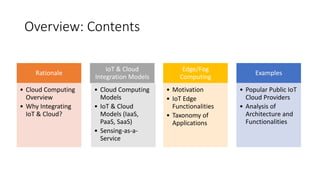
Overview: Contents
Rationale
• Cloud Computing
Overview
• Why Integrating
IoT & Cloud?
IoT & Cloud
Integration Models
• Cloud Computing
Models
• IoT & Cloud
Models (IaaS,
PaaS, SaaS)
• Sensing-as-a-
Service
Edge/Fog
Computing
• Motivation
• IoT Edge
Functionalities
• Taxonomy of
Applications
Examples
• Popular Public IoT
Cloud Providers
• Analysis of
Architecture and
Functionalities
Cloud Computing
• Next evolutionary step in Internet-
based computing models
• Provides the means for delivering
ICT resources as a service:
• Computing power
• Computing infrastructure
• Applications
• Business processes
• Collaboration
• Etc.
• Regardless of time and end-user’s
location
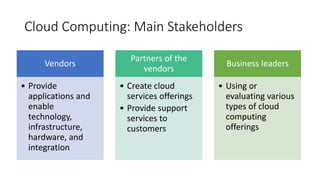
Cloud Computing: Main Stakeholders
Vendors
• Provide
applications and
enable
technology,
infrastructure,
hardware, and
integration
Partners of the
vendors
• Create cloud
services offerings
• Provide support
services to
customers
Business leaders
• Using or
evaluating various
types of cloud
computing
offerings
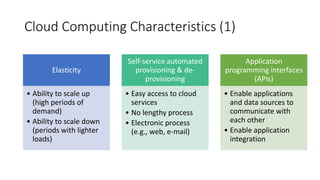
Cloud Computing Characteristics (1)
Elasticity
• Ability to scale up
(high periods of
demand)
• Ability to scale down
(periods with lighter
loads)
Self-service automated
provisioning & de-
provisioning
• Easy access to cloud
services
• No lengthy process
• Electronic process
(e.g., web, e-mail)
Application
programming interfaces
(APIs)
• Enable applications
and data sources to
communicate with
each other
• Enable application
integration
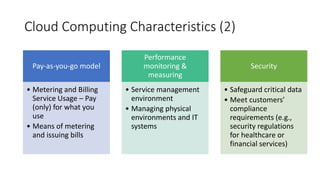
Cloud Computing Characteristics (2)
Pay-as-you-go model
• Metering and Billing
Service Usage – Pay
(only) for what you
use
• Means of metering
and issuing bills
Performance
monitoring &
measuring
• Service management
environment
• Managing physical
environments and IT
systems
Security
• Safeguard critical data
• Meet customers’
compliance
requirements (e.g.,
security regulations
for healthcare or
financial services)
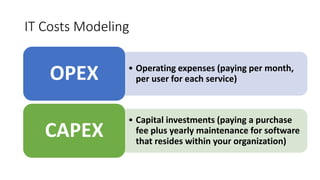
IT Costs Modeling
• Operating expenses (paying per month,
per user for each service)OPEX
• Capital investments (paying a purchase
fee plus yearly maintenance for software
that resides within your organization)
CAPEX
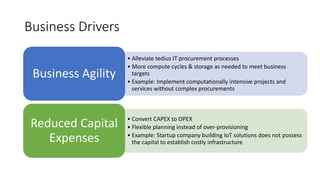
Business Drivers
• Alleviate tedius IT procurement processes
• More compute cycles & storage as needed to meet business
targets
• Example: Implement computationally intensive projects and
services without complex procurements
Business Agility
• Convert CAPEX to OPEX
• Flexible planning instead of over-provisioning
• Example: Startup company building IoT solutions does not possess
the capital to establish costly infrastructure
Reduced Capital
Expenses
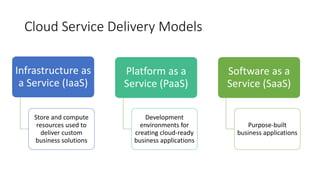
Cloud Service Delivery Models
Infrastructure as
a Service (IaaS)
Store and compute
resources used to
deliver custom
business solutions
Platform as a
Service (PaaS)
Development
environments for
creating cloud-ready
business applications
Software as a
Service (SaaS)
Purpose-built
business applications
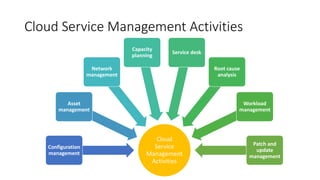
Cloud Service Management Activities
Cloud
Service
Management
Activities
Configuration
management
Asset
management
Network
management
Capacity
planning
Service desk
Root cause
analysis
Workload
management
Patch and
update
management
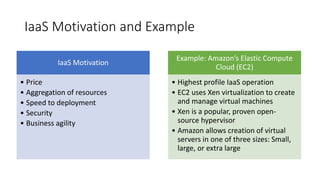
IaaS Motivation and Example
IaaS Motivation
• Price
• Aggregation of resources
• Speed to deployment
• Security
• Business agility
Example: Amazon’s Elastic Compute
Cloud (EC2)
• Highest profile IaaS operation
• EC2 uses Xen virtualization to create
and manage virtual machines
• Xen is a popular, proven open-
source hypervisor
• Amazon allows creation of virtual
servers in one of three sizes: Small,
large, or extra large
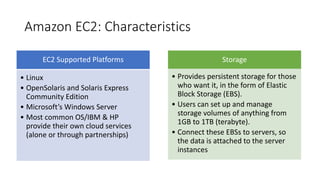
Amazon EC2: Characteristics
EC2 Supported Platforms
• Linux
• OpenSolaris and Solaris Express
Community Edition
• Microsoft’s Windows Server
• Most common OS/IBM & HP
provide their own cloud services
(alone or through partnerships)
Storage
• Provides persistent storage for those
who want it, in the form of Elastic
Block Storage (EBS).
• Users can set up and manage
storage volumes of anything from
1GB to 1TB (terabyte).
• Connect these EBSs to servers, so
the data is attached to the server
instances
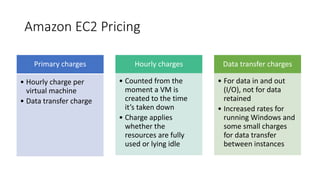
Amazon EC2 Pricing
Primary charges
• Hourly charge per
virtual machine
• Data transfer charge
Hourly charges
• Counted from the
moment a VM is
created to the time
it’s taken down
• Charge applies
whether the
resources are fully
used or lying idle
Data transfer charges
• For data in and out
(I/O), not for data
retained
• Increased rates for
running Windows and
some small charges
for data transfer
between instances
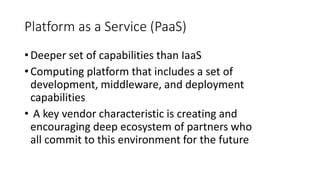
Platform as a Service (PaaS)
•Deeper set of capabilities than IaaS
•Computing platform that includes a set of
development, middleware, and deployment
capabilities
• A key vendor characteristic is creating and
encouraging deep ecosystem of partners who
all commit to this environment for the future
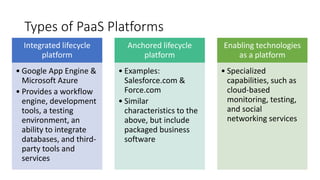
Types of PaaS Platforms
Integrated lifecycle
platform
• Google App Engine &
Microsoft Azure
• Provides a workflow
engine, development
tools, a testing
environment, an
ability to integrate
databases, and third-
party tools and
services
Anchored lifecycle
platform
• Examples:
Salesforce.com &
Force.com
• Similar
characteristics to the
above, but include
packaged business
software
Enabling technologies
as a platform
• Specialized
capabilities, such as
cloud-based
monitoring, testing,
and social
networking services
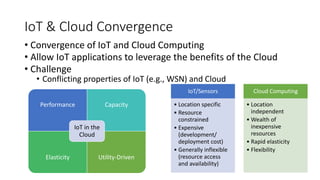
IoT & Cloud Convergence
• Convergence of IoT and Cloud Computing
• Allow IoT applications to leverage the benefits of the Cloud
• Challenge
• Conflicting properties of IoT (e.g., WSN) and Cloud
Performance Capacity
Elasticity Utility-Driven
IoT in the
Cloud
IoT/Sensors
• Location specific
• Resource
constrained
• Expensive
(development/
deployment cost)
• Generally inflexible
(resource access
and availability)
Cloud Computing
• Location
independent
• Wealth of
inexpensive
resources
• Rapid elasticity
• Flexibility
Sensor Clouds and Public IoT Clouds
• Streaming of Sensor/WSN data in a cloud infrastructure (2005-
2009) (Mainly Research Efforts)
• Advent of public IoT Clouds (2007+ including commercial
efforts), such as the following:
• Xively (xively.com)
• ThingsWorx (www.thingworx.com)
• ThingsSpeak (thingspeak.com)
• Sensor-Cloud (www.sensor-cloud.com)
• Realtime.io (https://realtime.io/)
• Etc.
• Open source IoT Cloud example:
• OpenIoT
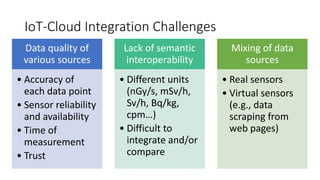
IoT-Cloud Integration Challenges
Data quality of
various sources
• Accuracy of
each data point
• Sensor reliability
and availability
• Time of
measurement
• Trust
Lack of semantic
interoperability
• Different units
(nGy/s, mSv/h,
Sv/h, Bq/kg,
cpm…)
• Difficult to
integrate and/or
compare
Mixing of data
sources
• Real sensors
• Virtual sensors
(e.g., data
scraping from
web pages)
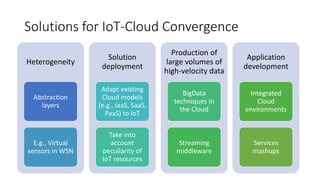
Solutions for IoT-Cloud Convergence
Heterogeneity
Abstraction
layers
E.g., Virtual
sensors in WSN
Solution
deployment
Adapt existing
Cloud models
(e.g., IaaS, SaaS,
PaaS) to IoT
Take into
account
peculiarity of
IoT resources
Production of
large volumes of
high-velocity data
BigData
techniques in
the Cloud
Streaming
middleware
Application
development
Integrated
Cloud
environments
Services
mashups
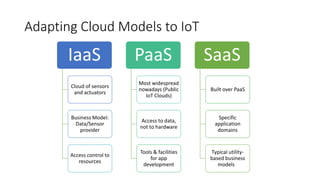
Adapting Cloud Models to IoT
IaaS
Cloud of sensors
and actuators
Business Model:
Data/Sensor
provider
Access control to
resources
PaaS
Most widespread
nowadays (Public
IoT Clouds)
Access to data,
not to hardware
Tools & facilities
for app
development
SaaS
Built over PaaS
Specific
application
domains
Typical utility-
based business
models
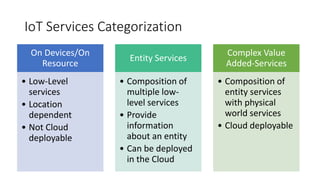
IoT Services Categorization
On Devices/On
Resource
• Low-Level
services
• Location
dependent
• Not Cloud
deployable
Entity Services
• Composition of
multiple low-
level services
• Provide
information
about an entity
• Can be deployed
in the Cloud
Complex Value
Added-Services
• Composition of
entity services
with physical
world services
• Cloud deployable
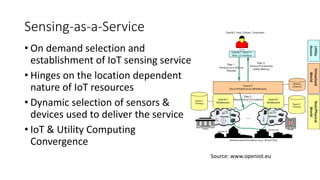
Sensing-as-a-Service
• On demand selection and
establishment of IoT sensing service
• Hinges on the location dependent
nature of IoT resources
• Dynamic selection of sensors &
devices used to deliver the service
• IoT & Utility Computing
Convergence
Source: www.openiot.eu
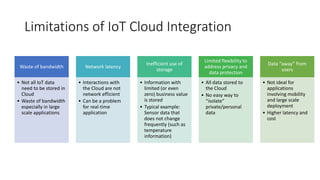
Limitations of IoT Cloud Integration
Waste of bandwidth
• Not all IoT data
need to be stored in
Cloud
• Waste of bandwidth
especially in large
scale applications
Network latency
• Interactions with
the Cloud are not
network efficient
• Can be a problem
for real-time
application
Inefficient use of
storage
• Information with
limited (or even
zero) business value
is stored
• Typical example:
Sensor data that
does not change
frequently (such as
temperature
information)
Limited flexibility to
address privacy and
data protection
• All data stored to
the Cloud
• No easy way to
“isolate”
private/personal
data
Data “away” from
users
• Not ideal for
applications
involving mobility
and large scale
deployment
• Higher latency and
cost
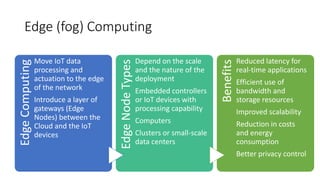
Edge (fog) ComputingEdgeComputing
Move IoT data
processing and
actuation to the edge
of the network
Introduce a layer of
gateways (Edge
Nodes) between the
Cloud and the IoT
devices
EdgeNodeTypes
Depend on the scale
and the nature of the
deployment
Embedded controllers
or IoT devices with
processing capability
Computers
Clusters or small-scale
data centers
Benefits
Reduced latency for
real-time applications
Efficient use of
bandwidth and
storage resources
Improved scalability
Reduction in costs
and energy
consumption
Better privacy control
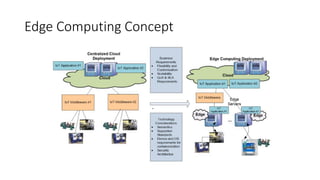
Edge Computing Concept
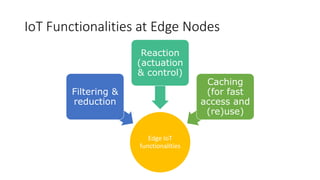
IoT Functionalities at Edge Nodes
Edge IoT
functionalities
Filtering &
reduction
Reaction
(actuation
& control)
Caching
(for fast
access and
(re)use)
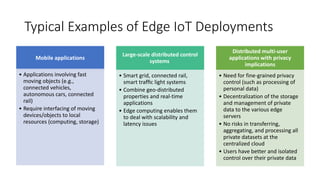
Typical Examples of Edge IoT Deployments
Mobile applications
• Applications involving fast
moving objects (e.g.,
connected vehicles,
autonomous cars, connected
rail)
• Require interfacing of moving
devices/objects to local
resources (computing, storage)
Large-scale distributed control
systems
• Smart grid, connected rail,
smart traffic light systems
• Combine geo-distributed
properties and real-time
applications
• Edge computing enables them
to deal with scalability and
latency issues
Distributed multi-user
applications with privacy
implications
• Need for fine-grained privacy
control (such as processing of
personal data)
• Decentralization of the storage
and management of private
data to the various edge
servers
• No risks in transferring,
aggregating, and processing all
private datasets at the
centralized cloud
• Users have better and isolated
control over their private data
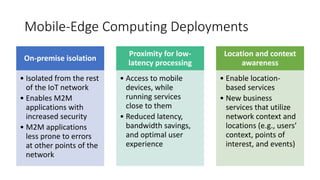
Mobile-Edge Computing Deployments
On-premise isolation
• Isolated from the rest
of the IoT network
• Enables M2M
applications with
increased security
• M2M applications
less prone to errors
at other points of the
network
Proximity for low-
latency processing
• Access to mobile
devices, while
running services
close to them
• Reduced latency,
bandwidth savings,
and optimal user
experience
Location and context
awareness
• Enable location-
based services
• New business
services that utilize
network context and
locations (e.g., users’
context, points of
interest, and events)
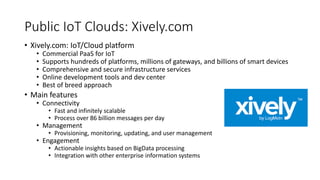
Public IoT Clouds: Xively.com
• Xively.com: IoT/Cloud platform
• Commercial PaaS for IoT
• Supports hundreds of platforms, millions of gateways, and billions of smart devices
• Comprehensive and secure infrastructure services
• Online development tools and dev center
• Best of breed approach
• Main features
• Connectivity
• Fast and infinitely scalable
• Process over 86 billion messages per day
• Management
• Provisioning, monitoring, updating, and user management
• Engagement
• Actionable insights based on BigData processing
• Integration with other enterprise information systems
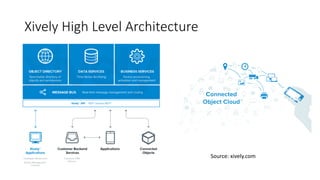
Xively High Level Architecture
Source: xively.com
ThingWorx.com
• Enterprise-ready technology platform that enables innovators
to rapidly develop and deploy smart, connected solutions for
IoT
• Delivered the 1st application platform for the Connected
World/M2M 2.0
• Enabled a 10X reduction in application development effort:
• Model-based development
• Search-based intelligence
• Ecosystem of ThingWorx Ready Extensions
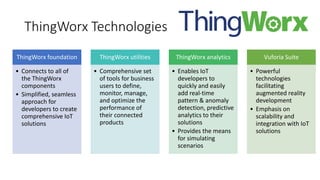
ThingWorx Technologies
ThingWorx foundation
• Connects to all of
the ThingWorx
components
• Simplified, seamless
approach for
developers to create
comprehensive IoT
solutions
ThingWorx utilities
• Comprehensive set
of tools for business
users to define,
monitor, manage,
and optimize the
performance of
their connected
products
ThingWorx analytics
• Enables IoT
developers to
quickly and easily
add real-time
pattern & anomaly
detection, predictive
analytics to their
solutions
• Provides the means
for simulating
scenarios
Vuforia Suite
• Powerful
technologies
facilitating
augmented reality
development
• Emphasis on
scalability and
integration with IoT
solutions
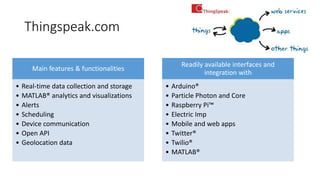
Thingspeak.com
Main features & functionalities
• Real-time data collection and storage
• MATLAB® analytics and visualizations
• Alerts
• Scheduling
• Device communication
• Open API
• Geolocation data
Readily available interfaces and
integration with
• Arduino®
• Particle Photon and Core
• Raspberry Pi™
• Electric Imp
• Mobile and web apps
• Twitter®
• Twilio®
• MATLAB®
Microsoft Azure Internet of Things (IoT)
• Microsoft Azure provides a PaaS infrastructure for IoT solutions:
• Primarily destined for Microsoft-based public IoT/cloud services
• Can enable private and hybrid cloud implementations as well
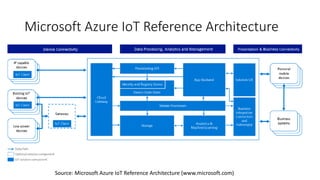
• Microsoft Azure IoT Reference Architecture
• Enable the flow of information between intermittent or
continuously connected devices and line-of-business assets and
cloud-based backend systems for the purpose of analysis, control,
and business process integration
• Designed for large-scale IoT environments with devices from
industrial serial production with tens of thousands of units and/or
industrial machinery emitting significant amounts of data
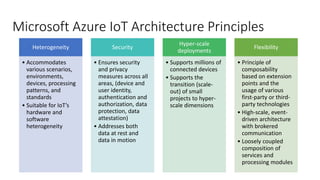
Microsoft Azure IoT Architecture Principles
Heterogeneity
• Accommodates
various scenarios,
environments,
devices, processing
patterns, and
standards
• Suitable for IoT’s
hardware and
software
heterogeneity
Security
• Ensures security
and privacy
measures across all
areas, (device and
user identity,
authentication and
authorization, data
protection, data
attestation)
• Addresses both
data at rest and
data in motion
Hyper-scale
deployments
• Supports millions of
connected devices
• Supports the
transition (scale-
out) of small
projects to hyper-
scale dimensions
Flexibility
• Principle of
composability
based on extension
points and the
usage of various
first-party or third-
party technologies
• High-scale, event-
driven architecture
with brokered
communication
• Loosely coupled
composition of
services and
processing modules
Microsoft Azure IoT Reference Architecture
Source: Microsoft Azure IoT Reference Architecture (www.microsoft.com)
Amazon AWS IoT
• AWS IoT provides secure, bi-directional communication between
Internet-connected things and the AWS cloud
• Supports
• Sensors
• Actuator
• Embedded devices
• Smart appliances
• Etc.
• Enables
• Collection of telemetry data from multiple devices
• Data storage and analysis
• Users to control these devices from their phones or tablets
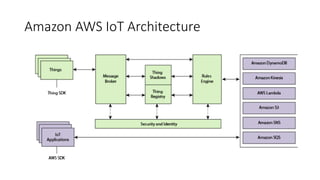
Amazon AWS IoT Architecture
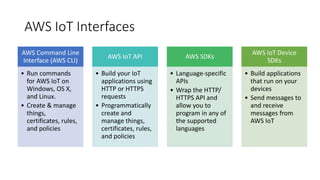
AWS IoT Interfaces
AWS Command Line
Interface (AWS CLI)
• Run commands
for AWS IoT on
Windows, OS X,
and Linux.
• Create & manage
things,
certificates, rules,
and policies
AWS IoT API
• Build your IoT
applications using
HTTP or HTTPS
requests
• Programmatically
create and
manage things,
certificates, rules,
and policies
AWS SDKs
• Language-specific
APIs
• Wrap the HTTP/
HTTPS API and
allow you to
program in any of
the supported
languages
AWS IoT Device
SDKs
• Build applications
that run on your
devices
• Send messages to
and receive
messages from
AWS IoT
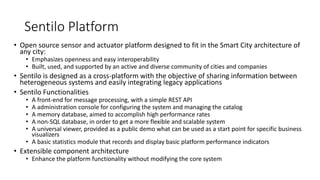
Sentilo Platform
• Open source sensor and actuator platform designed to fit in the Smart City architecture of
any city:
• Emphasizes openness and easy interoperability
• Built, used, and supported by an active and diverse community of cities and companies
• Sentilo is designed as a cross-platform with the objective of sharing information between
heterogeneous systems and easily integrating legacy applications
• Sentilo Functionalities
• A front-end for message processing, with a simple REST API
• A administration console for configuring the system and managing the catalog
• A memory database, aimed to accomplish high performance rates
• A non-SQL database, in order to get a more flexible and scalable system
• A universal viewer, provided as a public demo what can be used as a start point for specific business
visualizers
• A basic statistics module that records and display basic platform performance indicators
• Extensible component architecture
• Enhance the platform functionality without modifying the core system
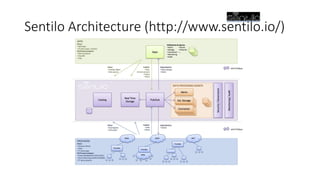
Sentilo Architecture (http://www.sentilo.io/)
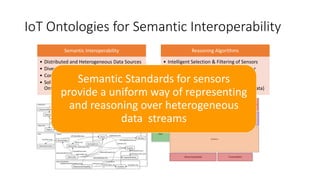
IoT Ontologies for Semantic Interoperability
Semantic Interoperability
• Distributed and Heterogeneous Data Sources
• Diverse Data Streams
• Common Semantics Needed
• Solution: Semantic Annoitation (W3C
Ontology)
Reasoning Algorithms
• Intelligent Selection & Filtering of Sensors
• Intelligent Selection & Filtering of Sensor
Data
• Use of Reasoners
• RDF/OWL Ontology (W3C SSN + Linked Data)
Semantic Standards for sensors
provide a uniform way of representing
and reasoning over heterogeneous
data streams
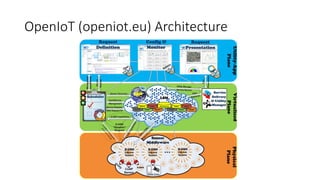
OpenIoT (openiot.eu) Architecture
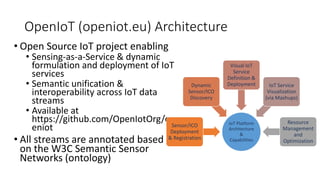
• Open Source IoT project enabling
• Sensing-as-a-Service & dynamic
formulation and deployment of IoT
services
• Semantic unification &
interoperability across IoT data
streams
• Available at
https://github.com/OpenIotOrg/op
eniot
• All streams are annotated based
on the W3C Semantic Sensor
Networks (ontology)
IoT Platform
Architecture
&
Capabilities
Sensor/ICO
Deployment
& Registration
Dynamic
Sensor/ICO
Discovery
Visual IoT
Service
Definition &
Deployment IoT Service
Visualization
(via Mashups)
Resource
Management
and
Optimization
OpenIoT (openiot.eu) Architecture
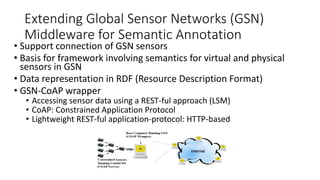
Extending Global Sensor Networks (GSN)
Middleware for Semantic Annotation
• Support connection of GSN sensors
• Basis for framework involving semantics for virtual and physical
sensors in GSN
• Data representation in RDF (Resource Description Format)
• GSN-CoAP wrapper
• Accessing sensor data using a REST-ful approach (LSM)
• CoAP: Constrained Application Protocol
• Lightweight REST-ful application-protocol: HTTP-based

05 internet-of-things-io t-cloudcomputing

  • 1.
    IoT and CloudComputing Integration John Soldatos, PhD (jsol@ait.gr; john.Soldatos@gmail.com)
  • 2.
    Overview: Contents Rationale • CloudComputing Overview • Why Integrating IoT & Cloud? IoT & Cloud Integration Models • Cloud Computing Models • IoT & Cloud Models (IaaS, PaaS, SaaS) • Sensing-as-a- Service Edge/Fog Computing • Motivation • IoT Edge Functionalities • Taxonomy of Applications Examples • Popular Public IoT Cloud Providers • Analysis of Architecture and Functionalities
  • 3.
    Cloud Computing • Nextevolutionary step in Internet- based computing models • Provides the means for delivering ICT resources as a service: • Computing power • Computing infrastructure • Applications • Business processes • Collaboration • Etc. • Regardless of time and end-user’s location
  • 4.
    Cloud Computing: MainStakeholders Vendors • Provide applications and enable technology, infrastructure, hardware, and integration Partners of the vendors • Create cloud services offerings • Provide support services to customers Business leaders • Using or evaluating various types of cloud computing offerings
  • 5.
    Cloud Computing Characteristics(1) Elasticity • Ability to scale up (high periods of demand) • Ability to scale down (periods with lighter loads) Self-service automated provisioning & de- provisioning • Easy access to cloud services • No lengthy process • Electronic process (e.g., web, e-mail) Application programming interfaces (APIs) • Enable applications and data sources to communicate with each other • Enable application integration
  • 6.
    Cloud Computing Characteristics(2) Pay-as-you-go model • Metering and Billing Service Usage – Pay (only) for what you use • Means of metering and issuing bills Performance monitoring & measuring • Service management environment • Managing physical environments and IT systems Security • Safeguard critical data • Meet customers’ compliance requirements (e.g., security regulations for healthcare or financial services)
  • 7.
    IT Costs Modeling •Operating expenses (paying per month, per user for each service)OPEX • Capital investments (paying a purchase fee plus yearly maintenance for software that resides within your organization) CAPEX
  • 8.
    Business Drivers • Alleviatetedius IT procurement processes • More compute cycles & storage as needed to meet business targets • Example: Implement computationally intensive projects and services without complex procurements Business Agility • Convert CAPEX to OPEX • Flexible planning instead of over-provisioning • Example: Startup company building IoT solutions does not possess the capital to establish costly infrastructure Reduced Capital Expenses
  • 9.
    Cloud Service DeliveryModels Infrastructure as a Service (IaaS) Store and compute resources used to deliver custom business solutions Platform as a Service (PaaS) Development environments for creating cloud-ready business applications Software as a Service (SaaS) Purpose-built business applications
  • 10.
    Cloud Service ManagementActivities Cloud Service Management Activities Configuration management Asset management Network management Capacity planning Service desk Root cause analysis Workload management Patch and update management
  • 11.
    IaaS Motivation andExample IaaS Motivation • Price • Aggregation of resources • Speed to deployment • Security • Business agility Example: Amazon’s Elastic Compute Cloud (EC2) • Highest profile IaaS operation • EC2 uses Xen virtualization to create and manage virtual machines • Xen is a popular, proven open- source hypervisor • Amazon allows creation of virtual servers in one of three sizes: Small, large, or extra large
  • 12.
    Amazon EC2: Characteristics EC2Supported Platforms • Linux • OpenSolaris and Solaris Express Community Edition • Microsoft’s Windows Server • Most common OS/IBM & HP provide their own cloud services (alone or through partnerships) Storage • Provides persistent storage for those who want it, in the form of Elastic Block Storage (EBS). • Users can set up and manage storage volumes of anything from 1GB to 1TB (terabyte). • Connect these EBSs to servers, so the data is attached to the server instances
  • 13.
    Amazon EC2 Pricing Primarycharges • Hourly charge per virtual machine • Data transfer charge Hourly charges • Counted from the moment a VM is created to the time it’s taken down • Charge applies whether the resources are fully used or lying idle Data transfer charges • For data in and out (I/O), not for data retained • Increased rates for running Windows and some small charges for data transfer between instances
  • 14.
    Platform as aService (PaaS) •Deeper set of capabilities than IaaS •Computing platform that includes a set of development, middleware, and deployment capabilities • A key vendor characteristic is creating and encouraging deep ecosystem of partners who all commit to this environment for the future
  • 15.
    Types of PaaSPlatforms Integrated lifecycle platform • Google App Engine & Microsoft Azure • Provides a workflow engine, development tools, a testing environment, an ability to integrate databases, and third- party tools and services Anchored lifecycle platform • Examples: Salesforce.com & Force.com • Similar characteristics to the above, but include packaged business software Enabling technologies as a platform • Specialized capabilities, such as cloud-based monitoring, testing, and social networking services
  • 16.
    IoT & CloudConvergence • Convergence of IoT and Cloud Computing • Allow IoT applications to leverage the benefits of the Cloud • Challenge • Conflicting properties of IoT (e.g., WSN) and Cloud Performance Capacity Elasticity Utility-Driven IoT in the Cloud IoT/Sensors • Location specific • Resource constrained • Expensive (development/ deployment cost) • Generally inflexible (resource access and availability) Cloud Computing • Location independent • Wealth of inexpensive resources • Rapid elasticity • Flexibility
  • 17.
    Sensor Clouds andPublic IoT Clouds • Streaming of Sensor/WSN data in a cloud infrastructure (2005- 2009) (Mainly Research Efforts) • Advent of public IoT Clouds (2007+ including commercial efforts), such as the following: • Xively (xively.com) • ThingsWorx (www.thingworx.com) • ThingsSpeak (thingspeak.com) • Sensor-Cloud (www.sensor-cloud.com) • Realtime.io (https://realtime.io/) • Etc. • Open source IoT Cloud example: • OpenIoT
  • 18.
    IoT-Cloud Integration Challenges Dataquality of various sources • Accuracy of each data point • Sensor reliability and availability • Time of measurement • Trust Lack of semantic interoperability • Different units (nGy/s, mSv/h, Sv/h, Bq/kg, cpm…) • Difficult to integrate and/or compare Mixing of data sources • Real sensors • Virtual sensors (e.g., data scraping from web pages)
  • 19.
    Solutions for IoT-CloudConvergence Heterogeneity Abstraction layers E.g., Virtual sensors in WSN Solution deployment Adapt existing Cloud models (e.g., IaaS, SaaS, PaaS) to IoT Take into account peculiarity of IoT resources Production of large volumes of high-velocity data BigData techniques in the Cloud Streaming middleware Application development Integrated Cloud environments Services mashups
  • 20.
    Adapting Cloud Modelsto IoT IaaS Cloud of sensors and actuators Business Model: Data/Sensor provider Access control to resources PaaS Most widespread nowadays (Public IoT Clouds) Access to data, not to hardware Tools & facilities for app development SaaS Built over PaaS Specific application domains Typical utility- based business models
  • 21.
    IoT Services Categorization OnDevices/On Resource • Low-Level services • Location dependent • Not Cloud deployable Entity Services • Composition of multiple low- level services • Provide information about an entity • Can be deployed in the Cloud Complex Value Added-Services • Composition of entity services with physical world services • Cloud deployable
  • 22.
    Sensing-as-a-Service • On demandselection and establishment of IoT sensing service • Hinges on the location dependent nature of IoT resources • Dynamic selection of sensors & devices used to deliver the service • IoT & Utility Computing Convergence Source: www.openiot.eu
  • 23.
    Limitations of IoTCloud Integration Waste of bandwidth • Not all IoT data need to be stored in Cloud • Waste of bandwidth especially in large scale applications Network latency • Interactions with the Cloud are not network efficient • Can be a problem for real-time application Inefficient use of storage • Information with limited (or even zero) business value is stored • Typical example: Sensor data that does not change frequently (such as temperature information) Limited flexibility to address privacy and data protection • All data stored to the Cloud • No easy way to “isolate” private/personal data Data “away” from users • Not ideal for applications involving mobility and large scale deployment • Higher latency and cost
  • 24.
    Edge (fog) ComputingEdgeComputing MoveIoT data processing and actuation to the edge of the network Introduce a layer of gateways (Edge Nodes) between the Cloud and the IoT devices EdgeNodeTypes Depend on the scale and the nature of the deployment Embedded controllers or IoT devices with processing capability Computers Clusters or small-scale data centers Benefits Reduced latency for real-time applications Efficient use of bandwidth and storage resources Improved scalability Reduction in costs and energy consumption Better privacy control
  • 25.
  • 26.
    IoT Functionalities atEdge Nodes Edge IoT functionalities Filtering & reduction Reaction (actuation & control) Caching (for fast access and (re)use)
  • 27.
    Typical Examples ofEdge IoT Deployments Mobile applications • Applications involving fast moving objects (e.g., connected vehicles, autonomous cars, connected rail) • Require interfacing of moving devices/objects to local resources (computing, storage) Large-scale distributed control systems • Smart grid, connected rail, smart traffic light systems • Combine geo-distributed properties and real-time applications • Edge computing enables them to deal with scalability and latency issues Distributed multi-user applications with privacy implications • Need for fine-grained privacy control (such as processing of personal data) • Decentralization of the storage and management of private data to the various edge servers • No risks in transferring, aggregating, and processing all private datasets at the centralized cloud • Users have better and isolated control over their private data
  • 28.
    Mobile-Edge Computing Deployments On-premiseisolation • Isolated from the rest of the IoT network • Enables M2M applications with increased security • M2M applications less prone to errors at other points of the network Proximity for low- latency processing • Access to mobile devices, while running services close to them • Reduced latency, bandwidth savings, and optimal user experience Location and context awareness • Enable location- based services • New business services that utilize network context and locations (e.g., users’ context, points of interest, and events)
  • 29.
    Public IoT Clouds:Xively.com • Xively.com: IoT/Cloud platform • Commercial PaaS for IoT • Supports hundreds of platforms, millions of gateways, and billions of smart devices • Comprehensive and secure infrastructure services • Online development tools and dev center • Best of breed approach • Main features • Connectivity • Fast and infinitely scalable • Process over 86 billion messages per day • Management • Provisioning, monitoring, updating, and user management • Engagement • Actionable insights based on BigData processing • Integration with other enterprise information systems
  • 30.
    Xively High LevelArchitecture Source: xively.com
  • 31.
    ThingWorx.com • Enterprise-ready technologyplatform that enables innovators to rapidly develop and deploy smart, connected solutions for IoT • Delivered the 1st application platform for the Connected World/M2M 2.0 • Enabled a 10X reduction in application development effort: • Model-based development • Search-based intelligence • Ecosystem of ThingWorx Ready Extensions
  • 32.
    ThingWorx Technologies ThingWorx foundation •Connects to all of the ThingWorx components • Simplified, seamless approach for developers to create comprehensive IoT solutions ThingWorx utilities • Comprehensive set of tools for business users to define, monitor, manage, and optimize the performance of their connected products ThingWorx analytics • Enables IoT developers to quickly and easily add real-time pattern & anomaly detection, predictive analytics to their solutions • Provides the means for simulating scenarios Vuforia Suite • Powerful technologies facilitating augmented reality development • Emphasis on scalability and integration with IoT solutions
  • 33.
    Thingspeak.com Main features &functionalities • Real-time data collection and storage • MATLAB® analytics and visualizations • Alerts • Scheduling • Device communication • Open API • Geolocation data Readily available interfaces and integration with • Arduino® • Particle Photon and Core • Raspberry Pi™ • Electric Imp • Mobile and web apps • Twitter® • Twilio® • MATLAB®
  • 34.
    Microsoft Azure Internetof Things (IoT) • Microsoft Azure provides a PaaS infrastructure for IoT solutions: • Primarily destined for Microsoft-based public IoT/cloud services • Can enable private and hybrid cloud implementations as well • Microsoft Azure IoT Reference Architecture • Enable the flow of information between intermittent or continuously connected devices and line-of-business assets and cloud-based backend systems for the purpose of analysis, control, and business process integration • Designed for large-scale IoT environments with devices from industrial serial production with tens of thousands of units and/or industrial machinery emitting significant amounts of data
  • 35.
    Microsoft Azure IoTArchitecture Principles Heterogeneity • Accommodates various scenarios, environments, devices, processing patterns, and standards • Suitable for IoT’s hardware and software heterogeneity Security • Ensures security and privacy measures across all areas, (device and user identity, authentication and authorization, data protection, data attestation) • Addresses both data at rest and data in motion Hyper-scale deployments • Supports millions of connected devices • Supports the transition (scale- out) of small projects to hyper- scale dimensions Flexibility • Principle of composability based on extension points and the usage of various first-party or third- party technologies • High-scale, event- driven architecture with brokered communication • Loosely coupled composition of services and processing modules
  • 36.
    Microsoft Azure IoTReference Architecture Source: Microsoft Azure IoT Reference Architecture (www.microsoft.com)
  • 37.
    Amazon AWS IoT •AWS IoT provides secure, bi-directional communication between Internet-connected things and the AWS cloud • Supports • Sensors • Actuator • Embedded devices • Smart appliances • Etc. • Enables • Collection of telemetry data from multiple devices • Data storage and analysis • Users to control these devices from their phones or tablets
  • 38.
    Amazon AWS IoTArchitecture
  • 39.
    AWS IoT Interfaces AWSCommand Line Interface (AWS CLI) • Run commands for AWS IoT on Windows, OS X, and Linux. • Create & manage things, certificates, rules, and policies AWS IoT API • Build your IoT applications using HTTP or HTTPS requests • Programmatically create and manage things, certificates, rules, and policies AWS SDKs • Language-specific APIs • Wrap the HTTP/ HTTPS API and allow you to program in any of the supported languages AWS IoT Device SDKs • Build applications that run on your devices • Send messages to and receive messages from AWS IoT
  • 40.
    Sentilo Platform • Opensource sensor and actuator platform designed to fit in the Smart City architecture of any city: • Emphasizes openness and easy interoperability • Built, used, and supported by an active and diverse community of cities and companies • Sentilo is designed as a cross-platform with the objective of sharing information between heterogeneous systems and easily integrating legacy applications • Sentilo Functionalities • A front-end for message processing, with a simple REST API • A administration console for configuring the system and managing the catalog • A memory database, aimed to accomplish high performance rates • A non-SQL database, in order to get a more flexible and scalable system • A universal viewer, provided as a public demo what can be used as a start point for specific business visualizers • A basic statistics module that records and display basic platform performance indicators • Extensible component architecture • Enhance the platform functionality without modifying the core system
  • 41.
  • 42.
    IoT Ontologies forSemantic Interoperability Semantic Interoperability • Distributed and Heterogeneous Data Sources • Diverse Data Streams • Common Semantics Needed • Solution: Semantic Annoitation (W3C Ontology) Reasoning Algorithms • Intelligent Selection & Filtering of Sensors • Intelligent Selection & Filtering of Sensor Data • Use of Reasoners • RDF/OWL Ontology (W3C SSN + Linked Data) Semantic Standards for sensors provide a uniform way of representing and reasoning over heterogeneous data streams
  • 43.
    OpenIoT (openiot.eu) Architecture •Open Source IoT project enabling • Sensing-as-a-Service & dynamic formulation and deployment of IoT services • Semantic unification & interoperability across IoT data streams • Available at https://github.com/OpenIotOrg/op eniot • All streams are annotated based on the W3C Semantic Sensor Networks (ontology) IoT Platform Architecture & Capabilities Sensor/ICO Deployment & Registration Dynamic Sensor/ICO Discovery Visual IoT Service Definition & Deployment IoT Service Visualization (via Mashups) Resource Management and Optimization
  • 44.
  • 45.
    Extending Global SensorNetworks (GSN) Middleware for Semantic Annotation • Support connection of GSN sensors • Basis for framework involving semantics for virtual and physical sensors in GSN • Data representation in RDF (Resource Description Format) • GSN-CoAP wrapper • Accessing sensor data using a REST-ful approach (LSM) • CoAP: Constrained Application Protocol • Lightweight REST-ful application-protocol: HTTP-based