NAME: ABDUL SULEMAN
ROLL NO: 22081A1202
BRANCH: INFORMATION TECHNOLOGY (I.T.)
2nd YEAR – 1st SEMESTER
IoT PRESENTATION
SUBMITTED TO: MR. RAJESH (IoT PROF.)
SHADAN COLLEGE OF ENGINEERING &
TECHNOLOGY
TOPIC: CLOUD
COMPUTING
CLOUD COMPUTING
 INTRODUCTION
 IMPORTANCE
 CLOUD BASED IOT PLATFORMS
 EDGE COMPUTING VS. CLOUD COMPUTING
 CLOUD-BASED IoT DATA STORAGE
 REAL-TIME DATA PROCESSING IN THE CLOUD
 IoT ANALYTICS AND MACHINE LEARNING IN THE CLOUD
 SECURITY AND PRIVACY CONSIDERATIONS
 CONCLUSION
INTRODUCTION
Cloud computing is a transformative technology that involves the delivery
of computing services—such as storage, processing power, and
applications—over the internet. Instead of relying on local servers or
devices, users access and utilize resources hosted on remote servers. This
model offers scalability, flexibility, and cost-efficiency, allowing
organizations and individuals to access computing capabilities on-demand
without the need for extensive infrastructure investments. Cloud
computing is characterized by three main service models: Infrastructure as
a Service (IaaS), Platform as a Service (PaaS), and Software as a Service
(SaaS), each catering to specific computing needs.
IMPORTANCE
Cloud computing is vital for modern businesses and individuals
due to its pivotal role in providing scalable, flexible, and cost-
effective access to computing resources over the internet. It
eliminates the need for extensive on-premises infrastructure,
enabling users to deploy applications, store data, and leverage
powerful computing capabilities on-demand. The importance
lies in its ability to enhance efficiency, agility, and innovation,
allowing organizations to adapt quickly to changing demands,
reduce operational costs, and foster a dynamic and competitive
digital landscape.
CLOUD BASED IOT PLATFORMS
Several cloud-based IoT platforms offer comprehensive solutions for deploying, managing, and extracting insights from Internet of Things
(IoT) devices. Here are some prominent platforms:
• AWS IoT (Amazon Web Services):
• Key Features: Device management, data processing, security, and integration with other AWS services.
• Benefits: Scalability, extensive ecosystem, and seamless integration with various AWS tools.
• Azure IoT (Microsoft Azure):
• Key Features: Device provisioning, analytics, machine learning, and integration with Azure services.
• Benefits: Robust analytics capabilities, integration with Microsoft products, and diverse development tools.
• Google Cloud IoT:
• Key Features: Device registry, data storage, machine learning, and integration with other Google Cloud
services.
• Benefits: Scalable infrastructure, strong analytics, and interoperability with Google Cloud's broader ecosystem.
• IBM Watson IoT:
• Key Features: Device management, analytics, artificial intelligence (AI), and integration with IBM Cloud
services.
• Benefits: AI-powered insights, advanced analytics, and end-to-end security.
• Cisco IoT Cloud Connect:
• Key Features: Device connectivity, data processing, and integration with Cisco's broader networking and
security solutions.
• Benefits: Robust networking capabilities, security features, and scalable connectivity.
• Thing Speak (MATLAB IoT):
• Key Features: Data collection, analysis, and visualization with MATLAB integration.
• Benefits: Simplicity, compatibility with MATLAB, and quick setup for small to medium-scale IoT projects.
• Particle:
• Key Features: Device management, data storage, and integration with third-party services.
• Benefits: Focus on ease of use, supports a variety of devices, and suitable for prototyping and
small-scale deployments.
• Bosch IoT Suite:
• Key Features: Device management, data analytics, and integration with Bosch's ecosystem.
• Benefits: Industrial focus, strong analytics, and compatibility with Bosch devices.
• Oracle IoT Cloud:
• Key Features: Device management, analytics, and integration with Oracle's broader cloud services.
• Benefits: Comprehensive cloud services, end-to-end security, and scalability.
• Ubidots:
• Key Features: Data visualization, analytics, and device management.
• Benefits: User-friendly interface, suitable for small to medium-scale deployments, and quick
implementation.
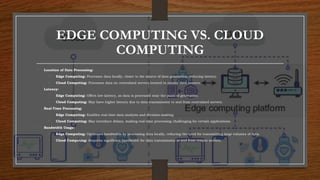
EDGE COMPUTING VS. CLOUD
COMPUTING
• Location of Data Processing:
• Edge Computing: Processes data locally, closer to the source of data generation, reducing latency.
• Cloud Computing: Processes data on centralized servers located in remote data centers.
• Latency:
• Edge Computing: Offers low latency, as data is processed near the point of generation.
• Cloud Computing: May have higher latency due to data transmission to and from centralized servers.
• Real-Time Processing:
• Edge Computing: Enables real-time data analysis and decision-making.
• Cloud Computing: May introduce delays, making real-time processing challenging for certain applications.
• Bandwidth Usage:
• Edge Computing: Optimizes bandwidth by processing data locally, reducing the need for transmitting large volumes of data.
• Cloud Computing: Requires significant bandwidth for data transmission to and from remote servers.
• Scalability:
• Edge Computing: May have limited scalability due to resource constraints on edge devices.
• Cloud Computing: Offers high scalability, allowing resources to be easily scaled up or down based
on demand.
• Accessibility:
• Edge Computing: Limited accessibility based on device proximity.
• Cloud Computing: Provides ubiquitous access from anywhere with an internet connection.
• Resource Availability:
• Edge Computing: Relies on local computational resources available on edge devices.
• Cloud Computing: Leverages remote servers with extensive computational capabilities.
• Use Cases:
• Edge Computing: Well-suited for applications requiring real-time responses, such as industrial
IoT, autonomous vehicles, and healthcare monitoring.
• Cloud Computing: Suited for scalable and centralized processing, including web-based
applications, data analytics, and software development.
• Security and Privacy:
• Edge Computing: Enhances privacy as data processing occurs locally, reducing the
need to transmit sensitive information.
• Cloud Computing: Requires robust security measures for centralized data storage and
processing, with potential privacy concerns.
• Dependency on Internet Connectivity:
• Edge Computing: Less dependent on continuous internet connectivity for data
processing.
• Cloud Computing: Requires a stable internet connection for accessing and processing
data on remote servers.
The choice between edge computing and cloud computing depends on specific use case
requirements, balancing factors such as latency, data processing needs, scalability, and
accessibility. In many scenarios, a hybrid or edge-to-cloud architecture is adopted to
leverage the strengths of both approaches.
CLOUD-BASED IOT DATA STORAGE
Cloud-based IoT data storage involves utilizing remote servers and databases to store and manage the vast amounts of data generated by Internet of
Things (IoT) devices. Here are key aspects of cloud-based IoT data storage:
• Scalability:
• Cloud platforms provide scalable storage solutions, allowing IoT applications to accommodate varying data volumes efficiently. Users can
easily scale up or down based on demand without the need for extensive infrastructure management.
• Accessibility:
• Data stored in the cloud is accessible from anywhere with an internet connection. This enables users to retrieve, analyze, and act upon IoT
data from diverse locations, supporting global accessibility and collaboration.
• Cost-Efficiency:
• Cloud-based storage eliminates the need for organizations to invest in and maintain on-premises storage infrastructure. Users pay for the
storage capacity they use, promoting cost-effectiveness and flexibility in managing data storage expenses.
• Data Security:
• Cloud service providers implement robust security measures to protect IoT data.
Encryption, access controls, and authentication mechanisms ensure the
confidentiality and integrity of stored information. Compliance with industry standards
and regulations further enhances data security.
• Data Redundancy and Reliability:
• Cloud platforms often incorporate redundancy measures such as data replication
across multiple locations. This ensures data reliability and availability even in the
event of hardware failures or other disruptions.
• Integration with Analytics:
• Cloud-based storage facilitates seamless integration with analytics services. Users can
perform advanced analytics, machine learning, and gain insights from IoT data directly
within the cloud environment, enabling informed decision-making.
• Real-Time Data Processing:
• Some cloud platforms support real-time data processing and analysis, allowing
organizations to derive actionable insights from IoT data as it is generated. This
capability is crucial for applications requiring immediate responses.
• Compatibility with IoT Platforms:
• Cloud-based data storage is often integrated with broader IoT platforms. This
integration streamlines the flow of data from IoT devices to storage, making it easier to
manage, analyze, and derive value from the data within the context of the entire IoT
ecosystem.
• Backup and Recovery:
• Cloud storage services typically include backup and recovery features, ensuring data
resilience. In case of data loss or corruption, organizations can restore information
from backups stored in the cloud.
• Data Lifecycle Management:
• Cloud platforms offer tools for managing the entire data lifecycle, from
ingestion to archival or deletion. This facilitates efficient data management,
optimizing storage resources and costs.
Popular cloud providers offering services for IoT data storage include Amazon
Web Services (AWS), Microsoft Azure, Google Cloud Platform, and IBM Cloud.
The choice of a specific cloud service depends on factors such as the
organization's requirements, integration needs, and preferred cloud ecosystem.
REAL-TIME DATA PROCESSING IN
THE CLOUD
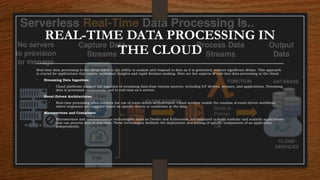
Real-time data processing in the cloud refers to the ability to analyze and respond to data as it is generated, without significant delays. This approach
is crucial for applications that require immediate insights and rapid decision-making. Here are key aspects of real-time data processing in the cloud:
• Streaming Data Ingestion:
• Cloud platforms support the ingestion of streaming data from various sources, including IoT devices, sensors, and applications. Streaming
data is processed continuously and in real-time as it arrives.
• Event-Driven Architectures:
• Real-time processing often involves the use of event-driven architectures. Cloud services enable the creation of event-driven workflows
where responses are triggered based on specific events or conditions in the data.
• Microservices and Containers:
• Microservices and containerization technologies, such as Docker and Kubernetes, are employed to build modular and scalable applications
that can process data in real-time. These technologies facilitate the deployment and scaling of specific components of an application
independently.
• Serverless Computing:
• Serverless computing models, where developers focus on writing code without managing the underlying
infrastructure, are conducive to real-time data processing. Cloud providers offer serverless platforms (e.g., AWS
Lambda, Azure Functions) that automatically scale based on demand.
• Cloud-Based Stream Processing Services:
• Cloud providers offer specialized services for stream processing. Examples include AWS Kinesis, Azure Stream
Analytics, and Google Cloud Dataflow. These services allow the creation of data pipelines for real-time processing.
• Analytics and Machine Learning:
• Cloud-based analytics and machine learning services can be integrated into real-time data processing pipelines.
This enables the extraction of actionable insights and predictions as data flows through the system.
• Low-Latency Data Storage:
• Cloud platforms provide low-latency data storage options, such as in-memory databases or NoSQL databases
optimized for fast read and write operations. This ensures that processed data can be quickly retrieved when
needed.
• Integration with External Services:
• Real-time data processing in the cloud often involves integration with external services, such as
messaging queues, notification systems, or third-party APIs. This facilitates the seamless flow of
data and information across different components.
• Monitoring and Visualization:
• Cloud platforms offer tools for monitoring and visualizing real-time data processing workflows.
Dashboards and alerts help ensure the health and performance of the system.
• Scalability and Fault Tolerance:
• Cloud environments provide scalability to handle varying workloads and fault-tolerance
mechanisms to ensure the reliability of real-time processing systems, even in the face of failures.
Applications that benefit from real-time data processing in the cloud include fraud detection, monitoring
and control of IoT devices, financial trading platforms, and real-time analytics in various industries.
Leveraging cloud services for real-time processing enables organizations to harness the power of immediate
insights and make timely decisions based on the most up-to-date information.
IoT ANALYTICS AND MAHINE
LEARNING IN THE CLOUD
IoT analytics and machine learning in the cloud involve leveraging cloud computing resources and services to analyze vast amounts of
data generated by Internet of Things (IoT) devices. Here are key aspects of incorporating analytics and machine learning into IoT
workflows in the cloud:
• Data Ingestion and Storage:
• Cloud platforms provide scalable and secure data storage solutions for handling large volumes of IoT-generated data. This
data is ingested into cloud-based databases or data lakes.
• Preprocessing and Transformation:
• Before analysis, raw IoT data often undergoes preprocessing and transformation in the cloud. This may include cleaning,
filtering, and structuring the data for further analysis.
• Cloud-Based Analytics Services:
• Cloud providers offer specialized analytics services that facilitate the exploration and visualization of IoT data. These services
include tools for querying, aggregating, and gaining insights from the stored data.
• Machine Learning Model Training:
• Cloud platforms provide environments for training machine learning models using IoT data. This
involves utilizing cloud-based machine learning services or frameworks like TensorFlow, PyTorch,
or scikit-learn.
• Predictive Analytics:
• Machine learning models trained on historical IoT data can be deployed in the cloud to make
predictions and identify patterns. Predictive analytics enable organizations to anticipate future
events or conditions based on current and historical data.
• Anomaly Detection:
• Machine learning algorithms in the cloud can be employed to detect anomalies or unusual patterns
in IoT data. This is valuable for identifying potential issues, faults, or security threats in real-time.
• Real-Time Inference:
• Cloud-based machine learning models can be deployed for real-time inference on incoming IoT data
streams. This enables immediate decision-making based on the latest data.
• Integration with Edge Computing:
• Analytics and machine learning models trained in the cloud can be integrated with edge devices for local processing. This
hybrid approach combines the scalability of the cloud with the low latency benefits of edge computing.
• AutoML (Automated Machine Learning):
• Cloud platforms offer AutoML tools that automate various steps in the machine learning process, from feature engineering to
model selection. This simplifies the deployment of machine learning models for users with varying levels of expertise.
• Model Monitoring and Management:
• Cloud environments provide tools for monitoring the performance of deployed machine learning models. Organizations can
track model accuracy, detect drift, and manage model versions efficiently.
• Scalability and Resource Management:
• Cloud services ensure the scalability of analytics and machine learning workloads. Organizations can dynamically allocate
resources based on demand, optimizing performance and cost-effectiveness.
• Integration with IoT Platforms:
• Cloud-based analytics seamlessly integrate with broader IoT platforms, creating end-to-end solutions. This integration
streamlines the flow of data, analysis, and decision-making within the entire IoT ecosystem.
By harnessing cloud-based analytics and machine learning, organizations can derive actionable insights from IoT data, enhance
operational efficiency, and make informed decisions. The cloud's flexibility and scalability contribute to the development of
intelligent and adaptive IoT systems.
SECURITY AN PRIVACY
CONSIDERATIONS
Security and privacy considerations in the cloud are paramount due to the sensitive nature of the data stored and processed on remote
servers. Here are key factors to consider in ensuring robust security and privacy practices in cloud computing:
• Data Encryption:
• Employ robust encryption for data in transit and at rest to protect against unauthorized access.
• Access Controls:
• Implement strict access controls and follow the principle of least privilege to restrict data access to authorized entities.
• Identity and Authentication:
• Utilize strong identity and authentication measures, including multi-factor authentication, to verify user and system identities.
• Regular Audits and Monitoring:
• Conduct regular security audits and employ monitoring tools to detect and respond
promptly to potential security threats.
• Incident Response Plan:
• Develop and implement an incident response plan to efficiently address and mitigate
the impact of security incidents.
• Privacy Compliance:
• Adhere to privacy regulations and standards, ensuring compliance with data
protection laws such as GDPR or HIPAA.
These measures collectively contribute to a secure and privacy-aware cloud environment,
safeguarding sensitive data and ensuring regulatory compliance.
CONCLUSION
In conclusion, the cloud has become a transformative force, reshaping the landscape of computing and data
management. Its scalability, flexibility, and cost-effectiveness have revolutionized the way businesses
operate and innovate. However, with these opportunities come critical considerations, particularly in the
realms of security and privacy. As organizations harness the power of cloud computing, it is imperative to
prioritize robust encryption, access controls, and identity verification to safeguard sensitive data. Regular
audits, incident response planning, and adherence to privacy regulations contribute to a resilient and
compliant cloud ecosystem. Striking a balance between innovation and security is key as we navigate the
dynamic landscape of cloud computing, ensuring that the potential for growth is maximized while risks are
mitigated effectively. The cloud's journey is ongoing, marked by continuous advancements and a
commitment to providing scalable, accessible, and secure computing solutions for the digital age.
information of technology ppt of cloud computing

information of technology ppt of cloud computing

  • 1.
    NAME: ABDUL SULEMAN ROLLNO: 22081A1202 BRANCH: INFORMATION TECHNOLOGY (I.T.) 2nd YEAR – 1st SEMESTER IoT PRESENTATION SUBMITTED TO: MR. RAJESH (IoT PROF.) SHADAN COLLEGE OF ENGINEERING & TECHNOLOGY
  • 2.
  • 3.
    CLOUD COMPUTING  INTRODUCTION IMPORTANCE  CLOUD BASED IOT PLATFORMS  EDGE COMPUTING VS. CLOUD COMPUTING  CLOUD-BASED IoT DATA STORAGE  REAL-TIME DATA PROCESSING IN THE CLOUD  IoT ANALYTICS AND MACHINE LEARNING IN THE CLOUD  SECURITY AND PRIVACY CONSIDERATIONS  CONCLUSION
  • 4.
    INTRODUCTION Cloud computing isa transformative technology that involves the delivery of computing services—such as storage, processing power, and applications—over the internet. Instead of relying on local servers or devices, users access and utilize resources hosted on remote servers. This model offers scalability, flexibility, and cost-efficiency, allowing organizations and individuals to access computing capabilities on-demand without the need for extensive infrastructure investments. Cloud computing is characterized by three main service models: Infrastructure as a Service (IaaS), Platform as a Service (PaaS), and Software as a Service (SaaS), each catering to specific computing needs.
  • 5.
    IMPORTANCE Cloud computing isvital for modern businesses and individuals due to its pivotal role in providing scalable, flexible, and cost- effective access to computing resources over the internet. It eliminates the need for extensive on-premises infrastructure, enabling users to deploy applications, store data, and leverage powerful computing capabilities on-demand. The importance lies in its ability to enhance efficiency, agility, and innovation, allowing organizations to adapt quickly to changing demands, reduce operational costs, and foster a dynamic and competitive digital landscape.
  • 6.
    CLOUD BASED IOTPLATFORMS Several cloud-based IoT platforms offer comprehensive solutions for deploying, managing, and extracting insights from Internet of Things (IoT) devices. Here are some prominent platforms: • AWS IoT (Amazon Web Services): • Key Features: Device management, data processing, security, and integration with other AWS services. • Benefits: Scalability, extensive ecosystem, and seamless integration with various AWS tools. • Azure IoT (Microsoft Azure): • Key Features: Device provisioning, analytics, machine learning, and integration with Azure services. • Benefits: Robust analytics capabilities, integration with Microsoft products, and diverse development tools.
  • 7.
    • Google CloudIoT: • Key Features: Device registry, data storage, machine learning, and integration with other Google Cloud services. • Benefits: Scalable infrastructure, strong analytics, and interoperability with Google Cloud's broader ecosystem. • IBM Watson IoT: • Key Features: Device management, analytics, artificial intelligence (AI), and integration with IBM Cloud services. • Benefits: AI-powered insights, advanced analytics, and end-to-end security. • Cisco IoT Cloud Connect: • Key Features: Device connectivity, data processing, and integration with Cisco's broader networking and security solutions. • Benefits: Robust networking capabilities, security features, and scalable connectivity. • Thing Speak (MATLAB IoT): • Key Features: Data collection, analysis, and visualization with MATLAB integration. • Benefits: Simplicity, compatibility with MATLAB, and quick setup for small to medium-scale IoT projects.
  • 8.
    • Particle: • KeyFeatures: Device management, data storage, and integration with third-party services. • Benefits: Focus on ease of use, supports a variety of devices, and suitable for prototyping and small-scale deployments. • Bosch IoT Suite: • Key Features: Device management, data analytics, and integration with Bosch's ecosystem. • Benefits: Industrial focus, strong analytics, and compatibility with Bosch devices. • Oracle IoT Cloud: • Key Features: Device management, analytics, and integration with Oracle's broader cloud services. • Benefits: Comprehensive cloud services, end-to-end security, and scalability. • Ubidots: • Key Features: Data visualization, analytics, and device management. • Benefits: User-friendly interface, suitable for small to medium-scale deployments, and quick implementation.
  • 9.
    EDGE COMPUTING VS.CLOUD COMPUTING • Location of Data Processing: • Edge Computing: Processes data locally, closer to the source of data generation, reducing latency. • Cloud Computing: Processes data on centralized servers located in remote data centers. • Latency: • Edge Computing: Offers low latency, as data is processed near the point of generation. • Cloud Computing: May have higher latency due to data transmission to and from centralized servers. • Real-Time Processing: • Edge Computing: Enables real-time data analysis and decision-making. • Cloud Computing: May introduce delays, making real-time processing challenging for certain applications. • Bandwidth Usage: • Edge Computing: Optimizes bandwidth by processing data locally, reducing the need for transmitting large volumes of data. • Cloud Computing: Requires significant bandwidth for data transmission to and from remote servers.
  • 10.
    • Scalability: • EdgeComputing: May have limited scalability due to resource constraints on edge devices. • Cloud Computing: Offers high scalability, allowing resources to be easily scaled up or down based on demand. • Accessibility: • Edge Computing: Limited accessibility based on device proximity. • Cloud Computing: Provides ubiquitous access from anywhere with an internet connection. • Resource Availability: • Edge Computing: Relies on local computational resources available on edge devices. • Cloud Computing: Leverages remote servers with extensive computational capabilities. • Use Cases: • Edge Computing: Well-suited for applications requiring real-time responses, such as industrial IoT, autonomous vehicles, and healthcare monitoring. • Cloud Computing: Suited for scalable and centralized processing, including web-based applications, data analytics, and software development.
  • 11.
    • Security andPrivacy: • Edge Computing: Enhances privacy as data processing occurs locally, reducing the need to transmit sensitive information. • Cloud Computing: Requires robust security measures for centralized data storage and processing, with potential privacy concerns. • Dependency on Internet Connectivity: • Edge Computing: Less dependent on continuous internet connectivity for data processing. • Cloud Computing: Requires a stable internet connection for accessing and processing data on remote servers. The choice between edge computing and cloud computing depends on specific use case requirements, balancing factors such as latency, data processing needs, scalability, and accessibility. In many scenarios, a hybrid or edge-to-cloud architecture is adopted to leverage the strengths of both approaches.
  • 12.
    CLOUD-BASED IOT DATASTORAGE Cloud-based IoT data storage involves utilizing remote servers and databases to store and manage the vast amounts of data generated by Internet of Things (IoT) devices. Here are key aspects of cloud-based IoT data storage: • Scalability: • Cloud platforms provide scalable storage solutions, allowing IoT applications to accommodate varying data volumes efficiently. Users can easily scale up or down based on demand without the need for extensive infrastructure management. • Accessibility: • Data stored in the cloud is accessible from anywhere with an internet connection. This enables users to retrieve, analyze, and act upon IoT data from diverse locations, supporting global accessibility and collaboration. • Cost-Efficiency: • Cloud-based storage eliminates the need for organizations to invest in and maintain on-premises storage infrastructure. Users pay for the storage capacity they use, promoting cost-effectiveness and flexibility in managing data storage expenses.
  • 13.
    • Data Security: •Cloud service providers implement robust security measures to protect IoT data. Encryption, access controls, and authentication mechanisms ensure the confidentiality and integrity of stored information. Compliance with industry standards and regulations further enhances data security. • Data Redundancy and Reliability: • Cloud platforms often incorporate redundancy measures such as data replication across multiple locations. This ensures data reliability and availability even in the event of hardware failures or other disruptions. • Integration with Analytics: • Cloud-based storage facilitates seamless integration with analytics services. Users can perform advanced analytics, machine learning, and gain insights from IoT data directly within the cloud environment, enabling informed decision-making.
  • 14.
    • Real-Time DataProcessing: • Some cloud platforms support real-time data processing and analysis, allowing organizations to derive actionable insights from IoT data as it is generated. This capability is crucial for applications requiring immediate responses. • Compatibility with IoT Platforms: • Cloud-based data storage is often integrated with broader IoT platforms. This integration streamlines the flow of data from IoT devices to storage, making it easier to manage, analyze, and derive value from the data within the context of the entire IoT ecosystem. • Backup and Recovery: • Cloud storage services typically include backup and recovery features, ensuring data resilience. In case of data loss or corruption, organizations can restore information from backups stored in the cloud.
  • 15.
    • Data LifecycleManagement: • Cloud platforms offer tools for managing the entire data lifecycle, from ingestion to archival or deletion. This facilitates efficient data management, optimizing storage resources and costs. Popular cloud providers offering services for IoT data storage include Amazon Web Services (AWS), Microsoft Azure, Google Cloud Platform, and IBM Cloud. The choice of a specific cloud service depends on factors such as the organization's requirements, integration needs, and preferred cloud ecosystem.
  • 16.
    REAL-TIME DATA PROCESSINGIN THE CLOUD Real-time data processing in the cloud refers to the ability to analyze and respond to data as it is generated, without significant delays. This approach is crucial for applications that require immediate insights and rapid decision-making. Here are key aspects of real-time data processing in the cloud: • Streaming Data Ingestion: • Cloud platforms support the ingestion of streaming data from various sources, including IoT devices, sensors, and applications. Streaming data is processed continuously and in real-time as it arrives. • Event-Driven Architectures: • Real-time processing often involves the use of event-driven architectures. Cloud services enable the creation of event-driven workflows where responses are triggered based on specific events or conditions in the data. • Microservices and Containers: • Microservices and containerization technologies, such as Docker and Kubernetes, are employed to build modular and scalable applications that can process data in real-time. These technologies facilitate the deployment and scaling of specific components of an application independently.
  • 17.
    • Serverless Computing: •Serverless computing models, where developers focus on writing code without managing the underlying infrastructure, are conducive to real-time data processing. Cloud providers offer serverless platforms (e.g., AWS Lambda, Azure Functions) that automatically scale based on demand. • Cloud-Based Stream Processing Services: • Cloud providers offer specialized services for stream processing. Examples include AWS Kinesis, Azure Stream Analytics, and Google Cloud Dataflow. These services allow the creation of data pipelines for real-time processing. • Analytics and Machine Learning: • Cloud-based analytics and machine learning services can be integrated into real-time data processing pipelines. This enables the extraction of actionable insights and predictions as data flows through the system. • Low-Latency Data Storage: • Cloud platforms provide low-latency data storage options, such as in-memory databases or NoSQL databases optimized for fast read and write operations. This ensures that processed data can be quickly retrieved when needed.
  • 18.
    • Integration withExternal Services: • Real-time data processing in the cloud often involves integration with external services, such as messaging queues, notification systems, or third-party APIs. This facilitates the seamless flow of data and information across different components. • Monitoring and Visualization: • Cloud platforms offer tools for monitoring and visualizing real-time data processing workflows. Dashboards and alerts help ensure the health and performance of the system. • Scalability and Fault Tolerance: • Cloud environments provide scalability to handle varying workloads and fault-tolerance mechanisms to ensure the reliability of real-time processing systems, even in the face of failures. Applications that benefit from real-time data processing in the cloud include fraud detection, monitoring and control of IoT devices, financial trading platforms, and real-time analytics in various industries. Leveraging cloud services for real-time processing enables organizations to harness the power of immediate insights and make timely decisions based on the most up-to-date information.
  • 19.
    IoT ANALYTICS ANDMAHINE LEARNING IN THE CLOUD IoT analytics and machine learning in the cloud involve leveraging cloud computing resources and services to analyze vast amounts of data generated by Internet of Things (IoT) devices. Here are key aspects of incorporating analytics and machine learning into IoT workflows in the cloud: • Data Ingestion and Storage: • Cloud platforms provide scalable and secure data storage solutions for handling large volumes of IoT-generated data. This data is ingested into cloud-based databases or data lakes. • Preprocessing and Transformation: • Before analysis, raw IoT data often undergoes preprocessing and transformation in the cloud. This may include cleaning, filtering, and structuring the data for further analysis. • Cloud-Based Analytics Services: • Cloud providers offer specialized analytics services that facilitate the exploration and visualization of IoT data. These services include tools for querying, aggregating, and gaining insights from the stored data.
  • 20.
    • Machine LearningModel Training: • Cloud platforms provide environments for training machine learning models using IoT data. This involves utilizing cloud-based machine learning services or frameworks like TensorFlow, PyTorch, or scikit-learn. • Predictive Analytics: • Machine learning models trained on historical IoT data can be deployed in the cloud to make predictions and identify patterns. Predictive analytics enable organizations to anticipate future events or conditions based on current and historical data. • Anomaly Detection: • Machine learning algorithms in the cloud can be employed to detect anomalies or unusual patterns in IoT data. This is valuable for identifying potential issues, faults, or security threats in real-time. • Real-Time Inference: • Cloud-based machine learning models can be deployed for real-time inference on incoming IoT data streams. This enables immediate decision-making based on the latest data.
  • 21.
    • Integration withEdge Computing: • Analytics and machine learning models trained in the cloud can be integrated with edge devices for local processing. This hybrid approach combines the scalability of the cloud with the low latency benefits of edge computing. • AutoML (Automated Machine Learning): • Cloud platforms offer AutoML tools that automate various steps in the machine learning process, from feature engineering to model selection. This simplifies the deployment of machine learning models for users with varying levels of expertise. • Model Monitoring and Management: • Cloud environments provide tools for monitoring the performance of deployed machine learning models. Organizations can track model accuracy, detect drift, and manage model versions efficiently. • Scalability and Resource Management: • Cloud services ensure the scalability of analytics and machine learning workloads. Organizations can dynamically allocate resources based on demand, optimizing performance and cost-effectiveness. • Integration with IoT Platforms: • Cloud-based analytics seamlessly integrate with broader IoT platforms, creating end-to-end solutions. This integration streamlines the flow of data, analysis, and decision-making within the entire IoT ecosystem. By harnessing cloud-based analytics and machine learning, organizations can derive actionable insights from IoT data, enhance operational efficiency, and make informed decisions. The cloud's flexibility and scalability contribute to the development of intelligent and adaptive IoT systems.
  • 22.
    SECURITY AN PRIVACY CONSIDERATIONS Securityand privacy considerations in the cloud are paramount due to the sensitive nature of the data stored and processed on remote servers. Here are key factors to consider in ensuring robust security and privacy practices in cloud computing: • Data Encryption: • Employ robust encryption for data in transit and at rest to protect against unauthorized access. • Access Controls: • Implement strict access controls and follow the principle of least privilege to restrict data access to authorized entities. • Identity and Authentication: • Utilize strong identity and authentication measures, including multi-factor authentication, to verify user and system identities.
  • 23.
    • Regular Auditsand Monitoring: • Conduct regular security audits and employ monitoring tools to detect and respond promptly to potential security threats. • Incident Response Plan: • Develop and implement an incident response plan to efficiently address and mitigate the impact of security incidents. • Privacy Compliance: • Adhere to privacy regulations and standards, ensuring compliance with data protection laws such as GDPR or HIPAA. These measures collectively contribute to a secure and privacy-aware cloud environment, safeguarding sensitive data and ensuring regulatory compliance.
  • 24.
    CONCLUSION In conclusion, thecloud has become a transformative force, reshaping the landscape of computing and data management. Its scalability, flexibility, and cost-effectiveness have revolutionized the way businesses operate and innovate. However, with these opportunities come critical considerations, particularly in the realms of security and privacy. As organizations harness the power of cloud computing, it is imperative to prioritize robust encryption, access controls, and identity verification to safeguard sensitive data. Regular audits, incident response planning, and adherence to privacy regulations contribute to a resilient and compliant cloud ecosystem. Striking a balance between innovation and security is key as we navigate the dynamic landscape of cloud computing, ensuring that the potential for growth is maximized while risks are mitigated effectively. The cloud's journey is ongoing, marked by continuous advancements and a commitment to providing scalable, accessible, and secure computing solutions for the digital age.