Diseases of Skeletal Muscle
Anne Buckley MD PhD
Neuropathology
Chapter 27 R&C
1. Neurogenic atrophy
2. Muscular dystrophies
3. “Congenital” myopathies
4. Metabolic myopathies
5. Inflammatory myopathies
6. Toxic myopathies
7. Diseases of the neuromuscular junction
A patient that presents with
muscle weakness can have any of
these:
Primary to the nerve, secondary
to the muscle
2-6 are primary to the muscle
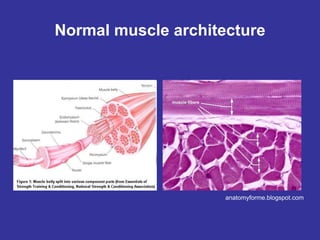
Normal muscle architecture
anatomyforme.blogspot.com
fascicle of
individual myocytes
longitudinal view
cross section view
Nucleus. Should be
peripheral like this in
normal muscle.
Myocytes should all
be about the same
size.
emedicine.medscape.com
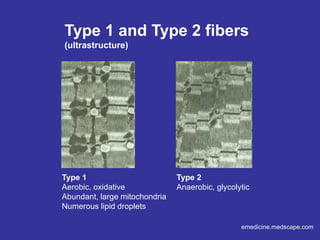
Type 1 and Type 2 fibers
(ultrastructure)
Type 1
Aerobic, oxidative
Abundant, large mitochondria
Numerous lipid droplets
Type 2
Anaerobic, glycolytic
Slow twitch
fast twitch
less
mitochodria,
and can't see
lipid droplets
mitochodria
lipid droplets
Chapter 27 R&C
1. Neurogenic atrophy
2. Muscular dystrophies
3. “Congenital” myopathies
4. Metabolic myopathies
5. Inflammatory myopathies
6. Toxic myopathies
7. Diseases of the neuromuscular junction
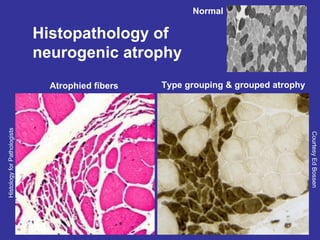
Type grouping & grouped atrophy
Histology
for
Pathologists
Courtesy
Ed
Bossen
Atrophied fibers
Histopathology of
neurogenic atrophy
Normal
ATPase stain: see
checkerboard
pattern of type 1
and type 2 fibers.
Good distribution
Grouping leads to loss of innervation of some
motor units and reinnervation by adjacent motor
units
Innervation of a muscle unit determines whether its
going to be type 1 or type 2. Innervation can alter
metabolism. So if type 2 motor unit innervates what
used to be a type 1 fiber then type 1 fiber will
regrow as type 2
Muscle fibers have
ost innervation
ausing them to
hrink
Normal sized
muscle fibers
Large area of
atrophy. Means
that process is
ongoing. You've
had deinnervation,
reinnervation, and
then deinnervation
again
Grouping of fiber
type (instead of
checkerboard
pattern) due to
deinnervation and
then reinnervation
www.pathology.vcu.edu
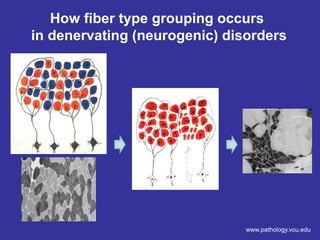
How fiber type grouping occurs
in denervating (neurogenic) disorders
Picture of motor units. Checkerboard
pattern which develops during initial
development of the muscle
Loss of innervation leads to atrophy.
Adjacet reinnervation leads to grouped
atrophy.
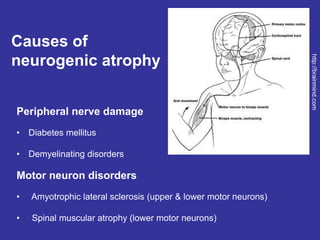
Peripheral nerve damage
• Diabetes mellitus
• Demyelinating disorders
Motor neuron disorders
• Amyotrophic lateral sclerosis (upper & lower motor neurons)
• Spinal muscular atrophy (lower motor neurons)
http://brainmind.com
Causes of
neurogenic atrophy
Read slide.
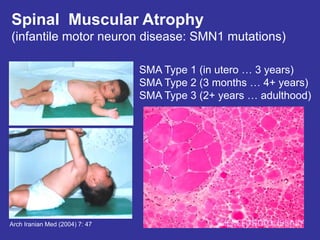
Spinal Muscular Atrophy
(infantile motor neuron disease: SMN1 mutations)
SMA Type 1 (in utero … 3 years)
SMA Type 2 (3 months … 4+ years)
SMA Type 3 (2+ years … adulthood)
Arch Iranian Med (2004) 7: 47
disease will depend on amount of loss of
SMN1 and how much SMN2 is present.
SMN2 can compensate for SNM1 loss
the earlier the disease arises, the more severe it is.
Children most affected will die of aspiration
pneumonia.
Pan fascicular
atrophy: entire
fascicle is
atrophied. Both
type 1 and type 2
will be atrophied
Compensatory
hypertrophy. Only
type 1 fibers.
Chapter 27 R&C
1. Neurogenic atrophy
2. Muscular dystrophies
3. “Congenital” myopathies
4. Metabolic myopathies
5. Inflammatory myopathies
6. Toxic myopathies
7. Diseases of the neuromuscular junction
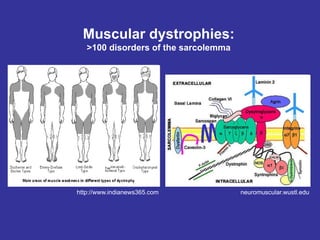
Muscular dystrophies:
>100 disorders of the sarcolemma
http://www.indianews365.com neuromuscular.wustl.edu
Fas
Actually systemic disorders.
Cognitive, respiratory, GI, bone,
and liver problems. Muscle
sypmtoms stick out because
having a good grip on cellular
stroma is key to muscle function
A muscular dystrophy: Duchenne
http://picasaweb.google.com
Histology
for
Pathologists
Courtesy
Ed
Bossen
Dystrophin expression
Gower maneuver
not commom but distinctive.
Dytrophic:
replacement of
normal muscle with
fat and collage
muscle fibers split
as they try to grow
and replace whats
been lost.
nuclei move into
center
loss of
muscle. kids
get calf
pseudohyper
trophy.
Symptoms
become
more
exaggerated
as they get
older. Can
now live into
their 20's due
to improved
respiratory
care
Becker is milder than
Duchennes. Basis of
disease is loss of
dystrophin expression. In
Duchenne's, dystrophin is
lost completely. above is
normal expression in
dystrophin. Becker is X
linked and only shows up in
males. Females with
mutations in both X
chromosomes will not be
born.
classic symptom
Chapter 27 R&C
1. Neurogenic atrophy
2. Muscular dystrophies
3. “Congenital” myopathies
4. Metabolic myopathies
5. Inflammatory myopathies
6. Toxic myopathies
7. Diseases of the neuromuscular junction
Central core disease (an ion channel myopathy)
Nemaline rod myopathy
Centronuclear myopathy
“Congenital” myopathies
(floppy babies):
http://www.gfmer.ch
www.pathology.vcu.edu
JRare
Diseases
(2008)
3:26
Problem with ryanodine receptor.
Clinical symtoms include periodic
paralysis.
accumulation of
proteins
central nucei.
generally static
disease, but
sometimes
progressive.
Chapter 27 R&C
1. Neurogenic atrophy
2. Muscular dystrophies
3. “Congenital” myopathies
4. Metabolic myopathies
5. Inflammatory myopathies
6. Toxic myopathies
7. Diseases of the neuromuscular junction
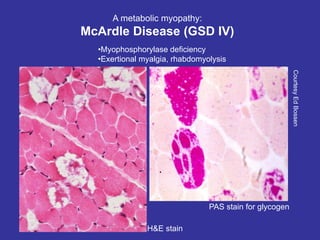
A metabolic myopathy:
McArdle Disease (GSD IV)
•Myophosphorylase deficiency
•Exertional myalgia, rhabdomyolysis
Courtesy
Ed
Bossen
PAS stain for glycogen
H&E stain
Glycogen storage disease.
Most servere form is Pompe's
disease which is GSD II
can cause kidney
failure. life
threatening
glycogen buildup
not all muscles are affected
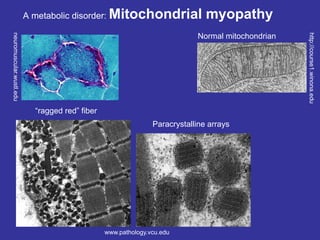
A metabolic disorder: Mitochondrial myopathy
www.pathology.vcu.edu
neuromuscular.wustl.edu
http://course1.winona.edu
Normal mitochondrian
“ragged red” fiber
Paracrystalline arrays
accumulation of
eosinophilic
material
mitochondria
accumulating in
sub-sarcolemma
space
called "parking lot
mitochondria".
sometimes you
will have normal
looking
mitochondria and
have disease
Chapter 27 R&C
1. Neurogenic atrophy
2. Muscular dystrophies
3. “Congenital” myopathies
4. Metabolic myopathies
5. Inflammatory myopathies
6. Toxic myopathies
7. Diseases of the neuromuscular junction
more common. often
autoimmune
An inflammatory myopathy:
Dermatomyositis
Wikimedia
commons
*Strongly associated with cancer*
sun exposed skin
more likely to have
rash Malar rash
due to antibody mediated attack on
blood vessels/capillaries
Courtesy Ed Bossen
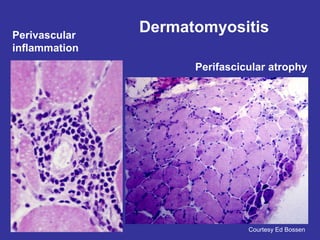
Dermatomyositis
Perifascicular atrophy
Perivascular
inflammation due to loss of
capillaries because
of autoantibodies.
leads to formation
of immune
complexes which
damage the blood
vessels.
fibers on edges
shrink
fibers in the middle
stay the same size
J
Neurol
Neurosurg
Psychiatry
2009;80:1186
www.neuropathologyweb.org
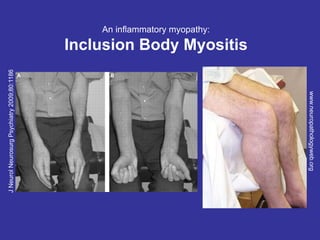
An inflammatory myopathy:
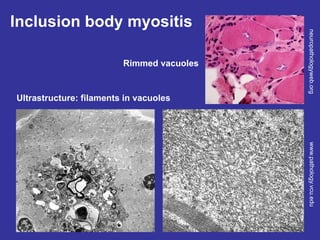
Inclusion Body Myositis
shows up in patients over 50. Degenerative disease in which there is
an accumulation of proteins in muscle over time. Body eventually
reacts against them.
finger flexor weakness
and intrinsic muscle
weakness quadricep atrophy and weakness
Inclusion body myositis
neuropathologyweb.org
www.pathology.vcu.edu
Rimmed vacuoles
Ultrastructure: filaments in vacuoles
inclusion body filaments are diagnostic feature
progressive disease. no cure. doesnt respond
to steroids.
Chapter 27 R&C
1. Neurogenic atrophy
2. Muscular dystrophies
3. “Congenital” myopathies
4. Metabolic myopathies
5. Inflammatory myopathies
6. Toxic myopathies
7. Diseases of the neuromuscular junction
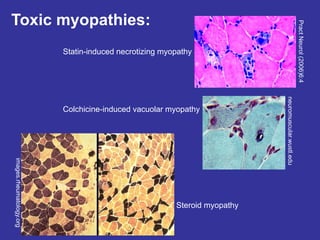
Statin-induced necrotizing myopathy
Colchicine-induced vacuolar myopathy
Steroid myopathy
neuromuscular.wustl.edu
Pract
Neurol
(2006)6:4
images.rheumatology.org
Toxic myopathies:
1-1.5% of people on statins
will develop myopathy. statins
have deleterious effect on
mitochondria. leads to muscle
weakness. Can cause
rhamdomyolysis. Can be life
threatening.
disappearance of
fibers.
macrophages
come in to clean it
up.
Colchicine is used to treat gout. affects
assembly of myofibrils
corticosteroids. type 2 fibers are
dark. selective atrophy of type 2
fibers
Chapter 27 R&C
1. Neurogenic atrophy
2. Muscular dystrophies
3. “Congenital” myopathies
4. Metabolic myopathies
5. Inflammatory myopathies
6. Toxic myopathies
7. Diseases of the neuromuscular junction
A neuromuscular junction disorder:
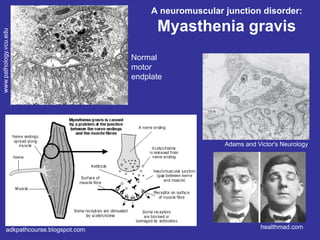
Myasthenia gravis
www.pathology.vcu.edu
Adams and Victor's Neurology
healthmad.com
adkpathcourse.blogspot.com
Normal
motor
endplate
autoimmune event which generate
antibodies to receptors on
postsynaptic membrane. prevents Ach
mediated muscle transport. Lambert
Eaton Syndrome doesnt respond to
AchE inhibitors because it affects
presynaptic agents
initially see ptosis, eyelid
drooping. effects reversed
by AchE inhibitors
abnormal motor
endplate
Chapter 27 R&C
1. Neurogenic atrophy
2. Muscular dystrophies
3. “Congenital” myopathies
4. Metabolic myopathies
5. Inflammatory myopathies
6. Toxic myopathies
7. Diseases of the neuromuscular junction
Malignant Hyperthermia
• A hypermetabolic state induced by some general anesthetics
(tachycardia, tachypnea, muscle spasms, hyperpyrexia)
• Patients with inherited muscle disease are predisposed
(dystrophinopathies, metabolic, other congenital myopathies)
patients with myopathic diseases
may be prone to malignant
hyperthermia. can be deadly
anne.buckley@duke.edu
04.08.1b_Diseases_of_Skeletal_Muscle_final.pdf

04.08.1b_Diseases_of_Skeletal_Muscle_final.pdf

  • 1.
    Diseases of SkeletalMuscle Anne Buckley MD PhD Neuropathology
  • 2.
    Chapter 27 R&C 1.Neurogenic atrophy 2. Muscular dystrophies 3. “Congenital” myopathies 4. Metabolic myopathies 5. Inflammatory myopathies 6. Toxic myopathies 7. Diseases of the neuromuscular junction A patient that presents with muscle weakness can have any of these: Primary to the nerve, secondary to the muscle 2-6 are primary to the muscle
  • 3.
    Normal muscle architecture anatomyforme.blogspot.com fascicleof individual myocytes longitudinal view cross section view Nucleus. Should be peripheral like this in normal muscle. Myocytes should all be about the same size.
  • 4.
    emedicine.medscape.com Type 1 andType 2 fibers (ultrastructure) Type 1 Aerobic, oxidative Abundant, large mitochondria Numerous lipid droplets Type 2 Anaerobic, glycolytic Slow twitch fast twitch less mitochodria, and can't see lipid droplets mitochodria lipid droplets
  • 5.
    Chapter 27 R&C 1.Neurogenic atrophy 2. Muscular dystrophies 3. “Congenital” myopathies 4. Metabolic myopathies 5. Inflammatory myopathies 6. Toxic myopathies 7. Diseases of the neuromuscular junction
  • 6.
    Type grouping &grouped atrophy Histology for Pathologists Courtesy Ed Bossen Atrophied fibers Histopathology of neurogenic atrophy Normal ATPase stain: see checkerboard pattern of type 1 and type 2 fibers. Good distribution Grouping leads to loss of innervation of some motor units and reinnervation by adjacent motor units Innervation of a muscle unit determines whether its going to be type 1 or type 2. Innervation can alter metabolism. So if type 2 motor unit innervates what used to be a type 1 fiber then type 1 fiber will regrow as type 2 Muscle fibers have ost innervation ausing them to hrink Normal sized muscle fibers Large area of atrophy. Means that process is ongoing. You've had deinnervation, reinnervation, and then deinnervation again Grouping of fiber type (instead of checkerboard pattern) due to deinnervation and then reinnervation
  • 7.
    www.pathology.vcu.edu How fiber typegrouping occurs in denervating (neurogenic) disorders Picture of motor units. Checkerboard pattern which develops during initial development of the muscle Loss of innervation leads to atrophy. Adjacet reinnervation leads to grouped atrophy.
  • 8.
    Peripheral nerve damage •Diabetes mellitus • Demyelinating disorders Motor neuron disorders • Amyotrophic lateral sclerosis (upper & lower motor neurons) • Spinal muscular atrophy (lower motor neurons) http://brainmind.com Causes of neurogenic atrophy Read slide.
  • 9.
    Spinal Muscular Atrophy (infantilemotor neuron disease: SMN1 mutations) SMA Type 1 (in utero … 3 years) SMA Type 2 (3 months … 4+ years) SMA Type 3 (2+ years … adulthood) Arch Iranian Med (2004) 7: 47 disease will depend on amount of loss of SMN1 and how much SMN2 is present. SMN2 can compensate for SNM1 loss the earlier the disease arises, the more severe it is. Children most affected will die of aspiration pneumonia. Pan fascicular atrophy: entire fascicle is atrophied. Both type 1 and type 2 will be atrophied Compensatory hypertrophy. Only type 1 fibers.
  • 10.
    Chapter 27 R&C 1.Neurogenic atrophy 2. Muscular dystrophies 3. “Congenital” myopathies 4. Metabolic myopathies 5. Inflammatory myopathies 6. Toxic myopathies 7. Diseases of the neuromuscular junction
  • 11.
    Muscular dystrophies: >100 disordersof the sarcolemma http://www.indianews365.com neuromuscular.wustl.edu Fas Actually systemic disorders. Cognitive, respiratory, GI, bone, and liver problems. Muscle sypmtoms stick out because having a good grip on cellular stroma is key to muscle function
  • 12.
    A muscular dystrophy:Duchenne http://picasaweb.google.com Histology for Pathologists Courtesy Ed Bossen Dystrophin expression Gower maneuver not commom but distinctive. Dytrophic: replacement of normal muscle with fat and collage muscle fibers split as they try to grow and replace whats been lost. nuclei move into center loss of muscle. kids get calf pseudohyper trophy. Symptoms become more exaggerated as they get older. Can now live into their 20's due to improved respiratory care Becker is milder than Duchennes. Basis of disease is loss of dystrophin expression. In Duchenne's, dystrophin is lost completely. above is normal expression in dystrophin. Becker is X linked and only shows up in males. Females with mutations in both X chromosomes will not be born. classic symptom
  • 13.
    Chapter 27 R&C 1.Neurogenic atrophy 2. Muscular dystrophies 3. “Congenital” myopathies 4. Metabolic myopathies 5. Inflammatory myopathies 6. Toxic myopathies 7. Diseases of the neuromuscular junction
  • 14.
    Central core disease(an ion channel myopathy) Nemaline rod myopathy Centronuclear myopathy “Congenital” myopathies (floppy babies): http://www.gfmer.ch www.pathology.vcu.edu JRare Diseases (2008) 3:26 Problem with ryanodine receptor. Clinical symtoms include periodic paralysis. accumulation of proteins central nucei. generally static disease, but sometimes progressive.
  • 15.
    Chapter 27 R&C 1.Neurogenic atrophy 2. Muscular dystrophies 3. “Congenital” myopathies 4. Metabolic myopathies 5. Inflammatory myopathies 6. Toxic myopathies 7. Diseases of the neuromuscular junction
  • 16.
    A metabolic myopathy: McArdleDisease (GSD IV) •Myophosphorylase deficiency •Exertional myalgia, rhabdomyolysis Courtesy Ed Bossen PAS stain for glycogen H&E stain Glycogen storage disease. Most servere form is Pompe's disease which is GSD II can cause kidney failure. life threatening glycogen buildup not all muscles are affected
  • 17.
    A metabolic disorder:Mitochondrial myopathy www.pathology.vcu.edu neuromuscular.wustl.edu http://course1.winona.edu Normal mitochondrian “ragged red” fiber Paracrystalline arrays accumulation of eosinophilic material mitochondria accumulating in sub-sarcolemma space called "parking lot mitochondria". sometimes you will have normal looking mitochondria and have disease
  • 18.
    Chapter 27 R&C 1.Neurogenic atrophy 2. Muscular dystrophies 3. “Congenital” myopathies 4. Metabolic myopathies 5. Inflammatory myopathies 6. Toxic myopathies 7. Diseases of the neuromuscular junction more common. often autoimmune
  • 19.
    An inflammatory myopathy: Dermatomyositis Wikimedia commons *Stronglyassociated with cancer* sun exposed skin more likely to have rash Malar rash due to antibody mediated attack on blood vessels/capillaries
  • 20.
    Courtesy Ed Bossen Dermatomyositis Perifascicularatrophy Perivascular inflammation due to loss of capillaries because of autoantibodies. leads to formation of immune complexes which damage the blood vessels. fibers on edges shrink fibers in the middle stay the same size
  • 21.
    J Neurol Neurosurg Psychiatry 2009;80:1186 www.neuropathologyweb.org An inflammatory myopathy: InclusionBody Myositis shows up in patients over 50. Degenerative disease in which there is an accumulation of proteins in muscle over time. Body eventually reacts against them. finger flexor weakness and intrinsic muscle weakness quadricep atrophy and weakness
  • 22.
    Inclusion body myositis neuropathologyweb.org www.pathology.vcu.edu Rimmedvacuoles Ultrastructure: filaments in vacuoles inclusion body filaments are diagnostic feature progressive disease. no cure. doesnt respond to steroids.
  • 23.
    Chapter 27 R&C 1.Neurogenic atrophy 2. Muscular dystrophies 3. “Congenital” myopathies 4. Metabolic myopathies 5. Inflammatory myopathies 6. Toxic myopathies 7. Diseases of the neuromuscular junction
  • 24.
    Statin-induced necrotizing myopathy Colchicine-inducedvacuolar myopathy Steroid myopathy neuromuscular.wustl.edu Pract Neurol (2006)6:4 images.rheumatology.org Toxic myopathies: 1-1.5% of people on statins will develop myopathy. statins have deleterious effect on mitochondria. leads to muscle weakness. Can cause rhamdomyolysis. Can be life threatening. disappearance of fibers. macrophages come in to clean it up. Colchicine is used to treat gout. affects assembly of myofibrils corticosteroids. type 2 fibers are dark. selective atrophy of type 2 fibers
  • 25.
    Chapter 27 R&C 1.Neurogenic atrophy 2. Muscular dystrophies 3. “Congenital” myopathies 4. Metabolic myopathies 5. Inflammatory myopathies 6. Toxic myopathies 7. Diseases of the neuromuscular junction
  • 26.
    A neuromuscular junctiondisorder: Myasthenia gravis www.pathology.vcu.edu Adams and Victor's Neurology healthmad.com adkpathcourse.blogspot.com Normal motor endplate autoimmune event which generate antibodies to receptors on postsynaptic membrane. prevents Ach mediated muscle transport. Lambert Eaton Syndrome doesnt respond to AchE inhibitors because it affects presynaptic agents initially see ptosis, eyelid drooping. effects reversed by AchE inhibitors abnormal motor endplate
  • 27.
    Chapter 27 R&C 1.Neurogenic atrophy 2. Muscular dystrophies 3. “Congenital” myopathies 4. Metabolic myopathies 5. Inflammatory myopathies 6. Toxic myopathies 7. Diseases of the neuromuscular junction
  • 28.
    Malignant Hyperthermia • Ahypermetabolic state induced by some general anesthetics (tachycardia, tachypnea, muscle spasms, hyperpyrexia) • Patients with inherited muscle disease are predisposed (dystrophinopathies, metabolic, other congenital myopathies) patients with myopathic diseases may be prone to malignant hyperthermia. can be deadly
  • 29.