Primary Headache
HEADACHE
CAUSED BY TRACTION, DISPLACEMENT, INFLAMMATION,
VASCULAR SPASM, DISTENTION OF THE PAIN SENSITIVE
STRUCTURE IN THE HEAD OR NECK
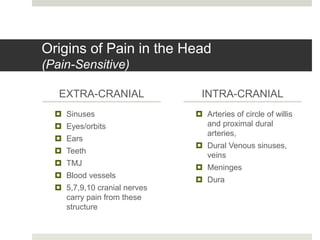
Origins of Pain in the Head
(Pain-Sensitive)
EXTRA-CRANIAL
 Sinuses
 Eyes/orbits
 Ears
 Teeth
 TMJ
 Blood vessels
 5,7,9,10 cranial nerves
carry pain from these
structure
INTRA-CRANIAL
 Arteries of circle of willis
and proximal dural
arteries,
 Dural Venous sinuses,
veins
 Meninges
 Dura
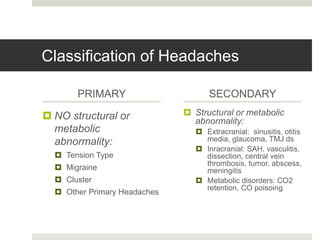
Classification of Headaches
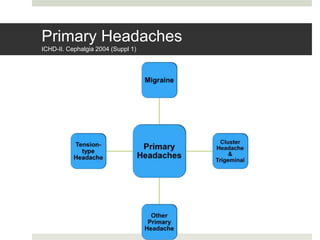
PRIMARY
 NO structural or
metabolic
abnormality:
 Tension Type
 Migraine
 Cluster
 Other Primary Headaches
SECONDARY
 Structural or metabolic
abnormality:
 Extracranial: sinusitis, otitis
media, glaucoma, TMJ ds
 Inracranial: SAH, vasculitis,
dissection, central vein
thrombosis, tumor, abscess,
meningitis
 Metabolic disorders: CO2
retention, CO poisoing
Primary Headaches
ICHD-II. Cephalgia 2004 (Suppl 1)
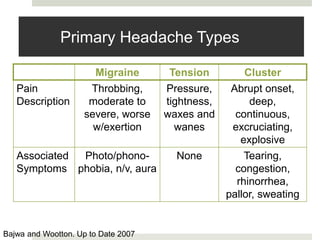
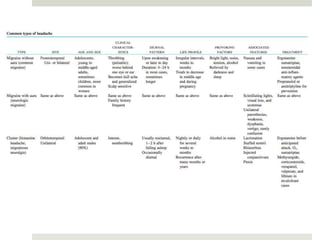
Primary Headache Types
Migraine Tension Cluster
Pain
Description
Throbbing,
moderate to
severe, worse
w/exertion
Pressure,
tightness,
waxes and
wanes
Abrupt onset,
deep,
continuous,
excruciating,
explosive
Associated
Symptoms
Photo/phono-
phobia, n/v, aura
None Tearing,
congestion,
rhinorrhea,
pallor, sweating
Bajwa and Wootton. Up to Date 2007
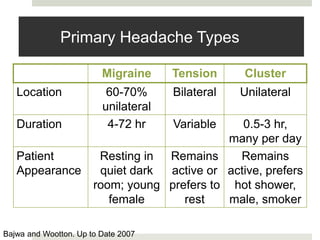
Primary Headache Types
Migraine Tension Cluster
Location 60-70%
unilateral
Bilateral Unilateral
Duration 4-72 hr Variable 0.5-3 hr,
many per day
Patient
Appearance
Resting in
quiet dark
room; young
female
Remains
active or
prefers to
rest
Remains
active, prefers
hot shower,
male, smoker
Bajwa and Wootton. Up to Date 2007
MIGRAINE
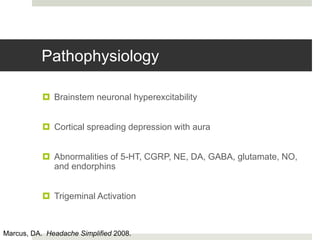
Pathophysiology
 Brainstem neuronal hyperexcitability
 Cortical spreading depression with aura
 Abnormalities of 5-HT, CGRP, NE, DA, GABA, glutamate, NO,
and endorphins
 Trigeminal Activation
Marcus, DA. Headache Simplified 2008.
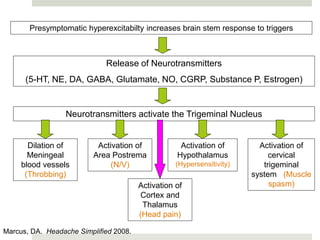
Presymptomatic hyperexcitabilty increases brain stem response to triggers
Release of Neurotransmitters
(5-HT, NE, DA, GABA, Glutamate, NO, CGRP, Substance P, Estrogen)
Neurotransmitters activate the Trigeminal Nucleus
Dilation of
Meningeal
blood vessels
(Throbbing)
Activation of
Area Postrema
(N/V)
Activation of
Hypothalamus
(Hypersensitivity)
Activation of
cervical
trigeminal
system (Muscle
spasm)
Activation of
Cortex and
Thalamus
(Head pain)
Marcus, DA. Headache Simplified 2008.
Migraine
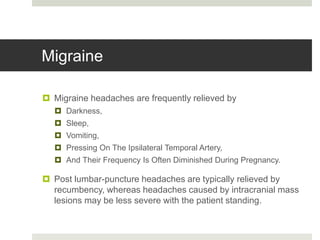
 Migraine headaches are frequently relieved by
 Darkness,
 Sleep,
 Vomiting,
 Pressing On The Ipsilateral Temporal Artery,
 And Their Frequency Is Often Diminished During Pregnancy.
 Post lumbar-puncture headaches are typically relieved by
recumbency, whereas headaches caused by intracranial mass
lesions may be less severe with the patient standing.
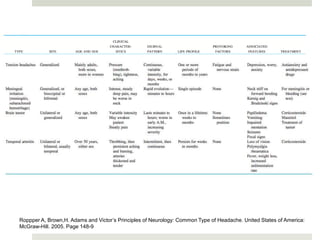
TEMPORAL PATTERN OF HEADACHE
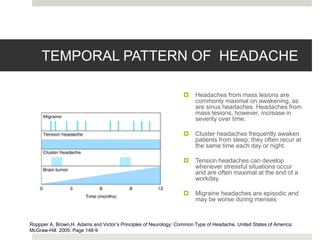
 Headaches from mass lesions are
commonly maximal on awakening, as
are sinus headaches. Headaches from
mass lesions, however, increase in
severity over time.
 Cluster headaches frequently awaken
patients from sleep; they often recur at
the same time each day or night.
 Tension headaches can develop
whenever stressful situations occur
and are often maximal at the end of a
workday.
 Migraine headaches are episodic and
may be worse during menses
Roppper A, Brown,H. Adams and Victor’s Principles of Neurology: Common Type of Headache. United States of America:
McGraw-Hill. 2005. Page 148-9
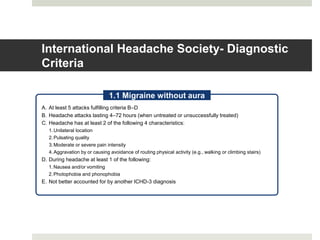
International Headache Society- Diagnostic
Criteria
A. At least 5 attacks fulfilling criteria B–D
B. Headache attacks lasting 4–72 hours (when untreated or unsuccessfully treated)
C. Headache has at least 2 of the following 4 characteristics:
1.Unilateral location
2.Pulsating quality
3.Moderate or severe pain intensity
4.Aggravation by or causing avoidance of routing physical activity (e.g., walking or climbing stairs)
D. During headache at least 1 of the following:
1.Nausea and/or vomiting
2.Photophobia and phonophobia
E. Not better accounted for by another ICHD-3 diagnosis
1.1 Migraine without aura
Migraine Specific Medications
Triptans
Ergots
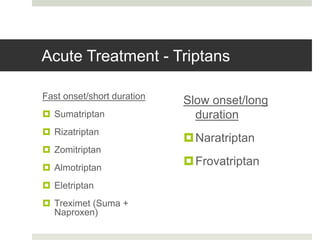
Acute Treatment - Triptans
Fast onset/short duration
 Sumatriptan
 Rizatriptan
 Zomitriptan
 Almotriptan
 Eletriptan
 Treximet (Suma +
Naproxen)
Slow onset/long
duration
Naratriptan
Frovatriptan
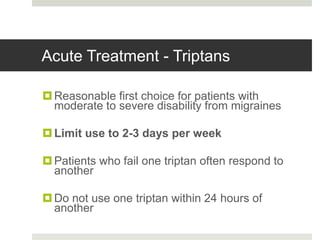
Acute Treatment - Triptans
Reasonable first choice for patients with
moderate to severe disability from migraines
Limit use to 2-3 days per week
Patients who fail one triptan often respond to
another
Do not use one triptan within 24 hours of
another
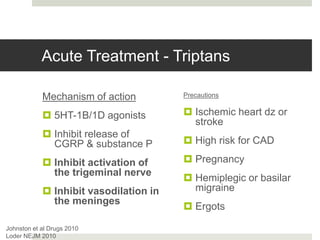
Acute Treatment - Triptans
Mechanism of action
 5HT-1B/1D agonists
 Inhibit release of
CGRP & substance P
 Inhibit activation of
the trigeminal nerve
 Inhibit vasodilation in
the meninges
Precautions
 Ischemic heart dz or
stroke
 High risk for CAD
 Pregnancy
 Hemiplegic or basilar
migraine
 Ergots
Johnston et al Drugs 2010
Loder NEJM 2010
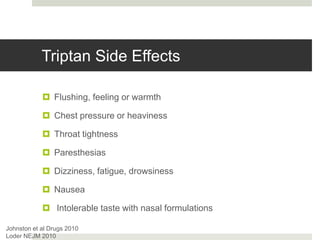
Triptan Side Effects
 Flushing, feeling or warmth
 Chest pressure or heaviness
 Throat tightness
 Paresthesias
 Dizziness, fatigue, drowsiness
 Nausea
 Intolerable taste with nasal formulations
Johnston et al Drugs 2010
Loder NEJM 2010
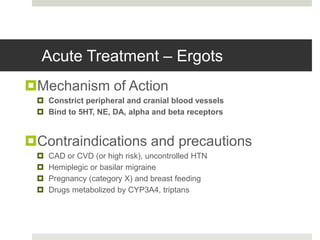
Acute Treatment – Ergots
Mechanism of Action
 Constrict peripheral and cranial blood vessels
 Bind to 5HT, NE, DA, alpha and beta receptors
Contraindications and precautions
 CAD or CVD (or high risk), uncontrolled HTN
 Hemiplegic or basilar migraine
 Pregnancy (category X) and breast feeding
 Drugs metabolized by CYP3A4, triptans
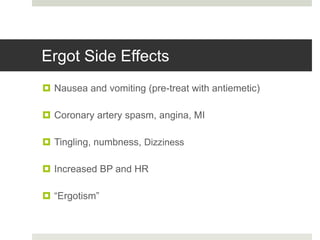
Ergot Side Effects
 Nausea and vomiting (pre-treat with antiemetic)
 Coronary artery spasm, angina, MI
 Tingling, numbness, Dizziness
 Increased BP and HR
 “Ergotism”
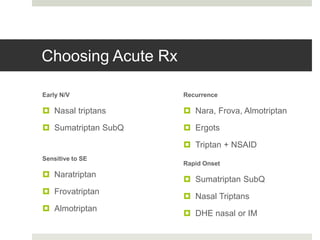
Choosing Acute Rx
Early N/V
 Nasal triptans
 Sumatriptan SubQ
Sensitive to SE
 Naratriptan
 Frovatriptan
 Almotriptan
Recurrence
 Nara, Frova, Almotriptan
 Ergots
 Triptan + NSAID
Rapid Onset
 Sumatriptan SubQ
 Nasal Triptans
 DHE nasal or IM
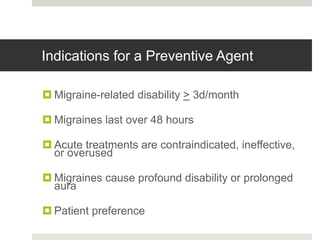
Indications for a Preventive Agent
 Migraine-related disability > 3d/month
 Migraines last over 48 hours
 Acute treatments are contraindicated, ineffective,
or overused
 Migraines cause profound disability or prolonged
aura
 Patient preference
TENSION-TYPE
 TTH is the most common type of headache, and it is classified
as episodic (ETTH) or chronic (CTTH). It had various ill-
defined names in the past including tension headache, stress
headache, muscle contraction headache, psychomyogenic
headache, ordinary headache, and psychogenic headache.
Tension Type Headache
Occurs in up to 80% of the population
Most patients treat with OTCs and do not seek
medical attention
Pathophysiology unclear
 Theory of increased muscle tension is unproven
Pain characteristics
 Bandlike, bilateral
 Extends form forehead to sides of temples
 Involves posterior neck muscles in cape-like distribution
Episodic tension-type headache
 At least 10 previous headaches fulfilling the following criteria; number of days
with such headache fewer than 15 per month
 Headaches lasting from 30 minutes to 7 days
 At least 2 of the following pain characteristics:
 Pressing/tightening (no npulsating) quality
 Mild or moderate intensity (may inhibit but does not prohibit activities)
 Bilateral location
 No aggravation from climbing stairs or similar routine physical activity
 Both of the following:
 No nausea or vomiting
 Photophobia and phonophobia absent or only one present
 Secondary headache types not suggested or confirmed
Chronic tension-type headache
 Average headache frequency of more than 15 days per month
for more than 6 months fulfilling the following criteria
 At least 2 of the following pain characteristics:
 Pressing/tightening (nonpulsating) quality
 Mild or moderate intensity (may inhibit but does not prohibit activities)
 Bilateral location
 No aggravation from climbing stairs or similar routine physical activity
 Both of the following:
 No vomiting
 No more than one of the following: nausea, photophobia, or
phonophobia
 Secondary headache types not suggested or confirmed
Pathophysiology
 Pathogenesis of TTH is complex and multifactorial,
with contributions from both central and peripheral
factors.
 In the past, various mechanisms including vascular,
muscular, and psychogenic factors were suggested.
 The more likely cause of these headaches is
believed now to be abnormal neuronal sensitivity
and pain facilitation, not abnormal muscle
contraction.
Various precipitating factors
One half of patients with TTH identify stress
or hunger as a precipitating factor.
Stress - Usually occurs in the afternoon after
long stressful work hours
Sleep deprivation
Uncomfortable stressful position and/or bad
posture
THERAPY
 The goals of pharmacotherapy are to relieve the headache,
reduce morbidity, and prevent complications.
Acute Treatment (Episodic TTH)
 First line: OTC analgesics (APAP, NSAIDs)
 Second line: ASA+APAP+caffeine, butalbital containing
products
 High risk of rebound headaches
 Limit acute treatment to 2-3 days per week
Preventive Treatment (Chronic TTH)
Non-Pharmacologic
 Proper sleep hygiene
 Stress management
 Acupuncture
 Biofeedback
 Physical therapy
Pharmacologic
TCAs (best efficacy)
SSRIs (better tolerated)
**Consider for patients with >15 headaches per month**
Patient Education
Advise the patient to take the following actions:
 Avoid stressful situations if possible
 Maintain a regular sleep schedule
 Exercise regularly
 Eat balanced meals
 Avoid uncomfortable stressful positions and bad posture
 Avoid eyestrain
 Try biofeedback and relaxation techniques
CLUSTER & TRIGEMINAL
Tic douloureux
Baehr M, Frotscher M. Duus’ Topical Diagnosis in Neurology: Disorder Affecting the Trigeminal Nerve. Newyork: Thieme.
2005. Page 165-7
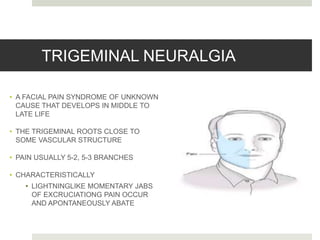
TRIGEMINAL NEURALGIA
• A FACIAL PAIN SYNDROME OF UNKNOWN
CAUSE THAT DEVELOPS IN MIDDLE TO
LATE LIFE
• THE TRIGEMINAL ROOTS CLOSE TO
SOME VASCULAR STRUCTURE
• PAIN USUALLY 5-2, 5-3 BRANCHES
• CHARACTERISTICALLY
• LIGHTNINGLIKE MOMENTARY JABS
OF EXCRUCIATIONG PAIN OCCUR
AND APONTANEOUSLY ABATE
CLUSTER HEADACHE
also known as BingHorton syndrome, erythroprosopalgia, and histamine headache
 MEN>WOMEN
 MEAN AGE ONSET AT 25 YEARS
 A CLUSTER OF BRIEF VERY SEVERE, UNILATERAL, SONSTANT
NONTHROBBING HEADACHES THAT LAST FROM A FEW MINUTES-
LESS THAN 2 HOURS
 ALWAYS UNILATERAL, SAME SIDE, COMMONLY OCCUR AT NIGHT,
RECUR DAILY, SAME TIME A DAY FOR A CLUSTER PERIOD OF
WEEKS TO MONTHS
 PATOPHYSIOLOGY IS UNCLEAR
 MRI FUNCTIONAL  ACTIVATION OF THE IPSILATERAL
HYPOTHALAMIC GRAY
CLUSTER HEADACHE
 BRIEF ATTACKS OF PAIN OCCURS MAINLY AT NIGHT INCLUDING
DURING SLEEP (IN DISTINCTION TO TRIGEMINAL NEURALGIA)
 BEGIN AS A BURNING SENSATION OVER THE LATERAL ASPECT OF
THE NOSE OR A PRESSURE BEHIND THE EYES
 IPSILATERAL CONJUNCTIVAL INJECTION
 NASAL STUFFINESS
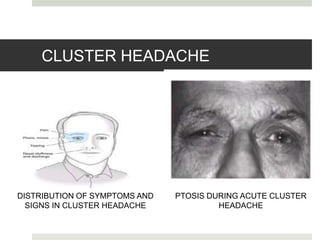
 THESE ATTACKS ARE ACCOMPANIED BY FACIAL ERYTHEMA,
LACRIMATION, WATERY NASAL SECRETION, AND OFTEN HORNER
SYNDROME AS WELL.
 EPISODES ARE OFTEN PRECIPITATED BY THE USE OF ALCOHOL
OR VASODILATING DRUGD
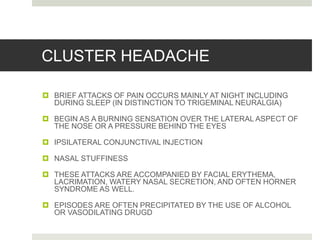
CLUSTER HEADACHE
DISTRIBUTION OF SYMPTOMS AND
SIGNS IN CLUSTER HEADACHE
PTOSIS DURING ACUTE CLUSTER
HEADACHE
CLUSTER HEADACHE
 The attacks occur repeatedly in periods (clusters)
characteristically lasting a week or more, separated by
headache-free intervals of at least two weeks’ duration.
 Its treatment is empirical, with oxygen, triptanes, or other
medications.
CONCLUSION
Roppper A, Brown,H. Adams and Victor’s Principles of Neurology: Common Type of Headache. United States of America:
McGraw-Hill. 2005. Page 148-9
Thank You

Primary headache types and management gate02.pptx

  • 1.
  • 2.
    HEADACHE CAUSED BY TRACTION,DISPLACEMENT, INFLAMMATION, VASCULAR SPASM, DISTENTION OF THE PAIN SENSITIVE STRUCTURE IN THE HEAD OR NECK
  • 3.
    Origins of Painin the Head (Pain-Sensitive) EXTRA-CRANIAL  Sinuses  Eyes/orbits  Ears  Teeth  TMJ  Blood vessels  5,7,9,10 cranial nerves carry pain from these structure INTRA-CRANIAL  Arteries of circle of willis and proximal dural arteries,  Dural Venous sinuses, veins  Meninges  Dura
  • 4.
    Classification of Headaches PRIMARY NO structural or metabolic abnormality:  Tension Type  Migraine  Cluster  Other Primary Headaches SECONDARY  Structural or metabolic abnormality:  Extracranial: sinusitis, otitis media, glaucoma, TMJ ds  Inracranial: SAH, vasculitis, dissection, central vein thrombosis, tumor, abscess, meningitis  Metabolic disorders: CO2 retention, CO poisoing
  • 5.
  • 6.
    Primary Headache Types MigraineTension Cluster Pain Description Throbbing, moderate to severe, worse w/exertion Pressure, tightness, waxes and wanes Abrupt onset, deep, continuous, excruciating, explosive Associated Symptoms Photo/phono- phobia, n/v, aura None Tearing, congestion, rhinorrhea, pallor, sweating Bajwa and Wootton. Up to Date 2007
  • 7.
    Primary Headache Types MigraineTension Cluster Location 60-70% unilateral Bilateral Unilateral Duration 4-72 hr Variable 0.5-3 hr, many per day Patient Appearance Resting in quiet dark room; young female Remains active or prefers to rest Remains active, prefers hot shower, male, smoker Bajwa and Wootton. Up to Date 2007
  • 8.
  • 9.
    Pathophysiology  Brainstem neuronalhyperexcitability  Cortical spreading depression with aura  Abnormalities of 5-HT, CGRP, NE, DA, GABA, glutamate, NO, and endorphins  Trigeminal Activation Marcus, DA. Headache Simplified 2008.
  • 10.
    Presymptomatic hyperexcitabilty increasesbrain stem response to triggers Release of Neurotransmitters (5-HT, NE, DA, GABA, Glutamate, NO, CGRP, Substance P, Estrogen) Neurotransmitters activate the Trigeminal Nucleus Dilation of Meningeal blood vessels (Throbbing) Activation of Area Postrema (N/V) Activation of Hypothalamus (Hypersensitivity) Activation of cervical trigeminal system (Muscle spasm) Activation of Cortex and Thalamus (Head pain) Marcus, DA. Headache Simplified 2008.
  • 11.
    Migraine  Migraine headachesare frequently relieved by  Darkness,  Sleep,  Vomiting,  Pressing On The Ipsilateral Temporal Artery,  And Their Frequency Is Often Diminished During Pregnancy.  Post lumbar-puncture headaches are typically relieved by recumbency, whereas headaches caused by intracranial mass lesions may be less severe with the patient standing.
  • 12.
    TEMPORAL PATTERN OFHEADACHE  Headaches from mass lesions are commonly maximal on awakening, as are sinus headaches. Headaches from mass lesions, however, increase in severity over time.  Cluster headaches frequently awaken patients from sleep; they often recur at the same time each day or night.  Tension headaches can develop whenever stressful situations occur and are often maximal at the end of a workday.  Migraine headaches are episodic and may be worse during menses Roppper A, Brown,H. Adams and Victor’s Principles of Neurology: Common Type of Headache. United States of America: McGraw-Hill. 2005. Page 148-9
  • 13.
    International Headache Society-Diagnostic Criteria A. At least 5 attacks fulfilling criteria B–D B. Headache attacks lasting 4–72 hours (when untreated or unsuccessfully treated) C. Headache has at least 2 of the following 4 characteristics: 1.Unilateral location 2.Pulsating quality 3.Moderate or severe pain intensity 4.Aggravation by or causing avoidance of routing physical activity (e.g., walking or climbing stairs) D. During headache at least 1 of the following: 1.Nausea and/or vomiting 2.Photophobia and phonophobia E. Not better accounted for by another ICHD-3 diagnosis 1.1 Migraine without aura
  • 14.
  • 15.
    Acute Treatment -Triptans Fast onset/short duration  Sumatriptan  Rizatriptan  Zomitriptan  Almotriptan  Eletriptan  Treximet (Suma + Naproxen) Slow onset/long duration Naratriptan Frovatriptan
  • 16.
    Acute Treatment -Triptans Reasonable first choice for patients with moderate to severe disability from migraines Limit use to 2-3 days per week Patients who fail one triptan often respond to another Do not use one triptan within 24 hours of another
  • 17.
    Acute Treatment -Triptans Mechanism of action  5HT-1B/1D agonists  Inhibit release of CGRP & substance P  Inhibit activation of the trigeminal nerve  Inhibit vasodilation in the meninges Precautions  Ischemic heart dz or stroke  High risk for CAD  Pregnancy  Hemiplegic or basilar migraine  Ergots Johnston et al Drugs 2010 Loder NEJM 2010
  • 18.
    Triptan Side Effects Flushing, feeling or warmth  Chest pressure or heaviness  Throat tightness  Paresthesias  Dizziness, fatigue, drowsiness  Nausea  Intolerable taste with nasal formulations Johnston et al Drugs 2010 Loder NEJM 2010
  • 19.
    Acute Treatment –Ergots Mechanism of Action  Constrict peripheral and cranial blood vessels  Bind to 5HT, NE, DA, alpha and beta receptors Contraindications and precautions  CAD or CVD (or high risk), uncontrolled HTN  Hemiplegic or basilar migraine  Pregnancy (category X) and breast feeding  Drugs metabolized by CYP3A4, triptans
  • 20.
    Ergot Side Effects Nausea and vomiting (pre-treat with antiemetic)  Coronary artery spasm, angina, MI  Tingling, numbness, Dizziness  Increased BP and HR  “Ergotism”
  • 21.
    Choosing Acute Rx EarlyN/V  Nasal triptans  Sumatriptan SubQ Sensitive to SE  Naratriptan  Frovatriptan  Almotriptan Recurrence  Nara, Frova, Almotriptan  Ergots  Triptan + NSAID Rapid Onset  Sumatriptan SubQ  Nasal Triptans  DHE nasal or IM
  • 22.
    Indications for aPreventive Agent  Migraine-related disability > 3d/month  Migraines last over 48 hours  Acute treatments are contraindicated, ineffective, or overused  Migraines cause profound disability or prolonged aura  Patient preference
  • 23.
  • 24.
     TTH isthe most common type of headache, and it is classified as episodic (ETTH) or chronic (CTTH). It had various ill- defined names in the past including tension headache, stress headache, muscle contraction headache, psychomyogenic headache, ordinary headache, and psychogenic headache.
  • 25.
    Tension Type Headache Occursin up to 80% of the population Most patients treat with OTCs and do not seek medical attention Pathophysiology unclear  Theory of increased muscle tension is unproven Pain characteristics  Bandlike, bilateral  Extends form forehead to sides of temples  Involves posterior neck muscles in cape-like distribution
  • 26.
    Episodic tension-type headache At least 10 previous headaches fulfilling the following criteria; number of days with such headache fewer than 15 per month  Headaches lasting from 30 minutes to 7 days  At least 2 of the following pain characteristics:  Pressing/tightening (no npulsating) quality  Mild or moderate intensity (may inhibit but does not prohibit activities)  Bilateral location  No aggravation from climbing stairs or similar routine physical activity  Both of the following:  No nausea or vomiting  Photophobia and phonophobia absent or only one present  Secondary headache types not suggested or confirmed
  • 27.
    Chronic tension-type headache Average headache frequency of more than 15 days per month for more than 6 months fulfilling the following criteria  At least 2 of the following pain characteristics:  Pressing/tightening (nonpulsating) quality  Mild or moderate intensity (may inhibit but does not prohibit activities)  Bilateral location  No aggravation from climbing stairs or similar routine physical activity  Both of the following:  No vomiting  No more than one of the following: nausea, photophobia, or phonophobia  Secondary headache types not suggested or confirmed
  • 28.
    Pathophysiology  Pathogenesis ofTTH is complex and multifactorial, with contributions from both central and peripheral factors.  In the past, various mechanisms including vascular, muscular, and psychogenic factors were suggested.  The more likely cause of these headaches is believed now to be abnormal neuronal sensitivity and pain facilitation, not abnormal muscle contraction.
  • 29.
    Various precipitating factors Onehalf of patients with TTH identify stress or hunger as a precipitating factor. Stress - Usually occurs in the afternoon after long stressful work hours Sleep deprivation Uncomfortable stressful position and/or bad posture
  • 30.
    THERAPY  The goalsof pharmacotherapy are to relieve the headache, reduce morbidity, and prevent complications.
  • 31.
    Acute Treatment (EpisodicTTH)  First line: OTC analgesics (APAP, NSAIDs)  Second line: ASA+APAP+caffeine, butalbital containing products  High risk of rebound headaches  Limit acute treatment to 2-3 days per week
  • 32.
    Preventive Treatment (ChronicTTH) Non-Pharmacologic  Proper sleep hygiene  Stress management  Acupuncture  Biofeedback  Physical therapy Pharmacologic TCAs (best efficacy) SSRIs (better tolerated) **Consider for patients with >15 headaches per month**
  • 33.
    Patient Education Advise thepatient to take the following actions:  Avoid stressful situations if possible  Maintain a regular sleep schedule  Exercise regularly  Eat balanced meals  Avoid uncomfortable stressful positions and bad posture  Avoid eyestrain  Try biofeedback and relaxation techniques
  • 34.
    CLUSTER & TRIGEMINAL Ticdouloureux Baehr M, Frotscher M. Duus’ Topical Diagnosis in Neurology: Disorder Affecting the Trigeminal Nerve. Newyork: Thieme. 2005. Page 165-7
  • 35.
    TRIGEMINAL NEURALGIA • AFACIAL PAIN SYNDROME OF UNKNOWN CAUSE THAT DEVELOPS IN MIDDLE TO LATE LIFE • THE TRIGEMINAL ROOTS CLOSE TO SOME VASCULAR STRUCTURE • PAIN USUALLY 5-2, 5-3 BRANCHES • CHARACTERISTICALLY • LIGHTNINGLIKE MOMENTARY JABS OF EXCRUCIATIONG PAIN OCCUR AND APONTANEOUSLY ABATE
  • 36.
    CLUSTER HEADACHE also knownas BingHorton syndrome, erythroprosopalgia, and histamine headache  MEN>WOMEN  MEAN AGE ONSET AT 25 YEARS  A CLUSTER OF BRIEF VERY SEVERE, UNILATERAL, SONSTANT NONTHROBBING HEADACHES THAT LAST FROM A FEW MINUTES- LESS THAN 2 HOURS  ALWAYS UNILATERAL, SAME SIDE, COMMONLY OCCUR AT NIGHT, RECUR DAILY, SAME TIME A DAY FOR A CLUSTER PERIOD OF WEEKS TO MONTHS  PATOPHYSIOLOGY IS UNCLEAR  MRI FUNCTIONAL  ACTIVATION OF THE IPSILATERAL HYPOTHALAMIC GRAY
  • 37.
    CLUSTER HEADACHE  BRIEFATTACKS OF PAIN OCCURS MAINLY AT NIGHT INCLUDING DURING SLEEP (IN DISTINCTION TO TRIGEMINAL NEURALGIA)  BEGIN AS A BURNING SENSATION OVER THE LATERAL ASPECT OF THE NOSE OR A PRESSURE BEHIND THE EYES  IPSILATERAL CONJUNCTIVAL INJECTION  NASAL STUFFINESS  THESE ATTACKS ARE ACCOMPANIED BY FACIAL ERYTHEMA, LACRIMATION, WATERY NASAL SECRETION, AND OFTEN HORNER SYNDROME AS WELL.  EPISODES ARE OFTEN PRECIPITATED BY THE USE OF ALCOHOL OR VASODILATING DRUGD
  • 38.
    CLUSTER HEADACHE DISTRIBUTION OFSYMPTOMS AND SIGNS IN CLUSTER HEADACHE PTOSIS DURING ACUTE CLUSTER HEADACHE
  • 39.
    CLUSTER HEADACHE  Theattacks occur repeatedly in periods (clusters) characteristically lasting a week or more, separated by headache-free intervals of at least two weeks’ duration.  Its treatment is empirical, with oxygen, triptanes, or other medications.
  • 40.
  • 42.
    Roppper A, Brown,H.Adams and Victor’s Principles of Neurology: Common Type of Headache. United States of America: McGraw-Hill. 2005. Page 148-9
  • 43.