Acute Ischemic Stroke
DR VIRTI SHAH
THROMBOLYSIS TIME WINDOW OR GOLDEN
HOUR = 4.5 HOURS
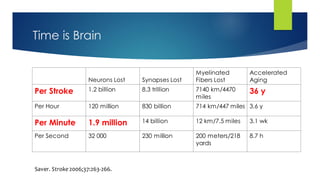
Time is Brain
Neurons Lost Synapses Lost
Myelinated
Fibers Lost
Accelerated
Aging
Per Stroke 1.2 billion 8.3 trillion 7140 km/4470
miles
36 y
Per Hour 120 million 830 billion 714 km/447 miles 3.6 y
Per Minute 1.9 million 14 billion 12 km/7.5 miles 3.1 wk
Per Second 32 000 230 million 200 meters/218
yards
8.7 h
Saver. Stroke 2006;37:263-266.
Thrombolysis needs to be given as early as possible to prevent the
conversion of potentially viable brain tissue in the penumbra from
becoming completely ischaemic and dying
Acute Stroke Treatment
Stroke patients pathway
VITAL SIGNS
MEDICAL HISTORY
SHORT NEUROLOGICALEXAM
(NIHSS)
PHYSICIAN
Vital signs: BP, HR, O2 sat, temp
“POINT OF CARE” BLOOD TESTS ( GLUCOSE)
IV ACCESS,
CBC, RFT,LFT,INR,aPTT
ECG
Foleys, RT(when indicated)
EMERGENCY NURSE
CT
IMMEDIATEREADING OF CT
24/7 NEUROLOGICAL
COVERAGE – STROKE UNIT
START THROMBOLYSIS IF
ELIGIBILITY CRITERIA MET
DOOR TO NEEDLE TIME <60MIN
EMERGENCY DEPARTMENT
4-step process:
Selection for thrombolysis treatment
Diagnosis
1 Severity of
stroke
2
Exclude
Bleeding
3
4
Contra-
indications
Key Components of History
Onset of
symptoms
Last known
normal
Recent events
Stroke
Myocardial
infarction
Trauma
Surgery
Bleeding
Comorbid
diseases
Hypertension
Diabetes
mellitus
Use of
medications
Anticoagulants
Insulin
Anti-
hypertensives
Jauch el al. Stroke. 2013 Mar;44(3):870-947
Examination – NIHSS scoring
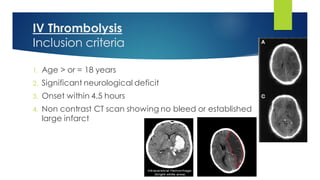
IV Thrombolysis
Inclusion criteria
1. Age > or = 18 years
2. Significant neurological deficit
3. Onset within 4.5 hours
4. Non contrast CT scan showing no bleed or established
large infarct
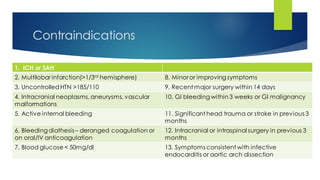
Contraindications
1. ICH or SAH
2. Multilobar infarction(>1/3rd hemisphere) 8. Minor or improving symptoms
3. UncontrolledHTN >185/110 9. Recent major surgery within 14 days
4. Intracranial neoplasms, aneurysms, vascular
malformations
10. GI bleeding within 3 weeks or GI malignancy
5. Active internal bleeding 11. Significant head trauma or stroke in previous 3
months
6. Bleeding diathesis– deranged coagulation or
on oral/IV anticoagulation
12. Intracranial or intraspinal surgery in previous 3
months
7. Blood glucose < 50mg/dl 13. Symptoms consistent with infective
endocarditis or aortic arch dissection
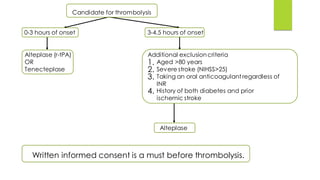
Candidate for thrombolysis
0-3 hours of onset
Alteplase (r-tPA)
OR
Tenecteplase
3-4.5 hours of onset
Additional exclusioncriteria
1. Aged >80 years
2. Severe stroke (NIHSS>25)
3. Taking an oral anticoagulant regardless of
INR
4. History of both diabetes and prior
ischemic stroke
Alteplase
Written informed consent is a must before thrombolysis.
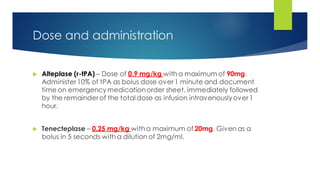
Dose and administration
 Alteplase (r-tPA) – Dose of 0.9 mg/kg with a maximum of 90mg.
Administer10% of tPA as bolus dose over1 minute and document
time on emergency medicationorder sheet, immediately followed
by the remainderof the total dose as infusion intravenouslyover1
hour.
 Tenecteplase – 0.25 mg/kg witha maximum of 20mg. Given as a
bolus in 5 seconds with a dilution of 2mg/ml.
Administration of Alteplase
Remove Actilyse vial,
sterile water for injection
and transfer device from
box (please note there is
no transfer device in the
10 mg pack).
Remove cap from one end
of transfer device. Insert
piercing pin into upright
vial of sterile WFI. KEEP
WATER VIAL UPRIGHT.
Remove cap from other
end of transfer device.
Push invertedActilyse vial
down so that piercing pin
passes through centre of
Actilyse vial stopper.
INVERT BOTH VIALS
so Actilyse is on bottom.
Allow ALL water to flow
intoActilyse vial.
Remove transfer device.
Swirl gently to dissolve
Actilyse. DO NOT SHAKE.
INSPECT SOLUTION
for particulate matter
and discolouration.
Withdraw BOLUS DOSE
(10% of total dose) using
a syringe and needle.
Administer
INTRAVENOUS BOLUS
dose over 1 minute.
Withdraw remaining 90%
of dose. DISCARD EXCESS
quantity of drug over that
requiredfor treatment.
INFUSE remaining 90% of
dose over 60 minutes
using infusion pump. At
the end of treatment
FLUSH tubing with
15-20 ml of Normal
Saline.
ACTILYSE ®India pack insert version dated 5 May 2017
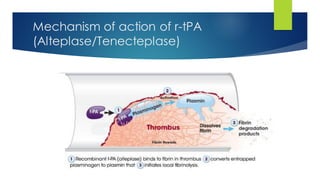
Mechanism of action of r-tPA
(Alteplase/Tenecteplase)
Factors delaying DTN time
Schaik et al. Short Door-to-Needle Times in Acute Ischemic Stroke and Prospective Identification of Its Delaying Factors.
CerebrovascDis Extra 2015;5:75–83
Post thrombolysis management
 Monitoring in ICU or stroke unit.
 If the patient develops severe headache, acute hypertension, nausea, or vomiting →
discontinuethe infusionand obtain emergency CT.
 BP & neurological assessments
➢ every 15 minutes for the first 2 hours
➢ every 30 minutes for the next 6 hours
➢ hourly until 24 hours after treatment
 If SBP is 180 mmHg or if DBP 105 mmHg →antihypertensive medications
 Obtain a follow-up CT at 24 h before starting anticoagulants/antiplatelet agents.
 STRICT sugar control – 140-180mg/dl. Hyperglycemia has a worse prognosis.
Management of complications
Pressure
ulcers
• Frequent repositioning and early mobilisation
• Support surfaces(air/water bed), moisturising sacral area
Dysphagia
• Present in 50% of stroke pts, assess swallowing in first 24 hours
• RT insertion
Aspiration
pneumonia
• Most common complication
• RT feeds, pulmonary physiotherapy, frequent position change
DVT and
Pulmonary
Embolism
•Adequate hydration and early mobilisation
•Prophylactic low molecular weight heparin
Falls
•Common in every stage of stroke
•Due to cognitive impairment, sensory and motor impairment,
polypharmacy
•Can be reduced by assistive devices and environmental changes
•Exercise, calcium, bisphosphonates improve bone strength and
reduces risk of fractures
seizures
•Prophylactic antiepileptic not beneficial
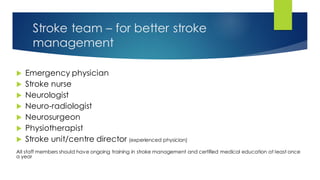
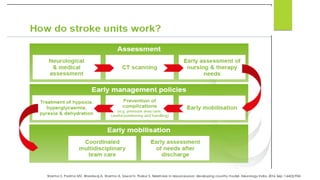
Stroke team – for better stroke
management
 Emergency physician
 Stroke nurse
 Neurologist
 Neuro-radiologist
 Neurosurgeon
 Physiotherapist
 Stroke unit/centre director (experienced physician)
All staff members should have ongoing training in stroke management and certified medical education at least once
a year
Sharma S, Padma MV, Bhardwaj A, Sharma A, Sawal N, Thakur S. Telestroke in resource-poor developing country model. Neurology India. 2016 Sep 1;64(5):934.
Summary
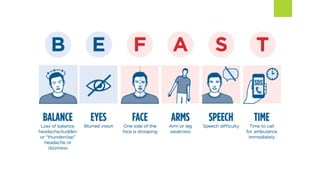
 FAST recognition of stroke symptoms
 Time is brain – window period is 4.5hours
 Try to achievea door to needle time of < 60minutes
 Alteplase or Tenecteplase can be givenas per guidelines
 Post thrombolysis care is equally important
 Team work leads to a better stroke outcome
Acute Ischemic Stroke management protocol 2.pdf

Acute Ischemic Stroke management protocol 2.pdf

  • 1.
  • 2.
    THROMBOLYSIS TIME WINDOWOR GOLDEN HOUR = 4.5 HOURS
  • 3.
    Time is Brain NeuronsLost Synapses Lost Myelinated Fibers Lost Accelerated Aging Per Stroke 1.2 billion 8.3 trillion 7140 km/4470 miles 36 y Per Hour 120 million 830 billion 714 km/447 miles 3.6 y Per Minute 1.9 million 14 billion 12 km/7.5 miles 3.1 wk Per Second 32 000 230 million 200 meters/218 yards 8.7 h Saver. Stroke 2006;37:263-266.
  • 4.
    Thrombolysis needs tobe given as early as possible to prevent the conversion of potentially viable brain tissue in the penumbra from becoming completely ischaemic and dying
  • 5.
  • 6.
    Stroke patients pathway VITALSIGNS MEDICAL HISTORY SHORT NEUROLOGICALEXAM (NIHSS) PHYSICIAN Vital signs: BP, HR, O2 sat, temp “POINT OF CARE” BLOOD TESTS ( GLUCOSE) IV ACCESS, CBC, RFT,LFT,INR,aPTT ECG Foleys, RT(when indicated) EMERGENCY NURSE CT IMMEDIATEREADING OF CT 24/7 NEUROLOGICAL COVERAGE – STROKE UNIT START THROMBOLYSIS IF ELIGIBILITY CRITERIA MET DOOR TO NEEDLE TIME <60MIN EMERGENCY DEPARTMENT
  • 7.
    4-step process: Selection forthrombolysis treatment Diagnosis 1 Severity of stroke 2 Exclude Bleeding 3 4 Contra- indications
  • 8.
    Key Components ofHistory Onset of symptoms Last known normal Recent events Stroke Myocardial infarction Trauma Surgery Bleeding Comorbid diseases Hypertension Diabetes mellitus Use of medications Anticoagulants Insulin Anti- hypertensives Jauch el al. Stroke. 2013 Mar;44(3):870-947
  • 10.
  • 11.
    IV Thrombolysis Inclusion criteria 1.Age > or = 18 years 2. Significant neurological deficit 3. Onset within 4.5 hours 4. Non contrast CT scan showing no bleed or established large infarct
  • 12.
    Contraindications 1. ICH orSAH 2. Multilobar infarction(>1/3rd hemisphere) 8. Minor or improving symptoms 3. UncontrolledHTN >185/110 9. Recent major surgery within 14 days 4. Intracranial neoplasms, aneurysms, vascular malformations 10. GI bleeding within 3 weeks or GI malignancy 5. Active internal bleeding 11. Significant head trauma or stroke in previous 3 months 6. Bleeding diathesis– deranged coagulation or on oral/IV anticoagulation 12. Intracranial or intraspinal surgery in previous 3 months 7. Blood glucose < 50mg/dl 13. Symptoms consistent with infective endocarditis or aortic arch dissection
  • 14.
    Candidate for thrombolysis 0-3hours of onset Alteplase (r-tPA) OR Tenecteplase 3-4.5 hours of onset Additional exclusioncriteria 1. Aged >80 years 2. Severe stroke (NIHSS>25) 3. Taking an oral anticoagulant regardless of INR 4. History of both diabetes and prior ischemic stroke Alteplase Written informed consent is a must before thrombolysis.
  • 15.
    Dose and administration Alteplase (r-tPA) – Dose of 0.9 mg/kg with a maximum of 90mg. Administer10% of tPA as bolus dose over1 minute and document time on emergency medicationorder sheet, immediately followed by the remainderof the total dose as infusion intravenouslyover1 hour.  Tenecteplase – 0.25 mg/kg witha maximum of 20mg. Given as a bolus in 5 seconds with a dilution of 2mg/ml.
  • 16.
    Administration of Alteplase RemoveActilyse vial, sterile water for injection and transfer device from box (please note there is no transfer device in the 10 mg pack). Remove cap from one end of transfer device. Insert piercing pin into upright vial of sterile WFI. KEEP WATER VIAL UPRIGHT. Remove cap from other end of transfer device. Push invertedActilyse vial down so that piercing pin passes through centre of Actilyse vial stopper. INVERT BOTH VIALS so Actilyse is on bottom. Allow ALL water to flow intoActilyse vial. Remove transfer device. Swirl gently to dissolve Actilyse. DO NOT SHAKE. INSPECT SOLUTION for particulate matter and discolouration. Withdraw BOLUS DOSE (10% of total dose) using a syringe and needle. Administer INTRAVENOUS BOLUS dose over 1 minute. Withdraw remaining 90% of dose. DISCARD EXCESS quantity of drug over that requiredfor treatment. INFUSE remaining 90% of dose over 60 minutes using infusion pump. At the end of treatment FLUSH tubing with 15-20 ml of Normal Saline. ACTILYSE ®India pack insert version dated 5 May 2017
  • 17.
    Mechanism of actionof r-tPA (Alteplase/Tenecteplase)
  • 18.
    Factors delaying DTNtime Schaik et al. Short Door-to-Needle Times in Acute Ischemic Stroke and Prospective Identification of Its Delaying Factors. CerebrovascDis Extra 2015;5:75–83
  • 19.
    Post thrombolysis management Monitoring in ICU or stroke unit.  If the patient develops severe headache, acute hypertension, nausea, or vomiting → discontinuethe infusionand obtain emergency CT.  BP & neurological assessments ➢ every 15 minutes for the first 2 hours ➢ every 30 minutes for the next 6 hours ➢ hourly until 24 hours after treatment  If SBP is 180 mmHg or if DBP 105 mmHg →antihypertensive medications  Obtain a follow-up CT at 24 h before starting anticoagulants/antiplatelet agents.  STRICT sugar control – 140-180mg/dl. Hyperglycemia has a worse prognosis.
  • 20.
    Management of complications Pressure ulcers •Frequent repositioning and early mobilisation • Support surfaces(air/water bed), moisturising sacral area Dysphagia • Present in 50% of stroke pts, assess swallowing in first 24 hours • RT insertion Aspiration pneumonia • Most common complication • RT feeds, pulmonary physiotherapy, frequent position change
  • 21.
    DVT and Pulmonary Embolism •Adequate hydrationand early mobilisation •Prophylactic low molecular weight heparin Falls •Common in every stage of stroke •Due to cognitive impairment, sensory and motor impairment, polypharmacy •Can be reduced by assistive devices and environmental changes •Exercise, calcium, bisphosphonates improve bone strength and reduces risk of fractures seizures •Prophylactic antiepileptic not beneficial
  • 22.
    Stroke team –for better stroke management  Emergency physician  Stroke nurse  Neurologist  Neuro-radiologist  Neurosurgeon  Physiotherapist  Stroke unit/centre director (experienced physician) All staff members should have ongoing training in stroke management and certified medical education at least once a year
  • 23.
    Sharma S, PadmaMV, Bhardwaj A, Sharma A, Sawal N, Thakur S. Telestroke in resource-poor developing country model. Neurology India. 2016 Sep 1;64(5):934.
  • 24.
    Summary  FAST recognitionof stroke symptoms  Time is brain – window period is 4.5hours  Try to achievea door to needle time of < 60minutes  Alteplase or Tenecteplase can be givenas per guidelines  Post thrombolysis care is equally important  Team work leads to a better stroke outcome