Stroke Thrombolysis Training
Dr. Indira Natarajan
Clinical Lead Acute Stroke and TIA Services
WHO DEFINITION
“ rapidly developing clinical signs (at times global) of
disturbance of cerebral function, lasting more than
24 hours with no apparent cause other than that of
vascular origin”
This definition includes signs and symptoms of
suggestive of
- ischaemic stroke
- haemorrhages (intracerebral)
Diagnostic Dilemma
“ Stroke Mimics ” or “ Stroke Syndrome ”
10% - 15% of patients referred with
possible stroke have something else
Some uncertainty is inevitable
Stop and Think!
Drowsy and Delirious
Patient with headache
Drowsiness, confusion and headache
Drowsiness / Delirium
SEIZURES
METABOLIC / TOXIC
SUBDURAL HAEMATOMA
UNCONCONSCIOUS
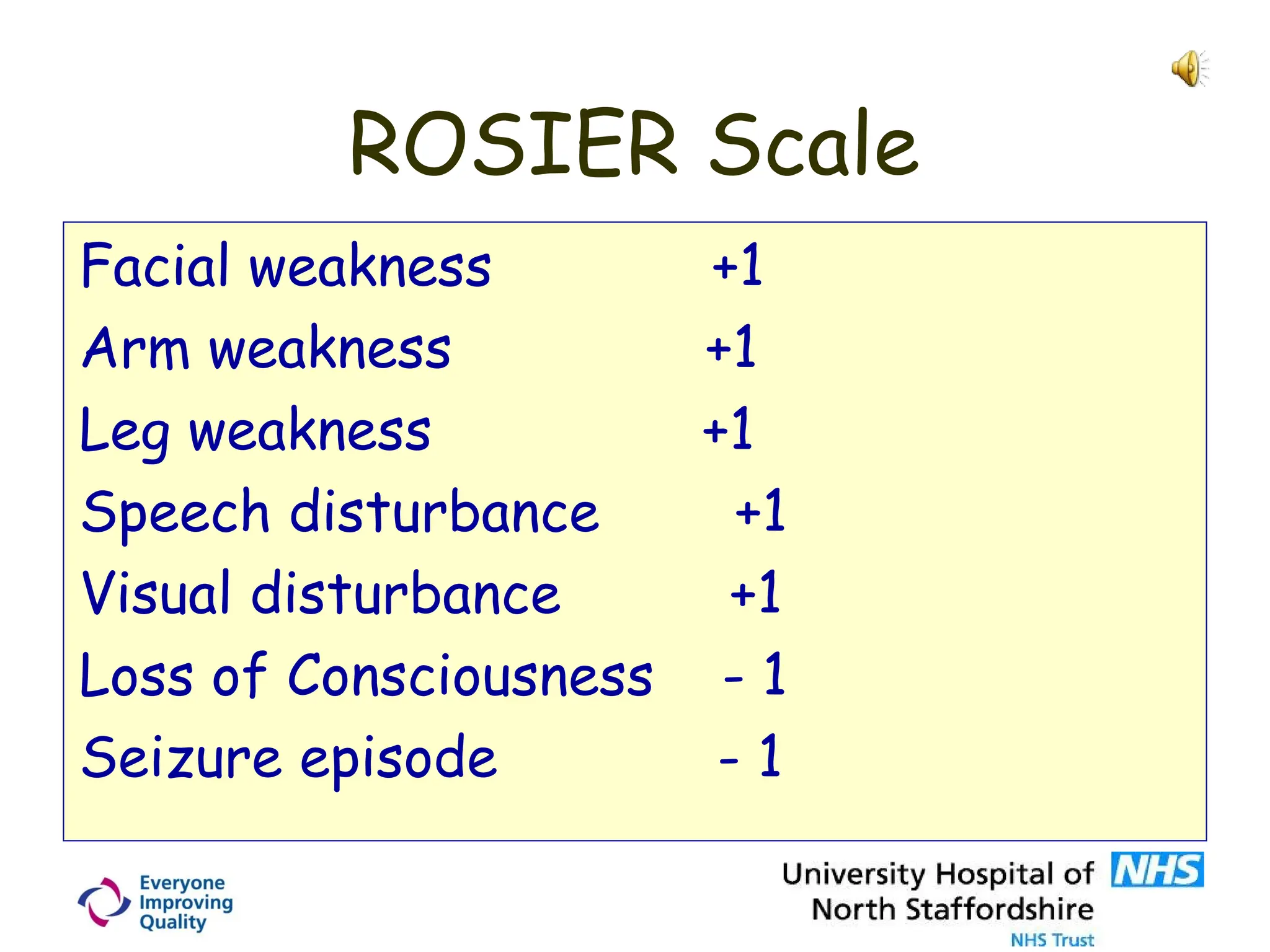
ROSIER Scale
Facial weakness +1
Arm weakness +1
Leg weakness +1
Speech disturbance +1
Visual disturbance +1
Loss of Consciousness - 1
Seizure episode - 1
Diagnostic Dilemma
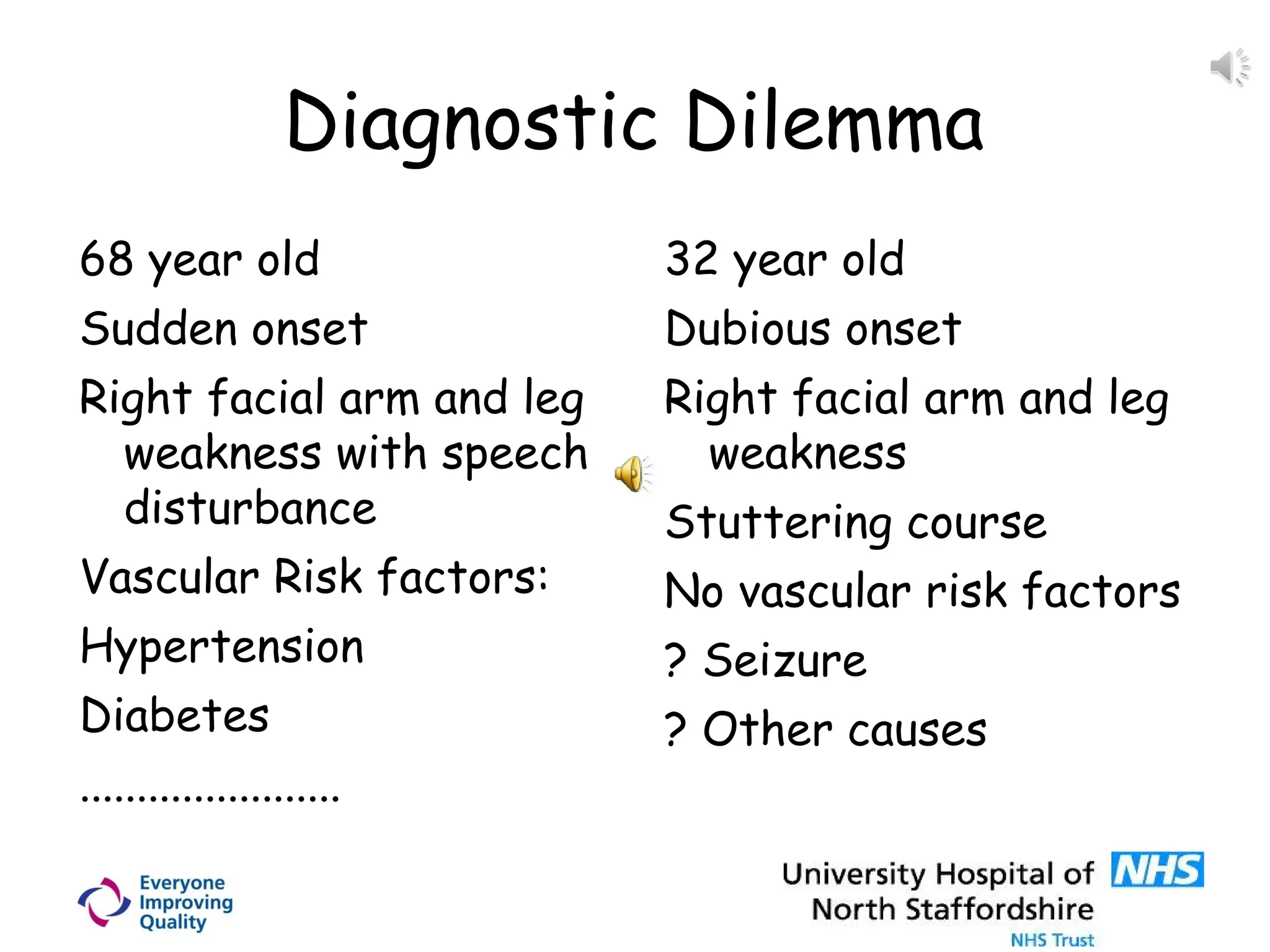
68 year old
Sudden onset
Right facial arm and leg
weakness with speech
disturbance
Vascular Risk factors:
Hypertension
Diabetes
.......................
32 year old
Dubious onset
Right facial arm and leg
weakness
Stuttering course
No vascular risk factors
? Seizure
? Other causes
Treatments effective within first
hours to days
Aspirin
Thrombolysis
Acute Stroke Unit
Hemicraniectomy
Effective treatment for 1 patient to benefit
Numbers treated to
benefit one patient
Propotion of patients
eligible
Asprin
100
70 - 80%
Stroke Unit
20
100%
Thrombolysis 10 10%
Hyper-acute treatment of
Stroke
 Re-Canalisation
Modified Rankin Scale
Independent Dependent
1 2 3 4 5
No Mild Moderate Moderately
Severe
Severe
TIME IS BRAIN
 2 million neurons are lost every minute that
treatment is delayed.
 Saver JL. Time is brain—quantified. Stroke 2006;37: 263–266.
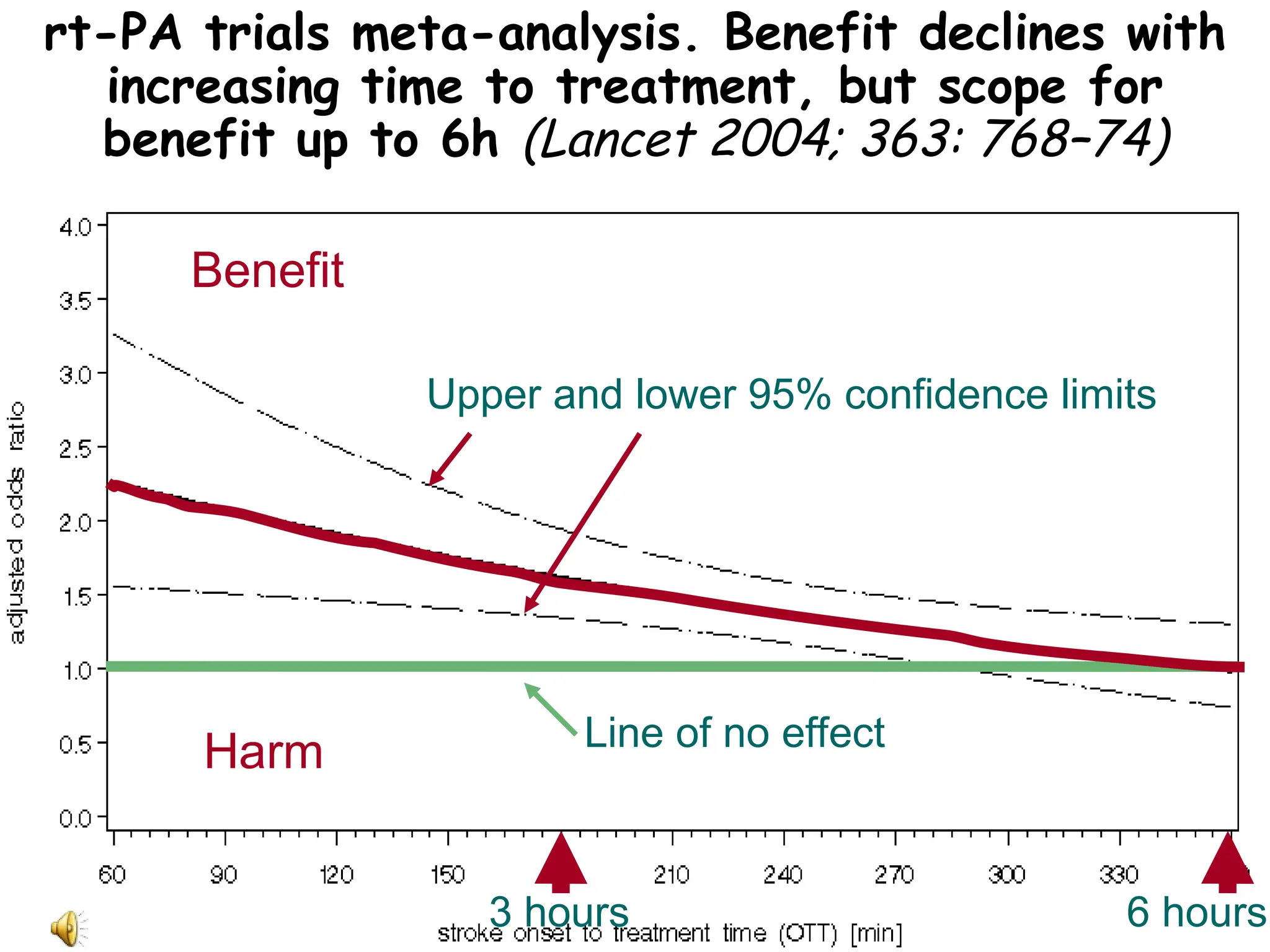
rt-PA trials meta-analysis. Benefit declines with
increasing time to treatment, but scope for
benefit up to 6h (Lancet 2004; 363: 768–74)
Benefit
Harm
3 hours 6 hours
Upper and lower 95% confidence limits
Line of no effect
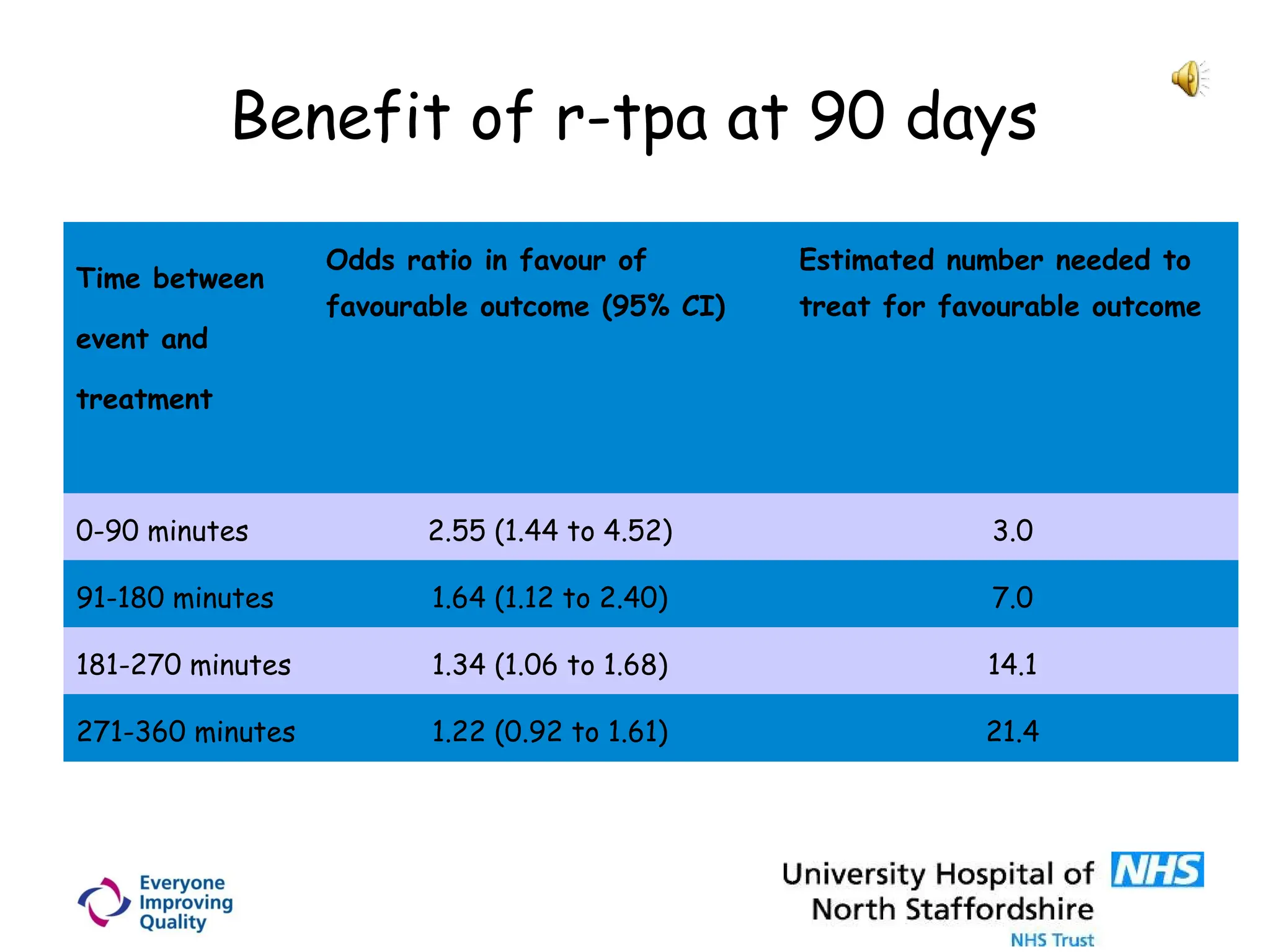
Benefit of r-tpa at 90 days
Time between
event and
treatment
Odds ratio in favour of
favourable outcome (95% CI)
Estimated number needed to
treat for favourable outcome
0-90 minutes 2.55 (1.44 to 4.52) 3.0
91-180 minutes 1.64 (1.12 to 2.40) 7.0
181-270 minutes 1.34 (1.06 to 1.68) 14.1
271-360 minutes 1.22 (0.92 to 1.61) 21.4
Acute Stroke Services...
999
1 hour
1 hour
0 - 4.5 hours
0 - 4.5 hours
A Patient's Journey.....
1 hour
1 hour
ESD
ESD
Check List
Confirm diagnosis
Exclude Hypo-glycaemia
Confirm Onset Time
NIHSS scale
Eligibility
Contra-indications
Consent
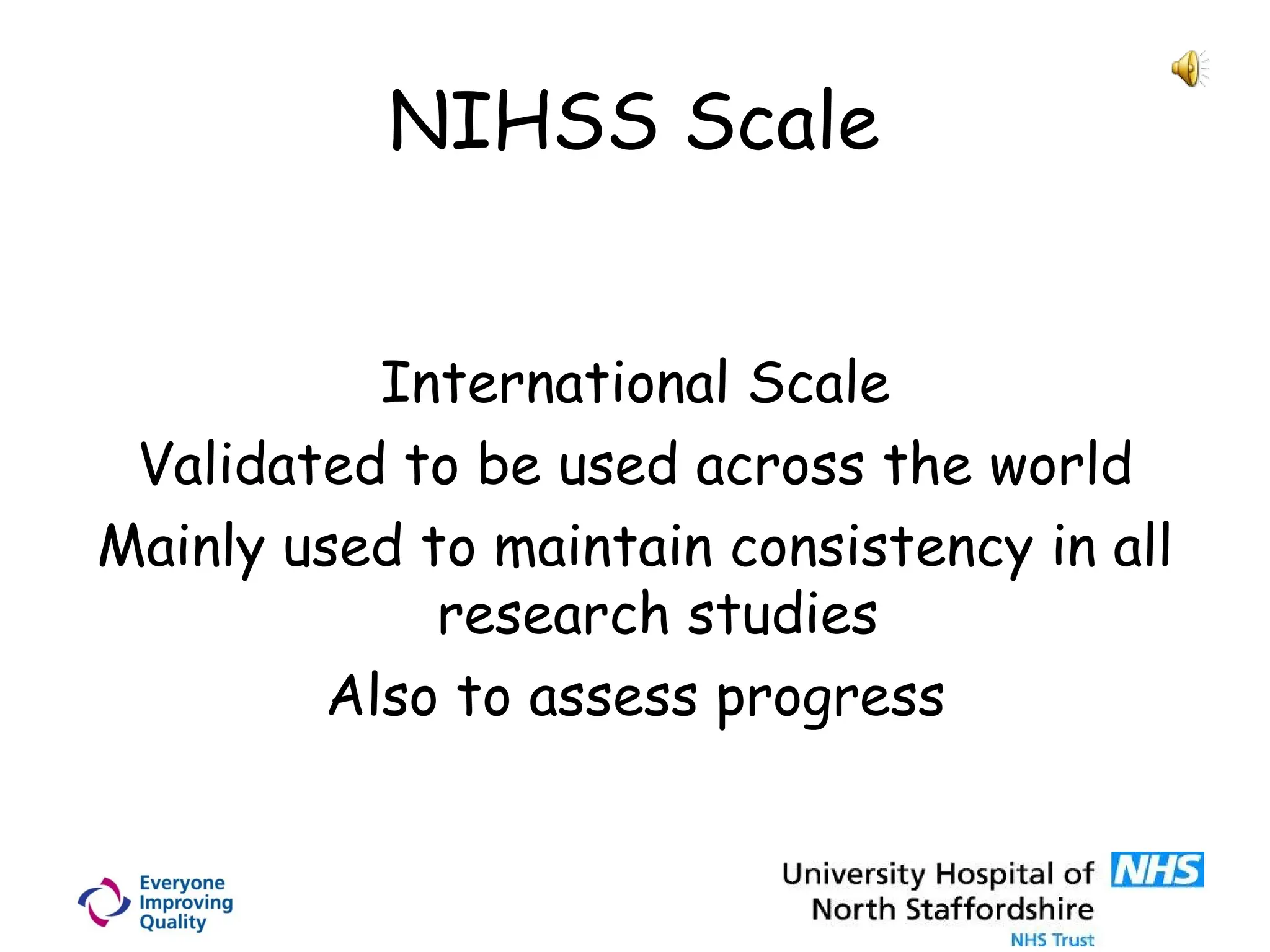
NIHSS Scale
International Scale
Validated to be used across the world
Mainly used to maintain consistency in all
research studies
Also to assess progress
Stroke Severity - NIHSS
NIHSS < 4
NIHSS 4 - 7
NIHSS 8 – 15
NIHSS >15
NIHSS >24
Eligibility
 Age 80 or below
 Previously fit and independent
 Onset time known and less than 4.5
hours
 CT excludes haemorrhage
Exclusions
 Recent surgery, biopsies arterial cannaulation
 Increased bleeding risk
 Past history of intracranial haemorrhage
 Any CNS pathology other than current stroke
 Any past stroke plus diabetes
 Stroke within 3 months
 Systolic blood pressure >185
 NIHSS < 4 or NIHSS > 25
Benefit of thrombolysis according to age
group.....
Mishra. et.al BMJ 2010; 341:c6046
Other ways of saving the
Penumbra if beyond 3 - 6 hours
Neuro-protection and
Re-perfusion
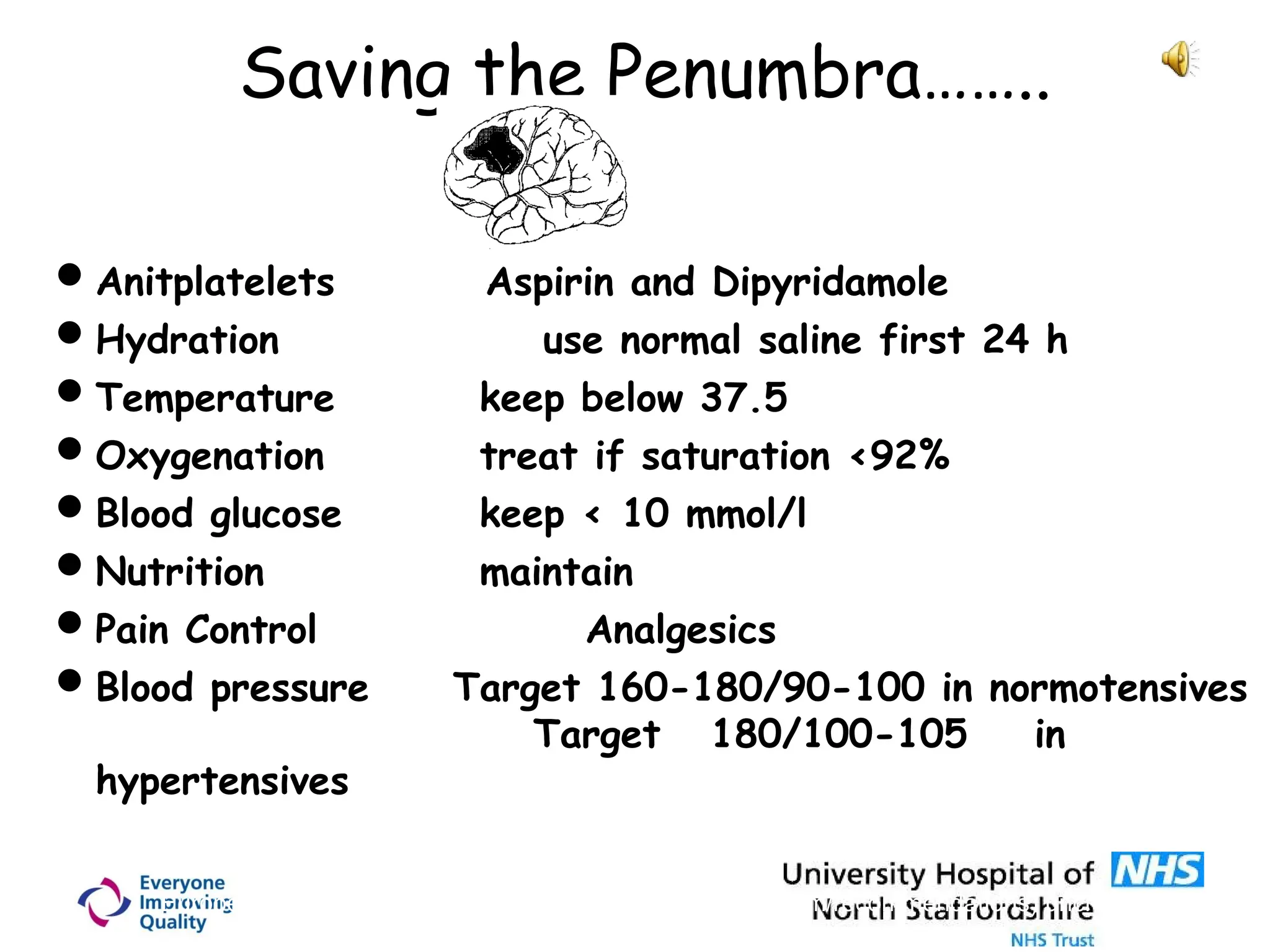
Saving the Penumbra……..
Anitplatelets Aspirin and Dipyridamole
Hydration use normal saline first 24 h
Temperature keep below 37.5
Oxygenation treat if saturation <92%
Blood glucose keep < 10 mmol/l
Nutrition maintain
Pain Control Analgesics
Blood pressure Target 160-180/90-100 in normotensives
Target 180/100-105 in
hypertensives
European Stroke Initiative 2003 (http://www.eusi-stroke.com/recommendations) unchanged in 200
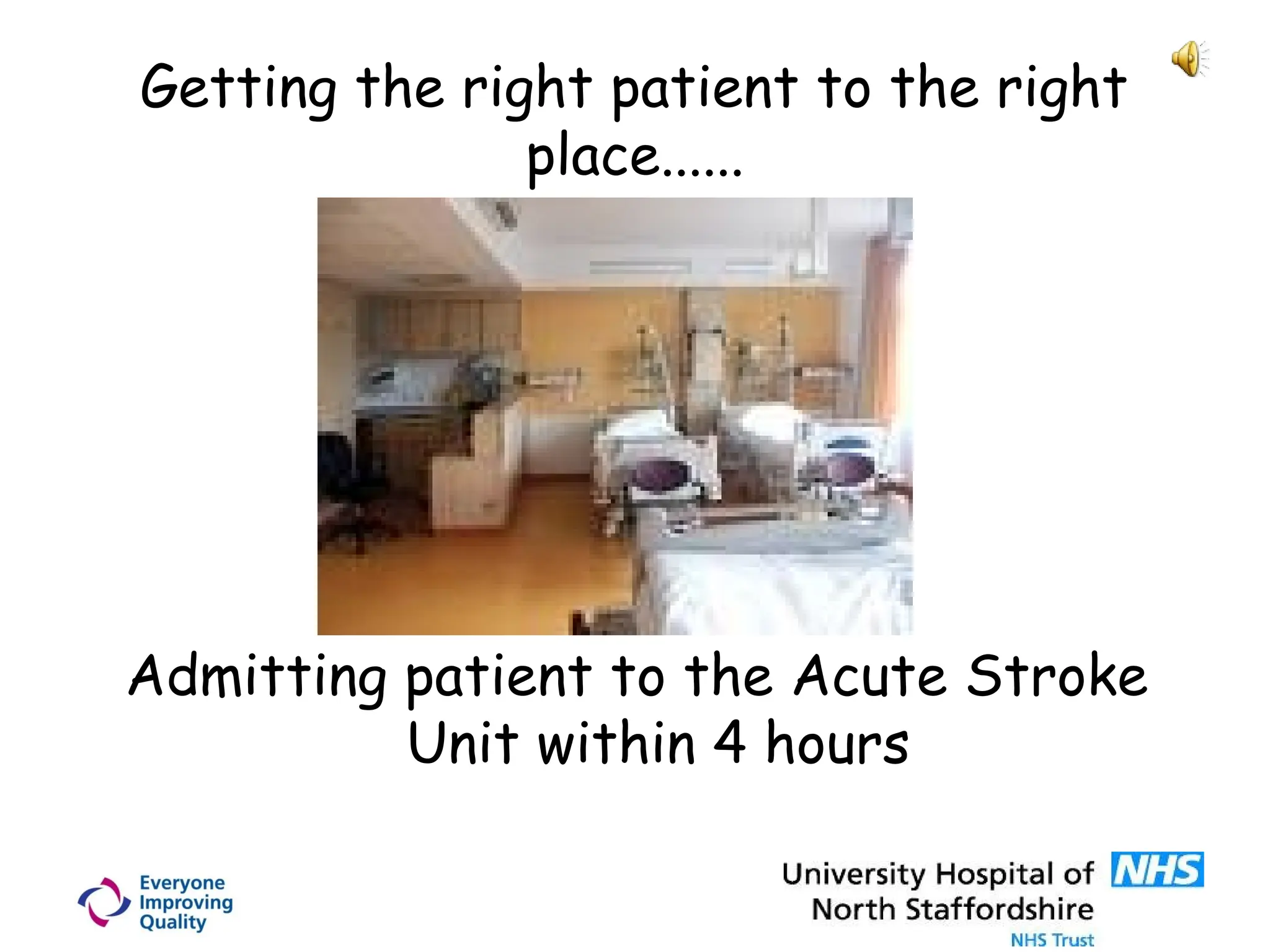
Getting the right patient to the right
place......
Admitting patient to the Acute Stroke
Unit within 4 hours
Management of
Management of
Complications
Complications
Copyright ©2008 BMJ Publishing Group Ltd.
Derex, L et al. J Neurol Neurosurg Psychiatry 2008;79:1093-1099
Figure 1 European Cooperative Acute Stroke Study (ECASS) classification of intracerebral
haemorrhage (ICH) following thrombolysis (from Berger and colleagues38). (A) HI-1; (B) HI-2; (C)
PH-1; (D) PH-2
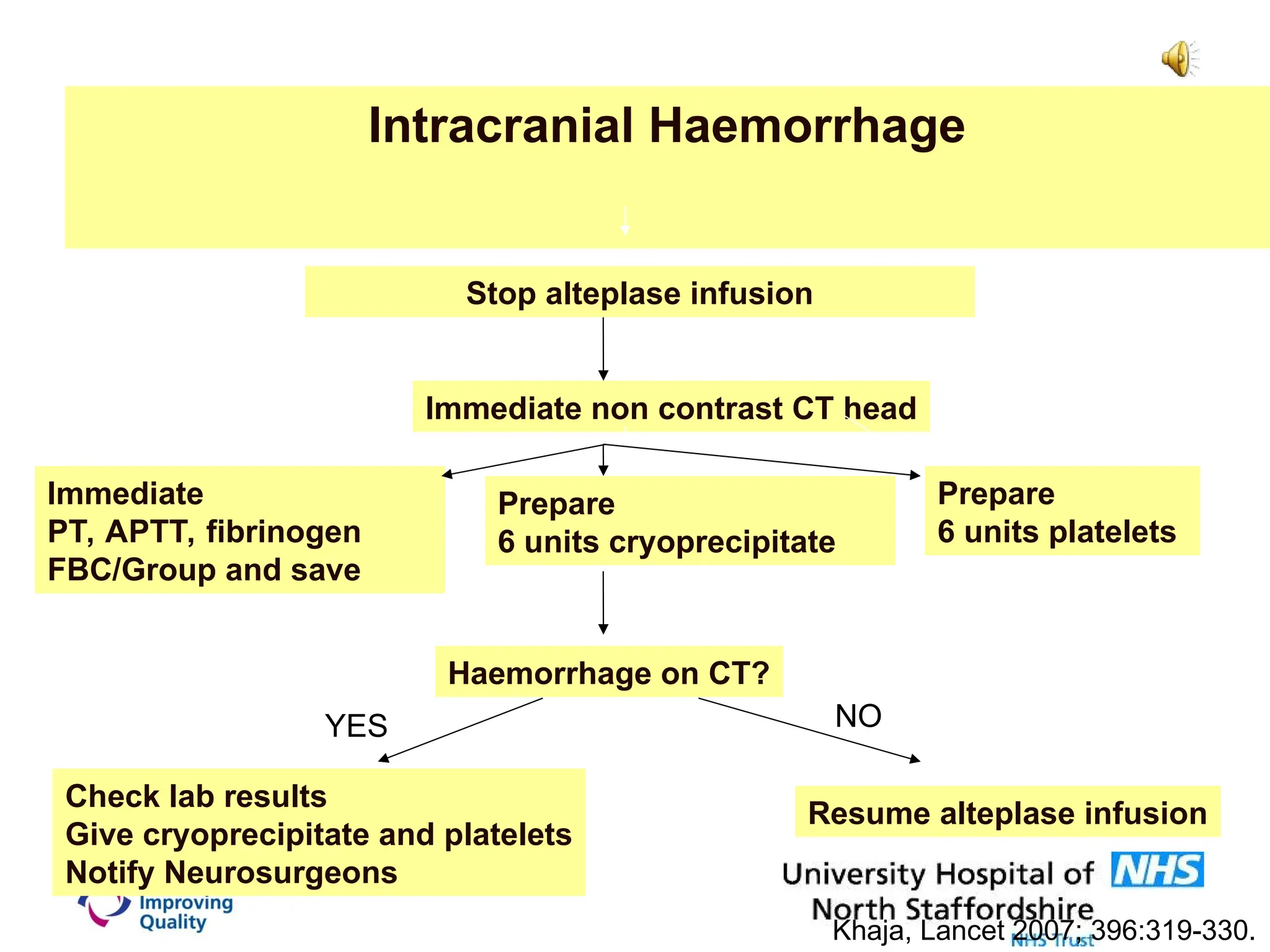
Intracranial Haemorrhage
Stop alteplase infusion
Immediate non contrast CT head
Immediate
PT, APTT, fibrinogen
FBC/Group and save
Prepare
6 units cryoprecipitate
Prepare
6 units platelets
Haemorrhage on CT?
Check lab results
Give cryoprecipitate and platelets
Notify Neurosurgeons
Resume alteplase infusion
YES NO
Khaja, Lancet 2007; 396:319-330.
Intracranial haemorrhage within 36 h
7 % risk of Intracranial Haemorrhage
(2 %of which were fatal)
Asymptomatic 5%
Asymptomatic 5%
Risk of haemorrhage depends on
stroke severity
stroke severity
NIHSS> 20 => haemorrhage risk 17%
NIHSS <10 => Haemorrhage risk 3%
Stroke 1997;28(11):2109-2118.
Extracranial bleeding
Stop alteplase infusion
Immediate PT, APTT, fibrinogen, FBC, group and save
Use mechanical compression, if possible, to control bleeding form
puncture sites
Support circulation with fluids and blood transfusion, as appropriate
For severe life threatening bleeding tranexamic acid 1 g i.v. over 15 min,
repeated at 8 h if needed
Consider transfusion of FFP and/or cryoprecipitate depending on the
results of the coagulation screen
Reperfusion cerebral oedema
Elevate the head to 30 degrees
Correct hyperthermia, hypoxia, hyperglycaemia, hypotension
AHA/ASA Stroke 2007;38:1655-1711. *as used by C. Roffe in Stoke, not in AHA/ASA guidance
If symptoms improve with mannitol reduce dose/frequency gradually
Mannitol 0.25-0.5 mg/kg over 20 min i.v., repeat q 6-8 h, if necessary
Dexamethasone 4 mg iv qds*
Frusemide 20-40 mg iv*
Avoid antihypertensives, especially vasodilators
Consider decompressive hemicraniectomy (once clotting correct/corrected)
Orololingual Angiooedema
Stop alteplase infusion
Antihistamines (clorpheniramine 10 mg i.v.)
Hydrocortisone 200 mg i.v.
Khaja, Lancet 2007; 396:319-330.
Observe vital for signs of progression, dyspnoea, anaphylactic shock
If sx are mild and non-progressive, alteplase can be restarted under close
observation
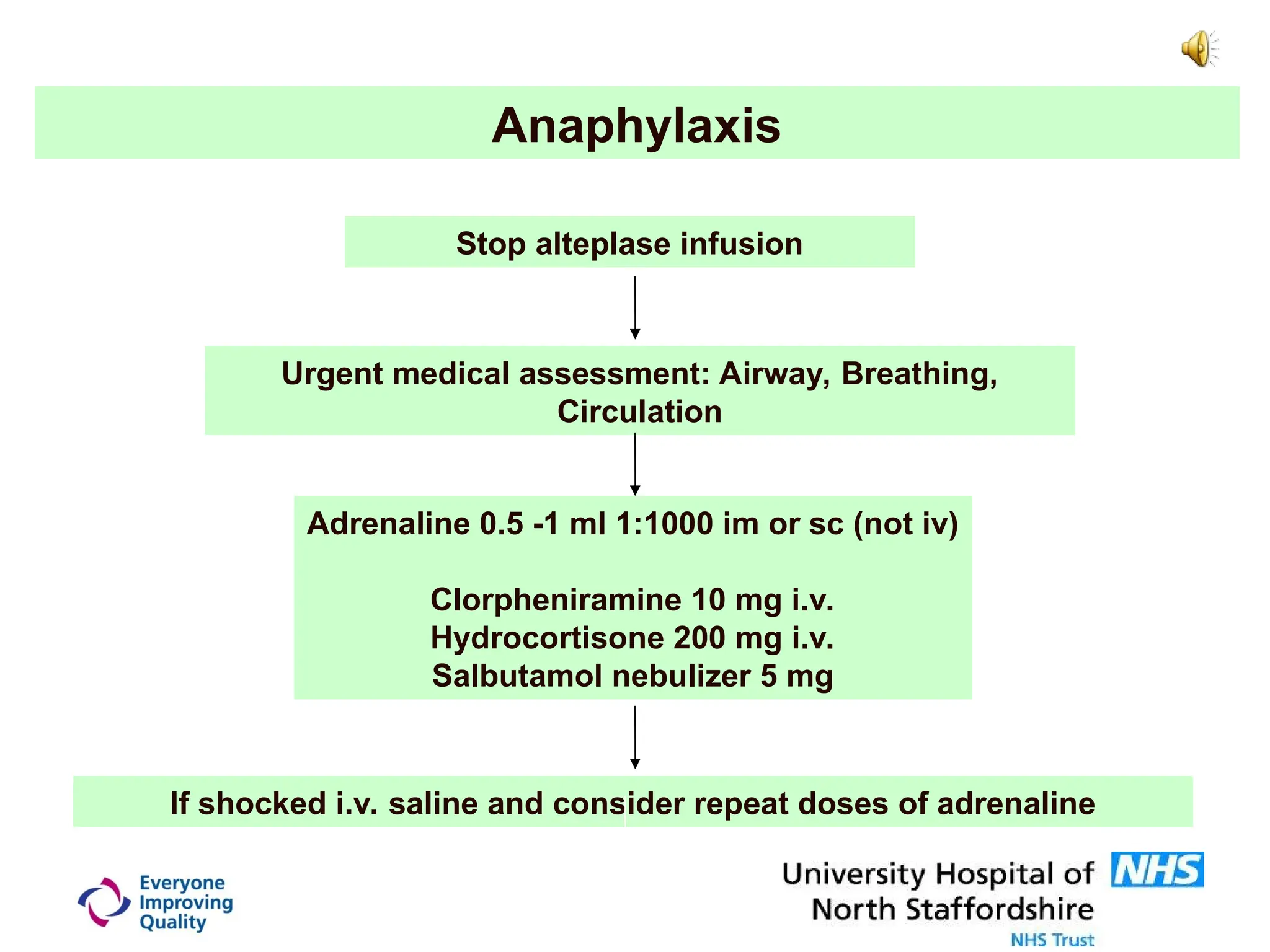
Anaphylaxis
Stop alteplase infusion
Adrenaline 0.5 -1 ml 1:1000 im or sc (not iv)
Clorpheniramine 10 mg i.v.
Hydrocortisone 200 mg i.v.
Salbutamol nebulizer 5 mg
Urgent medical assessment: Airway, Breathing,
Circulation
If shocked i.v. saline and consider repeat doses of adrenaline
Any Questions ?
Thank you

Acute Stroke management presentation ppt

  • 1.
    Stroke Thrombolysis Training Dr.Indira Natarajan Clinical Lead Acute Stroke and TIA Services
  • 2.
    WHO DEFINITION “ rapidlydeveloping clinical signs (at times global) of disturbance of cerebral function, lasting more than 24 hours with no apparent cause other than that of vascular origin” This definition includes signs and symptoms of suggestive of - ischaemic stroke - haemorrhages (intracerebral)
  • 3.
    Diagnostic Dilemma “ StrokeMimics ” or “ Stroke Syndrome ” 10% - 15% of patients referred with possible stroke have something else Some uncertainty is inevitable
  • 4.
    Stop and Think! Drowsyand Delirious Patient with headache Drowsiness, confusion and headache
  • 5.
    Drowsiness / Delirium SEIZURES METABOLIC/ TOXIC SUBDURAL HAEMATOMA UNCONCONSCIOUS
  • 6.
    ROSIER Scale Facial weakness+1 Arm weakness +1 Leg weakness +1 Speech disturbance +1 Visual disturbance +1 Loss of Consciousness - 1 Seizure episode - 1
  • 7.
    Diagnostic Dilemma 68 yearold Sudden onset Right facial arm and leg weakness with speech disturbance Vascular Risk factors: Hypertension Diabetes ....................... 32 year old Dubious onset Right facial arm and leg weakness Stuttering course No vascular risk factors ? Seizure ? Other causes
  • 8.
    Treatments effective withinfirst hours to days Aspirin Thrombolysis Acute Stroke Unit Hemicraniectomy
  • 9.
    Effective treatment for1 patient to benefit Numbers treated to benefit one patient Propotion of patients eligible Asprin 100 70 - 80% Stroke Unit 20 100% Thrombolysis 10 10%
  • 10.
  • 11.
    Modified Rankin Scale IndependentDependent 1 2 3 4 5 No Mild Moderate Moderately Severe Severe
  • 12.
    TIME IS BRAIN 2 million neurons are lost every minute that treatment is delayed.  Saver JL. Time is brain—quantified. Stroke 2006;37: 263–266.
  • 13.
    rt-PA trials meta-analysis.Benefit declines with increasing time to treatment, but scope for benefit up to 6h (Lancet 2004; 363: 768–74) Benefit Harm 3 hours 6 hours Upper and lower 95% confidence limits Line of no effect
  • 14.
    Benefit of r-tpaat 90 days Time between event and treatment Odds ratio in favour of favourable outcome (95% CI) Estimated number needed to treat for favourable outcome 0-90 minutes 2.55 (1.44 to 4.52) 3.0 91-180 minutes 1.64 (1.12 to 2.40) 7.0 181-270 minutes 1.34 (1.06 to 1.68) 14.1 271-360 minutes 1.22 (0.92 to 1.61) 21.4
  • 15.
    Acute Stroke Services... 999 1hour 1 hour 0 - 4.5 hours 0 - 4.5 hours A Patient's Journey..... 1 hour 1 hour ESD ESD
  • 16.
    Check List Confirm diagnosis ExcludeHypo-glycaemia Confirm Onset Time NIHSS scale Eligibility Contra-indications Consent
  • 17.
    NIHSS Scale International Scale Validatedto be used across the world Mainly used to maintain consistency in all research studies Also to assess progress
  • 18.
    Stroke Severity -NIHSS NIHSS < 4 NIHSS 4 - 7 NIHSS 8 – 15 NIHSS >15 NIHSS >24
  • 19.
    Eligibility  Age 80or below  Previously fit and independent  Onset time known and less than 4.5 hours  CT excludes haemorrhage
  • 20.
    Exclusions  Recent surgery,biopsies arterial cannaulation  Increased bleeding risk  Past history of intracranial haemorrhage  Any CNS pathology other than current stroke  Any past stroke plus diabetes  Stroke within 3 months  Systolic blood pressure >185  NIHSS < 4 or NIHSS > 25
  • 21.
    Benefit of thrombolysisaccording to age group..... Mishra. et.al BMJ 2010; 341:c6046
  • 22.
    Other ways ofsaving the Penumbra if beyond 3 - 6 hours Neuro-protection and Re-perfusion
  • 23.
    Saving the Penumbra…….. AnitplateletsAspirin and Dipyridamole Hydration use normal saline first 24 h Temperature keep below 37.5 Oxygenation treat if saturation <92% Blood glucose keep < 10 mmol/l Nutrition maintain Pain Control Analgesics Blood pressure Target 160-180/90-100 in normotensives Target 180/100-105 in hypertensives European Stroke Initiative 2003 (http://www.eusi-stroke.com/recommendations) unchanged in 200
  • 24.
    Getting the rightpatient to the right place...... Admitting patient to the Acute Stroke Unit within 4 hours
  • 25.
  • 26.
    Copyright ©2008 BMJPublishing Group Ltd. Derex, L et al. J Neurol Neurosurg Psychiatry 2008;79:1093-1099 Figure 1 European Cooperative Acute Stroke Study (ECASS) classification of intracerebral haemorrhage (ICH) following thrombolysis (from Berger and colleagues38). (A) HI-1; (B) HI-2; (C) PH-1; (D) PH-2
  • 27.
    Intracranial Haemorrhage Stop alteplaseinfusion Immediate non contrast CT head Immediate PT, APTT, fibrinogen FBC/Group and save Prepare 6 units cryoprecipitate Prepare 6 units platelets Haemorrhage on CT? Check lab results Give cryoprecipitate and platelets Notify Neurosurgeons Resume alteplase infusion YES NO Khaja, Lancet 2007; 396:319-330.
  • 28.
    Intracranial haemorrhage within36 h Intracranial haemorrhage within 36 h 7 % risk of Intracranial Haemorrhage 7 % risk of Intracranial Haemorrhage (2 %of which were fatal) (2 %of which were fatal) Asymptomatic 5% Asymptomatic 5%
  • 29.
    Risk of haemorrhagedepends on Risk of haemorrhage depends on stroke severity stroke severity NIHSS> 20 => haemorrhage risk 17% NIHSS> 20 => haemorrhage risk 17% NIHSS <10 => Haemorrhage risk 3% NIHSS <10 => Haemorrhage risk 3% Stroke 1997;28(11):2109-2118. Stroke 1997;28(11):2109-2118.
  • 30.
    Extracranial bleeding Stop alteplaseinfusion Immediate PT, APTT, fibrinogen, FBC, group and save Use mechanical compression, if possible, to control bleeding form puncture sites Support circulation with fluids and blood transfusion, as appropriate For severe life threatening bleeding tranexamic acid 1 g i.v. over 15 min, repeated at 8 h if needed Consider transfusion of FFP and/or cryoprecipitate depending on the results of the coagulation screen
  • 31.
    Reperfusion cerebral oedema Elevatethe head to 30 degrees Correct hyperthermia, hypoxia, hyperglycaemia, hypotension AHA/ASA Stroke 2007;38:1655-1711. *as used by C. Roffe in Stoke, not in AHA/ASA guidance If symptoms improve with mannitol reduce dose/frequency gradually Mannitol 0.25-0.5 mg/kg over 20 min i.v., repeat q 6-8 h, if necessary Dexamethasone 4 mg iv qds* Frusemide 20-40 mg iv* Avoid antihypertensives, especially vasodilators Consider decompressive hemicraniectomy (once clotting correct/corrected)
  • 32.
    Orololingual Angiooedema Stop alteplaseinfusion Antihistamines (clorpheniramine 10 mg i.v.) Hydrocortisone 200 mg i.v. Khaja, Lancet 2007; 396:319-330. Observe vital for signs of progression, dyspnoea, anaphylactic shock If sx are mild and non-progressive, alteplase can be restarted under close observation
  • 33.
    Anaphylaxis Stop alteplase infusion Adrenaline0.5 -1 ml 1:1000 im or sc (not iv) Clorpheniramine 10 mg i.v. Hydrocortisone 200 mg i.v. Salbutamol nebulizer 5 mg Urgent medical assessment: Airway, Breathing, Circulation If shocked i.v. saline and consider repeat doses of adrenaline
  • 34.

Editor's Notes

  • #31 The goal of hyperosmolar therapy is to increase the serum osmolarity to approximately 315–320 mOsm/L Steiner Neurol 2001
  • #32 Usually starts early after the start of rx Resolves within 72 h Insula infarct=> contralateral tongue oedema Entgelter 2005 Most are on ACEI 1.9% after stroke thrombolysis 0.05% after MI thrombolysis Other rx ranitidine clemastin