ACR BI-RADS® ATLAS — MAMMOGRAPHY
American College of Radiology	121
MAMMOGRAPHY
II.	 REPORTING SYSTEM
2013
122	 American College of Radiology		
MAMMOGRAPHY
ACR BI-RADS® ATLAS — MAMMOGRAPHY
American College of Radiology	123
MAMMOGRAPHY
A.	 REPORT ORGANIZATION (Guidance chapter, see page 147)
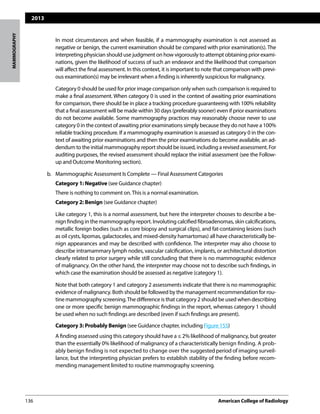
The reporting system should be concise and organized using the following structure. A statement
indicating that the current examination has been compared to previous examination(s) should be
included (specify date[s]). If this is not included, it should be assumed that no comparison has been
made, although it is preferable to indicate that no comparison was made.
Table 4.	 Report Organization
Report Structure
1. Indication for examination
2. Succinct description of the overall breast composition
3. Clear description of any important findings
4. Comparison to previous examination(s), if deemed appropriate by the interpreting physician
5. Assessment
6. Management
1.	 INDICATION FOR EXAMINATION
	 Provide a brief description of the indication for examination. This may be screening for an
asymptomatic woman, recall of a screening-detected finding, evaluation of a clinical finding
(specify the finding and its location), or follow-up of either a probably benign lesion or cancer
treatedwithbreastconservation.Ifanimplantispresent,bothstandardandimplant-displaced
views should be performed, and this should be stated in the mammography report.
2.	 SUCCINCT DESCRIPTION OF THE OVERALL BREAST COMPOSITION
	 This is an overall assessment of the volume of attenuating tissues in the breast, to help in-
dicate the relative possibility that a lesion could be obscured by normal tissue and that the
sensitivity of examination thereby may be compromised by dense breast tissue. A few co-
alescent areas of dense tissue may be present in breasts with as little as 10% dense tissue,
whereas primarily fatty areas may be present in breasts with as much as 90% dense tissue.
	 Since mammography does not depict all breast cancers, clinical breast examination is a
complementary element of screening. Findings at clinical breast examination should not be
ignored and may have increased importance in the dense breast.
The available data do not support the use of mammographic breast density for determining
screening frequency.
The following four categories of breast composition are defined by the visually estimated con-
tentoffibroglandular-densitytissuewithinthebreasts.Pleasenotethatthecategoriesarelisted
as a,b,c, and d so as not to be confused with the numbered BI-RADS® assessment categories.
If the breasts are not of apparently equal density, the denser breast should be used to catego-
rize breast density. The sensitivity of mammography for noncalcified lesions decreases as the
BI-RADS® breast density category increases. The denser the breast, the larger the lesion(s) that
may be obscured. There is considerable intra- and inter-observer variation in visually estimat-
ing breast density between any two adjacent density categories. Furthermore, there is only
2013
124	 American College of Radiology		
MAMMOGRAPHY
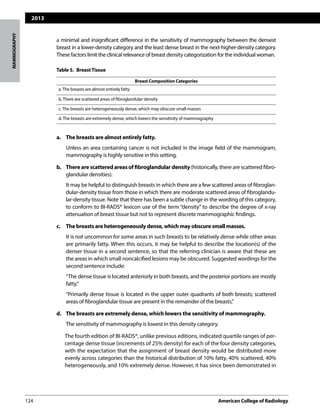
Table 5.	 BreastTissue
Breast Composition Categories
a.The breasts are almost entirely fatty
b.There are scattered areas of fibroglandular density
c.The breasts are heterogeneously dense, which may obscure small masses
d.The breasts are extremely dense, which lowers the sensitivity of mammography
a minimal and insignificant difference in the sensitivity of mammography between the densest
breast in a lower-density category and the least dense breast in the next-higher-density category.
These factors limit the clinical relevance of breast density categorization for the individual woman.
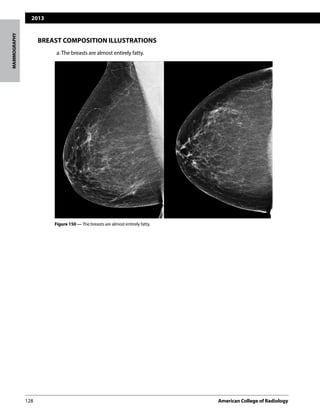
a.	 The breasts are almost entirely fatty.
	 Unless an area containing cancer is not included in the image field of the mammogram,
mammography is highly sensitive in this setting.
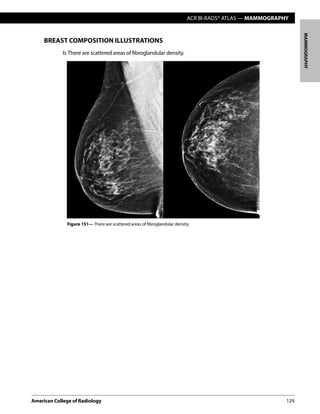
b.	 There are scattered areas of fibroglandular density (historically, there are scattered fibro-
glandular densities).
	 It may be helpful to distinguish breasts in which there are a few scattered areas of fibroglan-
dular-density tissue from those in which there are moderate scattered areas of fibroglandu-
lar-density tissue. Note that there has been a subtle change in the wording of this category,
to conform to BI-RADS® lexicon use of the term “density” to describe the degree of x-ray
attenuation of breast tissue but not to represent discrete mammographic findings.
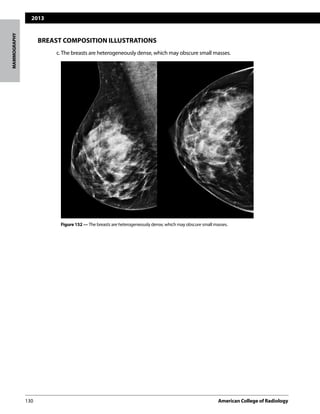
c.	 The breasts are heterogeneously dense, which may obscure small masses.
	 It is not uncommon for some areas in such breasts to be relatively dense while other areas
are primarily fatty. When this occurs, it may be helpful to describe the location(s) of the
denser tissue in a second sentence, so that the referring clinician is aware that these are
the areas in which small noncalcified lesions may be obscured. Suggested wordings for the
second sentence include:
	 “The dense tissue is located anteriorly in both breasts, and the posterior portions are mostly
fatty.”
	 “Primarily dense tissue is located in the upper outer quadrants of both breasts; scattered
areas of fibroglandular tissue are present in the remainder of the breasts.”
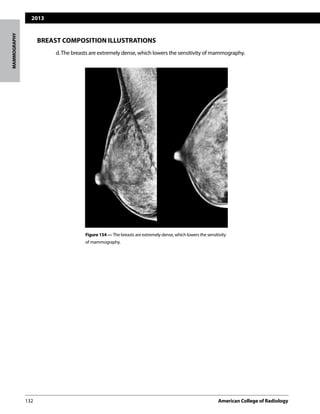
d.	 The breasts are extremely dense, which lowers the sensitivity of mammo­graphy.
	 The sensitivity of mammography is lowest in this density category.
	 The fourth edition of BI-RADS®, unlike previous editions, indicated quartile ranges of per-
centage dense tissue (increments of 25% density) for each of the four density categories,
with the expectation that the assignment of breast density would be distributed more
evenly across categories than the historical distribution of 10% fatty, 40% scattered, 40%
heterogeneously, and 10% extremely dense. However, it has since been demonstrated in
ACR BI-RADS® ATLAS — MAMMOGRAPHY
American College of Radiology	125
MAMMOGRAPHY
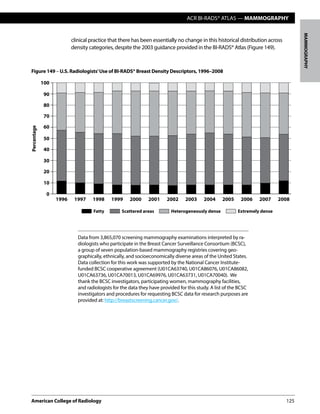
Figure 149 – U.S. Radiologists’Use of BI-RADS® Breast Density Descriptors, 1996–2008
0
10
1996
20
30
Percentage
40
50
60
70
80
Fatty
90
100
Scattered areas Heterogeneously dense Extremely dense
1997 1998 1999 2000 2001 2002 2003 2004 2005 2006 2007 2008
Data from 3,865,070 screening mammography examinations interpreted by ra-
diologists who participate in the Breast Cancer Surveillance Consortium (BCSC),
a group of seven population-based mammography registries covering geo-
graphically, ethnically, and socioeconomically diverse areas of the United States.
Data collection for this work was supported by the National Cancer Institute-
funded BCSC cooperative agreement (U01CA63740, U01CA86076, U01CA86082,
U01CA63736, U01CA70013, U01CA69976, U01CA63731, U01CA70040). We
thank the BCSC investigators, participating women, mammography facilities,
and radiologists for the data they have provided for this study. A list of the BCSC
investigators and procedures for requesting BCSC data for research purposes are
provided at: http://breastscreening.cancer.gov/.
clinical practice that there has been essentially no change in this historical distribution across
density categories, despite the 2003 guidance provided in the BI-RADS® Atlas (Figure 149).
2013
126	 American College of Radiology		
MAMMOGRAPHY
	 The absence of change in clinical practice of the assignment of breast density across categories
may reflect the reality that a few coalescent areas of dense tissue may be present in breasts with
aslittleas10%densetissue,whereasprimarilyfattyareasmaybepresentinbreastswithasmuch
as 90% dense tissue.
	 The fifth edition of BI-RADS® no longer indicates ranges of percentage dense tissue for the four
density categories.This is done to emphasize the text descriptions of breast density, which reflect
the masking effect of dense fibroglandular tissue on mammographic depiction of noncalcified
lesions, because the Committee on BI-RADS® concludes that the association of subjectively es-
timated breast density with changes in the sensitivity of mammography is clinically more im-
portant than the relatively smaller effect of percentage breast density as an indicator for breast
cancer risk.
	 The Committee on BI-RADS® indeed is aware of recent and continuing investigations of percent-
agebreastdensityasanindicatorforbreastcancerrisk,andbyeliminatingpercentagerangeswe
do not intend to compromise or impede any such research. We simply recognize the reality that
interpreting physicians will continue to use density categories in mammography reports as they
have done over the past many years, independent of BI-RADS® guidance on percentage breast
density. We further recognize that both subjective estimates and planimetry measurements of
breast density based on area as depicted on (2-D) mammograms are imprecise indicators of
the volume of dense tissue, which may be measured using (3-D) cross-sectional breast imaging
modalities.1
We await publication of robust volume-based breast density data, using validated
percentage cut points (not necessarily quartiles) that are readily and reproducibly determined
at imaging, before again indicating percentage ranges for BI-RADS® density categories. We also
urge avoidance of numbers to classify breast density instead of BI-RADS® terminology in order
to avoid confusion with BI-RADS® assessment categories, which are numbered.
	 Some breasts may appear more or less dense when imaged using full-field digital mammog-
raphy compared to screen-film mammography. Superior depiction of the skin line by digital
mammography provides the observer with a more accurate (and usually larger) estimate of
the extent of the subcutaneous fat. However, no change in the distribution across density cat-
egories has been observed when comparing full-field digital mammography with screen-film
mammography.2
ACR BI-RADS® ATLAS — MAMMOGRAPHY
American College of Radiology	127
MAMMOGRAPHY
BREAST COMPOSITION ILLUSTRATIONS
2013
128	 American College of Radiology		
MAMMOGRAPHY
BREAST COMPOSITION ILLUSTRATIONS
	 a.The breasts are almost entirely fatty.
Figure 150 — The breasts are almost entirely fatty.
ACR BI-RADS® ATLAS — MAMMOGRAPHY
American College of Radiology	129
MAMMOGRAPHY
BREAST COMPOSITION ILLUSTRATIONS
	 b.There are scattered areas of fibroglandular density.
Figure 151— There are scattered areas of fibroglandular density.
2013
130	 American College of Radiology		
MAMMOGRAPHY
BREAST COMPOSITION ILLUSTRATIONS
	 c.The breasts are heterogeneously dense, which may obscure small masses.
Figure 152 — The breasts are heterogeneously dense, which may obscure small masses.
ACR BI-RADS® ATLAS — MAMMOGRAPHY
American College of Radiology	131
MAMMOGRAPHY
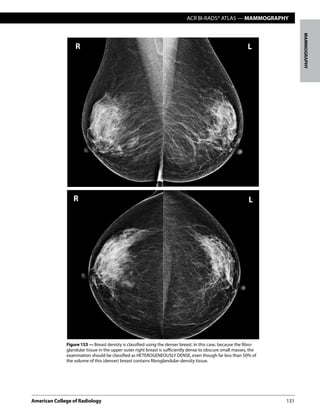
Figure 153 — Breast density is classified using the denser breast. In this case, because the fibro-
glandular tissue in the upper outer right breast is sufficiently dense to obscure small masses, the
examination should be classified as HETEROGENEOUSLY DENSE, even though far less than 50% of
the volume of this (denser) breast contains fibroglandular-density tissue.
2013
132	 American College of Radiology		
MAMMOGRAPHY
BREAST COMPOSITION ILLUSTRATIONS
	 d.The breasts are extremely dense, which lowers the sensitivity of mammography.
Figure 154 — The breasts are extremely dense, which lowers the sensitivity
of mammography.
ACR BI-RADS® ATLAS — MAMMOGRAPHY
American College of Radiology	133
MAMMOGRAPHY
3.	 CLEAR DESCRIPTION OF ANY IMPORTANT FINDINGS
		 (It is assumed that most important findings are either of concern at screening, inherently suspi-
cious, new, or seen to be larger/more extensive when compared to previous examination.)
a.	 Mass:
	Size
	 Morphology (shape, margin)
	Density
	 Associated calcifications
	 Associated features
	Location
b.	 Calcifications:
	 Morphology — describe typically benign type or describe shape of particles
	 Distribution (may not be appropriate for typically benign calcifications)
	 Associated features
	Location
c.	 Architectural Distortion:
	 Associated calcifications
	 Associated features
	Location
d.	 Asymmetries (asymmetry, global asymmetry, focal asymmetry, developing asymmetry):
	 Associated calcifications
	 Associated features
	Location
e.	 Intramammary lymph node (rarely important):
	Location
f.	 Skin lesion (rarely important):
	Location
g.	 Solitary dilated duct (rarely present):
	Location
2013
134	 American College of Radiology		
MAMMOGRAPHY
4.	 COMPARISON TO PREVIOUS EXAMINATION(S), IF DEEMED APPROPRIATE BY THE INTERPRETING
PHYSICIAN
		 Comparison to previous examination may assume importance if the finding of concern requires
an evaluation of change or stability. Comparison is not important when a finding has unequivo-
cally benign features. Comparison may be irrelevant when the finding is inherently suspicious
for malignancy.
5.	ASSESSMENT
		 Theincorporationofanassessmentcategoryintheoverallsummaryofthemammographyreport
is mandated by the Food and Drug Administration, Quality Mammography Standards; Final Rule.3
WhereasFDA-mandatedassessmentsarenotlinkedtomanagementrecommendations,BI-RADS®
assessment categories are designed to be concordant with specific management recommenda-
tions. The linking of assessment categories with concordant management recommendations
further enhances sound medical practice.
		 All final assessments (BI-RADS® categories 1, 2, 3, 4, 5, and 6) should be based on thorough
evaluation of the mammographic features of concern or after determination that an examina-
tion is negative or benign.
		 An incomplete (category 0) assessment is usually given for screening examinations when ad-
ditional imaging evaluation is recommended before it is appropriate to render a final assess-
ment. There may be rare situations in the screening setting in which a category 4 or 5 assess-
ment is used, but this practice is discouraged because it may compromise some aspects of
outcome analysis.
		 A recall (category 0) assessment should include specific suggestions for the next course of action
(spot-compression magnification views, US, etc.).
6.	MANAGEMENT
		 If a suspicious abnormality is identified, the report should indicate that a biopsy should be per-
formed in the absence of clinical contraindication. This is an assessment for which the interpret-
ing physician has sufficient concern that biopsy is warranted based on imaging findings. The
recommended language (“biopsy should be performed in the absence of clinical contraindica-
tion”) provides for the unusual circumstance in which either the patient or her physician might
reasonably wish to defer a biopsy.
Interpretationisfacilitatedbyrecognizingthatmostexaminationsmaybecategorizedunderafew
headings. These are listed in Table 6 and numeric codes are included for computer use.
ACR BI-RADS® ATLAS — MAMMOGRAPHY
American College of Radiology	135
MAMMOGRAPHY
B.	 ASSESSMENT CATEGORIES
Table 6. Concordance Between BI-RADS® Assessment Categories and Management Recommendations
Assessment Management Likelihood of Cancer
Category 0: Incomplete – Need
Additional Imaging Evaluation and/or
Prior Mammograms for Comparison
Recall for additional
imaging and/or comparison
with prior examination(s)
N/A
Category 1: Negative Routine mammography
screening
Essentially 0% likelihood of malignancy
Category 2: Benign Routine mammography
screening
Essentially 0% likelihood of malignancy
Category 3: Probably Benign Short-interval (6-month)
follow-up or continued
surveillance mammography
(Figure 155, see page 152)
> 0% but ≤ 2% likelihood of malignancy
Category 4: Suspicious
Category 4A:	 Low suspicion for
malignancy
Category 4B:	 Moderate suspicion for
malignancy
Category 4C:	 High suspicion for
malignancy
Tissue diagnosis > 2% but < 95% likelihood of malignancy
> 2% to ≤ 10% likelihood of malignancy
> 10% to ≤ 50% likelihood of
malignancy
> 50% to < 95% likelihood of
malignancy
Category 5: Highly Suggestive of
Malignancy
Tissue diagnosis ≥ 95% likelihood of malignancy
Category 6: Known Biopsy-Proven
Malignancy
Surgical excision when
clinically appropriate
N/A
a.	 Mammographic Assessment Is Incomplete
Category 0: Incomplete — Need Additional Imaging Evaluation and/or Prior Mammograms
for Comparison
		 For this assessment category, the text may be shortened to“Incomplete — Need Additional Imag-
ing Evaluation”or“Incomplete — Need Prior Mammograms for Comparison”, as appropriate. Refer
toTable 9 (see page 168) in Frequently Asked Question #1 in the Guidance chapter for a listing of
FDA-approved equivalent wording for assessment categories.
		 There is a finding for which additional imaging evaluation is needed.This is almost always used in a
screeningsituation.Undercertaincircumstancesthisassessmentcategorymaybeusedinadiagnos-
tic mammography report, such as when US equipment or personnel are not immediately available,
or when the patient is unable or unwilling to wait for completion of a full diagnostic examination. A
recommendation for additional imaging evaluation includes the use of spot-compression (with or
without magnification), special mammographic views, and US. Category 0 should not be used for
diagnosticbreastimagingfindingsthatwarrantfurtherevaluationwithMRI.Rather,theinterpreting
physician should issue a final assessment in a report that is made before the MRI examination is per-
formed. Refer to Frequently Asked Question #8 (See page 162) in the Guidance chapter for further
discussion.
2013
136	 American College of Radiology		
MAMMOGRAPHY
		 In most circumstances and when feasible, if a mammography examination is not assessed as
negative or benign, the current examination should be compared with prior examination(s). The
interpreting physician should use judgment on how vigorously to attempt obtaining prior exami-
nations, given the likelihood of success of such an endeavor and the likelihood that comparison
will affect the final assessment. In this context, it is important to note that comparison with previ-
ous examination(s) may be irrelevant when a finding is inherently suspicious for malignancy.
		 Category 0 should be used for prior image comparison only when such comparison is required to
make a final assessment. When category 0 is used in the context of awaiting prior examinations
for comparison, there should be in place a tracking procedure guaranteeing with 100% reliability
that a final assessment will be made within 30 days (preferably sooner) even if prior examinations
do not become available. Some mammography practices may reasonably choose never to use
category 0 in the context of awaiting prior examinations simply because they do not have a 100%
reliable tracking procedure. If a mammography examination is assessed as category 0 in the con-
text of awaiting prior examinations and then the prior examinations do become available, an ad-
dendum to the initial mammography report should be issued, including a revised assessment. For
auditing purposes, the revised assessment should replace the initial assessment (see the Follow-
up and Outcome Monitoring section).
b. 	 Mammographic Assessment Is Complete — Final Assessment Categories
		 Category 1: Negative (see Guidance chapter)
		 There is nothing to comment on.This is a normal examination.
		 Category 2: Benign (see Guidance chapter)
		 Like category 1, this is a normal assessment, but here the interpreter chooses to describe a be-
nign finding in the mammography report. Involuting calcified fibroadenomas, skin calcifications,
metallic foreign bodies (such as core biopsy and surgical clips), and fat-containing lesions (such
as oil cysts, lipomas, galactoceles, and mixed-density hamartomas) all have characteristically be-
nign appearances and may be described with confidence. The interpreter may also choose to
describe intramammary lymph nodes, vascular calcification, implants, or architectural distortion
clearly related to prior surgery while still concluding that there is no mammographic evidence
of malignancy. On the other hand, the interpreter may choose not to describe such findings, in
which case the examination should be assessed as negative (category 1).
		 Note that both category 1 and category 2 assessments indicate that there is no mammographic
evidence of malignancy. Both should be followed by the management recommendation for rou-
tine mammography screening.The difference is that category 2 should be used when describing
one or more specific benign mammographic findings in the report, whereas category 1 should
be used when no such findings are described (even if such findings are present).
	 Category 3: Probably Benign (see Guidance chapter, including Figure 155)
		 A finding assessed using this category should have a ≤ 2% likelihood of malignancy, but greater
than the essentially 0% likelihood of malignancy of a characteristically benign finding. A prob-
ably benign finding is not expected to change over the suggested period of imaging surveil-
lance, but the interpreting physician prefers to establish stability of the finding before recom-
mending management limited to routine mammography screening.
ACR BI-RADS® ATLAS — MAMMOGRAPHY
American College of Radiology	137
MAMMOGRAPHY
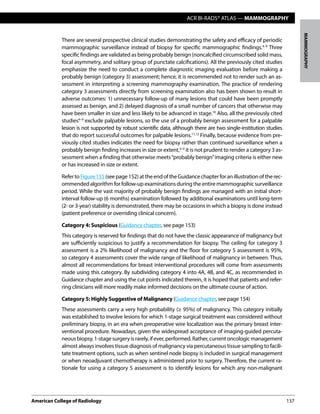
		 There are several prospective clinical studies demonstrating the safety and efficacy of periodic
mammographic surveillance instead of biopsy for specific mammographic findings.4–9
Three
specific findings are validated as being probably benign (noncalcified circumscribed solid mass,
focal asymmetry, and solitary group of punctate calcifications). All the previously cited studies
emphasize the need to conduct a complete diagnostic imaging evaluation before making a
probably benign (category 3) assessment; hence, it is recommended not to render such an as-
sessment in interpreting a screening mammography examination. The practice of rendering
category 3 assessments directly from screening examination also has been shown to result in
adverse outcomes: 1) unnecessary follow-up of many lesions that could have been promptly
assessed as benign, and 2) delayed diagnosis of a small number of cancers that otherwise may
have been smaller in size and less likely to be advanced in stage.10
Also, all the previously cited
studies4–9
exclude palpable lesions, so the use of a probably benign assessment for a palpable
lesion is not supported by robust scientific data, although there are two single-institution studies
that do report successful outcomes for palpable lesions.11,12
Finally, because evidence from pre-
viously cited studies indicates the need for biopsy rather than continued surveillance when a
probably benign finding increases in size or extent,4–9
it is not prudent to render a category 3 as-
sessment when a finding that otherwise meets“probably benign”imaging criteria is either new
or has increased in size or extent.
		 RefertoFigure155(seepage152)attheendoftheGuidancechapterforanillustrationoftherec-
ommended algorithm for follow-up examinations during the entire mammographic surveillance
period. While the vast majority of probably benign findings are managed with an initial short-
interval follow-up (6 months) examination followed by additional examinations until long-term
(2- or 3-year) stability is demonstrated, there may be occasions in which a biopsy is done instead
(patient preference or overriding clinical concern).
		 Category 4: Suspicious (Guidance chapter, see page 153)
		 This category is reserved for findings that do not have the classic appearance of malignancy but
are sufficiently suspicious to justify a recommendation for biopsy. The ceiling for category 3
assessment is a 2% likelihood of malignancy and the floor for category 5 assessment is 95%,
so category 4 assessments cover the wide range of likelihood of malignancy in between. Thus,
almost all recommendations for breast interventional procedures will come from assessments
made using this category. By subdividing category 4 into 4A, 4B, and 4C, as recommended in
Guidance chapter and using the cut points indicated therein, it is hoped that patients and refer-
ring clinicians will more readily make informed decisions on the ultimate course of action.
		 Category 5: Highly Suggestive of Malignancy (Guidance chapter, see page 154)
		 These assessments carry a very high probability (≥ 95%) of malignancy. This category initially
was established to involve lesions for which 1-stage surgical treatment was considered without
preliminary biopsy, in an era when preoperative wire localization was the primary breast inter-
ventional procedure. Nowadays, given the widespread acceptance of imaging-guided percuta-
neousbiopsy,1-stagesurgeryisrarely,ifever,performed.Rather,currentoncologicmanagement
almost always involves tissue diagnosis of malignancy via percutaneous tissue sampling to facili-
tate treatment options, such as when sentinel node biopsy is included in surgical management
or when neoadjuvant chemotherapy is administered prior to surgery. Therefore, the current ra-
tionale for using a category 5 assessment is to identify lesions for which any non-malignant
2013
138	 American College of Radiology		
MAMMOGRAPHY
percutaneous tissue diagnosis is automatically considered discordant, resulting in the recom-
mendation for repeat (usually surgical) biopsy.
		 Category 6: Known Biopsy-Proven Malignancy (Guidance chapter, see page 155):
		 This category is reserved for examinations performed after biopsy proof of malignancy (imaging
performed after percutaneous biopsy but prior to complete surgical excision), in which there are no
mammographic abnormalities other than the known cancer that might need additional evaluation.
ACR BI-RADS® ATLAS — MAMMOGRAPHY
American College of Radiology	139
MAMMOGRAPHY
C.	 WORDINGTHE REPORT
The current examination should be COMPARED TO PRIOR EXAMINATION(S) when appropriate. The
INDICATIONFOREXAMINATION,suchasscreeningor diagnostic, shouldbestated.Thereportshould
beorganizedwithabriefdescriptionoftheCOMPOSITIONofthebreastandanypertinentFINDINGS,
followed by the ASSESSMENT and MANAGEMENT RECOMMENDATIONS. Anyverbaldiscussionsbe-
tween the interpreting physician and the referring clinician or patient should be documented in
the original report or in an addendum to the report.
The report should be succinct, using terminology from the latest approved lexicon without embel-
lishment. Definitions of lexicon terms for mammographic findings should not appear in the report
narrative. Following the impression section and the (concordant) management recommendation
section of the report, both the assessment category numberandFDA-approved terminology for the
assessment category should be stated. Other aspects of the report should comply with the ACR
Practice Guideline for Communication: Diagnostic Radiology.13
2013
140	 American College of Radiology		
MAMMOGRAPHY
REFERENCES
	 1.	 Kopans DB. Basic physics and doubts about relationship between mammographically determined tissue den-
sity and breast cancer risk. Radiology 2008; 246(2):348–353.
	 2. 	Harvey JA, Gard CC, Miglioretti DL, et al. Reported mammographic density: film-screen versus digital acquisi-
tion. Radiology 2013; 266(3):752–758.
	 3.	 21CFR Part 16 and 900: Mammography Quality Standards; Final Rule. Federal Register, Washington, DC:
Government Printing Office, 62: No. 208; 55851-55994, October 28, 1997.
	 4.	 Sickles EA. Periodic mammographic follow-up of probably benign lesions: results in 3,184 consecutive cases.
Radiology 1991;179(2):463–468
	 5.	 Varas X, Leborgne F, Leborgne JH. Nonpalpable, probably benign lesions: role of follow-up mammography.
Radiology 1992;184(2):409–414.
	 6.	 Wolfe JN, Buck KA, Salane M, Parekh NJ. Xeroradiography of the breast: overview of 21, 057 consecutive cases.
Radiology 1987;165(2):305–311.
	 7.	 Helvie MA, Pennes DR, Rebner M, Adler DD. Mammographic follow-up of low-suspicion lesions: compliance
rate and diagnostic yield. Radiology 1991; 178(1):155–158.
	 8.	 Vizcaíno I, Gadea L, Andreo L, et al. Short-term follow-up results in 795 nonpalpable probably benign lesions
detected at screening mammography. Radiology 2001;219(2):475–483.
	 9.	 Varas X, Leborgne JH, Leborgne F, Mezzera J, Jaumandreu S, Leborgne F. Revisiting the mammographic follow-
up of BI-RADS category 3 lesions. AJR 2002; 179(3):691–695.
	10.	 Kerlikowske K, Smith-Bindman R, Abraham LA, et al. Breast cancer yield for screening mammographic exami-
nations with recommendation for short-interval follow-up. Radiology 2005; 234(3):684–692.
	11.	 GrafO,HelbichTH,FuchsjaegerMH,etal.Follow-upofpalpablecircumscribednoncalcifiedsolidbreastmasses
at mammography and US: can biopsy be averted? Radiology 2004; 233(3):850–856.
	12.	 Harvey JA, Nicholson BT, LoRusso AP, Cohen MA, Bovbjerg VE. Short-term follow-up of palpable breast lesions
with benign imaging features: evaluation of 375 lesions in 320 women. AJR 2009; 193(3):1723–1730.
	13.	 American College of Radiology. ACR Practice Guideline for Communication: Diagnostic Radiology. http://www.
acr.org/~/media/ACR/Documents/PGTS/guidelines/Comm_Diag_Imaging.pdf. Accessed November 4, 2013.

02 birads mammography reporting

  • 1.
    ACR BI-RADS® ATLAS— MAMMOGRAPHY American College of Radiology 121 MAMMOGRAPHY II. REPORTING SYSTEM
  • 2.
    2013 122 American Collegeof Radiology MAMMOGRAPHY
  • 3.
    ACR BI-RADS® ATLAS— MAMMOGRAPHY American College of Radiology 123 MAMMOGRAPHY A. REPORT ORGANIZATION (Guidance chapter, see page 147) The reporting system should be concise and organized using the following structure. A statement indicating that the current examination has been compared to previous examination(s) should be included (specify date[s]). If this is not included, it should be assumed that no comparison has been made, although it is preferable to indicate that no comparison was made. Table 4. Report Organization Report Structure 1. Indication for examination 2. Succinct description of the overall breast composition 3. Clear description of any important findings 4. Comparison to previous examination(s), if deemed appropriate by the interpreting physician 5. Assessment 6. Management 1. INDICATION FOR EXAMINATION Provide a brief description of the indication for examination. This may be screening for an asymptomatic woman, recall of a screening-detected finding, evaluation of a clinical finding (specify the finding and its location), or follow-up of either a probably benign lesion or cancer treatedwithbreastconservation.Ifanimplantispresent,bothstandardandimplant-displaced views should be performed, and this should be stated in the mammography report. 2. SUCCINCT DESCRIPTION OF THE OVERALL BREAST COMPOSITION This is an overall assessment of the volume of attenuating tissues in the breast, to help in- dicate the relative possibility that a lesion could be obscured by normal tissue and that the sensitivity of examination thereby may be compromised by dense breast tissue. A few co- alescent areas of dense tissue may be present in breasts with as little as 10% dense tissue, whereas primarily fatty areas may be present in breasts with as much as 90% dense tissue. Since mammography does not depict all breast cancers, clinical breast examination is a complementary element of screening. Findings at clinical breast examination should not be ignored and may have increased importance in the dense breast. The available data do not support the use of mammographic breast density for determining screening frequency. The following four categories of breast composition are defined by the visually estimated con- tentoffibroglandular-densitytissuewithinthebreasts.Pleasenotethatthecategoriesarelisted as a,b,c, and d so as not to be confused with the numbered BI-RADS® assessment categories. If the breasts are not of apparently equal density, the denser breast should be used to catego- rize breast density. The sensitivity of mammography for noncalcified lesions decreases as the BI-RADS® breast density category increases. The denser the breast, the larger the lesion(s) that may be obscured. There is considerable intra- and inter-observer variation in visually estimat- ing breast density between any two adjacent density categories. Furthermore, there is only
  • 4.
    2013 124 American Collegeof Radiology MAMMOGRAPHY Table 5. BreastTissue Breast Composition Categories a.The breasts are almost entirely fatty b.There are scattered areas of fibroglandular density c.The breasts are heterogeneously dense, which may obscure small masses d.The breasts are extremely dense, which lowers the sensitivity of mammography a minimal and insignificant difference in the sensitivity of mammography between the densest breast in a lower-density category and the least dense breast in the next-higher-density category. These factors limit the clinical relevance of breast density categorization for the individual woman. a. The breasts are almost entirely fatty. Unless an area containing cancer is not included in the image field of the mammogram, mammography is highly sensitive in this setting. b. There are scattered areas of fibroglandular density (historically, there are scattered fibro- glandular densities). It may be helpful to distinguish breasts in which there are a few scattered areas of fibroglan- dular-density tissue from those in which there are moderate scattered areas of fibroglandu- lar-density tissue. Note that there has been a subtle change in the wording of this category, to conform to BI-RADS® lexicon use of the term “density” to describe the degree of x-ray attenuation of breast tissue but not to represent discrete mammographic findings. c. The breasts are heterogeneously dense, which may obscure small masses. It is not uncommon for some areas in such breasts to be relatively dense while other areas are primarily fatty. When this occurs, it may be helpful to describe the location(s) of the denser tissue in a second sentence, so that the referring clinician is aware that these are the areas in which small noncalcified lesions may be obscured. Suggested wordings for the second sentence include: “The dense tissue is located anteriorly in both breasts, and the posterior portions are mostly fatty.” “Primarily dense tissue is located in the upper outer quadrants of both breasts; scattered areas of fibroglandular tissue are present in the remainder of the breasts.” d. The breasts are extremely dense, which lowers the sensitivity of mammo­graphy. The sensitivity of mammography is lowest in this density category. The fourth edition of BI-RADS®, unlike previous editions, indicated quartile ranges of per- centage dense tissue (increments of 25% density) for each of the four density categories, with the expectation that the assignment of breast density would be distributed more evenly across categories than the historical distribution of 10% fatty, 40% scattered, 40% heterogeneously, and 10% extremely dense. However, it has since been demonstrated in
  • 5.
    ACR BI-RADS® ATLAS— MAMMOGRAPHY American College of Radiology 125 MAMMOGRAPHY Figure 149 – U.S. Radiologists’Use of BI-RADS® Breast Density Descriptors, 1996–2008 0 10 1996 20 30 Percentage 40 50 60 70 80 Fatty 90 100 Scattered areas Heterogeneously dense Extremely dense 1997 1998 1999 2000 2001 2002 2003 2004 2005 2006 2007 2008 Data from 3,865,070 screening mammography examinations interpreted by ra- diologists who participate in the Breast Cancer Surveillance Consortium (BCSC), a group of seven population-based mammography registries covering geo- graphically, ethnically, and socioeconomically diverse areas of the United States. Data collection for this work was supported by the National Cancer Institute- funded BCSC cooperative agreement (U01CA63740, U01CA86076, U01CA86082, U01CA63736, U01CA70013, U01CA69976, U01CA63731, U01CA70040). We thank the BCSC investigators, participating women, mammography facilities, and radiologists for the data they have provided for this study. A list of the BCSC investigators and procedures for requesting BCSC data for research purposes are provided at: http://breastscreening.cancer.gov/. clinical practice that there has been essentially no change in this historical distribution across density categories, despite the 2003 guidance provided in the BI-RADS® Atlas (Figure 149).
  • 6.
    2013 126 American Collegeof Radiology MAMMOGRAPHY The absence of change in clinical practice of the assignment of breast density across categories may reflect the reality that a few coalescent areas of dense tissue may be present in breasts with aslittleas10%densetissue,whereasprimarilyfattyareasmaybepresentinbreastswithasmuch as 90% dense tissue. The fifth edition of BI-RADS® no longer indicates ranges of percentage dense tissue for the four density categories.This is done to emphasize the text descriptions of breast density, which reflect the masking effect of dense fibroglandular tissue on mammographic depiction of noncalcified lesions, because the Committee on BI-RADS® concludes that the association of subjectively es- timated breast density with changes in the sensitivity of mammography is clinically more im- portant than the relatively smaller effect of percentage breast density as an indicator for breast cancer risk. The Committee on BI-RADS® indeed is aware of recent and continuing investigations of percent- agebreastdensityasanindicatorforbreastcancerrisk,andbyeliminatingpercentagerangeswe do not intend to compromise or impede any such research. We simply recognize the reality that interpreting physicians will continue to use density categories in mammography reports as they have done over the past many years, independent of BI-RADS® guidance on percentage breast density. We further recognize that both subjective estimates and planimetry measurements of breast density based on area as depicted on (2-D) mammograms are imprecise indicators of the volume of dense tissue, which may be measured using (3-D) cross-sectional breast imaging modalities.1 We await publication of robust volume-based breast density data, using validated percentage cut points (not necessarily quartiles) that are readily and reproducibly determined at imaging, before again indicating percentage ranges for BI-RADS® density categories. We also urge avoidance of numbers to classify breast density instead of BI-RADS® terminology in order to avoid confusion with BI-RADS® assessment categories, which are numbered. Some breasts may appear more or less dense when imaged using full-field digital mammog- raphy compared to screen-film mammography. Superior depiction of the skin line by digital mammography provides the observer with a more accurate (and usually larger) estimate of the extent of the subcutaneous fat. However, no change in the distribution across density cat- egories has been observed when comparing full-field digital mammography with screen-film mammography.2
  • 7.
    ACR BI-RADS® ATLAS— MAMMOGRAPHY American College of Radiology 127 MAMMOGRAPHY BREAST COMPOSITION ILLUSTRATIONS
  • 8.
    2013 128 American Collegeof Radiology MAMMOGRAPHY BREAST COMPOSITION ILLUSTRATIONS a.The breasts are almost entirely fatty. Figure 150 — The breasts are almost entirely fatty.
  • 9.
    ACR BI-RADS® ATLAS— MAMMOGRAPHY American College of Radiology 129 MAMMOGRAPHY BREAST COMPOSITION ILLUSTRATIONS b.There are scattered areas of fibroglandular density. Figure 151— There are scattered areas of fibroglandular density.
  • 10.
    2013 130 American Collegeof Radiology MAMMOGRAPHY BREAST COMPOSITION ILLUSTRATIONS c.The breasts are heterogeneously dense, which may obscure small masses. Figure 152 — The breasts are heterogeneously dense, which may obscure small masses.
  • 11.
    ACR BI-RADS® ATLAS— MAMMOGRAPHY American College of Radiology 131 MAMMOGRAPHY Figure 153 — Breast density is classified using the denser breast. In this case, because the fibro- glandular tissue in the upper outer right breast is sufficiently dense to obscure small masses, the examination should be classified as HETEROGENEOUSLY DENSE, even though far less than 50% of the volume of this (denser) breast contains fibroglandular-density tissue.
  • 12.
    2013 132 American Collegeof Radiology MAMMOGRAPHY BREAST COMPOSITION ILLUSTRATIONS d.The breasts are extremely dense, which lowers the sensitivity of mammography. Figure 154 — The breasts are extremely dense, which lowers the sensitivity of mammography.
  • 13.
    ACR BI-RADS® ATLAS— MAMMOGRAPHY American College of Radiology 133 MAMMOGRAPHY 3. CLEAR DESCRIPTION OF ANY IMPORTANT FINDINGS (It is assumed that most important findings are either of concern at screening, inherently suspi- cious, new, or seen to be larger/more extensive when compared to previous examination.) a. Mass: Size Morphology (shape, margin) Density Associated calcifications Associated features Location b. Calcifications: Morphology — describe typically benign type or describe shape of particles Distribution (may not be appropriate for typically benign calcifications) Associated features Location c. Architectural Distortion: Associated calcifications Associated features Location d. Asymmetries (asymmetry, global asymmetry, focal asymmetry, developing asymmetry): Associated calcifications Associated features Location e. Intramammary lymph node (rarely important): Location f. Skin lesion (rarely important): Location g. Solitary dilated duct (rarely present): Location
  • 14.
    2013 134 American Collegeof Radiology MAMMOGRAPHY 4. COMPARISON TO PREVIOUS EXAMINATION(S), IF DEEMED APPROPRIATE BY THE INTERPRETING PHYSICIAN Comparison to previous examination may assume importance if the finding of concern requires an evaluation of change or stability. Comparison is not important when a finding has unequivo- cally benign features. Comparison may be irrelevant when the finding is inherently suspicious for malignancy. 5. ASSESSMENT Theincorporationofanassessmentcategoryintheoverallsummaryofthemammographyreport is mandated by the Food and Drug Administration, Quality Mammography Standards; Final Rule.3 WhereasFDA-mandatedassessmentsarenotlinkedtomanagementrecommendations,BI-RADS® assessment categories are designed to be concordant with specific management recommenda- tions. The linking of assessment categories with concordant management recommendations further enhances sound medical practice. All final assessments (BI-RADS® categories 1, 2, 3, 4, 5, and 6) should be based on thorough evaluation of the mammographic features of concern or after determination that an examina- tion is negative or benign. An incomplete (category 0) assessment is usually given for screening examinations when ad- ditional imaging evaluation is recommended before it is appropriate to render a final assess- ment. There may be rare situations in the screening setting in which a category 4 or 5 assess- ment is used, but this practice is discouraged because it may compromise some aspects of outcome analysis. A recall (category 0) assessment should include specific suggestions for the next course of action (spot-compression magnification views, US, etc.). 6. MANAGEMENT If a suspicious abnormality is identified, the report should indicate that a biopsy should be per- formed in the absence of clinical contraindication. This is an assessment for which the interpret- ing physician has sufficient concern that biopsy is warranted based on imaging findings. The recommended language (“biopsy should be performed in the absence of clinical contraindica- tion”) provides for the unusual circumstance in which either the patient or her physician might reasonably wish to defer a biopsy. Interpretationisfacilitatedbyrecognizingthatmostexaminationsmaybecategorizedunderafew headings. These are listed in Table 6 and numeric codes are included for computer use.
  • 15.
    ACR BI-RADS® ATLAS— MAMMOGRAPHY American College of Radiology 135 MAMMOGRAPHY B. ASSESSMENT CATEGORIES Table 6. Concordance Between BI-RADS® Assessment Categories and Management Recommendations Assessment Management Likelihood of Cancer Category 0: Incomplete – Need Additional Imaging Evaluation and/or Prior Mammograms for Comparison Recall for additional imaging and/or comparison with prior examination(s) N/A Category 1: Negative Routine mammography screening Essentially 0% likelihood of malignancy Category 2: Benign Routine mammography screening Essentially 0% likelihood of malignancy Category 3: Probably Benign Short-interval (6-month) follow-up or continued surveillance mammography (Figure 155, see page 152) > 0% but ≤ 2% likelihood of malignancy Category 4: Suspicious Category 4A: Low suspicion for malignancy Category 4B: Moderate suspicion for malignancy Category 4C: High suspicion for malignancy Tissue diagnosis > 2% but < 95% likelihood of malignancy > 2% to ≤ 10% likelihood of malignancy > 10% to ≤ 50% likelihood of malignancy > 50% to < 95% likelihood of malignancy Category 5: Highly Suggestive of Malignancy Tissue diagnosis ≥ 95% likelihood of malignancy Category 6: Known Biopsy-Proven Malignancy Surgical excision when clinically appropriate N/A a. Mammographic Assessment Is Incomplete Category 0: Incomplete — Need Additional Imaging Evaluation and/or Prior Mammograms for Comparison For this assessment category, the text may be shortened to“Incomplete — Need Additional Imag- ing Evaluation”or“Incomplete — Need Prior Mammograms for Comparison”, as appropriate. Refer toTable 9 (see page 168) in Frequently Asked Question #1 in the Guidance chapter for a listing of FDA-approved equivalent wording for assessment categories. There is a finding for which additional imaging evaluation is needed.This is almost always used in a screeningsituation.Undercertaincircumstancesthisassessmentcategorymaybeusedinadiagnos- tic mammography report, such as when US equipment or personnel are not immediately available, or when the patient is unable or unwilling to wait for completion of a full diagnostic examination. A recommendation for additional imaging evaluation includes the use of spot-compression (with or without magnification), special mammographic views, and US. Category 0 should not be used for diagnosticbreastimagingfindingsthatwarrantfurtherevaluationwithMRI.Rather,theinterpreting physician should issue a final assessment in a report that is made before the MRI examination is per- formed. Refer to Frequently Asked Question #8 (See page 162) in the Guidance chapter for further discussion.
  • 16.
    2013 136 American Collegeof Radiology MAMMOGRAPHY In most circumstances and when feasible, if a mammography examination is not assessed as negative or benign, the current examination should be compared with prior examination(s). The interpreting physician should use judgment on how vigorously to attempt obtaining prior exami- nations, given the likelihood of success of such an endeavor and the likelihood that comparison will affect the final assessment. In this context, it is important to note that comparison with previ- ous examination(s) may be irrelevant when a finding is inherently suspicious for malignancy. Category 0 should be used for prior image comparison only when such comparison is required to make a final assessment. When category 0 is used in the context of awaiting prior examinations for comparison, there should be in place a tracking procedure guaranteeing with 100% reliability that a final assessment will be made within 30 days (preferably sooner) even if prior examinations do not become available. Some mammography practices may reasonably choose never to use category 0 in the context of awaiting prior examinations simply because they do not have a 100% reliable tracking procedure. If a mammography examination is assessed as category 0 in the con- text of awaiting prior examinations and then the prior examinations do become available, an ad- dendum to the initial mammography report should be issued, including a revised assessment. For auditing purposes, the revised assessment should replace the initial assessment (see the Follow- up and Outcome Monitoring section). b. Mammographic Assessment Is Complete — Final Assessment Categories Category 1: Negative (see Guidance chapter) There is nothing to comment on.This is a normal examination. Category 2: Benign (see Guidance chapter) Like category 1, this is a normal assessment, but here the interpreter chooses to describe a be- nign finding in the mammography report. Involuting calcified fibroadenomas, skin calcifications, metallic foreign bodies (such as core biopsy and surgical clips), and fat-containing lesions (such as oil cysts, lipomas, galactoceles, and mixed-density hamartomas) all have characteristically be- nign appearances and may be described with confidence. The interpreter may also choose to describe intramammary lymph nodes, vascular calcification, implants, or architectural distortion clearly related to prior surgery while still concluding that there is no mammographic evidence of malignancy. On the other hand, the interpreter may choose not to describe such findings, in which case the examination should be assessed as negative (category 1). Note that both category 1 and category 2 assessments indicate that there is no mammographic evidence of malignancy. Both should be followed by the management recommendation for rou- tine mammography screening.The difference is that category 2 should be used when describing one or more specific benign mammographic findings in the report, whereas category 1 should be used when no such findings are described (even if such findings are present). Category 3: Probably Benign (see Guidance chapter, including Figure 155) A finding assessed using this category should have a ≤ 2% likelihood of malignancy, but greater than the essentially 0% likelihood of malignancy of a characteristically benign finding. A prob- ably benign finding is not expected to change over the suggested period of imaging surveil- lance, but the interpreting physician prefers to establish stability of the finding before recom- mending management limited to routine mammography screening.
  • 17.
    ACR BI-RADS® ATLAS— MAMMOGRAPHY American College of Radiology 137 MAMMOGRAPHY There are several prospective clinical studies demonstrating the safety and efficacy of periodic mammographic surveillance instead of biopsy for specific mammographic findings.4–9 Three specific findings are validated as being probably benign (noncalcified circumscribed solid mass, focal asymmetry, and solitary group of punctate calcifications). All the previously cited studies emphasize the need to conduct a complete diagnostic imaging evaluation before making a probably benign (category 3) assessment; hence, it is recommended not to render such an as- sessment in interpreting a screening mammography examination. The practice of rendering category 3 assessments directly from screening examination also has been shown to result in adverse outcomes: 1) unnecessary follow-up of many lesions that could have been promptly assessed as benign, and 2) delayed diagnosis of a small number of cancers that otherwise may have been smaller in size and less likely to be advanced in stage.10 Also, all the previously cited studies4–9 exclude palpable lesions, so the use of a probably benign assessment for a palpable lesion is not supported by robust scientific data, although there are two single-institution studies that do report successful outcomes for palpable lesions.11,12 Finally, because evidence from pre- viously cited studies indicates the need for biopsy rather than continued surveillance when a probably benign finding increases in size or extent,4–9 it is not prudent to render a category 3 as- sessment when a finding that otherwise meets“probably benign”imaging criteria is either new or has increased in size or extent. RefertoFigure155(seepage152)attheendoftheGuidancechapterforanillustrationoftherec- ommended algorithm for follow-up examinations during the entire mammographic surveillance period. While the vast majority of probably benign findings are managed with an initial short- interval follow-up (6 months) examination followed by additional examinations until long-term (2- or 3-year) stability is demonstrated, there may be occasions in which a biopsy is done instead (patient preference or overriding clinical concern). Category 4: Suspicious (Guidance chapter, see page 153) This category is reserved for findings that do not have the classic appearance of malignancy but are sufficiently suspicious to justify a recommendation for biopsy. The ceiling for category 3 assessment is a 2% likelihood of malignancy and the floor for category 5 assessment is 95%, so category 4 assessments cover the wide range of likelihood of malignancy in between. Thus, almost all recommendations for breast interventional procedures will come from assessments made using this category. By subdividing category 4 into 4A, 4B, and 4C, as recommended in Guidance chapter and using the cut points indicated therein, it is hoped that patients and refer- ring clinicians will more readily make informed decisions on the ultimate course of action. Category 5: Highly Suggestive of Malignancy (Guidance chapter, see page 154) These assessments carry a very high probability (≥ 95%) of malignancy. This category initially was established to involve lesions for which 1-stage surgical treatment was considered without preliminary biopsy, in an era when preoperative wire localization was the primary breast inter- ventional procedure. Nowadays, given the widespread acceptance of imaging-guided percuta- neousbiopsy,1-stagesurgeryisrarely,ifever,performed.Rather,currentoncologicmanagement almost always involves tissue diagnosis of malignancy via percutaneous tissue sampling to facili- tate treatment options, such as when sentinel node biopsy is included in surgical management or when neoadjuvant chemotherapy is administered prior to surgery. Therefore, the current ra- tionale for using a category 5 assessment is to identify lesions for which any non-malignant
  • 18.
    2013 138 American Collegeof Radiology MAMMOGRAPHY percutaneous tissue diagnosis is automatically considered discordant, resulting in the recom- mendation for repeat (usually surgical) biopsy. Category 6: Known Biopsy-Proven Malignancy (Guidance chapter, see page 155): This category is reserved for examinations performed after biopsy proof of malignancy (imaging performed after percutaneous biopsy but prior to complete surgical excision), in which there are no mammographic abnormalities other than the known cancer that might need additional evaluation.
  • 19.
    ACR BI-RADS® ATLAS— MAMMOGRAPHY American College of Radiology 139 MAMMOGRAPHY C. WORDINGTHE REPORT The current examination should be COMPARED TO PRIOR EXAMINATION(S) when appropriate. The INDICATIONFOREXAMINATION,suchasscreeningor diagnostic, shouldbestated.Thereportshould beorganizedwithabriefdescriptionoftheCOMPOSITIONofthebreastandanypertinentFINDINGS, followed by the ASSESSMENT and MANAGEMENT RECOMMENDATIONS. Anyverbaldiscussionsbe- tween the interpreting physician and the referring clinician or patient should be documented in the original report or in an addendum to the report. The report should be succinct, using terminology from the latest approved lexicon without embel- lishment. Definitions of lexicon terms for mammographic findings should not appear in the report narrative. Following the impression section and the (concordant) management recommendation section of the report, both the assessment category numberandFDA-approved terminology for the assessment category should be stated. Other aspects of the report should comply with the ACR Practice Guideline for Communication: Diagnostic Radiology.13
  • 20.
    2013 140 American Collegeof Radiology MAMMOGRAPHY REFERENCES 1. Kopans DB. Basic physics and doubts about relationship between mammographically determined tissue den- sity and breast cancer risk. Radiology 2008; 246(2):348–353. 2. Harvey JA, Gard CC, Miglioretti DL, et al. Reported mammographic density: film-screen versus digital acquisi- tion. Radiology 2013; 266(3):752–758. 3. 21CFR Part 16 and 900: Mammography Quality Standards; Final Rule. Federal Register, Washington, DC: Government Printing Office, 62: No. 208; 55851-55994, October 28, 1997. 4. Sickles EA. Periodic mammographic follow-up of probably benign lesions: results in 3,184 consecutive cases. Radiology 1991;179(2):463–468 5. Varas X, Leborgne F, Leborgne JH. Nonpalpable, probably benign lesions: role of follow-up mammography. Radiology 1992;184(2):409–414. 6. Wolfe JN, Buck KA, Salane M, Parekh NJ. Xeroradiography of the breast: overview of 21, 057 consecutive cases. Radiology 1987;165(2):305–311. 7. Helvie MA, Pennes DR, Rebner M, Adler DD. Mammographic follow-up of low-suspicion lesions: compliance rate and diagnostic yield. Radiology 1991; 178(1):155–158. 8. Vizcaíno I, Gadea L, Andreo L, et al. Short-term follow-up results in 795 nonpalpable probably benign lesions detected at screening mammography. Radiology 2001;219(2):475–483. 9. Varas X, Leborgne JH, Leborgne F, Mezzera J, Jaumandreu S, Leborgne F. Revisiting the mammographic follow- up of BI-RADS category 3 lesions. AJR 2002; 179(3):691–695. 10. Kerlikowske K, Smith-Bindman R, Abraham LA, et al. Breast cancer yield for screening mammographic exami- nations with recommendation for short-interval follow-up. Radiology 2005; 234(3):684–692. 11. GrafO,HelbichTH,FuchsjaegerMH,etal.Follow-upofpalpablecircumscribednoncalcifiedsolidbreastmasses at mammography and US: can biopsy be averted? Radiology 2004; 233(3):850–856. 12. Harvey JA, Nicholson BT, LoRusso AP, Cohen MA, Bovbjerg VE. Short-term follow-up of palpable breast lesions with benign imaging features: evaluation of 375 lesions in 320 women. AJR 2009; 193(3):1723–1730. 13. American College of Radiology. ACR Practice Guideline for Communication: Diagnostic Radiology. http://www. acr.org/~/media/ACR/Documents/PGTS/guidelines/Comm_Diag_Imaging.pdf. Accessed November 4, 2013.