Head Injury Assesment
Present by:PUNIT DUBEY
Introduction
• The neurological evaluation of the patient
with head injury remains an important
comprehensive process in the diagnostic
evaluation and as a baseline in assessing
progress. Thorough and careful examination
provides an index of generalized and focal
dysfunction of the nervous system which is
not provided by CT scanning, ICP monitoring
or any other modern technology
• Repeated good, reliable thorough
examination indicates the ongoing
neurological state and the progress or failure
of treatment rendered.
Purpose of an assessment
• The purposes of undertaking an assessment can be
summarised
• as follows:
• • To establish a baseline of neurological function.
• • To note any trend.
• • To monitor for any changes in status or complications.
• • To determine any associated risk.
• • To treat alterations in status.
• • To determine health needs.
• • To decide on intervention.
• • To prevent complications.
• • To predict patient outcome.
• The major goals in the evaluation of patients with head
injury are:
• 1. To define the presence of intracranial mass lesion requiring
operative removal.
• 2. To determine abnormal intracranial mass lesion in order to
guide and direct appropriate operative or non-operative
therapy.
• 3. To diagnose associated serious injuries.
• In patients who are conscious, the initial examination is as
thorough as possible.
• In patient with altered consciousness, emphasis is given to
certain critical aspects that will guide immediate treatment.
Epidemiology
• Traumatic brain injuries (TBI) cause morbidity, mortality, disability and
socioeconomic losses in India and other developing countries. It is estimated that
nearly 1.5 to 2 million persons are injured and 1 million succumb to death every
year in India. Road traffic injuries are the leading cause (60%) of TBIs followed by
falls (20—25%) and violence (10%). Alcohol involve ment is known to be present
among 15—20% of TBIs at the time of injury. The rehabilitation needs of brain
injured persons are significantly high and increasing from year to year. India and
other developing countries face the major challenges of prevention, pre-hospital
care and rehabilitation in their rapidly changing environments to reduce the
burden of TBIs
• Gururaj G .Epidemiology of traumatic brain injuries : Indian scenario. Neurological
Research 2002 Jan 24(1)24-8
History
• Information regarding precise time of injury and mechanism
of injury should be obtained. Acceleration injuries as a result
of vehicular accidents and falls is associated with serious
diffuse brain injury and polar contusion. Impact injuries such
as blow to cranial vault result in underlying focal brain
damage.
A history of the patient's neurological function at the scene of
the accident and during transport to the hospital should be
sought from police, relatives or witnesses. Any history of loss
of consciousness and seizures should be obtained. A report
from a referring hospital of the patients condition should also
be sought and recorded.
Information regarding drug or alcohol intake and the past
medical history is also valuable.
Initial Examination
• The American College of Surgeons Committee on Trauma
(1997)1 has given in its manual ATLS program for physicians, a
sequence ABCDE. The airway (A), breathing (B), and
circulation (C) are assessed before neurological assessment
(D) and general examination (E) assessment of the
consciousness is most important.
• The secondary survey of the patient is done after
resuscitation. Resuscitation may improve some clinical signs.
Simultaneously need for intubation and elective ventilation
should be assessed. Before paralyzing patients baseline
clinical record is mandatory. Pulse rate, blood pressure and
respiration should be assessed and given top priority in the
management of traumatic brain injury.
vitals
The systolic pressure, diastolic pressure and pulse pressure
must be noted.
If the neurosurgical patient’s blood pressure is dropping
consider:
• Hypovolaemic shock from extracranial haemorrhage or
diabetes insipidus.
• The patient is approaching the terminal stage.
• Hypertension associated with bradycardia suggests severely
increased intracranial pressure from increasing intracranial
clot.
• Unexplained hypotension with bradycardia points towards a
possibility of cervical injury.
• Hypotension associated with tachycardia usually indicates
presence of visceral injury elsewhere such as abdominal or
thoracic injury.
• According to Stening BP below 90 mm Hg persisting for more
than 60 minutes in acute subdural hematoma was strong
predictor of bad outcome.
• White et al found that in pediatric trauma odds of survival
increased 19-fold when maximum systolic blood pressure was
greater or equal to 135 mm Hg
Stening WA, Berry Q, Dan N G, et al. Experience with acute subdural
hematomas in New South Wales. Austral NZ] Surg 1986;56:549—56.
White JR, Farukhi Z, Bull C, Christensen J, Gordon T, Paidas C,
Nichols DG. Predictors of outcome in severely head-injured
children. Crit Care Med 2001 ;29(3):534—40
General Examination
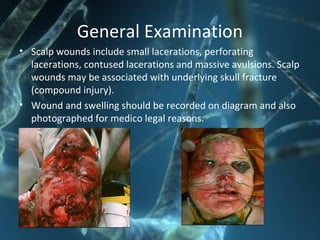
• Scalp wounds include small lacerations, perforating
lacerations, contused lacerations and massive avulsions. Scalp
wounds may be associated with underlying skull fracture
(compound injury).
• Wound and swelling should be recorded on diagram and also
photographed for medico legal reasons.
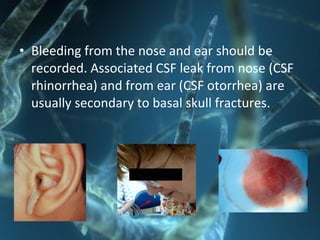
• Bleeding from the nose and ear should be
recorded. Associated CSF leak from nose (CSF
rhinorrhea) and from ear (CSF otorrhea) are
usually secondary to basal skull fractures.
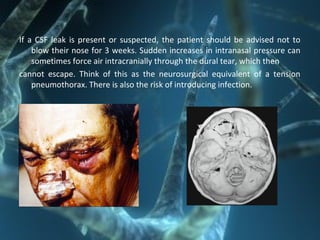
If a CSF leak is present or suspected, the patient should be advised not to
blow their nose for 3 weeks. Sudden increases in intranasal pressure can
sometimes force air intracranially through the dural tear, which then
cannot escape. Think of this as the neurosurgical equivalent of a tension
pneumothorax. There is also the risk of introducing infection.
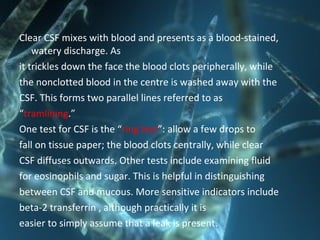
Clear CSF mixes with blood and presents as a blood-stained,
watery discharge. As
it trickles down the face the blood clots peripherally, while
the nonclotted blood in the centre is washed away with the
CSF. This forms two parallel lines referred to as
“tramlining.”
One test for CSF is the “ring test”: allow a few drops to
fall on tissue paper; the blood clots centrally, while clear
CSF diffuses outwards. Other tests include examining fluid
for eosinophils and sugar. This is helpful in distinguishing
between CSF and mucous. More sensitive indicators include
beta-2 transferrin , although practically it is
easier to simply assume that a leak is present.
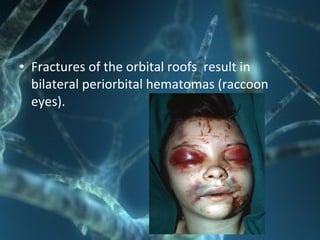
• Fractures of the orbital roofs result in
bilateral periorbital hematomas (raccoon
eyes).
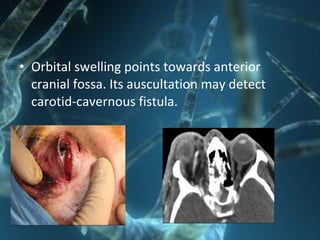
• Orbital swelling points towards anterior
cranial fossa. Its auscultation may detect
carotid-cavernous fistula.
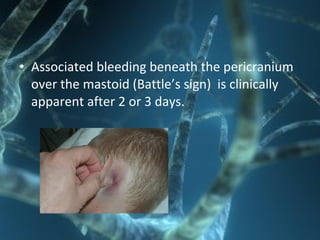
• Associated bleeding beneath the pericranium
over the mastoid (Battle’s sign) is clinically
apparent after 2 or 3 days.
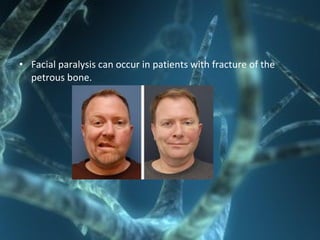
• Facial paralysis can occur in patients with fracture of the
petrous bone.
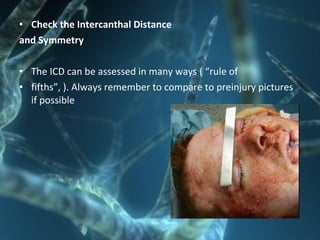
• Check the Intercanthal Distance
and Symmetry
• The ICD can be assessed in many ways ( “rule of
• fifths”, ). Always remember to compare to preinjury pictures
if possible
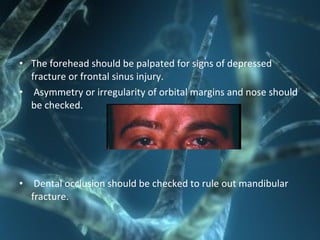
• The forehead should be palpated for signs of depressed
fracture or frontal sinus injury.
• Asymmetry or irregularity of orbital margins and nose should
be checked.
• Dental occlusion should be checked to rule out mandibular
fracture.
• Cervical injury should be suspected in all severe head injuries
and should be ruled out radiologically.
During assessment, the cervical spine should be immobilised,
either manually by an assistant, or by using a hard collar,
blocks, and straps. However, combative patients may
only tolerate a hard collar
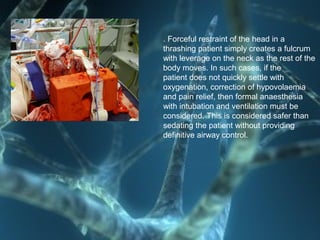
. Forceful restraint of the head in a
thrashing patient simply creates a fulcrum
with leverage on the neck as the rest of the
body moves. In such cases, if the
patient does not quickly settle with
oxygenation, correction of hypovolaemia
and pain relief, then formal anaesthesia
with intubation and ventilation must be
considered. This is considered safer than
sedating the patient without providing
definitive airway control.
Neurological Assessment
• Rapid Trauma Neurological Examination
1. Level Of Consciousness
2. Pupils
3. Fundus
4. Extremity Movement
5. involuntary movement
6. Response To Pain
7. Deep Tendon Reflexes
8. Plantar Responses
9. Brainstem Reflexes
Other useful clues include:
•Abnormal skin colour (cyanosis, jaundice)
•Needle-stick marks (drug overdose)
•Smell of breath (alcohol, ketosis, uraemia,
cyanide)
The frequency of neurological assessment
• Frequency of Observations should be performed and
recorded on a half hourly basis until GCS equal to 15 has been
achieved. If GCS=15 observe: half-hourly for 2 hours, then 1
hourly for 4 hours, then 2 hourly thereafter; Should the
patient with GCS equal to 15 deteriorate at any time after the
initial 2-hour period, observations should revert to half-
hourly. Urgent reappraisal by the supervising doctor
•
• A sustained (that is, for at least 30 minutes) drop of one point
in GCS level (greater weight should be given to a drop of one
point in the motor score of the GCS);
•
• Any drop of 3 or more points in the eye-opening or verbal
response scores of the GCS or 2 or more points in the motor
response.
•
• NICE : National Institute of Clinical Excellence Clinical Guideline 176 Head
Injury :Triage, Assessment, investigation and early management of head
injury in children, young people and adults. 2014
LEVEL OF CONSCIOUSNESS
• Teasdale and Jennett proposed that the degree of coma after
severe head injury is the most reliable clinical indicator of the
severity of brain damage and present a scale to assess the
depth and duration of impaired consciousness and coma.
Coma was defined as the inability to obey commands, to
peak, or to open the eyes, and these three behavioral aspects
were incorporated into the GCS first introduced in 1974 and
then revised by the addition of another motor response level
in 1977.
Level Of Consciousness
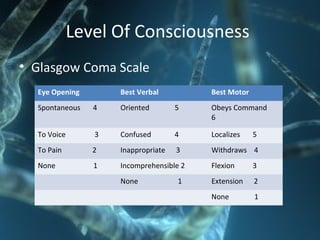
• Glasgow Coma Scale
Eye Opening Best Verbal Best Motor
Spontaneous 4 Oriented 5 Obeys Command
6
To Voice 3 Confused 4 Localizes 5
To Pain 2 Inappropriate 3 Withdraws 4
None 1 Incomprehensible 2 Flexion 3
None 1 Extension 2
None 1
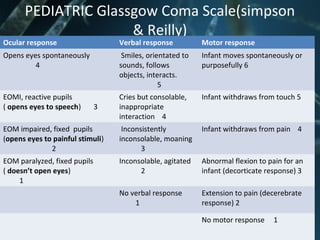
PEDIATRIC Glassgow Coma Scale(simpson
& Reilly)
Ocular response Verbal response Motor response
Opens eyes spontaneously
4
Smiles, orientated to
sounds, follows
objects, interacts.
5
Infant moves spontaneously or
purposefully 6
EOMI, reactive pupils
( opens eyes to speech) 3
Cries but consolable,
inappropriate
interaction 4
Infant withdraws from touch 5
EOM impaired, fixed pupils
(opens eyes to painful stimuli)
2
Inconsistently
inconsolable, moaning
3
Infant withdraws from pain 4
EOM paralyzed, fixed pupils
( doesn’t open eyes)
1
Inconsolable, agitated
2
Abnormal flexion to pain for an
infant (decorticate response) 3
No verbal response
1
Extension to pain (decerebrate
response) 2
No motor response 1
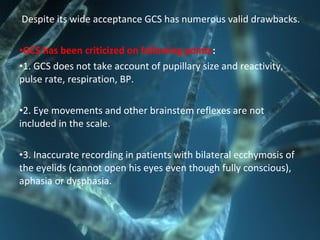
Despite its wide acceptance GCS has numerous valid drawbacks.
•GCS has been criticized on following points:
•1. GCS does not take account of pupillary size and reactivity,
pulse rate, respiration, BP.
•2. Eye movements and other brainstem reflexes are not
included in the scale.
•3. Inaccurate recording in patients with bilateral ecchymosis of
the eyelids (cannot open his eyes even though fully conscious),
aphasia or dysphasia.
• It is not easy to assess the conscious level in infants and
young children, and mistakes are often made. Sometimes the
severity of a head impact is overestimated, but the converse
error is much commoner; because an injured infant cries or
whimpers, it is thought to be fully conscious and serious brain
damage is overlooked
Implications for practice
Caution:
• Remember that the patient must not be assaulted
during testing.
• Test for painful response using fingernail bed pressure
or distribution of cranial nerves.
• Do not use a sternal rub.
A sternal rub does not stimulate pain along a cranial
nerve distribution and should not be used to assess
GCS. It is a technique that is unable to distinguish
between localisation and flexion, and may give aberrant
results in the presence of a spinal injury.
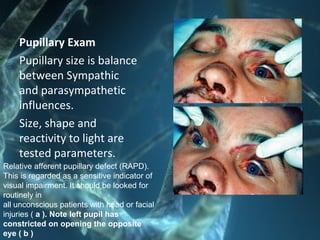
Pupillary Exam
Pupillary size is balance
between Sympathic
and parasympathetic
influences.
Size, shape and
reactivity to light are
tested parameters.
Relative afferent pupillary defect (RAPD).
This is regarded as a sensitive indicator of
visual impairment. It should be looked for
routinely in
all unconscious patients with head or facial
injuries ( a ). Note left pupil has
constricted on opening the opposite
eye ( b )
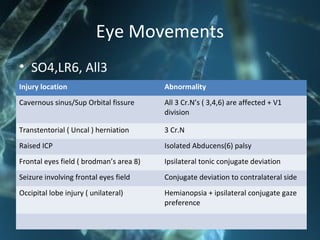
Eye Movements
• SO4,LR6, All3
Injury location Abnormality
Cavernous sinus/Sup Orbital fissure All 3 Cr.N’s ( 3,4,6) are affected + V1
division
Transtentorial ( Uncal ) herniation 3 Cr.N
Raised ICP Isolated Abducens(6) palsy
Frontal eyes field ( brodman’s area 8) Ipsilateral tonic conjugate deviation
Seizure involving frontal eyes field Conjugate deviation to contralateral side
Occipital lobe injury ( unilateral) Hemianopsia + ipsilateral conjugate gaze
preference
Motor assessment
Limb function should be assessed in order to identify the
presence of cerebral space occupying lesions or spinal
injuries. Document any pre existing weakness from previous
illness as this will affect the interpretation of the
assessment.
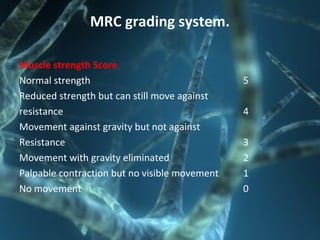
MRC grading system.
Muscle strength Score
Normal strength 5
Reduced strength but can still move against
resistance 4
Movement against gravity but not against
Resistance 3
Movement with gravity eliminated 2
Palpable contraction but no visible movement 1
No movement 0
Involuntary movements
Types of involuntary movement.
Name Movement
Athetosis - Snakelike movements of the limbs.
Chorea - Thrashing arm movements, known as St
Vitus dance.
Tremor- Tremor may occur at rest or on activity
and may involve a hand, limb or more
than one limb or the entire body.
Position of limbs.
Score Category Explanation
3 Normal When one examines the patient
the limbs are in a normal
position.
2 Decorticate The arms are flexed, the legs
are extended.
1 Decerebrate The arms and legs are extended.
Brainstem Reflexes
Facial palsy unilateral 7 N injury- Basilar skull #
Corneal reflex ( V1+V2) Rostral Pontine function
Dolls eye maneuver Vestibuloocular function
Gag and cough reflex 9,10th
N + brainstem swallowing centers
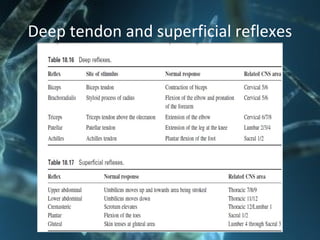
Deep tendon and superficial reflexes
• DTR’s exaggerated after traumatic brain injury
due to cortical disinhibition
• Decreased / absent after Spinal cord injury
• Asymmetric DTR’s unilateral brain/spine injury
• Superficial lost/decreased in corticospinal
dysfunction and helpful in localizing lesions
seizures
These are important and must be recorded. A seizure may
be motor or sensory depending on the area involved. The
following must be noted:
• Any predisposing factors.
• Type of seizure.
• Generalised seizure.
• Focal seizure.
• Duration.
Neurodiagnostic Evaluation
Skull Radiograph Controversial usage, costs> benefits
CT
Contiguous slices from vertex to foramen
Magnum.
Extend to C3 if upper spine # suspected
Brain, Blood and Bone windows
Indications controversial, a must in
1.Penetrating head trauma
2.basilar/ depressed skull #
3.Posttraumatic seizure
4.Severe head injury
In addition anyone with,
1.Altered level of consiousness
2.Focal deficits
3.Persistent headaches
MRI Better than CT in subacute and chronic phases of
injury to detect contusions
Indications for CT scan in head injured/unconscious
patient
1. GCS <13 on initial assessment in the emergency department
2. Neurological deterioration in resuscitated patient
3. GCS <15 at 2 h after the injury
4. Suspected open or depressed skull fracture
5. Any sign of basal skull fracture (haemotympanum, “panda” eyes,
6. CSF leaking from the ear or nose, Battle’s sign)
7. Post-traumatic seizure
8. Focal neurological deficit
9. More than one episode of vomiting
10. Amnesia for events more than 30 min before impact
11. Diagnosis uncertain
Clinical Features In Head Trauma
• Scalp Injuries
• Skull Fractures
• Depressed Skull Fractures
• Basilar Skull Fractures
• Vascular Injuries
• Penetrating Head Injury
• Intracranial Hemorrhage
– Epidural Hematoma
– Subdural Hematoma
– Subarachnoid Hemorrhage
– Intracerebral Hemorrhage
Scalp Injuries
• Most are laceration
– Simple Linear/ Stellate  treatment in emergency
department
– Extensive, Degloving/Avulsion  Repair GA
– Overlying Depressed Skull farcture Infections 
Repair and Elevation Of fracture
– Hematomas
Skull Fractures
• Thin skull is fracture common place.
• Risk of factors associated intracranial injuries
1. Open
2. Closed
3. Linear (3/4)
4. Comminuted ( multiple branches)
5. Diastatic ( edges split apart)<3yr
6. Depressed
7. Basilar
Depressed Skull #
• From focal blow
• Closed  10-15% seizures  Treatment for
cosmetic reasons
• < skull thickness- no elevation
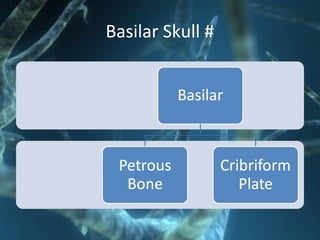
Basilar Skull #
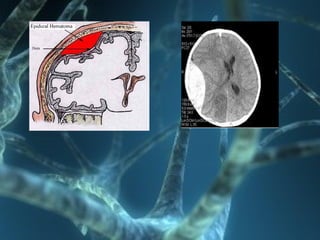
Epidural Hematomas (EDH)
• Peak incidence in 2nd
decade
• Source  meningeal vessel, Dural venous
sinus, diploic vein from skull fracture
• History of minor head injury with fall
• Clinical presentaion  wrt size, location, rate
of accumulation
– Lucid interval (33%), non specific
– Confusion, lethargy, agitation, focal neurological
deficits.
Diagnosis
• CT is diagnostic
• Initial Ct Hyperdense collection beneath
skull
• Actively bleeding- Mixed densities
Subdural Hematoma
• Common in infants.
• Cause  high velocity impact/ assault/ child
abuse/ fall from significant height.
• Associated with cerebral contusions
• Source  cortical bridging veins/ Dural
venous sinuses.
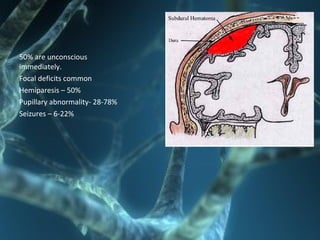
50% are unconscious
immediately.
Focal deficits common
Hemiparesis – 50%
Pupillary abnormality- 28-78%
Seizures – 6-22%
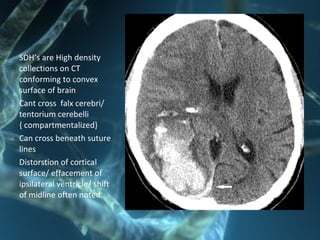
SDH’s are High density
collections on CT
conforming to convex
surface of brain
Cant cross falx cerebri/
tentorium cerebelli
{ compartmentalized}
Can cross beneath suture
lines
Distorstion of cortical
surface/ effacement of
ipsilateral ventricle/ shift
of midline often noted.
• Trauma is leading cause.
• Acute from disruption of
perforating vessels around
circle of Willis in basal
cistern
• Delayed from ruptured
pseudo aneurysm.
• Treatment –to maintain
intravascular volume to
prevent ischemia from
vasospasm.
• Mortality 39%
Subarachnoid
Hemorrhage
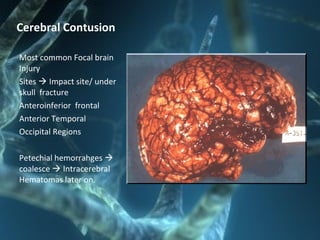
Cerebral Contusion
Most common Focal brain
Injury
Sites  Impact site/ under
skull fracture
Anteroinferior frontal
Anterior Temporal
Occipital Regions
Petechial hemorrahges 
coalesce  Intracerebral
Hematomas later on.
Intracerebral
BleedRare in Peditrics
60% from small contusions coalesce to form larger hematoma.
Rarely , violent angular acceleration bleed in deep white matter,
basal ganglia, thalamus
Transtentorial Herniation  midbrain bleed ( Duret hemorrhages)
Common sites
Anterior Temporal and Inferior Frontal lobes { impact against lateral
sphenoid bone/ floor of anterior fossa}
• CT- hyperdense/mixed
• MRI- small petechial bleed
Treatment- small- non operative. Resolve in 2-3
weeks
• Large- Surgical drainage.
• Repeat CT in small bleeds after 12-24 hr is
warranted to check large hematoma.
Penetrating
Head Injury
Infants and children fall on sharp objects with thin skull and open foraminae could
predispose for these injuries.
Surgical treatment.
Entry wound debrided and FB removed with in driven bone fragments.
Peri and post operative antibiotics
Prophylactic anticonvulsants
Adolescents and children  Gun Shot Wounds. ( 12%) and increasing annually.
Higher mortality when
1.Low GCS on presentation (3-4)
2.Bilateral hemispheric /brainstem injury
3.Hemodynamic instability/ apnea/both
4.Uncontrolled ICP.
• CT- localizes bullet and bone fragments
• MRI- non advised till magnetic properties of bullet known.
• .
Intracranial Hypertension
• Pathophysiology
– ICP monitoring and control are the cornerstones of
TBI management
– Normal ICP
• Adults  <10mmhg
• Children  3-7mmhg
• Infants 1.5- 6mmhg
– When to treat?
• Adults  > 20
• Children  >15
• Infants >10 { Arbitrary numbers most commonly used,
pending outcome studies}
ICP measurement
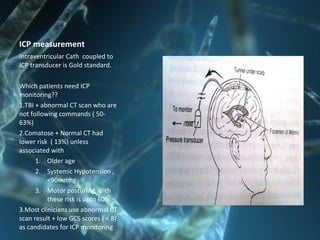
Intraventricular Cath coupled to
ICP transducer is Gold standard.
Which patients need ICP
monitoring??
1.TBI + abnormal CT scan who are
not following commands ( 50-
63%)
2.Comatose + Normal CT had
lower risk ( 13%) unless
associated with
1. Older age
2. Systemic Hypotension ,
<90mmhg
3. Motor posturing, with
these risk is upto 60%
3.Most clinicians use abnormal CT
scan result + low GCS scores ( < 8)
as candidates for ICP monitoring
Device / method Risk / benefit
1. Intraventricular catheter Adv- drainage of CSF to reduce ICP
DisAdv- infection/ ventricular
compression leads to inaccuracy
2. subdural/ subarachnoid bolts
( Philadelphia, Leeds, Richmond bolts)
Occlusion of port in device leads to
inaccuracy
3. Fiberoptic cath ( Camino labs) Improved fidelity & longevity
Can be placed Intraparenchymal/
intraventricular/ subdural
Used to drain CSF
Accuracy maintained even with fully
collapsed ventricles
Single cath can be used as long as needed
Thank You

Head injury assesment

  • 1.
  • 2.
    Introduction • The neurologicalevaluation of the patient with head injury remains an important comprehensive process in the diagnostic evaluation and as a baseline in assessing progress. Thorough and careful examination provides an index of generalized and focal dysfunction of the nervous system which is not provided by CT scanning, ICP monitoring or any other modern technology
  • 3.
    • Repeated good,reliable thorough examination indicates the ongoing neurological state and the progress or failure of treatment rendered.
  • 4.
    Purpose of anassessment • The purposes of undertaking an assessment can be summarised • as follows: • • To establish a baseline of neurological function. • • To note any trend. • • To monitor for any changes in status or complications. • • To determine any associated risk. • • To treat alterations in status. • • To determine health needs. • • To decide on intervention. • • To prevent complications. • • To predict patient outcome.
  • 5.
    • The majorgoals in the evaluation of patients with head injury are: • 1. To define the presence of intracranial mass lesion requiring operative removal. • 2. To determine abnormal intracranial mass lesion in order to guide and direct appropriate operative or non-operative therapy. • 3. To diagnose associated serious injuries. • In patients who are conscious, the initial examination is as thorough as possible. • In patient with altered consciousness, emphasis is given to certain critical aspects that will guide immediate treatment.
  • 6.
    Epidemiology • Traumatic braininjuries (TBI) cause morbidity, mortality, disability and socioeconomic losses in India and other developing countries. It is estimated that nearly 1.5 to 2 million persons are injured and 1 million succumb to death every year in India. Road traffic injuries are the leading cause (60%) of TBIs followed by falls (20—25%) and violence (10%). Alcohol involve ment is known to be present among 15—20% of TBIs at the time of injury. The rehabilitation needs of brain injured persons are significantly high and increasing from year to year. India and other developing countries face the major challenges of prevention, pre-hospital care and rehabilitation in their rapidly changing environments to reduce the burden of TBIs • Gururaj G .Epidemiology of traumatic brain injuries : Indian scenario. Neurological Research 2002 Jan 24(1)24-8
  • 7.
    History • Information regardingprecise time of injury and mechanism of injury should be obtained. Acceleration injuries as a result of vehicular accidents and falls is associated with serious diffuse brain injury and polar contusion. Impact injuries such as blow to cranial vault result in underlying focal brain damage. A history of the patient's neurological function at the scene of the accident and during transport to the hospital should be sought from police, relatives or witnesses. Any history of loss of consciousness and seizures should be obtained. A report from a referring hospital of the patients condition should also be sought and recorded. Information regarding drug or alcohol intake and the past medical history is also valuable.
  • 8.
    Initial Examination • TheAmerican College of Surgeons Committee on Trauma (1997)1 has given in its manual ATLS program for physicians, a sequence ABCDE. The airway (A), breathing (B), and circulation (C) are assessed before neurological assessment (D) and general examination (E) assessment of the consciousness is most important. • The secondary survey of the patient is done after resuscitation. Resuscitation may improve some clinical signs. Simultaneously need for intubation and elective ventilation should be assessed. Before paralyzing patients baseline clinical record is mandatory. Pulse rate, blood pressure and respiration should be assessed and given top priority in the management of traumatic brain injury.
  • 9.
    vitals The systolic pressure,diastolic pressure and pulse pressure must be noted. If the neurosurgical patient’s blood pressure is dropping consider: • Hypovolaemic shock from extracranial haemorrhage or diabetes insipidus. • The patient is approaching the terminal stage.
  • 10.
    • Hypertension associatedwith bradycardia suggests severely increased intracranial pressure from increasing intracranial clot. • Unexplained hypotension with bradycardia points towards a possibility of cervical injury. • Hypotension associated with tachycardia usually indicates presence of visceral injury elsewhere such as abdominal or thoracic injury.
  • 11.
    • According toStening BP below 90 mm Hg persisting for more than 60 minutes in acute subdural hematoma was strong predictor of bad outcome. • White et al found that in pediatric trauma odds of survival increased 19-fold when maximum systolic blood pressure was greater or equal to 135 mm Hg Stening WA, Berry Q, Dan N G, et al. Experience with acute subdural hematomas in New South Wales. Austral NZ] Surg 1986;56:549—56. White JR, Farukhi Z, Bull C, Christensen J, Gordon T, Paidas C, Nichols DG. Predictors of outcome in severely head-injured children. Crit Care Med 2001 ;29(3):534—40
  • 12.
    General Examination • Scalpwounds include small lacerations, perforating lacerations, contused lacerations and massive avulsions. Scalp wounds may be associated with underlying skull fracture (compound injury). • Wound and swelling should be recorded on diagram and also photographed for medico legal reasons.
  • 13.
    • Bleeding fromthe nose and ear should be recorded. Associated CSF leak from nose (CSF rhinorrhea) and from ear (CSF otorrhea) are usually secondary to basal skull fractures.
  • 14.
    If a CSFleak is present or suspected, the patient should be advised not to blow their nose for 3 weeks. Sudden increases in intranasal pressure can sometimes force air intracranially through the dural tear, which then cannot escape. Think of this as the neurosurgical equivalent of a tension pneumothorax. There is also the risk of introducing infection.
  • 15.
    Clear CSF mixeswith blood and presents as a blood-stained, watery discharge. As it trickles down the face the blood clots peripherally, while the nonclotted blood in the centre is washed away with the CSF. This forms two parallel lines referred to as “tramlining.” One test for CSF is the “ring test”: allow a few drops to fall on tissue paper; the blood clots centrally, while clear CSF diffuses outwards. Other tests include examining fluid for eosinophils and sugar. This is helpful in distinguishing between CSF and mucous. More sensitive indicators include beta-2 transferrin , although practically it is easier to simply assume that a leak is present.
  • 16.
    • Fractures ofthe orbital roofs result in bilateral periorbital hematomas (raccoon eyes).
  • 17.
    • Orbital swellingpoints towards anterior cranial fossa. Its auscultation may detect carotid-cavernous fistula.
  • 18.
    • Associated bleedingbeneath the pericranium over the mastoid (Battle’s sign) is clinically apparent after 2 or 3 days.
  • 19.
    • Facial paralysiscan occur in patients with fracture of the petrous bone.
  • 20.
    • Check theIntercanthal Distance and Symmetry • The ICD can be assessed in many ways ( “rule of • fifths”, ). Always remember to compare to preinjury pictures if possible
  • 21.
    • The foreheadshould be palpated for signs of depressed fracture or frontal sinus injury. • Asymmetry or irregularity of orbital margins and nose should be checked. • Dental occlusion should be checked to rule out mandibular fracture.
  • 22.
    • Cervical injuryshould be suspected in all severe head injuries and should be ruled out radiologically. During assessment, the cervical spine should be immobilised, either manually by an assistant, or by using a hard collar, blocks, and straps. However, combative patients may only tolerate a hard collar
  • 23.
    . Forceful restraintof the head in a thrashing patient simply creates a fulcrum with leverage on the neck as the rest of the body moves. In such cases, if the patient does not quickly settle with oxygenation, correction of hypovolaemia and pain relief, then formal anaesthesia with intubation and ventilation must be considered. This is considered safer than sedating the patient without providing definitive airway control.
  • 24.
    Neurological Assessment • RapidTrauma Neurological Examination 1. Level Of Consciousness 2. Pupils 3. Fundus 4. Extremity Movement 5. involuntary movement 6. Response To Pain 7. Deep Tendon Reflexes 8. Plantar Responses 9. Brainstem Reflexes
  • 25.
    Other useful cluesinclude: •Abnormal skin colour (cyanosis, jaundice) •Needle-stick marks (drug overdose) •Smell of breath (alcohol, ketosis, uraemia, cyanide)
  • 26.
    The frequency ofneurological assessment • Frequency of Observations should be performed and recorded on a half hourly basis until GCS equal to 15 has been achieved. If GCS=15 observe: half-hourly for 2 hours, then 1 hourly for 4 hours, then 2 hourly thereafter; Should the patient with GCS equal to 15 deteriorate at any time after the initial 2-hour period, observations should revert to half- hourly. Urgent reappraisal by the supervising doctor •
  • 27.
    • A sustained(that is, for at least 30 minutes) drop of one point in GCS level (greater weight should be given to a drop of one point in the motor score of the GCS); • • Any drop of 3 or more points in the eye-opening or verbal response scores of the GCS or 2 or more points in the motor response. • • NICE : National Institute of Clinical Excellence Clinical Guideline 176 Head Injury :Triage, Assessment, investigation and early management of head injury in children, young people and adults. 2014
  • 28.
    LEVEL OF CONSCIOUSNESS •Teasdale and Jennett proposed that the degree of coma after severe head injury is the most reliable clinical indicator of the severity of brain damage and present a scale to assess the depth and duration of impaired consciousness and coma. Coma was defined as the inability to obey commands, to peak, or to open the eyes, and these three behavioral aspects were incorporated into the GCS first introduced in 1974 and then revised by the addition of another motor response level in 1977.
  • 29.
    Level Of Consciousness •Glasgow Coma Scale Eye Opening Best Verbal Best Motor Spontaneous 4 Oriented 5 Obeys Command 6 To Voice 3 Confused 4 Localizes 5 To Pain 2 Inappropriate 3 Withdraws 4 None 1 Incomprehensible 2 Flexion 3 None 1 Extension 2 None 1
  • 30.
    PEDIATRIC Glassgow ComaScale(simpson & Reilly) Ocular response Verbal response Motor response Opens eyes spontaneously 4 Smiles, orientated to sounds, follows objects, interacts. 5 Infant moves spontaneously or purposefully 6 EOMI, reactive pupils ( opens eyes to speech) 3 Cries but consolable, inappropriate interaction 4 Infant withdraws from touch 5 EOM impaired, fixed pupils (opens eyes to painful stimuli) 2 Inconsistently inconsolable, moaning 3 Infant withdraws from pain 4 EOM paralyzed, fixed pupils ( doesn’t open eyes) 1 Inconsolable, agitated 2 Abnormal flexion to pain for an infant (decorticate response) 3 No verbal response 1 Extension to pain (decerebrate response) 2 No motor response 1
  • 31.
    Despite its wideacceptance GCS has numerous valid drawbacks. •GCS has been criticized on following points: •1. GCS does not take account of pupillary size and reactivity, pulse rate, respiration, BP. •2. Eye movements and other brainstem reflexes are not included in the scale. •3. Inaccurate recording in patients with bilateral ecchymosis of the eyelids (cannot open his eyes even though fully conscious), aphasia or dysphasia.
  • 32.
    • It isnot easy to assess the conscious level in infants and young children, and mistakes are often made. Sometimes the severity of a head impact is overestimated, but the converse error is much commoner; because an injured infant cries or whimpers, it is thought to be fully conscious and serious brain damage is overlooked
  • 33.
    Implications for practice Caution: •Remember that the patient must not be assaulted during testing. • Test for painful response using fingernail bed pressure or distribution of cranial nerves. • Do not use a sternal rub. A sternal rub does not stimulate pain along a cranial nerve distribution and should not be used to assess GCS. It is a technique that is unable to distinguish between localisation and flexion, and may give aberrant results in the presence of a spinal injury.
  • 34.
    Pupillary Exam Pupillary sizeis balance between Sympathic and parasympathetic influences. Size, shape and reactivity to light are tested parameters. Relative afferent pupillary defect (RAPD). This is regarded as a sensitive indicator of visual impairment. It should be looked for routinely in all unconscious patients with head or facial injuries ( a ). Note left pupil has constricted on opening the opposite eye ( b )
  • 35.
    Eye Movements • SO4,LR6,All3 Injury location Abnormality Cavernous sinus/Sup Orbital fissure All 3 Cr.N’s ( 3,4,6) are affected + V1 division Transtentorial ( Uncal ) herniation 3 Cr.N Raised ICP Isolated Abducens(6) palsy Frontal eyes field ( brodman’s area 8) Ipsilateral tonic conjugate deviation Seizure involving frontal eyes field Conjugate deviation to contralateral side Occipital lobe injury ( unilateral) Hemianopsia + ipsilateral conjugate gaze preference
  • 36.
    Motor assessment Limb functionshould be assessed in order to identify the presence of cerebral space occupying lesions or spinal injuries. Document any pre existing weakness from previous illness as this will affect the interpretation of the assessment.
  • 37.
    MRC grading system. Musclestrength Score Normal strength 5 Reduced strength but can still move against resistance 4 Movement against gravity but not against Resistance 3 Movement with gravity eliminated 2 Palpable contraction but no visible movement 1 No movement 0
  • 38.
    Involuntary movements Types ofinvoluntary movement. Name Movement Athetosis - Snakelike movements of the limbs. Chorea - Thrashing arm movements, known as St Vitus dance. Tremor- Tremor may occur at rest or on activity and may involve a hand, limb or more than one limb or the entire body.
  • 39.
    Position of limbs. ScoreCategory Explanation 3 Normal When one examines the patient the limbs are in a normal position. 2 Decorticate The arms are flexed, the legs are extended. 1 Decerebrate The arms and legs are extended.
  • 40.
    Brainstem Reflexes Facial palsyunilateral 7 N injury- Basilar skull # Corneal reflex ( V1+V2) Rostral Pontine function Dolls eye maneuver Vestibuloocular function Gag and cough reflex 9,10th N + brainstem swallowing centers
  • 41.
    Deep tendon andsuperficial reflexes
  • 42.
    • DTR’s exaggeratedafter traumatic brain injury due to cortical disinhibition • Decreased / absent after Spinal cord injury • Asymmetric DTR’s unilateral brain/spine injury • Superficial lost/decreased in corticospinal dysfunction and helpful in localizing lesions
  • 43.
    seizures These are importantand must be recorded. A seizure may be motor or sensory depending on the area involved. The following must be noted: • Any predisposing factors. • Type of seizure. • Generalised seizure. • Focal seizure. • Duration.
  • 44.
    Neurodiagnostic Evaluation Skull RadiographControversial usage, costs> benefits CT Contiguous slices from vertex to foramen Magnum. Extend to C3 if upper spine # suspected Brain, Blood and Bone windows Indications controversial, a must in 1.Penetrating head trauma 2.basilar/ depressed skull # 3.Posttraumatic seizure 4.Severe head injury In addition anyone with, 1.Altered level of consiousness 2.Focal deficits 3.Persistent headaches MRI Better than CT in subacute and chronic phases of injury to detect contusions
  • 45.
    Indications for CTscan in head injured/unconscious patient 1. GCS <13 on initial assessment in the emergency department 2. Neurological deterioration in resuscitated patient 3. GCS <15 at 2 h after the injury 4. Suspected open or depressed skull fracture 5. Any sign of basal skull fracture (haemotympanum, “panda” eyes, 6. CSF leaking from the ear or nose, Battle’s sign) 7. Post-traumatic seizure 8. Focal neurological deficit 9. More than one episode of vomiting 10. Amnesia for events more than 30 min before impact 11. Diagnosis uncertain
  • 46.
    Clinical Features InHead Trauma • Scalp Injuries • Skull Fractures • Depressed Skull Fractures • Basilar Skull Fractures • Vascular Injuries • Penetrating Head Injury • Intracranial Hemorrhage – Epidural Hematoma – Subdural Hematoma – Subarachnoid Hemorrhage – Intracerebral Hemorrhage
  • 47.
    Scalp Injuries • Mostare laceration – Simple Linear/ Stellate  treatment in emergency department – Extensive, Degloving/Avulsion  Repair GA – Overlying Depressed Skull farcture Infections  Repair and Elevation Of fracture – Hematomas
  • 48.
    Skull Fractures • Thinskull is fracture common place. • Risk of factors associated intracranial injuries 1. Open 2. Closed 3. Linear (3/4) 4. Comminuted ( multiple branches) 5. Diastatic ( edges split apart)<3yr 6. Depressed 7. Basilar
  • 49.
    Depressed Skull # •From focal blow • Closed  10-15% seizures  Treatment for cosmetic reasons • < skull thickness- no elevation
  • 50.
  • 51.
    Epidural Hematomas (EDH) •Peak incidence in 2nd decade • Source  meningeal vessel, Dural venous sinus, diploic vein from skull fracture • History of minor head injury with fall • Clinical presentaion  wrt size, location, rate of accumulation – Lucid interval (33%), non specific – Confusion, lethargy, agitation, focal neurological deficits.
  • 52.
    Diagnosis • CT isdiagnostic • Initial Ct Hyperdense collection beneath skull • Actively bleeding- Mixed densities
  • 55.
    Subdural Hematoma • Commonin infants. • Cause  high velocity impact/ assault/ child abuse/ fall from significant height. • Associated with cerebral contusions • Source  cortical bridging veins/ Dural venous sinuses.
  • 56.
    50% are unconscious immediately. Focaldeficits common Hemiparesis – 50% Pupillary abnormality- 28-78% Seizures – 6-22%
  • 57.
    SDH’s are Highdensity collections on CT conforming to convex surface of brain Cant cross falx cerebri/ tentorium cerebelli { compartmentalized} Can cross beneath suture lines Distorstion of cortical surface/ effacement of ipsilateral ventricle/ shift of midline often noted.
  • 58.
    • Trauma isleading cause. • Acute from disruption of perforating vessels around circle of Willis in basal cistern • Delayed from ruptured pseudo aneurysm. • Treatment –to maintain intravascular volume to prevent ischemia from vasospasm. • Mortality 39% Subarachnoid Hemorrhage
  • 59.
    Cerebral Contusion Most commonFocal brain Injury Sites  Impact site/ under skull fracture Anteroinferior frontal Anterior Temporal Occipital Regions Petechial hemorrahges  coalesce  Intracerebral Hematomas later on.
  • 60.
    Intracerebral BleedRare in Peditrics 60%from small contusions coalesce to form larger hematoma. Rarely , violent angular acceleration bleed in deep white matter, basal ganglia, thalamus Transtentorial Herniation  midbrain bleed ( Duret hemorrhages) Common sites Anterior Temporal and Inferior Frontal lobes { impact against lateral sphenoid bone/ floor of anterior fossa}
  • 61.
    • CT- hyperdense/mixed •MRI- small petechial bleed Treatment- small- non operative. Resolve in 2-3 weeks • Large- Surgical drainage. • Repeat CT in small bleeds after 12-24 hr is warranted to check large hematoma.
  • 62.
    Penetrating Head Injury Infants andchildren fall on sharp objects with thin skull and open foraminae could predispose for these injuries. Surgical treatment. Entry wound debrided and FB removed with in driven bone fragments. Peri and post operative antibiotics Prophylactic anticonvulsants Adolescents and children  Gun Shot Wounds. ( 12%) and increasing annually. Higher mortality when 1.Low GCS on presentation (3-4) 2.Bilateral hemispheric /brainstem injury 3.Hemodynamic instability/ apnea/both 4.Uncontrolled ICP.
  • 63.
    • CT- localizesbullet and bone fragments • MRI- non advised till magnetic properties of bullet known. • .
  • 64.
    Intracranial Hypertension • Pathophysiology –ICP monitoring and control are the cornerstones of TBI management – Normal ICP • Adults  <10mmhg • Children  3-7mmhg • Infants 1.5- 6mmhg – When to treat? • Adults  > 20 • Children  >15 • Infants >10 { Arbitrary numbers most commonly used, pending outcome studies}
  • 65.
    ICP measurement Intraventricular Cathcoupled to ICP transducer is Gold standard. Which patients need ICP monitoring?? 1.TBI + abnormal CT scan who are not following commands ( 50- 63%) 2.Comatose + Normal CT had lower risk ( 13%) unless associated with 1. Older age 2. Systemic Hypotension , <90mmhg 3. Motor posturing, with these risk is upto 60% 3.Most clinicians use abnormal CT scan result + low GCS scores ( < 8) as candidates for ICP monitoring
  • 66.
    Device / methodRisk / benefit 1. Intraventricular catheter Adv- drainage of CSF to reduce ICP DisAdv- infection/ ventricular compression leads to inaccuracy 2. subdural/ subarachnoid bolts ( Philadelphia, Leeds, Richmond bolts) Occlusion of port in device leads to inaccuracy 3. Fiberoptic cath ( Camino labs) Improved fidelity & longevity Can be placed Intraparenchymal/ intraventricular/ subdural Used to drain CSF Accuracy maintained even with fully collapsed ventricles Single cath can be used as long as needed
  • 67.