398
Motor driver ICs
Reversible motor driver
BA6219B / BA6219BFP-Y
The BA6219B and BA6219BFP-Y are reversible-motor drivers suitable for brush motors. Two logic inputs allow four out-
put modes: forward, reverse, idling, and braking. The motor revolving speed can be set arbitrarily by controlling the volt-
age applied to the motor.
FApplications
VCRs and cassette tape recorders
FFeatures
1) Large output current. (IO=2.2A Max.)
2) Built-in thermal shutdown circuit.
3) Built-in output voltage setting pins.
4) Small standby supply current.
FBlock diagram
399
Motor driver ICs BA6219B / BA6219BFP-Y
FAbsolute maximum ratings (Ta = 25_C)
FRecommended operating conditions (Ta = 25_C)
FElectrical characteristics (unless otherwise noted, Ta = 25_C and VCC = 12V)
FElectrical characteristic curves
400
Motor driver ICs BA6219B / BA6219BFP-Y
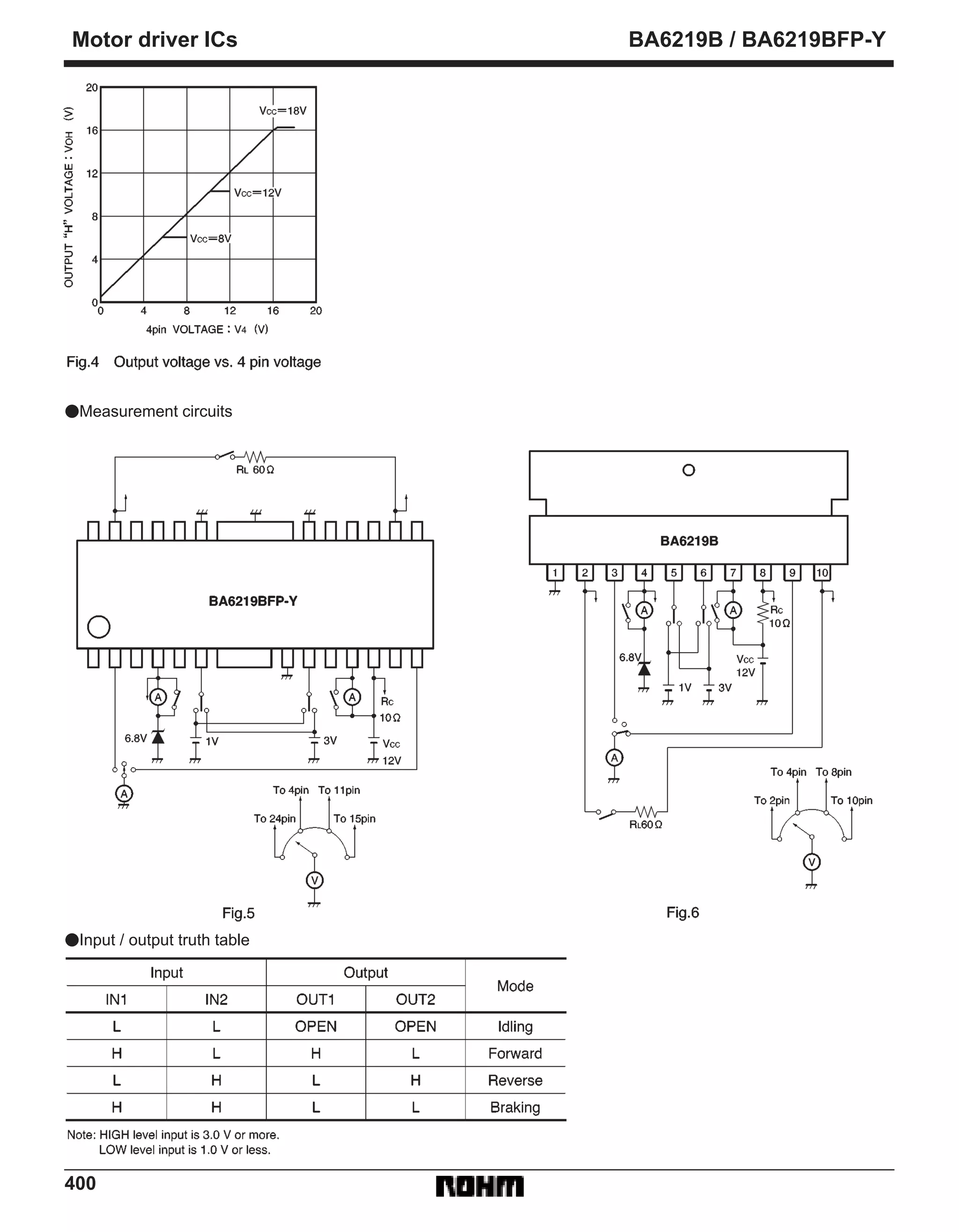
FMeasurement circuits
FInput / output truth table
401
Motor driver ICs BA6219B / BA6219BFP-Y
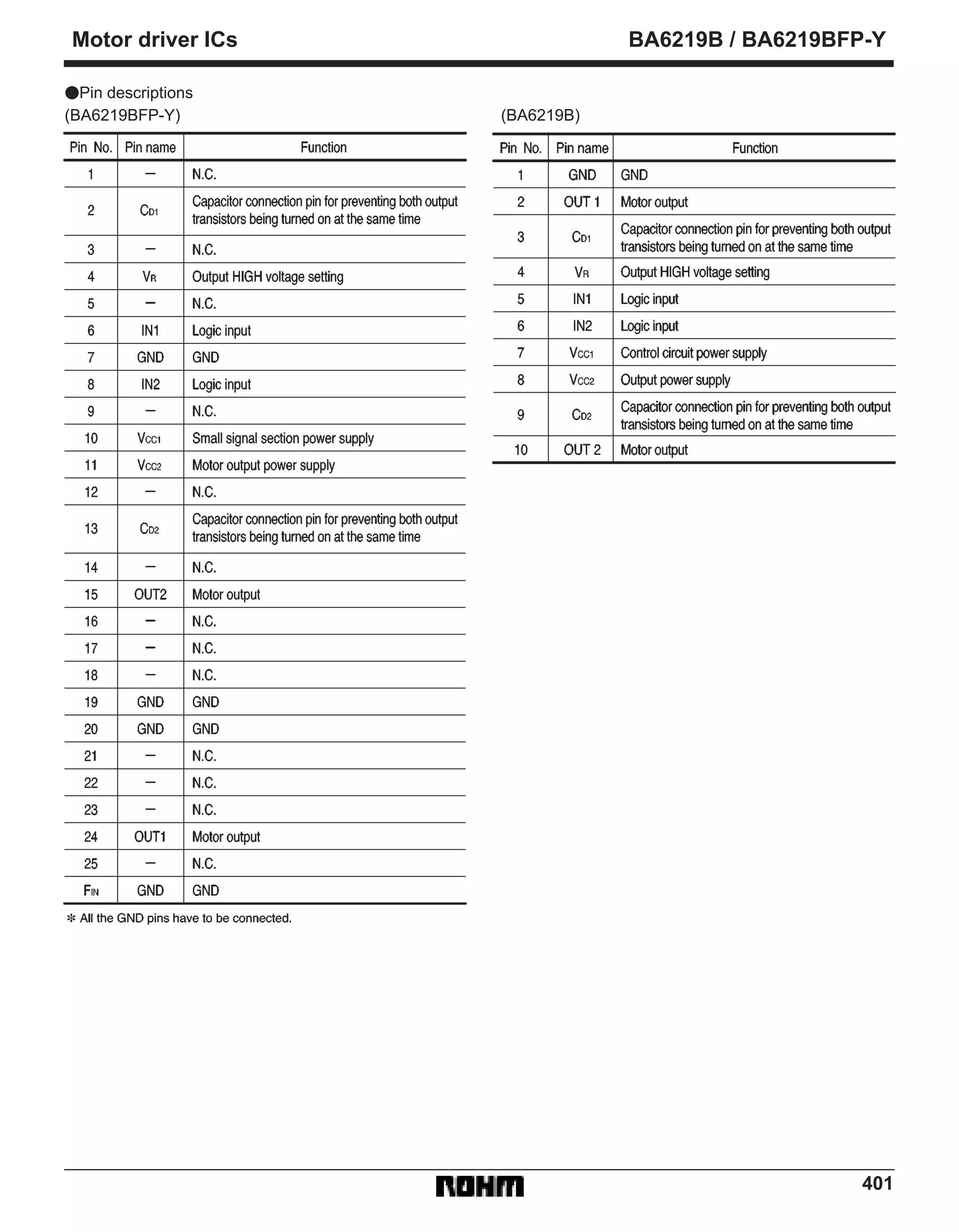
FPin descriptions
(BA6219BFP-Y) (BA6219B)
402
Motor driver ICs BA6219B / BA6219BFP-Y
FOperation notes
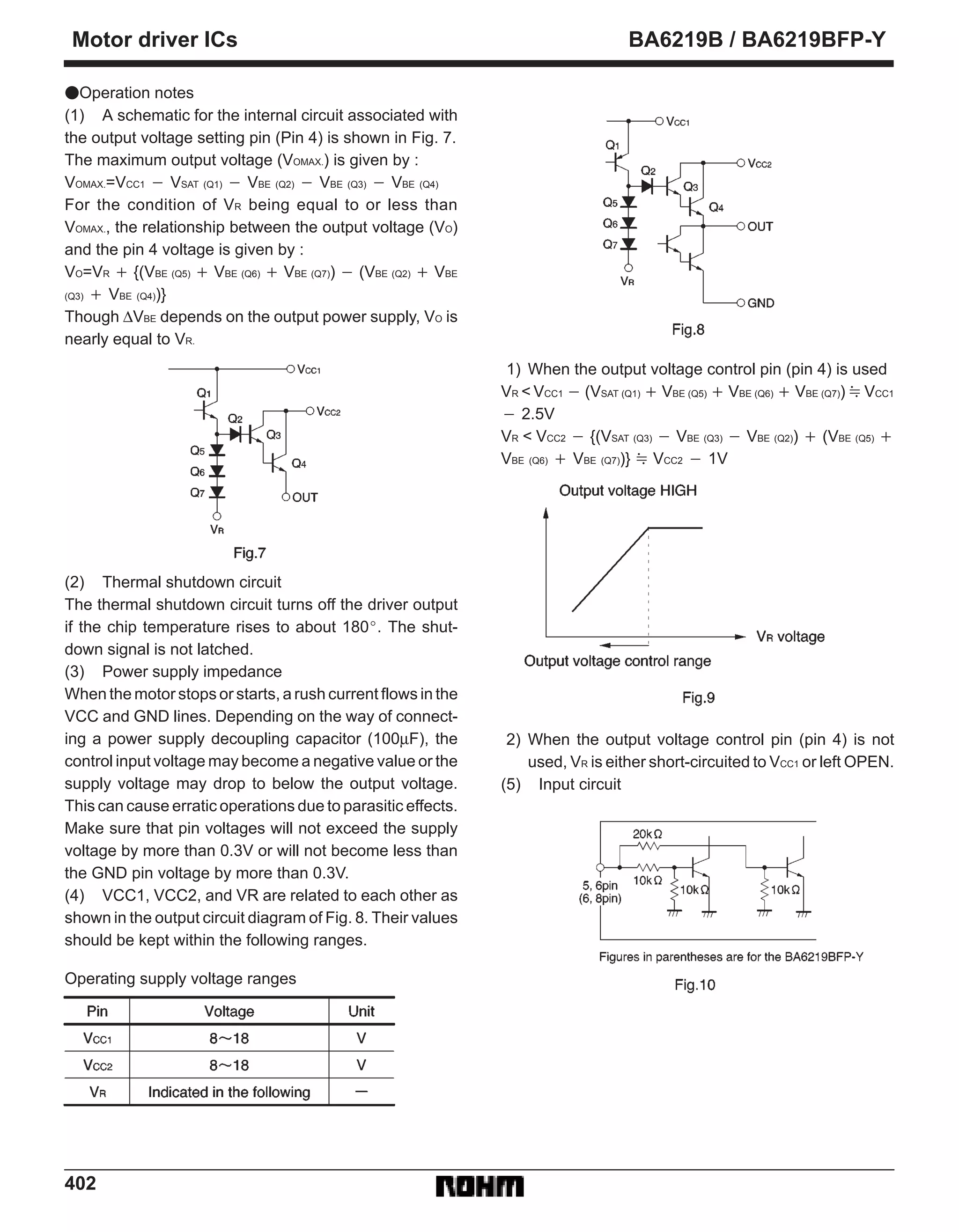
(1) A schematic for the internal circuit associated with
the output voltage setting pin (Pin 4) is shown in Fig. 7.
The maximum output voltage (VOMAX.) is given by :
VOMAX.=VCC1 * VSAT (Q1) * VBE (Q2) * VBE (Q3) * VBE (Q4)
For the condition of VR being equal to or less than
VOMAX., the relationship between the output voltage (VO)
and the pin 4 voltage is given by :
VO=VR ) {(VBE (Q5) ) VBE (Q6) ) VBE (Q7)) * (VBE (Q2) ) VBE
(Q3) ) VBE (Q4))}
Though ∆VBE depends on the output power supply, VO is
nearly equal to VR.
(2) Thermal shutdown circuit
The thermal shutdown circuit turns off the driver output
if the chip temperature rises to about 180_. The shut-
down signal is not latched.
(3) Power supply impedance
When the motor stops or starts, a rush current flows in the
VCC and GND lines. Depending on the way of connect-
ing a power supply decoupling capacitor (100µF), the
control input voltage may become a negative value or the
supply voltage may drop to below the output voltage.
This can cause erratic operations due to parasitic effects.
Make sure that pin voltages will not exceed the supply
voltage by more than 0.3V or will not become less than
the GND pin voltage by more than 0.3V.
(4) VCC1, VCC2, and VR are related to each other as
shown in the output circuit diagram of Fig. 8. Their values
should be kept within the following ranges.
Operating supply voltage ranges
(1) When the output voltage control pin (pin 4) is used
VR < VCC1 * (VSAT (Q1) ) VBE (Q5) ) VBE (Q6) ) VBE (Q7)) VCC1
* 2.5V
VR < VCC2 * {(VSAT (Q3) * VBE (Q3) * VBE (Q2)) ) (VBE (Q5) )
VBE (Q6) ) VBE (Q7))} VCC2 * 1V
(2) When the output voltage control pin (pin 4) is not
used, VR is either short-circuited to VCC1 or left OPEN.
(5) Input circuit
403
Motor driver ICs BA6219B / BA6219BFP-Y
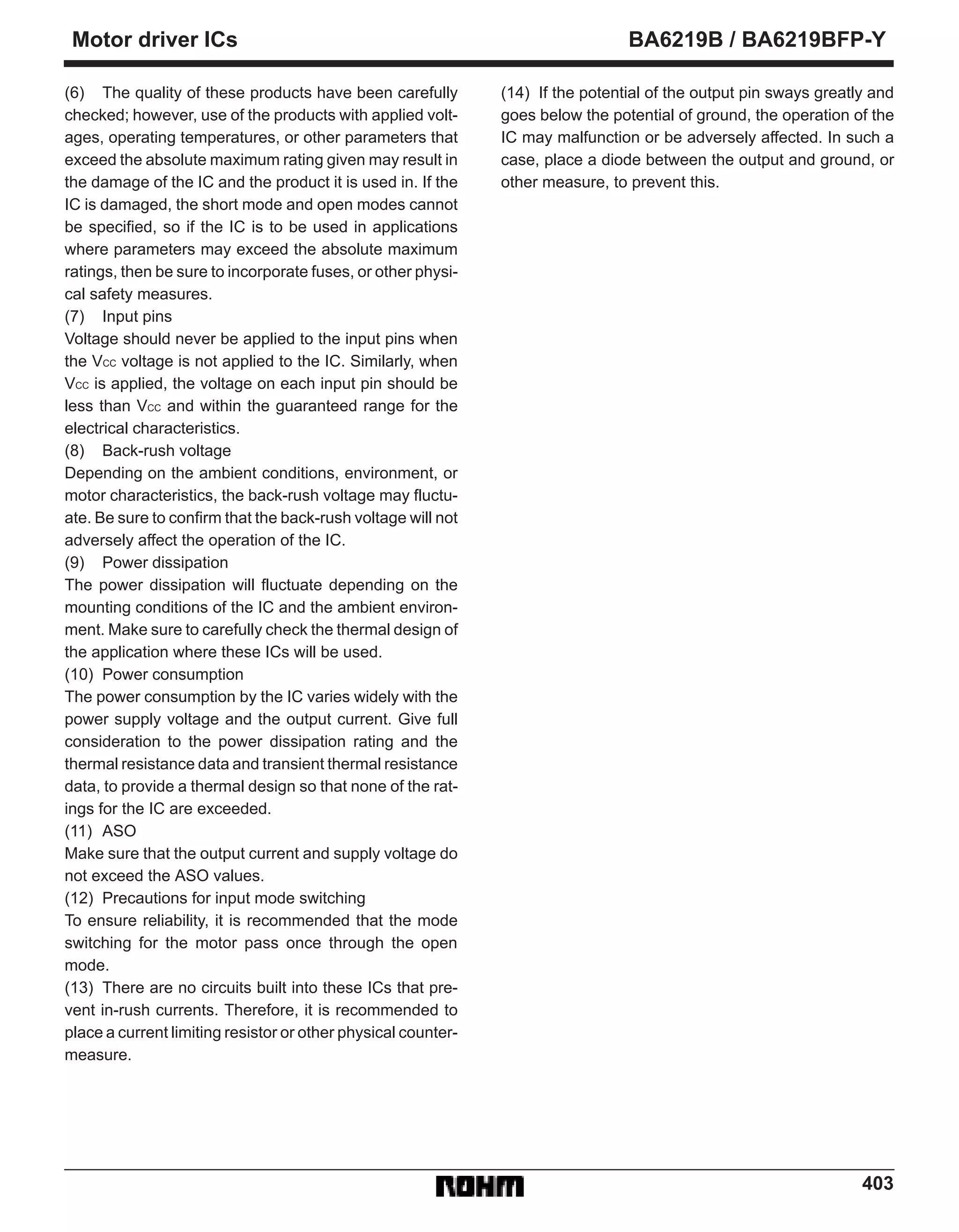
(6) The quality of these products have been carefully
checked; however, use of the products with applied volt-
ages, operating temperatures, or other parameters that
exceed the absolute maximum rating given may result in
the damage of the IC and the product it is used in. If the
IC is damaged, the short mode and open modes cannot
be specified, so if the IC is to be used in applications
where parameters may exceed the absolute maximum
ratings, then be sure to incorporate fuses, or other physi-
cal safety measures.
(7) Input pins
Voltage should never be applied to the input pins when
the VCC voltage is not applied to the IC. Similarly, when
VCC is applied, the voltage on each input pin should be
less than VCC and within the guaranteed range for the
electrical characteristics.
(8) Back-rush voltage
Depending on the ambient conditions, environment, or
motor characteristics, the back-rush voltage may fluctu-
ate. Be sure to confirm that the back-rush voltage will not
adversely affect the operation of the IC.
(9) Power dissipation
The power dissipation will fluctuate depending on the
mounting conditions of the IC and the ambient environ-
ment. Make sure to carefully check the thermal design of
the application where these ICs will be used.
(10) Power consumption
The power consumption by the IC varies widely with the
power supply voltage and the output current. Give full
consideration to the power dissipation rating and the
thermal resistance data and transient thermal resistance
data, to provide a thermal design so that none of the rat-
ings for the IC are exceeded.
(11) ASO
Make sure that the output current and supply voltage do
not exceed the ASO values.
(12) Precautions for input mode switching
To ensure reliability, it is recommended that the mode
switching for the motor pass once through the open
mode.
(13) There are no circuits built into these ICs that pre-
vent in-rush currents. Therefore, it is recommended to
place a current limiting resistor or other physical counter-
measure.
(14) If the potential of the output pin sways greatly and
goes below the potential of ground, the operation of the
IC may malfunction or be adversely affected. In such a
case, place a diode between the output and ground, or
other measure, to prevent this.
404
Motor driver ICs BA6219B / BA6219BFP-Y
FApplication examples
(1) BA6219B (2) BA6219BFP-Y
ZD : Zener diode to set output voltage. Use any zener
diode that is suitable for your application.
RC : Resistor used for reducing collector loss and limit-
ing the short-circuit current. A resistance range of
3X10Ω is recommended.
C : Power supply filtering capacitor. Place as near as
possible to the VCC1 pin.
CD : Capacitor to prevent both output transistors being
turned on at the same time.
CM : Capacitor to absorb surge voltage and prevent
parasitic oscillations.
FExternal dimensions (Units: mm)

000749

  • 1.
    398 Motor driver ICs Reversiblemotor driver BA6219B / BA6219BFP-Y The BA6219B and BA6219BFP-Y are reversible-motor drivers suitable for brush motors. Two logic inputs allow four out- put modes: forward, reverse, idling, and braking. The motor revolving speed can be set arbitrarily by controlling the volt- age applied to the motor. FApplications VCRs and cassette tape recorders FFeatures 1) Large output current. (IO=2.2A Max.) 2) Built-in thermal shutdown circuit. 3) Built-in output voltage setting pins. 4) Small standby supply current. FBlock diagram
  • 2.
    399 Motor driver ICsBA6219B / BA6219BFP-Y FAbsolute maximum ratings (Ta = 25_C) FRecommended operating conditions (Ta = 25_C) FElectrical characteristics (unless otherwise noted, Ta = 25_C and VCC = 12V) FElectrical characteristic curves
  • 3.
    400 Motor driver ICsBA6219B / BA6219BFP-Y FMeasurement circuits FInput / output truth table
  • 4.
    401 Motor driver ICsBA6219B / BA6219BFP-Y FPin descriptions (BA6219BFP-Y) (BA6219B)
  • 5.
    402 Motor driver ICsBA6219B / BA6219BFP-Y FOperation notes (1) A schematic for the internal circuit associated with the output voltage setting pin (Pin 4) is shown in Fig. 7. The maximum output voltage (VOMAX.) is given by : VOMAX.=VCC1 * VSAT (Q1) * VBE (Q2) * VBE (Q3) * VBE (Q4) For the condition of VR being equal to or less than VOMAX., the relationship between the output voltage (VO) and the pin 4 voltage is given by : VO=VR ) {(VBE (Q5) ) VBE (Q6) ) VBE (Q7)) * (VBE (Q2) ) VBE (Q3) ) VBE (Q4))} Though ∆VBE depends on the output power supply, VO is nearly equal to VR. (2) Thermal shutdown circuit The thermal shutdown circuit turns off the driver output if the chip temperature rises to about 180_. The shut- down signal is not latched. (3) Power supply impedance When the motor stops or starts, a rush current flows in the VCC and GND lines. Depending on the way of connect- ing a power supply decoupling capacitor (100µF), the control input voltage may become a negative value or the supply voltage may drop to below the output voltage. This can cause erratic operations due to parasitic effects. Make sure that pin voltages will not exceed the supply voltage by more than 0.3V or will not become less than the GND pin voltage by more than 0.3V. (4) VCC1, VCC2, and VR are related to each other as shown in the output circuit diagram of Fig. 8. Their values should be kept within the following ranges. Operating supply voltage ranges (1) When the output voltage control pin (pin 4) is used VR < VCC1 * (VSAT (Q1) ) VBE (Q5) ) VBE (Q6) ) VBE (Q7)) VCC1 * 2.5V VR < VCC2 * {(VSAT (Q3) * VBE (Q3) * VBE (Q2)) ) (VBE (Q5) ) VBE (Q6) ) VBE (Q7))} VCC2 * 1V (2) When the output voltage control pin (pin 4) is not used, VR is either short-circuited to VCC1 or left OPEN. (5) Input circuit
  • 6.
    403 Motor driver ICsBA6219B / BA6219BFP-Y (6) The quality of these products have been carefully checked; however, use of the products with applied volt- ages, operating temperatures, or other parameters that exceed the absolute maximum rating given may result in the damage of the IC and the product it is used in. If the IC is damaged, the short mode and open modes cannot be specified, so if the IC is to be used in applications where parameters may exceed the absolute maximum ratings, then be sure to incorporate fuses, or other physi- cal safety measures. (7) Input pins Voltage should never be applied to the input pins when the VCC voltage is not applied to the IC. Similarly, when VCC is applied, the voltage on each input pin should be less than VCC and within the guaranteed range for the electrical characteristics. (8) Back-rush voltage Depending on the ambient conditions, environment, or motor characteristics, the back-rush voltage may fluctu- ate. Be sure to confirm that the back-rush voltage will not adversely affect the operation of the IC. (9) Power dissipation The power dissipation will fluctuate depending on the mounting conditions of the IC and the ambient environ- ment. Make sure to carefully check the thermal design of the application where these ICs will be used. (10) Power consumption The power consumption by the IC varies widely with the power supply voltage and the output current. Give full consideration to the power dissipation rating and the thermal resistance data and transient thermal resistance data, to provide a thermal design so that none of the rat- ings for the IC are exceeded. (11) ASO Make sure that the output current and supply voltage do not exceed the ASO values. (12) Precautions for input mode switching To ensure reliability, it is recommended that the mode switching for the motor pass once through the open mode. (13) There are no circuits built into these ICs that pre- vent in-rush currents. Therefore, it is recommended to place a current limiting resistor or other physical counter- measure. (14) If the potential of the output pin sways greatly and goes below the potential of ground, the operation of the IC may malfunction or be adversely affected. In such a case, place a diode between the output and ground, or other measure, to prevent this.
  • 7.
    404 Motor driver ICsBA6219B / BA6219BFP-Y FApplication examples (1) BA6219B (2) BA6219BFP-Y ZD : Zener diode to set output voltage. Use any zener diode that is suitable for your application. RC : Resistor used for reducing collector loss and limit- ing the short-circuit current. A resistance range of 3X10Ω is recommended. C : Power supply filtering capacitor. Place as near as possible to the VCC1 pin. CD : Capacitor to prevent both output transistors being turned on at the same time. CM : Capacitor to absorb surge voltage and prevent parasitic oscillations. FExternal dimensions (Units: mm)