Application and Installation
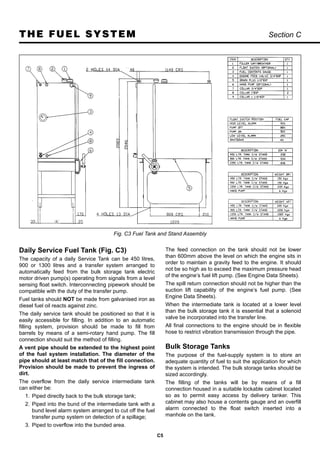
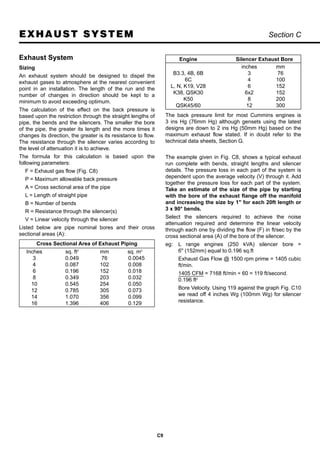
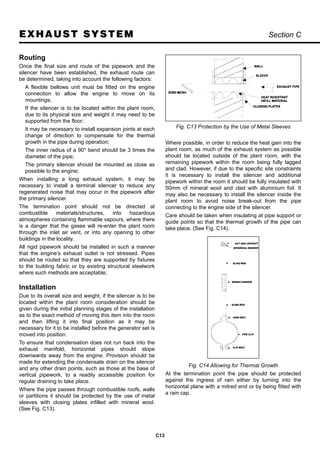
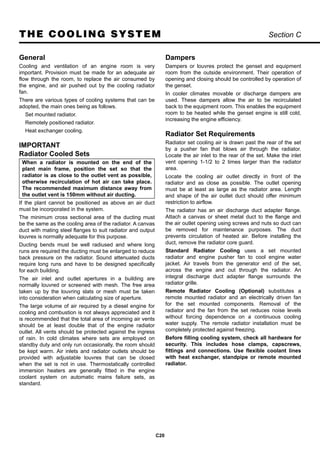
Guide for Generator Sets
from
Cummins Power Generation
Power
Generation
INDEX
Section A
Standards
Regulations
World supplies
Formulae
Installation questionnaire
Section B
Foundations and recommended room sizes and
layouts for one to four generators with or without
sound attenuation
Section C
Fuel systems
Exhaust systems
Cooling systems
Starting systems
Section D
Control systems
Paralleling
Switchgear
Cabling
Earthing
Circuit breakers
Automatic transfer systems
Section E
Health & Safety
Motor starting
Section F
Soundproofing
Silenced sets
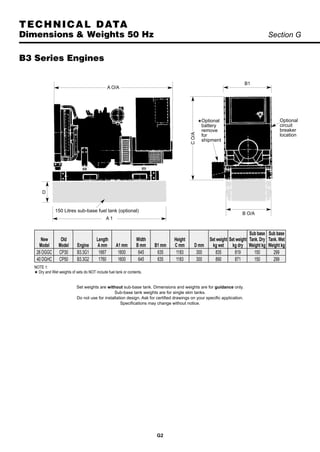
Dimensions and weights
Section G
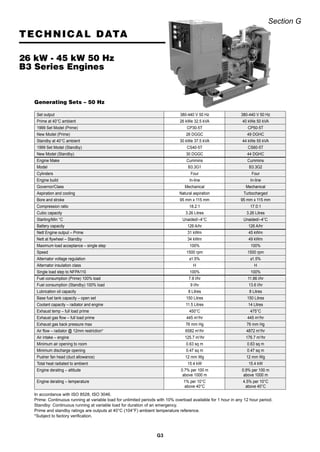
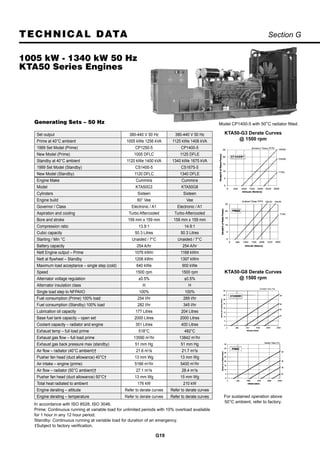
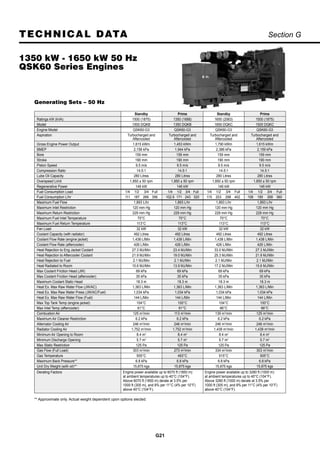
Technical data on gen sets
Air flows
Exhaust flows
Fuel consumption
Dimensions and weights
Conversion tables
Full load current tables
GENERAL Section A
A1
Scope
This manual provides an Installation Guide for Cummins
Power Generation generator sets. This includes the
following information:-
q Room Sizes
q Mounting Recommendations
q Electrical Connections
q Mechanical Connections
q Health and Safety
q General Maintenance
q Silencing
q Technical Data
This manual details typical installations only as it is not
possible to give specific details to many variables in an
application.
If you should require any further advice or information,
please consult:
Cummins Power Generation Ltd
Manston Park
Columbus Avenue, Manston
Ramsgate
Kent CT12 5BF, UK
Tel : +44 (0) 1843 255000
Fax : +44 (0) 1843 255902
Regulations and Bibliography
The authorities listed below may provide informative
sources when planning and implementing an installation.
Electrical Installation
Electrical Supply Regulations - 1937
“For securing the safety of the public and for ensuring
a proper and sufficient supply of electrical energy”
Electricity (Supply) Acts 1882 1936
Her Majesty’s Stationary Office (H.M.S.O)
Distribution units for electricity supplies for
construction and building sites.
British Standard (BS) 4363
Regulations for the Electrical Equipment of Buildings.
Institute of Electrical Engineers (1966)
Electrical Installations - General
British Standard Code of Practice CP321
Private Electric Generating Plant CP323
Quality Assessment Schedule QAS/3420.121 relating to
BS5750 Part 1 will apply.
ABGSM Publication TM3 (Revised 1985)
“Code of Practice for Designers, Installers and Users
of Generating Sets.”
Asbestos (Licensing) Regulations 1983 (SI 1983 No
1649) and Health and Safety at Work series Booklet H5
(R) 19
A Guide to Asbestos (Licensing ) Regulations 1983.
Electricity Council Engineering Recommendations G5/3
and G59.
Factories Act 1961
Health and Safety at Work Act 1974
ISO 4782 - Measurement of Airborne noise emitted by
construction equipment for outdoor use - method of
checking for compliance.
BS 4142 ISO 1996 - Method of rating industrial noise
affecting mixed residential and industrial areas.
Electrical Equipment
The Electrical Performance of Rotating Electrical
Machinery BS2615
Electrical Protective Systems for A.C Plant BS3950
A useful glossary of British Standards applicable to
electrical components is given at the ‘ Sectional List of
British Standards Institution.’
IEC 479 Effects of Current Passing through the Human
Body
IEE Regulations (15th Edition)
BS 159 1957 - Busbars and Busbar Connections.
BS 162 1661 - Electrical Power Switchgear and
Associated Apparatus.
BS 2757 Insulation
BS 4999 - General requirements for Rotating Electrical
Machines.
BS 5000 Part 3 1980 - Generators to be driven by
reciprocating Internal Combustion Engines.
BS 5424 Part 1 1977 - Contractors.
BS 5486 (IEC 439) - Factory Built assemblies of Low
Voltage Switchgear and Control Gear.
Mechanical Equipment
BS 1649 - Guards for Shaft Couplings
BS529 - Steel Eye Bolts
EEC Directive 84/536/EEC - Noise from construction
equipment - power generators.
BS 476 Part 7 Class 1 - Surface spread of Flame Tests
of Materials.
BS 799 Part 5 - Oil Storage Tanks
BS 2869 1970 - Fuel Oils for Oil Engines and Burners for
non- marine use.
BS 3926 - Recommendations for the use of maintenance
of Engine Coolant Solutions.
BS 4675 Part 1 (ISO 2372) - Mechanical vibration in
reciprocating machinery.
GENERAL Section A
A2
BS 4959 - Recommendations for Corrosion and Scale
Prevention in Engine Cooling Water Systems.
BS 5117 - Methods of Test for Corrosion Inhibition
Performance of Anti-Freeze Solutions.
BS 5514 (ISO 3046) - Specification for Reciprocating
Internal Combustion Engines, Part 1 to 6.
Manufacturing and Design Standards
The generator and its control system are manufactured
under a registered quality control system approved to BS
EN ISO 9001 (1994). The following regulations are
observed where applicable:
The Health & Safety at work Act 1974.
The Control of Substances Hazardous to Health Act
1974, 1988 & 1989.
IEE Wiring Regulations for Electrical Installations
(16th Edition).
The Electricity at Work Regulations 1989.
The Environmental Protection Act 1990.
The Health & Safety at work Regulations 1992.
The EMC Directive 89/336/EEC.
The LV Directive 73/23/EEC.
The Machinery Directive 89/392/EEC.
The generator and its control system has been
designed, constructed and tested generally in
accordance with the following Standards where
applicable:
q BS 4999 General requirements for rotating
(IEC 341
) electrical machines.
q BS 5000 Rotating electrical machines of
(IEC 341
) particular types or for particular
applications.
q BS 5514 Reciprocating internal combustion
(ISO 30462
) engines: performance.
q BS 7671 Requirements for electrical
(IEC 3641
) installations. IEE Wiring Regulations
(sixteenth edition).
q BS 7698 Reciprocating internal combustion
(ISO 85282
) engine driven alternating current
generating sets.
q BS EN 50081 Electromagnetic compatibility. Generic
(EN 500812
) emission standard.
q BS EN 50082 Electromagnetic compatibility. Generic
(EN 500822
) immunity standard.
q BS EN 60439 Specification for low-voltage
(IEC 4391
) switchgear and control gear
(EN 604392
) assemblies.
q BS EN 60947 Specification for low voltage
(IEC 9471
) switchgear and control gear.
(EN 609472
)
KEY:
1
A related, but not equivalent, standard: A BSI
publication, the content of which to any extent at all,
short of complete identity or technical equivalence,
covers subject matters similar to that covered by a
corresponding international standard.
2
An identical standard: A BSI publication identical in
every detail with a corresponding international
standard.
Regulations Governing Installations
Before purchasing a generating set, the advice of the
local authority should be obtained with regard to the
following requirements:-
Planning permission for the generator building.
Regulations governing the following:-
Storage of fuel
Noise levels
Air pollution levels
Electrical earthing requirements
Failure to comply with the local authorities regulations,
may result in the generator not being used. This type of
purchase should be installed correctly using the “best”
materials and installation guides to ensure the generator
set lasts a lifetime.
Specialist advice should be sought concerning any part
of the building requirements, installation, commissioning
etc. or any references in this manual from Cummins
Power Generation Applications Engineering Group.
Data compiled in this manual will be continuously
improved and therefore subject to change without notice,
all rights are reserved.
GENERAL Section A
A3
Country Frequency Supply Voltage
(Hz) Levels in Common
Use (V)
Abu Dhabi
(United Arab Emirates) 50 415/250
Afghanistan 50; 60 380/220; 220
Algeria 50 10 kV; 5.5 kV;
380/220; 220/127
Angola 50 380/220; 220
Antigua 60 400/230; 230
Argentina 50 13.2 kV;
6.88 kV; 390/225;
339/220: 220
Australia 50 22 kV; 11 kV;
6.6 kV; 440/250;
415/240; 240
Austria 50 20 kV; 10 kV; 5 kV;
380/220; 220
Bahamas 60 415/240; 240/120;
208/120; 120
Bahrain 50: 60 11 kV; 400/230:
380/220; 230;
220/110
Bangladesh 50 11 kV; 400/230;
230
Barbados 50 11 kV; 3.3 kV;
230/115; 200/115
Belgium 50 15 kV; 6 kV;
380/220; 2201127,
220
Belize 60 440/220; 220/110
Bermuda 60 4.16/2.4 kV;
240/120; 208/120
Bolivia 50; 60 230/115;
400/230/220/110
Botswana 50 380/220: 220
Brazil 50; 60 13.8 kV; 11.2 kV:
380/220,220/127
Brunei 50 415/230
Bulgaria 50 20 kV; 15 kV;
380/220; 220
Burma 50 11 kV; 6.6 kV;
400/230; 230
Burundi
Cambodia 50 380/220; 208/120;
(Khmer Republic) 120
Cameroon 50 15 kV; 320/220;
220
Canada 60 12.5/7.2 kV;
600/347; 240/120;
208/120; 600;
480; 240
Canary Islands 50 380/220; 230
Cape Verde Islands 50 380/220; 127/220
Cayman Islands 60 480/240; 480/227;
240/120; 208/120
Central African Republic 50 380/220
Chad 50 380/220; 220
China 50 380/220 50Hz
Chile 50 380/220; 220
Colombia 60 13.2 kV; 240/120;
120
Costa Rica 60 240/120; 120
World Electricity Supplies
Country Frequency Supply Voltage
(Hz) Levels in Common
Use (V)
Cuba 60 440/220; 220/110
Cyprus 50 11 kV; 415/240;
240
Czechoslovakia 50 22 kV; 15 kV; 6 kV;
3 kV; 380/220; 220
Dahomey 50 15 kV; 380/220;
220
Denmark 50 30 kV; 10 kV;
380/220; 220
Dominica
(Windward Islands) 50 400/230
Dominican Republic 60 220/110; 110
Dubai (United Arab 50 6.6 kV; 330/220;
Emirates) 220
Ecuador 60 240/120; 208/120;
220/127; 220/110
Egypt (United Arab 50 11 kV; 6.6 kV;
Republic) 380/220; 220
Eire (Republic of Ireland) 50 10 kV; 380/220;
220
El Salvador 60 14.4 kV; 2.4 kV;
240/120
Ethiopia 50 380/220; 220
Faeroe Islands
(Denmark) 50 380/220
Falkland Islands (UK) 50 415/230; 230
Fiji 50 11 kV; 415/240;
240
Finland 50 660/380; 500;
380/220; 220
France 50 20 kV; 15 kV;
380/220; 380; 220;
127
French Guiana 50 380/220
French Polynesia 60 220; 100
Gabon 50 380/220
Gambia 50 400/230; 230
Germany (BRD) 50 20 kV; 10 kV; 6 kV;
380/220; 220
Germany (DDR) 50 10 kV; 6 kV;
660/380; 380/220;
220/127; 220; 127
Ghana 50 440/250; 250
Gibraltar 50 415/240
Greece 50 22 kV; 20 kV;
15 kV; 6.6 kV;
380/220
Greenland 50 380/220
Grenada (Windward 50 400/230; 230
Islands)
Guadeloupe 50; 60 20 kV; 380/220;
220
Guam (Mariana Islands) 60 13.8 kV; 4 kV;
480/277; 480:
240/120; 207/120
Guatemala 60 13.8 kV; 240/120
Guyana 50 220/110
Haiti 60 380/220; 230/115;
230; 220; 115
Country Frequency Supply Voltage
(Hz) Levels in Common
Use (V)
Honduras 60 220/110; 110
Hong Kong (and Kowloon) 50 11 kV;
346/200; 200
Hungary 50 20 kV; 10 kV;
380/220; 220
Iceland 50 380/220; 220
India 50; 25 22 kV; 11 kV;
440/250; 400/230;
460/230; 230
Indonesia 50 380/220; 2201127
Iran 50 20 kV; 11 kV;
400/231; 380/220;
220
Iraq 50 11 kV; 380/220;
220
Israel 50 22 kV; 12.6 kV;
6.3 kV; 400/230;
230
Italy 50 20 kV; 15 kV;
10 kV; 380/220;
220/127; 220
Ivory Coast 50 380/220; 220
Jamaica 50 4/2.3 kV; 220/110
Japan 50; 60 6.6 kV; 200/100;
22 kV; 6.6 kV;
210/105; 200/100;
100
Jordan 50 380/220; 220
Kenya 50 415/240; 240
Korea Republic (South) 60 200/100; 100
Kuwait 50 415/240; 240
Laos 50 380/220
Lebanon 50 380/220; 190/110;
220;110
Lesotho 50 380/220; 220
Liberia 60 12.5/7.2 kV;
416/240; 240/120;
208/120
Libyan Arab Republic 50 400/230; 220/127;
230;127
Luxembourg 50 20 kV; 15 kV;
380/220; 220
Macao 50 380/220; 220/110
Malagassy Republic 50 5 kV; 380/220;
(Madagascar) 220/127
Malawi 50 400/230; 230
Malaysia (West) 50 415/240; 240
Mali 50 380/220; 220/127;
220; 127
Malta 50 415/240
Manila 60 20 kV; 6.24 kV;
3.6 kV; 240/120
Martinique 50 220/127; 127
Mauritania 50 380/220
Mauritius 50 400/230; 230
Mexico 60 13.8 kV; 13.2 kV;
480/277; 220/127;
220/120
Monaco 50 380/220; 220/127;
220; 127
GENERAL Section A
A4
World Electricity Supplies
Country Frequency Supply Voltage
(Hz) Levels in Common
Use (V)
Montserrat 60 400/230; 230
Morocco 50 380/220; 220/127
Mozambique 50 380/220
Muscat and Oman 50 415/240; 240
Naura 50 415/240
Nepal 50 11 kV; 400/220;
220
Netherlands 50 10 kV; 3 kV;
380/220; 220
Netherlands Antilles 50; 60 380/220; 230/115;
220/127; 208/120
New Caledonia 50 220
New Zealand 50 11 kV; 415/240;
400/230; 440;
240; 230
Nicaragua 60 13.2 kV; 7.6 kV;
240/120
Niger 50 380/220; 220
Nigeria 50 15 kV; 11 kV;
400/230; 380/220;
230; 220
Norway 50 20 kV; 10 kV; 5 kV;
380/220; 230
Pakistan 50 400/230; 230
Panama 60 12 kV; 480/227;
240/120; 208/120
Papua New Guinea 50 22 kV; 11 kV;
415/240; 240
Paraguay 50 440/220; 380/220;
220
Peru 60 10 kV; 6 kV; 225
Philippines 60 13.8 kV; 4.16 kV;
2.4 kV; 220/110
Poland 50 15 kV; 6 kV;
380/220; 220
Portugal 50 15 kV; 5 kV;
380/220; 220
Portuguese Guinea 50 380/220
Puerto Rico 60 8.32 kV; 4.16 kV;
480; 240/120
Qatar 50 415/240; 240
Reunion 50 110/220
Romania 50 20 kV; 10 kV; 6 kV;
380/220; 220
Rwanda 50 15 kV; 6.6 kV;
380/220; 220
Country Frequency Supply Voltage
(Hz) Levels in Common
Use (V)
Sabah 50 415/240; 240
Sarawak (East Malaysia) 50 4151240; 240
Saudi Arabia 60 380/220; 220/127;
127
Senegal 50 220/127; 127
Seychelles 50 415/240
Sierra Leone 50 11 kV; 400/230;
230
Singapore 50 22 kV; 6.6 kV;
400/230; 230
Somali Republic 50 440/220; 220/110;
230: 220; 110
South Africa 50; 25 11 kV; 6.6 kV;
3.3 kV; 433/250;
400/230; 380/220;
500; 220
Southern Yemen (Aden) 50 400/230
Spain 50 15 kV; 11 kV;
380/220; 220/127;
220; 127
Spanish Sahara 50 380/220; 110; 127
Sri Lanka (Ceylon) 50 11 kV; 400/230;
230
St. Helena 50 11 kV; 415/240
St. Kitts Nevis Anguilla 50 400/230; 230
St. Lucia 50 11 kV; 415/240;
240
Saint Vincent 50 3.3 kV; 400/230;
230
Sudan 50 415/240; 240
Surinam 50; 60 230/115; 220/127;
220/110; 127; 115
Swaziland 50 11 kV; 400/230;
230
Sweden 50 20 kV; 10 kV; 6 kV;
380/220; 220
Switzerland 50 16 kV; 11 kV; 6 kV;
380/220; 220
Syrian Arab Republic 50 380/220; 200/115;
220; 115
Taiwan (Republic of China) 60 22.8 kV;
11.4 kV; 380/220;
220/110
Tanzania (Union 50 11 kV; 400/230
Republic of)
Thailand 50 380/220; 220
Country Frequency Supply Voltage
(Hz) Levels in Common
Use (V)
Togo 50 20 kV; 5.5 kV;
380/220; 220
Tonga 50 11 kV; 6.6 kV;
415/240; 240; 210
Trinidad and Tobago 60 12 kV; 400/230;
230/115
Tunisia 50 15 kV; 10 kV;
380/220; 220
Turkey 50 15 kV; 6.3 kV;
380/220; 220
Uganda 50 11 kV; 415/240;
240
United Kingdom 50 22 kV; 11 kV;
6.6 kV; 3.3 kV;
400/230; 380/220;
240; 230; 220
Upper-Yolta 50 380/220; 220
Uruguay 50 15 kV; 6 kV; 220
USA 60 480/277; 208/120;
240/120
USSR 50 380/230; 220/127
and higher voltages
Venezuela 60 13.8 kV; 12.47 kV;
4.8 kV; 4.16 kV;
2.4 kV; 240/120;
208/120
Vietnam (Republic of) 50 15 kV; 380/220;
208/120; 220; 120
Virgin Islands (UK) 60 208; 120
Virgin Islands (US) 60 110/220
Western Samoa 50 415/240
Yemen, Democratic
(PDR) 50 440/250; 250
Yugoslavia 50 10 kV; 6.6 kV;
380/220; 220
Zaire (Republic of) 50 380/220; 220
Zambia 50 400/230; 230
Zimbabwe 50 11 kV; 390/225;
225
Table 1 World Electricity Supplies
GENERAL Section A
A5
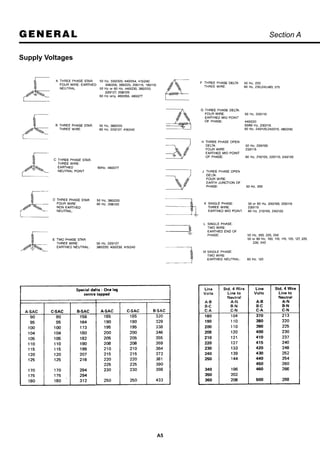
Supply Voltages
GENERAL Section A
A6
Equivalents and Formulae
Equivalents
1 horsepower = 746watts 1 kW = 1 000watts
1 horsepower = 0.746kW 1 kW = 1.3415hp
1 horsepower = 33,000ft lb/min 1 kW = 56.8ft lb/min
ft lb/min
1 horsepower = 550ft lb/sec 1 kW = 738ft lb/sec
1 horsepower = 2546Btu/hr 1 kW = 3412Btu/hr
1 horsepower = 42.4Btu/min
1 Btu = 9340in lb
1 Btu = 778.3ft lb 1ft lb = 0.001284Btu
1 Btu =.0002930kWhr 1 kWhr = 3413Btu
1 Btu = 1.05506kJ
1 Btu/min = 17.57watts
1 Btu/min = 0.0176kW
1 Btu/min = 0.0236hp
1 Btu/hr = 0.293watts
1 ft lb = 1.35582Nm
1 ft lb/sec = 0.001355kW
1 ft lb/sec = 0.001818hp
1 therm = 100,000Btu 12,000Btu = 1 Ton
(air conditioning)
Formulae
Brake Mean Effective Pressure (BMEP)
792,000 x BHP
BMEP = ——————————————— (for 4-cycle)
rpm x cubic inch displacement
Brake Horsepower (BHP)
BMEP x cubic inch displacement x rpm
BHP = ———————————————— (for 4-cycle)
792,000
Torque
5250 x BHP
Torque (ft lb) = —————————
rpm
Temperature
(°F - 32)
Temp. (°C) = ————————— °F = (°C x 1.8) + 32
1.8
Power Factor & kVA
kW kW
PF = ———— KVA = ————
kVA PF
Formulae for Obtaining kW, kVA, Reactive kVA, BHP
and Amperes
To Obtain:
Single Phase AC Three Phase AC Direct Current
V x A x PF kVA x PF V x A
KW = ———— ———— ————
1000 1000 1000
V x A V x A x 1.732
KVA = ———— ——————
1000 1000
Reactive kVA = kVA x 1 - PF2
kVA x 1 - PF2
BHP (Output) =
V x A x Gen. Eff. X PF 1.73 x V x A x Eff. X PF V x A x Gen. Eff.
———————— ————————— ——————
746 x 1000 746 x 1000 746 x 1000
BHP (Input) =
kW kW
—————— ——————
746 x 1000 746 x 1000
A (when BHP is known) =
BHP x 746 x 100 BHP x 746 x 100 BHP x 746 x 100
——————— ————————— —————
V x Gen. Eff. x PF 1.73 x V x Gen. Eff. x PF V x Gen. Eff.
A (when kW is known) =
KW x 1000 kW x 1000 kW x 1000
——————— ——————— ———————
V x PF V x PF x 1.732 V
A (when KVA is known) =
KVA x 1000 KVA x 1000
——————— ———————
V V x 1.732
Misc.
No. of poles x RPM No. of poles x RPM
HZ = —————————— ——————————
120 120
KW KW
HP = —————————— ——————————
0.746 x Gen Efficiency 0.746 x Gen Efficiency
Where;-
kW = Kilowatts
V = Line to Line Voltage
A = Line Current
PF = Power Factor
HZ = Frequency
HP = Horse Power
INSTALLATION QUESTIONNAIRE Section A
A7
Special Access Requirements:..........................................................
..........................................................................................................
Radiator 40°C 50°C
Is radiator to be Integral or REMOTE or OTHER
Position of Remote radiator relative to both plant and
control panel......................................................................................
..........................................................................................................
EXHAUST
Type of flue to be used: Steel Twin wall stainless steel
Overall length of exhaust Horiz ................Vert ..............metres/ft.
Number of Bends ..............................................................................
Type of Silencers: Residential Acoustic Other
Type of Brackets: Roller Fixed Spring
GLC type Mixed
Pipework to be: Flanged Butt welded
Residential Silencer to be:
floor mounted wall mounted ceiling mounted
Acoustic Silencer to be:
floor mounted wall mounted ceiling mounted
Exhaust weathering in: wall roof
Termination in: tailpipe cowl
Finish to pipework: red lead black epoxy paint
Access for erecting pipework:
good bad scaffold required
Welding supply available: YES NO
Type of lagging: rockwool other
Type of cladding:
22 swg aluminium stainless steel other
Length of pipe to be lagged and clad ................................metres/ft.
Type of silencer to be lagged and clad: Residential Acoustic
CABLE
Type of Load Cables:
PVCSWAPVC CSP/EPR Bus bar LSF
Route length of control cables between plant and panel:
..........................................................................................metres/ft.
Type of control cables:
PVCSWAPVC PVC LSF
Route length of control cables between plant and panel:
..........................................................................................metres/ft.
Load and control cable run in:
Trunking On tray Clipped
Load and control cables run overhead:
on wall on floor in trench
Cable entry to panel: top bottom side
Position of LTB: ................................................................................
Other control cables:
Service ............................................................................ metres/ft
Cable Type ...................................................................... metres/ft
Cable Route Length ........................................................ metres/ft
Installation Questionnaire
for Generating Sets
In order to accurately estimate the materials, technicalities and
costing for any installation it is essential that all available data
relating to the generator, location and room be itemised and
documented before contacting the supplier. This service can
alternatively be provided by your local Cummins Distributor.
Project ..............................................................................................
..........................................................................................................
Customer (End User) ........................................................................
..........................................................................................................
Address of Site..................................................................................
..........................................................................................................
..........................................................................................................
..........................................................................................................
Consultant ........................................................................................
..........................................................................................................
Address ............................................................................................
..........................................................................................................
..........................................................................................................
..........................................................................................................
Telephone No. ..................................................................................
Site Drawing No. ..............................................................................
Architect ............................................................................................
..........................................................................................................
GENERATING SET
DETAILS
Model .......................................... kVA ............................................
p.f................................................. kW ..............................................
Voltage ........................................ Phases........................................
Frequency.................................... Engine ........................................
Alternator .................................... Control System ..........................
Number ........................................ Size of Room ..............................
Position of Set(s) ..............................................................................
indicate on site drawing if possible
Are Control Panels to be Integral or Free Standing
Position of Free Standing Control Panel ..........................................
..........................................................................................................
Motor starting YES NO
UPS Load YES NO
Operate Lifts YES NO
Base Fuel Tank YES NO
SITE CONDITIONS
Brief description of site working conditions including time
scale for installation: ......................................................................
..........................................................................................................
Type of Crane ................................................................................
Distance to position of set from roadway? ....................................
Type of Transport ..........................................................................
Police Involvement YES NO Road Closure YES NO
Access (obstructions, restrictions, etc.)............................................
..........................................................................................................
Is set to be positioned
IN BASEMENT GROUND LEVEL
MID LEVEL ROOF TOP
Is set to be dismantled YES NO
ON PLINTHS R.S.J’s FLOOR
INSTALLATION QUESTIONNAIRE Section A
A8
Number of acoustic doors: ................................................................
Type: single double
Antivibration mounts required: YES NO
Acoustic louvres: YES NO
Noise survey required: YES NO
Sound proof enclosure: YES NO
Container Drop over Int fit out
Walk round Close fit EEC style
Paint finish ..........................RAL/BS4800 ........................................
DUCTING
Length of inlet duct: .......................................................... metres/ft.
No. of bends: ..........................................................................
Length of outlet duct: ........................................................ metres/ft.
No. of bends: ..........................................................................
Inlet duct: floor mounted wall mounted off ceiling
Outlet duct: floor mounted wall mounted off ceiling
Fire damper in inlet duct: YES NO
Fire damper in outlet duct: YES NO
LOUVRES
Inlet louvre Outlet louvre
Type: fixed blade gravity motorised
Position of louvre inlet: external internal
Position of louvre outlet: external internal
Colour finish to louvres: ....................................................................
COMMISSION
Distance from Genset/Conn.............................................. metres/ft.
Load Bank Resistive Reactive
Ground level Roof Other
Weekend working
Out of normal hours
During normal hours
First fill of lub. oil: YES NO ................................litres
First fill of fuel Quantity ................................litres
Anti freeze YES NO
Maintenance contract required:: YES NO
Are civil works required: YES NO
Set Length mm..................................................................................
Width mm..................................................................................
Height mm..................................................................................
Weight Kg..................................................................................
DRAWINGS
Plant Room Builders/Civils Other
COMPILED BY: ................................................................................
DATE:................................................................................................
WATER
Pipe route length between remote radiator and engine:
............................................................................................metres/ft
Pipe route length between break tank and radiator:
.......................................................................................... metres/ft
Break Tank required: YES NO
Pipework to be: screwed welded
Pipework to be: galvanised steel
FUEL
Type of bulk tank:
Cylindrical Rectangular Double skinned Bunded
Capacity of bulk tank:........................................................................
Standard Bosses Extra Bosses
Position of Bulk Tank in relation to set:..............................................
(height above or below ground etc.)
Access for offloading:........................................................................
Pipe route length between bulk tank and service tank:
flow .......................................... return ................................metres/ft
Local Atmosphere Remote Vent Route ....................
Pipework: below ground above ground
Pipework to be jacketed: YES NO
Pipe: Trace heated Denso
Type of fillpoint required: Cabinet Valve, cap and chain
Pipe route length between bulk tank and fill point:..............metres/ft
Fill alarm unit and tank float switch required:
YES NO
Pipework: Thickness ..................Single Skin Double Skin
If double skin all pipe or specify ..................................................
Pipework support/fixing ....................................................................
Type of bulk tank contents gauge:
Hydrostatic Electronic Mechanical
Position of contents gauge: ........................if not in fill point cabinet
Distance from bulk tank:.................................................... metres/ft.
Service tank: free standing on set
Overspill tank required: YES NO
If tank free standing, pipe route length to engine:
.......................................................................................... metres/ft.
Auto fuel transfer system: YES NO
Duplex YES NO
Solenoid valve required: YES NO
Position: ............................................................................................
If pump positioned away from tank determine position: ....................
..........................................................................................................
Fire valve required: YES NO
MERC: YES NO
MKOB SQR BATT PACK
Other alarms required: ......................................................................
Dump valve
ATTENUATION
Level of noise to be obtained ..................................................dB(A)
What distance.................................................................... metres/ft.
Position of inlet splitter: low level high level
Position of outlet splitter: low level high level
LAYOUT CONSIDERATIONS Section B
B1
General
In order to start to consider the possible layouts for a
site, the following criteria must first be determined:-
The total area available and any restrictions within
that area (i.e. buried or overhead services).
Any noise constraints. (i.e. the location of offices or
residential property).
The access to the site, initially for delivery and
installation purposes, but afterwards for the deliveries
of fuel and servicing vehicles, etc.
The ground condition, is it level or sloping?
When installing the equipment within a plant room,
consideration must be given to each of the following:-
A forced ventilation system is required for the
equipment, which draws sufficient cooling and
aspiration air into the room at the back of the
alternator and discharges the air from in front of the
engine. Dependent upon the layout of the building, it
may be necessary to install additional ductwork to
achieve the airflow required.
In order to reduce the heat gain within the plant room,
all the elements of the exhaust system will need to be
fully lagged. Where practical, the silencer and as
much of the pipework as possible should be outside
the generator room.
The access into the building, initially for the delivery
and installation of the equipment, and, afterwards for
servicing and maintenance of the equipment.
The plant room should be of sufficient size to
accommodate the following items of equipment:
The engine/alternator assembly.
The local fuel tank (if applicable).
The generator control panel including the PCC (if
free standing).
The exhaust system (if internally erected).
The air handling system including any sound
attenuating equipment that may be required.
The relative height of the base for the bulk tanks should
also be taken into consideration to determine the type of
fuel transfer system that is to be utilised. The sizes for
the bulk fuel storage tank(s) are dependent on the
duration of the storage that is required.
Where possible the equipment should be positioned in a
manner such that "cross overs" of the ancillary services,
(fuel, water and electrical power/controls) do not occur.
Due consideration should be given to the direction of the
noise sensitive areas so that elements generating noise
can be positioned to restrict any potential problem.(i.e.
exhaust outlets).
Modular Installation
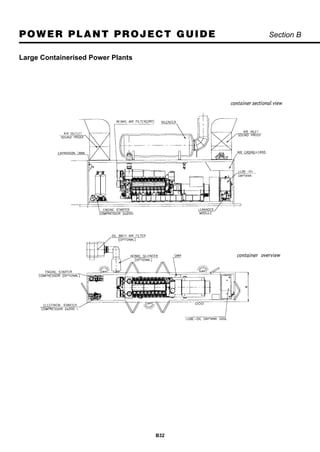
In terms of the external appearance the "drop-over"
enclosure system is virtually identical to a containerised
system. The principle difference between the two
systems is that in the containerised arrangement the
generator is mounted on the floor of the module,
whereas in the "dropover" arrangement, the generator
locates directly on the concrete plinth and the enclosure
drops over onto the plinth.
To maintain the advantage of the reduction in site work, it
is essential to give careful consideration to the
positioning of the set to optimise the space and to
minimise the lengths of any inter-connections.
Off-loading and Positioning the
Equipment
Prior to the commencement of the off-loading, using the
specific site and equipment drawings, the positions for
each of the principle items of equipment should be
carefully marked out on the plinth/plant room floor.
The order in which various items of equipment are to be
positioned should be determined to ensure that double
lifting is avoided as far as possible.
The appropriate size and type of crane should be
considered bearing in mind the site conditions and lifting
radius. All the necessary lifting chains, spreader beams,
strops etc., should be used to off-load and position the
equipment.
BASE AND FOUNDATIONS Section B
B2
Note : Special foundations are unnecessary. A level and
sufficiently strong concrete floor is adequate.
Introduction
The responsibility for the design of the foundation
(including seismic considerations) should be placed with
a civil or structural engineer specialising in this type of
work.
Major functions of a foundation are to:
Support the total weight of the generating set.
Isolate generator set vibration from surrounding
structures.
To support the structural design, the civil engineer will
need the following details:-
the plant’s operating temperatures (heat transfer from
machines to mass could lead to undesirable tensile
stresses).
the overall dimensions of the proposed foundation
mass.
the mounting and fixing arrangements of the
generator bedframe.
Concrete Foundations
The foundation will require at least seven days between
pouring the concrete and mounting the generating set to
cure. It is also essential that the foundation should be
level, preferably within ± 0.5° of any horizontal plane and
should rest on undisturbed soil.
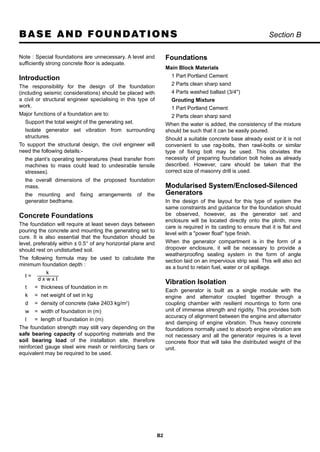
The following formula may be used to calculate the
minimum foundation depth :
k
t = ————
d x w x l
t = thickness of foundation in m
k = net weight of set in kg
d = density of concrete (take 2403 kg/m2
)
w = width of foundation in (m)
l = length of foundation in (m)
The foundation strength may still vary depending on the
safe bearing capacity of supporting materials and the
soil bearing load of the installation site, therefore
reinforced gauge steel wire mesh or reinforcing bars or
equivalent may be required to be used.
Foundations
Main Block Materials
1 Part Portland Cement
2 Parts clean sharp sand
4 Parts washed ballast (3/4")
Grouting Mixture
1 Part Portland Cement
2 Parts clean sharp sand
When the water is added, the consistency of the mixture
should be such that it can be easily poured.
Should a suitable concrete base already exist or it is not
convenient to use rag-bolts, then rawl-bolts or similar
type of fixing bolt may be used. This obviates the
necessity of preparing foundation bolt holes as already
described. However, care should be taken that the
correct size of masonry drill is used.
Modularised System/Enclosed-Silenced
Generators
In the design of the layout for this type of system the
same constraints and guidance for the foundation should
be observed, however, as the generator set and
enclosure will be located directly onto the plinth, more
care is required in its casting to ensure that it is flat and
level with a "power float" type finish.
When the generator compartment is in the form of a
dropover enclosure, it will be necessary to provide a
weatherproofing sealing system in the form of angle
section laid on an impervious strip seal. This will also act
as a bund to retain fuel, water or oil spillage.
Vibration Isolation
Each generator is built as a single module with the
engine and alternator coupled together through a
coupling chamber with resilient mountings to form one
unit of immense strength and rigidity. This provides both
accuracy of alignment between the engine and alternator
and damping of engine vibration. Thus heavy concrete
foundations normally used to absorb engine vibration are
not necessary and all the generator requires is a level
concrete floor that will take the distributed weight of the
unit.
BASE AND FOUNDATIONS Section B
B3
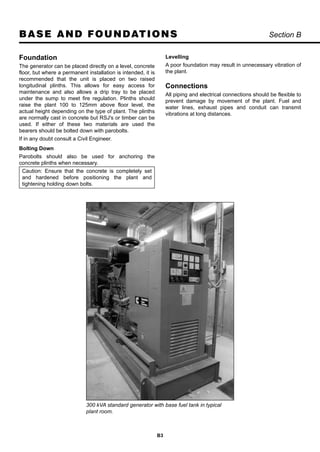
Foundation
The generator can be placed directly on a level, concrete
floor, but where a permanent installation is intended, it is
recommended that the unit is placed on two raised
longitudinal plinths. This allows for easy access for
maintenance and also allows a drip tray to be placed
under the sump to meet fire regulation. Plinths should
raise the plant 100 to 125mm above floor level, the
actual height depending on the type of plant. The plinths
are normally cast in concrete but RSJ's or timber can be
used. If either of these two materials are used the
bearers should be bolted down with parobolts.
If in any doubt consult a Civil Engineer.
Bolting Down
Parobolts should also be used for anchoring the
concrete plinths when necessary.
Caution: Ensure that the concrete is completely set
and hardened before positioning the plant and
tightening holding down bolts.
Levelling
A poor foundation may result in unnecessary vibration of
the plant.
Connections
All piping and electrical connections should be flexible to
prevent damage by movement of the plant. Fuel and
water lines, exhaust pipes and conduit can transmit
vibrations at long distances.
300 kVA standard generator with base fuel tank in typical
plant room.
ROOM DESIGN GUIDANCE NOTES Section B
B4
Generator installations with acoustic
treatment to achieve 85dBA at 1 metre
Note:- The layout drawings provided are intended as a
guide and to form the basis of the installation design, but
before the room design is finalised please ensure you
have a "project specific" generator general arrangement
drawing. Certain ambient temperatures or specific site
requirements can affect the finalised generator build,
layout configuration and room dimensions.
Room size allowance
The dimensions as indicated A & B allow for good
maintenance/escape access around the generator.
Ideally you should allow a minimum distance of 1 metre
from any wall, tank or panel within the room.
Machine access
It is important to remember that the generator has to be
moved into the constructed generator room, therefore
the personnel access door has to be of a sufficient size
to allow access alternatively the inlet/outlet attenuator
aperture should be extended to the finished floor level,
with the bottom uplift section built when the generator is
in the room.
Inlet and outlet attenuators with weather louvres
The inlet and outlet attenuators should be installed within
a wooden frame and are based on 100mm. airways with
200mm. acoustic modules. The attenuators should be
fitted with weather louvres with a minimum 50% free
area, good airflow profile and afford low restriction
airflow access. The noise level of 85dB(A) at 1m will
comply with minimum EEC Regulations. To achieve
lower levels attenuator size can more than double in
length.
The weather louvres should have bird/vermin mesh
screens fitted on the inside, but these screens must not
impede the free flow of cooling and aspiration air.
The outlet attenuator should be connected to the radiator
ducting flange with a heat and oil resistant flexible
connection.
Exhaust systems
The exhaust systems shown on the layout drawings are
supported from the ceiling. Should the building
construction be such that the roof supports were unable
to support the exhaust system, a floor standing steel
exhaust stand will be needed. Exhaust pipes should
terminate at least 2.3m above floor level to make it
reasonably safe for anyone passing or accidentally
touching.
It is recommended that stainless steel bellows be fitted
to the engine exhaust manifold followed by rigid
pipework to the silencer.
The dimension "E" as indicated on the layout diagrams is
based upon using standard manufacturers silencers to
achieve 85dBA at 1m, please ensure that the intended
silencers to be used can be positioned as indicated as
this dimension affects the builders works such as
apertures to the walls for the exhaust outlet.
The exhaust run as indicated exits via the side wall
through a wall sleeve, packed with a heat resistant
medium and closed to the weather with wall plates.
Should the generator room, internally or externally, be
constructed with plastic coated profiled steel sheet
cladding, it is important to ensure that the wall sections
at the exhaust outlet are isolated from the high exhaust
pipe temperature and sealed by a specialist cladder. The
same applies for any exhaust going through or near any
timber or plastic guttering.
It is good installation practice for the exhaust system
within the generator room to be insulated with a
minimum of 50mm. of high density, high temperature
mineral insulation covered by an aluminium overclad.
This reduces the possibility of operator burn injury and
reduces the heat being radiated to the operating
generator room.
Cable systems
The layout drawings assumes that the change-over
switch-gear is external to the generator room and
located in the power distribution room. Specific project
requirements can affect this layout.
The power output cables from the generator output
breaker to the distribution panel must be of a flexible
construction:-
EPR/CSP (6381TQ)
PCP (H07RNF)
Should the cable route length from the generator to the
distribution room be extensive the flexible cables can be
terminated to a load terminal close box to the generator
and then extended to the distribution room with
armoured multi-core cables. (See typical load terminal
box layout).
The flexible power cables as installed should be laid up
in trefoil, placed on support trays/ladder rack in the
trench with the recommended inter-spacing and
segregated from the system control cables.
The cables should be correctly supported and rated for
the installation/ambient conditions.
The flexible single core power cables when entering any
panel must pass through a non ferrous gland plate.
Doors.
Doors should always open outwards. This not only
makes for a better door seal when the set/s are running
but allows for a quick exit/panic button or handle to get
out. Make allowance for the generator to be moved into
the room by using double doors at the attenuator space.
Generator installations WITHOUT
acoustic treatment.
Note: Handy rule of thumb for INTAKE louvres. Use 1.5 x
radiator area.
All the previous notes regarding "generator installations
with acoustic treatment" equally apply to installations
without acoustic attenuators with the exception of
paragraph 3 relating to the Inlet and Outlet louvres.
Inlet and outlet louvres.
The inlet and outlet weather louvres should be installed
within a wooden frame with a minimum 50% free area,
good airflow profile and low restriction airflow access.
The weather louvres should have bird/vermin mesh
screens fitted on the inside, but must not impede the free
flow of cooling and aspiration air.
The outlet weather louvre should be connected to the
radiator ducting flange with a heat and oil resistant
flexible connection.
ROOM DESIGN GUIDANCE NOTES Section B
B5
Change-over panels.
Should the change-over panel be positioned within the
generator room due note must be made of the floor/wall
space that must be made available.
For change-over cubicles up to 1000Amp. rating the wall
mounting panel of maximum depth 420mm. can be
mounted directly above the cable trench in the side
access area without causing too many problems.
For change-over cubicles from 1600Amp. and above, a
floor standing panel is used which needs additional
space to be allocated. Refer to Page D11 for dimensions.
The room dimensions need to be increased in the area
of the cable duct/change-over panel to allow space and
man access around cubicles with the following
dimensions. A minimum of 800mm. for rear access
should be allowed.
The cable trench in the area of the change-over cubicle
needs to be increased in size to allow for the mains, load
and generator cable access requirement.
Generator Sets.
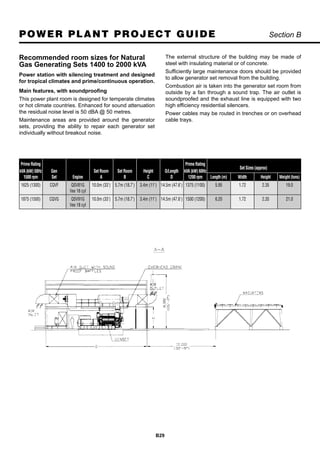
All generators shown include 8 hour base fuel tanks.
Free standing tanks can be provided but additional room
space will be required.
Canvas ducting between the radiator and ductwork or
attenuator should be a minimum of 300mm.
Air inlet should be at the rear of the alternator to allow
adequate circulation.
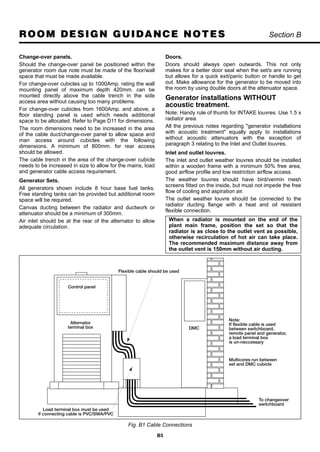
Fig. B1 Cable Connections
Control panel
Note:
If flexible cable is used
between switchboard,
remote panel and generator,
a load terminal box
is un-neccessary
Multicores run between
set and DMC cubicle
Flexible cable should be used
Alternator
terminal box
Load terminal box must be used
if connecting cable is PVC/SWA/PVC
DMC
To changeover
switchboard
When a radiator is mounted on the end of the
plant main frame, position the set so that the
radiator is as close to the outlet vent as possible,
otherwise recirculation of hot air can take place.
The recommended maximum distance away from
the outlet vent is 150mm without air ducting.
RECOMMENDED ROOM SIZES Section B
B6
Prime Type Room dimensions Set Set C/L Exhaust Outlet Inlet
Rating of 2000 1999 Length width height back position Offset Height Louvre Uplift Louvre Cable trench position
KVA ENGINE Model Model A B C D P E X F G H J K L M N
32.5 B3.3G1 26 DGGC CP30-5 3100 3000 2600 400 1500 159 2300 650 700 650 750 800 420 400 1165
50 B3.3G2 40 DGHC CP50-5 3100 3000 2600 400 1500 275 2300 750 800 650 900 900 420 400 1165
38 4B3.9G 30 DGBC CP40-5 3100 3000 2600 400 1500 141 2300 650 750 600 750 850 520 400 1325
52 4BT3.9G1 42 DGCA CP50-5 3200 3000 2600 400 1500 194 2300 650 750 600 750 850 520 400 1325
64 4BT3.9G2 51 DGCB CP60-5 3200 3000 2600 400 1500 194 2300 650 750 600 750 850 520 400 1325
70 4BTA3.9G1 56 DGCC CP70-5 3250 3000 2600 400 1500 194 2300 650 750 600 750 850 520 400 1410
96 6BT5.9G2 77 DGDB CP90-5 3500 3000 2600 400 1500 168 2300 700 860 540 800 800 520 400 1630
106 6BT5.9G2 85 DGDF CP100-5 3500 3000 2600 400 1500 168 2300 700 860 540 800 800 520 400 1630
129 6CT8.3G2 103 DGEA CP125-5 3850 3000 2700 400 1500 255 2300 850 1025 600 1000 1150 520 400 1910
153 6CTA8.3G 122 DGFA CP150-5 3850 3000 2700 400 1500 255 2300 850 1025 600 1000 1150 520 400 1910
185 6CTA8.3G 148 DGFB CP180-5 3850 3000 2700 400 1500 255 2300 850 1025 600 1000 1150 520 400 2070
200 6CTAA8.3G 163 DGFC CP200-5 3950 3000 2700 400 1500 255 2300 850 1025 600 1000 1150 520 400 2070
233 LTA10G2 186 DFAB CP200-5 4850 3250 2800 500 1625 361 2300 1000 1075 520 1150 1250 625 400 2285
252 LTA10G3 202 DFAC CP250-5 4850 3250 2800 500 1625 361 2300 1000 1075 520 1150 1250 625 400 2285
315 NT855G6 252 DFBH CP300-5 4850 3200 2700 500 1600 284 2300 1000 1300 700 1250 1400 625 400 2525
350 NTA855G4 280 DFCC CP350-5 4850 3200 2700 500 1600 284 2300 1000 1300 700 1250 1400 625 400 2525
431* NTA855G6 340 DFCE CS450-5 4850 3200 2700 500 1600 284 2300 1000 1300 700 1250 1400 625 400 2630
431 KTA19G3 345 DFEC CP400-5 5275 3400 3000 500 1700 320 2500 1400 1450 700 1600 1675 775 400 2815
450 KTA19G3 360 DFEL CP450-5 5275 3400 3000 500 1700 320 2500 1400 1450 700 1600 1675 775 400 2815
511 KTA19G4 409 DFED CP500-5 5275 3400 3000 500 1700 320 2500 1400 1450 700 1600 1675 775 400 2815
CUMMINS ENGINE POWERED 37 kVA - 511 kVA GENERATING SETS WITHOUT ACOUSTIC TREATMENT.
SINGLE SETS.
Before finalising the generator room layout please ensure you read the guidance notes.
*Standby rating only.
EXHAUST HUNG FROM CEILING
50mm MINERAL LAGGING
AND ALUMINIUM CLAD
FLEXIBLE EXHAUST
BELLOWS
WEATHER LOUVRE
SEE NOTES
WALL PLATES & SLEEVE
SEE NOTES
EXHAUST
G
X
H
K
C
H
TRENCH TO
SWITCHROOM
J B
M
N
E
L
FUEL TRANSFER
TRENCH IF BULK
TANK INCLUDED
SEE NOTES
RE PLANT ACCESS
F
P
D
A
SET
SUB BASE FUEL TANK
AIR
FLOW
AIR
FLOW
TRENCH
SEE NOTES
CABLE TRENCH
PANEL PC005
(IF SUPPLIED)
600
SET
DATUM
SET
DATUM
CANVAS
DUCTING
RECOMMENDED ROOM SIZES Section B
B7
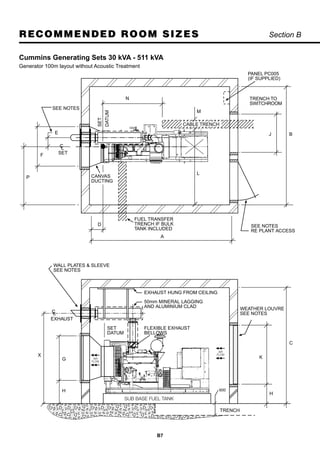
Cummins Generating Sets 30 kVA - 511 kVA
Generator 100m layout without Acoustic Treatment
RECOMMENDED ROOM SIZES Section B
B8
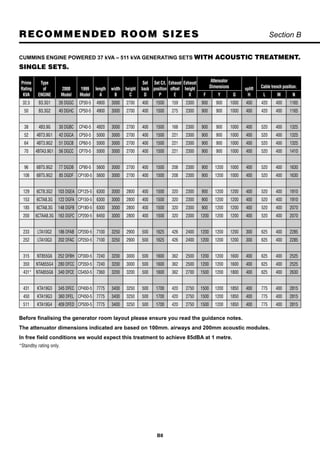
Prime Type Set Set C/L Exhaust Exhaust Attenuator
Rating of 2000 1999 length width height back position offset height Dimensions uplift Cable trench position.
KVA ENGINE Model Model A B C D P E X F Y G H L M N
32.5 B3.3G1 26 DGGC CP30-5 4900 3000 2700 400 1500 159 2300 900 900 1000 400 420 400 1165
50 B3.3G2 40 DGHC CP50-5 4900 3000 2700 400 1500 275 2300 900 900 1000 400 420 400 1165
38 4B3.9G 30 DGBC CP40-5 4920 3000 2700 400 1500 168 2300 900 900 1000 400 520 400 1325
52 4BT3.9G1 42 DGCA CP50-5 5000 3000 2700 400 1500 221 2300 900 900 1000 400 520 400 1325
64 4BT3.9G2 51 DGCB CP60-5 5000 3000 2700 400 1500 221 2300 900 900 1000 400 520 400 1325
70 4BTA3.9G1 56 DGCC CP70-5 5000 3000 2700 400 1500 221 2300 900 900 1000 400 520 400 1410
96 6BT5.9G2 77 DGDB CP90-5 5600 3000 2700 400 1500 208 2300 900 1200 1000 400 520 400 1630
106 6BT5.9G2 85 DGDF CP100-5 5600 3000 2700 400 1500 208 2300 900 1200 1000 400 520 400 1630
129 6CT8.3G2 103 DGEA CP125-5 6300 3000 2800 400 1500 320 2300 900 1200 1200 400 520 400 1910
153 6CTA8.3G 122 DGFA CP150-5 6300 3000 2800 400 1500 320 2300 900 1200 1200 400 520 400 1910
185 6CTA8.3G 148 DGFB CP180-5 6300 3000 2800 400 1500 320 2300 900 1200 1200 400 520 400 2070
200 6CTAA8.3G 163 DGFC CP200-5 6450 3000 2800 400 1500 320 2300 1200 1200 1200 400 520 400 2070
233 LTA10G2 186 DFAB CP200-5 7100 3250 2900 500 1625 426 2400 1200 1200 1200 300 625 400 2285
252 LTA10G3 202 DFAC CP250-5 7100 3250 2900 500 1625 426 2400 1200 1200 1200 300 625 400 2285
315 NT855G6 252 DFBH CP300-5 7240 3200 3000 500 1600 362 2500 1200 1200 1600 400 625 400 2525
350 NTA855G4 280 DFCC CP350-5 7240 3200 3000 500 1600 362 2500 1200 1200 1600 400 625 400 2525
431* NTA855G6 340 DFCE CS450-5 7360 3200 3200 500 1600 362 2700 1500 1200 1800 400 625 400 2630
431 KTA19G3 345 DFEC CP400-5 7775 3400 3250 500 1700 420 2750 1500 1200 1850 400 775 400 2815
450 KTA19G3 360 DFEL CP450-5 7775 3400 3250 500 1700 420 2750 1500 1200 1850 400 775 400 2815
511 KTA19G4 409 DFED CP500-5 7775 3400 3250 500 1700 420 2750 1500 1200 1850 400 775 400 2815
CUMMINS ENGINE POWERED 37 kVA – 511 kVA GENERATING SETS WITH ACOUSTIC TREATMENT.
SINGLE SETS.
Before finalising the generator room layout please ensure you read the guidance notes.
The attenuator dimensions indicated are based on 100mm. airways and 200mm acoustic modules.
In free field conditions we would expect this treatment to achieve 85dBA at 1 metre.
*Standby rating only.
B
ACOUSTIC DOOR
SEE NOTES
RE PLANT ACCESS
EXHAUST HUNG FROM CEILING
50mm MINERAL LAGGING
AND ALUMINIUM CLAD
FLEXIBLE EXHAUST
BELLOWS
WEATHER LOUVRE
SEE NOTES
WALL PLATES & SLEEVE
SEE NOTES
EXHAUST
G
X
H
G
C
H
TRENCH TO
SWITCHROOM
F
M
N
E
L
Y
FUEL TRANSFER
TRENCH IF BULK
TANK INCLUDED
F
Y
A
SET
D
INLET
AIR
FLOW
AIR
FLOW
SUB BASE FUEL TANK
SEE NOTES
CABLE TRENCH
TRENCH
600
INLET
ATTENUATOR
OUTLET
ATTENUATOR
SET
DATUM
SET
DATUM
P
RECOMMENDED ROOM SIZES Section B
B9
Cummins Generating Sets 30 kVA - 511 kVA
Generator room layout with Acoustic Treatment to achieve 85dB(A) @ 1 metre
RECOMMENDED ROOM SIZES Section B
B10
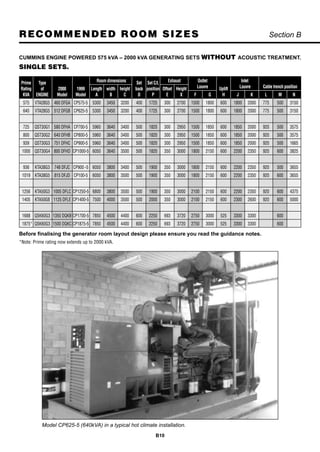
CUMMINS ENGINE POWERED 575 kVA – 2000 kVA GENERATING SETS WITHOUT ACOUSTIC TREATMENT.
SINGLE SETS.
Before finalising the generator room layout design please ensure you read the guidance notes.
*Note: Prime rating now extends up to 2000 kVA.
Model CP625-5 (640kVA) in a typical hot climate installation.
Prime Type Room dimensions Set Set C/L Exhaust Outlet Inlet
Rating of 2000 1999 Length width height back position Offset Height Louvre Uplift Louvre Cable trench position
KVA ENGINE Model Model A B C D P E X F G H J K L M N
575 VTA28G5 460 DFGA CP575-5 5300 3450 3200 400 1725 300 2700 1500 1800 600 1800 2000 775 500 3150
640 VTA28G5 512 DFGB CP625-5 5300 3450 3200 400 1725 300 2700 1500 1800 600 1800 2000 775 500 3150
725 QST30G1 580 DFHA CP700-5 5960 3640 3400 500 1820 300 2950 1500 1850 600 1850 2000 920 500 3575
800 QST30G2 640 DFHB CP800-5 5960 3640 3400 500 1820 300 2950 1500 1850 600 1850 2000 920 500 3575
939 QST30G3 751 DFHC CP900-5 5960 3640 3400 500 1820 300 2950 1500 1850 600 1850 2000 920 500 1665
1000 QST30G4 800 DFHD CP1000-5 6050 3640 3500 500 1820 350 3000 1800 2150 600 2200 2350 920 600 3825
936 KTA38G3 748 DFJC CP900 -5 6050 3800 3400 500 1900 350 3000 1800 2150 600 2200 2350 920 500 3655
1019 KTA38G5 815 DFJD CP100-5 6050 3800 3500 500 1900 350 3000 1800 2150 600 2200 2350 920 600 3655
1256 KTA50G3 1005 DFLC CP1250-5 6800 3800 3500 500 1900 350 3000 2100 2150 600 2200 2350 920 600 4375
1405 KTA50G8 1125 DFLE CP1400-5 7500 4000 3500 500 2000 350 3000 2100 2150 600 2300 2600 920 600 5000
1688 QSK60G3 1350 DQKB CP1700-5 7850 4500 4400 600 2250 693 3720 2750 3000 525 3300 3300 600
1875* QSK60G3 1500 DQKC CP1875-5 7850 4500 4400 600 2250 693 3720 2750 3000 525 3300 3300 600
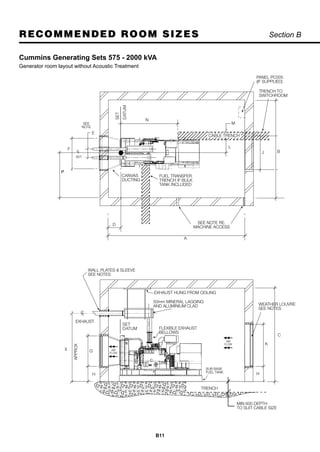
H
G
EXHAUST
WALL PLATES & SLEEVE
SEE NOTES
EXHAUST HUNG FROM CEILING
50mm MINERAL LAGGING
AND ALUMINIUM CLAD
FLEXIBLE EXHAUST
BELLOWS
WEATHER LOUVRE
SEE NOTES
C
B
SEE NOTE RE.
MACHINE ACCESS
FUEL TRANSFER
TRENCH IF BULK
TANK INCLUDED
E
SEE
NOTE
N
M
L
D
TRENCH TO
SWITCHROOM
A
K
SET
H
X
APPROX
AIR
FLOW
SUB BASE
FUEL TANK
CABLE TRENCH
F
J
TRENCH
AIR
FLOW
PANEL PC005
(IF SUPPLIED)
CANVAS
DUCTING
MIN 600 DEPTH
TO SUIT CABLE SIZE
SET
DATUM
P
SET
DATUM
RECOMMENDED ROOM SIZES Section B
B11
Cummins Generating Sets 575 - 2000 kVA
Generator room layout without Acoustic Treatment
RECOMMENDED ROOM SIZES Section B
B12
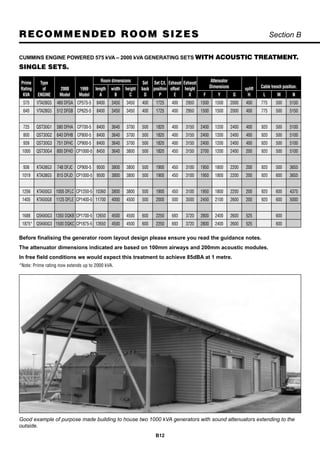
CUMMINS ENGINE POWERED 575 kVA – 2000 kVA GENERATING SETS WITH ACOUSTIC TREATMENT.
SINGLE SETS.
Before finalising the generator room layout design please ensure you read the guidance notes.
The attenuator dimensions indicated are based on 100mm airways and 200mm acoustic modules.
In free field conditions we would expect this treatment to achieve 85dBA at 1 metre.
*Note: Prime rating now extends up to 2000 kVA.
Good example of purpose made building to house two 1000 kVA generators with sound attenuators extending to the
outside.
Prime Type Room dimensions Set Set C/L Exhaust Exhaust Attenuator
Rating of 2000 1999 length width height back position offset height Dimensions uplift Cable trench position.
KVA ENGINE Model Model A B C D P E X F Y G H L M N
575 VTA28G5 460 DFGA CP575-5 8400 3450 3450 400 1725 400 2950 1500 1500 2000 400 775 500 5150
640 VTA28G5 512 DFGB CP625-5 8400 3450 3450 400 1725 400 2950 1500 1500 2000 400 775 500 5150
725 QST30G1 580 DFHA CP700-5 8400 3640 3700 500 1820 400 3150 2400 1200 2400 400 920 500 5100
800 QST30G2 640 DFHB CP800-5 8400 3640 3700 500 1820 400 3150 2400 1200 2400 400 920 500 5100
939 QST30G3 751 DFHC CP900-5 8400 3640 3700 500 1820 400 3150 2400 1200 2400 400 920 500 5100
1000 QST30G4 800 DFHD CP1000-5 8450 3640 3800 500 1820 450 3150 2700 1200 2400 200 920 500 5100
936 KTA38G3 748 DFJC CP900-5 9500 3800 3800 500 1900 450 3100 1950 1800 2200 200 920 500 3655
1019 KTA38G5 815 DFJD CP1000-5 9500 3800 3800 500 1900 450 3100 1950 1800 2200 200 920 600 3655
1256 KTA50G3 1005 DFLC CP1250-5 10360 3800 3800 500 1900 450 3100 1950 1800 2200 200 920 600 4375
1405 KTA50G8 1125 DFLE CP1400-5 11700 4000 4500 500 2000 500 3500 2450 2100 2600 200 920 600 5000
1688 QSK60G3 1350 DQKB CP1700-5 12650 4500 4500 600 2250 693 3720 2800 2400 2600 525 600
1875* QSK60G3 1500 DQKC CP1875-5 12650 4500 4500 600 2250 693 3720 2800 2400 2600 525 600
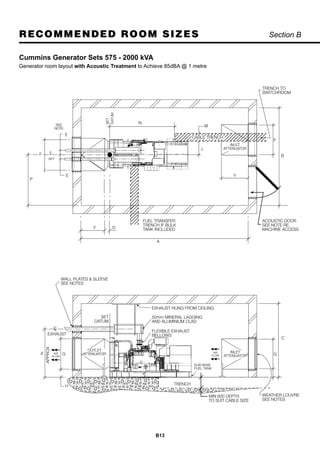
P
Y
F
H
G
EXHAUST
WALL PLATES & SLEEVE
SEE NOTES
EXHAUST HUNG FROM CEILING
50mm MINERAL LAGGING
AND ALUMINIUM CLAD
SET
DATUM
INLET
ATTENUATOR
OUTLET
ATTENUATOR
FLEXIBLE EXHAUST
BELLOWS
WEATHER LOUVRE
SEE NOTES
MIN 600 DEPTH
TO SUIT CABLE SIZE
C
G
INLET
ATTENUATOR
B
ACOUSTIC DOOR
SEE NOTE RE.
MACHINE ACCESS
FUEL TRANSFER
TRENCH IF BULK
TANK INCLUDED
N
M
L
Y D
TRENCH TO
SWITCHROOM
A
F
SEE
NOTE
SET
TRENCH
AIR
FLOW
AIR
FLOW
SUB BASE
FUEL TANK
CABLE TRENCH
E
E
X
APPROX
SET
DATUM
RECOMMENDED ROOM SIZES Section B
B13
Cummins Generator Sets 575 - 2000 kVA
Generator room layout with Acoustic Treatment to Achieve 85dBA @ 1 metre
RECOMMENDED ROOM SIZES Section B
B14
Prime Type Room dimensions Positions Exhaust OUTLET INLET
Rating of 2000 1999 length width height apart back set C/L Offset Height LOUVRE uplift LOUVRE Cable trench position.
KVA ENGINE Model Model A B C Z D P E X F G H J K L M N
233 LTA10G2 186 DFAB CP200-5 4850 6300 2800 2250 500 2425 361 2300 1000 1075 520 1150 1250 625 400 2285
252 LTA10G3 202 DFAC CP250-5 4850 6300 2800 2250 500 2425 361 2300 1000 1075 520 1150 1250 625 400 2285
315 NT855G6 252 DFBH CP300-5 4850 6200 2700 2200 500 2425 284 2300 1000 1300 700 1250 1400 625 400 2525
350 NTA855G4 280 DFCC CP350-5 4850 6200 2700 2200 500 2425 284 2300 1000 1300 700 1250 1400 625 400 2525
431* NTA855G6 340 DFCE CS450-5 4850 6200 2700 2200 500 2425 284 2300 1000 1300 700 1250 1400 625 400 2630
431 KTA19G3 345 DFEC CP400-5 5275 6600 3000 2400 400 2500 320 2500 1400 1450 700 1600 1675 775 400 2815
450 KTA19G3 360 DFEL CP450-5 5275 6600 3000 2400 400 2500 320 2500 1400 1450 700 1600 1675 775 400 2815
511 KTA19G4 409 DFED CP500-5 5275 6600 3000 2400 400 2500 320 2500 1400 1450 700 1600 1675 775 400 2815
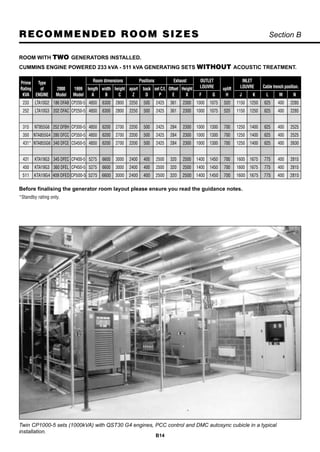
ROOM WITH TWO GENERATORS INSTALLED.
CUMMINS ENGINE POWERED 233 kVA - 511 kVA GENERATING SETS WITHOUT ACOUSTIC TREATMENT.
Before finalising the generator room layout please ensure you read the guidance notes.
*Standby rating only.
Twin CP1000-5 sets (1000kVA) with QST30 G4 engines, PCC control and DMC autosync cubicle in a typical
installation.
H
G
WALL PLATES & SLEEVE
SEE NOTES
EXHAUST HUNG FROM CEILING
50mm MINERAL LAGGING
AND ALUMINIUM CLAD
FLEXIBLE EXHAUST
BELLOWSSET
DATUM
MIN
600
C
B
SEE NOTE RE.
MACHINE ACCESS
F
E
SEE
NOTE
A
P
D
TRENCH TO
SWITCHROOM
K
L
M
SET
H
X
SET
FUEL TRANSFER
TRENCH IF BULK
TANK INCLUDED
POWER COMMAND
PARALLELING PANEL
L
M
J
Z
N
WEATHER
LOUVRE
SEE
NOTES
AIR
FLOW
SUB BASE
FUEL TANK
AIR
FLOW
TRENCH
CANVAS
DUCTS
SET
DATUM
RECOMMENDED ROOM SIZES Section B
B15
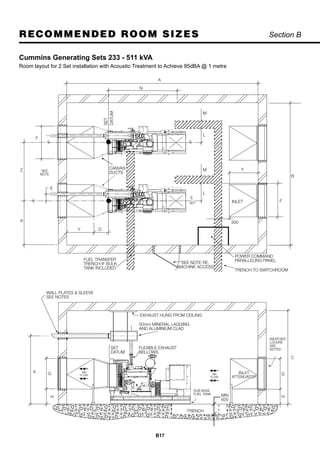
Cummins Generating Sets 233 - 511 kVA
2 Set installation without Acoustic Treatment
RECOMMENDED ROOM SIZES Section B
B16
ROOM WITH TWO GENERATORS INSTALLED.
CUMMINS ENGINE POWERED 233 kVA – 511 kVA GENERATING SETS WITH ACOUSTIC TREATMENT.
Before finalising the generator room layout please ensure you read the guidance notes.
The attenuator dimensions indicated are based on 100mm. airways and 200mm acoustic modules.
In free field conditions we would expect this treatment to achieve 85dBA at 1 metre.
*Standby rating only.
Prime Type Room dimensions Positions Exhaust Attenuator
Rating of 2000 1999 length width height Apart back Set C/L Offset Height Dimensions uplift Cable trench position.
KVA ENGINE Model Model A B C Z D P E X F Y G H L M N
233 LTA10G2 186 DFAB CP200-5 7700 6300 2900 2250 500 2425 426 2400 1200 1500 1200 300 625 400 2285
252 LTA10G3 202 DFAC CP250-5 7700 6300 2900 2250 500 2425 426 2400 1200 1500 1200 300 625 400 2285
315 NT855G6 252 DFBH CP300-5 7840 6200 3000 2200 500 2425 362 2500 1200 1500 1600 400 625 400 2525
350 NTA855G4 280 DFCC CP350-5 7840 6200 3000 2200 500 2425 362 2500 1200 1500 1600 400 625 400 2525
431* NTA855G6 340 DFCE CS450-5 7960 6200 3200 2200 500 2425 362 2700 1500 1500 1800 400 625 400 2630
431 KTA19G3 345 DFEC CP400-5 8375 6600 3250 2400 400 2500 420 2750 1500 1500 1850 400 775 400 2815
450 KTA19G3 360 DFEL CP450-5 8375 6600 3250 2400 400 2500 420 2750 1500 1500 1850 400 775 400 2815
511 KTA19G4 409 DFED CP500-5 8375 6600 3250 2400 400 2500 420 2750 1500 1500 1850 400 775 400 2815
H
G
WALL PLATES & SLEEVE
SEE NOTES
EXHAUST HUNG FROM CEILING
50mm MINERAL LAGGING
AND ALUMINIUM CLAD
FLEXIBLE EXHAUST
BELLOWS
SET
DATUM
MIN
600
C
G
H
SEE NOTE RE.
MACHINE ACCESS
F
E
SEE
NOTE
A
P
D
TRENCH TO SWITCHROOM
SET
X
FUEL TRANSFER
TRENCH IF BULK
TANK INCLUDED
POWER COMMAND
PARALLELING PANEL
F
Z
N
Y
300
INLET
WEATHER
LOUVRE
SEE
NOTES
AIR
FLOW
AIR
FLOW
SUB BASE
FUEL TANK
TRENCH
B
YCANVAS
DUCTS
SET
DATUM
L
M
L
M
RECOMMENDED ROOM SIZES Section B
B17
Cummins Generating Sets 233 - 511 kVA
Room layout for 2 Set installation with Acoustic Treatment to Achieve 85dBA @ 1 metre
RECOMMENDED ROOM SIZES Section B
B18
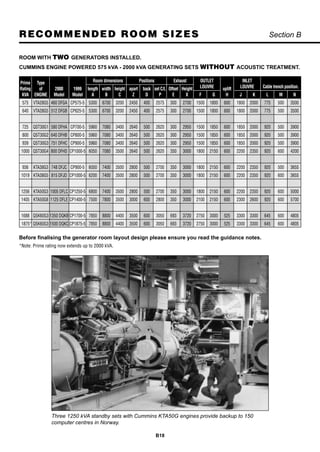
ROOM WITH TWO GENERATORS INSTALLED.
CUMMINS ENGINE POWERED 575 kVA - 2000 kVA GENERATING SETS WITHOUT ACOUSTIC TREATMENT.
Before finalising the generator room layout design please ensure you read the guidance notes.
*Note: Prime rating now extends up to 2000 kVA.
Three 1250 kVA standby sets with Cummins KTA50G engines provide backup to 150
computer centres in Norway.
Prime Type Room dimensions Positions Exhaust OUTLET INLET
Rating of 2000 1999 length width height apart back set C/L Offset Height LOUVRE uplift LOUVRE Cable trench position.
KVA ENGINE Model Model A B C Z D P E X F G H J K L M N
575 VTA28G5 460 DFGA CP575-5 5300 6700 3200 2450 400 2575 300 2700 1500 1800 600 1800 2000 775 500 3500
640 VTA28G5 512 DFGB CP625-5 5300 6700 3200 2450 400 2575 300 2700 1500 1800 600 1800 2000 775 500 3500
725 QST30G1 580 DFHA CP700-5 5960 7080 3400 2640 500 2620 300 2950 1500 1850 600 1850 2000 920 500 3900
800 QST30G2 640 DFHB CP800-5 5960 7080 3400 2640 500 2620 300 2950 1500 1850 600 1850 2000 920 500 3900
939 QST30G3 751 DFHC CP900-5 5960 7080 3400 2640 500 2620 300 2950 1500 1850 600 1850 2000 920 500 3900
1000 QST30G4 800 DFHD CP1000-5 6050 7080 3500 2640 500 2620 350 3000 1800 2150 600 2200 2350 920 600 4200
936 KTA38G3 748 DFJC CP900-5 6050 7400 3500 2800 500 2700 350 3000 1800 2150 600 2200 2350 920 500 3655
1019 KTA38G5 815 DFJD CP1000-5 6200 7400 3500 2800 500 2700 350 3000 1800 2150 600 2200 2350 920 600 3655
1256 KTA50G3 1005 DFLC CP1250-5 6800 7400 3500 2800 500 2700 350 3000 1800 2150 600 2200 2350 920 600 5000
1405 KTA50G8 1125 DFLE CP1400-5 7500 7800 3500 3000 600 2800 350 3000 2100 2150 600 2300 2600 920 600 5700
1688 QSK60G3 1350 DQKB CP1700-5 7850 8800 4400 3500 600 3050 693 3720 2750 3000 525 3300 3300 645 600 4805
1875* QSK60G3 1500 DQKC CP1875-5 7850 8800 4400 3500 600 3050 693 3720 2750 3000 525 3300 3300 645 600 4805
H
G
WALL PLATES & SLEEVE
SEE NOTES
EXHAUST HUNG FROM CEILING
50mm MINERAL LAGGING
AND ALUMINIUM CLAD
FLEXIBLE EXHAUST
BELLOWS
MIN
600
C
B
SEE NOTE RE.
MACHINE ACCESS
F
E
SEE
NOTE
A
D
TRENCH TO
SWITCHROOM
K
SET
H
X
SET
FUEL TRANSFER
TRENCH IF BULK
TANK INCLUDED
POWER COMMAND
PARALLELING PANEL
J
E
WEATHER
LOUVRE
SEE NOTES
N
SUB BASE
FUEL TANK
AIR
FLOW
WEATHER
LOUVRE
SEE
NOTES
AIR
FLOW
TRENCH
M
300
CANVAS
DUCTS
DEPTH TO SUIT
CABLE SIZE
SET
DATUM
Z
P
SET
DATUM
M
L
M
L
RECOMMENDED ROOM SIZES Section B
B19
Cummins Generating Sets 575 - 2000 kVA
Room layout for 2 Set installation without Acoustic Treatment
RECOMMENDED ROOM SIZES Section B
B20
ROOM WITH TWO GENERATORS INSTALLED.
CUMMINS ENGINE POWERED 575 kVA– 2000 kVAGENERATING SETS WITH ACOUSTIC TREATMENT.
Before finalising the generator room layout design please ensure you read the guidance notes.
The attenuator dimensions indicated are based on 100mm airways and 200mm acoustic modules.
In free field conditions we would expect this treatment to achieve 85dBA at 1 metre.
*Note: Prime rating now extends up to 2000 kVA.
Prime Type Room dimensions Positions Exhaust Attenuator
Rating of 2000 1999 Length width height apart back set C/L Offset height Dimensions uplift Cable trenchposition.
KVA ENGINE Model Model A B C Z D P E X F Y G H L M N
575 VTA28G5 460 DFGA CP575-5 9000 6700 3450 2450 400 2575 400 2950 1500 1800 2000 400 775 500 3500
640 VTA28G5 512 DFGB CP625-5 9000 6700 3450 2450 400 2575 400 2950 1500 1800 2000 400 775 500 3500
725 QST30G1 580 DFHA CP700-5 9000 7080 3700 2640 500 2620 400 3150 2400 1500 2400 400 920 500 3900
800 QST30G2 640 DFHB CP800-5 9000 7080 3700 2640 500 2620 400 3150 2400 1500 2400 400 920 500 3900
939 QST30G3 751 DFHC CP900-5 9000 7080 3700 2640 500 2620 400 3150 2400 1500 2400 400 920 500 3900
1000 QST30G4 800 DFHD CP1000-5 9050 7080 3800 2640 500 2620 450 3150 2700 1500 2400 200 920 500 4200
936 KTA38G3 748 DFJC CP900-5 10100 7400 3800 2800 500 2700 450 3100 1950 2100 2200 200 920 500 3655
1016 KTA38G5 815 DFJD CP1000-5 10100 7400 3800 2800 500 2700 500 3100 1950 2100 2200 200 920 600 3655
1256 KTA50G3 1005 DFLC CP1250-5 10960 7400 3800 2800 500 2700 450 3100 1950 2100 2200 200 920 600 5000
1405 KTA50G8 1125 DFLE CP1400-5 12300 7800 4500 3000 600 2800 500 3500 2450 2400 2600 200 920 600 5700
1688 QSK60G3 1350 DQKB CP1700-5 12650 8800 4500 3500 600 3050 693 3720 2800 2400 2600 525 645 600 4805
1875* QSK60G3 1500 DQKC CP1875-5 12650 8800 4500 3500 600 3050 693 3720 2800 2400 2600 525 645 600 4805
H
G
WALL PLATES & SLEEVE
SEE NOTES
EXHAUST HUNG FROM CEILING
50mm MINERAL LAGGING
AND ALUMINIUM CLAD
FLEXIBLE EXHAUST
BELLOWS
MIN
600
C
SEE NOTE RE.
MACHINE ACCESS
F
E
SEE
NOTE
A
P
D
TRENCH TO SWITCHROOM
SET
X
SET
FUEL TRANSFER
TRENCH IF BULK
TANK INCLUDED
POWER COMMAND
PARALLELING PANEL
F
Z
E
N
Y
M
300
INLET
AIR
FLOW
SUB BASE
FUEL TANK
AIR
FLOW
WEATHER
LOUVRE
SEE
NOTES
TRENCH
B
CANVAS
DUCTS
DEPTH TO SUIT
CABLE SIZE
C
G
H
Y
SET
DATUM
M
L
M
L
SET
DATUM
RECOMMENDED ROOM SIZES Section B
B21
Cummins Generating Sets 575 - 2000 kVA
Room layout for 2 Set installation with Acoustic Treatment
RECOMMENDED ROOM SIZES Section B
B22
ROOM WITH THREE GENERATORS INSTALLED.
CUMMINS ENGINE POWERED 575 kVA – 2000 kVA GENERATING SETS WITH ACOUSTIC TREATMENT.
Before finalising the generator room layout design please ensure you read the guidance notes.
The attenuator dimensions indicated are based on 100mm airways and 200mm acoustic modules.
In free field conditions we would expect this treatment to achieve 85dBA at 1 metre.
*Note: Prime rating now extends up to 2000 kVA.
ROOM WITH FOUR GENERATORS INSTALLED.
CUMMINS ENGINE POWERED 575 kVA – 2000 kVA GENERATING SETS WITH ACOUSTIC TREATMENT.
Before finalising the generator room layout design please ensure you read the guidance notes.
The attenuator dimensions indicated are based on 100mm airways and 200mm acoustic modules.
In free field conditions we would expect this treatment to achieve 85dBA at 1 metre.
*Note: Prime rating now extends up to 2000 kVA.
Prime Type Room dimensions Positions Exhaust Attenuator
Rating of 2000 1999 length width height Apart back set C/L Offset Height Dimensions uplift Cable trench position.
KVA ENGINE Model Model A B C Z D P E X F Y G H L M N
575 VTA28G5 460 DFGA CP575-5 9300 9150 3450 2450 400 2575 400 2950 1500 1950 2000 400 775 500 3500
640 VTA28G5 512 DFGB CP625-5 9300 9150 3450 2450 400 2575 400 2950 1500 1950 2000 400 775 500 3500
725 QST30G1 580 DFHA CP700-5 9300 9720 3700 2640 400 2620 400 3150 2400 1650 2400 400 920 500 3900
800 QST30G2 640 DFHB CP800-5 9300 9720 3700 2640 400 2620 400 3150 2400 1650 2400 400 920 500 3900
939 QST30G3 751 DFHC CP900-5 9300 9720 3700 2640 400 2620 400 3150 2400 1650 2400 400 920 500 3900
1000 QST30G4 800 DFHD CP1000-5 9350 9720 3800 2640 450 2620 450 3150 2700 1650 2400 200 920 500 4200
936 KTA38G3 748 DFJC CP700-5 10400 10200 3800 2800 450 2700 450 3100 1950 2000 2200 200 920 500 3655
1016 KTA38G3 815 DFJD CP1000-5 10400 10200 3800 2800 500 2700 450 3100 1950 2000 2200 200 920 600 3655
1256 KTA50G3 1005 DFLC CP1250-5 11260 10200 3800 2800 450 2700 450 3100 1950 2250 2200 200 920 600 5000
1405 KTA50G8 1125 DFLE CP1400-5 12600 10800 4500 3000 500 2800 500 3500 2450 2550 2600 200 920 600 5700
1688 QSK60G3 1300 DQKB CP1700-5 12650 12300 4500 3500 600 3050 693 3720 2800 2400 2600 525 645 600 4805
1875* QSK60G3 1500 DQKC CP1875-5 12650 12300 4500 3500 600 3050 693 3720 2800 2400 2600 525 645 600 4805
Prime Type Room dimensions Positions Exhaust Attenuator
Rating of 2000 1999 length width height Apart back set C/L Offset Height Dimensions uplift Cable trench position.
KVA ENGINE Model Model A B C Z D P E X F Y G H L M N
575 VTA28G5 460 DFGA CP575-5 9600 11600 3450 2450 400 2575 400 2950 1500 2100 2000 400 775 500 3500
640 VTA28G5 512 DFGB CP625-5 9600 11600 3450 2450 400 2575 400 2950 1500 2100 2000 400 775 500 3500
725 QST30G1 580 DFHA CP700-5 9600 12360 3700 2640 500 2620 400 3150 2400 1800 2400 400 920 500 3900
800 QST30G2 640 DFHB CP800-5 9600 12360 3700 2640 500 2620 400 3150 2400 1800 2400 400 920 500 3900
939 QST30G3 751 DFHC CP900-5 9600 12360 3700 2640 500 2620 400 3150 2400 1800 2400 400 920 500 3900
1000 QST30G4 800 DFHD CP1000-5 9650 12360 3800 2640 500 2620 450 3150 2700 1800 2400 200 920 500 4200
936 KTA38G3 748 DFJC CP900-5 10400 13000 3800 2800 500 2700 450 3100 1950 2000 2200 200 920 500 3655
1016 KTA38G3 815 DFJD CP1000-5 10400 13000 3800 2800 500 2700 450 3100 1950 2000 2200 200 920 600 3655
1256 KTA50G3 1005 DFLC CP1250-5 11560 13000 3800 2800 500 2700 450 3100 1950 2400 2200 200 920 600 5000
1405 KTA50G8 1125 DFLE CP1400-5 12900 13800 4500 3000 600 2800 500 3500 2450 2700 2600 200 920 600 5700
1688 QSK60G3 1300 DQKB CP1700-5 12650 15800 4500 3500 600 3050 693 3720 2800 2400 2600 525 645 600 4805
1875* QSK60G3 1500 DQKC CP1875-5 12650 15800 4500 3500 600 3050 693 3720 2800 2400 2600 525 645 600 4805
G
WALL PLATES & SLEEVE
SEE NOTES
EXHAUST HUNG FROM CEILING
50mm MINERAL LAGGING
AND ALUMINIUM CLAD
FLEXIBLE EXHAUST
BELLOWS
MIN
600
C
X
SEE NOTE RE.
MACHINE ACCESS
F
E
SEE
NOTE
D
TRENCH TO SWITCHROOM
SET
FUEL TRANSFER
TRENCH IF BULK
TANK INCLUDED
POWER COMMAND
PARALLELING PANEL
E
Y
F
M
300
INLETSET
SET
SET
INLET
INLET
INLET
TRENCH
A
AIR
FLOW
AIR
FLOW
SUB BASE
FUEL TANK
H H
N
B
WEATHER
LOUVRE
SEE
NOTES
L
M
L
M
L
M
P
Z
Z
Z
SET
DATUM
G
RECOMMENDED ROOM SIZES Section B
B23
Cummins Generating Sets 575 - 2000 kVA (up to 4.5 MW installation)
Room layout for Multiple Set installation with Acoustic Treatment to Achieve 85dBA @ 1 metre
RECOMMENDED ROOM SIZES Section B
B24
Multiple Gen Set Installations
Four 1500 kVA sets with KTA50 engines running on base load operation in Saudi Arabia.
4 x 800 kVA Gen Sets in a ground level room installation with simple but effective exhaust run.
ROOF TOP INSTALLATION Section B
B25
Unusual roof top (15 storeys high) installation for three
1500 kVA sets demands re-assembly of sets using rails
and specially built A frame for transport and lifting.
Enclosed and Roof Mounted
Generating Sets
Where internal Ground Floor or Basement space is
unavailable, either an adjacent outside location can be
used or, providing the structure is sufficiently strong
enough or can be strengthened, the flat roof area of a
building can be used. Roof installations have become
widely used in many towns and cities where space is of
a premium. Packaged and soundproofed individual units
up to 2MW each have been successfully accommodated
in this manner over the last few years in many countries.
Recommendations for Roof Top and High Level
Installations
Only consider when there is no ground or basement
level room available or/and when the cost of high level
installation – including structural work – is cheaper than
normal installations.
Benefits Disadvantages
No air flow problems Roof structure may have to
be strengthenedNo expensive ductwork
Large crane requiredNo lengthy exhaust runs
Possible road closureNo problems with
Planning permission requiredexhaust
Longer cable runsfume emissions
Limited fuel storageNo noise problem
No space limitation
problems
ROOF TOP INSTALLATION Section B
B26
Roof structure
The structure of the roof area must be suitable for an
installation. The strength of the flooring structure is vital.
Should the floor be found unsuitable the problem can
often be overcome by installing a floating floor of
structural steel platforms across the building’s main
columns.
Vibrations
Transmitted vibration through the building can be
drastically reduced by:
(a) Having built-in anti-vibration units within the design
of the generating set. This eliminates up to 75-80%
of transmitted engine vibrations.
(b) Installing additional vibration dampers between the
generating set chassis and the roof. This
combination eliminates up to 98% of the vibration.
(c) With generators over 1MW it may also be desirable
to include a concrete slab base which in turn is
resiliently mounted to eliminate vibration through the
building.
While all these methods have been used on various
buildings within the UK the majority have been found
quite satisfactorily with the normal built-in anti-vibration
system as described in item (a) and in other cases a
combination of any two of the methods described has
proved more than adequate.
Where possible a
packaged set,
300 kVA as shown
in picture, on a base
frame provides a
faster installation.
Silenced enclosure
drops over unit.
Note prepared steel
structure support
base.
ROOF TOP INSTALLATION Section B
B27
Noise
It is recommended that all generating sets installed at
roof level have soundproof enclosures fitted or are
installed in rooms with full inlet and outlet sound
attenuators and twin residential silencers. Heavy duty
soundproof enclosures can reduce noise levels by 15 to
30dB(A) and limited only by budget or local noise
regulations. A sound level of 75dB(A) at 1 metre is a
substantial reduction and equal to a normal office
environment.
Accessibility
The final roof location for the generator must take into
account access and cranage requirements. For example,
a 100 ton mobile crane with a 30m (100ft.) radius will
only lift approximately 5 tons. Lifting vertically is no
problem but positioning a large generator 30 or 40
metres from the building’s edge will place a heavy stress
on the crane’s jib. The lifting capacity is therefore limited
by the required reach or radius. To illustrate, in order to
lift a 1.3MW set weighing 22 tons onto an eight storey
roof and place it 14 metres from the edge, it was found
necessary to use a 250 ton crane.
In many cases because of the weight and radius
problem coupled with ground and street accessibility, it is
necessary to dismantle the generating set – sometimes
into five or six loads – engine, alternator, chassis, control
cubicle, soundproof enclosure and radiator.
Although this procedure may take a little longer in terms
of crane hire, dismantling and re-assembling, the smaller
crane size will cost less and overall the total installation
price is unlikely to be greatly changed.
It is possible to use a Helicopter, although there will be
weight and flying limitations, and this can be very cost
effective if all the restrictions can be overcome. At least 2
tons can be lifted and although this invariably means
dismantling the generator the cost of a helicopter will
only be a fifth of the cost of an equivalent sized crane.
In order to use a helicopter, it must have a ‘safe’
dropping area to fly over if it has to carry the equipment
any distance. Alternatively, it has to be able to lift from a
‘free and safe’ area in order to land equipment on a roof.
The helicopter hire company will advise you and seek
flying permission from the Aviation Authorities or the
whole job can be left to the generating set manufacturer.
Colour and Planning Permission
As you will almost certainly be changing the shape of the
skyline, Planning Permission will have to be sought.
Many area authorities stipulate that existing skylines
cannot be altered, whilst others specify that soundproof
enclosures must blend with the skyline.
For this reason, many enclosures are specified as ‘Sky
Blue’. The interpretation for colour ranges from Light
Grey to Dark Blue. It is wise, therefore, to seek guidance
from the local planning authorities in this respect.
It is the Client’s or Agent’s responsibility to acquire
Planning Permission.
Fuel Supply
A very limited amount of fuel storage is permitted at roof
level. Weight and Fire considerations are paramount. In
general, a ‘day tank’ for each set is permitted but even
this may be limited to 450 litres (100 gallons) by some
Local Planning and Fire Authorities. It is essential to
obtain full approval from the Authorities for the fuel
system.
Your bulk fuel storage will be at ground level and subject
to the Fire Regulations governing all safety aspects. Fuel
will be pumped up to the day service tank – which will
normally have a high and low float level regulator fitted to
control the pump motor. It is essential that the day tank
has adequately sized overflow pipework – certainly equal
to the supply pipe size if not larger – which returns to the
bulk fuel tank.
Roof mounted remote radiators for four 1000 kVA sets
and extended exhaust tail pipes where space and air
flow is restricted.
ROOF TOP INSTALLATION Section B
B28
Exhaust and Air Flows
Few problems are likely to be encountered with either
exhaust or air flows at roof top levels and this is a major
advantage with this type of location. If the roof level is
below adjoining buildings, the direction of the exhaust
system should be carefully sited – and prevailing winds
taken into consideration. A vertical stack with a
weathercap is occasionally recommended if offices with
open windows are in close proximity.
Air flow inlet areas should be kept clear of any
obstructions likely to restrict the air intake passage. Air
outlet is unlikely to cause any problems but again
prevailing winds should be considered as gale force
winds blowing straight into the air outlet may cause
restriction. As a solution use angled outlet louvres to
overcome this problem.
Cabling
Probably the most expensive item as a result of roof top
installation. It is recommended that the control cubicle
containing the changeover contractors be located as
close to the building’s incoming public power supply as
possible. This will limit one of your main power cable
runs to the minimum.
Control cables will still have to be run up to the roof level
but these are small core cables. It is recommended that
the generator’s control system, sensing and
instrumentation, be retained in close proximity to the
installed generator. Output cable from the generator
should use existing service ducting where possible.
Police
Invariably, the use of heavy vehicles and large cranes
will mean road closures, particularly in densely
populated urban areas. Notifying the Police well in
advance is recommended and their co-operation
encouraged. In busy city areas, traffic diversions are
essential – it also means delivery and installation is only
possible at weekends.
Two roof mounted super-silenced 1000 KVA sets with extended attenuators for a superstore provide a clean
installation.
POWER PLANT PROJECT GUIDE Section B
B29
Recommended room sizes for Natural
Gas Generating Sets 1400 to 2000 kVA
Power station with silencing treatment and designed
for tropical climates and prime/continuous operation.
Main features, with soundproofing
This power plant room is designed for temperate climates
or hot climate countries. Enhanced for sound attenuation
the residual noise level is 50 dBA @ 50 metres.
Maintenance areas are provided around the generator
sets, providing the ability to repair each generator set
individually without breakout noise.
The external structure of the building may be made of
steel with insulating material or of concrete.
Sufficiently large maintenance doors should be provided
to allow generator set removal from the building.
Combustion air is taken into the generator set room from
outside by a fan through a sound trap. The air outlet is
soundproofed and the exhaust line is equipped with two
high efficiency residential silencers.
Power cables may be routed in trenches or on overhead
cable trays.
Prime Rating Prime Rating
kVA (kW) 50Hz Gen Set Room Set Room Height O/Length kVA (kW) 60Hz
Set Sizes (approx)
1500 rpm Set Engine A B C D 1200 rpm Length (m) Width Height Weight (tons)
1625 (1300) CQVF QSV81G 10.0m (33') 5.7m (18.7') 3.4m (11') 14.5m (47.6') 1375 (1100) 5.95 1.72 2.35 19.0
Vee 16 cyl
1875 (1500) CQVG QSV91G 10.0m (33') 5.7m (18.7') 3.4m (11') 14.5m (47.6') 1500 (1200) 6.20 1.72 2.35 21.0
Vee 18 cyl
POWER PLANT PROJECT GUIDE Section B
B30
POWER PLANT PROJECT GUIDE Section B
B31
Large Containerised Power Plants
General
Containerised power plants are designed to be EASILY
AND QUICKLY DELIVERED ALL OVER THE WORLD,
AND INSTALLED IN A VERY SHORT TIME. THE LOW
SOUND LEVEL of a soundproofed container is 85 dB(A)
at one metre distance around the container or 75 dB(A)
with the supersilenced version.
Modularity
These large power plants are enclosed in two kinds of
containers, one 40ft for the generating set, one 20ft or
40ft, air conditioned, for electrical items. Radiators are
delivered separately and installed near the generator
container.
Step-up power transformers are situated outdoors.
Prepared cables are available for interconnecting
mechanical and electrical containers. External cooling
piping material is delivered loose. All the external
equipment (silencers, radiators, ventilation) is delivered
in a separate container.
A workshop container, with air conditioning may be
ordered as an option.
Installation Requirements
Containerised plant is intended to permit quick
installation on a paved area. Cables and pipe trenches
can be provided for multiple generator sets
interconnection. Slab concrete thickness should not vary
more than 30 mm over the whole seating area of the
generator set container. Horizontal tolerance is 10 mm
per metre. Slab strength shall be sufficient to support
indicated weights only. There are no significant dynamic
forces during operation.
Local scope of supply is mainly the electrical distribution
system and/or switchboard.
Operating power supply needs (25 to 50kW per
generator set) for preheating and starting, and fresh
water delivery for cooling circuit top-up.
Black-start containerised power plant can be provided on
request.
Installation of radiators
Radiators should be installed at ten metres distance from
the generator containers, to prevent exhaust gases
recirculating through the radiator. If multiple radiators are
installed, it is recommended to group them, ensuring that
the lateral air inlet section is equal or more than the top
surface. This arrangement ensures fresh air can reach
the central blowers. If these rules are followed,
recirculating hot air from existing radiators will be
minimised.
Exhaust stack
If exhaust lines are grouped into a common stack, each
single engine exhaust should be routed separately.
Civil works
Free areas to be provided between containers, with
separate trenches for pipes and for power cables.
Control and instrumentation cables may be eventually
installed over the pipes, but should never be routed with
power cables. Trenches shall be well drained by a large
diameter free running pipe.
Concrete slab should be layed on a well drained area.
Slab around containers must be able to support the
weight of generator sets when removed from container,
and the surround must provide a solid base for operating
the loading cranes.
Paved or gravelled area should be layed under radiators,
to prevent dust clogging.
POWER PLANT PROJECT GUIDE Section B
B32
Large Containerised Power Plants
POWER PLANT PROJECT GUIDE Section B
B33
Recommended buildings room sizes for
Natural Gas generating sets 1400 to
2000 kVA
Basic Power Station without sound attenuation
treatment
Main features
This power plant is designed for cost effective
installation, providing fast commissioning and simplified
servicing.
Prime Ratings Number Prime Ratings
kVA (kW) 50Hz Gen of kVA (kW) 60Hz
1500 rpm Set Engine W P E H gensets 1200 rpm
1625 (1300) CQVF QSV81G MV-HV 2 to 8 1375 (1100)
V16 6.5 m
15.0 m 5.0 m 21 ft 7.0 m
1875 (1500) CQVG QSV91G 49 ft 16' 5" LV 23 ft 2 to 8 1500 (1200)
V18 7.0 m
23 ft
The whole building is erected on an elevated slab to
prevent flooding. The structure of the building is made of
steel with a wall filling of corrugated steel or masonry.
Fans are installed on the front of the building and push
air towards the engine, transformer and generator. Room
ventilation may be by natural convection through large
inlet and outlet louvres, if ambient temperature is below
35ºC. Air exits are normally on the roof but take care that
louvres are not facing main winds.
Mechanical auxiliaries are positioned near the front end
of the engine to reduce piping runs.
An oil bath air filter, placed outdoors takes in air at a high
level to prevent dust and exhaust hot air recirculating.
The electrical room should be built in masonry to prevent
temperature changes and condensation effects. Placed
in the middle of the building it will shorten power and
control lines. Power cables may be routed in trenches or
on overhead cable trays.
Radiators are grouped together to prevent hot air
recirculating. It is recommended to place them 10 metres
(30 ft) from the power station.
POWER PLANT PROJECT GUIDE Section B
B34
Three containerised, 2.2 MW HV sets used for peak
lopping duties with horizontal external cooling radiators.
Whole installation silenced down to 75dB(A) at 1m and
inaudible at around 50ft.
Three 2.2MW HV standby sets in specially prepared plant room. Note height required to accommodate large silencers.
6.6 MW installation.
Fuel piping and auxiliary
cabling runs.
THE FUEL SYSTEM Section C
C1
General
Dependent upon the specific site layout, the fuel can be
supplied to the engine either from:-
1. Directly from the sub-base fuel tank located under
the generating set.
2. An intermediate daily service tank located within
the plant room or generator enclosure, which is
automatically refilled from a bulk storage tank; or
3. Directly from the bulk storage tank, provided that
the outlet connection from this tank is at least
500mm higher than the base on which the
generator is mounted.
Reputable fuel suppliers deliver clean, moisture free oil.
Most of the dirt and water in the fuel is introduced
through careless handling, dirty storage tanks or lines
and poorly fitted tank covers.
The final selection of the fuel system is very much
dependent upon the site layout and the relative heights
of the generator and the bulk storage facility. The engine
is designed to run on light domestic fuel oil to the
following specification:-
There are many fuel composition requirements that must
be met when purchasing diesel fuel. The following table
lists fuel properties and their limits: the more critical
definitions follow.
It is very important that the fuel oil purchased for use in
any engine be as clean and water-free as possible. Dirt
in the fuel can clog injector outlets and ruin the finely
machined precision parts in the fuel injection system.
Water in the fuel will accelerate corrosion of these parts.
Fuel Oil Recommendations
The following fuel oil specification is typical. For a
specific engine refer to manufacturers’ data sheets
for fuel oil details.
FUEL OIL RECOMMENDED ASTM TEST
PHYSICAL PROPERTIES SPECIFICATIONS METHOD
Viscosity 1.3 to 5.8 centistrokes
(1.3 to 5.8mm per second)
at 40°C (104°F) D445
Cetane Number 40 Minimum above 0°C
(32°F)
45 Minimum below 0°C
(32°F) D613
Sulphur Content Not to exceed 0.5 mass
percent* D129 or 1552
Active Sulfur Copper Strip Corrosion not
to exceed No. 2 rating after
three hours at 50°C (122°F) D130
Water and Sediment Not to exceed .05 volume
percent D1796
Carbon Residue
(Ramsbottom or Conradson) Not to exceed 0.35 mass
percent on 10 volume
percent residuum D524 or D189
Density 42 to 30° API gravity at 60°F
(0.816 to 0.876 g/cc at 15°C). D287
Cloud Point 6°C (10°F) below lowest
ambient temperature at which
the fuel is expected to operate D97
Ash Not to exceed 0.02 mass
percent (0.05 mass percent
with lubricating oil blending) D482
Distillation The distillation curve must be
smooth and continuous D86
Acid Number Not to exceed 0.1 Mg KOH
per 100 ML D664
Lubricity 3100 grams or greater
scuffing BOCLE test or Wear
Scar Diameter (WSD) less
than .45mm at 60°C (WSD
less than .38mm at 25°C) as
measured with the HFRR method.
Diesel Fuel Property Definitions
Ash - Mineral residue in fuel. High ash content leads to
excessive oxide build up in the cylinder and / or injector.
Cetane Number - "lgnitability" of the fuel. The lower the
cetane number, the harder it is to start and run the
engine. Low cetane fuels ignite later and burn slower.
This could lead to explosive detonation by having
excessive fuel in the chamber at the time of ignition.
In cold weather or with prolonged low loads, a higher
cetane number is desirable.
Cloud and Pour Points - The pour point is the
temperature at which the fuel will not flow. The cloud
point is the temperature at which the wax crystals
separate from the fuel. The pour point should be at least
6°C (10°F) below the ambient temperature to allow the
fuel to move through the lines. The cloud point must be
no more than 6°C (10°F) above the pour point so the
wax crystals will not settle out of the fuel and plug the
filtration system.
THE FUEL SYSTEM Section C
C2
Distillation - Temperature at which certain portions of
the fuel will evaporate. The distillation point will vary with
the grade of fuel used.
Sulphur - Amount of sulphur residue in the fuel. The
sulphur combines with the moisture formed during
combustion to form sulphuric acid.
Viscosity - Influences the size of the atomised droplets
during injection. Improper viscosity will lead to
detonation, power loss and excessive smoke.
Fuels that meet the requirements of ASTM or 2.0 diesel
fuels are satisfactory with Cummins fuel systems.
Use of Jet A Fuel in Diesel Engines
Jet A fuel can be used in diesel engines if it has a 40
cetane minimum. However, due to the lower specific
gravity of the fuel, there will be fewer BTU's available per
unit injected, and engine output will be lowered.
Specifically all Cummins engines using the PT fuel
system are Jet A tolerant (most L10, NT, V28 and K
range) and the in-line Bosch pumps as used on the C
and B series engines are Jet A tolerant. However the
Stanadyne rotary pumps used on the B series are only
marginally tolerant. Customers should expect to change
fuel pumps approx one third the engine rebuild life but
will generally be quite suitable for standby or low hour
gensets.
Sub-Base Fuel Tank
All Cummins Power Generation sets can be supplied
with or without base fuel tanks. Capacities vary but are
designed to provide approximately 8 hours of operation
at full load. In practice with a variable load this will be
extended. Recommended room layout drawings (Section
B) incorporate base fuel tanks on the generators and the
room height allows for this feature.
This provides a self contained installation without the
addition of external fuel lines, trenches and fuel transfer
pumps. Generators with base tanks are delivered fully
connected and ready to run.
All base tanks have provision to accept fuel lines from
externally mounted bulk fuel tanks or auxiliary free
standing fuel tanks installed in the generator room.
Fuel transfer can be manually, electrically or
automatically transferred via hand operated pumps or
electric motor driven units.
Without Intermediate Fuel Tank (Fig. C1)
The simplest arrangement would be to supply the engine
directly from the bulk storage tank and return the injector
spill directly to this tank. A typical arrangement for this is
shown in Fig. C1.
The principle limitations of this method are:
In order to gravity feed the engine, the outlet from the
bulk storage tank must be a minimum of 600mm
above the generator plinth level;
The pressure drop of the spill return pipework must
not exceed that detailed in the Engine Data sheet
The supply pipework from the bulk storage tank to the
engine must be sized to allow the total volume of fuel
required by the engine (consumed fuel plus spill return
fuel) to flow under gravity.
With Intermediate Fuel Tank (Fig. C2)
Where, due to site constraints, it is not possible to supply
the engine direct from the bulk tank an intermediate tank
can be located within the plant room/generator enclosure
which supplies fuel directly to the engine.
This type of system can be further enhanced by the
addition of the following optional items of equipment:
1. An automatic duplex fuel transfer pump and
primary filter system arranged to start the standby
pump should the duty pump fail. The transfer
pump(s) must be sized to cater for the total fuel
required by the engine, i.e. fuel consumed and the
spill return volumes (Fig. C5);
2. A fusible link operated dead weight drop valve
designed to cut off the supply of fuel to the
intermediate tank and to transmit a signal in the
event of fire;
3. A fusible link operated dump valve, arranged to
dump the contents of the local tank back into the
bulk tank in the event of a fire within the generator
enclosure.
The connection details for these additional items of
equipment are indicated. See Fig. C2.
THE FUEL SYSTEM Section C
C3
Fig. C1 Fuel System Without Intermediate Tank
Fig. C2 Fuel System With Intermediate Tank
THE FUEL SYSTEM Section C
C4
Example of a free standing 900 Litre fuel tank installed within a bund wall.
14000 Litre (3000 gallon) bulk fuel tank with a bund wall. Feeding a 500 kVA super silenced set with
sufficient fuel for 6 days full load operation.
THE FUEL SYSTEM Section C
C5
Fig. C3 Fuel Tank and Stand Assembly
Daily Service Fuel Tank (Fig. C3)
The capacity of a daily Service Tank can be 450 litres,
900 or 1300 litres and a transfer system arranged to
automatically feed from the bulk storage tank electric
motor driven pump(s) operating from signals from a level
sensing float switch. Interconnecting pipework should be
compatible with the duty of the transfer pump.
Fuel tanks should NOT be made from galvanised iron as
diesel fuel oil reacts against zinc.
The daily service tank should be positioned so that it is
easily accessible for filling. In addition to an automatic
filling system, provision should be made to fill from
barrels by means of a semi-rotary hand pump. The fill
connection should suit the method of filling.
A vent pipe should be extended to the highest point
of the fuel system installation. The diameter of the
pipe should at least match that of the fill connection.
Provision should be made to prevent the ingress of
dirt.
The overflow from the daily service intermediate tank
can either be:
1. Piped directly back to the bulk storage tank;
2. Piped into the bund of the intermediate tank with a
bund level alarm system arranged to cut off the fuel
transfer pump system on detection of a spillage;
3. Piped to overflow into the bunded area.
The feed connection on the tank should not be lower
than 600mm above the level on which the engine sits in
order to maintain a gravity feed to the engine. It should
not be so high as to exceed the maximum pressure head
of the engine’s fuel lift pump. (See Engine Data Sheets).
The spill return connection should not be higher than the
suction lift capability of the engine’s fuel pump. (See
Engine Data Sheets).
When the intermediate tank is located at a lower level
than the bulk storage tank it is essential that a solenoid
valve be incorporated into the transfer line.
All final connections to the engine should be in flexible
hose to restrict vibration transmission through the pipe.
Bulk Storage Tanks
The purpose of the fuel-supply system is to store an
adequate quantity of fuel to suit the application for which
the system is intended. The bulk storage tanks should be
sized accordingly.
The filling of the tanks will be by means of a fill
connection housed in a suitable lockable cabinet located
so as to permit easy access by delivery tanker. This
cabinet may also house a contents gauge and an overfill
alarm connected to the float switch inserted into a
manhole on the tank.
THE FUEL SYSTEM Section C
C6
Bulk Storage Tanks
When used with an intermediate tank an electrically
driven fuel transfer pump will be needed. Where possible
this pump should be located close to the bulk tank on the
grounds that any given size of pump has a greater ability
to push fuel than to pull it. It is good practice to install a
relief valve to return excess fuel from the discharge to
the suction side of the pump.
The storage tank should incorporate the following
facilities:
provision for isolation during cleaning or repair (where
multiple tanks are installed);
a fill connection;
a vent pipe/breather;
intermediate tank overflow connection;
inspection or manhole cover of approx. 18ins.
diameter;
a sludge drain connection at the lowest point;
a level indicator (if contents are transmitted to the fill
point cabinet); or dipstick
a feed connection at the opposite end to the sludge
drain connection;
strainer and (where necessary) a foot valve.
The tank piers or supports should be arranged so that
the tank is tilted some 50 from the horizontal. These
supports should be constructed or protected so as to
have a standard fire protection of 4 hours and should
permit thermal movement. That end of the tank to which
the principle pipelines are to be connected should be
secured to its supports, the other end should be free to
move.
A purpose built bund should be provided for all above
ground tanks, constructed in consideration of the
following requirements:
It should be large enough and be structurally sound
enough to hold at least 10% more than the contents of
the tank;
The floor should be laid to fall to an impervious un-
drained sump
Walls and floor should be lined with an impervious
lining;
All round access to tank’s sides and fittings should be
possible;
A hand or electric pumping system should facilitate
the draining of the bund.
Metalwork should be earthed in accordance with local
regulations.
For underground tanks the size of the excavation should
be sufficient to allow for easy installation. The pit should
be large enough to permit a clear gap of at least 1m
between the shell of the tank and the walls before
backfilling. The tank’s protective coating should not be
damaged when the tank is being lowered onto its
supports and care should be taken that rocks or other
abrasive materials do not damage the tank when
backfilling. Underground tanks should be fitted with an
extended nozzle of sufficient length to bring the manhole
clear of the backfill which should be some 0.6m above
the top of the tank.
Determining Pipe Sizes
Minimum pipe sizes are determined by the size of the
inlet to the fuel transfer pump. The pipe inner diameter
must be a least as large as the transfer pump inlet. If the
piping must carry the fuel over long distances, the pipe
size must be increased. An auxiliary transfer pump at the
tank outlet may also be needed to avoid high suction
pressure within the piping. In all cases, excessive fuel
line suction pressures must be avoided. At high suction
pressures the fuel will vaporise in the piping and the fuel
supply to the engine will be decreased.
When selecting pipe for fuel system installation, the
cloud points and pour points of the diesel fuel must be
considered. Over normal temperature ranges, this will
not be a factor. However, as the fuel cloud and pour
point temperatures are approached, the oil will become
thicker and the pipe size will have to be increased.
When sizing piping, always remember to account for
pressure drop across filters, fittings and restriction
valves.
A flex connector must be added to isolate the engine
vibration from the fuel piping. If this vibration is not
isolated, the piping could rupture and leak. The flexible
connector must be as close to the engine transfer pumps
as possible.
Any expanse of exposed piping must be properly
supported to prevent piping ruptures. Use pipe hangers
to isolate vibration from the system.
Exposed fuel piping must never run near heating pipes,
furnaces, electrical wiring or exhaust manifolds. It the
area around the piping is warm, the fuel lines should be
insulated to prevent the fuel and piping from picking up
any excess heat.
All pipes should be inspected for leaks and general
condition, including cleanliness before installation. Back
flush all lines to the tank before start-up to avoid pulling
excess dirt into the engine and fuel piping system. After
installation, the air should be bled from the fuel system.
A petcock should included at some high point in the
system to allow air removal.
THE FUEL SYSTEM Section C
C7
REMOTE FUEL TRANSFER SYSTEM
Bulk fuel tank
Sludge
Cock
Vent pipe
Fire valve
sensing switch
Bulk
tank
gauge
1m
To
fuel
fill
point
Shut
off
valve
Fire
vaultStrainer
Electric
pump
Supply & return fuel lines to engine
Bund to
suit bulk
tank
Bund alarm
Vent
pipe
Fig. C4
Fig. C5
GRAVITY FEED FUEL TRANSFER SUPPLY SYSTEM
THE FUEL SYSTEM Section C
C8
Use plugged tees, not elbows, to make piping bends.
This will allow for cleaning by removing the plugs and
flushing out the lines. All threaded pipe fittings must be
sealed with a suitable paste.
Caution: Do not use tape to seal fuel line pipe fittings.
Pieces of tape could shear off and jam in the pump or
injectors.
Fuel Return Lines
Fuel return lines take the hot excess fuel not used in the
engine cycle away from the injectors and back to either
the fuel storage tank or the day tank. The heat from the
excess fuel is dissipated in the tank.
Caution: Never run a fuel return line directly back to
the engine fuel supply lines. The fuel will overheat and
break down.
The fuel return lines should always enter the storage
or day tank above the highest fuel level expected.
This statement is true for all Cummins Gensets powered
by engines with the PT fuel system (L10, NT, V28 and K
range). However with sets using the B series, C series or
the QST30 series engines drain lines for fuel will cause
siphoning back through the supply line and result in hard
starting if installed above the fuel level.
The fuel return line should never be less than one pipe
size smaller than the fuel supply line.
Fuel Coolers
Fuel returned to the fuel tank normally collects heat from
the engine. In some cases, specifically using QSK45 and
QSK60 engined gensets, a fuel cooler will be necessary
to be installed within the fuel system.
TYPICAL DIMENSIONS OF BULK
FUEL STORAGE TANKS (CYLINDRICAL TYPE)
DIA. LENGTH
500 GALLONS 1372mm 1753mm
2273 LITRES 4ft 6ins 5ft 9ins
1000 GALLONS 1372mm 3353mm
4546 LITRES 4ft 6ins 11ft 0ins
2000 GALLONS 1981mm 3277mm
9092 LITRES 6ft 6ins 10ft 9ins
3000 GALLONS 2134mm 4115mm
13638 LITRES 7ft 0ins 13ft 6ins
4000 GALLONS 2438mm 4267mm
18184 LITRES 8ft 0ins 14ft 0ins
5000 GALLONS 2286mm 5944mm
22730 LITRES 7ft 6ins 19ft 6ins
6000 GALLONS 2744mm 5029mm
27276 LITRES 9ft 0ins 16ft 6ins
Fig. C6 Suggested Installation for Bulk and Set Tanks
EXHAUST SYSTEM Section C
C9
Exhaust System
Sizing
An exhaust system should be designed to dispel the
exhaust gases to atmosphere at the nearest convenient
point in an installation. The length of the run and the
number of changes in direction should be kept to a
minimum to avoid exceeding optimum.
The calculation of the effect on the back pressure is
based upon the restriction through the straight lengths of
pipe, the bends and the silencers. The smaller the bore
of the pipe, the greater its length and the more times it
changes its direction, the greater is its resistance to flow.
The resistance through the silencer varies according to
the level of attenuation it is to achieve.
The formula for this calculation is based upon the
following parameters:
F = Exhaust gas flow (Fig. C8)
P = Maximum allowable back pressure
A = Cross sectional area of the pipe
L = Length of straight pipe
B = Number of bends
R = Resistance through the silencer(s)
V = Linear velocity through the silencer
Listed below are pipe nominal bores and their cross
sectional areas (A):
Cross Sectional Area of Exhaust Piping
Inches sq. ft2
mm sq. m2
3 0.049 76 0.0045
4 0.087 102 0.008
6 0.196 152 0.018
8 0.349 203 0.032
10 0.545 254 0.050
12 0.785 305 0.073
14 1.070 356 0.099
16 1.396 406 0.129
Engine Silencer Exhaust Bore
inches mm
B3.3, 4B, 6B 3 76
6C 4 100
L, N, K19, V28 6 152
K38, QSK30 6x2 152
K50 8 200
QSK45/60 12 300
The back pressure limit for most Cummins engines is
3 ins Hg (76mm Hg) although gensets using the latest
designs are down to 2 ins Hg (50mm Hg) based on the
maximum exhaust flow stated. If in doubt refer to the
technical data sheets, Section G.
The example given in Fig. C8, shows a typical exhaust
run complete with bends, straight lengths and silencer
details. The pressure loss in each part of the system is
dependent upon the average velocity (V) through it. Add
together the pressure loss for each part of the system.
Take an estimate of the size of the pipe by starting
with the bore of the exhaust flange off the manifold
and increasing the size by 1" for each 20ft length or
3 x 90° bends.
Select the silencers required to achieve the noise
attenuation required and determine the linear velocity
through each one by dividing the flow (F) in ft/sec by the
cross sectional area (A) of the bore of the silencer.
eg: L range engines (250 kVA) silencer bore =
6" (152mm) equal to 0.196 sq.ft
Exhaust Gas Flow @ 1500 rpm prime = 1405 cubic
ft/min.
1405 CFM = 7168 ft/min ÷ 60 = 119 ft/second.
0.196 ft2
Bore Velocity. Using 119 against the graph Fig. C10
we read off 4 inches Wg (100mm Wg) for silencer
resistance.
EXHAUST SYSTEM Section C
C10
Fig. C7 Exhaust pipeline recommendations
Pipe size recommendations*
Exhaust outlet size Up to 6m to 12m 12m to 18m 18m to 24m
mm (inches) 6m (20ft) (20 to 40ft) (40 to 60ft) (60 to 80ft)
mm (ins) mm (ins) mm (ins) mm (ins) mm (ins)
50 (2) 50 (2) 63 (21
⁄2) 76 (3) 76 (3)
76 (3) 76 (3) 89 (31
⁄2) 100 (4) 100 (4)
89 (31
⁄2) 89 (31
⁄2) 100 (4) 100 (4) 100 (4)
100 (4) 100 (4) 127 (5) 127 (5) 150 (6)
127 (5) 127 (5) 150 (6) 150 (6) 200 (8)
150 (6) 150 (6) 150 (6) 200 (8) 200 (8)
200 (8) 200 (8) 200 (8) 254 (10) 254 (10)
254 (10) 254 (10) 254 (10) 305 (12) 305 (12)
* Note. These sizes are for guidance only. Specification and special silencer applications may affect the actual line sizes.
The following formula can be used to calculate the actual
back pressure to the exhaust system for a given length
and diameter.
L x S x Q2
P = —————
5184 x D5
L = Pipe length and elbows in feet/metres
Q = Exhaust flow CFM/m3
/sec
D = Inside diameter of pipe inches/metres
S = Specific weight of exhaust gas lb./cu.ft./kg/m3
S will vary with the absolute temperature of exhaust
gas as follows
41 365
S = ——————————— S = ———————————
460 + exhaust temp. °F 273 + exhaust temp. °C
P = Back pressure (p.s.i.). Must not exceed max.
allowable back pressure as shown in accompanying
table.
Some useful conversions
Millimeters to inches – multiply by 0.03937
Inches to centimetres – multiply by 2.54
Metres to feet – multiply by 3.281
Cubic metres to cubic feet – multiply by 35.31
Centigrade to Fahrenheit – multiply by (C x 1.8) + 32
p.s.i. to inches of water (H2O) – divide by 0.0361
Inches of water to mm of water – multiply by 25.4
Metric formula
L x S x Q2
P = —————
77319 x D5
Fig. C8 Typical Exhaust Run
TYPICAL EXHAUST EXTENDED RUN
FIRST 9 m (30 ft) of exhaust run – same diameter as engine exhaust outlet.
NEXT 6 m of exhaust run – enlarge internal diameter of exhaust by 2.54 cm.
THEREAFTER enlarge internal diameter of exhaust 2.54 cm for each 9 m of run
up to maximum of 27 m.
EXHAUST SYSTEM Section C
C11
CFM = Cubic feet per minute
*Refer to page G3 for data on B3.3 engines
Borevelocityinm/sec
Resistance in mm W.g.
150
100
75.0
50.0
40.0
30.0
25.0
20.0
15.0
10.0
500
400
300
200
100
50
40
30
2.0 3.0 4.0 5.0 10.0 20.0 30.0
7505002501501005025
TYPICAL VELOCITY/RESISTANCE CURVE AT 400°C
Resistance at temperature T°C: RT = R400 x 673
where R400 = resistance at 400°C from graph
T + 273
Borevelocityinft/sec
Resistance in inches W.g.
Fig. C10
Fig. C9 Exhaust Gas Flows and Temperatures
1500 rpm 1800 rpm
Prime Standby Prime Standby
Engine CFM °F CFM °F CFM °F CFM °F
4B3.9G* 260 1105 280 1215 325 1120 350 1270
4BT3.9G1 290 870 315 935 370 860 395 915
4BT3.9G2 335 970 365 1030 420 950 460 1010
4BTA3.9G1 377 940 352 890 420 950 460 1010
6BT5.9G2 600 1070 650 1130 745 1010 800 1060
6CT8.3G2 895 970 980 1040 1100 951 1221 1065
6CTA8.3G 1090 1180 1205 1210 1380 1095 1515 1130
6CTAA8.3G 1080 1080 1272 1100 1436 925 1605 952
LTA10G2 1405 955 1290 935 1655 905 1915 920
NT855G6 2270 1065 2450 1125 2290 950 2400 975
NTA855G4 2390 975 2595 1005 1866 895 2030 925
NTA855 G6 2270 1065 2450 1125 2290 950 2400 975
KTA19G3 2850 975 3155 990 3345 880 3630 915
KTA19G4 3039 1000 3398 1604 3673 898 3945 939
VTA28G5 4210 920 4340 945 4635 885 5040 935
QST30G1 1995 527 2170 538 2620 455 2908 480
QST30G2 2216 538 2526 557 2794 467 3118 496
QST30G3 2430 541 2720 563 3000 464 3290 481
QST30G4 N/A N/A N/A N/A N/A N/A N/A N/A
KTA50G3 7900 968 8500 977 8400 860 9100 887
KTA50G8 8150 900 9210 950 – – – –
KTA50G9 – – – – 9600 880 10650 960
QSK60G3 9650 920 10700 940 – – – –
QSK60G3 10700 940 11800 960 – – – –
QSK60G6 – – – – 12400 760 13400 794
QSK60G6 – – – – 13765 805 15150 850
EXHAUST SYSTEM Section C
C12
Pressure drop calculations
Section A - Straight length of pipe.
Section B - 90° bends
Section C - Straight length of pipe, one sixth that of
Section A.
Section D - The exhaust gas silencer, the manufacturers
data is required to calculate the pressure
drop.
Section E - Straight length of pipe, one third that of
Section A
Section F - Outlet, total pressure drop of the exhaust
system
Fig. C11 Typical Exhaust Run Complete with Bends
Select the appropriate silencer(s) required to achieve the
noise attenuation required and determine the linear
velocity through each one by dividing the flow (F) in
ft/sec by the cross sectional area of the bore of the
silencer.(A)
e.g. F(8500cfm) = 64.98ft/sec 60 x A(2.180 Ft2
)
The resistance through the silencer can be determined
by reference to the silencer manufacturer’s nomograph.
(Nelson Burgess BSA range nomograph is shown as Fig.
C12). In the event that a reactive and an absorptive
silencer is needed to achieve the noise attenuation level,
the absorptive silencer would be placed after the reactive
one and its resistance should be considered the same
as an equivalent bore straight length of pipe.
When added to the resistance through the silencer(s) the
total should not exceed the maximum allowable back
pressure of the engine. If it does, the procedure should
be repeated using an increased bore pipe and/or
silencer(s).
11000
2.0
2.0
2.5
3
4
5
6
7
8
9
10
13
1.0
0.5
0.1
0.05
0.02
0.15
0.01
0.005
0.0067 in.Hg
0.002
0.0015
0.001
0.0005
0.0002
0.00015
0.0001
0.00005
0.00001
10000
9000
8000
Resistance of:
ELBOWS
Use 2X Equivalent
of straight pipe
Straight pipe Equivalent
Length
90° Elbow = 16 x Dia. in inch/12
45° Elbow = 9 x Dia. in inch/12
(cfmx.472=l/s)
(in.Hgx25.4=mmHg)
(inchesx25.4=mm)
Example:
2000 cfm = 16 x 6" dia.
thru 6in. = 96 in. length equivalent
dia elbow = 8ft of 6" pipe
=.0067 x 8 = .0536 in. Hg
FLEX PIPE7000
6000
5000
4500
4000
3500
3000
2500
2000
1500
1000
900
800
600
400
300
250
200
Exhaust Gas Flow
cubic feet per minute
Silencer and Exhaust Pipe
diameter inches
Back Pressure
o cfm ∆P in Hg.
per foot
BACK PRESSURE NOMOGRAPH
Fig. C12 Silencer and Straight Line Nomograph
EXHAUST SYSTEM Section C
C13
Routing
Once the final size and route of the pipework and the
silencer have been established, the exhaust route can
be determined, taking into account the following factors:
A flexible bellows unit must be fitted on the engine
connection to allow the engine to move on its
mountings;
If the silencer is to be located within the plant room,
due to its physical size and weight it may need to be
supported from the floor;
It may be necessary to install expansion joints at each
change of direction to compensate for the thermal
growth in the pipe during operation;
The inner radius of a 90° bend should be 3 times the
diameter of the pipe;
The primary silencer should be mounted as close as
possible to the engine;
When installing a long exhaust system, it may be
necessary to install a terminal silencer to reduce any
regenerated noise that may occur in the pipework after
the primary silencer.
The termination point should not be directed at
combustible materials/structures, into hazardous
atmospheres containing flammable vapours, where there
is a danger that the gases will re-enter the plant room
through the inlet air vent, or into any opening to other
buildings in the locality.
All rigid pipework should be installed in such a manner
that the engine’s exhaust outlet is not stressed. Pipes
should be routed so that they are supported by fixtures
to the building fabric or by existing structural steelwork
where such methods are acceptable;
Installation
Due to its overall size and weight, if the silencer is to be
located within the plant room consideration should be
given during the initial planning stages of the installation
as to the exact method of moving this item into the room
and then lifting it into final position as it may be
necessary for it to be installed before the generator set is
moved into position.
To ensure that condensation does not run back into the
exhaust manifold, horizontal pipes should slope
downwards away from the engine. Provision should be
made for extending the condensate drain on the silencer
and any other drain points, such as those at the base of
vertical pipework, to a readily accessible position for
regular draining to take place.
Where the pipe passes through combustible roofs, walls
or partitions it should be protected by the use of metal
sleeves with closing plates infilled with mineral wool.
(See Fig. C13).
Fig. C13 Protection by the Use of Metal Sleeves
Where possible, in order to reduce the heat gain into the
plant room, as much of the exhaust system as possible
should be located outside of the plant room, with the
remaining pipework within the room being fully lagged
and clad. However, if due to the specific site constraints
it is necessary to install the silencer and additional
pipework within the room it should be fully insulated with
50mm of mineral wool and clad with aluminium foil. It
may also be necessary to install the silencer inside the
plant room to avoid noise break-out from the pipe
connecting to the engine side of the silencer.
Care should be taken when insulating at pipe support or
guide points so that the thermal growth of the pipe can
take place. (See Fig. C14).
Fig. C14 Allowing for Thermal Growth
At the termination point the pipe should be protected
against the ingress of rain either by turning into the
horizontal plane with a mitred end or by being fitted with
a rain cap.
EXHAUST SYSTEM Section C
C14
Exhaust System Design Considerations
and Requirements
Noise Level
The exhaust noise created by the engine must be
attenuated sufficiently to satisfy all local regulations and
on-site requirements. This can be accomplished with
proper silencer selection.
– Industrial (or Non-Critical) 12 to 18 dBA attenuation
– Residential 18 to 25 dBA attenuation
– Critical 25 to 35 dBA attenuation
System Restriction
It is important to keep the exhaust back pressure as low
as possible. Excessive exhaust back pressure can
contribute to poor engine performance and poor
durability by negatively affecting combustion efficiency
and increasing gas temperatures.
The back pressure limit on many Cummins
generator drive engines is normally 3 in Hg (76mm
Hg) but can be down to 2 in Hg (50mm Hg) on the
latest engines based on the maximum exhaust gas
flow stated on the Engine Data Sheet. To satisfy this
requirement, it is important to minimize piping length,
elbow quantities, and silencer restriction, and to
maximize piping diameters.
Exhaust Outlet Location
Location Planning
Normally, the discussion for the exhaust outlet location
would be included within a discussion of piping design.
However, the exhaust outlet location is worthy of a
dedicated discussion.
The most convenient exhaust outlet location is not
always the best location. The designer must recognize
that prevailing winds, building design, property layout,
the distance to the property line, and the available
exhaust gas velocity are each critical ingredients in
selecting the proper outlet location. The gases must not
have the opportunity to enter any vital air inlets
(windows, doors, ventilation ducts, engine combustion
air intakes, engine cooling/ventilation intakes, etc.), and
many items must be considered to prevent this.
Every precaution must be taken when selecting the
proper exhaust outlet location to prevent exhaust gases
from contaminating the air entering vital air inlets. Such
vita air inlets include windows, building ventilation
systems, engine combustion air intakes, doors, and
engine cooling/ventilation intakes.
Special consideration must be given to prevailing
winds, and potential stagnant air pockets near
buildings. These are as important as the mere distance
between the exhaust outlet and the vital air inlets.
The exhaust outlet must be located so as to
minimize the effects of stack noise on workers and
neighbours and to minimize the potential of carbon
particle accumulation on nearby structures and to
minimize the effects of noise.
Piping Design
All exhaust piping must be well supported by the building
or enclosure.
The silencer must never be mounted directly to the
exhaust manifold or turbocharger outlet on any engine
without supplementary support.
The exhaust outlet must be fitted with a rain cap, bonnet,
or otherwise be designed to prevent rainwater and snow
from entering the exhaust system.
A condensate trap and drain valve must be fitted as
close as practical to the engine to collect any water
vapour that might condense from the exhaust gas.
System Costs
Exhaust systems certainly cost money, but shaving costs
on the front end of a project may well cost the end-user a
great deal over the life of the unit. A restrictive system
will force the engine to run at an unacceptable air to fuel
ratio and could lead to temperature related durability
problems and smoke complaints.
System Length
The designer must make every effort to find the shortest
practical exhaust piping route between the engine and
the properly selected exhaust outlet location. The
following list summarises some of the reasons why the
system should be as short as possible:
– Minimize system restriction (back pressure).
– Maintain reasonable exhaust gas exit velocities so
that gases are easily dispersed (largest possible
plume).
– Minimize exhaust gas condensing so that gases
are not excessively dense when they exit.
Dense gases exiting at a low velocity contribute to
smoke complaints and to poor dispersion.
Flexible Connections
The piping system will expand and contract as it heats
and cools. It will also be susceptible to the vibration and
motion of the engine. For these reasons, a flexible piping
connection must be placed between the engine and the
piping system. The flexible pipe will minimize the
stresses on the engine and the stresses in the piping
EXHAUST SYSTEM Section C
C15
Good example of clean and well lagged exhaust installation run from two 725 kVA twelve cylinder engined powered
standby sets.
Dual exhaust run, lagged and
aluminium foil clad from a Cummins
VTA28 twelve cylinder twin
turbocharged engine.
Set output 640 kVA/50 Hz.
EXHAUST SYSTEM Section C
C16
system. The flexible pipe should be located at or near
the engine exhaust outlet (turbo or exhaust manifold).
Mandatory Accessories
The exhaust outlet must be fitted with a rain cap, bonnet
or otherwise be designed to prevent rainwater and snow
from entering the exhaust system. Flapper-type rain
caps are effective devices, but they are subject to the
effects of corrosion and carbon buildup which can
prevent them from operating properly. It is wise to use
these only in applications where they can be easily
accessed for maintenance.
A condensate trap and drain valve must also be fitted as
close as practical to the engine to collect any water
vapour that might condense from the exhaust gas. Such
a device is recommended, but rarely practical for a
portable unit.
Common Systems for Multiple Exhaust Sources
The practice of manifolding or plumbing engines into a
common exhaust system with furnaces, boilers, or other
engines is not recommended. Non-running engines are
at great risk to suffer damage due to the buildup of
carbon and condensation from a running engine or other
exhaust source. The turbocharger on a non-running
engine can be driven by the exhaust flow from other
sources and result in turbocharger bearing damage due
to lack of lubrication.
There is no effective way to safely isolate engines from a
common piping system. Valves used in the piping to
isolate specific branches tend to suffer from carbon
buildup and eventually leak or become stuck.
The exhaust gas velocities also tend to suffer in a
system like this especially when only a few exhaust
sources are operating. The exhaust gases condense and
do not disperse well at the outlet. It may be possible to
develop a forced air system to push the gases through
the common stack to achieve the desired velocity, but
this adds complication to the system. Cummins has no
experience with such a forced air/blower system.
EXHAUST SYSTEM Section C
C17
Standard Exhaust Bellows
Standard Exhaust Flex
EXHAUST SYSTEM Section C
C18
GA of Exhaust Silencers (Industrial)
GA of Exhaust Silencers (Residential)
EXHAUST SYSTEM Section C
C19
DC control
wiring
90° elbow/
sweeping elbow
Condensation
drain trap
Silencer
Flexible section
Wall plates
and sleeve
Air outlet
duct
AC power
wiring
Concrete
base
Air
in
IMPORTANT!
Cooling air inlet must be at least 1-1/2 times
larger than radiator duct outlet area on
radiator cooled models
Flow or cooling air and heated air can be
controlled by automatically
operated louvres
Typical Installation
THE COOLING SYSTEM Section C
C20
General
Cooling and ventilation of an engine room is very
important. Provision must be made for an adequate air
flow through the room, to replace the air consumed by
the engine, and air pushed out by the cooling radiator
fan.
There are various types of cooling systems that can be
adopted, the main ones being as follows.
Set mounted radiator.
Remotely positioned radiator.
Heat exchanger cooling.
IMPORTANT
Radiator Cooled Sets
When a radiator is mounted on the end of the
plant main frame, position the set so that the
radiator is as close to the outlet vent as possible,
otherwise recirculation of hot air can take place.
The recommended maximum distance away from
the outlet vent is 150mm without air ducting.
If the plant cannot be positioned as above an air duct
must be incorporated in the system.
The minimum cross sectional area of the ducting must
be the same as the cooling area of the radiator. A canvas
duct with mating steel flanges to suit radiator and output
louvres is normally adequate for this purpose.
Ducting bends must be well radiused and where long
runs are required the ducting must be enlarged to reduce
back pressure on the radiator. Sound attenuated ducts
require long runs and have to be designed specifically
for each building.
The air inlet and outlet apertures in a building are
normally louvred or screened with mesh. The free area
taken up by the louvring slats or mesh must be taken
into consideration when calculating size of aperture.
The large volume of air required by a diesel engine for
cooling and combustion is not always appreciated and it
is recommended that the total area of incoming air vents
should be at least double that of the engine radiator
outlet. All vents should be protected against the ingress
of rain. In cold climates where sets are employed on
standby duty and only run occasionally, the room should
be kept warm. Air inlets and radiator outlets should be
provided with adjustable louvres that can be closed
when the set is not in use. Thermostatically controlled
immersion heaters are generally fitted in the engine
coolant system on automatic mains failure sets, as
standard.
Dampers
Dampers or louvres protect the genset and equipment
room from the outside environment. Their operation of
opening and closing should be controlled by operation of
the genset.
In cooler climates movable or discharge dampers are
used. These dampers allow the air to be recirculated
back to the equipment room. This enables the equipment
room to be heated while the genset engine is still cold,
increasing the engine efficiency.
Radiator Set Requirements
Radiator set cooling air is drawn past the rear of the set
by a pusher fan that blows air through the radiator.
Locate the air inlet to the rear of the set. Make the inlet
vent opening 1-1/2 to 2 times larger than the radiator
area.
Locate the cooling air outlet directly in front of the
radiator and as close as possible. The outlet opening
must be at least as large as the radiator area. Length
and shape of the air outlet duct should offer minimum
restriction to airflow.
The radiator has an air discharge duct adapter flange.
Attach a canvas or sheet metal duct to the flange and
the air outlet opening using screws and nuts so duct can
be removed for maintenance purposes. The duct
prevents circulation of heated air. Before installing the
duct, remove the radiator core guard.
Standard Radiator Cooling uses a set mounted
radiator and engine pusher fan to cool engine water
jacket. Air travels from the generator end of the set,
across the engine and out through the radiator. An
integral discharge duct adapter flange surrounds the
radiator grille.
Remote Radiator Cooling (Optional) substitutes a
remote mounted radiator and an electrically driven fan
for the set mounted components. Removal of the
radiator and the fan from the set reduces noise levels
without forcing dependence on a continuous cooling
water supply. The remote radiator installation must be
completely protected against freezing.
Before filling cooling system, check all hardware for
security. This includes hose clamps, capscrews,
fittings and connections. Use flexible coolant lines
with heat exchanger, standpipe or remote mounted
radiator.
THE COOLING SYSTEM Section C
C21
Ventilation
Ventilation of the generator room is necessary to remove
the heat and fumes dissipated by the engine, generator
and its accessories and to provide combustion air.
Factory-mounted Radiator Ventilation
In this configuration the fan draws air over the set and
pushes it through the radiator which has flanges for
connecting a duct to the out-of-doors. Consider the
following:
q See the Generator Set Data Sheet for the design
airflow through the radiator and allowable airflow
restriction. The allowable air flow restriction
must not be exceeded. The static pressure (air
flow restriction) should be measured to confirm,
before the set is placed in service, that the system
is not too restrictive, especially when ventilating air
is supplied and discharged through long ducts,
restrictive grilles, screens and louvers.
q Note that the inlet duct must handle combustion air
flow (see the Set Data sheet) as well as ventilating
air flow and must be sized accordingly.
q Louvres and screens over air inlet and outlet
openings restrict air flow and vary widely in
performance. A louvre assembly with narrow
vanes, for example, tends to be more restrictive
than one with wide vanes. The effective open area
specified by the louvre or screen manufacturer
should be used.
q The airflow through the radiator is usually sufficient
for generator room ventilation. See the example
calculation for a method of determining the air flow
required to meet room air temperature rise
specifications, if any.
q Because the radiator fan will cause a slight
negative pressure in the generator room, it is highly
recommended that combustion equipment such as
the building heating boilers not be located in the
same room as the generator set. If this is
unavoidable, it will be necessary to determine
whether there will be detrimental effects, such as
backdraft, and to provide means (extra large room
inlet openings and/or ducts, pressurising fans, etc.)
to reduce the negative pressure to acceptable
levels.
Engine driven
fan
Inlet air
damper
Cool
air
Hot
air
Measure static pressure
within 6 inches (150mm)
of the radiator.
Flexible duct
connector
Outlet air
damper
Not less than
height of radiator
Radiator
Prevailing winds
Wind/noise
barrier
Thermostatically
controlled louvre (to order)
Fig. C15 Factory-Mounted Radiator Cooling
THE COOLING SYSTEM Section C
C22
q In colder climates, automatic dampers should be
used to close off the inlet and outlet air openings to
keep the generator room warm when the set is not
running. And, a thermostatic damper should be
used to recirculate a portion of the radiator
discharge air to reduce the volume of cold air that
is pulled through the room when the set is running.
The inlet and outlet dampers must fully open when
the set starts. The recirculating damper should
close fully at 16°C (60°F) .
q Other than recirculating radiator discharge air into
the generator room in colder climates, all
ventilating air must be discharged directly to the
out-of-doors. It must not be used to heat any space
other than the generator room.
q A flexible duct connector must be provided at the
radiator to take up generator set movement and
vibration and prevent transmission of noise.
q Ventilating air inlet and discharge openings should
be located or shielded to minimize fan noise and
the effects of wind on airflow.
Example Ventilating Air Flow Calculation: The
generator set Specification Sheet indicates that the heat
radiated to the room from the generator set (engine and
generator) is 4,100 BTU/min (72 kW). The silencer and
10 feet of 5-inch diameter exhaust pipe are also located
inside the generator room. Determine the air flow
required to limit the air temperature rise to 30°F.
1. Add the heat inputs to the room from all sources.
Table 11 indicates that the heat loss from 5-inch
exhaust pipe is 132 BTU per min per foot of pipe and
2,500 BTU per min from the silencer. Add the heat
inputs to the room as follows:
2. The required air flow is proportional to the total heat
input divided by the allowable room air temperature
rise:
58 x Total Heat 58 x 7,920
Required Air Flow = —————————— = ————— = 15,312 cfm
Temp Rise (∆°F) 30
Engine room ventilation can be estimated by the
following formulas:
H
V (cfm) = —————————— + Engine Combustion Air
0.070 x 0.24 x ∆ T
or
H
V (m3
/min) = —————————— + Engine Combustion Air
1.099 x 0.017 x ∆ T
V = Ventilating air (cfm) (m3/min).
H = Heat radiation (Btu/min) (kW).
∆T = Permissible temperature rise in engine room
(°F) (°C).
Density of air at 100°F = 0.070 lb/cu ft (1.099 kg/m3).
Specific heat of air = 0.24 Btu/°F (0.017 kW/°C).
Assuming 38°C (100°F) ambient air temperature.
Heat from Generator Set ................................................4,100
Heat from Exhaust Pipe 10 x 132...................................1,320
Heat from Silencer..........................................................2,500
———
TOTAL HEAT TO GENERATOR ROOM (Btu/Min) .......7,920
(Btu
)——
Min
HEAT FROM PIPE HEAT FROM SILENCERS
PIPE DIAMETER BTU/MIN-FOOT BTU/MIN
INCHES (mm) (kJ/Min-Metre) (kJ/Min)
1.5 (38) 47 (162) 297 (313)
2 (51) 57 (197) 490 (525)
2.5 (64) 70 (242) 785 (828)
3 (76) 84 (291) 1,100 (1,160)
3.5 (98) 96 (332) 1,408 (1,485)
4 (102) 108 (374) 1,767 (1,864)
5 (127) 132 (457) 2,500 (2,638)
6 (152) 156 (540) 3,550 (3,745)
8 (203) 200 (692) 5,467 (5,768)
10 (254) 249 (862) 8,500 (8,968)
12 (305) 293 (1,014) 10,083 (10,638)
Fig. C16 Heat Losses from Uninsulated Exhaust
Pipes and Silencers
Guide to Heat radiated to room from
Engine and Alternator
kW/min
Engine @50Hz @60Hz
B3.3G1 15.4 13.1
B3.3G2 15.4 21.1
4B3.9G 10.8 11.4
4BT3.9G1 13.1 15
4BT3.9G2 15 17
4BTA3.9G1 15.5 18
6BT5.9G2 22 25
6CT8.3G2 34 36
6CTA8.3G 35 40
6CTAA8.3G 36 N/A
LTA10G2 41 50
LTA10G3/G1 46 55
NT855G6 57 N/A
NTA855G4/G2 65 72
NTA855G6/G3 81 76
KTA19G2 N/A 85
KTA19G3 79 95
KTA19G4 88 99
VTA28G5 114 133
QST30G1 126 153
QST30G2 137 166
QST30G3 137 152
QST30G4 152 N/A
KTA38G4 N/A 197
KTA50G3 176 229
KTA50G8 236 N/A
KTA50G9 N/A 224
1 kW/min = 56.8 Btu/min Fig. C17
QSK60 – Refer to Tech Data Sheets
THE COOLING SYSTEM Section C
C23
EXHAUST HUNG FROM CEILING
50mm MINERAL LAGGING
AND ALUMINIUM CLAD
FLEXIBLE EXHAUST
BELLOWS
WEATHER LOUVRE
SEE NOTES
WALL PLATES & SLEEVE
SEE NOTES
EXHAUST
G
X
H
K
C
H
TRENCH TO
SWITCHROOM
J B
M
N
E
L
FUEL TRANSFER
TRENCH IF BULK
TANK INCLUDED
SEE NOTES
RE PLANT ACCESS
F
1000
D
A
SET
SUB BASE FUEL TANK
AIR
FLOW
AIR
FLOW
TRENCH
SEE NOTES
CABLE TRENCH
CANVAS
DUCTING
PANEL PC005
(IF SUPPLIED)
600
Cummins Generating Sets 37 KVa - 511 KVa – exhaust run and radiator cooling
Generator room layout without Acoustic Treatment (see page B6 for table dimensions)
THE COOLING SYSTEM Section C
C24
Remote Radiator Cooled Systems
Where space in a below ground level installation
precludes the use of ducting a number of alternative
methods of cooling are available.
Conventional small cooling tower which is reasonably
cheap, simple to install and maintain, or a separate
radiator system which can be constructed as shown in
figure 18. The radiator in this system is separated from
the engine and the fan driven by an electric motor.
The radiator with an electric driven fan can be supplied
as a totally enclosed unit for outside use, or an open
type for installation inside a building
When the radiator is mounted more than 3.0 metres
higher than the set, on most engines a break tank and
an electric driven water pump is required. The size of the
break tank depends on the capacity of the entire cooling
system.
Water is circulated from the break tank through the
radiator and engine by means of an electrically driven
circulating pump.
As the radiator electric fan motor and water circulating
pump are powered by the generator, this load
requirement must be added to the total set power.
As the water from the radiator will drain into the break
tank when the set is at rest, the tank must have sufficient
capacity to f ill the entire cooling system when the set is
running, and still retain enough coolant for it to circulate
efficiently.
Precautions Required with this System
The following precautions are required:
1. Against contamination of coolant water by foreign
matter.
2. Water becoming oxygenated through turbulence in
break tank.
3. Avoidance of air locks in system (pipes should
have vent points).
4. Suitable water treatment to engine manufacturers’
recommendations.
5. Protect against freezing.
6. Engine runs virtually unpressurised.
If the radiator is mounted at the same level as the engine
and no break tank is required, an expansion tank should
be fitted just above the radiator to allow for the
expansion of the coolant water.
Ventilating air inlet
Engine mounted
heat exchnager
Flexible
water connections
Raw water
discharge
Raw water
supply
Ventilating fan
Hot air
Prevailing winds
FACTORY-MOUNTED HEAT EXCHANGER COOLING AND VENTILATION FLOW
Air in
Expansion/deaeration
tank
Fig. C17
COOLING AIR Section C
C25
;;;;;;;;;;;;;;;;;;;;;;;;;;;;;;;;;;;;;;;;;;;;;;;;;;;;;;;;;;;;
@@@@@@@@@@@@@@@@@@@@@@@@@@@@@@@@@@@@@@@@@@@@@@@@@@@@@@@@@@@@
;;;;;;;;;;;;;;;;;;;;;;;;;;;;;;;;;;;;;;;;;;;;;;;;;;;;;;;;;;;;
@@@@@@@@@@@@@@@@@@@@@@@@@@@@@@@@@@@@@@@@@@@@@@@@@@@@@@@@@@@@
;;;;;;;;;;;;;;;;;;;;;;;;;;;;;;;;;;;;;;;;;;;;;;;;;;;;;;;;;;;;
@@@@@@@@@@@@@@@@@@@@@@@@@@@@@@@@@@@@@@@@@@@@@@@@@@@@@@@@@@@@
;;;;;;;;;;;;;;;;;;;;;;;;;;;;;;;;;;;;;;;;;;;;;;;;;;;;;;;;;;;;
@@@@@@@@@@@@@@@@@@@@@@@@@@@@@@@@@@@@@@@@@@@@@@@@@@@@@@@@@@@@
;;;;;;;;;;;;;;;;;;;;;;;;;;;;;;;;;;;;;;;;;;;;;;;;;;;;;;;;;;;;
@@@@@@@@@@@@@@@@@@@@@@@@@@@@@@@@@@@@@@@@@@@@@@@@@@@@@@@@@@@@
;;;;;;;;;;;;;;;;;;;;;;;;;;;;;;;;;;;;;;;;;;;;;;;;;;;;;;;;;;;;
@@@@@@@@@@@@@@@@@@@@@@@@@@@@@@@@@@@@@@@@@@@@@@@@@@@@@@@@@@@@
;;;;;;;;;;;;;;;;;;;;;;;;;;;;;;;;;;;;;;;;;;;;;;;;;;;;;;;;;;;;
@@@@@@@@@@@@@@@@@@@@@@@@@@@@@@@@@@@@@@@@@@@@@@@@@@@@@@@@@@@@
;;;;;;;;;;;;;;;;;;;;;;;;;;;;;;;;;;;;;;;;;;;;;;;;;;;;;;;;;;;;
@@@@@@@@@@@@@@@@@@@@@@@@@@@@@@@@@@@@@@@@@@@@@@@@@@@@@@@@@@@@
;;;;;;;;;;;;;;;;;;;;;;;;;;;;;;;;;;;;;;;;;;;;;;;;;;;;;;;;;;;;
@@@@@@@@@@@@@@@@@@@@@@@@@@@@@@@@@@@@@@@@@@@@@@@@@@@@@@@@@@@@
;;;;;;;;;;;;;;;;;;;;;;;;;;;;;;;;;;;;;;;;;;;;;;;;;;;;;;;;;;;;
@@@@@@@@@@@@@@@@@@@@@@@@@@@@@@@@@@@@@@@@@@@@@@@@@@@@@@@@@@@@
;;;;;;;;;;;;;;;;;;;;;;;;;;;;;;;;;;;;;;;;;;;;;;;;;;;;;;;;;;;;
@@@@@@@@@@@@@@@@@@@@@@@@@@@@@@@@@@@@@@@@@@@@@@@@@@@@@@@@@@@@
;;;;;;;;;;;;;;;;;;;;;;;;;;;;;;;;;;;;;;;;;;;;;;;;;;;;;;;;;;;;
@@@@@@@@@@@@@@@@@@@@@@@@@@@@@@@@@@@@@@@@@@@@@@@@@@@@@@@@@@@@
;;;;;;;;;;;;;;;;;;;;;;;;;;;;;;;;;;;;;;;;;;;;;;;;;;;;;;;;;;;;
@@@@@@@@@@@@@@@@@@@@@@@@@@@@@@@@@@@@@@@@@@@@@@@@@@@@@@@@@@@@
;;;;;;;;;;;;;;;;;;;;;;;;;;;;;;;;;;;;;;;;;;;;;;;;;;;;;;;;;;;;
@@@@@@@@@@@@@@@@@@@@@@@@@@@@@@@@@@@@@@@@@@@@@@@@@@@@@@@@@@@@
;;;;;;;;;;;;;;;;;;;;;;;;;;;;;;;;;;;;;;;;;;;;;;;;;;;;;;;;;;;;
@@@@@@@@@@@@@@@@@@@@@@@@@@@@@@@@@@@@@@@@@@@@@@@@@@@@@@@@@@@@
;;;;;;;;;;;;;;;;;;;;;;;;;;;;;;;;;;;;;;;;;;;;;;;;;;;;;;;;;;;;
@@@@@@@@@@@@@@@@@@@@@@@@@@@@@@@@@@@@@@@@@@@@@@@@@@@@@@@@@@@@
;;;;;;;;;;;;;;;;;;;;;;;;;;;;;;;;;;;;;;;;;;;;;;;;;;;;;;;;;;;;
@@@@@@@@@@@@@@@@@@@@@@@@@@@@@@@@@@@@@@@@@@@@@@@@@@@@@@@@@@@@
;;;;;;;;;;;;;;;;;;;;;;;;;;;;;;;;;;;;;;;;;;;;;;;;;;;;;;;;;;;;
@@@@@@@@@@@@@@@@@@@@@@@@@@@@@@@@@@@@@@@@@@@@@@@@@@@@@@@@@@@@
;;;;;;;;;;;;;;;;;;;;;;;;;;;;;;;;;;;;;;;;;;;;;;;;;;;;;;;;;;;;
@@@@@@@@@@@@@@@@@@@@@@@@@@@@@@@@@@@@@@@@@@@@@@@@@@@@@@@@@@@@
;;;;;;;;;;;;;;;;;;;;;;;;;;;;;;;;;;;;;;;;;;;;;;;;;;;;;;;;;;;;
@@@@@@@@@@@@@@@@@@@@@@@@@@@@@@@@@@@@@@@@@@@@@@@@@@@@@@@@@@@@
;;;;;;;;;;;;;;;;;;;;;;;;;;;;;;;;;;;;;;;;;;;;;;;;;;;;;;;;;;;;
@@@@@@@@@@@@@@@@@@@@@@@@@@@@@@@@@@@@@@@@@@@@@@@@@@@@@@@@@@@@
;;;;;;;;;;;;;;;;;;;;;;;;;;;;;;;;;;;;;;;;;;;;;;;;;;;;;;;;;;;;
@@@@@@@@@@@@@@@@@@@@@@@@@@@@@@@@@@@@@@@@@@@@@@@@@@@@@@@@@@@@
;;;;;;;;;;;;;;;;;;;;;;;;;;;;;;;;;;;;;;;;;;;;;;;;;;;;;;;;;;;;
@@@@@@@@@@@@@@@@@@@@@@@@@@@@@@@@@@@@@@@@@@@@@@@@@@@@@@@@@@@@
;;;;;;;;;;;;;;;;;;;;;;;;;;;;;;;;;;;;;;;;;;;;;;;;;;;;;;;;;;;;
@@@@@@@@@@@@@@@@@@@@@@@@@@@@@@@@@@@@@@@@@@@@@@@@@@@@@@@@@@@@
;;;;;;;;;;;;;;;;;;;;;;;;;;;;;;;;;;;;;;;;;;;;;;;;;;;;;;;;;;;;
@@@@@@@@@@@@@@@@@@@@@@@@@@@@@@@@@@@@@@@@@@@@@@@@@@@@@@@@@@@@
;;;;;;;;;;;;;;;;;;;;;;;;;;;;;;;;;;;;;;;;;;;;;;;;;;;;;;;;;;;;
@@@@@@@@@@@@@@@@@@@@@@@@@@@@@@@@@@@@@@@@@@@@@@@@@@@@@@@@@@@@
;;;;;;;;;;;;;;;;;;;;;;;;;;;;;;;;;;;;;;;;;;;;;;;;;;;;;;;;;;;;
@@@@@@@@@@@@@@@@@@@@@@@@@@@@@@@@@@@@@@@@@@@@@@@@@@@@@@@@@@@@
;;;;;;;;;;;;;;;;;;;
;;;;;;;;;;;;;;;;;
;;;;;;;;;;;;;;;;;
;;;;;;;;;;;;;;;;;
;;;;;;;;;;;;;;;;;
;;;;;;;;;;;;;;;;;
;;;;;;;;;;;;;;;;;
Expansion tank
Roof level
Electric pump Shut off valve Flex pipe
Flex pipe
Note:
Engine room
must
be ventilated
to remove
engine
radiated heat
and provide
engine
combustion
air. Fan intake
not to scale.
See above picture.
Heat
exchanger
Totally enclosed
remote radiator
Note:
height of radiator above engine room
depends on installation
Radiator fan
driven by
electric motor
Supply cable
to radiator fan
Note:
Maximum height of radiator
depends on engine type
max height 3m subject
to engine type. Most
Cummins engines have
the capability of dealing
with 18m of static cooling head.
A break tank will need to be
fitted if radiator exceeds 3m.
Electric fan
to clear radiated
heat from room
REMOTE RADIATOR COOLING
REMOTE RADIATOR COOLING – HIGH LEVEL
;;@@;;@@;;@@;;@@;;@@;;@@;;@@;;@@;;@@;;@@;;@@;;@@;;@@;;@@;;@@;;@@;;@@;;@@;;@@;;@@;;@@;;@@;;@@;;@@;;@@;;@@;;@@;;;;;;;;;;;;;;;;;;;;;
;;;;;;;;;;;;;;;;;;;;;
Expansion/deaeration
tank. See page C33
Fig. C18
THE COOLING SYSTEM Section C
C26
Four heat exchange cooled KTA50 Powered 1256 kVA sets run continuously for a factory in Spain.
Where sets are in basement areas flexible trunking direct to the air intake cleaner ensures a cool supply.
THE COOLING SYSTEM Section C
C27
Heat Exchanger
In situations where a constant source of cold water is
available, such as a reservoir or river, a heat exchanger
can be fitted to cool the engine. However, where direct
water cooling is used the quality of the water has an
important bearing on the life of the engine. Natural water,
such as that from rivers, lakes, reservoirs and ponds can
carry scale forming impurities so the raw water should be
passed through the tubes of the heat exchanger. The
raw water is passed through the tubes rather than the
engine coolant because the tubes can be cleaned more
easily than the outside. It is necessary to establish the
composition and quality of the water to ensure correct
selection of materials for the tubes.
The heat exchanger should be located within the plant
room adjacent to the engine, with a header tank located
locally above the height of the engine or heat
exchanger. The circulating pump should be located at a
low point within the system, as generally the pumps have
a greater pushing capacity compared with their lifting
ability).
Fig. C19 Heat Exchanger
The heat exchanger pipework recommended should be
steel, cast iron or neoprene, or in some cases
aluminium, copper or galvanised steel. All connections to
the engine should be by means of flexible pipes to avoid
the transmission of vibration.
When locating the heat exchanger within the plant room
area an allowance should be made for the radiated heat
from the units when selecting the ventilation fans.
Cooling Tower
Where, due to site limitations such as high ambient air
temperature, it is not practical to cool the engine by
means of a standard package, a cooling tower is used in
conjunction with a heat exchanger. Under these
circumstances the cooling tower, heat exchanger and
circulating pump would need to be selected to form a
matched system. The pump should provide the required
flow rate whilst overcoming the resistance’s of the heat
exchanger, the cooling tower and interconnecting
pipework.
The raw water, after passing through the engine heat
exchanger, is pumped to the cooling tower where the
heated water is cooled by running over slats into a
reservoir. The cooled water is then returned to the
engine heat exchanger. To aid the cooling, a motor
operated fan, may be required depending on the size of
the tower and amount of water to be cooled. For
optimum efficiency, the water circulating pump for the
cooling tower, should also be mounted within the plant
room adjacent to the heat exchanger. The cooling tower
should be located in a convenient position outside the
plant room.
Fig. C20 Cooling Tower
THE COOLING SYSTEM Section C
C28
Example of 600 kW Heat Exchanger Cooling Standby Set.
Four set (1 MW) Heat Exchange Cooling Installation for Base Load Operation.
THE COOLING SYSTEM Section C
C29
Typical Friction Losses in Water Pipe (Old pipe)
(Flow v Nominal Pipe Diameter)
Flow Nominal Pipe Diameter
g/min L/sec 0.75" 1.0" 1.25" 1.5" 2.0" 2.5" 3.0"
(19.05mm) (25.4mm) (31.75mm) (38.1mm) (50.8mm) (63.5mm) (76.2mm)
Head Loss in ft/100 ft
(m / 100 ft)
5 .34 10.5 3.25 0.84 0.40 0.16 0.05
10 .63 38.0 11.7 3.05 1.43 0.50 0.17 0.07
15 .95 80.0 25.0 6.50 3.05 1.07 0.37 0.15
20 1.26 136.0 42.0 11.1 5.20 1.82 0.61 0.25
25 1.58 4.0" 64.0 16.6 7.85 2.73 0.92 0.38
(101.6mm)
30 1.9 0.13 89.0 23.0 11.0 3.84 1.29 0.54
35 2.21 0.17 119.0 31.2 14.7 5.10 1.72 0.71
40 2.52 0.22 152.0 40.0 18.8 6.60 2.20 0.91
45 2.84 0.28 5" 50.0 23.2 8.20 2.76 1.16
(127mm)
50 3.15 0.34 0.11 60.0 28.4 9.90 3.32 1.38
60 3.79 0.47 0.16 85.0 39.6 13.9 4.65 1.92
70 4.42 0.63 0.21 113.0 53.0 18.4 6.20 2.57
75 4.73 0.72 0.24 129.0 60.0 20.9 7.05 2.93
80 5.05 0.81 0.27 145.0 68.0 23.7 7.90 3.28
90 5.68 1.00 0.34 6.0" 84.0 29.4 9.80 4.08
(152.4mm)
100 6.31 1.22 0.41 0.17 102.0 35.8 12.0 4.96
125 7.89 1.85 0.63 0.26 7.0" 54.0 17.6 7.55
(177.8mm)
150 9.46 2.60 0.87 0.36 0.17 76.0 25.7 10.5
175 11.05 3.44 1.16 0.48 0.22 8.0" 34.0 14.1
(203.2mm)
200 12.62 4.40 1.48 0.61 0.28 0.15 43.1 17.8
225 14.20 5.45 1.85 0.77 0.35 0.19 54.3 22.3
250 15.77 6.70 2.25 0.94 0.43 0.24 65.5 27.1
275 17.35 7.95 2.70 1.10 0.51 0.27 9.0" 32.3
(228.6mm)
300 18.93 9.30 3.14 1.30 0.60 0.32 0.18 38.0
325 20.5 10.8 3.65 1.51 0.68 0.37 0.21 44.1
350 22.08 12.4 4.19 1.70 0.77 0.43 0.24 50.5
375 23.66 14.2 4.80 1.95 0.89 0.48 0.28 10.0"
(254.0mm)
400 25.24 16.0 5.40 2.20 1.01 0.55 0.31 0.19
425 26.81 17.9 6.10 2.47 1.14 0.61 0.35 0.21
450 28.39 19.8 6.70 2.74 1.26 0.68 0.38 0.23
475 29.97 - 7.40 2.82 1.46 0.75 0.42 0.26
500 31.55 - 8.10 2.90 1.54 0.82 0.46 0.28
750 47.32 - - 7.09 3.23 1.76 0.98 0.59
1000 63.09 - - 12.0 5.59 2.97 1.67 1.23
1250 78.86 - - - 8.39 4.48 2.55 1.51
1500 94.64 - - - 11.7 6.24 3.52 2.13
1750 110.41 - - - - 7.45 4.70 2.80
2000 126.18 - - - - 10.71 6.02 3.59
Fig. C21 Typical Friction Losses in Water Pipe
THE COOLING SYSTEM Section C
C30
Line Velocities
Water velocity guidelines are as follows:
12
0
2
3.5
3
2.5
2
1.5
1
.5
4 6 8 10 12 14 16 18 20 22 24 26 28 l/s
50 100 150 200 250 300 350 400 450 GPM
FPSM/S
10
8
6
4
2
38.1 mm
1.50
50.8
2.00
63.5
2.50
76.2
3.00
89
3.50
1024.00
1144.50
127 mm5.00
Flow
Velocity
VELOCITY vs FLOW
Std. pipe sizes 1 1/2in. to 5in. (38.1 to 127 mm)
1250 kVA base power generators with heat transfer system.
Fig. C23
WATER TREATMENT Section C
C31
General
The engine cooling system is subject to rust and
cavitation attacks. To minimise the severity of this
condition an anti-corrosive agent can be added to totally
clean and limpid coolant water.
An antifreeze solution is also required to prevent freezing
of the coolant in the cold weather.
Engine Coolant
Water for coolant should be clean and free from any
corrosive chemicals such as chlorides, sulphates and
acids. It should be kept slightly alkaline with a pH value
in the range 8.5 to 10.5.
Generally, any water which is suitable for drinking can be
used, with treatment as described below.
Protection against corrosion
Supplemental Coolant Additive (Cummins DCA4 or
equivalent) is required to protect the cooling system from
fouling, solder blooming and general corrosion.
The use of antifreeze is also recommended as DCA4
concentrations are dependent upon the presence of
antifreeze. Antifreeze also interacts with DCA4 to provide
greater corrosion and cavitation protection.
Procedure for Treating Coolant
1. Add the required amount of water to a mixing
container and dissolve in the required quantity of
DCA.
Caution: Allow the cooling system to cool down before
removing the radiator cap. Observe the
manufacturer's instructions regarding pressurised
cooling systems and take great care when removing
the pressure cap.
2. Add the required amount of antifreeze, if used, to
the water solution and mix thoroughly.
3. Add the coolant to the cooling system and replace
the radiator cap securely.
Cold Weather Protection
Antifreeze must be added to the coolant where there is
any possibility of freezing to protect the engine from
damage due to coolant freezing I unfreezing.
A 50% antifreeze / 50% water mixture is recommended
because DCA4 concentrations are dependent upon the
presence of antifreeze. The dosage of DCA4 must be
increased to higher concentration if antifreeze is not
added to the coolant. A low-silicate antifreeze is
recommended.
Engine Warming
Where thermostatically controlled immersion heaters
operating from the mains supply are fitted in the cooling
system these maintain the temperature of the coolant in
cold weather.
A heater alone, fitted in the radiator will not be adequate
for starting or preventing freezing, so an antifreeze
mixture should be used.
COMBUSTION AIR Section C
C32
The engine charge combustion and aspirated air system
components are as follows:
Air Intake filter (all engines)
Turbocharger (most engines)
Exhaust Gas Bellows (all engines)
Exhaust Gas Silencer(s) (all engines)
The main function of the charge air / exhaust gas system
is to provide the engine with fresh combustion air of
sufficient quality and quantity, and to provide the means
of silencing and venting the combustion gases. (See
this Section for the Exhaust System). To prevent re-
circulation, hot air must be ducted out of the plant room
or enclosure directly through a flexible duct and an air
outlet louvre. An insufficient air supply will cause carbon
deposits on the engine components.
Air Intake Filter
Dry Type Air Intake Filter
A dry type air intake filter unit is normally fitted to the
engine to prevent the ingress of dirt or dust into the
combustion systems.
The intake filter can be supplied loose for mounting on
an outside wall of the enclosure or plant room, piped and
vented to the air intake system on the engine.
Air Combustion Flows
Refer to Section G Technical Data for engine air
combustion flow figures.
Heavy Duty Air Intake Filters
In severe locations such as the desert, heavy duty air
intake cleaners are required. They consist of one or
more pleated paper elements, which are fire resistant
and waterproof. The dust and dirt particles in the air are
deposited on the paper fibres, gradually building up to a
restrictive limit in which the element must be cleaned or
replaced.
In other installations with extreme conditions (cement
factories, etc.) the highest allowed particle
concentrations at turbocharger inlets are as follows:
Cement dust 10mg/m3
Calcium hydroxide 5mg/m3
Chlorine 1.5mg/m3
Oxides of sulphur 20mg/m3
COOLING AIR Section C
C33
Heat Rejection (Radiated Heat)
Whilst the cooling water system detailed in Section 7
serves to remove a substantial amount of the heat
produced by the engine, an additional amount is rejected
into the room from the following sources:-
The alternator, in terms of direct radiation from the
machine body and from its integral fan cooling system
Radiated heat from the engine assembly.
The sections of the exhaust system within the room,
especially unlagged sections of pipework or the
silencer.
Details of the level of heat rejected to the ambient by the
engine and alternator are given on the specification data
sheets or in the project technical specification. Heat
rejected from the exhaust pipework and manifolds is
taken into consideration for the assessment of the total
amount of heat that will be dissipated into the plant
room. Typically, 10% of the value given in the engine
data sheets as "heat rejected to exhaust" will cover the
exhaust system provided it is lagged.
The ventilation system should be designed to limit the
temperature rise within the plant room between 10
to15°C (18 to 27°F) above the ambient when operating
at full load. If the resultant temperature within the plant
room exceeds 40°C the aspiration air should be ducted
direct from the atmosphere to the engine.
Cooling Air Flow Calculation
Utilising the total heat rejection value, the cooling air flow
required through the plant room can be calculated using
the following formula:-
Rejected Heat (KW) X 58
Air Flow (cfm) = —————————————————
Air Density (0.07) x Specific heat of
air (0.238) x Temp Rise (F°)
Where:
The total kW of heat rejected is sourced from all
equipment within the plant room: the engine; the
alternator; the exhaust pipework and silencers etc.
The temperature rise is the maximum rise above
ambient permissible within the plant room (can vary
between 10 to 15°C (18 to 27°F).
Ventilation Fans and Louvres
Where cooling radiators are mounted externally
ventilation fans are used to remove this volume of air
from the plant room. The air inlet and discharge louvres
must be sized for this amount plus the aspiration air
requirement (if this is being drawn from within the plant
room).
Where the cooling radiator is mounted within the plant
room, an aperture should be positioned in an external
wall directly in line with the air flow through the radiator.
The radiator has a discharge duct adapter in which a
canvas flexible duct may be attached, this directs
unwanted hot air out of the plant room and prevents re-
circulation of the hot air. Re-circulation can also be
possible if the inlet and discharge air apertures are too
close together.
In some applications it is required to remove the heat
losses from the plant room while the generator is at
standstill. Inlet and outlet louvres may be motorised to
automatically move into the open position when the
generator is started, or where the air blast radiator is of
the pressure type, the outlet louvres may be gravity
operated.
Expansion/Deaeration Tanks
Figs 17 and 18 illustrate provision for an expansion/
deaeration tank above the heat exchanger. In general
there are included with the heat exchanger, alternatively
you may need to arrange the fabrication of this tank.
Components of Expansion/Deaeration Top Tanks
Cooling system must be designed so that when a cold
system is completely filled there is at least a 6% (max
8%) additional capacity to allow for coolant expansion
when it is at operating temperature with the correct
coolant concentration. This extra volume is obtained by
proper location of the FILL NECK. The distance between
the underside of the roof of the tank and the bottom of
the fill neck is the area in the tank used for expansion of
the fluid when it is heated, i.e. at least 6% of the total
system volume.
Radiator Cap
Fill Neck
Core Vent Tube
Top Tank
Deaeration Area
Fill Line Connection
BaffleCoolant Inlet
Connection
Engine Vent
Line Connection
Expansion Area
Vent Hole Located at the
Very Top of Fill Neck
Core Vent Tube
1/2" to 1/4" from Top of Tank
Tank Large Enough to
Provide Minimum Drawdown
Radiator Cap
Neck Extension with Vent
Hole (To Provide Expansion
Space)
Top of TubesSolid Baffle
Sealed All Around
Well
Connection for
Fill Line
Coolant Inlet
(Below Baffle)
Deaeration
Area
Connection for Vent Line
(Above Coolant Level)
STARTING SYSTEMS Section C
C34
Electric Starting Systems
Electric starting systems are generally used on all
gensets.
Electric starting systems employ a starter motor, flange
mounted on the flywheel housing and driving the
flywheel through a pinion and "Bendix" type gear
arrangement. For larger engines, a twin starter
arrangement may be used.
The power source for electric starting systems is a 12 or
24VDC battery system. The starting voltage is
determined by engine size, 24VDC being used for larger
engines to reduce starting current and hence cable size.
Control of starting is via a start solenoid which is
controlled by the genset control system.
Starter Arrangement
On start up, the "Bendix" gear maintains engagement of
the starter motor pinion with the flywheel until the engine
reaches self sustaining speed. At that stage a speed
sensing device automatically de-energises the start
solenoid which removes the supply to the electric starter
and starter motor pinion disengages from the flywheel.
Battery Systems
Types of Batteries Used
Batteries are of two types - lead acid and NiCad. Lead
acid batteries are generally used, being the least
expensive. NiCad batteries are used where longer life,
etc., is required.
Installing a Battery System
Batteries are an essential part of any standby generator
system and some 90% of all generator failures are due
to batteries. It is therefore vital that batteries are stored,
commissioned and maintained to the required standards.
On most Cummins Power Generation sets provisions
made for lead acid batteries to be fitted on the generator
chassis. A battery rack is provided for this purpose. If
NiCad batteries are provided the following advice should
be followed.
When installing a battery system for an electric starter
system consideration should be given to the following:
q Space requirement - for larger gensets the battery
system may require a considerable floor area.
q Install the battery system in a clean, well lit, and
well ventilated area. If installed in a cubicle,
adequate ventilation must be provided. Easy
access should be provided for maintenance - for
checking electrolyte level, topping up cells, etc.
q If the battery must be placed on the floor it is
necessary to use battens, preferably on insulators.
This will raise crates or cell bottoms clear of any
damp or dust which may accumulate.
q Avoid installing batteries in a hot area. For optimum
efficiency it is preferable to operate NiCad batteries
within the range 15°C to 25°C. It is essential that
filler openings of all cells are readily accessible.
q Place crates or tapered blocks of cells in the
correct position for connecting-up as a battery. Fit
inter-crate, or inter-block connectors and then the
main battery leads. Tighten all nuts firmly with a
box spanner. Smear the battery terminals with
petroleum jelly to prevent corrosion.
q Battery charging system -
q This may be a charge alternator which charges
the batteries only when the set is running, and /
or
q Mains powered battery charger which will
maintain the battery system in a charged
condition when the set is not running and is
powered from a mains supply.
Note: a mains powered battery charger must be
fed with power from a "maintained supply", not
from the set output.
q During the charging of a battery, explosive gases
are given off.
Caution: Ensure that batteries are charged in a well
ventilated area, away from naked flames and sparks.
Caution: When putting a battery into service on a
genset, connect the earth lead LAST; when removing
the battery, disconnect the earth lead FIRST.
Caution: Ensure correct polarity when connecting the
battery to the genset. Even momentary incorrect
connection may cause damage to the electrical
system. Connect the positive generator cable FIRST,
followed by the negative ground.
Starting Aids
It is customary to maintain coolant temperatures above
40°C min. to promote quick starting on an emergency
generating plant. Thermostatically controlled immersion
heaters, deriving their supply from the primary source of
power, are fitted in the engine cooling system to provide
this heating. For severe circumstances it is advisable to
include a similar heater for lubricating oil temperatures.
Avoid installing lead acid batteries in the same room as
NiCad batteries as these will deteriorate due to gaseous
fumes from the lead acid batteries.
ELECTRICAL SYSTEM Section C
C35
Verify all electrical connections are secure and
all wiring is complete and inspected. Replace
and secure any access panels that may have
been removed during installation.
Battery Connections
v! WARNING Accidental starting of the generator
set can cause severe personal injury or death. Make
sure that the Run/Off/Auto switch on the control
panel is set to the Off position before connecting the
battery cables.
Sets with LTA10 engines and above require 24 volt
battery current, using two or four, 12 volt batteries (see
Specification section). Connect the batteries in series
(negative post of first battery to the positive post of the
second battery) as shown below.
Necessary battery cables and rack are on the unit.
Service batteries as necessary. Infrequent use (as in
emergency standby service), may allow battery to self-
discharge to the point where it cannot start the unit. If
installing an automatic transfer switch that has no built-in
charge circuit, connect a separate trickle charger.
Cummins automatic transfer switches include such a
battery charging circuit.
v! WARNING Ignition of explosive battery gases
can cause severe personal injury. Always connect
battery negative last to prevent arcing.
v! WARNING Be sure battery area has been well
ventilated prior to servicing near it. Lead-acid
batteries emit a highly explosive hydrogen gas that
can be ignited by arcing, sparking, smoking, etc.
Ignition of these gases can cause severe personal
injury.
175 Through 1500 kW Genset Battery Connections
NOISE CONTROL Section C
C36
Legislation to control environmental noise pollution in
sensitive areas exists and must be complied with, but
generally it will be the local authority who will determine
the requirements. Planning must be sought with the local
authority to determine the noise level of the equipment.
The requirements for noise control will depend on the
environmental conditions and operating time at the
proposed location of the generating set and associated
equipment.
There are two types of noise to be considered:-
Structure borne noise - emanates from the vibrations
created by the generating set and associated
connected equipment. Minimise this type of noise by
use of anti vibration mounts and flexible connections.
Airborne Noise - emanated from the generating set in
particular at the high end of the frequency range.
Noise Reduction Methods
Reduction of structure borne noise can be achieved by
use of anti vibration mountings and flexible hangers and
connections. Reductions of airborne noise can be
achieved by the use of splitter attenuators, exhaust gas
mufflers, acoustic wall and ceiling linings, acoustic inlet
and outlet louvres, enclosures and drop over canopies.
In addition the use of slow speed fans within a plant
room or an internally mounted heat exchanger with an
externally mounted, low noise cooling tower would be
advantageous whilst locating them outside the plant
room in acoustic housings.
Enclosures can be supplied for installing over a
generating set within a plant room to isolate the rest of
the building from noise.
The noise level at a given location is a resultant from all
sources, once the level is known and the site restrictions
are known, the sound attenuation louvre sizes and
equipment can be considered and selected as required.
Each engine has a noise spectrum for both mechanical
noise coming off the block and for the exhaust noise
emitting from the end of the pipe. This information,
together with the combustion and cooling air flow
requirements and maximum pressure restrictions
allowable should be provided to the noise attenuation
equipment suppliers to size the splitter attenuators
required for the inlet and discharge air apertures and
silencers for the exhaust gas.
See Section F Silenced Generators.
Noise Legislation
Noise Legislation relating to generators working on
construction and building sites exists throughout all
countries in the EEC or are directives of the EEC.
Noise Legislation in other Countries
q France 85dB(A) at 1m for a generating set
on any construction site within 50
metres of a residential area.
q W. Germany 80dB(A) at 1m for a generating set
on any construction site within 50
metres of a residential area.
q Sweden Swedish standard SEN590111 sets
a limit of 85dB(A). This is applied for
the purpose of reducing the
exposure of employed persons
where the level of sound is
continuous for eight hours in any
one day. Hearing protection must be
used when the level exceeds
85dB(A). The equivalent is 90dB(A)
in the UK at present.
q U.S.A The OSHA Safety and Health
standard sets the limit of 90dBA for
an eight hour exposure, 95dB(A) for
four hours and 100dB(A) for two
hours.
PLANT ROOM PROVISIONS Section C
C37
Auxiliary AC Supplies
Auxiliary AC supplies must be provided for all auxiliary
equipment (e.g., ventilation fans, heaters, pumps, etc.),
together with the associated AC distribution panel. A
motor control unit (MCC) may be provided where
applicable.
Fire Protection
Diesel fuel can be stored safely above ground in suitable
containers. Whilst the flash point is high, it is
inflammable and suitable fire fighting equipment should
be provided.
Provision for fire fighting equipment should be made in
the initial design of the plant room. The storage area
should be adjacent to an access door, if possible.
Foam or CO2
should be used for oil fires, i.e. fuel oil, gas,
lubricating oils etc.
CO2
or CTC should be used for electrical fires or near
bare conductors.
Sand can be used for minor and isolated fires.
Under NO circumstances should water be used to
control a fire in the plant room.
Tools
A standard kit of engine tools are supplied with the plant.
They should be protected from corrosion and stored in a
safe dry place.
Spares
If spares are supplied with the plant they should be
protected against corrosion and stored in a safe dry
place.
Plant Room Lighting & Staging
The plant room should be well illuminated to assist
manual operations and maintenance. Natural lighting
from windows should give good illumination to critical
areas. Double glazing on windows will reduce heat loss
and emitted noise.
To provide access to elevated items on larger plants it
may be necessary to erect suitable staging which must
provide safe access.
Maintenance Space
All component parts of the installation should have
ample space and access around them to assist
maintenance.
The control cubicle should have sufficient free space to
enable all access doors and panels to be opened and
removed.
Space should be left around the plant to give safe and
easy access for personnel.
There should be a minimum distance of 1 metre from
any wall, tank or panel within the room.
CONTROL SYSTEM Section D
D1
Generator Control Panel
The generator set is controlled locally by a dedicated
Generator Control Panel. This incorporates the control
systems, metering and alarm indications and customer
connections.
Two forms of control system are currently available; PCL
and PowerCommandTM
control, described below.
PCL (Power Control)
PCL is a low cost generator set monitoring, metering and
control system which provides local control of the
generator set and forms part of the main control panel.
This control system provides high reliability and optimum
generator set performance.
Two versions of PCL are available:
PCL 001 which provides generator set control with
manual start.
PCL 002 which provides generator set control with
remote start.
Both units provide generator start / stop and indicate
operational status. In the event of a fault, the units will
indicate the fault condition(s) and in the case of
shutdown faults, e.g., low oil pressure, automatically shut
down the engine. Faults are indicated by means of
LED’s.
PCL 002 may be used with an Automatic Transfer Switch
(ATS) Control Unit which senses mains failure, supplies
a remote start signal to the generator set control unit and
provides breaker control.
An alarm annunciator module, with 6 input channels and
6 corresponding LED’s configurable to customer
requirements, may be used as a protection expansion
unit, an annunciator or a combination of both. Each unit
provides two relay outputs. A maximum of two alarm
annunciator units modules can be fitted to the generator
control panel.
PowerCommandTM
Control (PCC)
PowerCommandTM
Control (PCC) is a microprocessor-
based generator set monitoring, metering and control
system which provides local control of the generator set.
This system provides high reliability and optimum
generator set performance.
PCC provides an extensive array of integrated standard
control and display features, eliminating the need for
discrete component devices such as voltage regulator,
governor and protective relays. It offers a wide range of
standard control and digital features so that custom
control configurations are not needed to meet application
specifications. Refer to the Cummins Technical Manual.
Two versions of PowerCommandTM
are available:
PowerCommandTM
Generator Set Control which
provides generator set control for single sets.
PowerCommandTM
Generator Set Control Paralleling
Version which provides generator set control with
paralleling for multi set applications.
Major Control features include:
q Digital governing, voltage regulation, synchronising
and load sharing control.
q Electronic overcurrent alternator protection.
q Analogue and digital AC output metering.
q Digital alarm and status message display.
q Generator set monitoring status display of all
critical engine and alternator functions.
q Starting control including integrated fuel ramping to
limit black smoke and frequency overshoot with
optimised cold weather starting.
q Easy servicing.
q Communications network capability.
The Power Command Control meets or exceeds the
requirements of the following codes and standards:
UL508 - Category NIWT7 for US an Canadian Usage.
ISO 8528-4 - Control Systems for reciprocating engine
- driven generator sets. Canadian Standards - 282-M1
14 CSAC22.2, No - M91 for industrial Control
Equipment.
NFPA 70 - US National Electrical Code
NFPA 110 - Emergency Power Systems. Meets all
requirements for Level 1 systems.
AS3000 SAA Wiring Rules
AS3009 Emergency Power Supplies
AS3010.1 Electrical Supply by Generator Sets.
Mil Std 461 Electromagnetic Emission and
Susceptibility Requirements.
IEC801.2 Electrostatic Discharge Test
IEC801.3 Radiated Susceptibility
IEC801.4 Electrically Fast Transient
IEC801.5 / IEEE587 Surge Immunity
CONTROL SYSTEM Section D
D2
AC power to
emergency loads
DC start signal
from ATS,
change over contactors
or customer signal
DC signals
to remote
annunciator
Set running
signals
Remote
emergency
stop
Normal AC power
to control box heater
Normal AC power
to generator
heater
Normal AC power
to coolant
heater
DC signals
to generator
control and remote
annunciator
DC power
to battery charger
Normal AC
power to
battery
charger
AC power to
day tank
fuel pump
DC signals
to remote
annunciator
AC power to remote
vent or radiator fan
Day tank
fuel pump
Battery
charger1
TYPICAL GENERATOR SET CONTROL AND ACCESSORY WIRING
Notes:
1. The items in italics are not always used
Fig. D1
Typical Automatic Mains Fail Application
PCL or PCC configuration
A single generating set with control system PCL002 or PCC, an automatic transfer switch and a transfer
switch controller (the PCL005)
Wall mounting PCL005 mains failure control
system, providing two wire start output when
the mains fails. This incorporates mains fail,
mains return and run on timers.
PCL002 or PCC control system with
two wire start input from the mains
failure control unit PCL005
Automatic Transfer Switch (ATS)
wall mounting up to 1250 A and
a free standing from 1600 A to
3200 A.
MAINS
LOAD ATS
BREAKER
Non-automatic
PERCENT LOAD HERZ AC VOLTS PERCENT AMPERES
Warning
Upper scale
L1- L2 L1-L2 L1
L2- L3 L1- L2 L2
L3- L1
Voltage
Phase selectSelf Test Panel Lamps
3ph 1ph
Amps
Shutdown
Paralleling Breaker
Closed
Open
OffRun Auto Push for
emergency stop
L1
V Hz
L2 L3
WTGöV OPG
PCL005
PCC
PCL002
D3
CONTROL SYSTEM Section D
D4
Parallel Operation
PowerCommandTM
Digital Paralleling Systems are
available for isolated prime power, emergency standby
or interruptible applications utility (mains) paralleling
applications. These systems are unique in that they use
fully integrated, microprocessor-based control for all
system control functions to eliminates the need for
separate paralleling control devices such as
synchronisers and load sharing controls.
PowerCommandTM
Control allows state of the art
servicing of the entire paralleling control system
integration, monitoring and adjustment of system
parameters with a laptop computer.
The PowerCommandTM
Control incorporates AmpSentry
Protection for paralleling operations. This is a
comprehensive power monitoring and control system
integral to the PowerCommandTM
Control that guards the
electrical integrity of the alternator and power system
from the effects of overcurrent, short circuit, over/under
voltage, under frequency, overload, reverse power, loss
of excitation, alternator phase rotation and paralleling
circuit breaker failure to close. Current is regulated to
300% for both single phase and 3 phase faults when a
short circuit condition is sensed.
If the generating set is operating for an extended period
at a potentially damaging current level, an overcurrent
alarm will sound to warn the operator of an impending
problem before it causes a system failure. If an
overcurrent condition persists for the time pre-
programmed in the time/current characteristic for the
alternator, the PMG excitation system is de-energised,
avoiding alternator damage. The overcurrent protection
is time delayed in accordance with the alternator thermal
capacity. This allows current to flow until secondary
fuses or circuit breakers operate, isolate the fault and
thus achieve selective co-ordination.
Fixed over/under voltage and under frequency time
delayed set points also provide a degree of protection for
load equipment. Over/under voltage conditions trigger a
shutdown message on the digital display screen and
under frequency conditions prompt both warning and
shutdown message, depending on the length of time and
magnitude of variance below rated frequency.
AmpSentry protection includes an overload signal that
can be used in conjunction with transfer switches or
master controls to automatically shed load, preventing a
potential generating set shutdown. The overload signal is
programmable for operation at a specific kW level, on
the basis of an under frequency condition, or both. It also
includes protection for generating set reverse power,
loss of excitation, alternator phase rotation and
circuit breaker failure to close. It includes permissive
(synchronising check functions for automatic and manual
breaker closure operations.
Seven 900 kVA sets working in parallel for a major soft drinks bottling factory in the Middle East.
CONTROL SYSTEM Section D
D5
Twelve 1250 kVA sets working together as construction camp base power using the PCL control system.
Thirty-nine 1125 kVA sets with KTA50 engines produce a combined 30MW of site power using
PowerCommand Control (PCC) and Digital Master Control Systems when all operating in parallel.
Typical Paralleling Application
PCC configuration
An unlimited number of sets can be paralleled together with PCC(P). Each set must have a PCCP and be no
more than 20 metres away from the next set. PCCP requires a motorised breaker. Motorised breakers must
be mounted in a free standing cubicle.
PCCP on each set linked by
multicore cable
Motorised generator breakers
(free standing)
LOAD
Non-automatic
PERCENT LOAD HERZ AC VOLTS PERCENT AMPERES
Warning
Upper scale
L1- L2 L1-L2 L1
L2- L3 L1- L2 L2
L3- L1
Voltage
Phase selectSelf Test Panel Lamps
3ph 1ph
Amps
Shutdown
Paralleling Breaker
Closed
Open
OffRun Auto Push for
emergency stop
Non-automatic
PERCENT LOAD HERZ AC VOLTS PERCENT AMPERES
Warning
Upper scale
L1- L2 L1-L2 L1
L2- L3 L1- L2 L2
L3- L1
Voltage
Phase selectSelf Test Panel Lamps
3ph 1ph
Amps
Shutdown
Paralleling Breaker
Closed
Open
OffRun Auto Push for
emergency stop
PCCP
PCCP
BREAKER 1
SET 1
SET 2
BREAKER 2
D6
MC 150 Control Typical Application
Two set standby application – automatic synchronising
Features:
Master first start
Priority load add & load shed
Load demand
AMF
Once signalled to start (by manual input or remote start signal) the MC150
will: start both sets, sense which reaches rated speed and volts first and
switch this set onto the load, the remaining sets are then synchronised to
this first set to start. Each set (maximum total of 4) is controlled to take its
proportional share of the load.
Motorised generator breakers
(free standing)
LOAD
Non-automatic
PERCENT LOAD HERZ AC VOLTS PERCENT AMPERES
Warning
Upper scale
L1- L2 L1-L2 L1
L2- L3 L1- L2 L2
L3- L1
Voltage
Phase selectSelf Test Panel Lamps
3ph 1ph
Amps
Shutdown
Paralleling Breaker
Closed
Open
OffRun Auto Push for
emergency stop
PCCP
Non-automatic
PERCENT LOAD HERZ AC VOLTS PERCENT AMPERES
Warning
Upper scale
L1- L2 L1-L2 L1
L2- L3 L1- L2 L2
L3- L1
Voltage
Phase selectSelf Test Panel Lamps
3ph 1ph
Amps
Shutdown
Paralleling Breaker
Closed
Open
OffRun Auto Push for
emergency stop
PCCP
MAINS
MC150
PCL005
ATS
BREAKER 2
BREAKER 2
SET 1
SET 2
D7
MC 150 PLTE Control Typical Application
Single set standby / peak lop application
Features:
Mains monitoring
Essential & non-essential load
control
Peak lop auto or manual
G59 utility protection
Max time in parallel warning
AMF (integral no PCL005)
Load share
N-E contactor control
On & off load test
No break return
Volt free signals
The MC150 PLTE is a configurable controller designed to
operate as an automatic mains failure system with the
option of full output or peak-lopping in three modes: –
automatic, manual or share.
Motorised generator
breakers (free standing)
NON-ESSENTIAL
LOAD
ESSENTIAL
LOAD
Non-automatic
PERCENT LOAD HERZ AC VOLTS PERCENT AMPERES
Warning
Upper scale
L1- L2 L1-L2 L1
L2- L3 L1- L2 L2
L3- L1
Voltage
Phase selectSelf Test Panel Lamps
3ph 1ph
Amps
Shutdown
Paralleling Breaker
Closed
Open
OffRun Auto Push for
emergency stop
PCCP
MAINS
MC150 PLTE
& G59
BREAKER 1
ATS
D8
CONTROL SYSTEM Section D
D9
Networking
The PowerCommandTM
Control includes a Generator
Control Module (GCM) which allows for communications
over the PowerCommandTM
Network. The Network
is suitable for local or remote control and monitoring
using PowerCommandTM
Network hardware and
PowerCommandTM
software for Windows“. See Fig. 28.
The Network provides complete and consistent control,
monitoring and information access, additionally, all alarm
events may be programmed to automatically dial out to a
user specified telephone number upon alarm
occurrence. This provides all the required information,
when needed, from unattended sites. All events
including alarms, operator activities and system events
are recorded and may be printed as reports or saved to
disk for archiving purposes.
PowerCommandTM
software for windows allows the
facility for remote monitoring of the generation sites. A
Remote Access, Single Site version of Power Command
will be provided for a host monitoring computer. Power
Command will provide detailed information on the status
of the generating sets and their associated accessories.
The system communicates using an unshielded twisted
wire pair which illuminates the need for expensive
hardwired, point to point terminations.
AC Terminal Box
The AC terminal box, which forms part of the GCP
(Generator Control Panel), acts as marshalling box
between the engine / alternator and the AC auxiliary
supplies / control panel monitoring system.
Alternator Terminal Box
The alternator output terminals are mounted on a flat
thick steel saddle welded on the non-drive end of the
alternator. The terminals are fully sealed from the airflow
and are widely spaced to ensure adequate electrical
clearances. A large steel terminal box is mounted on top
of the saddle. It provides ample space for customer
wiring and gland arrangements and has removable
panels for easy access. Contained within the Alternator
terminal box is the following instruments and controls:-
q Current Transformers
q Alternator Voltage Regulator
q Electronic Governor
q Power factor controller
q Quadrature Droop kit
Fig. D2 PowerCommandTM
Network
SWITCHGEAR AND BUSBARS Section D
D10
Circuit Breakers
The circuit breakers fitted in the switchgear control panel
(if supplied) are manufactured by Merlin Gerin on the low
Voltage applications and Yorkshire Switchgear (A
Division of Merlin Gerin) on the high Voltage
applications. For specific details on the type and
specification of the breakers consult Cummins Power
Generation.
Low Voltage System Breakers
The L.V air circuit breakers are compliant with
International Standards, they are safe and reliable and
have a range of control units which offer multiple
functions, accessories and auxiliaries to suit the site
requirements. Circuit breakers are operated via a stored
energy mechanism for instantaneous opening and
closing. The mechanism is charged either manually or
electrically as required.
All characteristics for the breaker operation should be
collated, so that selection of the required breaker can be
made from the Merlin Gerin Manual. The points to be
considered are:-
q rated current and voltage
q number of poles required, either three or four
depending on the application of the system.
q breaking capacities and protection type
Auxiliaries and accessories
The manufacturer’s literature should be consulted for the
short circuit curves and technical data before selection of
the breaker can take place.
Medium and High Voltage System Breakers (YSF6)
The YSF6 circuit breakers are compliant with
international Standards and designed for a range of
voltages up to 24kV and symmetrical breaking fault
levels up to 40kA. The insulation and arc control systems
are designed and certified for use on 3 phase 50/60Hz
systems with earthed neutral. The manufacturer must be
consulted if this type of breaker is required to be used on
any other application.
Facilities fitted on the YSF6 Circuit Breaker include:-
q Tripping timer, from the application of tripping
voltage to final arc extinction in the order of 50m
sec.
q SF6 is a gas, Sulphur Hexafluoride, it is colourless,
odourless, non-toxic and non-flammable and is
artificially synthesised. At high temperatures and
when exposed to arcing, the gas transfers heat
away from the arc, to cool the arc and lessen the
possibilities of re-strikes after current zero,
therefore the gas is far more effective than air.
q A spring closing mechanism is fitted that may
either be charged by hand or by means of a spring
charging motor and the breaker may be tripped by
means of a mechanical trip lever or by the trip coil.
q Interlocks are incorporated into the design to
prevent potentially dangerous situations or
operations, also control levers can be supplied with
padlocking facilities.
q A low pressure switch is fitted to detect if the gas
pressure falls below a preset level, a relay will
operate to signal to alarms and indications and to
disconnect the trip and close circuits, or to trip the
circuit breaker.
q A cast resin insulation system enables a 125kV
impulse level to be incorporated into the unit for
current 12kV systems, complete with a monobloc
moulding which houses three contact systems and
carries the main isolating contacts with insulators,
shrouds and busbar receptacles.
The manufacturer’s literature should be consulted for the
short circuit curves and technical data.
Contactors
Contactors can be supplied if required, as a source of
automatic changeover between the mains supply and
the generator output supply. The contactors are fitted in
a separate switchgear panel, complete with electrical
and mechanical interlocks. They can be supplied as
three or four pole depending on the application and
neutral earthing of the system with instantaneous
overload protection.
The manufacturers’ literature should be consulted with
regards to the short circuit curves and technical data.
Busbar Arrangements
Where one or more single busbar system output breaker
panels are fitted together, the linking or commoning of
the supplies or outputs is achieved by the use of a single
busbar system.
Stationary breakers and buswork are housed within a
rigid, free standing panel, designed for indoor
applications, provided with bolt on covers, barriers and
supports. The framework is constructed with a minimum
of 12 gauge steel metal. Control components are totally
isolated from power carrying components by metal or
insulating barriers. All components and surfaces
operating in excess of 50 volts are shielded to prevent
inadvertent contact.
The current carrying capacity of busbars is determined
by the materials conductivity and the operating
temperature. In an air insulated system heat is
dissipated from the busbars, however the bars are
supported on insulating materials and the heat
conducted away is very small. This can be additionally
reduced by sleeving, painting and laminating.
SWITCHGEAR AND BUSBARS Section D
40A 3 pole 400 500 210
40A 4 pole 400 500 210
60A 3 pole 400 500 210
60A 4 pole 400 500 210
80A 3 pole 400 500 210
80A 4 pole 400 500 210
125A 3 pole 400 500 210
125A 4 pole 400 500 210
200A 3 pole 600 800 300
200A 4 pole 600 800 300
270A 3 pole 600 800 300
270A 4 pole 600 800 300
350A 3 pole 600 800 300
350A 4 pole 600 800 300
500A 3 pole 800 1000 350
500A 4 pole 800 1000 350
700A 3 pole 800 1000 350
700A 4 pole 800 1000 350
1000A 3 pole 800 1000 350
1000A 4 pole 800 1000 350
Approx. weight 1000A 85kg.
Contactor
rating
Dimensions (mm)
TABLE A
Width Height Depth
TABLE B
depth
height
width
Mains
Standby
Load
Neutral
Aux TMLS
Mains
(utility)
Standby
(generator)
Contactor
4 Fixing
holes
Cable entry
Gland plate
Doorfront
268mm
depth
Up to 6300 Amperes
height
width
Mains alternator load
Gland plate for
cable bottom entry
Hinge door
780mm wide
Depth with air circuit breakers
For use where controls and instruments are mounted on set/panel
CHANGEOVER CONTACTOR CUBICLES
D11
1600A 3 or 4 pole 1000 1500 1050
2000A 3 or 4 pole 1000 1500 1050
2500A 3 or 4 pole 1000 1500 1050
3200A 3 or 4 pole 1000 1500 1050
4000A 3 or 4 pole 1344 2000 1520
5000A 3 or 4 pole 1344 2000 1520
6300A 3 or 4 pole 1500 2000 1520
Floor standing contactor changeover cubicles
up to 6300 amperes
Dimensions and weights are for guidance only.
Specifications may change without notice.
Wall mounted cubicles up to 1000 amperes
Floor mounted cubicle for changeover contactors up to
6300 Amperes
SWITCHGEAR AND BUSBARS Section D
D12
The busbar system when fitted, is constructed from silver
plated copper bars with bolted joints for all three phases,
a full neutral, and a 1/4 x 2 inch ground bus extended
through all sections. This system is a typical single
busbar system as shown in Fig. 30.
Steady state bus ratings are based on a maximum of
1000amps/square inch current density, sized particularly
for the breaker or the combined output of the total
generators. In either case the busbars can be selected
using the space requirements within the panel and the
current capacity required.
Bus bracing levels range from 50kA to 200kA. The fault
ratings on the busbars and all data can be found in the
manufacturer’s literature manual.
Generator Neutrals
The electrical output of generators is normally in four
wire form, with the neutral point of the windings brought
out. An out of balance current results where there is
practical difficulty in balancing the single phase load
across all three phases. This out of balance load flows
through the neutral conductor. Current will also flow
through the neutral during an earth fault. In common
practice, the star point of the machine is connected to
the neutral bar, which in turn is earthed. There is a
possibility of large harmonic currents circulating in the
interconnected neutrals when machines are paralleled.
Careful consideration should, therefore, be given to the
paralleling of neutrals in any system.
The neutrals of generators of dissimilar construction and
differing output and power factor ratings, should
therefore, never be interconnected. Switchgear such as
neutral earthing contactors should be employed to cater
for this, ensuring that only one machine star point is
connected to the neutral bar at any one time. It is usual
to connect the largest running machine in the system for
this duty.
NOTE: machines of similar types, operating loads and
power factors, the neutrals can be connected in parallel.
Auxiliary Supplies Transformer
An auxiliary supply transformer may be required for the
interconnection of high voltage equipment. This is
mounted external from the complete package. This may
be provided by Cummins or others as per the contract
requirements.
Fig. D3 Typical Single Busbar System
ELECTRICAL DISTRIBUTION SYSTEM Section D
D13
Typical System One-Line Diagram
Figure D4 is a one-line diagram of a typical electrical distribution system that incorporates an emergency generator set.
Generator
set
Circuit breaker
(if required)
Utility
transformer
Service
overcurrent device
Feeder
overcurrent devices
Normal
distribution panel
Emergency
distribution panel
Transfer switches
To emergency loads
To non-emergency loads
Figure D4 typical one-line diagram of an electrical distribution system
CABLE AND WIRING Section D
D14
General
The cables in generator installations vary from
multicored light current control and communication types
to large single core. They are installed in a variety of
ways:
q In open runs directly attached to structural
surfaces, such as walls beams and columns
q In trenches, open, enclosed or back-filled
q On cable trays
q In underground ducts
q In metallic or plastic conduits and trunking
The cable runs between genset and associated
switchgear and control gear require to be as short as
possible.
The factors that influences the selection of the conductor
size are:
q Temperature
q Continuous, short-term, and cyclic loading
requirements.
q The type of protection afforded against overload
current.
q The fault level of the system, i.e. the power
sources fault capacity
q Voltage drop considerations for the installation.
It is good practice to use a flexible cable to connect on to
the alternator terminals in order to take out vibration.
EPR/CSP or BUTYL cable is recommended for this
purpose. If the switchgear panel is located at some
distance from the genset it may be more cost effective to
install a cable link box adjacent to the set to minimise the
length of flexible cable needed. Main connections
between the link box and switchgear panel and then to
the distribution panel can then be in less expensive
armoured cable.
All installations should have an isolator switch between
the mains incoming supply and the plant control cubicle
incoming terminals to enable maintenance to be carried
out on the plant.
Flexible cable entry into control module and cable tray arrangement for side entry.
CABLE AND WIRING Section D
D15
Cable Ratings
Cables must be chosen so that their current carrying
capacity (related to the cross sectional area) is not less
than the full load current they are required to carry. The
continuous current rating of a cable is dependent upon
the way heat is generated. Installation conditions have,
therefore, to be taken into account when determining the
size of the cable to be used. More often than not, the
limiting factor in low voltage installations is the cable
voltage drop.
The current carrying capacity of a cable is influenced
by:-
q Conductor material - copper or aluminium.
q Insulation material.
q The nature of its protective finishes - bedding,
armouring or sheathing.
q The installation ambient temperature.
q The method of installation - be it, in open air, in
trenches, buried, grouped with cables of other
circuits.
Low voltage installations come within the scope of IEE
Regulations. They must comply with the requirements of
Regulation 522. This means using the methods for
determining the cross sectional areas of cable
conductors to comply with Regulation 522-1.
Digital connections - The type/gauge wire to use for
these connections are:
q Less than 305m (1000ft), use 20 gauge stranded
copper wire.
q to 305 to 610m (2000ft), use 18 gauge stranded
copper wire.
To obtain the on-site rating of the cable, the correction
factors cover variations in ambient air and ground
temperatures, depth of laying, soil thermal resistivity, and
cable grouping. It is then possible to determine the
actual rating for the cables installed in free air, in ducts,
in trunking and conduit, and in open, enclosed and back-
filled trenches.
Appendix 9 of the IEE Regulations in particular will
provide valuable guidance on calculation methods.
Top cable entry and overhead cable tray run between sets (1000 kVA sets).
CABLE AND WIRING Section D
D16
Neat cable top entry into control module using perforated steel cable tray and ceiling supports.
Top cable entry. Control panels provide choice of top or bottom entry. LH or RH mounted.
CABLE AND WIRING Section D
D17
Methods of Installing Cables
Conduit
q Screwed conduit of the welded type to BS 4568
should be used.
q Surface conduits should be supported and fixed by
means of distance saddles spaced and located
within 300mm of bends or fittings.
q Runs must be earthed.
q The conduit system should be completely erected
before cables are drawn in.
q A space factor of at least 40% should be provided.
q The inner radii of bends should never be less than
2.5 times the outer diameter of the conduit..
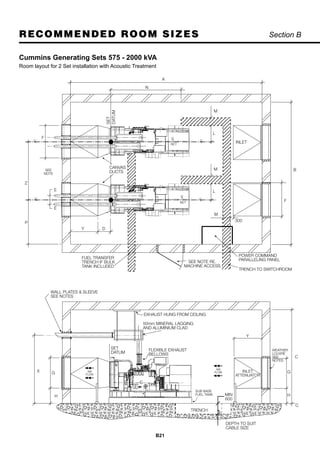
q Conduit systems should be designed so that they
can be sealed against the entry of dust and water.
Nevertheless, ventilation outlets should be
provided at the highest and lowest points in each
section of the system. These will permit the free
circulation of air and provide drainage outlets for
any condensation that may have accumulated in
the runs.
q To maintain the fire resistance of walls, ceilings
and floors, any opening made in them should be
made good with materials to restore the fire
integrity of the particular building element.
Trunking
q Steel trunking must comply with BS 4678
q Fittings must be used to ensure that bend radii are
adequate.
q As with steel conduit, steel trunking may be used
as a protective conductor provided it satisfies the
IEE Wiring Regulations, it may not be used as a
combined protective and neutral (pen) conductor.
q A space factor of at least 45% should be provided.
q Supports should be spaced at distances and ends
should not overhang a fixing by more than 300mm.
q Trunking should not be installed with covers on the
underside. Covers should be solidly fixed in
passage through walls, floors and ceilings.
q On vertical runs internal heat barriers should be
provided to prevent air at the topmost part of the
run attaining excessively high temperatures.
Cable installation into PCC module with Digital Master Control (DMC) cubicle and wall mounted changeover contactor
box adjacent to set.
CABLE AND WIRING Section D
D18
Segregation of Circuits
Segregation of cables of different circuits will prevent
electrical and physical contact. Three circuits are defined
in the Regulations. They are:
q 1 LV circuits (other than for fire alarm or
emergency lightning circuits) fed from the main
supply system.
q 2 Extra low voltage or telecommunication circuits
fed from a safety source (e.g. telephones,
address and data transmissions systems).
q 3 Fire alarm or emergency lighting circuits.
Where it is intended to install type 1 cables in the same
enclosure as telecommunication system which may be
connected to lines provided by a public
telecommunications system authority, the approval of
that authority is necessary. Cables used to connect the
battery chargers of self contained luminaries to mains
supply circuits are not deemed to be emergency lighting
circuits.
Cable Trays
The most common method for installing cables is by
clipping them to perforated trays. The trays should be
galvanised or protected with rust preventing finishes
applied before erection. Cleats or clips should be of
galvanised steel or brass.
Cables should be laid in a flat formation. The maximum
spacing for clips and cleats should be 450mm.
Tray supports should be spaced adequately, usually
about 1200mm.
Steel supports and trays should be of sufficient strength
and size to accommodate the future addition of
approximately 25% more cables than those originally
planned.
Digital Master Control Cubicle (DMC) installed with a water companies Switchboard Suite. Access to the DMC is all
front entry.
CABLE AND WIRING Section D
D19
Trenches
Trenches within plant rooms and generator halls should
be of the enclosed type with concrete slab or steel
chequer plate covers. (See Fig. D5).
Fig. D5 Trench Construction
Trench bends should be contoured to accommodate the
minimum bending radius for the largest cable installed.
Trenches should be kept as straight as possible. The
bottoms should be smoothly contoured and arranged to
fall away from the engine plinths so that water and oil
spillages do not accumulate within the trenches but are
drained away to a common catchment pit.
Trenches external to the building are often back-filled
which should be consolidated before the cable is
installed. This ensures that there is no further ground
settlement. Back filling should be made in even layers.
Laid Direct in Ground
Where armoured and sheathed cables are run external
to the buildings and laid direct in the ground, they should
be laid on a 75mm deep bedding medium.
Every cable in the layer should be protected by
interlocking cable tiles (to BS2484).
The separation distances between HV and LV cables in
trenches or laid direct in the ground should be between
160mm and 400mm, depending on the space available.
Cables passing under roads, pavements, or building
structures should be drawn through ducts and must be
of a type incorporating a sheath and/or armour which is
resistant to any mechanical damage likely to be caused
during drawing-in. The ducts should be laid on a firm,
consolidated base. The ends of the ducts should always
be sealed by plugs until the cables are installed.
No more than one cable should occupy a ductway,
providing a number of spare ways for future cables (say
25% more than those initially required).
Cable Termination
The termination of any power cable should be designed
to meet the following requirements:-
q Electrically connect the insulated cable
conductor(s) to electrical equipment
q Physically protect and support the end of cable
conductor, insulation, shielding system, and the
sheath or armour of the cable
q Effectively control electrical stresses to give the
dielectric strength required for the insulation level
of the cable system.
It is only necessary on LV systems to apply tape from the
lower portion of the terminal lug down onto the
conductors extruded insulation. The tape should be
compatible with the cable insulation. An alternative
method is to use heat shrinkable sleeves and lug boots.
Where cables are connected direct to busbars which are
likely to be operating at higher temperatures than the
cable conductors, high temperature insulation in sleeve
or tape form is used.
Screened MV cables must be terminated at a sufficient
distance back from the conductor(s) to give the creepage
distance required between conductor and shield.
It is recommended that heat shrink termination kits is
used on 11kV XLPE cables. These incorporate stress
control, non-tracking and weatherproof tubes, cable
gloves and termination boots.
Glands
Polymeric cables should be terminated using mechanical
type compression glands to BS6121. The material of the
gland must be compatible with the cable armour. Where
the glands terminate in non-metallic gland plates they
must be fitted with earth tags. Where glands are to be
screwed into aluminium or zinc base alloy plates, use
cadmium plated glands.
The gland must be capable of withstanding the fault
current during the time required for the cable protective
device to operate. Where a circuit breaker is used the
fault clearance time could be near one second.
It is good practice to fit PVC or neoprene shrouds over
armoured cable glands, particularly in outdoor
applications.
Connections to Terminals
Power cable conductors are usually terminated in
compression type cable lugs using a hydraulic tool. The
hexagonal joint appears to be the most popular crimp
shape for conductors over 25mm2
. Insulated crimped
lugs are used on the stranded conductors of small power
and control cables. Soldered lugs and shell type washer
terminations are now seldom specified.
CABLE AND WIRING Section D
Cable Tails
Cable tails from the gland to the terminals of the
equipment should be sufficient length to prevent the
development of tension within them. Allowance should
be made for the movement of cables connected to the
terminal boxes of any plant mounted on vibration
isolators. In these circumstances, and where
connections to the main switchboard are in single core
armoured cable, or in multicore, unarmoured cable, it is
usual to terminate in a free standing terminal box
mounted as close as possible to the plant. Flexible
connections, e.g. in single-core, PVC insulated or
PVC/XLPE insulated and PVC sheathed cables, are
then used between this floor mounting box and the plant
terminals. The connections should be generously
looped.
Control panel
Note:
If flexible cable is used
between control panel,
remote panel and generator,
a load terminal box
is un-neccessary
Flexible cable should be used
Alternator
terminal box
Load terminal box must be used
if connecting cable is PVC/SWA/PVC
Multicores run
between set and
DMC cubicle.
DMC
control
cubicle
DMC control cubicles
do not require back
accessibility. All access
is from front of cubicle.
Output power to changeover/ATS cubicle.
D20
Fig. D6 Cable Connections – Cable Tails
EARTHING Section D
D21
The generating set and all associated equipment, control
and switchgear panels must be earthed before the set is
put into operation. Earthing provides a reference for
system voltages to:
q Avoiding floating voltages
q Prevents insulation stress
q Allows single earth faults to be detected
q Prevents touch voltages on adjacent components
Provision is made on the set and within the panels for
connection of an earth continuity conductor. It is the
responsibility of the installers to ensure that the system
is correctly earthed with references to IEE Wiring
Regulations in countries where these apply, or to the
local wiring regulations where they do not.
There are a number of different earthing systems:-
Solid Earthing
The system is earthed with a direct connection via an
earth electrode with no intentional impedance to earth.
This method is used and required by the electrical code
on all low voltage systems, 600 volts and below with a
grounded earth electrode. This earthing system is made
up of the following;-
Earth Electrode
The earth electrode is one or more copper clad steel
rods driven into the ground. (neither water or gas mains
used separately or together are acceptable as an earth
electrode.) It must have a low resistance to earth to
prevent a dangerous voltage appearing between any
points which a person could reach simultaneously and
be capable of carrying a large current.
Earth Lead
The earth lead is a copper conductor of sufficient cross
sectional area, connecting the earth terminal to the earth
electrode. The size of the conductor may be obtained
from the IEE Wiring Regulations. The point of connection
of the earthing lead to the earth rod(s) should be
protected from accidental damage, but also must be
accessible for inspection.
Earth Terminal
The earth terminal is situated adjacent to the generator
circuit breaker to which all earth continuity conductors
are connected or terminated. The earth continuity
conductor bonds all non current carrying metalwork,
metallic conduit, enclosures and generator frame etc. in
the installation and customer premises, plant room to the
earth terminal. The conductor shall be connected to the
customers earth terminal, which will be effectively
earthed to an earth electrode.
Earth Rods
The number of rods that are required to form a
satisfactory earth electrode is dependent upon the
ground resistance. The earth loop resistance (of which
the electrode is part) must be low enough that in the
event of an earth fault occurring, sufficient current will
flow to operate the protection devices (fuses or circuit
breakers). The fault path value may be found by using
the formula in the IEE Wiring Regulations.
Impedance (Resistance or Reactance)
Grounding
An earthing fault limiting resistor is permanently installed
in the path of the neutral point of the generator phases to
the earth electrode. Used on three phase three wire
systems where continuity of power with one ground fault
is required. Systems 600 volts and below.
Unearthed
No internal connection is made between the AC
generator system and earth. Used on three phase, three
wire systems where continuity of power with one ground
fault is required. Used on systems of 600 volts and below.
Protections
Unrestricted Earth Fault.
A single Current Transformer is fitted in the neutral earth
link, protection is by a simple current sensing relay,
which will respond to any current flowing in the earth
path, it protects the whole system. The advantages of
unrestricted earth fault are:
q It provides protection for all earth faults on the
generator, switchgear and system.
q It provides a good level of personnel protection
throughout the system.
Restricted Earth Fault.
Current transformers are fitted in all phases and neutral
of the system. Protection is by a simple current sensing
relay, which again, will respond to any current flowing in
the earth path, it operates only within a protection zone.
The zone being limited to the generator and the position
of the neutral relative to the current transformers. It does
not discriminate with downstream protection. The
advantages of restricted earth fault protection are:
q It is not affected by faults outside the protection
zone
q It will provide protection discrimination.
q There is less risk of nuisance tripping.
q The protection relay can be set to low levels,
reducing damage to the alternator or cables in the
event of a fault.
q The protection relay can be set for instantaneous
operation. reducing the possibility of touch
voltages.
EARTHING Section D
D22
Differential Protection.
Current transformers are fitted in all three phases of the
equipment and the switchgear equipment. Under fault
free conditions, equal currents are induced in the line-
end and the neutral-end current transformers. No current
flows in the sensing relay, however, under a fault
condition it will respond instantaneously to any current
flowing in the earth path. The location of the earth link is
not important as the whole system is protected. The
advantages of differential protection are:
q The relay is very sensitive.
q Both line-to-line and line-to-earth faults are sensed.
q The zone protection eliminates discriminative
problems.
q The ability to annunciate which phase(s) have
faulted.
Earthing
Earthing or Grounding a conductor means the
connection of the conductor to the earth (the earth is a
conductor of electricity). The purpose of this is:
q TO DECREASE HAZARD TO HUMAN LIFE
q TO STABILIZE THE VOLTAGE OF THE SYSTEM
WITH RESPECT TO EARTH
q TO ENSURE THAT THE VOLTAGE BETWEEN
ANY PHASE AND EARTH DOES NOT
NORMALLY EXCEED THE PHASE VOLTAGE OF
THE SYSTEM
q TO REFERENCE THE NEUTRAL POINT SO
THAT ITS POTENTIAL DOES NOT FLUCTUATE
q TO ALLOW A MEANS OF IMPLEMENTING
PROTECTION OF FAULT CURRENT BETWEEN
ANY PHASE AND EARTH.
Earthing of Low Voltage Single
Generating Sets
It is usual for Low Voltage systems (LV) (below 600V), to
have their neutral conductor connected directly to earth.
This is done between the neutral point of the alternator
and the alternator frame (or sometimes in the control
panel or switchboard), with a physical linking cable or
copper bar. The alternator frame should in turn be
earthed into the soil through BONDING CONDUCTORS
via the main building earth, in accordance with local
legislation. In practice, the resistance of the path
between neutral and earth should be less than 1Ω in
good soil, and less than 5Ω in highly resistive soil.
(Absolute maximum 20Ω.)
The neutral to earth connection can be monitored to
detect current flowing between earth and neutral.
Current will only flow between these two conductors in
the case of a short between one of the phases and
earth. A direct sustained short via earth represents a
near infinite load for the alternator and will result in
burning out of the windings.
Earthing of Low Voltage Multiple
Generating Sets
Earthing arrangements for multiple generating set
systems should always be in accordance with alternator
manufacturers recommendations and the local
legislation. Always refer to the system designer.
Earthing of High Voltage Generating Sets
In the case of high voltage systems, the fault current
which will flow as a result of one phase being shorted to
earth would be many times higher than that of a low
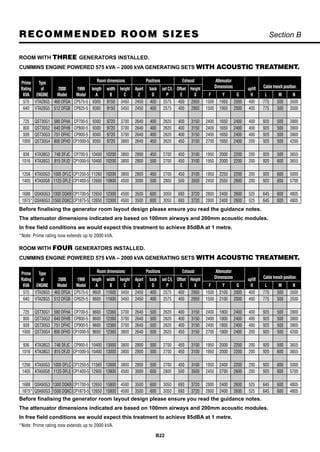
voltage system. In order to limit this current to a level
which is convenient for detection of CTs and
discrimination, a resistance is often placed between
neutral and earth in HV systems. Specification and
installation of HV systems should always be referred to
the designer.
EARTHING Section D
D23
Typical Earthing Arrangements
Standby generating set earthing with 3 and 4 pole ATS. N denotes NEUTRAL, E denotes EARTH.
3 phase
3 wire
connection
3 phase
4 wire
connection
3 pole switched
(PME typical)
3 phase
4 wire
connection
4 pole switched
EARTHING Section D
D24
Earth Fault Protection Schemes
Earth fault protection schemes for generator systems are
designed to protect the alternator. Earth fault protection
is sometimes referred to in general terms when
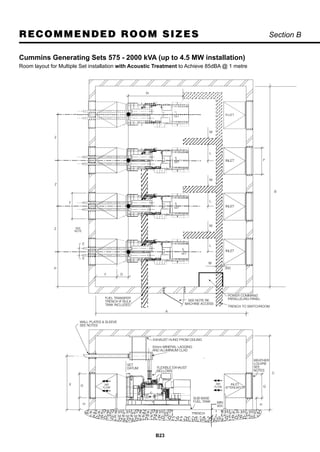
discussing operator safety and protection schemes.
Unless otherwise stated EARTH FAULT PROTECTION
IS FOR MACHINE PROTECTION UNLESS
OTHERWISE STATED. Always investigate whether
protection for operators is required.
Earth fault protection schemes for generating sets fall
into the following two main categories.
Restricted
Restricted earth fault protection concerns only one
ZONE OF PROTECTION. Restricted earth fault
protection should be used on generating set systems to
confine the trip in the event of an earth fault to the
generating set system ZONE OF PROTECTION and not
its load. In this way, it is possible to set up more systems
which discriminate between the earth faults of the load.
Unrestricted
Unrestricted earth fault protection concerns all
connected load all the way down the supply line. The
ZONE OF PROTECTION will in effect be all of the loads
connected to the generating set and the set itself. For
operator safety 30mA unrestricted protection is used.
That is, when 30mA is detected in the earth path, the
protection operates.
Earthing Checklist
q LV SOLID EARTH.
q CONNECTION POINT FOR EARTH.
q EARTH LEAKAGE PROTECTION SCHEME
REQUIRED.
q HV OR MULTIPLE GENERATING SET
INSTALLATION – REFER TO DESIGNER.
Fig. D6
EARTHING Section D
D25
Earthing or Grounding
An effective earth system is one that ensures at all times
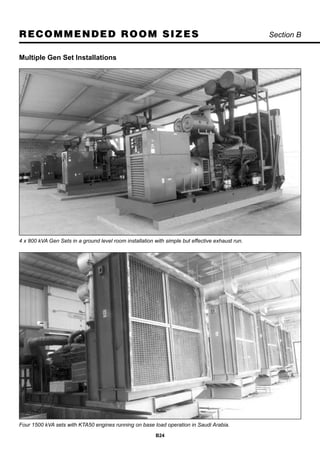
an immediate discharge of electrical energy without
danger to the lives or health of personnel operating
within the installation.
Good connections to earth should have:
q A LOW ELECTRICAL RESISTANCE TO THE
PATH OF LIGHTNING OR FAULT CURRENTS
GOOD CORROSION RESISTANCE.
q ABILITY TO CARRY HIGH CURRENT
REPEATEDLY.
q THE ABILITY TO PERFORM THE LISTED
FUNCTIONS FOR THE LIFE OF THE
INSTALLATION WITHOUT DEGRADATION.
The earth conductor of a generating set system and all
subsidiary earth connections should be sized in
accordance with local safety legislation. The IEE
Regulations should be used in the absence of specific
local legislation.
System Earthing
This term is used to describe the way in which the
generator set system is connected to earth.
Installations either have their neutral connected to earth,
or operate with an unearthed neutral in marine cases.
Diesel electric generators for use on land should be
intentionally earthed via solid conductor link or
resistance in the case of HV sets.
Equipment Earthing
This term is used to describe the connection of the
enclosures of electrical equipment to earth for safety
reasons. In such context, the enclosure of a piece of
equipment acts as a PROTECTIVE CONDUCTOR.
Protective conductors in an installation connect together
any of the following:
exposed conductive parts which are not live, but could
become live in fault conditions,
conductors which do not form part of the electrical
system, but which are liable to introduce a potential
through magnetic and capacitive coupling, the main
earth terminal,
earth electrodes,
earth point of the supply source.
BONDING CONDUCTORS act to ensure that a
dangerous potential difference cannot exist between the
earthed metalwork of the installation and other
conductive parts of other services, such as water and
gas pipes. Bonding in this way ensures that circuit
protection devices will operate in the instance of contact
between live conductors and other metalwork. This
minimizes the risk of electric shock.
Lightning Protection
The purpose of lightning protection is to reduce
destructive effect of a lightning strike on the installation
by conducting the lightning discharge directly to earth.
Lightning protection is detailed in BS 6651.
Air Termination Networks
This is intended to intercept the lightning strike. Current
recommendations call for horizontal conductors over the
roof of an installation which is never more than 5M away
from the roof at any point.
Down Conductors
This conducts the lightning discharge from the air
termination network to the earth point. The conductor
should take the most direct route. The conductors should
be symmetrically spaced around a building. Loops
should be avoided. Each down conductor should have
its own earth connection point.
Bonding to Prevent Side Flashing
Side flashing from a down conductor will occur when a
lightening discharge finds an alternative low impedance
path to earth via other metalwork near to a down
conductor. Where isolation by distance is not possible,
then a bond between the metalwork and the system
should be fitted.
Earth Termination Networks
The effectiveness of the termination of the down
conductor into the earth is largely dependent on the
resistivity of the soil at that point. The resistivity of soil is
affected by:
Physical Composition
Ash coke and carbon content increase conductivity.
Moisture Content
Moisture between 5 and 40% is typically found,
increased moisture increases conductivity. (Sandy
soils have poor conductivity.)
Chemical Composition
There are additives which can be put into the soil to
increase its electrolytic properties and increase
conductivity.
Temperature and Depth
Warmer soil conducts better, and the deeper the soil
level, the lower its resistance. The traditional earth rod
is about 2.4M. At this depth, the resistivity decreases.
CIRCUIT BREAKERS Section D
D26
A circuit breaker is an electro-mechanical switch which
can be connected in series with the alternator output.
The breaker is a type of automatic switching mechanism.
Under normal circumstances, it passes current and is
said to be closed. It automatically “opens” or “trips” and
breaks the circuit when excess current over a preset
level flows. The RATING of a breaker is the thermal full
load capacity of the breaker which it can pass
continuously. The essential purpose of a generator
circuit breaker is to:
PROTECT THE ALTERNATOR AGAINST EXCESSIVE
CURRENT BEING DRAWN WHICH WOULD
EVENTUALLY OVERHEAT THE INSULATION AND
SHORTEN THE LIFE OF THE MACHINE.
Excessive current would flow as a result of either:
PHASE TO NEUTRAL SHORT CIRCUIT
or
PHASE TO PHASE SHORT CIRCUIT
A circuit breaker should ensure that current levels
detailed in the damage curves for the alternator do not
flow for longer than the times specified in the damage
curves.
Circuit breakers are classified by their trip rating and
number of poles.
Breakers provide one trip system per phase and an
option for a neutral conductor trip, all are mechanically
interlocked, i.e.
q 3 POLE – all three phases
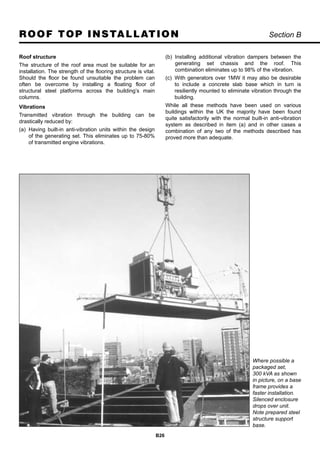
q 4 POLE – all three phases and neutral.
In addition, a main line breaker serves the following
purposes:
q DIFFERENTIATE BETWEEN SUSTAINED AND
TEMPORARY SHORT CIRCUIT CONDITIONS,
TRIP IN THE PRESENCE OF A SUSTAINED
FAULT AND NOT TRIP IN THE PRESENCE OF A
TEMPORARY FAULT, WHICH CAN BE
CLEARED BY THE DOWNSTREAM DEVICES.
q PROTECT THE ALTERNATOR FEEDER
CABLES IN THE EVENT OF EXCESSIVE
CURRENT FLOW.
q PROVIDE A MEANS OF ISOLATING THE
ALTERNATOR FROM EXTERNAL EQUIPMENT
(BY AUTOMATIC AND MANUAL MEANS).
When generators are connected in parallel, breakers are
essential for isolating one running generating set from
another which may not be running. Without the ability to
isolate the set which is not running, the running set
would motor the non-running set. This would result in
damage to the engine, and/or alternator on that set.
CIRCUIT BREAKER SYMBOLS
Fig. D7 In practice, many different symbols are used to
represent a circuit breaker by different manufacturers.
CIRCUIT BREAKERS Section D
D27
Fault Clearance Time
This is the time taken for the protective device, the
breaker, to disconnect the generator set from the load in
the presence of a fault. Different levels of fault current
require different disconnection times. For example, an
alternator can sustain an overload current of 120% for
far longer than it can sustain 300%, without degradation
to its insulation.
Local legislation dictates the required maximum
clearance time of protective devices under short circuit
or earth fault conditions. In practice this is dependent on:
q THE EARTH LOOP IMPEDANCE OF THE
INSTALLATION
This is determined by calculation of the resistance
of all conductors in the system, or by
measurement.
q THE SENSITIVITY OF THE PROTECTION
DEVICE
Magnetic trips found in MCCBs can be adjusted to
within a tolerance of 20%, while solid state
breakers can be adjusted to within 1%.
Circuit Breaker Action
The action of breaking a current flow between two
contacts of a circuit breaker causes the air between the
contacts to ionize and conduct, the result being an arc
across the contacts.
Contact arcing is undesirable, several methods of
increasing the resistance, and therefore dissipating arcs,
are employed in circuit breakers. Increasing the
resistance of the medium between the contacts is the
prime method of arc reduction used. This breaker
medium is also used loosely by breaker manufacturers
to classify breaker types.
The term FRAME used in relation to breakers is used to
describe the physical size of the mechanical housing
used to contain the circuit breaking mechanism.
q ACB – Air Circuit Breaker
Air is used as the arc interrupt medium, ACBs are
loosely divided into:
MCCB – Moulded Case Circuit Breakers
These are light duty, sealed, and relatively
inexpensive breakers. Current technology provides
MCCBs for operation up to 600V and between 100
to 2500A. Note Miniature Circuit Breakers MCBs
are available from 2-100A as single phase units.
These are for use in distribution systems, MCBs
are very light duty units for down-line load
protection, where fuses might also be used.
Metal Frame Air Circuit Breakers
These are a heavy duty open frame and heavier
duty type of ACB, being used up to 15kV and over
800 to 3200A. Often, these breakers incorporate a
SOLID STATE overload trip in place of thermal and
magnetic trips. SOLID STATE trips have the
following features:
q IMPROVED AND REPEATABLE ACCURACY
q ADJUSTABLE, NARROW BAND PREDICTABLE
ACCURACY
q WIDE CURRENT ADJUSTMENT
q Oil Circuit Breakers
Oil filled breakers have now largely been
superseded by advances in VCBs. Oil is used as
the interrupt medium. The oil has to be changed at
periodic intervals and presents a danger in certain
installations.
q VCB – Vacuum Circuit Breakers
The insulation properties of a vacuum make it an
excellent arc quencher for HV applications.
q SF6 – Sulphur Hexafluoride Breakers
When pressurized, SF6 is an excellent insulator
and braking medium for HV applications.
NB: SF6 has toxin by-products.
Moulded Case Circuit Breaker (MCCB)
MCCBs are in common use for protecting generating
sets, they are available is sizes of 100A to 2500A. The
moulded case of the circuit breaker is sealed and
maintenance free. The MCCB is designed to be an
inexpensive protection device and as such is not
intended for repeatedly interrupting fault current (20000
to 50000 changeover cycles). As fault current only flows
as the exception and not the normal in a generating set
application, MCCBs are acceptable for use on the most
common generating set applications up to approximately
1000A, above which ACBs are more often used.
MCCB Action
MCCBs detect and clear faults by thermal and magnetic
trip action.
q Magnetic Action
Purpose
The magnetic tripping element’s characteristic is to
give an instantaneous trip in the case of an
extreme short circuit, which would damage the
alternator.
Construction
The magnetic tripping element is a type of
electromagnetic solenoid operating from the
breaker current.
CIRCUIT BREAKERS Section D
D28
Trip Time
There is NO INTENDED time delay in this trip,
though the physical breaking action takes about
16ms.
Adjustment
Adjustment is provided on the instantaneous trip
level, the range of adjustment varies according to
the manufacturer, but 2-5 times trip rating is
possible for a ‘G’ trip, 4-10 times for a ‘D’ trip.
q Thermal Action
Purpose
The thermal tripping element’s characteristic is to
give inverse time delayed tripping action in the
case of long-term over current which, if allowed to
continue, would damage the alternator.
Construction
The thermal trip is a bi-metallic strip, arranged to
deform with the heating effects of long-term over
current.
Trip Time
The trip time is not instantaneous, it is proportional
to the time and level of current flowing over the
breaker rating.
Adjustment
Thermal trips are calibrated by the manufacturers
of the breaker, a 40%-100% adjustment range is
typically provided. Thermal trips are often provided
as interchangeable modules which will fit a range
of physically different frame sizes.
In addition, MCCBs are designed to incorporate the
following features:
q Manual Trip Action
Purpose
To provide a means of manually isolating the
alternator supply. Used in testing the generator set
and as a crude switch in some basic applications.
Construction
A toggle is provided which is normally arranged to
protrude from the breaker housing. This can be
operated like a switch to open the breaker.
However, should the toggle be physically held
closed in the presence of over current, the breaker
will still trip.
Trip Time
Regardless of the speed of manual operation, the
trip is arranged to always switch in a fixed time
period, i.e. that of the instantaneous magnetic trip.
Fig. D8 MCCB THERMAL AND MAGNETIC TRIP
PROFILE
Fig. D9 MCCB TRIP PROFILE AND THE ALTERNATOR
DAMAGE CURVE
CIRCUIT BREAKERS Section D
D29
q Motor Operated Breaker For Paralleling
Purpose
A motor assembly (typically DC) is provided by the
breaker manufacturer. This motor assembly fits
neatly onto the breaker assembly. It provides a
means of opening and closing the breaker from a
switched motor breaker supply under controlled
conditions (unlike the shunt trip, which is provided
to open the breaker in the case of a fault). The
motor breaker supply may be switched through
paralleling equipment, the motor breaker is an
essential feature of any automatic paralleling
system.
Construction
Motors for MCCBs fit either to the front or side of
the breaker. The complete unit is larger than a
single MCCB and housings designed for manual
MCCBs often require modification or alternative
hood arrangement to house a motor MCCB.
Breaker Capacity
Most standard specification generating sets are supplied
with a breaker as part of the package. In these
circumstances, the breaker will suit the majority of
generator set applications and will usually be sized
around the standby rating.
When selecting a breaker, the following should be
considered:
Steady Current Carrying Capacity
This is the continuous current which the breaker will
carry during steady state conditions. For example, while
the generator is running at full load.
Breaking Capacity
This is the maximum current rating which the breaker is
able to operate. For example, this would be in the order
of 40 times the rated carrying capacity (the level at which
the magnetic trip will operate). The breaking capacity
required should be calculated from the worst case three
phase fault current of the load circuit.
Ambient Temperature
Breakers are usually rated for 400
C before derate. As the
tripping action relies on thermal action it is extremely
important to consider the ambient environment and
the effect of the enclosure on breaker operating
temperature.
Continuous Operation
The breaker should carry its full load rating indefinitely.
Full Load Current
Full load current or FLC can be calculated for a given
system from:
1000(POWER in kW)
FLC = —————————————————————
1.73 x PHASE VOLTAGE x POWER FACTOR
or
1000(POWER in kVA)
FLC = ————————————————
1.73 x PHASE VOLTAGE
MCCB Physical Size, Mounting and
Connection
Circuit breakers increase in physical size with the
increased current carrying and tripping capacity. With
current technology, MCCBs are available up to 1000A
and can be mounted onto the alternator conduit box.
This is done for reasons of economy. Vibration rarely
causes a problem, however towards 630A, it is common
to find the breaker separately mounted from the
alternator for added vibration isolation.
Above 1000A the breaker would be of the traditional
ACB type, larger and heavier than an MCCB. This type
of breaker would be mounted in a free-standing cubicle.
As the current carrying capacity of the breaker
increases, so does the load cable diameter. It is common
practice to double up on load cables, that is use two per
phase, instead of using one large, and often very
expensive area on the breaker terminal required for the
load cable lugs to be fitted. In addition, the glanding and
channeling arrangement for the load cable will increase
as the number of load cables are increased.
It is useful to obtain some idea of customer load cable
arrangements, as this will figure in deciding upon the
most appropriate position for the set breaker.
The use of steel wire armoured cables will necessitate
the use of an interposing link box between a set
mounted breaker and the armoured load cable.
Armoured load cable is rigid and should be installed into
a trench or into fixed channeling. This type of cable
should be terminated close to the generator set and
flexible cables used to connect to a breaker which is
vibration isolated from the bed of the set. Failure to use
this arrangement for steel wire armoured cable will
almost certainly result in the disturbance of the cable
mountings on the generating set with eventual damage
to the load cable and possible fire.
CIRCUIT BREAKERS Section D
D30
Switchgear Certification in Accordance
with the LVD
The European (EEC) Low Voltage Directive (LVD) has
been in force since 1973. In the UK, this is implemented
by BS 5486, which calls for switch gear to be tested to its
declared rating. The Association of Short Circuit Testing
Authorities (ASTA), is one of the four bodies in the UK
authorized to assess compliance with the LVD. Its
objectives are:
q The coordination of the type testing of electrical
power transmission and distribution equipment.
Power Switching Standards
Standards Content
q The issuing of certificates based on the satisfactory
performance of type tests under the direction of
independent ASTA observers.
Other bodies with this authorization in Europe include:
N.V. tot Keuring Van Electrotechnische Materialen
(KEMA) in Holland.
Gesellschaft fur Elektrische Hochleistungsprufungen
(PHELA) in Germany.
Centro Elletrotechnico Sperimentale Italiano (CESI) in
Italy.
Ensemble des Stations Dessais a Grand Puissanse
Francaises (ESEF) in France.
BSEN 60947 Part 1 – general rules
Part 2 – circuit breakers
Part 3 – switches, disconnectors
Part 4 – contractors and motor starters
Part 5 – control devices and switching elements;automatic control components
IEC 158-1 2nd edn. 1970 Low voltage control equipment, including contactors
Part 158-1A (1975)
UTE.NFC 63-110 (April 1970) Low voltage industrial equipment, including contactors
VDE-0100 (May 1973) Specification for the construction of high current installations where the nominal
voltage <1000V
VDE-0105 (August 1964) Specification for high current installations
VDE-0110 (November 1972) Specification for leakage paths and distances in air
VDE-0113 (December 1973) Din 57113. Specification of electrical equipment for machine tools where the
nominal voltage <1000V
VDE-0660/1 (August 1969) Specification for switches where the nominal voltage <1000V for AC and
<3000V for DC
BS 5425 1977 Contactors for voltages <1000V AC and <1200V DC
CEI Publ. 252 Contactors for voltages <1000V AC and <1200V DC
NEN 10-158-1 Low voltage control equipment
SEN 280/600 (1974) Low voltage control equipment
IEC 408 (or BS 5419) Defines duty categories for power switching devices AC22 switching of mixed
resistive and inductive loads including moderate overloads
AC22 switching of motor or other high inductive loads
IEC 947 Defines electrical characteristics of power breakers and is adhered to by
breaker manufacturers
BS 5486 part 1 Low voltage switchgear and control gear assemblies
CIRCUIT BREAKERS Section D
D31
Breaker Enclosures
Breaker enclosures are provided to protect live terminals
from the touch of operators, to contain electrical arcs and
in some outdoor applications, to protect from the effect of
the environment.
The housing of a breaker for generating set protection is
normally either set-mounted, wall-mounted or free-
standing. The wall-mounted and free-standing types
require interconnection cable between alternator and
breaker, which will be physically further away than the
set-mounted devices. This physical distance should be
kept as short as possible (less than 3m) and the
interconnecting cables should be rated with the breaker
capacity in mind.
The affect of the enclosed on the breaker rating should
be carefully considered. The thermal tripping capacity of
a breaker must be derated with increase in ambient
temperature. It therefore follows that the better the
sealing of a breaker enclosure, and hence the worse the
ventilation, then the more the breaker will require
derating.
This derate should be incorporated into the generator set
design. However when operating at full load capacity in
high ambient temperatures (above 400
C), it is important
to consider the effect of the increased ambient to avoid
nuisance tripping of the breaker.
The degree of protection provided by a breaker
enclosure is classified by the Index of Protection (IP) as
outlined by BS 5420 (IEC144).
As a general guide, IP33 is a standard specification for
indoor breaker enclosures, this offers protection:
q against the ingress of foreign bodies up to 2.5mm
diameter
q against contact by the fingers with internal parts
q against vertically falling water droplets.
As a general guide, IP55 is an enhanced specification
for indoor breaker enclosures, this offers increased
protection:
q against deposits of dust which would prevent
normal operation
q against contact by the fingers with internal parts
q against jets of water from any direction.
Discrimination and Coordination
In electrical distribution systems with one large feeder (a
generator set) feeding multiply branches, it is important
to insure that a single fault on one small load of a few
amps on one branch, does not cause the whole system
to shut down. Particularly in stand-by generating set
systems, where critical loads must be maintained, the
breakers and fuse systems must be arranged to isolate a
faulty load and allow the rest of the circuit to operate
undisturbed.
The term DISCRIMINATION (or selective tripping)
applied to electrical systems is used to describe a
system with graded protective devices which operate to
isolate only the faulted load from the rest of the circuit.
The term CO-ORDINATION applied to electrical systems
is used to describe the arrangement of discriminative
tripping devices.
Fig. D10
Fig. D11
Breaker Checklist
q LOAD FAULT CURRENT VERSUS BREAKER
CONTINUOUS LOAD CURRENT RATING
q FAULT CLEARANCE TIME
q DERATE FOR TEMPERATURE
q SPECIFY NUMBER OF POLES
q SET-MOUNTED OR FREE-STANDING
ENCLOSURE
q IP RATING OF ENCLOSURE
q NUMBER OF CUSTOMER LOAD CABLES PER
PHASE AND CABLE LUG SIZE
q STEEL WIRE ARMOUR CABLE TERMINATION
ARRANGEMENTS
q GLANDING AREA REQUIRED FOR CUSTOMER
LOAD CABLES
q BENDING RADIUS OF CUSTOMER LOAD
CABLES ONTO BREAKER
AUTOMATIC TRANSFER SWITCHES Section D
D32
Automatic Transfer Switch (ATS)
The term ATS or AUTOMATIC MAINS FAILURE PANEL
is usually associated with the switching arrangements for
mains fail emergency standby generating set systems.
The purpose of an automatic transfer switch is to:
q MONITOR THE UTILITY SUPPLY FOR FAILURE
q TRANSFER THE LOAD TO AND FROM THE
UTILITY SUPPLY TO THE STAND-BY SYSTEM
IN A CONTROLLED MANNER
The ATS contains a power switch element and a control
element. The control element is sometimes part of the
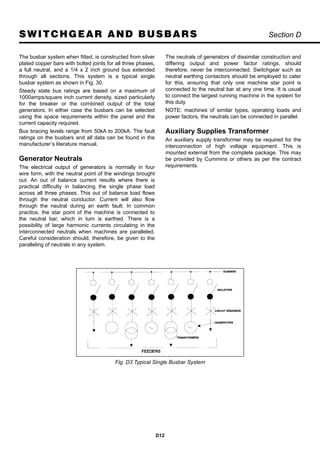
generator set control or some centralized control system
in larger installations.
The ATS is usually housed in a separate cubicle wall-
mounted or free-standing. The ATS may be located in
the main switching facility of a large installation, whereas
the generator may have its own dedicated building. It is
most desirable to site the ATS near to the load, thereby
minimising the length of cable run from each power
source to the load.
Automatic Transfer Switch Control
System
In some European specifications, the transfer switch
controls can be located on the generating set, others
and in particular those influenced by the US, will have a
degree of intelligence (timers) built into the transfer
switch. The transfer switch control system is responsible
for the following three control sequences.
Mains Fail
In order to detect the failure of the utility supply the
control system must compare the utility supply voltage
with a preset minimum level, then a timer is started. The
timer introduces a delay of about 5 seconds before the
transfer switch will start the generating set. The purpose
of this MAINS FAIL TIMER is to ensure that short
duration dips in the utility supply voltage will not cause
the generator to start unnecessarily. As a result of the
mains fail timer expiring, the controller signals the
generator to start. The generator starter motor is often
controlled from the ATS. This will engage and rest the
starter motor for regular periods until the engine turning
conditions are detected. (Alternator voltage, speed
sensed at the flywheel.) If the engine does not start after
a pre-determined number of attempts, then a fail to start
alarm is indicated.
Once the engine is up to rated speed and volts the load
breaker is closed.
Mains Return
Once the generator is running and supplying the load
acting as emergency standby, the utility supply may be
reinstated. There may, though, be several cases of the
utility supply being established momentarily and then
failing again. The MAINS RETURN TIMER takes care of
this effect by starting every time the mains is established
and resetting should the mains drop off again. The mains
return timer is usually around 3 to 5 minutes, the mains
must therefore be healthy for this period before the
transfer switch opens.
Run On
After the transfer switch has re-connected the load onto
the mains, the generator set is RUN ON for a cooling
down period before it is signalled to stop by the transfer
switch. Should the mains fail again during this RUN ON
period, then the transfer switch will immediately switch in
the generator set output.
In addition, it is common to site the engine exercising
timer in with the ATS control system in automatic mains
failure stand-by systems.
Exercise Timer
This will automatically start the generator set at regular
periodic intervals, the transfer switch is not operated
over from the utility supply position.
It is important to be clear on the most suitable position
for the transfer switch controls in any application. This
may be dictated to a large extent by the features of the
particular genset/ATS controls used.
However, always be sure where controls are required in
the ATS, that there is a suitable local supply for these
controls. In cases where the generating set is located
near to the ATS and the generating set batteries are
available, then supply voltage is not an issue.
In cases where the ATS is to be located remotely, some
distance (more than 20 metres) from a generating set,
then it is not recommended to run long lengths of supply
cable to the ATS, as the volt drop in these cables can
lead to non-start problems. A relay scheme will assist in
these cases.
In particular, for remote ATS type systems, it may be
tempting to position battery charges inside the transfer
switch panel, or next to it. This is not recommended, as
the battery charging current in this situation will be faced
with the resistance of the cable between the charger and
the batteries and will consequently not see true battery
terminal voltage.
In summary, the approach of controlling the transfer
switch from the generator set is a more flexible and
hence favourable scheme for general ATS/generator
control.
ATS Standards
ATS for use in Europe should meet any local legislation
and the international standards IEC-947-4 AC1, IEC-
158-1, VDE0106, BS 4794. As standard products, they
are usually available in approved ratings from 30A to
4000A below 600V.
For use in North America, ATS should be UL approved.
ATS are listed in Underwriters Laboratory Standard
UL1008. UlL approval adds to the cost of the ATS and is
not necessary for the sale of an ATS in Europe.
AUTOMATIC TRANSFER SWITCHES Section D
D33
ATS Power Switch Element
Transfer switches are available as three or four poles
switching mechanisms (linear switches) and changeover
contactor pairs. They employ similar techniques to
current breaking as circuit breakers. Many ATS systems
under 1250A are comprised of two contactors
mechanically and electrically interlocked. Above 1250A,
it becomes economic to incorporate the circuit breaker
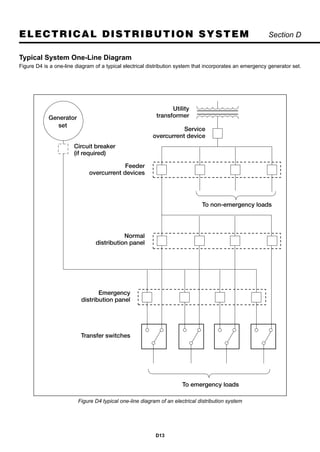
element into the generator contractor and these are now
widely available as a package at 1250 Amps plus.
Sizing an ATS
To correctly detail the transfer switch requirement for a
particular application, it is necessary to consider each of
the following features of an ATS.
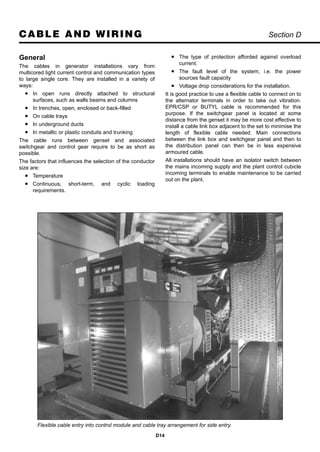
Voltage
The operating voltage of the circuit must be greater than
the circuit voltage.
Frequency
The operating frequency of the ATS must be equal to the
operating frequency of the circuit.
Number of Phases
In general, transfer switches are available as three
phase units.
Number of Cables Per Phase
Each phase may comprise of more than one cable to
carry total load. It is important to ensure that there is
adequate termination on the transfer switch for the
number of cables used to carry the load. For example,
there may be two cables per phase onto the switching
mechanism. The width of the termination lug and the
diameter of terminating bolt need to be known in order to
determine the cable termination arrangements. Most
manufacturers offer a range of termination kits which can
be retro fitted onto a standard terminal arrangement.
Always follow manufacturer’s and legal
recommendations for cable termination. There are
minimum safe distances between exposed conductors.
Type of Load
Special consideration must be given to switching motor
loads. For example:
q MOTORS
q HIGH INERTIA LOADS
q CENTRIFUGAL PUMPS
q CHILLERS
Due to the voltage decay characteristics of inductors
when experiencing a sudden change to the current flow,
the voltage across motor terminals will take time to fall.
For this reason, it is necessary to incorporate a delay
into the transfer action of the ATS when live switching
motors. This is usually provided as a timer in the ATS
control, which is normally set to instantaneous transfer
with no motor loads.
Available Fault Current
The worst case three phase fault current for the given
load must not destroy the transfer switch before the over
current or ground fault protection systems have operated.
Number of Switched Poles
Ground fault protection of electrical systems that have
more than one power source, i.e. a load is fed by either a
utility or engine generator set, requires special
consideration. A problem may occur in that the neutral
conductor of the engine generator set is generally
required to be grounded at its location, thus creating
multiple neutral-to-ground connections. Unless the
system is properly designed, multiple neutral-to-ground
connections may cause improper sensing of the ground
fault currents and nuisance tripping of the circuit breaker.
One approach is to use a four pole ATS in which the
neutral conductor is switched to provide isolation in the
event of a ground fault.
Cable Entry
As the rating increases, the routing of cable becomes
increasingly more awkward. It is important to specify the
correct cable entry point into the ATS enclosure for the
type of cable, its angle of entry to, and connection point
within, the enclosure.
Temperature
The continuous rating of an ATS will be quoted up to
400
C approximately, above this a derate must be applied
to the maximum current carrying capacity.
ATS Checklist
q VOLTAGE
q FREQUENCY
q NUMBER OF PHASES
q NUMBER OF CUSTOMER LOAD CABLES PER
PHASE
q LOCATION OF ATS MAINS FAIL DETECTION
AND CONTROL TIMERS
q SUPPLY VOLTAGE FOR ATS CONTROL
q INDUCTIVE LOAD SWITCHING – TRANSITION
TIMERS
q LOAD FAULT CURRENT VERSUS CONTINUOUS
ATS/CONTACTOR PAIR CURRENT RATING
q NUMBER OF SWITCHED POLES
q DERATE FOR TEMPERATURE
q IP RATING OF ENCLOSURE
q NUMBER OF CUSTOMER LOAD CABLES PER
PHASE AND CABLE LUG SIZE
q STEEL WIRE ARMOUR CABLE TERMINATION
ARRANGEMENTS
q GLANDING AREA REQUIRED FOR CUSTOMER
LOAD CABLES
q BENDING RADIUS OF CUSTOMER LOAD
CABLES ONTO BREAKER
HEALTH AND SAFETY Section E
E1
Safety should be the primary concern of the facility
design engineer and all personnel engaged on
installation and commissioning. Safety involves two
aspects:
1) Safe operation of the generator itself (and its
accessories).
2) Reliable operation of the system.
Reliable operation of the system is related to safety
because equipment affecting life and health, such as life
support equipment in hospitals, emergency egress
lighting, building ventilators, elevators and fire pumps,
may depend on the generator set.
Fire Protection
The design, selection and installation of fire protection
systems require the following considerations:
q The fire protection system must comply with the
requirements of National Standards and of the
authority having jurisdiction; who may be the
building inspector, fire marshal or insurance carrier.
q Typically, the generator room will be required to
have a one hour fire resistance rating if the
generator set will be in at level 1 application.
Generator room construction will have to have a
two hour fire resistance rating.
q The generator room shall NOT be used for storage
purposes.
q Generator rooms shall not be classified as
hazardous locations (as defined by the NEC)
solely by reason of the engine fuel.
q The authority will usually classify the engine as a
heat appliance when use is for only brief,
infrequent periods, even though the flue gas
temperature may exceed 1000°F (538°C).
q The authority may specify the quantity, type and
sizes of approved portable fire extinguishers
required for the generator room.
q A manual emergency stop station outside the
generator room or enclosure or remote from the
generator set in an outside enclosure would
facilitate shutting down the generator set in the
event of a fire or another type of emergency.
q The authority may have more stringent restrictions
on the amount of fuel that can be stored inside the
building than published in national standard.
q Fuel tank construction, location, installation,
venting, piping, and inspection inside buildings and
above the lowest storey or basement should
comply in accordance with National Standards.
q The generator set shall be exercised periodically as
recommended under at least 30% load until it
reaches stable operating temperatures and run
under nearly full load at least once a year to prevent
fuel from accumulating in the exhaust system.
Many national, state and local codes incorporate
standards which are periodically updated, requiring
continual review. Compliance with the applicable codes
is the responsibility of the facility design engineer.
General
q Do NOT fill fuel tanks when the engine is running,
unless tanks are located outside the generator
room.
q Do NOT permit any flame, cigarette, pilot light,
spark, arcing equipment, or other ignition source
near the generating set or fuel tank.
q Fuel lines must be adequately secured and free of
leaks. Fuel connection at the engine should be
made with an approved flexible line. Do NOT use
copper piping on flexible lines as copper will
become brittle if continuously vibrated or
repeatedly bent.
q Be sure all fuel supplies have a positive shut-off
valve.
Exhaust Gases
q Be sure the exhaust system will properly dispel
discharged gases away from enclosed or sheltered
areas and areas where individuals are likely to
congregate. Visually and audibly inspect the
exhaust for leaks as per the maintenance
schedule. Ensure that exhaust manifolds are
secured and not warped.
q NEVER connect the exhaust systems of two or
more engines.
q NEVER discharge engine exhaust into a brick, tile
or cement block chimney, or a similar structure.
Exhaust pulsations could cause severe structural
damage.
q Do NOT use exhaust gases to heat a
compartment.
q Be sure that the unit is well ventilated.
q Shield or insulate exhaust pipes if there is a danger
of personal contact or when routed through walls
or near other combustible materials.
q ENSURE that there is independent support for the
exhaust system. No strain should be imposed on
the engine exhaust manifolds. Which is especially
important on a turbocharged engine. Stress on a
turbocharger could distort the housing, leading to
failure.
HEALTH AND SAFETY Section E
E2
Annunciation
Codes may require different levels of annunciation for
critical life safety and all other emergency standby
applications.
Moving Parts
q Tighten supports and clamps and keep guards in
position over fans drive belts etc. Make sure that
fasteners on the set are secure.
q Keep hands, clothing and jewellery away from
moving parts.
q If adjustment must be made while the unit is
running, use extreme caution around hot
manifolds, moving parts, etc.
Hazardous Voltages
Electrical power generating, transmission and
distribution systems will be required to comply with the
applicable statutory regulations and approved codes of
practice of the particular country of installation.
Statutory Regulations (UK)
These include:
q Electricity Supply Regulations 1988; security of the
safety of the public and ensuring a proper and
sufficient supply of electrical energy.
q Electricity at Work Regulations 1989, Statutory
Instrument 1989 No 635; these came into force on
the 1st April 1990 and apply to all work places - not
only factories and sub-stations.
q Health and Safety at Work, etc. Act 1974; imposing
requirements for safety (including electrical) in all
employment situations; and the control of certain
emissions to the atmosphere.
q The Highly Flammable Liquids and Liquefied
Petroleum Gases Regulations 1972; this and the
following regulation cover premises where fire risk
is of an unusual character and requires special
consideration.
q The Petroleum Consolidation Act 1928.
q The Construction (General provisions) Regulations
1961; apply to the construction sites and contain
regulations relating to precautions to be taken with
contact with overhead lines and underground
cables; may also apply to temporary installations
under particular local authority and insurance
company requirements.
The administrative or legislative authority for Electricity
Supply Regulations is the secretary of State for Energy;
in every other case stated above it is the Health and
Safety Commission.
Some regulations are sufficiently detailed as to set down
just what has to be done for compliance. They may or
may not include direct reference to Codes of Practice.
Where they do, such codes have the same legal force as
the Regulations themselves. Other generally accepted
codes of good practice, which are not directly
referenced, are not legally enforceable.
With any legislation there is always a need for guidance
on the application of regulations. The following
publications are recommended reading. They are
obtainable from HMSO (Her Majesty’s Stationery
Office).
q Explanatory notes on the Electricity Supply
Regulations 1988.
q Memorandum of Guidance on the Electricity at
Work Regulations 1989, HSE booklet HS(R)25.
q In the context of the Petroleum Consolidation Act
1928, the Home Office Model Code of Principles of
Construction and Licensing Conditions Part 1.
q Note: Local authorities are empowered to grant
licences for the storage of petroleum spirit on
premises with their jurisdiction. The conditions for
Licence may vary from one authority to another.
Where it is proposed to install a protective multiple
earthing system it is mandatory, in the UK, that approval
is obtained from the Secretary of State for Energy.
Government authorisation is now largely delegated to
area electricity boards.
Before a generating station or transmission line is
erected, prior approval of the local planning authority
must be obtained. This is a requirement of the Town and
Country Planning Acts in the UK.
Codes of Practice
Approved Codes of Practice are usually generated by
the Health and Safety Commissions, possibly in
conjunction with industrial committees or with the British
Standards Institution. Codes of Practice otherwise
published by BSI or professional or trade bodies are
classified as non approved codes. The BSI codes of
Practice are supplemented by detailed specifications
covering application and design of equipment, material
and manufacturing standards.
Of the Codes and Standards prepared by professional
institutions and trade associations perhaps the most
important in our context, are the IEE Regulations for
Electrical Installations. Whilst they may not be legally
enforceable they represent the best practice in electrical
safety. Indeed, failure to the fundamental requirements
contained in Part 1 of the Regulations could not lead to a
an Electricity Supply Authority withholding a supply of
energy to the installation.
HEALTH AND SAFETY Section E
E3
Overseas Regulations
It is necessary to ascertain what regulations apply when
designing an overseas installation. For example, in those
locations where American practice is observed, safety
codes are inevitably those prepared by the National Fire
Protection Association. (NFPA). The BSI’s Technical
Help to Exporters (THE) service should be consulted for
guidance on other territories.
Control wire installation must be carried out with care to
avoid touching un-insulated live parts, especially inside
the control panel box which can result in severe personal
injury or death.
Improper wiring can cause fire or electrocution, resulting
in severe personal injury or death and property or
equipment damage.
For personal protection, stand on a dry wooden platform
or rubber insulating mat, make sure clothing and shoes
are dry, remove jewellery from hands and use tools with
insulated handles.
q Do NOT leave cables trailing on the engine room
floor.
q Do NOT use the same trunking for electric cables
and fuel or water lines
q Do NOT run AC and DC cables in the same looms
or trunking
q ALWAYS ensure that bonding and equipment
earthing are correctly done. All metallic parts that
could become energised under abnormal
conditions must be properly earthed.
q ALWAYS disconnect the batteries and battery
charger when servicing or carrying out
maintenance, particularly on equipment arranged
for automatic mains failure operation. ALWAYS
disconnect a battery charger from its AC source
before disconnecting the battery cables.
Otherwise, disconnecting the cables can result in
voltage spikes high enough to damage the DC
control circuit of the set. Accidental starting of the
generator set while working on it can cause severe
personal injury or death.
q Do NOT tamper with interlocks.
q ALWAYS follow all applicable state and local
electrical codes. Have all electrical installations
performed by a qualified licensed electrician.
q Do NOT connect the generator set directly to any
building electrical system.
q Hazardous voltages can flow from the generator
set utility line. This creates a potential for
electrocution or property damage. Connect only
through an approved isolation switch or an
approved paralleling device.
High voltage sets work differently to low voltage ones.
Special equipment and training is required to work
around high voltage equipment. Operation and
maintenance must be done only by persons trained and
qualified to work on such devices. Improper use or
procedures may well result in personal injury or death.
q Do NOT work on energised equipment.
Unauthorised personnel must not be permitted
near energised equipment. Due to the nature of
high voltage electrical equipment induced voltage
remains after the equipment is disconnected from
the power source. Equipment should be de-
energised and safely earthed.
Water
Water or moisture inside a generator increases the
possibility of "flashing" and electrical shock, which can
cause equipment damage and severe personal injury or
death. Do not use a generator which is not dry inside
and out.
Coolants and Fuel
The coolant heater must not be operated while the
cooling system is empty or when the engine is running or
damage to the heater will occur.
Coolant under pressure have a higher boiling point than
water.
q Do NOT open a radiator, heat exchanger or header
tank pressure cap while the engine is running.
Allow the generator set to cool and bleed the
system pressure first.
Never use galvanised or copper fuel lines, fittings or fuel
tanks. Condensation in the tanks and lines combines
with the sulphur in the fuel to produce sulphuric acid.
The molecular structure of the copper or galvanised lines
or tanks reacts with the acid and contaminates the fuel.
LOAD CHARACTERISTICS AND
APPLICATIONS Section E
E4
Generating plants are used in three main duties:
1) Primary or Base Load Duty
2) Peak Lopping Operation
3) Standby to Utility mode
Load Characteristics
An overall assessment of load characteristics is
necessary therefore the nature and characteristics of
loads must be established, supported by analysed data.
Installed equipment should be listed and duty cycles
known.
The proposed method of plant operation should be
known so that the load factor can be assessed and the
demand deduced.
Where loads of different power factor are being
considered, the active and reactive powers should be
segregated, and then added separately. More accurate
predictions can be made by applying diversity factors on
both the reactive and active power.
The mode of operation of any motors requires to be
established.
Generating capacity must be sufficient to meet peak
power demand, even if the peak only occurs for a few
hours once a year. Future load expansion should not be
ignored, as there may well be a rise in energy
requirements.
The timing of power plant additions must be carefully
planned and expedited and extra capacity should be
deferred until the need arises. Designs must be flexible
enough to allow for planned expansion with the minimum
of disruption to existing plant. It is usual to provide, at the
outset, 10 to 20% margin of capacity over and above
that required by the annual peak demand.
‘Safe Generating Capacity’ (SGC)
The SGC (safe generating capacity) = (installed capacity
of station) - (capacity of largest machine) - (a further
margin of 15% of the remaining installed generating
plant). The SGC caters for system demand.
The latter margin allows for the site derating due to high
ambient temperatures and low atmospheric
pressures.
A typical 5MW station with 5 x 1MW sets would have an
SGC of:
(5) - (1) - (4 x 0.15) = 3.4MW
Definitions
Peak load is the maximum load or maximum
demand during the period specified.
Utilisation factor the ratio of peak load to the plant
capacity.
Average load is the average height of the load
curve, given by;
the total energy over a period
—————————————
the total hours in the period.
Capacity factor is the ratio of the average load to
the plants total capacity. It is the
measure of the actual energy
supplied.
Load factor the measure of the plants utilisation,
or the ratio of the energy units
actually supplied in a given period.
The more usual way of expressing the load factor is to
use the consumer’s maximum demand (in kW or kVA)
multiplied by the length of period in hours. The annual
load factor (ALF) would then be given by:
units* used in the period x 100
ALF(%) = ——————————————
Maximum Demand (MD) x 8760
(*the units would be in kWh, if the MD is in kW)
It is very unusual that individual consumers’ MD’s will
coincide at any one time. The maximum demand on the
plant will always be less than the sum of the MD’s of the
individual consumers.
The type and rating of generating plant must be
dependent on the nature and size of the load it is
required to serve.
q The element which require close tolerance
parameters (computers and telecommunications)
q The element likely to change the load demand of
the set or affecting transient performance, such as;
q step change loads or motor starting.
q non-linear loads.
q cyclically varying loads.
q regenerative loads.
LOAD CHARACTERISTICS AND
APPLICATIONS Section E
E5
Motor Starting
To accurately calculate the size of your generating
set when the load consists of a number of electric
motors, varying in size, possibly with different forms
of starting methods plus a variety of resistive loads
it is necessary to be very accurate to avoid
undersizing your machine. For this reason Cummins
Power Generation have developed a software
programme called GENSIZE III to assist and
considerably speed up the calculations necessary. If
this programme does not accompany this manual,
please apply to your local distributor or direct to the
factory in Manston, Ramsgate, Kent, U.K.
The effect of motors starting and start sequence should
be determined in conjunction with the running loads so
that the least size of genset can be selected to match
the load profile. In certain circumstances, it may be more
prudent to consider the miss-matching of engine and
alternator to find the optimum solution.
Sizing
It should be noted that the largest motor may not
necessarily have the largest impact on load, the impact
being determined by the starting method.
The various normal starting methods, with their general
starting characteristics, are as follows:-
a) Direct on line 7 x flc, 0.35 pf
b) Star Delta 2.5 flc, 0.4 pf
c) Auto transformer 4 x flc (75% tap), 0.4 pf
d) Electronic Soft start 3 x flc, 0.35 pf
e) Inverter Drive 1.25 flc, 0.8 pf
(flc = full load current)
Particular care must be taken to ensure that:
1. engines can develop sufficient kilowatts.
2. alternators can develop sufficient kVA.
3. frequency and voltage drops can be maintained
within acceptable limits when the various loads
are introduced.
It is recommended that the client, or his consultant, be
contacted to discuss the load profile, particularly in cases
where worst case loading (i.e. the most onerous impact
load starting with all other loads connected) provides a
less economical solution in terms of capital cost of
equipment. A better solution may be achievable by re-
arranging the profile.
q To size the generating sets once the optimum
sequence of operation has been determined, refer
to the GenSize 3.0 programme (available free on
request).
Voltage Dip
Voltage dip is largely independent of the load already
carried by the generator, particularly if this is a mixed
passive load, but any motors running on the system at
the time will experience a speed change, which will
cause them to draw more current. This increased load
current, when added to the starting current of the starting
motors causes the voltage dip to exceed its expected
value.
The magnitude of the voltage dip at the generators
terminals, following load switching, is a direct function of
the subtransient and transient reactances of the
machine.
Dip, V = X’du (X’du + C)
Where X’du is the per unit unsaturated transient
reactance and C is the ratio:
generator rating (kVA or current)
——————————————
impact load (kVA or current)
Limiting Voltage Dip
The voltage dip on a machine can be limited in a number
of ways:
1. Where a number of motors constitute a major part
of the load, it may be feasible to limit the starting
sequences of the motors minimising the impact
load.
2. The motors with the largest load should be run up
first.
3. A generator of low transient reactance may be
used, this can be achieved by using a larger frame
size machine.
Power Factor Correction
When the load current and voltages are out of phase
due to the load not being purely resistive, defined as
lagging and leading loads, no single angle can be used
to derive the power factor.
The methods used for power factor correction are:
1) Synchronous motors (driving pumps, fans,
compressors, etc. with their working power factor
adjusted, through excitation control, to give
operation at unity or leading power factor. The
motors will only contribute to power factor
correction whilst they are running.
2) Synchronous condensers, which are effectively
synchronous motors used solely for power factor
correction and voltage regulation.
LOAD CHARACTERISTICS AND
APPLICATIONS Section E
E6
Capacitors
By individual correction using capacitors directly
connected to the supply terminals of individual, low
power factor items of plant.
By using manually controlled capacitors, located at key
points within the plant, and switched in when the
appropriate sections of plant are in operation.
Automatically controlled capacitors switched in and out
of circuit by contactors as the load varies.
Power factor correction capacitors operate at almost
zero power factor leading and are used to correct the
overall lagging power factor of a complete installation to
a value near to unity power factor but still lagging.
Unusual Loads
Non-linear Loads
The use of solid state power devices such as thyristers
and triacs are major sources of harmonic distortion in
supply networks. The non linear load currents that
characterise such equipment may well be within
acceptable limits, where the power source is a low
impedance public utility supply, but if a converter is used
in the installation the non linear loads will be more
significant and less predictable. The harmonic currents
generated will depend upon the type of converter used,
whereas the resulting voltage harmonics will relate to the
property supply network.
To suppress harmonic distortion the following methods
can be used;
Filter banks: their design requires considerations of the
load duty cycle and knowledge of the impedances, to
avoid them acting as sinks for harmonics generated
elsewhere.
q Grouping the converters to form a single unit.
q Phase shifting; with the use of special rectifier
transformers which alter the phasing of the
secondary winding or the angle at which the
harmonics are produced.
q Reduction of the supply system impedance: by
increasing the frame size of the alternator or
using a specially designed low-reactance machine.
Fluorescent Lights
At ‘switch on’, fluorescent lights produce high transient
terminal voltages, as a purely capacitive load is present
without any appreciable level of active load. The power
factor correction capacitors of fluorescent lamp
installations can have the effect of imposing high
transient stresses on the rotating diodes of the brushless
alternator. A non inductive and matched resistance in
parallel with the main field offers a solution to the
problem.
Lifts and Cranes
Mechanical energy may be fed back to the power source
in the form of electrical energy when braking lifts and
cranes. This energy may be absorbed by the other
equipment operating, but the surplus power will cause
the generator to act as a motor, tending to drive its prime
mover. The generator speed will increase and the
governor will reduce its fuel supply. The reverse power
must be totally absorbed by the mechanical losses and
the generators electrical losses. However the generator
is capable of absorbing limited regenerative power so if
regenerated load is connected to the generator, the total
of the other load elements should be equal to the
regenerated power. It may also be necessary to connect
a continuously rated resistive load to absorb the
regenerated power, such as load banks.
Capacitive Loads
As the capacitive load increases, there is a tendency to
over excite the generator, unless the main field current
can be reversed by the action of the machines excitation
control system. This is not possible with an ordinary
brushless alternator. The effect of capacitive loads,
produces a high terminal voltage, limited by the magnetic
saturation of the machine. The terminal voltage is
determined by the intersection of an impedance line with
the open-circuit magnetisation characteristic of the
generator. There must be a limit to the amount of
capacitance that can be switched onto the generator if
voltage stability is to be maintained. A non inductive and
matched resistance in parallel with the main field
resolves this problem as such loads will tend to increase
the main and excitor field currents and oppose the self
exciting effects of the capacitive load element.
The limitation on capacitive load level or the lowest
particle working level should be 0.75 p.u.
Unbalanced Loads
Unbalanced currents are caused by faults other than
those involving all three phases. Faults are usually
cleared by circuit protection, any failure of the remote
protection to operate or related circuit breakers to trip
would result in the fault circuit remaining connected to
the generator. Action should be taken to trip the
generator breaker if the unbalanced condition persists or
if the level of the negative phase sequence current rises.
The alternator manufacturer’s literature should be
consulted for the level settings of the fault circuits.
SERVICE AND INSTALLATION Section E
E7
Suggested Maintenance Schedule
Check Sheet – Emergency standby generators
1 Engine 1.1 Check lubricating oil level x
1.2 Change lubricating oil x
1.3 Check fuel tank level x
1.4 Check water coolant level x
1.5 Check anti-freeze content in cooling system and change DCA filter 6 monthly x
1.6 Check vee belt tension x
1.7 Clean air filter or if oil bath type check level x
1.8 Check all fuel, exhaust, air piping for leaks x
1.9 Drain sediment from fuel tank x
1.10 Check fuel tank breather x
Engine
2 Electrics 2.1 Check electrolyte level in battery x
2.2 Check state of charge with hydrometer x
2.3 Clean cable terminations on battery and regrease x
2.4 Check fuel solenoid is operating correctly x
2.5 Check auxiliary terminal box connections x
3 Generator 3.1 Clean apertures and internally with a dry air supply x
3.2 Grease bearings (if required) x
3.3 Check ventilation areas for obstructions x
4 Switchgear 4.1 Check functioning of all relays x
4.2 Check functioning of all switches (including engine) x
4.3 Check that contacts of circuit breakers and contactors are clean x
4.4 Check condition and rating of fuses and tripping devices x
5 General 5.1 Check and tighten all nuts and bolts (as required) x
5.2 Check condition of anti-vibration mountings (if fitted) x
6 Complete Set 6.1 Run set for one hour minimum preferably on 50 per cent load x
Check and Note:
1 Approximate starting time
2 That all engine instruments are functioning
3 That all switchgear meters are functioning
4 All lamps are operating correctly
5 All switches are functioning
6.2 Clean complete set and exterior of panel and remove dust x
7 7.1 Have generating set inspected by manufacturer x
10 hrs/
Weekly
100 hrs/
Monthly
200 hrs/
Yearly
GENERAL MAINTENANCE PROCEDURES Section E
E8
Regular Maintenance
Most owners of standby sets ensure that they are
completely and regularly maintained. There are,
however, other operators who ignore maintenance and
when there is a power shutdown, the set does not
always start. In most of these instances, faulty starting
and control systems are blamed, but over the years, the
real villain is neglect of regular preventive maintenance.
This neglect can be expensive and can endanger life.
Preventive maintenance is the easiest and most
inexpensive form of maintenance since it permits staff to
carry out the work at convenient times. It starts with a
well prepared schedule. This should be established
according to the duties expected of the generating set,
since while most sets are only used for short periods, “in
anger”, there are others used for load shedding, which
have higher working periods.
Regular checking
Generally, a standby set should be checked weekly and
run for a short period, preferably on load, to exercise
both the engine/alternator and its control panel. All
information and readings should be logged. The
suggested schedule check sheet may be used as a
guide to establish a maintenance programme to fit any
specific operation. It is assumed that the set has been
commissioned and that the initial running in instructions
have been carried out by a properly trained maintenance
Dept, who should supplement these with any other
particular operation that may be listed in the generating
sets engine manual. The time between checks could
vary depending upon site conditions, e.g. high dust
laden atmosphere, which the maintenance schedule
should take into account.
At some installations, there may be no properly trained
maintenance staff to carry out this work in which case it
is advisable to enter into a regular maintenance contract
with the supplier.
A maintenance contract can take the form of a simple
signed agreement between the owners of the generating
set and the set manufacturer or its representative. The
owner being referred to as the “user”, the manufacturer
as “The contractor”. It would be expected that the
maintenance contract would include clauses covering:
1. That the user only utilises experienced and trained
operators.
2. An agreed time between visits.
3. Exact details of work to be carried out.
4. The contractor to replace any parts recommended
by the user not covered by the guarantee or
maintenance schedule within a reasonable period
of time.
5. The contractor to undertake arrangements for
major engine overhauls that may be needed from
time to time.
6. An agreed period for work laid down in the
maintenance schedule (it is usual to add the cost
of parts used during the execution of the
schedule).
7. The user to provide all necessary facilities to
enable the contractor to carry out the execution of
the schedule during normal workday hours.
8. Indemnification of the contractor against loss or
damage to property or injury to personnel arising
directly or indirectly in the performance of the
service.
9. Notice of termination of the contract by either
party. To avoid any contention that may arise as a
result of any misunderstanding or obligation it is
advisable to have a formal, legalised agreement
drawn up.
The basic maintenance schedule normally covers the
following services:
(a) Check condition of air cleaners, fuel oil filter
elements and lubricating oil filter elements,
change if necessary.
(b) Check coolant level, leaks, anti-freeze strength
and DCA content where applicable.
(c) Check lubricating oil level and leaks and top up or
change if necessary.
(d) Check fuel oil levels and leaks.
(e) Check fuel injectors (visual only).
(f) Check fan belt condition and tension correct if
necessary.
(g) Check starter battery condition, voltage and
specific gravity of electrolyte and level.
(h) Check alternator brushes if applicable, replace as
necessary.
(i) Check condition of switchboard lamps, fuses,
meter, contactors and other switches.
(j) Check output of battery charger if applicable.
(k) Check for loose electrical and mechanical
connections, tighten as necessary.
(l) Check regulation of alternator voltage and
frequency.
(m) Simulate “mains failure” operation if applicable.
(n) Submit report to customer on condition and state
of plant. the most common cause of an engine failing to
start is badly charged batteries. Since most installations
incorporate lead-acid batteries, care has to be taken as
to their method of charging.
GENERAL MAINTENANCE PROCEDURES Section E
E9
Batteries
Invariably batteries are either under-charged or over-
charged, the latter being more common and causing a
deterioration in the battery’s life.
It is essential that special attention is given to batteries to
ensure that they are always in a near fully charged
condition at possible and regular readings are taken of
their specific gravity. The misuse of battery chargers is
normally found to be the cause of over-charging.
Nickel-cadmium batteries do not suffer with this
problem and therefore require less maintenance, but of
course they do cost considerably more than an
equivalent lead-acid battery.
Nicads must have a condition discharge-recharge,
recommend this twice per year.
It is not generally appreciated by the user of a diesel
generating set that during the starting cycle of an engine
the voltage of the battery drops to its lowest value and
the current drawn is at its highest level directly the
starting switch is operated.
Immediately the motor turns or “breaks away” the current
falls off with the voltage rising. It is at the initial critical
moment of operating the starting switch that essential
components such as fuel cut off solenoids and relays are
required to operate. Although some manufacturers
arrange their circuits to avoid this situation, by slightly
delaying the operation of the starter motor, there are
many sets where these two operations are carried out
simultaneously. It is therefore absolutely vital that the
battery is in peak condition.
Light Loads
A fault that occurs quite frequently even when
maintenance is carried out regularly, is the engine
injectors fouling due to excessive light load running. As
will be seen from the typical maintenance schedule, a
figure of 50 per cent loading is mentioned. The load
factor should be considered as a minimum and a full
load factor would be more desirable, followed by 110 per
cent load for a short period.
With this load factor it does ensure that the engine does
not suffer from injectors being “clogged with carbon
deposits due to unburnt fuel. Also, running on a light load
could in time dilute the engine lubricating oil. Obviously
there are many causes of a set failing to start or failing to
provide volts when started, preventive or planned
maintenance is not a panacea for malfunctioning, but it
will go a long way to avoid the non-starting of the set
when it is most needed.
SILENCED GENERATING SETS Section F
F1
Enclosed Soundproof Generating Sets
The choice of reducing sound levels on generating sets
falls into a number of categories.
Standard Sheet Metal Weather Protection – For use
outdoors, small reduction on mechanical noise, but
radiator noise is unaffected. Exhaust noise can be
considerably reduced.
Enclosing the Generator in a Specially Designed
Sound Proof Canopy with air inlet and outlet sound
attenuators – for use outdoors.
Standard soundproof enclosures will give a reduction
between 15 and 30 dBA. A further reduction can be
achieved by increasing the density of the barrier and
increasing the length of air inlet and outlet attenuator
on specially designed enclosures for specific duties.
Installing the Generating Set in a Normal Brick
Room with air inlet and outlet sound attenuators and
acoustic doors. High reverberant noise level within the
plant room but effective reduction of the noise levels
to outside.
Installing the Generating Set in a Room Lined with
Sound Absorbing Material and with air inlet and
outlet sound attenuators.
Noise inside plant room reduced and considerable
reduction on noise level to outside.
Installing an Enclosed Generating Set in a Room.
The set is enclosed in a specially designed sound
proof canopy with integral air inlet and outlet sound
attenuators.
Low noise levels inside and outside of room.
Other Means of Reducing Noise.
The use of remote radiators (to spread the noise over
selected areas) and the use of cooling towers,
although in both cases the generating set noise, even
without the radiator will be relatively high.
Definitions:
Weatherprotected
Sheetmetal enclosure with side doors for accessibility
and silencers mounted on roof. Small amount of
soundproofing but lowest cost weather protection.
Silenced
Noise level 85dba @ 1 metre distance from enclosure
x 1 metre high. This is the average noise level
recorded at 8 points around the enclosure with the
genset operating at 75% prime rating. Meets EEC
Regulations.
Super Silenced
Noise level 75dba @ 1 metre distance from enclosure
x 1 metre high. This is the average noise level
recorded at 8 points around the enclosure with the
genset operating at 75% prime rating.
Self Contained and Close Fit
Standard Genset housed within a soundproof
enclosure with an under-frame incorporating a lifting
facility enabling a single unit lift. A daily service fuel
tank is also housed within the enclose.
The enclosure sizes are kept to a minimum. Service
and maintenance is carried out through a number of
access doors. The genset controls are accessed from
outside the unit.
ISO Container
In 6m (20 ft), 9m (30 ft) and 12m (40 ft) sizes.
Silenced, supersilenced or unsilenced. Self contained
with walkround facilities.
Drop Over
This arrangement requires the genset to be placed on
a prepared concrete slab first. The soundproof
enclosure is then placed over the genset. The
enclosure is provided with a suitable lifting facility.
Finally, the radiator duct and exhaust system must be
connected.
Walk Round
The enclosure sizes increase to provide space around
the genset within the enclosure to carry out service/
maintenance and operate the set.
Description
Silencing and weather protection of generating sets is
accomplished in a wide variety of applications with a
range of enclosures.
Weatherprotected
Where sound levels are not critical, the “totally
enclosed” style, weatherprotected enclosure, suitable
for site operation, mobile work and emergency duties,
can be provided. Designed for generating Sets from
35kVA to 500kVA, these enclosures fit on to a skid
style bedframe to form a compact unit providing
accessibility to fuel, oil and water servicing points for
maintenance and operation.
Each enclosure has wide hinged side doors providing
70% service accessibility to the engine, alternator and
control system. Each door is lockable. These
enclosures allow generating Sets to be run with all
doors closed. Silencers are mounted internally.
A base fuel tank is normally incorporated in the
chassis of the generating Set, complete with a low
level fuel filter, splash-guard, twist release cap,
retaining chain and internal filter.
SILENCED GENERATING SETS Section F
F2
Fig. F1 A typical drop over Acoustic Enclosure for a 1000 kVA generator.
SILENCED GENERATING SETS Section F
F3
Silenced and Supersilenced (Fig. F2)
Acoustic enclosures are designed to reduce noise
emitted from a generating Set. A range of types
provide noise reductions from 15dB(A) to 30dB(A) and
above.
Air inlet and outlet air flow is through attenuator
splitters positioned at the front and rear end of the
enclosure.
Each enclosure has wide, hinged and lockable doors
each side providing excellent accessibility to all
servicing points.
Residential silencers are installed internally. Internal
pipework is lagged with a heat and sound resistant
material.
All enclosures have four lifting points to allow the
installation and removal of the acoustic body. Where
specified, additional lifting lugs are welded to the base
for lifting of both the enclosure and generating Set. All
units are totally self contained with base fuel tanks,
batteries, exhaust system and control panel.
Containerised Style (Fig. F3)
For packaged and portable style generating Sets,
“container” style, acoustic sound-proofed enclosures
can be provided. These are available for all sizes of
generating Sets from 35kVA to 2000kVA. Generating
Sets up to 1200kVA can be accommodated within
standard ISO 6m (20 ft) containers.
Air inlet and discharge flows are through external
sound attenuators positioned at each end of the
container and constructed in splitter or baffle form to
achieve effective noise absorption with minimum air
resistance. Each sound attenuator incorporates fixed
blade weather louvres and bird guards.
The exhaust system employs residential silencers
mounted on the roof with pipework lagged inside the
container.
All containers incorporate personnel access doors,
generally with one single door on each side. These
have a peripheral compression seal and are fitted with
either a heavy-duty single-point handle and fastener
or an espagnolette fastener. An internal panic release
mechanism is fitted and all doors are lockable.
Four-point lifting is provided.
A cable gland plate is fitted on the output side.
Containerised power plant complying to EEC and
other noise directives are produced for generating
Sets up to 2000kVA.
Drop Over and Walk-around Style
Enclosures
Walk-around style enclosures are designed for
installations where a silenced generating Set and
acoustic enclosure will take the place of a brick-built
plant room (see Fig. F1).
Full-height doors are provided at each side of the
enclosure to permit personnel to enter and walk inside
the facility for maintenance and operating purposes.
Chromium plated slam locks are provided on each
lockable door, with panic buttons on the inside to
release the door-locking mechanism.
The generating Set is silenced by an acoustic
enclosure built to the customers specification
generally meeting 75dB(1) @ 1 m or better. A
prepared concrete platform with a smooth surface is
necessary to accommodate the generating Set
initially, normally a ‘packaged’ unit with its own base
fuel tank, prior to the acoustic enclosure being
‘dropped over’. Allowance for cable runs and, if
necessary, fuel pipes from a bulk tank must be made
into the concrete slab. The underside of the
enclosures bodywork should be provided with a
suitable sealant before installation to ensure a totally
airtight bonding. Check which side of the set fuel lines
and cables originate from.
SILENCED GENERATING SETS Section F
F4
Installation of Enclosed / Silenced Sets
Positioning
Select a position for the enclosured generator which is
as close as possible to the load to be supplied,
ensuring that the following conditions are met:
The ground must be dry, level and firm enough to
support the weight of the enclosure without any
sinking with time.
The positioning of the enclosured generator should be
such that generator exhaust and cooling air flows do
not create a nuisance, or potential source of danger to
personnel, or buildings etc.
There must be adequate access for installation and
commissioning of the generator. Also allowance must
be made for maintenance including:
q Inspection of door seals and door hinges, door
handles, locks, and internal panic-release
mechanisms for correct operation.
q Inspection of air inlet and outlet ventilation grilles
for clogging by debris, and obstruction by objects.
q Inspection of exhaust system for leaks and
damage, and that no materials or debris can come
into contact with the hot exhaust system.
q Inspection of exhaust pipe exit for obstruction.
q Inspection of external surfaces for damage
periodically, with periodic cleaning where required.
Preparing for Installation
Prepare for installation as follows:
q Position the enclosure in the required place.
q Open the canopy doors and carry out the full
installation procedure as described in the
Generator manual.
q Carry out generator commissioning as described in
the Control System manual.
Caution:
Plugs / wiring of adequate current, voltage and
insulation rating must be used.
Caution:
All non-current carrying metalwork associated with the
equipment must be bonded to a suitable earth
connection.
Fig. F2 Packaged Super silenced 100kVA Generator
SILENCED GENERATING SETS Section F
F5
Fig. F3 Super silenced 1000kVA ISO style containerised unit
Example of containerised style silenced enclosure for generators up to 2000 kVA
Emergency stop
Gland plate
Lifting lug
Exhaust and
airflow
Exhaust and
airflow
Airflow
direction
A Wp & Sil
A SSil
B
C
Emergency stop
Gland plate
Lifting lug
Airflow
direction
A Wp & Sil
A SSil
B
C
A Sil & SSil B
C
Airflow
direction
Exhaust
out
Air out
No.06
Note: All dimensions and weights are intended
as an approximate guide only. Always ask for
certified drawings once a project proceeds.
Wp = weather protected
Sil = silenced 85dBC(A) @ 1m
SSil = supersilenced 75dB (A) @ 1m
For Sets
38 kVA to 120 kVA
with 4B, 6B engines.
For Sets
230 kVA to 511 kVA
with LTA10, NT855
and K19 engines.
For Sets
575 kVA to 1406 kVA
ENCLOSED AND SILENCED
GENERATING SETS Section F
F6
Fig. F4
ENCLOSED AND SILENCED
GENERATING SETS Section F
F7
Rating Length width height
Prime 2000 1999 A B C Weight
KVA Engine Model Model mm mm mm (Dry)
38 4B3.9G 30 DGBC CP40-5 2850 1050 1725 1200
52 4BT3.9G1 42 DGCA CP50-5 2850 1050 1725 1500
64 4BT3.9G2 51 DGCB CP60-5 2850 1050 1725 1550
70 4BTA3.9G1 56 DGCC CP70-5 2850 1050 1725 1580
96 6BT5.9G2 77 DGDB CP90-5 2850 1050 1725 2000
106 6BT5.9G2 85 DGDF CP100-5 2850 1050 1725 2000
129 6CT8.3G2 103 DGEA CP125-5 3423 1050 1825 2685
153 6CTA8.3G 122 DGFA CP150-5 3423 1050 1825 2785
185 6CTA8.3G 148 DGFB CP180-5 3423 1050 1825 2865
233 LTA10G2 186 DFAB CP200-5 4350 1400 2200 3960
252 LTA10G3 202 DFAC CP250-5 4350 1400 2200 3970
313 NT855G6 250 DFBF CS300-5 4350 1400 2200 5010
315 NT855G6 252 DFBH CP300-5 4350 1400 2200 5140
Rating Length width height
Prime 2000 1999 A B C Weight
KVA Engine Model Model mm mm mm (Dry)
350 NTA855G4 280 DFCC CP350-5 4350 1400 2200 5185
425 NTA855G6 340 DFCE CS400-5 4350 1400 2200 5318
431 KTA19G3 345 DFEC CP400-5 5126 2451 3020 8016
450 KTA19G3 360 DFEL CP450-5 5126 2451 3020 8120
511 KTA19G4 409 DFED CP500-5 5126 2451 3020 8156
575 VTA28G5 460 DFGA CP575-5 6072 2451 3020 9635
640 VTA28G5 512 DFGB CP625-5 6072 2451 3020 10010
725 QST30G1 580 DFHA CP700-5 6072 2451 3020 11102
800 QST30G2 640 DFHB CP800-5 6072 2451 3020 11252
939 QST30G3 751 DFHC CP900-5 6072 2451 3020 11772
1000 QST30G4 800 DFHD CP1000-5 6072 2451 3020 12047
1256 KTA50G3 1005 DFLC CP1250-5 7062 2451 3020 16798
1406 KTA50G8 1125 DFLE CP1400-5 7062 2451 3020 18195
Rating Length width height
Prime 2000 1999 A B C Weight
KVA Engine Model Model mm mm mm (Dry) Style
350 NTA855G4 280 DFCC CP350-5 4350 1400 2200 5205 CF
425 NTA855G6 340 DFCE CS400-5 4350 1400 2200 5338 CF
431 KTA19G3 345 DFEC CP400-5 7062 2451 3020 9716 WR
450 KTA19G3 360 DFEL CP450-5 7062 2451 3020 9820 WR
511 KTA19G4 409 DFED CP500-5 7062 2451 3020 9856 WR
575 VTA28G5 460 DFGA CP575-5 8052 2451 3020 11635 WR
640 VTA28G5 512 DFGB CP625-5 8052 2451 3020 12010 WR
725 QST30G1 580 DFHA CP700-5 9137 2451 3020 15602 WR
800 QST30G2 640 DFHB CP800-5 9137 2451 3020 15752 WR
939 QST30G3 751 DFHC CP900-5 9137 2451 3020 16202 WR
1000 QST30G4 800 DFHD CP1000-5 9137 2451 3020 16547 WR
1256 KTA50G3 1005 DFLC CP1250-5 10127 2451 3020 21198 WR
1406 KTA50G8 1125 DFLE CP1400-5 10127 2451 3020 22595 WR
Weather protected Generating Sets Type WP
Silenced Generating Sets 85dB(A) @ 1 m Type Sil
Rating Length width height
Prime 2000 1999 A B C Weight
KVA Engine Model Model mm mm mm (Dry) Style
38 4B3.9G 30 DGBC CP40-5 2850 1050 1725 1210 CF
52 4BT3.9G1 42 DGCA CP50-5 2850 1050 1725 1510 CF
64 4BT3.9G2 51 DGCB CP60-5 2850 1050 1725 1560 CF
70 4BTA3.9G1 56 DGCC CP70-5 2850 1050 1725 1590 CF
96 6BT5.9G2 77 DGDB CP90-5 2850 1050 1725 2010 CF
106 6BT5.9G2 85 DGDF CP100-5 2850 1050 1725 2010 CF
129 6CT8.3G2 103 DGEA CP125-5 3523 1050 1825 2700 CF
153 6CTA8.3G 122 DGFA CP150-5 3523 1050 1825 2800 CF
185 6CTA8.3G 148 DGFB CP180-5 3523 1050 1825 2880 CF
233 LTA10G2 186 DFAB CP200-5 4350 1400 2200 3980 CF
252 LTA10G3 202 DFAC CP250-5 4350 1400 2200 3990 CF
313 NT855G6 250 DFBF CS300-5 4350 1400 2200 5030 CF
315 NT855G6 252 DFBH CP300-5 4350 1400 2200 5160 CF
Rating Length width height
Prime 2000 1999 A B C Weight
KVA Engine Model Model mm mm mm (Dry) Style
350 NTA855G4 280 DFCC CP350-5 4900 1400 2200 5725 CF
425 NTA855G6 340 DFCE CS400-5 4900 1400 2200 5872 CF
431 KTA19G3 345 DFEC CP400-5 8052 2451 3020 104716 WR
450 KTA19G3 360 DFEL CP450-5 8052 2451 3020 10820 WR
511 KTA19G4 409 DFED CP500-5 8052 2451 3020 10856 WR
575 VTA28G5 460 DFGA CP575-5 9137 2451 3020 14235 WR
640 VTA28G5 512 DFGB CP625-5 9137 2451 3020 14610 WR
725 QST30G1 580 DFHA CP700-5 11120 2451 3020 16302 WR
800 QST30G2 640 DFHB CP800-5 11120 2451 3020 16452 WR
939 QST30G3 751 DFHC CP900-5 11120 2451 3020 16902 WR
1000 QST30G4 800 DFHD CP1000-5 11120 2451 3020 17247 WR
1256 KTA50G3 1005 DFLC CP1250-5 12200 2451 3020 22298 WR
1406 KTA50G8 1125 DFLE CP1400-5 12200 2451 3020 23695 WR
Supersilenced Generating Sets 75dB(A) @ 1 m Type SSil
Rating Length width height
Prime 2000 1999 A B C Weight
KVA Engine Model Model mm mm mm (Dry) Style
38 4B3.9G 30 DGBC CP40-5 2850 1050 1725 1330 CF
52 4BT3.9G1 42 DGCA CP50-5 2850 1050 1725 1661 CF
64 4BT3.9G2 51 DGCB CP60-5 2850 1050 1725 1710 CF
70 4BTA3.9G1 56 DGCC CP70-5 2850 1050 1725 1740 CF
96 6BT5.9G2 77 DGDB CP90-5 3400 1050 1725 2201 CF
106 6BT5.9G2 85 DGDF CP100-5 3400 1050 1725 2201 CF
129 6CT8.3G2 103 DGEA CCP125-5 3923 1050 1825 2970 CF
153 6CTA8.3G 122 DGFA CP150-5 3923 1050 1825 3080 CF
185 6CTA8.3G 148 DGFB CP180-5 3923 1050 1825 3168 CF
233 LTA10G2 186 DFAB CP200-5 4900 1400 2200 4378 CF
252 LTA10G3 202 DFAC CP250-5 4900 1400 2200 4389 CF
313 NT855G6 250 DFBF CS300-5 4900 1400 2200 5533 CF
315 NT855G6 252 DFBH CP300-5 4900 1400 2200 5670 CF
Note 1. Weight: For complete set and enclosure (dry).
2. Styles: CF – self contained close fit. WR – self contained ISO style walk round.
3. All dimensions and weights are for guidance only. Ask for certified drawings on specific projects.
SILENCED GENERATING SETS Section F
F8
2000 1999 2000 1999 Cummins Enclosure Dimensions (mm)Attenuator Length (mm) Enclosure
Prime Standby Model Model Model Model Engine Length Width Height Discharge Inlet Weight
kVA kVA Pime Prime Standby Standby Model A B C D E (Kg)
106 119 85 DGDF CP100-5 95 DGDF CS125-5 6BT5.9G2 4400 2200 3000 1200 900 1300
129 145 103 DGEA CP125-5T 116 DGEA CS150-5 6CT8.3G2 4400 2200 3000 1200 900 1300
153 170 122 DGFA CP150-5 136 DGFA CS170-5 6CTA8.3G 4400 2200 3000 1200 900 1300
185 204 148 DGFB CP180-5 163 DGFB CS200-5 6CTA8.3G 4400 2200 3000 1200 900 1300
233 259 186 DFAB CP200-5 207 DFAB CS250-5 LTA10G2 5200 2200 3000 1200 900 1600
204 – 163 DGFC CP200-5T – – 6CTAA8.3G 5200 2200 3000 1200 900 1600
252 279 202 DFAC CP250-5 223 DFAC CS280-5 LTA10G3 5200 2200 3000 1200 900 1600
– 313 – – 250 DFBF CS300-5 NT855G6 5200 2200 3400 1200 900 1900
315 350 252 DFBH CP300-5 280 DFBH S350-5 NT855G6 5200 2200 3400 1200 900 1900
350 390 280 DFCC CP350-5 312 DFCC CS400-5 NTA855G4 5200 2200 3400 1200 900 1900
– 425 – – 340 DFCE CS450-5 NTA855G6 5200 2200 3400 1200 900 1900
431 – 345 DFEC CP400-5 – – KTA19G3 5700 2400 3400 1500 1200 3200
450 500 360 DFEL CP450-5 400 DFEL CS500-5 KTA19G3 5700 2400 3400 1500 1200 3200
511 576 409 DFED CP500-5 461 DFED CS575-5 KTA19G4 5700 2400 3400 1500 1200 3200
575 636 460 DFGA CP575-5 509 DFGA CS625-5 VTA28G5 5700 2400 3500 1500 1200 3200
640 706 512 DFGB CP625-5 565 DFGB CS700-5 VTA28G5 5700 2400 3500 1500 1200 3200
725 800 580 DFHA CP700-5 640 DFHA CS800-5 QST30G1 6400 2800 4100 1500 1200 4100
800 891 640 DFHB CP800-5 713 DFHB CS900-5 QST30G2 6400 2800 4100 1500 1200 4100
939 1041 751 DFHC CP900-5 833 DFHC CS1000-5 QST30G3 6400 2800 4100 1500 1200 4100
1000 1110 800 DFHD CP1000-5 888 DFHD CS1100-5 QST30G4 6400 2800 4100 1500 1200 5300
1256 1400 1005 DFLC CP1250-5 1120 DFLC CS1400-5 KTA50G3 7700 3000 4600 1500 1200 5300
1406 1675 1125 DFLE CP1400-5 1340 DFLE CS1675-5 KTA50G8 7700 3000 4600 1800 1500 5900
Approximate acoustic enclosure dimensions for 85 dBA at 1 metre, drop-over, walk-round design
Note: Height includes for generator sets fitted with base mounted fuel tanks and enclosures with roof mounted exhaust
silencer systems. Attenuator lengths to be added to enclosure for total overall length
Silenced Generating sets with DROP OVER ENCLOSURES. 85 dB(A) @ 1m
SILENCED GENERATING SETS Section F
F9
2000 1999 2000 1999 Cummins Enclosure Dimensions (mm) Attenuator Length (mm) Enclosure
Prime Standby Model Model Model Model Engine Length Width Height Discharge Inlet Weight
kVA kVA Prime Prime Standby Standby Model A B C D E (Kg)
106 119 85 DGDF CP100-5 95 DGDF CS125-5 6BT5.9G2 4400 2200 3000 1800 1500 1500
129 145 103 DGEA CP125-5T 116 DGEA CS150-5 6CT8.3G2 4400 2200 3000 1800 1500 1500
153 170 122 DGFA CP150-5 136 DGFA CS170-5 6CTA8.3G 4400 2200 3000 1800 1500 1500
185 204 148 DGFB CP180-5 163 DGFB CS200-5 6CTA8.3G 4400 2200 3000 1800 1500 1500
233 259 186 DFAB CP200-5 207 DFAB CS250-5 LTA10G2 5200 2200 3000 1800 1500 1800
204 – 163 DGFC CP200-5T – – 6CTAA8.3G 5200 2200 3000 1800 1500 1800
252 279 202 DFAC CP250-5 223 DFAC CS280-5 LTA10G3 5200 2200 3000 1800 1500 1800
– 313 – – 250 DFBF CS300-5 NT855G6 5200 2200 3400 1800 1500 2400
315 350 252 DFBH CP300-5 280 DFBH CS350-5 NT855G6 5200 2200 3400 1800 1500 2400
350 390 280 DFCC CP350-5 312 DFCC CS400-5 NTA855G4 5200 2200 3400 1800 1500 2400
– 425 – – 340 DFCE CS450-5 NTA855G6 5200 2200 3400 1800 1500 2400
431 – 345 DFEC CP400-5 – – KTA19G3 5700 2400 3400 2100 1800 4000
450 500 360 DFEL CP450-5 400 DFEL CS500-5 KTA19G3 5700 2400 3400 2100 1800 4000
511 576 409 DFED CP500-5 461 DFED CS575-5 KTA19G4 5700 2400 3400 2100 1800 4000
575 636 460 DFGA CP575-5 509 DFGA CS625-5 VTA28G5 5700 2400 3500 2100 1800 4000
640 706 512 DFGB CP625-5 565 DFGB CS700-5 VTA28G5 5700 2400 3500 2100 1800 4000
725 800 580 DFHA CP700-5 640 DFHA CS800-5 QST30G1 6400 2800 4100 2100 1800 5200
800 891 640 DFHB CP800-5 713 DFHB CS900-5 QST30G2 6400 2800 4100 2100 1800 5200
939 1041 751 DFHC CP900-5 833 DFHC CS1000-5 QST30G3 6400 2800 4100 2100 1800 5200
1000 1110 800 DFHD CP1000-5 888 DFHD CS1100-5 QST30G4 6400 2800 4100 2100 1800 5200
1256 1400 1005 DFLC CP1250-5 1120 DFLC CS1400-5 KTA50G3 7700 3000 4600 2100 1800 6700
1406 1675 1125 DFLE CP1400-5 1340 DFLE CS1675-5 KTA50G8 7700 3000 4600 2400 2100 7200
Approximate acoustic enclosure dimensions for 75 dBA at 1 metre, drop-over, walk-round design
Note: Height includes for generator sets fitted with base mounted fuel tanks and enclosures with roof mounted exhaust
silencer systems. Attenuator lengths to be added to enclosure for total overall length
Silenced Generating sets with DROP OVER ENCLOSURES. 75dB(A) @ 1m
DIESEL GENERATOR NOISE CONTROL Section F
F10
Main Sources of Noise
Generator noise falls into three main categories -
- airborne noise from the engine itself
(typically 100-110 dBA at 1 m)
- engine exhaust noise
(typically 120-130 dBA at 1 m, unsilenced)
- radiator fan noise (where applicable)
(typically 100-105 dBA at 1 m)
Although the alternator itself is also a noise source,
levels are typically 15-20 dBA below engine noise levels,
and are thus normally not significant.
Where set mounted or local motor driven radiators are
involved it is important to recognise the significance of
the radiator fan as a noise source. This is particularly the
case now that ‘high duct allowance’ radiator fans are
increasingly used to reduce the size and cost of
ventilation/attenuation systems.
Whilst looking at noise levels, it is worth noting that noise
is not particularly sensitive to the size of the generator
set - for the output range of 100-2000 kVA, for example,
typically airborne engine noise levels may only vary by
up to 15 dB (i.e. 100-115 dBA).
Noise + Ventilation
The main problem with generator noise control is not the
noise control per se, but the combination of noise
control and ventilation requirements.
Diesel generator sets radiate significant amounts of heat
and whether directly radiator cooled, remote radiator, or
heat exchanger cooled - significant air quantities are
required for cooling (e.g. 15-20m3
/s for a 1000 kVA set).
This, when compared with noise control requirements,
involves significant space for the equipment involved -
and space is invariably at a premium.
Standards/Spec. Levels
Such National / European Community standards specific
to generator sets as exist or are envisaged relate more
to noise exposure from a health and safety aspect than
to ‘comfort’ levels. Whilst for most sets this involves
some degree of noise control (typically around 85 dBA at
1m), ‘comfort’ levels associated with the surrounding
environment into which the generator is to be introduced
generally result in more stringent noise levels. In many
cases theses levels are stipulated by Local Authority
Environmental Health Departments as part of the
planning conditions, and relate to Environmental
Legislation (the Environmental Protection Act etc..)
These levels will often relate to existing background
noise levels in the area /(e.g. at nearby residences,
offices, hospitals etc..). Whilst some relaxation may be
tolerated due to the standby nature of most generators,
this would typically only be +5 dBA on levels specified for
continuous running plant.
Some account will be taken, however, of likely times of
operation (i.e. night-time levels will generally have to be
significantly lower than daytime levels).
Noise levels are still most common expressed in ‘dBA’
requirements. The ‘A’ weighting essentially relates to the
response of the human ear (i.e. less sensitive to low
frequency noise). Environmental noise is often
expressed in time weighted averaged (e.g. Lgo, Leq),
but for test purposes a generator would effectively be
taken as continuous running.
Sometimes noise levels are specified in ‘NC’ or ‘NR’
terms. These relate to standard curves (See Table 1)
which must not be exceeded in any particular octave
band (unlike the ‘dBA’ figure, which is an overall level).
As a rough guide, dBA can be related to NC/NR levels
using the following relationship:
NC/NR +5 –– dB(A)
E.G. NR40 –– 45 dBA
It is important when relating to specified levels that the
distance/position at which that level applies is clarified
(see below).
EC Directive 84/536 which specifically applies to the
generator sets used on construction sites is widely used
as a base standard for noise levels in the absence of
overriding environmental requirements. The specification
uses sound power level rather than pressure level as a
unit (the intention being that the measure is independent
of the environment in which the plant is used - a
common analogy is that a 2kW electric fire will not tell
you the temperature a space will reach unless you know
the details about that space).
Currently (for sets above 2 kVA) the figure is 100 dBA
sound power level, which broadly relates to 83-85 dBA
@1M sound pressure level (depending on the physical
size of the set). However, the Directive is currently under
review, and it is anticipated that these levels will drop
by 3 dB.
-Ω-
-Ω-
Drop over super silenced enclosure for
2 x 1000 kVA standby generators.
DIESEL GENERATOR NOISE CONTROL Section F
F11
NR LEVELS
OCTAVE BAND CENTRE FREQUENCY (Hz)
63 125 250 500 1K 2K 4K 8K
NR100 125 119 105 102 100 98 96 95
NR 95 111 105 100 97 95 93 91 90
NR 90 107 100 96 92 90 88 86 85
NR 85 103 96 91 87 85 83 81 80
NR 80 99 91 86 82 80 78 76 74
NR 75 95 87 82 78 75 73 71 69
NR 70 91 83 77 73 70 68 66 64
NR 65 87 78 72 68 65 62 61 59
NR 60 83 74 68 63 60 57 55 54
NR 55 79 70 63 58 55 52 50 49
NR 50 75 65 59 53 50 47 45 43
NR 45 71 61 54 48 45 42 40 38
NR 40 67 57 49 44 40 37 35 33
NR 35 63 52 45 39 35 32 30 28
NR 30 59 48 40 34 30 27 25 23
NR 25 55 44 35 29 25 22 20 18
NR 20 51 39 31 24 20 17 14 13
NR 15 47 35 26 19 15 12 9 7
NR 10 43 31 21 15 10 7 4 2
NR LEVELS
OCTAVE BAND CENTRE FREQUENCY (Hz)
63 125 250 500 1K 2K 4K 8K
NC 70 83 79 75 72 71 70 69 68
NC 65 80 75 71 68 66 64 63 62
NC 60 77 71 67 63 61 59 58 57
NC 55 74 67 62 58 56 54 53 52
NC 50 71 64 58 54 51 49 48 47
NC 45 67 60 54 49 46 44 43 42
NC 40 64 57 50 45 41 39 38 37
NC 35 60 52 45 40 36 34 33 32
NC 30 57 48 41 35 31 29 28 27
NC 25 54 44 37 31 27 24 22 21
NC 20 51 40 33 26 22 19 17 16
NC 15 47 38 29 22 17 14 12 11
Table 1
DIESEL GENERATOR NOISE CONTROL Section F
F12
Table 2 shows the typical ambient levels for both day
time and night time in central London, suburban and
country conditions.
Noise Climate Noise Climate
dB(A) dB(A)
Group Location 08.00-18.00h 01.00-06.00h
A Arterial roads with many heavy 80-68 68-50
vehicles and buses
(kerbside).
B i) Major roads with heavy traffic and buses. 75-63 61-48
ii) Side roads within 15-20m of a road in
group A or B(I)
C i) Main residential roads 70-60 54-44
ii) Side roads within 20-50m of heavy
traffic routes
iii) Courtyards of blocks of flats screened
from direct view of heavy traffic.
D Residential roads with local traffic only. 65-57 52-44
E i) Minor roads 60-52 48-43
ii) Gardens of houses with traffic routes
more than 100m distant
F Parks courtyards and gardens in 55-50 46-41
residential areas well away from
traffic routes
G Places of few local noises and only very 50-47 43-40
distant traffic noise
Point
Line
Plane
Distance
SoundleveldB
3dB
0dB
3dB
6dB
c a b
Attenuation with distance from various sources
The slope represents 0.3 and 6dB per doubling of distance
DIESEL GENERATOR NOISE CONTROL Section F
F13
Noise Legislation in Other Countries
France - 85 dBA at 1 metre for any construction site
within 50 metres of a residential area.
Germany - 80 dBA at 1 metre for a generating set on
any construction site within 50 meters of a
residential area.
Sweden - Swedish standard SEN 590111 sets a limit of
85 dBA. This is applied for the purpose of
reducing the exposure of employed persons
where the level of sound is continuous for
eight hours in any one day. Hearing
protection must be used when the level
exceeds 85 dBA.
USA - The OSHA Safety and Health standards
sets a limit of 90 dBA for an eight hour
exposure, 95 dBA for four hours and 100
dBA for two hours.
Typical Noise ‘Climates’
Where a noise level is not specified, but it is felt that
some attenuation may be required, an assessment of a
desirable level can be made by relating to the prevailing
background noise (this is broadly what current UK
environmental legislation does). It is important to
recognise that background noise would not generally
include noise ‘peaks’ from (e.g.) passing traffic, trains or
planes. More distant (e.g. motorway) traffic noise may be
relevant if it effectively represents a more continuous
type of noise. Table 2 indicates some typical ambient
noise levels, and also shows the variation between
daytime and night-time.
As a rough guide (in the absence of other specified
levels) standby generator noise should equal or be up to
5 dBA less than the background noise at the most likely
noise sensitive points. Note that peak lopping, CHP,
landfill gas and other ‘non-standby’ sets will generally
need designing to a lower level dependant on times of
operation.
Relating the Specification Level to
Generator Noise
Having been given or estimated a spec. level it is
important - as stated earlier - to establish where these
level(s) apply - at what distance(s) and position(s) in
relation to the generator set. If there is a choice in the
siting of the set this can have a significant effect on the
attenuation required. If, for example, the level applies at
a particular boundary then siting the generator remotely
from that boundary will allow distance attenuation to
assist in establishing a more realistically achievable
noise level at the set position.
Similarly, the effect on any building(s)/topography on site
between the generator position and spec. point should be
considered. The resultant ‘screening’ attenuation can be
valuable in assisting to achieve the spec. level required.
It is important that such factors are taken into account
when specifying generator noise levels - often the latter
are presented in terms of a level at 1 m from the
set/package/plant-room without allowing for ‘natural’
attenuation. The resultant spec. level - apart from being
unrealistic - can often be very costly (if it is not
impossible) to achieve.
In most situations the main ‘natural’ attenuation available
is that due to distance (as the sound waves radiate
further from the source the radiating area increases and
so sound pressure level reduces). Whilst the commonly
used formula for distance attenuation is “6 dB drop with
doubling of distance” this must be used with caution.
This is because the formula relates to radiation from a
point source. At closer distances a generator set
(whether enclosed or via plant room louvres) effectively
represents a plane source. Nearer a plane source the
reduction from attenuation due to distance is
considerably less than for a point source. (See figure 3)
The following corrections should be used as an
approximate guide for attenuation due to distance.
Up to 10m 1 dB per meter
(i.e. 5m = -5 dB, 10m = -10 dB etc.)
Above 10m, apply 6 dB per doubling of distance,
i.e. 20m = -16 dB, 40m = -22 dB etc..
The following table summarises the attenuation due to
distance:
Distance (m) Attenuation (dB)
1 -1
3 -3
5 -5
7 -7
10 -10
15 -13
20 -16
30 -19
40 -22
50 -23
100 -29
Also see Page F12.
DIESEL GENERATOR NOISE CONTROL Section F
F14
Application Notes
Outdoor locations, acoustically
enclosed
In this situation the acoustic enclosure performs two
main functions - providing a secure weatherproof
housing for the generator, and the required level of
attenuation.
The enclosure and its ancillaries can take various forms,
but all contain a number of key features:
- The enclosure itself. Typically a one piece ‘drop over’
style unit with access doors as appropriate or a self
contained package unit.
- The attenuated ventilation system, comprising inlet
and outlet louvres/attenuators, with dampers/gravity
flap units as required.
- The exhaust silencing system.
It is important that the generator set itself is isolated from
the enclosure components, to minimise vibration
transmission. This is achieved using anti-vibration
mounts under the set itself, a flexible connector between
the radiator and discharge attenuator, and a flexible
bellow in the exhaust system (plus flexible links in fuel
lines etc.).
Fig. F5 shows a fairly typical layout. Although this shows
the enclosure/set sitting on a concrete plinth, in many
situations ‘packaged’ units are supplied - for example
when the unit sits on I section steel joists or on raised
concrete piers. For these applications the enclosure has
a separate steel base, or the set is supplied in a
‘containerised’ unit.
Noise Levels
For arrangements such as this noise levels of 70-85 dBA
at 1m are readily achievable for most sets. Lower levels
down to 60/65 dBA at 1m can be achieved but require
special attention to the ventilation attenuation and
exhaust systems. With regard to the latter, noise
radiating from the casings of external silencers can be
problematical for lower noise levels, requiring them to be
located inside the enclosure, and thermally lagged to
control radiated heat.
It should also be noted that - at lower noise levels -
regenerated noise at weather louvres can cause high
frequency problems.
Very Low Noise
Fig. F6 shows one arrangement for an enclosure to meet
lower noise specs. This arrangement can also be used
where ‘cleaner lines’ are required for aesthetic reasons -
the conventional ‘3 box’ arrangement of an enclosure
with external attenuators and roof mounted exhausts is
not always acceptable to architects and planners.
This particular example also shows an acoustically
treated steel base - the ‘package’ approach previously
referred to.
60 dBA at 1 m generally represents the lowest practically
achievable level for the ‘single enclosure’ approach. If a
lower level is required (and they are often asked for !)
and it is required at 1 m, then the ‘extreme’ treatment of
a ‘double’ (inner and outer) enclosure - with two stage
attenuation and elaborate exhaust systems - is required.
It is important to recognise that not only is the cost of
such treatment very significant, but that the increased
space (and weight) involved can make it impractical.
Indoor plant-room locations
Although the main principles of acoustic enclosure
design and layout broadly apply to plant-room situations,
the latter often have particular design difficulties brought
about by building layout and space constraints.
A fairly typical situation is that of the generator(s) located
below ground level in an urban office complex (Fig. F7).
If we consider ventilation aspects first, as these are often
problematical in their own right (without the complication
of noise control), particularly on multiple set installations.
Ventilation
Ventilation paths can be somewhat restricted (due to
limited shaft areas available to/from ground level), and
an added complication is that frequently only one outside
wall/well is available. This can cause problems in terms
of getting an acceptable airflow pattern across the set
(i.e. avoiding ‘dead’ spots at the alternator end) and -
more particularly - in terms of possible recirculation of
hot air between the air discharge and air inlet. This leads
to overheating (and eventual shutdown) of the generator
set, and needs controlling using barriers in/around
ventilation spaces.
These problems are exacerbated with the introduction of
noise control. Such ventilation paths invariably terminate
at street level, where relatively severe noise constraints
will apply (55-60 dBA at pavement level is a typical
requirement).
Attenuators
To achieve the high degree of attenuation required along
what is unlikely to be a ‘straight through’ type ventilation
path often means that conventional ‘cased’ attenuator
units cannot be used. One proven approach is to
construct acoustic plenum chambers from acoustic
panels, creating the attenuators therein using acoustic
splitter elements (Fig. F8).
Noise via the ventilation system is often the most difficult
problem to solve, but it is by no means the only
consideration. Noise breakout to adjacent areas via the
plant-room walls/ceiling slab can also be a problem.
Whilst the attenuation achieved through standard
wall/slab constructions is normally appreciable, it must
be remembered that internal noise levels for (say) office
areas are considerably lower than might be required at
the external louvres.
DIESEL GENERATOR NOISE CONTROL Section F
F15
A TYPICAL GENSET INSTALLATION SHOWING
TYPICAL NOISE CONTROL MEASURES
Primary silencer
Flexible bellows
Inlet attenuator
Rubber in
shear mounts
Allow plinth width to
overlap enclosure by
600mm to 1000mm
all round
Suggested foundation
100mm thick to be level
and flat. Allow for fuel
lines and cables
Outlet air attenuator
A sealistic compound
between enclosure and foundations
is recommended to stop ingress
of water and noise breakout
Secondary silencer
Fig. F5
DIESEL GENERATOR NOISE CONTROL Section F
F16
GENERATING SETS – NOISE REDUCTION RECOMMENDATIONS
With acoustic enclosure 60-75 DBA
Internal attenuators (typical)
Internal exhaust silencing @1M
Lagging
Sound attenuator
Air in
Air out
Additional extract motor
fan recommended for use
in high ambient temperatures
exceeding 30°C
Fig. F6 Arrangement to meet low noise specifications.
DIESEL GENERATOR NOISE CONTROL Section F
F17
Exhaust flue
Offices
OfficesGround
level
Basement
plant room
Exhaust run to roof should
be through sound attenuated flue ducting
GENERATION SETS – NOISE REDUCTION RECOMMENDATIONS
Fig. F7 Generator located below ground level.
DIESEL GENERATOR NOISE CONTROL Section F
F18
Sound attenuators inside a plant room for two 1256kVA CP1250-5 sets
1000kVA Super Silenced (75dBA@1m) automatic standby set for major hypermarket chain warehouse
DIESEL GENERATOR NOISE CONTROL Section F
F19
Ground floor
Basement
Sound attenuator
GENERATING SETS – NOISE REDUCTION RECOMMENDATIONS
Additional extract
motor fan
recommended
for use in high
ambient temperatures
exceeding 30°C
Plant-room locations (cont.)
Thus with a plant-room noise level of (say) 105 dBA, and
typical reductions through walls of 25-35 dBA, and
through a ceiling slab of 30-40 dBA, resultant levels in
adjacent areas would be 70-80 dBA (the other side of
the walls) and 65-75 dBA (above the slab). Whilst areas
to either side of the generator room may well be non-
critical (e.g. if they are other plant-rooms), areas above
are usually office/reception areas, where maximum
tolerable levels are likely to be 45-55 dBA.
Room Treatment
To significantly improve noise breakout levels - either
involves fitting an indoor style acoustic enclosure around
the set (space/access problems often preclude this) or
adding acoustic panel wall/ceilings to the room. It is
important to recognise that such treatments are different
to simple absorptive lining treatments. These latter,
which are applied direct onto the surfaces involved,
simply introduce areas of adsorption into the area ,
reducing the reverberant noise level in the plant-room.
Whilst this reduction (typically about 5 dBA) in internal
plant-room noise level will also manifest itself as a
reduction in noise breaking through to adjacent areas,
such treatments do not significantly improve the sound
insulation of the wall/slab treated.
By using secondary acoustic panel treatments spaced
off the wall/slab concerned the noise breakout level
can be reduced by 10-15 dBA. On acoustic ceilings it is
important to minimise rigid fixings to the slab, using
spring hangers where possible.
Plant-Room Doors
One final (but critical) point concerning noise breakout
from the generator plant-room is that any access doors
should generally be of the acoustic type (of appropriate
performance), and consideration must be given to noise
breakout via pipe/cable penetrations - particularly
trenches which often pass under dividing wall lines.
Exhaust system
Turning now to the exhaust system - this is often
overlooked somewhat on the basis this is frequently
piped via a flue to roof level, and so assumed that
‘residential’ grade silencing is adequate. Whilst this may
be acceptable in many cases, consideration should be
given to noise from the flue itself (Fig. F7). Even with
primary silencing carried out in the generator room,
residual noise levels inside the exhaust riser are still
relatively high (possibly 90-100 dBA), and if the riser
shaft is constructed from lighter weight materials, or has
access doors/panels then noise breakout to low noise
level offices can be a problem. In terms of noise at the
exhaust termination, this should obviously relate to spec.
levels at (say) surrounding buildings - or noise breaking
back into the building served. For particularly low levels
regenerated noise caused by the relatively high pipe
velocities can be a problem.
Fig. F8 Acoustic plenum chamber silencing.
DIESEL GENERATOR NOISE CONTROL Section F
F20
Two 1000kVA silenced standby sets with ‘drop over’ enclosures at roof top level eliminate many problems but create others
Four 1250kVA automatic starting, auto sync sets in specially adapted containers reduce noise levels down to
75dB(A)@1m Photo: Courtesy of EuroTunnel - Transmanche link
DIESEL GENERATOR NOISE CONTROL Section F
F21
6m (20ft) silenced module forms part of an 18m (60ft) installation containing a 2000kVA standby generator
Modular construction cuts time factor down significantly on site.
DIESEL GENERATOR NOISE CONTROL Section F
F22
Completed installation with roof mounted radiators and exhaust system.
Large containerised generators for isolated locations provide a convenient package for transportation and fast
installation.
DIESEL GENERATOR NOISE CONTROL Section F
F23
Roof top locations
Not all generators are located in basements, however,
and mention should be made of units in higher level - or
rooftop - plant-rooms . The main additional problem here
is noise breakout through the floor slab to areas below
(which are generally noise sensitive). This can be
controlled by full floating floors, although these are
often problematical with large heavy items such as
generator sets.
A more practical approach is to have the generator set
on plinths (using suitable high performance anti-vibration
mountings) with an ‘infill’ acoustic floor for the
intermediate spaces.
Table 8 summarises plant-room treatments for a range of
external noise levels.
DIESEL GENERATOR INSTALLATIONS - PLANT ROOM.
ELEMENTS RELATIVE TO NOISE LEVELS (GUIDANCE ONLY)
Noise Level Louvres/Attenuators Doors Walls Exhaust Comments
85-90 Acoustic Louvres Solid Core Timber Blockwork Single Residential
75-80 Attenuators Acoustic Cavity Blockwork Residential +
(Standard) (plastered/sealed) Secondary or
high performance
65-70 Attenuators Acoustic Cavity Blockwork 2 residential +
(Heavy Duty) (plastered/sealed) secondary or
high performance
+ secondary
55-60 Attenuators, Acoustic inner Cavity Blockwork 4 Silencer System Internal Enclosure
possibly with acoustic + outer + acoustic lining - possible option.
louvres or lined bend(s). Air generated
Attenuators may need noise at
panelwork casings. louvres needs
consideration
55 or less Untypical and often
impractical. Requires
special consideration.
Table 8
DIESEL GENERATOR NOISE CONTROL Section F
F24
Units of Sound Measurement
Sound power level (environmental noise) = dB(A) / 1pw
Sound pressure level (at operators ear) = dB(A)
The ‘regulated’ levels of sound are unlikely to be
adequate for standby generators located near to
sensitive environments such as hospitals, offices, public
places and residential districts.
Measurement of Sound - Decibels
Pressure Measurement
Each crest of a sound wave arriving at the ear causes
the eardrum to flex inward. A powerful wave with high
crests will cause more eardrum flexure than a weaker
wave and so the brain perceives one sound as being
more loud than another.
The diaphragm of a microphone behaves exactly the
same way as the eardrum when struck by a sound wave.
A microphone, augmented by amplifiers, rectifiers and a
measuring instrument can thus measure the sound
pressures of different sound waves and therefore
determine the intensity of the sound.
Measurements have shown that a barely audible sound
has an intensity of one picowatt (one million-millionth of
a watt) per square meter, whereas a jet engine at a
range of 25 meters delivers 100 w/m2. The roar of the jet
engine is thus 1014 times more intense!
Logarithmic Decibel Scale
Absolute values of sound pressure and sound intensity
can only be expressed in long and cumbersome
numbers. The use of a logarithmic scale makes it much
easier to express the levels in convenient terms. The unit
of measurement on this scale is called the ‘bel’ after
Alexander Graham Bell. In practice, for the sake of being
able to work with whole numbers, it is customary to
multiply values in bels by 10 and to express the values in
decibels (dB).
Fig. F10 Attenuation in dB with ‘A’ Filter
Fig. F9 Frequency Octave Band Noise Ambients
Frequency Octave Band Noise Ambients
dBA
80
70
60
50
40
30
20
10
0
63 125 250 500 1000 2000 4000 6000
Frequency - Hz
Country Night
Country Day
Suburb Day
London Night
London Day
DIESEL GENERATOR NOISE CONTROL Section F
F25
Logarithmic Decibel Scale (cont.)
The decibel rating of a given sound indicates the level of
sound pressure or intensity at which it lies. The threshold
of hearing (Fig. F10) at a frequency of 1000 Hz gives the
starting point of 0 dB, and the threshold of pain is
reached somewhere between 120 and 130 dB.
But we have to be careful with decibels, logarithmic
numbers cannot be added together in the same way as
ordinary numbers. Thus a rise of 3 dB corresponds to a
doubling of sound intensity, while a rise of 10 dB from a
given level means that the sound intensity becomes 10
times higher than before.
Frequency Filter
Although two sound waves with different frequencies
may have the same sound pressure, we do not
necessarily hear them as loud. This is because the ear is
most sensitive in the 2000 to 4000 (2 - 4 kHz) range,
while lower frequencies in particular are not picked up as
well. Allowances are made for this non-uniform
sensitivity when noise levels are measured. Most sound
level meters therefore have built in filters. They imitate
the ear by attenuating the lower frequencies thereby
obtaining physiologically realistic noise level readings.
There are several different types of frequency filter, but
the most widely used one is the ‘A’ filter. This is
standard equipment when measuring traffic noise, for
example. Readings obtained with such meters are
expressed in dB(A), the letter in brackets indicating the
filter type used.
Octave Band Analysis
A measurement of true loudness requires, not only single
reading of a noise-level meter, but at least eight single
readings of the sound level, each reading being an
indication of the noise power in part of the frequency
range encompassed by the noise. Some simple
arithmetical manipulation of the eight values obtained
then gives the true loudness, a figure that would agree
with the subjective reactions of a panel of listeners.
Most common noises consist of a mixture of separate
frequencies and are not just a single frequency. A
measurement of the distribution of the sound energy can
be given by a sound level meter, preceded by suitable
electronic circuits that separate the total frequency band
into eight separate sections and allows the noise energy
in each section to be separately determined. These are
the eight readings known as octave band analysis. See
Figs. F9 and F11.
Fig. F11
How loud is ‘too loud’
It is accepted that the ‘upper threshold’ of sensitivity to
noises varies from person to person: variations of ±20
dB have been noted. The composition of noises in terms
of frequency is another variable factor, and the effects of
different parts of the noise spectrum on human
physiology are well documented. The predominant
frequencies in a noise are of fundamental importance
when selecting the means of controlling noise.
Normal industrial acoustic-measurements systems
incorporate a weighting which balances out sound in
terms of human response at different frequencies. Of the
three principal weighting networks (A,B and C), A
equates so well with the subjective response of average
people that many noise problems are assessed in terms
of the A-weighted decibel, denoted dB(A).
Specifying sound - Decibels and noise
ratings
Decibels
Sound levels in decibels should be defined by one of the
three principal frequency filters, namely A, B or C. For
example, most sound levels, if intended to relate directly
to human hearing should be defined in dB(A) terms.
But dB(A) figures by themselves are valueless until
applied to a distance, for example 83 dB(A) at 1 metre.
This is essentially the ‘average’ value of decibel
readings at specific frequencies taken across an octave
of eight frequency bands, say from 63 to 8000 Hz (see
Figs. F11 and F12).
20 75 150 300 800 1200 2400 4800
75 150 300 600 1200 2400 4800 9600
63 125 250 500 1K 2K 4K 8K
Hz Frequency bands (full width) Octave
Typical Octave on Centre Frequency
DIESEL GENERATOR NOISE CONTROL Section F
F26
Noise Rating (NR terms)
A further and lesser used system to define the noise
level for a generating set is the NR (Noise Rating)
method as illustrated in Figure F13.
In this case the specification could call for an NR40
rating at 30 metres for example. The NR ratings are an
arbitrary scale and are used as a guide to the
‘annoyance’ factor that a certain level of noise will create
in the minds of those exposed to the irritation.
Scales for dB(A) levels and the eight frequency levels
(as in Fig. F11) are the accepted international standards
for noise measurement. The NR ratings on the RH side
of the diagram, however, are ‘values of annoyance’. The
accompanying table gives an indication of possible
results using this method.
Sound of equal loudness but of different frequency do
not produce equal degrees of irritation, high frequency
noises being much more ‘annoying per decibel’ than an
equal lower frequency noise. Instruments do not take
this into account but as Figure 13 shows, graphical
illustration does.
Each curve is a contour of ‘equal annoyance’, indicating
the sound intensity required at each frequency to
produce the value of annoyance mark at the right hand
side of the curve.
To test, readings of sound intensity, in each of the eight
octave bands, can be taken by a sound level meter
preceded by an octave filter and plotted on the curve
sheet. The points should then be joined together by
straight lines. The resultant plot gives this noise a ‘Noise
Rating’, the rating being taken at that point of the curve
immediately above the highest plotted rating.
Frequency Hz 63 125 250 500 1K 2K 4K 8K dBA
@ 1m from radiator & exhaust 88 89 98 94 91 90 98 105
@ 1m from side 78 92 92 93 96 89 92 105
Frequency Hz 63 125 250 500 1K 2K 4K 8K dBA
@ 1m from radiator & exhaust 83 87 71 65 61 58 60 84
@ 1m from side 72 75 67 63 61 55 55 76
@ 7m from radiator & exhaust 77 73 66 62 56 52 57 76
@ 7m from side 68 67 66 59 56 52 49 72
200 kW generating set in Silencing Enclosure
Examples of noise levels of generating sets on full load
Unsilenced 200 kW generating set
Fig. F13
Fig. F12
DIESEL GENERATOR NOISE CONTROL Section F
F27
For anyone to specify noise levels below - say NR40 - it
is necessary for them to specify the distance away from
the generating set that the readings are taken. For
instance, a generator 30 m away will probably comply,
but not 15m away. As an approximate guide to “noise
annoyance” levels, the following NR ratings are indicated
and apply to Figure F13.
NR40 and below - No observed reaction
NR40 to NR50 - Few complaints
NR45 to NR55 - Main sector for complaints
NR50 to NR60 - Legal action possibly threatened
NR65 and above - Action taken
By comparison with actual environments (Figure F15)
illustrates NR ratings against specific locations.
Fig. F15 NR - Noise Rating Table
Table. F16 Decibel Rating - (dB) - Environments
Noise
Rating Type of Room
Number
15 Broadcasting Studio
20 Concert Hall or Theatre
25 Bedroom, large conference room,
classroom, TV studio
30 Living room, small conference room,
hospital, church library
40-50 Private office, gymnasium, restaurants
50-55 General office
65-75 Workshops
Decibels dB
Threshold of hearing at 1kHz 0
Studio for sound pictures 20
Residence - no children 40
Conversation 60
Heavy Traffic 80
Underground train 100
Close to pneumatic drill 120
Gas turbine engine at 30m (damage to ears) 140
Rocket engine at 30m (panting of stomach) 160
110dB in vicinity of airports
Logarithmic scale of measurement
Sound of 1 watt at 0.3m distance = Intensity of 104
(painful to ears)
Each step of 10 decibels = Increase of intensity of 10 times
Therefore 20 dB = 100 times the minimum
Therefore 30 dB = 1000 times the minimum
Fig. F14
DIESEL GENERATOR NOISE CONTROL Section F
F28
Sound Reduction - The choice
The choice of reducing sound levels on generating sets
falls into a number of categories.
q Standard sheet metal weather protection - for use
outdoors, small reduction on mechanical noise, but
radiator noise is unaffected. Exhaust noise can be
considerably reduced.
q Enclosing the generator in a specially designed
sound proof canopy with air inlet and outlet sound
attenuators - for use outdoors.
q Standard soundproof enclosures will give a reduction
between 12 and 30 dBA. A further reduction can be
achieved by increasing the density of the barrier and
increasing the length of air inlet and outlet attenuator
on specially designed enclosures for specific duties.
q Installing the generating set in a normal brick room
with air inlet and outlet sound attenuators and
acoustic doors. High reverberant noise level within
the plant room but effective reduction of the noise
levels to outside.
q Installing the generating set in a room lined with
sound absorbing material and with air inlet and outlet
sound attenuators.
Noise inside plant room reduced and considerable
reduction on noise level to outside.
q Installing an enclosed generating set in a room. The
set is enclosed in a specially designed sound proof
canopy with integral air inlet and outlet sound
attenuators.
Low noise levels inside and outside of room.
q Other means of reducing noise. These remote
radiators (to spread the noise over selected areas)
and the use of cooling towers, although in both cases
the generating set noise, even without the radiator
will be relatively high.
The noise level of an unsilenced or silenced generating
set as heard by the listener depends on the following
factors
i) The level of the noise at its source
ii) The level of ambient background noise
iii) The hearing ability of the listener
iv) The distance of the listener from the source of the
noise
Fig. F17 Sound Intensity Examples
DIESEL GENERATOR NOISE CONTROL Section F
F29
Acoustically Treated Enclosures for
Cummins Generating Sets
Attenuation
The standard enclosures are designed to give a noise
reduction of 15 to 30 dB(A) and relate to the two
standards of silencing produced by Cummins Power
Generation ie: (see Fig F18)
Silenced sets - 85dB(A)@1m
Supersilenced sets - 75dB(A)@1m
General Specification - Package Units
In noise critical installations, the addition of acoustic
enclosure over the generating set will normally reduce
the mechanical noise to an acceptable level. See page
F6 and F7 for dimensions and weights.
The enclosures are pre assembled on a channel
support. The exhaust silencer(s) will be mounted within
the enclosure. The primary silencer is normally lagged
with insulation to reduce the radiated heat. The exhaust
is discharged to atmosphere through a tuned tail pipe in
the direction of the cooling air flow. A flexible exhaust
section is incorporated between the engine outlet and
the silencer to isolate the enclosure from vibration. The
generating plant is fully protected against the weather by
the enclosure. Hand pumps are recommended on the
plant for filling the fuel tank and draining the engine
lubricating oil and, on large plant, for filling the radiator
water cooling system. Doors are provided in the
enclosure to gain access to the plant for routine
maintenance and operating controls, but for major
overhauls, the enclosure may be lifted clear.
Specification - Drop Over Enclosures
Require a concrete pad for generator and enclosure.
Generator is positioned and silenced enclosure ‘dropped
over’, leaving only the exhaust system to be connected
and cables run in to the load terminal box. Exhaust
silencers are generally roof mounted.
The enclosures can also be supplied for assembling over
a generating plant inside an engine room to isolate the
rest of the building from noise. With this type of
installation, additional exhaust piping and cooling air
ducting may be required. The enclosures can be used
equally well for mobile generating plant, and in these
cases the trailer should be suitably uprated to allow for
the additional weight involved.
Fig F18
DIESEL GENERATOR NOISE CONTROL Section F
F30
Sound Reduction - Site Conditions
As noise is highly modified by its surroundings, it is
essential to know the ultimate location of the generating
plant. This usually falls into separate categories:
Installed in a plant room or external to a building in the
open. The following questions need to be answered:
1) What is the existing noise and vibration climate of
the site?
2) What is the maximum noise level allowable in the
surrounding area?
3) Is the predetermined noise level realistic?
4) If an existing plant room, what is the insulating and
isolating performance of the building?
5) Is there sufficient ventilation for the plant?
6) What is the permissible floor loading of the site?
Existing Noise on Site (See Table 2 page
F12 and Fig. F17 page F28)
It is always advisable to measure the existing
background noise level before installation of the
equipment, as it is pointless to attempt to attempt to
reduce the noise levels below those already existing.
There are, however, exceptions to this in certain parts of
the country, where there is an obvious attempt by local
authorities to reduce the overall noise pollution. Although
many existing sites are extremely noisy during working
hours, they may be extremely quite at night-time and this
should be borne in mind, particularly if the standby plant
may be required to run outside normal hours.
Maximum Noise Level
Correction for the type of district in the neighbourhood of
the measuring position.
1) Rural residential. -5dBA
2) Suburban, little road traffic. 0
3) Urban residential. +5bBA
4) Predominantly residential urban but
some light industry or main roads +10dBA
5) General industrial (between 4 and 6) +15dBA
6) Predominantly industrial area with
few dwellings +20dBA
Correction of time of day
Weekdays only
08.00 - 18.00 +5dBA
22.0 - 17.00 -5dBA
Other times 0
If it is known that the noise will occur only during the
winter months, +5dBA is added to the base criterion.
Realistic pre-determined Noise Levels
As previously pointed out, there is little point in
attenuating noise to ridiculously low levels. In certain
cases (TV and radio studios, hospitals etc.), very low
noise levels are required but these are generally well
specified.
In the main, noise levels of 60 dBA are usually
acceptable for residential areas and to attempt to reduce
the noise levels below this figure is costly and can add
considerably to the size of an installation (a 40 dBA
outlet attenuator can exceed 2m in length)
Insulating and Isolating Properties of
Plant room materials.
We should first consider the terms used:
Sound Insulation
This is the reduction in sound energy achieved by a
structure separating a noise source from a quiet area.
Sound insulation term is only used when a reduction of
airborne sound is involved and implies a net reduction
in sound when it is transmitted by walls etc. connecting
two rooms.
Sound Isolation
A term used for the transmission originating at impacting
or vibrating sources, i.e. water hammer in pipework,
slammed doors, vibrational excitation originating at
machinery. The ability of a partition to resist impact noise
is dependant on the character of the surface receiving
the energy. The effectiveness of a partition to act as an
insulator is determined by the following parameters:
1) Weight
2) Stiffness
3) Homogeneity and uniformity
4) Discontinuity and isolation
The following list gives some idea of the average Sound
Reduction index for typical building materials (see also
Figures 19,20,22,23 and 24)
Doors
Hollow door with 3mm wood panels 15dB
42mm solid wood, normally hung 20dB
Glass
3mm 26dB
6mm 30dB
12mm 33dB
Double glazed units with two
6mm panels and 12mm gap 40dB
Plaster
50mm 35dB
Plastered breeze block 40dB
DIESEL GENERATOR NOISE CONTROL Section F
F31
Brickwork
100mm unfinished breeze block 20dB
110mm brick 45dB
220mm brick 45dB
350mm brick 50dB
450mm brick 55dB
The Sound Reduction Index can be arrived at by the
following formula:
Rmean = 20 + 14.5 log10W dB
Where W is the superficial weight in lb/ft2
Plant Ventilation
An important factor in specifying noise control equipment
for diesel generating plant is the need for adequate
provision of air into and out of the plant room or
enclosure. As the larger plant (800kW) require a
combustion air volume of around 3200 c.f.m. and a
radiator throughput of 40 000 c.f.m., this can entail using
quite large attenuators if the pressure drop is to be kept
to reasonable figures.
Certain locations may require the air to be ducted in from
the outside and allow for this in the site survey.
Fig F19
Fig F20
DIESEL GENERATOR NOISE CONTROL Section F
F32
6. Floor Loading
The acoustic mass law relates the superficial weight of a
partition to its transmission loss. In general, for every
doubling of the weight , there is an increase in insulation
of about 5dB.
As most acoustic partitions have a weight of
approximately 41kg/sq.m.(10 lb/ft2
,) it can be seen that
the overall weight of an enclosure can be quite large, i.e.
an 2.4m (8 ft) wide by 4.6m (15 ft) long enclosure for a
300 kW generator can weigh 4 tons. If you add to this
the weight of the plant it is easy to see that there will be
a considerable floor loading at the site.
There are many factors which can modify the sound
level on site - either increasing or decreasing the sound
pressure level. Amongst these factors are :
Absorption of sound energy in the atmosphere (See
Fig. F21)
Diffraction due to atmospheric gradients of
temperature and wind speed.
Reflections from buildings.
The directivity of the noise.
The addition of one or more sets in a generator room.
Fig F21
DIESEL GENERATOR NOISE CONTROL Section F
F33
Installation of a Closed Set
For the most effective reduction in noise levels, it is
recommended that the installation be isolated and as far
away from working, office and residential quarters as
possible. This may prove impractical on occasions and
does mean increased costs for cable and fuel pipe runs.
Control cubicles can be located inside the enclosure
mounted on the set and for manual electric start
versions, this is recommended. For automatic mains
failure system, the changeover contactors or ATS units
should be located as near to the incoming mains as
possible to avoid unnecessary cable runs. Protected
gullies in the plinth are necessary for the output cables.
Sets can be provided with integral fuel tanks or from an
externally mounted day tank with an automatic fuel
transfer system from the bulk tank, which is
recommended for the permanent installation. Allowance
must be made for fuel lines to run to and from the engine
through the concrete plinth. Also check which side of the
engine these emerge from.
Ensure that the air inlet and outlet flows are not
obstructed, as any restrictions of air flows may lead to
overheating, loss of output and even shutdown.
dB dB
10 10
_____1mm Plywood_____
_20 SWG Plain Aluminium_
_____6mm Plywood_____
20 _____9mm Plywood_____ 20
____22mm Whitewood____
____19mm Chipboard____ ___22 SWG Sheet Steel____ ___3mm Glass___________
30 ____50mm Mahogany____ ___16 SWG Sheet Steel____ ___6mm Glass___________ 30
____Gypsum Wallboard____ ___9mm Asbestos faced___ ___12mm Glass__________
18 SWG Sheet Steel
__19mm Plasterboard____ __Corrugated Aluminium__
Plaster Both Sides
40 ___4 x 12mm Gypsum___ __50mm Reinforced concrete 40
Wallboard
___125mm Plain Brick_____
_100mm Reinforced concrete
50 ___300mm Plain Brick_____ 50
___50mm x 200mm____
blockwork with 100mm gap in
between
60 60
Average Sound Reduction Indices For Typical Partitions
Figure F22
Figure F23
DIESEL GENERATOR NOISE CONTROL Section F
F34
Figure F24
ISO container (9m) 30ft unit contains 600kVA emergency generator. Silenced to 75dB(A) at 1m
DIESEL GENERATOR NOISE CONTROL Section F
F35
Drop over supersilenced enclosure for a 3700kVA Prime Power set sits on specially prepared concrete base
DIESEL GENERATOR NOISE CONTROL Section F
F36
Double silencers
Built-in anti-vibration
mountings
Tuned exhaust
tail length
Air
out
Air in
Enclosure sealed all
round at ground level
Alternative position for secondary
silencer if room height does not
permit silencer on roof of enclosure
Control panel - free-standing
Alternative access door
for personnel
Fuel line to
bulk storage
tank
Plastered 9" brickwork
or 11" cavity walls
Grill or louvred
air outlet
in wall
Reduce space
to absolute
minimum to
avoid hot
air recirculation
Sealed access
door
Alternatively
fully louvred doors
for air inlet
Cable duct
Position of air inlet attenuator
which can extend outside
building if preferred
2M
2M
1M
1M
INSTALLATION OF A SILENCED ENCLOSED SET INSIDE A BUILDING
Installation of a Silenced Enclosed Set
inside a Building
For extremely critical locations, where little or no noise
can be tolerated, and the cost of the installation is
secondary, the use of a soundproof enclosure over a
generating set and all enclosed in a well built double
capacity brick room is the most effective means. The
soundproof enclosure is dismantled, transported into the
room in sections and rebuilt in situ, as most installations
of this type are in existing buildings.
Air inlet and outlet attenuators are part of the enclosure
and it is only necessary to provide normal louvred
apertures in the walls for air flow requirements, unless
additional sound attenuators in the louvres are
specifically required. This type of installation has an
additional advantage - from the operator’s point of view -
of also being extremely quiet “within” the room as well as
outside.
Height and space may prove a problem - especially if the
site is a converted room in an existing building and, in
these cases, the air attenuators can be positioned
separately from the enclosure. The secondary silencer
can be extended to an outside wall.
Fig F25
SELECTION CHART Section G
G1
50 Hz Ratings
Diesel Powered
Generating Sets
26 kW - 1760 kW
Rating Conditions:
All ratings at 40°C (104°F) ambient temperature.
Ratings: Prime (Unlimited Running Time), applicable for supplying power in lieu of commercially-purchased power.
Prime power is available at a variable load for an unlimited number of hours. A 10% overload capacity is available. Nominally
rated. All in accordance with ISO 8528, ISO 3046, AS 2789, DIN 6271 and BS 5514.
Standby: Applicable for supplying emergency power for the duration of normal power interruption. No sustained overload
capability is available for this rating. Nominally rated. In accordance with ISO 3046, AS 2789, DIN 6271 and BS 5514.
Prime Rating Standby Model Cummins
*2000 Model 1999 Model 2000 Model 1999 Model Engine
kVA kW Prime Prime kVA kW Standby Standby Model
32 26 26 DGGC CP30-5T 37 30 30 DGGC CS40-5T B3.3G1
50 40 40 DGHC CP50-5T 55 44 44 DGHC CS60-5T B3.3G2
38 30 30 DGBC CP40-5 41 33 33 DGBC CS40-5 4B3.9G
52 42 42 DGCA CP50-5 59 47 47 DGCA CS60-5 4BT3.9G1
64 51 51 DGCB CP60-5 70 56 56 DGCB CS70-5 4BT3.9G2
70 56 56 DGCC CP70-5 78 62 62 DGCC CS80-5 4BTA3.9G1
96 77 77 DGDB CP90-5 106 85 85 DGDB CS100-5 6BT5.9G2
106 85 85 DGDB CP100-5 119 95 95 DGDB CS125-5 6BT5.9G2
129 103 103 DGEA CP125-5T 145 116 116 DGEA CS150-5 6CT8.3G2
153 122 122 DGFA CP150-5T 170 136 136 DGFA CS170-5 6CTA8.3G2
185 148 148 DGFB CP180-5T 204 163 163 DGFB CS200-5 6CTA8.3G2
204 163 163 DGFC CP200-5T NA NA NA NA 6CTAA8.3G1
233 186 186 DFAB CP200-5 259 207 207 DFAB CS250-5 LTA10G2
252 202 202 DFAC CP250-5 279 223 223 DFAC CS280-5 LTA10G3
NA NA NA NA 313 250 250 DFBF CS300-5 NT855G6
315 252 252 DFBF CP300-5 350 280 280 DFBF CS350-5 NT855G6
350 280 280 DFCC CP350-5 390 312 312 DFCC CS400-5 NTA855G4
NA NA NA NA 425 340 340 DFCE CS450-5 NTA855G6
431 345 345 DFEC CP400-5 NA NA NA NA KTA19G3
450 360 360 DFEC CP450-5 500 400 400 DFEC CS500-5 KTA19G3
511 409 409 DFED CP500-5 576 461 461 DFED CS575-5 KTA19G4
575 460 460 DFGA CP575-5 636 509 509 DFGA CS625-5 VTA28G5
640 512 512 DFGB CP625-5 706 565 565 DFGB CS700-5 VTA28G5
725 580 580 DFHA CP700-5(T) 800 640 640 DFHA CS800-5 QST30G1(6)
800 640 640 DFHB CP800-5(T) 891 713 713 DFHB CS900-5 QST30G2(7)
939 751 751 DFHC CP900-5(T) 1041 833 833 DFHC CS1000-5 QST30G3(8)
1000 800 800 DFHD CP1000-5 1110 888 888 DFHD CS1100-5 QST30G4
936 748 748 DFJC CP900-5 1040 832 832 DFJC CS1000-5 KTA38G3
1019 815 815 DFJD CP1000-5 1132 906 906 DFJD CS1100-5 KTA38G5
1256 1005 1005 DFLC CP1250-5(T1/2) 1400 1120 1120 DFLC CS1400-5 KTA50G3(6/7)
1406 1125 1125 DFLE CP1400-5 1675 1340 1340 DFLE CS1675-5 KTA50G8
1688 1350 1350 DQKB CP1700-5 1875 1500 1500 DQKB CS1900-5 QSK60G3
1875 1500 1500 DQKC CP1875-5 2063 1650 1650 DQKC CS2000-5 QSK60G3
2000 1600 1600 DQKD CP2000-5 2200 1760 1760 DQKD CS2200-5 QSK60G4
*New nomenclature for Year 2000 superceeds 1999 models
TECHNICAL DATA
Dimensions & Weights 50 Hz Section G
G2
D
150 Litres sub-base fuel tank (optional)
A 1
B O/A
5Optional
battery
remove
for
shipment
Optional
circuit
breaker
location
A O/A
CO/A
B1
B3 Series Engines
NOTE 1:
5 Dry and Wet weights of sets do NOT include fuel tank or contents.
Set weights are without sub-base tank. Dimensions and weights are for guidance only.
Sub-base tank weights are for single skin tanks.
Do not use for installation design. Ask for certified drawings on your specific application.
Specifications may change without notice.
Sub base Sub base
New Old Length Width Height Set weight Set weight Tank. Dry Tank. Wet
Model Model Engine A mm A1 mm B mm B1 mm C mm D mm kg wet kg dry Weight kg Weight kg
26 DGGC CP30 B3.3G1 1667 1600 645 635 1183 300 835 819 150 299
40 DGHC CP50 B3.3G2 1760 1600 645 635 1183 300 890 871 150 299
TECHNICAL DATA
G3
26 kW - 45 kW 50 Hz
B3 Series Engines
Section G
Set output 380-440 V 50 Hz 380-440 V 50 Hz
Prime at 40°C ambient 26 kWe 32.5 kVA 40 kWe 50 kVA
1999 Set Model (Prime) CP30-5T CP50-5T
New Model (Prime) 26 DGGC 49 DGHC
Standby at 40°C ambient 30 kWe 37.5 kVA 44 kWe 55 kVA
1999 Set Model (Standby) CS40-5T CS60-5T
New Model (Standby) 30 DGGC 44 DGHC
Engine Make Cummins Cummins
Model B3.3G1 B3.3G2
Cylinders Four Four
Engine build In-line In-line
Governor/Class Mechanical Mechanical
Aspiration and cooling Natural aspiration Turbocharged
Bore and stroke 95 mm x 115 mm 95 mm x 115 mm
Compression ratio 18.2:1 17.0:1
Cubic capacity 3.26 Litres 3.26 Litres
Starting/Min °C Unaided/–4°C Unaided/–4°C
Battery capacity 126 A/hr 126 A/hr
Nett Engine output – Prime 31 kWm 45 kWm
Nett at flywheel – Standby 34 kWm 49 kWm
Maximum load acceptance – single step 100% 100%
Speed 1500 rpm 1500 rpm
Alternator voltage regulation ±1.5% ±1.5%
Alternator insulation class H H
Single load step to NFPA110 100% 100%
Fuel consumption (Prime) 100% load 7.8 l/hr 11.86 l/hr
Fuel consumption (Standby) 100% load 9 l/hr 13.6 l/hr
Lubrication oil capacity 8 Litres 8 Litres
Base fuel tank capacity – open set 150 Litres 150 Litres
Coolant capacity – radiator and engine 11.5 Litres 14 Litres
Exhaust temp – full load prime 450°C 475°C
Exhaust gas flow – full load prime 445 m3
/hr 445 m3
/hr
Exhaust gas back pressure max 76 mm Hg 76 mm Hg
Air flow – radiator @ 12mm restriction* 6582 m3
/hr 4872 m3
/hr
Air intake – engine 125.7 m3
/hr 176.7 m3
/hr
Minimum air opening to room 0.63 sq m 0.63 sq m
Minimum discharge opening 0.47 sq m 0.47 sq m
Pusher fan head (duct allowance) 12 mm Wg 12 mm Wg
Total heat radiated to ambient 15.4 kW 15.4 kW
Engine derating – altitude 0.7% per 100 m 0.9% per 100 m
above 1000 m above 1000 m
Engine derating – temperature 1% per 10°C 4.5% per 10°C
above 40°C above 40°C
Generating Sets – 50 Hz
In accordance with ISO 8528, ISO 3046.
Prime: Continuous running at variable load for unlimited periods with 10% overload available for 1 hour in any 12 hour period.
Standby: Continuous running at variable load for duration of an emergency.
Prime and standby ratings are outputs at 40°C (104°F) ambient temperature reference.
*Subject to factory verification.
TECHNICAL DATA
Dimensions & Weights 50 Hz Section G
G4
B1
B O/A
A O/A
D
CO/A
Optional
circuit
breaker or
cable
entrance
box can be
fitted either
side or
both
Optional sub-base fuel tank
5Battery removable
for shipment A 1
B1
A O/A
CO/A
Optional
circuit
breaker or
cable
entrance
box can be
fitted either
side
Optional sub-base fuel tank
5Battery removable
for shipment
D
A 1
B O/A
4B Series Engines
6B Series Engines
NOTE 1: 5 Battery/tray extends out 260 mm from side when fitted. 5 Dry and Wet weights of sets do NOT include fuel tank or contents.
NOTE 1: 5 Battery tray extends out 260 mm from side – when fitted. 5 Dry and Wet weights of sets do NOT include fuel tank or contents.
Set weights are without sub-base tank. Dimensions and weights are for guidance only. Do not use for installation design.
Ask for certified drawings on your specific application. Specifications may change without notice.
Sub base Sub base
New Old Length Width Height Set weight Set weight Tank. Dry Tank. Wet
Model Model Engine A mm A1 mm B1 mm B mm C mm D mm kg wet kg dry Weight kg Weight kg
30 DGBC CP40-5 4B3.9G 1720 1675 840 675 1345 200 800 772 150 310
42 DGCA CP50-5 4BT3.9G1 1810 1675 840 675 1245 200 850 822 150 310
51 DGCB CP60-5 4BT3.9G2 1810 1675 840 675 1245 200 920 892 150 310
56 DGCC CP70-5 4BTA3.9G1 1846 1675 840 675 1245 200 975 932 150 310
Sub base Sub base
New Old Length Width Height Set weight Set weight Tank. Dry Tank. Wet
Model Model Engine A mm A1 mm B1 mm B mm C mm D mm kg wet kg dry Weight kg Weight kg
77 DGDB CP90-5 6BT5.9G2 2087 1675 840 675 1337 200 1175 1138 150 310
85 DGDB CP100-5 6BT5.9G2 2162 1675 840 675 1337 200 1175 1138 150 310
TECHNICAL DATA
G5
30 kW - 62 kW 50 Hz
4B Series Engines
Section G
Set output 380-440 V 50 Hz 380-440 V 50 Hz 380-440 V 50 Hz 380-440 V 50 Hz
Prime at 40°C ambient 30 kWe 38 kVA 42 kWe 52 kVA 51 kWe 64 kVA 56 kWe 70 kVA
1999 Set Model (Prime) CP40-5 CP50-5 CP60-5 CP70-5
New Model (Prime) 30 DGBC 42 DGCA 51 DGCB 56 DGCC
Standby at 40°C ambient 33 kWe 41 kVA 47 kWe 59 kVA 56 kWe 70 kVA 62 kWe 78 kVA
1999 Set Model (Standby) CS40-5 CS60-5 CS70-5 CS80-5
New Model (Standby) 33 DGBC 47 DGCA 56 DGCB 62 DGCC
Engine Make Cummins Cummins Cummins Cummins
Model 4B3.9G 4BT3.9G1 4BT3.9G2 4BTA3.9G1
Cylinders Four Four Four Four
Engine build In-line In-line In-line In-line
Governor/Class Mechanical Mechanical Mechanical Mechanical
Aspiration and cooling Natural aspiration Turbocharged Turbocharged Turbocharged
Bore and stroke 102 mm x 120 mm 102 mm x 120 mm 102 mm x 120 mm 102 mm x 120 mm
Compression ratio 17.3:1 16.5:1 16.5:1 16.5:1
Cubic capacity 3.92 Litres 3.92 Litres 3.92 Litres 3.92 Litres
Starting/Min °C Unaided/–12°C Unaided/–12°C Unaided/–12°C Unaided/–12°C
Battery capacity 165 A/hr 165 A/hr 165 A/hr 165 A/hr
Nett Engine output – Prime 34 kWm 48 kWm 57 kWm 64 kWm
Nett at flywheel – Standby 38 kWm 53 kWm 63 kWm 71 kWm
Maximum load acceptance – single step 33 kWe 36 kWe 40 kWe 40 kWe
Speed 1500 rpm 1500 rpm 1500 rpm 1500 rpm
Alternator voltage regulation ±1.0% ±1.0% ±1.0% ±1.0%
Alternator insulation class H H H H
Single load step to NFPA110 100% 100% 100% 100%
Fuel consumption (Prime) 100% load 9.7 l/hr 12.76 l/hr 15.37 l/hr 15.0 l/hr
Fuel consumption (Standby) 100% load 10.6 l/hr 13.89 l/hr 16.88 l/hr 17.0 l/hr
Lubrication oil capacity 9.5 Litres 9.5 Litres 9.5 Litres 9.5 Litres
Base fuel tank capacity – open set 195 Litres 195 Litres 195 Litres 195 Litres
Coolant capacity – radiator and engine 19 Litres 19 Litres 19 Litres 20 Litres
Exhaust temp – full load prime 596°C 466°C 521°C 475°C
Exhaust gas flow – full load prime 432 m3
/hr 493 m3
/hr 569 m3
/hr 598 m3
/hr
Exhaust gas back pressure max 76 mm Hg 76 mm Hg 76 mm Hg 76 mm Hg
Air flow – radiator* 2.26 m3
/s 2.26 m3
/s 2.26 m3
/s 2.27 m3
/s
Air intake – engine 144 m3
/hr 187 m3
/hr 205 m3
/hr 248 m3
/hr
Minimum air opening to room 0.7 sq m 0.7 sq m 0.7 sq m 0.7 sq m
Minimum discharge opening 0.5 sq m 0.5 sq m 0.5 sq m 0.5 sq m
Pusher fan head (duct allowance)* 10 mm Wg* 10 mm Wg* 10 mm Wg* 10 mm Wg*
Total heat radiated to ambient 10.8 kW 13.1 kW 15 kW 15.5 kW
Engine derating – altitude 3% per 300 m 4% per 300 m 4% per 300 m 4% per 300 m
above 150 m above 610 m above 150 m above 1525 m
Engine derating – temperature 2% per 11°C 2% per 11°C 2% per 11°C 2% per 11°C
above 40°C above 40°C above 40°C above 40°C
Generating Sets – 50 Hz
In accordance with ISO 8528, ISO 3046.
Prime: Continuous running at variable load for unlimited periods with 10% overload available for 1 hour in any 12 hour period.
Standby: Continuous running at variable load for duration of an emergency.
Prime and standby ratings are outputs at 40°C (104°F) ambient temperature reference.
*Subject to factory verification.
TECHNICAL DATA
G6
77 kW - 95 kW 50 Hz
6B Series Engines
Section G
Set output 380-415 V 50 Hz 380-415 V 50 Hz
Prime at 40°C ambient 77 kWe 96 kVA 85 kWe 106 kVA
1999 Set Model (Prime) CP90-5 CP100-5
New Model (Prime) 77 DGDB 85 DGDB
Standby at 40°C ambient 85 kWe 106 kVA 95 kWe 119 kVA
1999 Set Model (Standby) CS100-5 CS125-5
New Model (Standby) 85 DGDB 95 DGDB
Engine Make Cummins Cummins
Model 6BT5.9G2 6BT5.9G2
Cylinders Six Six
Engine build In-line In-line
Governor/Class Mechanical Mechanical
Aspiration and cooling Turbocharged Turbocharged
Bore and stroke 102 mm x 120 mm 102 mm x 120 mm
Compression ratio 17.5:1 17.5:1
Cubic capacity 5.88 Litres 5.88 Litres
Starting/Min °C Unaided/–12°C Unaided/–12°C
Battery capacity 165 A/hr 165 A/hr
Nett Engine output – Prime 93 kWm 93 kWm
Nett at flywheel – Standby 103 kWm 103 kWm
Maximum load acceptance – single step 65 kWe 65 kWe
Speed 1500 rpm 1500 rpm
Alternator voltage regulation ±1.0% ±1.0%
Alternator insulation class H H
Single load step to NFPAII0 para 5.13.2.6 100% 100%
Fuel consumption (Prime) 100% load 22.0 l/hr 24.07 l/hr
Fuel consumption (Standby) 100% load 24.3 l/hr 26.87 l/hr
Lubrication oil capacity 14.3 Litres 14.3 Litres
Base fuel tank capacity – open set 200 Litres 200 Litres
Coolant capacity – radiator and engine 25.1 Litres 25.1 Litres
Exhaust temp – full load prime 577°C 577°C
Exhaust gas flow – full load prime 1020 m3
/hr 1020 m3
/hr
Exhaust gas back pressure max 76 mm Hg 76 mm Hg
Air flow – radiator* 1.5 m3
/s 1.5 m3
/s
Air intake – engine 338 m3
/hr 338 m3
/hr
Minimum air opening to room 0.7 sq m 0.7 sq m
Minimum discharge opening 0.5 sq m 0.5 sq m
Pusher fan head (duct allowance) 10 mm Wg* 10 mm Wg*
Total heat radiated to ambient (Engine) 22 kW 22 kW
Engine derating – altitude 4% per 300 m 4% per 300 m
above 150 m above 150 m
Engine derating – temperature 2% per 11°C 2% per 11°C
above 40°C above 40°C
Generating Sets – 50 Hz
In accordance with ISO 8528, BS5514.
Prime: Continuous running at variable load for unlimited periods with 10% overload available for 1 hour in any 12 hour period.
Standby: Continuous running at variable load for duration of an emergency.
Prime and standby ratings are outputs at 40°C (104°F) ambient temperature reference.
*Subject to factory verification.
TECHNICAL DATA
Dimensions & Weights 50 Hz Section G
G7
NOTE 1:
5 Battery tray extends out 260 mm from side – when fitted. 5 Dry and Wet weights of sets do NOT include fuel tank or contents.
B1
B O/A A O/ACO/A
Optional
circuit
breaker or
cable
entrance
box can be
fitted either
side
5Battery
removable
for
shipment
Optional sub-base fuel tank
D
A 1
6C Series Engines
LTA10 Series Engines
Set weights are without sub-base tank.
Dimensions and weights are for guidance only. Do not use for installation design. Ask for certified drawings on your specific application.
Specifications may change without notice.
B
B1A1
A O/A
CO/A
D
Load terminals
and optional
circuit breaker
either side.
Optional sub-base fuel tank.
Battery
removed for
shipping.
Extends 20cm
Sub base Sub base
New Old Length Width Height Set weight Set weight Tank. Dry Tank. Wet
Model Model Engine A mm A1 mm B1 mm B mm C mm D mm kg wet kg dry Weight kg Weight kg
103 DGEA CP125-5 6CT8.3G2 2332 2200 840 831 1412 250 1500 1448 210 490
122 DGFA CP150-5 6CTA8.3G 2339 2200 840 831 1412 250 1650 1594 210 490
148 DGFB CP180-5 6CTA8.3G 2429 2200 840 831 1412 250 1760 1704 210 490
163 DGFC CP200-5 6CTAA8.3G 2555 2200 840 1070 1426 250 1800 1744 210 490
New Old Dimensions and Weights (mm/kg) Set Weight Set Weight Tank (dry) Tank (wet)
Model Engine Model A A1 B B1 C D kg Dry kg Wet Weight kg Weight kg
186 DFAB LTA10G2 CP200-5 2980 3338 1048 1050 1644 300 2230 2300 445 1085
202 DFAC LTA10G3 CP250-5 2980 3338 1048 1050 1644 300 2230 2300 445 1085
TECHNICAL DATA
Section G
G8
103 kW - 163 kW 50 Hz
6C Series Engines
In accordance with ISO 8528, BS5514.
Prime: Continuous running at variable load for unlimited periods with 10% overload available for 1 hour in any 12 hour period.
Standby: Continuous running at variable load for duration of an emergency.
Prime and standby ratings are outputs at 40°C (104°F) ambient temperature reference (with exception of Model CP200-5
which is 30°C).
*Subject to factory verification.
Set output 380-440 V 50 Hz 380-440 V 50 Hz 380-440 V 50 Hz 380-440 V 50 Hz
Prime at 40°C ambient 103 kWe 129 kVA 122 kWe 153 kVA 148 kWe 185 kVA 163 kWe 204 kVA
1999 Set Model (Prime) CP125-5 CP150-5 CP180-5 CP200-5
New Model (Prime) 103 DGEA 122 DGFA 148 DGFB 163 DGFC
Standby at 40°C ambient 116 kWe 145 kVA 136 kWe 170 kVA 163 kWe 204 kVA N/A
1999 Set Model (Standby) CS150-5 CS170.5 CS200-5 N/A
New Model (Standby) 116 DGEA 136 DGFA 163 DGFB N/A
Engine Make Cummins Cummins Cummins Cummins
Model 6CT8.3G2 6CTA8.3G 6CTA8.3G 6CTAA8.3G
Cylinders Six Six Six Six
Engine build In-line In-line In-line In-line
Governor/Class Mechanical Mechanical Mechanical Mechanical
Aspiration and cooling Turbocharged Turbo Aftercharged Turbo Aftercharged Turbo Aftercharged/
Charge Air Cooled
Bore and stroke 114 mm x 135 mm 114 mm x 135 mm 114 mm x 135 mm 114 mm x 135 mm
Compression ratio 16.8 16.5:1 16.5:1 16.8:1
Cubic capacity 8.3 Litres 8.3 Litres 8.3 Litres 8.3 Litres
Starting/Min °C Unaided/–12°C Unaided/–12°C Unaided/–12°C Unaided/–12°C
Battery capacity 165 A/hr 165 A/hr 165 A/hr 165 A/hr
Nett Engine output – Prime 122 kWm 159 kWm 159 kWm 183 kWm
Nett at flywheel – Standby 135 kWm 176 kWm 176 kWm 203 kWm
Maximum load acceptance – single step 87 kWe 100 kWe 100 kWe 131 kWe
Speed 1500 rpm 1500 rpm 1500 rpm 1500 rpm
Alternator voltage regulation ±1.0% ±1.0% ±1.0% ±1.0%
Alternator insulation class H H H H
Single load step to NFPAII0 100% 100% 100% 100%
Fuel consumption (Prime) 100% load 30 l/hr 33 l/hr 40 l/hr 44.5 l/hr
Fuel consumption (Standby) 100% load 34 l/hr 36.6 l/hr 44 l/hr 49.9 l/hr
Lubrication oil capacity 23.8 Litres 23.8 Litres 23.8 Litres 23.8 Litres
Base fuel tank capacity – open set 330 Litres 330 Litres 330 Litres 330 Litres
Coolant capacity – radiator and engine 26 Litres 28 Litres 28 Litres 26 Litres
Exhaust temp – full load prime 521°C 627°C 638°C 583°C
Exhaust gas flow – full load prime 1522 m3
/hr 1716 m3
/hr 1850.4 m3
/hr 1955 m3
/hr
Exhaust gas back pressure max 76 mm Hg 76 mm Hg 76 mm Hg 75mm Hg
Air flow – radiator* 3.5 m3
/s 3.1 m3
/s 3.1 m3
/s 3.6 m3
/s
Air intake – engine 568 m3
/hr 546 m3
/hr 586.8 m3
/hr 676 m3
/hr
Minimum air opening to room 0.9 sq m 0.9 sq m 0.9 sq m 0.9 sq m
Minimum discharge opening 0.6 sq m 0.6 sq m 0.6 sq m 0.6 sq m
Pusher fan head (duct allowance)* 10 mm Wg* 10 mm Wg* 10 mm Wg* 13 mm Wg*
Total heat radiated to ambient (Engine) 27 kW 34 kW 35 kW 36 kW
Engine derating – altitude 4% per 300 m 4% per 300 m 4% per 300 m 4% per 300 m
above 1525 m above 1525 m above 1525 m above 1000 m
Engine derating – temperature 1% per 5°C 2% per 11°C 2% per 11°C 1.5% per 1°C
above 40°C above 40°C above 40°C above 30°C
Generating Sets – 50 Hz
TECHNICAL DATA
Section G
G9
In accordance with ISO 8528, BS5514.
Prime: Continuous running at variable load for unlimited periods with 10% overload available for 1 hour in any 12 hour period.
Standby: Continuous running at variable load for duration of an emergency.
Prime and standby ratings are outputs at 40°C (104°F) reference.
186 kW - 223 kW 50 Hz
LTA10 Series Engines
Set output 380-415 V 50 Hz 380-415 V 50 Hz
Prime at 40°C ambient 186 kWe 233 kVA 202 kWe 253 kVA
1999 Set Model (Prime) CP200-5 CP250-5
New Model (Prime) 186 DFAB 202 DFAC
Standby at 40°C ambient 207 kWe 259 kVA 223 kWe 279 kVA
1999 Set Model (Standby) CS250-5 CS280-5
New Model (Standby) 207 DFAB 223 DFAC
Engine Make Cummins Cummins
Model LTA10G2 LTA10G3
Cylinders Six Six
Engine build In-line In-line
Governor/Class Electronic/A1 Electronic/A1
Aspiration and cooling Turbo Aftercooled Turbo Aftercooled
Bore and stroke 125 mm x 136 mm 125 mm x 136 mm
Compression ratio 16.0:1 16.0:1
Cubic capacity 10 Litres 10 Litres
Starting/Min °C Unaided/–1°C Unaided/–1°C
Battery capacity 127 A/hr 127 A/hr
Engine output – Prime 203 kWm 218 kWm
Nett at flywheel – Standby 225 kWm 240 kWm
Maximum load acceptance – single step 120 kWe 120 kWe
Speed 1500 rpm 1500 rpm
Alternator voltage regulation ±1.0% ±1.0%
Alternator insulation class H H
Single load step to NFPAII0 100% 100%
Fuel consumption (Prime) 100% load 48.4 l/hr 51.1 l/hr
Fuel consumption (Standby) 100% load 53.4 l/hr 55.6 l/hr
Lubrication oil capacity 36 Litres 36 Litres
Base fuel tank capacity – open set 675 Litres 675 Litres
Coolant capacity – radiator and engine 53 Litres 53 Litres
Exhaust temp – full load prime 502°C 510°C
Exhaust gas flow – full load prime 2192 m3
/hr 2329.2 m3
/hr
Exhaust gas back pressure max 76 mm Hg 76 mm Hg
Air flow – radiator (40°C) ambient* 5.6 m3
/s 4.5 m3
/s
Pusher fan head (duct allowance) 40°C* 13 mm Wg 13 mm Wg
Air intake – engine 817 m3
/hr 848 m3
/hr
Air flow – radiator (50°C)* 5.0 m3
/s 3.8 m3
/s
Pusher fan head (duct allowance) 40°C and 50°C* 13 mm Wg 13 mm Wg
Total heat radiated to ambient 41 kW 46 kW
Engine derating – altitude 4% per 300 m 4% per 300 m
above 1525 m above 1525 m
Engine derating – temperature 2% per 11°C 2% per 11°C
above 40°C above 40°C
Generating Sets – 50 Hz
TECHNICAL DATA
Dimensions & Weights 50 Hz Section G
G10
B O/A B1A1
A O/A
D
SUB-BASE FUEL TANK OPTION
CO/A
Optional
entrance box
or circuit
breaker either
side.
Battery protrudes
190mm
NT855 Series Engines
K19 Series Engines
Set weights are without sub-base tank.
Dimensions and weights are for guidance only. Do not use for installation design. Ask for certified drawings on your specific application.
Specifications may change without notice.
SUB-BASE FUEL TANK OPTION
A O/A
CO/A
B
Battery protrudes 100mm
B1A1
D
Optional
entrance box
or circuit
breaker either
side.
New Old Dimensions and Weights (mm/kg) Set Weight Set Weight Tank Weight Tank Weight
Model Engine Model A A1 B B1 C D kg Dry kg Wet kg (dry) kg (wet)
250 DFBF NT855G6 CS300-5 3196 3338 990 1048 1777 300 2983 3100 445 1085
252 DFBF NT855G6 CP300-5 3286 3338 990 1048 1777 300 3133 3230 445 1085
280 DFCC NTA855G4 CP350-5 3286 3338 990 1048 1777 300 3178 3275 445 1085
340 DFCE NTA855G6 CS450-5 3304 3338 990 1048 1777 300 3291 3388 445 1085
New Old Dimensions and Weights (mm/kg) Set Weight Set Weight Tank Weight Tank Weight
Model Engine Model A A1 B B1 C D kg Dry kg Wet kg (dry) kg (wet)
345 DFEC KTA19G3 CP400-5 3490 3875 1266 1350 1830 300 4136 4270 580 1580
360 DFEC KTA19G3 CP450-5 3490 3875 1266 1350 1830 300 4136 4270 580 1580
409 DFED KTA19G4 CP450-5 3490 3875 1266 1350 1830 300 4276 4410 580 1580
TECHNICAL DATA
Section G
G11
In accordance with ISO 8528, BS5514.
Prime: Continuous running at variable load for unlimited periods with 10% overload available for 1 hour in any 12 hour period.
Standby: Continuous running at variable load for duration of an emergency.
250 kW - 340 kW 50 Hz
NT855 Series Engines
Set output 380-440 V 50 Hz 380-440 V 50 Hz 380-440 V 50 Hz 380-440 V 50 Hz
Prime at 40°C ambient – 252 kWe 315 kVA 280 kWe 350 kVA –
1999 Set Model (Prime) – CP300-5 CP350-5 –
New Model (Prime) – 252 DFBF 280 DFCC –
Standby at 40°C ambient 250 kWe 313 kVA 280 kWe 350 kVA 312 kWe 390 kVA 340 kWe 425 kVA
1999 Set Model (Standby) CS300-5 CS350-5 CS400-5 CS450-5
New Model (Standby) 250 DFBF 280 DFBF 312 DFCC 340 DFCE
Engine Make Cummins Cummins Cummins Cummins
Model NT855G6 NT855G6 NTA855G4 NTA855G6
Cylinders Six Six Six Six
Engine build In-line In-line In-line In-line
Governor/Class Electronic/A1 Electronic/A1 Electronic/A1 Electronic/A1
Aspiration and cooling Turbocharged Turbocharged Turbo Aftercooled Turbo Aftercooled
Bore and stroke 140 mm x 152 mm 140 mm x 152 mm 140 mm x 152 mm 140 mm x 152 mm
Compression ratio 14.0:1 14.0:1 14.0:1 14.0:1
Cubic capacity 14 Litres 14 Litres 14 Litres 14 Litres
Starting/Min °C Unaided/4°C Unaided/4°C Unaided/–7°C Unaided/–7°C
Battery capacity 127 A/hr 127 A/hr 127 A/hr 127 A/hr
Nett Engine output – Prime 272 kWm 272 kWm 309 kWm –
Nett at flywheel – Standby 302 kWm 302 kWm 342 kWm 361 kWm
Maximum load acceptance single step 172 kWe 172 kWe 175 kWe 175 kWe
Speed 1500 rpm 1500 rpm 1500 rpm 1500 rpm
Alternator voltage regulation ±1.0% ±1.0% ±1.0% ±1.0%
Alternator insulation class H H H H
Single load step to NFPAII0 100% 100% 100% 100%
Fuel consumption (Prime) 100% load 60 l/hr 69 l/hr 76 l/hr –
Fuel consumption (Standby) 100% load 67 l/hr 76 l/hr 84 l/hr 91 l/hr
Lubrication oil capacity 38.6 Litres 38.6 Litres 38.6 Litres 38.6 Litres
Base fuel tank capacity – open set 800 Litres 800 Litres 800 Litres 800 Litres
Coolant capacity – radiator and engine 63.9 Litres 63.9 Litres 69.8 Litres 69.8 Litres
Exhaust temp – full load prime 574°C 574°C 524°C 487°C
Exhaust gas flow – full load prime 3855.6 m3
/hr 3855.6 m3
/hr 4060.8 m3
/hr 4723 m3
/hr
Exhaust gas back pressure max 76 mm Hg 76 mm Hg 76 mm Hg 76 mm Hg
Air flow – radiator (40°C) 7.6 m3
/s 7.6 m3
/s 6.4 m3
/s 7.6 m3
/s
Pusher fan head (duct allowance) 40°C 13 mm Wg 13 mm Wg 13 mm Wg 13 mm Wg
Air intake – engine 1299.6 m3
/hr 1299 m3
/hr 1468.8 m3
/hr 1854 m3
/hr
Air flow – radiator (50°C) 7.6 m3
/s 7.6 m3
/s 8.3 m3
/s 8.3 m3
/s
Pusher fan head (duct allowance) 50°C 13 mm Wg 13 mm Wg 13 mm Wg 13 mm Wg
Total heat radiated to ambient 57 kW 57 kW 65 kW 81 kW
Engine derating – altitude 4% per 300 m 4% per 300 m 4% per 300 m 4% per 300 m
above 1525 m above 1525 m above 1525 m above 1525 m
Engine derating – temperature 2% per 11°C 2% per 11°C 2% per 11°C 2% per 11°C
above 40°C above 40°C above 40°C above 40°C
Generating Sets – 50 Hz
TECHNICAL DATA
G12
In accordance with ISO 8528, BS5514.
Prime: Continuous running at variable load for unlimited periods with 10% overload available for 1 hour in any 12 hour period.
Standby: Continuous running at variable load for duration of an emergency.
345 kW - 461 kW 50 Hz
K19 Series Engines
Section G
Generating Sets – 50 Hz
Set output 380-440 V 50 Hz 380-440 V 50 Hz 380-440 V 50 Hz
Prime at 40°C ambient 345 kWe 431 kVA 360 kWe 450 kVA 409 kWe 511 kVA
1999 Set Model (Prime) CP400-5 CP450-5 CP500-5
New Model (Prime) 345 DFEC 360 DFEC 409 DFED
Standby at 40°C ambient – 400 kWe 500 kVA 461 kWe 576 kVA
1999 Set Model (Standby) – CS500-5 CS575-5
New Model (Standby) – 400 DFEC 461 DFED
Engine Make Cummins Cummins Cummins
Model KTA19G3 KTA19G3 KTA19G4
Cylinders Six Six Six
Engine build In-line In-line In-line
Governor/Class Electronic/A1 Electronic/A1 Electronic/A1
Aspiration and cooling Turbo Aftercooled Turbo Aftercooled Turbo Aftercooled
Bore and stroke 159 mm x 159 mm 159 mm x 159 mm 159 mm x 159 mm
Compression ratio 13.9:1 13.9:1 13.9:1
Cubic capacity 18.9 Litres 18.9 Litres 18.9 Litres
Starting/Min °C Unaided/7°C Unaided/7°C Unaided/0°C
Battery capacity 190 A/hr 190 A/hr 190 A/hr
Nett Engine output – Prime 384 kWm 384 kWm 429 kWm
Nett at flywheel – Standby NA 429 kWm 485 kWm
Maximum load acceptance single step 250 kWe 250 kWe 250 kWe
Speed 1500 rpm 1500 rpm 1500 rpm
Alternator voltage regulation ±1.0% ±1.0% ±1.0%
Alternator insulation class H H H
Single load step to NFPAII0 100% 100% 100%
Fuel consumption (Prime) 100% load 91 l/hr 97 l/hr 107 l/hr
Fuel consumption (Standby) 100% load 100 l/hr 107 l/hr 121 l/hr
Lubrication oil capacity 50 Litres 50 Litres 50 Litres
Base fuel tank capacity – open set 1200 Litres 1200 Litres 1200 Litres
Coolant capacity – radiator and engine 91 Litres 91 Litres 91 Litres
Exhaust temp – full load prime 524°C 524°C 538°C
Exhaust gas flow – full load prime 4842 m3
/hr 4842 m3
/hr 5162 m3
/hr
Exhaust gas back pressure max 76 mm Hg 76 mm Hg 76 mm Hg
Air flow – radiator (40°C ambient) 13.7 m3
/s 13.7 m3
/s 13.7 m3
/s
Pusher fan head (duct allowance) 40°C 13 mm Wg 13 mm Wg 13 mm Wg
Air intake – engine 1749 m3
/hr 1749.6 m3
/hr 1912 m3
/hr
Air flow – radiator (50°C) 11.5 m3
/s 11.5 m3
/s 11.5 m3
/s
Pusher fan head (duct allownace) 50°C 13 mm Wg 13 mm Wg 13 mm Wg
Total heat radiated to ambient 78 kW 79 kW 88 kW
Engine derating – altitude 4% per 300 m 4% per 300 m 4% per 300 m
above 1525 m above 1525 m above 2280 m
Engine derating – temperature 2% per 11°C 2% per 11°C 2% per 11°C
above 40°C above 40°C above 40°C
TECHNICAL DATA
Dimensions & Weights 50 Hz Section G
G13
A
A1
D
B1
B
C
Optional base tank.
Optional circuit
breaker or cable
entrance box can
be fitted either
side.
Battery protrudes
approx 120mm
Removable for
shipment
VTA28 Series Engines
QST30 Series Engines
Set weights are without sub-base tank.
Dimensions and weights are for guidance only. Do not use for installation design. Ask for certified drawings on your specific application.
Specifications may change without notice.
B
A1 B1
A
C
D
Optional
cable
entrance box
and optional
circuit
breaker
can be
positioned
either side.
Optional sub-base
fuel tank.
Battery extends 120mm.
(Removed for shipment)
804
New Old Dimensions and Weights (mm/kg) Set Weight Set Weight Tank Weight Tank Weight
Model Engine Model A A1 B1 B C D kg Dry kg Wet kg (dry) kg (wet)
460 DFGA VTA28G5 CP575-5 3825 3875 1350 1423 1942 300 5355 5665 580 1580
512 DFGB VTA28G5 CP625-5 3900 3875 1350 1423 1942 300 5730 6040 580 1580
New Old Dimensions and Weights (mm/kg) Set Weight Set Weight Tank Weight Tank Weight
Model Engine Model A A1 B B1 C D kg Dry kg Wet kg (dry) kg (wet)
580 DFHA QST30G1 CP700-5 4297 4460 1442 1640 2092 300 6552 6850 850 2210
640 DFHB QST30G2 CP800-5 4297 4460 1442 1640 2092 300 6702 7000 850 2210
751 DFHC QST30G3 CP900-5 4297 4460 1442 1640 2092 300 7152 7450 850 2210
800 DFHD QST30G4 CP1000-5 4547 4460 1722 1640 2332 300 7712 8000 850 2210
TECHNICAL DATA
Section G
G14
In accordance with ISO 8528, BS5514.
Prime: Continuous running at variable load for unlimited periods with 10% overload available for 1 hour in any 12 hour period.
Standby: Continuous running at variable load for duration of an emergency.
*Subject to factory verification.
458 kW - 565 kW 50 Hz
VTA28 Series Engines
Generating Sets – 50 Hz
Set output 380-440 V 50 Hz 380-440 V 50 Hz
Prime at 40°C ambient 460 kWe 575 kVA 512 kWe 640 kVA
1999 Set Model (Prime) CP575-5 CP625-5
New Model (Prime) 460 DFGA 512 DFGB
Standby at 40°C ambient 509 kWe 636 kVA 565 kWe 706 kVA
1999 Set Model (Standby) CS625-5 CS700-5
New Model (Standby) 509 DFGA 565 DFGB
Engine Make Cummins Cummins
Model VTA28G5 VTA28G5
Cylinders Twelve Twelve
Engine build Vee Vee
Governor / Class Electronic / A1 Electronic / A1
Aspiration and cooling Turbo Aftercooled Turbo Aftercooled
Bore and stroke 140 mm x 152 mm 140 mm x 152 mm
Compression ratio 13.0:1 13.0:1
Cubic capacity 28 Litres 28 Litres
Starting / Min °C Unaided / 4°C Unaided / 4°C
Battery capacity 254 A/hr 254 A/hr
Nett Engine output – Prime 548 kWm 548 kWm
Nett at flywheel – Standby 604 kWm 604 kWm
Maximum load acceptance – single step 340 kWe 340 kWe
Speed 1500 rpm 1500 rpm
Alternator voltage regulation ±1.0% ±1.0%
Alternator insulation class H H
Single load step to NFPAIIO 100% 100%
Fuel consumption (Prime) 100% load 124 l/hr 140 l/hr
Fuel consumption (Standby) 100% load 137 l/hr 154 l/hr
Lubrication oil capacity 83 Litres 83 Litres
Base fuel tank capacity – open set 1200 Litres 1200 Litres
Coolant capacity – radiator and engine 166 Litres 166 Litres
Exhaust temp – full load prime 493°C 493°C
Exhaust gas flow – full load prime 7153 m3
/hr 7153.2 m3
/hr
Exhaust gas back pressure max 76 mm Hg 76 mm Hg
Air flow – radiator (40°C ambient) *13.7 m3
/s *13.7 m3
/s
Pusher fan head (duct allowance) 40°C *19 mm Wg *19 mm Wg
Air intake – engine 2976.6 m3
/hr 2976.6 m3
/hr
Air flow – radiator (50°C) *13.1 m3
/s *13.1 m3
/s
Pusher fan head (duct allowance) 50°C *19 mm Wg *19 mm Wg
Total heat radiated to ambient 112 kW 114 kW
Engine derating – altitude 4% per 300 m 4% per 300 m
above 1220 m above 1220 m
Engine derating – temperature 2% per 11°C 2% per 11°C
above 40°C above 40°C
TECHNICAL DATA
G15
In accordance with ISO 8528, BS5514.
Prime: Continuous running at variable load for unlimited periods with 10% overload available for 1 hour in any 12 hour period.
Standby: Continuous running at variable load for duration of an emergency.
Prime and standby ratings are outputs at 40°C (104°F) ambient temperature.
*Subject to factory verification.
†No temperature derating is applicable to any of these generator sets with a
Class H alternator up to 50°C. For Class F alternators refer to factory.
580 kW - 888 kW 50 Hz
QST30 Series Engines
Section G
Set output 380-440 V 50 Hz 380-440 V 50 Hz 380-440 V 50 Hz 380-440 V 50 Hz
Prime at 40°C ambient 580 kWe 725 kVA 640 kWe 800 kVA 751 kWe 939 kVA 800 kWe 1000 kVA
1999 Set Model (Prime) CP700-5 CP800-5 CP900-5 CP1000-5
New Model (Prime) 580 DFHA 640 DFHB 751 DFHC 800 DFHD
Standby at 40°C ambient 640 kWe 800 kVA 713 kWe 891 kVA 833 kWe 1041 kVA 888 kWe 1110 kVA
1999 Set Model (Standby) CS800-5 CS900-5 CS1000-5 CS1100-5
New Model (Standby) 640 DFHA 713 DFHB 833 DFHC 888 DFHD
Engine Make Cummins Cummins Cummins Cummins
Model QST30G1 QST30G2 QST30G3 QST30G4
Cylinders Twelve Twelve Twelve Twelve
Engine build Vee Vee Vee Vee
Governor/Class Electronic/A1 Electronic/A1 Electronic/A1 Electronic/A1
Aspiration and cooling Turbo Aftercooled Turbo Aftercooled Turbo Aftercooled Turbo Aftercooled
Bore and stroke 140 mm x 165 mm 140 mm x 165 mm 140 mm x 165 mm 140 mm x 165 mm
Compression ratio 14:1 14:1 14:1 14:1
Cubic capacity 30.48 Litres 30.48 Litres 30.48 Litres 30.48 Litres
Starting/Min °C Unaided/1°C Unaided/1°C Unaided/7°C Unaided/7°C
Battery capacity 254 A/hr 254 A/hr 254 A/hr 254 A/hr
Engine output – Prime 634 kWm 697 kWm 806 kWm 880 kWm
Engine output – Standby 701 kWm 768 kWm 895 kWm 970 kWm
Maximum load acceptance – single step 570 kWe 570 kWe 583 kWe 622 kWe
Speed 1500 rpm 1500 rpm 1500 rpm 1500 rpm
Alternator voltage regulation ±0.5% ±0.5% ±0.5% ±0.5%
Alternator insulation class H H H H
Single load step to NFPAII0 100% 100% 100% 100%
Fuel consumption (Prime) 100% load 153 l/hr 168 l/hr 184 l/hr 202 l/hr
Fuel consumption (Standby) 100% load 169 l/hr 187 l/hr 204 l/hr 224 l/hr
Lubrication oil capacity 154 Litres 154 Litres 154 Litres 154 Litres
Base fuel tank capacity – open set 1700 Litres 1700 Litres 1700 Litres 1700 Litres
Coolant capacity – radiator and engine (40°C) 169 Litres 169 Litres 169 Litres 302 Litres
Coolant capacity – radiator and engine (50°C) 175 Litres 175 Litres 175 Litres 342 Litres
Exhaust temp – full load prime 527°C 538°C 541°C 565°C
Exhaust gas flow – full load prime 7182 m3
/hr 7977 m3
/hr 8748 m3
/hr 10728 m3
/hr
Exhaust gas back pressure max 76 mm Hg 76 mm Hg 76 mm Hg 51 mm Hg
Air flow – radiator (40°C ambient)* 15.5 m3
/s 15.5 m3
/s 15.5 m3
/s 18 m3
/s
Pusher fan head (duct allowance) 40°C* 13 mm Wg 13 mm Wg *13 mm Wg *13 mm Wg
Air intake – engine 2544 m3
/hr 2794 m3
/hr 3114 m3
/hr 3402 m3
/hr
Air flow – radiator (50°C ambient)* 17.6 m3
/s 17.6 m3
/s 18.1 m3
/s 24.8 m3
/s
Pusher fan head (duct allowance) 50°C* 13 mm Wg 13 mm Wg 13 mm Wg 13 mm Wg
Total heat radiated to ambient 126 kW 137 kW 137 kW 152 kW
Engine derating – altitude 4% per 300 m 4% per 300 m 4% per 300 m 5% per 300 m
above 1524 m above 1524 m above 1000 m above 1000 m
Engine derating – temperature 2% per 11°C above 40°C 2% per 11°C above 40°C 2% per 11°C above 40°C 4% per 5°C above 50°C†
(52°C below 305 m) (52°C below 305 m)
Generating Sets – 50 Hz
TECHNICAL DATA
Dimensions & Weights 50 Hz Section G
G16
KTA38 Series Engines
Weights are dry without sub-base tank. Add 250 kg when PowerCommand panel is fitted.
Dimensions and weights are for guidance only. Do not use for installation design. Ask for certified drawings on your specific application.
Specifications may change without notice.
Floor mounted circuit breaker and load terminal cubicle
(for use above 1250 amps)
Capacity Width Depth Height
amps mm mm mm
1600 1000 1050 1500
2000 1000 1050 1500
2500 1000 1050 1500
3200 1000 1050 1500
New Old Dimensions and Weights (cm/kg) 50 Hz Tank capacity Tank Weight
Model Engine Model A B C D Weight kg Litres kg (dry)
748 DFJC KTA38G3 CP900-5 457 179 254 30 7640 1700 800
815 DFJD KTA38G5 CP1000-5 457 179 254 30 7640 1700 800
B O/A
SUB-BASE FUEL TANK OPTION
A O/A
D
21.8
CO/A
TECHNICAL DATA
G17
In accordance with ISO 8528, BS5514.
Prime: Continuous running at variable load for unlimited periods with 10% overload available for 1 hour in any 12 hour period.
Standby: Continuous running at variable load for duration of an emergency.
Note: Sets with PowerCommand control system fitted add 250 kg to weight.
748 kW - 906 kW 50 Hz
KTA38 Series Engines
Set output 380-415 V 50 Hz 380-415 V 50 Hz
Prime at 40°C ambient 748 kWe 936 kVA 815 kWe 1019 kVA
1999 Set Model (Prime) CP900-5 CP1000-5
New Model (Prime) 748 DFJC 815 DFJD
Standby at 40°C ambient 832 kWe 1040 kVA 906 kWe 1132 kVA
1999 Set Model (Standby) CS1000-5 CS1100-5
New Model (Standby) 832 DFJC 906 DFJD
Engine Make Cummins Cummins
Model KTA38G3 KTA38G5
Cylinders Twelve Twelve
Engine build Vee Vee
Governor / Class Electronic / A1 Electronic / A1
Aspiration and cooling Turbo Aftercooled Turbo Aftercooled
Bore and stroke 159 mm x 159 mm 159 mm x 159 mm
Compression ratio 13.9:1 13.9:1
Cubic capacity 37.8 Litres 37.8 Litres
Starting / Min °C Unaided Unaided / 7°C
Battery capacity 254 A/hr 254 A/hr
Nett Engine output – Prime 786 kWm 860 kWm
Nett at flywheel – Standby 875 kWm 950 kWm
Maximum load acceptance single step (cold) 500 kWe 451 kWe
Speed 1500 rpm 1500 rpm
Alternator voltage regulation ±0.5% ±0.5%
Alternator insulation class H H
Single load step to NFPAII0 para 5.13.2.6 100% 100%
Fuel consumption (Prime) 100% load 194 l/hr 209 l/hr
Fuel consumption (Standby) 100% load 215 l/hr 228 l/hr
Lubrication oil capacity 135 Litres 135 Litres
Base fuel tank capacity – open set 1700 Litres 1700 Litres
Coolant capacity – radiator and engine 290 Litres 290 Litres
Exhaust temp – full load prime 507°C 499°C
Exhaust gas flow – full load prime 9932 m3
/hr 10983 m3
/hr
Exhaust gas back pressure max 76 mm Hg 76 mm Hg
Air flow – radiator (40°C ambient) 13.8 m3
/s 15 m3
/s
Pusher fan head (duct allowance) 40°C 13 mm Wg 13 mm Wg
Air intake – engine 3603 m3
/hr 4104 m3
/hr
Air flow – radiator (50°C ambient) 13.8 m3
/s 22.3 m3
/s
Pusher fan head (duct allowance) 50°C 13 mm Wg 13 mm Wg
Total heat radiated to ambient 164 kW 163 kW
Engine derating – altitude 4% per 300 m 4% per 300 m
above 1525 m above 1525 m
Engine derating – temperature 2% per 11°C 2% per 11°C
above 40°C above 40°C
Weight wet with tank 9740 kg 10130 kg
Generating Sets – 50 Hz
Section G
TECHNICAL DATA
Dimensions & Weights 50 Hz Section G
G18
Set weights are without sub-base tank.
Dimensions and weights are for guidance only. Do not use for installation design. Ask for certified drawings on your specific application.
Specifications may change without notice.
AB
B1
C
D
SUB-BASE FUEL TANK OPTION
Optional
entrance box
or circuit
breaker either
side.
A 1
KTA50 Series Engines
Floor mounted circuit breaker and load terminal cubicle
(for use above 2000 amps)
Capacity Width Depth Height
amps mm mm mm
1600 1000 1050 1500
2000 1000 1050 1500
2500 1000 1050 1500
*With 50°C ambient radiator
New Old Dimensions and Weights (mm/kg) Set Weight Set Weight Tank Weight Tank Weight
Model Engine Model A A1 B1 B C D kg Dry kg Wet kg (wet) kg (dry)
1005 DFLC KTA50G3 CP1250-5 5290 5690 1640 1785 2241 300 9743 10300 2755 1075
1125 DFLE KTA50G8 CP1400-5 5866 5690 1640 2033 2333 300 11140 11700 2755 1075
1125 DFLE *KTA50G8 CP1400-5 5880 5690 1640 2033 2771 300 11540 12100 2755 1075
Section G
G19
Model CP1400-5 with 50°C radiator fitted.
1005 kW - 1340 kW 50 Hz
KTA50 Series Engines
TECHNICAL DATA
Generating Sets – 50 Hz
In accordance with ISO 8528, ISO 3046.
Prime: Continuous running at variable load for unlimited periods with 10% overload available
for 1 hour in any 12 hour period.
Standby: Continuous running at variable load for duration of an emergency.
†Subject to factory verification.
Set output 380-440 V 50 Hz 380-440 V 50 Hz
Prime at 40°C ambient 1005 kWe 1256 kVA 1125 kWe 1406 kVA
1999 Set Model (Prime) CP1250-5 CP1400-5
New Model (Prime) 1005 DFLC 1125 DFLE
Standby at 40°C ambient 1120 kWe 1400 kVA 1340 kWe 1675 kVA
1999 Set Model (Standby) CS1400-5 CS1675-5
New Model (Standby) 1120 DFLC 1340 DFLE
Engine Make Cummins Cummins
Model KTA50G3 KTA50G8
Cylinders Sixteen Sixteen
Engine build 60° Vee Vee
Governor / Class Electronic / A1 Electronic / A1
Aspiration and cooling Turbo Aftercooled Turbo Aftercooled
Bore and stroke 159 mm x 159 mm 159 mm x 159 mm
Compression ratio 13.9:1 14.9:1
Cubic capacity 50.3 Litres 50.3 Litres
Starting / Min °C Unaided / 7°C Unaided / 7°C
Battery capacity 254 A/hr 254 A/hr
Nett Engine output – Prime 1076 kWm 1168 kWm
Nett at flywheel – Standby 1206 kWm 1397 kWm
Maximum load acceptance – single step (cold) 640 kWe 900 kWe
Speed 1500 rpm 1500 rpm
Alternator voltage regulation ±0.5% ±0.5%
Alternator insulation class H H
Single load step to NFPAIIO 100% 100%
Fuel consumption (Prime) 100% load 254 l/hr 289 l/hr
Fuel consumption (Standby) 100% load 282 l/hr 345 l/hr
Lubrication oil capacity 177 Litres 204 Litres
Base fuel tank capacity – open set 2000 Litres 2000 Litres
Coolant capacity – radiator and engine 351 Litres 400 Litres
Exhaust temp – full load prime 518°C 482°C
Exhaust gas flow – full load prime 13590 m3
/hr 13842 m3
/hr
Exhaust gas back pressure max (standby) 51 mm Hg 51 mm Hg
Air flow – radiator (40°C ambient)† 21.6 m3
/s 21.7 m3
/s
Pusher fan head (duct allowance) 40°C† 13 mm Wg 13 mm Wg
Air intake – engine (prime) 5166 m3
/hr 5400 m3
/hr
Air flow – radiator (50°C ambient)† 27.1 m3
/s 28.4 m3
/s
Pusher fan head (duct allowance) 50°C† 13 mm Wg 15 mm Wg
Total heat radiated to ambient 176 kW 210 kW
Engine derating – altitude Refer to derate curves Refer to derate curves
Engine derating – temperature Refer to derate curves Refer to derate curves
KTA50-G3 Derate Curves
@ 1500 rpm
KTA50-G8 Derate Curves
@ 1500 rpm
For sustained operation above
50°C ambient, refer to factory.
Section G
G20
TECHNICAL DATA
Dimensions & Weights 50 Hz
QSK60 Series
Floor mounted circuit breaker and load terminal cubicle
(for use above 2000 amps)
Capacity Width Depth Height
amps mm mm mm
1600 1000 1050 1500
2000 1000 1050 1500
2500 1000 1050 1500
*Weight given is with standard low voltage alternator.
Model Dim “A” Dim “B” Dim “C” Dry Weight*
1350 DQKB 98.2 in 2494 mm 119.8 in 3043 mm 239.7 in 6090 mm 34260 lb 15540 kg
1500 DQKC 98.2 in 2494 mm 119.8 in 3043 mm 239.7 in 6090 mm 34701 lb 15740 kg
Set weights are without sub-base tank.
Dimensions and weights are for guidance only. Do not use for installation design. Ask for certified drawings on your specific application.
Specifications may change without notice.
A B
C
Section G
G21
TECHNICAL DATA
1350 kW - 1650 kW 50 Hz
QSK60 Series Engines
Standby Prime Standby Prime
Ratings kW (kVA) 1500 (1875) 1350 (1688) 1650 (2063) 1500 (1875)
Model 1500 DQKB 1350 DQKB 1650 DQKC 1500 DQKC
Engine Model QSK60-G3 QSK60-G3 QSK60-G3 QSK60-G3
Aspiration Turbocharged and Turbocharged and Turbocharged and Turbocharged and
Aftercooled Aftercooled Aftercooled Aftercooled
Gross Engine Power Output 1,615 kWm 1,453 kWm 1,790 kWm 1,615 kWm
BMEP 2,158 kPa 1,944 kPa 2,386 kPa 2,159 kPa
Bore 159 mm 159 mm 159 mm 159 mm
Stroke 190 mm 190 mm 190 mm 190 mm
Piston Speed 9.5 m/s 9.5 m/s 9.5 m/s 9.5 m/s
Compression Ratio 14.5:1 14.5:1 14.5:1 14.5:1
Lube Oil Capacity 280 Litres 280 Litres 280 Litres 280 Litres
Overspeed Limit 1,850 ± 50 rpm 1,850 ± 50 rpm 1,850 ± 50 rpm 1,850 ± 50 rpm
Regenerative Power 146 kW 146 kW 146 kW 146 kW
Fuel Consumption Load 1/4 1/2 3/4 Full 1/4 1/2 3/4 Full 1/4 1/2 3/4 Full 1/4 1/2 3/4 Full
Fuel Consumption L/hr 111 187 266 356 102.9 171 243 320 115 203 298 402 106 185 268 360
Maximum Fuel Flow 1,893 L/hr 1,893 L/hr 1,893 L/hr 1,893 L/hr
Maximum Inlet Restriction 120 mm Hg 120 mm Hg 120 mm Hg 120 mm Hg
Maximum Return Restriction 229 mm Hg 229 mm Hg 229 mm Hg 229 mm Hg
Maximum Fuel Inlet Temperature 70°C 70°C 70°C 70°C
Maximum Fuel Return Temperature 113°C 113°C 113°C 113°C
Fan Load 32 kW 32 kW 32 kW 32 kW
Coolant Capacity (with radiator) 492 Litres 492 Litres 492 Litres 492 Litres
Coolant Flow Rate (engine jacket) 1,438 L/Min 1,438 L/Min 1,438 L/Min 1,438 L/Min
Coolant Flow Rate (aftercooler) 426 L/Min 426 L/Min 426 L/Min 426 L/Min
Heat Rejection to Eng Jacket Coolant 27.3 MJ/Min 23.4 MJ/Min 33.0 MJ/Min 27.3 MJ/Min
Heat Rejection to Aftercooler Coolant 21.9 MJ/Min 19.0 MJ/Min 25.3 MJ/Min 21.9 MJ/Min
Heat Rejection to Fuel 2.1 MJ/Min 2.1 MJ/Min 2.1 MJ/Min 2.1 MJ/Min
Heat Radiated to Room 15.6 MJ/Min 13.9 MJ/Min 17.2 MJ/Min 15.6 MJ/Min
Max Coolant Friction Head (JW) 69 kPa 69 kPa 69 kPa 69 kPa
Max Coolant Friction Head (aftercooler) 35 kPa 35 kPa 35 kPa 35 kPa
Maximum Coolant Static Head 18.3 m 18.3 m 18.3 m 18.3 m
Heat Ex. Max Raw Water Flow (JW/AC) 1,363 L/Min 1,363 L/Min 1,363 L/Min 1,363 L/Min
Heat Ex. Max Raw Water Press (JW/AC/Fuel) 1,034 kPa 1,034 kPa 1,034 kPa 1,034 kPa
Heat Ex. Max Raw Water Flow (Fuel) 144 L/Min 144 L/Min 144 L/Min 144 L/Min
Max Top Tank Temp (engine jacket) 104°C 100°C 104°C 100°C
Max Inlet Temp (aftercooler) 61°C 61°C 66°C 66°C
Combustion Air 125 m3
/min 113 m3
/min 139 m3
/min 125 m3
/min
Maximum Air Cleaner Restriction 6.2 kPa 6.2 kPa 6.2 kPa 6.2 kPa
Alternator Cooling Air 246 m3
/min 246 m3
/min 246 m3
/min 246 m3
/min
Radiator Cooling Air 1,752 m3
/min 1,752 m3
/min 1,439 m3
/min 1,439 m3
/min
Minimum Air Opening to Room 8.4 m2
8.4 m2
8.4 m2
8.4 m2
Minimum Discharge Opening 5.7 m2
5.7 m2
5.7 m2
5.7 m2
Max Static Restriction 125 Pa 125 Pa 125 Pa 125 Pa
Gas Flow (Full Load) 303 m3
/min 273 m3
/min 334 m3
/min 303 m3
/min
Gas Temperature 505°C 493°C 515°C 505°C
Maximum Back Pressure** 6.8 kPa 6.8 kPa 6.8 kPa 6.8 kPa
Unit Dry Weight (with oil)** 15,875 kgs 15,875 kgs 15,875 kgs 15,875 kgs
Derating Factors Engine power available up to 6070 ft (1850 m) Engine power available up to 3280 ft (1000 m)
at ambient temperatures up to 40°C (104°F). at ambient temperatures up to 40°C (104°F).
Above 6070 ft (1850 m) derate at 3.5% per Above 3280 ft (1000 m) derate at 3.5% per
1000 ft (305 m), and 8% per 11°C (4% per 10°F) 1000 ft (305 m), and 8% per 11°C (4% per 10°F)
above 40°C (104°F). above 40°C (104°F).
Generating Sets – 50 Hz
** Approximate only. Actual weight dependent upon options slected.
SELECTION CHART Section G
G23
60 Hz Ratings
Diesel Powered
Generating Sets
32 kW - 2000 kW
Prime Rating Standby Model Cummins
2000 Model 1999 Model 2000 Model 1999 Model Engine
kVA kW Prime Prime kVA kW Standby Standby Model
40 32 32 DGGC CP40-6 43 35 35 DGGC CS40-6 B3.3G1
57 46 46 DGHC CP60-6 63 52 52 DGHC CS60-6 B3.3G2
44 36 36 DGBC CP40-6 50 40 40 DGBC CS50-6 4B3.9G
60 48 48 DGCA CP60-6 64 51 51 DGCA CS60-6 4BT3.9G1
73 59 59 DGCB CP70-6 81 65 65 DGCB CS80-6 4BT3.9G2
83 66 66 DGCC CP80-6 89 72 72 DGCC CS90-6 4BTA3.9G2
95 76 76 DGDA CP100-6 106 85 85 DGDA CS100-6 6BT5.9G1
119 95 95 DGDB CP125-6 131 105 105 DGDB CS125-6 6BT5.9G2
153 122 122 DGEA CP160-6 167 133 133 DGEA CS170-6 6CT8.3G2
210 168 168 DGFB CP200-6 228 182 182 DGFB CS200-6 6CTA8.3G2
254 203 203 DFAB CP250-6 250 200 200 DFAB CS250-6 LTA10G2
286 229 229 DFAC CP300-6 315 252 252 DFAC CS300-6 LTA10G1
351 281 281 DFCB CP350-6 390 312 312 DFCB CS400-6 NTA855G2
402 322 322 DFCC CP400-6 437 350 350 DFCC CS450-6 NTA855G3
439 351 351 DFEB CP450-6 500 400 400 DFEB CS500-6 KTA19G2
504 403 403 DFEC CP500-6 562 450 450 DFEC CS550-6 KTA19G3
561 449 449 DFED CP550-6 626 501 501 DFED CS625-6 KTA19G4
681 545 545 DFGB CP700-6 754 603 603 DFGB CS750-6 VTA28G5
862 690 690 DFHA CP850-6 950 760 760 DFHA CS950-6 QST30G1
920 736 736 DFHB CP900-6 1012 810 810 DFHB CS1000-6 QST30G2
1044 835 835 DFHC CP1000-6 1156 925 925 DFHC CS1100-6 QST30G3
1160 928 928 DFJD CP1100-6 1276 1020 1020 DFJD CS1250-6 KTA38G4
1400 1120 1120 DFLC CP1400-6 1587 1270 1270 DFLC CS1600-6 KTA50G3
1608 1286 1286 DFLE CP1600-6 1931 1545 1545 DFLE CS1900-6 KTA50G9
2000 1600 1600 DQKB CP2000-6 2188 1750 1750 DQKB CS2200-6 QSK60G6
2250 1800 1800 DQKC CP2250-6 2500 2000 2000 DQKC CS2500-6 QSK60G6
Rating Conditions:
All ratings at 40°C (104°F) ambient temperature with a 50°C (122°F) radiator.
Ratings: Prime (Unlimited Running Time), applicable for supplying power in lieu of commercially-purchased power.
Prime power is available at a variable load for an unlimited number of hours. A 10% overload capacity is available. Nominally
rated. All in accordance with ISO 8528, ISO 3046, AS 2789, DIN 6271 and BS 5514.
Standby: Applicable for supplying emergency power for the duration of normal power interruption. No sustained overload
capability is available for this rating. Nominally rated. In accordance with ISO 3046, AS 2789, DIN 6271 and BS 5514.
TECHNICAL DATA
Dimensions & Weights 60 Hz Section G
G24
NOTE 1:
5 Dry and Wet weights of sets do NOT include fuel tank or contents.
Set weights are without sub-base tank. Dimensions and weights are for guidance only.
Sub-base tank weights are for single skin tanks.
Do not use for installation design. Ask for certified drawings on your specific application.
Specifications may change without notice.
B3 Series Engines
D
150 Litres sub-base fuel tank (optional)
A 1
B O/A
5Optional
battery
remove
for
shipment
Optional
circuit
breaker
location
A O/A
CO/A
B1
Sub base Sub base
New Old Length Width Height Set weight Set weight Tank. Dry Tank. Wet
Model Model Engine A mm A1 mm B mm B1 mm C mm D mm kg wet kg dry Weight kg Weight kg
32 DGGC CP40-6 B3.3G1 1667 1600 645 671 1175 300 832 813 185 310
46 DGHC CP60-6 B3.3G2 1667 1600 645 671 1175 300 841 820 185 310
TECHNICAL DATA
G25
32 kW - 52 kW 60 Hz
B3 Series Engines
Section G
Set output 220-480 V 60 Hz 220-480 V 60 Hz
Prime at 40°C ambient 32 kWe 40 kVA 46 kWe 57 kVA
1999 Set Model (Prime) CP40-6 CP60-6
New Model (Prime) 32 DGGC 46 DGHC
Standby at 40°C ambient 35 kWe 43 kVA 52 kWe 63 kVA
1999 Set Model (Standby) CS40-6 CS60-6
New Model (Standby) 35 DGGC 52 DGHC
Engine Make Cummins Cummins
Model B3.3G1 B3.3G2
Cylinders Four Four
Engine build In-line In-line
Governor/Class Mechanical/G2 Mechanical/G2
Aspiration Natural aspiration Turbocharged
Bore and stroke 95 mm x 115 mm 95 mm x 115 mm
Compression ratio 8.2 17
Cubic capacity 3.26 Litres 3.26 Litres
Starting/Min °C Unaided/–4°C Unaided/–4°C
Battery capacity 126 A/hr 126 A/hr
Nett Engine output @ flywheel @ Prime 36.6 kWm 52.7 kWm
Nett at Engine output @ flywheel @ Standby 40.3 kWm 59.3 kWm
Maximum load acceptance @ single step 100% 100%
Speed 1800 rpm 1800 rpm
Alternator voltage regulation ±1.5% ±1.5%
Alternator insulation class H H
Single load step to NFPA110 100% 100%
Fuel consumption (Prime) 100% load 8.7 l/hr 13.3 l/hr
Fuel consumption (Standby) 100% load 9.8 l/hr 14.8 l/hr
Lubrication oil capacity 8 Litres 8 Litres
Base fuel tank capacity – open set 150 Litres 150 Litres
Coolant capacity – radiator and engine 11.5 Litres 14 Litres
Exhaust temp @ full load standby 460°C 510°C
Exhaust gas flow @ full load standby 424 m3
/hr 608 m3
/hr
Exhaust gas back pressure max 76 mm Hg 76 mm Hg
Air flow – radiator @ 0mm back pressure 8430 m3
/hr 5866 m3
/hr
Air intake – engine 144 m3
/hr 231 m3
/hr
Minimum air opening to room* 0.48 sq m 0.63 sq m
Minimum discharge opening* 0.36 sq m 0.47 sq m
Pusher fan head (duct allowance) 12 mm Wg 12 mm Wg
Total heat radiated to ambient 13.1 kW 21.1 kW
Engine derating for altitude 0.7% per 100 m 0.9% per 100 m
above 1000 m above 1000 m
Engine derating for temperature 1% per 10°C 4.5% per 10°C
above 40°C above 40°C
Generating Sets – 60 Hz
In accordance with ISO 8528, ISO 3046.
Prime: Continuous running at variable load for unlimited periods with 10% overload available for 1 hour in any 12 hour period.
Standby: Continuous running at variable load for duration of an emergency.
Prime and standby ratings are outputs at 40°C (104°F) ambient temperature and 1000m altitude reference.
*Subject to 6mm Wg each, inlet and outlet restriction.
TECHNICAL DATA
Dimensions & Weights 60 Hz Section G
G26
NOTE 1: 5 Battery/tray extends out 260 mm from side when fitted. 5 Dry and Wet weights of sets do NOT include fuel tank or contents.
B1
B O/A
A O/A
D
CO/A
Optional
circuit
breaker or
cable
entrance
box can be
fitted either
side or
both
Optional sub-base fuel tank
5 Battery removable
for shipment A 1
4B Series Engines
Weights are without sub-base tank. Dimensions and weights are for guidance only. Do not use for installation design.
Ask for certified drawings on your specific application. Specifications may change without notice.
NOTE 1: 5 Battery tray extends out 260 mm from side – when fitted. 5 Dry and Wet weights of sets do NOT include fuel tank or contents.
B1
A O/A
CO/A
Optional
circuit
breaker or
cable
entrance
box can be
fitted either
side
Optional sub-base fuel tank
Battery removable
for shipment
D
A 1
B O/A
Sub base Sub base
New Old Length Width Height Set weight Set weight Tank. Dry Tank. Wet
Model Model Engine A mm A1 mm B1 mm B mm C mm D mm kg wet kg dry Weight kg Weight kg
36 DGBC CP40-6 4B3.9G 1720 1675 840 675 1345 200 800 772 150 310
48 DGCA CP60-6 4BT3.9G1 1810 1675 840 675 1245 200 870 842 150 310
59 DGCB CP70-6 4BT3.9G2 1810 1675 840 675 1245 200 920 892 150 310
66 DGCC CP80-6 4BTA3.9G2 1847 1675 840 675 1377 200 975 938 150 310
6B Series Engines
Sub base Sub base
New Old Length Width Height Set weight Set weight Tank. Dry Tank. Wet
Model Model Engine A mm A1 mm B1 mm B mm C mm D mm kg wet kg dry Weight kg Weight kg
76 DGDA CP100-6 6BT5.9G1 2087 1675 840 675 1337 200 1100 1060 150 310
95 DGDB CP125-6 6BT5.9G2 2162 1675 840 675 1337 200 1175 1131 150 310
TECHNICAL DATA
G27
36 kW - 72 kW 60 Hz
4B Series Engines
Section G
Set output 220-480 V 60 Hz 220-480 V 60 Hz 220-480 V 60 Hz 220-480 V 60 Hz
Prime at 40°C ambient 36 kWe 44 kVA 48 kWe 60 kVA 59 kWe 73 kVA 66 kWe 83 kVA
1999 Set Model (Prime) CP40-6 CP60-6 CP70-6 CP80-6
New Model (Prime) 36 DGBC 48 DGCA 59 DGCB 66 DGCC
Standby at 40°C ambient 40 kWe 50 kVA 51 kWe 64 kVA 65 kWe 81 kVA 72 kWe 89 kVA
1999 Set Model (Standby) CS50-6 CS60-6 CS80-6 CS90-6
New Model (Standby) 40 DGBC 51 DGCA 65 DGCB 72 DGCC
Engine Make Cummins Cummins Cummins Cummins
Model 4B3.9G 4BT3.9G1 4BT3.9G2 4BTA3.9G2
Cylinders Four Four Four Four
Engine build In-line In-line In-line In-line
Governor/Class Mechanical Mechanical Mechanical Mechanical
Aspiration and cooling Natural aspiration Turbocharged Turbocharged Turbocharged
Bore and stroke 102 mm x 120 mm 102 mm x 120 mm 102 mm x 120 mm 102 mm x 120 mm
Compression ratio 17.3:1 16.5:1 16.5:1 16.5:1
Cubic capacity 3.92 Litres 3.92 Litres 3.92 Litres 3.92 Litres
Starting/Min °C Unaided/–12°C Unaided/–12°C Unaided/–12°C Unaided/–12°C
Battery capacity 165 A/hr 165 A/hr 165 A/hr 165 A/hr
Nett Engine output – Prime 40 kWm 54 kWm 65 kWm 73 kWm
Nett at flywheel – Standby 46 kWm 60 kWm 72 kWm 80 kWm
Speed 1800 rpm 1800 rpm 1800 rpm 1800 rpm
Alternator voltage regulation ±1.0% ±1.0% ±1.0% ±1.0%
Alternator insulation class H H H H
Single load step to NFPAII0 para 5.13.2.6 100% 100% 100% 100%
Fuel consumption (Prime) 100% load 12.8 l/hr 14.99 l/hr 17.6 l/hr 18.0 l/hr
Fuel consumption (Standby) 100% load 14.5 l/hr 16.43 l/hr 19.5 l/hr 20.0 l/hr
Lubrication oil capacity 9.5 Litres 9.5 Litres 9.5 Litres 9.5 Litres
Base fuel tank capacity – open set 197 Litres 197 Litres 197 Litres 197 Litres
Coolant capacity – radiator and engine 21 Litres* 21 Litres* 21 Litres* 21 Litres*
Exhaust temp – full load prime 604°C 463°C 510°C 461°C
Exhaust gas flow – full load prime 550 m3
/hr 630 m3
/hr 713 m3
/hr 810 m3
/hr
Exhaust gas back pressure max 76 mm Hg 76 mm Hg 76 mm Hg 76 mm Hg
Air flow – radiator 2.9 m3
/s 2.9 m3
/s 2.9 m3
/s 2.27 m3
/s
Air intake – engine 180 m3
/hr 237 m3
/hr 252 m3
/hr 349 m3
/hr
Minimum air opening to room 0.7 sq m 0.7 sq m 0.7 sq m 0.7 sq m
Minimum discharge opening 0.5 sq m 0.5 sq m 0.5 sq m 0.5 sq m
Pusher fan head (duct allowance) 10 mm Wg* 10 mm Wg* 10 mm Wg* 10 mm Wg*
Total heat radiated to ambient 11.4 kW 15 kW 17 kW 18 kW
Engine derating – altitude 3% per 300 m 4% per 300 m 4% per 300 m 4% per 300 m
above 150 m above 1525 m above 1220 m above 1220 m
Engine derating – temperature 2% per 11°C 2% per 11°C 2% per 11°C 2% per 11°C
above 40°C above 40°C above 40°C above 40°C
Generating Sets – 60 Hz
In accordance with ISO 8528, BS5514.
Prime: Continuous running at variable load for unlimited periods with 10% overload available for 1 hour in any 12 hour period.
Standby: Continuous running at variable load for duration of an emergency.
Prime and standby ratings are outputs at 40°C (104°F) ambient temperature reference.
*Subject to factory verification.
TECHNICAL DATA
G28
76 kW - 105 kW 60 Hz
6B Series Engines
Section G
Set output 220-480 V 60 Hz 220-480 V 60 Hz
Prime at 40°C ambient 76 kWe 95 kVA 95 kWe 119 kVA
1999 Set Model (Prime) CP100-6 CP125-6
New Model (Prime) 76 DGDA 95 DGDB
Standby at 40°C ambient 85 kWe 106 kVA 105 kWe 131 kVA
1999 Set Model (Standby) CS100-6 CS125-6
New Model (Standby) 85 DGDA 105 DGDB
Engine Make Cummins Cummins
Model 6BT5.9G1 6BT5.9G2
Cylinders Six Six
Engine build In-line In-line
Governor/Class Mechanical Mechanical
Aspiration and cooling Turbocharged Turbocharged
Bore and stroke 102 mm x 120 mm 102 mm x 120 mm
Compression ratio 17.5:1 17.5:1
Cubic capacity 5.88 Litres 5.88 Litres
Starting/Min °C Unaided/–12°C Unaided/–12°C
Battery capacity 165 A/hr 165 A/hr
Nett Engine output – Prime 83 kWm 106 kWm
Nett at flywheel – Standby 95 kWm 118 kWm
Speed 1800 rpm 1800 rpm
Alternator voltage regulation ±1.0% ±1.0%
Alternator insulation class H H
Single load step to NFPAII0 100% 100%
Fuel consumption (Prime) 100% load 23.4 l/hr 27.1 l/hr
Fuel consumption (Standby) 100% load 25.7 l/hr 29.8 l/hr
Lubrication oil capacity 14.3 Litres 14.3 Litres
Base fuel tank capacity – open set 200 Litres 200 Litres
Coolant capacity – radiator and engine 22.4 Litres 23.3 Litres
Exhaust temp – full load prime 482°C 543°C
Exhaust gas flow – full load prime 1036 m3
/hr 1267 m3
/hr
Exhaust gas back pressure max 76 mm Hg 76 mm Hg
Air flow – radiator 2.5 m3
/s* 2.3 m3
/s*
Air intake – engine 392 m3
/hr 443 m3
/hr
Minimum air opening to room 0.7 sq m 0.7 sq m
Minimum discharge opening 0.5 sq m 0.5 sq m
Pusher fan head (duct allowance) 10 mm Wg* 10 mm Wg*
Total heat radiated to ambient (Engine) 22 kW 25 kW
Engine derating – altitude 4% per 300 m 4% per 300 m
above 2285 m above 2285 m
Engine derating – temperature 2% per 11°C 2% per 11°C
above 40°C above 40°C
Generating Sets – 60 Hz
In accordance with ISO 8528, BS5514.
Prime: Continuous running at variable load for unlimited periods with 10% overload available for 1 hour in any 12 hour period.
Standby: Continuous running at variable load for duration of an emergency.
Prime and standby ratings are outputs at 40°C (104°F) ambient temperature reference.
*Subject to factory verification.
TECHNICAL DATA
Dimensions & Weights 60 Hz Section G
G29
NOTE 1:
5 Battery tray extends out 260 mm from side – when fitted. 5 Dry and Wet weights of sets do NOT include fuel tank or contents.
B1
B O/A A O/ACO/A
Optional
circuit
breaker or
cable
entrance
box can be
fitted either
side
5Battery
removable
for
shipment
Optional sub-base fuel tank
D
A 1
6C Series Engines
LTA10 Series Engines
Set weights are without sub-base tank.
Dimensions and weights are for guidance only. Do not use for installation design. Ask for certified drawings on your specific application.
Specifications may change without notice.
B
B1A1
A O/A
CO/A
D
Load terminals
and optional
circuit breaker
either side.
Optional sub-base fuel tank.
Battery
removed for
shipping.
Extends 20cm
Sub base Sub base
New Old Length Width Height Set weight Set weight Tank. Dry Tank. Wet
Model Model Engine A mm A1 mm B1 mm B mm C mm D mm kg wet kg dry Weight kg Weight kg
122 DGEA CP150-6 6CT8.3G2 2332 2200 840 831 1412 250 1550 1498 210 490
168 DGFB CP200-6 6CTA8.3G2 2389 2200 840 831 1412 250 1760 1704 210 490
New Old Dimensions and Weights (mm/kg) Set Weight Set Weight Tank (dry) Tank (wet)
Model Engine Model A A1 B B1 C D kg Dry kg Wet Weight kg Weight kg
203 DFAB LTA10G2 CP250-6 2980 3338 1048 1050 1644 300 2230 2300 445 1085
229 DFAC LTA10G1 CP300-6 2980 3338 1048 1050 1644 300 2332 2380 445 1085
TECHNICAL DATA
G30
122 kW - 182 kW 60 Hz
6C Series Engines
Section G
Set output 220-480 V 60 Hz 220-480 V 60 Hz
Prime at 40°C ambient 122 kWe 153 kVA 168 kWe 210 kVA
1999 Set Model (Prime) CP150-6 CP200-6
New Model (Prime) 122 DGEA 168 DGFB
Standby at 40°C ambient 133 kWe 167 kVA 182 kWe 228 kVA
1999 Set Model (Standby) CS170-6 CS200-6
New Model (Standby) 133 DGEA 182 DGFB
Engine Make Cummins Cummins
Model 6CT8.3G2 6CTA8.3G2
Cylinders Six Six
Engine build In-line In-line
Governor/Class Mechanical Mechanical
Aspiration and cooling Turbocharged Turbo Aftercharged
Bore and stroke 114 mm x 135 mm 114 mm x 135 mm
Compression ratio 16.8:1 16.5:1
Cubic capacity 8.3 Litres 8.3 Litres
Starting/Min °C Unaided/–12°C Unaided/–12°C
Battery capacity 165 A/hr 165 A/hr
Nett Engine output – Prime 132 kWm 180 kWm
Nett at flywheel – Standby 146 kWm 199 kWm
Speed 1800 rpm 1800 rpm
Alternator voltage regulation ±1.0% ±1.0%
Alternator insulation class H H
Single load step to NFPAII0 100% 100%
Fuel consumption (Prime) 100% load 37 l/hr 46 l/hr
Fuel consumption (Standby) 100% load 41 l/hr 51 l/hr
Lubrication oil capacity 23.8 Litres 23.8 Litres
Base fuel tank capacity – open set 330 Litres 330 Litres
Coolant capacity – radiator and engine 26 Litres 28 Litres
Exhaust temp – full load prime 511°C 591°C
Exhaust gas flow – full load prime 1872 m3
/hr 2343 m3
/hr
Exhaust gas back pressure max 76 mm Hg 76 mm Hg
Air flow – radiator* 4.4 m3
/s 3.9 m3
/s
Air intake – engine 752 m3
/hr 781 m3
/hr
Minimum air opening to room 0.9 sq m 0.9 sq m
Minimum discharge opening 0.6 sq m 0.6 sq m
Pusher fan head (duct allowance)* 13 mm Wg* 13 mm Wg*
Total heat radiated to ambient (Engine) 36 kW 40 kW
Engine derating – altitude 4% per 300 m 4% per 300 m
above 1525 m above 1525 m
Engine derating – temperature 2% per 11°C 2% per 5°C
above 40°C above 40°C
Generating Sets – 60 Hz
In accordance with ISO 8528, BS5514.
Prime: Continuous running at variable load for unlimited periods with 10% overload available for 1 hour in any 12 hour period.
Standby: Continuous running at variable load for duration of an emergency.
Prime and standby ratings are outputs at 40°C (104°F) ambient temperature reference.
*Subject to factory verification.
TECHNICAL DATA
Section G
G31
203 kW - 252 kW 60 Hz
LTA10 Series Engines
Set output 220-480 V 60 Hz 220-480 V 60 Hz
Prime at 40°C ambient 203 kWe 254 kVA 229 kWe 286 kVA
1999 Set Model (Prime) CP250-6 CP300-6
New Model (Prime) 203 DFAB 229 DFAC
Standby at 40°C ambient 200 kWe 250 kVA 252 kWe 315 kVA
1999 Set Model (Standby) CS250-6 CS300-6
New Model (Standby) 200 DFAB 252 DFAC
Engine Make Cummins Cummins
Model LTA10G2 LTA10G1
Cylinders Six Six
Engine build In-line In-line
Governor/Class Electronic/A1 Electronic/A1
Aspiration and cooling Turbo Aftercooled Turbo Aftercooled
Bore and stroke 125 mm x 136 mm 125 mm x 136 mm
Compression ratio 16.0:1 16.0:1
Cubic capacity 10 Litres 10 Litres
Starting/Min °C Unaided/–1°C Unaided/–1°C
Battery capacity 2 x 127 A/hr 2 x 127 A/hr
Nett Engine output – Prime 220 kWm 246 kWm
Nett at flywheel – Standby 246 kWm 272 kWm
Speed 1800 rpm 1800 rpm
Alternator voltage regulation ±1.0% ±1.0%
Alternator insulation class H H
Single load step to NFPAII0 100% 100%
Fuel consumption (Prime) 100% load 56.4 l/hr 59 l/hr
Fuel consumption (Standby) 100% load 63.2 l/hr 64.7 l/hr
Lubrication oil capacity 36 Litres 36 Litres
Base fuel tank capacity – open set 675 Litres 675 Litres
Coolant capacity – radiator and engine 61.8 Litres 61.8 Litres
Exhaust temp – full load prime 485°C 504°C
Exhaust gas flow – full load prime 2812 m3
/hr 2794 m3
/hr
Exhaust gas back pressure max 76 mm Hg 76 mm Hg
Air intake – engine 1069 m3
/hr 1037 m3
/hr
Air flow – radiator (50°C) 6.5 m3
/s 6.5 m3
/s
Pusher fan head (duct allowance) 50°C 13 mm Wg 13 mm Wg
Total heat radiated to ambient 50 kW 55 kW
Engine derating – altitude 4% per 300 m 4% per 300 m
above 1220 m above 1525 m
Engine derating – temperature 2% per 11°C 2% per 11°C
above 40°C above 40°C
Generating Sets – 60 Hz
In accordance with ISO 8528, BS5514.
Prime: Continuous running at variable load for unlimited periods with 10% overload available for 1 hour in any 12 hour period.
Standby: Continuous running at variable load for duration of an emergency.
TECHNICAL DATA
Dimensions & Weights 60 Hz Section G
G32
B O/A B1A1
A O/A
D
SUB-BASE FUEL TANK OPTION
CO/A
Optional
entrance box
or circuit
breaker either
side.
Battery protrudes
190mm
NT855 Series Engines
K19 Series Engines
Set weights are without sub-base tank.
Dimensions and weights are for guidance only. Do not use for installation design. Ask for certified drawings on your specific application.
Specifications may change without notice.
SUB-BASE FUEL TANK OPTION
A O/A
CO/A
B
Battery protrudes 100mm
Removed for shipping
B1A1
D
Optional
entrance box
or circuit
breaker either
side.
New Old Dimensions and Weights (mm/kg) Set Weight Set Weight Tank Weight Tank Weight
Model Engine Model A A1 B B1 C D kg Dry kg Wet kg (dry) kg (wet)
281 DFCB NTA855G2 CP350-6 3286 3338 990 1048 1117 300 3178 3275 445 1085
322 DFCC NTA855G3 CP400-6 3304 3338 990 1048 1117 300 3293 3390 445 1085
New Old Dimensions and Weights (mm/kg) Set Weight Set Weight Tank Weight Tank Weight
Model Engine Model A A1 B B1 C D kg Dry kg Wet kg (dry) kg (wet)
351 DFEB KTA19G2 CP450-6 3490 3875 1266 1350 1830 300 4136 4270 580 1580
403 DFEC KTA19G3 CP500-6 3490 3875 1266 1350 1830 300 4276 4410 580 1580
449 DFED KTA19G4 CP550-6 3490 3875 1266 1350 1830 300 4276 4410 580 1580
TECHNICAL DATA
G33
281 kW - 350 kW 60 Hz
NT855 Series Engines
Section G
Set output 220-480 V 60 Hz 220-480 V 60 Hz
Prime at 40°C ambient 281 kWe 351 kVA 322 kWe 402 kVA
1999 Set Model (Prime) CP350-6 CP400-6
New Model (Prime) 281 DFCB 322 DFCC
Standby at 40°C ambient 312 kWe 390 kVA 350 kWe 437 kVA
1999 Set Model (Standby) CS400-6 CS450-6
New Model (Standby) 312 DFCB 350 DFCC
Engine Make Cummins Cummins
Model NTA855G2 NTA855G3
Cylinders Six Six
Engine build In-line In-line
Governor/Class Electronic/A1 Electronic/A1
Aspiration and cooling Turbo Aftercooled Turbo Aftercooled
Bore and stroke 140 mm x 152 mm 140 mm x 152 mm
Compression ratio 14.0:1 14.0:1
Cubic capacity 14 Litres 14 Litres
Starting/Min °C Unaided/–7°C Unaided/–7°C
Battery capacity 127 A/hr 127 A/hr
Nett Engine output – Prime 299 kWm 344 kWm
Nett at flywheel – Standby 333 kWm 385 kWm
Speed 1800 rpm 1800 rpm
Alternator voltage regulation ±1.0% ±1.0%
Alternator insulation class H H
Single load step to NFPAII0 100% 100%
Fuel consumption (Prime) 100% load 79 l/hr 87 l/hr
Fuel consumption (Standby) 100% load 89 l/hr 96 l/hr
Lubrication oil capacity 38.6 Litres 38.6 Litres
Base fuel tank capacity – open set 800 Litres 800 Litres
Coolant capacity – radiator and engine 79.8 Litres 84.8 Litres
Exhaust temp – full load prime 466°C 521°C
Exhaust gas flow – full load prime 4136 m3
/hr 4734 m3
/hr
Exhaust gas back pressure max 76 mm Hg 76 mm Hg
Air intake – engine 1613 m3
/hr 1717 m3
/hr
Air flow – radiator (50°C) 9.7 m3
/s 9.2 m3
/s
Pusher fan head (duct allowance) 50°C 13 mm Wg 13 mm Wg
Total heat radiated to ambient 72 kW 76 kW
Engine derating – altitude 4% per 300 m 4% per 300 m
above 1525 m above 1525 m
Engine derating – temperature 2% per 11°C 2% per 11°C
above 40°C above 40°C
Generating Sets – 60 Hz
In accordance with ISO 8528, BS5514.
Prime: Continuous running at variable load for unlimited periods with 10% overload available for 1 hour in any 12 hour period.
Standby: Continuous running at variable load for duration of an emergency.
TECHNICAL DATA
G34
351 kW - 453 kW 60 Hz
K19 Series Engines
Section G
Generating Sets – 60 Hz
In accordance with ISO 8528, BS5514.
Prime: Continuous running at variable load for unlimited periods with 10% overload available for 1 hour in any 12 hour period.
Standby: Continuous running at variable load for duration of an emergency.
*Subject to factory verification.
Set output 220-480 V 60 Hz 220-480 V 60 Hz 220-480 V 60 Hz
Prime at 40°C ambient 351 kWe 439 kVA 403 kWe 504 kVA 449 kWe 561 kVA
1999 Set Model (Prime) CP450-6 CP500-6 CP550-6
New Model (Prime) 351 DFEB 403 DFEC 449 DFED
Standby at 40°C ambient 400 kWe 500 kVA 450 kWe 562 kVA 501 kWe 626 kVA
1999 Set Model (Standby) CS500-6 CS550-6 CS625-6
New Model (Standby) 400 DFEB 450 DFEC 501 DFED
Engine Make Cummins Cummins Cummins
Model KTA19G2 KTA19G3 KTA19G4
Cylinders Six Six Six
Engine build In-line In-line In-line
Governor/Class Electronic/A1 Electronic/A1 Electronic/A1
Aspiration and cooling Turbo Aftercooled Turbo Aftercooled Turbo Aftercooled
Bore and stroke 159 mm x 159 mm 159 mm x 159 mm 159 mm x 159 mm
Compression ratio 13.9:1 13.9:1 13.9:1
Cubic capacity 18.9 Litres 18.9 Litres 18.9 Litres
Starting/Min °C Unaided/7°C Unaided/7°C Unaided/0°C
Battery capacity 190 A/hr 190 A/hr 190 A/hr
Nett Engine output – Prime 373 kWm 429 kWm 473 kWm
Nett at flywheel – Standby 429 kWm 477 kWm 529 kWm
Speed 1800 rpm 1800 rpm 1800 rpm
Alternator voltage regulation ±1.0% ±1.0% ±1.0%
Alternator insulation class H H H
Single load step to NFPAII0 100% 100% 100%
Fuel consumption (Prime) 100% load 98 l/hr 111 l/hr 120 l/hr
Fuel consumption (Standby) 100% load 113 l/hr 122 l/hr 133 l/hr
Lubrication oil capacity 50 Litres 50 Litres 50 Litres
Base fuel tank capacity – open set 1200 Litres 1200 Litres 1200 Litres
Coolant capacity – radiator and engine 105 Litres 105 Litres 105 Litres
Exhaust temp – full load prime 493°C 471°C 481°C
Exhaust gas flow – full load prime 5554 m3
/hr 5684 m3
/hr 6242 m3
/hr
Exhaust gas back pressure max 76 mm Hg 76 mm Hg 76 mm Hg
Air intake – engine 2092 m3
/hr 2199 m3
/hr 2473 m3
/hr
Air flow – radiator (50°C)* 11.3 m3
/s 14.8 m3
/s 14.8 m3
/s
Pusher fan head (duct allowance) 50°C* 13 mm Wg 13 mm Wg 13 mm Wg
Total heat radiated to ambient 85 kW 95 kW 99 kW
Engine derating – altitude 4% per 300 m 4% per 300 m 4% per 300 m
above 1525 m above 1525 m above 1525 m
Engine derating – temperature 2% per 11°C 2% per 11°C 2% per 11°C
above 40°C above 40°C above 40°C
TECHNICAL DATA
Dimensions & Weights 60 Hz Section G
G35
A
A1
D
B1
B
C
Optional base tank.
Optional circuit
breaker or cable
entrance box can
be fitted either
side.
Battery protrudes
approx 120mm
Removable for
shipment
VTA28 Series Engines
Set weights are without sub-base tank.Dimensions and weights are for guidance only. Do not use for installation design.
Ask for certified drawings on your specific application. Specifications may change without notice.
New Old Dimensions and Weights (mm/kg) Set Weight Set Weight Tank Weight Tank Weight
Model Engine Model A A1 B1 B C D kg Dry kg Wet kg (dry) kg (wet)
545 DFGB VTA28G5 CP700-6 4047 4092 1350 1423 1987 300 5730 6040 610 1670
B
A1 B1
A
C
D
Optional
cable
entrance box
and optional
circuit
breaker
can be
positioned
either side.
Optional sub-base
fuel tank.
Battery extends 120mm.
(Removed for shipment)
804
QST30 Series Engines
New Old Dimensions and Weights (mm/kg) Set Weight Set Weight Tank Weight Tank Weight
Model Engine Model A A1 B B1 C D kg Dry kg Wet kg (dry) kg (wet)
690 DFHA QST30G1 CP850-6 4297 4460 1442 1640 2092 300 6702 7000 850 2210
736 DFHB QST30G2 CP900-6 4297 4460 1442 1640 2092 300 6852 7150 850 2210
835 DFHC QST30G3 CP1000-6 4391 4460 1442 1640 2092 300 7152 7450 850 2210
TECHNICAL DATA
G36
545 kW - 603 kW 60 Hz
VTA28 Series Engines
Section G
Generating Sets – 60 Hz
In accordance with ISO 8528, BS5514.
Prime: Continuous running at variable load for unlimited periods with 10% overload available for 1 hour in any 12 hour period.
Standby: Continuous running at variable load for duration of an emergency.
*Subject to factory verification.
Set output 220-480 V 60 Hz
Prime at 40°C ambient 545 kWe 681 kVA
1999 Set Model (Prime) CP700-6
New Model (Prime) 545 DFGB
Standby at 40°C ambient 603 kWe 754 kVA
1999 Set Model (Standby) CS750-6
New Model (Standby) 603 DFGB
Engine Make Cummins
Model VTA28G5
Cylinders Twelve
Engine build Vee
Governor / Class Electronic / A1
Aspiration and cooling Turbo Aftercooled
Bore and stroke 140 mm x 152 mm
Compression ratio 13.0:1
Cubic capacity 28 Litres
Starting / Min °C Unaided / 4°C
Battery capacity 254 A/hr
Nett Engine output – Prime 576 kWm
Nett at flywheel – Standby 639 kWm
Speed 1800 rpm
Alternator voltage regulation ±1.0%
Alternator insulation class H
Single load step to NFPAIIO para.5.13.2.6 100%
Fuel consumption (Prime) 100% load 154 l/hr
Fuel consumption (Standby) 100% load 173 l/hr
Lubrication oil capacity 83 Litres
Base fuel tank capacity – open set 1325 Litres
Coolant capacity – radiator and engine 207 Litres
Exhaust temp – full load prime 474°C
Exhaust gas flow – full load prime 7877 m3
/hr
Exhaust gas back pressure max 76 mm Hg
Air intake – engine 3510 m3
/hr
Air flow – radiator (50°C)* 19.4 m3
/s
Pusher fan head (duct allowance) 50°C* 13 mm Wg
Total heat radiated to ambient 133 kW
Engine derating – altitude 4% per 300 m
above 1220 m
Engine derating – temperature 2% per 11°C
above 40°C
G37
TECHNICAL DATA
690 kW - 925 kW 60 Hz
QST30 Series Engines
Section G
Set output 220-480 V 60 Hz 220-480 V 60 Hz 220-480 V 60 Hz
Prime at 40°C ambient 690 kWe 862 kVA 736 kWe 920 kVA 835 kWe 1044 kVA
1999 Set Model (Prime) CP850-6 CP900-6 CP1000-6
New Model (Prime) 690 DFHA 736 DFHB 835 DFHC
Standby at 40°C ambient 760 kWe 950 kVA 810 kWe 1012 kVA 925 kWe 1156 kVA
1999 Set Model (Standby) CS950-6 CS1000-6 CS1100-6
New Model (Standby) 760 DFHA 810 DFHB 925 DFHC
Engine Make Cummins Cummins Cummins
Model QST30G1 QST30G2 QST30G3
Cylinders Twelve Twelve Twelve
Engine build Vee Vee Vee
Governor/Class Electronic/A1 Electronic/A1 Electronic/A1
Aspiration and cooling Turbo Aftercooled Turbo Aftercooled Turbo Aftercooled
Bore and stroke 140 mm x 165 mm 140 mm x 165 mm 140 mm x 165 mm
Compression ratio 14:1 14:1 14:1
Cubic capacity 30.48 Litres 30.48 Litres 30.48 Litres
Starting/Min °C Unaided/1°C Unaided/1°C Unaided/7°C
Battery capacity 254 A/hr 254 A/hr 254 A/hr
Nett Engine output – Prime 718 kWm 759 kWm 910 kWm
Nett Engine output – Standby 796 kWm 844 kWm 1007 kWm
Speed 1800 rpm 1800 rpm 1800 rpm
Alternator voltage regulation ±0.5% ±0.5% ±0.5%
Alternator insulation class H H H
Single load step to NFPAII0 100% 100% 100%
Fuel consumption (Prime) 100% load 186 l/hr 197 l/hr 207 l/hr
Fuel consumption (Standby) 100% load 207 l/hr 219 l/hr 228 l/hr
Lubrication oil capacity 154 Litres 154 Litres 154 Litres
Base fuel tank capacity – open set 1700 Litres 1700 Litres 1700 Litres
Coolant capacity – radiator and engine 168 Litres 168 Litres 168 Litres
Exhaust temp – full load prime 455°C 467°C 464°C
Exhaust gas flow – full load prime 9432 m3
/hr 10058 m3
/hr 10800 m3
/hr
Exhaust gas back pressure max 76 mm Hg 76 mm Hg 76 mm Hg
Air intake – engine 3679 m3
/hr 3859 m3
/hr 4284 m3
/hr
Air flow 40°C ambient* 19.1 m3
/s 19.1 m3
/s TBA
Air flow – radiator (50°C ambient)* 21.9 m3
/s 21.9 m3
/s 21.9 m3
/s
Pusher fan head (duct allowance) 50°C* 13 mm Wg 13 mm Wg 13 mm Wg
Total heat radiated to ambient (prime) 153 kW 166 kW 152 kW
Engine derating – altitude 4% per 300 m 4% per 300 m 4% per 300 m
above 1524 m above 1524 m above 1000 m
Engine derating – temperature 2% per 11°C above 40°C 2% per 11°C above 40°C 2% per 11°C above 40°C
(52°C below 305 m) (52°C below 305 m)
Generating Sets – 60 Hz
In accordance with ISO 8528, BS5514.
Prime: Continuous running at variable load for unlimited periods with 10% overload available for 1 hour in any 12 hour period.
Standby: Continuous running at variable load for duration of an emergency.
Prime and standby ratings are outputs at 40°C (104°F) ambient temperature.
*Subject to factory verification.
G38
KTA38 Series Engines
Set weights are without sub-base tank.Dimensions and weights are for guidance only. Do not use for installation design.
Ask for certified drawings on your specific application. Specifications may change without notice.
B A O/A
A1 B1
SUB-BASE FUEL TANK OPTION
D
CO/A
Floor mounted circuit breaker and load terminal cubicle
(for use above 1250 amps)
Capacity Width Depth Height
amps mm mm mm
1600 1000 1050 1500
2000 1000 1050 1500
2500 1000 1050 1500
3200 1000 1050 1500
New Old Dimensions and Weights (mm/kg) Set Weight Set Weight Tank Weight Tank Weight
Model Engine Model A A1 B B1 C D kg Dry kg Wet kg (dry) kg (wet)
928 DFJD KTA38G4 CP1100-6 4470 4600 1785 1640 2229 300 8527 8600 850 2210
TECHNICAL DATA
Dimensions & Weights 60 Hz Section G
G39
TECHNICAL DATA
928 kW - 1020 kW 60 Hz
KTA38 Series Engines
Section G
In accordance with ISO 8528, BS5514.
Prime: Continuous running at variable load for unlimited periods with 10% overload available for 1 hour in any 12 hour period.
Standby: Continuous running at variable load for duration of an emergency.
*Subject to factory verification.
Set output 220-480 V 60 Hz
Prime at 40°C ambient 928 kWe 1160 kVA
1999 Set Model (Prime) CP1100-6
New Model (Prime) 928 DFJD
Standby at 40°C ambient 1020 kWe 1276 kVA
1999 Set Model (Standby) CS1250-6
New Model (Standby) 1020 DFJD
Engine Make Cummins
Model KTA38G4
Cylinders Twelve
Engine build Vee
Governor / Class Electronic / A1
Aspiration and cooling Turbo Aftercooled
Bore and stroke 159 mm x 159 mm
Compression ratio 13.9:1
Cubic capacity 37.8 Litres
Starting / Min °C Unaided / 7°C
Battery capacity 254 A/hr
Nett Engine output – Prime 973 kWm
Nett at flywheel – Standby 1078 kWm
Speed 1800 rpm
Alternator voltage regulation ±0.5%
Alternator insulation class H
Single load step to NFPAII0 para 5.13.2.6 100%
Fuel consumption (Prime) 100% load 245 l/hr
Fuel consumption (Standby) 100% load 271 l/hr
Lubrication oil capacity 135 Litres
Base fuel tank capacity – open set 1700 Litres
Coolant capacity – radiator and engine 307 Litres
Exhaust temp – full load prime 499°C
Exhaust gas flow – full load prime 13107 m3
/hr
Exhaust gas back pressure max 76 mm Hg
Air intake – engine (Prime) 4892 m3
/hr
Air flow – radiator (50°C ambient)* 28.5 m3
/s
Pusher fan head (duct allowance) 50°C* 13 mm Wg
Total heat radiated to ambient 197 kW
Engine derating – altitude 4% per 300 m
above 1525 m
Engine derating – temperature 2% per 11°C
above 40°C
Generating Sets – 60 Hz
G40
KTA50 Series Engines
Set weights are without sub-base tank. Dimensions and weights are for guidance only. Do not use for installation design.
Ask for certified drawings on your specific application. Specifications may change without notice.
AB
B1
C
D
SUB-BASE FUEL TANK OPTION
Optional
entrance box
or circuit
breaker either
side.
A 1
Floor mounted circuit breaker and load terminal cubicle
(for use above 2000 amps)
Capacity Width Depth Height
amps mm mm mm
1600 1000 1050 1500
2000 1000 1050 1500
2500 1000 1050 1500
New Old Dimensions and Weights (mm/kg) Set Weight Set Weight Tank Weight Tank Weight
Model Engine Model A A1 B B1 C D kg Dry kg Wet kg (dry) kg (wet)
1120 DFLC KTA50G3 CP1400-6 5290 5690 1785 1640 2244 300 9743 10300 2755 1075
1286 DFLE KTA50G9 CP1600-6 5866 5690 2033 1640 2333 300 11540 12100 2755 1075
TECHNICAL DATA
Dimensions & Weights 60 Hz Section G
TECHNICAL DATA
G41
1120 kW - 1545 kW 60 Hz
KTA50 Series Engines
Model CP1600 with KTA50G9 Engine
Generating Sets – 60 Hz
In accordance with ISO 8528, BS5514.
Prime: Continuous running at variable load for unlimited periods with 10% overload available
for 1 hour in any 12 hour period.
Standby: Continuous running at variable load for duration of an emergency.
*Subject to factory verification.
Set output 220-480 V 60 Hz 220-480 V 60 Hz
Prime at 40°C ambient 1120 kWe 1400 kVA 1286 kWe 1608 kVA
1999 Set Model (Prime) CP1400-6 CP1600-6
New Model (Prime) 1120 DFLC 1286 DFLE
Standby at 40°C ambient 1270 kWe 1587 kVA 1545 kWe 1931 kVA
1999 Set Model (Standby) CS1600-6 CS1900-6
New Model (Standby) 1270 DFLC 1545 DFLE
Engine Make Cummins Cummins
Model KTA50G3 KTA50G9
Cylinders Sixteen Sixteen
Engine build 60° Vee 60° Vee
Governor / Class Electronic / A1 Electronic / A1
Aspiration and cooling Turbo Aftercooled Turbo Aftercooled
Bore and stroke 159 mm x 159 mm 159 mm x 159 mm
Compression ratio 13.9:1 13.9:1
Cubic capacity 50.3 Litres 50.3 Litres
Starting / Min °C Unaided / 7°C Unaided / 7°C
Battery capacity 254 A/hr 254 A/hr
Nett Engine output – Prime 1172 kWm 1370 kWm
Nett at flywheel – Standby 1332 kWm 1609 kWm
Speed 1800 rpm 1800 rpm
Alternator voltage regulation ±0.5% ±0.5%
Alternator insulation class H H
Single load step to NFPAIIO para.5.13.2.6 100% 100%
Fuel consumption (Prime) 100% load 291 l/hr 330 l/hr
Fuel consumption (Standby) 100% load 330 l/hr 392 l/hr
Lubrication oil capacity 177 Litres 204 Litres
Base fuel tank capacity – open set 2000 Litres 2000 Litres
Coolant capacity – radiator and engine 351 Litres 521 Litres*
Exhaust temp – full load prime 460°C 471°C
Exhaust gas flow – full load prime 14270 m3
/hr 16308 m3
/hr
Exhaust gas back pressure max 51 mm Hg 51 mm Hg
Air flow – radiator (50°C ambient)* 33.7 m3
/s 28.2 m3
/s
Pusher fan head (duct allowance) 50°C* 13 mm Wg 13 mm Wg*
Air intake – engine 6285 m3
/hr 6948 m3
/hr
Total heat radiated to ambient 229 kW 186 kW
Engine derating – altitude
up to 1550 m (5500 ft) up to 1000 m (3300 ft)
prime and 1760 m prime or standby
(5800 ft) standby @ @ 40°C without
Engine derating – temperature 40°C without derating. derating. Above these
Above these limits limits refer to graphs
refer to graphs
KTA50G3
KTA50G9
Section G
Section G
G42
TECHNICAL DATA
Dimensions & Weights 60 Hz
QSK60 Series
Floor mounted circuit breaker and load terminal cubicle
(for use above 2000 amps)
Capacity Width Depth Height
amps mm mm mm
1600 1000 1050 1500
2000 1000 1050 1500
2500 1000 1050 1500
*Weight given is with standard low voltage alternator.
Model Dim “A” Dim “B” Dim “C” Dry Weight*
1600 DQKB 98.2 in 2494 mm 119.8 in 3043 mm 239.7 in 6090 mm 34260 lb 15540 kg
1800 DQKC 98.2 in 2494 mm 119.8 in 3043 mm 239.7 in 6090 mm 34701 lb 15740 kg
Set weights are without sub-base tank.
Dimensions and weights are for guidance only. Do not use for installation design. Ask for certified drawings on your specific application.
Specifications may change without notice.
A B
C
Section G
G43
TECHNICAL DATA
1600 kW - 2000 kW 60 Hz
QSK60 Series Engines
Standby Prime Standby Prime
Ratings kW (kVA) 1750 (2188) 1600 (2000) 2000 (2500) 1800 (2250)
Model 1750 DQKB 1600 DQKB 2000 DQKC 1800 DQKC
Engine Model QSK60G6 QSK60G6 QSK60G6 QSK60G6
Aspiration Turbocharged and Turbocharged and Turbocharged and Turbocharged and
Aftercooled Aftercooled Aftercooled Aftercooled
Gross Engine Power Output 1,907 kWm 1,733 kWm 2,180 kWm 1,950 kWm
BMEP 2,117 kPa 1,917 kPa 2,420 kPa 2,159 kPa
Bore 159 mm 159 mm 159 mm 159 mm
Stroke 190 mm 190 mm 190 mm 190 mm
Piston Speed 11.4 m/s 11.4 m/s 11.4 m/s 11.4 m/s
Compression Ratio 14.5:1 14.5:1 14.5:1 14.5:1
Lube Oil Capacity 280 Litres 280 Litres 280 Litres 280 Litres
Overspeed Limit 2,100 ± 50 rpm 2,100 ± 50 rpm 2,100 ± 50 rpm 2,100 ± 50 rpm
Regenerative Power 207 kW 207 kW 207 kW 207 kW
Fuel Consumption Load 1/4 1/2 3/4 Full 1/4 1/2 3/4 Full 1/4 1/2 3/4 Full 1/4 1/2 3/4 Full
Fuel Consumption L/hr 146 243 339 436 144 228 314 403 161 269 389 517 148 247 350 460
Maximum Fuel Flow 2,309 L/hr 2,309 L/hr 2,309 L/hr 2,309 L/hr
Maximum Inlet Restriction 120 mm Hg 120 mm Hg 102 mm Hg 102 mm Hg
Maximum Return Restriction 229 mm Hg 229 mm Hg 229 mm Hg 229 mm Hg
Maximum Fuel Inlet Temperature 70°C 70°C 71°C 71°C
Maximum Fuel Return Temperature 113°C 113°C 113°C 113°C
Fan Load 50 kW 50 kW 50 kW 50 kW
Coolant Capacity (with radiator) 378.5 Litres 378.5 Litres 454 Litres 454 Litres
Coolant Flow Rate (engine jacket) 1,932 L/Min 1,932 L/Min 1,817 L/Min 1,817 L/Min
Coolant Flow Rate (aftercooler) 510 L/Min 510 L/Min 502 L/Min 502 L/Min
Heat Rejection to Eng Jacket Coolant 36.4 MJ/Min 34.0 MJ/Min 40.6 MJ/Min 37.4 MJ/Min
Heat Rejection to Aftercooler Coolant 28.8 MJ/Min 26.2 MJ/Min 37.6 MJ/Min 31.0 MJ/Min
Heat Rejection to Fuel 3.2 MJ/Min 3.2 MJ/Min 3.2 MJ/Min 3.2 MJ/Min
Heat Radiated to Room 19.0 MJ/Min 15.9 MJ/Min 23.3 MJ/Min 19.5 MJ/Min
Max Coolant Friction Head (JW) 69 kPa 69 kPa 69 kPa 69 kPa
Max Coolant Friction Head (aftercooler) 35 kPa 35 kPa 48.3 kPa 48.3 kPa
Maximum Coolant Static Head 18.3 m 18.3 m 18.3 m 18.3 m
Heat Ex. Max Raw Water Flow (JW/AC) 1,363 L/Min 1,363 L/Min 1,363 L/Min 1,363 L/Min
Heat Ex. Max Raw Water Press (JW/AC/Fuel) 1,034 kPa 1,034 kPa 1,034 kPa 1,034 kPa
Heat Ex. Max Raw Water Flow (Fuel) 144 L/Min 144 L/Min 144 L/Min 144 L/Min
Max Top Tank Temp (engine jacket) 104°C 100°C 104°C 100°C
Max Inlet Temp (aftercooler) 65°C 65°C 65°C 65°C
Combustion Air 151 m3
/min 144 m3
/min 172 m3
/min 161 m3
/min
Maximum Air Cleaner Restriction 6.2 kPa 6.2 kPa 6.2 kPa 6.2 kPa
Alternator Cooling Air 290 m3
/min 290 m3
/min 290 m3
/min 290 m3
/min
Radiator Cooling Air 1,869 m3
/min 1,869 m3
/min 1,726 m3
/min 1,726 m3
/min
Minimum Air Opening to Room 8.4 m2
8.4 m2
8.4 m2
8.4 m2
Minimum Discharge Opening 5.7 m2
5.7 m2
5.7 m2
5.7 m2
Max Static Restriction 125 Pa 125 Pa 125 Pa 125 Pa
Gas Flow (Full Load) 380 m3
/min 352 m3
/min 429 m3
/min 390 m3
/min
Gas Temperature 423°C 404°C 455°C 430°C
Maximum Back Pressure** 6.8 kPa 6.8 kPa 6.8 kPa 6.8 kPa
Unit Dry Weight (with oil)** 15,875 kgs 15,875 kgs 15,875 kgs 15,875 kgs
Derating Factors Engine power available up to 6300 ft (1920 m) Engine power available up to 2300 ft (700 m)
at ambient temperatures up to 40°C (104°F). at ambient temperatures up to 104°F (40°C).
Above 6300 ft (1920 m) derate at 4.6% per Above 2300 ft (700 m) derate at 3.5% per
1000 ft (305 m), and 4% per 11°C (2% per 10°F) 1000 ft (305 m), and 4% per 11°C (2% per 10°F)
above 40°C (104°F). above 40°C (104°F) up to 5000 ft.
Generating Sets – 60 Hz
** Approximate only. Actual weight dependent upon options slected.
TABLES Section G
G44
TABLES – CONVERSIONS Section G
G45
TABLES Section G
G46
TABLES Section G
G47
DIMENSIONS & WEIGHTS Section G
G48
ELECTRICAL SYMBOLS Section G
G49
VOLTMETER
A- AMMETER
HZ - FREQUENCY METER
SYN - SYNCHROSCOPE
KW - KILOWATT METER
PF - POWER FACTOR METER
LAMP
LED
CAPACITOR
BATTERY
EARTH
DIODE
OPEN CONTACTS
CLOSED CONTACTS
REISTER
TERMINAL
LINK OR FUSE
MOTOR
ISOLATOR
Power
Generation
Cummins Power Generation Limited
Manston Park, Columbus Avenue
Manston, Ramsgate
Kent CT12 5BF, UK
Tel: +44 (0)1843 255000
Fax: +44 (0)1843 255902
Email: cpg.uk@cummins.com09/00 Ref. No. 3-666-700-01
YOUR LOCAL DISTRIBUTOR

86548526 installation-for-generator-set

  • 1.
    Application and Installation Guidefor Generator Sets from Cummins Power Generation Power Generation
  • 3.
    INDEX Section A Standards Regulations World supplies Formulae Installationquestionnaire Section B Foundations and recommended room sizes and layouts for one to four generators with or without sound attenuation Section C Fuel systems Exhaust systems Cooling systems Starting systems Section D Control systems Paralleling Switchgear Cabling Earthing Circuit breakers Automatic transfer systems Section E Health & Safety Motor starting Section F Soundproofing Silenced sets Dimensions and weights Section G Technical data on gen sets Air flows Exhaust flows Fuel consumption Dimensions and weights Conversion tables Full load current tables
  • 5.
    GENERAL Section A A1 Scope Thismanual provides an Installation Guide for Cummins Power Generation generator sets. This includes the following information:- q Room Sizes q Mounting Recommendations q Electrical Connections q Mechanical Connections q Health and Safety q General Maintenance q Silencing q Technical Data This manual details typical installations only as it is not possible to give specific details to many variables in an application. If you should require any further advice or information, please consult: Cummins Power Generation Ltd Manston Park Columbus Avenue, Manston Ramsgate Kent CT12 5BF, UK Tel : +44 (0) 1843 255000 Fax : +44 (0) 1843 255902 Regulations and Bibliography The authorities listed below may provide informative sources when planning and implementing an installation. Electrical Installation Electrical Supply Regulations - 1937 “For securing the safety of the public and for ensuring a proper and sufficient supply of electrical energy” Electricity (Supply) Acts 1882 1936 Her Majesty’s Stationary Office (H.M.S.O) Distribution units for electricity supplies for construction and building sites. British Standard (BS) 4363 Regulations for the Electrical Equipment of Buildings. Institute of Electrical Engineers (1966) Electrical Installations - General British Standard Code of Practice CP321 Private Electric Generating Plant CP323 Quality Assessment Schedule QAS/3420.121 relating to BS5750 Part 1 will apply. ABGSM Publication TM3 (Revised 1985) “Code of Practice for Designers, Installers and Users of Generating Sets.” Asbestos (Licensing) Regulations 1983 (SI 1983 No 1649) and Health and Safety at Work series Booklet H5 (R) 19 A Guide to Asbestos (Licensing ) Regulations 1983. Electricity Council Engineering Recommendations G5/3 and G59. Factories Act 1961 Health and Safety at Work Act 1974 ISO 4782 - Measurement of Airborne noise emitted by construction equipment for outdoor use - method of checking for compliance. BS 4142 ISO 1996 - Method of rating industrial noise affecting mixed residential and industrial areas. Electrical Equipment The Electrical Performance of Rotating Electrical Machinery BS2615 Electrical Protective Systems for A.C Plant BS3950 A useful glossary of British Standards applicable to electrical components is given at the ‘ Sectional List of British Standards Institution.’ IEC 479 Effects of Current Passing through the Human Body IEE Regulations (15th Edition) BS 159 1957 - Busbars and Busbar Connections. BS 162 1661 - Electrical Power Switchgear and Associated Apparatus. BS 2757 Insulation BS 4999 - General requirements for Rotating Electrical Machines. BS 5000 Part 3 1980 - Generators to be driven by reciprocating Internal Combustion Engines. BS 5424 Part 1 1977 - Contractors. BS 5486 (IEC 439) - Factory Built assemblies of Low Voltage Switchgear and Control Gear. Mechanical Equipment BS 1649 - Guards for Shaft Couplings BS529 - Steel Eye Bolts EEC Directive 84/536/EEC - Noise from construction equipment - power generators. BS 476 Part 7 Class 1 - Surface spread of Flame Tests of Materials. BS 799 Part 5 - Oil Storage Tanks BS 2869 1970 - Fuel Oils for Oil Engines and Burners for non- marine use. BS 3926 - Recommendations for the use of maintenance of Engine Coolant Solutions. BS 4675 Part 1 (ISO 2372) - Mechanical vibration in reciprocating machinery.
  • 6.
    GENERAL Section A A2 BS4959 - Recommendations for Corrosion and Scale Prevention in Engine Cooling Water Systems. BS 5117 - Methods of Test for Corrosion Inhibition Performance of Anti-Freeze Solutions. BS 5514 (ISO 3046) - Specification for Reciprocating Internal Combustion Engines, Part 1 to 6. Manufacturing and Design Standards The generator and its control system are manufactured under a registered quality control system approved to BS EN ISO 9001 (1994). The following regulations are observed where applicable: The Health & Safety at work Act 1974. The Control of Substances Hazardous to Health Act 1974, 1988 & 1989. IEE Wiring Regulations for Electrical Installations (16th Edition). The Electricity at Work Regulations 1989. The Environmental Protection Act 1990. The Health & Safety at work Regulations 1992. The EMC Directive 89/336/EEC. The LV Directive 73/23/EEC. The Machinery Directive 89/392/EEC. The generator and its control system has been designed, constructed and tested generally in accordance with the following Standards where applicable: q BS 4999 General requirements for rotating (IEC 341 ) electrical machines. q BS 5000 Rotating electrical machines of (IEC 341 ) particular types or for particular applications. q BS 5514 Reciprocating internal combustion (ISO 30462 ) engines: performance. q BS 7671 Requirements for electrical (IEC 3641 ) installations. IEE Wiring Regulations (sixteenth edition). q BS 7698 Reciprocating internal combustion (ISO 85282 ) engine driven alternating current generating sets. q BS EN 50081 Electromagnetic compatibility. Generic (EN 500812 ) emission standard. q BS EN 50082 Electromagnetic compatibility. Generic (EN 500822 ) immunity standard. q BS EN 60439 Specification for low-voltage (IEC 4391 ) switchgear and control gear (EN 604392 ) assemblies. q BS EN 60947 Specification for low voltage (IEC 9471 ) switchgear and control gear. (EN 609472 ) KEY: 1 A related, but not equivalent, standard: A BSI publication, the content of which to any extent at all, short of complete identity or technical equivalence, covers subject matters similar to that covered by a corresponding international standard. 2 An identical standard: A BSI publication identical in every detail with a corresponding international standard. Regulations Governing Installations Before purchasing a generating set, the advice of the local authority should be obtained with regard to the following requirements:- Planning permission for the generator building. Regulations governing the following:- Storage of fuel Noise levels Air pollution levels Electrical earthing requirements Failure to comply with the local authorities regulations, may result in the generator not being used. This type of purchase should be installed correctly using the “best” materials and installation guides to ensure the generator set lasts a lifetime. Specialist advice should be sought concerning any part of the building requirements, installation, commissioning etc. or any references in this manual from Cummins Power Generation Applications Engineering Group. Data compiled in this manual will be continuously improved and therefore subject to change without notice, all rights are reserved.
  • 7.
    GENERAL Section A A3 CountryFrequency Supply Voltage (Hz) Levels in Common Use (V) Abu Dhabi (United Arab Emirates) 50 415/250 Afghanistan 50; 60 380/220; 220 Algeria 50 10 kV; 5.5 kV; 380/220; 220/127 Angola 50 380/220; 220 Antigua 60 400/230; 230 Argentina 50 13.2 kV; 6.88 kV; 390/225; 339/220: 220 Australia 50 22 kV; 11 kV; 6.6 kV; 440/250; 415/240; 240 Austria 50 20 kV; 10 kV; 5 kV; 380/220; 220 Bahamas 60 415/240; 240/120; 208/120; 120 Bahrain 50: 60 11 kV; 400/230: 380/220; 230; 220/110 Bangladesh 50 11 kV; 400/230; 230 Barbados 50 11 kV; 3.3 kV; 230/115; 200/115 Belgium 50 15 kV; 6 kV; 380/220; 2201127, 220 Belize 60 440/220; 220/110 Bermuda 60 4.16/2.4 kV; 240/120; 208/120 Bolivia 50; 60 230/115; 400/230/220/110 Botswana 50 380/220: 220 Brazil 50; 60 13.8 kV; 11.2 kV: 380/220,220/127 Brunei 50 415/230 Bulgaria 50 20 kV; 15 kV; 380/220; 220 Burma 50 11 kV; 6.6 kV; 400/230; 230 Burundi Cambodia 50 380/220; 208/120; (Khmer Republic) 120 Cameroon 50 15 kV; 320/220; 220 Canada 60 12.5/7.2 kV; 600/347; 240/120; 208/120; 600; 480; 240 Canary Islands 50 380/220; 230 Cape Verde Islands 50 380/220; 127/220 Cayman Islands 60 480/240; 480/227; 240/120; 208/120 Central African Republic 50 380/220 Chad 50 380/220; 220 China 50 380/220 50Hz Chile 50 380/220; 220 Colombia 60 13.2 kV; 240/120; 120 Costa Rica 60 240/120; 120 World Electricity Supplies Country Frequency Supply Voltage (Hz) Levels in Common Use (V) Cuba 60 440/220; 220/110 Cyprus 50 11 kV; 415/240; 240 Czechoslovakia 50 22 kV; 15 kV; 6 kV; 3 kV; 380/220; 220 Dahomey 50 15 kV; 380/220; 220 Denmark 50 30 kV; 10 kV; 380/220; 220 Dominica (Windward Islands) 50 400/230 Dominican Republic 60 220/110; 110 Dubai (United Arab 50 6.6 kV; 330/220; Emirates) 220 Ecuador 60 240/120; 208/120; 220/127; 220/110 Egypt (United Arab 50 11 kV; 6.6 kV; Republic) 380/220; 220 Eire (Republic of Ireland) 50 10 kV; 380/220; 220 El Salvador 60 14.4 kV; 2.4 kV; 240/120 Ethiopia 50 380/220; 220 Faeroe Islands (Denmark) 50 380/220 Falkland Islands (UK) 50 415/230; 230 Fiji 50 11 kV; 415/240; 240 Finland 50 660/380; 500; 380/220; 220 France 50 20 kV; 15 kV; 380/220; 380; 220; 127 French Guiana 50 380/220 French Polynesia 60 220; 100 Gabon 50 380/220 Gambia 50 400/230; 230 Germany (BRD) 50 20 kV; 10 kV; 6 kV; 380/220; 220 Germany (DDR) 50 10 kV; 6 kV; 660/380; 380/220; 220/127; 220; 127 Ghana 50 440/250; 250 Gibraltar 50 415/240 Greece 50 22 kV; 20 kV; 15 kV; 6.6 kV; 380/220 Greenland 50 380/220 Grenada (Windward 50 400/230; 230 Islands) Guadeloupe 50; 60 20 kV; 380/220; 220 Guam (Mariana Islands) 60 13.8 kV; 4 kV; 480/277; 480: 240/120; 207/120 Guatemala 60 13.8 kV; 240/120 Guyana 50 220/110 Haiti 60 380/220; 230/115; 230; 220; 115 Country Frequency Supply Voltage (Hz) Levels in Common Use (V) Honduras 60 220/110; 110 Hong Kong (and Kowloon) 50 11 kV; 346/200; 200 Hungary 50 20 kV; 10 kV; 380/220; 220 Iceland 50 380/220; 220 India 50; 25 22 kV; 11 kV; 440/250; 400/230; 460/230; 230 Indonesia 50 380/220; 2201127 Iran 50 20 kV; 11 kV; 400/231; 380/220; 220 Iraq 50 11 kV; 380/220; 220 Israel 50 22 kV; 12.6 kV; 6.3 kV; 400/230; 230 Italy 50 20 kV; 15 kV; 10 kV; 380/220; 220/127; 220 Ivory Coast 50 380/220; 220 Jamaica 50 4/2.3 kV; 220/110 Japan 50; 60 6.6 kV; 200/100; 22 kV; 6.6 kV; 210/105; 200/100; 100 Jordan 50 380/220; 220 Kenya 50 415/240; 240 Korea Republic (South) 60 200/100; 100 Kuwait 50 415/240; 240 Laos 50 380/220 Lebanon 50 380/220; 190/110; 220;110 Lesotho 50 380/220; 220 Liberia 60 12.5/7.2 kV; 416/240; 240/120; 208/120 Libyan Arab Republic 50 400/230; 220/127; 230;127 Luxembourg 50 20 kV; 15 kV; 380/220; 220 Macao 50 380/220; 220/110 Malagassy Republic 50 5 kV; 380/220; (Madagascar) 220/127 Malawi 50 400/230; 230 Malaysia (West) 50 415/240; 240 Mali 50 380/220; 220/127; 220; 127 Malta 50 415/240 Manila 60 20 kV; 6.24 kV; 3.6 kV; 240/120 Martinique 50 220/127; 127 Mauritania 50 380/220 Mauritius 50 400/230; 230 Mexico 60 13.8 kV; 13.2 kV; 480/277; 220/127; 220/120 Monaco 50 380/220; 220/127; 220; 127
  • 8.
    GENERAL Section A A4 WorldElectricity Supplies Country Frequency Supply Voltage (Hz) Levels in Common Use (V) Montserrat 60 400/230; 230 Morocco 50 380/220; 220/127 Mozambique 50 380/220 Muscat and Oman 50 415/240; 240 Naura 50 415/240 Nepal 50 11 kV; 400/220; 220 Netherlands 50 10 kV; 3 kV; 380/220; 220 Netherlands Antilles 50; 60 380/220; 230/115; 220/127; 208/120 New Caledonia 50 220 New Zealand 50 11 kV; 415/240; 400/230; 440; 240; 230 Nicaragua 60 13.2 kV; 7.6 kV; 240/120 Niger 50 380/220; 220 Nigeria 50 15 kV; 11 kV; 400/230; 380/220; 230; 220 Norway 50 20 kV; 10 kV; 5 kV; 380/220; 230 Pakistan 50 400/230; 230 Panama 60 12 kV; 480/227; 240/120; 208/120 Papua New Guinea 50 22 kV; 11 kV; 415/240; 240 Paraguay 50 440/220; 380/220; 220 Peru 60 10 kV; 6 kV; 225 Philippines 60 13.8 kV; 4.16 kV; 2.4 kV; 220/110 Poland 50 15 kV; 6 kV; 380/220; 220 Portugal 50 15 kV; 5 kV; 380/220; 220 Portuguese Guinea 50 380/220 Puerto Rico 60 8.32 kV; 4.16 kV; 480; 240/120 Qatar 50 415/240; 240 Reunion 50 110/220 Romania 50 20 kV; 10 kV; 6 kV; 380/220; 220 Rwanda 50 15 kV; 6.6 kV; 380/220; 220 Country Frequency Supply Voltage (Hz) Levels in Common Use (V) Sabah 50 415/240; 240 Sarawak (East Malaysia) 50 4151240; 240 Saudi Arabia 60 380/220; 220/127; 127 Senegal 50 220/127; 127 Seychelles 50 415/240 Sierra Leone 50 11 kV; 400/230; 230 Singapore 50 22 kV; 6.6 kV; 400/230; 230 Somali Republic 50 440/220; 220/110; 230: 220; 110 South Africa 50; 25 11 kV; 6.6 kV; 3.3 kV; 433/250; 400/230; 380/220; 500; 220 Southern Yemen (Aden) 50 400/230 Spain 50 15 kV; 11 kV; 380/220; 220/127; 220; 127 Spanish Sahara 50 380/220; 110; 127 Sri Lanka (Ceylon) 50 11 kV; 400/230; 230 St. Helena 50 11 kV; 415/240 St. Kitts Nevis Anguilla 50 400/230; 230 St. Lucia 50 11 kV; 415/240; 240 Saint Vincent 50 3.3 kV; 400/230; 230 Sudan 50 415/240; 240 Surinam 50; 60 230/115; 220/127; 220/110; 127; 115 Swaziland 50 11 kV; 400/230; 230 Sweden 50 20 kV; 10 kV; 6 kV; 380/220; 220 Switzerland 50 16 kV; 11 kV; 6 kV; 380/220; 220 Syrian Arab Republic 50 380/220; 200/115; 220; 115 Taiwan (Republic of China) 60 22.8 kV; 11.4 kV; 380/220; 220/110 Tanzania (Union 50 11 kV; 400/230 Republic of) Thailand 50 380/220; 220 Country Frequency Supply Voltage (Hz) Levels in Common Use (V) Togo 50 20 kV; 5.5 kV; 380/220; 220 Tonga 50 11 kV; 6.6 kV; 415/240; 240; 210 Trinidad and Tobago 60 12 kV; 400/230; 230/115 Tunisia 50 15 kV; 10 kV; 380/220; 220 Turkey 50 15 kV; 6.3 kV; 380/220; 220 Uganda 50 11 kV; 415/240; 240 United Kingdom 50 22 kV; 11 kV; 6.6 kV; 3.3 kV; 400/230; 380/220; 240; 230; 220 Upper-Yolta 50 380/220; 220 Uruguay 50 15 kV; 6 kV; 220 USA 60 480/277; 208/120; 240/120 USSR 50 380/230; 220/127 and higher voltages Venezuela 60 13.8 kV; 12.47 kV; 4.8 kV; 4.16 kV; 2.4 kV; 240/120; 208/120 Vietnam (Republic of) 50 15 kV; 380/220; 208/120; 220; 120 Virgin Islands (UK) 60 208; 120 Virgin Islands (US) 60 110/220 Western Samoa 50 415/240 Yemen, Democratic (PDR) 50 440/250; 250 Yugoslavia 50 10 kV; 6.6 kV; 380/220; 220 Zaire (Republic of) 50 380/220; 220 Zambia 50 400/230; 230 Zimbabwe 50 11 kV; 390/225; 225 Table 1 World Electricity Supplies
  • 9.
  • 10.
    GENERAL Section A A6 Equivalentsand Formulae Equivalents 1 horsepower = 746watts 1 kW = 1 000watts 1 horsepower = 0.746kW 1 kW = 1.3415hp 1 horsepower = 33,000ft lb/min 1 kW = 56.8ft lb/min ft lb/min 1 horsepower = 550ft lb/sec 1 kW = 738ft lb/sec 1 horsepower = 2546Btu/hr 1 kW = 3412Btu/hr 1 horsepower = 42.4Btu/min 1 Btu = 9340in lb 1 Btu = 778.3ft lb 1ft lb = 0.001284Btu 1 Btu =.0002930kWhr 1 kWhr = 3413Btu 1 Btu = 1.05506kJ 1 Btu/min = 17.57watts 1 Btu/min = 0.0176kW 1 Btu/min = 0.0236hp 1 Btu/hr = 0.293watts 1 ft lb = 1.35582Nm 1 ft lb/sec = 0.001355kW 1 ft lb/sec = 0.001818hp 1 therm = 100,000Btu 12,000Btu = 1 Ton (air conditioning) Formulae Brake Mean Effective Pressure (BMEP) 792,000 x BHP BMEP = ——————————————— (for 4-cycle) rpm x cubic inch displacement Brake Horsepower (BHP) BMEP x cubic inch displacement x rpm BHP = ———————————————— (for 4-cycle) 792,000 Torque 5250 x BHP Torque (ft lb) = ————————— rpm Temperature (°F - 32) Temp. (°C) = ————————— °F = (°C x 1.8) + 32 1.8 Power Factor & kVA kW kW PF = ———— KVA = ———— kVA PF Formulae for Obtaining kW, kVA, Reactive kVA, BHP and Amperes To Obtain: Single Phase AC Three Phase AC Direct Current V x A x PF kVA x PF V x A KW = ———— ———— ———— 1000 1000 1000 V x A V x A x 1.732 KVA = ———— —————— 1000 1000 Reactive kVA = kVA x 1 - PF2 kVA x 1 - PF2 BHP (Output) = V x A x Gen. Eff. X PF 1.73 x V x A x Eff. X PF V x A x Gen. Eff. ———————— ————————— —————— 746 x 1000 746 x 1000 746 x 1000 BHP (Input) = kW kW —————— —————— 746 x 1000 746 x 1000 A (when BHP is known) = BHP x 746 x 100 BHP x 746 x 100 BHP x 746 x 100 ——————— ————————— ————— V x Gen. Eff. x PF 1.73 x V x Gen. Eff. x PF V x Gen. Eff. A (when kW is known) = KW x 1000 kW x 1000 kW x 1000 ——————— ——————— ——————— V x PF V x PF x 1.732 V A (when KVA is known) = KVA x 1000 KVA x 1000 ——————— ——————— V V x 1.732 Misc. No. of poles x RPM No. of poles x RPM HZ = —————————— —————————— 120 120 KW KW HP = —————————— —————————— 0.746 x Gen Efficiency 0.746 x Gen Efficiency Where;- kW = Kilowatts V = Line to Line Voltage A = Line Current PF = Power Factor HZ = Frequency HP = Horse Power
  • 11.
    INSTALLATION QUESTIONNAIRE SectionA A7 Special Access Requirements:.......................................................... .......................................................................................................... Radiator 40°C 50°C Is radiator to be Integral or REMOTE or OTHER Position of Remote radiator relative to both plant and control panel...................................................................................... .......................................................................................................... EXHAUST Type of flue to be used: Steel Twin wall stainless steel Overall length of exhaust Horiz ................Vert ..............metres/ft. Number of Bends .............................................................................. Type of Silencers: Residential Acoustic Other Type of Brackets: Roller Fixed Spring GLC type Mixed Pipework to be: Flanged Butt welded Residential Silencer to be: floor mounted wall mounted ceiling mounted Acoustic Silencer to be: floor mounted wall mounted ceiling mounted Exhaust weathering in: wall roof Termination in: tailpipe cowl Finish to pipework: red lead black epoxy paint Access for erecting pipework: good bad scaffold required Welding supply available: YES NO Type of lagging: rockwool other Type of cladding: 22 swg aluminium stainless steel other Length of pipe to be lagged and clad ................................metres/ft. Type of silencer to be lagged and clad: Residential Acoustic CABLE Type of Load Cables: PVCSWAPVC CSP/EPR Bus bar LSF Route length of control cables between plant and panel: ..........................................................................................metres/ft. Type of control cables: PVCSWAPVC PVC LSF Route length of control cables between plant and panel: ..........................................................................................metres/ft. Load and control cable run in: Trunking On tray Clipped Load and control cables run overhead: on wall on floor in trench Cable entry to panel: top bottom side Position of LTB: ................................................................................ Other control cables: Service ............................................................................ metres/ft Cable Type ...................................................................... metres/ft Cable Route Length ........................................................ metres/ft Installation Questionnaire for Generating Sets In order to accurately estimate the materials, technicalities and costing for any installation it is essential that all available data relating to the generator, location and room be itemised and documented before contacting the supplier. This service can alternatively be provided by your local Cummins Distributor. Project .............................................................................................. .......................................................................................................... Customer (End User) ........................................................................ .......................................................................................................... Address of Site.................................................................................. .......................................................................................................... .......................................................................................................... .......................................................................................................... Consultant ........................................................................................ .......................................................................................................... Address ............................................................................................ .......................................................................................................... .......................................................................................................... .......................................................................................................... Telephone No. .................................................................................. Site Drawing No. .............................................................................. Architect ............................................................................................ .......................................................................................................... GENERATING SET DETAILS Model .......................................... kVA ............................................ p.f................................................. kW .............................................. Voltage ........................................ Phases........................................ Frequency.................................... Engine ........................................ Alternator .................................... Control System .......................... Number ........................................ Size of Room .............................. Position of Set(s) .............................................................................. indicate on site drawing if possible Are Control Panels to be Integral or Free Standing Position of Free Standing Control Panel .......................................... .......................................................................................................... Motor starting YES NO UPS Load YES NO Operate Lifts YES NO Base Fuel Tank YES NO SITE CONDITIONS Brief description of site working conditions including time scale for installation: ...................................................................... .......................................................................................................... Type of Crane ................................................................................ Distance to position of set from roadway? .................................... Type of Transport .......................................................................... Police Involvement YES NO Road Closure YES NO Access (obstructions, restrictions, etc.)............................................ .......................................................................................................... Is set to be positioned IN BASEMENT GROUND LEVEL MID LEVEL ROOF TOP Is set to be dismantled YES NO ON PLINTHS R.S.J’s FLOOR
  • 12.
    INSTALLATION QUESTIONNAIRE SectionA A8 Number of acoustic doors: ................................................................ Type: single double Antivibration mounts required: YES NO Acoustic louvres: YES NO Noise survey required: YES NO Sound proof enclosure: YES NO Container Drop over Int fit out Walk round Close fit EEC style Paint finish ..........................RAL/BS4800 ........................................ DUCTING Length of inlet duct: .......................................................... metres/ft. No. of bends: .......................................................................... Length of outlet duct: ........................................................ metres/ft. No. of bends: .......................................................................... Inlet duct: floor mounted wall mounted off ceiling Outlet duct: floor mounted wall mounted off ceiling Fire damper in inlet duct: YES NO Fire damper in outlet duct: YES NO LOUVRES Inlet louvre Outlet louvre Type: fixed blade gravity motorised Position of louvre inlet: external internal Position of louvre outlet: external internal Colour finish to louvres: .................................................................... COMMISSION Distance from Genset/Conn.............................................. metres/ft. Load Bank Resistive Reactive Ground level Roof Other Weekend working Out of normal hours During normal hours First fill of lub. oil: YES NO ................................litres First fill of fuel Quantity ................................litres Anti freeze YES NO Maintenance contract required:: YES NO Are civil works required: YES NO Set Length mm.................................................................................. Width mm.................................................................................. Height mm.................................................................................. Weight Kg.................................................................................. DRAWINGS Plant Room Builders/Civils Other COMPILED BY: ................................................................................ DATE:................................................................................................ WATER Pipe route length between remote radiator and engine: ............................................................................................metres/ft Pipe route length between break tank and radiator: .......................................................................................... metres/ft Break Tank required: YES NO Pipework to be: screwed welded Pipework to be: galvanised steel FUEL Type of bulk tank: Cylindrical Rectangular Double skinned Bunded Capacity of bulk tank:........................................................................ Standard Bosses Extra Bosses Position of Bulk Tank in relation to set:.............................................. (height above or below ground etc.) Access for offloading:........................................................................ Pipe route length between bulk tank and service tank: flow .......................................... return ................................metres/ft Local Atmosphere Remote Vent Route .................... Pipework: below ground above ground Pipework to be jacketed: YES NO Pipe: Trace heated Denso Type of fillpoint required: Cabinet Valve, cap and chain Pipe route length between bulk tank and fill point:..............metres/ft Fill alarm unit and tank float switch required: YES NO Pipework: Thickness ..................Single Skin Double Skin If double skin all pipe or specify .................................................. Pipework support/fixing .................................................................... Type of bulk tank contents gauge: Hydrostatic Electronic Mechanical Position of contents gauge: ........................if not in fill point cabinet Distance from bulk tank:.................................................... metres/ft. Service tank: free standing on set Overspill tank required: YES NO If tank free standing, pipe route length to engine: .......................................................................................... metres/ft. Auto fuel transfer system: YES NO Duplex YES NO Solenoid valve required: YES NO Position: ............................................................................................ If pump positioned away from tank determine position: .................... .......................................................................................................... Fire valve required: YES NO MERC: YES NO MKOB SQR BATT PACK Other alarms required: ...................................................................... Dump valve ATTENUATION Level of noise to be obtained ..................................................dB(A) What distance.................................................................... metres/ft. Position of inlet splitter: low level high level Position of outlet splitter: low level high level
  • 13.
    LAYOUT CONSIDERATIONS SectionB B1 General In order to start to consider the possible layouts for a site, the following criteria must first be determined:- The total area available and any restrictions within that area (i.e. buried or overhead services). Any noise constraints. (i.e. the location of offices or residential property). The access to the site, initially for delivery and installation purposes, but afterwards for the deliveries of fuel and servicing vehicles, etc. The ground condition, is it level or sloping? When installing the equipment within a plant room, consideration must be given to each of the following:- A forced ventilation system is required for the equipment, which draws sufficient cooling and aspiration air into the room at the back of the alternator and discharges the air from in front of the engine. Dependent upon the layout of the building, it may be necessary to install additional ductwork to achieve the airflow required. In order to reduce the heat gain within the plant room, all the elements of the exhaust system will need to be fully lagged. Where practical, the silencer and as much of the pipework as possible should be outside the generator room. The access into the building, initially for the delivery and installation of the equipment, and, afterwards for servicing and maintenance of the equipment. The plant room should be of sufficient size to accommodate the following items of equipment: The engine/alternator assembly. The local fuel tank (if applicable). The generator control panel including the PCC (if free standing). The exhaust system (if internally erected). The air handling system including any sound attenuating equipment that may be required. The relative height of the base for the bulk tanks should also be taken into consideration to determine the type of fuel transfer system that is to be utilised. The sizes for the bulk fuel storage tank(s) are dependent on the duration of the storage that is required. Where possible the equipment should be positioned in a manner such that "cross overs" of the ancillary services, (fuel, water and electrical power/controls) do not occur. Due consideration should be given to the direction of the noise sensitive areas so that elements generating noise can be positioned to restrict any potential problem.(i.e. exhaust outlets). Modular Installation In terms of the external appearance the "drop-over" enclosure system is virtually identical to a containerised system. The principle difference between the two systems is that in the containerised arrangement the generator is mounted on the floor of the module, whereas in the "dropover" arrangement, the generator locates directly on the concrete plinth and the enclosure drops over onto the plinth. To maintain the advantage of the reduction in site work, it is essential to give careful consideration to the positioning of the set to optimise the space and to minimise the lengths of any inter-connections. Off-loading and Positioning the Equipment Prior to the commencement of the off-loading, using the specific site and equipment drawings, the positions for each of the principle items of equipment should be carefully marked out on the plinth/plant room floor. The order in which various items of equipment are to be positioned should be determined to ensure that double lifting is avoided as far as possible. The appropriate size and type of crane should be considered bearing in mind the site conditions and lifting radius. All the necessary lifting chains, spreader beams, strops etc., should be used to off-load and position the equipment.
  • 14.
    BASE AND FOUNDATIONSSection B B2 Note : Special foundations are unnecessary. A level and sufficiently strong concrete floor is adequate. Introduction The responsibility for the design of the foundation (including seismic considerations) should be placed with a civil or structural engineer specialising in this type of work. Major functions of a foundation are to: Support the total weight of the generating set. Isolate generator set vibration from surrounding structures. To support the structural design, the civil engineer will need the following details:- the plant’s operating temperatures (heat transfer from machines to mass could lead to undesirable tensile stresses). the overall dimensions of the proposed foundation mass. the mounting and fixing arrangements of the generator bedframe. Concrete Foundations The foundation will require at least seven days between pouring the concrete and mounting the generating set to cure. It is also essential that the foundation should be level, preferably within ± 0.5° of any horizontal plane and should rest on undisturbed soil. The following formula may be used to calculate the minimum foundation depth : k t = ———— d x w x l t = thickness of foundation in m k = net weight of set in kg d = density of concrete (take 2403 kg/m2 ) w = width of foundation in (m) l = length of foundation in (m) The foundation strength may still vary depending on the safe bearing capacity of supporting materials and the soil bearing load of the installation site, therefore reinforced gauge steel wire mesh or reinforcing bars or equivalent may be required to be used. Foundations Main Block Materials 1 Part Portland Cement 2 Parts clean sharp sand 4 Parts washed ballast (3/4") Grouting Mixture 1 Part Portland Cement 2 Parts clean sharp sand When the water is added, the consistency of the mixture should be such that it can be easily poured. Should a suitable concrete base already exist or it is not convenient to use rag-bolts, then rawl-bolts or similar type of fixing bolt may be used. This obviates the necessity of preparing foundation bolt holes as already described. However, care should be taken that the correct size of masonry drill is used. Modularised System/Enclosed-Silenced Generators In the design of the layout for this type of system the same constraints and guidance for the foundation should be observed, however, as the generator set and enclosure will be located directly onto the plinth, more care is required in its casting to ensure that it is flat and level with a "power float" type finish. When the generator compartment is in the form of a dropover enclosure, it will be necessary to provide a weatherproofing sealing system in the form of angle section laid on an impervious strip seal. This will also act as a bund to retain fuel, water or oil spillage. Vibration Isolation Each generator is built as a single module with the engine and alternator coupled together through a coupling chamber with resilient mountings to form one unit of immense strength and rigidity. This provides both accuracy of alignment between the engine and alternator and damping of engine vibration. Thus heavy concrete foundations normally used to absorb engine vibration are not necessary and all the generator requires is a level concrete floor that will take the distributed weight of the unit.
  • 15.
    BASE AND FOUNDATIONSSection B B3 Foundation The generator can be placed directly on a level, concrete floor, but where a permanent installation is intended, it is recommended that the unit is placed on two raised longitudinal plinths. This allows for easy access for maintenance and also allows a drip tray to be placed under the sump to meet fire regulation. Plinths should raise the plant 100 to 125mm above floor level, the actual height depending on the type of plant. The plinths are normally cast in concrete but RSJ's or timber can be used. If either of these two materials are used the bearers should be bolted down with parobolts. If in any doubt consult a Civil Engineer. Bolting Down Parobolts should also be used for anchoring the concrete plinths when necessary. Caution: Ensure that the concrete is completely set and hardened before positioning the plant and tightening holding down bolts. Levelling A poor foundation may result in unnecessary vibration of the plant. Connections All piping and electrical connections should be flexible to prevent damage by movement of the plant. Fuel and water lines, exhaust pipes and conduit can transmit vibrations at long distances. 300 kVA standard generator with base fuel tank in typical plant room.
  • 16.
    ROOM DESIGN GUIDANCENOTES Section B B4 Generator installations with acoustic treatment to achieve 85dBA at 1 metre Note:- The layout drawings provided are intended as a guide and to form the basis of the installation design, but before the room design is finalised please ensure you have a "project specific" generator general arrangement drawing. Certain ambient temperatures or specific site requirements can affect the finalised generator build, layout configuration and room dimensions. Room size allowance The dimensions as indicated A & B allow for good maintenance/escape access around the generator. Ideally you should allow a minimum distance of 1 metre from any wall, tank or panel within the room. Machine access It is important to remember that the generator has to be moved into the constructed generator room, therefore the personnel access door has to be of a sufficient size to allow access alternatively the inlet/outlet attenuator aperture should be extended to the finished floor level, with the bottom uplift section built when the generator is in the room. Inlet and outlet attenuators with weather louvres The inlet and outlet attenuators should be installed within a wooden frame and are based on 100mm. airways with 200mm. acoustic modules. The attenuators should be fitted with weather louvres with a minimum 50% free area, good airflow profile and afford low restriction airflow access. The noise level of 85dB(A) at 1m will comply with minimum EEC Regulations. To achieve lower levels attenuator size can more than double in length. The weather louvres should have bird/vermin mesh screens fitted on the inside, but these screens must not impede the free flow of cooling and aspiration air. The outlet attenuator should be connected to the radiator ducting flange with a heat and oil resistant flexible connection. Exhaust systems The exhaust systems shown on the layout drawings are supported from the ceiling. Should the building construction be such that the roof supports were unable to support the exhaust system, a floor standing steel exhaust stand will be needed. Exhaust pipes should terminate at least 2.3m above floor level to make it reasonably safe for anyone passing or accidentally touching. It is recommended that stainless steel bellows be fitted to the engine exhaust manifold followed by rigid pipework to the silencer. The dimension "E" as indicated on the layout diagrams is based upon using standard manufacturers silencers to achieve 85dBA at 1m, please ensure that the intended silencers to be used can be positioned as indicated as this dimension affects the builders works such as apertures to the walls for the exhaust outlet. The exhaust run as indicated exits via the side wall through a wall sleeve, packed with a heat resistant medium and closed to the weather with wall plates. Should the generator room, internally or externally, be constructed with plastic coated profiled steel sheet cladding, it is important to ensure that the wall sections at the exhaust outlet are isolated from the high exhaust pipe temperature and sealed by a specialist cladder. The same applies for any exhaust going through or near any timber or plastic guttering. It is good installation practice for the exhaust system within the generator room to be insulated with a minimum of 50mm. of high density, high temperature mineral insulation covered by an aluminium overclad. This reduces the possibility of operator burn injury and reduces the heat being radiated to the operating generator room. Cable systems The layout drawings assumes that the change-over switch-gear is external to the generator room and located in the power distribution room. Specific project requirements can affect this layout. The power output cables from the generator output breaker to the distribution panel must be of a flexible construction:- EPR/CSP (6381TQ) PCP (H07RNF) Should the cable route length from the generator to the distribution room be extensive the flexible cables can be terminated to a load terminal close box to the generator and then extended to the distribution room with armoured multi-core cables. (See typical load terminal box layout). The flexible power cables as installed should be laid up in trefoil, placed on support trays/ladder rack in the trench with the recommended inter-spacing and segregated from the system control cables. The cables should be correctly supported and rated for the installation/ambient conditions. The flexible single core power cables when entering any panel must pass through a non ferrous gland plate.
  • 17.
    Doors. Doors should alwaysopen outwards. This not only makes for a better door seal when the set/s are running but allows for a quick exit/panic button or handle to get out. Make allowance for the generator to be moved into the room by using double doors at the attenuator space. Generator installations WITHOUT acoustic treatment. Note: Handy rule of thumb for INTAKE louvres. Use 1.5 x radiator area. All the previous notes regarding "generator installations with acoustic treatment" equally apply to installations without acoustic attenuators with the exception of paragraph 3 relating to the Inlet and Outlet louvres. Inlet and outlet louvres. The inlet and outlet weather louvres should be installed within a wooden frame with a minimum 50% free area, good airflow profile and low restriction airflow access. The weather louvres should have bird/vermin mesh screens fitted on the inside, but must not impede the free flow of cooling and aspiration air. The outlet weather louvre should be connected to the radiator ducting flange with a heat and oil resistant flexible connection. ROOM DESIGN GUIDANCE NOTES Section B B5 Change-over panels. Should the change-over panel be positioned within the generator room due note must be made of the floor/wall space that must be made available. For change-over cubicles up to 1000Amp. rating the wall mounting panel of maximum depth 420mm. can be mounted directly above the cable trench in the side access area without causing too many problems. For change-over cubicles from 1600Amp. and above, a floor standing panel is used which needs additional space to be allocated. Refer to Page D11 for dimensions. The room dimensions need to be increased in the area of the cable duct/change-over panel to allow space and man access around cubicles with the following dimensions. A minimum of 800mm. for rear access should be allowed. The cable trench in the area of the change-over cubicle needs to be increased in size to allow for the mains, load and generator cable access requirement. Generator Sets. All generators shown include 8 hour base fuel tanks. Free standing tanks can be provided but additional room space will be required. Canvas ducting between the radiator and ductwork or attenuator should be a minimum of 300mm. Air inlet should be at the rear of the alternator to allow adequate circulation. Fig. B1 Cable Connections Control panel Note: If flexible cable is used between switchboard, remote panel and generator, a load terminal box is un-neccessary Multicores run between set and DMC cubicle Flexible cable should be used Alternator terminal box Load terminal box must be used if connecting cable is PVC/SWA/PVC DMC To changeover switchboard When a radiator is mounted on the end of the plant main frame, position the set so that the radiator is as close to the outlet vent as possible, otherwise recirculation of hot air can take place. The recommended maximum distance away from the outlet vent is 150mm without air ducting.
  • 18.
    RECOMMENDED ROOM SIZESSection B B6 Prime Type Room dimensions Set Set C/L Exhaust Outlet Inlet Rating of 2000 1999 Length width height back position Offset Height Louvre Uplift Louvre Cable trench position KVA ENGINE Model Model A B C D P E X F G H J K L M N 32.5 B3.3G1 26 DGGC CP30-5 3100 3000 2600 400 1500 159 2300 650 700 650 750 800 420 400 1165 50 B3.3G2 40 DGHC CP50-5 3100 3000 2600 400 1500 275 2300 750 800 650 900 900 420 400 1165 38 4B3.9G 30 DGBC CP40-5 3100 3000 2600 400 1500 141 2300 650 750 600 750 850 520 400 1325 52 4BT3.9G1 42 DGCA CP50-5 3200 3000 2600 400 1500 194 2300 650 750 600 750 850 520 400 1325 64 4BT3.9G2 51 DGCB CP60-5 3200 3000 2600 400 1500 194 2300 650 750 600 750 850 520 400 1325 70 4BTA3.9G1 56 DGCC CP70-5 3250 3000 2600 400 1500 194 2300 650 750 600 750 850 520 400 1410 96 6BT5.9G2 77 DGDB CP90-5 3500 3000 2600 400 1500 168 2300 700 860 540 800 800 520 400 1630 106 6BT5.9G2 85 DGDF CP100-5 3500 3000 2600 400 1500 168 2300 700 860 540 800 800 520 400 1630 129 6CT8.3G2 103 DGEA CP125-5 3850 3000 2700 400 1500 255 2300 850 1025 600 1000 1150 520 400 1910 153 6CTA8.3G 122 DGFA CP150-5 3850 3000 2700 400 1500 255 2300 850 1025 600 1000 1150 520 400 1910 185 6CTA8.3G 148 DGFB CP180-5 3850 3000 2700 400 1500 255 2300 850 1025 600 1000 1150 520 400 2070 200 6CTAA8.3G 163 DGFC CP200-5 3950 3000 2700 400 1500 255 2300 850 1025 600 1000 1150 520 400 2070 233 LTA10G2 186 DFAB CP200-5 4850 3250 2800 500 1625 361 2300 1000 1075 520 1150 1250 625 400 2285 252 LTA10G3 202 DFAC CP250-5 4850 3250 2800 500 1625 361 2300 1000 1075 520 1150 1250 625 400 2285 315 NT855G6 252 DFBH CP300-5 4850 3200 2700 500 1600 284 2300 1000 1300 700 1250 1400 625 400 2525 350 NTA855G4 280 DFCC CP350-5 4850 3200 2700 500 1600 284 2300 1000 1300 700 1250 1400 625 400 2525 431* NTA855G6 340 DFCE CS450-5 4850 3200 2700 500 1600 284 2300 1000 1300 700 1250 1400 625 400 2630 431 KTA19G3 345 DFEC CP400-5 5275 3400 3000 500 1700 320 2500 1400 1450 700 1600 1675 775 400 2815 450 KTA19G3 360 DFEL CP450-5 5275 3400 3000 500 1700 320 2500 1400 1450 700 1600 1675 775 400 2815 511 KTA19G4 409 DFED CP500-5 5275 3400 3000 500 1700 320 2500 1400 1450 700 1600 1675 775 400 2815 CUMMINS ENGINE POWERED 37 kVA - 511 kVA GENERATING SETS WITHOUT ACOUSTIC TREATMENT. SINGLE SETS. Before finalising the generator room layout please ensure you read the guidance notes. *Standby rating only.
  • 19.
    EXHAUST HUNG FROMCEILING 50mm MINERAL LAGGING AND ALUMINIUM CLAD FLEXIBLE EXHAUST BELLOWS WEATHER LOUVRE SEE NOTES WALL PLATES & SLEEVE SEE NOTES EXHAUST G X H K C H TRENCH TO SWITCHROOM J B M N E L FUEL TRANSFER TRENCH IF BULK TANK INCLUDED SEE NOTES RE PLANT ACCESS F P D A SET SUB BASE FUEL TANK AIR FLOW AIR FLOW TRENCH SEE NOTES CABLE TRENCH PANEL PC005 (IF SUPPLIED) 600 SET DATUM SET DATUM CANVAS DUCTING RECOMMENDED ROOM SIZES Section B B7 Cummins Generating Sets 30 kVA - 511 kVA Generator 100m layout without Acoustic Treatment
  • 20.
    RECOMMENDED ROOM SIZESSection B B8 Prime Type Set Set C/L Exhaust Exhaust Attenuator Rating of 2000 1999 length width height back position offset height Dimensions uplift Cable trench position. KVA ENGINE Model Model A B C D P E X F Y G H L M N 32.5 B3.3G1 26 DGGC CP30-5 4900 3000 2700 400 1500 159 2300 900 900 1000 400 420 400 1165 50 B3.3G2 40 DGHC CP50-5 4900 3000 2700 400 1500 275 2300 900 900 1000 400 420 400 1165 38 4B3.9G 30 DGBC CP40-5 4920 3000 2700 400 1500 168 2300 900 900 1000 400 520 400 1325 52 4BT3.9G1 42 DGCA CP50-5 5000 3000 2700 400 1500 221 2300 900 900 1000 400 520 400 1325 64 4BT3.9G2 51 DGCB CP60-5 5000 3000 2700 400 1500 221 2300 900 900 1000 400 520 400 1325 70 4BTA3.9G1 56 DGCC CP70-5 5000 3000 2700 400 1500 221 2300 900 900 1000 400 520 400 1410 96 6BT5.9G2 77 DGDB CP90-5 5600 3000 2700 400 1500 208 2300 900 1200 1000 400 520 400 1630 106 6BT5.9G2 85 DGDF CP100-5 5600 3000 2700 400 1500 208 2300 900 1200 1000 400 520 400 1630 129 6CT8.3G2 103 DGEA CP125-5 6300 3000 2800 400 1500 320 2300 900 1200 1200 400 520 400 1910 153 6CTA8.3G 122 DGFA CP150-5 6300 3000 2800 400 1500 320 2300 900 1200 1200 400 520 400 1910 185 6CTA8.3G 148 DGFB CP180-5 6300 3000 2800 400 1500 320 2300 900 1200 1200 400 520 400 2070 200 6CTAA8.3G 163 DGFC CP200-5 6450 3000 2800 400 1500 320 2300 1200 1200 1200 400 520 400 2070 233 LTA10G2 186 DFAB CP200-5 7100 3250 2900 500 1625 426 2400 1200 1200 1200 300 625 400 2285 252 LTA10G3 202 DFAC CP250-5 7100 3250 2900 500 1625 426 2400 1200 1200 1200 300 625 400 2285 315 NT855G6 252 DFBH CP300-5 7240 3200 3000 500 1600 362 2500 1200 1200 1600 400 625 400 2525 350 NTA855G4 280 DFCC CP350-5 7240 3200 3000 500 1600 362 2500 1200 1200 1600 400 625 400 2525 431* NTA855G6 340 DFCE CS450-5 7360 3200 3200 500 1600 362 2700 1500 1200 1800 400 625 400 2630 431 KTA19G3 345 DFEC CP400-5 7775 3400 3250 500 1700 420 2750 1500 1200 1850 400 775 400 2815 450 KTA19G3 360 DFEL CP450-5 7775 3400 3250 500 1700 420 2750 1500 1200 1850 400 775 400 2815 511 KTA19G4 409 DFED CP500-5 7775 3400 3250 500 1700 420 2750 1500 1200 1850 400 775 400 2815 CUMMINS ENGINE POWERED 37 kVA – 511 kVA GENERATING SETS WITH ACOUSTIC TREATMENT. SINGLE SETS. Before finalising the generator room layout please ensure you read the guidance notes. The attenuator dimensions indicated are based on 100mm. airways and 200mm acoustic modules. In free field conditions we would expect this treatment to achieve 85dBA at 1 metre. *Standby rating only.
  • 21.
    B ACOUSTIC DOOR SEE NOTES REPLANT ACCESS EXHAUST HUNG FROM CEILING 50mm MINERAL LAGGING AND ALUMINIUM CLAD FLEXIBLE EXHAUST BELLOWS WEATHER LOUVRE SEE NOTES WALL PLATES & SLEEVE SEE NOTES EXHAUST G X H G C H TRENCH TO SWITCHROOM F M N E L Y FUEL TRANSFER TRENCH IF BULK TANK INCLUDED F Y A SET D INLET AIR FLOW AIR FLOW SUB BASE FUEL TANK SEE NOTES CABLE TRENCH TRENCH 600 INLET ATTENUATOR OUTLET ATTENUATOR SET DATUM SET DATUM P RECOMMENDED ROOM SIZES Section B B9 Cummins Generating Sets 30 kVA - 511 kVA Generator room layout with Acoustic Treatment to achieve 85dB(A) @ 1 metre
  • 22.
    RECOMMENDED ROOM SIZESSection B B10 CUMMINS ENGINE POWERED 575 kVA – 2000 kVA GENERATING SETS WITHOUT ACOUSTIC TREATMENT. SINGLE SETS. Before finalising the generator room layout design please ensure you read the guidance notes. *Note: Prime rating now extends up to 2000 kVA. Model CP625-5 (640kVA) in a typical hot climate installation. Prime Type Room dimensions Set Set C/L Exhaust Outlet Inlet Rating of 2000 1999 Length width height back position Offset Height Louvre Uplift Louvre Cable trench position KVA ENGINE Model Model A B C D P E X F G H J K L M N 575 VTA28G5 460 DFGA CP575-5 5300 3450 3200 400 1725 300 2700 1500 1800 600 1800 2000 775 500 3150 640 VTA28G5 512 DFGB CP625-5 5300 3450 3200 400 1725 300 2700 1500 1800 600 1800 2000 775 500 3150 725 QST30G1 580 DFHA CP700-5 5960 3640 3400 500 1820 300 2950 1500 1850 600 1850 2000 920 500 3575 800 QST30G2 640 DFHB CP800-5 5960 3640 3400 500 1820 300 2950 1500 1850 600 1850 2000 920 500 3575 939 QST30G3 751 DFHC CP900-5 5960 3640 3400 500 1820 300 2950 1500 1850 600 1850 2000 920 500 1665 1000 QST30G4 800 DFHD CP1000-5 6050 3640 3500 500 1820 350 3000 1800 2150 600 2200 2350 920 600 3825 936 KTA38G3 748 DFJC CP900 -5 6050 3800 3400 500 1900 350 3000 1800 2150 600 2200 2350 920 500 3655 1019 KTA38G5 815 DFJD CP100-5 6050 3800 3500 500 1900 350 3000 1800 2150 600 2200 2350 920 600 3655 1256 KTA50G3 1005 DFLC CP1250-5 6800 3800 3500 500 1900 350 3000 2100 2150 600 2200 2350 920 600 4375 1405 KTA50G8 1125 DFLE CP1400-5 7500 4000 3500 500 2000 350 3000 2100 2150 600 2300 2600 920 600 5000 1688 QSK60G3 1350 DQKB CP1700-5 7850 4500 4400 600 2250 693 3720 2750 3000 525 3300 3300 600 1875* QSK60G3 1500 DQKC CP1875-5 7850 4500 4400 600 2250 693 3720 2750 3000 525 3300 3300 600
  • 23.
    H G EXHAUST WALL PLATES &SLEEVE SEE NOTES EXHAUST HUNG FROM CEILING 50mm MINERAL LAGGING AND ALUMINIUM CLAD FLEXIBLE EXHAUST BELLOWS WEATHER LOUVRE SEE NOTES C B SEE NOTE RE. MACHINE ACCESS FUEL TRANSFER TRENCH IF BULK TANK INCLUDED E SEE NOTE N M L D TRENCH TO SWITCHROOM A K SET H X APPROX AIR FLOW SUB BASE FUEL TANK CABLE TRENCH F J TRENCH AIR FLOW PANEL PC005 (IF SUPPLIED) CANVAS DUCTING MIN 600 DEPTH TO SUIT CABLE SIZE SET DATUM P SET DATUM RECOMMENDED ROOM SIZES Section B B11 Cummins Generating Sets 575 - 2000 kVA Generator room layout without Acoustic Treatment
  • 24.
    RECOMMENDED ROOM SIZESSection B B12 CUMMINS ENGINE POWERED 575 kVA – 2000 kVA GENERATING SETS WITH ACOUSTIC TREATMENT. SINGLE SETS. Before finalising the generator room layout design please ensure you read the guidance notes. The attenuator dimensions indicated are based on 100mm airways and 200mm acoustic modules. In free field conditions we would expect this treatment to achieve 85dBA at 1 metre. *Note: Prime rating now extends up to 2000 kVA. Good example of purpose made building to house two 1000 kVA generators with sound attenuators extending to the outside. Prime Type Room dimensions Set Set C/L Exhaust Exhaust Attenuator Rating of 2000 1999 length width height back position offset height Dimensions uplift Cable trench position. KVA ENGINE Model Model A B C D P E X F Y G H L M N 575 VTA28G5 460 DFGA CP575-5 8400 3450 3450 400 1725 400 2950 1500 1500 2000 400 775 500 5150 640 VTA28G5 512 DFGB CP625-5 8400 3450 3450 400 1725 400 2950 1500 1500 2000 400 775 500 5150 725 QST30G1 580 DFHA CP700-5 8400 3640 3700 500 1820 400 3150 2400 1200 2400 400 920 500 5100 800 QST30G2 640 DFHB CP800-5 8400 3640 3700 500 1820 400 3150 2400 1200 2400 400 920 500 5100 939 QST30G3 751 DFHC CP900-5 8400 3640 3700 500 1820 400 3150 2400 1200 2400 400 920 500 5100 1000 QST30G4 800 DFHD CP1000-5 8450 3640 3800 500 1820 450 3150 2700 1200 2400 200 920 500 5100 936 KTA38G3 748 DFJC CP900-5 9500 3800 3800 500 1900 450 3100 1950 1800 2200 200 920 500 3655 1019 KTA38G5 815 DFJD CP1000-5 9500 3800 3800 500 1900 450 3100 1950 1800 2200 200 920 600 3655 1256 KTA50G3 1005 DFLC CP1250-5 10360 3800 3800 500 1900 450 3100 1950 1800 2200 200 920 600 4375 1405 KTA50G8 1125 DFLE CP1400-5 11700 4000 4500 500 2000 500 3500 2450 2100 2600 200 920 600 5000 1688 QSK60G3 1350 DQKB CP1700-5 12650 4500 4500 600 2250 693 3720 2800 2400 2600 525 600 1875* QSK60G3 1500 DQKC CP1875-5 12650 4500 4500 600 2250 693 3720 2800 2400 2600 525 600
  • 25.
    P Y F H G EXHAUST WALL PLATES &SLEEVE SEE NOTES EXHAUST HUNG FROM CEILING 50mm MINERAL LAGGING AND ALUMINIUM CLAD SET DATUM INLET ATTENUATOR OUTLET ATTENUATOR FLEXIBLE EXHAUST BELLOWS WEATHER LOUVRE SEE NOTES MIN 600 DEPTH TO SUIT CABLE SIZE C G INLET ATTENUATOR B ACOUSTIC DOOR SEE NOTE RE. MACHINE ACCESS FUEL TRANSFER TRENCH IF BULK TANK INCLUDED N M L Y D TRENCH TO SWITCHROOM A F SEE NOTE SET TRENCH AIR FLOW AIR FLOW SUB BASE FUEL TANK CABLE TRENCH E E X APPROX SET DATUM RECOMMENDED ROOM SIZES Section B B13 Cummins Generator Sets 575 - 2000 kVA Generator room layout with Acoustic Treatment to Achieve 85dBA @ 1 metre
  • 26.
    RECOMMENDED ROOM SIZESSection B B14 Prime Type Room dimensions Positions Exhaust OUTLET INLET Rating of 2000 1999 length width height apart back set C/L Offset Height LOUVRE uplift LOUVRE Cable trench position. KVA ENGINE Model Model A B C Z D P E X F G H J K L M N 233 LTA10G2 186 DFAB CP200-5 4850 6300 2800 2250 500 2425 361 2300 1000 1075 520 1150 1250 625 400 2285 252 LTA10G3 202 DFAC CP250-5 4850 6300 2800 2250 500 2425 361 2300 1000 1075 520 1150 1250 625 400 2285 315 NT855G6 252 DFBH CP300-5 4850 6200 2700 2200 500 2425 284 2300 1000 1300 700 1250 1400 625 400 2525 350 NTA855G4 280 DFCC CP350-5 4850 6200 2700 2200 500 2425 284 2300 1000 1300 700 1250 1400 625 400 2525 431* NTA855G6 340 DFCE CS450-5 4850 6200 2700 2200 500 2425 284 2300 1000 1300 700 1250 1400 625 400 2630 431 KTA19G3 345 DFEC CP400-5 5275 6600 3000 2400 400 2500 320 2500 1400 1450 700 1600 1675 775 400 2815 450 KTA19G3 360 DFEL CP450-5 5275 6600 3000 2400 400 2500 320 2500 1400 1450 700 1600 1675 775 400 2815 511 KTA19G4 409 DFED CP500-5 5275 6600 3000 2400 400 2500 320 2500 1400 1450 700 1600 1675 775 400 2815 ROOM WITH TWO GENERATORS INSTALLED. CUMMINS ENGINE POWERED 233 kVA - 511 kVA GENERATING SETS WITHOUT ACOUSTIC TREATMENT. Before finalising the generator room layout please ensure you read the guidance notes. *Standby rating only. Twin CP1000-5 sets (1000kVA) with QST30 G4 engines, PCC control and DMC autosync cubicle in a typical installation.
  • 27.
    H G WALL PLATES &SLEEVE SEE NOTES EXHAUST HUNG FROM CEILING 50mm MINERAL LAGGING AND ALUMINIUM CLAD FLEXIBLE EXHAUST BELLOWSSET DATUM MIN 600 C B SEE NOTE RE. MACHINE ACCESS F E SEE NOTE A P D TRENCH TO SWITCHROOM K L M SET H X SET FUEL TRANSFER TRENCH IF BULK TANK INCLUDED POWER COMMAND PARALLELING PANEL L M J Z N WEATHER LOUVRE SEE NOTES AIR FLOW SUB BASE FUEL TANK AIR FLOW TRENCH CANVAS DUCTS SET DATUM RECOMMENDED ROOM SIZES Section B B15 Cummins Generating Sets 233 - 511 kVA 2 Set installation without Acoustic Treatment
  • 28.
    RECOMMENDED ROOM SIZESSection B B16 ROOM WITH TWO GENERATORS INSTALLED. CUMMINS ENGINE POWERED 233 kVA – 511 kVA GENERATING SETS WITH ACOUSTIC TREATMENT. Before finalising the generator room layout please ensure you read the guidance notes. The attenuator dimensions indicated are based on 100mm. airways and 200mm acoustic modules. In free field conditions we would expect this treatment to achieve 85dBA at 1 metre. *Standby rating only. Prime Type Room dimensions Positions Exhaust Attenuator Rating of 2000 1999 length width height Apart back Set C/L Offset Height Dimensions uplift Cable trench position. KVA ENGINE Model Model A B C Z D P E X F Y G H L M N 233 LTA10G2 186 DFAB CP200-5 7700 6300 2900 2250 500 2425 426 2400 1200 1500 1200 300 625 400 2285 252 LTA10G3 202 DFAC CP250-5 7700 6300 2900 2250 500 2425 426 2400 1200 1500 1200 300 625 400 2285 315 NT855G6 252 DFBH CP300-5 7840 6200 3000 2200 500 2425 362 2500 1200 1500 1600 400 625 400 2525 350 NTA855G4 280 DFCC CP350-5 7840 6200 3000 2200 500 2425 362 2500 1200 1500 1600 400 625 400 2525 431* NTA855G6 340 DFCE CS450-5 7960 6200 3200 2200 500 2425 362 2700 1500 1500 1800 400 625 400 2630 431 KTA19G3 345 DFEC CP400-5 8375 6600 3250 2400 400 2500 420 2750 1500 1500 1850 400 775 400 2815 450 KTA19G3 360 DFEL CP450-5 8375 6600 3250 2400 400 2500 420 2750 1500 1500 1850 400 775 400 2815 511 KTA19G4 409 DFED CP500-5 8375 6600 3250 2400 400 2500 420 2750 1500 1500 1850 400 775 400 2815
  • 29.
    H G WALL PLATES &SLEEVE SEE NOTES EXHAUST HUNG FROM CEILING 50mm MINERAL LAGGING AND ALUMINIUM CLAD FLEXIBLE EXHAUST BELLOWS SET DATUM MIN 600 C G H SEE NOTE RE. MACHINE ACCESS F E SEE NOTE A P D TRENCH TO SWITCHROOM SET X FUEL TRANSFER TRENCH IF BULK TANK INCLUDED POWER COMMAND PARALLELING PANEL F Z N Y 300 INLET WEATHER LOUVRE SEE NOTES AIR FLOW AIR FLOW SUB BASE FUEL TANK TRENCH B YCANVAS DUCTS SET DATUM L M L M RECOMMENDED ROOM SIZES Section B B17 Cummins Generating Sets 233 - 511 kVA Room layout for 2 Set installation with Acoustic Treatment to Achieve 85dBA @ 1 metre
  • 30.
    RECOMMENDED ROOM SIZESSection B B18 ROOM WITH TWO GENERATORS INSTALLED. CUMMINS ENGINE POWERED 575 kVA - 2000 kVA GENERATING SETS WITHOUT ACOUSTIC TREATMENT. Before finalising the generator room layout design please ensure you read the guidance notes. *Note: Prime rating now extends up to 2000 kVA. Three 1250 kVA standby sets with Cummins KTA50G engines provide backup to 150 computer centres in Norway. Prime Type Room dimensions Positions Exhaust OUTLET INLET Rating of 2000 1999 length width height apart back set C/L Offset Height LOUVRE uplift LOUVRE Cable trench position. KVA ENGINE Model Model A B C Z D P E X F G H J K L M N 575 VTA28G5 460 DFGA CP575-5 5300 6700 3200 2450 400 2575 300 2700 1500 1800 600 1800 2000 775 500 3500 640 VTA28G5 512 DFGB CP625-5 5300 6700 3200 2450 400 2575 300 2700 1500 1800 600 1800 2000 775 500 3500 725 QST30G1 580 DFHA CP700-5 5960 7080 3400 2640 500 2620 300 2950 1500 1850 600 1850 2000 920 500 3900 800 QST30G2 640 DFHB CP800-5 5960 7080 3400 2640 500 2620 300 2950 1500 1850 600 1850 2000 920 500 3900 939 QST30G3 751 DFHC CP900-5 5960 7080 3400 2640 500 2620 300 2950 1500 1850 600 1850 2000 920 500 3900 1000 QST30G4 800 DFHD CP1000-5 6050 7080 3500 2640 500 2620 350 3000 1800 2150 600 2200 2350 920 600 4200 936 KTA38G3 748 DFJC CP900-5 6050 7400 3500 2800 500 2700 350 3000 1800 2150 600 2200 2350 920 500 3655 1019 KTA38G5 815 DFJD CP1000-5 6200 7400 3500 2800 500 2700 350 3000 1800 2150 600 2200 2350 920 600 3655 1256 KTA50G3 1005 DFLC CP1250-5 6800 7400 3500 2800 500 2700 350 3000 1800 2150 600 2200 2350 920 600 5000 1405 KTA50G8 1125 DFLE CP1400-5 7500 7800 3500 3000 600 2800 350 3000 2100 2150 600 2300 2600 920 600 5700 1688 QSK60G3 1350 DQKB CP1700-5 7850 8800 4400 3500 600 3050 693 3720 2750 3000 525 3300 3300 645 600 4805 1875* QSK60G3 1500 DQKC CP1875-5 7850 8800 4400 3500 600 3050 693 3720 2750 3000 525 3300 3300 645 600 4805
  • 31.
    H G WALL PLATES &SLEEVE SEE NOTES EXHAUST HUNG FROM CEILING 50mm MINERAL LAGGING AND ALUMINIUM CLAD FLEXIBLE EXHAUST BELLOWS MIN 600 C B SEE NOTE RE. MACHINE ACCESS F E SEE NOTE A D TRENCH TO SWITCHROOM K SET H X SET FUEL TRANSFER TRENCH IF BULK TANK INCLUDED POWER COMMAND PARALLELING PANEL J E WEATHER LOUVRE SEE NOTES N SUB BASE FUEL TANK AIR FLOW WEATHER LOUVRE SEE NOTES AIR FLOW TRENCH M 300 CANVAS DUCTS DEPTH TO SUIT CABLE SIZE SET DATUM Z P SET DATUM M L M L RECOMMENDED ROOM SIZES Section B B19 Cummins Generating Sets 575 - 2000 kVA Room layout for 2 Set installation without Acoustic Treatment
  • 32.
    RECOMMENDED ROOM SIZESSection B B20 ROOM WITH TWO GENERATORS INSTALLED. CUMMINS ENGINE POWERED 575 kVA– 2000 kVAGENERATING SETS WITH ACOUSTIC TREATMENT. Before finalising the generator room layout design please ensure you read the guidance notes. The attenuator dimensions indicated are based on 100mm airways and 200mm acoustic modules. In free field conditions we would expect this treatment to achieve 85dBA at 1 metre. *Note: Prime rating now extends up to 2000 kVA. Prime Type Room dimensions Positions Exhaust Attenuator Rating of 2000 1999 Length width height apart back set C/L Offset height Dimensions uplift Cable trenchposition. KVA ENGINE Model Model A B C Z D P E X F Y G H L M N 575 VTA28G5 460 DFGA CP575-5 9000 6700 3450 2450 400 2575 400 2950 1500 1800 2000 400 775 500 3500 640 VTA28G5 512 DFGB CP625-5 9000 6700 3450 2450 400 2575 400 2950 1500 1800 2000 400 775 500 3500 725 QST30G1 580 DFHA CP700-5 9000 7080 3700 2640 500 2620 400 3150 2400 1500 2400 400 920 500 3900 800 QST30G2 640 DFHB CP800-5 9000 7080 3700 2640 500 2620 400 3150 2400 1500 2400 400 920 500 3900 939 QST30G3 751 DFHC CP900-5 9000 7080 3700 2640 500 2620 400 3150 2400 1500 2400 400 920 500 3900 1000 QST30G4 800 DFHD CP1000-5 9050 7080 3800 2640 500 2620 450 3150 2700 1500 2400 200 920 500 4200 936 KTA38G3 748 DFJC CP900-5 10100 7400 3800 2800 500 2700 450 3100 1950 2100 2200 200 920 500 3655 1016 KTA38G5 815 DFJD CP1000-5 10100 7400 3800 2800 500 2700 500 3100 1950 2100 2200 200 920 600 3655 1256 KTA50G3 1005 DFLC CP1250-5 10960 7400 3800 2800 500 2700 450 3100 1950 2100 2200 200 920 600 5000 1405 KTA50G8 1125 DFLE CP1400-5 12300 7800 4500 3000 600 2800 500 3500 2450 2400 2600 200 920 600 5700 1688 QSK60G3 1350 DQKB CP1700-5 12650 8800 4500 3500 600 3050 693 3720 2800 2400 2600 525 645 600 4805 1875* QSK60G3 1500 DQKC CP1875-5 12650 8800 4500 3500 600 3050 693 3720 2800 2400 2600 525 645 600 4805
  • 33.
    H G WALL PLATES &SLEEVE SEE NOTES EXHAUST HUNG FROM CEILING 50mm MINERAL LAGGING AND ALUMINIUM CLAD FLEXIBLE EXHAUST BELLOWS MIN 600 C SEE NOTE RE. MACHINE ACCESS F E SEE NOTE A P D TRENCH TO SWITCHROOM SET X SET FUEL TRANSFER TRENCH IF BULK TANK INCLUDED POWER COMMAND PARALLELING PANEL F Z E N Y M 300 INLET AIR FLOW SUB BASE FUEL TANK AIR FLOW WEATHER LOUVRE SEE NOTES TRENCH B CANVAS DUCTS DEPTH TO SUIT CABLE SIZE C G H Y SET DATUM M L M L SET DATUM RECOMMENDED ROOM SIZES Section B B21 Cummins Generating Sets 575 - 2000 kVA Room layout for 2 Set installation with Acoustic Treatment
  • 34.
    RECOMMENDED ROOM SIZESSection B B22 ROOM WITH THREE GENERATORS INSTALLED. CUMMINS ENGINE POWERED 575 kVA – 2000 kVA GENERATING SETS WITH ACOUSTIC TREATMENT. Before finalising the generator room layout design please ensure you read the guidance notes. The attenuator dimensions indicated are based on 100mm airways and 200mm acoustic modules. In free field conditions we would expect this treatment to achieve 85dBA at 1 metre. *Note: Prime rating now extends up to 2000 kVA. ROOM WITH FOUR GENERATORS INSTALLED. CUMMINS ENGINE POWERED 575 kVA – 2000 kVA GENERATING SETS WITH ACOUSTIC TREATMENT. Before finalising the generator room layout design please ensure you read the guidance notes. The attenuator dimensions indicated are based on 100mm airways and 200mm acoustic modules. In free field conditions we would expect this treatment to achieve 85dBA at 1 metre. *Note: Prime rating now extends up to 2000 kVA. Prime Type Room dimensions Positions Exhaust Attenuator Rating of 2000 1999 length width height Apart back set C/L Offset Height Dimensions uplift Cable trench position. KVA ENGINE Model Model A B C Z D P E X F Y G H L M N 575 VTA28G5 460 DFGA CP575-5 9300 9150 3450 2450 400 2575 400 2950 1500 1950 2000 400 775 500 3500 640 VTA28G5 512 DFGB CP625-5 9300 9150 3450 2450 400 2575 400 2950 1500 1950 2000 400 775 500 3500 725 QST30G1 580 DFHA CP700-5 9300 9720 3700 2640 400 2620 400 3150 2400 1650 2400 400 920 500 3900 800 QST30G2 640 DFHB CP800-5 9300 9720 3700 2640 400 2620 400 3150 2400 1650 2400 400 920 500 3900 939 QST30G3 751 DFHC CP900-5 9300 9720 3700 2640 400 2620 400 3150 2400 1650 2400 400 920 500 3900 1000 QST30G4 800 DFHD CP1000-5 9350 9720 3800 2640 450 2620 450 3150 2700 1650 2400 200 920 500 4200 936 KTA38G3 748 DFJC CP700-5 10400 10200 3800 2800 450 2700 450 3100 1950 2000 2200 200 920 500 3655 1016 KTA38G3 815 DFJD CP1000-5 10400 10200 3800 2800 500 2700 450 3100 1950 2000 2200 200 920 600 3655 1256 KTA50G3 1005 DFLC CP1250-5 11260 10200 3800 2800 450 2700 450 3100 1950 2250 2200 200 920 600 5000 1405 KTA50G8 1125 DFLE CP1400-5 12600 10800 4500 3000 500 2800 500 3500 2450 2550 2600 200 920 600 5700 1688 QSK60G3 1300 DQKB CP1700-5 12650 12300 4500 3500 600 3050 693 3720 2800 2400 2600 525 645 600 4805 1875* QSK60G3 1500 DQKC CP1875-5 12650 12300 4500 3500 600 3050 693 3720 2800 2400 2600 525 645 600 4805 Prime Type Room dimensions Positions Exhaust Attenuator Rating of 2000 1999 length width height Apart back set C/L Offset Height Dimensions uplift Cable trench position. KVA ENGINE Model Model A B C Z D P E X F Y G H L M N 575 VTA28G5 460 DFGA CP575-5 9600 11600 3450 2450 400 2575 400 2950 1500 2100 2000 400 775 500 3500 640 VTA28G5 512 DFGB CP625-5 9600 11600 3450 2450 400 2575 400 2950 1500 2100 2000 400 775 500 3500 725 QST30G1 580 DFHA CP700-5 9600 12360 3700 2640 500 2620 400 3150 2400 1800 2400 400 920 500 3900 800 QST30G2 640 DFHB CP800-5 9600 12360 3700 2640 500 2620 400 3150 2400 1800 2400 400 920 500 3900 939 QST30G3 751 DFHC CP900-5 9600 12360 3700 2640 500 2620 400 3150 2400 1800 2400 400 920 500 3900 1000 QST30G4 800 DFHD CP1000-5 9650 12360 3800 2640 500 2620 450 3150 2700 1800 2400 200 920 500 4200 936 KTA38G3 748 DFJC CP900-5 10400 13000 3800 2800 500 2700 450 3100 1950 2000 2200 200 920 500 3655 1016 KTA38G3 815 DFJD CP1000-5 10400 13000 3800 2800 500 2700 450 3100 1950 2000 2200 200 920 600 3655 1256 KTA50G3 1005 DFLC CP1250-5 11560 13000 3800 2800 500 2700 450 3100 1950 2400 2200 200 920 600 5000 1405 KTA50G8 1125 DFLE CP1400-5 12900 13800 4500 3000 600 2800 500 3500 2450 2700 2600 200 920 600 5700 1688 QSK60G3 1300 DQKB CP1700-5 12650 15800 4500 3500 600 3050 693 3720 2800 2400 2600 525 645 600 4805 1875* QSK60G3 1500 DQKC CP1875-5 12650 15800 4500 3500 600 3050 693 3720 2800 2400 2600 525 645 600 4805
  • 35.
    G WALL PLATES &SLEEVE SEE NOTES EXHAUST HUNG FROM CEILING 50mm MINERAL LAGGING AND ALUMINIUM CLAD FLEXIBLE EXHAUST BELLOWS MIN 600 C X SEE NOTE RE. MACHINE ACCESS F E SEE NOTE D TRENCH TO SWITCHROOM SET FUEL TRANSFER TRENCH IF BULK TANK INCLUDED POWER COMMAND PARALLELING PANEL E Y F M 300 INLETSET SET SET INLET INLET INLET TRENCH A AIR FLOW AIR FLOW SUB BASE FUEL TANK H H N B WEATHER LOUVRE SEE NOTES L M L M L M P Z Z Z SET DATUM G RECOMMENDED ROOM SIZES Section B B23 Cummins Generating Sets 575 - 2000 kVA (up to 4.5 MW installation) Room layout for Multiple Set installation with Acoustic Treatment to Achieve 85dBA @ 1 metre
  • 36.
    RECOMMENDED ROOM SIZESSection B B24 Multiple Gen Set Installations Four 1500 kVA sets with KTA50 engines running on base load operation in Saudi Arabia. 4 x 800 kVA Gen Sets in a ground level room installation with simple but effective exhaust run.
  • 37.
    ROOF TOP INSTALLATIONSection B B25 Unusual roof top (15 storeys high) installation for three 1500 kVA sets demands re-assembly of sets using rails and specially built A frame for transport and lifting. Enclosed and Roof Mounted Generating Sets Where internal Ground Floor or Basement space is unavailable, either an adjacent outside location can be used or, providing the structure is sufficiently strong enough or can be strengthened, the flat roof area of a building can be used. Roof installations have become widely used in many towns and cities where space is of a premium. Packaged and soundproofed individual units up to 2MW each have been successfully accommodated in this manner over the last few years in many countries. Recommendations for Roof Top and High Level Installations Only consider when there is no ground or basement level room available or/and when the cost of high level installation – including structural work – is cheaper than normal installations. Benefits Disadvantages No air flow problems Roof structure may have to be strengthenedNo expensive ductwork Large crane requiredNo lengthy exhaust runs Possible road closureNo problems with Planning permission requiredexhaust Longer cable runsfume emissions Limited fuel storageNo noise problem No space limitation problems
  • 38.
    ROOF TOP INSTALLATIONSection B B26 Roof structure The structure of the roof area must be suitable for an installation. The strength of the flooring structure is vital. Should the floor be found unsuitable the problem can often be overcome by installing a floating floor of structural steel platforms across the building’s main columns. Vibrations Transmitted vibration through the building can be drastically reduced by: (a) Having built-in anti-vibration units within the design of the generating set. This eliminates up to 75-80% of transmitted engine vibrations. (b) Installing additional vibration dampers between the generating set chassis and the roof. This combination eliminates up to 98% of the vibration. (c) With generators over 1MW it may also be desirable to include a concrete slab base which in turn is resiliently mounted to eliminate vibration through the building. While all these methods have been used on various buildings within the UK the majority have been found quite satisfactorily with the normal built-in anti-vibration system as described in item (a) and in other cases a combination of any two of the methods described has proved more than adequate. Where possible a packaged set, 300 kVA as shown in picture, on a base frame provides a faster installation. Silenced enclosure drops over unit. Note prepared steel structure support base.
  • 39.
    ROOF TOP INSTALLATIONSection B B27 Noise It is recommended that all generating sets installed at roof level have soundproof enclosures fitted or are installed in rooms with full inlet and outlet sound attenuators and twin residential silencers. Heavy duty soundproof enclosures can reduce noise levels by 15 to 30dB(A) and limited only by budget or local noise regulations. A sound level of 75dB(A) at 1 metre is a substantial reduction and equal to a normal office environment. Accessibility The final roof location for the generator must take into account access and cranage requirements. For example, a 100 ton mobile crane with a 30m (100ft.) radius will only lift approximately 5 tons. Lifting vertically is no problem but positioning a large generator 30 or 40 metres from the building’s edge will place a heavy stress on the crane’s jib. The lifting capacity is therefore limited by the required reach or radius. To illustrate, in order to lift a 1.3MW set weighing 22 tons onto an eight storey roof and place it 14 metres from the edge, it was found necessary to use a 250 ton crane. In many cases because of the weight and radius problem coupled with ground and street accessibility, it is necessary to dismantle the generating set – sometimes into five or six loads – engine, alternator, chassis, control cubicle, soundproof enclosure and radiator. Although this procedure may take a little longer in terms of crane hire, dismantling and re-assembling, the smaller crane size will cost less and overall the total installation price is unlikely to be greatly changed. It is possible to use a Helicopter, although there will be weight and flying limitations, and this can be very cost effective if all the restrictions can be overcome. At least 2 tons can be lifted and although this invariably means dismantling the generator the cost of a helicopter will only be a fifth of the cost of an equivalent sized crane. In order to use a helicopter, it must have a ‘safe’ dropping area to fly over if it has to carry the equipment any distance. Alternatively, it has to be able to lift from a ‘free and safe’ area in order to land equipment on a roof. The helicopter hire company will advise you and seek flying permission from the Aviation Authorities or the whole job can be left to the generating set manufacturer. Colour and Planning Permission As you will almost certainly be changing the shape of the skyline, Planning Permission will have to be sought. Many area authorities stipulate that existing skylines cannot be altered, whilst others specify that soundproof enclosures must blend with the skyline. For this reason, many enclosures are specified as ‘Sky Blue’. The interpretation for colour ranges from Light Grey to Dark Blue. It is wise, therefore, to seek guidance from the local planning authorities in this respect. It is the Client’s or Agent’s responsibility to acquire Planning Permission. Fuel Supply A very limited amount of fuel storage is permitted at roof level. Weight and Fire considerations are paramount. In general, a ‘day tank’ for each set is permitted but even this may be limited to 450 litres (100 gallons) by some Local Planning and Fire Authorities. It is essential to obtain full approval from the Authorities for the fuel system. Your bulk fuel storage will be at ground level and subject to the Fire Regulations governing all safety aspects. Fuel will be pumped up to the day service tank – which will normally have a high and low float level regulator fitted to control the pump motor. It is essential that the day tank has adequately sized overflow pipework – certainly equal to the supply pipe size if not larger – which returns to the bulk fuel tank. Roof mounted remote radiators for four 1000 kVA sets and extended exhaust tail pipes where space and air flow is restricted.
  • 40.
    ROOF TOP INSTALLATIONSection B B28 Exhaust and Air Flows Few problems are likely to be encountered with either exhaust or air flows at roof top levels and this is a major advantage with this type of location. If the roof level is below adjoining buildings, the direction of the exhaust system should be carefully sited – and prevailing winds taken into consideration. A vertical stack with a weathercap is occasionally recommended if offices with open windows are in close proximity. Air flow inlet areas should be kept clear of any obstructions likely to restrict the air intake passage. Air outlet is unlikely to cause any problems but again prevailing winds should be considered as gale force winds blowing straight into the air outlet may cause restriction. As a solution use angled outlet louvres to overcome this problem. Cabling Probably the most expensive item as a result of roof top installation. It is recommended that the control cubicle containing the changeover contractors be located as close to the building’s incoming public power supply as possible. This will limit one of your main power cable runs to the minimum. Control cables will still have to be run up to the roof level but these are small core cables. It is recommended that the generator’s control system, sensing and instrumentation, be retained in close proximity to the installed generator. Output cable from the generator should use existing service ducting where possible. Police Invariably, the use of heavy vehicles and large cranes will mean road closures, particularly in densely populated urban areas. Notifying the Police well in advance is recommended and their co-operation encouraged. In busy city areas, traffic diversions are essential – it also means delivery and installation is only possible at weekends. Two roof mounted super-silenced 1000 KVA sets with extended attenuators for a superstore provide a clean installation.
  • 41.
    POWER PLANT PROJECTGUIDE Section B B29 Recommended room sizes for Natural Gas Generating Sets 1400 to 2000 kVA Power station with silencing treatment and designed for tropical climates and prime/continuous operation. Main features, with soundproofing This power plant room is designed for temperate climates or hot climate countries. Enhanced for sound attenuation the residual noise level is 50 dBA @ 50 metres. Maintenance areas are provided around the generator sets, providing the ability to repair each generator set individually without breakout noise. The external structure of the building may be made of steel with insulating material or of concrete. Sufficiently large maintenance doors should be provided to allow generator set removal from the building. Combustion air is taken into the generator set room from outside by a fan through a sound trap. The air outlet is soundproofed and the exhaust line is equipped with two high efficiency residential silencers. Power cables may be routed in trenches or on overhead cable trays. Prime Rating Prime Rating kVA (kW) 50Hz Gen Set Room Set Room Height O/Length kVA (kW) 60Hz Set Sizes (approx) 1500 rpm Set Engine A B C D 1200 rpm Length (m) Width Height Weight (tons) 1625 (1300) CQVF QSV81G 10.0m (33') 5.7m (18.7') 3.4m (11') 14.5m (47.6') 1375 (1100) 5.95 1.72 2.35 19.0 Vee 16 cyl 1875 (1500) CQVG QSV91G 10.0m (33') 5.7m (18.7') 3.4m (11') 14.5m (47.6') 1500 (1200) 6.20 1.72 2.35 21.0 Vee 18 cyl
  • 42.
    POWER PLANT PROJECTGUIDE Section B B30
  • 43.
    POWER PLANT PROJECTGUIDE Section B B31 Large Containerised Power Plants General Containerised power plants are designed to be EASILY AND QUICKLY DELIVERED ALL OVER THE WORLD, AND INSTALLED IN A VERY SHORT TIME. THE LOW SOUND LEVEL of a soundproofed container is 85 dB(A) at one metre distance around the container or 75 dB(A) with the supersilenced version. Modularity These large power plants are enclosed in two kinds of containers, one 40ft for the generating set, one 20ft or 40ft, air conditioned, for electrical items. Radiators are delivered separately and installed near the generator container. Step-up power transformers are situated outdoors. Prepared cables are available for interconnecting mechanical and electrical containers. External cooling piping material is delivered loose. All the external equipment (silencers, radiators, ventilation) is delivered in a separate container. A workshop container, with air conditioning may be ordered as an option. Installation Requirements Containerised plant is intended to permit quick installation on a paved area. Cables and pipe trenches can be provided for multiple generator sets interconnection. Slab concrete thickness should not vary more than 30 mm over the whole seating area of the generator set container. Horizontal tolerance is 10 mm per metre. Slab strength shall be sufficient to support indicated weights only. There are no significant dynamic forces during operation. Local scope of supply is mainly the electrical distribution system and/or switchboard. Operating power supply needs (25 to 50kW per generator set) for preheating and starting, and fresh water delivery for cooling circuit top-up. Black-start containerised power plant can be provided on request. Installation of radiators Radiators should be installed at ten metres distance from the generator containers, to prevent exhaust gases recirculating through the radiator. If multiple radiators are installed, it is recommended to group them, ensuring that the lateral air inlet section is equal or more than the top surface. This arrangement ensures fresh air can reach the central blowers. If these rules are followed, recirculating hot air from existing radiators will be minimised. Exhaust stack If exhaust lines are grouped into a common stack, each single engine exhaust should be routed separately. Civil works Free areas to be provided between containers, with separate trenches for pipes and for power cables. Control and instrumentation cables may be eventually installed over the pipes, but should never be routed with power cables. Trenches shall be well drained by a large diameter free running pipe. Concrete slab should be layed on a well drained area. Slab around containers must be able to support the weight of generator sets when removed from container, and the surround must provide a solid base for operating the loading cranes. Paved or gravelled area should be layed under radiators, to prevent dust clogging.
  • 44.
    POWER PLANT PROJECTGUIDE Section B B32 Large Containerised Power Plants
  • 45.
    POWER PLANT PROJECTGUIDE Section B B33 Recommended buildings room sizes for Natural Gas generating sets 1400 to 2000 kVA Basic Power Station without sound attenuation treatment Main features This power plant is designed for cost effective installation, providing fast commissioning and simplified servicing. Prime Ratings Number Prime Ratings kVA (kW) 50Hz Gen of kVA (kW) 60Hz 1500 rpm Set Engine W P E H gensets 1200 rpm 1625 (1300) CQVF QSV81G MV-HV 2 to 8 1375 (1100) V16 6.5 m 15.0 m 5.0 m 21 ft 7.0 m 1875 (1500) CQVG QSV91G 49 ft 16' 5" LV 23 ft 2 to 8 1500 (1200) V18 7.0 m 23 ft The whole building is erected on an elevated slab to prevent flooding. The structure of the building is made of steel with a wall filling of corrugated steel or masonry. Fans are installed on the front of the building and push air towards the engine, transformer and generator. Room ventilation may be by natural convection through large inlet and outlet louvres, if ambient temperature is below 35ºC. Air exits are normally on the roof but take care that louvres are not facing main winds. Mechanical auxiliaries are positioned near the front end of the engine to reduce piping runs. An oil bath air filter, placed outdoors takes in air at a high level to prevent dust and exhaust hot air recirculating. The electrical room should be built in masonry to prevent temperature changes and condensation effects. Placed in the middle of the building it will shorten power and control lines. Power cables may be routed in trenches or on overhead cable trays. Radiators are grouped together to prevent hot air recirculating. It is recommended to place them 10 metres (30 ft) from the power station.
  • 46.
    POWER PLANT PROJECTGUIDE Section B B34 Three containerised, 2.2 MW HV sets used for peak lopping duties with horizontal external cooling radiators. Whole installation silenced down to 75dB(A) at 1m and inaudible at around 50ft. Three 2.2MW HV standby sets in specially prepared plant room. Note height required to accommodate large silencers. 6.6 MW installation. Fuel piping and auxiliary cabling runs.
  • 47.
    THE FUEL SYSTEMSection C C1 General Dependent upon the specific site layout, the fuel can be supplied to the engine either from:- 1. Directly from the sub-base fuel tank located under the generating set. 2. An intermediate daily service tank located within the plant room or generator enclosure, which is automatically refilled from a bulk storage tank; or 3. Directly from the bulk storage tank, provided that the outlet connection from this tank is at least 500mm higher than the base on which the generator is mounted. Reputable fuel suppliers deliver clean, moisture free oil. Most of the dirt and water in the fuel is introduced through careless handling, dirty storage tanks or lines and poorly fitted tank covers. The final selection of the fuel system is very much dependent upon the site layout and the relative heights of the generator and the bulk storage facility. The engine is designed to run on light domestic fuel oil to the following specification:- There are many fuel composition requirements that must be met when purchasing diesel fuel. The following table lists fuel properties and their limits: the more critical definitions follow. It is very important that the fuel oil purchased for use in any engine be as clean and water-free as possible. Dirt in the fuel can clog injector outlets and ruin the finely machined precision parts in the fuel injection system. Water in the fuel will accelerate corrosion of these parts. Fuel Oil Recommendations The following fuel oil specification is typical. For a specific engine refer to manufacturers’ data sheets for fuel oil details. FUEL OIL RECOMMENDED ASTM TEST PHYSICAL PROPERTIES SPECIFICATIONS METHOD Viscosity 1.3 to 5.8 centistrokes (1.3 to 5.8mm per second) at 40°C (104°F) D445 Cetane Number 40 Minimum above 0°C (32°F) 45 Minimum below 0°C (32°F) D613 Sulphur Content Not to exceed 0.5 mass percent* D129 or 1552 Active Sulfur Copper Strip Corrosion not to exceed No. 2 rating after three hours at 50°C (122°F) D130 Water and Sediment Not to exceed .05 volume percent D1796 Carbon Residue (Ramsbottom or Conradson) Not to exceed 0.35 mass percent on 10 volume percent residuum D524 or D189 Density 42 to 30° API gravity at 60°F (0.816 to 0.876 g/cc at 15°C). D287 Cloud Point 6°C (10°F) below lowest ambient temperature at which the fuel is expected to operate D97 Ash Not to exceed 0.02 mass percent (0.05 mass percent with lubricating oil blending) D482 Distillation The distillation curve must be smooth and continuous D86 Acid Number Not to exceed 0.1 Mg KOH per 100 ML D664 Lubricity 3100 grams or greater scuffing BOCLE test or Wear Scar Diameter (WSD) less than .45mm at 60°C (WSD less than .38mm at 25°C) as measured with the HFRR method. Diesel Fuel Property Definitions Ash - Mineral residue in fuel. High ash content leads to excessive oxide build up in the cylinder and / or injector. Cetane Number - "lgnitability" of the fuel. The lower the cetane number, the harder it is to start and run the engine. Low cetane fuels ignite later and burn slower. This could lead to explosive detonation by having excessive fuel in the chamber at the time of ignition. In cold weather or with prolonged low loads, a higher cetane number is desirable. Cloud and Pour Points - The pour point is the temperature at which the fuel will not flow. The cloud point is the temperature at which the wax crystals separate from the fuel. The pour point should be at least 6°C (10°F) below the ambient temperature to allow the fuel to move through the lines. The cloud point must be no more than 6°C (10°F) above the pour point so the wax crystals will not settle out of the fuel and plug the filtration system.
  • 48.
    THE FUEL SYSTEMSection C C2 Distillation - Temperature at which certain portions of the fuel will evaporate. The distillation point will vary with the grade of fuel used. Sulphur - Amount of sulphur residue in the fuel. The sulphur combines with the moisture formed during combustion to form sulphuric acid. Viscosity - Influences the size of the atomised droplets during injection. Improper viscosity will lead to detonation, power loss and excessive smoke. Fuels that meet the requirements of ASTM or 2.0 diesel fuels are satisfactory with Cummins fuel systems. Use of Jet A Fuel in Diesel Engines Jet A fuel can be used in diesel engines if it has a 40 cetane minimum. However, due to the lower specific gravity of the fuel, there will be fewer BTU's available per unit injected, and engine output will be lowered. Specifically all Cummins engines using the PT fuel system are Jet A tolerant (most L10, NT, V28 and K range) and the in-line Bosch pumps as used on the C and B series engines are Jet A tolerant. However the Stanadyne rotary pumps used on the B series are only marginally tolerant. Customers should expect to change fuel pumps approx one third the engine rebuild life but will generally be quite suitable for standby or low hour gensets. Sub-Base Fuel Tank All Cummins Power Generation sets can be supplied with or without base fuel tanks. Capacities vary but are designed to provide approximately 8 hours of operation at full load. In practice with a variable load this will be extended. Recommended room layout drawings (Section B) incorporate base fuel tanks on the generators and the room height allows for this feature. This provides a self contained installation without the addition of external fuel lines, trenches and fuel transfer pumps. Generators with base tanks are delivered fully connected and ready to run. All base tanks have provision to accept fuel lines from externally mounted bulk fuel tanks or auxiliary free standing fuel tanks installed in the generator room. Fuel transfer can be manually, electrically or automatically transferred via hand operated pumps or electric motor driven units. Without Intermediate Fuel Tank (Fig. C1) The simplest arrangement would be to supply the engine directly from the bulk storage tank and return the injector spill directly to this tank. A typical arrangement for this is shown in Fig. C1. The principle limitations of this method are: In order to gravity feed the engine, the outlet from the bulk storage tank must be a minimum of 600mm above the generator plinth level; The pressure drop of the spill return pipework must not exceed that detailed in the Engine Data sheet The supply pipework from the bulk storage tank to the engine must be sized to allow the total volume of fuel required by the engine (consumed fuel plus spill return fuel) to flow under gravity. With Intermediate Fuel Tank (Fig. C2) Where, due to site constraints, it is not possible to supply the engine direct from the bulk tank an intermediate tank can be located within the plant room/generator enclosure which supplies fuel directly to the engine. This type of system can be further enhanced by the addition of the following optional items of equipment: 1. An automatic duplex fuel transfer pump and primary filter system arranged to start the standby pump should the duty pump fail. The transfer pump(s) must be sized to cater for the total fuel required by the engine, i.e. fuel consumed and the spill return volumes (Fig. C5); 2. A fusible link operated dead weight drop valve designed to cut off the supply of fuel to the intermediate tank and to transmit a signal in the event of fire; 3. A fusible link operated dump valve, arranged to dump the contents of the local tank back into the bulk tank in the event of a fire within the generator enclosure. The connection details for these additional items of equipment are indicated. See Fig. C2.
  • 49.
    THE FUEL SYSTEMSection C C3 Fig. C1 Fuel System Without Intermediate Tank Fig. C2 Fuel System With Intermediate Tank
  • 50.
    THE FUEL SYSTEMSection C C4 Example of a free standing 900 Litre fuel tank installed within a bund wall. 14000 Litre (3000 gallon) bulk fuel tank with a bund wall. Feeding a 500 kVA super silenced set with sufficient fuel for 6 days full load operation.
  • 51.
    THE FUEL SYSTEMSection C C5 Fig. C3 Fuel Tank and Stand Assembly Daily Service Fuel Tank (Fig. C3) The capacity of a daily Service Tank can be 450 litres, 900 or 1300 litres and a transfer system arranged to automatically feed from the bulk storage tank electric motor driven pump(s) operating from signals from a level sensing float switch. Interconnecting pipework should be compatible with the duty of the transfer pump. Fuel tanks should NOT be made from galvanised iron as diesel fuel oil reacts against zinc. The daily service tank should be positioned so that it is easily accessible for filling. In addition to an automatic filling system, provision should be made to fill from barrels by means of a semi-rotary hand pump. The fill connection should suit the method of filling. A vent pipe should be extended to the highest point of the fuel system installation. The diameter of the pipe should at least match that of the fill connection. Provision should be made to prevent the ingress of dirt. The overflow from the daily service intermediate tank can either be: 1. Piped directly back to the bulk storage tank; 2. Piped into the bund of the intermediate tank with a bund level alarm system arranged to cut off the fuel transfer pump system on detection of a spillage; 3. Piped to overflow into the bunded area. The feed connection on the tank should not be lower than 600mm above the level on which the engine sits in order to maintain a gravity feed to the engine. It should not be so high as to exceed the maximum pressure head of the engine’s fuel lift pump. (See Engine Data Sheets). The spill return connection should not be higher than the suction lift capability of the engine’s fuel pump. (See Engine Data Sheets). When the intermediate tank is located at a lower level than the bulk storage tank it is essential that a solenoid valve be incorporated into the transfer line. All final connections to the engine should be in flexible hose to restrict vibration transmission through the pipe. Bulk Storage Tanks The purpose of the fuel-supply system is to store an adequate quantity of fuel to suit the application for which the system is intended. The bulk storage tanks should be sized accordingly. The filling of the tanks will be by means of a fill connection housed in a suitable lockable cabinet located so as to permit easy access by delivery tanker. This cabinet may also house a contents gauge and an overfill alarm connected to the float switch inserted into a manhole on the tank.
  • 52.
    THE FUEL SYSTEMSection C C6 Bulk Storage Tanks When used with an intermediate tank an electrically driven fuel transfer pump will be needed. Where possible this pump should be located close to the bulk tank on the grounds that any given size of pump has a greater ability to push fuel than to pull it. It is good practice to install a relief valve to return excess fuel from the discharge to the suction side of the pump. The storage tank should incorporate the following facilities: provision for isolation during cleaning or repair (where multiple tanks are installed); a fill connection; a vent pipe/breather; intermediate tank overflow connection; inspection or manhole cover of approx. 18ins. diameter; a sludge drain connection at the lowest point; a level indicator (if contents are transmitted to the fill point cabinet); or dipstick a feed connection at the opposite end to the sludge drain connection; strainer and (where necessary) a foot valve. The tank piers or supports should be arranged so that the tank is tilted some 50 from the horizontal. These supports should be constructed or protected so as to have a standard fire protection of 4 hours and should permit thermal movement. That end of the tank to which the principle pipelines are to be connected should be secured to its supports, the other end should be free to move. A purpose built bund should be provided for all above ground tanks, constructed in consideration of the following requirements: It should be large enough and be structurally sound enough to hold at least 10% more than the contents of the tank; The floor should be laid to fall to an impervious un- drained sump Walls and floor should be lined with an impervious lining; All round access to tank’s sides and fittings should be possible; A hand or electric pumping system should facilitate the draining of the bund. Metalwork should be earthed in accordance with local regulations. For underground tanks the size of the excavation should be sufficient to allow for easy installation. The pit should be large enough to permit a clear gap of at least 1m between the shell of the tank and the walls before backfilling. The tank’s protective coating should not be damaged when the tank is being lowered onto its supports and care should be taken that rocks or other abrasive materials do not damage the tank when backfilling. Underground tanks should be fitted with an extended nozzle of sufficient length to bring the manhole clear of the backfill which should be some 0.6m above the top of the tank. Determining Pipe Sizes Minimum pipe sizes are determined by the size of the inlet to the fuel transfer pump. The pipe inner diameter must be a least as large as the transfer pump inlet. If the piping must carry the fuel over long distances, the pipe size must be increased. An auxiliary transfer pump at the tank outlet may also be needed to avoid high suction pressure within the piping. In all cases, excessive fuel line suction pressures must be avoided. At high suction pressures the fuel will vaporise in the piping and the fuel supply to the engine will be decreased. When selecting pipe for fuel system installation, the cloud points and pour points of the diesel fuel must be considered. Over normal temperature ranges, this will not be a factor. However, as the fuel cloud and pour point temperatures are approached, the oil will become thicker and the pipe size will have to be increased. When sizing piping, always remember to account for pressure drop across filters, fittings and restriction valves. A flex connector must be added to isolate the engine vibration from the fuel piping. If this vibration is not isolated, the piping could rupture and leak. The flexible connector must be as close to the engine transfer pumps as possible. Any expanse of exposed piping must be properly supported to prevent piping ruptures. Use pipe hangers to isolate vibration from the system. Exposed fuel piping must never run near heating pipes, furnaces, electrical wiring or exhaust manifolds. It the area around the piping is warm, the fuel lines should be insulated to prevent the fuel and piping from picking up any excess heat. All pipes should be inspected for leaks and general condition, including cleanliness before installation. Back flush all lines to the tank before start-up to avoid pulling excess dirt into the engine and fuel piping system. After installation, the air should be bled from the fuel system. A petcock should included at some high point in the system to allow air removal.
  • 53.
    THE FUEL SYSTEMSection C C7 REMOTE FUEL TRANSFER SYSTEM Bulk fuel tank Sludge Cock Vent pipe Fire valve sensing switch Bulk tank gauge 1m To fuel fill point Shut off valve Fire vaultStrainer Electric pump Supply & return fuel lines to engine Bund to suit bulk tank Bund alarm Vent pipe Fig. C4 Fig. C5 GRAVITY FEED FUEL TRANSFER SUPPLY SYSTEM
  • 54.
    THE FUEL SYSTEMSection C C8 Use plugged tees, not elbows, to make piping bends. This will allow for cleaning by removing the plugs and flushing out the lines. All threaded pipe fittings must be sealed with a suitable paste. Caution: Do not use tape to seal fuel line pipe fittings. Pieces of tape could shear off and jam in the pump or injectors. Fuel Return Lines Fuel return lines take the hot excess fuel not used in the engine cycle away from the injectors and back to either the fuel storage tank or the day tank. The heat from the excess fuel is dissipated in the tank. Caution: Never run a fuel return line directly back to the engine fuel supply lines. The fuel will overheat and break down. The fuel return lines should always enter the storage or day tank above the highest fuel level expected. This statement is true for all Cummins Gensets powered by engines with the PT fuel system (L10, NT, V28 and K range). However with sets using the B series, C series or the QST30 series engines drain lines for fuel will cause siphoning back through the supply line and result in hard starting if installed above the fuel level. The fuel return line should never be less than one pipe size smaller than the fuel supply line. Fuel Coolers Fuel returned to the fuel tank normally collects heat from the engine. In some cases, specifically using QSK45 and QSK60 engined gensets, a fuel cooler will be necessary to be installed within the fuel system. TYPICAL DIMENSIONS OF BULK FUEL STORAGE TANKS (CYLINDRICAL TYPE) DIA. LENGTH 500 GALLONS 1372mm 1753mm 2273 LITRES 4ft 6ins 5ft 9ins 1000 GALLONS 1372mm 3353mm 4546 LITRES 4ft 6ins 11ft 0ins 2000 GALLONS 1981mm 3277mm 9092 LITRES 6ft 6ins 10ft 9ins 3000 GALLONS 2134mm 4115mm 13638 LITRES 7ft 0ins 13ft 6ins 4000 GALLONS 2438mm 4267mm 18184 LITRES 8ft 0ins 14ft 0ins 5000 GALLONS 2286mm 5944mm 22730 LITRES 7ft 6ins 19ft 6ins 6000 GALLONS 2744mm 5029mm 27276 LITRES 9ft 0ins 16ft 6ins Fig. C6 Suggested Installation for Bulk and Set Tanks
  • 55.
    EXHAUST SYSTEM SectionC C9 Exhaust System Sizing An exhaust system should be designed to dispel the exhaust gases to atmosphere at the nearest convenient point in an installation. The length of the run and the number of changes in direction should be kept to a minimum to avoid exceeding optimum. The calculation of the effect on the back pressure is based upon the restriction through the straight lengths of pipe, the bends and the silencers. The smaller the bore of the pipe, the greater its length and the more times it changes its direction, the greater is its resistance to flow. The resistance through the silencer varies according to the level of attenuation it is to achieve. The formula for this calculation is based upon the following parameters: F = Exhaust gas flow (Fig. C8) P = Maximum allowable back pressure A = Cross sectional area of the pipe L = Length of straight pipe B = Number of bends R = Resistance through the silencer(s) V = Linear velocity through the silencer Listed below are pipe nominal bores and their cross sectional areas (A): Cross Sectional Area of Exhaust Piping Inches sq. ft2 mm sq. m2 3 0.049 76 0.0045 4 0.087 102 0.008 6 0.196 152 0.018 8 0.349 203 0.032 10 0.545 254 0.050 12 0.785 305 0.073 14 1.070 356 0.099 16 1.396 406 0.129 Engine Silencer Exhaust Bore inches mm B3.3, 4B, 6B 3 76 6C 4 100 L, N, K19, V28 6 152 K38, QSK30 6x2 152 K50 8 200 QSK45/60 12 300 The back pressure limit for most Cummins engines is 3 ins Hg (76mm Hg) although gensets using the latest designs are down to 2 ins Hg (50mm Hg) based on the maximum exhaust flow stated. If in doubt refer to the technical data sheets, Section G. The example given in Fig. C8, shows a typical exhaust run complete with bends, straight lengths and silencer details. The pressure loss in each part of the system is dependent upon the average velocity (V) through it. Add together the pressure loss for each part of the system. Take an estimate of the size of the pipe by starting with the bore of the exhaust flange off the manifold and increasing the size by 1" for each 20ft length or 3 x 90° bends. Select the silencers required to achieve the noise attenuation required and determine the linear velocity through each one by dividing the flow (F) in ft/sec by the cross sectional area (A) of the bore of the silencer. eg: L range engines (250 kVA) silencer bore = 6" (152mm) equal to 0.196 sq.ft Exhaust Gas Flow @ 1500 rpm prime = 1405 cubic ft/min. 1405 CFM = 7168 ft/min ÷ 60 = 119 ft/second. 0.196 ft2 Bore Velocity. Using 119 against the graph Fig. C10 we read off 4 inches Wg (100mm Wg) for silencer resistance.
  • 56.
    EXHAUST SYSTEM SectionC C10 Fig. C7 Exhaust pipeline recommendations Pipe size recommendations* Exhaust outlet size Up to 6m to 12m 12m to 18m 18m to 24m mm (inches) 6m (20ft) (20 to 40ft) (40 to 60ft) (60 to 80ft) mm (ins) mm (ins) mm (ins) mm (ins) mm (ins) 50 (2) 50 (2) 63 (21 ⁄2) 76 (3) 76 (3) 76 (3) 76 (3) 89 (31 ⁄2) 100 (4) 100 (4) 89 (31 ⁄2) 89 (31 ⁄2) 100 (4) 100 (4) 100 (4) 100 (4) 100 (4) 127 (5) 127 (5) 150 (6) 127 (5) 127 (5) 150 (6) 150 (6) 200 (8) 150 (6) 150 (6) 150 (6) 200 (8) 200 (8) 200 (8) 200 (8) 200 (8) 254 (10) 254 (10) 254 (10) 254 (10) 254 (10) 305 (12) 305 (12) * Note. These sizes are for guidance only. Specification and special silencer applications may affect the actual line sizes. The following formula can be used to calculate the actual back pressure to the exhaust system for a given length and diameter. L x S x Q2 P = ————— 5184 x D5 L = Pipe length and elbows in feet/metres Q = Exhaust flow CFM/m3 /sec D = Inside diameter of pipe inches/metres S = Specific weight of exhaust gas lb./cu.ft./kg/m3 S will vary with the absolute temperature of exhaust gas as follows 41 365 S = ——————————— S = ——————————— 460 + exhaust temp. °F 273 + exhaust temp. °C P = Back pressure (p.s.i.). Must not exceed max. allowable back pressure as shown in accompanying table. Some useful conversions Millimeters to inches – multiply by 0.03937 Inches to centimetres – multiply by 2.54 Metres to feet – multiply by 3.281 Cubic metres to cubic feet – multiply by 35.31 Centigrade to Fahrenheit – multiply by (C x 1.8) + 32 p.s.i. to inches of water (H2O) – divide by 0.0361 Inches of water to mm of water – multiply by 25.4 Metric formula L x S x Q2 P = ————— 77319 x D5 Fig. C8 Typical Exhaust Run TYPICAL EXHAUST EXTENDED RUN FIRST 9 m (30 ft) of exhaust run – same diameter as engine exhaust outlet. NEXT 6 m of exhaust run – enlarge internal diameter of exhaust by 2.54 cm. THEREAFTER enlarge internal diameter of exhaust 2.54 cm for each 9 m of run up to maximum of 27 m.
  • 57.
    EXHAUST SYSTEM SectionC C11 CFM = Cubic feet per minute *Refer to page G3 for data on B3.3 engines Borevelocityinm/sec Resistance in mm W.g. 150 100 75.0 50.0 40.0 30.0 25.0 20.0 15.0 10.0 500 400 300 200 100 50 40 30 2.0 3.0 4.0 5.0 10.0 20.0 30.0 7505002501501005025 TYPICAL VELOCITY/RESISTANCE CURVE AT 400°C Resistance at temperature T°C: RT = R400 x 673 where R400 = resistance at 400°C from graph T + 273 Borevelocityinft/sec Resistance in inches W.g. Fig. C10 Fig. C9 Exhaust Gas Flows and Temperatures 1500 rpm 1800 rpm Prime Standby Prime Standby Engine CFM °F CFM °F CFM °F CFM °F 4B3.9G* 260 1105 280 1215 325 1120 350 1270 4BT3.9G1 290 870 315 935 370 860 395 915 4BT3.9G2 335 970 365 1030 420 950 460 1010 4BTA3.9G1 377 940 352 890 420 950 460 1010 6BT5.9G2 600 1070 650 1130 745 1010 800 1060 6CT8.3G2 895 970 980 1040 1100 951 1221 1065 6CTA8.3G 1090 1180 1205 1210 1380 1095 1515 1130 6CTAA8.3G 1080 1080 1272 1100 1436 925 1605 952 LTA10G2 1405 955 1290 935 1655 905 1915 920 NT855G6 2270 1065 2450 1125 2290 950 2400 975 NTA855G4 2390 975 2595 1005 1866 895 2030 925 NTA855 G6 2270 1065 2450 1125 2290 950 2400 975 KTA19G3 2850 975 3155 990 3345 880 3630 915 KTA19G4 3039 1000 3398 1604 3673 898 3945 939 VTA28G5 4210 920 4340 945 4635 885 5040 935 QST30G1 1995 527 2170 538 2620 455 2908 480 QST30G2 2216 538 2526 557 2794 467 3118 496 QST30G3 2430 541 2720 563 3000 464 3290 481 QST30G4 N/A N/A N/A N/A N/A N/A N/A N/A KTA50G3 7900 968 8500 977 8400 860 9100 887 KTA50G8 8150 900 9210 950 – – – – KTA50G9 – – – – 9600 880 10650 960 QSK60G3 9650 920 10700 940 – – – – QSK60G3 10700 940 11800 960 – – – – QSK60G6 – – – – 12400 760 13400 794 QSK60G6 – – – – 13765 805 15150 850
  • 58.
    EXHAUST SYSTEM SectionC C12 Pressure drop calculations Section A - Straight length of pipe. Section B - 90° bends Section C - Straight length of pipe, one sixth that of Section A. Section D - The exhaust gas silencer, the manufacturers data is required to calculate the pressure drop. Section E - Straight length of pipe, one third that of Section A Section F - Outlet, total pressure drop of the exhaust system Fig. C11 Typical Exhaust Run Complete with Bends Select the appropriate silencer(s) required to achieve the noise attenuation required and determine the linear velocity through each one by dividing the flow (F) in ft/sec by the cross sectional area of the bore of the silencer.(A) e.g. F(8500cfm) = 64.98ft/sec 60 x A(2.180 Ft2 ) The resistance through the silencer can be determined by reference to the silencer manufacturer’s nomograph. (Nelson Burgess BSA range nomograph is shown as Fig. C12). In the event that a reactive and an absorptive silencer is needed to achieve the noise attenuation level, the absorptive silencer would be placed after the reactive one and its resistance should be considered the same as an equivalent bore straight length of pipe. When added to the resistance through the silencer(s) the total should not exceed the maximum allowable back pressure of the engine. If it does, the procedure should be repeated using an increased bore pipe and/or silencer(s). 11000 2.0 2.0 2.5 3 4 5 6 7 8 9 10 13 1.0 0.5 0.1 0.05 0.02 0.15 0.01 0.005 0.0067 in.Hg 0.002 0.0015 0.001 0.0005 0.0002 0.00015 0.0001 0.00005 0.00001 10000 9000 8000 Resistance of: ELBOWS Use 2X Equivalent of straight pipe Straight pipe Equivalent Length 90° Elbow = 16 x Dia. in inch/12 45° Elbow = 9 x Dia. in inch/12 (cfmx.472=l/s) (in.Hgx25.4=mmHg) (inchesx25.4=mm) Example: 2000 cfm = 16 x 6" dia. thru 6in. = 96 in. length equivalent dia elbow = 8ft of 6" pipe =.0067 x 8 = .0536 in. Hg FLEX PIPE7000 6000 5000 4500 4000 3500 3000 2500 2000 1500 1000 900 800 600 400 300 250 200 Exhaust Gas Flow cubic feet per minute Silencer and Exhaust Pipe diameter inches Back Pressure o cfm ∆P in Hg. per foot BACK PRESSURE NOMOGRAPH Fig. C12 Silencer and Straight Line Nomograph
  • 59.
    EXHAUST SYSTEM SectionC C13 Routing Once the final size and route of the pipework and the silencer have been established, the exhaust route can be determined, taking into account the following factors: A flexible bellows unit must be fitted on the engine connection to allow the engine to move on its mountings; If the silencer is to be located within the plant room, due to its physical size and weight it may need to be supported from the floor; It may be necessary to install expansion joints at each change of direction to compensate for the thermal growth in the pipe during operation; The inner radius of a 90° bend should be 3 times the diameter of the pipe; The primary silencer should be mounted as close as possible to the engine; When installing a long exhaust system, it may be necessary to install a terminal silencer to reduce any regenerated noise that may occur in the pipework after the primary silencer. The termination point should not be directed at combustible materials/structures, into hazardous atmospheres containing flammable vapours, where there is a danger that the gases will re-enter the plant room through the inlet air vent, or into any opening to other buildings in the locality. All rigid pipework should be installed in such a manner that the engine’s exhaust outlet is not stressed. Pipes should be routed so that they are supported by fixtures to the building fabric or by existing structural steelwork where such methods are acceptable; Installation Due to its overall size and weight, if the silencer is to be located within the plant room consideration should be given during the initial planning stages of the installation as to the exact method of moving this item into the room and then lifting it into final position as it may be necessary for it to be installed before the generator set is moved into position. To ensure that condensation does not run back into the exhaust manifold, horizontal pipes should slope downwards away from the engine. Provision should be made for extending the condensate drain on the silencer and any other drain points, such as those at the base of vertical pipework, to a readily accessible position for regular draining to take place. Where the pipe passes through combustible roofs, walls or partitions it should be protected by the use of metal sleeves with closing plates infilled with mineral wool. (See Fig. C13). Fig. C13 Protection by the Use of Metal Sleeves Where possible, in order to reduce the heat gain into the plant room, as much of the exhaust system as possible should be located outside of the plant room, with the remaining pipework within the room being fully lagged and clad. However, if due to the specific site constraints it is necessary to install the silencer and additional pipework within the room it should be fully insulated with 50mm of mineral wool and clad with aluminium foil. It may also be necessary to install the silencer inside the plant room to avoid noise break-out from the pipe connecting to the engine side of the silencer. Care should be taken when insulating at pipe support or guide points so that the thermal growth of the pipe can take place. (See Fig. C14). Fig. C14 Allowing for Thermal Growth At the termination point the pipe should be protected against the ingress of rain either by turning into the horizontal plane with a mitred end or by being fitted with a rain cap.
  • 60.
    EXHAUST SYSTEM SectionC C14 Exhaust System Design Considerations and Requirements Noise Level The exhaust noise created by the engine must be attenuated sufficiently to satisfy all local regulations and on-site requirements. This can be accomplished with proper silencer selection. – Industrial (or Non-Critical) 12 to 18 dBA attenuation – Residential 18 to 25 dBA attenuation – Critical 25 to 35 dBA attenuation System Restriction It is important to keep the exhaust back pressure as low as possible. Excessive exhaust back pressure can contribute to poor engine performance and poor durability by negatively affecting combustion efficiency and increasing gas temperatures. The back pressure limit on many Cummins generator drive engines is normally 3 in Hg (76mm Hg) but can be down to 2 in Hg (50mm Hg) on the latest engines based on the maximum exhaust gas flow stated on the Engine Data Sheet. To satisfy this requirement, it is important to minimize piping length, elbow quantities, and silencer restriction, and to maximize piping diameters. Exhaust Outlet Location Location Planning Normally, the discussion for the exhaust outlet location would be included within a discussion of piping design. However, the exhaust outlet location is worthy of a dedicated discussion. The most convenient exhaust outlet location is not always the best location. The designer must recognize that prevailing winds, building design, property layout, the distance to the property line, and the available exhaust gas velocity are each critical ingredients in selecting the proper outlet location. The gases must not have the opportunity to enter any vital air inlets (windows, doors, ventilation ducts, engine combustion air intakes, engine cooling/ventilation intakes, etc.), and many items must be considered to prevent this. Every precaution must be taken when selecting the proper exhaust outlet location to prevent exhaust gases from contaminating the air entering vital air inlets. Such vita air inlets include windows, building ventilation systems, engine combustion air intakes, doors, and engine cooling/ventilation intakes. Special consideration must be given to prevailing winds, and potential stagnant air pockets near buildings. These are as important as the mere distance between the exhaust outlet and the vital air inlets. The exhaust outlet must be located so as to minimize the effects of stack noise on workers and neighbours and to minimize the potential of carbon particle accumulation on nearby structures and to minimize the effects of noise. Piping Design All exhaust piping must be well supported by the building or enclosure. The silencer must never be mounted directly to the exhaust manifold or turbocharger outlet on any engine without supplementary support. The exhaust outlet must be fitted with a rain cap, bonnet, or otherwise be designed to prevent rainwater and snow from entering the exhaust system. A condensate trap and drain valve must be fitted as close as practical to the engine to collect any water vapour that might condense from the exhaust gas. System Costs Exhaust systems certainly cost money, but shaving costs on the front end of a project may well cost the end-user a great deal over the life of the unit. A restrictive system will force the engine to run at an unacceptable air to fuel ratio and could lead to temperature related durability problems and smoke complaints. System Length The designer must make every effort to find the shortest practical exhaust piping route between the engine and the properly selected exhaust outlet location. The following list summarises some of the reasons why the system should be as short as possible: – Minimize system restriction (back pressure). – Maintain reasonable exhaust gas exit velocities so that gases are easily dispersed (largest possible plume). – Minimize exhaust gas condensing so that gases are not excessively dense when they exit. Dense gases exiting at a low velocity contribute to smoke complaints and to poor dispersion. Flexible Connections The piping system will expand and contract as it heats and cools. It will also be susceptible to the vibration and motion of the engine. For these reasons, a flexible piping connection must be placed between the engine and the piping system. The flexible pipe will minimize the stresses on the engine and the stresses in the piping
  • 61.
    EXHAUST SYSTEM SectionC C15 Good example of clean and well lagged exhaust installation run from two 725 kVA twelve cylinder engined powered standby sets. Dual exhaust run, lagged and aluminium foil clad from a Cummins VTA28 twelve cylinder twin turbocharged engine. Set output 640 kVA/50 Hz.
  • 62.
    EXHAUST SYSTEM SectionC C16 system. The flexible pipe should be located at or near the engine exhaust outlet (turbo or exhaust manifold). Mandatory Accessories The exhaust outlet must be fitted with a rain cap, bonnet or otherwise be designed to prevent rainwater and snow from entering the exhaust system. Flapper-type rain caps are effective devices, but they are subject to the effects of corrosion and carbon buildup which can prevent them from operating properly. It is wise to use these only in applications where they can be easily accessed for maintenance. A condensate trap and drain valve must also be fitted as close as practical to the engine to collect any water vapour that might condense from the exhaust gas. Such a device is recommended, but rarely practical for a portable unit. Common Systems for Multiple Exhaust Sources The practice of manifolding or plumbing engines into a common exhaust system with furnaces, boilers, or other engines is not recommended. Non-running engines are at great risk to suffer damage due to the buildup of carbon and condensation from a running engine or other exhaust source. The turbocharger on a non-running engine can be driven by the exhaust flow from other sources and result in turbocharger bearing damage due to lack of lubrication. There is no effective way to safely isolate engines from a common piping system. Valves used in the piping to isolate specific branches tend to suffer from carbon buildup and eventually leak or become stuck. The exhaust gas velocities also tend to suffer in a system like this especially when only a few exhaust sources are operating. The exhaust gases condense and do not disperse well at the outlet. It may be possible to develop a forced air system to push the gases through the common stack to achieve the desired velocity, but this adds complication to the system. Cummins has no experience with such a forced air/blower system.
  • 63.
    EXHAUST SYSTEM SectionC C17 Standard Exhaust Bellows Standard Exhaust Flex
  • 64.
    EXHAUST SYSTEM SectionC C18 GA of Exhaust Silencers (Industrial) GA of Exhaust Silencers (Residential)
  • 65.
    EXHAUST SYSTEM SectionC C19 DC control wiring 90° elbow/ sweeping elbow Condensation drain trap Silencer Flexible section Wall plates and sleeve Air outlet duct AC power wiring Concrete base Air in IMPORTANT! Cooling air inlet must be at least 1-1/2 times larger than radiator duct outlet area on radiator cooled models Flow or cooling air and heated air can be controlled by automatically operated louvres Typical Installation
  • 66.
    THE COOLING SYSTEMSection C C20 General Cooling and ventilation of an engine room is very important. Provision must be made for an adequate air flow through the room, to replace the air consumed by the engine, and air pushed out by the cooling radiator fan. There are various types of cooling systems that can be adopted, the main ones being as follows. Set mounted radiator. Remotely positioned radiator. Heat exchanger cooling. IMPORTANT Radiator Cooled Sets When a radiator is mounted on the end of the plant main frame, position the set so that the radiator is as close to the outlet vent as possible, otherwise recirculation of hot air can take place. The recommended maximum distance away from the outlet vent is 150mm without air ducting. If the plant cannot be positioned as above an air duct must be incorporated in the system. The minimum cross sectional area of the ducting must be the same as the cooling area of the radiator. A canvas duct with mating steel flanges to suit radiator and output louvres is normally adequate for this purpose. Ducting bends must be well radiused and where long runs are required the ducting must be enlarged to reduce back pressure on the radiator. Sound attenuated ducts require long runs and have to be designed specifically for each building. The air inlet and outlet apertures in a building are normally louvred or screened with mesh. The free area taken up by the louvring slats or mesh must be taken into consideration when calculating size of aperture. The large volume of air required by a diesel engine for cooling and combustion is not always appreciated and it is recommended that the total area of incoming air vents should be at least double that of the engine radiator outlet. All vents should be protected against the ingress of rain. In cold climates where sets are employed on standby duty and only run occasionally, the room should be kept warm. Air inlets and radiator outlets should be provided with adjustable louvres that can be closed when the set is not in use. Thermostatically controlled immersion heaters are generally fitted in the engine coolant system on automatic mains failure sets, as standard. Dampers Dampers or louvres protect the genset and equipment room from the outside environment. Their operation of opening and closing should be controlled by operation of the genset. In cooler climates movable or discharge dampers are used. These dampers allow the air to be recirculated back to the equipment room. This enables the equipment room to be heated while the genset engine is still cold, increasing the engine efficiency. Radiator Set Requirements Radiator set cooling air is drawn past the rear of the set by a pusher fan that blows air through the radiator. Locate the air inlet to the rear of the set. Make the inlet vent opening 1-1/2 to 2 times larger than the radiator area. Locate the cooling air outlet directly in front of the radiator and as close as possible. The outlet opening must be at least as large as the radiator area. Length and shape of the air outlet duct should offer minimum restriction to airflow. The radiator has an air discharge duct adapter flange. Attach a canvas or sheet metal duct to the flange and the air outlet opening using screws and nuts so duct can be removed for maintenance purposes. The duct prevents circulation of heated air. Before installing the duct, remove the radiator core guard. Standard Radiator Cooling uses a set mounted radiator and engine pusher fan to cool engine water jacket. Air travels from the generator end of the set, across the engine and out through the radiator. An integral discharge duct adapter flange surrounds the radiator grille. Remote Radiator Cooling (Optional) substitutes a remote mounted radiator and an electrically driven fan for the set mounted components. Removal of the radiator and the fan from the set reduces noise levels without forcing dependence on a continuous cooling water supply. The remote radiator installation must be completely protected against freezing. Before filling cooling system, check all hardware for security. This includes hose clamps, capscrews, fittings and connections. Use flexible coolant lines with heat exchanger, standpipe or remote mounted radiator.
  • 67.
    THE COOLING SYSTEMSection C C21 Ventilation Ventilation of the generator room is necessary to remove the heat and fumes dissipated by the engine, generator and its accessories and to provide combustion air. Factory-mounted Radiator Ventilation In this configuration the fan draws air over the set and pushes it through the radiator which has flanges for connecting a duct to the out-of-doors. Consider the following: q See the Generator Set Data Sheet for the design airflow through the radiator and allowable airflow restriction. The allowable air flow restriction must not be exceeded. The static pressure (air flow restriction) should be measured to confirm, before the set is placed in service, that the system is not too restrictive, especially when ventilating air is supplied and discharged through long ducts, restrictive grilles, screens and louvers. q Note that the inlet duct must handle combustion air flow (see the Set Data sheet) as well as ventilating air flow and must be sized accordingly. q Louvres and screens over air inlet and outlet openings restrict air flow and vary widely in performance. A louvre assembly with narrow vanes, for example, tends to be more restrictive than one with wide vanes. The effective open area specified by the louvre or screen manufacturer should be used. q The airflow through the radiator is usually sufficient for generator room ventilation. See the example calculation for a method of determining the air flow required to meet room air temperature rise specifications, if any. q Because the radiator fan will cause a slight negative pressure in the generator room, it is highly recommended that combustion equipment such as the building heating boilers not be located in the same room as the generator set. If this is unavoidable, it will be necessary to determine whether there will be detrimental effects, such as backdraft, and to provide means (extra large room inlet openings and/or ducts, pressurising fans, etc.) to reduce the negative pressure to acceptable levels. Engine driven fan Inlet air damper Cool air Hot air Measure static pressure within 6 inches (150mm) of the radiator. Flexible duct connector Outlet air damper Not less than height of radiator Radiator Prevailing winds Wind/noise barrier Thermostatically controlled louvre (to order) Fig. C15 Factory-Mounted Radiator Cooling
  • 68.
    THE COOLING SYSTEMSection C C22 q In colder climates, automatic dampers should be used to close off the inlet and outlet air openings to keep the generator room warm when the set is not running. And, a thermostatic damper should be used to recirculate a portion of the radiator discharge air to reduce the volume of cold air that is pulled through the room when the set is running. The inlet and outlet dampers must fully open when the set starts. The recirculating damper should close fully at 16°C (60°F) . q Other than recirculating radiator discharge air into the generator room in colder climates, all ventilating air must be discharged directly to the out-of-doors. It must not be used to heat any space other than the generator room. q A flexible duct connector must be provided at the radiator to take up generator set movement and vibration and prevent transmission of noise. q Ventilating air inlet and discharge openings should be located or shielded to minimize fan noise and the effects of wind on airflow. Example Ventilating Air Flow Calculation: The generator set Specification Sheet indicates that the heat radiated to the room from the generator set (engine and generator) is 4,100 BTU/min (72 kW). The silencer and 10 feet of 5-inch diameter exhaust pipe are also located inside the generator room. Determine the air flow required to limit the air temperature rise to 30°F. 1. Add the heat inputs to the room from all sources. Table 11 indicates that the heat loss from 5-inch exhaust pipe is 132 BTU per min per foot of pipe and 2,500 BTU per min from the silencer. Add the heat inputs to the room as follows: 2. The required air flow is proportional to the total heat input divided by the allowable room air temperature rise: 58 x Total Heat 58 x 7,920 Required Air Flow = —————————— = ————— = 15,312 cfm Temp Rise (∆°F) 30 Engine room ventilation can be estimated by the following formulas: H V (cfm) = —————————— + Engine Combustion Air 0.070 x 0.24 x ∆ T or H V (m3 /min) = —————————— + Engine Combustion Air 1.099 x 0.017 x ∆ T V = Ventilating air (cfm) (m3/min). H = Heat radiation (Btu/min) (kW). ∆T = Permissible temperature rise in engine room (°F) (°C). Density of air at 100°F = 0.070 lb/cu ft (1.099 kg/m3). Specific heat of air = 0.24 Btu/°F (0.017 kW/°C). Assuming 38°C (100°F) ambient air temperature. Heat from Generator Set ................................................4,100 Heat from Exhaust Pipe 10 x 132...................................1,320 Heat from Silencer..........................................................2,500 ——— TOTAL HEAT TO GENERATOR ROOM (Btu/Min) .......7,920 (Btu )—— Min HEAT FROM PIPE HEAT FROM SILENCERS PIPE DIAMETER BTU/MIN-FOOT BTU/MIN INCHES (mm) (kJ/Min-Metre) (kJ/Min) 1.5 (38) 47 (162) 297 (313) 2 (51) 57 (197) 490 (525) 2.5 (64) 70 (242) 785 (828) 3 (76) 84 (291) 1,100 (1,160) 3.5 (98) 96 (332) 1,408 (1,485) 4 (102) 108 (374) 1,767 (1,864) 5 (127) 132 (457) 2,500 (2,638) 6 (152) 156 (540) 3,550 (3,745) 8 (203) 200 (692) 5,467 (5,768) 10 (254) 249 (862) 8,500 (8,968) 12 (305) 293 (1,014) 10,083 (10,638) Fig. C16 Heat Losses from Uninsulated Exhaust Pipes and Silencers Guide to Heat radiated to room from Engine and Alternator kW/min Engine @50Hz @60Hz B3.3G1 15.4 13.1 B3.3G2 15.4 21.1 4B3.9G 10.8 11.4 4BT3.9G1 13.1 15 4BT3.9G2 15 17 4BTA3.9G1 15.5 18 6BT5.9G2 22 25 6CT8.3G2 34 36 6CTA8.3G 35 40 6CTAA8.3G 36 N/A LTA10G2 41 50 LTA10G3/G1 46 55 NT855G6 57 N/A NTA855G4/G2 65 72 NTA855G6/G3 81 76 KTA19G2 N/A 85 KTA19G3 79 95 KTA19G4 88 99 VTA28G5 114 133 QST30G1 126 153 QST30G2 137 166 QST30G3 137 152 QST30G4 152 N/A KTA38G4 N/A 197 KTA50G3 176 229 KTA50G8 236 N/A KTA50G9 N/A 224 1 kW/min = 56.8 Btu/min Fig. C17 QSK60 – Refer to Tech Data Sheets
  • 69.
    THE COOLING SYSTEMSection C C23 EXHAUST HUNG FROM CEILING 50mm MINERAL LAGGING AND ALUMINIUM CLAD FLEXIBLE EXHAUST BELLOWS WEATHER LOUVRE SEE NOTES WALL PLATES & SLEEVE SEE NOTES EXHAUST G X H K C H TRENCH TO SWITCHROOM J B M N E L FUEL TRANSFER TRENCH IF BULK TANK INCLUDED SEE NOTES RE PLANT ACCESS F 1000 D A SET SUB BASE FUEL TANK AIR FLOW AIR FLOW TRENCH SEE NOTES CABLE TRENCH CANVAS DUCTING PANEL PC005 (IF SUPPLIED) 600 Cummins Generating Sets 37 KVa - 511 KVa – exhaust run and radiator cooling Generator room layout without Acoustic Treatment (see page B6 for table dimensions)
  • 70.
    THE COOLING SYSTEMSection C C24 Remote Radiator Cooled Systems Where space in a below ground level installation precludes the use of ducting a number of alternative methods of cooling are available. Conventional small cooling tower which is reasonably cheap, simple to install and maintain, or a separate radiator system which can be constructed as shown in figure 18. The radiator in this system is separated from the engine and the fan driven by an electric motor. The radiator with an electric driven fan can be supplied as a totally enclosed unit for outside use, or an open type for installation inside a building When the radiator is mounted more than 3.0 metres higher than the set, on most engines a break tank and an electric driven water pump is required. The size of the break tank depends on the capacity of the entire cooling system. Water is circulated from the break tank through the radiator and engine by means of an electrically driven circulating pump. As the radiator electric fan motor and water circulating pump are powered by the generator, this load requirement must be added to the total set power. As the water from the radiator will drain into the break tank when the set is at rest, the tank must have sufficient capacity to f ill the entire cooling system when the set is running, and still retain enough coolant for it to circulate efficiently. Precautions Required with this System The following precautions are required: 1. Against contamination of coolant water by foreign matter. 2. Water becoming oxygenated through turbulence in break tank. 3. Avoidance of air locks in system (pipes should have vent points). 4. Suitable water treatment to engine manufacturers’ recommendations. 5. Protect against freezing. 6. Engine runs virtually unpressurised. If the radiator is mounted at the same level as the engine and no break tank is required, an expansion tank should be fitted just above the radiator to allow for the expansion of the coolant water. Ventilating air inlet Engine mounted heat exchnager Flexible water connections Raw water discharge Raw water supply Ventilating fan Hot air Prevailing winds FACTORY-MOUNTED HEAT EXCHANGER COOLING AND VENTILATION FLOW Air in Expansion/deaeration tank Fig. C17
  • 71.
    COOLING AIR SectionC C25 ;;;;;;;;;;;;;;;;;;;;;;;;;;;;;;;;;;;;;;;;;;;;;;;;;;;;;;;;;;;; @@@@@@@@@@@@@@@@@@@@@@@@@@@@@@@@@@@@@@@@@@@@@@@@@@@@@@@@@@@@ ;;;;;;;;;;;;;;;;;;;;;;;;;;;;;;;;;;;;;;;;;;;;;;;;;;;;;;;;;;;; @@@@@@@@@@@@@@@@@@@@@@@@@@@@@@@@@@@@@@@@@@@@@@@@@@@@@@@@@@@@ ;;;;;;;;;;;;;;;;;;;;;;;;;;;;;;;;;;;;;;;;;;;;;;;;;;;;;;;;;;;; @@@@@@@@@@@@@@@@@@@@@@@@@@@@@@@@@@@@@@@@@@@@@@@@@@@@@@@@@@@@ ;;;;;;;;;;;;;;;;;;;;;;;;;;;;;;;;;;;;;;;;;;;;;;;;;;;;;;;;;;;; @@@@@@@@@@@@@@@@@@@@@@@@@@@@@@@@@@@@@@@@@@@@@@@@@@@@@@@@@@@@ ;;;;;;;;;;;;;;;;;;;;;;;;;;;;;;;;;;;;;;;;;;;;;;;;;;;;;;;;;;;; @@@@@@@@@@@@@@@@@@@@@@@@@@@@@@@@@@@@@@@@@@@@@@@@@@@@@@@@@@@@ ;;;;;;;;;;;;;;;;;;;;;;;;;;;;;;;;;;;;;;;;;;;;;;;;;;;;;;;;;;;; @@@@@@@@@@@@@@@@@@@@@@@@@@@@@@@@@@@@@@@@@@@@@@@@@@@@@@@@@@@@ ;;;;;;;;;;;;;;;;;;;;;;;;;;;;;;;;;;;;;;;;;;;;;;;;;;;;;;;;;;;; @@@@@@@@@@@@@@@@@@@@@@@@@@@@@@@@@@@@@@@@@@@@@@@@@@@@@@@@@@@@ ;;;;;;;;;;;;;;;;;;;;;;;;;;;;;;;;;;;;;;;;;;;;;;;;;;;;;;;;;;;; @@@@@@@@@@@@@@@@@@@@@@@@@@@@@@@@@@@@@@@@@@@@@@@@@@@@@@@@@@@@ ;;;;;;;;;;;;;;;;;;;;;;;;;;;;;;;;;;;;;;;;;;;;;;;;;;;;;;;;;;;; @@@@@@@@@@@@@@@@@@@@@@@@@@@@@@@@@@@@@@@@@@@@@@@@@@@@@@@@@@@@ ;;;;;;;;;;;;;;;;;;;;;;;;;;;;;;;;;;;;;;;;;;;;;;;;;;;;;;;;;;;; @@@@@@@@@@@@@@@@@@@@@@@@@@@@@@@@@@@@@@@@@@@@@@@@@@@@@@@@@@@@ ;;;;;;;;;;;;;;;;;;;;;;;;;;;;;;;;;;;;;;;;;;;;;;;;;;;;;;;;;;;; @@@@@@@@@@@@@@@@@@@@@@@@@@@@@@@@@@@@@@@@@@@@@@@@@@@@@@@@@@@@ ;;;;;;;;;;;;;;;;;;;;;;;;;;;;;;;;;;;;;;;;;;;;;;;;;;;;;;;;;;;; @@@@@@@@@@@@@@@@@@@@@@@@@@@@@@@@@@@@@@@@@@@@@@@@@@@@@@@@@@@@ ;;;;;;;;;;;;;;;;;;;;;;;;;;;;;;;;;;;;;;;;;;;;;;;;;;;;;;;;;;;; @@@@@@@@@@@@@@@@@@@@@@@@@@@@@@@@@@@@@@@@@@@@@@@@@@@@@@@@@@@@ ;;;;;;;;;;;;;;;;;;;;;;;;;;;;;;;;;;;;;;;;;;;;;;;;;;;;;;;;;;;; @@@@@@@@@@@@@@@@@@@@@@@@@@@@@@@@@@@@@@@@@@@@@@@@@@@@@@@@@@@@ ;;;;;;;;;;;;;;;;;;;;;;;;;;;;;;;;;;;;;;;;;;;;;;;;;;;;;;;;;;;; @@@@@@@@@@@@@@@@@@@@@@@@@@@@@@@@@@@@@@@@@@@@@@@@@@@@@@@@@@@@ ;;;;;;;;;;;;;;;;;;;;;;;;;;;;;;;;;;;;;;;;;;;;;;;;;;;;;;;;;;;; @@@@@@@@@@@@@@@@@@@@@@@@@@@@@@@@@@@@@@@@@@@@@@@@@@@@@@@@@@@@ ;;;;;;;;;;;;;;;;;;;;;;;;;;;;;;;;;;;;;;;;;;;;;;;;;;;;;;;;;;;; @@@@@@@@@@@@@@@@@@@@@@@@@@@@@@@@@@@@@@@@@@@@@@@@@@@@@@@@@@@@ ;;;;;;;;;;;;;;;;;;;;;;;;;;;;;;;;;;;;;;;;;;;;;;;;;;;;;;;;;;;; @@@@@@@@@@@@@@@@@@@@@@@@@@@@@@@@@@@@@@@@@@@@@@@@@@@@@@@@@@@@ ;;;;;;;;;;;;;;;;;;;;;;;;;;;;;;;;;;;;;;;;;;;;;;;;;;;;;;;;;;;; @@@@@@@@@@@@@@@@@@@@@@@@@@@@@@@@@@@@@@@@@@@@@@@@@@@@@@@@@@@@ ;;;;;;;;;;;;;;;;;;;;;;;;;;;;;;;;;;;;;;;;;;;;;;;;;;;;;;;;;;;; @@@@@@@@@@@@@@@@@@@@@@@@@@@@@@@@@@@@@@@@@@@@@@@@@@@@@@@@@@@@ ;;;;;;;;;;;;;;;;;;;;;;;;;;;;;;;;;;;;;;;;;;;;;;;;;;;;;;;;;;;; @@@@@@@@@@@@@@@@@@@@@@@@@@@@@@@@@@@@@@@@@@@@@@@@@@@@@@@@@@@@ ;;;;;;;;;;;;;;;;;;;;;;;;;;;;;;;;;;;;;;;;;;;;;;;;;;;;;;;;;;;; @@@@@@@@@@@@@@@@@@@@@@@@@@@@@@@@@@@@@@@@@@@@@@@@@@@@@@@@@@@@ ;;;;;;;;;;;;;;;;;;;;;;;;;;;;;;;;;;;;;;;;;;;;;;;;;;;;;;;;;;;; @@@@@@@@@@@@@@@@@@@@@@@@@@@@@@@@@@@@@@@@@@@@@@@@@@@@@@@@@@@@ ;;;;;;;;;;;;;;;;;;;;;;;;;;;;;;;;;;;;;;;;;;;;;;;;;;;;;;;;;;;; @@@@@@@@@@@@@@@@@@@@@@@@@@@@@@@@@@@@@@@@@@@@@@@@@@@@@@@@@@@@ ;;;;;;;;;;;;;;;;;;;;;;;;;;;;;;;;;;;;;;;;;;;;;;;;;;;;;;;;;;;; @@@@@@@@@@@@@@@@@@@@@@@@@@@@@@@@@@@@@@@@@@@@@@@@@@@@@@@@@@@@ ;;;;;;;;;;;;;;;;;;;;;;;;;;;;;;;;;;;;;;;;;;;;;;;;;;;;;;;;;;;; @@@@@@@@@@@@@@@@@@@@@@@@@@@@@@@@@@@@@@@@@@@@@@@@@@@@@@@@@@@@ ;;;;;;;;;;;;;;;;;;;;;;;;;;;;;;;;;;;;;;;;;;;;;;;;;;;;;;;;;;;; @@@@@@@@@@@@@@@@@@@@@@@@@@@@@@@@@@@@@@@@@@@@@@@@@@@@@@@@@@@@ ;;;;;;;;;;;;;;;;;;; ;;;;;;;;;;;;;;;;; ;;;;;;;;;;;;;;;;; ;;;;;;;;;;;;;;;;; ;;;;;;;;;;;;;;;;; ;;;;;;;;;;;;;;;;; ;;;;;;;;;;;;;;;;; Expansion tank Roof level Electric pump Shut off valve Flex pipe Flex pipe Note: Engine room must be ventilated to remove engine radiated heat and provide engine combustion air. Fan intake not to scale. See above picture. Heat exchanger Totally enclosed remote radiator Note: height of radiator above engine room depends on installation Radiator fan driven by electric motor Supply cable to radiator fan Note: Maximum height of radiator depends on engine type max height 3m subject to engine type. Most Cummins engines have the capability of dealing with 18m of static cooling head. A break tank will need to be fitted if radiator exceeds 3m. Electric fan to clear radiated heat from room REMOTE RADIATOR COOLING REMOTE RADIATOR COOLING – HIGH LEVEL ;;@@;;@@;;@@;;@@;;@@;;@@;;@@;;@@;;@@;;@@;;@@;;@@;;@@;;@@;;@@;;@@;;@@;;@@;;@@;;@@;;@@;;@@;;@@;;@@;;@@;;@@;;@@;;;;;;;;;;;;;;;;;;;;; ;;;;;;;;;;;;;;;;;;;;; Expansion/deaeration tank. See page C33 Fig. C18
  • 72.
    THE COOLING SYSTEMSection C C26 Four heat exchange cooled KTA50 Powered 1256 kVA sets run continuously for a factory in Spain. Where sets are in basement areas flexible trunking direct to the air intake cleaner ensures a cool supply.
  • 73.
    THE COOLING SYSTEMSection C C27 Heat Exchanger In situations where a constant source of cold water is available, such as a reservoir or river, a heat exchanger can be fitted to cool the engine. However, where direct water cooling is used the quality of the water has an important bearing on the life of the engine. Natural water, such as that from rivers, lakes, reservoirs and ponds can carry scale forming impurities so the raw water should be passed through the tubes of the heat exchanger. The raw water is passed through the tubes rather than the engine coolant because the tubes can be cleaned more easily than the outside. It is necessary to establish the composition and quality of the water to ensure correct selection of materials for the tubes. The heat exchanger should be located within the plant room adjacent to the engine, with a header tank located locally above the height of the engine or heat exchanger. The circulating pump should be located at a low point within the system, as generally the pumps have a greater pushing capacity compared with their lifting ability). Fig. C19 Heat Exchanger The heat exchanger pipework recommended should be steel, cast iron or neoprene, or in some cases aluminium, copper or galvanised steel. All connections to the engine should be by means of flexible pipes to avoid the transmission of vibration. When locating the heat exchanger within the plant room area an allowance should be made for the radiated heat from the units when selecting the ventilation fans. Cooling Tower Where, due to site limitations such as high ambient air temperature, it is not practical to cool the engine by means of a standard package, a cooling tower is used in conjunction with a heat exchanger. Under these circumstances the cooling tower, heat exchanger and circulating pump would need to be selected to form a matched system. The pump should provide the required flow rate whilst overcoming the resistance’s of the heat exchanger, the cooling tower and interconnecting pipework. The raw water, after passing through the engine heat exchanger, is pumped to the cooling tower where the heated water is cooled by running over slats into a reservoir. The cooled water is then returned to the engine heat exchanger. To aid the cooling, a motor operated fan, may be required depending on the size of the tower and amount of water to be cooled. For optimum efficiency, the water circulating pump for the cooling tower, should also be mounted within the plant room adjacent to the heat exchanger. The cooling tower should be located in a convenient position outside the plant room. Fig. C20 Cooling Tower
  • 74.
    THE COOLING SYSTEMSection C C28 Example of 600 kW Heat Exchanger Cooling Standby Set. Four set (1 MW) Heat Exchange Cooling Installation for Base Load Operation.
  • 75.
    THE COOLING SYSTEMSection C C29 Typical Friction Losses in Water Pipe (Old pipe) (Flow v Nominal Pipe Diameter) Flow Nominal Pipe Diameter g/min L/sec 0.75" 1.0" 1.25" 1.5" 2.0" 2.5" 3.0" (19.05mm) (25.4mm) (31.75mm) (38.1mm) (50.8mm) (63.5mm) (76.2mm) Head Loss in ft/100 ft (m / 100 ft) 5 .34 10.5 3.25 0.84 0.40 0.16 0.05 10 .63 38.0 11.7 3.05 1.43 0.50 0.17 0.07 15 .95 80.0 25.0 6.50 3.05 1.07 0.37 0.15 20 1.26 136.0 42.0 11.1 5.20 1.82 0.61 0.25 25 1.58 4.0" 64.0 16.6 7.85 2.73 0.92 0.38 (101.6mm) 30 1.9 0.13 89.0 23.0 11.0 3.84 1.29 0.54 35 2.21 0.17 119.0 31.2 14.7 5.10 1.72 0.71 40 2.52 0.22 152.0 40.0 18.8 6.60 2.20 0.91 45 2.84 0.28 5" 50.0 23.2 8.20 2.76 1.16 (127mm) 50 3.15 0.34 0.11 60.0 28.4 9.90 3.32 1.38 60 3.79 0.47 0.16 85.0 39.6 13.9 4.65 1.92 70 4.42 0.63 0.21 113.0 53.0 18.4 6.20 2.57 75 4.73 0.72 0.24 129.0 60.0 20.9 7.05 2.93 80 5.05 0.81 0.27 145.0 68.0 23.7 7.90 3.28 90 5.68 1.00 0.34 6.0" 84.0 29.4 9.80 4.08 (152.4mm) 100 6.31 1.22 0.41 0.17 102.0 35.8 12.0 4.96 125 7.89 1.85 0.63 0.26 7.0" 54.0 17.6 7.55 (177.8mm) 150 9.46 2.60 0.87 0.36 0.17 76.0 25.7 10.5 175 11.05 3.44 1.16 0.48 0.22 8.0" 34.0 14.1 (203.2mm) 200 12.62 4.40 1.48 0.61 0.28 0.15 43.1 17.8 225 14.20 5.45 1.85 0.77 0.35 0.19 54.3 22.3 250 15.77 6.70 2.25 0.94 0.43 0.24 65.5 27.1 275 17.35 7.95 2.70 1.10 0.51 0.27 9.0" 32.3 (228.6mm) 300 18.93 9.30 3.14 1.30 0.60 0.32 0.18 38.0 325 20.5 10.8 3.65 1.51 0.68 0.37 0.21 44.1 350 22.08 12.4 4.19 1.70 0.77 0.43 0.24 50.5 375 23.66 14.2 4.80 1.95 0.89 0.48 0.28 10.0" (254.0mm) 400 25.24 16.0 5.40 2.20 1.01 0.55 0.31 0.19 425 26.81 17.9 6.10 2.47 1.14 0.61 0.35 0.21 450 28.39 19.8 6.70 2.74 1.26 0.68 0.38 0.23 475 29.97 - 7.40 2.82 1.46 0.75 0.42 0.26 500 31.55 - 8.10 2.90 1.54 0.82 0.46 0.28 750 47.32 - - 7.09 3.23 1.76 0.98 0.59 1000 63.09 - - 12.0 5.59 2.97 1.67 1.23 1250 78.86 - - - 8.39 4.48 2.55 1.51 1500 94.64 - - - 11.7 6.24 3.52 2.13 1750 110.41 - - - - 7.45 4.70 2.80 2000 126.18 - - - - 10.71 6.02 3.59 Fig. C21 Typical Friction Losses in Water Pipe
  • 76.
    THE COOLING SYSTEMSection C C30 Line Velocities Water velocity guidelines are as follows: 12 0 2 3.5 3 2.5 2 1.5 1 .5 4 6 8 10 12 14 16 18 20 22 24 26 28 l/s 50 100 150 200 250 300 350 400 450 GPM FPSM/S 10 8 6 4 2 38.1 mm 1.50 50.8 2.00 63.5 2.50 76.2 3.00 89 3.50 1024.00 1144.50 127 mm5.00 Flow Velocity VELOCITY vs FLOW Std. pipe sizes 1 1/2in. to 5in. (38.1 to 127 mm) 1250 kVA base power generators with heat transfer system. Fig. C23
  • 77.
    WATER TREATMENT SectionC C31 General The engine cooling system is subject to rust and cavitation attacks. To minimise the severity of this condition an anti-corrosive agent can be added to totally clean and limpid coolant water. An antifreeze solution is also required to prevent freezing of the coolant in the cold weather. Engine Coolant Water for coolant should be clean and free from any corrosive chemicals such as chlorides, sulphates and acids. It should be kept slightly alkaline with a pH value in the range 8.5 to 10.5. Generally, any water which is suitable for drinking can be used, with treatment as described below. Protection against corrosion Supplemental Coolant Additive (Cummins DCA4 or equivalent) is required to protect the cooling system from fouling, solder blooming and general corrosion. The use of antifreeze is also recommended as DCA4 concentrations are dependent upon the presence of antifreeze. Antifreeze also interacts with DCA4 to provide greater corrosion and cavitation protection. Procedure for Treating Coolant 1. Add the required amount of water to a mixing container and dissolve in the required quantity of DCA. Caution: Allow the cooling system to cool down before removing the radiator cap. Observe the manufacturer's instructions regarding pressurised cooling systems and take great care when removing the pressure cap. 2. Add the required amount of antifreeze, if used, to the water solution and mix thoroughly. 3. Add the coolant to the cooling system and replace the radiator cap securely. Cold Weather Protection Antifreeze must be added to the coolant where there is any possibility of freezing to protect the engine from damage due to coolant freezing I unfreezing. A 50% antifreeze / 50% water mixture is recommended because DCA4 concentrations are dependent upon the presence of antifreeze. The dosage of DCA4 must be increased to higher concentration if antifreeze is not added to the coolant. A low-silicate antifreeze is recommended. Engine Warming Where thermostatically controlled immersion heaters operating from the mains supply are fitted in the cooling system these maintain the temperature of the coolant in cold weather. A heater alone, fitted in the radiator will not be adequate for starting or preventing freezing, so an antifreeze mixture should be used.
  • 78.
    COMBUSTION AIR SectionC C32 The engine charge combustion and aspirated air system components are as follows: Air Intake filter (all engines) Turbocharger (most engines) Exhaust Gas Bellows (all engines) Exhaust Gas Silencer(s) (all engines) The main function of the charge air / exhaust gas system is to provide the engine with fresh combustion air of sufficient quality and quantity, and to provide the means of silencing and venting the combustion gases. (See this Section for the Exhaust System). To prevent re- circulation, hot air must be ducted out of the plant room or enclosure directly through a flexible duct and an air outlet louvre. An insufficient air supply will cause carbon deposits on the engine components. Air Intake Filter Dry Type Air Intake Filter A dry type air intake filter unit is normally fitted to the engine to prevent the ingress of dirt or dust into the combustion systems. The intake filter can be supplied loose for mounting on an outside wall of the enclosure or plant room, piped and vented to the air intake system on the engine. Air Combustion Flows Refer to Section G Technical Data for engine air combustion flow figures. Heavy Duty Air Intake Filters In severe locations such as the desert, heavy duty air intake cleaners are required. They consist of one or more pleated paper elements, which are fire resistant and waterproof. The dust and dirt particles in the air are deposited on the paper fibres, gradually building up to a restrictive limit in which the element must be cleaned or replaced. In other installations with extreme conditions (cement factories, etc.) the highest allowed particle concentrations at turbocharger inlets are as follows: Cement dust 10mg/m3 Calcium hydroxide 5mg/m3 Chlorine 1.5mg/m3 Oxides of sulphur 20mg/m3
  • 79.
    COOLING AIR SectionC C33 Heat Rejection (Radiated Heat) Whilst the cooling water system detailed in Section 7 serves to remove a substantial amount of the heat produced by the engine, an additional amount is rejected into the room from the following sources:- The alternator, in terms of direct radiation from the machine body and from its integral fan cooling system Radiated heat from the engine assembly. The sections of the exhaust system within the room, especially unlagged sections of pipework or the silencer. Details of the level of heat rejected to the ambient by the engine and alternator are given on the specification data sheets or in the project technical specification. Heat rejected from the exhaust pipework and manifolds is taken into consideration for the assessment of the total amount of heat that will be dissipated into the plant room. Typically, 10% of the value given in the engine data sheets as "heat rejected to exhaust" will cover the exhaust system provided it is lagged. The ventilation system should be designed to limit the temperature rise within the plant room between 10 to15°C (18 to 27°F) above the ambient when operating at full load. If the resultant temperature within the plant room exceeds 40°C the aspiration air should be ducted direct from the atmosphere to the engine. Cooling Air Flow Calculation Utilising the total heat rejection value, the cooling air flow required through the plant room can be calculated using the following formula:- Rejected Heat (KW) X 58 Air Flow (cfm) = ————————————————— Air Density (0.07) x Specific heat of air (0.238) x Temp Rise (F°) Where: The total kW of heat rejected is sourced from all equipment within the plant room: the engine; the alternator; the exhaust pipework and silencers etc. The temperature rise is the maximum rise above ambient permissible within the plant room (can vary between 10 to 15°C (18 to 27°F). Ventilation Fans and Louvres Where cooling radiators are mounted externally ventilation fans are used to remove this volume of air from the plant room. The air inlet and discharge louvres must be sized for this amount plus the aspiration air requirement (if this is being drawn from within the plant room). Where the cooling radiator is mounted within the plant room, an aperture should be positioned in an external wall directly in line with the air flow through the radiator. The radiator has a discharge duct adapter in which a canvas flexible duct may be attached, this directs unwanted hot air out of the plant room and prevents re- circulation of the hot air. Re-circulation can also be possible if the inlet and discharge air apertures are too close together. In some applications it is required to remove the heat losses from the plant room while the generator is at standstill. Inlet and outlet louvres may be motorised to automatically move into the open position when the generator is started, or where the air blast radiator is of the pressure type, the outlet louvres may be gravity operated. Expansion/Deaeration Tanks Figs 17 and 18 illustrate provision for an expansion/ deaeration tank above the heat exchanger. In general there are included with the heat exchanger, alternatively you may need to arrange the fabrication of this tank. Components of Expansion/Deaeration Top Tanks Cooling system must be designed so that when a cold system is completely filled there is at least a 6% (max 8%) additional capacity to allow for coolant expansion when it is at operating temperature with the correct coolant concentration. This extra volume is obtained by proper location of the FILL NECK. The distance between the underside of the roof of the tank and the bottom of the fill neck is the area in the tank used for expansion of the fluid when it is heated, i.e. at least 6% of the total system volume. Radiator Cap Fill Neck Core Vent Tube Top Tank Deaeration Area Fill Line Connection BaffleCoolant Inlet Connection Engine Vent Line Connection Expansion Area Vent Hole Located at the Very Top of Fill Neck Core Vent Tube 1/2" to 1/4" from Top of Tank Tank Large Enough to Provide Minimum Drawdown Radiator Cap Neck Extension with Vent Hole (To Provide Expansion Space) Top of TubesSolid Baffle Sealed All Around Well Connection for Fill Line Coolant Inlet (Below Baffle) Deaeration Area Connection for Vent Line (Above Coolant Level)
  • 80.
    STARTING SYSTEMS SectionC C34 Electric Starting Systems Electric starting systems are generally used on all gensets. Electric starting systems employ a starter motor, flange mounted on the flywheel housing and driving the flywheel through a pinion and "Bendix" type gear arrangement. For larger engines, a twin starter arrangement may be used. The power source for electric starting systems is a 12 or 24VDC battery system. The starting voltage is determined by engine size, 24VDC being used for larger engines to reduce starting current and hence cable size. Control of starting is via a start solenoid which is controlled by the genset control system. Starter Arrangement On start up, the "Bendix" gear maintains engagement of the starter motor pinion with the flywheel until the engine reaches self sustaining speed. At that stage a speed sensing device automatically de-energises the start solenoid which removes the supply to the electric starter and starter motor pinion disengages from the flywheel. Battery Systems Types of Batteries Used Batteries are of two types - lead acid and NiCad. Lead acid batteries are generally used, being the least expensive. NiCad batteries are used where longer life, etc., is required. Installing a Battery System Batteries are an essential part of any standby generator system and some 90% of all generator failures are due to batteries. It is therefore vital that batteries are stored, commissioned and maintained to the required standards. On most Cummins Power Generation sets provisions made for lead acid batteries to be fitted on the generator chassis. A battery rack is provided for this purpose. If NiCad batteries are provided the following advice should be followed. When installing a battery system for an electric starter system consideration should be given to the following: q Space requirement - for larger gensets the battery system may require a considerable floor area. q Install the battery system in a clean, well lit, and well ventilated area. If installed in a cubicle, adequate ventilation must be provided. Easy access should be provided for maintenance - for checking electrolyte level, topping up cells, etc. q If the battery must be placed on the floor it is necessary to use battens, preferably on insulators. This will raise crates or cell bottoms clear of any damp or dust which may accumulate. q Avoid installing batteries in a hot area. For optimum efficiency it is preferable to operate NiCad batteries within the range 15°C to 25°C. It is essential that filler openings of all cells are readily accessible. q Place crates or tapered blocks of cells in the correct position for connecting-up as a battery. Fit inter-crate, or inter-block connectors and then the main battery leads. Tighten all nuts firmly with a box spanner. Smear the battery terminals with petroleum jelly to prevent corrosion. q Battery charging system - q This may be a charge alternator which charges the batteries only when the set is running, and / or q Mains powered battery charger which will maintain the battery system in a charged condition when the set is not running and is powered from a mains supply. Note: a mains powered battery charger must be fed with power from a "maintained supply", not from the set output. q During the charging of a battery, explosive gases are given off. Caution: Ensure that batteries are charged in a well ventilated area, away from naked flames and sparks. Caution: When putting a battery into service on a genset, connect the earth lead LAST; when removing the battery, disconnect the earth lead FIRST. Caution: Ensure correct polarity when connecting the battery to the genset. Even momentary incorrect connection may cause damage to the electrical system. Connect the positive generator cable FIRST, followed by the negative ground. Starting Aids It is customary to maintain coolant temperatures above 40°C min. to promote quick starting on an emergency generating plant. Thermostatically controlled immersion heaters, deriving their supply from the primary source of power, are fitted in the engine cooling system to provide this heating. For severe circumstances it is advisable to include a similar heater for lubricating oil temperatures. Avoid installing lead acid batteries in the same room as NiCad batteries as these will deteriorate due to gaseous fumes from the lead acid batteries.
  • 81.
    ELECTRICAL SYSTEM SectionC C35 Verify all electrical connections are secure and all wiring is complete and inspected. Replace and secure any access panels that may have been removed during installation. Battery Connections v! WARNING Accidental starting of the generator set can cause severe personal injury or death. Make sure that the Run/Off/Auto switch on the control panel is set to the Off position before connecting the battery cables. Sets with LTA10 engines and above require 24 volt battery current, using two or four, 12 volt batteries (see Specification section). Connect the batteries in series (negative post of first battery to the positive post of the second battery) as shown below. Necessary battery cables and rack are on the unit. Service batteries as necessary. Infrequent use (as in emergency standby service), may allow battery to self- discharge to the point where it cannot start the unit. If installing an automatic transfer switch that has no built-in charge circuit, connect a separate trickle charger. Cummins automatic transfer switches include such a battery charging circuit. v! WARNING Ignition of explosive battery gases can cause severe personal injury. Always connect battery negative last to prevent arcing. v! WARNING Be sure battery area has been well ventilated prior to servicing near it. Lead-acid batteries emit a highly explosive hydrogen gas that can be ignited by arcing, sparking, smoking, etc. Ignition of these gases can cause severe personal injury. 175 Through 1500 kW Genset Battery Connections
  • 82.
    NOISE CONTROL SectionC C36 Legislation to control environmental noise pollution in sensitive areas exists and must be complied with, but generally it will be the local authority who will determine the requirements. Planning must be sought with the local authority to determine the noise level of the equipment. The requirements for noise control will depend on the environmental conditions and operating time at the proposed location of the generating set and associated equipment. There are two types of noise to be considered:- Structure borne noise - emanates from the vibrations created by the generating set and associated connected equipment. Minimise this type of noise by use of anti vibration mounts and flexible connections. Airborne Noise - emanated from the generating set in particular at the high end of the frequency range. Noise Reduction Methods Reduction of structure borne noise can be achieved by use of anti vibration mountings and flexible hangers and connections. Reductions of airborne noise can be achieved by the use of splitter attenuators, exhaust gas mufflers, acoustic wall and ceiling linings, acoustic inlet and outlet louvres, enclosures and drop over canopies. In addition the use of slow speed fans within a plant room or an internally mounted heat exchanger with an externally mounted, low noise cooling tower would be advantageous whilst locating them outside the plant room in acoustic housings. Enclosures can be supplied for installing over a generating set within a plant room to isolate the rest of the building from noise. The noise level at a given location is a resultant from all sources, once the level is known and the site restrictions are known, the sound attenuation louvre sizes and equipment can be considered and selected as required. Each engine has a noise spectrum for both mechanical noise coming off the block and for the exhaust noise emitting from the end of the pipe. This information, together with the combustion and cooling air flow requirements and maximum pressure restrictions allowable should be provided to the noise attenuation equipment suppliers to size the splitter attenuators required for the inlet and discharge air apertures and silencers for the exhaust gas. See Section F Silenced Generators. Noise Legislation Noise Legislation relating to generators working on construction and building sites exists throughout all countries in the EEC or are directives of the EEC. Noise Legislation in other Countries q France 85dB(A) at 1m for a generating set on any construction site within 50 metres of a residential area. q W. Germany 80dB(A) at 1m for a generating set on any construction site within 50 metres of a residential area. q Sweden Swedish standard SEN590111 sets a limit of 85dB(A). This is applied for the purpose of reducing the exposure of employed persons where the level of sound is continuous for eight hours in any one day. Hearing protection must be used when the level exceeds 85dB(A). The equivalent is 90dB(A) in the UK at present. q U.S.A The OSHA Safety and Health standard sets the limit of 90dBA for an eight hour exposure, 95dB(A) for four hours and 100dB(A) for two hours.
  • 83.
    PLANT ROOM PROVISIONSSection C C37 Auxiliary AC Supplies Auxiliary AC supplies must be provided for all auxiliary equipment (e.g., ventilation fans, heaters, pumps, etc.), together with the associated AC distribution panel. A motor control unit (MCC) may be provided where applicable. Fire Protection Diesel fuel can be stored safely above ground in suitable containers. Whilst the flash point is high, it is inflammable and suitable fire fighting equipment should be provided. Provision for fire fighting equipment should be made in the initial design of the plant room. The storage area should be adjacent to an access door, if possible. Foam or CO2 should be used for oil fires, i.e. fuel oil, gas, lubricating oils etc. CO2 or CTC should be used for electrical fires or near bare conductors. Sand can be used for minor and isolated fires. Under NO circumstances should water be used to control a fire in the plant room. Tools A standard kit of engine tools are supplied with the plant. They should be protected from corrosion and stored in a safe dry place. Spares If spares are supplied with the plant they should be protected against corrosion and stored in a safe dry place. Plant Room Lighting & Staging The plant room should be well illuminated to assist manual operations and maintenance. Natural lighting from windows should give good illumination to critical areas. Double glazing on windows will reduce heat loss and emitted noise. To provide access to elevated items on larger plants it may be necessary to erect suitable staging which must provide safe access. Maintenance Space All component parts of the installation should have ample space and access around them to assist maintenance. The control cubicle should have sufficient free space to enable all access doors and panels to be opened and removed. Space should be left around the plant to give safe and easy access for personnel. There should be a minimum distance of 1 metre from any wall, tank or panel within the room.
  • 85.
    CONTROL SYSTEM SectionD D1 Generator Control Panel The generator set is controlled locally by a dedicated Generator Control Panel. This incorporates the control systems, metering and alarm indications and customer connections. Two forms of control system are currently available; PCL and PowerCommandTM control, described below. PCL (Power Control) PCL is a low cost generator set monitoring, metering and control system which provides local control of the generator set and forms part of the main control panel. This control system provides high reliability and optimum generator set performance. Two versions of PCL are available: PCL 001 which provides generator set control with manual start. PCL 002 which provides generator set control with remote start. Both units provide generator start / stop and indicate operational status. In the event of a fault, the units will indicate the fault condition(s) and in the case of shutdown faults, e.g., low oil pressure, automatically shut down the engine. Faults are indicated by means of LED’s. PCL 002 may be used with an Automatic Transfer Switch (ATS) Control Unit which senses mains failure, supplies a remote start signal to the generator set control unit and provides breaker control. An alarm annunciator module, with 6 input channels and 6 corresponding LED’s configurable to customer requirements, may be used as a protection expansion unit, an annunciator or a combination of both. Each unit provides two relay outputs. A maximum of two alarm annunciator units modules can be fitted to the generator control panel. PowerCommandTM Control (PCC) PowerCommandTM Control (PCC) is a microprocessor- based generator set monitoring, metering and control system which provides local control of the generator set. This system provides high reliability and optimum generator set performance. PCC provides an extensive array of integrated standard control and display features, eliminating the need for discrete component devices such as voltage regulator, governor and protective relays. It offers a wide range of standard control and digital features so that custom control configurations are not needed to meet application specifications. Refer to the Cummins Technical Manual. Two versions of PowerCommandTM are available: PowerCommandTM Generator Set Control which provides generator set control for single sets. PowerCommandTM Generator Set Control Paralleling Version which provides generator set control with paralleling for multi set applications. Major Control features include: q Digital governing, voltage regulation, synchronising and load sharing control. q Electronic overcurrent alternator protection. q Analogue and digital AC output metering. q Digital alarm and status message display. q Generator set monitoring status display of all critical engine and alternator functions. q Starting control including integrated fuel ramping to limit black smoke and frequency overshoot with optimised cold weather starting. q Easy servicing. q Communications network capability. The Power Command Control meets or exceeds the requirements of the following codes and standards: UL508 - Category NIWT7 for US an Canadian Usage. ISO 8528-4 - Control Systems for reciprocating engine - driven generator sets. Canadian Standards - 282-M1 14 CSAC22.2, No - M91 for industrial Control Equipment. NFPA 70 - US National Electrical Code NFPA 110 - Emergency Power Systems. Meets all requirements for Level 1 systems. AS3000 SAA Wiring Rules AS3009 Emergency Power Supplies AS3010.1 Electrical Supply by Generator Sets. Mil Std 461 Electromagnetic Emission and Susceptibility Requirements. IEC801.2 Electrostatic Discharge Test IEC801.3 Radiated Susceptibility IEC801.4 Electrically Fast Transient IEC801.5 / IEEE587 Surge Immunity
  • 86.
    CONTROL SYSTEM SectionD D2 AC power to emergency loads DC start signal from ATS, change over contactors or customer signal DC signals to remote annunciator Set running signals Remote emergency stop Normal AC power to control box heater Normal AC power to generator heater Normal AC power to coolant heater DC signals to generator control and remote annunciator DC power to battery charger Normal AC power to battery charger AC power to day tank fuel pump DC signals to remote annunciator AC power to remote vent or radiator fan Day tank fuel pump Battery charger1 TYPICAL GENERATOR SET CONTROL AND ACCESSORY WIRING Notes: 1. The items in italics are not always used Fig. D1
  • 87.
    Typical Automatic MainsFail Application PCL or PCC configuration A single generating set with control system PCL002 or PCC, an automatic transfer switch and a transfer switch controller (the PCL005) Wall mounting PCL005 mains failure control system, providing two wire start output when the mains fails. This incorporates mains fail, mains return and run on timers. PCL002 or PCC control system with two wire start input from the mains failure control unit PCL005 Automatic Transfer Switch (ATS) wall mounting up to 1250 A and a free standing from 1600 A to 3200 A. MAINS LOAD ATS BREAKER Non-automatic PERCENT LOAD HERZ AC VOLTS PERCENT AMPERES Warning Upper scale L1- L2 L1-L2 L1 L2- L3 L1- L2 L2 L3- L1 Voltage Phase selectSelf Test Panel Lamps 3ph 1ph Amps Shutdown Paralleling Breaker Closed Open OffRun Auto Push for emergency stop L1 V Hz L2 L3 WTGöV OPG PCL005 PCC PCL002 D3
  • 88.
    CONTROL SYSTEM SectionD D4 Parallel Operation PowerCommandTM Digital Paralleling Systems are available for isolated prime power, emergency standby or interruptible applications utility (mains) paralleling applications. These systems are unique in that they use fully integrated, microprocessor-based control for all system control functions to eliminates the need for separate paralleling control devices such as synchronisers and load sharing controls. PowerCommandTM Control allows state of the art servicing of the entire paralleling control system integration, monitoring and adjustment of system parameters with a laptop computer. The PowerCommandTM Control incorporates AmpSentry Protection for paralleling operations. This is a comprehensive power monitoring and control system integral to the PowerCommandTM Control that guards the electrical integrity of the alternator and power system from the effects of overcurrent, short circuit, over/under voltage, under frequency, overload, reverse power, loss of excitation, alternator phase rotation and paralleling circuit breaker failure to close. Current is regulated to 300% for both single phase and 3 phase faults when a short circuit condition is sensed. If the generating set is operating for an extended period at a potentially damaging current level, an overcurrent alarm will sound to warn the operator of an impending problem before it causes a system failure. If an overcurrent condition persists for the time pre- programmed in the time/current characteristic for the alternator, the PMG excitation system is de-energised, avoiding alternator damage. The overcurrent protection is time delayed in accordance with the alternator thermal capacity. This allows current to flow until secondary fuses or circuit breakers operate, isolate the fault and thus achieve selective co-ordination. Fixed over/under voltage and under frequency time delayed set points also provide a degree of protection for load equipment. Over/under voltage conditions trigger a shutdown message on the digital display screen and under frequency conditions prompt both warning and shutdown message, depending on the length of time and magnitude of variance below rated frequency. AmpSentry protection includes an overload signal that can be used in conjunction with transfer switches or master controls to automatically shed load, preventing a potential generating set shutdown. The overload signal is programmable for operation at a specific kW level, on the basis of an under frequency condition, or both. It also includes protection for generating set reverse power, loss of excitation, alternator phase rotation and circuit breaker failure to close. It includes permissive (synchronising check functions for automatic and manual breaker closure operations. Seven 900 kVA sets working in parallel for a major soft drinks bottling factory in the Middle East.
  • 89.
    CONTROL SYSTEM SectionD D5 Twelve 1250 kVA sets working together as construction camp base power using the PCL control system. Thirty-nine 1125 kVA sets with KTA50 engines produce a combined 30MW of site power using PowerCommand Control (PCC) and Digital Master Control Systems when all operating in parallel.
  • 90.
    Typical Paralleling Application PCCconfiguration An unlimited number of sets can be paralleled together with PCC(P). Each set must have a PCCP and be no more than 20 metres away from the next set. PCCP requires a motorised breaker. Motorised breakers must be mounted in a free standing cubicle. PCCP on each set linked by multicore cable Motorised generator breakers (free standing) LOAD Non-automatic PERCENT LOAD HERZ AC VOLTS PERCENT AMPERES Warning Upper scale L1- L2 L1-L2 L1 L2- L3 L1- L2 L2 L3- L1 Voltage Phase selectSelf Test Panel Lamps 3ph 1ph Amps Shutdown Paralleling Breaker Closed Open OffRun Auto Push for emergency stop Non-automatic PERCENT LOAD HERZ AC VOLTS PERCENT AMPERES Warning Upper scale L1- L2 L1-L2 L1 L2- L3 L1- L2 L2 L3- L1 Voltage Phase selectSelf Test Panel Lamps 3ph 1ph Amps Shutdown Paralleling Breaker Closed Open OffRun Auto Push for emergency stop PCCP PCCP BREAKER 1 SET 1 SET 2 BREAKER 2 D6
  • 91.
    MC 150 ControlTypical Application Two set standby application – automatic synchronising Features: Master first start Priority load add & load shed Load demand AMF Once signalled to start (by manual input or remote start signal) the MC150 will: start both sets, sense which reaches rated speed and volts first and switch this set onto the load, the remaining sets are then synchronised to this first set to start. Each set (maximum total of 4) is controlled to take its proportional share of the load. Motorised generator breakers (free standing) LOAD Non-automatic PERCENT LOAD HERZ AC VOLTS PERCENT AMPERES Warning Upper scale L1- L2 L1-L2 L1 L2- L3 L1- L2 L2 L3- L1 Voltage Phase selectSelf Test Panel Lamps 3ph 1ph Amps Shutdown Paralleling Breaker Closed Open OffRun Auto Push for emergency stop PCCP Non-automatic PERCENT LOAD HERZ AC VOLTS PERCENT AMPERES Warning Upper scale L1- L2 L1-L2 L1 L2- L3 L1- L2 L2 L3- L1 Voltage Phase selectSelf Test Panel Lamps 3ph 1ph Amps Shutdown Paralleling Breaker Closed Open OffRun Auto Push for emergency stop PCCP MAINS MC150 PCL005 ATS BREAKER 2 BREAKER 2 SET 1 SET 2 D7
  • 92.
    MC 150 PLTEControl Typical Application Single set standby / peak lop application Features: Mains monitoring Essential & non-essential load control Peak lop auto or manual G59 utility protection Max time in parallel warning AMF (integral no PCL005) Load share N-E contactor control On & off load test No break return Volt free signals The MC150 PLTE is a configurable controller designed to operate as an automatic mains failure system with the option of full output or peak-lopping in three modes: – automatic, manual or share. Motorised generator breakers (free standing) NON-ESSENTIAL LOAD ESSENTIAL LOAD Non-automatic PERCENT LOAD HERZ AC VOLTS PERCENT AMPERES Warning Upper scale L1- L2 L1-L2 L1 L2- L3 L1- L2 L2 L3- L1 Voltage Phase selectSelf Test Panel Lamps 3ph 1ph Amps Shutdown Paralleling Breaker Closed Open OffRun Auto Push for emergency stop PCCP MAINS MC150 PLTE & G59 BREAKER 1 ATS D8
  • 93.
    CONTROL SYSTEM SectionD D9 Networking The PowerCommandTM Control includes a Generator Control Module (GCM) which allows for communications over the PowerCommandTM Network. The Network is suitable for local or remote control and monitoring using PowerCommandTM Network hardware and PowerCommandTM software for Windows“. See Fig. 28. The Network provides complete and consistent control, monitoring and information access, additionally, all alarm events may be programmed to automatically dial out to a user specified telephone number upon alarm occurrence. This provides all the required information, when needed, from unattended sites. All events including alarms, operator activities and system events are recorded and may be printed as reports or saved to disk for archiving purposes. PowerCommandTM software for windows allows the facility for remote monitoring of the generation sites. A Remote Access, Single Site version of Power Command will be provided for a host monitoring computer. Power Command will provide detailed information on the status of the generating sets and their associated accessories. The system communicates using an unshielded twisted wire pair which illuminates the need for expensive hardwired, point to point terminations. AC Terminal Box The AC terminal box, which forms part of the GCP (Generator Control Panel), acts as marshalling box between the engine / alternator and the AC auxiliary supplies / control panel monitoring system. Alternator Terminal Box The alternator output terminals are mounted on a flat thick steel saddle welded on the non-drive end of the alternator. The terminals are fully sealed from the airflow and are widely spaced to ensure adequate electrical clearances. A large steel terminal box is mounted on top of the saddle. It provides ample space for customer wiring and gland arrangements and has removable panels for easy access. Contained within the Alternator terminal box is the following instruments and controls:- q Current Transformers q Alternator Voltage Regulator q Electronic Governor q Power factor controller q Quadrature Droop kit Fig. D2 PowerCommandTM Network
  • 94.
    SWITCHGEAR AND BUSBARSSection D D10 Circuit Breakers The circuit breakers fitted in the switchgear control panel (if supplied) are manufactured by Merlin Gerin on the low Voltage applications and Yorkshire Switchgear (A Division of Merlin Gerin) on the high Voltage applications. For specific details on the type and specification of the breakers consult Cummins Power Generation. Low Voltage System Breakers The L.V air circuit breakers are compliant with International Standards, they are safe and reliable and have a range of control units which offer multiple functions, accessories and auxiliaries to suit the site requirements. Circuit breakers are operated via a stored energy mechanism for instantaneous opening and closing. The mechanism is charged either manually or electrically as required. All characteristics for the breaker operation should be collated, so that selection of the required breaker can be made from the Merlin Gerin Manual. The points to be considered are:- q rated current and voltage q number of poles required, either three or four depending on the application of the system. q breaking capacities and protection type Auxiliaries and accessories The manufacturer’s literature should be consulted for the short circuit curves and technical data before selection of the breaker can take place. Medium and High Voltage System Breakers (YSF6) The YSF6 circuit breakers are compliant with international Standards and designed for a range of voltages up to 24kV and symmetrical breaking fault levels up to 40kA. The insulation and arc control systems are designed and certified for use on 3 phase 50/60Hz systems with earthed neutral. The manufacturer must be consulted if this type of breaker is required to be used on any other application. Facilities fitted on the YSF6 Circuit Breaker include:- q Tripping timer, from the application of tripping voltage to final arc extinction in the order of 50m sec. q SF6 is a gas, Sulphur Hexafluoride, it is colourless, odourless, non-toxic and non-flammable and is artificially synthesised. At high temperatures and when exposed to arcing, the gas transfers heat away from the arc, to cool the arc and lessen the possibilities of re-strikes after current zero, therefore the gas is far more effective than air. q A spring closing mechanism is fitted that may either be charged by hand or by means of a spring charging motor and the breaker may be tripped by means of a mechanical trip lever or by the trip coil. q Interlocks are incorporated into the design to prevent potentially dangerous situations or operations, also control levers can be supplied with padlocking facilities. q A low pressure switch is fitted to detect if the gas pressure falls below a preset level, a relay will operate to signal to alarms and indications and to disconnect the trip and close circuits, or to trip the circuit breaker. q A cast resin insulation system enables a 125kV impulse level to be incorporated into the unit for current 12kV systems, complete with a monobloc moulding which houses three contact systems and carries the main isolating contacts with insulators, shrouds and busbar receptacles. The manufacturer’s literature should be consulted for the short circuit curves and technical data. Contactors Contactors can be supplied if required, as a source of automatic changeover between the mains supply and the generator output supply. The contactors are fitted in a separate switchgear panel, complete with electrical and mechanical interlocks. They can be supplied as three or four pole depending on the application and neutral earthing of the system with instantaneous overload protection. The manufacturers’ literature should be consulted with regards to the short circuit curves and technical data. Busbar Arrangements Where one or more single busbar system output breaker panels are fitted together, the linking or commoning of the supplies or outputs is achieved by the use of a single busbar system. Stationary breakers and buswork are housed within a rigid, free standing panel, designed for indoor applications, provided with bolt on covers, barriers and supports. The framework is constructed with a minimum of 12 gauge steel metal. Control components are totally isolated from power carrying components by metal or insulating barriers. All components and surfaces operating in excess of 50 volts are shielded to prevent inadvertent contact. The current carrying capacity of busbars is determined by the materials conductivity and the operating temperature. In an air insulated system heat is dissipated from the busbars, however the bars are supported on insulating materials and the heat conducted away is very small. This can be additionally reduced by sleeving, painting and laminating.
  • 95.
    SWITCHGEAR AND BUSBARSSection D 40A 3 pole 400 500 210 40A 4 pole 400 500 210 60A 3 pole 400 500 210 60A 4 pole 400 500 210 80A 3 pole 400 500 210 80A 4 pole 400 500 210 125A 3 pole 400 500 210 125A 4 pole 400 500 210 200A 3 pole 600 800 300 200A 4 pole 600 800 300 270A 3 pole 600 800 300 270A 4 pole 600 800 300 350A 3 pole 600 800 300 350A 4 pole 600 800 300 500A 3 pole 800 1000 350 500A 4 pole 800 1000 350 700A 3 pole 800 1000 350 700A 4 pole 800 1000 350 1000A 3 pole 800 1000 350 1000A 4 pole 800 1000 350 Approx. weight 1000A 85kg. Contactor rating Dimensions (mm) TABLE A Width Height Depth TABLE B depth height width Mains Standby Load Neutral Aux TMLS Mains (utility) Standby (generator) Contactor 4 Fixing holes Cable entry Gland plate Doorfront 268mm depth Up to 6300 Amperes height width Mains alternator load Gland plate for cable bottom entry Hinge door 780mm wide Depth with air circuit breakers For use where controls and instruments are mounted on set/panel CHANGEOVER CONTACTOR CUBICLES D11 1600A 3 or 4 pole 1000 1500 1050 2000A 3 or 4 pole 1000 1500 1050 2500A 3 or 4 pole 1000 1500 1050 3200A 3 or 4 pole 1000 1500 1050 4000A 3 or 4 pole 1344 2000 1520 5000A 3 or 4 pole 1344 2000 1520 6300A 3 or 4 pole 1500 2000 1520 Floor standing contactor changeover cubicles up to 6300 amperes Dimensions and weights are for guidance only. Specifications may change without notice. Wall mounted cubicles up to 1000 amperes Floor mounted cubicle for changeover contactors up to 6300 Amperes
  • 96.
    SWITCHGEAR AND BUSBARSSection D D12 The busbar system when fitted, is constructed from silver plated copper bars with bolted joints for all three phases, a full neutral, and a 1/4 x 2 inch ground bus extended through all sections. This system is a typical single busbar system as shown in Fig. 30. Steady state bus ratings are based on a maximum of 1000amps/square inch current density, sized particularly for the breaker or the combined output of the total generators. In either case the busbars can be selected using the space requirements within the panel and the current capacity required. Bus bracing levels range from 50kA to 200kA. The fault ratings on the busbars and all data can be found in the manufacturer’s literature manual. Generator Neutrals The electrical output of generators is normally in four wire form, with the neutral point of the windings brought out. An out of balance current results where there is practical difficulty in balancing the single phase load across all three phases. This out of balance load flows through the neutral conductor. Current will also flow through the neutral during an earth fault. In common practice, the star point of the machine is connected to the neutral bar, which in turn is earthed. There is a possibility of large harmonic currents circulating in the interconnected neutrals when machines are paralleled. Careful consideration should, therefore, be given to the paralleling of neutrals in any system. The neutrals of generators of dissimilar construction and differing output and power factor ratings, should therefore, never be interconnected. Switchgear such as neutral earthing contactors should be employed to cater for this, ensuring that only one machine star point is connected to the neutral bar at any one time. It is usual to connect the largest running machine in the system for this duty. NOTE: machines of similar types, operating loads and power factors, the neutrals can be connected in parallel. Auxiliary Supplies Transformer An auxiliary supply transformer may be required for the interconnection of high voltage equipment. This is mounted external from the complete package. This may be provided by Cummins or others as per the contract requirements. Fig. D3 Typical Single Busbar System
  • 97.
    ELECTRICAL DISTRIBUTION SYSTEMSection D D13 Typical System One-Line Diagram Figure D4 is a one-line diagram of a typical electrical distribution system that incorporates an emergency generator set. Generator set Circuit breaker (if required) Utility transformer Service overcurrent device Feeder overcurrent devices Normal distribution panel Emergency distribution panel Transfer switches To emergency loads To non-emergency loads Figure D4 typical one-line diagram of an electrical distribution system
  • 98.
    CABLE AND WIRINGSection D D14 General The cables in generator installations vary from multicored light current control and communication types to large single core. They are installed in a variety of ways: q In open runs directly attached to structural surfaces, such as walls beams and columns q In trenches, open, enclosed or back-filled q On cable trays q In underground ducts q In metallic or plastic conduits and trunking The cable runs between genset and associated switchgear and control gear require to be as short as possible. The factors that influences the selection of the conductor size are: q Temperature q Continuous, short-term, and cyclic loading requirements. q The type of protection afforded against overload current. q The fault level of the system, i.e. the power sources fault capacity q Voltage drop considerations for the installation. It is good practice to use a flexible cable to connect on to the alternator terminals in order to take out vibration. EPR/CSP or BUTYL cable is recommended for this purpose. If the switchgear panel is located at some distance from the genset it may be more cost effective to install a cable link box adjacent to the set to minimise the length of flexible cable needed. Main connections between the link box and switchgear panel and then to the distribution panel can then be in less expensive armoured cable. All installations should have an isolator switch between the mains incoming supply and the plant control cubicle incoming terminals to enable maintenance to be carried out on the plant. Flexible cable entry into control module and cable tray arrangement for side entry.
  • 99.
    CABLE AND WIRINGSection D D15 Cable Ratings Cables must be chosen so that their current carrying capacity (related to the cross sectional area) is not less than the full load current they are required to carry. The continuous current rating of a cable is dependent upon the way heat is generated. Installation conditions have, therefore, to be taken into account when determining the size of the cable to be used. More often than not, the limiting factor in low voltage installations is the cable voltage drop. The current carrying capacity of a cable is influenced by:- q Conductor material - copper or aluminium. q Insulation material. q The nature of its protective finishes - bedding, armouring or sheathing. q The installation ambient temperature. q The method of installation - be it, in open air, in trenches, buried, grouped with cables of other circuits. Low voltage installations come within the scope of IEE Regulations. They must comply with the requirements of Regulation 522. This means using the methods for determining the cross sectional areas of cable conductors to comply with Regulation 522-1. Digital connections - The type/gauge wire to use for these connections are: q Less than 305m (1000ft), use 20 gauge stranded copper wire. q to 305 to 610m (2000ft), use 18 gauge stranded copper wire. To obtain the on-site rating of the cable, the correction factors cover variations in ambient air and ground temperatures, depth of laying, soil thermal resistivity, and cable grouping. It is then possible to determine the actual rating for the cables installed in free air, in ducts, in trunking and conduit, and in open, enclosed and back- filled trenches. Appendix 9 of the IEE Regulations in particular will provide valuable guidance on calculation methods. Top cable entry and overhead cable tray run between sets (1000 kVA sets).
  • 100.
    CABLE AND WIRINGSection D D16 Neat cable top entry into control module using perforated steel cable tray and ceiling supports. Top cable entry. Control panels provide choice of top or bottom entry. LH or RH mounted.
  • 101.
    CABLE AND WIRINGSection D D17 Methods of Installing Cables Conduit q Screwed conduit of the welded type to BS 4568 should be used. q Surface conduits should be supported and fixed by means of distance saddles spaced and located within 300mm of bends or fittings. q Runs must be earthed. q The conduit system should be completely erected before cables are drawn in. q A space factor of at least 40% should be provided. q The inner radii of bends should never be less than 2.5 times the outer diameter of the conduit.. q Conduit systems should be designed so that they can be sealed against the entry of dust and water. Nevertheless, ventilation outlets should be provided at the highest and lowest points in each section of the system. These will permit the free circulation of air and provide drainage outlets for any condensation that may have accumulated in the runs. q To maintain the fire resistance of walls, ceilings and floors, any opening made in them should be made good with materials to restore the fire integrity of the particular building element. Trunking q Steel trunking must comply with BS 4678 q Fittings must be used to ensure that bend radii are adequate. q As with steel conduit, steel trunking may be used as a protective conductor provided it satisfies the IEE Wiring Regulations, it may not be used as a combined protective and neutral (pen) conductor. q A space factor of at least 45% should be provided. q Supports should be spaced at distances and ends should not overhang a fixing by more than 300mm. q Trunking should not be installed with covers on the underside. Covers should be solidly fixed in passage through walls, floors and ceilings. q On vertical runs internal heat barriers should be provided to prevent air at the topmost part of the run attaining excessively high temperatures. Cable installation into PCC module with Digital Master Control (DMC) cubicle and wall mounted changeover contactor box adjacent to set.
  • 102.
    CABLE AND WIRINGSection D D18 Segregation of Circuits Segregation of cables of different circuits will prevent electrical and physical contact. Three circuits are defined in the Regulations. They are: q 1 LV circuits (other than for fire alarm or emergency lightning circuits) fed from the main supply system. q 2 Extra low voltage or telecommunication circuits fed from a safety source (e.g. telephones, address and data transmissions systems). q 3 Fire alarm or emergency lighting circuits. Where it is intended to install type 1 cables in the same enclosure as telecommunication system which may be connected to lines provided by a public telecommunications system authority, the approval of that authority is necessary. Cables used to connect the battery chargers of self contained luminaries to mains supply circuits are not deemed to be emergency lighting circuits. Cable Trays The most common method for installing cables is by clipping them to perforated trays. The trays should be galvanised or protected with rust preventing finishes applied before erection. Cleats or clips should be of galvanised steel or brass. Cables should be laid in a flat formation. The maximum spacing for clips and cleats should be 450mm. Tray supports should be spaced adequately, usually about 1200mm. Steel supports and trays should be of sufficient strength and size to accommodate the future addition of approximately 25% more cables than those originally planned. Digital Master Control Cubicle (DMC) installed with a water companies Switchboard Suite. Access to the DMC is all front entry.
  • 103.
    CABLE AND WIRINGSection D D19 Trenches Trenches within plant rooms and generator halls should be of the enclosed type with concrete slab or steel chequer plate covers. (See Fig. D5). Fig. D5 Trench Construction Trench bends should be contoured to accommodate the minimum bending radius for the largest cable installed. Trenches should be kept as straight as possible. The bottoms should be smoothly contoured and arranged to fall away from the engine plinths so that water and oil spillages do not accumulate within the trenches but are drained away to a common catchment pit. Trenches external to the building are often back-filled which should be consolidated before the cable is installed. This ensures that there is no further ground settlement. Back filling should be made in even layers. Laid Direct in Ground Where armoured and sheathed cables are run external to the buildings and laid direct in the ground, they should be laid on a 75mm deep bedding medium. Every cable in the layer should be protected by interlocking cable tiles (to BS2484). The separation distances between HV and LV cables in trenches or laid direct in the ground should be between 160mm and 400mm, depending on the space available. Cables passing under roads, pavements, or building structures should be drawn through ducts and must be of a type incorporating a sheath and/or armour which is resistant to any mechanical damage likely to be caused during drawing-in. The ducts should be laid on a firm, consolidated base. The ends of the ducts should always be sealed by plugs until the cables are installed. No more than one cable should occupy a ductway, providing a number of spare ways for future cables (say 25% more than those initially required). Cable Termination The termination of any power cable should be designed to meet the following requirements:- q Electrically connect the insulated cable conductor(s) to electrical equipment q Physically protect and support the end of cable conductor, insulation, shielding system, and the sheath or armour of the cable q Effectively control electrical stresses to give the dielectric strength required for the insulation level of the cable system. It is only necessary on LV systems to apply tape from the lower portion of the terminal lug down onto the conductors extruded insulation. The tape should be compatible with the cable insulation. An alternative method is to use heat shrinkable sleeves and lug boots. Where cables are connected direct to busbars which are likely to be operating at higher temperatures than the cable conductors, high temperature insulation in sleeve or tape form is used. Screened MV cables must be terminated at a sufficient distance back from the conductor(s) to give the creepage distance required between conductor and shield. It is recommended that heat shrink termination kits is used on 11kV XLPE cables. These incorporate stress control, non-tracking and weatherproof tubes, cable gloves and termination boots. Glands Polymeric cables should be terminated using mechanical type compression glands to BS6121. The material of the gland must be compatible with the cable armour. Where the glands terminate in non-metallic gland plates they must be fitted with earth tags. Where glands are to be screwed into aluminium or zinc base alloy plates, use cadmium plated glands. The gland must be capable of withstanding the fault current during the time required for the cable protective device to operate. Where a circuit breaker is used the fault clearance time could be near one second. It is good practice to fit PVC or neoprene shrouds over armoured cable glands, particularly in outdoor applications. Connections to Terminals Power cable conductors are usually terminated in compression type cable lugs using a hydraulic tool. The hexagonal joint appears to be the most popular crimp shape for conductors over 25mm2 . Insulated crimped lugs are used on the stranded conductors of small power and control cables. Soldered lugs and shell type washer terminations are now seldom specified.
  • 104.
    CABLE AND WIRINGSection D Cable Tails Cable tails from the gland to the terminals of the equipment should be sufficient length to prevent the development of tension within them. Allowance should be made for the movement of cables connected to the terminal boxes of any plant mounted on vibration isolators. In these circumstances, and where connections to the main switchboard are in single core armoured cable, or in multicore, unarmoured cable, it is usual to terminate in a free standing terminal box mounted as close as possible to the plant. Flexible connections, e.g. in single-core, PVC insulated or PVC/XLPE insulated and PVC sheathed cables, are then used between this floor mounting box and the plant terminals. The connections should be generously looped. Control panel Note: If flexible cable is used between control panel, remote panel and generator, a load terminal box is un-neccessary Flexible cable should be used Alternator terminal box Load terminal box must be used if connecting cable is PVC/SWA/PVC Multicores run between set and DMC cubicle. DMC control cubicle DMC control cubicles do not require back accessibility. All access is from front of cubicle. Output power to changeover/ATS cubicle. D20 Fig. D6 Cable Connections – Cable Tails
  • 105.
    EARTHING Section D D21 Thegenerating set and all associated equipment, control and switchgear panels must be earthed before the set is put into operation. Earthing provides a reference for system voltages to: q Avoiding floating voltages q Prevents insulation stress q Allows single earth faults to be detected q Prevents touch voltages on adjacent components Provision is made on the set and within the panels for connection of an earth continuity conductor. It is the responsibility of the installers to ensure that the system is correctly earthed with references to IEE Wiring Regulations in countries where these apply, or to the local wiring regulations where they do not. There are a number of different earthing systems:- Solid Earthing The system is earthed with a direct connection via an earth electrode with no intentional impedance to earth. This method is used and required by the electrical code on all low voltage systems, 600 volts and below with a grounded earth electrode. This earthing system is made up of the following;- Earth Electrode The earth electrode is one or more copper clad steel rods driven into the ground. (neither water or gas mains used separately or together are acceptable as an earth electrode.) It must have a low resistance to earth to prevent a dangerous voltage appearing between any points which a person could reach simultaneously and be capable of carrying a large current. Earth Lead The earth lead is a copper conductor of sufficient cross sectional area, connecting the earth terminal to the earth electrode. The size of the conductor may be obtained from the IEE Wiring Regulations. The point of connection of the earthing lead to the earth rod(s) should be protected from accidental damage, but also must be accessible for inspection. Earth Terminal The earth terminal is situated adjacent to the generator circuit breaker to which all earth continuity conductors are connected or terminated. The earth continuity conductor bonds all non current carrying metalwork, metallic conduit, enclosures and generator frame etc. in the installation and customer premises, plant room to the earth terminal. The conductor shall be connected to the customers earth terminal, which will be effectively earthed to an earth electrode. Earth Rods The number of rods that are required to form a satisfactory earth electrode is dependent upon the ground resistance. The earth loop resistance (of which the electrode is part) must be low enough that in the event of an earth fault occurring, sufficient current will flow to operate the protection devices (fuses or circuit breakers). The fault path value may be found by using the formula in the IEE Wiring Regulations. Impedance (Resistance or Reactance) Grounding An earthing fault limiting resistor is permanently installed in the path of the neutral point of the generator phases to the earth electrode. Used on three phase three wire systems where continuity of power with one ground fault is required. Systems 600 volts and below. Unearthed No internal connection is made between the AC generator system and earth. Used on three phase, three wire systems where continuity of power with one ground fault is required. Used on systems of 600 volts and below. Protections Unrestricted Earth Fault. A single Current Transformer is fitted in the neutral earth link, protection is by a simple current sensing relay, which will respond to any current flowing in the earth path, it protects the whole system. The advantages of unrestricted earth fault are: q It provides protection for all earth faults on the generator, switchgear and system. q It provides a good level of personnel protection throughout the system. Restricted Earth Fault. Current transformers are fitted in all phases and neutral of the system. Protection is by a simple current sensing relay, which again, will respond to any current flowing in the earth path, it operates only within a protection zone. The zone being limited to the generator and the position of the neutral relative to the current transformers. It does not discriminate with downstream protection. The advantages of restricted earth fault protection are: q It is not affected by faults outside the protection zone q It will provide protection discrimination. q There is less risk of nuisance tripping. q The protection relay can be set to low levels, reducing damage to the alternator or cables in the event of a fault. q The protection relay can be set for instantaneous operation. reducing the possibility of touch voltages.
  • 106.
    EARTHING Section D D22 DifferentialProtection. Current transformers are fitted in all three phases of the equipment and the switchgear equipment. Under fault free conditions, equal currents are induced in the line- end and the neutral-end current transformers. No current flows in the sensing relay, however, under a fault condition it will respond instantaneously to any current flowing in the earth path. The location of the earth link is not important as the whole system is protected. The advantages of differential protection are: q The relay is very sensitive. q Both line-to-line and line-to-earth faults are sensed. q The zone protection eliminates discriminative problems. q The ability to annunciate which phase(s) have faulted. Earthing Earthing or Grounding a conductor means the connection of the conductor to the earth (the earth is a conductor of electricity). The purpose of this is: q TO DECREASE HAZARD TO HUMAN LIFE q TO STABILIZE THE VOLTAGE OF THE SYSTEM WITH RESPECT TO EARTH q TO ENSURE THAT THE VOLTAGE BETWEEN ANY PHASE AND EARTH DOES NOT NORMALLY EXCEED THE PHASE VOLTAGE OF THE SYSTEM q TO REFERENCE THE NEUTRAL POINT SO THAT ITS POTENTIAL DOES NOT FLUCTUATE q TO ALLOW A MEANS OF IMPLEMENTING PROTECTION OF FAULT CURRENT BETWEEN ANY PHASE AND EARTH. Earthing of Low Voltage Single Generating Sets It is usual for Low Voltage systems (LV) (below 600V), to have their neutral conductor connected directly to earth. This is done between the neutral point of the alternator and the alternator frame (or sometimes in the control panel or switchboard), with a physical linking cable or copper bar. The alternator frame should in turn be earthed into the soil through BONDING CONDUCTORS via the main building earth, in accordance with local legislation. In practice, the resistance of the path between neutral and earth should be less than 1Ω in good soil, and less than 5Ω in highly resistive soil. (Absolute maximum 20Ω.) The neutral to earth connection can be monitored to detect current flowing between earth and neutral. Current will only flow between these two conductors in the case of a short between one of the phases and earth. A direct sustained short via earth represents a near infinite load for the alternator and will result in burning out of the windings. Earthing of Low Voltage Multiple Generating Sets Earthing arrangements for multiple generating set systems should always be in accordance with alternator manufacturers recommendations and the local legislation. Always refer to the system designer. Earthing of High Voltage Generating Sets In the case of high voltage systems, the fault current which will flow as a result of one phase being shorted to earth would be many times higher than that of a low voltage system. In order to limit this current to a level which is convenient for detection of CTs and discrimination, a resistance is often placed between neutral and earth in HV systems. Specification and installation of HV systems should always be referred to the designer.
  • 107.
    EARTHING Section D D23 TypicalEarthing Arrangements Standby generating set earthing with 3 and 4 pole ATS. N denotes NEUTRAL, E denotes EARTH. 3 phase 3 wire connection 3 phase 4 wire connection 3 pole switched (PME typical) 3 phase 4 wire connection 4 pole switched
  • 108.
    EARTHING Section D D24 EarthFault Protection Schemes Earth fault protection schemes for generator systems are designed to protect the alternator. Earth fault protection is sometimes referred to in general terms when discussing operator safety and protection schemes. Unless otherwise stated EARTH FAULT PROTECTION IS FOR MACHINE PROTECTION UNLESS OTHERWISE STATED. Always investigate whether protection for operators is required. Earth fault protection schemes for generating sets fall into the following two main categories. Restricted Restricted earth fault protection concerns only one ZONE OF PROTECTION. Restricted earth fault protection should be used on generating set systems to confine the trip in the event of an earth fault to the generating set system ZONE OF PROTECTION and not its load. In this way, it is possible to set up more systems which discriminate between the earth faults of the load. Unrestricted Unrestricted earth fault protection concerns all connected load all the way down the supply line. The ZONE OF PROTECTION will in effect be all of the loads connected to the generating set and the set itself. For operator safety 30mA unrestricted protection is used. That is, when 30mA is detected in the earth path, the protection operates. Earthing Checklist q LV SOLID EARTH. q CONNECTION POINT FOR EARTH. q EARTH LEAKAGE PROTECTION SCHEME REQUIRED. q HV OR MULTIPLE GENERATING SET INSTALLATION – REFER TO DESIGNER. Fig. D6
  • 109.
    EARTHING Section D D25 Earthingor Grounding An effective earth system is one that ensures at all times an immediate discharge of electrical energy without danger to the lives or health of personnel operating within the installation. Good connections to earth should have: q A LOW ELECTRICAL RESISTANCE TO THE PATH OF LIGHTNING OR FAULT CURRENTS GOOD CORROSION RESISTANCE. q ABILITY TO CARRY HIGH CURRENT REPEATEDLY. q THE ABILITY TO PERFORM THE LISTED FUNCTIONS FOR THE LIFE OF THE INSTALLATION WITHOUT DEGRADATION. The earth conductor of a generating set system and all subsidiary earth connections should be sized in accordance with local safety legislation. The IEE Regulations should be used in the absence of specific local legislation. System Earthing This term is used to describe the way in which the generator set system is connected to earth. Installations either have their neutral connected to earth, or operate with an unearthed neutral in marine cases. Diesel electric generators for use on land should be intentionally earthed via solid conductor link or resistance in the case of HV sets. Equipment Earthing This term is used to describe the connection of the enclosures of electrical equipment to earth for safety reasons. In such context, the enclosure of a piece of equipment acts as a PROTECTIVE CONDUCTOR. Protective conductors in an installation connect together any of the following: exposed conductive parts which are not live, but could become live in fault conditions, conductors which do not form part of the electrical system, but which are liable to introduce a potential through magnetic and capacitive coupling, the main earth terminal, earth electrodes, earth point of the supply source. BONDING CONDUCTORS act to ensure that a dangerous potential difference cannot exist between the earthed metalwork of the installation and other conductive parts of other services, such as water and gas pipes. Bonding in this way ensures that circuit protection devices will operate in the instance of contact between live conductors and other metalwork. This minimizes the risk of electric shock. Lightning Protection The purpose of lightning protection is to reduce destructive effect of a lightning strike on the installation by conducting the lightning discharge directly to earth. Lightning protection is detailed in BS 6651. Air Termination Networks This is intended to intercept the lightning strike. Current recommendations call for horizontal conductors over the roof of an installation which is never more than 5M away from the roof at any point. Down Conductors This conducts the lightning discharge from the air termination network to the earth point. The conductor should take the most direct route. The conductors should be symmetrically spaced around a building. Loops should be avoided. Each down conductor should have its own earth connection point. Bonding to Prevent Side Flashing Side flashing from a down conductor will occur when a lightening discharge finds an alternative low impedance path to earth via other metalwork near to a down conductor. Where isolation by distance is not possible, then a bond between the metalwork and the system should be fitted. Earth Termination Networks The effectiveness of the termination of the down conductor into the earth is largely dependent on the resistivity of the soil at that point. The resistivity of soil is affected by: Physical Composition Ash coke and carbon content increase conductivity. Moisture Content Moisture between 5 and 40% is typically found, increased moisture increases conductivity. (Sandy soils have poor conductivity.) Chemical Composition There are additives which can be put into the soil to increase its electrolytic properties and increase conductivity. Temperature and Depth Warmer soil conducts better, and the deeper the soil level, the lower its resistance. The traditional earth rod is about 2.4M. At this depth, the resistivity decreases.
  • 110.
    CIRCUIT BREAKERS SectionD D26 A circuit breaker is an electro-mechanical switch which can be connected in series with the alternator output. The breaker is a type of automatic switching mechanism. Under normal circumstances, it passes current and is said to be closed. It automatically “opens” or “trips” and breaks the circuit when excess current over a preset level flows. The RATING of a breaker is the thermal full load capacity of the breaker which it can pass continuously. The essential purpose of a generator circuit breaker is to: PROTECT THE ALTERNATOR AGAINST EXCESSIVE CURRENT BEING DRAWN WHICH WOULD EVENTUALLY OVERHEAT THE INSULATION AND SHORTEN THE LIFE OF THE MACHINE. Excessive current would flow as a result of either: PHASE TO NEUTRAL SHORT CIRCUIT or PHASE TO PHASE SHORT CIRCUIT A circuit breaker should ensure that current levels detailed in the damage curves for the alternator do not flow for longer than the times specified in the damage curves. Circuit breakers are classified by their trip rating and number of poles. Breakers provide one trip system per phase and an option for a neutral conductor trip, all are mechanically interlocked, i.e. q 3 POLE – all three phases q 4 POLE – all three phases and neutral. In addition, a main line breaker serves the following purposes: q DIFFERENTIATE BETWEEN SUSTAINED AND TEMPORARY SHORT CIRCUIT CONDITIONS, TRIP IN THE PRESENCE OF A SUSTAINED FAULT AND NOT TRIP IN THE PRESENCE OF A TEMPORARY FAULT, WHICH CAN BE CLEARED BY THE DOWNSTREAM DEVICES. q PROTECT THE ALTERNATOR FEEDER CABLES IN THE EVENT OF EXCESSIVE CURRENT FLOW. q PROVIDE A MEANS OF ISOLATING THE ALTERNATOR FROM EXTERNAL EQUIPMENT (BY AUTOMATIC AND MANUAL MEANS). When generators are connected in parallel, breakers are essential for isolating one running generating set from another which may not be running. Without the ability to isolate the set which is not running, the running set would motor the non-running set. This would result in damage to the engine, and/or alternator on that set. CIRCUIT BREAKER SYMBOLS Fig. D7 In practice, many different symbols are used to represent a circuit breaker by different manufacturers.
  • 111.
    CIRCUIT BREAKERS SectionD D27 Fault Clearance Time This is the time taken for the protective device, the breaker, to disconnect the generator set from the load in the presence of a fault. Different levels of fault current require different disconnection times. For example, an alternator can sustain an overload current of 120% for far longer than it can sustain 300%, without degradation to its insulation. Local legislation dictates the required maximum clearance time of protective devices under short circuit or earth fault conditions. In practice this is dependent on: q THE EARTH LOOP IMPEDANCE OF THE INSTALLATION This is determined by calculation of the resistance of all conductors in the system, or by measurement. q THE SENSITIVITY OF THE PROTECTION DEVICE Magnetic trips found in MCCBs can be adjusted to within a tolerance of 20%, while solid state breakers can be adjusted to within 1%. Circuit Breaker Action The action of breaking a current flow between two contacts of a circuit breaker causes the air between the contacts to ionize and conduct, the result being an arc across the contacts. Contact arcing is undesirable, several methods of increasing the resistance, and therefore dissipating arcs, are employed in circuit breakers. Increasing the resistance of the medium between the contacts is the prime method of arc reduction used. This breaker medium is also used loosely by breaker manufacturers to classify breaker types. The term FRAME used in relation to breakers is used to describe the physical size of the mechanical housing used to contain the circuit breaking mechanism. q ACB – Air Circuit Breaker Air is used as the arc interrupt medium, ACBs are loosely divided into: MCCB – Moulded Case Circuit Breakers These are light duty, sealed, and relatively inexpensive breakers. Current technology provides MCCBs for operation up to 600V and between 100 to 2500A. Note Miniature Circuit Breakers MCBs are available from 2-100A as single phase units. These are for use in distribution systems, MCBs are very light duty units for down-line load protection, where fuses might also be used. Metal Frame Air Circuit Breakers These are a heavy duty open frame and heavier duty type of ACB, being used up to 15kV and over 800 to 3200A. Often, these breakers incorporate a SOLID STATE overload trip in place of thermal and magnetic trips. SOLID STATE trips have the following features: q IMPROVED AND REPEATABLE ACCURACY q ADJUSTABLE, NARROW BAND PREDICTABLE ACCURACY q WIDE CURRENT ADJUSTMENT q Oil Circuit Breakers Oil filled breakers have now largely been superseded by advances in VCBs. Oil is used as the interrupt medium. The oil has to be changed at periodic intervals and presents a danger in certain installations. q VCB – Vacuum Circuit Breakers The insulation properties of a vacuum make it an excellent arc quencher for HV applications. q SF6 – Sulphur Hexafluoride Breakers When pressurized, SF6 is an excellent insulator and braking medium for HV applications. NB: SF6 has toxin by-products. Moulded Case Circuit Breaker (MCCB) MCCBs are in common use for protecting generating sets, they are available is sizes of 100A to 2500A. The moulded case of the circuit breaker is sealed and maintenance free. The MCCB is designed to be an inexpensive protection device and as such is not intended for repeatedly interrupting fault current (20000 to 50000 changeover cycles). As fault current only flows as the exception and not the normal in a generating set application, MCCBs are acceptable for use on the most common generating set applications up to approximately 1000A, above which ACBs are more often used. MCCB Action MCCBs detect and clear faults by thermal and magnetic trip action. q Magnetic Action Purpose The magnetic tripping element’s characteristic is to give an instantaneous trip in the case of an extreme short circuit, which would damage the alternator. Construction The magnetic tripping element is a type of electromagnetic solenoid operating from the breaker current.
  • 112.
    CIRCUIT BREAKERS SectionD D28 Trip Time There is NO INTENDED time delay in this trip, though the physical breaking action takes about 16ms. Adjustment Adjustment is provided on the instantaneous trip level, the range of adjustment varies according to the manufacturer, but 2-5 times trip rating is possible for a ‘G’ trip, 4-10 times for a ‘D’ trip. q Thermal Action Purpose The thermal tripping element’s characteristic is to give inverse time delayed tripping action in the case of long-term over current which, if allowed to continue, would damage the alternator. Construction The thermal trip is a bi-metallic strip, arranged to deform with the heating effects of long-term over current. Trip Time The trip time is not instantaneous, it is proportional to the time and level of current flowing over the breaker rating. Adjustment Thermal trips are calibrated by the manufacturers of the breaker, a 40%-100% adjustment range is typically provided. Thermal trips are often provided as interchangeable modules which will fit a range of physically different frame sizes. In addition, MCCBs are designed to incorporate the following features: q Manual Trip Action Purpose To provide a means of manually isolating the alternator supply. Used in testing the generator set and as a crude switch in some basic applications. Construction A toggle is provided which is normally arranged to protrude from the breaker housing. This can be operated like a switch to open the breaker. However, should the toggle be physically held closed in the presence of over current, the breaker will still trip. Trip Time Regardless of the speed of manual operation, the trip is arranged to always switch in a fixed time period, i.e. that of the instantaneous magnetic trip. Fig. D8 MCCB THERMAL AND MAGNETIC TRIP PROFILE Fig. D9 MCCB TRIP PROFILE AND THE ALTERNATOR DAMAGE CURVE
  • 113.
    CIRCUIT BREAKERS SectionD D29 q Motor Operated Breaker For Paralleling Purpose A motor assembly (typically DC) is provided by the breaker manufacturer. This motor assembly fits neatly onto the breaker assembly. It provides a means of opening and closing the breaker from a switched motor breaker supply under controlled conditions (unlike the shunt trip, which is provided to open the breaker in the case of a fault). The motor breaker supply may be switched through paralleling equipment, the motor breaker is an essential feature of any automatic paralleling system. Construction Motors for MCCBs fit either to the front or side of the breaker. The complete unit is larger than a single MCCB and housings designed for manual MCCBs often require modification or alternative hood arrangement to house a motor MCCB. Breaker Capacity Most standard specification generating sets are supplied with a breaker as part of the package. In these circumstances, the breaker will suit the majority of generator set applications and will usually be sized around the standby rating. When selecting a breaker, the following should be considered: Steady Current Carrying Capacity This is the continuous current which the breaker will carry during steady state conditions. For example, while the generator is running at full load. Breaking Capacity This is the maximum current rating which the breaker is able to operate. For example, this would be in the order of 40 times the rated carrying capacity (the level at which the magnetic trip will operate). The breaking capacity required should be calculated from the worst case three phase fault current of the load circuit. Ambient Temperature Breakers are usually rated for 400 C before derate. As the tripping action relies on thermal action it is extremely important to consider the ambient environment and the effect of the enclosure on breaker operating temperature. Continuous Operation The breaker should carry its full load rating indefinitely. Full Load Current Full load current or FLC can be calculated for a given system from: 1000(POWER in kW) FLC = ————————————————————— 1.73 x PHASE VOLTAGE x POWER FACTOR or 1000(POWER in kVA) FLC = ———————————————— 1.73 x PHASE VOLTAGE MCCB Physical Size, Mounting and Connection Circuit breakers increase in physical size with the increased current carrying and tripping capacity. With current technology, MCCBs are available up to 1000A and can be mounted onto the alternator conduit box. This is done for reasons of economy. Vibration rarely causes a problem, however towards 630A, it is common to find the breaker separately mounted from the alternator for added vibration isolation. Above 1000A the breaker would be of the traditional ACB type, larger and heavier than an MCCB. This type of breaker would be mounted in a free-standing cubicle. As the current carrying capacity of the breaker increases, so does the load cable diameter. It is common practice to double up on load cables, that is use two per phase, instead of using one large, and often very expensive area on the breaker terminal required for the load cable lugs to be fitted. In addition, the glanding and channeling arrangement for the load cable will increase as the number of load cables are increased. It is useful to obtain some idea of customer load cable arrangements, as this will figure in deciding upon the most appropriate position for the set breaker. The use of steel wire armoured cables will necessitate the use of an interposing link box between a set mounted breaker and the armoured load cable. Armoured load cable is rigid and should be installed into a trench or into fixed channeling. This type of cable should be terminated close to the generator set and flexible cables used to connect to a breaker which is vibration isolated from the bed of the set. Failure to use this arrangement for steel wire armoured cable will almost certainly result in the disturbance of the cable mountings on the generating set with eventual damage to the load cable and possible fire.
  • 114.
    CIRCUIT BREAKERS SectionD D30 Switchgear Certification in Accordance with the LVD The European (EEC) Low Voltage Directive (LVD) has been in force since 1973. In the UK, this is implemented by BS 5486, which calls for switch gear to be tested to its declared rating. The Association of Short Circuit Testing Authorities (ASTA), is one of the four bodies in the UK authorized to assess compliance with the LVD. Its objectives are: q The coordination of the type testing of electrical power transmission and distribution equipment. Power Switching Standards Standards Content q The issuing of certificates based on the satisfactory performance of type tests under the direction of independent ASTA observers. Other bodies with this authorization in Europe include: N.V. tot Keuring Van Electrotechnische Materialen (KEMA) in Holland. Gesellschaft fur Elektrische Hochleistungsprufungen (PHELA) in Germany. Centro Elletrotechnico Sperimentale Italiano (CESI) in Italy. Ensemble des Stations Dessais a Grand Puissanse Francaises (ESEF) in France. BSEN 60947 Part 1 – general rules Part 2 – circuit breakers Part 3 – switches, disconnectors Part 4 – contractors and motor starters Part 5 – control devices and switching elements;automatic control components IEC 158-1 2nd edn. 1970 Low voltage control equipment, including contactors Part 158-1A (1975) UTE.NFC 63-110 (April 1970) Low voltage industrial equipment, including contactors VDE-0100 (May 1973) Specification for the construction of high current installations where the nominal voltage <1000V VDE-0105 (August 1964) Specification for high current installations VDE-0110 (November 1972) Specification for leakage paths and distances in air VDE-0113 (December 1973) Din 57113. Specification of electrical equipment for machine tools where the nominal voltage <1000V VDE-0660/1 (August 1969) Specification for switches where the nominal voltage <1000V for AC and <3000V for DC BS 5425 1977 Contactors for voltages <1000V AC and <1200V DC CEI Publ. 252 Contactors for voltages <1000V AC and <1200V DC NEN 10-158-1 Low voltage control equipment SEN 280/600 (1974) Low voltage control equipment IEC 408 (or BS 5419) Defines duty categories for power switching devices AC22 switching of mixed resistive and inductive loads including moderate overloads AC22 switching of motor or other high inductive loads IEC 947 Defines electrical characteristics of power breakers and is adhered to by breaker manufacturers BS 5486 part 1 Low voltage switchgear and control gear assemblies
  • 115.
    CIRCUIT BREAKERS SectionD D31 Breaker Enclosures Breaker enclosures are provided to protect live terminals from the touch of operators, to contain electrical arcs and in some outdoor applications, to protect from the effect of the environment. The housing of a breaker for generating set protection is normally either set-mounted, wall-mounted or free- standing. The wall-mounted and free-standing types require interconnection cable between alternator and breaker, which will be physically further away than the set-mounted devices. This physical distance should be kept as short as possible (less than 3m) and the interconnecting cables should be rated with the breaker capacity in mind. The affect of the enclosed on the breaker rating should be carefully considered. The thermal tripping capacity of a breaker must be derated with increase in ambient temperature. It therefore follows that the better the sealing of a breaker enclosure, and hence the worse the ventilation, then the more the breaker will require derating. This derate should be incorporated into the generator set design. However when operating at full load capacity in high ambient temperatures (above 400 C), it is important to consider the effect of the increased ambient to avoid nuisance tripping of the breaker. The degree of protection provided by a breaker enclosure is classified by the Index of Protection (IP) as outlined by BS 5420 (IEC144). As a general guide, IP33 is a standard specification for indoor breaker enclosures, this offers protection: q against the ingress of foreign bodies up to 2.5mm diameter q against contact by the fingers with internal parts q against vertically falling water droplets. As a general guide, IP55 is an enhanced specification for indoor breaker enclosures, this offers increased protection: q against deposits of dust which would prevent normal operation q against contact by the fingers with internal parts q against jets of water from any direction. Discrimination and Coordination In electrical distribution systems with one large feeder (a generator set) feeding multiply branches, it is important to insure that a single fault on one small load of a few amps on one branch, does not cause the whole system to shut down. Particularly in stand-by generating set systems, where critical loads must be maintained, the breakers and fuse systems must be arranged to isolate a faulty load and allow the rest of the circuit to operate undisturbed. The term DISCRIMINATION (or selective tripping) applied to electrical systems is used to describe a system with graded protective devices which operate to isolate only the faulted load from the rest of the circuit. The term CO-ORDINATION applied to electrical systems is used to describe the arrangement of discriminative tripping devices. Fig. D10 Fig. D11 Breaker Checklist q LOAD FAULT CURRENT VERSUS BREAKER CONTINUOUS LOAD CURRENT RATING q FAULT CLEARANCE TIME q DERATE FOR TEMPERATURE q SPECIFY NUMBER OF POLES q SET-MOUNTED OR FREE-STANDING ENCLOSURE q IP RATING OF ENCLOSURE q NUMBER OF CUSTOMER LOAD CABLES PER PHASE AND CABLE LUG SIZE q STEEL WIRE ARMOUR CABLE TERMINATION ARRANGEMENTS q GLANDING AREA REQUIRED FOR CUSTOMER LOAD CABLES q BENDING RADIUS OF CUSTOMER LOAD CABLES ONTO BREAKER
  • 116.
    AUTOMATIC TRANSFER SWITCHESSection D D32 Automatic Transfer Switch (ATS) The term ATS or AUTOMATIC MAINS FAILURE PANEL is usually associated with the switching arrangements for mains fail emergency standby generating set systems. The purpose of an automatic transfer switch is to: q MONITOR THE UTILITY SUPPLY FOR FAILURE q TRANSFER THE LOAD TO AND FROM THE UTILITY SUPPLY TO THE STAND-BY SYSTEM IN A CONTROLLED MANNER The ATS contains a power switch element and a control element. The control element is sometimes part of the generator set control or some centralized control system in larger installations. The ATS is usually housed in a separate cubicle wall- mounted or free-standing. The ATS may be located in the main switching facility of a large installation, whereas the generator may have its own dedicated building. It is most desirable to site the ATS near to the load, thereby minimising the length of cable run from each power source to the load. Automatic Transfer Switch Control System In some European specifications, the transfer switch controls can be located on the generating set, others and in particular those influenced by the US, will have a degree of intelligence (timers) built into the transfer switch. The transfer switch control system is responsible for the following three control sequences. Mains Fail In order to detect the failure of the utility supply the control system must compare the utility supply voltage with a preset minimum level, then a timer is started. The timer introduces a delay of about 5 seconds before the transfer switch will start the generating set. The purpose of this MAINS FAIL TIMER is to ensure that short duration dips in the utility supply voltage will not cause the generator to start unnecessarily. As a result of the mains fail timer expiring, the controller signals the generator to start. The generator starter motor is often controlled from the ATS. This will engage and rest the starter motor for regular periods until the engine turning conditions are detected. (Alternator voltage, speed sensed at the flywheel.) If the engine does not start after a pre-determined number of attempts, then a fail to start alarm is indicated. Once the engine is up to rated speed and volts the load breaker is closed. Mains Return Once the generator is running and supplying the load acting as emergency standby, the utility supply may be reinstated. There may, though, be several cases of the utility supply being established momentarily and then failing again. The MAINS RETURN TIMER takes care of this effect by starting every time the mains is established and resetting should the mains drop off again. The mains return timer is usually around 3 to 5 minutes, the mains must therefore be healthy for this period before the transfer switch opens. Run On After the transfer switch has re-connected the load onto the mains, the generator set is RUN ON for a cooling down period before it is signalled to stop by the transfer switch. Should the mains fail again during this RUN ON period, then the transfer switch will immediately switch in the generator set output. In addition, it is common to site the engine exercising timer in with the ATS control system in automatic mains failure stand-by systems. Exercise Timer This will automatically start the generator set at regular periodic intervals, the transfer switch is not operated over from the utility supply position. It is important to be clear on the most suitable position for the transfer switch controls in any application. This may be dictated to a large extent by the features of the particular genset/ATS controls used. However, always be sure where controls are required in the ATS, that there is a suitable local supply for these controls. In cases where the generating set is located near to the ATS and the generating set batteries are available, then supply voltage is not an issue. In cases where the ATS is to be located remotely, some distance (more than 20 metres) from a generating set, then it is not recommended to run long lengths of supply cable to the ATS, as the volt drop in these cables can lead to non-start problems. A relay scheme will assist in these cases. In particular, for remote ATS type systems, it may be tempting to position battery charges inside the transfer switch panel, or next to it. This is not recommended, as the battery charging current in this situation will be faced with the resistance of the cable between the charger and the batteries and will consequently not see true battery terminal voltage. In summary, the approach of controlling the transfer switch from the generator set is a more flexible and hence favourable scheme for general ATS/generator control. ATS Standards ATS for use in Europe should meet any local legislation and the international standards IEC-947-4 AC1, IEC- 158-1, VDE0106, BS 4794. As standard products, they are usually available in approved ratings from 30A to 4000A below 600V. For use in North America, ATS should be UL approved. ATS are listed in Underwriters Laboratory Standard UL1008. UlL approval adds to the cost of the ATS and is not necessary for the sale of an ATS in Europe.
  • 117.
    AUTOMATIC TRANSFER SWITCHESSection D D33 ATS Power Switch Element Transfer switches are available as three or four poles switching mechanisms (linear switches) and changeover contactor pairs. They employ similar techniques to current breaking as circuit breakers. Many ATS systems under 1250A are comprised of two contactors mechanically and electrically interlocked. Above 1250A, it becomes economic to incorporate the circuit breaker element into the generator contractor and these are now widely available as a package at 1250 Amps plus. Sizing an ATS To correctly detail the transfer switch requirement for a particular application, it is necessary to consider each of the following features of an ATS. Voltage The operating voltage of the circuit must be greater than the circuit voltage. Frequency The operating frequency of the ATS must be equal to the operating frequency of the circuit. Number of Phases In general, transfer switches are available as three phase units. Number of Cables Per Phase Each phase may comprise of more than one cable to carry total load. It is important to ensure that there is adequate termination on the transfer switch for the number of cables used to carry the load. For example, there may be two cables per phase onto the switching mechanism. The width of the termination lug and the diameter of terminating bolt need to be known in order to determine the cable termination arrangements. Most manufacturers offer a range of termination kits which can be retro fitted onto a standard terminal arrangement. Always follow manufacturer’s and legal recommendations for cable termination. There are minimum safe distances between exposed conductors. Type of Load Special consideration must be given to switching motor loads. For example: q MOTORS q HIGH INERTIA LOADS q CENTRIFUGAL PUMPS q CHILLERS Due to the voltage decay characteristics of inductors when experiencing a sudden change to the current flow, the voltage across motor terminals will take time to fall. For this reason, it is necessary to incorporate a delay into the transfer action of the ATS when live switching motors. This is usually provided as a timer in the ATS control, which is normally set to instantaneous transfer with no motor loads. Available Fault Current The worst case three phase fault current for the given load must not destroy the transfer switch before the over current or ground fault protection systems have operated. Number of Switched Poles Ground fault protection of electrical systems that have more than one power source, i.e. a load is fed by either a utility or engine generator set, requires special consideration. A problem may occur in that the neutral conductor of the engine generator set is generally required to be grounded at its location, thus creating multiple neutral-to-ground connections. Unless the system is properly designed, multiple neutral-to-ground connections may cause improper sensing of the ground fault currents and nuisance tripping of the circuit breaker. One approach is to use a four pole ATS in which the neutral conductor is switched to provide isolation in the event of a ground fault. Cable Entry As the rating increases, the routing of cable becomes increasingly more awkward. It is important to specify the correct cable entry point into the ATS enclosure for the type of cable, its angle of entry to, and connection point within, the enclosure. Temperature The continuous rating of an ATS will be quoted up to 400 C approximately, above this a derate must be applied to the maximum current carrying capacity. ATS Checklist q VOLTAGE q FREQUENCY q NUMBER OF PHASES q NUMBER OF CUSTOMER LOAD CABLES PER PHASE q LOCATION OF ATS MAINS FAIL DETECTION AND CONTROL TIMERS q SUPPLY VOLTAGE FOR ATS CONTROL q INDUCTIVE LOAD SWITCHING – TRANSITION TIMERS q LOAD FAULT CURRENT VERSUS CONTINUOUS ATS/CONTACTOR PAIR CURRENT RATING q NUMBER OF SWITCHED POLES q DERATE FOR TEMPERATURE q IP RATING OF ENCLOSURE q NUMBER OF CUSTOMER LOAD CABLES PER PHASE AND CABLE LUG SIZE q STEEL WIRE ARMOUR CABLE TERMINATION ARRANGEMENTS q GLANDING AREA REQUIRED FOR CUSTOMER LOAD CABLES q BENDING RADIUS OF CUSTOMER LOAD CABLES ONTO BREAKER
  • 119.
    HEALTH AND SAFETYSection E E1 Safety should be the primary concern of the facility design engineer and all personnel engaged on installation and commissioning. Safety involves two aspects: 1) Safe operation of the generator itself (and its accessories). 2) Reliable operation of the system. Reliable operation of the system is related to safety because equipment affecting life and health, such as life support equipment in hospitals, emergency egress lighting, building ventilators, elevators and fire pumps, may depend on the generator set. Fire Protection The design, selection and installation of fire protection systems require the following considerations: q The fire protection system must comply with the requirements of National Standards and of the authority having jurisdiction; who may be the building inspector, fire marshal or insurance carrier. q Typically, the generator room will be required to have a one hour fire resistance rating if the generator set will be in at level 1 application. Generator room construction will have to have a two hour fire resistance rating. q The generator room shall NOT be used for storage purposes. q Generator rooms shall not be classified as hazardous locations (as defined by the NEC) solely by reason of the engine fuel. q The authority will usually classify the engine as a heat appliance when use is for only brief, infrequent periods, even though the flue gas temperature may exceed 1000°F (538°C). q The authority may specify the quantity, type and sizes of approved portable fire extinguishers required for the generator room. q A manual emergency stop station outside the generator room or enclosure or remote from the generator set in an outside enclosure would facilitate shutting down the generator set in the event of a fire or another type of emergency. q The authority may have more stringent restrictions on the amount of fuel that can be stored inside the building than published in national standard. q Fuel tank construction, location, installation, venting, piping, and inspection inside buildings and above the lowest storey or basement should comply in accordance with National Standards. q The generator set shall be exercised periodically as recommended under at least 30% load until it reaches stable operating temperatures and run under nearly full load at least once a year to prevent fuel from accumulating in the exhaust system. Many national, state and local codes incorporate standards which are periodically updated, requiring continual review. Compliance with the applicable codes is the responsibility of the facility design engineer. General q Do NOT fill fuel tanks when the engine is running, unless tanks are located outside the generator room. q Do NOT permit any flame, cigarette, pilot light, spark, arcing equipment, or other ignition source near the generating set or fuel tank. q Fuel lines must be adequately secured and free of leaks. Fuel connection at the engine should be made with an approved flexible line. Do NOT use copper piping on flexible lines as copper will become brittle if continuously vibrated or repeatedly bent. q Be sure all fuel supplies have a positive shut-off valve. Exhaust Gases q Be sure the exhaust system will properly dispel discharged gases away from enclosed or sheltered areas and areas where individuals are likely to congregate. Visually and audibly inspect the exhaust for leaks as per the maintenance schedule. Ensure that exhaust manifolds are secured and not warped. q NEVER connect the exhaust systems of two or more engines. q NEVER discharge engine exhaust into a brick, tile or cement block chimney, or a similar structure. Exhaust pulsations could cause severe structural damage. q Do NOT use exhaust gases to heat a compartment. q Be sure that the unit is well ventilated. q Shield or insulate exhaust pipes if there is a danger of personal contact or when routed through walls or near other combustible materials. q ENSURE that there is independent support for the exhaust system. No strain should be imposed on the engine exhaust manifolds. Which is especially important on a turbocharged engine. Stress on a turbocharger could distort the housing, leading to failure.
  • 120.
    HEALTH AND SAFETYSection E E2 Annunciation Codes may require different levels of annunciation for critical life safety and all other emergency standby applications. Moving Parts q Tighten supports and clamps and keep guards in position over fans drive belts etc. Make sure that fasteners on the set are secure. q Keep hands, clothing and jewellery away from moving parts. q If adjustment must be made while the unit is running, use extreme caution around hot manifolds, moving parts, etc. Hazardous Voltages Electrical power generating, transmission and distribution systems will be required to comply with the applicable statutory regulations and approved codes of practice of the particular country of installation. Statutory Regulations (UK) These include: q Electricity Supply Regulations 1988; security of the safety of the public and ensuring a proper and sufficient supply of electrical energy. q Electricity at Work Regulations 1989, Statutory Instrument 1989 No 635; these came into force on the 1st April 1990 and apply to all work places - not only factories and sub-stations. q Health and Safety at Work, etc. Act 1974; imposing requirements for safety (including electrical) in all employment situations; and the control of certain emissions to the atmosphere. q The Highly Flammable Liquids and Liquefied Petroleum Gases Regulations 1972; this and the following regulation cover premises where fire risk is of an unusual character and requires special consideration. q The Petroleum Consolidation Act 1928. q The Construction (General provisions) Regulations 1961; apply to the construction sites and contain regulations relating to precautions to be taken with contact with overhead lines and underground cables; may also apply to temporary installations under particular local authority and insurance company requirements. The administrative or legislative authority for Electricity Supply Regulations is the secretary of State for Energy; in every other case stated above it is the Health and Safety Commission. Some regulations are sufficiently detailed as to set down just what has to be done for compliance. They may or may not include direct reference to Codes of Practice. Where they do, such codes have the same legal force as the Regulations themselves. Other generally accepted codes of good practice, which are not directly referenced, are not legally enforceable. With any legislation there is always a need for guidance on the application of regulations. The following publications are recommended reading. They are obtainable from HMSO (Her Majesty’s Stationery Office). q Explanatory notes on the Electricity Supply Regulations 1988. q Memorandum of Guidance on the Electricity at Work Regulations 1989, HSE booklet HS(R)25. q In the context of the Petroleum Consolidation Act 1928, the Home Office Model Code of Principles of Construction and Licensing Conditions Part 1. q Note: Local authorities are empowered to grant licences for the storage of petroleum spirit on premises with their jurisdiction. The conditions for Licence may vary from one authority to another. Where it is proposed to install a protective multiple earthing system it is mandatory, in the UK, that approval is obtained from the Secretary of State for Energy. Government authorisation is now largely delegated to area electricity boards. Before a generating station or transmission line is erected, prior approval of the local planning authority must be obtained. This is a requirement of the Town and Country Planning Acts in the UK. Codes of Practice Approved Codes of Practice are usually generated by the Health and Safety Commissions, possibly in conjunction with industrial committees or with the British Standards Institution. Codes of Practice otherwise published by BSI or professional or trade bodies are classified as non approved codes. The BSI codes of Practice are supplemented by detailed specifications covering application and design of equipment, material and manufacturing standards. Of the Codes and Standards prepared by professional institutions and trade associations perhaps the most important in our context, are the IEE Regulations for Electrical Installations. Whilst they may not be legally enforceable they represent the best practice in electrical safety. Indeed, failure to the fundamental requirements contained in Part 1 of the Regulations could not lead to a an Electricity Supply Authority withholding a supply of energy to the installation.
  • 121.
    HEALTH AND SAFETYSection E E3 Overseas Regulations It is necessary to ascertain what regulations apply when designing an overseas installation. For example, in those locations where American practice is observed, safety codes are inevitably those prepared by the National Fire Protection Association. (NFPA). The BSI’s Technical Help to Exporters (THE) service should be consulted for guidance on other territories. Control wire installation must be carried out with care to avoid touching un-insulated live parts, especially inside the control panel box which can result in severe personal injury or death. Improper wiring can cause fire or electrocution, resulting in severe personal injury or death and property or equipment damage. For personal protection, stand on a dry wooden platform or rubber insulating mat, make sure clothing and shoes are dry, remove jewellery from hands and use tools with insulated handles. q Do NOT leave cables trailing on the engine room floor. q Do NOT use the same trunking for electric cables and fuel or water lines q Do NOT run AC and DC cables in the same looms or trunking q ALWAYS ensure that bonding and equipment earthing are correctly done. All metallic parts that could become energised under abnormal conditions must be properly earthed. q ALWAYS disconnect the batteries and battery charger when servicing or carrying out maintenance, particularly on equipment arranged for automatic mains failure operation. ALWAYS disconnect a battery charger from its AC source before disconnecting the battery cables. Otherwise, disconnecting the cables can result in voltage spikes high enough to damage the DC control circuit of the set. Accidental starting of the generator set while working on it can cause severe personal injury or death. q Do NOT tamper with interlocks. q ALWAYS follow all applicable state and local electrical codes. Have all electrical installations performed by a qualified licensed electrician. q Do NOT connect the generator set directly to any building electrical system. q Hazardous voltages can flow from the generator set utility line. This creates a potential for electrocution or property damage. Connect only through an approved isolation switch or an approved paralleling device. High voltage sets work differently to low voltage ones. Special equipment and training is required to work around high voltage equipment. Operation and maintenance must be done only by persons trained and qualified to work on such devices. Improper use or procedures may well result in personal injury or death. q Do NOT work on energised equipment. Unauthorised personnel must not be permitted near energised equipment. Due to the nature of high voltage electrical equipment induced voltage remains after the equipment is disconnected from the power source. Equipment should be de- energised and safely earthed. Water Water or moisture inside a generator increases the possibility of "flashing" and electrical shock, which can cause equipment damage and severe personal injury or death. Do not use a generator which is not dry inside and out. Coolants and Fuel The coolant heater must not be operated while the cooling system is empty or when the engine is running or damage to the heater will occur. Coolant under pressure have a higher boiling point than water. q Do NOT open a radiator, heat exchanger or header tank pressure cap while the engine is running. Allow the generator set to cool and bleed the system pressure first. Never use galvanised or copper fuel lines, fittings or fuel tanks. Condensation in the tanks and lines combines with the sulphur in the fuel to produce sulphuric acid. The molecular structure of the copper or galvanised lines or tanks reacts with the acid and contaminates the fuel.
  • 122.
    LOAD CHARACTERISTICS AND APPLICATIONSSection E E4 Generating plants are used in three main duties: 1) Primary or Base Load Duty 2) Peak Lopping Operation 3) Standby to Utility mode Load Characteristics An overall assessment of load characteristics is necessary therefore the nature and characteristics of loads must be established, supported by analysed data. Installed equipment should be listed and duty cycles known. The proposed method of plant operation should be known so that the load factor can be assessed and the demand deduced. Where loads of different power factor are being considered, the active and reactive powers should be segregated, and then added separately. More accurate predictions can be made by applying diversity factors on both the reactive and active power. The mode of operation of any motors requires to be established. Generating capacity must be sufficient to meet peak power demand, even if the peak only occurs for a few hours once a year. Future load expansion should not be ignored, as there may well be a rise in energy requirements. The timing of power plant additions must be carefully planned and expedited and extra capacity should be deferred until the need arises. Designs must be flexible enough to allow for planned expansion with the minimum of disruption to existing plant. It is usual to provide, at the outset, 10 to 20% margin of capacity over and above that required by the annual peak demand. ‘Safe Generating Capacity’ (SGC) The SGC (safe generating capacity) = (installed capacity of station) - (capacity of largest machine) - (a further margin of 15% of the remaining installed generating plant). The SGC caters for system demand. The latter margin allows for the site derating due to high ambient temperatures and low atmospheric pressures. A typical 5MW station with 5 x 1MW sets would have an SGC of: (5) - (1) - (4 x 0.15) = 3.4MW Definitions Peak load is the maximum load or maximum demand during the period specified. Utilisation factor the ratio of peak load to the plant capacity. Average load is the average height of the load curve, given by; the total energy over a period ————————————— the total hours in the period. Capacity factor is the ratio of the average load to the plants total capacity. It is the measure of the actual energy supplied. Load factor the measure of the plants utilisation, or the ratio of the energy units actually supplied in a given period. The more usual way of expressing the load factor is to use the consumer’s maximum demand (in kW or kVA) multiplied by the length of period in hours. The annual load factor (ALF) would then be given by: units* used in the period x 100 ALF(%) = —————————————— Maximum Demand (MD) x 8760 (*the units would be in kWh, if the MD is in kW) It is very unusual that individual consumers’ MD’s will coincide at any one time. The maximum demand on the plant will always be less than the sum of the MD’s of the individual consumers. The type and rating of generating plant must be dependent on the nature and size of the load it is required to serve. q The element which require close tolerance parameters (computers and telecommunications) q The element likely to change the load demand of the set or affecting transient performance, such as; q step change loads or motor starting. q non-linear loads. q cyclically varying loads. q regenerative loads.
  • 123.
    LOAD CHARACTERISTICS AND APPLICATIONSSection E E5 Motor Starting To accurately calculate the size of your generating set when the load consists of a number of electric motors, varying in size, possibly with different forms of starting methods plus a variety of resistive loads it is necessary to be very accurate to avoid undersizing your machine. For this reason Cummins Power Generation have developed a software programme called GENSIZE III to assist and considerably speed up the calculations necessary. If this programme does not accompany this manual, please apply to your local distributor or direct to the factory in Manston, Ramsgate, Kent, U.K. The effect of motors starting and start sequence should be determined in conjunction with the running loads so that the least size of genset can be selected to match the load profile. In certain circumstances, it may be more prudent to consider the miss-matching of engine and alternator to find the optimum solution. Sizing It should be noted that the largest motor may not necessarily have the largest impact on load, the impact being determined by the starting method. The various normal starting methods, with their general starting characteristics, are as follows:- a) Direct on line 7 x flc, 0.35 pf b) Star Delta 2.5 flc, 0.4 pf c) Auto transformer 4 x flc (75% tap), 0.4 pf d) Electronic Soft start 3 x flc, 0.35 pf e) Inverter Drive 1.25 flc, 0.8 pf (flc = full load current) Particular care must be taken to ensure that: 1. engines can develop sufficient kilowatts. 2. alternators can develop sufficient kVA. 3. frequency and voltage drops can be maintained within acceptable limits when the various loads are introduced. It is recommended that the client, or his consultant, be contacted to discuss the load profile, particularly in cases where worst case loading (i.e. the most onerous impact load starting with all other loads connected) provides a less economical solution in terms of capital cost of equipment. A better solution may be achievable by re- arranging the profile. q To size the generating sets once the optimum sequence of operation has been determined, refer to the GenSize 3.0 programme (available free on request). Voltage Dip Voltage dip is largely independent of the load already carried by the generator, particularly if this is a mixed passive load, but any motors running on the system at the time will experience a speed change, which will cause them to draw more current. This increased load current, when added to the starting current of the starting motors causes the voltage dip to exceed its expected value. The magnitude of the voltage dip at the generators terminals, following load switching, is a direct function of the subtransient and transient reactances of the machine. Dip, V = X’du (X’du + C) Where X’du is the per unit unsaturated transient reactance and C is the ratio: generator rating (kVA or current) —————————————— impact load (kVA or current) Limiting Voltage Dip The voltage dip on a machine can be limited in a number of ways: 1. Where a number of motors constitute a major part of the load, it may be feasible to limit the starting sequences of the motors minimising the impact load. 2. The motors with the largest load should be run up first. 3. A generator of low transient reactance may be used, this can be achieved by using a larger frame size machine. Power Factor Correction When the load current and voltages are out of phase due to the load not being purely resistive, defined as lagging and leading loads, no single angle can be used to derive the power factor. The methods used for power factor correction are: 1) Synchronous motors (driving pumps, fans, compressors, etc. with their working power factor adjusted, through excitation control, to give operation at unity or leading power factor. The motors will only contribute to power factor correction whilst they are running. 2) Synchronous condensers, which are effectively synchronous motors used solely for power factor correction and voltage regulation.
  • 124.
    LOAD CHARACTERISTICS AND APPLICATIONSSection E E6 Capacitors By individual correction using capacitors directly connected to the supply terminals of individual, low power factor items of plant. By using manually controlled capacitors, located at key points within the plant, and switched in when the appropriate sections of plant are in operation. Automatically controlled capacitors switched in and out of circuit by contactors as the load varies. Power factor correction capacitors operate at almost zero power factor leading and are used to correct the overall lagging power factor of a complete installation to a value near to unity power factor but still lagging. Unusual Loads Non-linear Loads The use of solid state power devices such as thyristers and triacs are major sources of harmonic distortion in supply networks. The non linear load currents that characterise such equipment may well be within acceptable limits, where the power source is a low impedance public utility supply, but if a converter is used in the installation the non linear loads will be more significant and less predictable. The harmonic currents generated will depend upon the type of converter used, whereas the resulting voltage harmonics will relate to the property supply network. To suppress harmonic distortion the following methods can be used; Filter banks: their design requires considerations of the load duty cycle and knowledge of the impedances, to avoid them acting as sinks for harmonics generated elsewhere. q Grouping the converters to form a single unit. q Phase shifting; with the use of special rectifier transformers which alter the phasing of the secondary winding or the angle at which the harmonics are produced. q Reduction of the supply system impedance: by increasing the frame size of the alternator or using a specially designed low-reactance machine. Fluorescent Lights At ‘switch on’, fluorescent lights produce high transient terminal voltages, as a purely capacitive load is present without any appreciable level of active load. The power factor correction capacitors of fluorescent lamp installations can have the effect of imposing high transient stresses on the rotating diodes of the brushless alternator. A non inductive and matched resistance in parallel with the main field offers a solution to the problem. Lifts and Cranes Mechanical energy may be fed back to the power source in the form of electrical energy when braking lifts and cranes. This energy may be absorbed by the other equipment operating, but the surplus power will cause the generator to act as a motor, tending to drive its prime mover. The generator speed will increase and the governor will reduce its fuel supply. The reverse power must be totally absorbed by the mechanical losses and the generators electrical losses. However the generator is capable of absorbing limited regenerative power so if regenerated load is connected to the generator, the total of the other load elements should be equal to the regenerated power. It may also be necessary to connect a continuously rated resistive load to absorb the regenerated power, such as load banks. Capacitive Loads As the capacitive load increases, there is a tendency to over excite the generator, unless the main field current can be reversed by the action of the machines excitation control system. This is not possible with an ordinary brushless alternator. The effect of capacitive loads, produces a high terminal voltage, limited by the magnetic saturation of the machine. The terminal voltage is determined by the intersection of an impedance line with the open-circuit magnetisation characteristic of the generator. There must be a limit to the amount of capacitance that can be switched onto the generator if voltage stability is to be maintained. A non inductive and matched resistance in parallel with the main field resolves this problem as such loads will tend to increase the main and excitor field currents and oppose the self exciting effects of the capacitive load element. The limitation on capacitive load level or the lowest particle working level should be 0.75 p.u. Unbalanced Loads Unbalanced currents are caused by faults other than those involving all three phases. Faults are usually cleared by circuit protection, any failure of the remote protection to operate or related circuit breakers to trip would result in the fault circuit remaining connected to the generator. Action should be taken to trip the generator breaker if the unbalanced condition persists or if the level of the negative phase sequence current rises. The alternator manufacturer’s literature should be consulted for the level settings of the fault circuits.
  • 125.
    SERVICE AND INSTALLATIONSection E E7 Suggested Maintenance Schedule Check Sheet – Emergency standby generators 1 Engine 1.1 Check lubricating oil level x 1.2 Change lubricating oil x 1.3 Check fuel tank level x 1.4 Check water coolant level x 1.5 Check anti-freeze content in cooling system and change DCA filter 6 monthly x 1.6 Check vee belt tension x 1.7 Clean air filter or if oil bath type check level x 1.8 Check all fuel, exhaust, air piping for leaks x 1.9 Drain sediment from fuel tank x 1.10 Check fuel tank breather x Engine 2 Electrics 2.1 Check electrolyte level in battery x 2.2 Check state of charge with hydrometer x 2.3 Clean cable terminations on battery and regrease x 2.4 Check fuel solenoid is operating correctly x 2.5 Check auxiliary terminal box connections x 3 Generator 3.1 Clean apertures and internally with a dry air supply x 3.2 Grease bearings (if required) x 3.3 Check ventilation areas for obstructions x 4 Switchgear 4.1 Check functioning of all relays x 4.2 Check functioning of all switches (including engine) x 4.3 Check that contacts of circuit breakers and contactors are clean x 4.4 Check condition and rating of fuses and tripping devices x 5 General 5.1 Check and tighten all nuts and bolts (as required) x 5.2 Check condition of anti-vibration mountings (if fitted) x 6 Complete Set 6.1 Run set for one hour minimum preferably on 50 per cent load x Check and Note: 1 Approximate starting time 2 That all engine instruments are functioning 3 That all switchgear meters are functioning 4 All lamps are operating correctly 5 All switches are functioning 6.2 Clean complete set and exterior of panel and remove dust x 7 7.1 Have generating set inspected by manufacturer x 10 hrs/ Weekly 100 hrs/ Monthly 200 hrs/ Yearly
  • 126.
    GENERAL MAINTENANCE PROCEDURESSection E E8 Regular Maintenance Most owners of standby sets ensure that they are completely and regularly maintained. There are, however, other operators who ignore maintenance and when there is a power shutdown, the set does not always start. In most of these instances, faulty starting and control systems are blamed, but over the years, the real villain is neglect of regular preventive maintenance. This neglect can be expensive and can endanger life. Preventive maintenance is the easiest and most inexpensive form of maintenance since it permits staff to carry out the work at convenient times. It starts with a well prepared schedule. This should be established according to the duties expected of the generating set, since while most sets are only used for short periods, “in anger”, there are others used for load shedding, which have higher working periods. Regular checking Generally, a standby set should be checked weekly and run for a short period, preferably on load, to exercise both the engine/alternator and its control panel. All information and readings should be logged. The suggested schedule check sheet may be used as a guide to establish a maintenance programme to fit any specific operation. It is assumed that the set has been commissioned and that the initial running in instructions have been carried out by a properly trained maintenance Dept, who should supplement these with any other particular operation that may be listed in the generating sets engine manual. The time between checks could vary depending upon site conditions, e.g. high dust laden atmosphere, which the maintenance schedule should take into account. At some installations, there may be no properly trained maintenance staff to carry out this work in which case it is advisable to enter into a regular maintenance contract with the supplier. A maintenance contract can take the form of a simple signed agreement between the owners of the generating set and the set manufacturer or its representative. The owner being referred to as the “user”, the manufacturer as “The contractor”. It would be expected that the maintenance contract would include clauses covering: 1. That the user only utilises experienced and trained operators. 2. An agreed time between visits. 3. Exact details of work to be carried out. 4. The contractor to replace any parts recommended by the user not covered by the guarantee or maintenance schedule within a reasonable period of time. 5. The contractor to undertake arrangements for major engine overhauls that may be needed from time to time. 6. An agreed period for work laid down in the maintenance schedule (it is usual to add the cost of parts used during the execution of the schedule). 7. The user to provide all necessary facilities to enable the contractor to carry out the execution of the schedule during normal workday hours. 8. Indemnification of the contractor against loss or damage to property or injury to personnel arising directly or indirectly in the performance of the service. 9. Notice of termination of the contract by either party. To avoid any contention that may arise as a result of any misunderstanding or obligation it is advisable to have a formal, legalised agreement drawn up. The basic maintenance schedule normally covers the following services: (a) Check condition of air cleaners, fuel oil filter elements and lubricating oil filter elements, change if necessary. (b) Check coolant level, leaks, anti-freeze strength and DCA content where applicable. (c) Check lubricating oil level and leaks and top up or change if necessary. (d) Check fuel oil levels and leaks. (e) Check fuel injectors (visual only). (f) Check fan belt condition and tension correct if necessary. (g) Check starter battery condition, voltage and specific gravity of electrolyte and level. (h) Check alternator brushes if applicable, replace as necessary. (i) Check condition of switchboard lamps, fuses, meter, contactors and other switches. (j) Check output of battery charger if applicable. (k) Check for loose electrical and mechanical connections, tighten as necessary. (l) Check regulation of alternator voltage and frequency. (m) Simulate “mains failure” operation if applicable. (n) Submit report to customer on condition and state of plant. the most common cause of an engine failing to start is badly charged batteries. Since most installations incorporate lead-acid batteries, care has to be taken as to their method of charging.
  • 127.
    GENERAL MAINTENANCE PROCEDURESSection E E9 Batteries Invariably batteries are either under-charged or over- charged, the latter being more common and causing a deterioration in the battery’s life. It is essential that special attention is given to batteries to ensure that they are always in a near fully charged condition at possible and regular readings are taken of their specific gravity. The misuse of battery chargers is normally found to be the cause of over-charging. Nickel-cadmium batteries do not suffer with this problem and therefore require less maintenance, but of course they do cost considerably more than an equivalent lead-acid battery. Nicads must have a condition discharge-recharge, recommend this twice per year. It is not generally appreciated by the user of a diesel generating set that during the starting cycle of an engine the voltage of the battery drops to its lowest value and the current drawn is at its highest level directly the starting switch is operated. Immediately the motor turns or “breaks away” the current falls off with the voltage rising. It is at the initial critical moment of operating the starting switch that essential components such as fuel cut off solenoids and relays are required to operate. Although some manufacturers arrange their circuits to avoid this situation, by slightly delaying the operation of the starter motor, there are many sets where these two operations are carried out simultaneously. It is therefore absolutely vital that the battery is in peak condition. Light Loads A fault that occurs quite frequently even when maintenance is carried out regularly, is the engine injectors fouling due to excessive light load running. As will be seen from the typical maintenance schedule, a figure of 50 per cent loading is mentioned. The load factor should be considered as a minimum and a full load factor would be more desirable, followed by 110 per cent load for a short period. With this load factor it does ensure that the engine does not suffer from injectors being “clogged with carbon deposits due to unburnt fuel. Also, running on a light load could in time dilute the engine lubricating oil. Obviously there are many causes of a set failing to start or failing to provide volts when started, preventive or planned maintenance is not a panacea for malfunctioning, but it will go a long way to avoid the non-starting of the set when it is most needed.
  • 129.
    SILENCED GENERATING SETSSection F F1 Enclosed Soundproof Generating Sets The choice of reducing sound levels on generating sets falls into a number of categories. Standard Sheet Metal Weather Protection – For use outdoors, small reduction on mechanical noise, but radiator noise is unaffected. Exhaust noise can be considerably reduced. Enclosing the Generator in a Specially Designed Sound Proof Canopy with air inlet and outlet sound attenuators – for use outdoors. Standard soundproof enclosures will give a reduction between 15 and 30 dBA. A further reduction can be achieved by increasing the density of the barrier and increasing the length of air inlet and outlet attenuator on specially designed enclosures for specific duties. Installing the Generating Set in a Normal Brick Room with air inlet and outlet sound attenuators and acoustic doors. High reverberant noise level within the plant room but effective reduction of the noise levels to outside. Installing the Generating Set in a Room Lined with Sound Absorbing Material and with air inlet and outlet sound attenuators. Noise inside plant room reduced and considerable reduction on noise level to outside. Installing an Enclosed Generating Set in a Room. The set is enclosed in a specially designed sound proof canopy with integral air inlet and outlet sound attenuators. Low noise levels inside and outside of room. Other Means of Reducing Noise. The use of remote radiators (to spread the noise over selected areas) and the use of cooling towers, although in both cases the generating set noise, even without the radiator will be relatively high. Definitions: Weatherprotected Sheetmetal enclosure with side doors for accessibility and silencers mounted on roof. Small amount of soundproofing but lowest cost weather protection. Silenced Noise level 85dba @ 1 metre distance from enclosure x 1 metre high. This is the average noise level recorded at 8 points around the enclosure with the genset operating at 75% prime rating. Meets EEC Regulations. Super Silenced Noise level 75dba @ 1 metre distance from enclosure x 1 metre high. This is the average noise level recorded at 8 points around the enclosure with the genset operating at 75% prime rating. Self Contained and Close Fit Standard Genset housed within a soundproof enclosure with an under-frame incorporating a lifting facility enabling a single unit lift. A daily service fuel tank is also housed within the enclose. The enclosure sizes are kept to a minimum. Service and maintenance is carried out through a number of access doors. The genset controls are accessed from outside the unit. ISO Container In 6m (20 ft), 9m (30 ft) and 12m (40 ft) sizes. Silenced, supersilenced or unsilenced. Self contained with walkround facilities. Drop Over This arrangement requires the genset to be placed on a prepared concrete slab first. The soundproof enclosure is then placed over the genset. The enclosure is provided with a suitable lifting facility. Finally, the radiator duct and exhaust system must be connected. Walk Round The enclosure sizes increase to provide space around the genset within the enclosure to carry out service/ maintenance and operate the set. Description Silencing and weather protection of generating sets is accomplished in a wide variety of applications with a range of enclosures. Weatherprotected Where sound levels are not critical, the “totally enclosed” style, weatherprotected enclosure, suitable for site operation, mobile work and emergency duties, can be provided. Designed for generating Sets from 35kVA to 500kVA, these enclosures fit on to a skid style bedframe to form a compact unit providing accessibility to fuel, oil and water servicing points for maintenance and operation. Each enclosure has wide hinged side doors providing 70% service accessibility to the engine, alternator and control system. Each door is lockable. These enclosures allow generating Sets to be run with all doors closed. Silencers are mounted internally. A base fuel tank is normally incorporated in the chassis of the generating Set, complete with a low level fuel filter, splash-guard, twist release cap, retaining chain and internal filter.
  • 130.
    SILENCED GENERATING SETSSection F F2 Fig. F1 A typical drop over Acoustic Enclosure for a 1000 kVA generator.
  • 131.
    SILENCED GENERATING SETSSection F F3 Silenced and Supersilenced (Fig. F2) Acoustic enclosures are designed to reduce noise emitted from a generating Set. A range of types provide noise reductions from 15dB(A) to 30dB(A) and above. Air inlet and outlet air flow is through attenuator splitters positioned at the front and rear end of the enclosure. Each enclosure has wide, hinged and lockable doors each side providing excellent accessibility to all servicing points. Residential silencers are installed internally. Internal pipework is lagged with a heat and sound resistant material. All enclosures have four lifting points to allow the installation and removal of the acoustic body. Where specified, additional lifting lugs are welded to the base for lifting of both the enclosure and generating Set. All units are totally self contained with base fuel tanks, batteries, exhaust system and control panel. Containerised Style (Fig. F3) For packaged and portable style generating Sets, “container” style, acoustic sound-proofed enclosures can be provided. These are available for all sizes of generating Sets from 35kVA to 2000kVA. Generating Sets up to 1200kVA can be accommodated within standard ISO 6m (20 ft) containers. Air inlet and discharge flows are through external sound attenuators positioned at each end of the container and constructed in splitter or baffle form to achieve effective noise absorption with minimum air resistance. Each sound attenuator incorporates fixed blade weather louvres and bird guards. The exhaust system employs residential silencers mounted on the roof with pipework lagged inside the container. All containers incorporate personnel access doors, generally with one single door on each side. These have a peripheral compression seal and are fitted with either a heavy-duty single-point handle and fastener or an espagnolette fastener. An internal panic release mechanism is fitted and all doors are lockable. Four-point lifting is provided. A cable gland plate is fitted on the output side. Containerised power plant complying to EEC and other noise directives are produced for generating Sets up to 2000kVA. Drop Over and Walk-around Style Enclosures Walk-around style enclosures are designed for installations where a silenced generating Set and acoustic enclosure will take the place of a brick-built plant room (see Fig. F1). Full-height doors are provided at each side of the enclosure to permit personnel to enter and walk inside the facility for maintenance and operating purposes. Chromium plated slam locks are provided on each lockable door, with panic buttons on the inside to release the door-locking mechanism. The generating Set is silenced by an acoustic enclosure built to the customers specification generally meeting 75dB(1) @ 1 m or better. A prepared concrete platform with a smooth surface is necessary to accommodate the generating Set initially, normally a ‘packaged’ unit with its own base fuel tank, prior to the acoustic enclosure being ‘dropped over’. Allowance for cable runs and, if necessary, fuel pipes from a bulk tank must be made into the concrete slab. The underside of the enclosures bodywork should be provided with a suitable sealant before installation to ensure a totally airtight bonding. Check which side of the set fuel lines and cables originate from.
  • 132.
    SILENCED GENERATING SETSSection F F4 Installation of Enclosed / Silenced Sets Positioning Select a position for the enclosured generator which is as close as possible to the load to be supplied, ensuring that the following conditions are met: The ground must be dry, level and firm enough to support the weight of the enclosure without any sinking with time. The positioning of the enclosured generator should be such that generator exhaust and cooling air flows do not create a nuisance, or potential source of danger to personnel, or buildings etc. There must be adequate access for installation and commissioning of the generator. Also allowance must be made for maintenance including: q Inspection of door seals and door hinges, door handles, locks, and internal panic-release mechanisms for correct operation. q Inspection of air inlet and outlet ventilation grilles for clogging by debris, and obstruction by objects. q Inspection of exhaust system for leaks and damage, and that no materials or debris can come into contact with the hot exhaust system. q Inspection of exhaust pipe exit for obstruction. q Inspection of external surfaces for damage periodically, with periodic cleaning where required. Preparing for Installation Prepare for installation as follows: q Position the enclosure in the required place. q Open the canopy doors and carry out the full installation procedure as described in the Generator manual. q Carry out generator commissioning as described in the Control System manual. Caution: Plugs / wiring of adequate current, voltage and insulation rating must be used. Caution: All non-current carrying metalwork associated with the equipment must be bonded to a suitable earth connection. Fig. F2 Packaged Super silenced 100kVA Generator
  • 133.
    SILENCED GENERATING SETSSection F F5 Fig. F3 Super silenced 1000kVA ISO style containerised unit Example of containerised style silenced enclosure for generators up to 2000 kVA
  • 134.
    Emergency stop Gland plate Liftinglug Exhaust and airflow Exhaust and airflow Airflow direction A Wp & Sil A SSil B C Emergency stop Gland plate Lifting lug Airflow direction A Wp & Sil A SSil B C A Sil & SSil B C Airflow direction Exhaust out Air out No.06 Note: All dimensions and weights are intended as an approximate guide only. Always ask for certified drawings once a project proceeds. Wp = weather protected Sil = silenced 85dBC(A) @ 1m SSil = supersilenced 75dB (A) @ 1m For Sets 38 kVA to 120 kVA with 4B, 6B engines. For Sets 230 kVA to 511 kVA with LTA10, NT855 and K19 engines. For Sets 575 kVA to 1406 kVA ENCLOSED AND SILENCED GENERATING SETS Section F F6 Fig. F4
  • 135.
    ENCLOSED AND SILENCED GENERATINGSETS Section F F7 Rating Length width height Prime 2000 1999 A B C Weight KVA Engine Model Model mm mm mm (Dry) 38 4B3.9G 30 DGBC CP40-5 2850 1050 1725 1200 52 4BT3.9G1 42 DGCA CP50-5 2850 1050 1725 1500 64 4BT3.9G2 51 DGCB CP60-5 2850 1050 1725 1550 70 4BTA3.9G1 56 DGCC CP70-5 2850 1050 1725 1580 96 6BT5.9G2 77 DGDB CP90-5 2850 1050 1725 2000 106 6BT5.9G2 85 DGDF CP100-5 2850 1050 1725 2000 129 6CT8.3G2 103 DGEA CP125-5 3423 1050 1825 2685 153 6CTA8.3G 122 DGFA CP150-5 3423 1050 1825 2785 185 6CTA8.3G 148 DGFB CP180-5 3423 1050 1825 2865 233 LTA10G2 186 DFAB CP200-5 4350 1400 2200 3960 252 LTA10G3 202 DFAC CP250-5 4350 1400 2200 3970 313 NT855G6 250 DFBF CS300-5 4350 1400 2200 5010 315 NT855G6 252 DFBH CP300-5 4350 1400 2200 5140 Rating Length width height Prime 2000 1999 A B C Weight KVA Engine Model Model mm mm mm (Dry) 350 NTA855G4 280 DFCC CP350-5 4350 1400 2200 5185 425 NTA855G6 340 DFCE CS400-5 4350 1400 2200 5318 431 KTA19G3 345 DFEC CP400-5 5126 2451 3020 8016 450 KTA19G3 360 DFEL CP450-5 5126 2451 3020 8120 511 KTA19G4 409 DFED CP500-5 5126 2451 3020 8156 575 VTA28G5 460 DFGA CP575-5 6072 2451 3020 9635 640 VTA28G5 512 DFGB CP625-5 6072 2451 3020 10010 725 QST30G1 580 DFHA CP700-5 6072 2451 3020 11102 800 QST30G2 640 DFHB CP800-5 6072 2451 3020 11252 939 QST30G3 751 DFHC CP900-5 6072 2451 3020 11772 1000 QST30G4 800 DFHD CP1000-5 6072 2451 3020 12047 1256 KTA50G3 1005 DFLC CP1250-5 7062 2451 3020 16798 1406 KTA50G8 1125 DFLE CP1400-5 7062 2451 3020 18195 Rating Length width height Prime 2000 1999 A B C Weight KVA Engine Model Model mm mm mm (Dry) Style 350 NTA855G4 280 DFCC CP350-5 4350 1400 2200 5205 CF 425 NTA855G6 340 DFCE CS400-5 4350 1400 2200 5338 CF 431 KTA19G3 345 DFEC CP400-5 7062 2451 3020 9716 WR 450 KTA19G3 360 DFEL CP450-5 7062 2451 3020 9820 WR 511 KTA19G4 409 DFED CP500-5 7062 2451 3020 9856 WR 575 VTA28G5 460 DFGA CP575-5 8052 2451 3020 11635 WR 640 VTA28G5 512 DFGB CP625-5 8052 2451 3020 12010 WR 725 QST30G1 580 DFHA CP700-5 9137 2451 3020 15602 WR 800 QST30G2 640 DFHB CP800-5 9137 2451 3020 15752 WR 939 QST30G3 751 DFHC CP900-5 9137 2451 3020 16202 WR 1000 QST30G4 800 DFHD CP1000-5 9137 2451 3020 16547 WR 1256 KTA50G3 1005 DFLC CP1250-5 10127 2451 3020 21198 WR 1406 KTA50G8 1125 DFLE CP1400-5 10127 2451 3020 22595 WR Weather protected Generating Sets Type WP Silenced Generating Sets 85dB(A) @ 1 m Type Sil Rating Length width height Prime 2000 1999 A B C Weight KVA Engine Model Model mm mm mm (Dry) Style 38 4B3.9G 30 DGBC CP40-5 2850 1050 1725 1210 CF 52 4BT3.9G1 42 DGCA CP50-5 2850 1050 1725 1510 CF 64 4BT3.9G2 51 DGCB CP60-5 2850 1050 1725 1560 CF 70 4BTA3.9G1 56 DGCC CP70-5 2850 1050 1725 1590 CF 96 6BT5.9G2 77 DGDB CP90-5 2850 1050 1725 2010 CF 106 6BT5.9G2 85 DGDF CP100-5 2850 1050 1725 2010 CF 129 6CT8.3G2 103 DGEA CP125-5 3523 1050 1825 2700 CF 153 6CTA8.3G 122 DGFA CP150-5 3523 1050 1825 2800 CF 185 6CTA8.3G 148 DGFB CP180-5 3523 1050 1825 2880 CF 233 LTA10G2 186 DFAB CP200-5 4350 1400 2200 3980 CF 252 LTA10G3 202 DFAC CP250-5 4350 1400 2200 3990 CF 313 NT855G6 250 DFBF CS300-5 4350 1400 2200 5030 CF 315 NT855G6 252 DFBH CP300-5 4350 1400 2200 5160 CF Rating Length width height Prime 2000 1999 A B C Weight KVA Engine Model Model mm mm mm (Dry) Style 350 NTA855G4 280 DFCC CP350-5 4900 1400 2200 5725 CF 425 NTA855G6 340 DFCE CS400-5 4900 1400 2200 5872 CF 431 KTA19G3 345 DFEC CP400-5 8052 2451 3020 104716 WR 450 KTA19G3 360 DFEL CP450-5 8052 2451 3020 10820 WR 511 KTA19G4 409 DFED CP500-5 8052 2451 3020 10856 WR 575 VTA28G5 460 DFGA CP575-5 9137 2451 3020 14235 WR 640 VTA28G5 512 DFGB CP625-5 9137 2451 3020 14610 WR 725 QST30G1 580 DFHA CP700-5 11120 2451 3020 16302 WR 800 QST30G2 640 DFHB CP800-5 11120 2451 3020 16452 WR 939 QST30G3 751 DFHC CP900-5 11120 2451 3020 16902 WR 1000 QST30G4 800 DFHD CP1000-5 11120 2451 3020 17247 WR 1256 KTA50G3 1005 DFLC CP1250-5 12200 2451 3020 22298 WR 1406 KTA50G8 1125 DFLE CP1400-5 12200 2451 3020 23695 WR Supersilenced Generating Sets 75dB(A) @ 1 m Type SSil Rating Length width height Prime 2000 1999 A B C Weight KVA Engine Model Model mm mm mm (Dry) Style 38 4B3.9G 30 DGBC CP40-5 2850 1050 1725 1330 CF 52 4BT3.9G1 42 DGCA CP50-5 2850 1050 1725 1661 CF 64 4BT3.9G2 51 DGCB CP60-5 2850 1050 1725 1710 CF 70 4BTA3.9G1 56 DGCC CP70-5 2850 1050 1725 1740 CF 96 6BT5.9G2 77 DGDB CP90-5 3400 1050 1725 2201 CF 106 6BT5.9G2 85 DGDF CP100-5 3400 1050 1725 2201 CF 129 6CT8.3G2 103 DGEA CCP125-5 3923 1050 1825 2970 CF 153 6CTA8.3G 122 DGFA CP150-5 3923 1050 1825 3080 CF 185 6CTA8.3G 148 DGFB CP180-5 3923 1050 1825 3168 CF 233 LTA10G2 186 DFAB CP200-5 4900 1400 2200 4378 CF 252 LTA10G3 202 DFAC CP250-5 4900 1400 2200 4389 CF 313 NT855G6 250 DFBF CS300-5 4900 1400 2200 5533 CF 315 NT855G6 252 DFBH CP300-5 4900 1400 2200 5670 CF Note 1. Weight: For complete set and enclosure (dry). 2. Styles: CF – self contained close fit. WR – self contained ISO style walk round. 3. All dimensions and weights are for guidance only. Ask for certified drawings on specific projects.
  • 136.
    SILENCED GENERATING SETSSection F F8 2000 1999 2000 1999 Cummins Enclosure Dimensions (mm)Attenuator Length (mm) Enclosure Prime Standby Model Model Model Model Engine Length Width Height Discharge Inlet Weight kVA kVA Pime Prime Standby Standby Model A B C D E (Kg) 106 119 85 DGDF CP100-5 95 DGDF CS125-5 6BT5.9G2 4400 2200 3000 1200 900 1300 129 145 103 DGEA CP125-5T 116 DGEA CS150-5 6CT8.3G2 4400 2200 3000 1200 900 1300 153 170 122 DGFA CP150-5 136 DGFA CS170-5 6CTA8.3G 4400 2200 3000 1200 900 1300 185 204 148 DGFB CP180-5 163 DGFB CS200-5 6CTA8.3G 4400 2200 3000 1200 900 1300 233 259 186 DFAB CP200-5 207 DFAB CS250-5 LTA10G2 5200 2200 3000 1200 900 1600 204 – 163 DGFC CP200-5T – – 6CTAA8.3G 5200 2200 3000 1200 900 1600 252 279 202 DFAC CP250-5 223 DFAC CS280-5 LTA10G3 5200 2200 3000 1200 900 1600 – 313 – – 250 DFBF CS300-5 NT855G6 5200 2200 3400 1200 900 1900 315 350 252 DFBH CP300-5 280 DFBH S350-5 NT855G6 5200 2200 3400 1200 900 1900 350 390 280 DFCC CP350-5 312 DFCC CS400-5 NTA855G4 5200 2200 3400 1200 900 1900 – 425 – – 340 DFCE CS450-5 NTA855G6 5200 2200 3400 1200 900 1900 431 – 345 DFEC CP400-5 – – KTA19G3 5700 2400 3400 1500 1200 3200 450 500 360 DFEL CP450-5 400 DFEL CS500-5 KTA19G3 5700 2400 3400 1500 1200 3200 511 576 409 DFED CP500-5 461 DFED CS575-5 KTA19G4 5700 2400 3400 1500 1200 3200 575 636 460 DFGA CP575-5 509 DFGA CS625-5 VTA28G5 5700 2400 3500 1500 1200 3200 640 706 512 DFGB CP625-5 565 DFGB CS700-5 VTA28G5 5700 2400 3500 1500 1200 3200 725 800 580 DFHA CP700-5 640 DFHA CS800-5 QST30G1 6400 2800 4100 1500 1200 4100 800 891 640 DFHB CP800-5 713 DFHB CS900-5 QST30G2 6400 2800 4100 1500 1200 4100 939 1041 751 DFHC CP900-5 833 DFHC CS1000-5 QST30G3 6400 2800 4100 1500 1200 4100 1000 1110 800 DFHD CP1000-5 888 DFHD CS1100-5 QST30G4 6400 2800 4100 1500 1200 5300 1256 1400 1005 DFLC CP1250-5 1120 DFLC CS1400-5 KTA50G3 7700 3000 4600 1500 1200 5300 1406 1675 1125 DFLE CP1400-5 1340 DFLE CS1675-5 KTA50G8 7700 3000 4600 1800 1500 5900 Approximate acoustic enclosure dimensions for 85 dBA at 1 metre, drop-over, walk-round design Note: Height includes for generator sets fitted with base mounted fuel tanks and enclosures with roof mounted exhaust silencer systems. Attenuator lengths to be added to enclosure for total overall length Silenced Generating sets with DROP OVER ENCLOSURES. 85 dB(A) @ 1m
  • 137.
    SILENCED GENERATING SETSSection F F9 2000 1999 2000 1999 Cummins Enclosure Dimensions (mm) Attenuator Length (mm) Enclosure Prime Standby Model Model Model Model Engine Length Width Height Discharge Inlet Weight kVA kVA Prime Prime Standby Standby Model A B C D E (Kg) 106 119 85 DGDF CP100-5 95 DGDF CS125-5 6BT5.9G2 4400 2200 3000 1800 1500 1500 129 145 103 DGEA CP125-5T 116 DGEA CS150-5 6CT8.3G2 4400 2200 3000 1800 1500 1500 153 170 122 DGFA CP150-5 136 DGFA CS170-5 6CTA8.3G 4400 2200 3000 1800 1500 1500 185 204 148 DGFB CP180-5 163 DGFB CS200-5 6CTA8.3G 4400 2200 3000 1800 1500 1500 233 259 186 DFAB CP200-5 207 DFAB CS250-5 LTA10G2 5200 2200 3000 1800 1500 1800 204 – 163 DGFC CP200-5T – – 6CTAA8.3G 5200 2200 3000 1800 1500 1800 252 279 202 DFAC CP250-5 223 DFAC CS280-5 LTA10G3 5200 2200 3000 1800 1500 1800 – 313 – – 250 DFBF CS300-5 NT855G6 5200 2200 3400 1800 1500 2400 315 350 252 DFBH CP300-5 280 DFBH CS350-5 NT855G6 5200 2200 3400 1800 1500 2400 350 390 280 DFCC CP350-5 312 DFCC CS400-5 NTA855G4 5200 2200 3400 1800 1500 2400 – 425 – – 340 DFCE CS450-5 NTA855G6 5200 2200 3400 1800 1500 2400 431 – 345 DFEC CP400-5 – – KTA19G3 5700 2400 3400 2100 1800 4000 450 500 360 DFEL CP450-5 400 DFEL CS500-5 KTA19G3 5700 2400 3400 2100 1800 4000 511 576 409 DFED CP500-5 461 DFED CS575-5 KTA19G4 5700 2400 3400 2100 1800 4000 575 636 460 DFGA CP575-5 509 DFGA CS625-5 VTA28G5 5700 2400 3500 2100 1800 4000 640 706 512 DFGB CP625-5 565 DFGB CS700-5 VTA28G5 5700 2400 3500 2100 1800 4000 725 800 580 DFHA CP700-5 640 DFHA CS800-5 QST30G1 6400 2800 4100 2100 1800 5200 800 891 640 DFHB CP800-5 713 DFHB CS900-5 QST30G2 6400 2800 4100 2100 1800 5200 939 1041 751 DFHC CP900-5 833 DFHC CS1000-5 QST30G3 6400 2800 4100 2100 1800 5200 1000 1110 800 DFHD CP1000-5 888 DFHD CS1100-5 QST30G4 6400 2800 4100 2100 1800 5200 1256 1400 1005 DFLC CP1250-5 1120 DFLC CS1400-5 KTA50G3 7700 3000 4600 2100 1800 6700 1406 1675 1125 DFLE CP1400-5 1340 DFLE CS1675-5 KTA50G8 7700 3000 4600 2400 2100 7200 Approximate acoustic enclosure dimensions for 75 dBA at 1 metre, drop-over, walk-round design Note: Height includes for generator sets fitted with base mounted fuel tanks and enclosures with roof mounted exhaust silencer systems. Attenuator lengths to be added to enclosure for total overall length Silenced Generating sets with DROP OVER ENCLOSURES. 75dB(A) @ 1m
  • 138.
    DIESEL GENERATOR NOISECONTROL Section F F10 Main Sources of Noise Generator noise falls into three main categories - - airborne noise from the engine itself (typically 100-110 dBA at 1 m) - engine exhaust noise (typically 120-130 dBA at 1 m, unsilenced) - radiator fan noise (where applicable) (typically 100-105 dBA at 1 m) Although the alternator itself is also a noise source, levels are typically 15-20 dBA below engine noise levels, and are thus normally not significant. Where set mounted or local motor driven radiators are involved it is important to recognise the significance of the radiator fan as a noise source. This is particularly the case now that ‘high duct allowance’ radiator fans are increasingly used to reduce the size and cost of ventilation/attenuation systems. Whilst looking at noise levels, it is worth noting that noise is not particularly sensitive to the size of the generator set - for the output range of 100-2000 kVA, for example, typically airborne engine noise levels may only vary by up to 15 dB (i.e. 100-115 dBA). Noise + Ventilation The main problem with generator noise control is not the noise control per se, but the combination of noise control and ventilation requirements. Diesel generator sets radiate significant amounts of heat and whether directly radiator cooled, remote radiator, or heat exchanger cooled - significant air quantities are required for cooling (e.g. 15-20m3 /s for a 1000 kVA set). This, when compared with noise control requirements, involves significant space for the equipment involved - and space is invariably at a premium. Standards/Spec. Levels Such National / European Community standards specific to generator sets as exist or are envisaged relate more to noise exposure from a health and safety aspect than to ‘comfort’ levels. Whilst for most sets this involves some degree of noise control (typically around 85 dBA at 1m), ‘comfort’ levels associated with the surrounding environment into which the generator is to be introduced generally result in more stringent noise levels. In many cases theses levels are stipulated by Local Authority Environmental Health Departments as part of the planning conditions, and relate to Environmental Legislation (the Environmental Protection Act etc..) These levels will often relate to existing background noise levels in the area /(e.g. at nearby residences, offices, hospitals etc..). Whilst some relaxation may be tolerated due to the standby nature of most generators, this would typically only be +5 dBA on levels specified for continuous running plant. Some account will be taken, however, of likely times of operation (i.e. night-time levels will generally have to be significantly lower than daytime levels). Noise levels are still most common expressed in ‘dBA’ requirements. The ‘A’ weighting essentially relates to the response of the human ear (i.e. less sensitive to low frequency noise). Environmental noise is often expressed in time weighted averaged (e.g. Lgo, Leq), but for test purposes a generator would effectively be taken as continuous running. Sometimes noise levels are specified in ‘NC’ or ‘NR’ terms. These relate to standard curves (See Table 1) which must not be exceeded in any particular octave band (unlike the ‘dBA’ figure, which is an overall level). As a rough guide, dBA can be related to NC/NR levels using the following relationship: NC/NR +5 –– dB(A) E.G. NR40 –– 45 dBA It is important when relating to specified levels that the distance/position at which that level applies is clarified (see below). EC Directive 84/536 which specifically applies to the generator sets used on construction sites is widely used as a base standard for noise levels in the absence of overriding environmental requirements. The specification uses sound power level rather than pressure level as a unit (the intention being that the measure is independent of the environment in which the plant is used - a common analogy is that a 2kW electric fire will not tell you the temperature a space will reach unless you know the details about that space). Currently (for sets above 2 kVA) the figure is 100 dBA sound power level, which broadly relates to 83-85 dBA @1M sound pressure level (depending on the physical size of the set). However, the Directive is currently under review, and it is anticipated that these levels will drop by 3 dB. -Ω- -Ω- Drop over super silenced enclosure for 2 x 1000 kVA standby generators.
  • 139.
    DIESEL GENERATOR NOISECONTROL Section F F11 NR LEVELS OCTAVE BAND CENTRE FREQUENCY (Hz) 63 125 250 500 1K 2K 4K 8K NR100 125 119 105 102 100 98 96 95 NR 95 111 105 100 97 95 93 91 90 NR 90 107 100 96 92 90 88 86 85 NR 85 103 96 91 87 85 83 81 80 NR 80 99 91 86 82 80 78 76 74 NR 75 95 87 82 78 75 73 71 69 NR 70 91 83 77 73 70 68 66 64 NR 65 87 78 72 68 65 62 61 59 NR 60 83 74 68 63 60 57 55 54 NR 55 79 70 63 58 55 52 50 49 NR 50 75 65 59 53 50 47 45 43 NR 45 71 61 54 48 45 42 40 38 NR 40 67 57 49 44 40 37 35 33 NR 35 63 52 45 39 35 32 30 28 NR 30 59 48 40 34 30 27 25 23 NR 25 55 44 35 29 25 22 20 18 NR 20 51 39 31 24 20 17 14 13 NR 15 47 35 26 19 15 12 9 7 NR 10 43 31 21 15 10 7 4 2 NR LEVELS OCTAVE BAND CENTRE FREQUENCY (Hz) 63 125 250 500 1K 2K 4K 8K NC 70 83 79 75 72 71 70 69 68 NC 65 80 75 71 68 66 64 63 62 NC 60 77 71 67 63 61 59 58 57 NC 55 74 67 62 58 56 54 53 52 NC 50 71 64 58 54 51 49 48 47 NC 45 67 60 54 49 46 44 43 42 NC 40 64 57 50 45 41 39 38 37 NC 35 60 52 45 40 36 34 33 32 NC 30 57 48 41 35 31 29 28 27 NC 25 54 44 37 31 27 24 22 21 NC 20 51 40 33 26 22 19 17 16 NC 15 47 38 29 22 17 14 12 11 Table 1
  • 140.
    DIESEL GENERATOR NOISECONTROL Section F F12 Table 2 shows the typical ambient levels for both day time and night time in central London, suburban and country conditions. Noise Climate Noise Climate dB(A) dB(A) Group Location 08.00-18.00h 01.00-06.00h A Arterial roads with many heavy 80-68 68-50 vehicles and buses (kerbside). B i) Major roads with heavy traffic and buses. 75-63 61-48 ii) Side roads within 15-20m of a road in group A or B(I) C i) Main residential roads 70-60 54-44 ii) Side roads within 20-50m of heavy traffic routes iii) Courtyards of blocks of flats screened from direct view of heavy traffic. D Residential roads with local traffic only. 65-57 52-44 E i) Minor roads 60-52 48-43 ii) Gardens of houses with traffic routes more than 100m distant F Parks courtyards and gardens in 55-50 46-41 residential areas well away from traffic routes G Places of few local noises and only very 50-47 43-40 distant traffic noise Point Line Plane Distance SoundleveldB 3dB 0dB 3dB 6dB c a b Attenuation with distance from various sources The slope represents 0.3 and 6dB per doubling of distance
  • 141.
    DIESEL GENERATOR NOISECONTROL Section F F13 Noise Legislation in Other Countries France - 85 dBA at 1 metre for any construction site within 50 metres of a residential area. Germany - 80 dBA at 1 metre for a generating set on any construction site within 50 meters of a residential area. Sweden - Swedish standard SEN 590111 sets a limit of 85 dBA. This is applied for the purpose of reducing the exposure of employed persons where the level of sound is continuous for eight hours in any one day. Hearing protection must be used when the level exceeds 85 dBA. USA - The OSHA Safety and Health standards sets a limit of 90 dBA for an eight hour exposure, 95 dBA for four hours and 100 dBA for two hours. Typical Noise ‘Climates’ Where a noise level is not specified, but it is felt that some attenuation may be required, an assessment of a desirable level can be made by relating to the prevailing background noise (this is broadly what current UK environmental legislation does). It is important to recognise that background noise would not generally include noise ‘peaks’ from (e.g.) passing traffic, trains or planes. More distant (e.g. motorway) traffic noise may be relevant if it effectively represents a more continuous type of noise. Table 2 indicates some typical ambient noise levels, and also shows the variation between daytime and night-time. As a rough guide (in the absence of other specified levels) standby generator noise should equal or be up to 5 dBA less than the background noise at the most likely noise sensitive points. Note that peak lopping, CHP, landfill gas and other ‘non-standby’ sets will generally need designing to a lower level dependant on times of operation. Relating the Specification Level to Generator Noise Having been given or estimated a spec. level it is important - as stated earlier - to establish where these level(s) apply - at what distance(s) and position(s) in relation to the generator set. If there is a choice in the siting of the set this can have a significant effect on the attenuation required. If, for example, the level applies at a particular boundary then siting the generator remotely from that boundary will allow distance attenuation to assist in establishing a more realistically achievable noise level at the set position. Similarly, the effect on any building(s)/topography on site between the generator position and spec. point should be considered. The resultant ‘screening’ attenuation can be valuable in assisting to achieve the spec. level required. It is important that such factors are taken into account when specifying generator noise levels - often the latter are presented in terms of a level at 1 m from the set/package/plant-room without allowing for ‘natural’ attenuation. The resultant spec. level - apart from being unrealistic - can often be very costly (if it is not impossible) to achieve. In most situations the main ‘natural’ attenuation available is that due to distance (as the sound waves radiate further from the source the radiating area increases and so sound pressure level reduces). Whilst the commonly used formula for distance attenuation is “6 dB drop with doubling of distance” this must be used with caution. This is because the formula relates to radiation from a point source. At closer distances a generator set (whether enclosed or via plant room louvres) effectively represents a plane source. Nearer a plane source the reduction from attenuation due to distance is considerably less than for a point source. (See figure 3) The following corrections should be used as an approximate guide for attenuation due to distance. Up to 10m 1 dB per meter (i.e. 5m = -5 dB, 10m = -10 dB etc.) Above 10m, apply 6 dB per doubling of distance, i.e. 20m = -16 dB, 40m = -22 dB etc.. The following table summarises the attenuation due to distance: Distance (m) Attenuation (dB) 1 -1 3 -3 5 -5 7 -7 10 -10 15 -13 20 -16 30 -19 40 -22 50 -23 100 -29 Also see Page F12.
  • 142.
    DIESEL GENERATOR NOISECONTROL Section F F14 Application Notes Outdoor locations, acoustically enclosed In this situation the acoustic enclosure performs two main functions - providing a secure weatherproof housing for the generator, and the required level of attenuation. The enclosure and its ancillaries can take various forms, but all contain a number of key features: - The enclosure itself. Typically a one piece ‘drop over’ style unit with access doors as appropriate or a self contained package unit. - The attenuated ventilation system, comprising inlet and outlet louvres/attenuators, with dampers/gravity flap units as required. - The exhaust silencing system. It is important that the generator set itself is isolated from the enclosure components, to minimise vibration transmission. This is achieved using anti-vibration mounts under the set itself, a flexible connector between the radiator and discharge attenuator, and a flexible bellow in the exhaust system (plus flexible links in fuel lines etc.). Fig. F5 shows a fairly typical layout. Although this shows the enclosure/set sitting on a concrete plinth, in many situations ‘packaged’ units are supplied - for example when the unit sits on I section steel joists or on raised concrete piers. For these applications the enclosure has a separate steel base, or the set is supplied in a ‘containerised’ unit. Noise Levels For arrangements such as this noise levels of 70-85 dBA at 1m are readily achievable for most sets. Lower levels down to 60/65 dBA at 1m can be achieved but require special attention to the ventilation attenuation and exhaust systems. With regard to the latter, noise radiating from the casings of external silencers can be problematical for lower noise levels, requiring them to be located inside the enclosure, and thermally lagged to control radiated heat. It should also be noted that - at lower noise levels - regenerated noise at weather louvres can cause high frequency problems. Very Low Noise Fig. F6 shows one arrangement for an enclosure to meet lower noise specs. This arrangement can also be used where ‘cleaner lines’ are required for aesthetic reasons - the conventional ‘3 box’ arrangement of an enclosure with external attenuators and roof mounted exhausts is not always acceptable to architects and planners. This particular example also shows an acoustically treated steel base - the ‘package’ approach previously referred to. 60 dBA at 1 m generally represents the lowest practically achievable level for the ‘single enclosure’ approach. If a lower level is required (and they are often asked for !) and it is required at 1 m, then the ‘extreme’ treatment of a ‘double’ (inner and outer) enclosure - with two stage attenuation and elaborate exhaust systems - is required. It is important to recognise that not only is the cost of such treatment very significant, but that the increased space (and weight) involved can make it impractical. Indoor plant-room locations Although the main principles of acoustic enclosure design and layout broadly apply to plant-room situations, the latter often have particular design difficulties brought about by building layout and space constraints. A fairly typical situation is that of the generator(s) located below ground level in an urban office complex (Fig. F7). If we consider ventilation aspects first, as these are often problematical in their own right (without the complication of noise control), particularly on multiple set installations. Ventilation Ventilation paths can be somewhat restricted (due to limited shaft areas available to/from ground level), and an added complication is that frequently only one outside wall/well is available. This can cause problems in terms of getting an acceptable airflow pattern across the set (i.e. avoiding ‘dead’ spots at the alternator end) and - more particularly - in terms of possible recirculation of hot air between the air discharge and air inlet. This leads to overheating (and eventual shutdown) of the generator set, and needs controlling using barriers in/around ventilation spaces. These problems are exacerbated with the introduction of noise control. Such ventilation paths invariably terminate at street level, where relatively severe noise constraints will apply (55-60 dBA at pavement level is a typical requirement). Attenuators To achieve the high degree of attenuation required along what is unlikely to be a ‘straight through’ type ventilation path often means that conventional ‘cased’ attenuator units cannot be used. One proven approach is to construct acoustic plenum chambers from acoustic panels, creating the attenuators therein using acoustic splitter elements (Fig. F8). Noise via the ventilation system is often the most difficult problem to solve, but it is by no means the only consideration. Noise breakout to adjacent areas via the plant-room walls/ceiling slab can also be a problem. Whilst the attenuation achieved through standard wall/slab constructions is normally appreciable, it must be remembered that internal noise levels for (say) office areas are considerably lower than might be required at the external louvres.
  • 143.
    DIESEL GENERATOR NOISECONTROL Section F F15 A TYPICAL GENSET INSTALLATION SHOWING TYPICAL NOISE CONTROL MEASURES Primary silencer Flexible bellows Inlet attenuator Rubber in shear mounts Allow plinth width to overlap enclosure by 600mm to 1000mm all round Suggested foundation 100mm thick to be level and flat. Allow for fuel lines and cables Outlet air attenuator A sealistic compound between enclosure and foundations is recommended to stop ingress of water and noise breakout Secondary silencer Fig. F5
  • 144.
    DIESEL GENERATOR NOISECONTROL Section F F16 GENERATING SETS – NOISE REDUCTION RECOMMENDATIONS With acoustic enclosure 60-75 DBA Internal attenuators (typical) Internal exhaust silencing @1M Lagging Sound attenuator Air in Air out Additional extract motor fan recommended for use in high ambient temperatures exceeding 30°C Fig. F6 Arrangement to meet low noise specifications.
  • 145.
    DIESEL GENERATOR NOISECONTROL Section F F17 Exhaust flue Offices OfficesGround level Basement plant room Exhaust run to roof should be through sound attenuated flue ducting GENERATION SETS – NOISE REDUCTION RECOMMENDATIONS Fig. F7 Generator located below ground level.
  • 146.
    DIESEL GENERATOR NOISECONTROL Section F F18 Sound attenuators inside a plant room for two 1256kVA CP1250-5 sets 1000kVA Super Silenced (75dBA@1m) automatic standby set for major hypermarket chain warehouse
  • 147.
    DIESEL GENERATOR NOISECONTROL Section F F19 Ground floor Basement Sound attenuator GENERATING SETS – NOISE REDUCTION RECOMMENDATIONS Additional extract motor fan recommended for use in high ambient temperatures exceeding 30°C Plant-room locations (cont.) Thus with a plant-room noise level of (say) 105 dBA, and typical reductions through walls of 25-35 dBA, and through a ceiling slab of 30-40 dBA, resultant levels in adjacent areas would be 70-80 dBA (the other side of the walls) and 65-75 dBA (above the slab). Whilst areas to either side of the generator room may well be non- critical (e.g. if they are other plant-rooms), areas above are usually office/reception areas, where maximum tolerable levels are likely to be 45-55 dBA. Room Treatment To significantly improve noise breakout levels - either involves fitting an indoor style acoustic enclosure around the set (space/access problems often preclude this) or adding acoustic panel wall/ceilings to the room. It is important to recognise that such treatments are different to simple absorptive lining treatments. These latter, which are applied direct onto the surfaces involved, simply introduce areas of adsorption into the area , reducing the reverberant noise level in the plant-room. Whilst this reduction (typically about 5 dBA) in internal plant-room noise level will also manifest itself as a reduction in noise breaking through to adjacent areas, such treatments do not significantly improve the sound insulation of the wall/slab treated. By using secondary acoustic panel treatments spaced off the wall/slab concerned the noise breakout level can be reduced by 10-15 dBA. On acoustic ceilings it is important to minimise rigid fixings to the slab, using spring hangers where possible. Plant-Room Doors One final (but critical) point concerning noise breakout from the generator plant-room is that any access doors should generally be of the acoustic type (of appropriate performance), and consideration must be given to noise breakout via pipe/cable penetrations - particularly trenches which often pass under dividing wall lines. Exhaust system Turning now to the exhaust system - this is often overlooked somewhat on the basis this is frequently piped via a flue to roof level, and so assumed that ‘residential’ grade silencing is adequate. Whilst this may be acceptable in many cases, consideration should be given to noise from the flue itself (Fig. F7). Even with primary silencing carried out in the generator room, residual noise levels inside the exhaust riser are still relatively high (possibly 90-100 dBA), and if the riser shaft is constructed from lighter weight materials, or has access doors/panels then noise breakout to low noise level offices can be a problem. In terms of noise at the exhaust termination, this should obviously relate to spec. levels at (say) surrounding buildings - or noise breaking back into the building served. For particularly low levels regenerated noise caused by the relatively high pipe velocities can be a problem. Fig. F8 Acoustic plenum chamber silencing.
  • 148.
    DIESEL GENERATOR NOISECONTROL Section F F20 Two 1000kVA silenced standby sets with ‘drop over’ enclosures at roof top level eliminate many problems but create others Four 1250kVA automatic starting, auto sync sets in specially adapted containers reduce noise levels down to 75dB(A)@1m Photo: Courtesy of EuroTunnel - Transmanche link
  • 149.
    DIESEL GENERATOR NOISECONTROL Section F F21 6m (20ft) silenced module forms part of an 18m (60ft) installation containing a 2000kVA standby generator Modular construction cuts time factor down significantly on site.
  • 150.
    DIESEL GENERATOR NOISECONTROL Section F F22 Completed installation with roof mounted radiators and exhaust system. Large containerised generators for isolated locations provide a convenient package for transportation and fast installation.
  • 151.
    DIESEL GENERATOR NOISECONTROL Section F F23 Roof top locations Not all generators are located in basements, however, and mention should be made of units in higher level - or rooftop - plant-rooms . The main additional problem here is noise breakout through the floor slab to areas below (which are generally noise sensitive). This can be controlled by full floating floors, although these are often problematical with large heavy items such as generator sets. A more practical approach is to have the generator set on plinths (using suitable high performance anti-vibration mountings) with an ‘infill’ acoustic floor for the intermediate spaces. Table 8 summarises plant-room treatments for a range of external noise levels. DIESEL GENERATOR INSTALLATIONS - PLANT ROOM. ELEMENTS RELATIVE TO NOISE LEVELS (GUIDANCE ONLY) Noise Level Louvres/Attenuators Doors Walls Exhaust Comments 85-90 Acoustic Louvres Solid Core Timber Blockwork Single Residential 75-80 Attenuators Acoustic Cavity Blockwork Residential + (Standard) (plastered/sealed) Secondary or high performance 65-70 Attenuators Acoustic Cavity Blockwork 2 residential + (Heavy Duty) (plastered/sealed) secondary or high performance + secondary 55-60 Attenuators, Acoustic inner Cavity Blockwork 4 Silencer System Internal Enclosure possibly with acoustic + outer + acoustic lining - possible option. louvres or lined bend(s). Air generated Attenuators may need noise at panelwork casings. louvres needs consideration 55 or less Untypical and often impractical. Requires special consideration. Table 8
  • 152.
    DIESEL GENERATOR NOISECONTROL Section F F24 Units of Sound Measurement Sound power level (environmental noise) = dB(A) / 1pw Sound pressure level (at operators ear) = dB(A) The ‘regulated’ levels of sound are unlikely to be adequate for standby generators located near to sensitive environments such as hospitals, offices, public places and residential districts. Measurement of Sound - Decibels Pressure Measurement Each crest of a sound wave arriving at the ear causes the eardrum to flex inward. A powerful wave with high crests will cause more eardrum flexure than a weaker wave and so the brain perceives one sound as being more loud than another. The diaphragm of a microphone behaves exactly the same way as the eardrum when struck by a sound wave. A microphone, augmented by amplifiers, rectifiers and a measuring instrument can thus measure the sound pressures of different sound waves and therefore determine the intensity of the sound. Measurements have shown that a barely audible sound has an intensity of one picowatt (one million-millionth of a watt) per square meter, whereas a jet engine at a range of 25 meters delivers 100 w/m2. The roar of the jet engine is thus 1014 times more intense! Logarithmic Decibel Scale Absolute values of sound pressure and sound intensity can only be expressed in long and cumbersome numbers. The use of a logarithmic scale makes it much easier to express the levels in convenient terms. The unit of measurement on this scale is called the ‘bel’ after Alexander Graham Bell. In practice, for the sake of being able to work with whole numbers, it is customary to multiply values in bels by 10 and to express the values in decibels (dB). Fig. F10 Attenuation in dB with ‘A’ Filter Fig. F9 Frequency Octave Band Noise Ambients Frequency Octave Band Noise Ambients dBA 80 70 60 50 40 30 20 10 0 63 125 250 500 1000 2000 4000 6000 Frequency - Hz Country Night Country Day Suburb Day London Night London Day
  • 153.
    DIESEL GENERATOR NOISECONTROL Section F F25 Logarithmic Decibel Scale (cont.) The decibel rating of a given sound indicates the level of sound pressure or intensity at which it lies. The threshold of hearing (Fig. F10) at a frequency of 1000 Hz gives the starting point of 0 dB, and the threshold of pain is reached somewhere between 120 and 130 dB. But we have to be careful with decibels, logarithmic numbers cannot be added together in the same way as ordinary numbers. Thus a rise of 3 dB corresponds to a doubling of sound intensity, while a rise of 10 dB from a given level means that the sound intensity becomes 10 times higher than before. Frequency Filter Although two sound waves with different frequencies may have the same sound pressure, we do not necessarily hear them as loud. This is because the ear is most sensitive in the 2000 to 4000 (2 - 4 kHz) range, while lower frequencies in particular are not picked up as well. Allowances are made for this non-uniform sensitivity when noise levels are measured. Most sound level meters therefore have built in filters. They imitate the ear by attenuating the lower frequencies thereby obtaining physiologically realistic noise level readings. There are several different types of frequency filter, but the most widely used one is the ‘A’ filter. This is standard equipment when measuring traffic noise, for example. Readings obtained with such meters are expressed in dB(A), the letter in brackets indicating the filter type used. Octave Band Analysis A measurement of true loudness requires, not only single reading of a noise-level meter, but at least eight single readings of the sound level, each reading being an indication of the noise power in part of the frequency range encompassed by the noise. Some simple arithmetical manipulation of the eight values obtained then gives the true loudness, a figure that would agree with the subjective reactions of a panel of listeners. Most common noises consist of a mixture of separate frequencies and are not just a single frequency. A measurement of the distribution of the sound energy can be given by a sound level meter, preceded by suitable electronic circuits that separate the total frequency band into eight separate sections and allows the noise energy in each section to be separately determined. These are the eight readings known as octave band analysis. See Figs. F9 and F11. Fig. F11 How loud is ‘too loud’ It is accepted that the ‘upper threshold’ of sensitivity to noises varies from person to person: variations of ±20 dB have been noted. The composition of noises in terms of frequency is another variable factor, and the effects of different parts of the noise spectrum on human physiology are well documented. The predominant frequencies in a noise are of fundamental importance when selecting the means of controlling noise. Normal industrial acoustic-measurements systems incorporate a weighting which balances out sound in terms of human response at different frequencies. Of the three principal weighting networks (A,B and C), A equates so well with the subjective response of average people that many noise problems are assessed in terms of the A-weighted decibel, denoted dB(A). Specifying sound - Decibels and noise ratings Decibels Sound levels in decibels should be defined by one of the three principal frequency filters, namely A, B or C. For example, most sound levels, if intended to relate directly to human hearing should be defined in dB(A) terms. But dB(A) figures by themselves are valueless until applied to a distance, for example 83 dB(A) at 1 metre. This is essentially the ‘average’ value of decibel readings at specific frequencies taken across an octave of eight frequency bands, say from 63 to 8000 Hz (see Figs. F11 and F12). 20 75 150 300 800 1200 2400 4800 75 150 300 600 1200 2400 4800 9600 63 125 250 500 1K 2K 4K 8K Hz Frequency bands (full width) Octave Typical Octave on Centre Frequency
  • 154.
    DIESEL GENERATOR NOISECONTROL Section F F26 Noise Rating (NR terms) A further and lesser used system to define the noise level for a generating set is the NR (Noise Rating) method as illustrated in Figure F13. In this case the specification could call for an NR40 rating at 30 metres for example. The NR ratings are an arbitrary scale and are used as a guide to the ‘annoyance’ factor that a certain level of noise will create in the minds of those exposed to the irritation. Scales for dB(A) levels and the eight frequency levels (as in Fig. F11) are the accepted international standards for noise measurement. The NR ratings on the RH side of the diagram, however, are ‘values of annoyance’. The accompanying table gives an indication of possible results using this method. Sound of equal loudness but of different frequency do not produce equal degrees of irritation, high frequency noises being much more ‘annoying per decibel’ than an equal lower frequency noise. Instruments do not take this into account but as Figure 13 shows, graphical illustration does. Each curve is a contour of ‘equal annoyance’, indicating the sound intensity required at each frequency to produce the value of annoyance mark at the right hand side of the curve. To test, readings of sound intensity, in each of the eight octave bands, can be taken by a sound level meter preceded by an octave filter and plotted on the curve sheet. The points should then be joined together by straight lines. The resultant plot gives this noise a ‘Noise Rating’, the rating being taken at that point of the curve immediately above the highest plotted rating. Frequency Hz 63 125 250 500 1K 2K 4K 8K dBA @ 1m from radiator & exhaust 88 89 98 94 91 90 98 105 @ 1m from side 78 92 92 93 96 89 92 105 Frequency Hz 63 125 250 500 1K 2K 4K 8K dBA @ 1m from radiator & exhaust 83 87 71 65 61 58 60 84 @ 1m from side 72 75 67 63 61 55 55 76 @ 7m from radiator & exhaust 77 73 66 62 56 52 57 76 @ 7m from side 68 67 66 59 56 52 49 72 200 kW generating set in Silencing Enclosure Examples of noise levels of generating sets on full load Unsilenced 200 kW generating set Fig. F13 Fig. F12
  • 155.
    DIESEL GENERATOR NOISECONTROL Section F F27 For anyone to specify noise levels below - say NR40 - it is necessary for them to specify the distance away from the generating set that the readings are taken. For instance, a generator 30 m away will probably comply, but not 15m away. As an approximate guide to “noise annoyance” levels, the following NR ratings are indicated and apply to Figure F13. NR40 and below - No observed reaction NR40 to NR50 - Few complaints NR45 to NR55 - Main sector for complaints NR50 to NR60 - Legal action possibly threatened NR65 and above - Action taken By comparison with actual environments (Figure F15) illustrates NR ratings against specific locations. Fig. F15 NR - Noise Rating Table Table. F16 Decibel Rating - (dB) - Environments Noise Rating Type of Room Number 15 Broadcasting Studio 20 Concert Hall or Theatre 25 Bedroom, large conference room, classroom, TV studio 30 Living room, small conference room, hospital, church library 40-50 Private office, gymnasium, restaurants 50-55 General office 65-75 Workshops Decibels dB Threshold of hearing at 1kHz 0 Studio for sound pictures 20 Residence - no children 40 Conversation 60 Heavy Traffic 80 Underground train 100 Close to pneumatic drill 120 Gas turbine engine at 30m (damage to ears) 140 Rocket engine at 30m (panting of stomach) 160 110dB in vicinity of airports Logarithmic scale of measurement Sound of 1 watt at 0.3m distance = Intensity of 104 (painful to ears) Each step of 10 decibels = Increase of intensity of 10 times Therefore 20 dB = 100 times the minimum Therefore 30 dB = 1000 times the minimum Fig. F14
  • 156.
    DIESEL GENERATOR NOISECONTROL Section F F28 Sound Reduction - The choice The choice of reducing sound levels on generating sets falls into a number of categories. q Standard sheet metal weather protection - for use outdoors, small reduction on mechanical noise, but radiator noise is unaffected. Exhaust noise can be considerably reduced. q Enclosing the generator in a specially designed sound proof canopy with air inlet and outlet sound attenuators - for use outdoors. q Standard soundproof enclosures will give a reduction between 12 and 30 dBA. A further reduction can be achieved by increasing the density of the barrier and increasing the length of air inlet and outlet attenuator on specially designed enclosures for specific duties. q Installing the generating set in a normal brick room with air inlet and outlet sound attenuators and acoustic doors. High reverberant noise level within the plant room but effective reduction of the noise levels to outside. q Installing the generating set in a room lined with sound absorbing material and with air inlet and outlet sound attenuators. Noise inside plant room reduced and considerable reduction on noise level to outside. q Installing an enclosed generating set in a room. The set is enclosed in a specially designed sound proof canopy with integral air inlet and outlet sound attenuators. Low noise levels inside and outside of room. q Other means of reducing noise. These remote radiators (to spread the noise over selected areas) and the use of cooling towers, although in both cases the generating set noise, even without the radiator will be relatively high. The noise level of an unsilenced or silenced generating set as heard by the listener depends on the following factors i) The level of the noise at its source ii) The level of ambient background noise iii) The hearing ability of the listener iv) The distance of the listener from the source of the noise Fig. F17 Sound Intensity Examples
  • 157.
    DIESEL GENERATOR NOISECONTROL Section F F29 Acoustically Treated Enclosures for Cummins Generating Sets Attenuation The standard enclosures are designed to give a noise reduction of 15 to 30 dB(A) and relate to the two standards of silencing produced by Cummins Power Generation ie: (see Fig F18) Silenced sets - 85dB(A)@1m Supersilenced sets - 75dB(A)@1m General Specification - Package Units In noise critical installations, the addition of acoustic enclosure over the generating set will normally reduce the mechanical noise to an acceptable level. See page F6 and F7 for dimensions and weights. The enclosures are pre assembled on a channel support. The exhaust silencer(s) will be mounted within the enclosure. The primary silencer is normally lagged with insulation to reduce the radiated heat. The exhaust is discharged to atmosphere through a tuned tail pipe in the direction of the cooling air flow. A flexible exhaust section is incorporated between the engine outlet and the silencer to isolate the enclosure from vibration. The generating plant is fully protected against the weather by the enclosure. Hand pumps are recommended on the plant for filling the fuel tank and draining the engine lubricating oil and, on large plant, for filling the radiator water cooling system. Doors are provided in the enclosure to gain access to the plant for routine maintenance and operating controls, but for major overhauls, the enclosure may be lifted clear. Specification - Drop Over Enclosures Require a concrete pad for generator and enclosure. Generator is positioned and silenced enclosure ‘dropped over’, leaving only the exhaust system to be connected and cables run in to the load terminal box. Exhaust silencers are generally roof mounted. The enclosures can also be supplied for assembling over a generating plant inside an engine room to isolate the rest of the building from noise. With this type of installation, additional exhaust piping and cooling air ducting may be required. The enclosures can be used equally well for mobile generating plant, and in these cases the trailer should be suitably uprated to allow for the additional weight involved. Fig F18
  • 158.
    DIESEL GENERATOR NOISECONTROL Section F F30 Sound Reduction - Site Conditions As noise is highly modified by its surroundings, it is essential to know the ultimate location of the generating plant. This usually falls into separate categories: Installed in a plant room or external to a building in the open. The following questions need to be answered: 1) What is the existing noise and vibration climate of the site? 2) What is the maximum noise level allowable in the surrounding area? 3) Is the predetermined noise level realistic? 4) If an existing plant room, what is the insulating and isolating performance of the building? 5) Is there sufficient ventilation for the plant? 6) What is the permissible floor loading of the site? Existing Noise on Site (See Table 2 page F12 and Fig. F17 page F28) It is always advisable to measure the existing background noise level before installation of the equipment, as it is pointless to attempt to attempt to reduce the noise levels below those already existing. There are, however, exceptions to this in certain parts of the country, where there is an obvious attempt by local authorities to reduce the overall noise pollution. Although many existing sites are extremely noisy during working hours, they may be extremely quite at night-time and this should be borne in mind, particularly if the standby plant may be required to run outside normal hours. Maximum Noise Level Correction for the type of district in the neighbourhood of the measuring position. 1) Rural residential. -5dBA 2) Suburban, little road traffic. 0 3) Urban residential. +5bBA 4) Predominantly residential urban but some light industry or main roads +10dBA 5) General industrial (between 4 and 6) +15dBA 6) Predominantly industrial area with few dwellings +20dBA Correction of time of day Weekdays only 08.00 - 18.00 +5dBA 22.0 - 17.00 -5dBA Other times 0 If it is known that the noise will occur only during the winter months, +5dBA is added to the base criterion. Realistic pre-determined Noise Levels As previously pointed out, there is little point in attenuating noise to ridiculously low levels. In certain cases (TV and radio studios, hospitals etc.), very low noise levels are required but these are generally well specified. In the main, noise levels of 60 dBA are usually acceptable for residential areas and to attempt to reduce the noise levels below this figure is costly and can add considerably to the size of an installation (a 40 dBA outlet attenuator can exceed 2m in length) Insulating and Isolating Properties of Plant room materials. We should first consider the terms used: Sound Insulation This is the reduction in sound energy achieved by a structure separating a noise source from a quiet area. Sound insulation term is only used when a reduction of airborne sound is involved and implies a net reduction in sound when it is transmitted by walls etc. connecting two rooms. Sound Isolation A term used for the transmission originating at impacting or vibrating sources, i.e. water hammer in pipework, slammed doors, vibrational excitation originating at machinery. The ability of a partition to resist impact noise is dependant on the character of the surface receiving the energy. The effectiveness of a partition to act as an insulator is determined by the following parameters: 1) Weight 2) Stiffness 3) Homogeneity and uniformity 4) Discontinuity and isolation The following list gives some idea of the average Sound Reduction index for typical building materials (see also Figures 19,20,22,23 and 24) Doors Hollow door with 3mm wood panels 15dB 42mm solid wood, normally hung 20dB Glass 3mm 26dB 6mm 30dB 12mm 33dB Double glazed units with two 6mm panels and 12mm gap 40dB Plaster 50mm 35dB Plastered breeze block 40dB
  • 159.
    DIESEL GENERATOR NOISECONTROL Section F F31 Brickwork 100mm unfinished breeze block 20dB 110mm brick 45dB 220mm brick 45dB 350mm brick 50dB 450mm brick 55dB The Sound Reduction Index can be arrived at by the following formula: Rmean = 20 + 14.5 log10W dB Where W is the superficial weight in lb/ft2 Plant Ventilation An important factor in specifying noise control equipment for diesel generating plant is the need for adequate provision of air into and out of the plant room or enclosure. As the larger plant (800kW) require a combustion air volume of around 3200 c.f.m. and a radiator throughput of 40 000 c.f.m., this can entail using quite large attenuators if the pressure drop is to be kept to reasonable figures. Certain locations may require the air to be ducted in from the outside and allow for this in the site survey. Fig F19 Fig F20
  • 160.
    DIESEL GENERATOR NOISECONTROL Section F F32 6. Floor Loading The acoustic mass law relates the superficial weight of a partition to its transmission loss. In general, for every doubling of the weight , there is an increase in insulation of about 5dB. As most acoustic partitions have a weight of approximately 41kg/sq.m.(10 lb/ft2 ,) it can be seen that the overall weight of an enclosure can be quite large, i.e. an 2.4m (8 ft) wide by 4.6m (15 ft) long enclosure for a 300 kW generator can weigh 4 tons. If you add to this the weight of the plant it is easy to see that there will be a considerable floor loading at the site. There are many factors which can modify the sound level on site - either increasing or decreasing the sound pressure level. Amongst these factors are : Absorption of sound energy in the atmosphere (See Fig. F21) Diffraction due to atmospheric gradients of temperature and wind speed. Reflections from buildings. The directivity of the noise. The addition of one or more sets in a generator room. Fig F21
  • 161.
    DIESEL GENERATOR NOISECONTROL Section F F33 Installation of a Closed Set For the most effective reduction in noise levels, it is recommended that the installation be isolated and as far away from working, office and residential quarters as possible. This may prove impractical on occasions and does mean increased costs for cable and fuel pipe runs. Control cubicles can be located inside the enclosure mounted on the set and for manual electric start versions, this is recommended. For automatic mains failure system, the changeover contactors or ATS units should be located as near to the incoming mains as possible to avoid unnecessary cable runs. Protected gullies in the plinth are necessary for the output cables. Sets can be provided with integral fuel tanks or from an externally mounted day tank with an automatic fuel transfer system from the bulk tank, which is recommended for the permanent installation. Allowance must be made for fuel lines to run to and from the engine through the concrete plinth. Also check which side of the engine these emerge from. Ensure that the air inlet and outlet flows are not obstructed, as any restrictions of air flows may lead to overheating, loss of output and even shutdown. dB dB 10 10 _____1mm Plywood_____ _20 SWG Plain Aluminium_ _____6mm Plywood_____ 20 _____9mm Plywood_____ 20 ____22mm Whitewood____ ____19mm Chipboard____ ___22 SWG Sheet Steel____ ___3mm Glass___________ 30 ____50mm Mahogany____ ___16 SWG Sheet Steel____ ___6mm Glass___________ 30 ____Gypsum Wallboard____ ___9mm Asbestos faced___ ___12mm Glass__________ 18 SWG Sheet Steel __19mm Plasterboard____ __Corrugated Aluminium__ Plaster Both Sides 40 ___4 x 12mm Gypsum___ __50mm Reinforced concrete 40 Wallboard ___125mm Plain Brick_____ _100mm Reinforced concrete 50 ___300mm Plain Brick_____ 50 ___50mm x 200mm____ blockwork with 100mm gap in between 60 60 Average Sound Reduction Indices For Typical Partitions Figure F22 Figure F23
  • 162.
    DIESEL GENERATOR NOISECONTROL Section F F34 Figure F24 ISO container (9m) 30ft unit contains 600kVA emergency generator. Silenced to 75dB(A) at 1m
  • 163.
    DIESEL GENERATOR NOISECONTROL Section F F35 Drop over supersilenced enclosure for a 3700kVA Prime Power set sits on specially prepared concrete base
  • 164.
    DIESEL GENERATOR NOISECONTROL Section F F36 Double silencers Built-in anti-vibration mountings Tuned exhaust tail length Air out Air in Enclosure sealed all round at ground level Alternative position for secondary silencer if room height does not permit silencer on roof of enclosure Control panel - free-standing Alternative access door for personnel Fuel line to bulk storage tank Plastered 9" brickwork or 11" cavity walls Grill or louvred air outlet in wall Reduce space to absolute minimum to avoid hot air recirculation Sealed access door Alternatively fully louvred doors for air inlet Cable duct Position of air inlet attenuator which can extend outside building if preferred 2M 2M 1M 1M INSTALLATION OF A SILENCED ENCLOSED SET INSIDE A BUILDING Installation of a Silenced Enclosed Set inside a Building For extremely critical locations, where little or no noise can be tolerated, and the cost of the installation is secondary, the use of a soundproof enclosure over a generating set and all enclosed in a well built double capacity brick room is the most effective means. The soundproof enclosure is dismantled, transported into the room in sections and rebuilt in situ, as most installations of this type are in existing buildings. Air inlet and outlet attenuators are part of the enclosure and it is only necessary to provide normal louvred apertures in the walls for air flow requirements, unless additional sound attenuators in the louvres are specifically required. This type of installation has an additional advantage - from the operator’s point of view - of also being extremely quiet “within” the room as well as outside. Height and space may prove a problem - especially if the site is a converted room in an existing building and, in these cases, the air attenuators can be positioned separately from the enclosure. The secondary silencer can be extended to an outside wall. Fig F25
  • 165.
    SELECTION CHART SectionG G1 50 Hz Ratings Diesel Powered Generating Sets 26 kW - 1760 kW Rating Conditions: All ratings at 40°C (104°F) ambient temperature. Ratings: Prime (Unlimited Running Time), applicable for supplying power in lieu of commercially-purchased power. Prime power is available at a variable load for an unlimited number of hours. A 10% overload capacity is available. Nominally rated. All in accordance with ISO 8528, ISO 3046, AS 2789, DIN 6271 and BS 5514. Standby: Applicable for supplying emergency power for the duration of normal power interruption. No sustained overload capability is available for this rating. Nominally rated. In accordance with ISO 3046, AS 2789, DIN 6271 and BS 5514. Prime Rating Standby Model Cummins *2000 Model 1999 Model 2000 Model 1999 Model Engine kVA kW Prime Prime kVA kW Standby Standby Model 32 26 26 DGGC CP30-5T 37 30 30 DGGC CS40-5T B3.3G1 50 40 40 DGHC CP50-5T 55 44 44 DGHC CS60-5T B3.3G2 38 30 30 DGBC CP40-5 41 33 33 DGBC CS40-5 4B3.9G 52 42 42 DGCA CP50-5 59 47 47 DGCA CS60-5 4BT3.9G1 64 51 51 DGCB CP60-5 70 56 56 DGCB CS70-5 4BT3.9G2 70 56 56 DGCC CP70-5 78 62 62 DGCC CS80-5 4BTA3.9G1 96 77 77 DGDB CP90-5 106 85 85 DGDB CS100-5 6BT5.9G2 106 85 85 DGDB CP100-5 119 95 95 DGDB CS125-5 6BT5.9G2 129 103 103 DGEA CP125-5T 145 116 116 DGEA CS150-5 6CT8.3G2 153 122 122 DGFA CP150-5T 170 136 136 DGFA CS170-5 6CTA8.3G2 185 148 148 DGFB CP180-5T 204 163 163 DGFB CS200-5 6CTA8.3G2 204 163 163 DGFC CP200-5T NA NA NA NA 6CTAA8.3G1 233 186 186 DFAB CP200-5 259 207 207 DFAB CS250-5 LTA10G2 252 202 202 DFAC CP250-5 279 223 223 DFAC CS280-5 LTA10G3 NA NA NA NA 313 250 250 DFBF CS300-5 NT855G6 315 252 252 DFBF CP300-5 350 280 280 DFBF CS350-5 NT855G6 350 280 280 DFCC CP350-5 390 312 312 DFCC CS400-5 NTA855G4 NA NA NA NA 425 340 340 DFCE CS450-5 NTA855G6 431 345 345 DFEC CP400-5 NA NA NA NA KTA19G3 450 360 360 DFEC CP450-5 500 400 400 DFEC CS500-5 KTA19G3 511 409 409 DFED CP500-5 576 461 461 DFED CS575-5 KTA19G4 575 460 460 DFGA CP575-5 636 509 509 DFGA CS625-5 VTA28G5 640 512 512 DFGB CP625-5 706 565 565 DFGB CS700-5 VTA28G5 725 580 580 DFHA CP700-5(T) 800 640 640 DFHA CS800-5 QST30G1(6) 800 640 640 DFHB CP800-5(T) 891 713 713 DFHB CS900-5 QST30G2(7) 939 751 751 DFHC CP900-5(T) 1041 833 833 DFHC CS1000-5 QST30G3(8) 1000 800 800 DFHD CP1000-5 1110 888 888 DFHD CS1100-5 QST30G4 936 748 748 DFJC CP900-5 1040 832 832 DFJC CS1000-5 KTA38G3 1019 815 815 DFJD CP1000-5 1132 906 906 DFJD CS1100-5 KTA38G5 1256 1005 1005 DFLC CP1250-5(T1/2) 1400 1120 1120 DFLC CS1400-5 KTA50G3(6/7) 1406 1125 1125 DFLE CP1400-5 1675 1340 1340 DFLE CS1675-5 KTA50G8 1688 1350 1350 DQKB CP1700-5 1875 1500 1500 DQKB CS1900-5 QSK60G3 1875 1500 1500 DQKC CP1875-5 2063 1650 1650 DQKC CS2000-5 QSK60G3 2000 1600 1600 DQKD CP2000-5 2200 1760 1760 DQKD CS2200-5 QSK60G4 *New nomenclature for Year 2000 superceeds 1999 models
  • 166.
    TECHNICAL DATA Dimensions &Weights 50 Hz Section G G2 D 150 Litres sub-base fuel tank (optional) A 1 B O/A 5Optional battery remove for shipment Optional circuit breaker location A O/A CO/A B1 B3 Series Engines NOTE 1: 5 Dry and Wet weights of sets do NOT include fuel tank or contents. Set weights are without sub-base tank. Dimensions and weights are for guidance only. Sub-base tank weights are for single skin tanks. Do not use for installation design. Ask for certified drawings on your specific application. Specifications may change without notice. Sub base Sub base New Old Length Width Height Set weight Set weight Tank. Dry Tank. Wet Model Model Engine A mm A1 mm B mm B1 mm C mm D mm kg wet kg dry Weight kg Weight kg 26 DGGC CP30 B3.3G1 1667 1600 645 635 1183 300 835 819 150 299 40 DGHC CP50 B3.3G2 1760 1600 645 635 1183 300 890 871 150 299
  • 167.
    TECHNICAL DATA G3 26 kW- 45 kW 50 Hz B3 Series Engines Section G Set output 380-440 V 50 Hz 380-440 V 50 Hz Prime at 40°C ambient 26 kWe 32.5 kVA 40 kWe 50 kVA 1999 Set Model (Prime) CP30-5T CP50-5T New Model (Prime) 26 DGGC 49 DGHC Standby at 40°C ambient 30 kWe 37.5 kVA 44 kWe 55 kVA 1999 Set Model (Standby) CS40-5T CS60-5T New Model (Standby) 30 DGGC 44 DGHC Engine Make Cummins Cummins Model B3.3G1 B3.3G2 Cylinders Four Four Engine build In-line In-line Governor/Class Mechanical Mechanical Aspiration and cooling Natural aspiration Turbocharged Bore and stroke 95 mm x 115 mm 95 mm x 115 mm Compression ratio 18.2:1 17.0:1 Cubic capacity 3.26 Litres 3.26 Litres Starting/Min °C Unaided/–4°C Unaided/–4°C Battery capacity 126 A/hr 126 A/hr Nett Engine output – Prime 31 kWm 45 kWm Nett at flywheel – Standby 34 kWm 49 kWm Maximum load acceptance – single step 100% 100% Speed 1500 rpm 1500 rpm Alternator voltage regulation ±1.5% ±1.5% Alternator insulation class H H Single load step to NFPA110 100% 100% Fuel consumption (Prime) 100% load 7.8 l/hr 11.86 l/hr Fuel consumption (Standby) 100% load 9 l/hr 13.6 l/hr Lubrication oil capacity 8 Litres 8 Litres Base fuel tank capacity – open set 150 Litres 150 Litres Coolant capacity – radiator and engine 11.5 Litres 14 Litres Exhaust temp – full load prime 450°C 475°C Exhaust gas flow – full load prime 445 m3 /hr 445 m3 /hr Exhaust gas back pressure max 76 mm Hg 76 mm Hg Air flow – radiator @ 12mm restriction* 6582 m3 /hr 4872 m3 /hr Air intake – engine 125.7 m3 /hr 176.7 m3 /hr Minimum air opening to room 0.63 sq m 0.63 sq m Minimum discharge opening 0.47 sq m 0.47 sq m Pusher fan head (duct allowance) 12 mm Wg 12 mm Wg Total heat radiated to ambient 15.4 kW 15.4 kW Engine derating – altitude 0.7% per 100 m 0.9% per 100 m above 1000 m above 1000 m Engine derating – temperature 1% per 10°C 4.5% per 10°C above 40°C above 40°C Generating Sets – 50 Hz In accordance with ISO 8528, ISO 3046. Prime: Continuous running at variable load for unlimited periods with 10% overload available for 1 hour in any 12 hour period. Standby: Continuous running at variable load for duration of an emergency. Prime and standby ratings are outputs at 40°C (104°F) ambient temperature reference. *Subject to factory verification.
  • 168.
    TECHNICAL DATA Dimensions &Weights 50 Hz Section G G4 B1 B O/A A O/A D CO/A Optional circuit breaker or cable entrance box can be fitted either side or both Optional sub-base fuel tank 5Battery removable for shipment A 1 B1 A O/A CO/A Optional circuit breaker or cable entrance box can be fitted either side Optional sub-base fuel tank 5Battery removable for shipment D A 1 B O/A 4B Series Engines 6B Series Engines NOTE 1: 5 Battery/tray extends out 260 mm from side when fitted. 5 Dry and Wet weights of sets do NOT include fuel tank or contents. NOTE 1: 5 Battery tray extends out 260 mm from side – when fitted. 5 Dry and Wet weights of sets do NOT include fuel tank or contents. Set weights are without sub-base tank. Dimensions and weights are for guidance only. Do not use for installation design. Ask for certified drawings on your specific application. Specifications may change without notice. Sub base Sub base New Old Length Width Height Set weight Set weight Tank. Dry Tank. Wet Model Model Engine A mm A1 mm B1 mm B mm C mm D mm kg wet kg dry Weight kg Weight kg 30 DGBC CP40-5 4B3.9G 1720 1675 840 675 1345 200 800 772 150 310 42 DGCA CP50-5 4BT3.9G1 1810 1675 840 675 1245 200 850 822 150 310 51 DGCB CP60-5 4BT3.9G2 1810 1675 840 675 1245 200 920 892 150 310 56 DGCC CP70-5 4BTA3.9G1 1846 1675 840 675 1245 200 975 932 150 310 Sub base Sub base New Old Length Width Height Set weight Set weight Tank. Dry Tank. Wet Model Model Engine A mm A1 mm B1 mm B mm C mm D mm kg wet kg dry Weight kg Weight kg 77 DGDB CP90-5 6BT5.9G2 2087 1675 840 675 1337 200 1175 1138 150 310 85 DGDB CP100-5 6BT5.9G2 2162 1675 840 675 1337 200 1175 1138 150 310
  • 169.
    TECHNICAL DATA G5 30 kW- 62 kW 50 Hz 4B Series Engines Section G Set output 380-440 V 50 Hz 380-440 V 50 Hz 380-440 V 50 Hz 380-440 V 50 Hz Prime at 40°C ambient 30 kWe 38 kVA 42 kWe 52 kVA 51 kWe 64 kVA 56 kWe 70 kVA 1999 Set Model (Prime) CP40-5 CP50-5 CP60-5 CP70-5 New Model (Prime) 30 DGBC 42 DGCA 51 DGCB 56 DGCC Standby at 40°C ambient 33 kWe 41 kVA 47 kWe 59 kVA 56 kWe 70 kVA 62 kWe 78 kVA 1999 Set Model (Standby) CS40-5 CS60-5 CS70-5 CS80-5 New Model (Standby) 33 DGBC 47 DGCA 56 DGCB 62 DGCC Engine Make Cummins Cummins Cummins Cummins Model 4B3.9G 4BT3.9G1 4BT3.9G2 4BTA3.9G1 Cylinders Four Four Four Four Engine build In-line In-line In-line In-line Governor/Class Mechanical Mechanical Mechanical Mechanical Aspiration and cooling Natural aspiration Turbocharged Turbocharged Turbocharged Bore and stroke 102 mm x 120 mm 102 mm x 120 mm 102 mm x 120 mm 102 mm x 120 mm Compression ratio 17.3:1 16.5:1 16.5:1 16.5:1 Cubic capacity 3.92 Litres 3.92 Litres 3.92 Litres 3.92 Litres Starting/Min °C Unaided/–12°C Unaided/–12°C Unaided/–12°C Unaided/–12°C Battery capacity 165 A/hr 165 A/hr 165 A/hr 165 A/hr Nett Engine output – Prime 34 kWm 48 kWm 57 kWm 64 kWm Nett at flywheel – Standby 38 kWm 53 kWm 63 kWm 71 kWm Maximum load acceptance – single step 33 kWe 36 kWe 40 kWe 40 kWe Speed 1500 rpm 1500 rpm 1500 rpm 1500 rpm Alternator voltage regulation ±1.0% ±1.0% ±1.0% ±1.0% Alternator insulation class H H H H Single load step to NFPA110 100% 100% 100% 100% Fuel consumption (Prime) 100% load 9.7 l/hr 12.76 l/hr 15.37 l/hr 15.0 l/hr Fuel consumption (Standby) 100% load 10.6 l/hr 13.89 l/hr 16.88 l/hr 17.0 l/hr Lubrication oil capacity 9.5 Litres 9.5 Litres 9.5 Litres 9.5 Litres Base fuel tank capacity – open set 195 Litres 195 Litres 195 Litres 195 Litres Coolant capacity – radiator and engine 19 Litres 19 Litres 19 Litres 20 Litres Exhaust temp – full load prime 596°C 466°C 521°C 475°C Exhaust gas flow – full load prime 432 m3 /hr 493 m3 /hr 569 m3 /hr 598 m3 /hr Exhaust gas back pressure max 76 mm Hg 76 mm Hg 76 mm Hg 76 mm Hg Air flow – radiator* 2.26 m3 /s 2.26 m3 /s 2.26 m3 /s 2.27 m3 /s Air intake – engine 144 m3 /hr 187 m3 /hr 205 m3 /hr 248 m3 /hr Minimum air opening to room 0.7 sq m 0.7 sq m 0.7 sq m 0.7 sq m Minimum discharge opening 0.5 sq m 0.5 sq m 0.5 sq m 0.5 sq m Pusher fan head (duct allowance)* 10 mm Wg* 10 mm Wg* 10 mm Wg* 10 mm Wg* Total heat radiated to ambient 10.8 kW 13.1 kW 15 kW 15.5 kW Engine derating – altitude 3% per 300 m 4% per 300 m 4% per 300 m 4% per 300 m above 150 m above 610 m above 150 m above 1525 m Engine derating – temperature 2% per 11°C 2% per 11°C 2% per 11°C 2% per 11°C above 40°C above 40°C above 40°C above 40°C Generating Sets – 50 Hz In accordance with ISO 8528, ISO 3046. Prime: Continuous running at variable load for unlimited periods with 10% overload available for 1 hour in any 12 hour period. Standby: Continuous running at variable load for duration of an emergency. Prime and standby ratings are outputs at 40°C (104°F) ambient temperature reference. *Subject to factory verification.
  • 170.
    TECHNICAL DATA G6 77 kW- 95 kW 50 Hz 6B Series Engines Section G Set output 380-415 V 50 Hz 380-415 V 50 Hz Prime at 40°C ambient 77 kWe 96 kVA 85 kWe 106 kVA 1999 Set Model (Prime) CP90-5 CP100-5 New Model (Prime) 77 DGDB 85 DGDB Standby at 40°C ambient 85 kWe 106 kVA 95 kWe 119 kVA 1999 Set Model (Standby) CS100-5 CS125-5 New Model (Standby) 85 DGDB 95 DGDB Engine Make Cummins Cummins Model 6BT5.9G2 6BT5.9G2 Cylinders Six Six Engine build In-line In-line Governor/Class Mechanical Mechanical Aspiration and cooling Turbocharged Turbocharged Bore and stroke 102 mm x 120 mm 102 mm x 120 mm Compression ratio 17.5:1 17.5:1 Cubic capacity 5.88 Litres 5.88 Litres Starting/Min °C Unaided/–12°C Unaided/–12°C Battery capacity 165 A/hr 165 A/hr Nett Engine output – Prime 93 kWm 93 kWm Nett at flywheel – Standby 103 kWm 103 kWm Maximum load acceptance – single step 65 kWe 65 kWe Speed 1500 rpm 1500 rpm Alternator voltage regulation ±1.0% ±1.0% Alternator insulation class H H Single load step to NFPAII0 para 5.13.2.6 100% 100% Fuel consumption (Prime) 100% load 22.0 l/hr 24.07 l/hr Fuel consumption (Standby) 100% load 24.3 l/hr 26.87 l/hr Lubrication oil capacity 14.3 Litres 14.3 Litres Base fuel tank capacity – open set 200 Litres 200 Litres Coolant capacity – radiator and engine 25.1 Litres 25.1 Litres Exhaust temp – full load prime 577°C 577°C Exhaust gas flow – full load prime 1020 m3 /hr 1020 m3 /hr Exhaust gas back pressure max 76 mm Hg 76 mm Hg Air flow – radiator* 1.5 m3 /s 1.5 m3 /s Air intake – engine 338 m3 /hr 338 m3 /hr Minimum air opening to room 0.7 sq m 0.7 sq m Minimum discharge opening 0.5 sq m 0.5 sq m Pusher fan head (duct allowance) 10 mm Wg* 10 mm Wg* Total heat radiated to ambient (Engine) 22 kW 22 kW Engine derating – altitude 4% per 300 m 4% per 300 m above 150 m above 150 m Engine derating – temperature 2% per 11°C 2% per 11°C above 40°C above 40°C Generating Sets – 50 Hz In accordance with ISO 8528, BS5514. Prime: Continuous running at variable load for unlimited periods with 10% overload available for 1 hour in any 12 hour period. Standby: Continuous running at variable load for duration of an emergency. Prime and standby ratings are outputs at 40°C (104°F) ambient temperature reference. *Subject to factory verification.
  • 171.
    TECHNICAL DATA Dimensions &Weights 50 Hz Section G G7 NOTE 1: 5 Battery tray extends out 260 mm from side – when fitted. 5 Dry and Wet weights of sets do NOT include fuel tank or contents. B1 B O/A A O/ACO/A Optional circuit breaker or cable entrance box can be fitted either side 5Battery removable for shipment Optional sub-base fuel tank D A 1 6C Series Engines LTA10 Series Engines Set weights are without sub-base tank. Dimensions and weights are for guidance only. Do not use for installation design. Ask for certified drawings on your specific application. Specifications may change without notice. B B1A1 A O/A CO/A D Load terminals and optional circuit breaker either side. Optional sub-base fuel tank. Battery removed for shipping. Extends 20cm Sub base Sub base New Old Length Width Height Set weight Set weight Tank. Dry Tank. Wet Model Model Engine A mm A1 mm B1 mm B mm C mm D mm kg wet kg dry Weight kg Weight kg 103 DGEA CP125-5 6CT8.3G2 2332 2200 840 831 1412 250 1500 1448 210 490 122 DGFA CP150-5 6CTA8.3G 2339 2200 840 831 1412 250 1650 1594 210 490 148 DGFB CP180-5 6CTA8.3G 2429 2200 840 831 1412 250 1760 1704 210 490 163 DGFC CP200-5 6CTAA8.3G 2555 2200 840 1070 1426 250 1800 1744 210 490 New Old Dimensions and Weights (mm/kg) Set Weight Set Weight Tank (dry) Tank (wet) Model Engine Model A A1 B B1 C D kg Dry kg Wet Weight kg Weight kg 186 DFAB LTA10G2 CP200-5 2980 3338 1048 1050 1644 300 2230 2300 445 1085 202 DFAC LTA10G3 CP250-5 2980 3338 1048 1050 1644 300 2230 2300 445 1085
  • 172.
    TECHNICAL DATA Section G G8 103kW - 163 kW 50 Hz 6C Series Engines In accordance with ISO 8528, BS5514. Prime: Continuous running at variable load for unlimited periods with 10% overload available for 1 hour in any 12 hour period. Standby: Continuous running at variable load for duration of an emergency. Prime and standby ratings are outputs at 40°C (104°F) ambient temperature reference (with exception of Model CP200-5 which is 30°C). *Subject to factory verification. Set output 380-440 V 50 Hz 380-440 V 50 Hz 380-440 V 50 Hz 380-440 V 50 Hz Prime at 40°C ambient 103 kWe 129 kVA 122 kWe 153 kVA 148 kWe 185 kVA 163 kWe 204 kVA 1999 Set Model (Prime) CP125-5 CP150-5 CP180-5 CP200-5 New Model (Prime) 103 DGEA 122 DGFA 148 DGFB 163 DGFC Standby at 40°C ambient 116 kWe 145 kVA 136 kWe 170 kVA 163 kWe 204 kVA N/A 1999 Set Model (Standby) CS150-5 CS170.5 CS200-5 N/A New Model (Standby) 116 DGEA 136 DGFA 163 DGFB N/A Engine Make Cummins Cummins Cummins Cummins Model 6CT8.3G2 6CTA8.3G 6CTA8.3G 6CTAA8.3G Cylinders Six Six Six Six Engine build In-line In-line In-line In-line Governor/Class Mechanical Mechanical Mechanical Mechanical Aspiration and cooling Turbocharged Turbo Aftercharged Turbo Aftercharged Turbo Aftercharged/ Charge Air Cooled Bore and stroke 114 mm x 135 mm 114 mm x 135 mm 114 mm x 135 mm 114 mm x 135 mm Compression ratio 16.8 16.5:1 16.5:1 16.8:1 Cubic capacity 8.3 Litres 8.3 Litres 8.3 Litres 8.3 Litres Starting/Min °C Unaided/–12°C Unaided/–12°C Unaided/–12°C Unaided/–12°C Battery capacity 165 A/hr 165 A/hr 165 A/hr 165 A/hr Nett Engine output – Prime 122 kWm 159 kWm 159 kWm 183 kWm Nett at flywheel – Standby 135 kWm 176 kWm 176 kWm 203 kWm Maximum load acceptance – single step 87 kWe 100 kWe 100 kWe 131 kWe Speed 1500 rpm 1500 rpm 1500 rpm 1500 rpm Alternator voltage regulation ±1.0% ±1.0% ±1.0% ±1.0% Alternator insulation class H H H H Single load step to NFPAII0 100% 100% 100% 100% Fuel consumption (Prime) 100% load 30 l/hr 33 l/hr 40 l/hr 44.5 l/hr Fuel consumption (Standby) 100% load 34 l/hr 36.6 l/hr 44 l/hr 49.9 l/hr Lubrication oil capacity 23.8 Litres 23.8 Litres 23.8 Litres 23.8 Litres Base fuel tank capacity – open set 330 Litres 330 Litres 330 Litres 330 Litres Coolant capacity – radiator and engine 26 Litres 28 Litres 28 Litres 26 Litres Exhaust temp – full load prime 521°C 627°C 638°C 583°C Exhaust gas flow – full load prime 1522 m3 /hr 1716 m3 /hr 1850.4 m3 /hr 1955 m3 /hr Exhaust gas back pressure max 76 mm Hg 76 mm Hg 76 mm Hg 75mm Hg Air flow – radiator* 3.5 m3 /s 3.1 m3 /s 3.1 m3 /s 3.6 m3 /s Air intake – engine 568 m3 /hr 546 m3 /hr 586.8 m3 /hr 676 m3 /hr Minimum air opening to room 0.9 sq m 0.9 sq m 0.9 sq m 0.9 sq m Minimum discharge opening 0.6 sq m 0.6 sq m 0.6 sq m 0.6 sq m Pusher fan head (duct allowance)* 10 mm Wg* 10 mm Wg* 10 mm Wg* 13 mm Wg* Total heat radiated to ambient (Engine) 27 kW 34 kW 35 kW 36 kW Engine derating – altitude 4% per 300 m 4% per 300 m 4% per 300 m 4% per 300 m above 1525 m above 1525 m above 1525 m above 1000 m Engine derating – temperature 1% per 5°C 2% per 11°C 2% per 11°C 1.5% per 1°C above 40°C above 40°C above 40°C above 30°C Generating Sets – 50 Hz
  • 173.
    TECHNICAL DATA Section G G9 Inaccordance with ISO 8528, BS5514. Prime: Continuous running at variable load for unlimited periods with 10% overload available for 1 hour in any 12 hour period. Standby: Continuous running at variable load for duration of an emergency. Prime and standby ratings are outputs at 40°C (104°F) reference. 186 kW - 223 kW 50 Hz LTA10 Series Engines Set output 380-415 V 50 Hz 380-415 V 50 Hz Prime at 40°C ambient 186 kWe 233 kVA 202 kWe 253 kVA 1999 Set Model (Prime) CP200-5 CP250-5 New Model (Prime) 186 DFAB 202 DFAC Standby at 40°C ambient 207 kWe 259 kVA 223 kWe 279 kVA 1999 Set Model (Standby) CS250-5 CS280-5 New Model (Standby) 207 DFAB 223 DFAC Engine Make Cummins Cummins Model LTA10G2 LTA10G3 Cylinders Six Six Engine build In-line In-line Governor/Class Electronic/A1 Electronic/A1 Aspiration and cooling Turbo Aftercooled Turbo Aftercooled Bore and stroke 125 mm x 136 mm 125 mm x 136 mm Compression ratio 16.0:1 16.0:1 Cubic capacity 10 Litres 10 Litres Starting/Min °C Unaided/–1°C Unaided/–1°C Battery capacity 127 A/hr 127 A/hr Engine output – Prime 203 kWm 218 kWm Nett at flywheel – Standby 225 kWm 240 kWm Maximum load acceptance – single step 120 kWe 120 kWe Speed 1500 rpm 1500 rpm Alternator voltage regulation ±1.0% ±1.0% Alternator insulation class H H Single load step to NFPAII0 100% 100% Fuel consumption (Prime) 100% load 48.4 l/hr 51.1 l/hr Fuel consumption (Standby) 100% load 53.4 l/hr 55.6 l/hr Lubrication oil capacity 36 Litres 36 Litres Base fuel tank capacity – open set 675 Litres 675 Litres Coolant capacity – radiator and engine 53 Litres 53 Litres Exhaust temp – full load prime 502°C 510°C Exhaust gas flow – full load prime 2192 m3 /hr 2329.2 m3 /hr Exhaust gas back pressure max 76 mm Hg 76 mm Hg Air flow – radiator (40°C) ambient* 5.6 m3 /s 4.5 m3 /s Pusher fan head (duct allowance) 40°C* 13 mm Wg 13 mm Wg Air intake – engine 817 m3 /hr 848 m3 /hr Air flow – radiator (50°C)* 5.0 m3 /s 3.8 m3 /s Pusher fan head (duct allowance) 40°C and 50°C* 13 mm Wg 13 mm Wg Total heat radiated to ambient 41 kW 46 kW Engine derating – altitude 4% per 300 m 4% per 300 m above 1525 m above 1525 m Engine derating – temperature 2% per 11°C 2% per 11°C above 40°C above 40°C Generating Sets – 50 Hz
  • 174.
    TECHNICAL DATA Dimensions &Weights 50 Hz Section G G10 B O/A B1A1 A O/A D SUB-BASE FUEL TANK OPTION CO/A Optional entrance box or circuit breaker either side. Battery protrudes 190mm NT855 Series Engines K19 Series Engines Set weights are without sub-base tank. Dimensions and weights are for guidance only. Do not use for installation design. Ask for certified drawings on your specific application. Specifications may change without notice. SUB-BASE FUEL TANK OPTION A O/A CO/A B Battery protrudes 100mm B1A1 D Optional entrance box or circuit breaker either side. New Old Dimensions and Weights (mm/kg) Set Weight Set Weight Tank Weight Tank Weight Model Engine Model A A1 B B1 C D kg Dry kg Wet kg (dry) kg (wet) 250 DFBF NT855G6 CS300-5 3196 3338 990 1048 1777 300 2983 3100 445 1085 252 DFBF NT855G6 CP300-5 3286 3338 990 1048 1777 300 3133 3230 445 1085 280 DFCC NTA855G4 CP350-5 3286 3338 990 1048 1777 300 3178 3275 445 1085 340 DFCE NTA855G6 CS450-5 3304 3338 990 1048 1777 300 3291 3388 445 1085 New Old Dimensions and Weights (mm/kg) Set Weight Set Weight Tank Weight Tank Weight Model Engine Model A A1 B B1 C D kg Dry kg Wet kg (dry) kg (wet) 345 DFEC KTA19G3 CP400-5 3490 3875 1266 1350 1830 300 4136 4270 580 1580 360 DFEC KTA19G3 CP450-5 3490 3875 1266 1350 1830 300 4136 4270 580 1580 409 DFED KTA19G4 CP450-5 3490 3875 1266 1350 1830 300 4276 4410 580 1580
  • 175.
    TECHNICAL DATA Section G G11 Inaccordance with ISO 8528, BS5514. Prime: Continuous running at variable load for unlimited periods with 10% overload available for 1 hour in any 12 hour period. Standby: Continuous running at variable load for duration of an emergency. 250 kW - 340 kW 50 Hz NT855 Series Engines Set output 380-440 V 50 Hz 380-440 V 50 Hz 380-440 V 50 Hz 380-440 V 50 Hz Prime at 40°C ambient – 252 kWe 315 kVA 280 kWe 350 kVA – 1999 Set Model (Prime) – CP300-5 CP350-5 – New Model (Prime) – 252 DFBF 280 DFCC – Standby at 40°C ambient 250 kWe 313 kVA 280 kWe 350 kVA 312 kWe 390 kVA 340 kWe 425 kVA 1999 Set Model (Standby) CS300-5 CS350-5 CS400-5 CS450-5 New Model (Standby) 250 DFBF 280 DFBF 312 DFCC 340 DFCE Engine Make Cummins Cummins Cummins Cummins Model NT855G6 NT855G6 NTA855G4 NTA855G6 Cylinders Six Six Six Six Engine build In-line In-line In-line In-line Governor/Class Electronic/A1 Electronic/A1 Electronic/A1 Electronic/A1 Aspiration and cooling Turbocharged Turbocharged Turbo Aftercooled Turbo Aftercooled Bore and stroke 140 mm x 152 mm 140 mm x 152 mm 140 mm x 152 mm 140 mm x 152 mm Compression ratio 14.0:1 14.0:1 14.0:1 14.0:1 Cubic capacity 14 Litres 14 Litres 14 Litres 14 Litres Starting/Min °C Unaided/4°C Unaided/4°C Unaided/–7°C Unaided/–7°C Battery capacity 127 A/hr 127 A/hr 127 A/hr 127 A/hr Nett Engine output – Prime 272 kWm 272 kWm 309 kWm – Nett at flywheel – Standby 302 kWm 302 kWm 342 kWm 361 kWm Maximum load acceptance single step 172 kWe 172 kWe 175 kWe 175 kWe Speed 1500 rpm 1500 rpm 1500 rpm 1500 rpm Alternator voltage regulation ±1.0% ±1.0% ±1.0% ±1.0% Alternator insulation class H H H H Single load step to NFPAII0 100% 100% 100% 100% Fuel consumption (Prime) 100% load 60 l/hr 69 l/hr 76 l/hr – Fuel consumption (Standby) 100% load 67 l/hr 76 l/hr 84 l/hr 91 l/hr Lubrication oil capacity 38.6 Litres 38.6 Litres 38.6 Litres 38.6 Litres Base fuel tank capacity – open set 800 Litres 800 Litres 800 Litres 800 Litres Coolant capacity – radiator and engine 63.9 Litres 63.9 Litres 69.8 Litres 69.8 Litres Exhaust temp – full load prime 574°C 574°C 524°C 487°C Exhaust gas flow – full load prime 3855.6 m3 /hr 3855.6 m3 /hr 4060.8 m3 /hr 4723 m3 /hr Exhaust gas back pressure max 76 mm Hg 76 mm Hg 76 mm Hg 76 mm Hg Air flow – radiator (40°C) 7.6 m3 /s 7.6 m3 /s 6.4 m3 /s 7.6 m3 /s Pusher fan head (duct allowance) 40°C 13 mm Wg 13 mm Wg 13 mm Wg 13 mm Wg Air intake – engine 1299.6 m3 /hr 1299 m3 /hr 1468.8 m3 /hr 1854 m3 /hr Air flow – radiator (50°C) 7.6 m3 /s 7.6 m3 /s 8.3 m3 /s 8.3 m3 /s Pusher fan head (duct allowance) 50°C 13 mm Wg 13 mm Wg 13 mm Wg 13 mm Wg Total heat radiated to ambient 57 kW 57 kW 65 kW 81 kW Engine derating – altitude 4% per 300 m 4% per 300 m 4% per 300 m 4% per 300 m above 1525 m above 1525 m above 1525 m above 1525 m Engine derating – temperature 2% per 11°C 2% per 11°C 2% per 11°C 2% per 11°C above 40°C above 40°C above 40°C above 40°C Generating Sets – 50 Hz
  • 176.
    TECHNICAL DATA G12 In accordancewith ISO 8528, BS5514. Prime: Continuous running at variable load for unlimited periods with 10% overload available for 1 hour in any 12 hour period. Standby: Continuous running at variable load for duration of an emergency. 345 kW - 461 kW 50 Hz K19 Series Engines Section G Generating Sets – 50 Hz Set output 380-440 V 50 Hz 380-440 V 50 Hz 380-440 V 50 Hz Prime at 40°C ambient 345 kWe 431 kVA 360 kWe 450 kVA 409 kWe 511 kVA 1999 Set Model (Prime) CP400-5 CP450-5 CP500-5 New Model (Prime) 345 DFEC 360 DFEC 409 DFED Standby at 40°C ambient – 400 kWe 500 kVA 461 kWe 576 kVA 1999 Set Model (Standby) – CS500-5 CS575-5 New Model (Standby) – 400 DFEC 461 DFED Engine Make Cummins Cummins Cummins Model KTA19G3 KTA19G3 KTA19G4 Cylinders Six Six Six Engine build In-line In-line In-line Governor/Class Electronic/A1 Electronic/A1 Electronic/A1 Aspiration and cooling Turbo Aftercooled Turbo Aftercooled Turbo Aftercooled Bore and stroke 159 mm x 159 mm 159 mm x 159 mm 159 mm x 159 mm Compression ratio 13.9:1 13.9:1 13.9:1 Cubic capacity 18.9 Litres 18.9 Litres 18.9 Litres Starting/Min °C Unaided/7°C Unaided/7°C Unaided/0°C Battery capacity 190 A/hr 190 A/hr 190 A/hr Nett Engine output – Prime 384 kWm 384 kWm 429 kWm Nett at flywheel – Standby NA 429 kWm 485 kWm Maximum load acceptance single step 250 kWe 250 kWe 250 kWe Speed 1500 rpm 1500 rpm 1500 rpm Alternator voltage regulation ±1.0% ±1.0% ±1.0% Alternator insulation class H H H Single load step to NFPAII0 100% 100% 100% Fuel consumption (Prime) 100% load 91 l/hr 97 l/hr 107 l/hr Fuel consumption (Standby) 100% load 100 l/hr 107 l/hr 121 l/hr Lubrication oil capacity 50 Litres 50 Litres 50 Litres Base fuel tank capacity – open set 1200 Litres 1200 Litres 1200 Litres Coolant capacity – radiator and engine 91 Litres 91 Litres 91 Litres Exhaust temp – full load prime 524°C 524°C 538°C Exhaust gas flow – full load prime 4842 m3 /hr 4842 m3 /hr 5162 m3 /hr Exhaust gas back pressure max 76 mm Hg 76 mm Hg 76 mm Hg Air flow – radiator (40°C ambient) 13.7 m3 /s 13.7 m3 /s 13.7 m3 /s Pusher fan head (duct allowance) 40°C 13 mm Wg 13 mm Wg 13 mm Wg Air intake – engine 1749 m3 /hr 1749.6 m3 /hr 1912 m3 /hr Air flow – radiator (50°C) 11.5 m3 /s 11.5 m3 /s 11.5 m3 /s Pusher fan head (duct allownace) 50°C 13 mm Wg 13 mm Wg 13 mm Wg Total heat radiated to ambient 78 kW 79 kW 88 kW Engine derating – altitude 4% per 300 m 4% per 300 m 4% per 300 m above 1525 m above 1525 m above 2280 m Engine derating – temperature 2% per 11°C 2% per 11°C 2% per 11°C above 40°C above 40°C above 40°C
  • 177.
    TECHNICAL DATA Dimensions &Weights 50 Hz Section G G13 A A1 D B1 B C Optional base tank. Optional circuit breaker or cable entrance box can be fitted either side. Battery protrudes approx 120mm Removable for shipment VTA28 Series Engines QST30 Series Engines Set weights are without sub-base tank. Dimensions and weights are for guidance only. Do not use for installation design. Ask for certified drawings on your specific application. Specifications may change without notice. B A1 B1 A C D Optional cable entrance box and optional circuit breaker can be positioned either side. Optional sub-base fuel tank. Battery extends 120mm. (Removed for shipment) 804 New Old Dimensions and Weights (mm/kg) Set Weight Set Weight Tank Weight Tank Weight Model Engine Model A A1 B1 B C D kg Dry kg Wet kg (dry) kg (wet) 460 DFGA VTA28G5 CP575-5 3825 3875 1350 1423 1942 300 5355 5665 580 1580 512 DFGB VTA28G5 CP625-5 3900 3875 1350 1423 1942 300 5730 6040 580 1580 New Old Dimensions and Weights (mm/kg) Set Weight Set Weight Tank Weight Tank Weight Model Engine Model A A1 B B1 C D kg Dry kg Wet kg (dry) kg (wet) 580 DFHA QST30G1 CP700-5 4297 4460 1442 1640 2092 300 6552 6850 850 2210 640 DFHB QST30G2 CP800-5 4297 4460 1442 1640 2092 300 6702 7000 850 2210 751 DFHC QST30G3 CP900-5 4297 4460 1442 1640 2092 300 7152 7450 850 2210 800 DFHD QST30G4 CP1000-5 4547 4460 1722 1640 2332 300 7712 8000 850 2210
  • 178.
    TECHNICAL DATA Section G G14 Inaccordance with ISO 8528, BS5514. Prime: Continuous running at variable load for unlimited periods with 10% overload available for 1 hour in any 12 hour period. Standby: Continuous running at variable load for duration of an emergency. *Subject to factory verification. 458 kW - 565 kW 50 Hz VTA28 Series Engines Generating Sets – 50 Hz Set output 380-440 V 50 Hz 380-440 V 50 Hz Prime at 40°C ambient 460 kWe 575 kVA 512 kWe 640 kVA 1999 Set Model (Prime) CP575-5 CP625-5 New Model (Prime) 460 DFGA 512 DFGB Standby at 40°C ambient 509 kWe 636 kVA 565 kWe 706 kVA 1999 Set Model (Standby) CS625-5 CS700-5 New Model (Standby) 509 DFGA 565 DFGB Engine Make Cummins Cummins Model VTA28G5 VTA28G5 Cylinders Twelve Twelve Engine build Vee Vee Governor / Class Electronic / A1 Electronic / A1 Aspiration and cooling Turbo Aftercooled Turbo Aftercooled Bore and stroke 140 mm x 152 mm 140 mm x 152 mm Compression ratio 13.0:1 13.0:1 Cubic capacity 28 Litres 28 Litres Starting / Min °C Unaided / 4°C Unaided / 4°C Battery capacity 254 A/hr 254 A/hr Nett Engine output – Prime 548 kWm 548 kWm Nett at flywheel – Standby 604 kWm 604 kWm Maximum load acceptance – single step 340 kWe 340 kWe Speed 1500 rpm 1500 rpm Alternator voltage regulation ±1.0% ±1.0% Alternator insulation class H H Single load step to NFPAIIO 100% 100% Fuel consumption (Prime) 100% load 124 l/hr 140 l/hr Fuel consumption (Standby) 100% load 137 l/hr 154 l/hr Lubrication oil capacity 83 Litres 83 Litres Base fuel tank capacity – open set 1200 Litres 1200 Litres Coolant capacity – radiator and engine 166 Litres 166 Litres Exhaust temp – full load prime 493°C 493°C Exhaust gas flow – full load prime 7153 m3 /hr 7153.2 m3 /hr Exhaust gas back pressure max 76 mm Hg 76 mm Hg Air flow – radiator (40°C ambient) *13.7 m3 /s *13.7 m3 /s Pusher fan head (duct allowance) 40°C *19 mm Wg *19 mm Wg Air intake – engine 2976.6 m3 /hr 2976.6 m3 /hr Air flow – radiator (50°C) *13.1 m3 /s *13.1 m3 /s Pusher fan head (duct allowance) 50°C *19 mm Wg *19 mm Wg Total heat radiated to ambient 112 kW 114 kW Engine derating – altitude 4% per 300 m 4% per 300 m above 1220 m above 1220 m Engine derating – temperature 2% per 11°C 2% per 11°C above 40°C above 40°C
  • 179.
    TECHNICAL DATA G15 In accordancewith ISO 8528, BS5514. Prime: Continuous running at variable load for unlimited periods with 10% overload available for 1 hour in any 12 hour period. Standby: Continuous running at variable load for duration of an emergency. Prime and standby ratings are outputs at 40°C (104°F) ambient temperature. *Subject to factory verification. †No temperature derating is applicable to any of these generator sets with a Class H alternator up to 50°C. For Class F alternators refer to factory. 580 kW - 888 kW 50 Hz QST30 Series Engines Section G Set output 380-440 V 50 Hz 380-440 V 50 Hz 380-440 V 50 Hz 380-440 V 50 Hz Prime at 40°C ambient 580 kWe 725 kVA 640 kWe 800 kVA 751 kWe 939 kVA 800 kWe 1000 kVA 1999 Set Model (Prime) CP700-5 CP800-5 CP900-5 CP1000-5 New Model (Prime) 580 DFHA 640 DFHB 751 DFHC 800 DFHD Standby at 40°C ambient 640 kWe 800 kVA 713 kWe 891 kVA 833 kWe 1041 kVA 888 kWe 1110 kVA 1999 Set Model (Standby) CS800-5 CS900-5 CS1000-5 CS1100-5 New Model (Standby) 640 DFHA 713 DFHB 833 DFHC 888 DFHD Engine Make Cummins Cummins Cummins Cummins Model QST30G1 QST30G2 QST30G3 QST30G4 Cylinders Twelve Twelve Twelve Twelve Engine build Vee Vee Vee Vee Governor/Class Electronic/A1 Electronic/A1 Electronic/A1 Electronic/A1 Aspiration and cooling Turbo Aftercooled Turbo Aftercooled Turbo Aftercooled Turbo Aftercooled Bore and stroke 140 mm x 165 mm 140 mm x 165 mm 140 mm x 165 mm 140 mm x 165 mm Compression ratio 14:1 14:1 14:1 14:1 Cubic capacity 30.48 Litres 30.48 Litres 30.48 Litres 30.48 Litres Starting/Min °C Unaided/1°C Unaided/1°C Unaided/7°C Unaided/7°C Battery capacity 254 A/hr 254 A/hr 254 A/hr 254 A/hr Engine output – Prime 634 kWm 697 kWm 806 kWm 880 kWm Engine output – Standby 701 kWm 768 kWm 895 kWm 970 kWm Maximum load acceptance – single step 570 kWe 570 kWe 583 kWe 622 kWe Speed 1500 rpm 1500 rpm 1500 rpm 1500 rpm Alternator voltage regulation ±0.5% ±0.5% ±0.5% ±0.5% Alternator insulation class H H H H Single load step to NFPAII0 100% 100% 100% 100% Fuel consumption (Prime) 100% load 153 l/hr 168 l/hr 184 l/hr 202 l/hr Fuel consumption (Standby) 100% load 169 l/hr 187 l/hr 204 l/hr 224 l/hr Lubrication oil capacity 154 Litres 154 Litres 154 Litres 154 Litres Base fuel tank capacity – open set 1700 Litres 1700 Litres 1700 Litres 1700 Litres Coolant capacity – radiator and engine (40°C) 169 Litres 169 Litres 169 Litres 302 Litres Coolant capacity – radiator and engine (50°C) 175 Litres 175 Litres 175 Litres 342 Litres Exhaust temp – full load prime 527°C 538°C 541°C 565°C Exhaust gas flow – full load prime 7182 m3 /hr 7977 m3 /hr 8748 m3 /hr 10728 m3 /hr Exhaust gas back pressure max 76 mm Hg 76 mm Hg 76 mm Hg 51 mm Hg Air flow – radiator (40°C ambient)* 15.5 m3 /s 15.5 m3 /s 15.5 m3 /s 18 m3 /s Pusher fan head (duct allowance) 40°C* 13 mm Wg 13 mm Wg *13 mm Wg *13 mm Wg Air intake – engine 2544 m3 /hr 2794 m3 /hr 3114 m3 /hr 3402 m3 /hr Air flow – radiator (50°C ambient)* 17.6 m3 /s 17.6 m3 /s 18.1 m3 /s 24.8 m3 /s Pusher fan head (duct allowance) 50°C* 13 mm Wg 13 mm Wg 13 mm Wg 13 mm Wg Total heat radiated to ambient 126 kW 137 kW 137 kW 152 kW Engine derating – altitude 4% per 300 m 4% per 300 m 4% per 300 m 5% per 300 m above 1524 m above 1524 m above 1000 m above 1000 m Engine derating – temperature 2% per 11°C above 40°C 2% per 11°C above 40°C 2% per 11°C above 40°C 4% per 5°C above 50°C† (52°C below 305 m) (52°C below 305 m) Generating Sets – 50 Hz
  • 180.
    TECHNICAL DATA Dimensions &Weights 50 Hz Section G G16 KTA38 Series Engines Weights are dry without sub-base tank. Add 250 kg when PowerCommand panel is fitted. Dimensions and weights are for guidance only. Do not use for installation design. Ask for certified drawings on your specific application. Specifications may change without notice. Floor mounted circuit breaker and load terminal cubicle (for use above 1250 amps) Capacity Width Depth Height amps mm mm mm 1600 1000 1050 1500 2000 1000 1050 1500 2500 1000 1050 1500 3200 1000 1050 1500 New Old Dimensions and Weights (cm/kg) 50 Hz Tank capacity Tank Weight Model Engine Model A B C D Weight kg Litres kg (dry) 748 DFJC KTA38G3 CP900-5 457 179 254 30 7640 1700 800 815 DFJD KTA38G5 CP1000-5 457 179 254 30 7640 1700 800 B O/A SUB-BASE FUEL TANK OPTION A O/A D 21.8 CO/A
  • 181.
    TECHNICAL DATA G17 In accordancewith ISO 8528, BS5514. Prime: Continuous running at variable load for unlimited periods with 10% overload available for 1 hour in any 12 hour period. Standby: Continuous running at variable load for duration of an emergency. Note: Sets with PowerCommand control system fitted add 250 kg to weight. 748 kW - 906 kW 50 Hz KTA38 Series Engines Set output 380-415 V 50 Hz 380-415 V 50 Hz Prime at 40°C ambient 748 kWe 936 kVA 815 kWe 1019 kVA 1999 Set Model (Prime) CP900-5 CP1000-5 New Model (Prime) 748 DFJC 815 DFJD Standby at 40°C ambient 832 kWe 1040 kVA 906 kWe 1132 kVA 1999 Set Model (Standby) CS1000-5 CS1100-5 New Model (Standby) 832 DFJC 906 DFJD Engine Make Cummins Cummins Model KTA38G3 KTA38G5 Cylinders Twelve Twelve Engine build Vee Vee Governor / Class Electronic / A1 Electronic / A1 Aspiration and cooling Turbo Aftercooled Turbo Aftercooled Bore and stroke 159 mm x 159 mm 159 mm x 159 mm Compression ratio 13.9:1 13.9:1 Cubic capacity 37.8 Litres 37.8 Litres Starting / Min °C Unaided Unaided / 7°C Battery capacity 254 A/hr 254 A/hr Nett Engine output – Prime 786 kWm 860 kWm Nett at flywheel – Standby 875 kWm 950 kWm Maximum load acceptance single step (cold) 500 kWe 451 kWe Speed 1500 rpm 1500 rpm Alternator voltage regulation ±0.5% ±0.5% Alternator insulation class H H Single load step to NFPAII0 para 5.13.2.6 100% 100% Fuel consumption (Prime) 100% load 194 l/hr 209 l/hr Fuel consumption (Standby) 100% load 215 l/hr 228 l/hr Lubrication oil capacity 135 Litres 135 Litres Base fuel tank capacity – open set 1700 Litres 1700 Litres Coolant capacity – radiator and engine 290 Litres 290 Litres Exhaust temp – full load prime 507°C 499°C Exhaust gas flow – full load prime 9932 m3 /hr 10983 m3 /hr Exhaust gas back pressure max 76 mm Hg 76 mm Hg Air flow – radiator (40°C ambient) 13.8 m3 /s 15 m3 /s Pusher fan head (duct allowance) 40°C 13 mm Wg 13 mm Wg Air intake – engine 3603 m3 /hr 4104 m3 /hr Air flow – radiator (50°C ambient) 13.8 m3 /s 22.3 m3 /s Pusher fan head (duct allowance) 50°C 13 mm Wg 13 mm Wg Total heat radiated to ambient 164 kW 163 kW Engine derating – altitude 4% per 300 m 4% per 300 m above 1525 m above 1525 m Engine derating – temperature 2% per 11°C 2% per 11°C above 40°C above 40°C Weight wet with tank 9740 kg 10130 kg Generating Sets – 50 Hz Section G
  • 182.
    TECHNICAL DATA Dimensions &Weights 50 Hz Section G G18 Set weights are without sub-base tank. Dimensions and weights are for guidance only. Do not use for installation design. Ask for certified drawings on your specific application. Specifications may change without notice. AB B1 C D SUB-BASE FUEL TANK OPTION Optional entrance box or circuit breaker either side. A 1 KTA50 Series Engines Floor mounted circuit breaker and load terminal cubicle (for use above 2000 amps) Capacity Width Depth Height amps mm mm mm 1600 1000 1050 1500 2000 1000 1050 1500 2500 1000 1050 1500 *With 50°C ambient radiator New Old Dimensions and Weights (mm/kg) Set Weight Set Weight Tank Weight Tank Weight Model Engine Model A A1 B1 B C D kg Dry kg Wet kg (wet) kg (dry) 1005 DFLC KTA50G3 CP1250-5 5290 5690 1640 1785 2241 300 9743 10300 2755 1075 1125 DFLE KTA50G8 CP1400-5 5866 5690 1640 2033 2333 300 11140 11700 2755 1075 1125 DFLE *KTA50G8 CP1400-5 5880 5690 1640 2033 2771 300 11540 12100 2755 1075
  • 183.
    Section G G19 Model CP1400-5with 50°C radiator fitted. 1005 kW - 1340 kW 50 Hz KTA50 Series Engines TECHNICAL DATA Generating Sets – 50 Hz In accordance with ISO 8528, ISO 3046. Prime: Continuous running at variable load for unlimited periods with 10% overload available for 1 hour in any 12 hour period. Standby: Continuous running at variable load for duration of an emergency. †Subject to factory verification. Set output 380-440 V 50 Hz 380-440 V 50 Hz Prime at 40°C ambient 1005 kWe 1256 kVA 1125 kWe 1406 kVA 1999 Set Model (Prime) CP1250-5 CP1400-5 New Model (Prime) 1005 DFLC 1125 DFLE Standby at 40°C ambient 1120 kWe 1400 kVA 1340 kWe 1675 kVA 1999 Set Model (Standby) CS1400-5 CS1675-5 New Model (Standby) 1120 DFLC 1340 DFLE Engine Make Cummins Cummins Model KTA50G3 KTA50G8 Cylinders Sixteen Sixteen Engine build 60° Vee Vee Governor / Class Electronic / A1 Electronic / A1 Aspiration and cooling Turbo Aftercooled Turbo Aftercooled Bore and stroke 159 mm x 159 mm 159 mm x 159 mm Compression ratio 13.9:1 14.9:1 Cubic capacity 50.3 Litres 50.3 Litres Starting / Min °C Unaided / 7°C Unaided / 7°C Battery capacity 254 A/hr 254 A/hr Nett Engine output – Prime 1076 kWm 1168 kWm Nett at flywheel – Standby 1206 kWm 1397 kWm Maximum load acceptance – single step (cold) 640 kWe 900 kWe Speed 1500 rpm 1500 rpm Alternator voltage regulation ±0.5% ±0.5% Alternator insulation class H H Single load step to NFPAIIO 100% 100% Fuel consumption (Prime) 100% load 254 l/hr 289 l/hr Fuel consumption (Standby) 100% load 282 l/hr 345 l/hr Lubrication oil capacity 177 Litres 204 Litres Base fuel tank capacity – open set 2000 Litres 2000 Litres Coolant capacity – radiator and engine 351 Litres 400 Litres Exhaust temp – full load prime 518°C 482°C Exhaust gas flow – full load prime 13590 m3 /hr 13842 m3 /hr Exhaust gas back pressure max (standby) 51 mm Hg 51 mm Hg Air flow – radiator (40°C ambient)† 21.6 m3 /s 21.7 m3 /s Pusher fan head (duct allowance) 40°C† 13 mm Wg 13 mm Wg Air intake – engine (prime) 5166 m3 /hr 5400 m3 /hr Air flow – radiator (50°C ambient)† 27.1 m3 /s 28.4 m3 /s Pusher fan head (duct allowance) 50°C† 13 mm Wg 15 mm Wg Total heat radiated to ambient 176 kW 210 kW Engine derating – altitude Refer to derate curves Refer to derate curves Engine derating – temperature Refer to derate curves Refer to derate curves KTA50-G3 Derate Curves @ 1500 rpm KTA50-G8 Derate Curves @ 1500 rpm For sustained operation above 50°C ambient, refer to factory.
  • 184.
    Section G G20 TECHNICAL DATA Dimensions& Weights 50 Hz QSK60 Series Floor mounted circuit breaker and load terminal cubicle (for use above 2000 amps) Capacity Width Depth Height amps mm mm mm 1600 1000 1050 1500 2000 1000 1050 1500 2500 1000 1050 1500 *Weight given is with standard low voltage alternator. Model Dim “A” Dim “B” Dim “C” Dry Weight* 1350 DQKB 98.2 in 2494 mm 119.8 in 3043 mm 239.7 in 6090 mm 34260 lb 15540 kg 1500 DQKC 98.2 in 2494 mm 119.8 in 3043 mm 239.7 in 6090 mm 34701 lb 15740 kg Set weights are without sub-base tank. Dimensions and weights are for guidance only. Do not use for installation design. Ask for certified drawings on your specific application. Specifications may change without notice. A B C
  • 185.
    Section G G21 TECHNICAL DATA 1350kW - 1650 kW 50 Hz QSK60 Series Engines Standby Prime Standby Prime Ratings kW (kVA) 1500 (1875) 1350 (1688) 1650 (2063) 1500 (1875) Model 1500 DQKB 1350 DQKB 1650 DQKC 1500 DQKC Engine Model QSK60-G3 QSK60-G3 QSK60-G3 QSK60-G3 Aspiration Turbocharged and Turbocharged and Turbocharged and Turbocharged and Aftercooled Aftercooled Aftercooled Aftercooled Gross Engine Power Output 1,615 kWm 1,453 kWm 1,790 kWm 1,615 kWm BMEP 2,158 kPa 1,944 kPa 2,386 kPa 2,159 kPa Bore 159 mm 159 mm 159 mm 159 mm Stroke 190 mm 190 mm 190 mm 190 mm Piston Speed 9.5 m/s 9.5 m/s 9.5 m/s 9.5 m/s Compression Ratio 14.5:1 14.5:1 14.5:1 14.5:1 Lube Oil Capacity 280 Litres 280 Litres 280 Litres 280 Litres Overspeed Limit 1,850 ± 50 rpm 1,850 ± 50 rpm 1,850 ± 50 rpm 1,850 ± 50 rpm Regenerative Power 146 kW 146 kW 146 kW 146 kW Fuel Consumption Load 1/4 1/2 3/4 Full 1/4 1/2 3/4 Full 1/4 1/2 3/4 Full 1/4 1/2 3/4 Full Fuel Consumption L/hr 111 187 266 356 102.9 171 243 320 115 203 298 402 106 185 268 360 Maximum Fuel Flow 1,893 L/hr 1,893 L/hr 1,893 L/hr 1,893 L/hr Maximum Inlet Restriction 120 mm Hg 120 mm Hg 120 mm Hg 120 mm Hg Maximum Return Restriction 229 mm Hg 229 mm Hg 229 mm Hg 229 mm Hg Maximum Fuel Inlet Temperature 70°C 70°C 70°C 70°C Maximum Fuel Return Temperature 113°C 113°C 113°C 113°C Fan Load 32 kW 32 kW 32 kW 32 kW Coolant Capacity (with radiator) 492 Litres 492 Litres 492 Litres 492 Litres Coolant Flow Rate (engine jacket) 1,438 L/Min 1,438 L/Min 1,438 L/Min 1,438 L/Min Coolant Flow Rate (aftercooler) 426 L/Min 426 L/Min 426 L/Min 426 L/Min Heat Rejection to Eng Jacket Coolant 27.3 MJ/Min 23.4 MJ/Min 33.0 MJ/Min 27.3 MJ/Min Heat Rejection to Aftercooler Coolant 21.9 MJ/Min 19.0 MJ/Min 25.3 MJ/Min 21.9 MJ/Min Heat Rejection to Fuel 2.1 MJ/Min 2.1 MJ/Min 2.1 MJ/Min 2.1 MJ/Min Heat Radiated to Room 15.6 MJ/Min 13.9 MJ/Min 17.2 MJ/Min 15.6 MJ/Min Max Coolant Friction Head (JW) 69 kPa 69 kPa 69 kPa 69 kPa Max Coolant Friction Head (aftercooler) 35 kPa 35 kPa 35 kPa 35 kPa Maximum Coolant Static Head 18.3 m 18.3 m 18.3 m 18.3 m Heat Ex. Max Raw Water Flow (JW/AC) 1,363 L/Min 1,363 L/Min 1,363 L/Min 1,363 L/Min Heat Ex. Max Raw Water Press (JW/AC/Fuel) 1,034 kPa 1,034 kPa 1,034 kPa 1,034 kPa Heat Ex. Max Raw Water Flow (Fuel) 144 L/Min 144 L/Min 144 L/Min 144 L/Min Max Top Tank Temp (engine jacket) 104°C 100°C 104°C 100°C Max Inlet Temp (aftercooler) 61°C 61°C 66°C 66°C Combustion Air 125 m3 /min 113 m3 /min 139 m3 /min 125 m3 /min Maximum Air Cleaner Restriction 6.2 kPa 6.2 kPa 6.2 kPa 6.2 kPa Alternator Cooling Air 246 m3 /min 246 m3 /min 246 m3 /min 246 m3 /min Radiator Cooling Air 1,752 m3 /min 1,752 m3 /min 1,439 m3 /min 1,439 m3 /min Minimum Air Opening to Room 8.4 m2 8.4 m2 8.4 m2 8.4 m2 Minimum Discharge Opening 5.7 m2 5.7 m2 5.7 m2 5.7 m2 Max Static Restriction 125 Pa 125 Pa 125 Pa 125 Pa Gas Flow (Full Load) 303 m3 /min 273 m3 /min 334 m3 /min 303 m3 /min Gas Temperature 505°C 493°C 515°C 505°C Maximum Back Pressure** 6.8 kPa 6.8 kPa 6.8 kPa 6.8 kPa Unit Dry Weight (with oil)** 15,875 kgs 15,875 kgs 15,875 kgs 15,875 kgs Derating Factors Engine power available up to 6070 ft (1850 m) Engine power available up to 3280 ft (1000 m) at ambient temperatures up to 40°C (104°F). at ambient temperatures up to 40°C (104°F). Above 6070 ft (1850 m) derate at 3.5% per Above 3280 ft (1000 m) derate at 3.5% per 1000 ft (305 m), and 8% per 11°C (4% per 10°F) 1000 ft (305 m), and 8% per 11°C (4% per 10°F) above 40°C (104°F). above 40°C (104°F). Generating Sets – 50 Hz ** Approximate only. Actual weight dependent upon options slected.
  • 187.
    SELECTION CHART SectionG G23 60 Hz Ratings Diesel Powered Generating Sets 32 kW - 2000 kW Prime Rating Standby Model Cummins 2000 Model 1999 Model 2000 Model 1999 Model Engine kVA kW Prime Prime kVA kW Standby Standby Model 40 32 32 DGGC CP40-6 43 35 35 DGGC CS40-6 B3.3G1 57 46 46 DGHC CP60-6 63 52 52 DGHC CS60-6 B3.3G2 44 36 36 DGBC CP40-6 50 40 40 DGBC CS50-6 4B3.9G 60 48 48 DGCA CP60-6 64 51 51 DGCA CS60-6 4BT3.9G1 73 59 59 DGCB CP70-6 81 65 65 DGCB CS80-6 4BT3.9G2 83 66 66 DGCC CP80-6 89 72 72 DGCC CS90-6 4BTA3.9G2 95 76 76 DGDA CP100-6 106 85 85 DGDA CS100-6 6BT5.9G1 119 95 95 DGDB CP125-6 131 105 105 DGDB CS125-6 6BT5.9G2 153 122 122 DGEA CP160-6 167 133 133 DGEA CS170-6 6CT8.3G2 210 168 168 DGFB CP200-6 228 182 182 DGFB CS200-6 6CTA8.3G2 254 203 203 DFAB CP250-6 250 200 200 DFAB CS250-6 LTA10G2 286 229 229 DFAC CP300-6 315 252 252 DFAC CS300-6 LTA10G1 351 281 281 DFCB CP350-6 390 312 312 DFCB CS400-6 NTA855G2 402 322 322 DFCC CP400-6 437 350 350 DFCC CS450-6 NTA855G3 439 351 351 DFEB CP450-6 500 400 400 DFEB CS500-6 KTA19G2 504 403 403 DFEC CP500-6 562 450 450 DFEC CS550-6 KTA19G3 561 449 449 DFED CP550-6 626 501 501 DFED CS625-6 KTA19G4 681 545 545 DFGB CP700-6 754 603 603 DFGB CS750-6 VTA28G5 862 690 690 DFHA CP850-6 950 760 760 DFHA CS950-6 QST30G1 920 736 736 DFHB CP900-6 1012 810 810 DFHB CS1000-6 QST30G2 1044 835 835 DFHC CP1000-6 1156 925 925 DFHC CS1100-6 QST30G3 1160 928 928 DFJD CP1100-6 1276 1020 1020 DFJD CS1250-6 KTA38G4 1400 1120 1120 DFLC CP1400-6 1587 1270 1270 DFLC CS1600-6 KTA50G3 1608 1286 1286 DFLE CP1600-6 1931 1545 1545 DFLE CS1900-6 KTA50G9 2000 1600 1600 DQKB CP2000-6 2188 1750 1750 DQKB CS2200-6 QSK60G6 2250 1800 1800 DQKC CP2250-6 2500 2000 2000 DQKC CS2500-6 QSK60G6 Rating Conditions: All ratings at 40°C (104°F) ambient temperature with a 50°C (122°F) radiator. Ratings: Prime (Unlimited Running Time), applicable for supplying power in lieu of commercially-purchased power. Prime power is available at a variable load for an unlimited number of hours. A 10% overload capacity is available. Nominally rated. All in accordance with ISO 8528, ISO 3046, AS 2789, DIN 6271 and BS 5514. Standby: Applicable for supplying emergency power for the duration of normal power interruption. No sustained overload capability is available for this rating. Nominally rated. In accordance with ISO 3046, AS 2789, DIN 6271 and BS 5514.
  • 188.
    TECHNICAL DATA Dimensions &Weights 60 Hz Section G G24 NOTE 1: 5 Dry and Wet weights of sets do NOT include fuel tank or contents. Set weights are without sub-base tank. Dimensions and weights are for guidance only. Sub-base tank weights are for single skin tanks. Do not use for installation design. Ask for certified drawings on your specific application. Specifications may change without notice. B3 Series Engines D 150 Litres sub-base fuel tank (optional) A 1 B O/A 5Optional battery remove for shipment Optional circuit breaker location A O/A CO/A B1 Sub base Sub base New Old Length Width Height Set weight Set weight Tank. Dry Tank. Wet Model Model Engine A mm A1 mm B mm B1 mm C mm D mm kg wet kg dry Weight kg Weight kg 32 DGGC CP40-6 B3.3G1 1667 1600 645 671 1175 300 832 813 185 310 46 DGHC CP60-6 B3.3G2 1667 1600 645 671 1175 300 841 820 185 310
  • 189.
    TECHNICAL DATA G25 32 kW- 52 kW 60 Hz B3 Series Engines Section G Set output 220-480 V 60 Hz 220-480 V 60 Hz Prime at 40°C ambient 32 kWe 40 kVA 46 kWe 57 kVA 1999 Set Model (Prime) CP40-6 CP60-6 New Model (Prime) 32 DGGC 46 DGHC Standby at 40°C ambient 35 kWe 43 kVA 52 kWe 63 kVA 1999 Set Model (Standby) CS40-6 CS60-6 New Model (Standby) 35 DGGC 52 DGHC Engine Make Cummins Cummins Model B3.3G1 B3.3G2 Cylinders Four Four Engine build In-line In-line Governor/Class Mechanical/G2 Mechanical/G2 Aspiration Natural aspiration Turbocharged Bore and stroke 95 mm x 115 mm 95 mm x 115 mm Compression ratio 8.2 17 Cubic capacity 3.26 Litres 3.26 Litres Starting/Min °C Unaided/–4°C Unaided/–4°C Battery capacity 126 A/hr 126 A/hr Nett Engine output @ flywheel @ Prime 36.6 kWm 52.7 kWm Nett at Engine output @ flywheel @ Standby 40.3 kWm 59.3 kWm Maximum load acceptance @ single step 100% 100% Speed 1800 rpm 1800 rpm Alternator voltage regulation ±1.5% ±1.5% Alternator insulation class H H Single load step to NFPA110 100% 100% Fuel consumption (Prime) 100% load 8.7 l/hr 13.3 l/hr Fuel consumption (Standby) 100% load 9.8 l/hr 14.8 l/hr Lubrication oil capacity 8 Litres 8 Litres Base fuel tank capacity – open set 150 Litres 150 Litres Coolant capacity – radiator and engine 11.5 Litres 14 Litres Exhaust temp @ full load standby 460°C 510°C Exhaust gas flow @ full load standby 424 m3 /hr 608 m3 /hr Exhaust gas back pressure max 76 mm Hg 76 mm Hg Air flow – radiator @ 0mm back pressure 8430 m3 /hr 5866 m3 /hr Air intake – engine 144 m3 /hr 231 m3 /hr Minimum air opening to room* 0.48 sq m 0.63 sq m Minimum discharge opening* 0.36 sq m 0.47 sq m Pusher fan head (duct allowance) 12 mm Wg 12 mm Wg Total heat radiated to ambient 13.1 kW 21.1 kW Engine derating for altitude 0.7% per 100 m 0.9% per 100 m above 1000 m above 1000 m Engine derating for temperature 1% per 10°C 4.5% per 10°C above 40°C above 40°C Generating Sets – 60 Hz In accordance with ISO 8528, ISO 3046. Prime: Continuous running at variable load for unlimited periods with 10% overload available for 1 hour in any 12 hour period. Standby: Continuous running at variable load for duration of an emergency. Prime and standby ratings are outputs at 40°C (104°F) ambient temperature and 1000m altitude reference. *Subject to 6mm Wg each, inlet and outlet restriction.
  • 190.
    TECHNICAL DATA Dimensions &Weights 60 Hz Section G G26 NOTE 1: 5 Battery/tray extends out 260 mm from side when fitted. 5 Dry and Wet weights of sets do NOT include fuel tank or contents. B1 B O/A A O/A D CO/A Optional circuit breaker or cable entrance box can be fitted either side or both Optional sub-base fuel tank 5 Battery removable for shipment A 1 4B Series Engines Weights are without sub-base tank. Dimensions and weights are for guidance only. Do not use for installation design. Ask for certified drawings on your specific application. Specifications may change without notice. NOTE 1: 5 Battery tray extends out 260 mm from side – when fitted. 5 Dry and Wet weights of sets do NOT include fuel tank or contents. B1 A O/A CO/A Optional circuit breaker or cable entrance box can be fitted either side Optional sub-base fuel tank Battery removable for shipment D A 1 B O/A Sub base Sub base New Old Length Width Height Set weight Set weight Tank. Dry Tank. Wet Model Model Engine A mm A1 mm B1 mm B mm C mm D mm kg wet kg dry Weight kg Weight kg 36 DGBC CP40-6 4B3.9G 1720 1675 840 675 1345 200 800 772 150 310 48 DGCA CP60-6 4BT3.9G1 1810 1675 840 675 1245 200 870 842 150 310 59 DGCB CP70-6 4BT3.9G2 1810 1675 840 675 1245 200 920 892 150 310 66 DGCC CP80-6 4BTA3.9G2 1847 1675 840 675 1377 200 975 938 150 310 6B Series Engines Sub base Sub base New Old Length Width Height Set weight Set weight Tank. Dry Tank. Wet Model Model Engine A mm A1 mm B1 mm B mm C mm D mm kg wet kg dry Weight kg Weight kg 76 DGDA CP100-6 6BT5.9G1 2087 1675 840 675 1337 200 1100 1060 150 310 95 DGDB CP125-6 6BT5.9G2 2162 1675 840 675 1337 200 1175 1131 150 310
  • 191.
    TECHNICAL DATA G27 36 kW- 72 kW 60 Hz 4B Series Engines Section G Set output 220-480 V 60 Hz 220-480 V 60 Hz 220-480 V 60 Hz 220-480 V 60 Hz Prime at 40°C ambient 36 kWe 44 kVA 48 kWe 60 kVA 59 kWe 73 kVA 66 kWe 83 kVA 1999 Set Model (Prime) CP40-6 CP60-6 CP70-6 CP80-6 New Model (Prime) 36 DGBC 48 DGCA 59 DGCB 66 DGCC Standby at 40°C ambient 40 kWe 50 kVA 51 kWe 64 kVA 65 kWe 81 kVA 72 kWe 89 kVA 1999 Set Model (Standby) CS50-6 CS60-6 CS80-6 CS90-6 New Model (Standby) 40 DGBC 51 DGCA 65 DGCB 72 DGCC Engine Make Cummins Cummins Cummins Cummins Model 4B3.9G 4BT3.9G1 4BT3.9G2 4BTA3.9G2 Cylinders Four Four Four Four Engine build In-line In-line In-line In-line Governor/Class Mechanical Mechanical Mechanical Mechanical Aspiration and cooling Natural aspiration Turbocharged Turbocharged Turbocharged Bore and stroke 102 mm x 120 mm 102 mm x 120 mm 102 mm x 120 mm 102 mm x 120 mm Compression ratio 17.3:1 16.5:1 16.5:1 16.5:1 Cubic capacity 3.92 Litres 3.92 Litres 3.92 Litres 3.92 Litres Starting/Min °C Unaided/–12°C Unaided/–12°C Unaided/–12°C Unaided/–12°C Battery capacity 165 A/hr 165 A/hr 165 A/hr 165 A/hr Nett Engine output – Prime 40 kWm 54 kWm 65 kWm 73 kWm Nett at flywheel – Standby 46 kWm 60 kWm 72 kWm 80 kWm Speed 1800 rpm 1800 rpm 1800 rpm 1800 rpm Alternator voltage regulation ±1.0% ±1.0% ±1.0% ±1.0% Alternator insulation class H H H H Single load step to NFPAII0 para 5.13.2.6 100% 100% 100% 100% Fuel consumption (Prime) 100% load 12.8 l/hr 14.99 l/hr 17.6 l/hr 18.0 l/hr Fuel consumption (Standby) 100% load 14.5 l/hr 16.43 l/hr 19.5 l/hr 20.0 l/hr Lubrication oil capacity 9.5 Litres 9.5 Litres 9.5 Litres 9.5 Litres Base fuel tank capacity – open set 197 Litres 197 Litres 197 Litres 197 Litres Coolant capacity – radiator and engine 21 Litres* 21 Litres* 21 Litres* 21 Litres* Exhaust temp – full load prime 604°C 463°C 510°C 461°C Exhaust gas flow – full load prime 550 m3 /hr 630 m3 /hr 713 m3 /hr 810 m3 /hr Exhaust gas back pressure max 76 mm Hg 76 mm Hg 76 mm Hg 76 mm Hg Air flow – radiator 2.9 m3 /s 2.9 m3 /s 2.9 m3 /s 2.27 m3 /s Air intake – engine 180 m3 /hr 237 m3 /hr 252 m3 /hr 349 m3 /hr Minimum air opening to room 0.7 sq m 0.7 sq m 0.7 sq m 0.7 sq m Minimum discharge opening 0.5 sq m 0.5 sq m 0.5 sq m 0.5 sq m Pusher fan head (duct allowance) 10 mm Wg* 10 mm Wg* 10 mm Wg* 10 mm Wg* Total heat radiated to ambient 11.4 kW 15 kW 17 kW 18 kW Engine derating – altitude 3% per 300 m 4% per 300 m 4% per 300 m 4% per 300 m above 150 m above 1525 m above 1220 m above 1220 m Engine derating – temperature 2% per 11°C 2% per 11°C 2% per 11°C 2% per 11°C above 40°C above 40°C above 40°C above 40°C Generating Sets – 60 Hz In accordance with ISO 8528, BS5514. Prime: Continuous running at variable load for unlimited periods with 10% overload available for 1 hour in any 12 hour period. Standby: Continuous running at variable load for duration of an emergency. Prime and standby ratings are outputs at 40°C (104°F) ambient temperature reference. *Subject to factory verification.
  • 192.
    TECHNICAL DATA G28 76 kW- 105 kW 60 Hz 6B Series Engines Section G Set output 220-480 V 60 Hz 220-480 V 60 Hz Prime at 40°C ambient 76 kWe 95 kVA 95 kWe 119 kVA 1999 Set Model (Prime) CP100-6 CP125-6 New Model (Prime) 76 DGDA 95 DGDB Standby at 40°C ambient 85 kWe 106 kVA 105 kWe 131 kVA 1999 Set Model (Standby) CS100-6 CS125-6 New Model (Standby) 85 DGDA 105 DGDB Engine Make Cummins Cummins Model 6BT5.9G1 6BT5.9G2 Cylinders Six Six Engine build In-line In-line Governor/Class Mechanical Mechanical Aspiration and cooling Turbocharged Turbocharged Bore and stroke 102 mm x 120 mm 102 mm x 120 mm Compression ratio 17.5:1 17.5:1 Cubic capacity 5.88 Litres 5.88 Litres Starting/Min °C Unaided/–12°C Unaided/–12°C Battery capacity 165 A/hr 165 A/hr Nett Engine output – Prime 83 kWm 106 kWm Nett at flywheel – Standby 95 kWm 118 kWm Speed 1800 rpm 1800 rpm Alternator voltage regulation ±1.0% ±1.0% Alternator insulation class H H Single load step to NFPAII0 100% 100% Fuel consumption (Prime) 100% load 23.4 l/hr 27.1 l/hr Fuel consumption (Standby) 100% load 25.7 l/hr 29.8 l/hr Lubrication oil capacity 14.3 Litres 14.3 Litres Base fuel tank capacity – open set 200 Litres 200 Litres Coolant capacity – radiator and engine 22.4 Litres 23.3 Litres Exhaust temp – full load prime 482°C 543°C Exhaust gas flow – full load prime 1036 m3 /hr 1267 m3 /hr Exhaust gas back pressure max 76 mm Hg 76 mm Hg Air flow – radiator 2.5 m3 /s* 2.3 m3 /s* Air intake – engine 392 m3 /hr 443 m3 /hr Minimum air opening to room 0.7 sq m 0.7 sq m Minimum discharge opening 0.5 sq m 0.5 sq m Pusher fan head (duct allowance) 10 mm Wg* 10 mm Wg* Total heat radiated to ambient (Engine) 22 kW 25 kW Engine derating – altitude 4% per 300 m 4% per 300 m above 2285 m above 2285 m Engine derating – temperature 2% per 11°C 2% per 11°C above 40°C above 40°C Generating Sets – 60 Hz In accordance with ISO 8528, BS5514. Prime: Continuous running at variable load for unlimited periods with 10% overload available for 1 hour in any 12 hour period. Standby: Continuous running at variable load for duration of an emergency. Prime and standby ratings are outputs at 40°C (104°F) ambient temperature reference. *Subject to factory verification.
  • 193.
    TECHNICAL DATA Dimensions &Weights 60 Hz Section G G29 NOTE 1: 5 Battery tray extends out 260 mm from side – when fitted. 5 Dry and Wet weights of sets do NOT include fuel tank or contents. B1 B O/A A O/ACO/A Optional circuit breaker or cable entrance box can be fitted either side 5Battery removable for shipment Optional sub-base fuel tank D A 1 6C Series Engines LTA10 Series Engines Set weights are without sub-base tank. Dimensions and weights are for guidance only. Do not use for installation design. Ask for certified drawings on your specific application. Specifications may change without notice. B B1A1 A O/A CO/A D Load terminals and optional circuit breaker either side. Optional sub-base fuel tank. Battery removed for shipping. Extends 20cm Sub base Sub base New Old Length Width Height Set weight Set weight Tank. Dry Tank. Wet Model Model Engine A mm A1 mm B1 mm B mm C mm D mm kg wet kg dry Weight kg Weight kg 122 DGEA CP150-6 6CT8.3G2 2332 2200 840 831 1412 250 1550 1498 210 490 168 DGFB CP200-6 6CTA8.3G2 2389 2200 840 831 1412 250 1760 1704 210 490 New Old Dimensions and Weights (mm/kg) Set Weight Set Weight Tank (dry) Tank (wet) Model Engine Model A A1 B B1 C D kg Dry kg Wet Weight kg Weight kg 203 DFAB LTA10G2 CP250-6 2980 3338 1048 1050 1644 300 2230 2300 445 1085 229 DFAC LTA10G1 CP300-6 2980 3338 1048 1050 1644 300 2332 2380 445 1085
  • 194.
    TECHNICAL DATA G30 122 kW- 182 kW 60 Hz 6C Series Engines Section G Set output 220-480 V 60 Hz 220-480 V 60 Hz Prime at 40°C ambient 122 kWe 153 kVA 168 kWe 210 kVA 1999 Set Model (Prime) CP150-6 CP200-6 New Model (Prime) 122 DGEA 168 DGFB Standby at 40°C ambient 133 kWe 167 kVA 182 kWe 228 kVA 1999 Set Model (Standby) CS170-6 CS200-6 New Model (Standby) 133 DGEA 182 DGFB Engine Make Cummins Cummins Model 6CT8.3G2 6CTA8.3G2 Cylinders Six Six Engine build In-line In-line Governor/Class Mechanical Mechanical Aspiration and cooling Turbocharged Turbo Aftercharged Bore and stroke 114 mm x 135 mm 114 mm x 135 mm Compression ratio 16.8:1 16.5:1 Cubic capacity 8.3 Litres 8.3 Litres Starting/Min °C Unaided/–12°C Unaided/–12°C Battery capacity 165 A/hr 165 A/hr Nett Engine output – Prime 132 kWm 180 kWm Nett at flywheel – Standby 146 kWm 199 kWm Speed 1800 rpm 1800 rpm Alternator voltage regulation ±1.0% ±1.0% Alternator insulation class H H Single load step to NFPAII0 100% 100% Fuel consumption (Prime) 100% load 37 l/hr 46 l/hr Fuel consumption (Standby) 100% load 41 l/hr 51 l/hr Lubrication oil capacity 23.8 Litres 23.8 Litres Base fuel tank capacity – open set 330 Litres 330 Litres Coolant capacity – radiator and engine 26 Litres 28 Litres Exhaust temp – full load prime 511°C 591°C Exhaust gas flow – full load prime 1872 m3 /hr 2343 m3 /hr Exhaust gas back pressure max 76 mm Hg 76 mm Hg Air flow – radiator* 4.4 m3 /s 3.9 m3 /s Air intake – engine 752 m3 /hr 781 m3 /hr Minimum air opening to room 0.9 sq m 0.9 sq m Minimum discharge opening 0.6 sq m 0.6 sq m Pusher fan head (duct allowance)* 13 mm Wg* 13 mm Wg* Total heat radiated to ambient (Engine) 36 kW 40 kW Engine derating – altitude 4% per 300 m 4% per 300 m above 1525 m above 1525 m Engine derating – temperature 2% per 11°C 2% per 5°C above 40°C above 40°C Generating Sets – 60 Hz In accordance with ISO 8528, BS5514. Prime: Continuous running at variable load for unlimited periods with 10% overload available for 1 hour in any 12 hour period. Standby: Continuous running at variable load for duration of an emergency. Prime and standby ratings are outputs at 40°C (104°F) ambient temperature reference. *Subject to factory verification.
  • 195.
    TECHNICAL DATA Section G G31 203kW - 252 kW 60 Hz LTA10 Series Engines Set output 220-480 V 60 Hz 220-480 V 60 Hz Prime at 40°C ambient 203 kWe 254 kVA 229 kWe 286 kVA 1999 Set Model (Prime) CP250-6 CP300-6 New Model (Prime) 203 DFAB 229 DFAC Standby at 40°C ambient 200 kWe 250 kVA 252 kWe 315 kVA 1999 Set Model (Standby) CS250-6 CS300-6 New Model (Standby) 200 DFAB 252 DFAC Engine Make Cummins Cummins Model LTA10G2 LTA10G1 Cylinders Six Six Engine build In-line In-line Governor/Class Electronic/A1 Electronic/A1 Aspiration and cooling Turbo Aftercooled Turbo Aftercooled Bore and stroke 125 mm x 136 mm 125 mm x 136 mm Compression ratio 16.0:1 16.0:1 Cubic capacity 10 Litres 10 Litres Starting/Min °C Unaided/–1°C Unaided/–1°C Battery capacity 2 x 127 A/hr 2 x 127 A/hr Nett Engine output – Prime 220 kWm 246 kWm Nett at flywheel – Standby 246 kWm 272 kWm Speed 1800 rpm 1800 rpm Alternator voltage regulation ±1.0% ±1.0% Alternator insulation class H H Single load step to NFPAII0 100% 100% Fuel consumption (Prime) 100% load 56.4 l/hr 59 l/hr Fuel consumption (Standby) 100% load 63.2 l/hr 64.7 l/hr Lubrication oil capacity 36 Litres 36 Litres Base fuel tank capacity – open set 675 Litres 675 Litres Coolant capacity – radiator and engine 61.8 Litres 61.8 Litres Exhaust temp – full load prime 485°C 504°C Exhaust gas flow – full load prime 2812 m3 /hr 2794 m3 /hr Exhaust gas back pressure max 76 mm Hg 76 mm Hg Air intake – engine 1069 m3 /hr 1037 m3 /hr Air flow – radiator (50°C) 6.5 m3 /s 6.5 m3 /s Pusher fan head (duct allowance) 50°C 13 mm Wg 13 mm Wg Total heat radiated to ambient 50 kW 55 kW Engine derating – altitude 4% per 300 m 4% per 300 m above 1220 m above 1525 m Engine derating – temperature 2% per 11°C 2% per 11°C above 40°C above 40°C Generating Sets – 60 Hz In accordance with ISO 8528, BS5514. Prime: Continuous running at variable load for unlimited periods with 10% overload available for 1 hour in any 12 hour period. Standby: Continuous running at variable load for duration of an emergency.
  • 196.
    TECHNICAL DATA Dimensions &Weights 60 Hz Section G G32 B O/A B1A1 A O/A D SUB-BASE FUEL TANK OPTION CO/A Optional entrance box or circuit breaker either side. Battery protrudes 190mm NT855 Series Engines K19 Series Engines Set weights are without sub-base tank. Dimensions and weights are for guidance only. Do not use for installation design. Ask for certified drawings on your specific application. Specifications may change without notice. SUB-BASE FUEL TANK OPTION A O/A CO/A B Battery protrudes 100mm Removed for shipping B1A1 D Optional entrance box or circuit breaker either side. New Old Dimensions and Weights (mm/kg) Set Weight Set Weight Tank Weight Tank Weight Model Engine Model A A1 B B1 C D kg Dry kg Wet kg (dry) kg (wet) 281 DFCB NTA855G2 CP350-6 3286 3338 990 1048 1117 300 3178 3275 445 1085 322 DFCC NTA855G3 CP400-6 3304 3338 990 1048 1117 300 3293 3390 445 1085 New Old Dimensions and Weights (mm/kg) Set Weight Set Weight Tank Weight Tank Weight Model Engine Model A A1 B B1 C D kg Dry kg Wet kg (dry) kg (wet) 351 DFEB KTA19G2 CP450-6 3490 3875 1266 1350 1830 300 4136 4270 580 1580 403 DFEC KTA19G3 CP500-6 3490 3875 1266 1350 1830 300 4276 4410 580 1580 449 DFED KTA19G4 CP550-6 3490 3875 1266 1350 1830 300 4276 4410 580 1580
  • 197.
    TECHNICAL DATA G33 281 kW- 350 kW 60 Hz NT855 Series Engines Section G Set output 220-480 V 60 Hz 220-480 V 60 Hz Prime at 40°C ambient 281 kWe 351 kVA 322 kWe 402 kVA 1999 Set Model (Prime) CP350-6 CP400-6 New Model (Prime) 281 DFCB 322 DFCC Standby at 40°C ambient 312 kWe 390 kVA 350 kWe 437 kVA 1999 Set Model (Standby) CS400-6 CS450-6 New Model (Standby) 312 DFCB 350 DFCC Engine Make Cummins Cummins Model NTA855G2 NTA855G3 Cylinders Six Six Engine build In-line In-line Governor/Class Electronic/A1 Electronic/A1 Aspiration and cooling Turbo Aftercooled Turbo Aftercooled Bore and stroke 140 mm x 152 mm 140 mm x 152 mm Compression ratio 14.0:1 14.0:1 Cubic capacity 14 Litres 14 Litres Starting/Min °C Unaided/–7°C Unaided/–7°C Battery capacity 127 A/hr 127 A/hr Nett Engine output – Prime 299 kWm 344 kWm Nett at flywheel – Standby 333 kWm 385 kWm Speed 1800 rpm 1800 rpm Alternator voltage regulation ±1.0% ±1.0% Alternator insulation class H H Single load step to NFPAII0 100% 100% Fuel consumption (Prime) 100% load 79 l/hr 87 l/hr Fuel consumption (Standby) 100% load 89 l/hr 96 l/hr Lubrication oil capacity 38.6 Litres 38.6 Litres Base fuel tank capacity – open set 800 Litres 800 Litres Coolant capacity – radiator and engine 79.8 Litres 84.8 Litres Exhaust temp – full load prime 466°C 521°C Exhaust gas flow – full load prime 4136 m3 /hr 4734 m3 /hr Exhaust gas back pressure max 76 mm Hg 76 mm Hg Air intake – engine 1613 m3 /hr 1717 m3 /hr Air flow – radiator (50°C) 9.7 m3 /s 9.2 m3 /s Pusher fan head (duct allowance) 50°C 13 mm Wg 13 mm Wg Total heat radiated to ambient 72 kW 76 kW Engine derating – altitude 4% per 300 m 4% per 300 m above 1525 m above 1525 m Engine derating – temperature 2% per 11°C 2% per 11°C above 40°C above 40°C Generating Sets – 60 Hz In accordance with ISO 8528, BS5514. Prime: Continuous running at variable load for unlimited periods with 10% overload available for 1 hour in any 12 hour period. Standby: Continuous running at variable load for duration of an emergency.
  • 198.
    TECHNICAL DATA G34 351 kW- 453 kW 60 Hz K19 Series Engines Section G Generating Sets – 60 Hz In accordance with ISO 8528, BS5514. Prime: Continuous running at variable load for unlimited periods with 10% overload available for 1 hour in any 12 hour period. Standby: Continuous running at variable load for duration of an emergency. *Subject to factory verification. Set output 220-480 V 60 Hz 220-480 V 60 Hz 220-480 V 60 Hz Prime at 40°C ambient 351 kWe 439 kVA 403 kWe 504 kVA 449 kWe 561 kVA 1999 Set Model (Prime) CP450-6 CP500-6 CP550-6 New Model (Prime) 351 DFEB 403 DFEC 449 DFED Standby at 40°C ambient 400 kWe 500 kVA 450 kWe 562 kVA 501 kWe 626 kVA 1999 Set Model (Standby) CS500-6 CS550-6 CS625-6 New Model (Standby) 400 DFEB 450 DFEC 501 DFED Engine Make Cummins Cummins Cummins Model KTA19G2 KTA19G3 KTA19G4 Cylinders Six Six Six Engine build In-line In-line In-line Governor/Class Electronic/A1 Electronic/A1 Electronic/A1 Aspiration and cooling Turbo Aftercooled Turbo Aftercooled Turbo Aftercooled Bore and stroke 159 mm x 159 mm 159 mm x 159 mm 159 mm x 159 mm Compression ratio 13.9:1 13.9:1 13.9:1 Cubic capacity 18.9 Litres 18.9 Litres 18.9 Litres Starting/Min °C Unaided/7°C Unaided/7°C Unaided/0°C Battery capacity 190 A/hr 190 A/hr 190 A/hr Nett Engine output – Prime 373 kWm 429 kWm 473 kWm Nett at flywheel – Standby 429 kWm 477 kWm 529 kWm Speed 1800 rpm 1800 rpm 1800 rpm Alternator voltage regulation ±1.0% ±1.0% ±1.0% Alternator insulation class H H H Single load step to NFPAII0 100% 100% 100% Fuel consumption (Prime) 100% load 98 l/hr 111 l/hr 120 l/hr Fuel consumption (Standby) 100% load 113 l/hr 122 l/hr 133 l/hr Lubrication oil capacity 50 Litres 50 Litres 50 Litres Base fuel tank capacity – open set 1200 Litres 1200 Litres 1200 Litres Coolant capacity – radiator and engine 105 Litres 105 Litres 105 Litres Exhaust temp – full load prime 493°C 471°C 481°C Exhaust gas flow – full load prime 5554 m3 /hr 5684 m3 /hr 6242 m3 /hr Exhaust gas back pressure max 76 mm Hg 76 mm Hg 76 mm Hg Air intake – engine 2092 m3 /hr 2199 m3 /hr 2473 m3 /hr Air flow – radiator (50°C)* 11.3 m3 /s 14.8 m3 /s 14.8 m3 /s Pusher fan head (duct allowance) 50°C* 13 mm Wg 13 mm Wg 13 mm Wg Total heat radiated to ambient 85 kW 95 kW 99 kW Engine derating – altitude 4% per 300 m 4% per 300 m 4% per 300 m above 1525 m above 1525 m above 1525 m Engine derating – temperature 2% per 11°C 2% per 11°C 2% per 11°C above 40°C above 40°C above 40°C
  • 199.
    TECHNICAL DATA Dimensions &Weights 60 Hz Section G G35 A A1 D B1 B C Optional base tank. Optional circuit breaker or cable entrance box can be fitted either side. Battery protrudes approx 120mm Removable for shipment VTA28 Series Engines Set weights are without sub-base tank.Dimensions and weights are for guidance only. Do not use for installation design. Ask for certified drawings on your specific application. Specifications may change without notice. New Old Dimensions and Weights (mm/kg) Set Weight Set Weight Tank Weight Tank Weight Model Engine Model A A1 B1 B C D kg Dry kg Wet kg (dry) kg (wet) 545 DFGB VTA28G5 CP700-6 4047 4092 1350 1423 1987 300 5730 6040 610 1670 B A1 B1 A C D Optional cable entrance box and optional circuit breaker can be positioned either side. Optional sub-base fuel tank. Battery extends 120mm. (Removed for shipment) 804 QST30 Series Engines New Old Dimensions and Weights (mm/kg) Set Weight Set Weight Tank Weight Tank Weight Model Engine Model A A1 B B1 C D kg Dry kg Wet kg (dry) kg (wet) 690 DFHA QST30G1 CP850-6 4297 4460 1442 1640 2092 300 6702 7000 850 2210 736 DFHB QST30G2 CP900-6 4297 4460 1442 1640 2092 300 6852 7150 850 2210 835 DFHC QST30G3 CP1000-6 4391 4460 1442 1640 2092 300 7152 7450 850 2210
  • 200.
    TECHNICAL DATA G36 545 kW- 603 kW 60 Hz VTA28 Series Engines Section G Generating Sets – 60 Hz In accordance with ISO 8528, BS5514. Prime: Continuous running at variable load for unlimited periods with 10% overload available for 1 hour in any 12 hour period. Standby: Continuous running at variable load for duration of an emergency. *Subject to factory verification. Set output 220-480 V 60 Hz Prime at 40°C ambient 545 kWe 681 kVA 1999 Set Model (Prime) CP700-6 New Model (Prime) 545 DFGB Standby at 40°C ambient 603 kWe 754 kVA 1999 Set Model (Standby) CS750-6 New Model (Standby) 603 DFGB Engine Make Cummins Model VTA28G5 Cylinders Twelve Engine build Vee Governor / Class Electronic / A1 Aspiration and cooling Turbo Aftercooled Bore and stroke 140 mm x 152 mm Compression ratio 13.0:1 Cubic capacity 28 Litres Starting / Min °C Unaided / 4°C Battery capacity 254 A/hr Nett Engine output – Prime 576 kWm Nett at flywheel – Standby 639 kWm Speed 1800 rpm Alternator voltage regulation ±1.0% Alternator insulation class H Single load step to NFPAIIO para.5.13.2.6 100% Fuel consumption (Prime) 100% load 154 l/hr Fuel consumption (Standby) 100% load 173 l/hr Lubrication oil capacity 83 Litres Base fuel tank capacity – open set 1325 Litres Coolant capacity – radiator and engine 207 Litres Exhaust temp – full load prime 474°C Exhaust gas flow – full load prime 7877 m3 /hr Exhaust gas back pressure max 76 mm Hg Air intake – engine 3510 m3 /hr Air flow – radiator (50°C)* 19.4 m3 /s Pusher fan head (duct allowance) 50°C* 13 mm Wg Total heat radiated to ambient 133 kW Engine derating – altitude 4% per 300 m above 1220 m Engine derating – temperature 2% per 11°C above 40°C
  • 201.
    G37 TECHNICAL DATA 690 kW- 925 kW 60 Hz QST30 Series Engines Section G Set output 220-480 V 60 Hz 220-480 V 60 Hz 220-480 V 60 Hz Prime at 40°C ambient 690 kWe 862 kVA 736 kWe 920 kVA 835 kWe 1044 kVA 1999 Set Model (Prime) CP850-6 CP900-6 CP1000-6 New Model (Prime) 690 DFHA 736 DFHB 835 DFHC Standby at 40°C ambient 760 kWe 950 kVA 810 kWe 1012 kVA 925 kWe 1156 kVA 1999 Set Model (Standby) CS950-6 CS1000-6 CS1100-6 New Model (Standby) 760 DFHA 810 DFHB 925 DFHC Engine Make Cummins Cummins Cummins Model QST30G1 QST30G2 QST30G3 Cylinders Twelve Twelve Twelve Engine build Vee Vee Vee Governor/Class Electronic/A1 Electronic/A1 Electronic/A1 Aspiration and cooling Turbo Aftercooled Turbo Aftercooled Turbo Aftercooled Bore and stroke 140 mm x 165 mm 140 mm x 165 mm 140 mm x 165 mm Compression ratio 14:1 14:1 14:1 Cubic capacity 30.48 Litres 30.48 Litres 30.48 Litres Starting/Min °C Unaided/1°C Unaided/1°C Unaided/7°C Battery capacity 254 A/hr 254 A/hr 254 A/hr Nett Engine output – Prime 718 kWm 759 kWm 910 kWm Nett Engine output – Standby 796 kWm 844 kWm 1007 kWm Speed 1800 rpm 1800 rpm 1800 rpm Alternator voltage regulation ±0.5% ±0.5% ±0.5% Alternator insulation class H H H Single load step to NFPAII0 100% 100% 100% Fuel consumption (Prime) 100% load 186 l/hr 197 l/hr 207 l/hr Fuel consumption (Standby) 100% load 207 l/hr 219 l/hr 228 l/hr Lubrication oil capacity 154 Litres 154 Litres 154 Litres Base fuel tank capacity – open set 1700 Litres 1700 Litres 1700 Litres Coolant capacity – radiator and engine 168 Litres 168 Litres 168 Litres Exhaust temp – full load prime 455°C 467°C 464°C Exhaust gas flow – full load prime 9432 m3 /hr 10058 m3 /hr 10800 m3 /hr Exhaust gas back pressure max 76 mm Hg 76 mm Hg 76 mm Hg Air intake – engine 3679 m3 /hr 3859 m3 /hr 4284 m3 /hr Air flow 40°C ambient* 19.1 m3 /s 19.1 m3 /s TBA Air flow – radiator (50°C ambient)* 21.9 m3 /s 21.9 m3 /s 21.9 m3 /s Pusher fan head (duct allowance) 50°C* 13 mm Wg 13 mm Wg 13 mm Wg Total heat radiated to ambient (prime) 153 kW 166 kW 152 kW Engine derating – altitude 4% per 300 m 4% per 300 m 4% per 300 m above 1524 m above 1524 m above 1000 m Engine derating – temperature 2% per 11°C above 40°C 2% per 11°C above 40°C 2% per 11°C above 40°C (52°C below 305 m) (52°C below 305 m) Generating Sets – 60 Hz In accordance with ISO 8528, BS5514. Prime: Continuous running at variable load for unlimited periods with 10% overload available for 1 hour in any 12 hour period. Standby: Continuous running at variable load for duration of an emergency. Prime and standby ratings are outputs at 40°C (104°F) ambient temperature. *Subject to factory verification.
  • 202.
    G38 KTA38 Series Engines Setweights are without sub-base tank.Dimensions and weights are for guidance only. Do not use for installation design. Ask for certified drawings on your specific application. Specifications may change without notice. B A O/A A1 B1 SUB-BASE FUEL TANK OPTION D CO/A Floor mounted circuit breaker and load terminal cubicle (for use above 1250 amps) Capacity Width Depth Height amps mm mm mm 1600 1000 1050 1500 2000 1000 1050 1500 2500 1000 1050 1500 3200 1000 1050 1500 New Old Dimensions and Weights (mm/kg) Set Weight Set Weight Tank Weight Tank Weight Model Engine Model A A1 B B1 C D kg Dry kg Wet kg (dry) kg (wet) 928 DFJD KTA38G4 CP1100-6 4470 4600 1785 1640 2229 300 8527 8600 850 2210 TECHNICAL DATA Dimensions & Weights 60 Hz Section G
  • 203.
    G39 TECHNICAL DATA 928 kW- 1020 kW 60 Hz KTA38 Series Engines Section G In accordance with ISO 8528, BS5514. Prime: Continuous running at variable load for unlimited periods with 10% overload available for 1 hour in any 12 hour period. Standby: Continuous running at variable load for duration of an emergency. *Subject to factory verification. Set output 220-480 V 60 Hz Prime at 40°C ambient 928 kWe 1160 kVA 1999 Set Model (Prime) CP1100-6 New Model (Prime) 928 DFJD Standby at 40°C ambient 1020 kWe 1276 kVA 1999 Set Model (Standby) CS1250-6 New Model (Standby) 1020 DFJD Engine Make Cummins Model KTA38G4 Cylinders Twelve Engine build Vee Governor / Class Electronic / A1 Aspiration and cooling Turbo Aftercooled Bore and stroke 159 mm x 159 mm Compression ratio 13.9:1 Cubic capacity 37.8 Litres Starting / Min °C Unaided / 7°C Battery capacity 254 A/hr Nett Engine output – Prime 973 kWm Nett at flywheel – Standby 1078 kWm Speed 1800 rpm Alternator voltage regulation ±0.5% Alternator insulation class H Single load step to NFPAII0 para 5.13.2.6 100% Fuel consumption (Prime) 100% load 245 l/hr Fuel consumption (Standby) 100% load 271 l/hr Lubrication oil capacity 135 Litres Base fuel tank capacity – open set 1700 Litres Coolant capacity – radiator and engine 307 Litres Exhaust temp – full load prime 499°C Exhaust gas flow – full load prime 13107 m3 /hr Exhaust gas back pressure max 76 mm Hg Air intake – engine (Prime) 4892 m3 /hr Air flow – radiator (50°C ambient)* 28.5 m3 /s Pusher fan head (duct allowance) 50°C* 13 mm Wg Total heat radiated to ambient 197 kW Engine derating – altitude 4% per 300 m above 1525 m Engine derating – temperature 2% per 11°C above 40°C Generating Sets – 60 Hz
  • 204.
    G40 KTA50 Series Engines Setweights are without sub-base tank. Dimensions and weights are for guidance only. Do not use for installation design. Ask for certified drawings on your specific application. Specifications may change without notice. AB B1 C D SUB-BASE FUEL TANK OPTION Optional entrance box or circuit breaker either side. A 1 Floor mounted circuit breaker and load terminal cubicle (for use above 2000 amps) Capacity Width Depth Height amps mm mm mm 1600 1000 1050 1500 2000 1000 1050 1500 2500 1000 1050 1500 New Old Dimensions and Weights (mm/kg) Set Weight Set Weight Tank Weight Tank Weight Model Engine Model A A1 B B1 C D kg Dry kg Wet kg (dry) kg (wet) 1120 DFLC KTA50G3 CP1400-6 5290 5690 1785 1640 2244 300 9743 10300 2755 1075 1286 DFLE KTA50G9 CP1600-6 5866 5690 2033 1640 2333 300 11540 12100 2755 1075 TECHNICAL DATA Dimensions & Weights 60 Hz Section G
  • 205.
    TECHNICAL DATA G41 1120 kW- 1545 kW 60 Hz KTA50 Series Engines Model CP1600 with KTA50G9 Engine Generating Sets – 60 Hz In accordance with ISO 8528, BS5514. Prime: Continuous running at variable load for unlimited periods with 10% overload available for 1 hour in any 12 hour period. Standby: Continuous running at variable load for duration of an emergency. *Subject to factory verification. Set output 220-480 V 60 Hz 220-480 V 60 Hz Prime at 40°C ambient 1120 kWe 1400 kVA 1286 kWe 1608 kVA 1999 Set Model (Prime) CP1400-6 CP1600-6 New Model (Prime) 1120 DFLC 1286 DFLE Standby at 40°C ambient 1270 kWe 1587 kVA 1545 kWe 1931 kVA 1999 Set Model (Standby) CS1600-6 CS1900-6 New Model (Standby) 1270 DFLC 1545 DFLE Engine Make Cummins Cummins Model KTA50G3 KTA50G9 Cylinders Sixteen Sixteen Engine build 60° Vee 60° Vee Governor / Class Electronic / A1 Electronic / A1 Aspiration and cooling Turbo Aftercooled Turbo Aftercooled Bore and stroke 159 mm x 159 mm 159 mm x 159 mm Compression ratio 13.9:1 13.9:1 Cubic capacity 50.3 Litres 50.3 Litres Starting / Min °C Unaided / 7°C Unaided / 7°C Battery capacity 254 A/hr 254 A/hr Nett Engine output – Prime 1172 kWm 1370 kWm Nett at flywheel – Standby 1332 kWm 1609 kWm Speed 1800 rpm 1800 rpm Alternator voltage regulation ±0.5% ±0.5% Alternator insulation class H H Single load step to NFPAIIO para.5.13.2.6 100% 100% Fuel consumption (Prime) 100% load 291 l/hr 330 l/hr Fuel consumption (Standby) 100% load 330 l/hr 392 l/hr Lubrication oil capacity 177 Litres 204 Litres Base fuel tank capacity – open set 2000 Litres 2000 Litres Coolant capacity – radiator and engine 351 Litres 521 Litres* Exhaust temp – full load prime 460°C 471°C Exhaust gas flow – full load prime 14270 m3 /hr 16308 m3 /hr Exhaust gas back pressure max 51 mm Hg 51 mm Hg Air flow – radiator (50°C ambient)* 33.7 m3 /s 28.2 m3 /s Pusher fan head (duct allowance) 50°C* 13 mm Wg 13 mm Wg* Air intake – engine 6285 m3 /hr 6948 m3 /hr Total heat radiated to ambient 229 kW 186 kW Engine derating – altitude up to 1550 m (5500 ft) up to 1000 m (3300 ft) prime and 1760 m prime or standby (5800 ft) standby @ @ 40°C without Engine derating – temperature 40°C without derating. derating. Above these Above these limits limits refer to graphs refer to graphs KTA50G3 KTA50G9 Section G
  • 206.
    Section G G42 TECHNICAL DATA Dimensions& Weights 60 Hz QSK60 Series Floor mounted circuit breaker and load terminal cubicle (for use above 2000 amps) Capacity Width Depth Height amps mm mm mm 1600 1000 1050 1500 2000 1000 1050 1500 2500 1000 1050 1500 *Weight given is with standard low voltage alternator. Model Dim “A” Dim “B” Dim “C” Dry Weight* 1600 DQKB 98.2 in 2494 mm 119.8 in 3043 mm 239.7 in 6090 mm 34260 lb 15540 kg 1800 DQKC 98.2 in 2494 mm 119.8 in 3043 mm 239.7 in 6090 mm 34701 lb 15740 kg Set weights are without sub-base tank. Dimensions and weights are for guidance only. Do not use for installation design. Ask for certified drawings on your specific application. Specifications may change without notice. A B C
  • 207.
    Section G G43 TECHNICAL DATA 1600kW - 2000 kW 60 Hz QSK60 Series Engines Standby Prime Standby Prime Ratings kW (kVA) 1750 (2188) 1600 (2000) 2000 (2500) 1800 (2250) Model 1750 DQKB 1600 DQKB 2000 DQKC 1800 DQKC Engine Model QSK60G6 QSK60G6 QSK60G6 QSK60G6 Aspiration Turbocharged and Turbocharged and Turbocharged and Turbocharged and Aftercooled Aftercooled Aftercooled Aftercooled Gross Engine Power Output 1,907 kWm 1,733 kWm 2,180 kWm 1,950 kWm BMEP 2,117 kPa 1,917 kPa 2,420 kPa 2,159 kPa Bore 159 mm 159 mm 159 mm 159 mm Stroke 190 mm 190 mm 190 mm 190 mm Piston Speed 11.4 m/s 11.4 m/s 11.4 m/s 11.4 m/s Compression Ratio 14.5:1 14.5:1 14.5:1 14.5:1 Lube Oil Capacity 280 Litres 280 Litres 280 Litres 280 Litres Overspeed Limit 2,100 ± 50 rpm 2,100 ± 50 rpm 2,100 ± 50 rpm 2,100 ± 50 rpm Regenerative Power 207 kW 207 kW 207 kW 207 kW Fuel Consumption Load 1/4 1/2 3/4 Full 1/4 1/2 3/4 Full 1/4 1/2 3/4 Full 1/4 1/2 3/4 Full Fuel Consumption L/hr 146 243 339 436 144 228 314 403 161 269 389 517 148 247 350 460 Maximum Fuel Flow 2,309 L/hr 2,309 L/hr 2,309 L/hr 2,309 L/hr Maximum Inlet Restriction 120 mm Hg 120 mm Hg 102 mm Hg 102 mm Hg Maximum Return Restriction 229 mm Hg 229 mm Hg 229 mm Hg 229 mm Hg Maximum Fuel Inlet Temperature 70°C 70°C 71°C 71°C Maximum Fuel Return Temperature 113°C 113°C 113°C 113°C Fan Load 50 kW 50 kW 50 kW 50 kW Coolant Capacity (with radiator) 378.5 Litres 378.5 Litres 454 Litres 454 Litres Coolant Flow Rate (engine jacket) 1,932 L/Min 1,932 L/Min 1,817 L/Min 1,817 L/Min Coolant Flow Rate (aftercooler) 510 L/Min 510 L/Min 502 L/Min 502 L/Min Heat Rejection to Eng Jacket Coolant 36.4 MJ/Min 34.0 MJ/Min 40.6 MJ/Min 37.4 MJ/Min Heat Rejection to Aftercooler Coolant 28.8 MJ/Min 26.2 MJ/Min 37.6 MJ/Min 31.0 MJ/Min Heat Rejection to Fuel 3.2 MJ/Min 3.2 MJ/Min 3.2 MJ/Min 3.2 MJ/Min Heat Radiated to Room 19.0 MJ/Min 15.9 MJ/Min 23.3 MJ/Min 19.5 MJ/Min Max Coolant Friction Head (JW) 69 kPa 69 kPa 69 kPa 69 kPa Max Coolant Friction Head (aftercooler) 35 kPa 35 kPa 48.3 kPa 48.3 kPa Maximum Coolant Static Head 18.3 m 18.3 m 18.3 m 18.3 m Heat Ex. Max Raw Water Flow (JW/AC) 1,363 L/Min 1,363 L/Min 1,363 L/Min 1,363 L/Min Heat Ex. Max Raw Water Press (JW/AC/Fuel) 1,034 kPa 1,034 kPa 1,034 kPa 1,034 kPa Heat Ex. Max Raw Water Flow (Fuel) 144 L/Min 144 L/Min 144 L/Min 144 L/Min Max Top Tank Temp (engine jacket) 104°C 100°C 104°C 100°C Max Inlet Temp (aftercooler) 65°C 65°C 65°C 65°C Combustion Air 151 m3 /min 144 m3 /min 172 m3 /min 161 m3 /min Maximum Air Cleaner Restriction 6.2 kPa 6.2 kPa 6.2 kPa 6.2 kPa Alternator Cooling Air 290 m3 /min 290 m3 /min 290 m3 /min 290 m3 /min Radiator Cooling Air 1,869 m3 /min 1,869 m3 /min 1,726 m3 /min 1,726 m3 /min Minimum Air Opening to Room 8.4 m2 8.4 m2 8.4 m2 8.4 m2 Minimum Discharge Opening 5.7 m2 5.7 m2 5.7 m2 5.7 m2 Max Static Restriction 125 Pa 125 Pa 125 Pa 125 Pa Gas Flow (Full Load) 380 m3 /min 352 m3 /min 429 m3 /min 390 m3 /min Gas Temperature 423°C 404°C 455°C 430°C Maximum Back Pressure** 6.8 kPa 6.8 kPa 6.8 kPa 6.8 kPa Unit Dry Weight (with oil)** 15,875 kgs 15,875 kgs 15,875 kgs 15,875 kgs Derating Factors Engine power available up to 6300 ft (1920 m) Engine power available up to 2300 ft (700 m) at ambient temperatures up to 40°C (104°F). at ambient temperatures up to 104°F (40°C). Above 6300 ft (1920 m) derate at 4.6% per Above 2300 ft (700 m) derate at 3.5% per 1000 ft (305 m), and 4% per 11°C (2% per 10°F) 1000 ft (305 m), and 4% per 11°C (2% per 10°F) above 40°C (104°F). above 40°C (104°F) up to 5000 ft. Generating Sets – 60 Hz ** Approximate only. Actual weight dependent upon options slected.
  • 208.
  • 209.
  • 210.
  • 211.
  • 212.
    DIMENSIONS & WEIGHTSSection G G48
  • 213.
    ELECTRICAL SYMBOLS SectionG G49 VOLTMETER A- AMMETER HZ - FREQUENCY METER SYN - SYNCHROSCOPE KW - KILOWATT METER PF - POWER FACTOR METER LAMP LED CAPACITOR BATTERY EARTH DIODE OPEN CONTACTS CLOSED CONTACTS REISTER TERMINAL LINK OR FUSE MOTOR ISOLATOR
  • 216.
    Power Generation Cummins Power GenerationLimited Manston Park, Columbus Avenue Manston, Ramsgate Kent CT12 5BF, UK Tel: +44 (0)1843 255000 Fax: +44 (0)1843 255902 Email: cpg.uk@cummins.com09/00 Ref. No. 3-666-700-01 YOUR LOCAL DISTRIBUTOR