EachTechnique:
1) Defined
2) Reduced to 3 simple clear words
3) Example provided
4) The effect his has on the audience / reader
 Definition
 Three word summary (student created)
 Evidence: “Example in quotation marks”
 The effect this has on the reader
 The repetition of vowel or consonant sounds for effect.
 Repetition of Sounds.
 Evidence: “Jared Jokes about John”.
 The effect this has on the reader:
Draws attention to the point. Nice to read and listen to.
 Any story or retelling of an event, can be a personal story or
a story heard elsewhere.
 Personal, emotional, story.
 Evidence: “Recently my neighbour experienced this problem
first hand”.
 The effect this has on the reader:
It encourages the reader to show emotion and see the topic as
more related to them.
 A reference to someone with experience on the topic.
 Words from expert.
 Evidence: Professor John Matthews said “it’s true, trust me, I’m a
professor”.
 The effect this has on the reader:
Positons the audience as a learner, with someone knowledgeable
explaining things. It must be true because a person with experience
said it.
 Refers to things that most people would agree to.
 Pressures practical point.
 Example: “Terrorism is like an angry dog, if you poke a dog it will
bite.”
 The effect this has on the reader:
Makes a complex argument seem simple and easy to decide on,
usually by comparing it to something more simple.
 Links the wider world to family groups to inspire warm feelings.
 Traditional family, pls.
 Evidence: “Move your family to Craigieburn, and they will be safe,
happy and smart!”
 The effect this has on the reader:
Makes the text appeal to people who have a family, or who are
parents.
 Refers to potential, imagined, or real threats to safety.
 Be scared & Fearful.
 Example: “Imagine your dad exploding”.
 The effect this has on the reader:
Intends to make them scared, fearful and therefore easy to
convince.
 Referring to money and the way that it is used.
 Saving money = good.
 Evidence: “ Imagine how much money you would save if you stopped
driving your car”.
 The effect this has on the reader:
Either tries to make the reader angry at being charged money for something
or Positions the reader to support an opinion because of their desire to save
money, or to not see money wasted.
 Reference to traditions, the old ways and customary actions.
 Change is bad.
 Evidence: “Elders have been complaining about young
generations for years, and look what the result of it is a decayed
society!”
 The effect this has on the reader:
Makes a person feel comfortable about doing the same old things.
 Referring to the love of ones country.
 Love your Country.
 Example: “Aussies rule the world”.
 The effect this has on the reader:
Positions the reader to agree with actions that benefit the
nation as a whole.
 Refers to a sense of fairness and punishment.
 Crime = time = fair.
 Evidence: “The death penalty is the ultimate form of cruelty, it’s a
violation of fundamental human rights, its not a right or just thing to
do.”
 The effect this has on the reader:
Making things sound fair will catch the readers eyes by making sure that
something is in it for everyone.
 Attacks people or groups not respected by the author.
 Your are revolting.
 Evidence: “Mr Kolber is the most massive idiot yet born.”
 The effect this has on the reader:
The reader can clearly tell who the ‘baddies’ are.
 Using a commonly used or well-known phrase.
 Cheesy, overused phrase.
 Evidence: “We brought our A game”.
 The effect this has on the reader:
The phrase is familiar, so the reader feels safe and familiar
with the writers expression.
 A use of strange or uncommon language to draw interest
to key concepts.
 Swearing, exaggeration, connotations.
 Example: “The brutal beheading of people.”
 The effect this has on the reader:
Evokes a sentiment or opinion through word choice.
 Words that carry baggage and associated meanings.
 Emotional, implied baggage.
 Example: “The Australian dollar slumped to a new low
last night due to increasing nervousness about
Europe’s economic woes.
 The effect this has on the reader:
Works up the readers and makes them feel emotional
about it.
 Uses emotional words to tap in to emotional responses and
empathy in the reader.
 Feels bad / good.
 Evidence: “Come on, you don’t want to be sad your whole life, don’t
you want to be happy?”
 The effect this has on the reader:
To make them feel the way you want them to feel when they read your
essay.
 Providing quotations or clear pieces of evidence to support
arguments.
 Hard facts, supports.
 Evidence: “ An ACER report found this pattern common.”
 The effect this has on the reader:
Makes the argument seem objective and reliable.
 Expressing arguments in an overt, overblown way.
 OTT (OverTheTop) or Overreacts, dramatic, emotional.
 Evidence: “The spurs are the best team ever, they are so fit, young
and beautiful.They are so good and full of skill, such an amazing
team”.
 The effect this has on the reader:
Is very over the top, so the reader either finds this funny or believable.
 Using an expert to support arguments.
 Important Person says.
 Evidence: “Professor Phillips states, all animals have no brain”
 The effect this has on the reader:
Makes it more believable, because it is easier to believe an expert
than a writer.
 Grouping people arbitrarily, stereotyping.
 Everyone thinks same.
 Evidence: “All ofTony Abbott’s supporters are biased, bigoted
racists who don’t deserve your vote.”
 The effect this has on the reader:
Makes the reader think a group or type of person are all the same,
or share the same opinion.
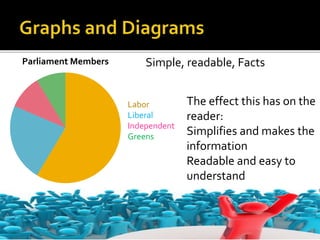
Parliament Members
Labor
Liberal
Independent
Greens
Simple, readable, Facts
The effect this has on the
reader:
Simplifies and makes the
information
Readable and easy to
understand
 Use of collective pronouns to unite views.
 Includes reader together.
 Example: “Finally, the research to back up what we all know’, that
the cost of parking in this city is painful.”
 The effect this has on the reader:
It is meant to include the reader into the article and make them feel
involved.
 Expressing the opposite meaning to what one is arguing
for humour or effect.
 Meaning is opposite or sarcastic opposition people.
 Evidence: “ Is Jill dumb, Nahhh.”
 The effect this has on the reader: It gives the reason some
enthusiasm, fun, laughter
 A use of descriptive language to make comparisons clear
and imaginable.
 This like that or Comparing x = y.
 Example: “Coburg is a melting pot.”
 The effect this has on the reader: Gives a comparison
between two things and makes the reader more interested.
 Praises people or groups respected by the author.
 Your are perfect.
 Evidence: “Mr Kolber is amazing!”
 The effect this has on the reader:
The reader can clearly tell who the ‘goodies’ are.
 Using a shared awareness of homonyms (words with
multiple meanings) to generate comedy.
 Play on words.
 Evidence: “ Being a vegetarian is a missed steak”.
 The effect this has on the reader:
Makes them laugh, or be impressed by the writers word play.
 Performing logical steps to support arguments.
 Sensible, logical, superior.
 Evidence: “If the spurs beat the heat, the heat suck.”
 The effect this has on the reader:
Makes complex things simple by saying: if _____ is _____,
then _____ is true.
 Using the same word more than once.
 Repetition of word.
 Example: Blah, Blah, Blah.
 The effect this has on the reader:
Makes the text easier to read and remember, emphasises
certain words and points of view.
 A question for which an answer is not expected.
 Don’t answer = rhetorical or No thinking needed.
 Example: “ Do you want your children to grow up and become
alcoholic druggies?”
 The effect this has on the reader:
Draws attention to the reader by forcing the reader to then agree
with the statement being put forward.
 Providing numerical proof to arguments.
 Numbers, number one!
 Example: 500% increases in the taxable income of normal
Australians would mean death for the Aussie battler`.
 The effect this has on readers:
Information can be obscured, and manipulated to produce shocking
and surprising pieces of information.
 Grouping concepts into groups of three.
 Thing 1,Thing 2,Thing 3
 Example: “We all need life, liberty and the pursuit of
happiness.”
 The effect this has on readers:
Pleasing to the eye and ear, easy to digest information.
 These informative slides were
originally begun by 10N class –
Circa 2014 (Graduating Class of
2016)
 The effect this has on the reader:
relief at being finished
 

Persuasive Language Techniques List

  • 1.
    EachTechnique: 1) Defined 2) Reducedto 3 simple clear words 3) Example provided 4) The effect his has on the audience / reader
  • 2.
     Definition  Threeword summary (student created)  Evidence: “Example in quotation marks”  The effect this has on the reader
  • 3.
     The repetitionof vowel or consonant sounds for effect.  Repetition of Sounds.  Evidence: “Jared Jokes about John”.  The effect this has on the reader: Draws attention to the point. Nice to read and listen to.
  • 4.
     Any storyor retelling of an event, can be a personal story or a story heard elsewhere.  Personal, emotional, story.  Evidence: “Recently my neighbour experienced this problem first hand”.  The effect this has on the reader: It encourages the reader to show emotion and see the topic as more related to them.
  • 5.
     A referenceto someone with experience on the topic.  Words from expert.  Evidence: Professor John Matthews said “it’s true, trust me, I’m a professor”.  The effect this has on the reader: Positons the audience as a learner, with someone knowledgeable explaining things. It must be true because a person with experience said it.
  • 6.
     Refers tothings that most people would agree to.  Pressures practical point.  Example: “Terrorism is like an angry dog, if you poke a dog it will bite.”  The effect this has on the reader: Makes a complex argument seem simple and easy to decide on, usually by comparing it to something more simple.
  • 7.
     Links thewider world to family groups to inspire warm feelings.  Traditional family, pls.  Evidence: “Move your family to Craigieburn, and they will be safe, happy and smart!”  The effect this has on the reader: Makes the text appeal to people who have a family, or who are parents.
  • 8.
     Refers topotential, imagined, or real threats to safety.  Be scared & Fearful.  Example: “Imagine your dad exploding”.  The effect this has on the reader: Intends to make them scared, fearful and therefore easy to convince.
  • 9.
     Referring tomoney and the way that it is used.  Saving money = good.  Evidence: “ Imagine how much money you would save if you stopped driving your car”.  The effect this has on the reader: Either tries to make the reader angry at being charged money for something or Positions the reader to support an opinion because of their desire to save money, or to not see money wasted.
  • 10.
     Reference totraditions, the old ways and customary actions.  Change is bad.  Evidence: “Elders have been complaining about young generations for years, and look what the result of it is a decayed society!”  The effect this has on the reader: Makes a person feel comfortable about doing the same old things.
  • 11.
     Referring tothe love of ones country.  Love your Country.  Example: “Aussies rule the world”.  The effect this has on the reader: Positions the reader to agree with actions that benefit the nation as a whole.
  • 12.
     Refers toa sense of fairness and punishment.  Crime = time = fair.  Evidence: “The death penalty is the ultimate form of cruelty, it’s a violation of fundamental human rights, its not a right or just thing to do.”  The effect this has on the reader: Making things sound fair will catch the readers eyes by making sure that something is in it for everyone.
  • 13.
     Attacks peopleor groups not respected by the author.  Your are revolting.  Evidence: “Mr Kolber is the most massive idiot yet born.”  The effect this has on the reader: The reader can clearly tell who the ‘baddies’ are.
  • 14.
     Using acommonly used or well-known phrase.  Cheesy, overused phrase.  Evidence: “We brought our A game”.  The effect this has on the reader: The phrase is familiar, so the reader feels safe and familiar with the writers expression.
  • 15.
     A useof strange or uncommon language to draw interest to key concepts.  Swearing, exaggeration, connotations.  Example: “The brutal beheading of people.”  The effect this has on the reader: Evokes a sentiment or opinion through word choice.
  • 16.
     Words thatcarry baggage and associated meanings.  Emotional, implied baggage.  Example: “The Australian dollar slumped to a new low last night due to increasing nervousness about Europe’s economic woes.  The effect this has on the reader: Works up the readers and makes them feel emotional about it.
  • 17.
     Uses emotionalwords to tap in to emotional responses and empathy in the reader.  Feels bad / good.  Evidence: “Come on, you don’t want to be sad your whole life, don’t you want to be happy?”  The effect this has on the reader: To make them feel the way you want them to feel when they read your essay.
  • 18.
     Providing quotationsor clear pieces of evidence to support arguments.  Hard facts, supports.  Evidence: “ An ACER report found this pattern common.”  The effect this has on the reader: Makes the argument seem objective and reliable.
  • 19.
     Expressing argumentsin an overt, overblown way.  OTT (OverTheTop) or Overreacts, dramatic, emotional.  Evidence: “The spurs are the best team ever, they are so fit, young and beautiful.They are so good and full of skill, such an amazing team”.  The effect this has on the reader: Is very over the top, so the reader either finds this funny or believable.
  • 20.
     Using anexpert to support arguments.  Important Person says.  Evidence: “Professor Phillips states, all animals have no brain”  The effect this has on the reader: Makes it more believable, because it is easier to believe an expert than a writer.
  • 21.
     Grouping peoplearbitrarily, stereotyping.  Everyone thinks same.  Evidence: “All ofTony Abbott’s supporters are biased, bigoted racists who don’t deserve your vote.”  The effect this has on the reader: Makes the reader think a group or type of person are all the same, or share the same opinion.
  • 22.
    Parliament Members Labor Liberal Independent Greens Simple, readable,Facts The effect this has on the reader: Simplifies and makes the information Readable and easy to understand
  • 23.
     Use ofcollective pronouns to unite views.  Includes reader together.  Example: “Finally, the research to back up what we all know’, that the cost of parking in this city is painful.”  The effect this has on the reader: It is meant to include the reader into the article and make them feel involved.
  • 24.
     Expressing theopposite meaning to what one is arguing for humour or effect.  Meaning is opposite or sarcastic opposition people.  Evidence: “ Is Jill dumb, Nahhh.”  The effect this has on the reader: It gives the reason some enthusiasm, fun, laughter
  • 25.
     A useof descriptive language to make comparisons clear and imaginable.  This like that or Comparing x = y.  Example: “Coburg is a melting pot.”  The effect this has on the reader: Gives a comparison between two things and makes the reader more interested.
  • 26.
     Praises peopleor groups respected by the author.  Your are perfect.  Evidence: “Mr Kolber is amazing!”  The effect this has on the reader: The reader can clearly tell who the ‘goodies’ are.
  • 27.
     Using ashared awareness of homonyms (words with multiple meanings) to generate comedy.  Play on words.  Evidence: “ Being a vegetarian is a missed steak”.  The effect this has on the reader: Makes them laugh, or be impressed by the writers word play.
  • 28.
     Performing logicalsteps to support arguments.  Sensible, logical, superior.  Evidence: “If the spurs beat the heat, the heat suck.”  The effect this has on the reader: Makes complex things simple by saying: if _____ is _____, then _____ is true.
  • 29.
     Using thesame word more than once.  Repetition of word.  Example: Blah, Blah, Blah.  The effect this has on the reader: Makes the text easier to read and remember, emphasises certain words and points of view.
  • 30.
     A questionfor which an answer is not expected.  Don’t answer = rhetorical or No thinking needed.  Example: “ Do you want your children to grow up and become alcoholic druggies?”  The effect this has on the reader: Draws attention to the reader by forcing the reader to then agree with the statement being put forward.
  • 31.
     Providing numericalproof to arguments.  Numbers, number one!  Example: 500% increases in the taxable income of normal Australians would mean death for the Aussie battler`.  The effect this has on readers: Information can be obscured, and manipulated to produce shocking and surprising pieces of information.
  • 32.
     Grouping conceptsinto groups of three.  Thing 1,Thing 2,Thing 3  Example: “We all need life, liberty and the pursuit of happiness.”  The effect this has on readers: Pleasing to the eye and ear, easy to digest information.
  • 33.
     These informativeslides were originally begun by 10N class – Circa 2014 (Graduating Class of 2016)  The effect this has on the reader: relief at being finished  