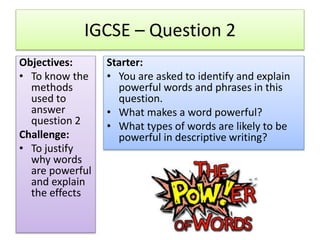
IGCSE – Question 2
Objectives:
• To know the
methods
used to
answer
question 2
Challenge:
• To justify
why words
are powerful
and explain
the effects
Starter:
• You are asked to identify and explain
powerful words and phrases in this
question.
• What makes a word powerful?
• What types of words are likely to be
powerful in descriptive writing?
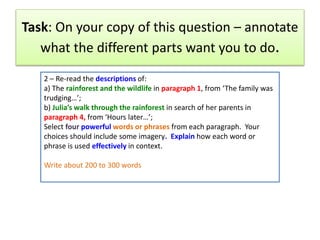
2 – Re-read the descriptions of:
a) The rainforest and the wildlife in paragraph 1, from ‘The family was
trudging…’;
b) Julia’s walk through the rainforest in search of her parents in
paragraph 4, from ‘Hours later…’;
Select four powerful words or phrases from each paragraph. Your
choices should include some imagery. Explain how each word or
phrase is used effectively in context.
Write about 200 to 300 words
Task: On your copy of this question – annotate
what the different parts want you to do.
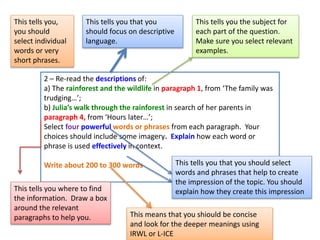
2 – Re-read the descriptions of:
a) The rainforest and the wildlife in paragraph 1, from ‘The family was
trudging…’;
b) Julia’s walk through the rainforest in search of her parents in
paragraph 4, from ‘Hours later…’;
Select four powerful words or phrases from each paragraph. Your
choices should include some imagery. Explain how each word or
phrase is used effectively in context.
Write about 200 to 300 words
This tells you that you
should focus on descriptive
language.
This tells you that you should select
words and phrases that help to create
the impression of the topic. You should
explain how they create this impression
This tells you the subject for
each part of the question.
Make sure you select relevant
examples.
This tells you where to find
the information. Draw a box
around the relevant
paragraphs to help you.
This tells you,
you should
select individual
words or very
short phrases.
This means that you shiould be concise
and look for the deeper meanings using
IRWL or L-ICE
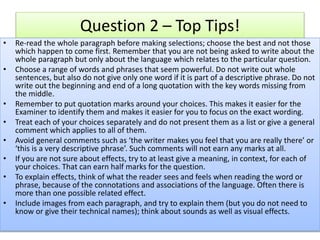
Question 2 – Top Tips!
• Re-read the whole paragraph before making selections; choose the best and not those
which happen to come first. Remember that you are not being asked to write about the
whole paragraph but only about the language which relates to the particular question.
• Choose a range of words and phrases that seem powerful. Do not write out whole
sentences, but also do not give only one word if it is part of a descriptive phrase. Do not
write out the beginning and end of a long quotation with the key words missing from
the middle.
• Remember to put quotation marks around your choices. This makes it easier for the
Examiner to identify them and makes it easier for you to focus on the exact wording.
• Treat each of your choices separately and do not present them as a list or give a general
comment which applies to all of them.
• Avoid general comments such as ‘the writer makes you feel that you are really there’ or
‘this is a very descriptive phrase’. Such comments will not earn any marks at all.
• If you are not sure about effects, try to at least give a meaning, in context, for each of
your choices. That can earn half marks for the question.
• To explain effects, think of what the reader sees and feels when reading the word or
phrase, because of the connotations and associations of the language. Often there is
more than one possible related effect.
• Include images from each paragraph, and try to explain them (but you do not need to
know or give their technical names); think about sounds as well as visual effects.
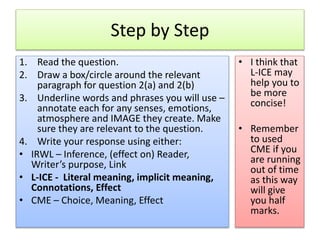
Step by Step
1. Read the question.
2. Draw a box/circle around the relevant
paragraph for question 2(a) and 2(b)
3. Underline words and phrases you will use –
annotate each for any senses, emotions,
atmosphere and IMAGE they create. Make
sure they are relevant to the question.
4. Write your response using either:
• IRWL – Inference, (effect on) Reader,
Writer’s purpose, Link
• L-ICE - Literal meaning, implicit meaning,
Connotations, Effect
• CME – Choice, Meaning, Effect
• I think that
L-ICE may
help you to
be more
concise!
• Remember
to used
CME if you
are running
out of time
as this way
will give
you half
marks.
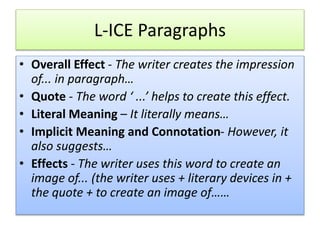
L-ICE Paragraphs
• Overall Effect - The writer creates the impression
of... in paragraph…
• Quote - The word ‘ ...’ helps to create this effect.
• Literal Meaning – It literally means…
• Implicit Meaning and Connotation- However, it
also suggests…
• Effects - The writer uses this word to create an
image of... (the writer uses + literary devices in +
the quote + to create an image of……
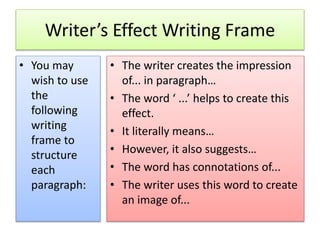
Writer’s Effect Writing Frame
• You may
wish to use
the
following
writing
frame to
structure
each
paragraph:
• The writer creates the impression
of... in paragraph…
• The word ‘ ...’ helps to create this
effect.
• It literally means…
• However, it also suggests…
• The word has connotations of...
• The writer uses this word to create
an image of...
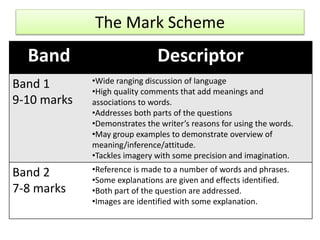
The Mark Scheme
Band Descriptor
Band 1
9-10 marks
•Wide ranging discussion of language
•High quality comments that add meanings and
associations to words.
•Addresses both parts of the questions
•Demonstrates the writer’s reasons for using the words.
•May group examples to demonstrate overview of
meaning/inference/attitude.
•Tackles imagery with some precision and imagination.
Band 2
7-8 marks
•Reference is made to a number of words and phrases.
•Some explanations are given and effects identified.
•Both part of the question are addressed.
•Images are identified with some explanation.
Task: Practice Question
• Read the text on your sheets and highlight four
powerful words or phrases that describe the
rainforest and the wildlife in paragraph 1.
• Then highlight 4 powerful words or phrases about
walk through the rainforest in search of her
parents in paragraph 4, from ‘Hours later…’;
• Explain how each word or phrase selected is used
effectively in the context. Write about 200 words.
Up to 10 marks are available for the content of
your answer.

question-2.pptx

  • 1.
    IGCSE – Question2 Objectives: • To know the methods used to answer question 2 Challenge: • To justify why words are powerful and explain the effects Starter: • You are asked to identify and explain powerful words and phrases in this question. • What makes a word powerful? • What types of words are likely to be powerful in descriptive writing?
  • 2.
    2 – Re-readthe descriptions of: a) The rainforest and the wildlife in paragraph 1, from ‘The family was trudging…’; b) Julia’s walk through the rainforest in search of her parents in paragraph 4, from ‘Hours later…’; Select four powerful words or phrases from each paragraph. Your choices should include some imagery. Explain how each word or phrase is used effectively in context. Write about 200 to 300 words Task: On your copy of this question – annotate what the different parts want you to do.
  • 3.
    2 – Re-readthe descriptions of: a) The rainforest and the wildlife in paragraph 1, from ‘The family was trudging…’; b) Julia’s walk through the rainforest in search of her parents in paragraph 4, from ‘Hours later…’; Select four powerful words or phrases from each paragraph. Your choices should include some imagery. Explain how each word or phrase is used effectively in context. Write about 200 to 300 words This tells you that you should focus on descriptive language. This tells you that you should select words and phrases that help to create the impression of the topic. You should explain how they create this impression This tells you the subject for each part of the question. Make sure you select relevant examples. This tells you where to find the information. Draw a box around the relevant paragraphs to help you. This tells you, you should select individual words or very short phrases. This means that you shiould be concise and look for the deeper meanings using IRWL or L-ICE
  • 4.
    Question 2 –Top Tips! • Re-read the whole paragraph before making selections; choose the best and not those which happen to come first. Remember that you are not being asked to write about the whole paragraph but only about the language which relates to the particular question. • Choose a range of words and phrases that seem powerful. Do not write out whole sentences, but also do not give only one word if it is part of a descriptive phrase. Do not write out the beginning and end of a long quotation with the key words missing from the middle. • Remember to put quotation marks around your choices. This makes it easier for the Examiner to identify them and makes it easier for you to focus on the exact wording. • Treat each of your choices separately and do not present them as a list or give a general comment which applies to all of them. • Avoid general comments such as ‘the writer makes you feel that you are really there’ or ‘this is a very descriptive phrase’. Such comments will not earn any marks at all. • If you are not sure about effects, try to at least give a meaning, in context, for each of your choices. That can earn half marks for the question. • To explain effects, think of what the reader sees and feels when reading the word or phrase, because of the connotations and associations of the language. Often there is more than one possible related effect. • Include images from each paragraph, and try to explain them (but you do not need to know or give their technical names); think about sounds as well as visual effects.
  • 5.
    Step by Step 1.Read the question. 2. Draw a box/circle around the relevant paragraph for question 2(a) and 2(b) 3. Underline words and phrases you will use – annotate each for any senses, emotions, atmosphere and IMAGE they create. Make sure they are relevant to the question. 4. Write your response using either: • IRWL – Inference, (effect on) Reader, Writer’s purpose, Link • L-ICE - Literal meaning, implicit meaning, Connotations, Effect • CME – Choice, Meaning, Effect • I think that L-ICE may help you to be more concise! • Remember to used CME if you are running out of time as this way will give you half marks.
  • 6.
    L-ICE Paragraphs • OverallEffect - The writer creates the impression of... in paragraph… • Quote - The word ‘ ...’ helps to create this effect. • Literal Meaning – It literally means… • Implicit Meaning and Connotation- However, it also suggests… • Effects - The writer uses this word to create an image of... (the writer uses + literary devices in + the quote + to create an image of……
  • 7.
    Writer’s Effect WritingFrame • You may wish to use the following writing frame to structure each paragraph: • The writer creates the impression of... in paragraph… • The word ‘ ...’ helps to create this effect. • It literally means… • However, it also suggests… • The word has connotations of... • The writer uses this word to create an image of...
  • 8.
    The Mark Scheme BandDescriptor Band 1 9-10 marks •Wide ranging discussion of language •High quality comments that add meanings and associations to words. •Addresses both parts of the questions •Demonstrates the writer’s reasons for using the words. •May group examples to demonstrate overview of meaning/inference/attitude. •Tackles imagery with some precision and imagination. Band 2 7-8 marks •Reference is made to a number of words and phrases. •Some explanations are given and effects identified. •Both part of the question are addressed. •Images are identified with some explanation.
  • 9.
    Task: Practice Question •Read the text on your sheets and highlight four powerful words or phrases that describe the rainforest and the wildlife in paragraph 1. • Then highlight 4 powerful words or phrases about walk through the rainforest in search of her parents in paragraph 4, from ‘Hours later…’; • Explain how each word or phrase selected is used effectively in the context. Write about 200 words. Up to 10 marks are available for the content of your answer.