Chapter 4: Fatty Acid
4.1 Composition/Production of fatty acids and its
derivatives.
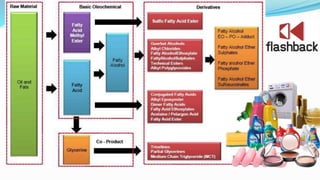
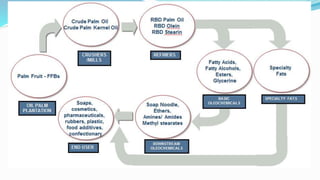
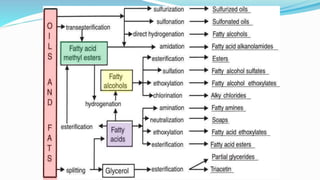
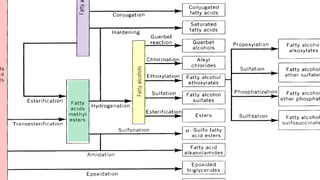
4.2 Flow chart
4.3 Uses and application of fatty acids.
Fatty acids:
• basic units of fat composed of chains of carbon
atoms
• an acid group at one end and hydrogen atoms
attached all along their length
Fatty Acids
 The simplest lipids are the fatty acids, which rarely exist alone in nature, but
instead are usually a component of more complex lipids
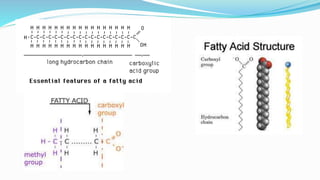
 Fatty acids are carboxylic acids with a long hydrocarbon chain attached
 Although the acid end is polar, the nonpolar hydrocarbon tail makes fatty acids
insoluble (or sparingly soluble) in water
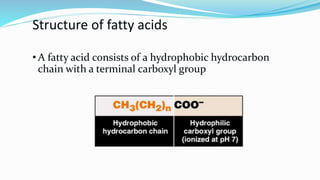
Structure of fatty acids
• A fatty acid consists of a hydrophobic hydrocarbon
chain with a terminal carboxyl group
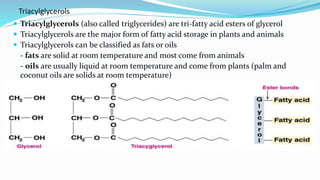
Triacylglycerols
 Triacylglycerols (also called triglycerides) are tri-fatty acid esters of glycerol
 Triacylglycerols are the major form of fatty acid storage in plants and animals
 Triacylglycerols can be classified as fats or oils
- fats are solid at room temperature and most come from animals
- oils are usually liquid at room temperature and come from plants (palm and
coconut oils are solids at room temperature)
Lipids
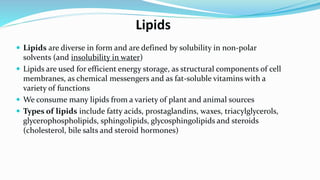
 Lipids are diverse in form and are defined by solubility in non-polar
solvents (and insolubility in water)
 Lipids are used for efficient energy storage, as structural components of cell
membranes, as chemical messengers and as fat-soluble vitamins with a
variety of functions
 We consume many lipids from a variety of plant and animal sources
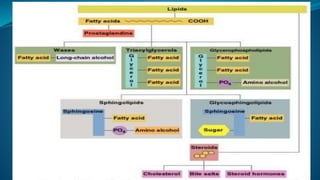
 Types of lipids include fatty acids, prostaglandins, waxes, triacylglycerols,
glycerophospholipids, sphingolipids, glycosphingolipids and steroids
(cholesterol, bile salts and steroid hormones)
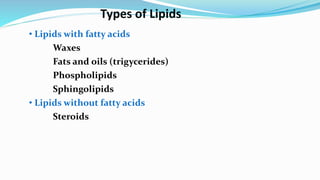
Types of Lipids
• Lipids with fatty acids
Waxes
Fats and oils (trigycerides)
Phospholipids
Sphingolipids
• Lipids without fatty acids
Steroids
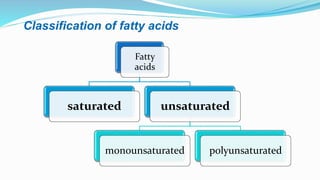
Classification of fatty acids
Fatty
acids
saturated unsaturated
monounsaturated polyunsaturated
 Fats that are solid at room temperature
are made up mainly of saturated fatty
acids.
 Fats that are liquid at room temperature
are made up mainly of unsaturated fatty
acids.
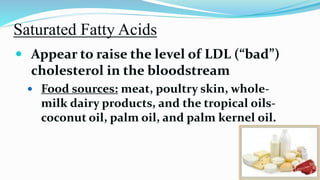
Saturated Fatty Acids
 Appear to raise the level of LDL (“bad”)
cholesterol in the bloodstream
 Food sources: meat, poultry skin, whole-
milk dairy products, and the tropical oils-
coconut oil, palm oil, and palm kernel oil.
Polyunsaturated Fatty Acids
 Fats that seem to lower total
cholesterol levels.
 Food sources: many vegetable oils,
such as corn oil, soybean oil and
safflower oil.
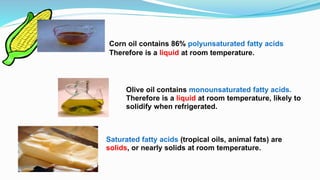
Corn oil contains 86% polyunsaturated fatty acids
Therefore is a liquid at room temperature.
Olive oil contains monounsaturated fatty acids.
Therefore is a liquid at room temperature, likely to
solidify when refrigerated.
Saturated fatty acids (tropical oils, animal fats) are
solids, or nearly solids at room temperature.
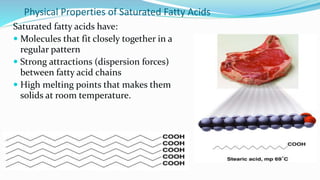
Physical Properties of Saturated Fatty Acids
Saturated fatty acids have:
 Molecules that fit closely together in a
regular pattern
 Strong attractions (dispersion forces)
between fatty acid chains
 High melting points that makes them
solids at room temperature.
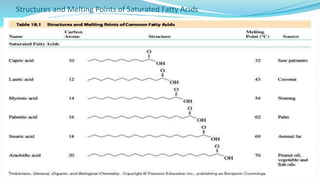
Structures and Melting Points of Saturated Fatty Acids
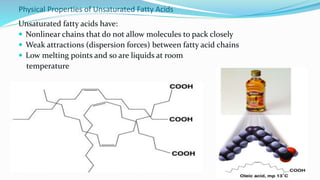
Physical Properties of Unsaturated Fatty Acids
Unsaturated fatty acids have:
 Nonlinear chains that do not allow molecules to pack closely
 Weak attractions (dispersion forces) between fatty acid chains
 Low melting points and so are liquids at room
temperature
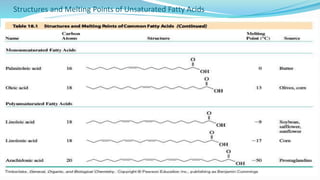
Structures and Melting Points of Unsaturated Fatty Acids
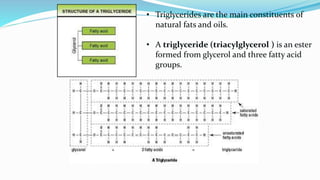
• Triglycerides are the main constituents of
natural fats and oils.
• A triglyceride (triacylglycerol ) is an ester
formed from glycerol and three fatty acid
groups.
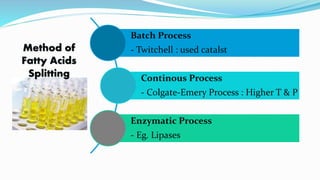
Batch Process
- Twitchell : used catalst
Continous Process
- Colgate-Emery Process : Higher T & P
Enzymatic Process
- Eg. Lipases
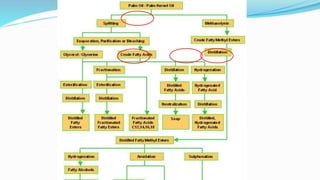
Method of
Fatty Acids
Splitting
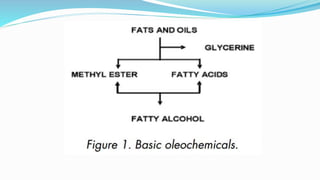
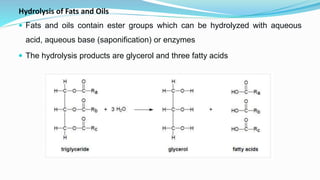
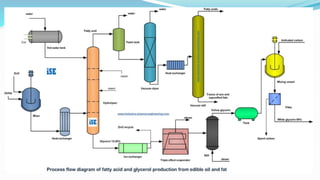
Hydrolysis of Fats and Oils
 Fats and oils contain ester groups which can be hydrolyzed with aqueous
acid, aqueous base (saponification) or enzymes
 The hydrolysis products are glycerol and three fatty acids
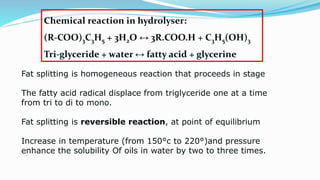
Fat splitting is homogeneous reaction that proceeds in stage
The fatty acid radical displace from triglyceride one at a time
from tri to di to mono.
Fat splitting is reversible reaction, at point of equilibrium
Increase in temperature (from 150°c to 220°)and pressure
enhance the solubility Of oils in water by two to three times.
Chemical reaction in hydrolyser:
(R-COO)3C3H5 + 3H2O ↔ 3R.COO.H + C3H5(OH)3
Tri-glyceride + water ↔ fatty acid + glycerine
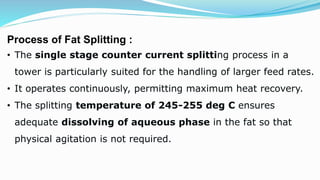
Process of Fat Splitting :
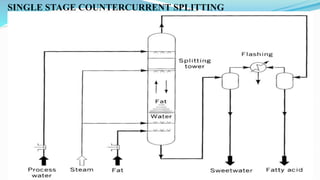
• The single stage counter current splitting process in a
tower is particularly suited for the handling of larger feed rates.
• It operates continuously, permitting maximum heat recovery.
• The splitting temperature of 245-255 deg C ensures
adequate dissolving of aqueous phase in the fat so that
physical agitation is not required.
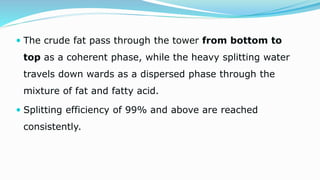
 The crude fat pass through the tower from bottom to
top as a coherent phase, while the heavy splitting water
travels down wards as a dispersed phase through the
mixture of fat and fatty acid.
 Splitting efficiency of 99% and above are reached
consistently.
SINGLE STAGE COUNTERCURRENT SPLITTING
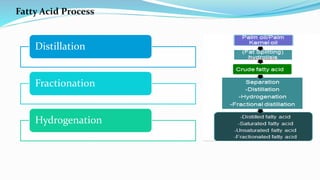
Fatty Acid Process
Distillation
Fractionation
Hydrogenation
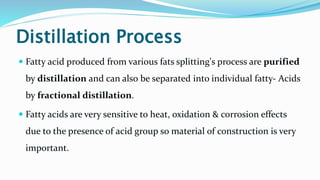
Distillation Process
 Fatty acid produced from various fats splitting's process are purified
by distillation and can also be separated into individual fatty- Acids
by fractional distillation.
 Fatty acids are very sensitive to heat, oxidation & corrosion effects
due to the presence of acid group so material of construction is very
important.
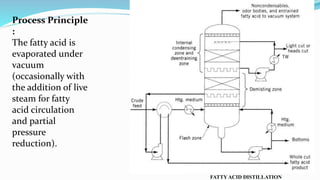
FATTY ACID DISTILLATION
Process Principle
:
The fatty acid is
evaporated under
vacuum
(occasionally with
the addition of live
steam for fatty
acid circulation
and partial
pressure
reduction).
Fractional Distillation
Why?
 Crude FA contain unsaponifiable matters, dark color, polymeried FA
 To separate different type of FA (saturated and unsaturated)
 Remove impurities and color
How?
 Different number of carbon has different boiling point
 Carry out under high vacuum and low temperature
Fractionation Process
 The Fatty Acid Fractionation process separates the Fatty Acid into much
narrower components to obtain fractional purities of up to 99.5% for products
like Fatty Alcohols, Methyl Esters of Fatty Acids and other organic compounds.
 The design process employed optimizes the recovery of heat and provides the
highest quality of product available in the market today.
 Vacuum towers equipped with structured packing are utilized to fractionate
the fatty acids.
 While the vapors are condensed on the surface condensers, the reflux is
evaporated by the Falling Film Evaporators.
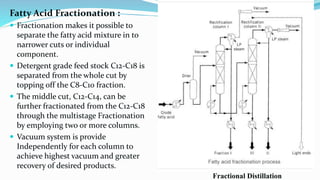
Fractional Distillation
Fatty Acid Fractionation :
 Fractionation makes it possible to
separate the fatty acid mixture in to
narrower cuts or individual
component.
 Detergent grade feed stock C12-C18 is
separated from the whole cut by
topping off the C8-C10 fraction.
 The middle cut, C12-C14, can be
further fractionated from the C12-C18
through the multistage Fractionation
by employing two or more columns.
 Vacuum system is provide
Independently for each column to
achieve highest vacuum and greater
recovery of desired products.
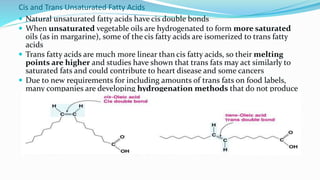
Cis and Trans Unsaturated Fatty Acids
 Natural unsaturated fatty acids have cis double bonds
 When unsaturated vegetable oils are hydrogenated to form more saturated
oils (as in margarine), some of the cis fatty acids are isomerized to trans fatty
acids
 Trans fatty acids are much more linear than cis fatty acids, so their melting
points are higher and studies have shown that trans fats may act similarly to
saturated fats and could contribute to heart disease and some cancers
 Due to new requirements for including amounts of trans fats on food labels,
many companies are developing hydrogenation methods that do not produce
trans fats
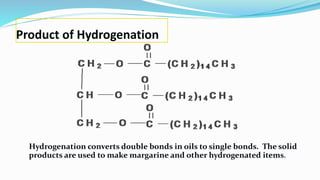
Product of Hydrogenation
Hydrogenation converts double bonds in oils to single bonds. The solid
products are used to make margarine and other hydrogenated items.
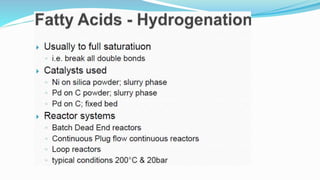
Hydrogenation
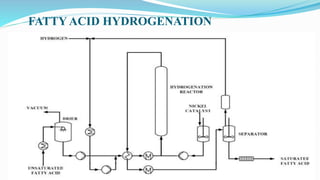
 To saturated the double bonds of fatty acid
 Usually saturated FA is more favorable compare to unsaturated FA
FATTY ACID HYDROGENATION
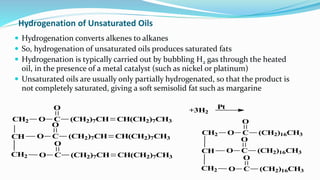
Hydrogenation of Unsaturated Oils
 Hydrogenation converts alkenes to alkanes
 So, hydrogenation of unsaturated oils produces saturated fats
 Hydrogenation is typically carried out by bubbling H2 gas through the heated
oil, in the presence of a metal catalyst (such as nickel or platinum)
 Unsaturated oils are usually only partially hydrogenated, so that the product is
not completely saturated, giving a soft semisolid fat such as margarine
Pt
CH2 O C
O
(CH2)16CH3
CH2 O C
O
(CH2)16CH3
CH O C
O
(CH2)16CH3
+3H2
CH
CH2
O C
O
(CH2)7CH CH(CH2)7CH3
O C
O
(CH2)7CH CH(CH2)7CH3
CH2 O C
O
(CH2)7CH CH(CH2)7CH3

Fatty acids

  • 2.
    Chapter 4: FattyAcid 4.1 Composition/Production of fatty acids and its derivatives. 4.2 Flow chart 4.3 Uses and application of fatty acids.
  • 4.
    Fatty acids: • basicunits of fat composed of chains of carbon atoms • an acid group at one end and hydrogen atoms attached all along their length
  • 5.
    Fatty Acids  Thesimplest lipids are the fatty acids, which rarely exist alone in nature, but instead are usually a component of more complex lipids  Fatty acids are carboxylic acids with a long hydrocarbon chain attached  Although the acid end is polar, the nonpolar hydrocarbon tail makes fatty acids insoluble (or sparingly soluble) in water
  • 6.
    Structure of fattyacids • A fatty acid consists of a hydrophobic hydrocarbon chain with a terminal carboxyl group
  • 7.
    Triacylglycerols  Triacylglycerols (alsocalled triglycerides) are tri-fatty acid esters of glycerol  Triacylglycerols are the major form of fatty acid storage in plants and animals  Triacylglycerols can be classified as fats or oils - fats are solid at room temperature and most come from animals - oils are usually liquid at room temperature and come from plants (palm and coconut oils are solids at room temperature)
  • 8.
    Lipids  Lipids arediverse in form and are defined by solubility in non-polar solvents (and insolubility in water)  Lipids are used for efficient energy storage, as structural components of cell membranes, as chemical messengers and as fat-soluble vitamins with a variety of functions  We consume many lipids from a variety of plant and animal sources  Types of lipids include fatty acids, prostaglandins, waxes, triacylglycerols, glycerophospholipids, sphingolipids, glycosphingolipids and steroids (cholesterol, bile salts and steroid hormones)
  • 9.
    Types of Lipids •Lipids with fatty acids Waxes Fats and oils (trigycerides) Phospholipids Sphingolipids • Lipids without fatty acids Steroids
  • 11.
    Classification of fattyacids Fatty acids saturated unsaturated monounsaturated polyunsaturated
  • 12.
     Fats thatare solid at room temperature are made up mainly of saturated fatty acids.  Fats that are liquid at room temperature are made up mainly of unsaturated fatty acids.
  • 13.
    Saturated Fatty Acids Appear to raise the level of LDL (“bad”) cholesterol in the bloodstream  Food sources: meat, poultry skin, whole- milk dairy products, and the tropical oils- coconut oil, palm oil, and palm kernel oil.
  • 14.
    Polyunsaturated Fatty Acids Fats that seem to lower total cholesterol levels.  Food sources: many vegetable oils, such as corn oil, soybean oil and safflower oil.
  • 15.
    Corn oil contains86% polyunsaturated fatty acids Therefore is a liquid at room temperature. Olive oil contains monounsaturated fatty acids. Therefore is a liquid at room temperature, likely to solidify when refrigerated. Saturated fatty acids (tropical oils, animal fats) are solids, or nearly solids at room temperature.
  • 16.
    Physical Properties ofSaturated Fatty Acids Saturated fatty acids have:  Molecules that fit closely together in a regular pattern  Strong attractions (dispersion forces) between fatty acid chains  High melting points that makes them solids at room temperature.
  • 17.
    Structures and MeltingPoints of Saturated Fatty Acids
  • 18.
    Physical Properties ofUnsaturated Fatty Acids Unsaturated fatty acids have:  Nonlinear chains that do not allow molecules to pack closely  Weak attractions (dispersion forces) between fatty acid chains  Low melting points and so are liquids at room temperature
  • 19.
    Structures and MeltingPoints of Unsaturated Fatty Acids
  • 21.
    • Triglycerides arethe main constituents of natural fats and oils. • A triglyceride (triacylglycerol ) is an ester formed from glycerol and three fatty acid groups.
  • 27.
    Batch Process - Twitchell: used catalst Continous Process - Colgate-Emery Process : Higher T & P Enzymatic Process - Eg. Lipases Method of Fatty Acids Splitting
  • 28.
    Hydrolysis of Fatsand Oils  Fats and oils contain ester groups which can be hydrolyzed with aqueous acid, aqueous base (saponification) or enzymes  The hydrolysis products are glycerol and three fatty acids
  • 29.
    Fat splitting ishomogeneous reaction that proceeds in stage The fatty acid radical displace from triglyceride one at a time from tri to di to mono. Fat splitting is reversible reaction, at point of equilibrium Increase in temperature (from 150°c to 220°)and pressure enhance the solubility Of oils in water by two to three times. Chemical reaction in hydrolyser: (R-COO)3C3H5 + 3H2O ↔ 3R.COO.H + C3H5(OH)3 Tri-glyceride + water ↔ fatty acid + glycerine
  • 30.
    Process of FatSplitting : • The single stage counter current splitting process in a tower is particularly suited for the handling of larger feed rates. • It operates continuously, permitting maximum heat recovery. • The splitting temperature of 245-255 deg C ensures adequate dissolving of aqueous phase in the fat so that physical agitation is not required.
  • 31.
     The crudefat pass through the tower from bottom to top as a coherent phase, while the heavy splitting water travels down wards as a dispersed phase through the mixture of fat and fatty acid.  Splitting efficiency of 99% and above are reached consistently.
  • 32.
  • 35.
  • 36.
    Distillation Process  Fattyacid produced from various fats splitting's process are purified by distillation and can also be separated into individual fatty- Acids by fractional distillation.  Fatty acids are very sensitive to heat, oxidation & corrosion effects due to the presence of acid group so material of construction is very important.
  • 37.
    FATTY ACID DISTILLATION ProcessPrinciple : The fatty acid is evaporated under vacuum (occasionally with the addition of live steam for fatty acid circulation and partial pressure reduction).
  • 39.
    Fractional Distillation Why?  CrudeFA contain unsaponifiable matters, dark color, polymeried FA  To separate different type of FA (saturated and unsaturated)  Remove impurities and color How?  Different number of carbon has different boiling point  Carry out under high vacuum and low temperature
  • 40.
    Fractionation Process  TheFatty Acid Fractionation process separates the Fatty Acid into much narrower components to obtain fractional purities of up to 99.5% for products like Fatty Alcohols, Methyl Esters of Fatty Acids and other organic compounds.  The design process employed optimizes the recovery of heat and provides the highest quality of product available in the market today.  Vacuum towers equipped with structured packing are utilized to fractionate the fatty acids.  While the vapors are condensed on the surface condensers, the reflux is evaporated by the Falling Film Evaporators.
  • 41.
    Fractional Distillation Fatty AcidFractionation :  Fractionation makes it possible to separate the fatty acid mixture in to narrower cuts or individual component.  Detergent grade feed stock C12-C18 is separated from the whole cut by topping off the C8-C10 fraction.  The middle cut, C12-C14, can be further fractionated from the C12-C18 through the multistage Fractionation by employing two or more columns.  Vacuum system is provide Independently for each column to achieve highest vacuum and greater recovery of desired products.

  • 43.
    Cis and TransUnsaturated Fatty Acids  Natural unsaturated fatty acids have cis double bonds  When unsaturated vegetable oils are hydrogenated to form more saturated oils (as in margarine), some of the cis fatty acids are isomerized to trans fatty acids  Trans fatty acids are much more linear than cis fatty acids, so their melting points are higher and studies have shown that trans fats may act similarly to saturated fats and could contribute to heart disease and some cancers  Due to new requirements for including amounts of trans fats on food labels, many companies are developing hydrogenation methods that do not produce trans fats
  • 45.
    Product of Hydrogenation Hydrogenationconverts double bonds in oils to single bonds. The solid products are used to make margarine and other hydrogenated items.
  • 46.
    Hydrogenation  To saturatedthe double bonds of fatty acid  Usually saturated FA is more favorable compare to unsaturated FA
  • 47.
  • 48.
    Hydrogenation of UnsaturatedOils  Hydrogenation converts alkenes to alkanes  So, hydrogenation of unsaturated oils produces saturated fats  Hydrogenation is typically carried out by bubbling H2 gas through the heated oil, in the presence of a metal catalyst (such as nickel or platinum)  Unsaturated oils are usually only partially hydrogenated, so that the product is not completely saturated, giving a soft semisolid fat such as margarine Pt CH2 O C O (CH2)16CH3 CH2 O C O (CH2)16CH3 CH O C O (CH2)16CH3 +3H2 CH CH2 O C O (CH2)7CH CH(CH2)7CH3 O C O (CH2)7CH CH(CH2)7CH3 CH2 O C O (CH2)7CH CH(CH2)7CH3