041 MARK-RECAPTURE METHOD 
FOR POPULATION STUDY 
This technique is used to simulate a population estimate by wildlife 
biologists in the field. The first step is to trap a random sample of 
animals of the species being studied. These animals are then marked in 
some manner appropriate to the species and released. Then the next step 
is to do another trapping. Some of the animals captured may have been 
marked from the first sample. Using a simple ratio, a quick population estimate, 
Petersen-Lincoln estimator of population size can be made as follows: 
N = Population estimate 
M = Number of individuals captured in first sample & marked 
n = Number of individuals captured in second sample 
m = Number of (n) that were already marked 
Assuming that the marked proportion in the sample is equal to the marked 
proportion in the population suggests that 
N/M = n/m 
To solve for (N) we re-arrange the formula: 
N = nM/m
MATERIALS REQUIRED 
White Beads (around 5-6 handfuls) 
Red Beads (around 1-2 handfuls 
Small paper bags 
White Beads Black Beads paper bags 
NOTE: Red beans such as Rajma and light coloured beans 
can also be used to simulate this experiment
PROCEDURE 
Put 5-6 handfuls of white beads into a bag. Do not count them. 
Pick out a handful of these beans and count them (do not return them to the 
sack). This is the first trapping sample (M). Record answer [M = ___ ] 
To mark these beans merely replace them with colored beans (red). Now 
release these marked individuals (beads) back into the population (bag). The 
replaced white beads are set aside and never returned to the bag again. 
They were replaced (marked). 
Shake the bag and without looking into the bag grab another handful of beads. 
This represents the second trapping sample (n). Count them and record the 
answer. [n = ___ ] 
How many of the beads in the second trapping sample were already marked 
(red beads)? This is the (m) value. Count them and record the answer. 
Return this trapping sample (white and red) to the bag. [m = ____ ] 
Now use the equation to calculate the population estimate (N). [N = ____ ]
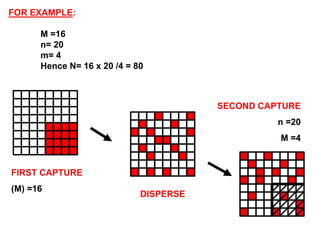
FOR EXAMPLE: 
M =16 
n= 20 
m= 4 
Hence N= 16 x 20 /4 = 80 
SECOND CAPTURE 
n =20 
M =4 
FIRST CAPTURE 
(M) =16 
DISPERSE

041 mark recapture method for population study

  • 1.
    041 MARK-RECAPTURE METHOD FOR POPULATION STUDY This technique is used to simulate a population estimate by wildlife biologists in the field. The first step is to trap a random sample of animals of the species being studied. These animals are then marked in some manner appropriate to the species and released. Then the next step is to do another trapping. Some of the animals captured may have been marked from the first sample. Using a simple ratio, a quick population estimate, Petersen-Lincoln estimator of population size can be made as follows: N = Population estimate M = Number of individuals captured in first sample & marked n = Number of individuals captured in second sample m = Number of (n) that were already marked Assuming that the marked proportion in the sample is equal to the marked proportion in the population suggests that N/M = n/m To solve for (N) we re-arrange the formula: N = nM/m
  • 2.
    MATERIALS REQUIRED WhiteBeads (around 5-6 handfuls) Red Beads (around 1-2 handfuls Small paper bags White Beads Black Beads paper bags NOTE: Red beans such as Rajma and light coloured beans can also be used to simulate this experiment
  • 3.
    PROCEDURE Put 5-6handfuls of white beads into a bag. Do not count them. Pick out a handful of these beans and count them (do not return them to the sack). This is the first trapping sample (M). Record answer [M = ___ ] To mark these beans merely replace them with colored beans (red). Now release these marked individuals (beads) back into the population (bag). The replaced white beads are set aside and never returned to the bag again. They were replaced (marked). Shake the bag and without looking into the bag grab another handful of beads. This represents the second trapping sample (n). Count them and record the answer. [n = ___ ] How many of the beads in the second trapping sample were already marked (red beads)? This is the (m) value. Count them and record the answer. Return this trapping sample (white and red) to the bag. [m = ____ ] Now use the equation to calculate the population estimate (N). [N = ____ ]
  • 4.
    FOR EXAMPLE: M=16 n= 20 m= 4 Hence N= 16 x 20 /4 = 80 SECOND CAPTURE n =20 M =4 FIRST CAPTURE (M) =16 DISPERSE