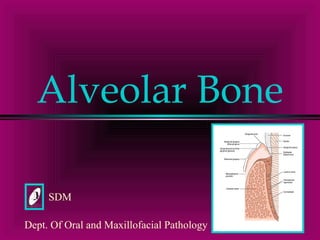
Alveolar Bone 
SDM 
Dept. Of Oral and Maxillofacial Pathology
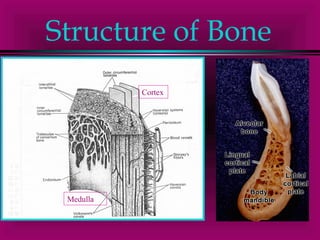
Structure of Bone 
Medulla 
Cortex
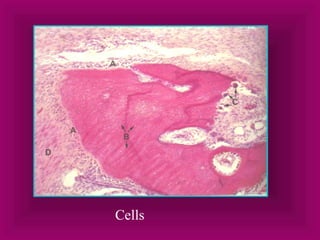
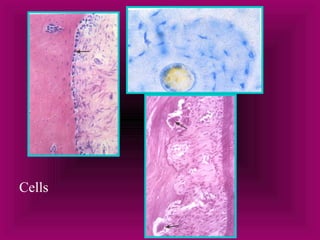
Cells
Cells
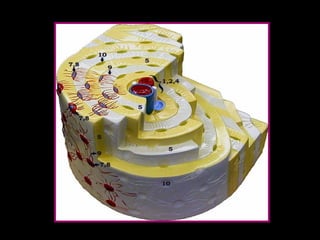
Parts of bone 
Periosteum &Endosteum 
Types of lamellae 
Harvesian system 
VolKman canal 
Cells of bone 
Matrix 
Marrow tissue
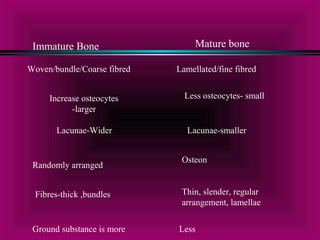
Immature Bone Mature bone 
Woven/bundle/Coarse fibred Lamellated/fine fibred 
Increase osteocytes 
-larger 
Less osteocytes- small 
Lacunae-Wider Lacunae-smaller 
Randomly arranged Osteon 
Fibres-thick ,bundles Thin, slender, regular 
arrangement, lamellae 
Ground substance is more Less
Parts of bone 
Periosteum &Endosteum 
Types of lamellae 
Harvesian system 
Volkman canal 
Cells of bone 
Matrix 
Marrow tissue
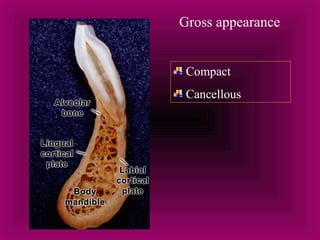
Gross appearance 
Compact 
Cancellous
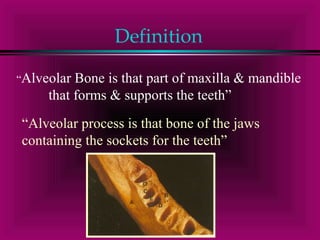
Definition 
“Alveolar Bone is that part of maxilla & mandible 
that forms & supports the teeth” 
“Alveolar process is that bone of the jaws 
containing the sockets for the teeth”
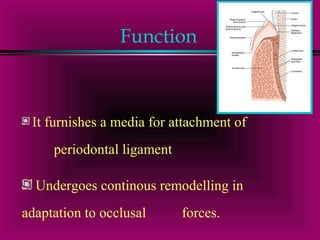
Function 
It furnishes a media for attachment of 
periodontal ligament 
Undergoes continous remodelling in 
adaptation to occlusal forces.
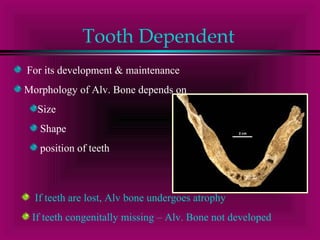
Tooth Dependent 
For its development & maintenance 
Morphology of Alv. Bone depends on 
Size 
Shape 
position of teeth 
If teeth are lost, Alv bone undergoes atrophy 
If teeth congenitally missing – Alv. Bone not developed
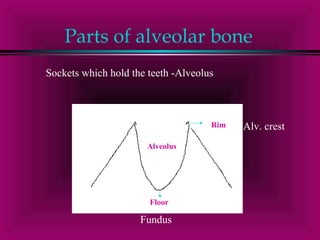
Parts of alveolar bone 
Sockets which hold the teeth -Alveolus 
Alveolus 
Rim 
Floor 
Alv. crest 
Fundus
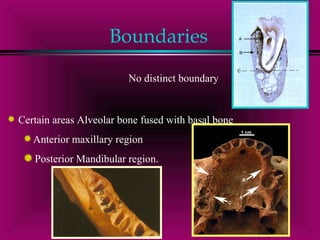
Boundaries 
No distinct boundary 
Certain areas Alveolar bone fused with basal bone 
Anterior maxillary region 
Posterior Mandibular region.
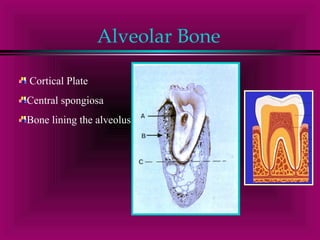
Alveolar Bone 
Cortical Plate 
Central spongiosa 
Bone lining the alveolus
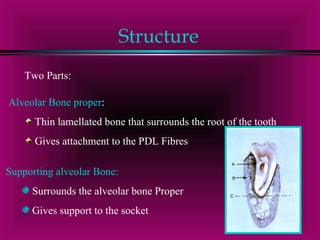
Structure 
Two Parts: 
Alveolar Bone proper: 
Thin lamellated bone that surrounds the root of the tooth 
Gives attachment to the PDL Fibres 
Supporting alveolar Bone: 
Surrounds the alveolar bone Proper 
Gives support to the socket
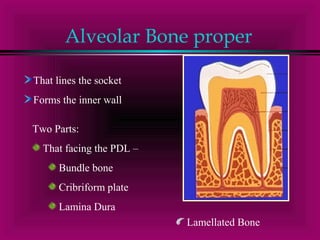
Alveolar Bone proper 
That lines the socket 
Forms the inner wall 
Two Parts: 
That facing the PDL – 
Bundle bone 
Cribriform plate 
Lamina Dura 
Lamellated Bone
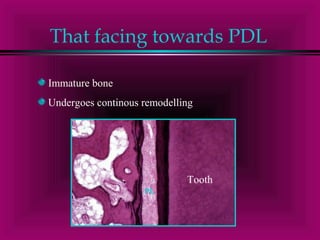
That facing towards PDL 
Immature bone 
Undergoes continous remodelling 
Tooth 
PL
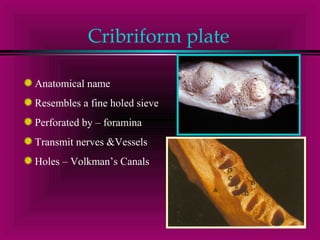
Cribriform plate 
Anatomical name 
Resembles a fine holed sieve 
Perforated by – foramina 
Transmit nerves &Vessels 
Holes – Volkman’s Canals
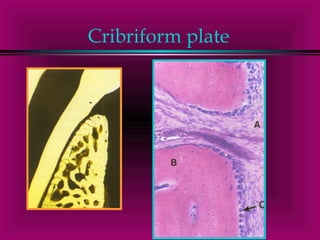
Cribriform plate
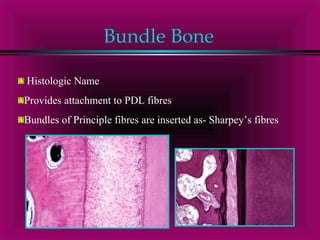
Bundle Bone 
Histologic Name 
Provides attachment to PDL fibres 
Bundles of Principle fibres are inserted as- Sharpey’s fibres
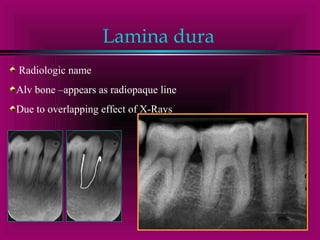
Lamina dura 
Radiologic name 
Alv bone –appears as radiopaque line 
Due to overlapping effect of X-Rays
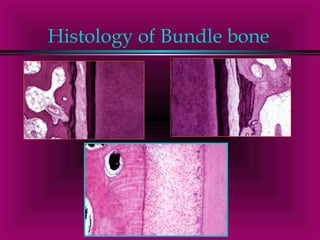
Histology of Bundle bone
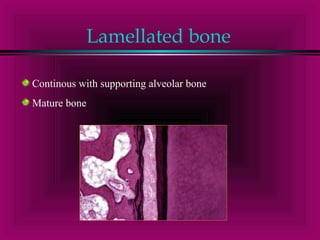
Lamellated bone 
Continous with supporting alveolar bone 
Mature bone
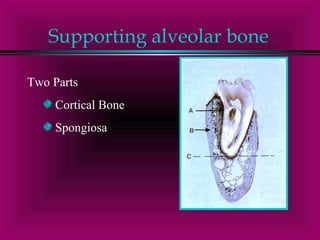
Supporting alveolar bone 
Two Parts 
Cortical Bone 
Spongiosa
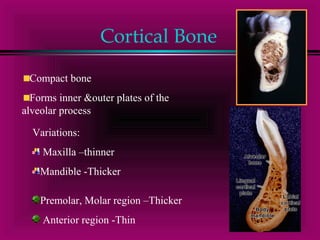
Cortical Bone 
Compact bone 
Forms inner &outer plates of the 
alveolar process 
Variations: 
Maxilla –thinner 
Mandible -Thicker 
Premolar, Molar region –Thicker 
Anterior region -Thin
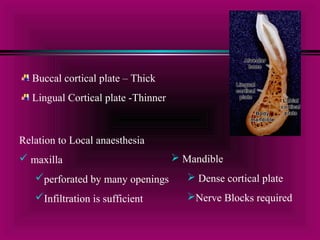
Buccal cortical plate – Thick 
Lingual Cortical plate -Thinner 
Relation to Local anaesthesia 
 maxilla 
perforated by many openings 
Infiltration is sufficient 
 Mandible 
 Dense cortical plate 
Nerve Blocks required
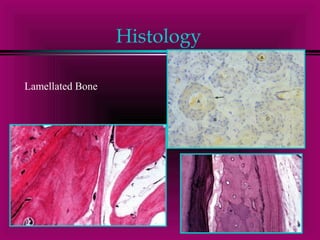
Histology 
Lamellated Bone
Spongiosa 
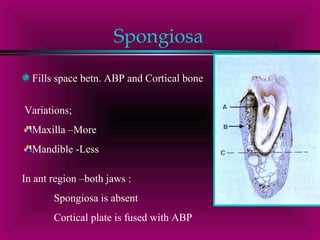
Fills space betn. ABP and Cortical bone 
Variations; 
Maxilla –More 
Mandible -Less 
In ant region –both jaws : 
Spongiosa is absent 
Cortical plate is fused with ABP
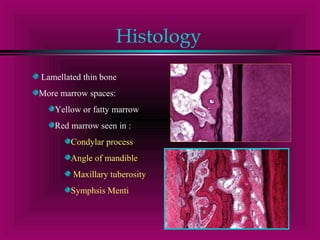
Histology 
Lamellated thin bone 
More marrow spaces: 
Yellow or fatty marrow 
Red marrow seen in : 
Condylar process 
Angle of mandible 
Maxillary tuberosity 
Symphsis Menti
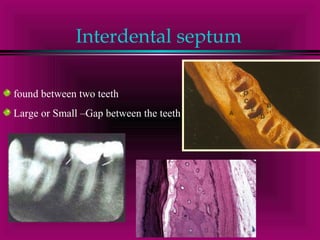
Interdental septum 
found between two teeth 
Large or Small –Gap between the teeth
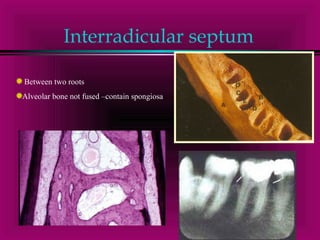
Interradicular septum 
Between two roots 
Alveolar bone not fused –contain spongiosa
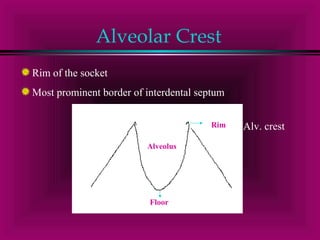
Alveolar Crest 
Rim of the socket 
Most prominent border of interdental septum 
Alveolus 
Rim 
Floor 
Alv. crest
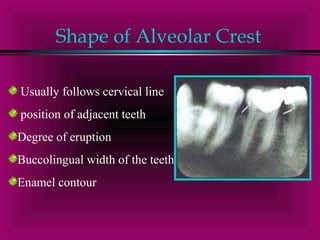
Shape of Alveolar Crest 
Usually follows cervical line 
position of adjacent teeth 
Degree of eruption 
Buccolingual width of the teeth 
Enamel contour
Relationship with CEJ 
1.5-2mm apical to CEJ 
Relation always maintained &Is constant 
Attrition 
Inclination
Arrangement of Trabeculae 
Present in Spongiosa 
More in max than in Mand 
When masticatory stresses 
increase –less spongiosa , 
thick CP 
When masticatory stresses 
decrease – 
more spongiosa , thin CP
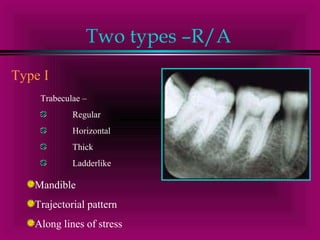
Two types –R/A 
Type I 
Trabeculae – 
Regular 
Horizontal 
Thick 
Ladderlike 
Mandible 
Trajectorial pattern 
Along lines of stress
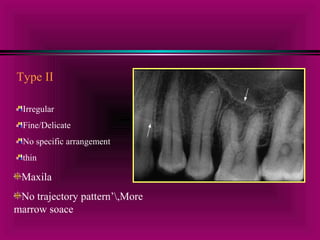
Type II 
Irregular 
Fine/Delicate 
No specific arrangement 
thin 
Maxila 
No trajectory pattern’,More 
marrow soace
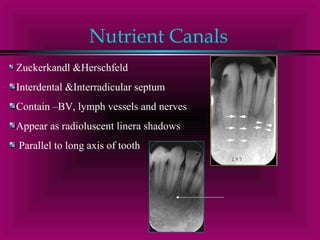
Nutrient Canals 
Zuckerkandl &Herschfeld 
Interdental &Interradicular septum 
Contain –BV, lymph vessels and nerves 
Appear as radioluscent linera shadows 
Parallel to long axis of tooth
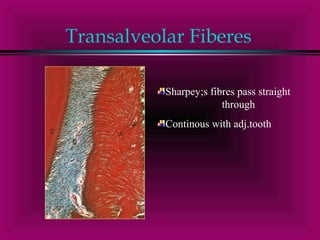
Transalveolar Fiberes 
Sharpey;s fibres pass straight 
through 
Continous with adj.tooth
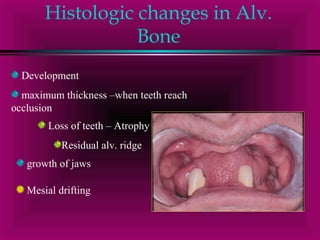
Histologic changes in Alv. 
Bone 
Development 
maximum thickness –when teeth reach 
occlusion 
Loss of teeth – Atrophy 
Residual alv. ridge 
growth of jaws 
Mesial drifting
Functions 
supportive 
Protective 
Heamatopoietic 
Calcium Homeostasis 
Reserve tissue For PDL
Clinical Considerations 
Maxillary teeth 
Easy to extract 
Infiltration is sufficient 
Infection in alv. Bone – 
R/F- loss of lamina dura 
Periodontal disease – 
Destruction of Alv.Bone
Orthodontic Treatment – 
Plasticity of the bone 
Cyst and tumours 
Effect of hormones –Hypo /Hyperparathyroidism
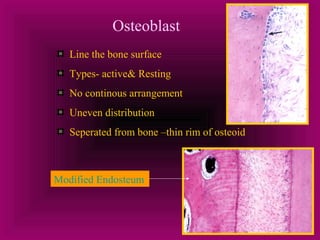
Osteoblast 
Line the bone surface 
Types- active& Resting 
No continous arrangement 
Uneven distribution 
Seperated from bone –thin rim of osteoid 
Modified Endosteum
Osteoclast 
Cells that resorb bone 
Multinucleated cells (2-10) , can be mononucleated 
Origin: Fusion of Circulating monocytes 
Location: Howships lacunae- bay like recesses 
Arrangement –usually in clusters 
Content: Abundant golgi, mitochondria, lysosomes but 
little RER. 
Acid phosphatase 
Function – resorb bone
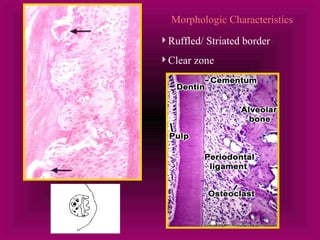
Morphologic Characteristics 
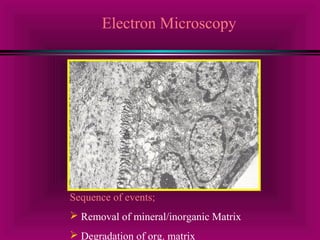
Ruffled/ Striated border 
Clear zone
Electron Microscopy 
Sequence of events; 
 Removal of mineral/inorganic Matrix 
 Degradation of org. matrix
Alveolar bone
Alveolar bone

Alveolar bone

  • 1.
    Alveolar Bone SDM Dept. Of Oral and Maxillofacial Pathology
  • 2.
    Structure of Bone Medulla Cortex
  • 4.
  • 5.
  • 6.
    Parts of bone Periosteum &Endosteum Types of lamellae Harvesian system VolKman canal Cells of bone Matrix Marrow tissue
  • 7.
    Immature Bone Maturebone Woven/bundle/Coarse fibred Lamellated/fine fibred Increase osteocytes -larger Less osteocytes- small Lacunae-Wider Lacunae-smaller Randomly arranged Osteon Fibres-thick ,bundles Thin, slender, regular arrangement, lamellae Ground substance is more Less
  • 8.
    Parts of bone Periosteum &Endosteum Types of lamellae Harvesian system Volkman canal Cells of bone Matrix Marrow tissue
  • 9.
  • 10.
    Definition “Alveolar Boneis that part of maxilla & mandible that forms & supports the teeth” “Alveolar process is that bone of the jaws containing the sockets for the teeth”
  • 11.
    Function It furnishesa media for attachment of periodontal ligament Undergoes continous remodelling in adaptation to occlusal forces.
  • 12.
    Tooth Dependent Forits development & maintenance Morphology of Alv. Bone depends on Size Shape position of teeth If teeth are lost, Alv bone undergoes atrophy If teeth congenitally missing – Alv. Bone not developed
  • 13.
    Parts of alveolarbone Sockets which hold the teeth -Alveolus Alveolus Rim Floor Alv. crest Fundus
  • 14.
    Boundaries No distinctboundary Certain areas Alveolar bone fused with basal bone Anterior maxillary region Posterior Mandibular region.
  • 15.
    Alveolar Bone CorticalPlate Central spongiosa Bone lining the alveolus
  • 16.
    Structure Two Parts: Alveolar Bone proper: Thin lamellated bone that surrounds the root of the tooth Gives attachment to the PDL Fibres Supporting alveolar Bone: Surrounds the alveolar bone Proper Gives support to the socket
  • 17.
    Alveolar Bone proper That lines the socket Forms the inner wall Two Parts: That facing the PDL – Bundle bone Cribriform plate Lamina Dura Lamellated Bone
  • 18.
    That facing towardsPDL Immature bone Undergoes continous remodelling Tooth PL
  • 19.
    Cribriform plate Anatomicalname Resembles a fine holed sieve Perforated by – foramina Transmit nerves &Vessels Holes – Volkman’s Canals
  • 20.
  • 21.
    Bundle Bone HistologicName Provides attachment to PDL fibres Bundles of Principle fibres are inserted as- Sharpey’s fibres
  • 22.
    Lamina dura Radiologicname Alv bone –appears as radiopaque line Due to overlapping effect of X-Rays
  • 23.
  • 24.
    Lamellated bone Continouswith supporting alveolar bone Mature bone
  • 25.
    Supporting alveolar bone Two Parts Cortical Bone Spongiosa
  • 26.
    Cortical Bone Compactbone Forms inner &outer plates of the alveolar process Variations: Maxilla –thinner Mandible -Thicker Premolar, Molar region –Thicker Anterior region -Thin
  • 27.
    Buccal cortical plate– Thick Lingual Cortical plate -Thinner Relation to Local anaesthesia  maxilla perforated by many openings Infiltration is sufficient  Mandible  Dense cortical plate Nerve Blocks required
  • 28.
  • 29.
    Spongiosa Fills spacebetn. ABP and Cortical bone Variations; Maxilla –More Mandible -Less In ant region –both jaws : Spongiosa is absent Cortical plate is fused with ABP
  • 30.
    Histology Lamellated thinbone More marrow spaces: Yellow or fatty marrow Red marrow seen in : Condylar process Angle of mandible Maxillary tuberosity Symphsis Menti
  • 31.
    Interdental septum foundbetween two teeth Large or Small –Gap between the teeth
  • 32.
    Interradicular septum Betweentwo roots Alveolar bone not fused –contain spongiosa
  • 33.
    Alveolar Crest Rimof the socket Most prominent border of interdental septum Alveolus Rim Floor Alv. crest
  • 34.
    Shape of AlveolarCrest Usually follows cervical line position of adjacent teeth Degree of eruption Buccolingual width of the teeth Enamel contour
  • 35.
    Relationship with CEJ 1.5-2mm apical to CEJ Relation always maintained &Is constant Attrition Inclination
  • 36.
    Arrangement of Trabeculae Present in Spongiosa More in max than in Mand When masticatory stresses increase –less spongiosa , thick CP When masticatory stresses decrease – more spongiosa , thin CP
  • 37.
    Two types –R/A Type I Trabeculae – Regular Horizontal Thick Ladderlike Mandible Trajectorial pattern Along lines of stress
  • 38.
    Type II Irregular Fine/Delicate No specific arrangement thin Maxila No trajectory pattern’,More marrow soace
  • 39.
    Nutrient Canals Zuckerkandl&Herschfeld Interdental &Interradicular septum Contain –BV, lymph vessels and nerves Appear as radioluscent linera shadows Parallel to long axis of tooth
  • 40.
    Transalveolar Fiberes Sharpey;sfibres pass straight through Continous with adj.tooth
  • 41.
    Histologic changes inAlv. Bone Development maximum thickness –when teeth reach occlusion Loss of teeth – Atrophy Residual alv. ridge growth of jaws Mesial drifting
  • 42.
    Functions supportive Protective Heamatopoietic Calcium Homeostasis Reserve tissue For PDL
  • 43.
    Clinical Considerations Maxillaryteeth Easy to extract Infiltration is sufficient Infection in alv. Bone – R/F- loss of lamina dura Periodontal disease – Destruction of Alv.Bone
  • 44.
    Orthodontic Treatment – Plasticity of the bone Cyst and tumours Effect of hormones –Hypo /Hyperparathyroidism
  • 45.
    Osteoblast Line thebone surface Types- active& Resting No continous arrangement Uneven distribution Seperated from bone –thin rim of osteoid Modified Endosteum
  • 46.
    Osteoclast Cells thatresorb bone Multinucleated cells (2-10) , can be mononucleated Origin: Fusion of Circulating monocytes Location: Howships lacunae- bay like recesses Arrangement –usually in clusters Content: Abundant golgi, mitochondria, lysosomes but little RER. Acid phosphatase Function – resorb bone
  • 47.
    Morphologic Characteristics Ruffled/Striated border Clear zone
  • 48.
    Electron Microscopy Sequenceof events;  Removal of mineral/inorganic Matrix  Degradation of org. matrix