DEFINITION
Nebulization is the process of medication
administration via inhalation
It utilizes a nebulizer which transports
medications to the lungs by means of mist
inhalation.
• Process of dispersing a liquid (medication)
into microscopic particles and delivering into
lungs as patient inhales through the nebulizer.
• It is used to liquefy and remove retained
secretions from the respiratory tract.
Nebulizers are commonly used for the
treatment of
 cystic fibrosis
 Asthma
 COPD
 respiratory diseases or disorders
• To relieve respiratory insufficiency due to
broncho spasm.
• To correct the underlying respiratory disorders
responsible for broncho spasm.
• To liquefy and remove retained thick
secretions.
• To reduce inflammatory and allergic responses
of the upper respiratory tract.
• When a person is in respiratory distress.
• To correct humidify deficit resulting from
inspired air by passing the airway during the
use of mechanical ventilation in critically and
post surgical patents.
• If a person is unable to use a inhaler.
• When a person has a acute asthma attack.
• If a person has stridor.
• Respiratory congestions
• Pneumonia
• Atelectasis
 CONTRAINDICATIONS
In some cases, Nebulization is restricted or avoided due
to possible untoward results or rather decreased
effectiveness such as:
• Patients with unstable and increased blood pressure
• Individuals with cardiac irritability (may result to
dysrhythmias)
• Persons with increased pulses
• Unconscious patients (inhalation may be done via
mask but the therapeutic effect may be significantly
low)
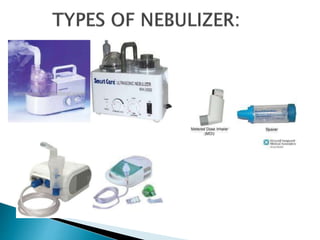
 Mechanical nebulizer
 Soft mist inhaler
 Human powered nebulizer
 Electrical nebulizer
 jet nebulizer
 Ultrasonic wave nebulizer
• Nebulizer and nebulizer connecting tube
• Mouthpiece/mask
• Respiratory medication to be
administered
• Normal saline solution
• Sterile water
• Cotton balls
• Face mask
• Sputum mug with disinfectant
• Gauze pieces
• Kidney tray
• Medication card
1. Position the patient appropriately, allowing optimal
ventilation (semi fowlers position).
2. Assess and record
 breath sounds,
 respiratory status,
 pulse rate
 and other significant respiratory functions.
3. Teach patient the proper way of inhalation:
Slow inhalation through the mouth via the mouthpiece
Short pause after the inspiration
Slow and complete exhalation
Some resting breaths before another deep inhalation
4. Prepare equipments at hand cont……
5. Check doctor’s orders for the medication, prepare
thereafter
6. Place the medication in the nebulizer while adding
the amount of saline solution ordered. or add respules
7. Attach the nebulizer to the compressed gas source
8. Attach the connecting tubes and mouthpiece to the
nebulizer
9. Turn the machine on (notice the mist produced by
the nebulizer)
10. Offer the nebulizer to the patient, offer assistance
until he is able to perform proper inhalation (if unable
to hold the nebulizer [pediatric/geriatric/special
cases], replace the mouthpiece with mask.
• Dry or irritated throat, temporary or occasional
cough
• Sneezing, stuffy or itchy nose, watery eyes.
• Burning or bleeding of your nose
• Nausea, heartburn, stomach pain.
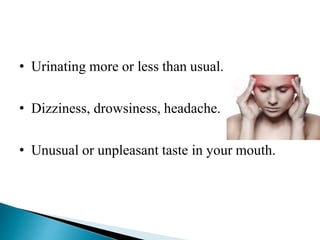
• Urinating more or less than usual.
• Dizziness, drowsiness, headache.
• Unusual or unpleasant taste in your mouth.
• In some cases, nebulization is restricted or
avoided due to possible untoward results or rather
decreased effectiveness such as:
• Patients with unstable and increased blood
pressure
• Individuals with cardiac irritability (may result to
dysrhythmias)
• Persons with increased pulses
• Unconscious patients (inhalation may be done via
mask but the therapeutic effect may be
significantly low)
Nebulization

Nebulization

  • 2.
    DEFINITION Nebulization is theprocess of medication administration via inhalation It utilizes a nebulizer which transports medications to the lungs by means of mist inhalation.
  • 3.
    • Process ofdispersing a liquid (medication) into microscopic particles and delivering into lungs as patient inhales through the nebulizer. • It is used to liquefy and remove retained secretions from the respiratory tract.
  • 4.
    Nebulizers are commonlyused for the treatment of  cystic fibrosis  Asthma  COPD  respiratory diseases or disorders
  • 5.
    • To relieverespiratory insufficiency due to broncho spasm. • To correct the underlying respiratory disorders responsible for broncho spasm. • To liquefy and remove retained thick secretions. • To reduce inflammatory and allergic responses of the upper respiratory tract. • When a person is in respiratory distress.
  • 6.
    • To correcthumidify deficit resulting from inspired air by passing the airway during the use of mechanical ventilation in critically and post surgical patents. • If a person is unable to use a inhaler. • When a person has a acute asthma attack. • If a person has stridor. • Respiratory congestions • Pneumonia • Atelectasis
  • 7.
     CONTRAINDICATIONS In somecases, Nebulization is restricted or avoided due to possible untoward results or rather decreased effectiveness such as: • Patients with unstable and increased blood pressure • Individuals with cardiac irritability (may result to dysrhythmias) • Persons with increased pulses • Unconscious patients (inhalation may be done via mask but the therapeutic effect may be significantly low)
  • 8.
     Mechanical nebulizer Soft mist inhaler  Human powered nebulizer  Electrical nebulizer  jet nebulizer  Ultrasonic wave nebulizer
  • 10.
    • Nebulizer andnebulizer connecting tube • Mouthpiece/mask • Respiratory medication to be administered • Normal saline solution • Sterile water • Cotton balls
  • 11.
    • Face mask •Sputum mug with disinfectant • Gauze pieces • Kidney tray • Medication card
  • 13.
    1. Position thepatient appropriately, allowing optimal ventilation (semi fowlers position). 2. Assess and record  breath sounds,  respiratory status,  pulse rate  and other significant respiratory functions. 3. Teach patient the proper way of inhalation: Slow inhalation through the mouth via the mouthpiece Short pause after the inspiration Slow and complete exhalation Some resting breaths before another deep inhalation 4. Prepare equipments at hand cont……
  • 14.
    5. Check doctor’sorders for the medication, prepare thereafter 6. Place the medication in the nebulizer while adding the amount of saline solution ordered. or add respules 7. Attach the nebulizer to the compressed gas source 8. Attach the connecting tubes and mouthpiece to the nebulizer 9. Turn the machine on (notice the mist produced by the nebulizer) 10. Offer the nebulizer to the patient, offer assistance until he is able to perform proper inhalation (if unable to hold the nebulizer [pediatric/geriatric/special cases], replace the mouthpiece with mask.
  • 15.
    • Dry orirritated throat, temporary or occasional cough • Sneezing, stuffy or itchy nose, watery eyes. • Burning or bleeding of your nose • Nausea, heartburn, stomach pain.
  • 16.
    • Urinating moreor less than usual. • Dizziness, drowsiness, headache. • Unusual or unpleasant taste in your mouth.
  • 17.
    • In somecases, nebulization is restricted or avoided due to possible untoward results or rather decreased effectiveness such as: • Patients with unstable and increased blood pressure • Individuals with cardiac irritability (may result to dysrhythmias) • Persons with increased pulses • Unconscious patients (inhalation may be done via mask but the therapeutic effect may be significantly low)