Downloaded 943 times

![Bucket Sort
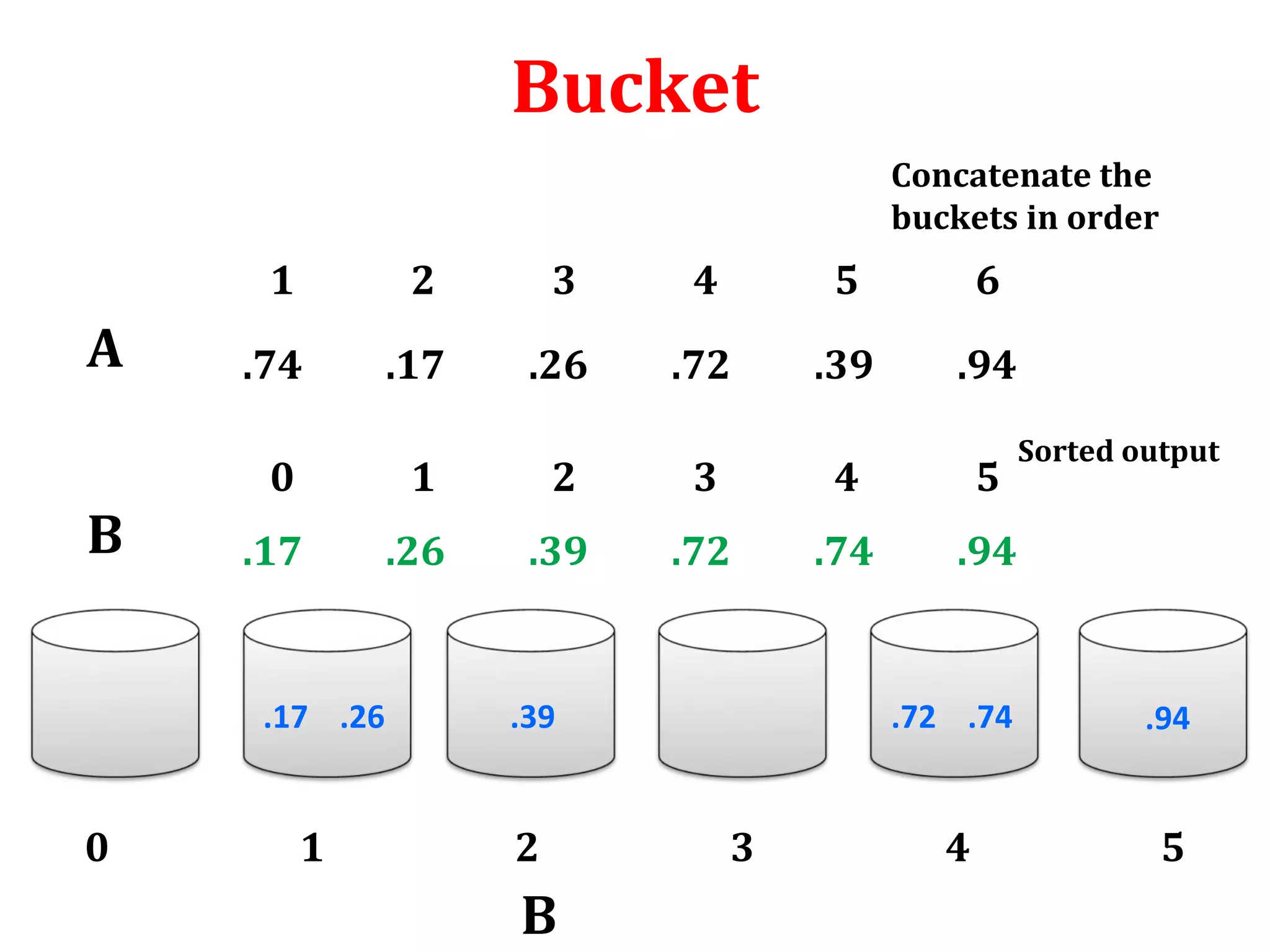
Bucket sort assumes that the input is generated by a random
process and drawn from a uniform distribution.
In other words the elements are distributed uniformly and
independently over the interval [0,1].
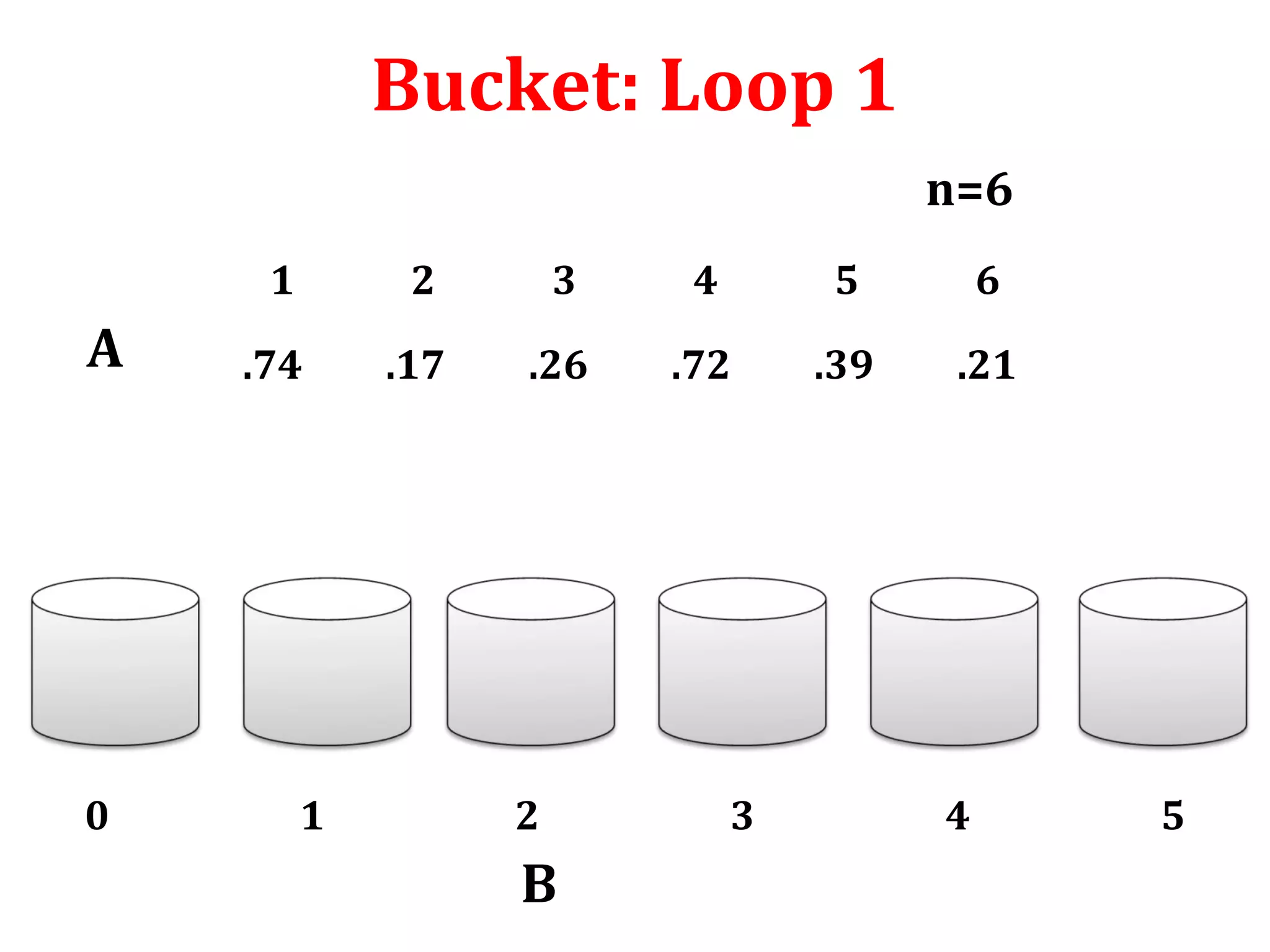
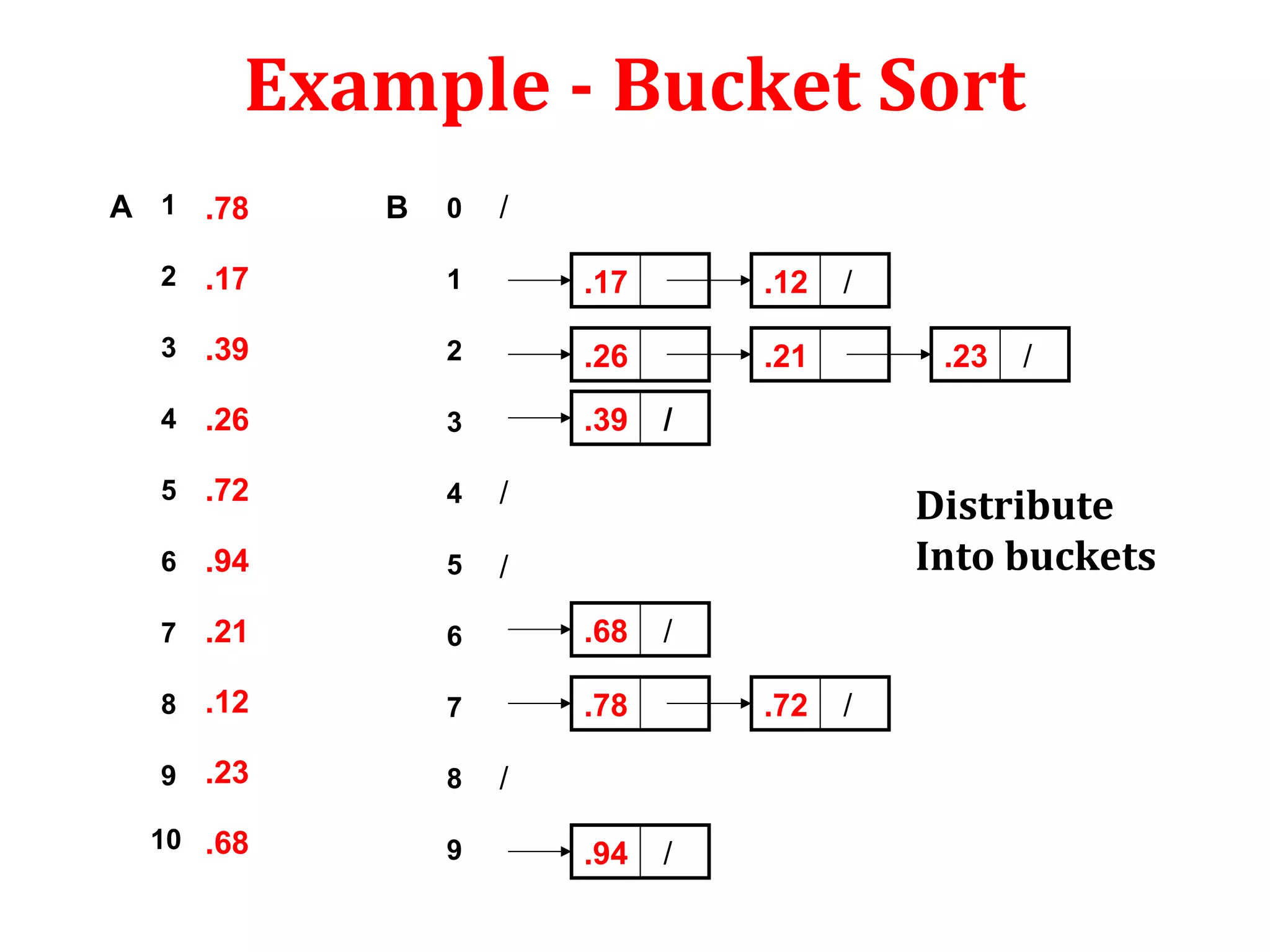
Bucket sort divides the interval [0,1] into n equal sized
subintervals or buckets. Then distributes the n inputs into
these buckets.
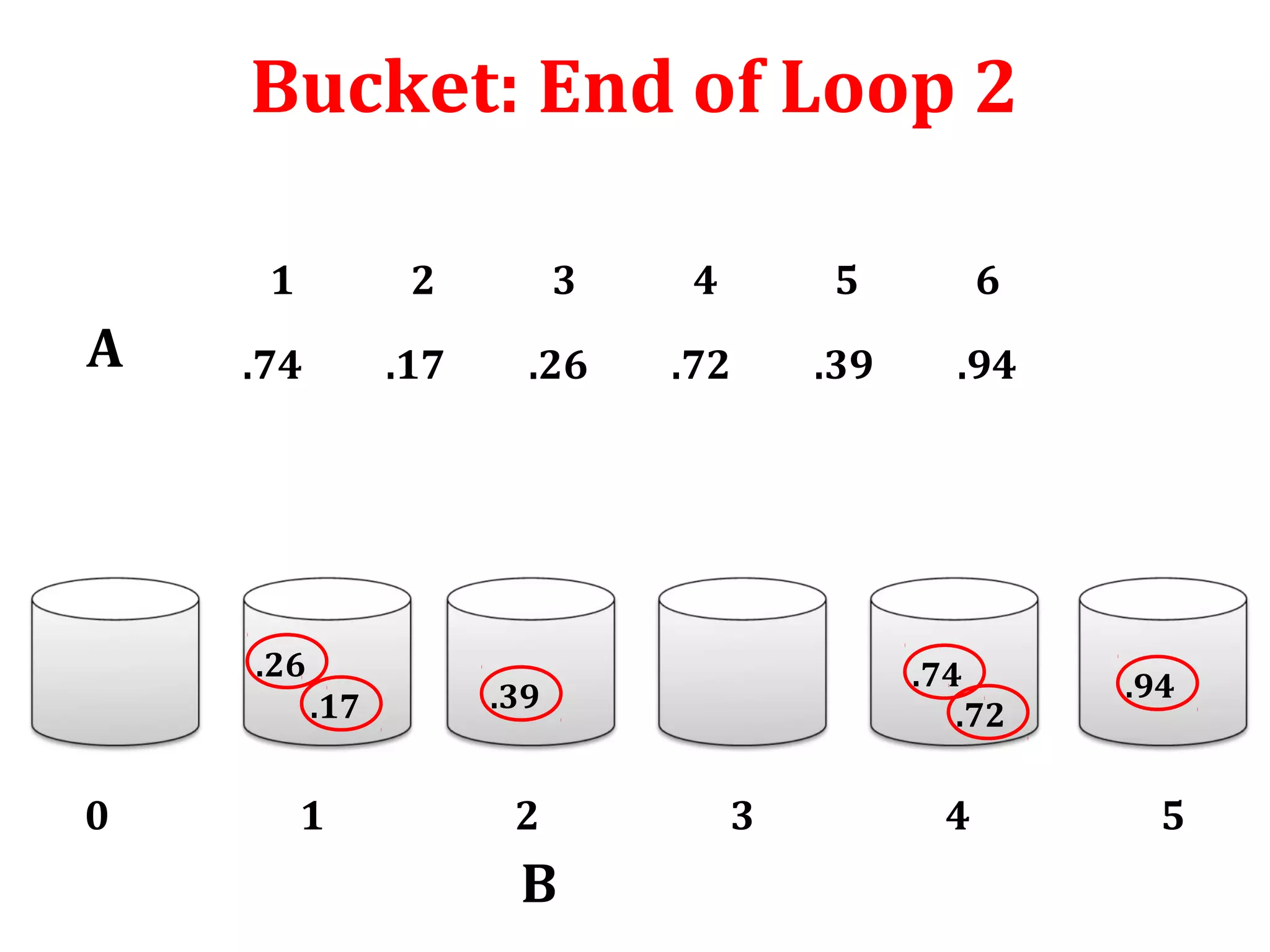
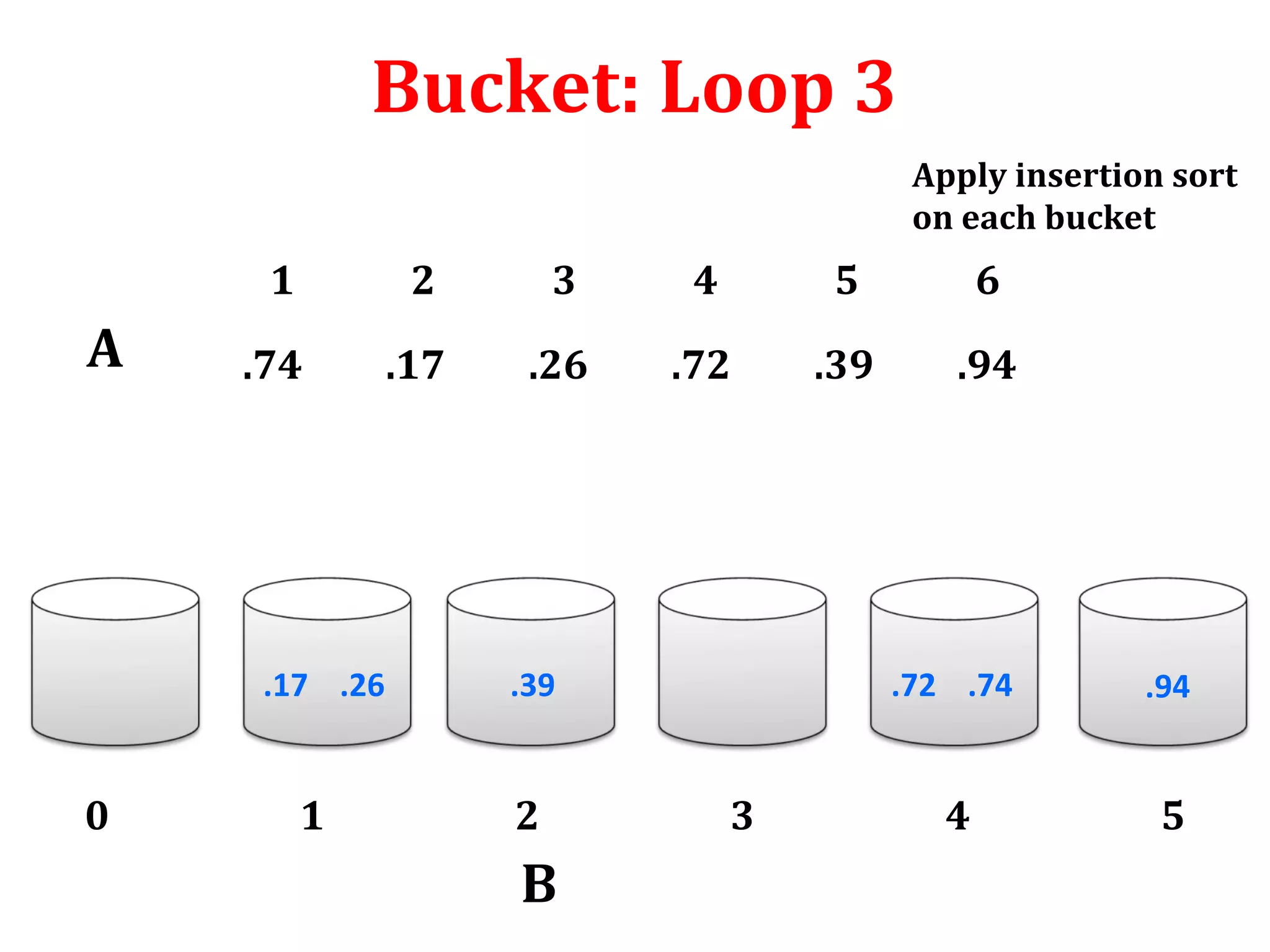
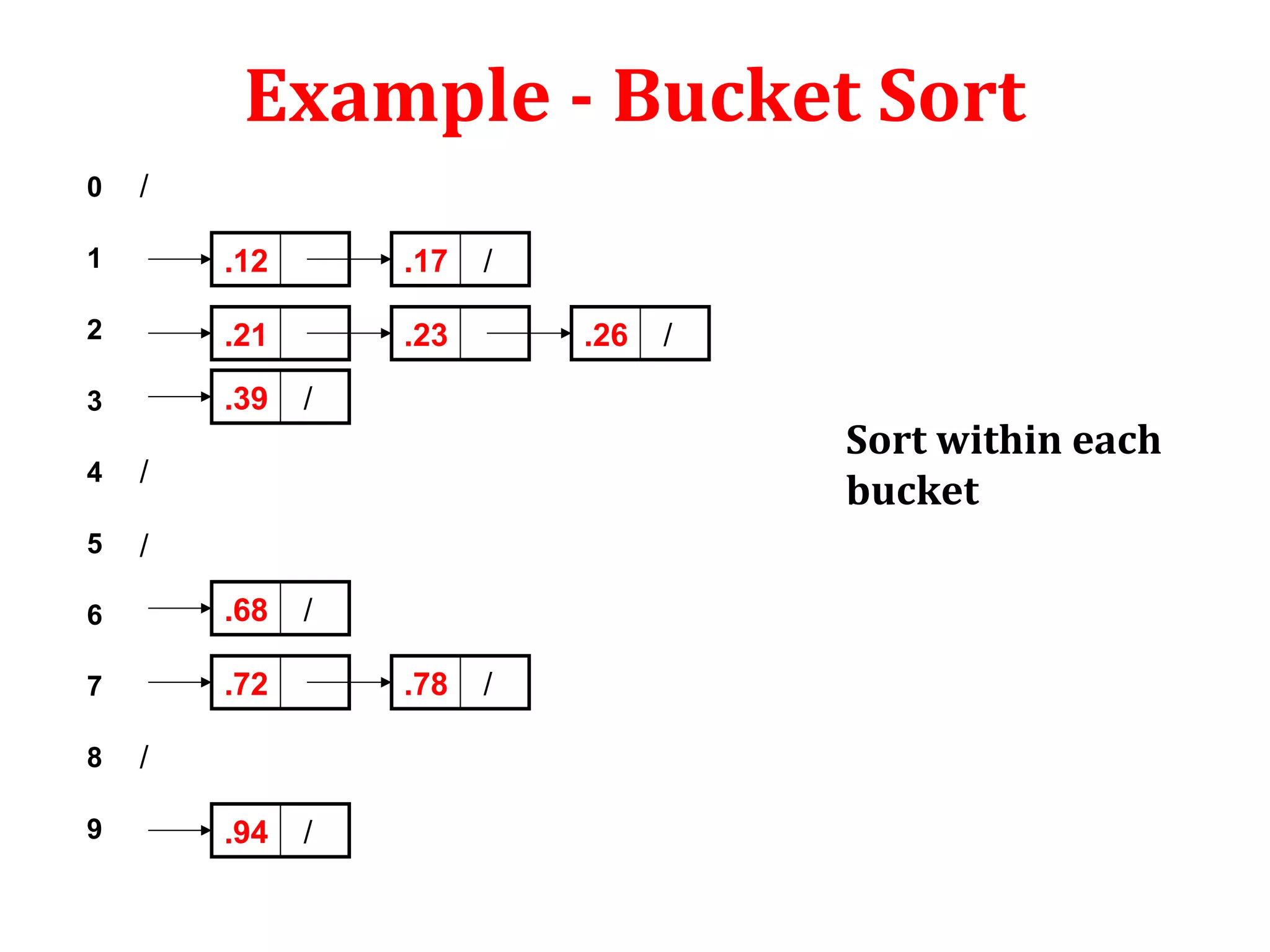
After that the elements of each buckets are sorted using a
sorting algorithm generally using insertion or quick sort.
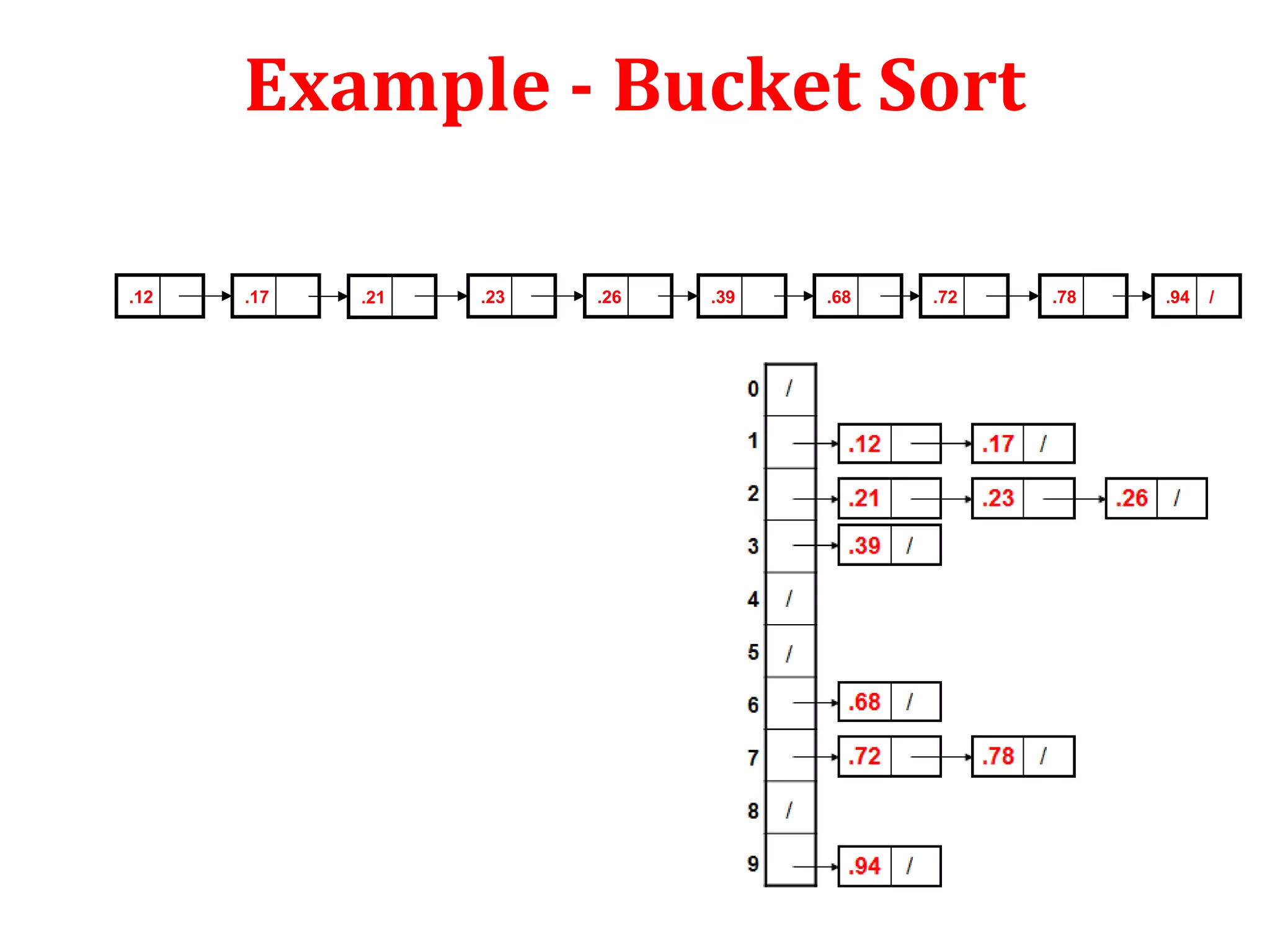
Finally the buckets are concatenated together in order.
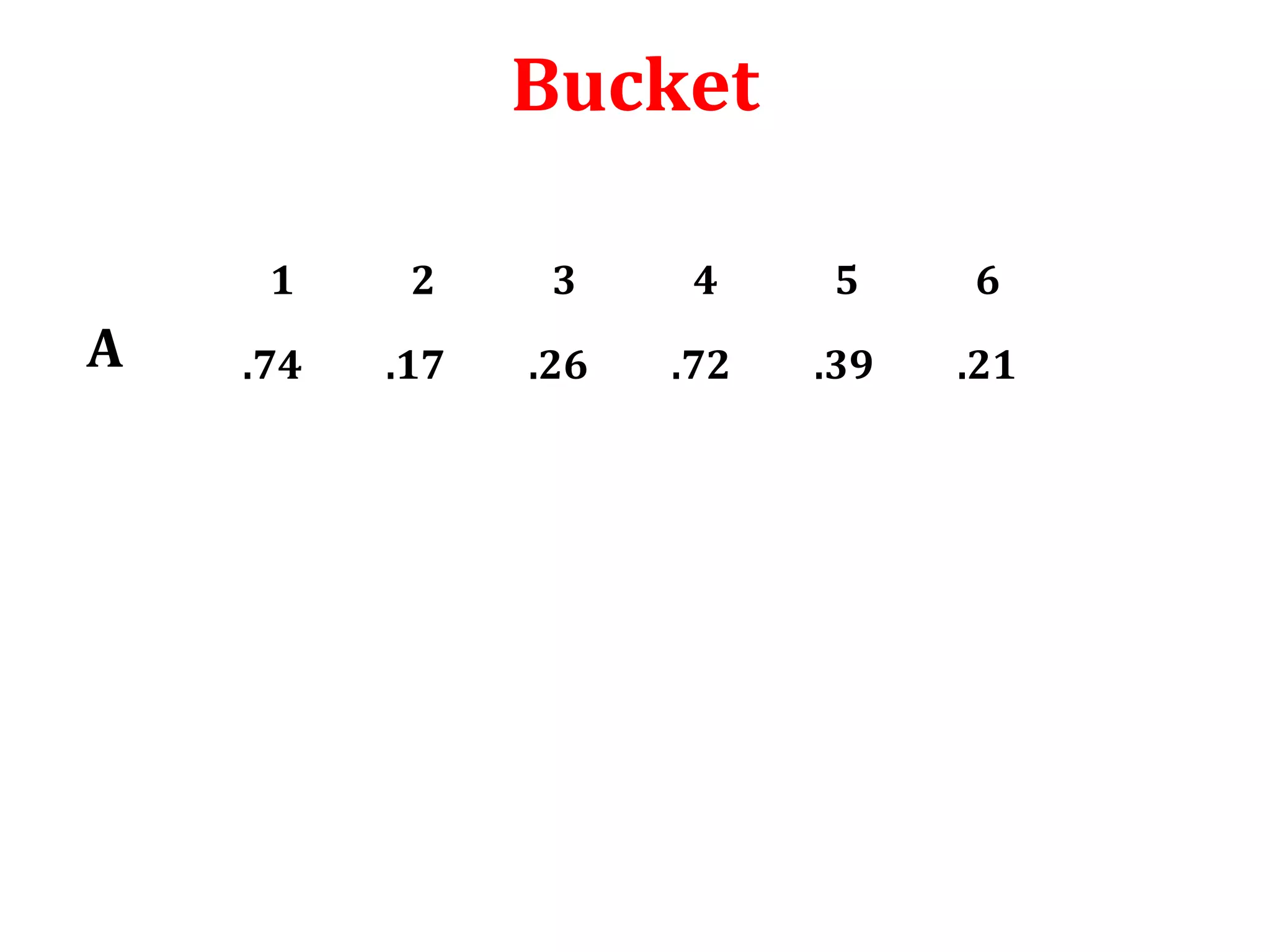
Consider that the input is an n-element array A and each
element A[i] in the array satisfies the 0<=A[i]<1](https://image.slidesharecdn.com/bucketsort-140222062606-phpapp01/75/Bucket-sort-2-2048.jpg)
![Bucket Sort Algorithm
1.
2.
3.
4.
5.
6.
7.
8.
9.
Bucket-Sort(A)
Let B[0….n-1] be a new array
n = length[A]
for i = 0 to n-1
make B[i] an empty list
for i = 1 to n
do insert A[i] into list B[ n A[i] ]
for i = 0 to n-1
do sort list B[i] with Insertion-Sort
Concatenate lists B[0], B[1],…,B[n-1] together in
order](https://image.slidesharecdn.com/bucketsort-140222062606-phpapp01/75/Bucket-sort-3-2048.jpg)
![Bucket: Loop 2
FOR n=6, i=1
1
A
2
3
4
5
6
.74
.17
.26
.72
.39
.21
B[ n A[i] ] = B[ 6X.74 ]=B[ 4.44 ]=B[4]
0
1
2
B
3
4
5](https://image.slidesharecdn.com/bucketsort-140222062606-phpapp01/75/Bucket-sort-6-2048.jpg)
![Bucket: Loop 2
FOR n=6, i=2
1
A
2
3
4
5
6
.74
.17
.26
.72
.39
.21
B[ n A[i] ] = B[ 6X.17 ]=B[ 1.02 ]=B[1]
.74
0
1
2
B
3
4
5](https://image.slidesharecdn.com/bucketsort-140222062606-phpapp01/75/Bucket-sort-7-2048.jpg)
![Bucket: Loop 2
FOR n=6, i=3
1
A
2
3
4
5
6
.74
.17
.26
.72
.39
.21
B[ n A[i] ] = B[ 6X.26 ]=B[ 1.56 ]=B[1]
.74
.17
0
1
2
B
3
4
5](https://image.slidesharecdn.com/bucketsort-140222062606-phpapp01/75/Bucket-sort-8-2048.jpg)
![Bucket: Loop 2
FOR n=6, i=4
1
A
2
3
4
5
6
.74
.17
.26
.72
.39
.21
B[ n A[i] ] = B[ 6X.72 ]=B[ 4.32 ]=B[4]
.26
.74
.17
0
1
2
B
3
4
5](https://image.slidesharecdn.com/bucketsort-140222062606-phpapp01/75/Bucket-sort-9-2048.jpg)
![Bucket: Loop 2
FOR n=6, i=5
1
A
2
3
4
5
6
.74
.17
.26
.72
.39
.21
B[ n A[i] ] = B[ 6X.39 ]=B[ 2.34 ]=B[2]
.26
.74
.72
.17
0
1
2
B
3
4
5](https://image.slidesharecdn.com/bucketsort-140222062606-phpapp01/75/Bucket-sort-10-2048.jpg)
![Bucket: Loop 2
FOR n=6, i=6
1
A
2
3
4
5
6
.74
.17
.26
.72
.39
.94
B[ n A[i] ] = B[ 6X.94 ]=B[ 5.64 ]=B[5]
.26
.17
0
1
.74
.72
.39
2
B
3
4
5](https://image.slidesharecdn.com/bucketsort-140222062606-phpapp01/75/Bucket-sort-11-2048.jpg)
![Analysis of Bucket Sort
1.
2.
3.
4.
5.
6.
7.
8.
9.
Bucket-Sort(A)
Let B[0….n-1] be a new array
n = length[A]
for i = 0 to n-1
make B[i] an empty list
for i = 1 to n
do insert A[i] into list B[ floor of n A[i] ]
for i = 0 to n-1
do sort list B[i] with Insertion-Sort
Concatenate lists B[0], B[1],…,B[n-1]
together in order
In total Bucket sort takes :
Step 5 and 6
takes O(n)
time
Step 7 and 8
takes O(n
log(n/k) time
Step 9 takes
O(k) time
O(n) (if k=Θ(n))](https://image.slidesharecdn.com/bucketsort-140222062606-phpapp01/75/Bucket-sort-18-2048.jpg)
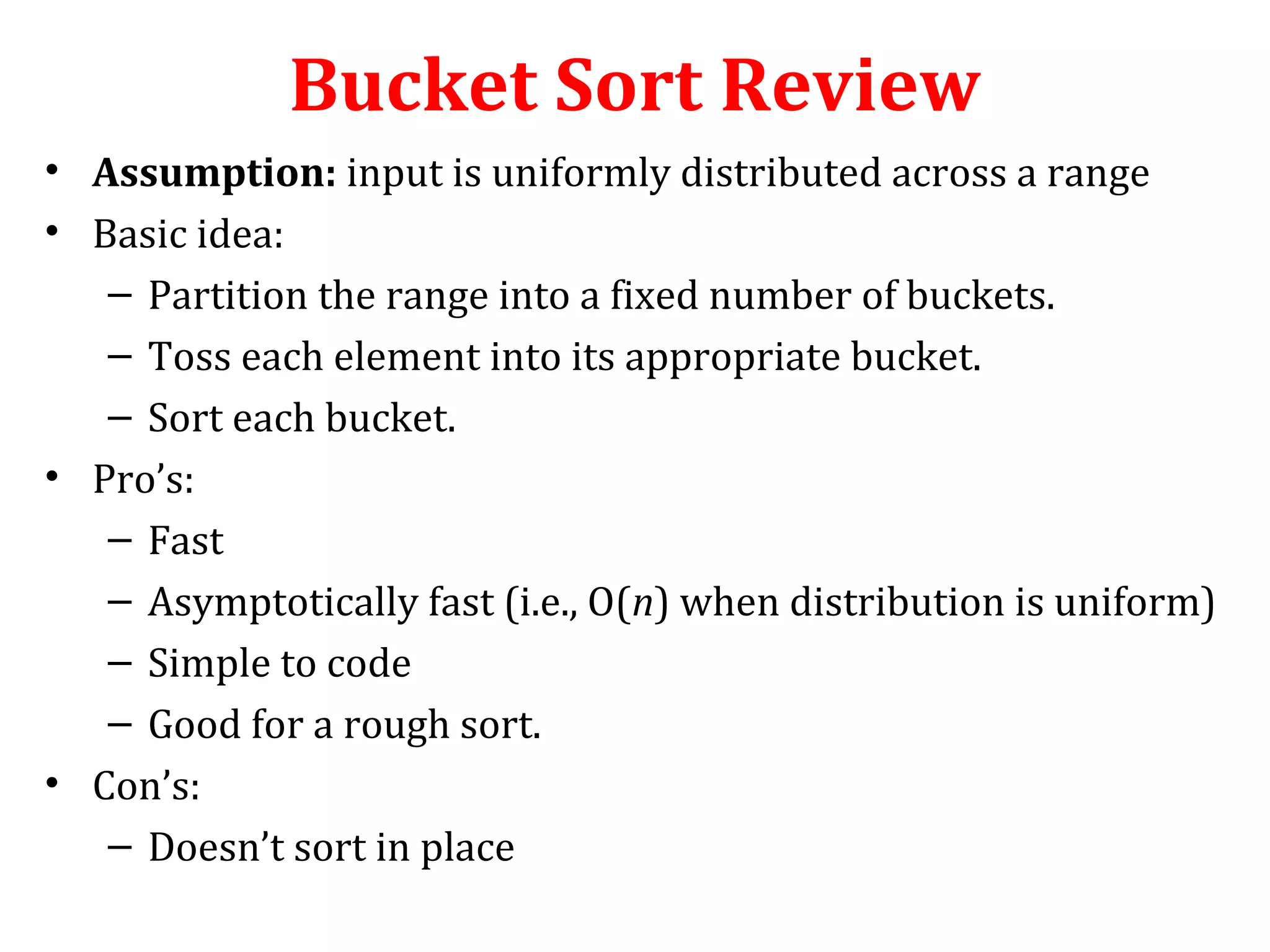


The document describes the bucket sorting algorithm. It works by dividing the input range into buckets and distributing elements into the buckets based on their values. Each bucket is then sorted individually, usually with insertion sort, and concatenated together in order. The time complexity is O(n) when the number of buckets k is Θ(n), as distributing elements takes O(n) time, sorting each bucket takes O(n log(n/k)) time, and concatenating takes O(k) time. Bucket sort assumes uniform distribution of input elements across the range.


![Data Structures - Lecture 8 [Sorting Algorithms]](https://cdn.slidesharecdn.com/ss_thumbnails/lecture-8sortingalgorithms-150205105023-conversion-gate02-thumbnail.jpg?width=640&height=640&fit=bounds)


