This document explains the bucket sort algorithm. It works by dividing the range of possible input values into buckets. Elements are distributed into the buckets and then sorted within each bucket, usually using a simpler algorithm like insertion sort. The sorted buckets are then concatenated together to produce the fully sorted output array. An example is provided to illustrate bucket sort on an array of random values between 0 and 1. Pseudocode for the bucket sort algorithm is also presented.

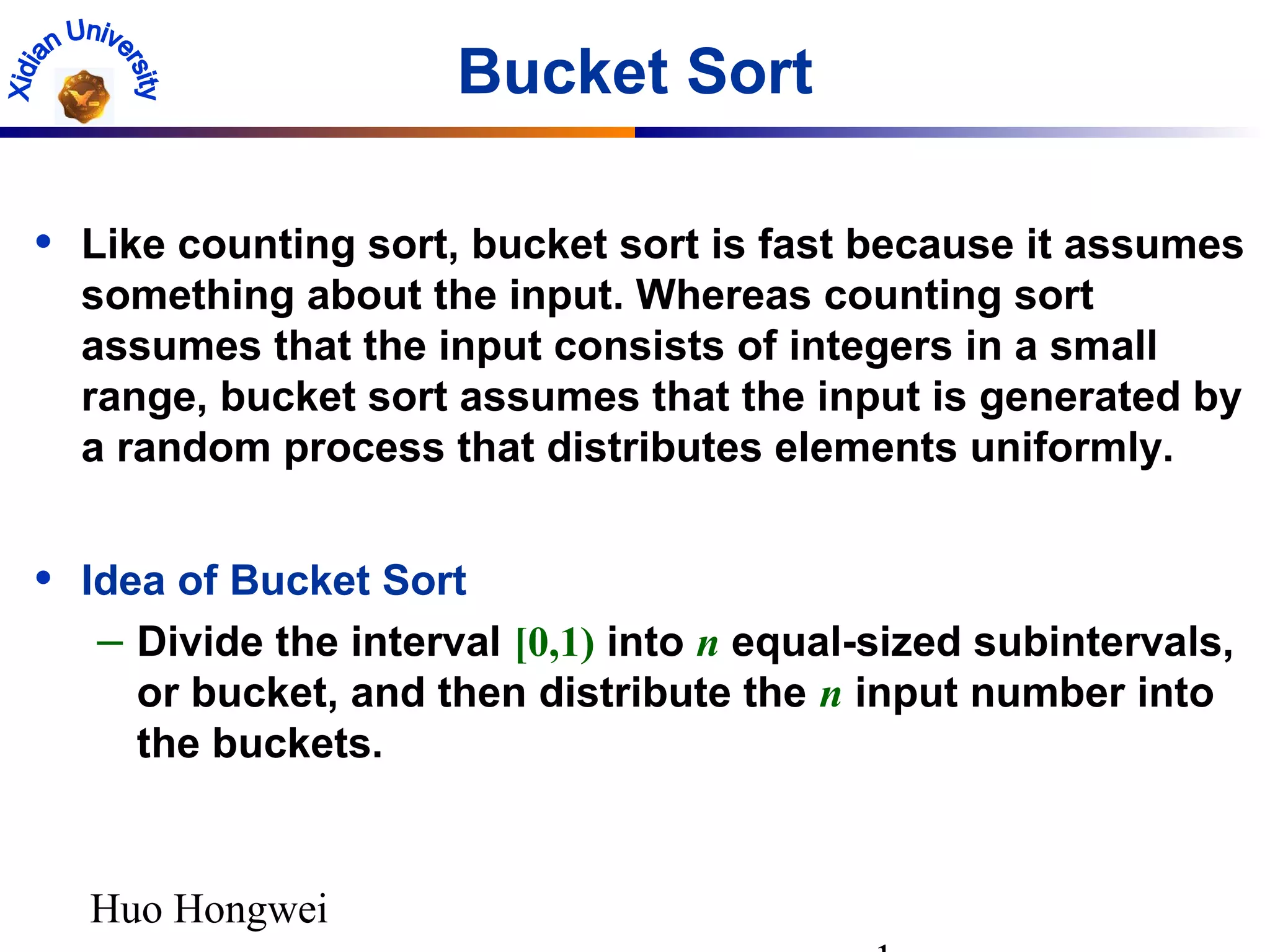
![Huo Hongwei
Bucket Sort
• Assume that all the input is generated by a random
process that distributes elements uniform over the
interval [0,1)
• Bucket sort
Allocate a bucket for each value of the key
»That is, insert A[i] into list B[nA[i]]
For each bucket,
»sort list B[i] with insertion sort
concatenate the list B[0], B[1], …, B[n-1] together
in order](https://image.slidesharecdn.com/bucketsort-150512230622-lva1-app6891/85/Bucket-sort-2-320.jpg)
![Huo Hongwei
Bucket Sort Example
• A=(0.5, 0.1, 0.3, 0.4, 0.3, 0.2, 0.1, 0.1, 0.5, 0.4, 0.5)
Sorted list:
0.1, 0.1, 0.1, 0.2, 0.3, 0.3,
0.4, 0.4, 0.5, 0.5, 0.5
bucket in array
B[1] 0.1, 0.1, 0.1
B[2] 0.2
B[3] 0.3, 0.3
B[4] 0.4, 0.4
B[5] 0.5, 0.5, 0.5](https://image.slidesharecdn.com/bucketsort-150512230622-lva1-app6891/85/Bucket-sort-3-320.jpg)
![Huo Hongwei
Bucket Sort Algorithm
BUCKET-SORT(A)
1 n ← length[A]
2 for i ← 1 to n
3 do insert A[i] into list B[nA[i]]
4 for i ← 1 to n-1
5 do sort list B[i] with insertion sort
6 concatenate the list B[0],B[1],…,B[n-1] together in order
BUCKET SORT](https://image.slidesharecdn.com/bucketsort-150512230622-lva1-app6891/85/Bucket-sort-4-320.jpg)
![Huo Hongwei
Another Example
(a) The input array A[1..10]
(b) The array B[0..9] of sorted lists(buckets) after line 5 of the algorithm.
.39
.17
.78
.26
.72
.12
.21
.94
.23
.68
3
2
1
4
5
8
7
6
9
10
A
/
/
/
/
2
1
0
3
4
7
6
5
8
9
B
.12 .17 /
.21 .23
.39 /
.68 /
.72 .78 /
.94 /
.26 /
(a) (b)](https://image.slidesharecdn.com/bucketsort-150512230622-lva1-app6891/85/Bucket-sort-5-320.jpg)
![Huo Hongwei
Another Example
(a) The input array A[1..10]
(b) The array B[0..9] of sorted lists(buckets) after line 5 of the algorithm.
.39
.17
.78
.26
.72
.12
.21
.94
.23
.68
3
2
1
4
5
8
7
6
9
10
A
/
/
/
/
2
1
0
3
4
7
6
5
8
9
B
.12 .17 /
.21 .23
.39 /
.68 /
.72 .78 /
.94 /
.26 /
(a) (b)](https://image.slidesharecdn.com/bucketsort-150512230622-lva1-app6891/85/Bucket-sort-6-320.jpg)


