Franklin Public
Schools
K-12 Math Program
School Committee Meeting
ss
School Committee Meeting
October 25, 2016
Agenda
Overview
Elementary Mathematics (Noelle Hendrixson, Brian Kelley, Victoria Saldana, Jen Violet)
Questions
Middle School Mathematics (Jeff Chaffee, Colleen Donahue, Caryn Parnell)
Questions
High School Mathematics (Ron Taylor)
Questions
Overview
Our goal is to prepare students for both colleges and careers by providing high
quality Mathematics instruction that includes content, process, and real world
application
Our mandate is to align our curriculum to MA frameworks which include both
content and practices
We know that effective learning involves the construction of knowledge rather
than passive or rote learning
We value the process and thinking as well as content and the answer
Overview
As a result:
By design and based on research, schools and learning are very different today
Standardized test or traditional assessments are only one measure of
achievement
We work to meet the needs of all students in a variety of ways
If you have a question, please ask your child’s teacher or the Math Specialist
We value partnerships with families
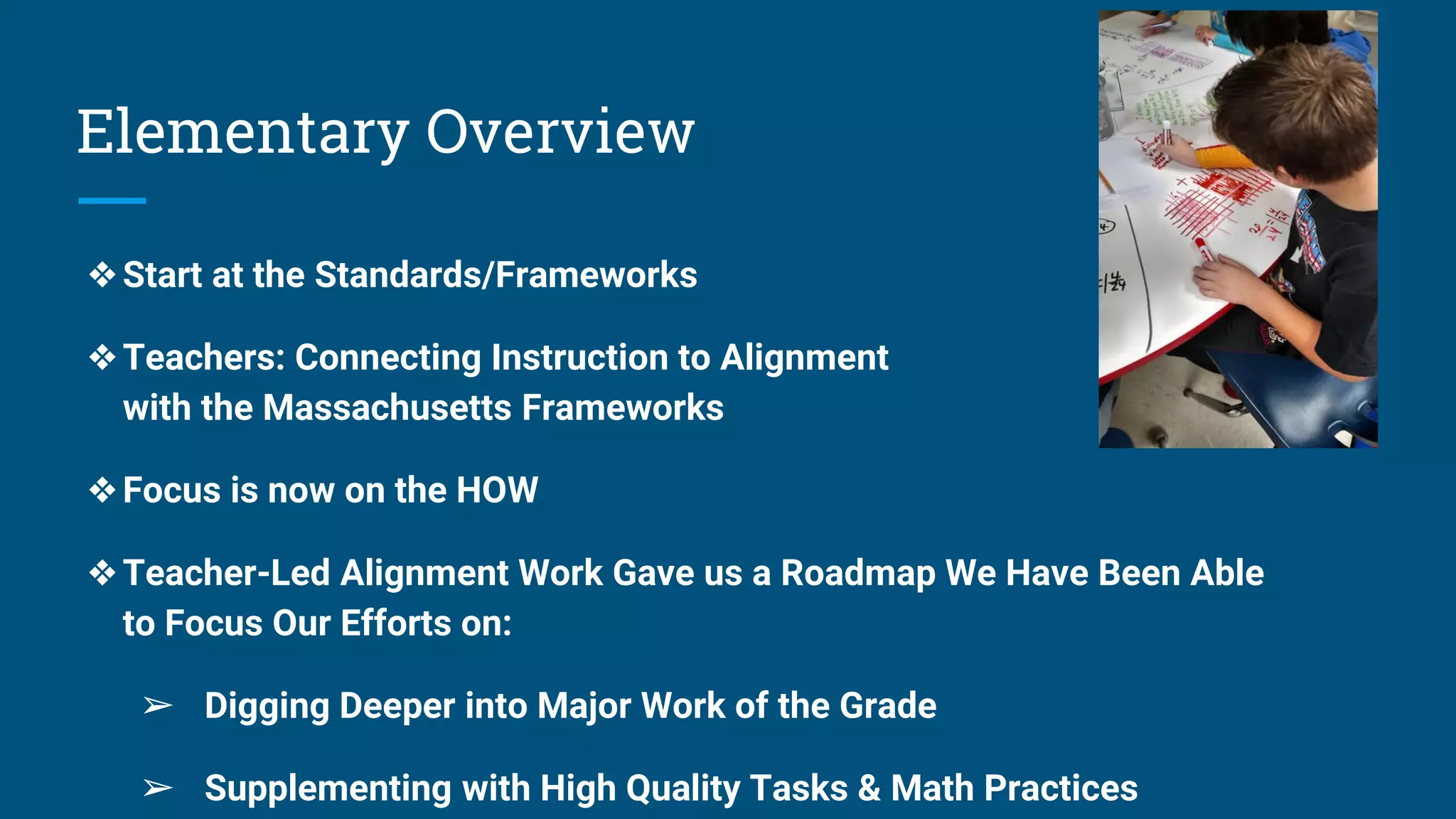
Elementary Overview
❖Start at the Standards/Frameworks
❖Teachers: Connecting Instruction to Alignment
with the Massachusetts Frameworks
❖Focus is now on the HOW
❖Teacher-Led Alignment Work Gave us a Roadmap We Have Been Able
to Focus Our Efforts on:
➢ Digging Deeper into Major Work of the Grade
➢ Supplementing with High Quality Tasks & Math Practices
Elementary Overview
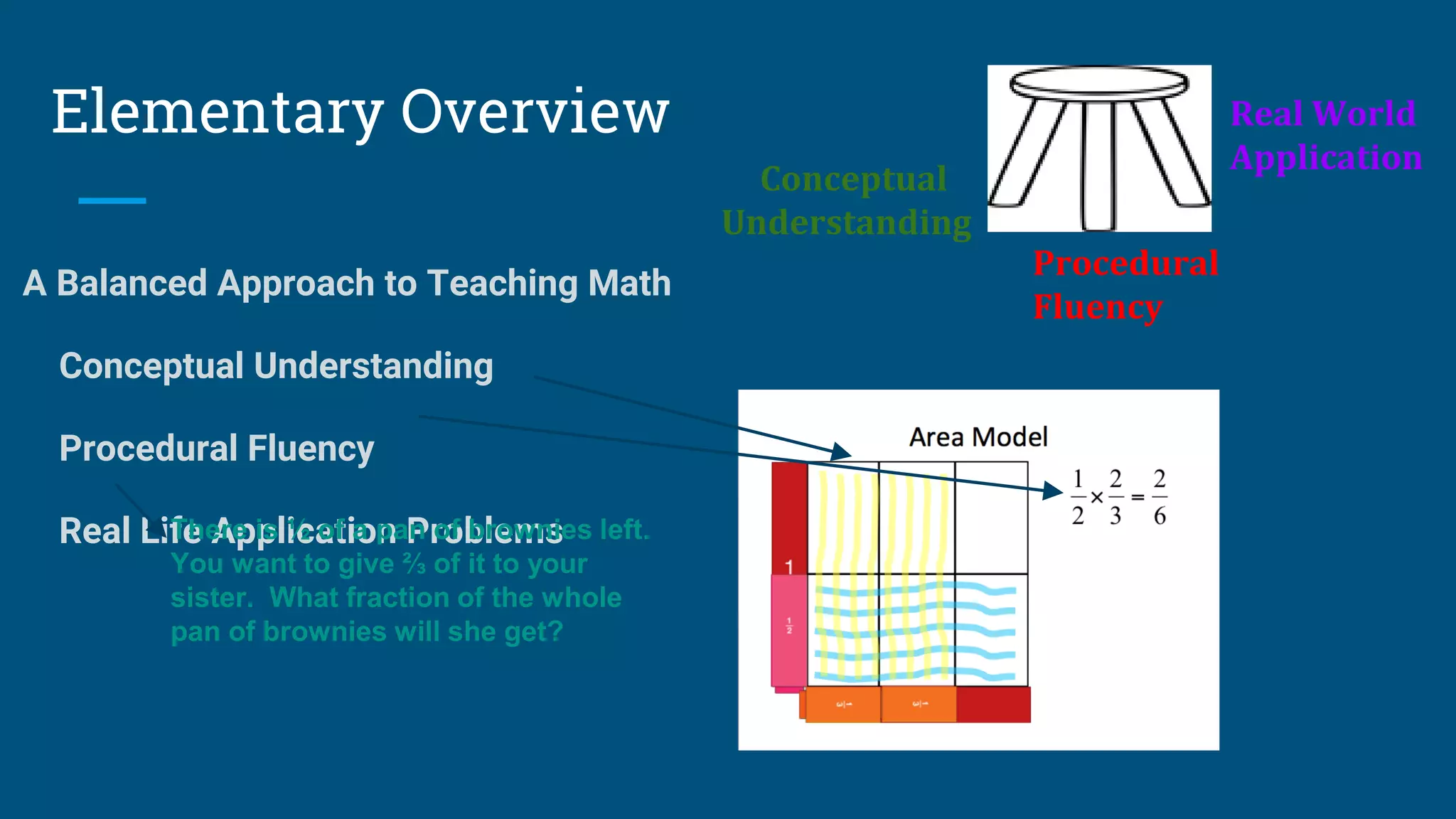
A Balanced Approach to Teaching Math
Conceptual Understanding
Procedural Fluency
Real Life Application Problems
Conceptual
Understanding
Procedural
Fluency
Real World
Application
There is ½ of a pan of brownies left.
You want to give ⅔ of it to your
sister. What fraction of the whole
pan of brownies will she get?
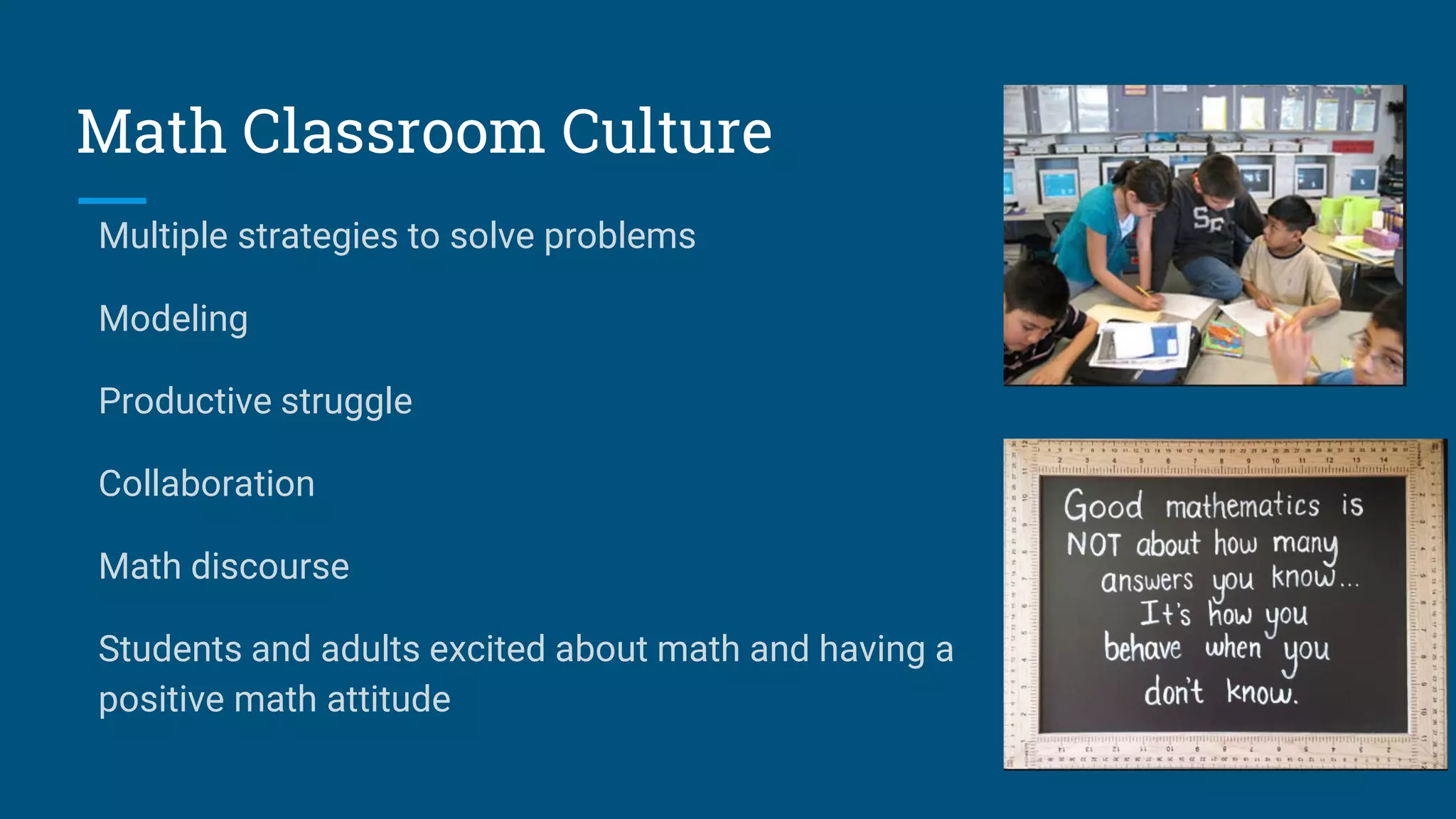
Math Classroom Culture
Multiple strategies to solve problems
Modeling
Productive struggle
Collaboration
Math discourse
Students and adults excited about math and having a
positive math attitude
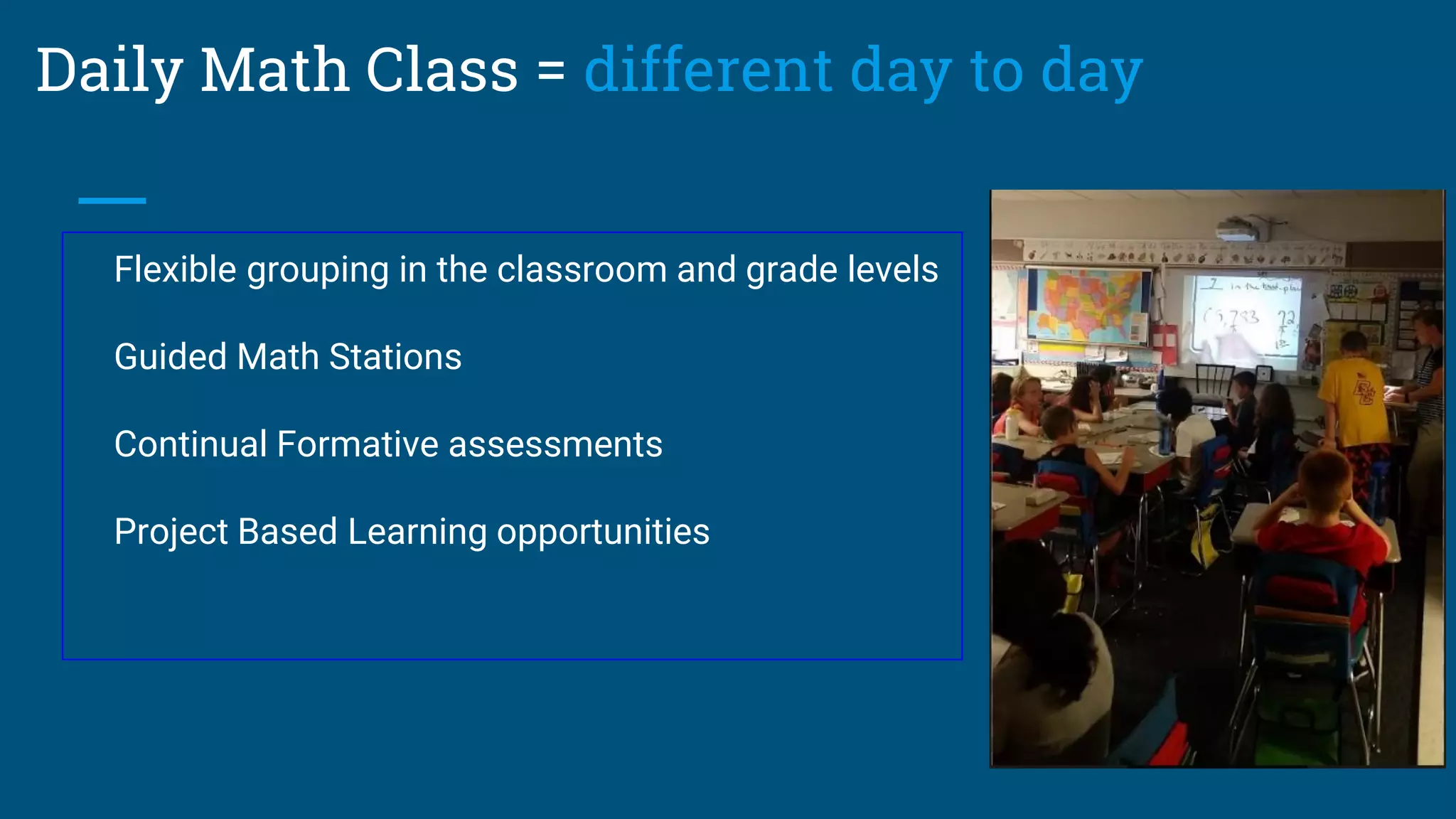
Daily Math Class = different day to day
Flexible grouping in the classroom and grade levels
Guided Math Stations
Continual Formative assessments
Project Based Learning opportunities
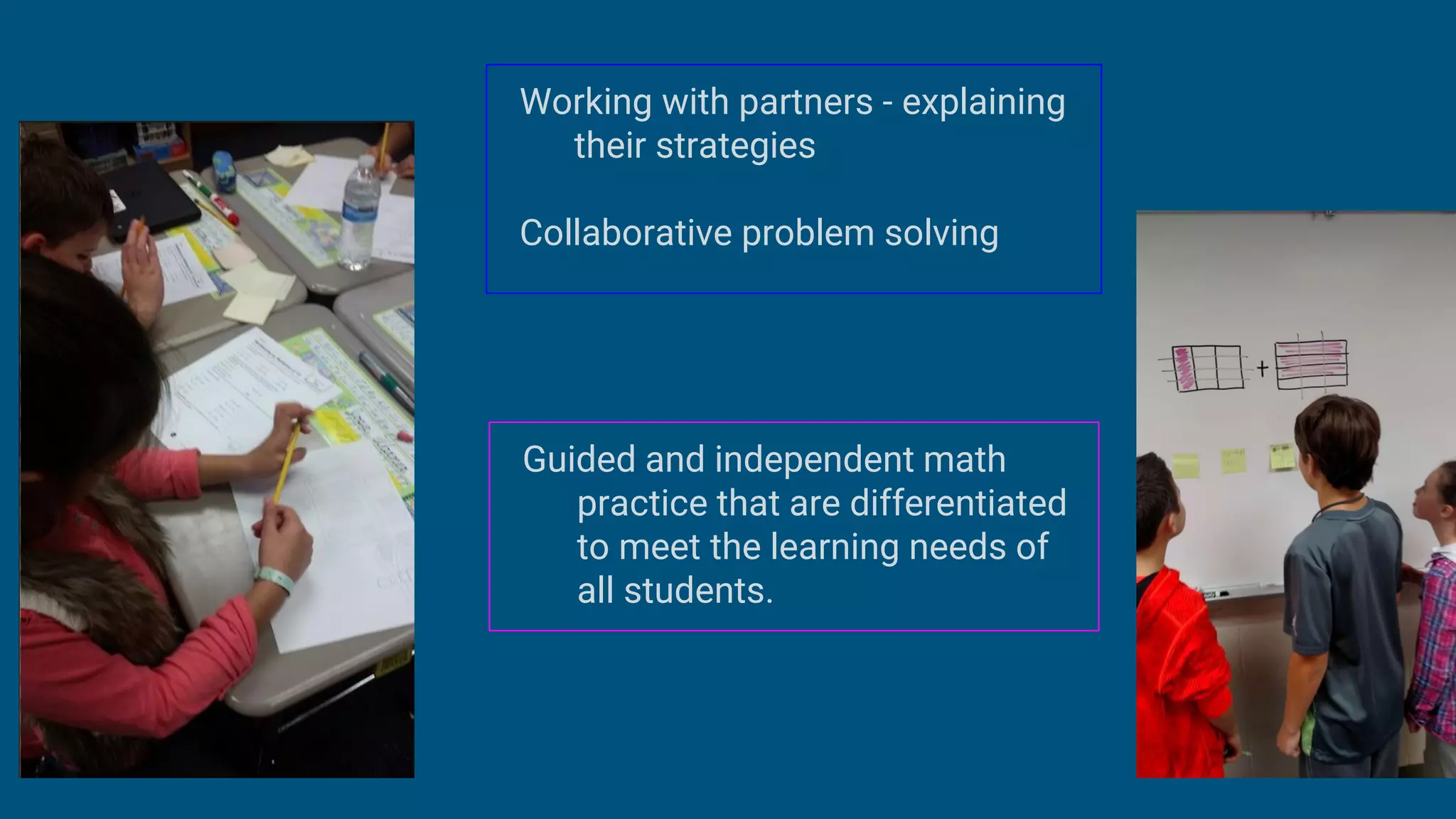
Working with partners - explaining
their strategies
Collaborative problem solving
Guided and independent math
practice that are differentiated
to meet the learning needs of
all students.
Learning how to multiply by tens - we are not just “adding
zero’s to the end” .
So how do we learn to solve 8 x 30 ...
Third Grade - video
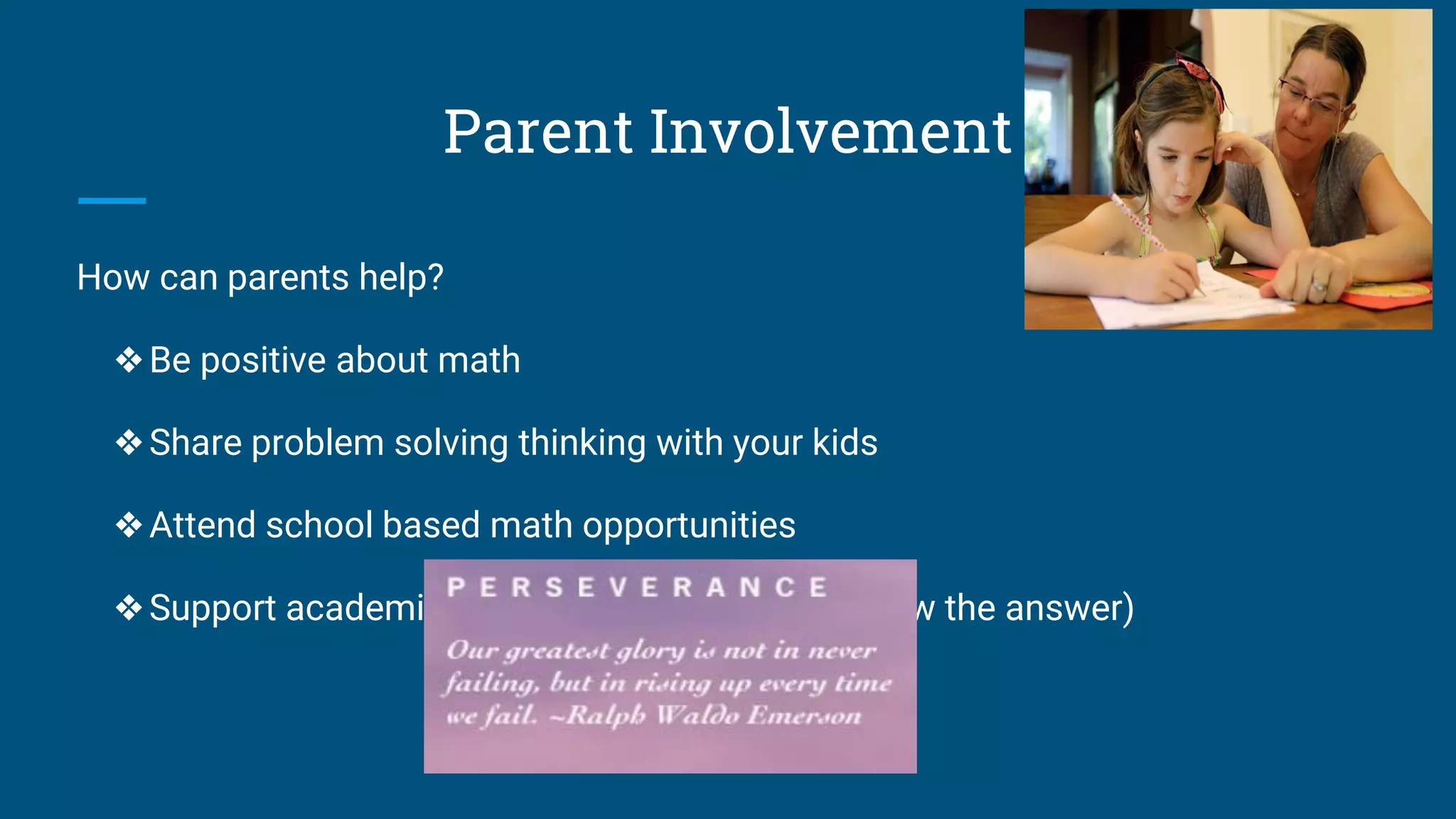
Parent Involvement
How can parents help?
❖Be positive about math
❖Share problem solving thinking with your kids
❖Attend school based math opportunities
❖Support academic risk taking (it’s ok to not know the answer)
Parent Resources
❖Teachers, Math Specialists- Just Ask
❖Individual Teacher Blogs, Web Pages and Twitter Accounts
❖K-5 District Math Site
➢ School Webpage
➢ Math Specialist
★ Student Resources
★ Parent Resources
★ Teacher Resources
★ Helpful Links
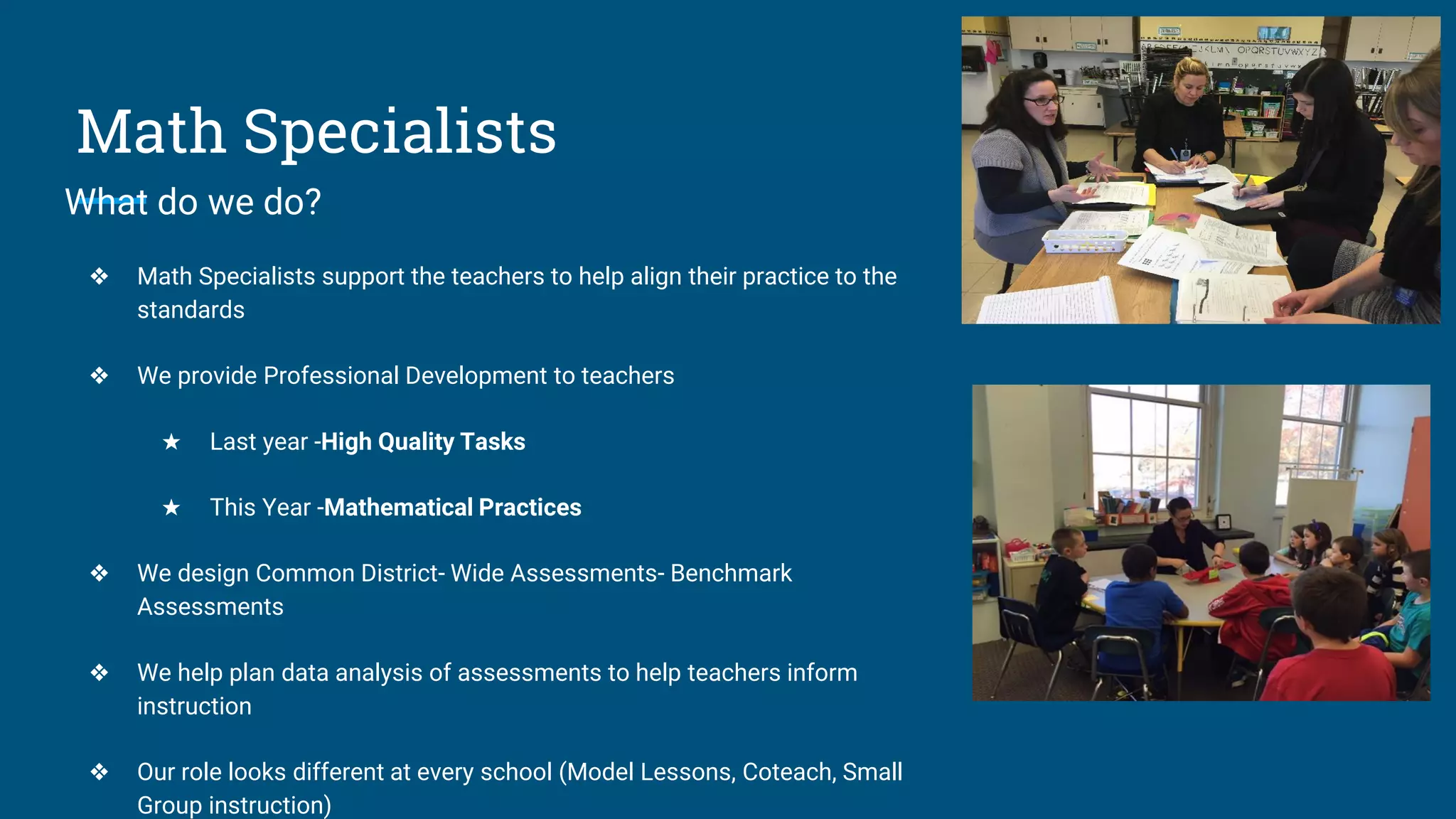
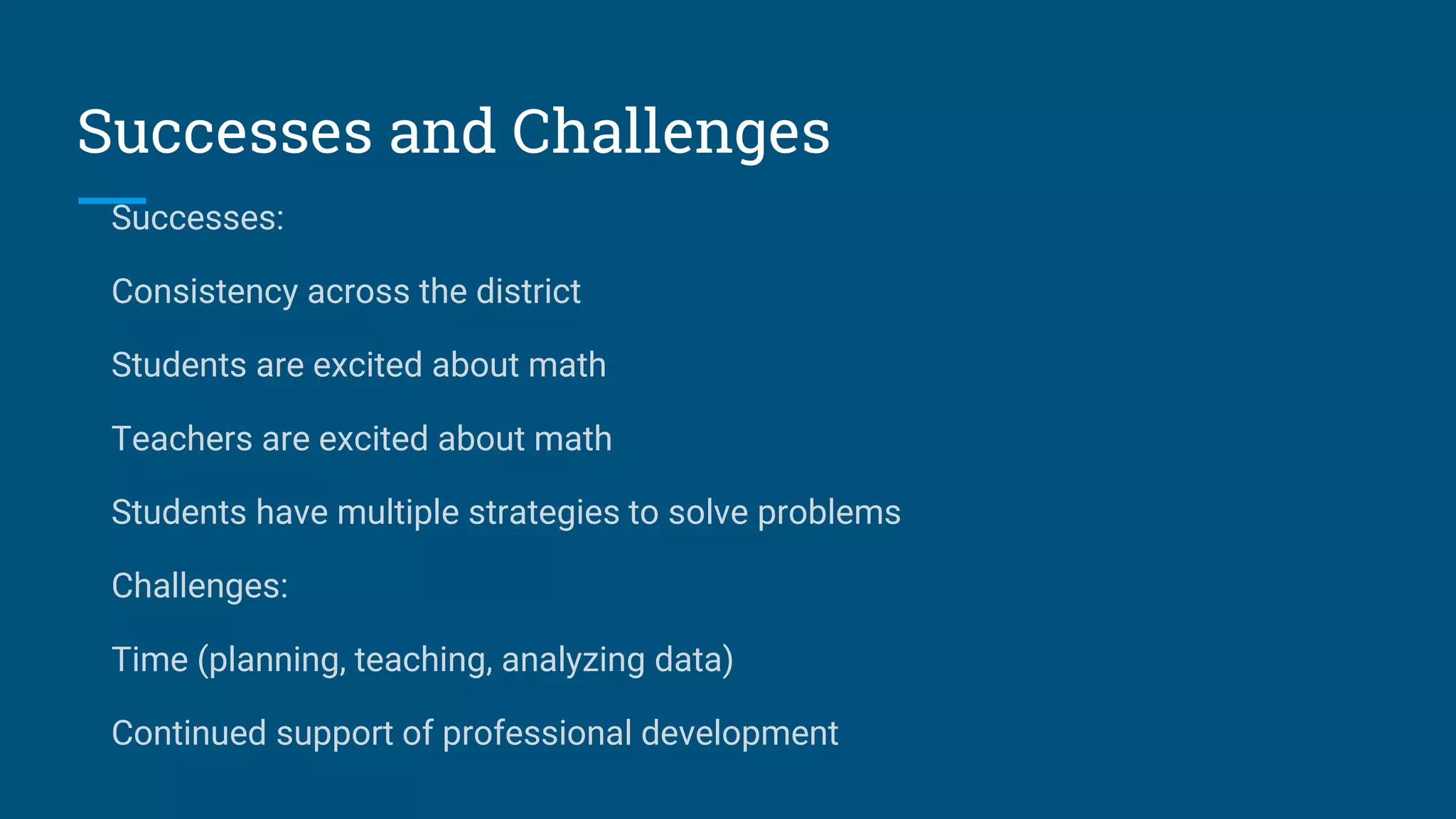
Math Specialists
What do we do?
❖ Math Specialists support the teachers to help align their practice to the
standards
❖ We provide Professional Development to teachers
★ Last year -High Quality Tasks
★ This Year -Mathematical Practices
❖ We design Common District- Wide Assessments- Benchmark
Assessments
❖ We help plan data analysis of assessments to help teachers inform
instruction
❖ Our role looks different at every school (Model Lessons, Coteach, Small
Group instruction)
Successes and Challenges
Successes:
Consistency across the district
Students are excited about math
Teachers are excited about math
Students have multiple strategies to solve problems
Challenges:
Time (planning, teaching, analyzing data)
Continued support of professional development
Questions?
Elementary Math Specialists:
Davis Thayer-Jen Violet
Jefferson-Victoria Saldana
Parmenter-Brian Kelley
Oak Street-Katie Weeman
Kennedy-Beth Murray
Keller-Noelle Hendrixson
Middle School
Mathematics
Jeff Chaffee - RMS
Colleen Donahue - HMMS
Caryn Parnell - ASMS
What does a
Middle School
Math CET do?
● Teach classes
● Supports teachers and students
● Facilitates department meetings
● Serves as liaison
● Curriculum alignment
Professional
Development
Facilitated by
Math CETs
Yearly themes such as :
Rigor
Collaboration
Differentiated Instruction
Activities include:
Creating/revising district unit assessments
Analyzing student work
Co-Teaching Model
Curriculum alignment
Sharing best practices
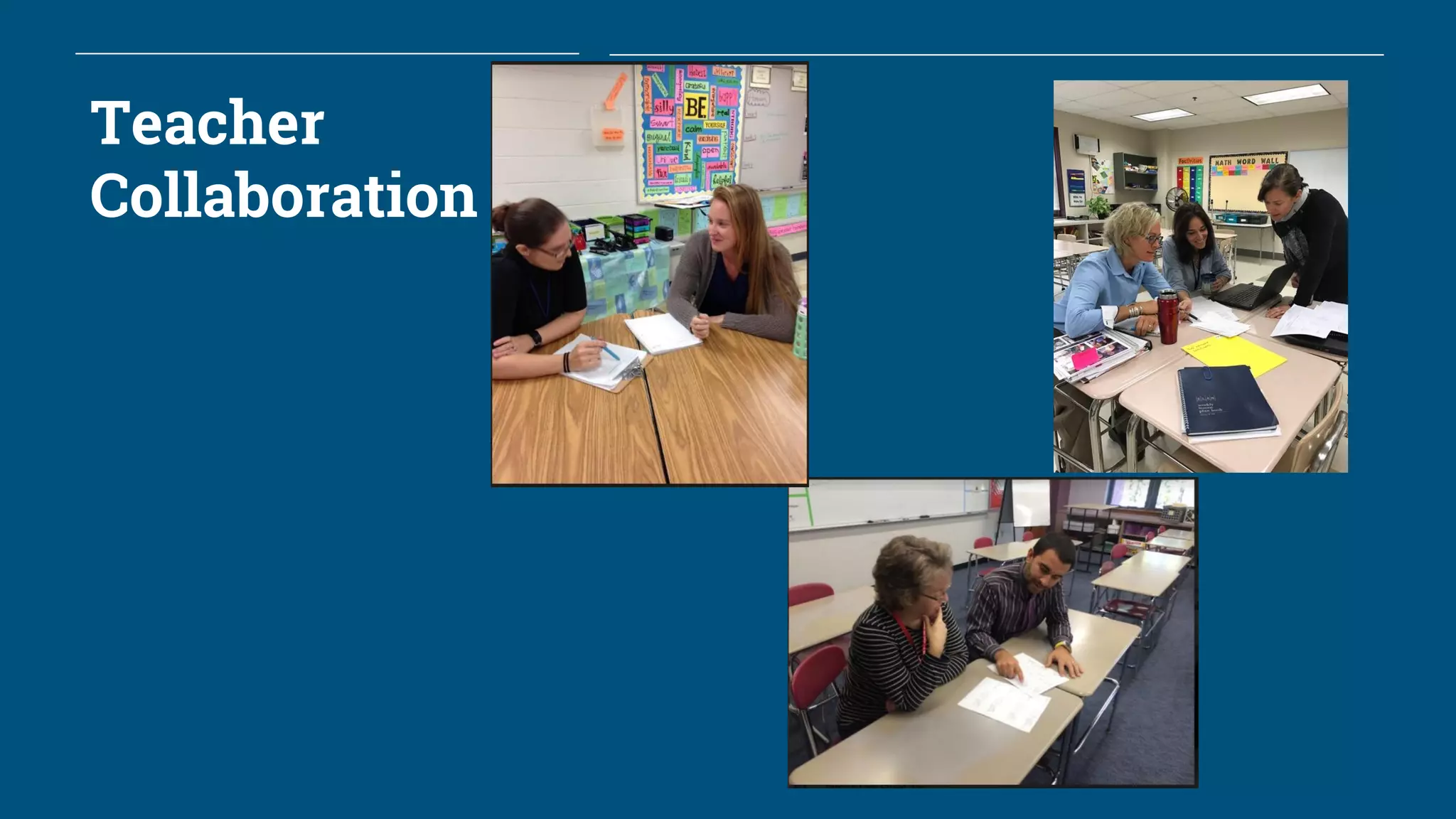
Teacher
Collaboration
Peer
Observation
● What?
● Who?
● Where?
● When?
● Why?
Teacher
Feedback
“I really enjoy the academic and moral support I get
from spending a day with my math peers. I always
leave our professional days recharged with specific
ideas to try in my classroom.”(Catherine Gallo,
RMS)
"Peer observations are a great way to see new
strategies and techniques that I can implement in
my classroom." (Diane Stadelbauer HMMS)
“The middle school math department in Franklin is
a friendly, professional group and every PD
opportunity we have shared has helped me grow as
an educator.”(Samantha Bekkum HMMS)
Teacher
Feedback
(continued)
“I found the time to look at rubrics with my
colleagues very helpful. “ (Rachel Garay-ASMS)
“It was very helpful to brainstorm the rubric with
other math teachers. I am looking forward to
applying the rubrics together against student work
next year. “ (Marianne Zogby-ASMS)
Transitions:
*Elementary to
Middle School
*Middle to High
School
● 6th grade students are heterogeneously
grouped
● 7th/8th grade students are placed in
math courses according to district
determined criteria
● High School Placement
● Communication with regard to:
● Student transition
● Vertical alignment of curriculum
Middle School
Math:
What parents
need to know.
● Reinforce the importance of good study
habits.
● Encourage your child to self-advocate
● Encourage risk taking in learning
● Foster a positive attitude towards math
○ Ask your student “What did you learn today?”
○ Praise success in math
● On-going communication with teacher
and team
Questions?
Jeff Chaffee - RMS
Colleen Donahue - HMMS
Caryn Parnell - ASMS
Franklin High School
Mathematics
Math Department Head
Ron Taylor
Math Class
Experience
Student-Centered
Objectives
Student Choice
One size fits all
Collaboration
Movement
Co-Teaching
The Struggle
Turn and Talk
Dipsticking
Risk Taking
Standards of
Math Practice
Student-Friendly
Version
I can try many times to understand and solve
a math problem
I can make a plan to solve the problem and
discuss other students’ strategies too
I can check to see if my strategy and
calculations are correct
I can use what I already know about math to
solve the problem
Department
Meetings &
Professional
Development
Align and Write Curriculum
Review Grading Practices
Analyze Student Work
Share Best Practices
Present Lesson Snippets
Share Research
What does a
High School
Dept Head do?
Support Teachers and Students
○ Observe teaching and LEARNING
○ Provide non-evaluative feedback
● Facilitate Department Meetings
● Attend Principal Council Meetings
○ Curriculum, Instruction, Assessment
Concerns
&
Solutions
● Initiative
● Perseverance
● Retention
● Word Problems
● Formulas
★ Model
★ Multimedia
★ Student Intuition
Questions?
FHS Math Dept Head
Ron Taylor

K-12 Math Program Update for Franklin (MA) School Committee

  • 1.
    Franklin Public Schools K-12 MathProgram School Committee Meeting ss School Committee Meeting October 25, 2016
  • 2.
    Agenda Overview Elementary Mathematics (NoelleHendrixson, Brian Kelley, Victoria Saldana, Jen Violet) Questions Middle School Mathematics (Jeff Chaffee, Colleen Donahue, Caryn Parnell) Questions High School Mathematics (Ron Taylor) Questions
  • 3.
    Overview Our goal isto prepare students for both colleges and careers by providing high quality Mathematics instruction that includes content, process, and real world application Our mandate is to align our curriculum to MA frameworks which include both content and practices We know that effective learning involves the construction of knowledge rather than passive or rote learning We value the process and thinking as well as content and the answer
  • 4.
    Overview As a result: Bydesign and based on research, schools and learning are very different today Standardized test or traditional assessments are only one measure of achievement We work to meet the needs of all students in a variety of ways If you have a question, please ask your child’s teacher or the Math Specialist We value partnerships with families
  • 5.
    Elementary Overview ❖Start atthe Standards/Frameworks ❖Teachers: Connecting Instruction to Alignment with the Massachusetts Frameworks ❖Focus is now on the HOW ❖Teacher-Led Alignment Work Gave us a Roadmap We Have Been Able to Focus Our Efforts on: ➢ Digging Deeper into Major Work of the Grade ➢ Supplementing with High Quality Tasks & Math Practices
  • 6.
    Elementary Overview A BalancedApproach to Teaching Math Conceptual Understanding Procedural Fluency Real Life Application Problems Conceptual Understanding Procedural Fluency Real World Application There is ½ of a pan of brownies left. You want to give ⅔ of it to your sister. What fraction of the whole pan of brownies will she get?
  • 7.
    Math Classroom Culture Multiplestrategies to solve problems Modeling Productive struggle Collaboration Math discourse Students and adults excited about math and having a positive math attitude
  • 8.
    Daily Math Class= different day to day Flexible grouping in the classroom and grade levels Guided Math Stations Continual Formative assessments Project Based Learning opportunities
  • 9.
    Working with partners- explaining their strategies Collaborative problem solving Guided and independent math practice that are differentiated to meet the learning needs of all students.
  • 10.
    Learning how tomultiply by tens - we are not just “adding zero’s to the end” . So how do we learn to solve 8 x 30 ... Third Grade - video
  • 11.
    Parent Involvement How canparents help? ❖Be positive about math ❖Share problem solving thinking with your kids ❖Attend school based math opportunities ❖Support academic risk taking (it’s ok to not know the answer)
  • 12.
    Parent Resources ❖Teachers, MathSpecialists- Just Ask ❖Individual Teacher Blogs, Web Pages and Twitter Accounts ❖K-5 District Math Site ➢ School Webpage ➢ Math Specialist ★ Student Resources ★ Parent Resources ★ Teacher Resources ★ Helpful Links
  • 13.
    Math Specialists What dowe do? ❖ Math Specialists support the teachers to help align their practice to the standards ❖ We provide Professional Development to teachers ★ Last year -High Quality Tasks ★ This Year -Mathematical Practices ❖ We design Common District- Wide Assessments- Benchmark Assessments ❖ We help plan data analysis of assessments to help teachers inform instruction ❖ Our role looks different at every school (Model Lessons, Coteach, Small Group instruction)
  • 14.
    Successes and Challenges Successes: Consistencyacross the district Students are excited about math Teachers are excited about math Students have multiple strategies to solve problems Challenges: Time (planning, teaching, analyzing data) Continued support of professional development
  • 15.
    Questions? Elementary Math Specialists: DavisThayer-Jen Violet Jefferson-Victoria Saldana Parmenter-Brian Kelley Oak Street-Katie Weeman Kennedy-Beth Murray Keller-Noelle Hendrixson
  • 16.
    Middle School Mathematics Jeff Chaffee- RMS Colleen Donahue - HMMS Caryn Parnell - ASMS
  • 17.
    What does a MiddleSchool Math CET do? ● Teach classes ● Supports teachers and students ● Facilitates department meetings ● Serves as liaison ● Curriculum alignment
  • 18.
    Professional Development Facilitated by Math CETs Yearlythemes such as : Rigor Collaboration Differentiated Instruction Activities include: Creating/revising district unit assessments Analyzing student work Co-Teaching Model Curriculum alignment Sharing best practices
  • 19.
  • 20.
    Peer Observation ● What? ● Who? ●Where? ● When? ● Why?
  • 21.
    Teacher Feedback “I really enjoythe academic and moral support I get from spending a day with my math peers. I always leave our professional days recharged with specific ideas to try in my classroom.”(Catherine Gallo, RMS) "Peer observations are a great way to see new strategies and techniques that I can implement in my classroom." (Diane Stadelbauer HMMS) “The middle school math department in Franklin is a friendly, professional group and every PD opportunity we have shared has helped me grow as an educator.”(Samantha Bekkum HMMS)
  • 22.
    Teacher Feedback (continued) “I found thetime to look at rubrics with my colleagues very helpful. “ (Rachel Garay-ASMS) “It was very helpful to brainstorm the rubric with other math teachers. I am looking forward to applying the rubrics together against student work next year. “ (Marianne Zogby-ASMS)
  • 23.
    Transitions: *Elementary to Middle School *Middleto High School ● 6th grade students are heterogeneously grouped ● 7th/8th grade students are placed in math courses according to district determined criteria ● High School Placement ● Communication with regard to: ● Student transition ● Vertical alignment of curriculum
  • 24.
    Middle School Math: What parents needto know. ● Reinforce the importance of good study habits. ● Encourage your child to self-advocate ● Encourage risk taking in learning ● Foster a positive attitude towards math ○ Ask your student “What did you learn today?” ○ Praise success in math ● On-going communication with teacher and team
  • 25.
    Questions? Jeff Chaffee -RMS Colleen Donahue - HMMS Caryn Parnell - ASMS
  • 26.
    Franklin High School Mathematics MathDepartment Head Ron Taylor
  • 27.
    Math Class Experience Student-Centered Objectives Student Choice Onesize fits all Collaboration Movement Co-Teaching The Struggle Turn and Talk Dipsticking Risk Taking
  • 28.
    Standards of Math Practice Student-Friendly Version Ican try many times to understand and solve a math problem I can make a plan to solve the problem and discuss other students’ strategies too I can check to see if my strategy and calculations are correct I can use what I already know about math to solve the problem
  • 29.
    Department Meetings & Professional Development Align andWrite Curriculum Review Grading Practices Analyze Student Work Share Best Practices Present Lesson Snippets Share Research
  • 30.
    What does a HighSchool Dept Head do? Support Teachers and Students ○ Observe teaching and LEARNING ○ Provide non-evaluative feedback ● Facilitate Department Meetings ● Attend Principal Council Meetings ○ Curriculum, Instruction, Assessment
  • 31.
    Concerns & Solutions ● Initiative ● Perseverance ●Retention ● Word Problems ● Formulas ★ Model ★ Multimedia ★ Student Intuition
  • 32.
    Questions? FHS Math DeptHead Ron Taylor