Classroom-Based Pooled
Testing Initiative
Presentation to the Franklin Public Schools Community
Week of February 8, 2021
Why Pooled Testing?
Theory of Action:
If schools conduct proactive classroom-based pool testing
for students and staff, infected individuals (and close
contacts) who are asymptomatic or presymptomatic can be
identified, proactively isolated and treated.
◎ Provides additional layer of health and safety prevention
and reassurance that could reduce the spread of the
Coronavirus within schools and the greater Franklin
community.
◎ Vaccinations of educators (est. Phase 2: February - April)
will add to the reassurance.
◎ Pool testing should provide better indication of the %
positivity rate within FPS, which will assist with making
decisions on our instructional model.
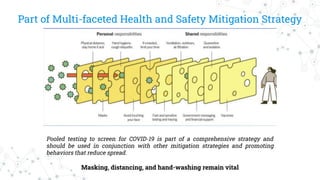
Part of Multi-faceted Health and Safety Mitigation Strategy
Pooled testing to screen for COVID-19 is part of a comprehensive strategy and
should be used in conjunction with other mitigation strategies and promoting
behaviors that reduce spread.
Masking, distancing, and hand-washing remain vital
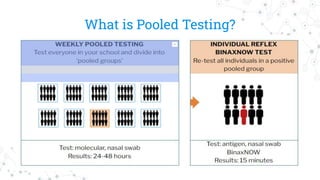
What is Pooled Testing?
◎ Pooling is the combining of respiratory samples from several people
together in a ‘pool’ to conduct one laboratory test to detect SARS CoV 2
(COVID-19).
○ Allows laboratories to test more samples with fewer testing
materials, potentially increasing testing capacity.
◎ The test is performed once per week with an anterior nasal swab for all
consenting staff and students.
◎ Results are typically delivered in 24-48 hours
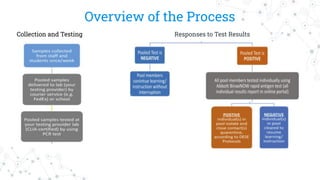
◎ If a pooled test result is positive, then the pool of people receive individual
follow-up testing using the the Abbott BinaxNOW rapid point-of-care
antigen test (results in approx. 15 minutes)
What is Pooled Testing?
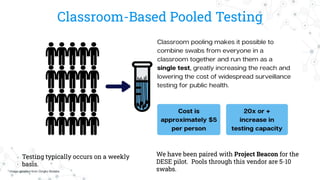
Classroom-Based Pooled Testing
Testing typically occurs on a weekly
basis.
Image adapted from Gingko Biolabs
We have been paired with Project Beacon for the
DESE pilot. Pools through this vendor are 5-10
swabs.
Prerequisites for Pooled Testing
Relatively low rate of the virus among the
population.
High participation rate of individuals being
tested (in this case, students and staff).
◎ About 50% of families responding to our
survey indicated “yes” for participation
with an additional 20% stating “maybe”
◎ About 73% of faculty/staff are interested
in pool testing participation
How Does Classroom-Based Pooled Testing Work?
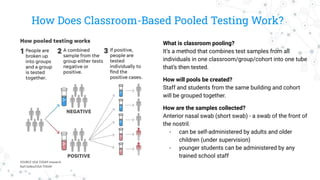
What is classroom pooling?
It’s a method that combines test samples from all
individuals in one classroom/group/cohort into one tube
that’s then tested.
How will pools be created?
Staff and students from the same building and cohort
will be grouped together.
How are the samples collected?
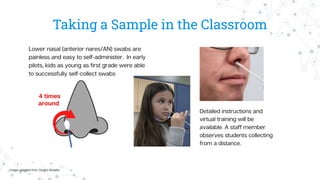
Anterior nasal swab (short swab) - a swab of the front of
the nostril.
- can be self-administered by adults and older
children (under supervision)
- younger students can be administered by any
trained school staff
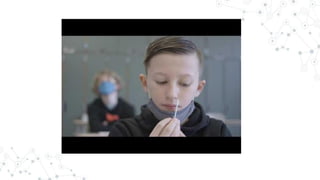
Taking a Sample in the Classroom
Image adapted from Gingko Biolabs
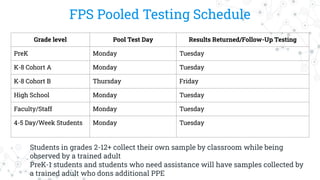
FPS Pooled Testing Schedule
◎ Students in grades 2-12+ collect their own sample by classroom while being
observed by a trained adult
◎ PreK-1 students and students who need assistance will have samples collected by
a trained adult who dons additional PPE
Grade level Pool Test Day Results Returned/Follow-Up Testing
PreK Monday Tuesday
K-8 Cohort A Monday Tuesday
K-8 Cohort B Thursday Friday
High School Monday Tuesday
Faculty/Staff Monday Tuesday
4-5 Day/Week Students Monday Tuesday
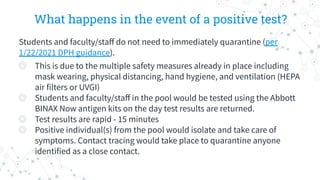
What happens in the event of a positive test?
Students and faculty/staff do not need to immediately quarantine (per
1/22/2021 DPH guidance).
◎ This is due to the multiple safety measures already in place including
mask wearing, physical distancing, hand hygiene, and ventilation (HEPA
air filters or UVGI)
◎ Students and faculty/staff in the pool would be tested using the Abbott
BINAX Now antigen kits on the day test results are returned.
◎ Test results are rapid - 15 minutes
◎ Positive individual(s) from the pool would isolate and take care of
symptoms. Contact tracing would take place to quarantine anyone
identified as a close contact.
Overview of the Process
Collection and Testing Responses to Test Results
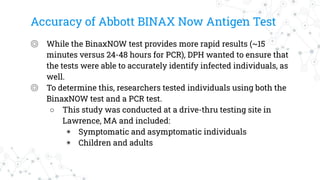
Accuracy of Abbott BINAX Now Antigen Test
◎ While the BinaxNOW test provides more rapid results (~15
minutes versus 24-48 hours for PCR), DPH wanted to ensure that
the tests were able to accurately identify infected individuals, as
well.
◎ To determine this, researchers tested individuals using both the
BinaxNOW test and a PCR test.
○ This study was conducted at a drive-thru testing site in
Lawrence, MA and included:
◉ Symptomatic and asymptomatic individuals
◉ Children and adults
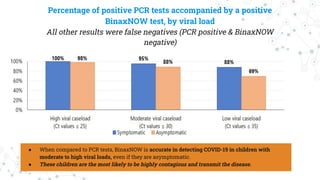
Percentage of positive PCR tests accompanied by a positive
BinaxNOW test, by viral load
All other results were false negatives (PCR positive & BinaxNOW
negative)
● When compared to PCR tests, BinaxNOW is accurate in detecting COVID-19 in children with
moderate to high viral loads, even if they are asymptomatic.
● These children are the most likely to be highly contagious and transmit the disease.
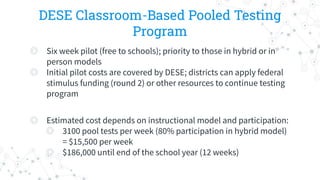
DESE Classroom-Based Pooled Testing
Program
◎ Six week pilot (free to schools); priority to those in hybrid or in
person models
◎ Initial pilot costs are covered by DESE; districts can apply federal
stimulus funding (round 2) or other resources to continue testing
program
◎ Estimated cost depends on instructional model and participation:
◎ 3100 pool tests per week (80% participation in hybrid model)
= $15,500 per week
◎ $186,000 until end of the school year (12 weeks)
Statewide Contract & Included Services
Onboarding and continued training
● Operations & Logistics
○ Delivery of tests to schools
○ Testing hardware (tubes,
labels, etc…)
● Lab processing
● Secure tech system
● Customer Support
● Coordination and direct administration
of program
● Overseeing testing logistics
○ Test administration
○ Data entry
○ Software management
● Administer specimen collection to students
and staff
● Administer follow-up testing with Abbott
BinaxNOW
● Transport tests to laboratory for processing
Reporting
◎ Pooled tests are not reported to the
Department of Public Health
◎ Diagnostic tests for individuals
within a positive pooled sample
(Abbott BinaxNow) are reported to
the Department of Public Health
(whether negative or positive)
Anticipated Timeline
◎ Week of February 8, 2021
○ Information to families, faculty/staff
○ Finalize Implementation Plan
◎ Mid-Late February, 2021
○ Begin online registration of families and faculty/staff
including consent forms
◎ February 25, 2021
○ FPS begins testing in selected classrooms/schools
◎ March 4, 2021 or March 8, 2021
○ FPS begins testing all participants in Classroom Pool
Testing program
Expected Communication
◎ Pooled Testing Webpage as part of FPS website
(coming soon to the website)
◎ Will include:
○ Implementation Steps
○ Instructional Resources
○ Important Dates
○ Communications
○ FAQs

FPS Pooled Testing Presentation 2/09/2021

  • 1.
    Classroom-Based Pooled Testing Initiative Presentationto the Franklin Public Schools Community Week of February 8, 2021
  • 2.
    Why Pooled Testing? Theoryof Action: If schools conduct proactive classroom-based pool testing for students and staff, infected individuals (and close contacts) who are asymptomatic or presymptomatic can be identified, proactively isolated and treated. ◎ Provides additional layer of health and safety prevention and reassurance that could reduce the spread of the Coronavirus within schools and the greater Franklin community. ◎ Vaccinations of educators (est. Phase 2: February - April) will add to the reassurance. ◎ Pool testing should provide better indication of the % positivity rate within FPS, which will assist with making decisions on our instructional model.
  • 3.
    Part of Multi-facetedHealth and Safety Mitigation Strategy Pooled testing to screen for COVID-19 is part of a comprehensive strategy and should be used in conjunction with other mitigation strategies and promoting behaviors that reduce spread. Masking, distancing, and hand-washing remain vital
  • 4.
    What is PooledTesting? ◎ Pooling is the combining of respiratory samples from several people together in a ‘pool’ to conduct one laboratory test to detect SARS CoV 2 (COVID-19). ○ Allows laboratories to test more samples with fewer testing materials, potentially increasing testing capacity. ◎ The test is performed once per week with an anterior nasal swab for all consenting staff and students. ◎ Results are typically delivered in 24-48 hours ◎ If a pooled test result is positive, then the pool of people receive individual follow-up testing using the the Abbott BinaxNOW rapid point-of-care antigen test (results in approx. 15 minutes)
  • 5.
  • 6.
    Classroom-Based Pooled Testing Testingtypically occurs on a weekly basis. Image adapted from Gingko Biolabs We have been paired with Project Beacon for the DESE pilot. Pools through this vendor are 5-10 swabs.
  • 7.
    Prerequisites for PooledTesting Relatively low rate of the virus among the population. High participation rate of individuals being tested (in this case, students and staff). ◎ About 50% of families responding to our survey indicated “yes” for participation with an additional 20% stating “maybe” ◎ About 73% of faculty/staff are interested in pool testing participation
  • 8.
    How Does Classroom-BasedPooled Testing Work? What is classroom pooling? It’s a method that combines test samples from all individuals in one classroom/group/cohort into one tube that’s then tested. How will pools be created? Staff and students from the same building and cohort will be grouped together. How are the samples collected? Anterior nasal swab (short swab) - a swab of the front of the nostril. - can be self-administered by adults and older children (under supervision) - younger students can be administered by any trained school staff
  • 9.
    Taking a Samplein the Classroom Image adapted from Gingko Biolabs
  • 11.
    FPS Pooled TestingSchedule ◎ Students in grades 2-12+ collect their own sample by classroom while being observed by a trained adult ◎ PreK-1 students and students who need assistance will have samples collected by a trained adult who dons additional PPE Grade level Pool Test Day Results Returned/Follow-Up Testing PreK Monday Tuesday K-8 Cohort A Monday Tuesday K-8 Cohort B Thursday Friday High School Monday Tuesday Faculty/Staff Monday Tuesday 4-5 Day/Week Students Monday Tuesday
  • 12.
    What happens inthe event of a positive test? Students and faculty/staff do not need to immediately quarantine (per 1/22/2021 DPH guidance). ◎ This is due to the multiple safety measures already in place including mask wearing, physical distancing, hand hygiene, and ventilation (HEPA air filters or UVGI) ◎ Students and faculty/staff in the pool would be tested using the Abbott BINAX Now antigen kits on the day test results are returned. ◎ Test results are rapid - 15 minutes ◎ Positive individual(s) from the pool would isolate and take care of symptoms. Contact tracing would take place to quarantine anyone identified as a close contact.
  • 13.
    Overview of theProcess Collection and Testing Responses to Test Results
  • 14.
    Accuracy of AbbottBINAX Now Antigen Test ◎ While the BinaxNOW test provides more rapid results (~15 minutes versus 24-48 hours for PCR), DPH wanted to ensure that the tests were able to accurately identify infected individuals, as well. ◎ To determine this, researchers tested individuals using both the BinaxNOW test and a PCR test. ○ This study was conducted at a drive-thru testing site in Lawrence, MA and included: ◉ Symptomatic and asymptomatic individuals ◉ Children and adults
  • 15.
    Percentage of positivePCR tests accompanied by a positive BinaxNOW test, by viral load All other results were false negatives (PCR positive & BinaxNOW negative) ● When compared to PCR tests, BinaxNOW is accurate in detecting COVID-19 in children with moderate to high viral loads, even if they are asymptomatic. ● These children are the most likely to be highly contagious and transmit the disease.
  • 16.
    DESE Classroom-Based PooledTesting Program ◎ Six week pilot (free to schools); priority to those in hybrid or in person models ◎ Initial pilot costs are covered by DESE; districts can apply federal stimulus funding (round 2) or other resources to continue testing program ◎ Estimated cost depends on instructional model and participation: ◎ 3100 pool tests per week (80% participation in hybrid model) = $15,500 per week ◎ $186,000 until end of the school year (12 weeks)
  • 17.
    Statewide Contract &Included Services Onboarding and continued training ● Operations & Logistics ○ Delivery of tests to schools ○ Testing hardware (tubes, labels, etc…) ● Lab processing ● Secure tech system ● Customer Support ● Coordination and direct administration of program ● Overseeing testing logistics ○ Test administration ○ Data entry ○ Software management ● Administer specimen collection to students and staff ● Administer follow-up testing with Abbott BinaxNOW ● Transport tests to laboratory for processing
  • 18.
    Reporting ◎ Pooled testsare not reported to the Department of Public Health ◎ Diagnostic tests for individuals within a positive pooled sample (Abbott BinaxNow) are reported to the Department of Public Health (whether negative or positive)
  • 19.
    Anticipated Timeline ◎ Weekof February 8, 2021 ○ Information to families, faculty/staff ○ Finalize Implementation Plan ◎ Mid-Late February, 2021 ○ Begin online registration of families and faculty/staff including consent forms ◎ February 25, 2021 ○ FPS begins testing in selected classrooms/schools ◎ March 4, 2021 or March 8, 2021 ○ FPS begins testing all participants in Classroom Pool Testing program
  • 20.
    Expected Communication ◎ PooledTesting Webpage as part of FPS website (coming soon to the website) ◎ Will include: ○ Implementation Steps ○ Instructional Resources ○ Important Dates ○ Communications ○ FAQs