Creating A Clean, Affordable, Equitable and Resilient Energy Future For the Commonwealth
Building Energy Code Straw
Proposal:
Updated Stretch Code &
Specialized Opt-In Code
February 2022
COMMONWEALTH OF MASSACHUSETTS
DEPARTMENT OF ENERGY RESOURCES
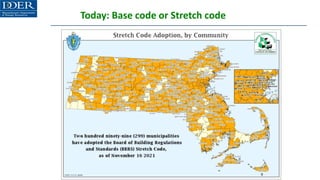
Patrick Woodcock, Commissioner
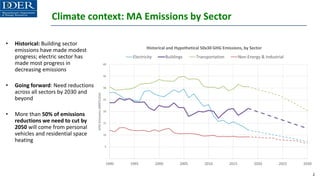
Climate context: MA Emissions by Sector
2
• Historical: Building sector
emissions have made modest
progress; electric sector has
made most progress in
decreasing emissions
• Going forward: Need reductions
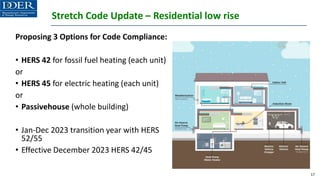
across all sectors by 2030 and
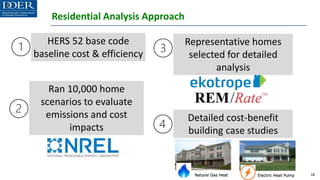
beyond
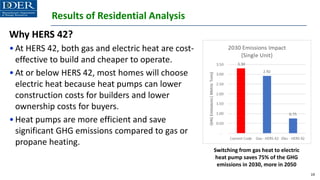
• More than 50% of emissions
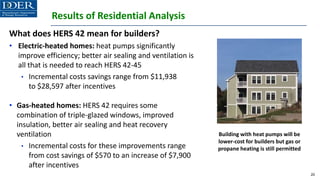
reductions we need to cut by
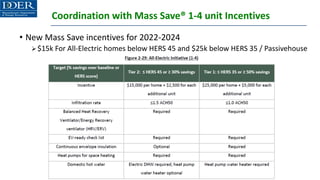
2050 will come from personal
vehicles and residential space
heating
-
5
10
15
20
25
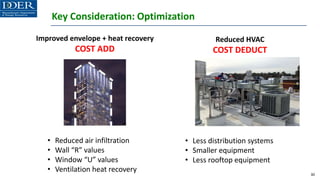
30
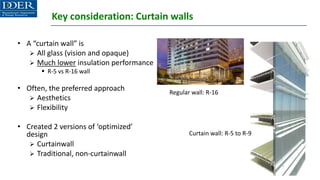
35
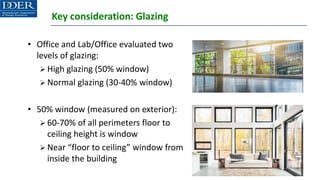
40
1990 1995 2000 2005 2010 2015 2020 2025 2030
GHG
Emissions
(MMTCO2e)
Historical and Hypothetical 50x30 GHG Emissions, by Sector
Electricity Buildings Transportation Non-Energy & Industrial
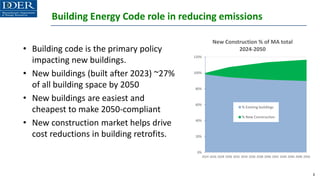
Building Energy Code role in reducing emissions
• Building code is the primary policy
impacting new buildings.
• New buildings (built after 2023) ~27%
of all building space by 2050
• New buildings are easiest and
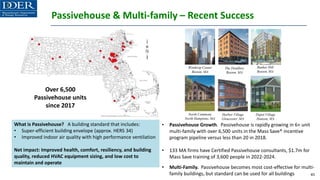
cheapest to make 2050-compliant
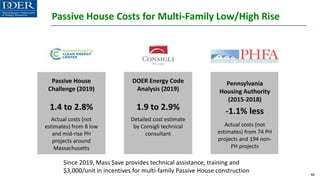
• New construction market helps drive
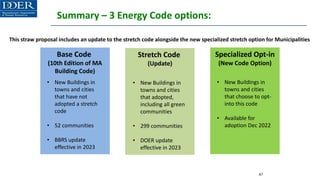
cost reductions in building retrofits.
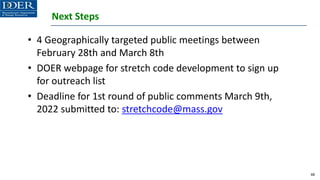
3
0%
20%
40%
60%
80%
100%
120%
2024 2026 2028 2030 2032 2034 2036 2038 2040 2042 2044 2046 2048 2050
New Construction % of MA total
2024-2050
% Existing buildings
% New Construction
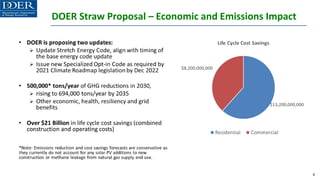
DOER Straw Proposal – Economic and Emissions Impact
4
Straw Proposal for Comment
DOER is seeking comments on its Straw Proposal updating the Stretch
Energy Code and Proposing the new, Specialized Stretch Energy Code.
DOER highly encourages written comments be
submitted electronically to stretchcode@mass.gov with the subject
line “Stretch Code Straw Proposal Comments”. Responses will
be accepted until 5 pm on March 9, 2022. Written comments may
also be submitted via mail to the Department of Energy Resources,
100 Cambridge Street, Suite 1020, Boston, Ma 02114, attention Nina
Mascarenhas.
5
ENERGY CODE BACKGROUND
6
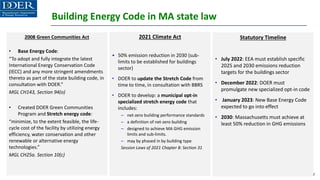
Building Energy Code in MA state law
7
2008 Green Communities Act
• Base Energy Code:
“To adopt and fully integrate the latest
International Energy Conservation Code
(IECC) and any more stringent amendments
thereto as part of the state building code, in
consultation with DOER.”
MGL CH143, Section 94(o)
• Created DOER Green Communities
Program and Stretch energy code:
“minimize, to the extent feasible, the life-
cycle cost of the facility by utilizing energy
efficiency, water conservation and other
renewable or alternative energy
technologies.”
MGL CH25a. Section 10(c)
2021 Climate Act
• 50% emission reduction in 2030 (sub-
limits to be established for buildings
sector)
• DOER to update the Stretch Code from
time to time, in consultation with BBRS
• DOER to develop: a municipal opt-in
specialized stretch energy code that
includes:
– net-zero building performance standards
– a definition of net-zero building
– designed to achieve MA GHG emission
limits and sub-limits.
– may by phased in by building type
Session Laws of 2021 Chapter 8: Section 31
Statutory Timeline
• July 2022: EEA must establish specific
2025 and 2030 emissions reduction
targets for the buildings sector
• December 2022: DOER must
promulgate new specialized opt-in code
• January 2023: New Base Energy Code
expected to go into effect
• 2030: Massachusetts must achieve at
least 50% reduction in GHG emissions
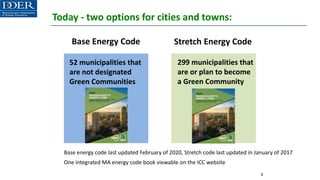
Today - two options for cities and towns:
8
Base Energy Code
52 municipalities that
are not designated
Green Communities
Stretch Energy Code
299 municipalities that
are or plan to become
a Green Community
Base energy code last updated February of 2020, Stretch code last updated in January of 2017
One integrated MA energy code book viewable on the ICC website
Today: Base code or Stretch code
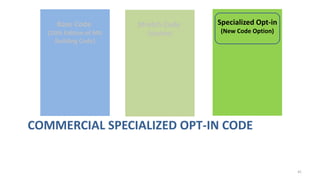
9
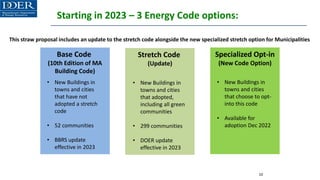
Starting in 2023 – 3 Energy Code options:
10
Base Code
(10th Edition of MA
Building Code)
• New Buildings in
towns and cities
that have not
adopted a stretch
code
• 52 communities
• BBRS update
effective in 2023
Stretch Code
(Update)
• New Buildings in
towns and cities
that adopted,
including all green
communities
• 299 communities
• DOER update
effective in 2023
Specialized Opt-in
(New Code Option)
• New Buildings in
towns and cities
that choose to opt-
into this code
• Available for
adoption Dec 2022
This straw proposal includes an update to the stretch code alongside the new specialized stretch option for Municipalities
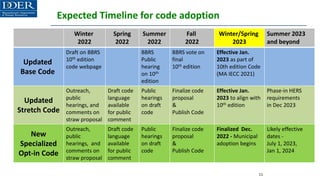
Expected Timeline for code adoption
11
Winter
2022
Spring
2022
Summer
2022
Fall
2022
Winter/Spring
2023
Summer 2023
and beyond
Updated
Base Code
Draft on BBRS
10th edition
code webpage
BBRS
Public
hearing
on 10th
edition
BBRS vote on
final
10th edition
Effective Jan.
2023 as part of
10th edition Code
(MA IECC 2021)
Updated
Stretch Code
Outreach,
public
hearings, and
comments on
straw proposal
Draft code
language
available
for public
comment
Public
hearings
on draft
code
Finalize code
proposal
&
Publish Code
Effective Jan.
2023 to align with
10th edition
Phase-in HERS
requirements
in Dec 2023
New
Specialized
Opt-in Code
Outreach,
public
hearings, and
comments on
straw proposal
Draft code
language
available
for public
comment
Public
hearings
on draft
code
Finalize code
proposal
&
Publish Code
Finalized Dec.
2022 - Municipal
adoption begins
Likely effective
dates -
July 1, 2023,
Jan 1, 2024
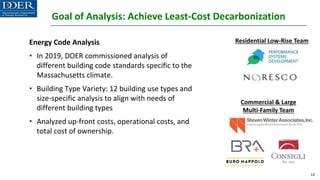
Goal of Analysis: Achieve Least-Cost Decarbonization
12
Commercial & Large
Multi-Family Team
Residential Low-Rise Team
Energy Code Analysis
• In 2019, DOER commissioned analysis of
different building code standards specific to the
Massachusetts climate.
• Building Type Variety: 12 building use types and
size-specific analysis to align with needs of
different building types
• Analyzed up-front costs, operational costs, and
total cost of ownership.
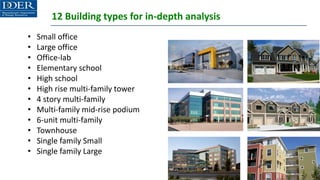
12 Building types for in-depth analysis
• Small office
• Large office
• Office-lab
• Elementary school
• High school
• High rise multi-family tower
• 4 story multi-family
• Multi-family mid-rise podium
• 6-unit multi-family
• Townhouse
• Single family Small
• Single family Large
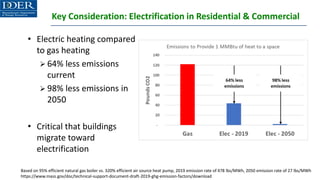
Key Consideration: Electrification in Residential & Commercial
• Electric heating compared
to gas heating
➢ 64% less emissions
current
➢ 98% less emissions in
2050
• Critical that buildings
migrate toward
electrification
Based on 95% efficient natural gas boiler vs. 320% efficient air source heat pump, 2019 emission rate of 478 lbs/MWh, 2050 emission rate of 27 lbs/MWh
https://www.mass.gov/doc/technical-support-document-draft-2019-ghg-emission-factors/download
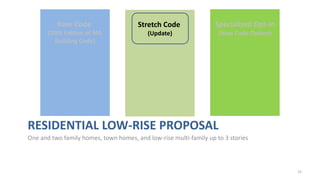
RESIDENTIAL LOW-RISE PROPOSAL
One and two family homes, town homes, and low-rise multi-family up to 3 stories
15
Base Code
(10th Edition of MA
Building Code)
Stretch Code
(Update)
Specialized Opt-in
(New Code Option)
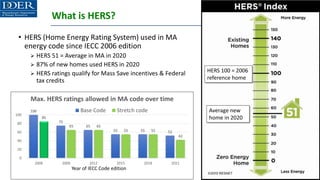
What is HERS?
• HERS (Home Energy Rating System) used in MA
energy code since IECC 2006 edition
➢ HERS 51 = Average in MA in 2020
➢ 87% of new homes used HERS in 2020
➢ HERS ratings qualify for Mass Save incentives & Federal
tax credits
16
100
75
65
55 55 52
85
65 65
55 55
42
0
20
40
60
80
100
2006 2009 2012 2015 2018 2021
Max. HERS ratings allowed in MA code over time
Base Code Stretch code Average new
home in 2020
HERS 100 = 2006
reference home
Year of IECC Code edition
Stretch Code Update – Residential low rise
Proposing 3 Options for Code Compliance:
• HERS 42 for fossil fuel heating (each unit)
or
• HERS 45 for electric heating (each unit)
or
• Passivehouse (whole building)
• Jan-Dec 2023 transition year with HERS
52/55
• Effective December 2023 HERS 42/45
17
Residential Analysis Approach
18
HERS 52 base code
baseline cost & efficiency
Representative homes
selected for detailed
analysis
Ran 10,000 home
scenarios to evaluate
emissions and cost
impacts
Detailed cost-benefit
building case studies
Results of Residential Analysis
19
Why HERS 42?
•At HERS 42, both gas and electric heat are cost-
effective to build and cheaper to operate.
•At or below HERS 42, most homes will choose
electric heat because heat pumps can lower
construction costs for builders and lower
ownership costs for buyers.
•Heat pumps are more efficient and save
significant GHG emissions compared to gas or
propane heating.
Switching from gas heat to electric
heat pump saves 75% of the GHG
emissions in 2030, more in 2050
Results of Residential Analysis
20
What does HERS 42 mean for builders?
• Electric-heated homes: heat pumps significantly
improve efficiency; better air sealing and ventilation is
all that is needed to reach HERS 42-45
• Incremental costs savings range from $11,938
to $28,597 after incentives
• Gas-heated homes: HERS 42 requires some
combination of triple-glazed windows, improved
insulation, better air sealing and heat recovery
ventilation
• Incremental costs for these improvements range
from cost savings of $570 to an increase of $7,900
after incentives
Building with heat pumps will be
lower-cost for builders but gas or
propane heating is still permitted
Coordination with Mass Save® 1-4 unit Incentives
• New Mass Save incentives for 2022-2024
➢$15k For All-Electric homes below HERS 45 and $25k below HERS 35 / Passivehouse
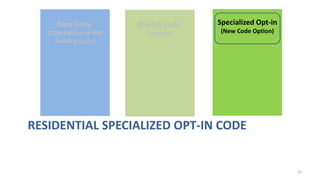
RESIDENTIAL SPECIALIZED OPT-IN CODE
22
Specialized Opt-in
(New Code Option)
Base Code
(10th Edition of MA
Building Code)
Stretch Code
(Update)
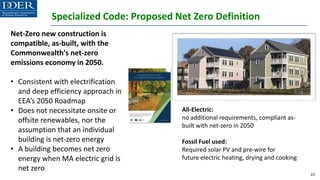
Specialized Code: Proposed Net Zero Definition
23
Net-Zero new construction is
compatible, as-built, with the
Commonwealth's net-zero
emissions economy in 2050.
• Consistent with electrification
and deep efficiency approach in
EEA’s 2050 Roadmap
• Does not necessitate onsite or
offsite renewables, nor the
assumption that an individual
building is net-zero energy
• A building becomes net zero
energy when MA electric grid is
net zero
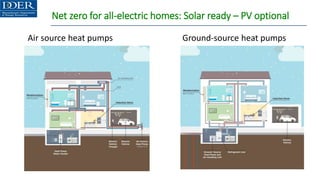
All-Electric:
no additional requirements, compliant as-
built with net-zero in 2050
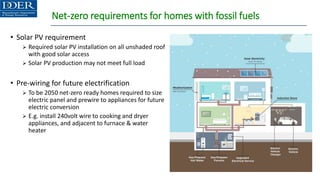
Fossil Fuel used:
Required solar PV and pre-wire for
future electric heating, drying and cooking
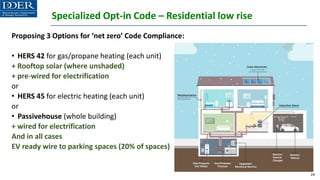
Specialized Opt-in Code – Residential low rise
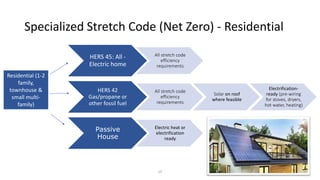
Proposing 3 Options for ‘net zero’ Code Compliance:
• HERS 42 for gas/propane heating (each unit)
+ Rooftop solar (where unshaded)
+ pre-wired for electrification
or
• HERS 45 for electric heating (each unit)
or
• Passivehouse (whole building)
+ wired for electrification
And in all cases
EV ready wire to parking spaces (20% of spaces)
24
Specialized Stretch Code (Net Zero) - Residential
25
HERS 45: All -
Electric home
All stretch code
efficiency
requirements
HERS 42
Gas/propane or
other fossil fuel
All stretch code
efficiency
requirements
Solar on roof
where feasible
Electrification-
ready (pre-wiring
for stoves, dryers,
hot water, heating)
Passive
House
Electric heat or
electrification
ready
Residential (1-2
family,
townhouse &
small multi-
family)
Net zero for all-electric homes: Solar ready – PV optional
Air source heat pumps Ground-source heat pumps
Net-zero requirements for homes with fossil fuels
• Solar PV requirement
➢ Required solar PV installation on all unshaded roof
with good solar access
➢ Solar PV production may not meet full load
• Pre-wiring for future electrification
➢ To be 2050 net-zero ready homes required to size
electric panel and prewire to appliances for future
electric conversion
➢ E.g. install 240volt wire to cooking and dryer
appliances, and adjacent to furnace & water
heater
COMMERCIAL STRETCH CODE UPDATE
28
Stretch Code
(Update)
Base Code
(10th Edition of MA
Building Code)
Stretch Code
(Update)
Specialized Opt-in
(New Code Option)
Commercial Stretch Code
29
• Key considerations during evaluation (4 slides)
• Key findings from evaluations (1 slide)
• Proposed Stretch Code (6 slides)
Key Consideration: Optimization
30
Improved envelope + heat recovery
COST ADD
Reduced HVAC
COST DEDUCT
• Reduced air infiltration
• Wall “R” values
• Window “U” values
• Ventilation heat recovery
• Less distribution systems
• Smaller equipment
• Less rooftop equipment
Key consideration: Curtain walls
• A “curtain wall” is
➢ All glass (vision and opaque)
➢ Much lower insulation performance
▪ R-5 vs R-16 wall
• Often, the preferred approach
➢ Aesthetics
➢ Flexibility
• Created 2 versions of ‘optimized’
design
➢ Curtainwall
➢ Traditional, non-curtainwall
Regular wall: R-16
Curtain wall: R-5 to R-9
Key consideration: Glazing
• Office and Lab/Office evaluated two
levels of glazing:
➢ High glazing (50% window)
➢ Normal glazing (30-40% window)
• 50% window (measured on exterior):
➢ 60-70% of all perimeters floor to
ceiling height is window
➢ Near “floor to ceiling” window from
inside the building
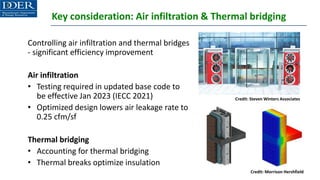
Key consideration: Air infiltration & Thermal bridging
Controlling air infiltration and thermal bridges
- significant efficiency improvement
Air infiltration
• Testing required in updated base code to
be effective Jan 2023 (IECC 2021)
• Optimized design lowers air leakage rate to
0.25 cfm/sf
Thermal bridging
• Accounting for thermal bridging
• Thermal breaks optimize insulation
Credit: Steven Winters Associates
Credit: Morrison Hershfield
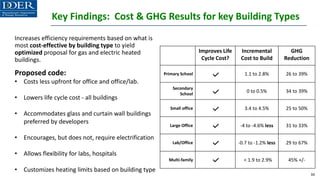
Key Findings: Cost & GHG Results for key Building Types
34
Increases efficiency requirements based on what is
most cost-effective by building type to yield
optimized proposal for gas and electric heated
buildings.
Proposed code:
• Costs less upfront for office and office/lab.
• Lowers life cycle cost - all buildings
• Accommodates glass and curtain wall buildings
preferred by developers
• Encourages, but does not, require electrification
• Allows flexibility for labs, hospitals
• Customizes heating limits based on building type
Improves Life
Cycle Cost?
Incremental
Cost to Build
GHG
Reduction
Primary School 1.1 to 2.8% 26 to 39%
Secondary
School
0 to 0.5% 34 to 39%
Small office 3.4 to 4.5% 25 to 50%
Large Office -4 to -4.6% less 31 to 33%
Lab/Office -0.7 to -1.2% less 29 to 67%
Multi-family < 1.9 to 2.9% 45% +/-
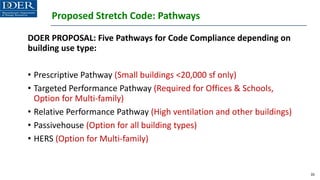
Proposed Stretch Code: Pathways
DOER PROPOSAL: Five Pathways for Code Compliance depending on
building use type:
• Prescriptive Pathway (Small buildings <20,000 sf only)
• Targeted Performance Pathway (Required for Offices & Schools,
Option for Multi-family)
• Relative Performance Pathway (High ventilation and other buildings)
• Passivehouse (Option for all building types)
• HERS (Option for Multi-family)
35
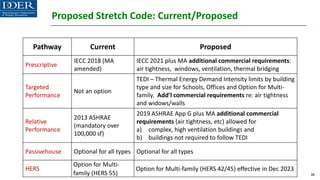
Proposed Stretch Code: Current/Proposed
36
Pathway Current Proposed
Prescriptive
IECC 2018 (MA
amended)
IECC 2021 plus MA additional commercial requirements:
air tightness, windows, ventilation, thermal bridging
Targeted
Performance
Not an option
TEDI – Thermal Energy Demand Intensity limits by building
type and size for Schools, Offices and Option for Multi-
family. Add’l commercial requirements re: air tightness
and widows/walls
Relative
Performance
2013 ASHRAE
(mandatory over
100,000 sf)
2019 ASHRAE App G plus MA additional commercial
requirements (air tightness, etc) allowed for
a) complex, high ventilation buildings and
b) buildings not required to follow TEDI
Passivehouse Optional for all types Optional for all types
HERS
Option for Multi-
family (HERS 55)
Option for Multi-family (HERS 42/45) effective in Dec 2023
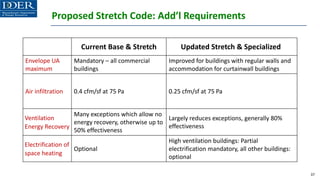
Proposed Stretch Code: Add’l Requirements
37
Current Base & Stretch Updated Stretch & Specialized
Envelope UA
maximum
Mandatory – all commercial
buildings
Improved for buildings with regular walls and
accommodation for curtainwall buildings
Air infiltration 0.4 cfm/sf at 75 Pa 0.25 cfm/sf at 75 Pa
Ventilation
Energy Recovery
Many exceptions which allow no
energy recovery, otherwise up to
50% effectiveness
Largely reduces exceptions, generally 80%
effectiveness
Electrification of
space heating
Optional
High ventilation buildings: Partial
electrification mandatory, all other buildings:
optional
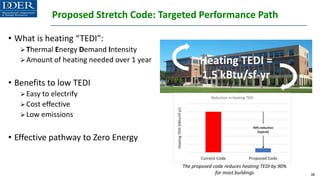
Proposed Stretch Code: Targeted Performance Path
38
Heating TEDI =
1.5 kBtu/sf-yr
• What is heating “TEDI”:
➢Thermal Energy Demand Intensity
➢Amount of heating needed over 1 year
• Benefits to low TEDI
➢Easy to electrify
➢Cost effective
➢Low emissions
• Effective pathway to Zero Energy
The proposed code reduces heating TEDI by 90%
for most buildings
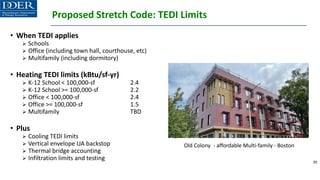
Proposed Stretch Code: TEDI Limits
39
When applies
Requirements
• When TEDI applies
➢ Schools
➢ Office (including town hall, courthouse, etc)
➢ Multifamily (including dormitory)
• Heating TEDI limits (kBtu/sf-yr)
➢ K-12 School < 100,000-sf 2.4
➢ K-12 School >= 100,000-sf 2.2
➢ Office < 100,000-sf 2.4
➢ Office >= 100,000-sf 1.5
➢ Multifamily TBD
• Plus
➢ Cooling TEDI limits
➢ Vertical envelope UA backstop
➢ Thermal bridge accounting
➢ Infiltration limits and testing
Old Colony - affordable Multi-family - Boston
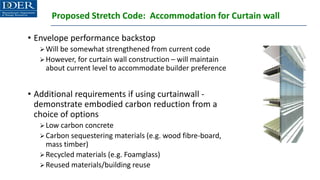
Proposed Stretch Code: Accommodation for Curtain wall
• Envelope performance backstop
➢Will be somewhat strengthened from current code
➢However, for curtain wall construction – will maintain
about current level to accommodate builder preference
• Additional requirements if using curtainwall -
demonstrate embodied carbon reduction from a
choice of options
➢Low carbon concrete
➢Carbon sequestering materials (e.g. wood fibre-board,
mass timber)
➢Recycled materials (e.g. Foamglass)
➢Reused materials/building reuse
COMMERCIAL SPECIALIZED OPT-IN CODE
41
Specialized Opt-in
(New Code Option)
Base Code
(10th Edition of MA
Building Code)
Stretch Code
(Update)
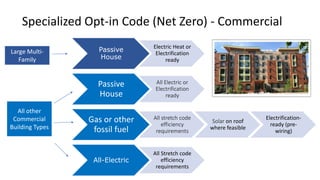
Specialized Opt-in Code (Net Zero) - Commercial
42
Large Multi-
Family
Passive
House
Electric Heat or
Electrification
ready
Passive
House
All Electric or
Electrification
ready
Gas or other
fossil fuel
All stretch code
efficiency
requirements
Solar on roof
where feasible
Electrification-
ready (pre-
wiring)
All-Electric
All Stretch code
efficiency
requirements
All other
Commercial
Building Types
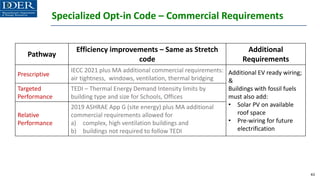
Specialized Opt-in Code – Commercial Requirements
43
Pathway
Efficiency improvements – Same as Stretch
code
Additional
Requirements
Prescriptive
IECC 2021 plus MA additional commercial requirements:
air tightness, windows, ventilation, thermal bridging
Additional EV ready wiring;
&
Buildings with fossil fuels
must also add:
• Solar PV on available
roof space
• Pre-wiring for future
electrification
Targeted
Performance
TEDI – Thermal Energy Demand Intensity limits by
building type and size for Schools, Offices
Relative
Performance
2019 ASHRAE App G (site energy) plus MA additional
commercial requirements allowed for
a) complex, high ventilation buildings and
b) buildings not required to follow TEDI
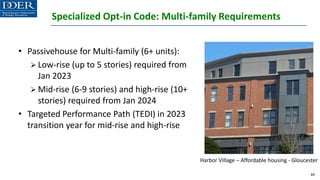
Specialized Opt-in Code: Multi-family Requirements
• Passivehouse for Multi-family (6+ units):
➢ Low-rise (up to 5 stories) required from
Jan 2023
➢ Mid-rise (6-9 stories) and high-rise (10+
stories) required from Jan 2024
• Targeted Performance Path (TEDI) in 2023
transition year for mid-rise and high-rise
44
Harbor Village – Affordable housing - Gloucester
Passivehouse & Multi-family – Recent Success
45
What is Passivehouse? A building standard that includes:
• Super-efficient building envelope (approx. HERS 34)
• Improved indoor air quality with high performance ventilation
Net impact: Improved health, comfort, resiliency, and building
quality, reduced HVAC equipment sizing, and low cost to
maintain and operate
• Passivehouse Growth. Passivehouse is rapidly growing in 6+ unit
multi-family with over 6,500 units in the Mass Save® incentive
program pipeline versus less than 20 in 2018.
• 133 MA firms have Certified Passivehouse consultants, $1.7m for
Mass Save training of 3,600 people in 2022-2024.
• Multi-Family. Passivehouse becomes most cost-effective for multi-
family buildings, but standard can be used for all buildings
The Distillery
Boston, MA
Winthrop Center
Boston, MA
Bunker Hill
Boston, MA
North Commons
North Hamptons, MA
Harbor Village
Gloucester, MA
Depot Village
Hanson, MA
Over 6,500
Passivehouse units
since 2017
Passive House Costs for Multi-Family Low/High Rise
46
Pennsylvania
Housing Authority
(2015-2018)
-1.1% less
Actual costs (not
estimates) from 74 PH
projects and 194 non-
PH projects
DOER Energy Code
Analysis (2019)
1.9 to 2.9%
Detailed cost estimate
by Consigli technical
consultant
Passive House
Challenge (2019)
1.4 to 2.8%
Actual costs (not
estimates) from 8 low
and mid-rise PH
projects around
Massachusetts
Since 2019, Mass Save provides technical assistance, training and
$3,000/unit in incentives for multi-family Passive House construction
Summary – 3 Energy Code options:
47
Base Code
(10th Edition of MA
Building Code)
• New Buildings in
towns and cities
that have not
adopted a stretch
code
• 52 communities
• BBRS update
effective in 2023
Stretch Code
(Update)
• New Buildings in
towns and cities
that adopted,
including all green
communities
• 299 communities
• DOER update
effective in 2023
Specialized Opt-in
(New Code Option)
• New Buildings in
towns and cities
that choose to opt-
into this code
• Available for
adoption Dec 2022
This straw proposal includes an update to the stretch code alongside the new specialized stretch option for Municipalities
Next Steps
• 4 Geographically targeted public meetings between
February 28th and March 8th
• DOER webpage for stretch code development to sign up
for outreach list
• Deadline for 1st round of public comments March 9th,
2022 submitted to: stretchcode@mass.gov
48

2022 DOER Proposed Code Updates

  • 1.
    Creating A Clean,Affordable, Equitable and Resilient Energy Future For the Commonwealth Building Energy Code Straw Proposal: Updated Stretch Code & Specialized Opt-In Code February 2022 COMMONWEALTH OF MASSACHUSETTS DEPARTMENT OF ENERGY RESOURCES Patrick Woodcock, Commissioner
  • 2.
    Climate context: MAEmissions by Sector 2 • Historical: Building sector emissions have made modest progress; electric sector has made most progress in decreasing emissions • Going forward: Need reductions across all sectors by 2030 and beyond • More than 50% of emissions reductions we need to cut by 2050 will come from personal vehicles and residential space heating - 5 10 15 20 25 30 35 40 1990 1995 2000 2005 2010 2015 2020 2025 2030 GHG Emissions (MMTCO2e) Historical and Hypothetical 50x30 GHG Emissions, by Sector Electricity Buildings Transportation Non-Energy & Industrial
  • 3.
    Building Energy Coderole in reducing emissions • Building code is the primary policy impacting new buildings. • New buildings (built after 2023) ~27% of all building space by 2050 • New buildings are easiest and cheapest to make 2050-compliant • New construction market helps drive cost reductions in building retrofits. 3 0% 20% 40% 60% 80% 100% 120% 2024 2026 2028 2030 2032 2034 2036 2038 2040 2042 2044 2046 2048 2050 New Construction % of MA total 2024-2050 % Existing buildings % New Construction
  • 4.
    DOER Straw Proposal– Economic and Emissions Impact 4
  • 5.
    Straw Proposal forComment DOER is seeking comments on its Straw Proposal updating the Stretch Energy Code and Proposing the new, Specialized Stretch Energy Code. DOER highly encourages written comments be submitted electronically to stretchcode@mass.gov with the subject line “Stretch Code Straw Proposal Comments”. Responses will be accepted until 5 pm on March 9, 2022. Written comments may also be submitted via mail to the Department of Energy Resources, 100 Cambridge Street, Suite 1020, Boston, Ma 02114, attention Nina Mascarenhas. 5
  • 6.
  • 7.
    Building Energy Codein MA state law 7 2008 Green Communities Act • Base Energy Code: “To adopt and fully integrate the latest International Energy Conservation Code (IECC) and any more stringent amendments thereto as part of the state building code, in consultation with DOER.” MGL CH143, Section 94(o) • Created DOER Green Communities Program and Stretch energy code: “minimize, to the extent feasible, the life- cycle cost of the facility by utilizing energy efficiency, water conservation and other renewable or alternative energy technologies.” MGL CH25a. Section 10(c) 2021 Climate Act • 50% emission reduction in 2030 (sub- limits to be established for buildings sector) • DOER to update the Stretch Code from time to time, in consultation with BBRS • DOER to develop: a municipal opt-in specialized stretch energy code that includes: – net-zero building performance standards – a definition of net-zero building – designed to achieve MA GHG emission limits and sub-limits. – may by phased in by building type Session Laws of 2021 Chapter 8: Section 31 Statutory Timeline • July 2022: EEA must establish specific 2025 and 2030 emissions reduction targets for the buildings sector • December 2022: DOER must promulgate new specialized opt-in code • January 2023: New Base Energy Code expected to go into effect • 2030: Massachusetts must achieve at least 50% reduction in GHG emissions
  • 8.
    Today - twooptions for cities and towns: 8 Base Energy Code 52 municipalities that are not designated Green Communities Stretch Energy Code 299 municipalities that are or plan to become a Green Community Base energy code last updated February of 2020, Stretch code last updated in January of 2017 One integrated MA energy code book viewable on the ICC website
  • 9.
    Today: Base codeor Stretch code 9
  • 10.
    Starting in 2023– 3 Energy Code options: 10 Base Code (10th Edition of MA Building Code) • New Buildings in towns and cities that have not adopted a stretch code • 52 communities • BBRS update effective in 2023 Stretch Code (Update) • New Buildings in towns and cities that adopted, including all green communities • 299 communities • DOER update effective in 2023 Specialized Opt-in (New Code Option) • New Buildings in towns and cities that choose to opt- into this code • Available for adoption Dec 2022 This straw proposal includes an update to the stretch code alongside the new specialized stretch option for Municipalities
  • 11.
    Expected Timeline forcode adoption 11 Winter 2022 Spring 2022 Summer 2022 Fall 2022 Winter/Spring 2023 Summer 2023 and beyond Updated Base Code Draft on BBRS 10th edition code webpage BBRS Public hearing on 10th edition BBRS vote on final 10th edition Effective Jan. 2023 as part of 10th edition Code (MA IECC 2021) Updated Stretch Code Outreach, public hearings, and comments on straw proposal Draft code language available for public comment Public hearings on draft code Finalize code proposal & Publish Code Effective Jan. 2023 to align with 10th edition Phase-in HERS requirements in Dec 2023 New Specialized Opt-in Code Outreach, public hearings, and comments on straw proposal Draft code language available for public comment Public hearings on draft code Finalize code proposal & Publish Code Finalized Dec. 2022 - Municipal adoption begins Likely effective dates - July 1, 2023, Jan 1, 2024
  • 12.
    Goal of Analysis:Achieve Least-Cost Decarbonization 12 Commercial & Large Multi-Family Team Residential Low-Rise Team Energy Code Analysis • In 2019, DOER commissioned analysis of different building code standards specific to the Massachusetts climate. • Building Type Variety: 12 building use types and size-specific analysis to align with needs of different building types • Analyzed up-front costs, operational costs, and total cost of ownership.
  • 13.
    12 Building typesfor in-depth analysis • Small office • Large office • Office-lab • Elementary school • High school • High rise multi-family tower • 4 story multi-family • Multi-family mid-rise podium • 6-unit multi-family • Townhouse • Single family Small • Single family Large
  • 14.
    Key Consideration: Electrificationin Residential & Commercial • Electric heating compared to gas heating ➢ 64% less emissions current ➢ 98% less emissions in 2050 • Critical that buildings migrate toward electrification Based on 95% efficient natural gas boiler vs. 320% efficient air source heat pump, 2019 emission rate of 478 lbs/MWh, 2050 emission rate of 27 lbs/MWh https://www.mass.gov/doc/technical-support-document-draft-2019-ghg-emission-factors/download
  • 15.
    RESIDENTIAL LOW-RISE PROPOSAL Oneand two family homes, town homes, and low-rise multi-family up to 3 stories 15 Base Code (10th Edition of MA Building Code) Stretch Code (Update) Specialized Opt-in (New Code Option)
  • 16.
    What is HERS? •HERS (Home Energy Rating System) used in MA energy code since IECC 2006 edition ➢ HERS 51 = Average in MA in 2020 ➢ 87% of new homes used HERS in 2020 ➢ HERS ratings qualify for Mass Save incentives & Federal tax credits 16 100 75 65 55 55 52 85 65 65 55 55 42 0 20 40 60 80 100 2006 2009 2012 2015 2018 2021 Max. HERS ratings allowed in MA code over time Base Code Stretch code Average new home in 2020 HERS 100 = 2006 reference home Year of IECC Code edition
  • 17.
    Stretch Code Update– Residential low rise Proposing 3 Options for Code Compliance: • HERS 42 for fossil fuel heating (each unit) or • HERS 45 for electric heating (each unit) or • Passivehouse (whole building) • Jan-Dec 2023 transition year with HERS 52/55 • Effective December 2023 HERS 42/45 17
  • 18.
    Residential Analysis Approach 18 HERS52 base code baseline cost & efficiency Representative homes selected for detailed analysis Ran 10,000 home scenarios to evaluate emissions and cost impacts Detailed cost-benefit building case studies
  • 19.
    Results of ResidentialAnalysis 19 Why HERS 42? •At HERS 42, both gas and electric heat are cost- effective to build and cheaper to operate. •At or below HERS 42, most homes will choose electric heat because heat pumps can lower construction costs for builders and lower ownership costs for buyers. •Heat pumps are more efficient and save significant GHG emissions compared to gas or propane heating. Switching from gas heat to electric heat pump saves 75% of the GHG emissions in 2030, more in 2050
  • 20.
    Results of ResidentialAnalysis 20 What does HERS 42 mean for builders? • Electric-heated homes: heat pumps significantly improve efficiency; better air sealing and ventilation is all that is needed to reach HERS 42-45 • Incremental costs savings range from $11,938 to $28,597 after incentives • Gas-heated homes: HERS 42 requires some combination of triple-glazed windows, improved insulation, better air sealing and heat recovery ventilation • Incremental costs for these improvements range from cost savings of $570 to an increase of $7,900 after incentives Building with heat pumps will be lower-cost for builders but gas or propane heating is still permitted
  • 21.
    Coordination with MassSave® 1-4 unit Incentives • New Mass Save incentives for 2022-2024 ➢$15k For All-Electric homes below HERS 45 and $25k below HERS 35 / Passivehouse
  • 22.
    RESIDENTIAL SPECIALIZED OPT-INCODE 22 Specialized Opt-in (New Code Option) Base Code (10th Edition of MA Building Code) Stretch Code (Update)
  • 23.
    Specialized Code: ProposedNet Zero Definition 23 Net-Zero new construction is compatible, as-built, with the Commonwealth's net-zero emissions economy in 2050. • Consistent with electrification and deep efficiency approach in EEA’s 2050 Roadmap • Does not necessitate onsite or offsite renewables, nor the assumption that an individual building is net-zero energy • A building becomes net zero energy when MA electric grid is net zero All-Electric: no additional requirements, compliant as- built with net-zero in 2050 Fossil Fuel used: Required solar PV and pre-wire for future electric heating, drying and cooking
  • 24.
    Specialized Opt-in Code– Residential low rise Proposing 3 Options for ‘net zero’ Code Compliance: • HERS 42 for gas/propane heating (each unit) + Rooftop solar (where unshaded) + pre-wired for electrification or • HERS 45 for electric heating (each unit) or • Passivehouse (whole building) + wired for electrification And in all cases EV ready wire to parking spaces (20% of spaces) 24
  • 25.
    Specialized Stretch Code(Net Zero) - Residential 25 HERS 45: All - Electric home All stretch code efficiency requirements HERS 42 Gas/propane or other fossil fuel All stretch code efficiency requirements Solar on roof where feasible Electrification- ready (pre-wiring for stoves, dryers, hot water, heating) Passive House Electric heat or electrification ready Residential (1-2 family, townhouse & small multi- family)
  • 26.
    Net zero forall-electric homes: Solar ready – PV optional Air source heat pumps Ground-source heat pumps
  • 27.
    Net-zero requirements forhomes with fossil fuels • Solar PV requirement ➢ Required solar PV installation on all unshaded roof with good solar access ➢ Solar PV production may not meet full load • Pre-wiring for future electrification ➢ To be 2050 net-zero ready homes required to size electric panel and prewire to appliances for future electric conversion ➢ E.g. install 240volt wire to cooking and dryer appliances, and adjacent to furnace & water heater
  • 28.
    COMMERCIAL STRETCH CODEUPDATE 28 Stretch Code (Update) Base Code (10th Edition of MA Building Code) Stretch Code (Update) Specialized Opt-in (New Code Option)
  • 29.
    Commercial Stretch Code 29 •Key considerations during evaluation (4 slides) • Key findings from evaluations (1 slide) • Proposed Stretch Code (6 slides)
  • 30.
    Key Consideration: Optimization 30 Improvedenvelope + heat recovery COST ADD Reduced HVAC COST DEDUCT • Reduced air infiltration • Wall “R” values • Window “U” values • Ventilation heat recovery • Less distribution systems • Smaller equipment • Less rooftop equipment
  • 31.
    Key consideration: Curtainwalls • A “curtain wall” is ➢ All glass (vision and opaque) ➢ Much lower insulation performance ▪ R-5 vs R-16 wall • Often, the preferred approach ➢ Aesthetics ➢ Flexibility • Created 2 versions of ‘optimized’ design ➢ Curtainwall ➢ Traditional, non-curtainwall Regular wall: R-16 Curtain wall: R-5 to R-9
  • 32.
    Key consideration: Glazing •Office and Lab/Office evaluated two levels of glazing: ➢ High glazing (50% window) ➢ Normal glazing (30-40% window) • 50% window (measured on exterior): ➢ 60-70% of all perimeters floor to ceiling height is window ➢ Near “floor to ceiling” window from inside the building
  • 33.
    Key consideration: Airinfiltration & Thermal bridging Controlling air infiltration and thermal bridges - significant efficiency improvement Air infiltration • Testing required in updated base code to be effective Jan 2023 (IECC 2021) • Optimized design lowers air leakage rate to 0.25 cfm/sf Thermal bridging • Accounting for thermal bridging • Thermal breaks optimize insulation Credit: Steven Winters Associates Credit: Morrison Hershfield
  • 34.
    Key Findings: Cost& GHG Results for key Building Types 34 Increases efficiency requirements based on what is most cost-effective by building type to yield optimized proposal for gas and electric heated buildings. Proposed code: • Costs less upfront for office and office/lab. • Lowers life cycle cost - all buildings • Accommodates glass and curtain wall buildings preferred by developers • Encourages, but does not, require electrification • Allows flexibility for labs, hospitals • Customizes heating limits based on building type Improves Life Cycle Cost? Incremental Cost to Build GHG Reduction Primary School 1.1 to 2.8% 26 to 39% Secondary School 0 to 0.5% 34 to 39% Small office 3.4 to 4.5% 25 to 50% Large Office -4 to -4.6% less 31 to 33% Lab/Office -0.7 to -1.2% less 29 to 67% Multi-family < 1.9 to 2.9% 45% +/-
  • 35.
    Proposed Stretch Code:Pathways DOER PROPOSAL: Five Pathways for Code Compliance depending on building use type: • Prescriptive Pathway (Small buildings <20,000 sf only) • Targeted Performance Pathway (Required for Offices & Schools, Option for Multi-family) • Relative Performance Pathway (High ventilation and other buildings) • Passivehouse (Option for all building types) • HERS (Option for Multi-family) 35
  • 36.
    Proposed Stretch Code:Current/Proposed 36 Pathway Current Proposed Prescriptive IECC 2018 (MA amended) IECC 2021 plus MA additional commercial requirements: air tightness, windows, ventilation, thermal bridging Targeted Performance Not an option TEDI – Thermal Energy Demand Intensity limits by building type and size for Schools, Offices and Option for Multi- family. Add’l commercial requirements re: air tightness and widows/walls Relative Performance 2013 ASHRAE (mandatory over 100,000 sf) 2019 ASHRAE App G plus MA additional commercial requirements (air tightness, etc) allowed for a) complex, high ventilation buildings and b) buildings not required to follow TEDI Passivehouse Optional for all types Optional for all types HERS Option for Multi- family (HERS 55) Option for Multi-family (HERS 42/45) effective in Dec 2023
  • 37.
    Proposed Stretch Code:Add’l Requirements 37 Current Base & Stretch Updated Stretch & Specialized Envelope UA maximum Mandatory – all commercial buildings Improved for buildings with regular walls and accommodation for curtainwall buildings Air infiltration 0.4 cfm/sf at 75 Pa 0.25 cfm/sf at 75 Pa Ventilation Energy Recovery Many exceptions which allow no energy recovery, otherwise up to 50% effectiveness Largely reduces exceptions, generally 80% effectiveness Electrification of space heating Optional High ventilation buildings: Partial electrification mandatory, all other buildings: optional
  • 38.
    Proposed Stretch Code:Targeted Performance Path 38 Heating TEDI = 1.5 kBtu/sf-yr • What is heating “TEDI”: ➢Thermal Energy Demand Intensity ➢Amount of heating needed over 1 year • Benefits to low TEDI ➢Easy to electrify ➢Cost effective ➢Low emissions • Effective pathway to Zero Energy The proposed code reduces heating TEDI by 90% for most buildings
  • 39.
    Proposed Stretch Code:TEDI Limits 39 When applies Requirements • When TEDI applies ➢ Schools ➢ Office (including town hall, courthouse, etc) ➢ Multifamily (including dormitory) • Heating TEDI limits (kBtu/sf-yr) ➢ K-12 School < 100,000-sf 2.4 ➢ K-12 School >= 100,000-sf 2.2 ➢ Office < 100,000-sf 2.4 ➢ Office >= 100,000-sf 1.5 ➢ Multifamily TBD • Plus ➢ Cooling TEDI limits ➢ Vertical envelope UA backstop ➢ Thermal bridge accounting ➢ Infiltration limits and testing Old Colony - affordable Multi-family - Boston
  • 40.
    Proposed Stretch Code:Accommodation for Curtain wall • Envelope performance backstop ➢Will be somewhat strengthened from current code ➢However, for curtain wall construction – will maintain about current level to accommodate builder preference • Additional requirements if using curtainwall - demonstrate embodied carbon reduction from a choice of options ➢Low carbon concrete ➢Carbon sequestering materials (e.g. wood fibre-board, mass timber) ➢Recycled materials (e.g. Foamglass) ➢Reused materials/building reuse
  • 41.
    COMMERCIAL SPECIALIZED OPT-INCODE 41 Specialized Opt-in (New Code Option) Base Code (10th Edition of MA Building Code) Stretch Code (Update)
  • 42.
    Specialized Opt-in Code(Net Zero) - Commercial 42 Large Multi- Family Passive House Electric Heat or Electrification ready Passive House All Electric or Electrification ready Gas or other fossil fuel All stretch code efficiency requirements Solar on roof where feasible Electrification- ready (pre- wiring) All-Electric All Stretch code efficiency requirements All other Commercial Building Types
  • 43.
    Specialized Opt-in Code– Commercial Requirements 43 Pathway Efficiency improvements – Same as Stretch code Additional Requirements Prescriptive IECC 2021 plus MA additional commercial requirements: air tightness, windows, ventilation, thermal bridging Additional EV ready wiring; & Buildings with fossil fuels must also add: • Solar PV on available roof space • Pre-wiring for future electrification Targeted Performance TEDI – Thermal Energy Demand Intensity limits by building type and size for Schools, Offices Relative Performance 2019 ASHRAE App G (site energy) plus MA additional commercial requirements allowed for a) complex, high ventilation buildings and b) buildings not required to follow TEDI
  • 44.
    Specialized Opt-in Code:Multi-family Requirements • Passivehouse for Multi-family (6+ units): ➢ Low-rise (up to 5 stories) required from Jan 2023 ➢ Mid-rise (6-9 stories) and high-rise (10+ stories) required from Jan 2024 • Targeted Performance Path (TEDI) in 2023 transition year for mid-rise and high-rise 44 Harbor Village – Affordable housing - Gloucester
  • 45.
    Passivehouse & Multi-family– Recent Success 45 What is Passivehouse? A building standard that includes: • Super-efficient building envelope (approx. HERS 34) • Improved indoor air quality with high performance ventilation Net impact: Improved health, comfort, resiliency, and building quality, reduced HVAC equipment sizing, and low cost to maintain and operate • Passivehouse Growth. Passivehouse is rapidly growing in 6+ unit multi-family with over 6,500 units in the Mass Save® incentive program pipeline versus less than 20 in 2018. • 133 MA firms have Certified Passivehouse consultants, $1.7m for Mass Save training of 3,600 people in 2022-2024. • Multi-Family. Passivehouse becomes most cost-effective for multi- family buildings, but standard can be used for all buildings The Distillery Boston, MA Winthrop Center Boston, MA Bunker Hill Boston, MA North Commons North Hamptons, MA Harbor Village Gloucester, MA Depot Village Hanson, MA Over 6,500 Passivehouse units since 2017
  • 46.
    Passive House Costsfor Multi-Family Low/High Rise 46 Pennsylvania Housing Authority (2015-2018) -1.1% less Actual costs (not estimates) from 74 PH projects and 194 non- PH projects DOER Energy Code Analysis (2019) 1.9 to 2.9% Detailed cost estimate by Consigli technical consultant Passive House Challenge (2019) 1.4 to 2.8% Actual costs (not estimates) from 8 low and mid-rise PH projects around Massachusetts Since 2019, Mass Save provides technical assistance, training and $3,000/unit in incentives for multi-family Passive House construction
  • 47.
    Summary – 3Energy Code options: 47 Base Code (10th Edition of MA Building Code) • New Buildings in towns and cities that have not adopted a stretch code • 52 communities • BBRS update effective in 2023 Stretch Code (Update) • New Buildings in towns and cities that adopted, including all green communities • 299 communities • DOER update effective in 2023 Specialized Opt-in (New Code Option) • New Buildings in towns and cities that choose to opt- into this code • Available for adoption Dec 2022 This straw proposal includes an update to the stretch code alongside the new specialized stretch option for Municipalities
  • 48.
    Next Steps • 4Geographically targeted public meetings between February 28th and March 8th • DOER webpage for stretch code development to sign up for outreach list • Deadline for 1st round of public comments March 9th, 2022 submitted to: stretchcode@mass.gov 48