Apache Hadoop HBASE
Sheetal Sharma
Intern At IBM Innovation Centre
HBase is ..
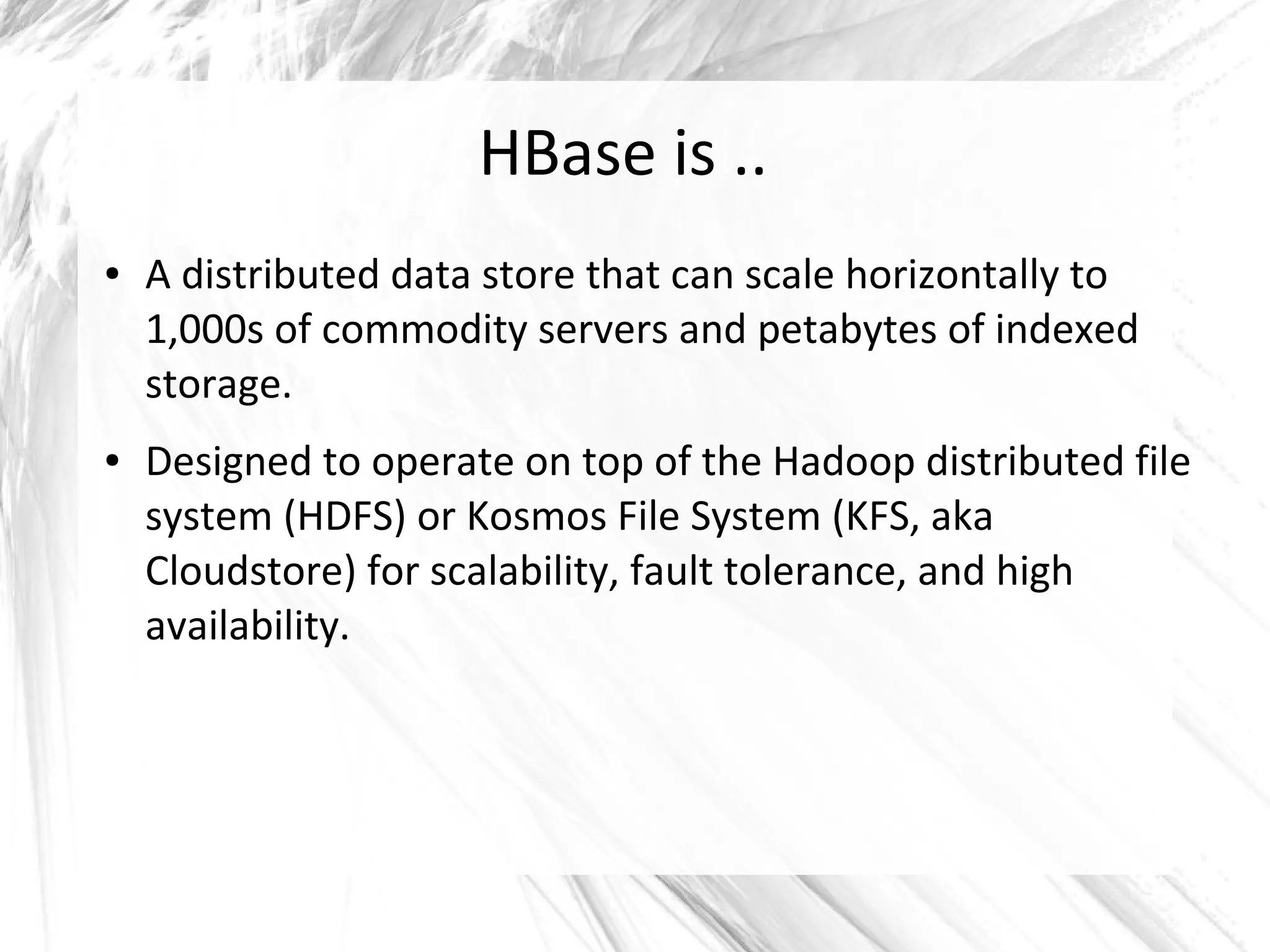
● A distributed data store that can scale horizontally to
1,000s of commodity servers and petabytes of indexed
storage.
● Designed to operate on top of the Hadoop distributed file
system (HDFS) or Kosmos File System (KFS, aka
Cloudstore) for scalability, fault tolerance, and high
availability.
Benefits
● Distributed storage
● Table-like in data structure
multi-dimensional map
● High scalability
● High availability
● High performance
HBase Is Not …
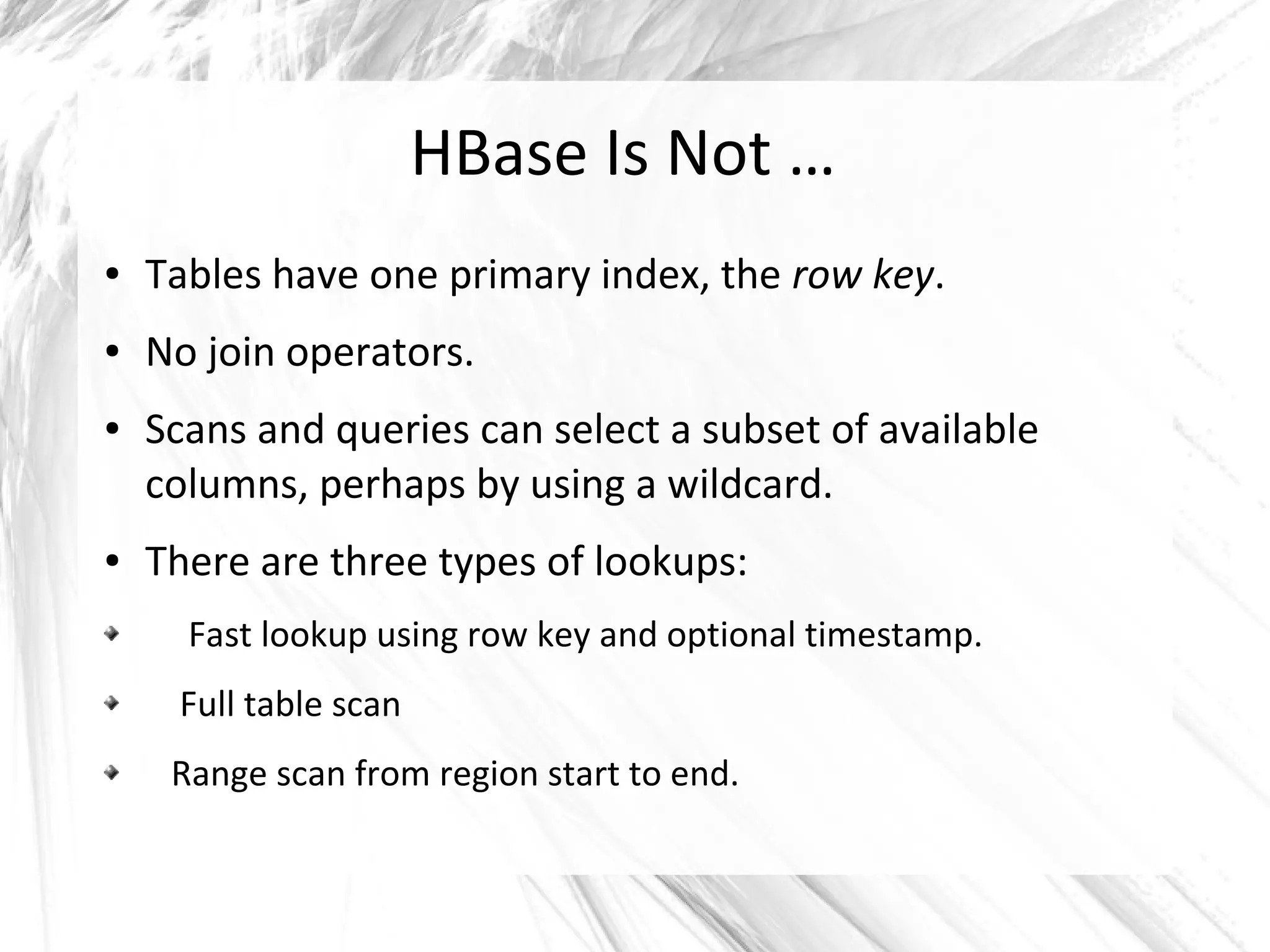
● Tables have one primary index, the row key.
● No join operators.
● Scans and queries can select a subset of available
columns, perhaps by using a wildcard.
● There are three types of lookups:
Fast lookup using row key and optional timestamp.
Full table scan
Range scan from region start to end.
HBase Is Not …(2)
● Limited atomicity and transaction support.
- HBase supports multiple batched mutations of single
rows only.
- Data is unstructured and untyped.
● No accessed or manipulated via SQL.
- Programmatic access via Java, REST, or Thrift APIs.
- Scripting via JRuby.
Why HBase ?
● HBase is a Bigtable clone.
● It is open source
● It has a good community and promise for the
future
● It is developed on top of and has good integration
for the Hadoop platform, if you are using Hadoop
already.
● It has a Cascading connector.
When to use HBase
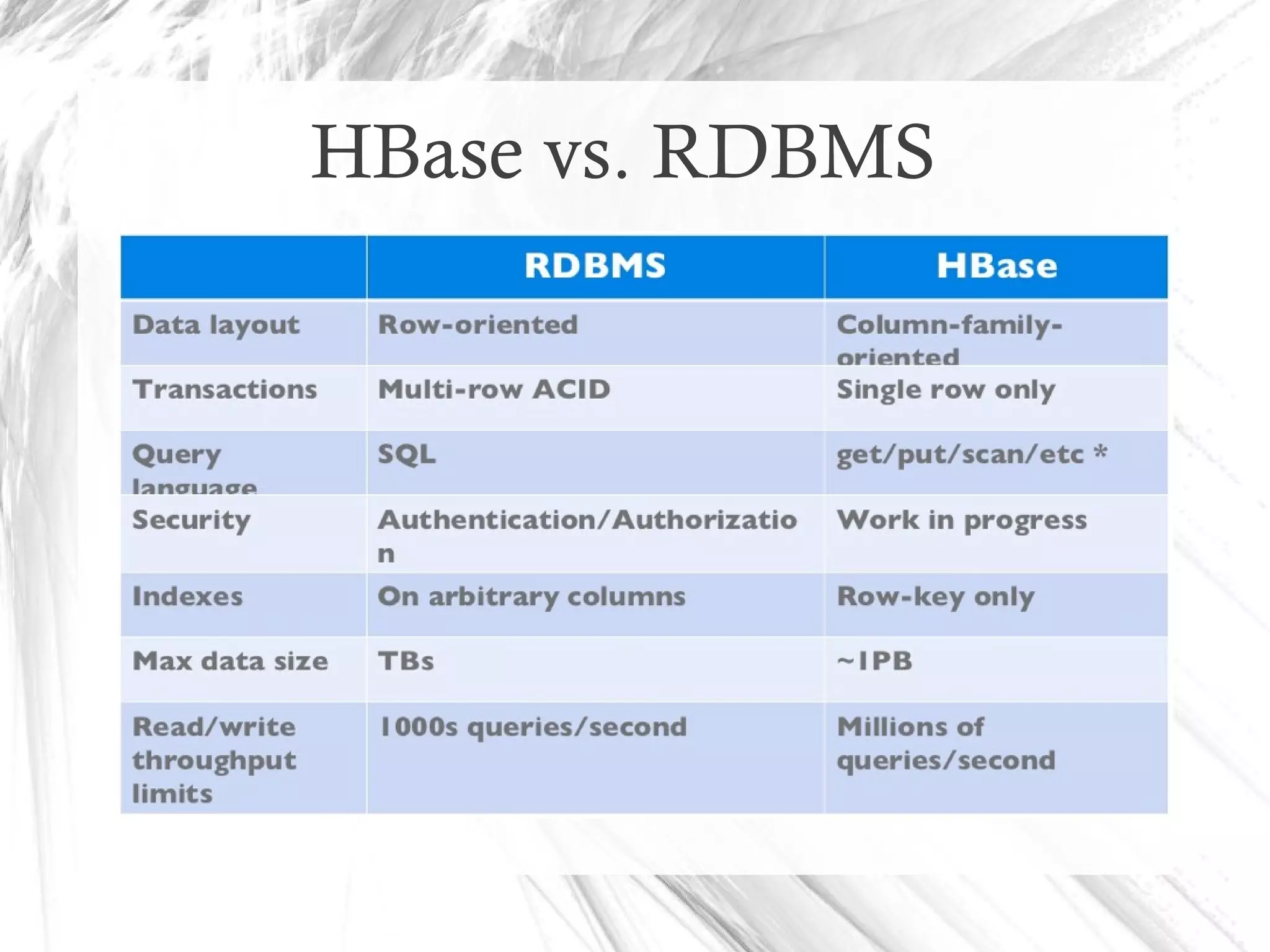
HBase benefits than RDBMS
● No real indexes
● Automatic partitioning
● Scale linearly and automatically with new nodes
● Commodity hardware
● Fault tolerance
● Batch processing
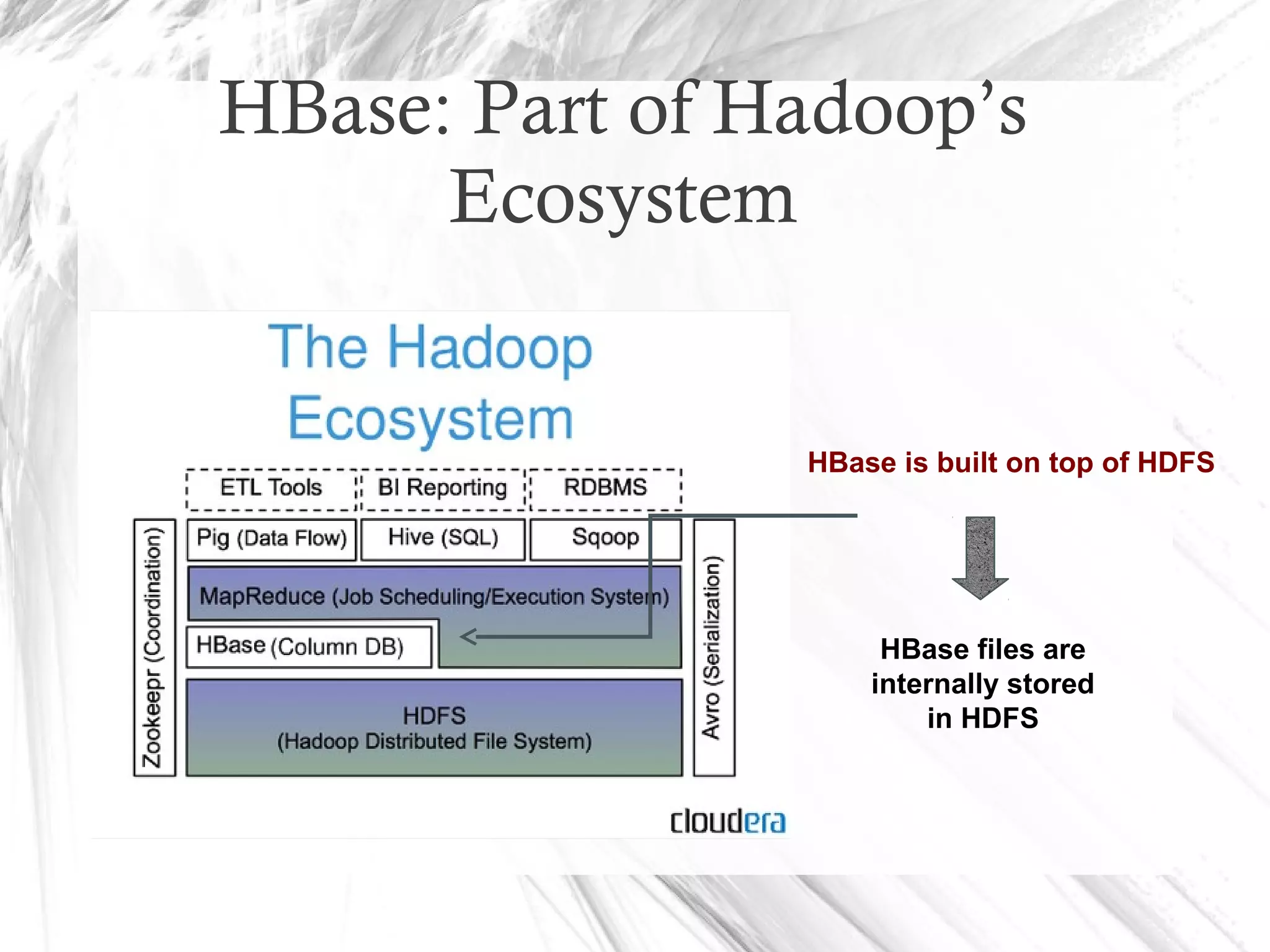
HBase: Part of Hadoop’s
Ecosystem
HBase is built on top of HDFS
HBase files are
internally stored
in HDFS
HBase vs. HDFS
● Both are distributed systems that scale to hundreds or thousands
of nodes
● HDFS is good for batch processing (scans over big files)
Not good for record lookup
Not good for incremental addition of small batches
Not good for updates
HBase vs. HDFS (Cont’d)
● HBase is designed to efficiently address the above points
Fast record lookup
Support for record-level insertion
Support for updates (not in place)
● HBase updates are done by creating new versions of values
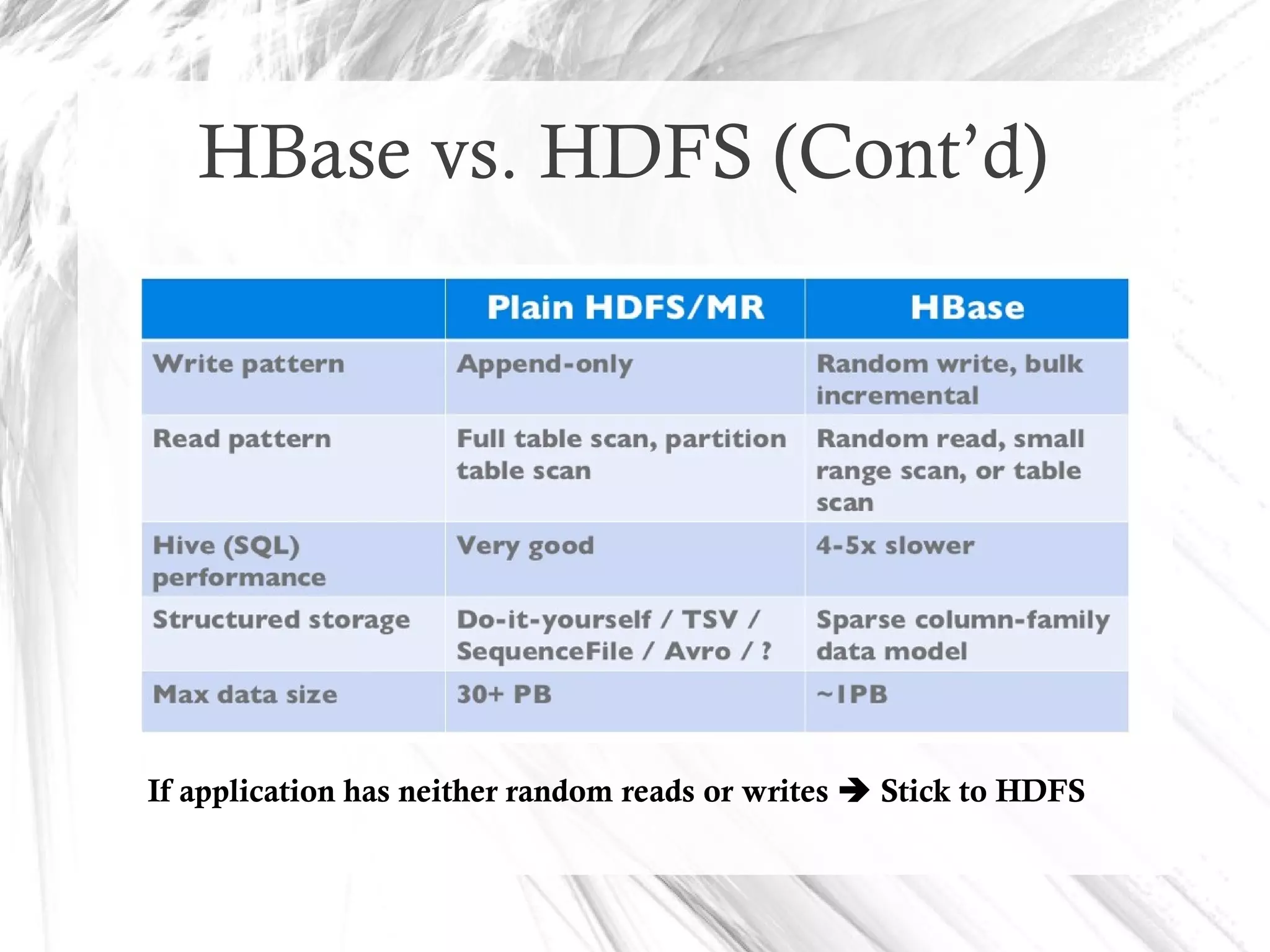
HBase vs. HDFS (Cont’d)
If application has neither random reads or writes  Stick to HDFS
HBase vs. RDBMS
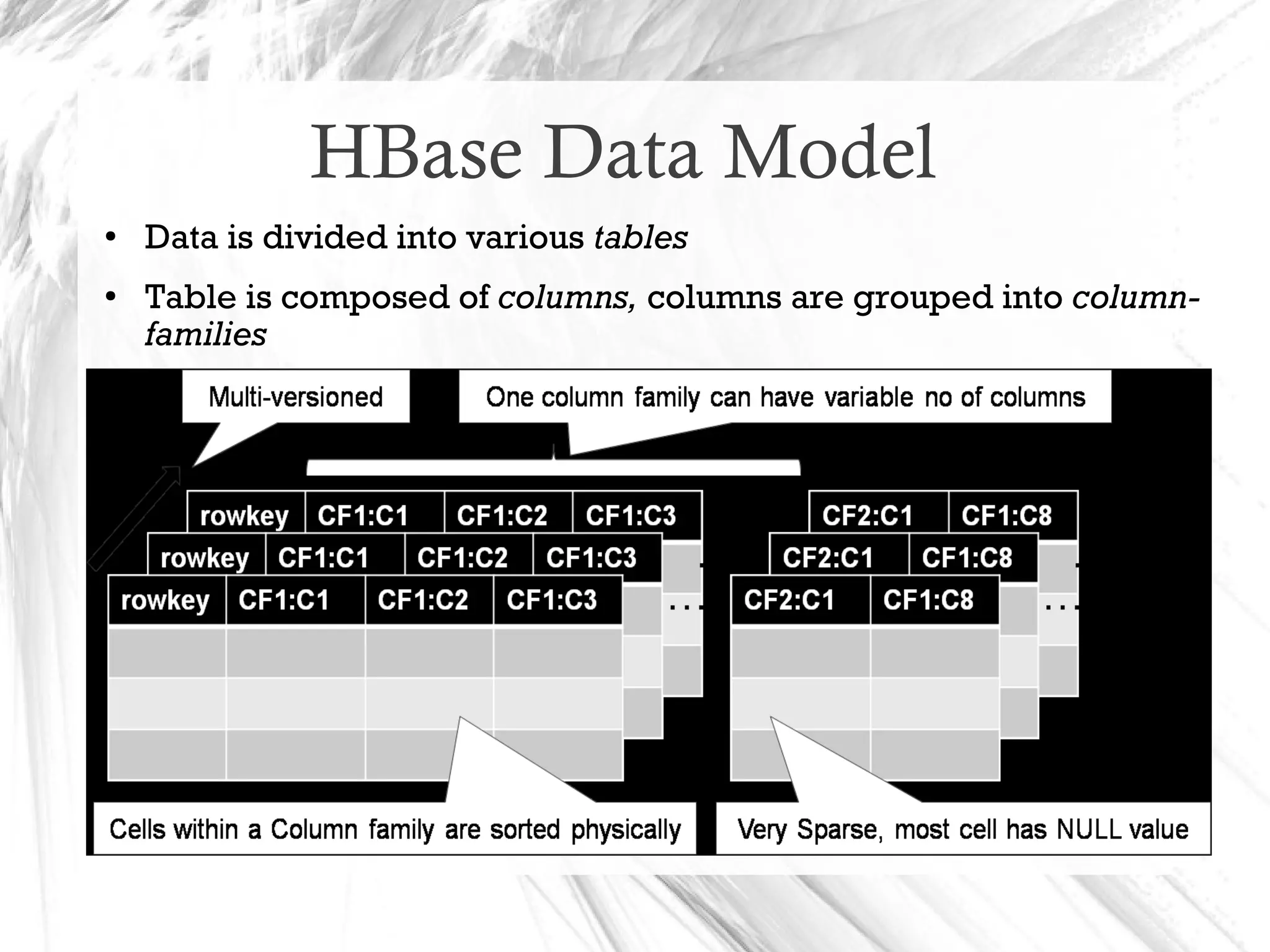
HBase Data Model
● Data is divided into various tables
● Table is composed of columns, columns are grouped into column-
families
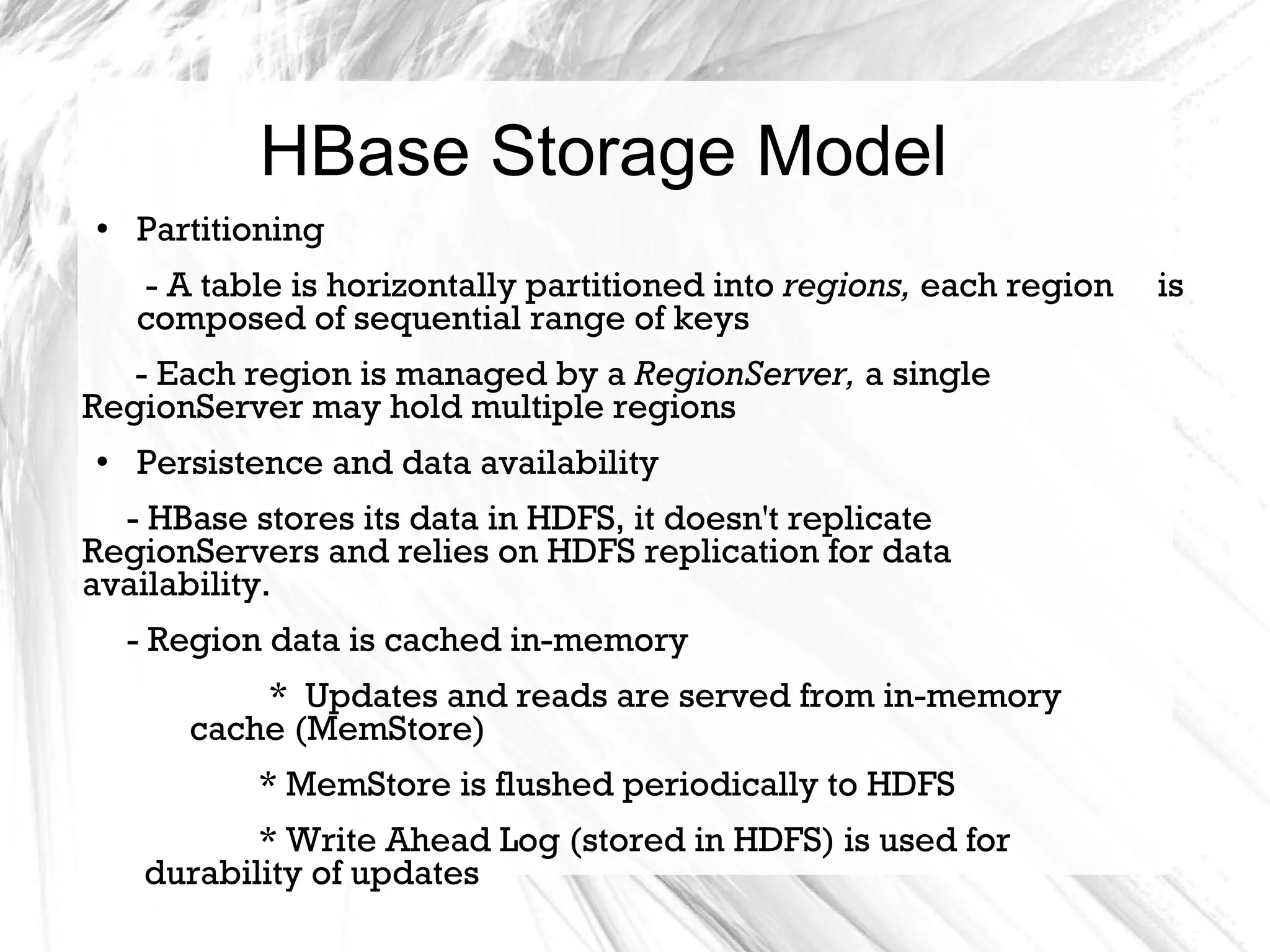
HBase Storage Model
● Partitioning
- A table is horizontally partitioned into regions, each region is
composed of sequential range of keys
- Each region is managed by a RegionServer, a single
RegionServer may hold multiple regions
●
Persistence and data availability
- HBase stores its data in HDFS, it doesn't replicate
RegionServers and relies on HDFS replication for data
availability.
- Region data is cached in-memory
* Updates and reads are served from in-memory
cache (MemStore)
* MemStore is flushed periodically to HDFS
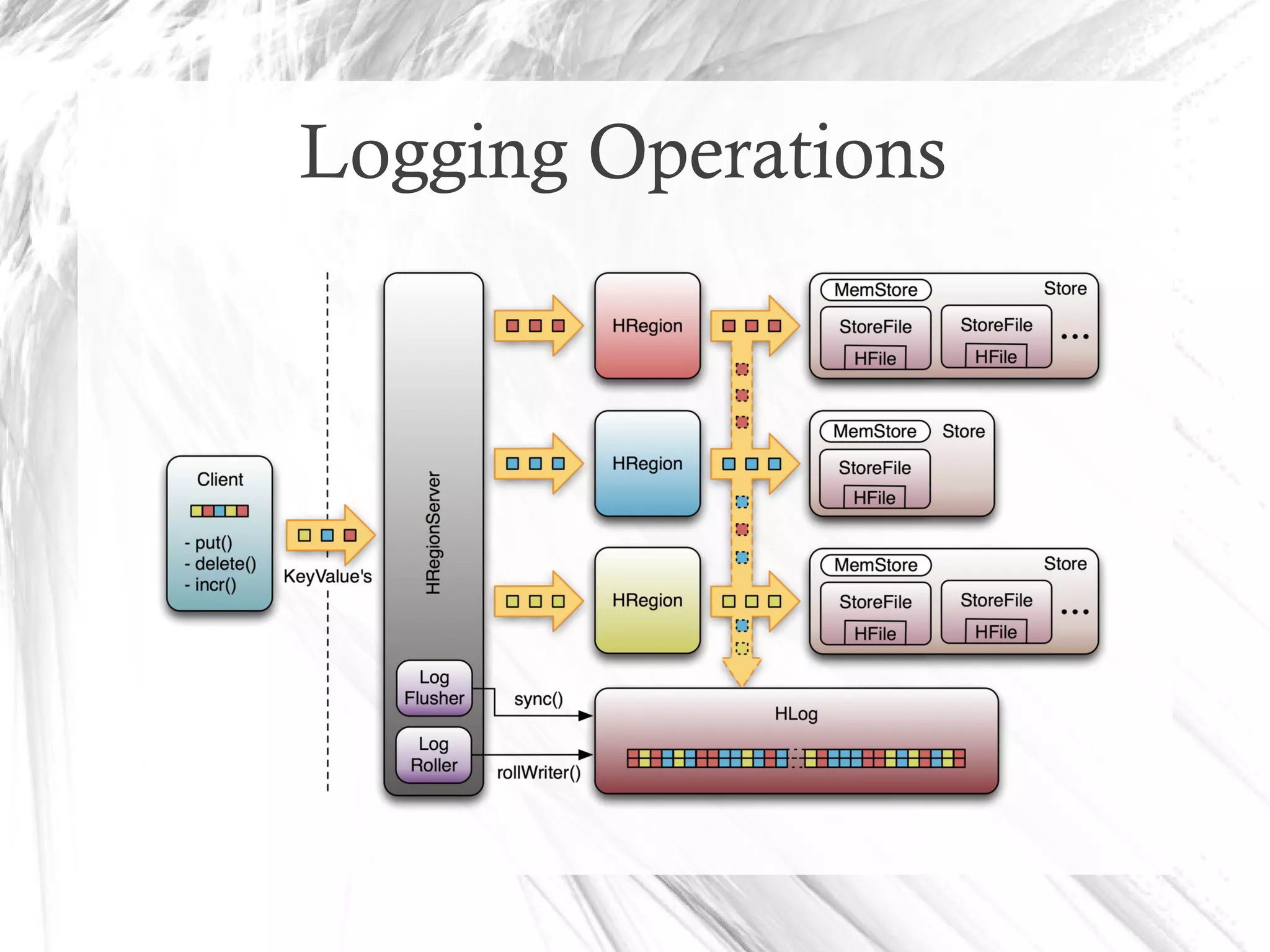
* Write Ahead Log (stored in HDFS) is used for
durability of updates
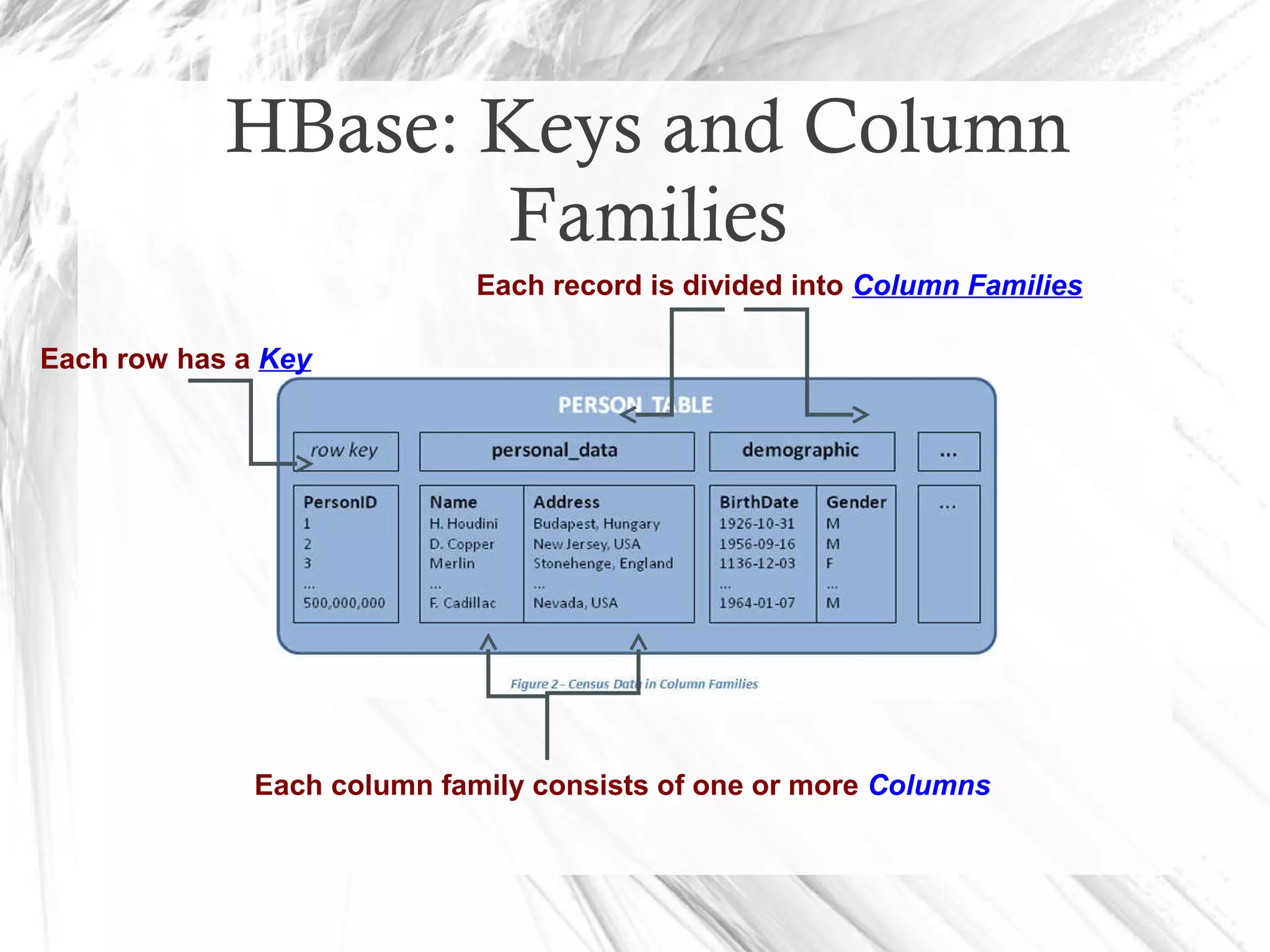
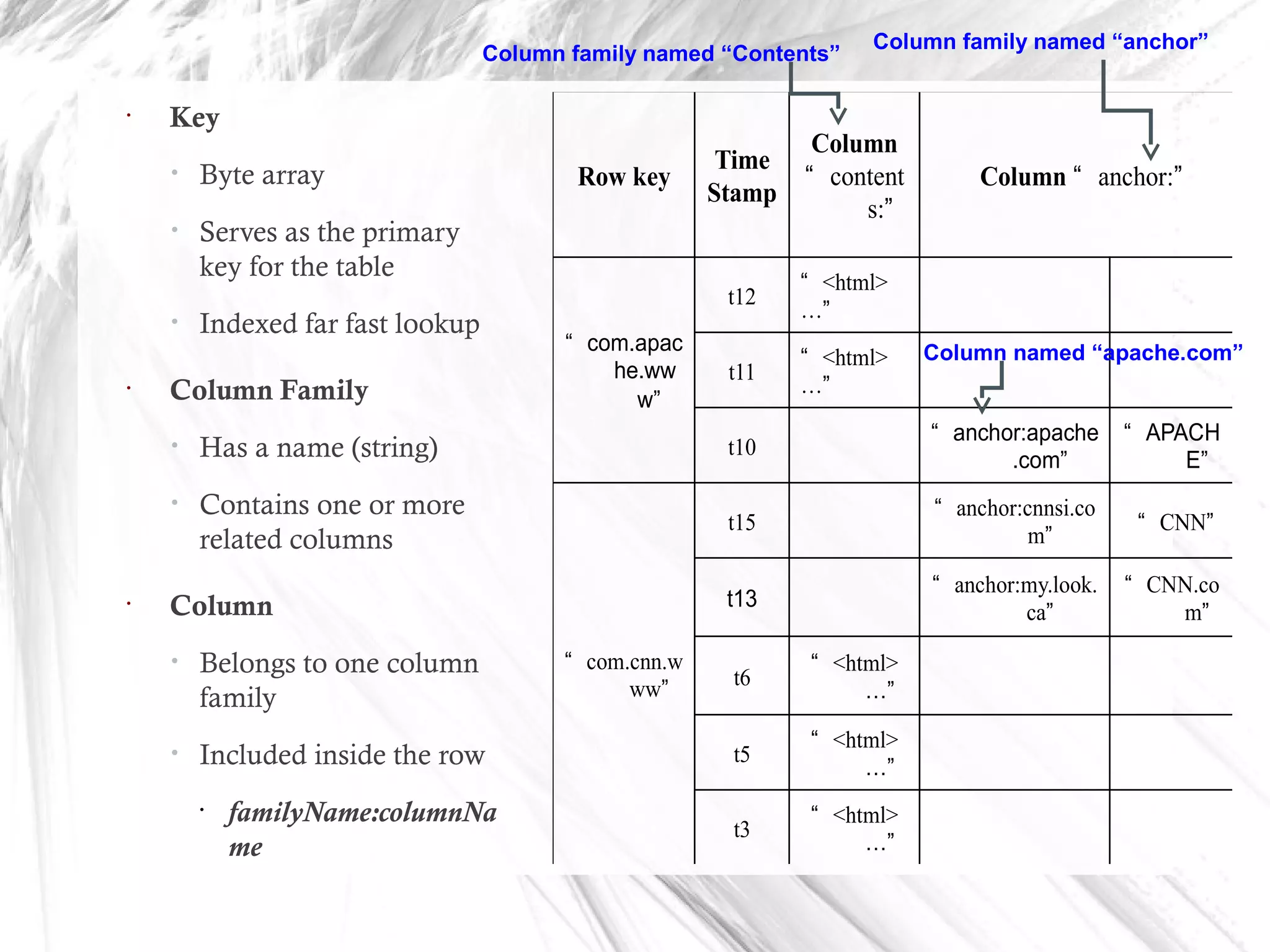
HBase: Keys and Column
Families
Each record is divided into Column Families
Each row has a Key
Each column family consists of one or more Columns
Row key
Time
Stamp
Column
“ content
s:”
Column “ anchor:”
“ com.apac
he.ww
w”
t12
“ <html>
…”
t11
“ <html>
…”
t10
“ anchor:apache
.com”
“ APACH
E”
“ com.cnn.w
ww”
t15
“ anchor:cnnsi.co
m”
“ CNN”
t13
“ anchor:my.look.
ca”
“ CNN.co
m”
t6
“ <html>
…”
t5
“ <html>
…”
t3
“ <html>
…”
•
Key
• Byte array
• Serves as the primary
key for the table
• Indexed far fast lookup
•
Column Family
• Has a name (string)
• Contains one or more
related columns
•
Column
• Belongs to one column
family
• Included inside the row
•
familyName:columnNa
me
Column family named “Contents”
Column family named “anchor”
Column named “apache.com”
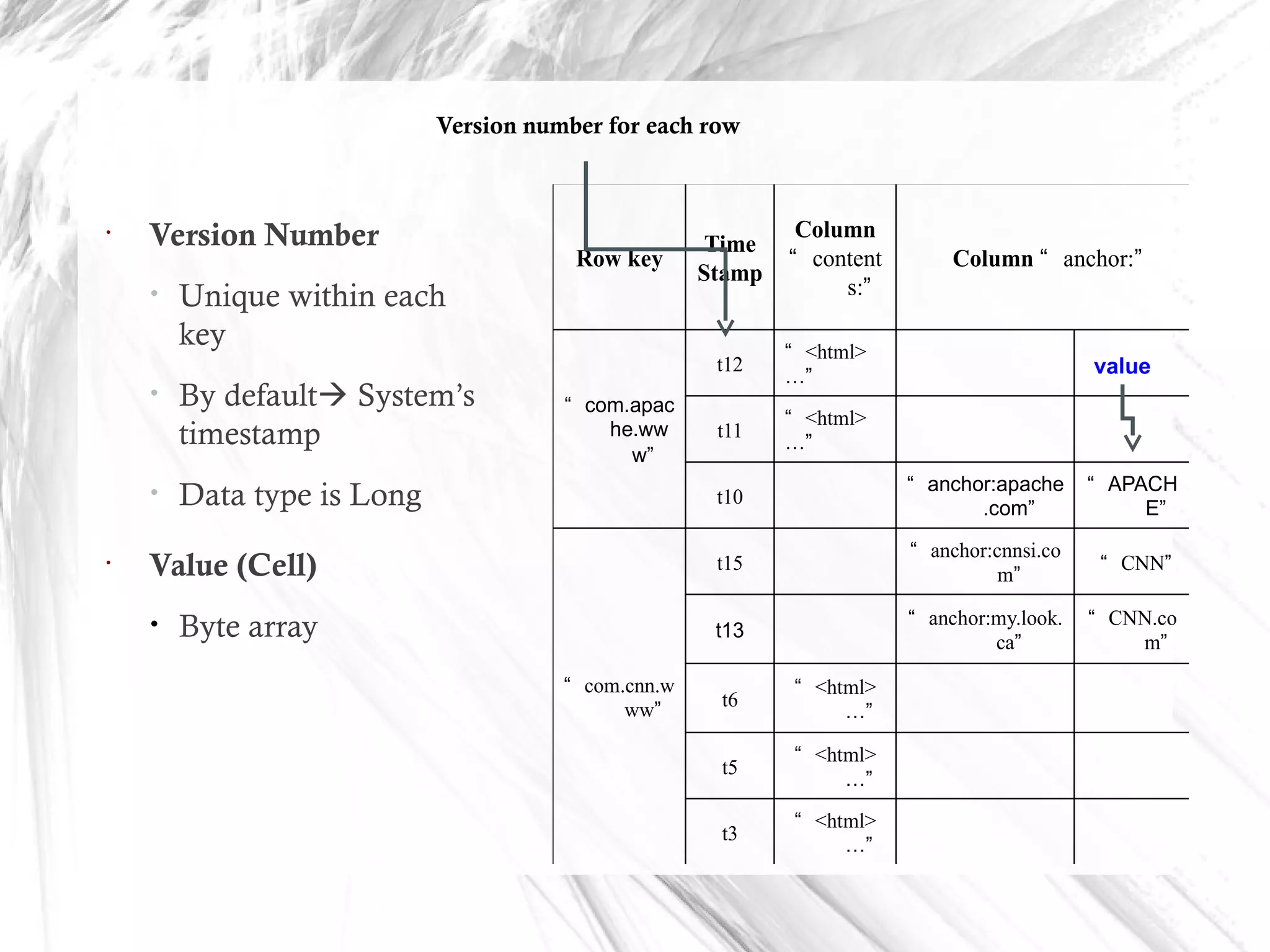
Row key
Time
Stamp
Column
“ content
s:”
Column “ anchor:”
“ com.apac
he.ww
w”
t12
“ <html>
…”
t11
“ <html>
…”
t10
“ anchor:apache
.com”
“ APACH
E”
“ com.cnn.w
ww”
t15
“ anchor:cnnsi.co
m”
“ CNN”
t13
“ anchor:my.look.
ca”
“ CNN.co
m”
t6
“ <html>
…”
t5
“ <html>
…”
t3
“ <html>
…”
•
Version Number
• Unique within each
key
• By default System’s
timestamp
• Data type is Long
•
Value (Cell)
• Byte array
Version number for each row
value
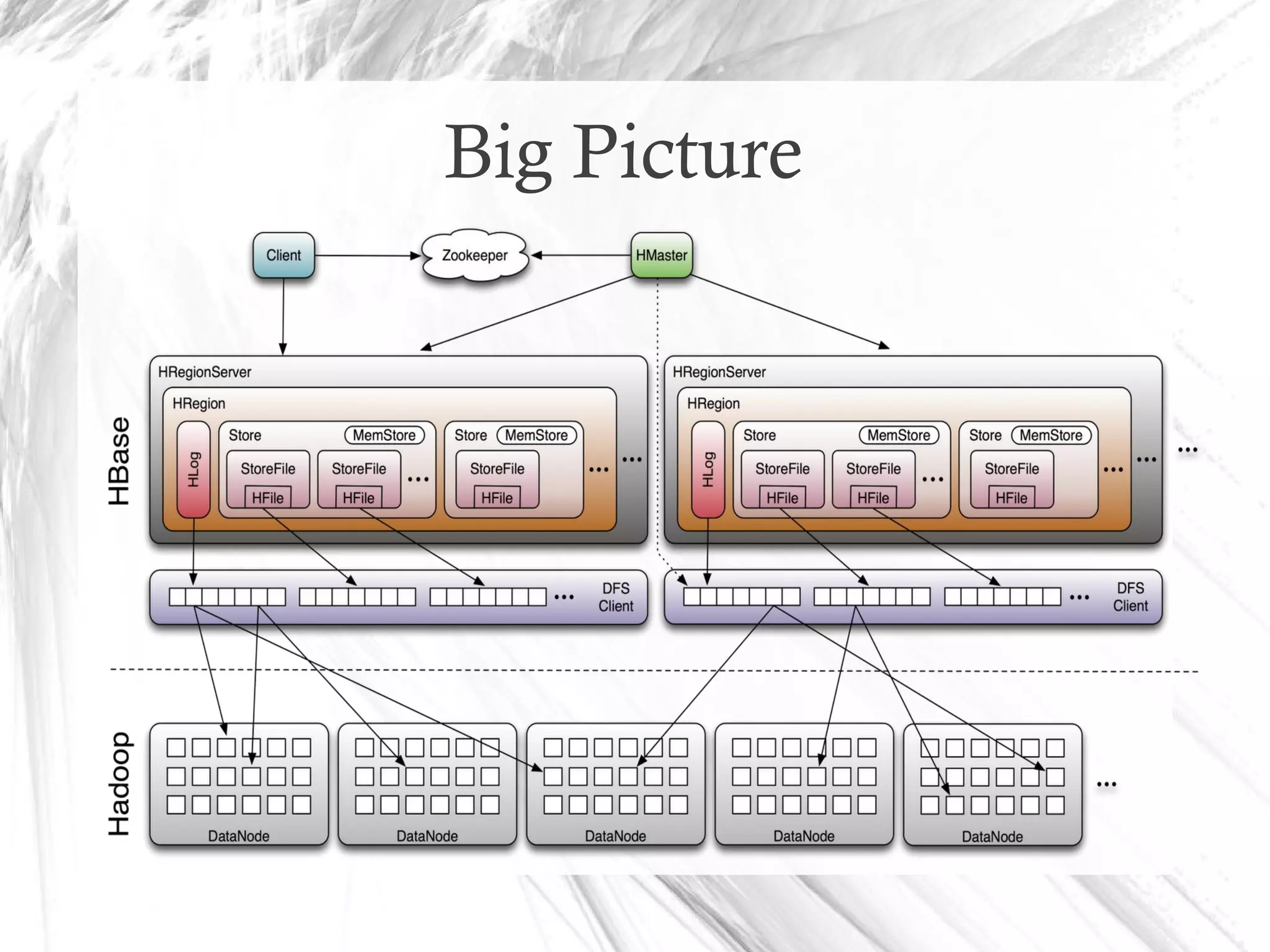
HBase Architecture
Three Major Components
•
The HBaseMaster
• One master
•
The HRegionServer
• Many region servers
•
The HBase client
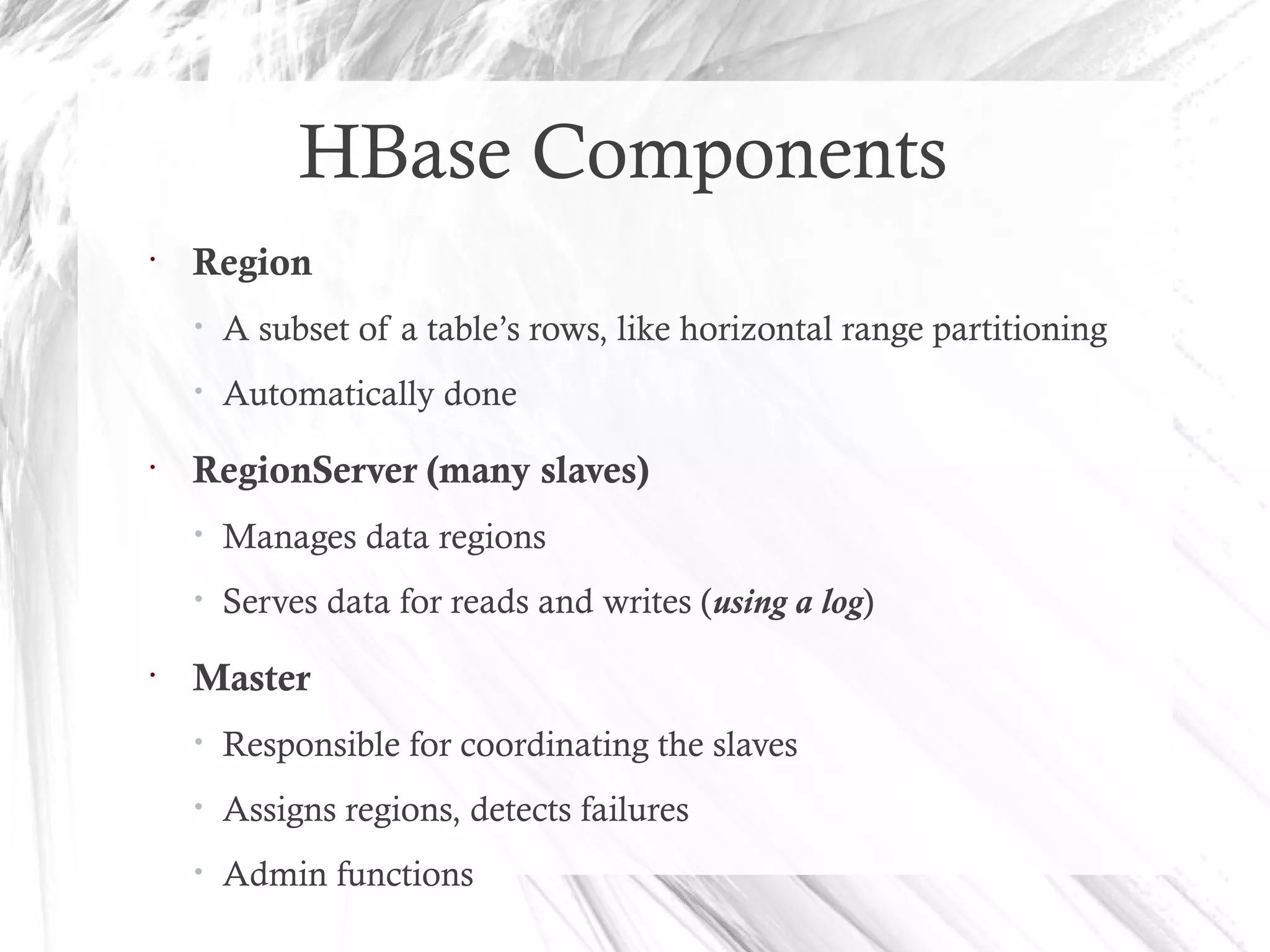
HBase Components
•
Region
• A subset of a table’s rows, like horizontal range partitioning
• Automatically done
•
RegionServer (many slaves)
• Manages data regions
• Serves data for reads and writes (using a log)
•
Master
• Responsible for coordinating the slaves
• Assigns regions, detects failures
• Admin functions
Big Picture
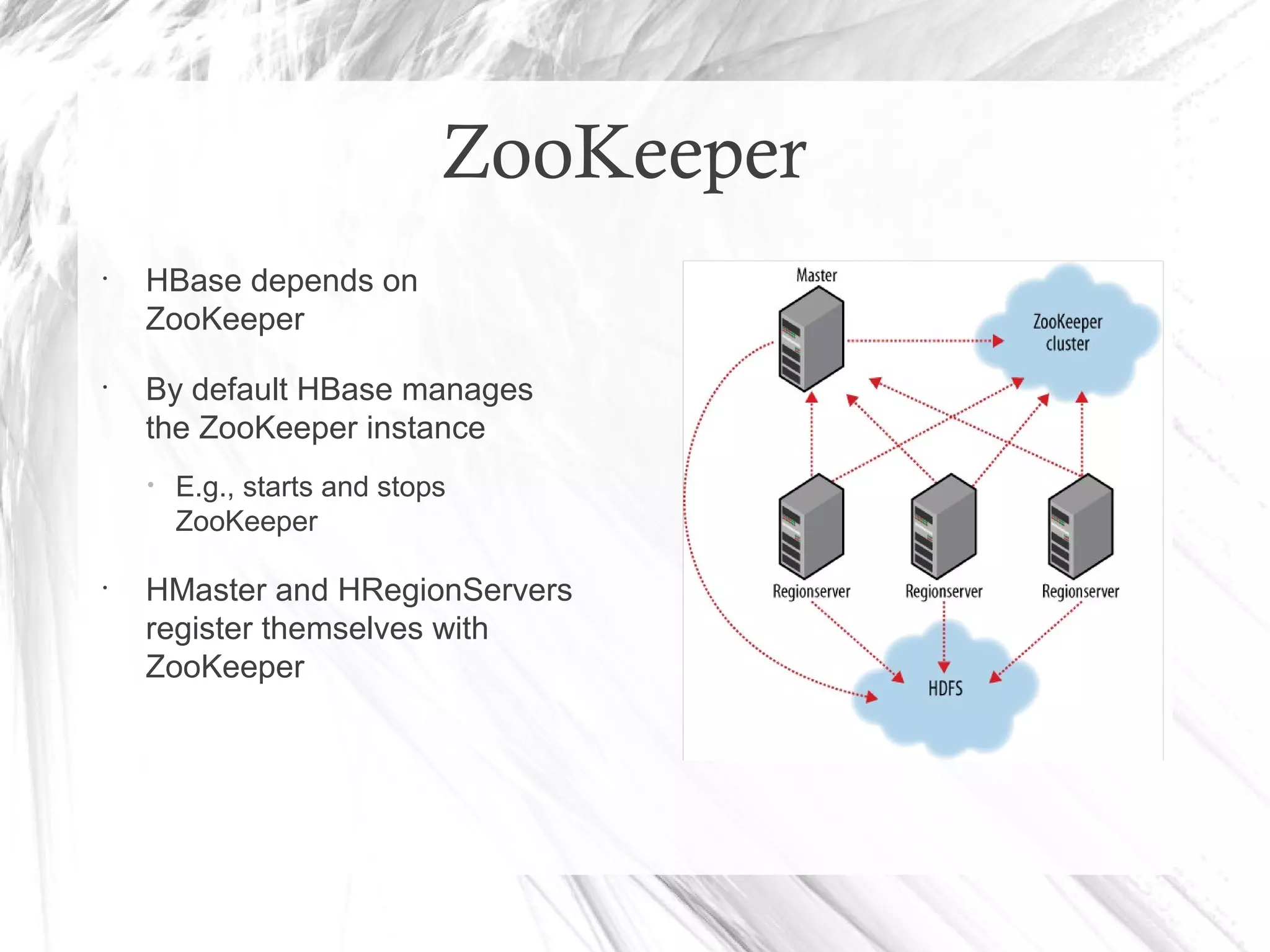
ZooKeeper
•
HBase depends on
ZooKeeper
•
By default HBase manages
the ZooKeeper instance
• E.g., starts and stops
ZooKeeper
•
HMaster and HRegionServers
register themselves with
ZooKeeper
Creating a Table
HBaseAdmin admin= new HBaseAdmin(config);
HColumnDescriptor []column;
column= new HColumnDescriptor[2];
column[0]=new HColumnDescriptor("columnFamily1:");
column[1]=new HColumnDescriptor("columnFamily2:");
HTableDescriptor desc= new
HTableDescriptor(Bytes.toBytes("MyTable"));
desc.addFamily(column[0]);
desc.addFamily(column[1]);
admin.createTable(desc);
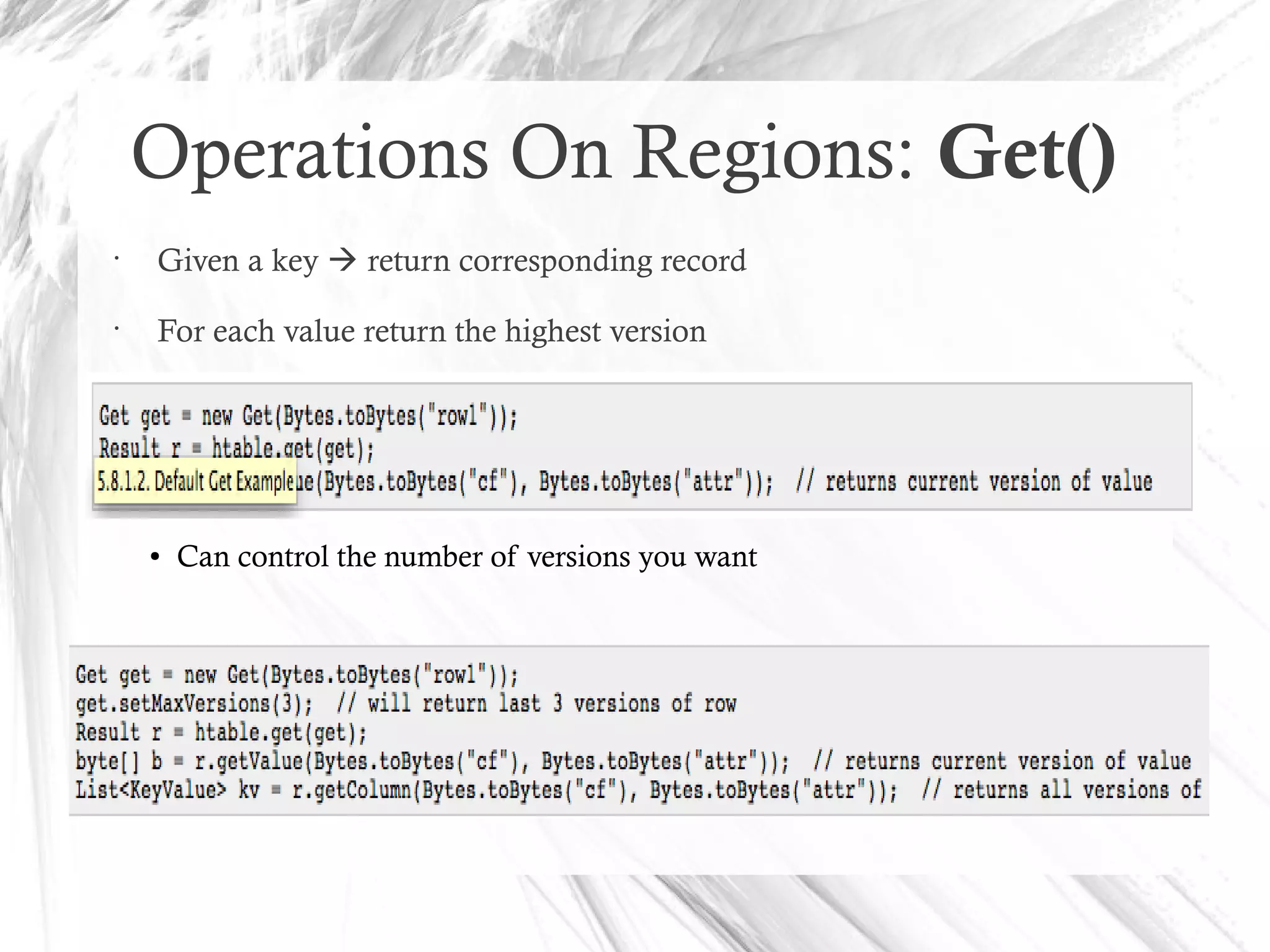
Operations On Regions: Get()
•
Given a key  return corresponding record
•
For each value return the highest version
● Can control the number of versions you want
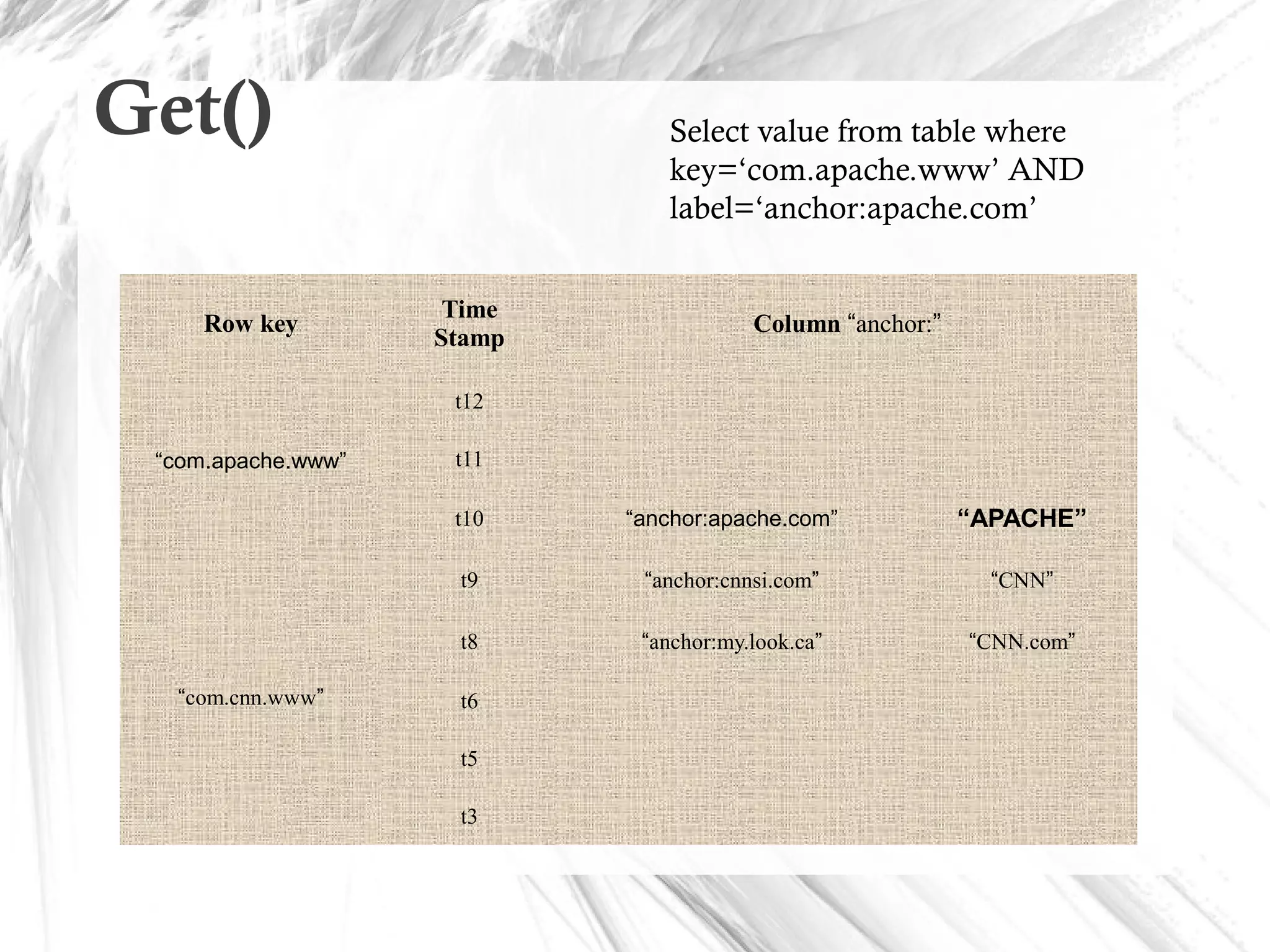
Get() Select value from table where
key=‘com.apache.www’ AND
label=‘anchor:apache.com’
Row key
Time
Stamp
Column “anchor:”
“com.apache.www”
t12
t11
t10 “anchor:apache.com” “APACHE”
“com.cnn.www”
t9 “anchor:cnnsi.com” “CNN”
t8 “anchor:my.look.ca” “CNN.com”
t6
t5
t3
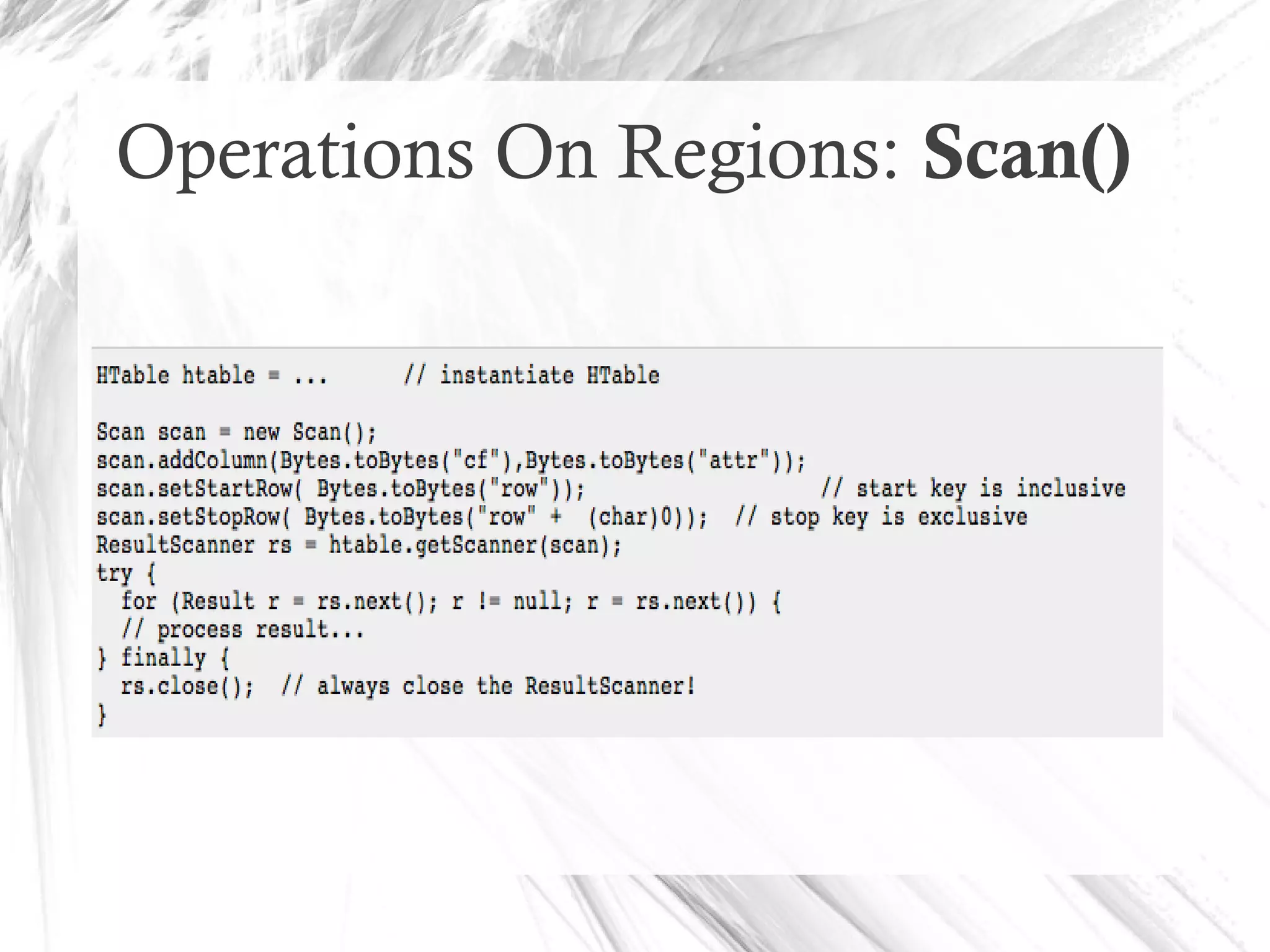
Operations On Regions: Scan()
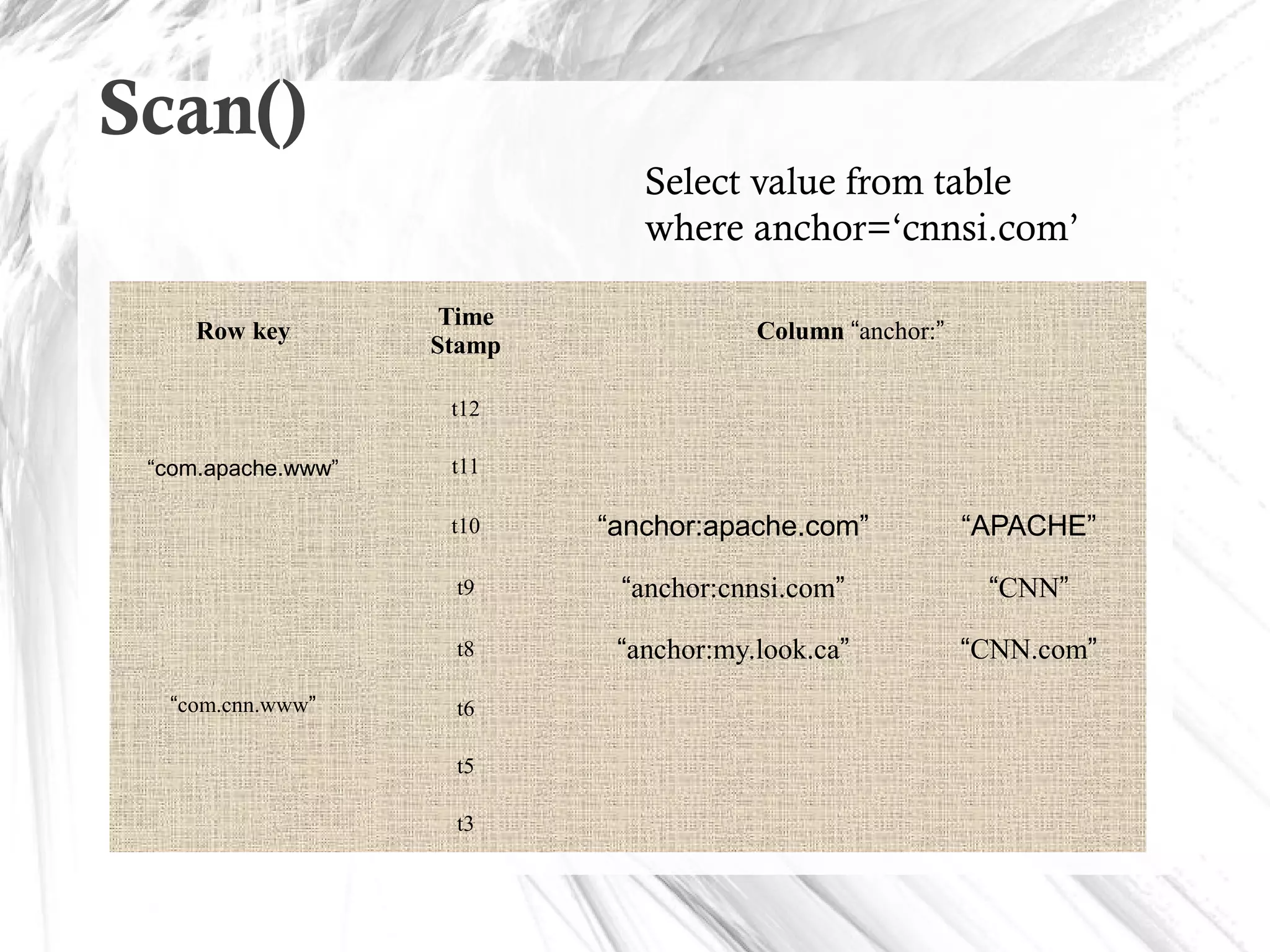
Scan()
Select value from table
where anchor=‘cnnsi.com’
Row key
Time
Stamp
Column “anchor:”
“com.apache.www”
t12
t11
t10 “anchor:apache.com” “APACHE”
“com.cnn.www”
t9 “anchor:cnnsi.com” “CNN”
t8 “anchor:my.look.ca” “CNN.com”
t6
t5
t3
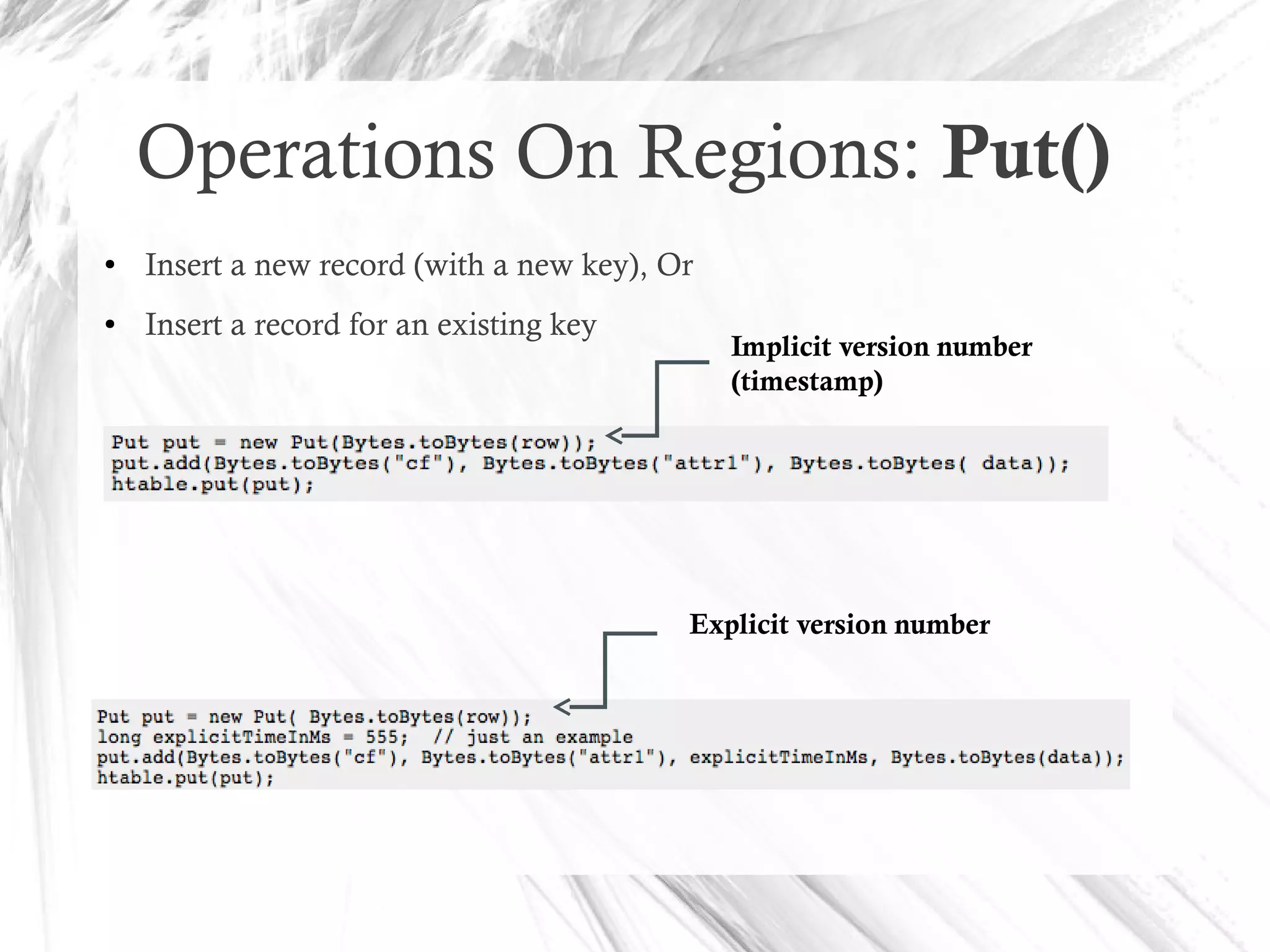
Operations On Regions: Put()
● Insert a new record (with a new key), Or
● Insert a record for an existing key
Implicit version number
(timestamp)
Explicit version number
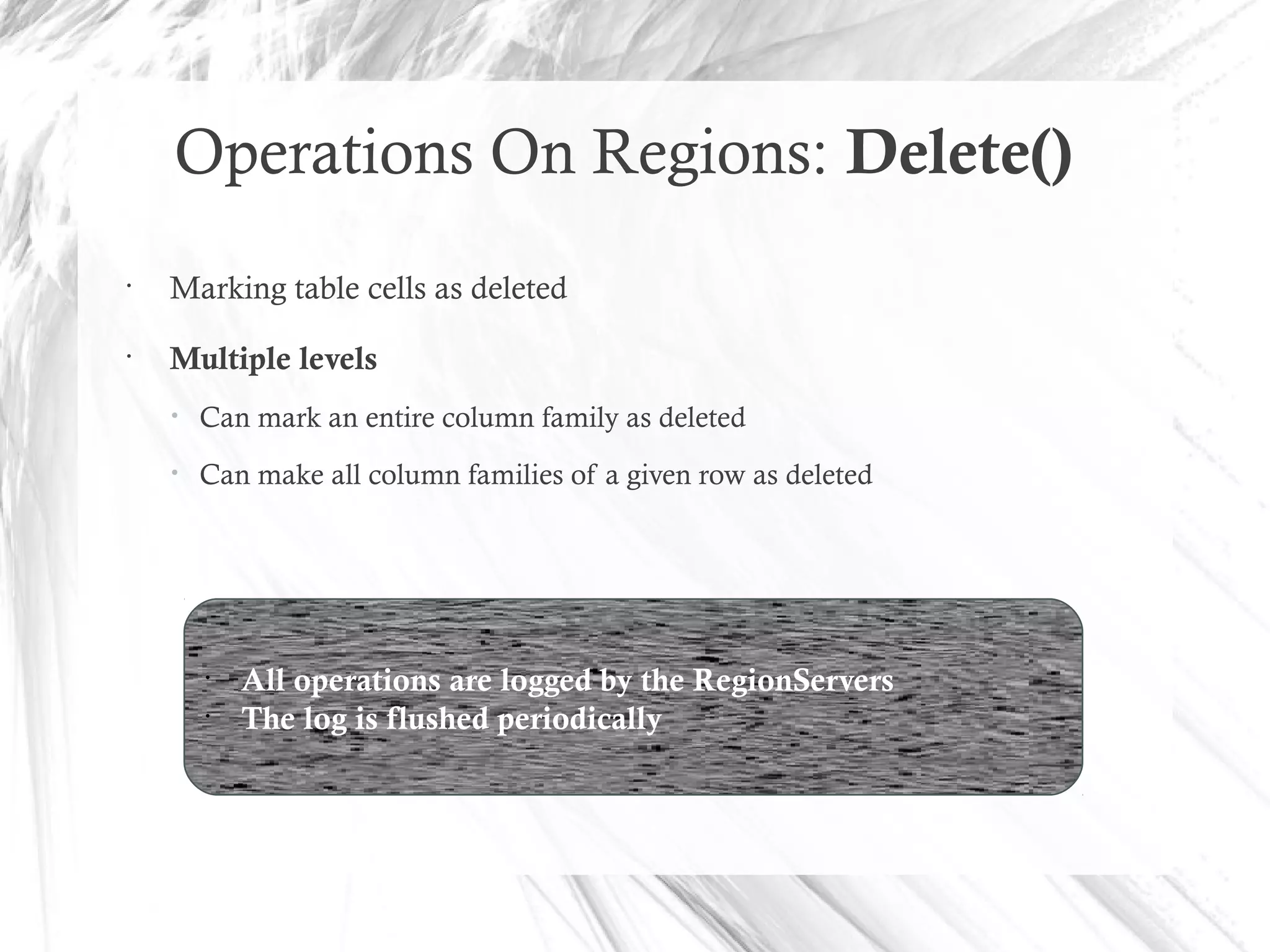
Operations On Regions: Delete()
•
Marking table cells as deleted
•
Multiple levels
• Can mark an entire column family as deleted
• Can make all column families of a given row as deleted
•
All operations are logged by the RegionServers
•
The log is flushed periodically
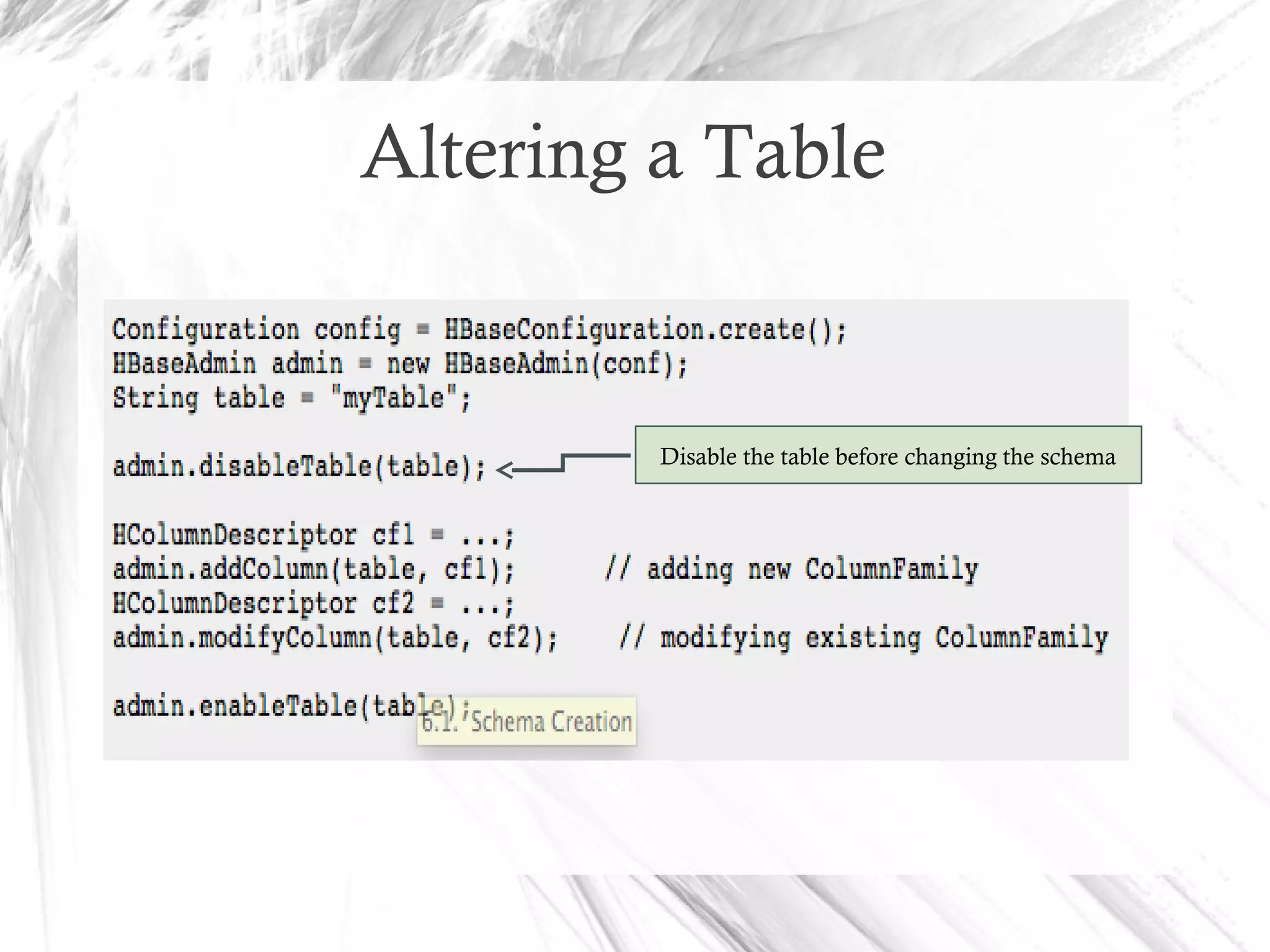
Altering a Table
Disable the table before changing the schema
Logging Operations
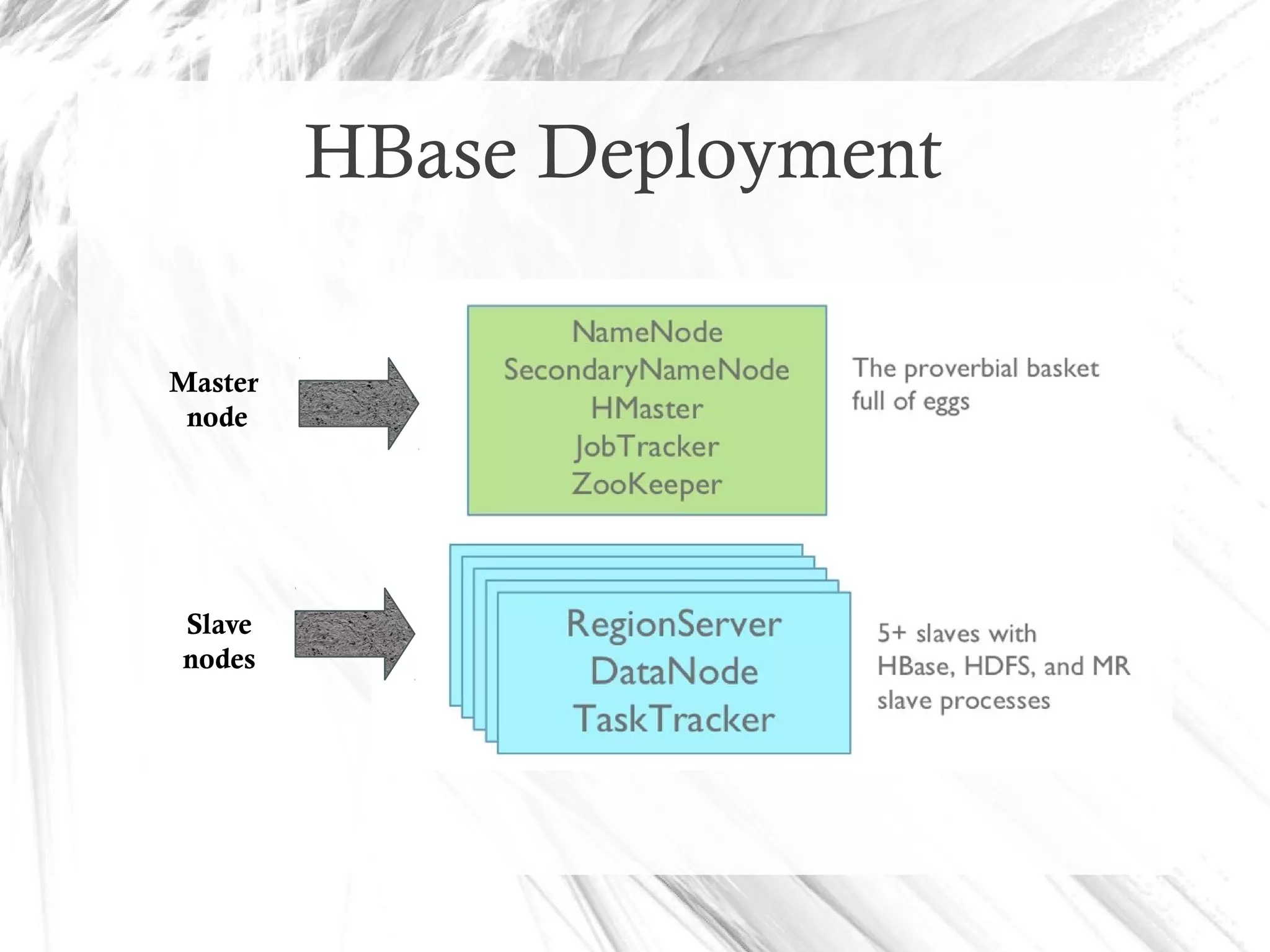
HBase Deployment
Master
node
Slave
nodes
References
● Introduction to Hbase
trac.nchc.org.tw/cloud/raw-
attachment/wiki/.../hbase_intro.ppt
● web.cs.wpi.edu/~cs525/s13-MYE/lectures/5/HBase.pptx
● www-users.cselabs.umn.edu/classes/Spring.../Hadoop-HBase-
Tutorial.ppt
● www.cs.kent.edu/~jin/Cloud12Spring/HbaseHivePig.pptx
Apache hadoop hbase

Apache hadoop hbase

  • 1.
    Apache Hadoop HBASE SheetalSharma Intern At IBM Innovation Centre
  • 2.
    HBase is .. ●A distributed data store that can scale horizontally to 1,000s of commodity servers and petabytes of indexed storage. ● Designed to operate on top of the Hadoop distributed file system (HDFS) or Kosmos File System (KFS, aka Cloudstore) for scalability, fault tolerance, and high availability.
  • 3.
    Benefits ● Distributed storage ●Table-like in data structure multi-dimensional map ● High scalability ● High availability ● High performance
  • 4.
    HBase Is Not… ● Tables have one primary index, the row key. ● No join operators. ● Scans and queries can select a subset of available columns, perhaps by using a wildcard. ● There are three types of lookups: Fast lookup using row key and optional timestamp. Full table scan Range scan from region start to end.
  • 5.
    HBase Is Not…(2) ● Limited atomicity and transaction support. - HBase supports multiple batched mutations of single rows only. - Data is unstructured and untyped. ● No accessed or manipulated via SQL. - Programmatic access via Java, REST, or Thrift APIs. - Scripting via JRuby.
  • 6.
    Why HBase ? ●HBase is a Bigtable clone. ● It is open source ● It has a good community and promise for the future ● It is developed on top of and has good integration for the Hadoop platform, if you are using Hadoop already. ● It has a Cascading connector.
  • 7.
  • 8.
    HBase benefits thanRDBMS ● No real indexes ● Automatic partitioning ● Scale linearly and automatically with new nodes ● Commodity hardware ● Fault tolerance ● Batch processing
  • 9.
    HBase: Part ofHadoop’s Ecosystem HBase is built on top of HDFS HBase files are internally stored in HDFS
  • 10.
    HBase vs. HDFS ●Both are distributed systems that scale to hundreds or thousands of nodes ● HDFS is good for batch processing (scans over big files) Not good for record lookup Not good for incremental addition of small batches Not good for updates
  • 11.
    HBase vs. HDFS(Cont’d) ● HBase is designed to efficiently address the above points Fast record lookup Support for record-level insertion Support for updates (not in place) ● HBase updates are done by creating new versions of values
  • 12.
    HBase vs. HDFS(Cont’d) If application has neither random reads or writes  Stick to HDFS
  • 13.
  • 14.
    HBase Data Model ●Data is divided into various tables ● Table is composed of columns, columns are grouped into column- families
  • 15.
    HBase Storage Model ●Partitioning - A table is horizontally partitioned into regions, each region is composed of sequential range of keys - Each region is managed by a RegionServer, a single RegionServer may hold multiple regions ● Persistence and data availability - HBase stores its data in HDFS, it doesn't replicate RegionServers and relies on HDFS replication for data availability. - Region data is cached in-memory * Updates and reads are served from in-memory cache (MemStore) * MemStore is flushed periodically to HDFS * Write Ahead Log (stored in HDFS) is used for durability of updates
  • 16.
    HBase: Keys andColumn Families Each record is divided into Column Families Each row has a Key Each column family consists of one or more Columns
  • 17.
    Row key Time Stamp Column “ content s:” Column“ anchor:” “ com.apac he.ww w” t12 “ <html> …” t11 “ <html> …” t10 “ anchor:apache .com” “ APACH E” “ com.cnn.w ww” t15 “ anchor:cnnsi.co m” “ CNN” t13 “ anchor:my.look. ca” “ CNN.co m” t6 “ <html> …” t5 “ <html> …” t3 “ <html> …” • Key • Byte array • Serves as the primary key for the table • Indexed far fast lookup • Column Family • Has a name (string) • Contains one or more related columns • Column • Belongs to one column family • Included inside the row • familyName:columnNa me Column family named “Contents” Column family named “anchor” Column named “apache.com”
  • 18.
    Row key Time Stamp Column “ content s:” Column“ anchor:” “ com.apac he.ww w” t12 “ <html> …” t11 “ <html> …” t10 “ anchor:apache .com” “ APACH E” “ com.cnn.w ww” t15 “ anchor:cnnsi.co m” “ CNN” t13 “ anchor:my.look. ca” “ CNN.co m” t6 “ <html> …” t5 “ <html> …” t3 “ <html> …” • Version Number • Unique within each key • By default System’s timestamp • Data type is Long • Value (Cell) • Byte array Version number for each row value
  • 19.
    HBase Architecture Three MajorComponents • The HBaseMaster • One master • The HRegionServer • Many region servers • The HBase client
  • 20.
    HBase Components • Region • Asubset of a table’s rows, like horizontal range partitioning • Automatically done • RegionServer (many slaves) • Manages data regions • Serves data for reads and writes (using a log) • Master • Responsible for coordinating the slaves • Assigns regions, detects failures • Admin functions
  • 21.
  • 22.
    ZooKeeper • HBase depends on ZooKeeper • Bydefault HBase manages the ZooKeeper instance • E.g., starts and stops ZooKeeper • HMaster and HRegionServers register themselves with ZooKeeper
  • 23.
    Creating a Table HBaseAdminadmin= new HBaseAdmin(config); HColumnDescriptor []column; column= new HColumnDescriptor[2]; column[0]=new HColumnDescriptor("columnFamily1:"); column[1]=new HColumnDescriptor("columnFamily2:"); HTableDescriptor desc= new HTableDescriptor(Bytes.toBytes("MyTable")); desc.addFamily(column[0]); desc.addFamily(column[1]); admin.createTable(desc);
  • 24.
    Operations On Regions:Get() • Given a key  return corresponding record • For each value return the highest version ● Can control the number of versions you want
  • 25.
    Get() Select valuefrom table where key=‘com.apache.www’ AND label=‘anchor:apache.com’ Row key Time Stamp Column “anchor:” “com.apache.www” t12 t11 t10 “anchor:apache.com” “APACHE” “com.cnn.www” t9 “anchor:cnnsi.com” “CNN” t8 “anchor:my.look.ca” “CNN.com” t6 t5 t3
  • 26.
  • 27.
    Scan() Select value fromtable where anchor=‘cnnsi.com’ Row key Time Stamp Column “anchor:” “com.apache.www” t12 t11 t10 “anchor:apache.com” “APACHE” “com.cnn.www” t9 “anchor:cnnsi.com” “CNN” t8 “anchor:my.look.ca” “CNN.com” t6 t5 t3
  • 28.
    Operations On Regions:Put() ● Insert a new record (with a new key), Or ● Insert a record for an existing key Implicit version number (timestamp) Explicit version number
  • 29.
    Operations On Regions:Delete() • Marking table cells as deleted • Multiple levels • Can mark an entire column family as deleted • Can make all column families of a given row as deleted • All operations are logged by the RegionServers • The log is flushed periodically
  • 30.
    Altering a Table Disablethe table before changing the schema
  • 31.
  • 32.
  • 33.
    References ● Introduction toHbase trac.nchc.org.tw/cloud/raw- attachment/wiki/.../hbase_intro.ppt ● web.cs.wpi.edu/~cs525/s13-MYE/lectures/5/HBase.pptx ● www-users.cselabs.umn.edu/classes/Spring.../Hadoop-HBase- Tutorial.ppt ● www.cs.kent.edu/~jin/Cloud12Spring/HbaseHivePig.pptx