Apache
HBase
. HBase is a distributed column-oriented database built on top
of the Hadoop file system. It is an open-source project and is
horizontally scalable.
. HBase is a data model that is similar to Google’sbig table
designed to provide quick random access to huge amounts of
structured data. It leverages the fault tolerance provided by
the Hadoop File System (HDFS).
. It is a part of the Hadoop ecosystem that provides random
real-time read/write access to data in the Hadoop File System.
. One can store the data in HDFS either directly or through
HBase. Data consumer reads/accesses the data in HDFS
randomly using HBase. HBase sits on top of the Hadoop File
System and provides read and write access.
What is
HBase?
HBase
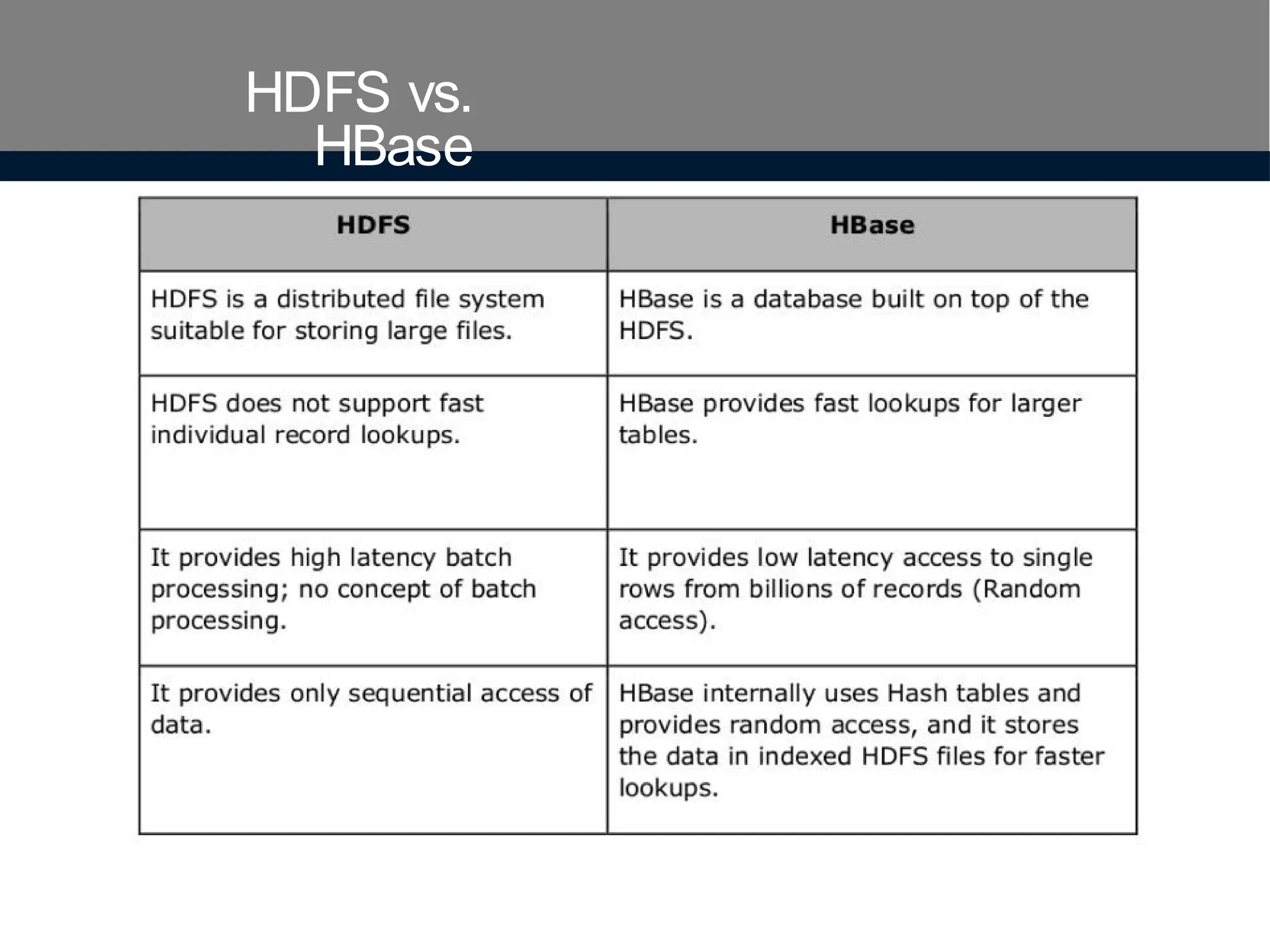
HDFS vs.
HBase
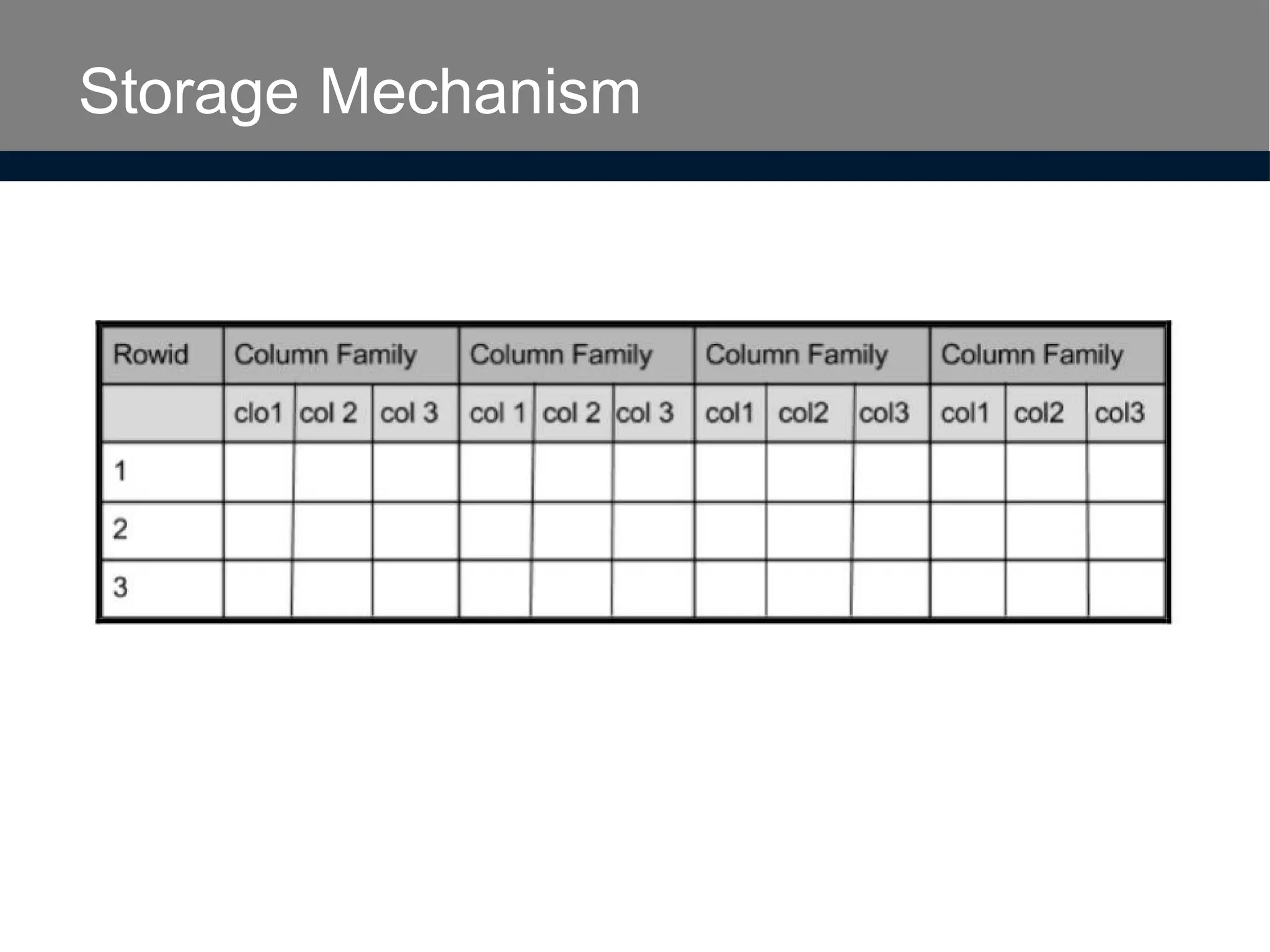
. HBase is a column-oriented database and the tables in it
are sorted by row.
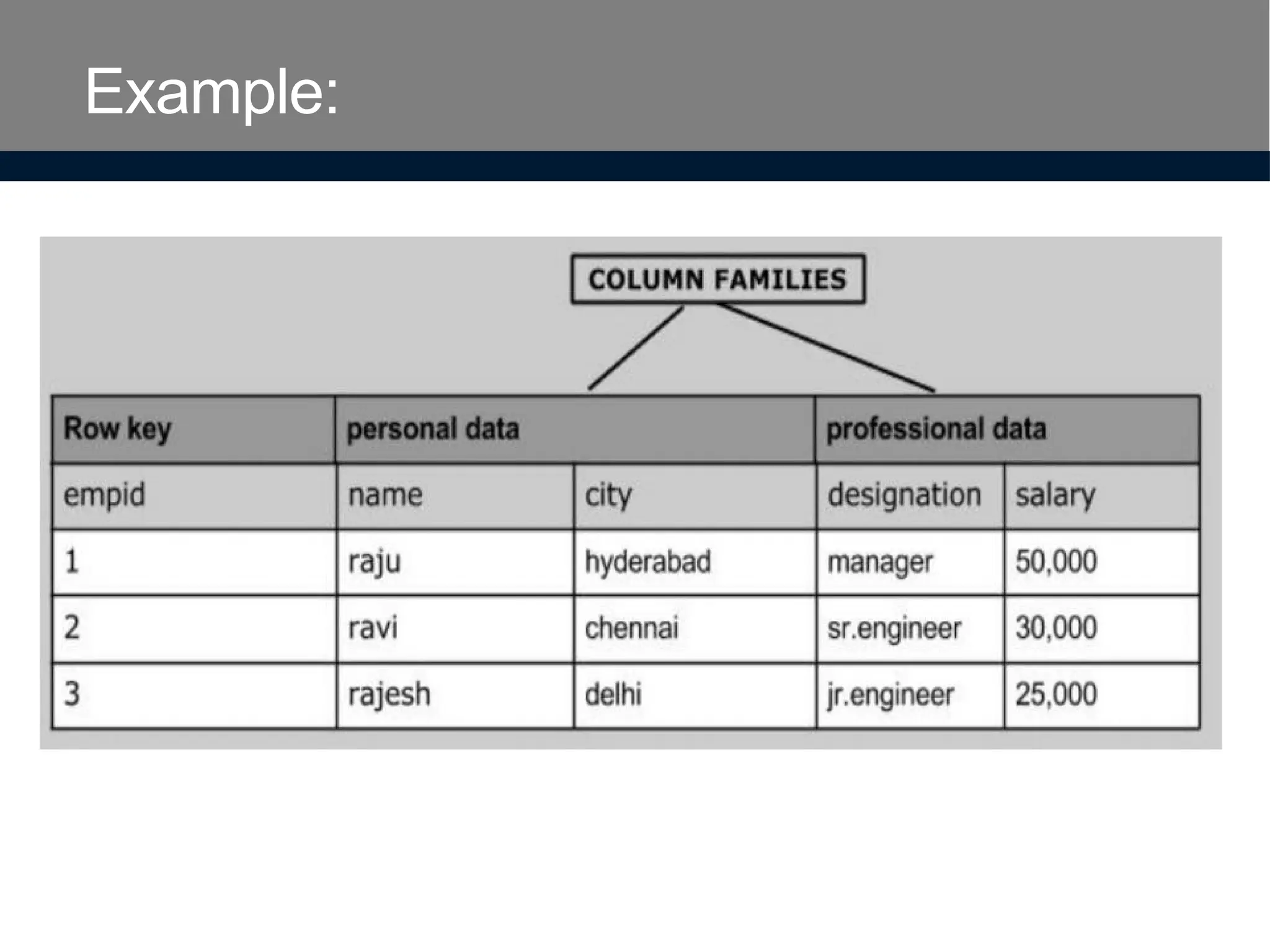
. The table schema defines only column families, which are
the key value pairs. A table have multiple column families
and each column family can have any number of
columns.
. Subsequent column values are stored contiguously on the
disk. Each cell value of the table has a timestamp. In
short, in an Hbase:
– Table is a collection of rows.
– Row is a collection of column families.
– Column family is a collection of columns.
– Column is a collection of key value pairs.
Storage Mechanism
Storage Mechanism
Column Oriented vs. Row Oriented
Example:
. HBase is linearly scalable.
. It has automatic failure support.
. It provides consistent read and writes.
. It integrates with Hadoop, both as a source
and a destination.
. It has easy java API for client.
. It provides data replication across clusters.
Features
. It is used whenever there is a need to
write heavy applications.
. HBase is used whenever we need to
provide fast random access to available
data.
. Companies such as Facebook, Twitter,
Yahoo, and Adobe use Hbase internally.
Use
s
Architecture
. Assigns regions to the region servers and takes
the help of Apache ZooKeeper for this task.
. Handles load balancing of the regions across
region servers. It unloads the busy servers and
shifts the regions to less occupied servers.
. Maintains the state of the cluster by
negotiating the load balancing.
. Is responsible for schema changes and other
metadata operations such as creation of tables
and column families.
Master server
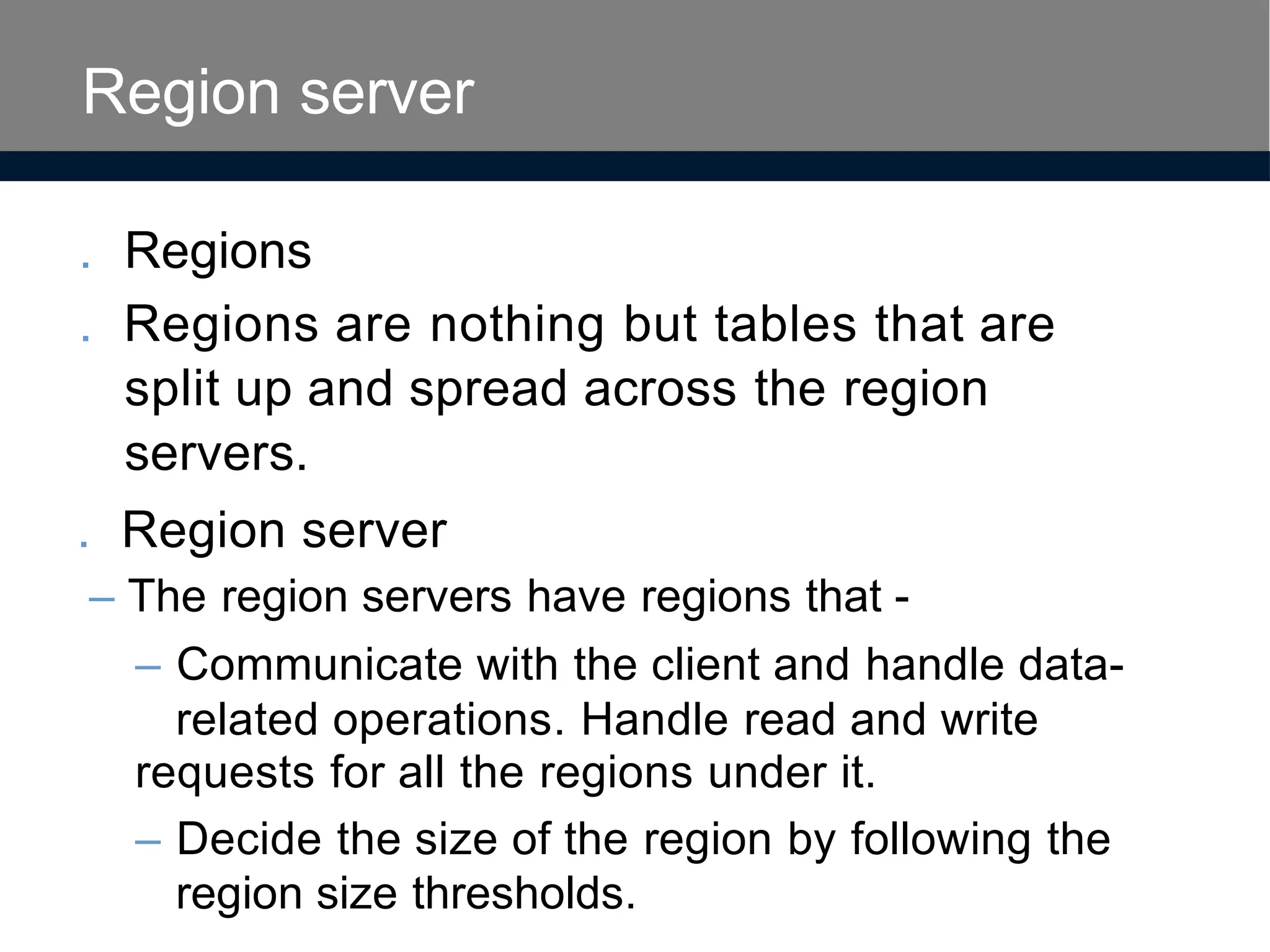
. Regions
. Regions are nothing but tables that are
split up and spread across the region
servers.
. Region server
– The region servers have regions that -
– Communicate with the client and handle data-
related operations. Handle read and write
requests for all the regions under it.
– Decide the size of the region by following the
region size thresholds.
Region server
. Zookeeper is an open-source project that provides
services like maintaining configuration information,
naming, providing distributed synchronization, etc.
. Zookeeper has ephemeral nodes representing different
region servers. Master servers use these nodes to
discover available servers.
. In addition to availability, the nodes are also used to
track server failures or network partitions.
. Clients communicate with region servers via zookeeper.
. In pseudo and standalone modes, HBase itself will take
care of zookeeper.
Zookeeper
. HBase contains a shell using which you can
communicate with HBase.
. Hbase uses the Hadoop File System to store
its data.
. It will have a master server and region
servers. The data storage will be in the form
of regions (tables).
. These regions will be split up and stored in
region servers.
Hbase
Shell
. status: Provides the status of HBase, for example,
the number of servers.
. version: Provides the version of HBase being
used.
. table_help: Provides help for table-reference
commands.
. whoami: Provides information about the user.
General Commands
. create: Creates a table.
. list: Lists all the tables in HBase.
. disable: Disables a table.
. is_disabled: Verifies whether a table is disabled.
. enable: Enables a table.
. is_enabled: Verifies whether a table is enabled.
. describe: Provides the description of a table.
. alter: Alters a table.
. exists: Verifies whether a table exists.
. drop: Drops a table from HBase.
DDL Commands
. put: Puts a cell value at a specified column in a
specified row in a particular table.
. get: Fetches the contents of row or a cell.
. delete: Deletes a cell value in a table.
. deleteall: Deletes all the cells in a given row.
. scan: Scans and returns the table data.
. count: Counts and returns the number of rows in a
table.
. truncate: Disables, drops, and recreates a specified
table.
DML
Commands
Create table
. create 'emp','personal data', ‘professional
data’
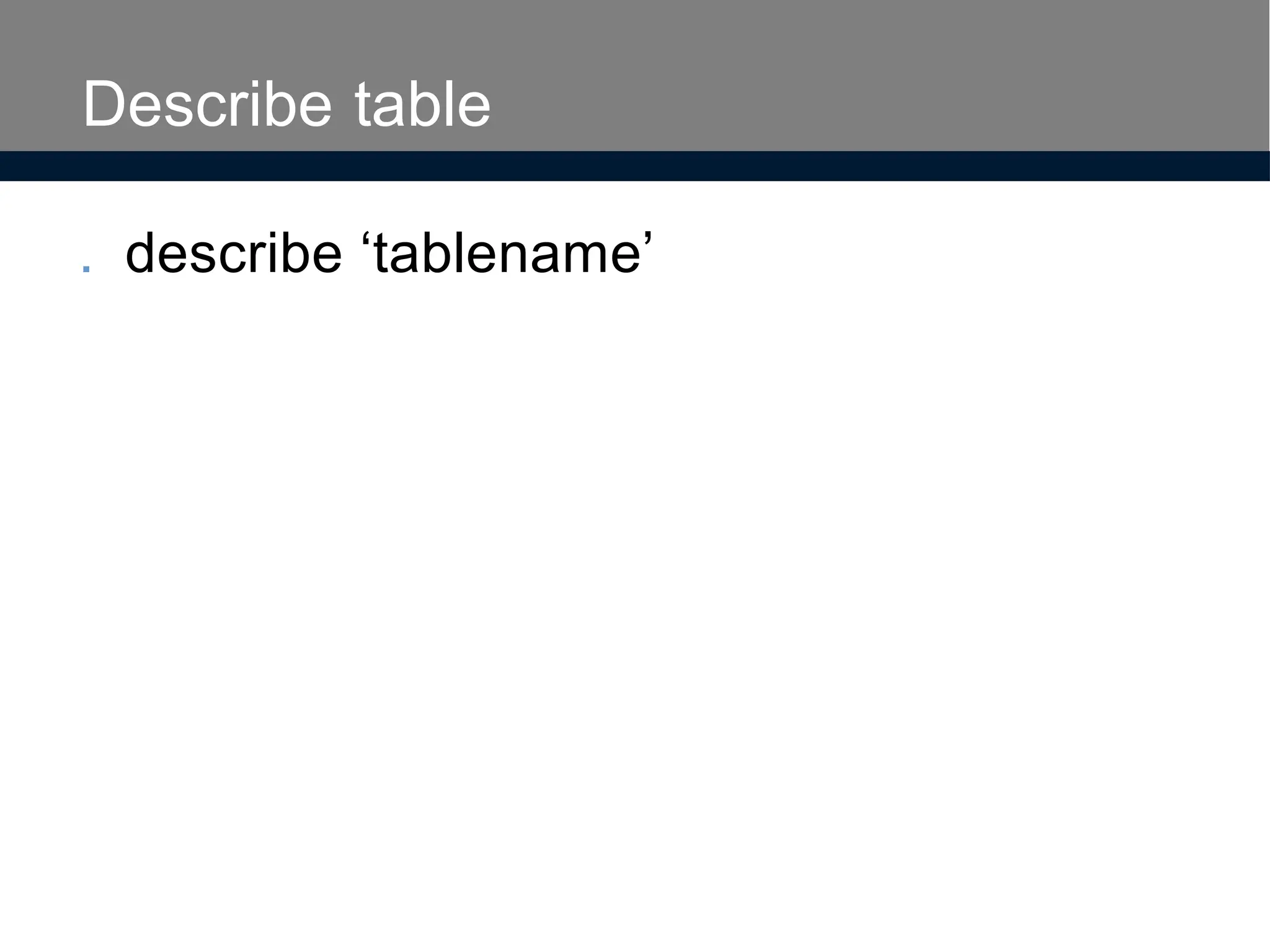
Describe table
. describe ‘tablename’
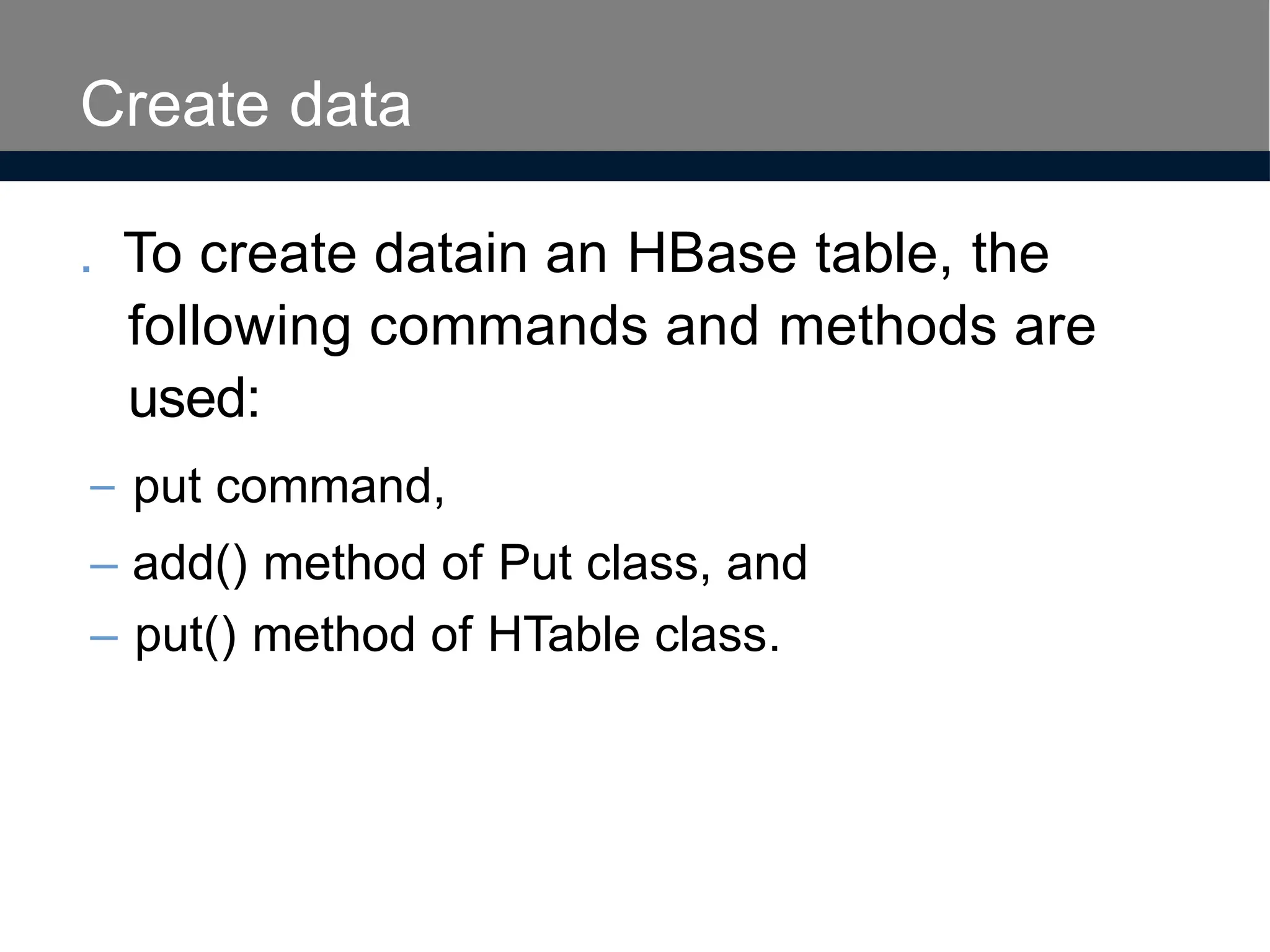
. To create datain an HBase table, the
following commands and methods are
used:
– put command,
– add() method of Put class, and
– put() method of HTable class.
Create data
Example:
. put 'emp','1','personal data:name','raju'
. put 'emp','1','personal data:city','mumbai'
. put 'emp','1','professional
data:designation','manager'
. put 'emp','1','professional data:salary','50000'
.
Example:
Display:
. scan ‘tablename’
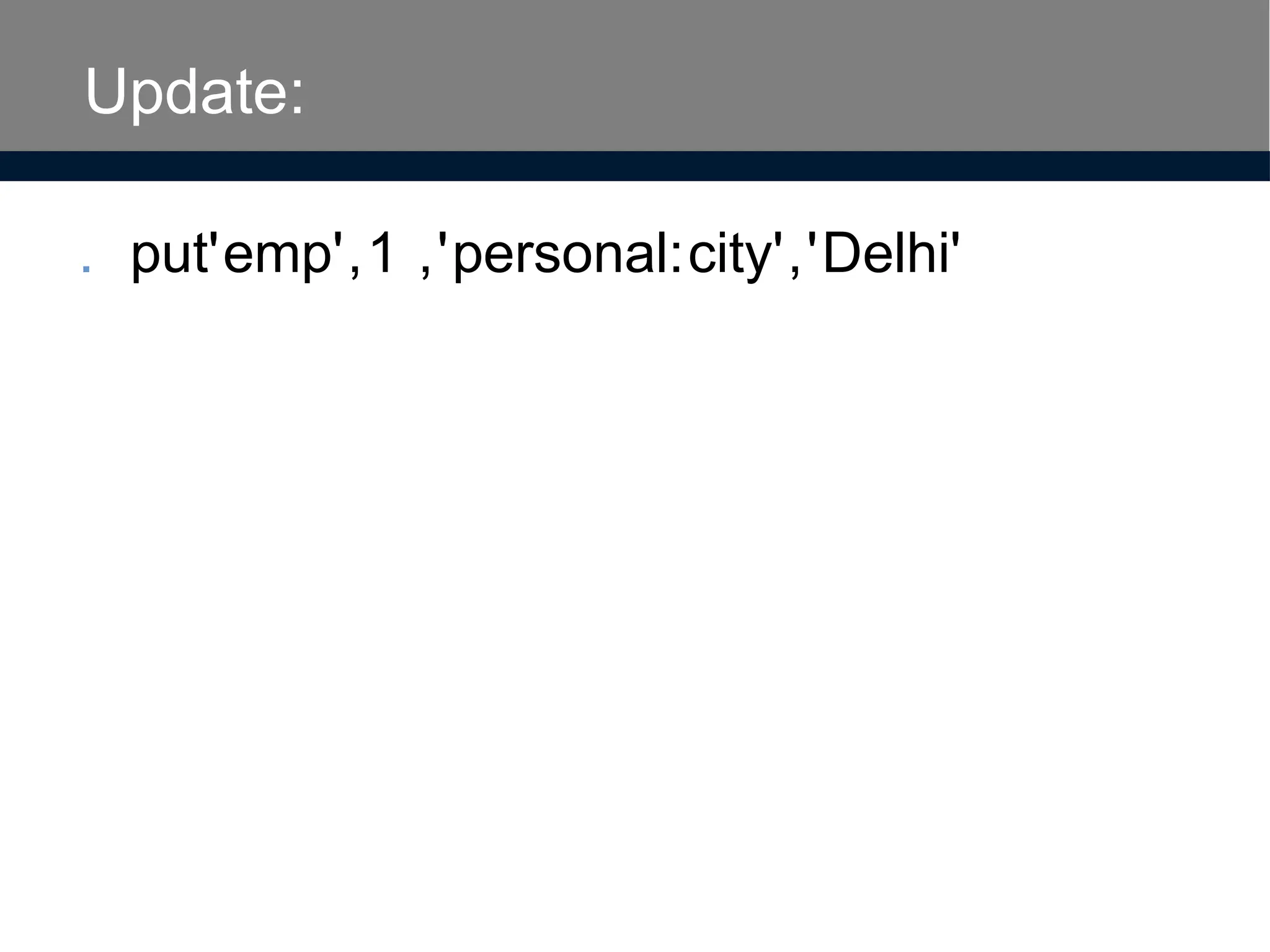
Update:
. put'emp',1 ,'personal:city','Delhi'
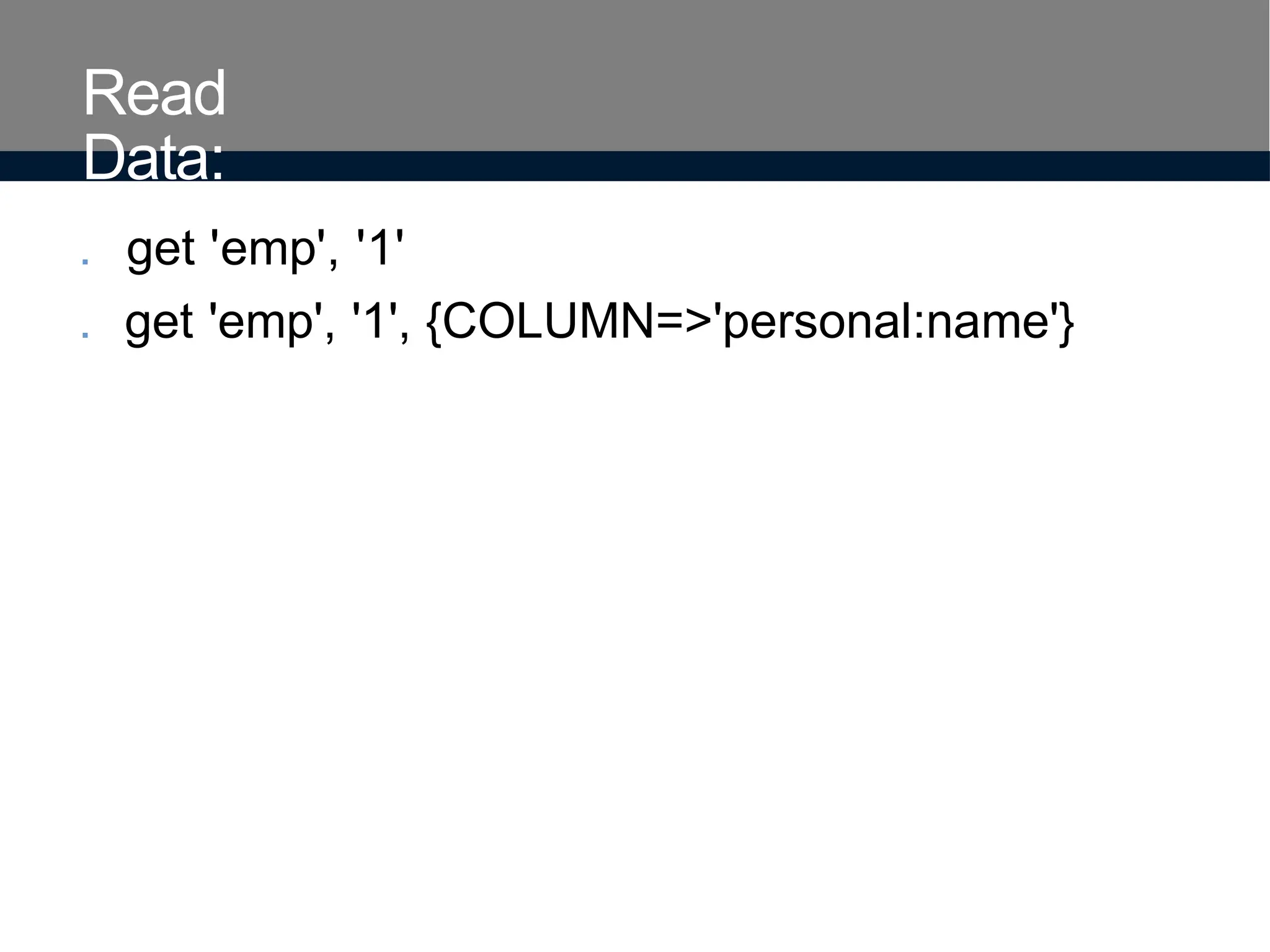
Read
Data:
. get 'emp', '1'
. get 'emp', '1', {COLUMN=>'personal:name'}
Read
Data:
. delete 'emp', '1', 'personal data:city'
. You can count the number of rows of a
table using the count command.
count ‘emp’
. This command disables drops and
recreates a table.
truncate ‘tablename’
Count and truncate

hbase hkijhishdfshdfsjkdfsdhfsdhfsjkfjdf

  • 1.
  • 2.
    . HBase isa distributed column-oriented database built on top of the Hadoop file system. It is an open-source project and is horizontally scalable. . HBase is a data model that is similar to Google’sbig table designed to provide quick random access to huge amounts of structured data. It leverages the fault tolerance provided by the Hadoop File System (HDFS). . It is a part of the Hadoop ecosystem that provides random real-time read/write access to data in the Hadoop File System. . One can store the data in HDFS either directly or through HBase. Data consumer reads/accesses the data in HDFS randomly using HBase. HBase sits on top of the Hadoop File System and provides read and write access. What is HBase?
  • 3.
  • 4.
  • 5.
    . HBase isa column-oriented database and the tables in it are sorted by row. . The table schema defines only column families, which are the key value pairs. A table have multiple column families and each column family can have any number of columns. . Subsequent column values are stored contiguously on the disk. Each cell value of the table has a timestamp. In short, in an Hbase: – Table is a collection of rows. – Row is a collection of column families. – Column family is a collection of columns. – Column is a collection of key value pairs. Storage Mechanism
  • 6.
  • 7.
    Column Oriented vs.Row Oriented
  • 8.
  • 9.
    . HBase islinearly scalable. . It has automatic failure support. . It provides consistent read and writes. . It integrates with Hadoop, both as a source and a destination. . It has easy java API for client. . It provides data replication across clusters. Features
  • 10.
    . It isused whenever there is a need to write heavy applications. . HBase is used whenever we need to provide fast random access to available data. . Companies such as Facebook, Twitter, Yahoo, and Adobe use Hbase internally. Use s
  • 11.
  • 13.
    . Assigns regionsto the region servers and takes the help of Apache ZooKeeper for this task. . Handles load balancing of the regions across region servers. It unloads the busy servers and shifts the regions to less occupied servers. . Maintains the state of the cluster by negotiating the load balancing. . Is responsible for schema changes and other metadata operations such as creation of tables and column families. Master server
  • 14.
    . Regions . Regionsare nothing but tables that are split up and spread across the region servers. . Region server – The region servers have regions that - – Communicate with the client and handle data- related operations. Handle read and write requests for all the regions under it. – Decide the size of the region by following the region size thresholds. Region server
  • 15.
    . Zookeeper isan open-source project that provides services like maintaining configuration information, naming, providing distributed synchronization, etc. . Zookeeper has ephemeral nodes representing different region servers. Master servers use these nodes to discover available servers. . In addition to availability, the nodes are also used to track server failures or network partitions. . Clients communicate with region servers via zookeeper. . In pseudo and standalone modes, HBase itself will take care of zookeeper. Zookeeper
  • 16.
    . HBase containsa shell using which you can communicate with HBase. . Hbase uses the Hadoop File System to store its data. . It will have a master server and region servers. The data storage will be in the form of regions (tables). . These regions will be split up and stored in region servers. Hbase Shell
  • 17.
    . status: Providesthe status of HBase, for example, the number of servers. . version: Provides the version of HBase being used. . table_help: Provides help for table-reference commands. . whoami: Provides information about the user. General Commands
  • 18.
    . create: Createsa table. . list: Lists all the tables in HBase. . disable: Disables a table. . is_disabled: Verifies whether a table is disabled. . enable: Enables a table. . is_enabled: Verifies whether a table is enabled. . describe: Provides the description of a table. . alter: Alters a table. . exists: Verifies whether a table exists. . drop: Drops a table from HBase. DDL Commands
  • 19.
    . put: Putsa cell value at a specified column in a specified row in a particular table. . get: Fetches the contents of row or a cell. . delete: Deletes a cell value in a table. . deleteall: Deletes all the cells in a given row. . scan: Scans and returns the table data. . count: Counts and returns the number of rows in a table. . truncate: Disables, drops, and recreates a specified table. DML Commands
  • 20.
    Create table . create'emp','personal data', ‘professional data’
  • 21.
  • 22.
    . To createdatain an HBase table, the following commands and methods are used: – put command, – add() method of Put class, and – put() method of HTable class. Create data
  • 23.
  • 24.
    . put 'emp','1','personaldata:name','raju' . put 'emp','1','personal data:city','mumbai' . put 'emp','1','professional data:designation','manager' . put 'emp','1','professional data:salary','50000' . Example:
  • 25.
  • 26.
  • 27.
    Read Data: . get 'emp','1' . get 'emp', '1', {COLUMN=>'personal:name'}
  • 28.
    Read Data: . delete 'emp','1', 'personal data:city'
  • 29.
    . You cancount the number of rows of a table using the count command. count ‘emp’ . This command disables drops and recreates a table. truncate ‘tablename’ Count and truncate