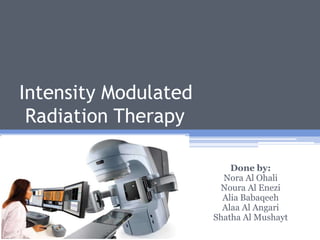
Intensity Modulated Radiation TherapyDone by:Nora Al OhaliNoura Al EneziAlia BabaqeehAlaa Al AngariShatha Al Mushayt
Outline IntroductionLiterature reviewPhysical aspect Discussion Conclusion
IntroductionIntensity modulated radiation therapy (IMRT) is the product of advances in the RT technology.Aims to deliver radiation more precisely to the tumor while relatively limiting dose to the surrounding normal tissues. The purpose of this presentation is to discuss the new concept of IMRT, its physical aspect, its applications and comparison with other RT methods.
Literature Review1950’s the medical linear accelerator was developed and marketed to treat cancer.1980’s the 3D-Conformal Radiotherapy (3D-CRT) was introduced.3D-CRTbased on 3D dose planning system.Conform the shape of the radiation beam to that of the tumor.Problem: Cannot conform well to 3D objects due to the uniformity of beam strength.30% of tumors exhibit concave features difficult conventional ConfornL RT.
Literature Review1960’sIMRT was first conceptualized 1994 the 1st commercial IMRT delivery unit was introduced.IMRTAn advanced form of 3D-CRT. Based on linear accelerator(L.A.) where the radiation intensity could be modulated during the treatment.The field is geometrically shaped by MLC’s.The intensity is varied pixel-by-pixel within the shaped field.
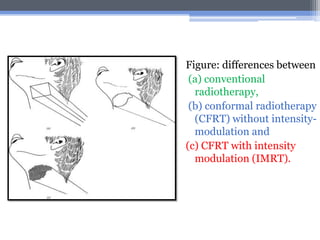
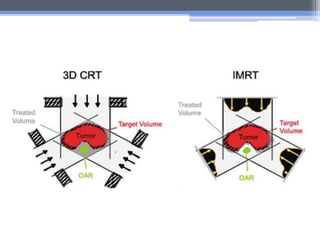
Figure: differences between(a) conventional radiotherapy,(b) conformal radiotherapy (CFRT) without intensity-modulation and (c) CFRT with intensity modulation (IMRT).
Physical AspectIMRT combines two advanced concepts to deliver 3D CRT:Inverse treatment planning with optimization by computercomputer-controlled intensity modulation of the radiation beam during treatment
Treatment planning Based on “Inverse planning”Initially, a CT scan is performed on the affected region.A radiation oncologist defines the PTVEnters the plan criteria: max dose, mini dose, desired -limiting dose(for critical structures) and a dose-volume histogramThen, an optimisation program is run to find the treatment plan which best matches all the input criteria.
Planning
Dose volume histogramDVH is to summarize 3D dose distributions in a graphical 2D format
Treatment planning Inverse planning methods are divided into:Analytic methodsIterative methodsMany computer programs use both methods to achieve a beam arrangement.
Analytic methods: It a mathematical techniques in which the TV dose distribution depends on the point dose intensity.
Iterative methods: Itis a manual technique and the beamlets depends on the cost function that is the energy dose for each point in the TV.
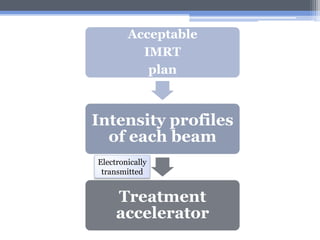
Electronically transmitted
How to modulate intensity?By MLC’s
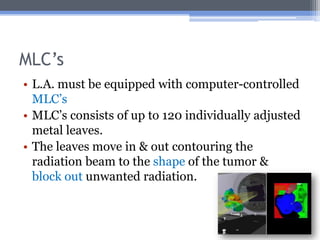
MLC’sL.A. must be equipped with computer-controlled MLC’sMLC’s consists of up to 120 individually adjusted metal leaves. The leaves move in & out contouring the radiation beam to the shape of the tumor & block out unwanted radiation.
MLC modes Multi segmented static fieldsDynamic deliveryIntensity modulated arc therapy
Multi segmented static fieldsAlso called, step-and-shoot or stop-and-shootThe patient is treated by multiple fields MLC divides each field into a set of subfields irradiated with uniform beam intensity levels. Delivered in an arrangement one at a time in sequence without operator intervention. The L.A is turned off while the leaves move to create the next subfield.
Dynamic Delivery Shift during deliveryThe radiation is “on” all the time, even when the leaves are moving from one static subfield to the next.
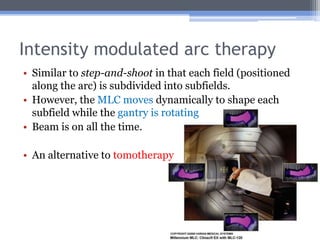
Intensity modulated arc therapySimilar to step-and-shoot in that each field (positioned along the arc) is subdivided into subfields. However, the MLC moves dynamically to shape each subfield while the gantry is rotating Beam is on all the time. An alternative to tomotherapy
IMRT plan to treat tumor & avoid critical structures
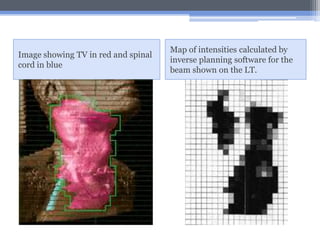
Image showing TV in red and spinal cord in blueMap of intensities calculated by inverse planning software for the beam shown on the LT.
Some Application of IMRT 1. Brain Tumors:  IMRT can treat Intracranial tumors (benign & malignant). large, irregular, and solitary, or smaller & multiple Brain lesions.IMRT limit the dose to surrounding normal tissues; optic nerve, chiasm, lens, & brainstem.  Brain IMRT
Some Application of IMRT 2. Head and Neck Cancer: Many of the technique issues for brain tumors also apply to head and neck ca.Limiting dose to the parotid gland to prevent xerostomia, or permanent dry mouth that occurs with typical head and neck radiotherapy.Head & neck IMRT
Some Application of IMRT 3. Prostate Cancer: RT has been a mainstay of localized prostate ca therapy for several decades.Higher doses to the prostate and better shielding of the rectum and bladder to minimize morbidity. Prostate IMRT
Some Application of IMRT 4. Breast cancer:IMRT is the better treatment.  Gives more even dose to the breast with fewer hot spots & less dosing to normal tissues (lung & heart).Common SE of radiation, like swelling, breast heaviness and sunburn-like changes, can be reduced with IMRT.
Discussion IMRT & 3D-CRTMany studies have generated 3D-CRT & IMRT treatment plans predicted dose distributions within the target & adjacent tissues  compared them.Results: IMRT  doses to the normal organs, target dose conformity, hypothesized that IMRT may improve treatment outcomes
Discussion IMRT & IGRTImage-guided RT is by far the most advanced form of RT today.To see the location of the tumor during the delivery treatment sessions. In IGRT, Cone Beam CT is taken just before the treatment delivery aligned with the previous planning CT image appropriate corrections are made online. IMRT improves the radiation delivery precisionIGRT improves accuracye.g. of IGRT, CYBERKNIFE, TOMOTHERAPY
Conclusion Both theoretical and clinical data have shown the benefits of IMRTTumor dose esclation and critical organ sparing would not be a problemIMRT holds promise in radiation oncology in the new century More clinical data are needed to confirm the potential promise.
A smiling face demonstrating how radiation can be deposited in almost any pattern.
Thank you
References http://bjr.birjournals.org/cgi/content/full/76/910/678http://www.cancernews.com/data/Article/259.asphttp://www.oncolink.org/treatment/article.cfm?c=5&s=33&id=181http://www.sinaigrace.org/?id=351http://www.asco.org/ascov2/Meetings/Abstracts?&vmview=abst_detail_view&confID=52&abstractID=40388http://www.oralcancerfoundation.org/facts/pdf/radiation_types.pdfhttp://www.fchp.org/providers/medical-management/~/media/Files/FCHP/Imported/IMRTBreast.pdf.ashxhttp://www.oncolink.org/treatment/article.cfm?c=5&s=33&id=181http://www.cancerinfotech.com/igrt.aspThe Physics of Radiation Therapy - 3rd Edition - Faiz M. Khan

IMRT: Intensity Modulated Radiotherapy

  • 1.
    Intensity Modulated RadiationTherapyDone by:Nora Al OhaliNoura Al EneziAlia BabaqeehAlaa Al AngariShatha Al Mushayt
  • 2.
  • 3.
    IntroductionIntensity modulated radiationtherapy (IMRT) is the product of advances in the RT technology.Aims to deliver radiation more precisely to the tumor while relatively limiting dose to the surrounding normal tissues. The purpose of this presentation is to discuss the new concept of IMRT, its physical aspect, its applications and comparison with other RT methods.
  • 4.
    Literature Review1950’s themedical linear accelerator was developed and marketed to treat cancer.1980’s the 3D-Conformal Radiotherapy (3D-CRT) was introduced.3D-CRTbased on 3D dose planning system.Conform the shape of the radiation beam to that of the tumor.Problem: Cannot conform well to 3D objects due to the uniformity of beam strength.30% of tumors exhibit concave features difficult conventional ConfornL RT.
  • 5.
    Literature Review1960’sIMRT wasfirst conceptualized 1994 the 1st commercial IMRT delivery unit was introduced.IMRTAn advanced form of 3D-CRT. Based on linear accelerator(L.A.) where the radiation intensity could be modulated during the treatment.The field is geometrically shaped by MLC’s.The intensity is varied pixel-by-pixel within the shaped field.
  • 6.
    Figure: differences between(a)conventional radiotherapy,(b) conformal radiotherapy (CFRT) without intensity-modulation and (c) CFRT with intensity modulation (IMRT).
  • 8.
    Physical AspectIMRT combinestwo advanced concepts to deliver 3D CRT:Inverse treatment planning with optimization by computercomputer-controlled intensity modulation of the radiation beam during treatment
  • 9.
    Treatment planning Basedon “Inverse planning”Initially, a CT scan is performed on the affected region.A radiation oncologist defines the PTVEnters the plan criteria: max dose, mini dose, desired -limiting dose(for critical structures) and a dose-volume histogramThen, an optimisation program is run to find the treatment plan which best matches all the input criteria.
  • 10.
  • 11.
    Dose volume histogramDVHis to summarize 3D dose distributions in a graphical 2D format
  • 12.
    Treatment planning Inverseplanning methods are divided into:Analytic methodsIterative methodsMany computer programs use both methods to achieve a beam arrangement.
  • 13.
    Analytic methods: Ita mathematical techniques in which the TV dose distribution depends on the point dose intensity.
  • 14.
    Iterative methods: Itisa manual technique and the beamlets depends on the cost function that is the energy dose for each point in the TV.
  • 15.
  • 16.
    How to modulateintensity?By MLC’s
  • 17.
    MLC’sL.A. must beequipped with computer-controlled MLC’sMLC’s consists of up to 120 individually adjusted metal leaves. The leaves move in & out contouring the radiation beam to the shape of the tumor & block out unwanted radiation.
  • 18.
    MLC modes Multisegmented static fieldsDynamic deliveryIntensity modulated arc therapy
  • 19.
    Multi segmented staticfieldsAlso called, step-and-shoot or stop-and-shootThe patient is treated by multiple fields MLC divides each field into a set of subfields irradiated with uniform beam intensity levels. Delivered in an arrangement one at a time in sequence without operator intervention. The L.A is turned off while the leaves move to create the next subfield.
  • 20.
    Dynamic Delivery Shiftduring deliveryThe radiation is “on” all the time, even when the leaves are moving from one static subfield to the next.
  • 21.
    Intensity modulated arctherapySimilar to step-and-shoot in that each field (positioned along the arc) is subdivided into subfields. However, the MLC moves dynamically to shape each subfield while the gantry is rotating Beam is on all the time. An alternative to tomotherapy
  • 22.
    IMRT plan totreat tumor & avoid critical structures
  • 23.
    Image showing TVin red and spinal cord in blueMap of intensities calculated by inverse planning software for the beam shown on the LT.
  • 25.
    Some Application ofIMRT 1. Brain Tumors: IMRT can treat Intracranial tumors (benign & malignant). large, irregular, and solitary, or smaller & multiple Brain lesions.IMRT limit the dose to surrounding normal tissues; optic nerve, chiasm, lens, & brainstem.  Brain IMRT
  • 26.
    Some Application ofIMRT 2. Head and Neck Cancer: Many of the technique issues for brain tumors also apply to head and neck ca.Limiting dose to the parotid gland to prevent xerostomia, or permanent dry mouth that occurs with typical head and neck radiotherapy.Head & neck IMRT
  • 27.
    Some Application ofIMRT 3. Prostate Cancer: RT has been a mainstay of localized prostate ca therapy for several decades.Higher doses to the prostate and better shielding of the rectum and bladder to minimize morbidity. Prostate IMRT
  • 28.
    Some Application ofIMRT 4. Breast cancer:IMRT is the better treatment. Gives more even dose to the breast with fewer hot spots & less dosing to normal tissues (lung & heart).Common SE of radiation, like swelling, breast heaviness and sunburn-like changes, can be reduced with IMRT.
  • 30.
    Discussion IMRT &3D-CRTMany studies have generated 3D-CRT & IMRT treatment plans predicted dose distributions within the target & adjacent tissues  compared them.Results: IMRT  doses to the normal organs, target dose conformity, hypothesized that IMRT may improve treatment outcomes
  • 32.
    Discussion IMRT &IGRTImage-guided RT is by far the most advanced form of RT today.To see the location of the tumor during the delivery treatment sessions. In IGRT, Cone Beam CT is taken just before the treatment delivery aligned with the previous planning CT image appropriate corrections are made online. IMRT improves the radiation delivery precisionIGRT improves accuracye.g. of IGRT, CYBERKNIFE, TOMOTHERAPY
  • 33.
    Conclusion Both theoreticaland clinical data have shown the benefits of IMRTTumor dose esclation and critical organ sparing would not be a problemIMRT holds promise in radiation oncology in the new century More clinical data are needed to confirm the potential promise.
  • 34.
    A smiling facedemonstrating how radiation can be deposited in almost any pattern.
  • 35.
  • 36.